
A Copilot-style AI chat panel that lives inside Blender. The agent loop runs in Blender's own Python process, executes the model's code against your live scene, and wraps every turn in one Ctrl+Z.
Python
0
51 commits
updated Sep 26, 2026
See what people are saying
README
Blender Copilot
Five sentences in. A spaceship out.
A Copilot-style chat panel that lives inside Blender. It runs an agent loop in
Blender's own Python process, executes the model's bpy against your live scene, and
wraps the whole turn in one Ctrl+Z.
No bridge. No sidecar. No second copy of your scene to keep in sync — the loop is
Blender's Python, so bpy.context is live and correct by construction.








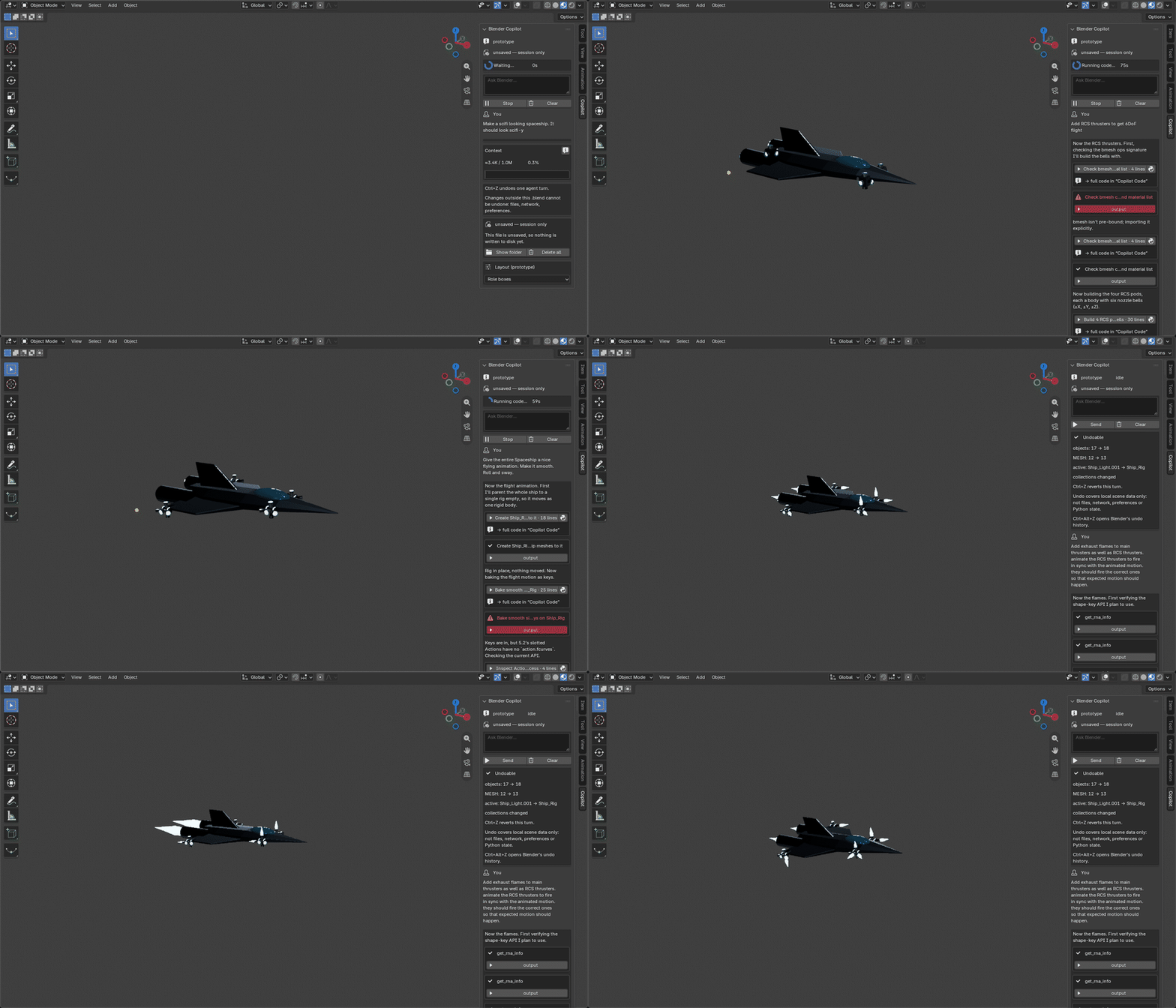
Five prompts, one spaceship — recorded from a real Blender 5.2.2 session against a real model. The panel, the loop, the sandbox that runs the model's code, the transcript rows and the undo receipt are the shipped add-on; the code is the model's. The GIF is the build, cut to 18 s; the flight is played at the end of the video below, because a GIF cannot hold motion and an animation that is never played looks exactly like no animation at all.
Why it is different, in three lines
- 🧬 The agent runs inside Blender, not beside it. Same process, same
bpy.context, same selection, same mode, same undo stack. Nothing needs mirroring because nothing is on the other side. - ↩️ One turn = one undo step.
Ctrl+Ztakes back every call the turn made — and the receipt beside the transcript states what that step does not cover. Measured both ways, including the case where pushing early makes undo reach too far. - 🔬 The results that lost are published. A capability guard that a 77-attempt probe showed does not contain was therefore not built. Most numbers below are the numbers that killed a design.
Star it if you want to see where this goes — and read what it does not do before you point it at a real file.
Five sentences, one spaceship
Sent one after another, as a conversation. Each prompt is a step, not a specification — the third only means anything against the object the second one built.
| # | Prompt (verbatim) | What came back |
|---|---|---|
| 1 | Make a scifi looking spaceship. It should look scifi-y | A faceted stealth hull, swept wings and an integrated tail fin, nacelles with glow discs, a canopy, four materials, bevel modifiers — and its own hero camera, three lights and dark world. |
| 2 | Add RCS thrusters to get 6DoF flight | Four RCS pods carrying 24 nozzle bells, given their own materials, then a read-back of every nozzle's exhaust direction. |
| 3 | Make the RCS thrusters match the scifi look. And also position them properly. | It rebuilt the pods three times and ray-cast every nozzle to prove the exhaust path was clear — diagnosing a self-hit on the aft bells, canting the nozzles 35° outboard, moving the aft cassettes out to the wingtips, then re-verifying all 20. |
| 4 | Give the entire Spaceship a nice flying animation. Make it smooth. Roll and sway. | A Ship_Rig empty with all 12 meshes parented to it, baked sinusoidal roll and sway, then "compare evaluated curve values against the exact sine per channel" — plus pre-roll and post-roll keys to fix the tangent at the loop seam. |
| 5 | Add exhaust flames to main thrusters as well as RCS thrusters. animate the RCS thrusters to fire in sync with the animated motion. they should fire the correct ones so that expected motion should happen. | 22 plumes as a single mesh driven by per-nozzle shape keys, flame intensity baked to the ship's own accelerations, then the firing signs rechecked against a volume-based centre of mass. |
The video, in one file: the build at a readable pace, then the animation played at its own frame rate — every frame the model keyframed, at 24 fps, at the end.
https://github.com/user-attachments/assets/517c3c50-036b-459a-ae45-2f910dcc7654
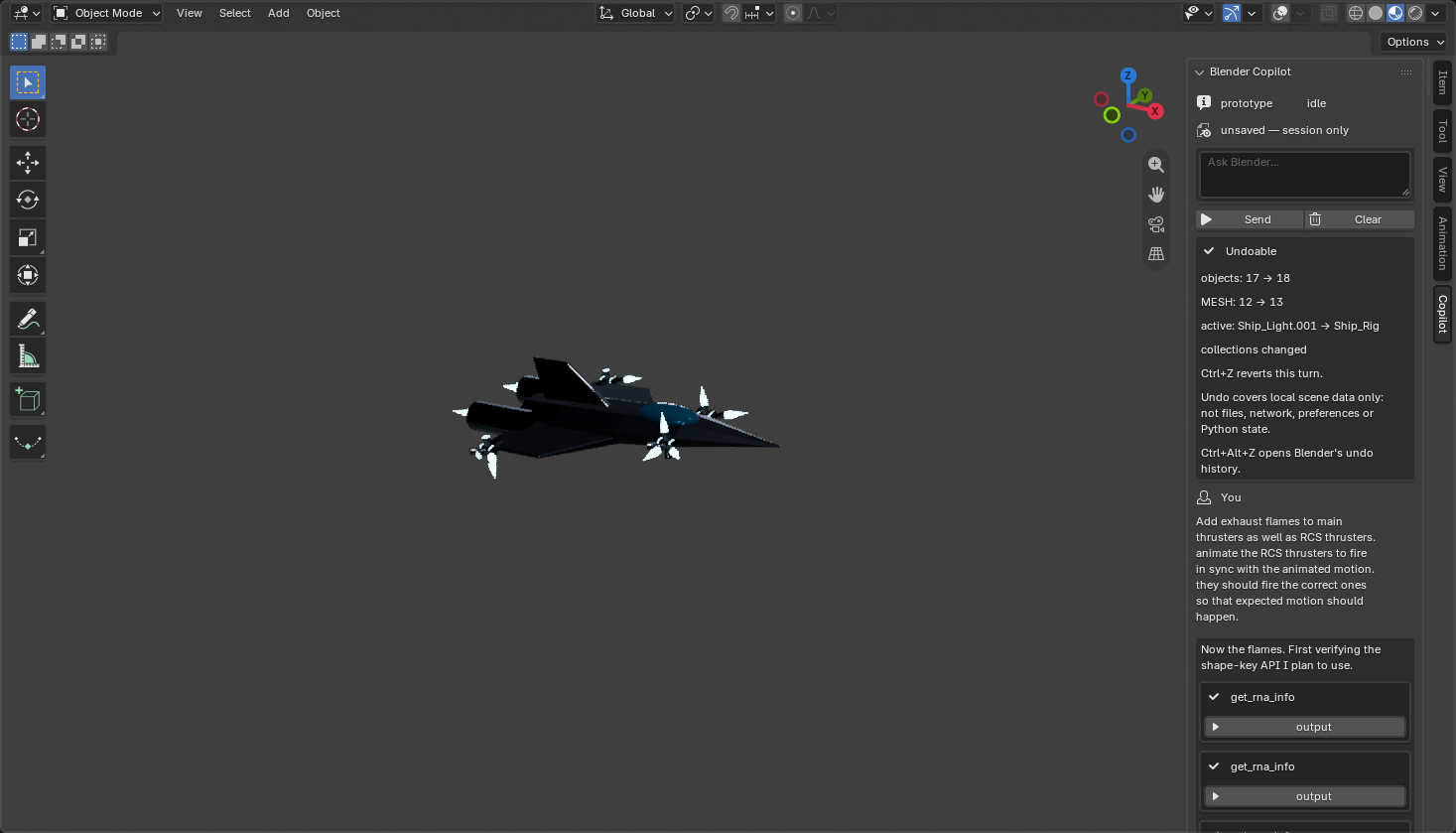
The last frame at full size — a GIF is too small to see the detail and a video is awkward to stop on the frame you want.

The flight as stills, for anyone who looks away during a loop.
| Measured, from that run | |
|---|---|
| Wall clock, all five turns | 917 s (15 min) |
| Model calls | 52, of which 4 were read-only get_rna_info lookups before it touched anything |
| Provider usage | 109,016 prompt tokens — 106,880 of them cached — 1,236 completion, 739 of those reasoning |
| The last turn's receipt | objects: 17 → 18, MESH: 12 → 13 — the flame rig, added as one step |
What the harness stages, and what it does not
Stated plainly, because a recording of an agent should say where the agent stops:
- It empties Blender's default file first (a Cube, a Camera and a Light — the cube sits exactly where a spaceship gets built), opens the sidebar, and re-frames the camera as geometry appears. The model's own "switch 3D viewports to Rendered shading" is what gives the picture its dark backdrop; the world and the lights are the model's, not the harness's.
- It steps the timeline to photograph the animation, one frame per tick, and the composer plays those frames back at the scene's rate. That is the harness pressing play, and nothing else.
- It writes no scene code. In this mode
tools/demo_capture.pycontributes nobpyat all — five sentences go in and the geometry comes back.
The playback rate is not a guess. The capture reads the scene's frame rate and this take
logged scene fps: 24, which is the number the composer used to time the flight — so the
rate the animation was authored at is the rate you see.
The previous take could not say that: it predates the capture logging the frame rate, so its flight was timed off Blender's default 24 fps on faith. Same number, but one was measured and one was assumed.
The idea
Every Blender AI tool has to answer one question: how does the model's code reach your scene? Most answer it with a bridge — a socket, a file mailbox, a Node sidecar, a second process holding a copy of the scene that has to be kept in sync.
This one answers it with exec. The loop runs in Blender's Python process, so
bpy.context is live and correct by construction: the same objects, the same
selection, the same mode, the same undo stack. Nothing needs mirroring because nothing
is on the other side.
That choice has consequences, and the interesting part of this project is that most of them were measured rather than assumed — see what is measured. Some are uncomfortable, and they are written down anyway.
Where this stands. A working vertical slice inside a real Blender 5.2.2: the panel,
the loop, the three tools, per-turn undo, streaming, the context budget and per-.blend
history all run, and every picture here came out of an actual GUI session. It is not
published to the extensions platform yet. There is no LICENSE file in this
repository, so no terms have actually been chosen: the manifest's license key is a
value the extension platform requires to be present (removing it fails validation with
missing "license"), not a grant. Treat reuse as unlicensed until a real one lands.
What is missing is listed under
what it does not do rather than left to be found.
What it does
| Panel | The 3D Viewport sidebar, N → Copilot. Labelled user turns, one bordered box per assistant turn, tool rows with output behind an expander, errors as first-class blocks, and a busy indicator that only redraws while a turn is live. |
| Agent loop | Up to 8 rounds / 24 tool calls per turn (both are levers now), with a repeat-signature stop and a consecutive-failure stop. One step per timer tick — nothing can block the UI thread. |
| Tools | Three, deliberately: run_blender_python (fresh namespace per call, a required purpose, and the full traceback on failure), get_scene_info (counts and a bounded list — never a scene dump), get_rna_info (exact-name lookup against the live build, because a hand-maintained API list rots). |
| Undo | One step per turn, pushed at the end in a finally, labelled in Undo History. The receipt beside the transcript is a pre/post diff of the scene summary. |
| Context | A request-time projection of the conversation, measured in UTF-8 bytes against a 48,000-byte budget and never written back to the store. The live scene summary rides last as a second system message, so the base prompt keeps index 0 and the provider's cache prefix survives — 98% of those 109,016 prompt tokens were cache hits. |
| History | JSON outside the .blend, scoped per file path with an alias on Save-As. 200 messages / 1 MiB, pruned by whole turn. |
| Streaming and Stop | SSE from a subprocess; Stop replaces Send in the same slot, and the panel states exactly what Stop can and cannot interrupt. |
The receipt, and the one Ctrl+Z
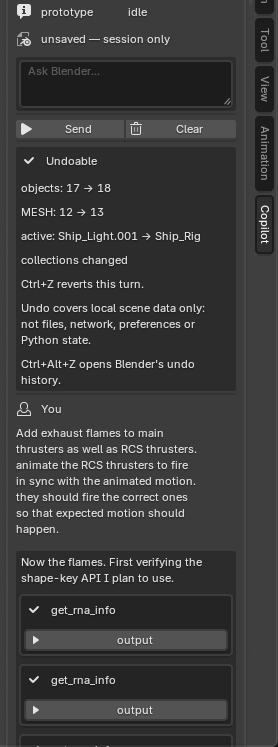
A turn that changed the scene leaves one step in Undo History, named after the prompt.
One Ctrl+Z takes the whole turn back — every call in it, not the last one. The receipt
says what the step covers and, in the same box, what it does not: local scene data
only, not files, network, preferences or Python state. That sentence is not decoration;
it is the boundary the probes measured.
How it works
flowchart LR
    subgraph BP["Blender process — main thread"]
        direction TB
        UI["Copilot panel<br/>3D Viewport sidebar"]
        TICK["stream._tick()<br/>one step per timer tick"]
        SBX["sandbox<br/>fresh namespace + bpy prelude"]
        UI -->|Send| TICK
        TICK -->|at most one call| SBX
        SBX --> SCENE[("your live scene")]
        TICK -->|"one push, at the end, in a finally"| UNDO[("undo stack")]
    end
    TICK <-->|"newline-delimited JSON<br/>over stdin / stdout"| W["_worker.py<br/>Blender's own python3.13"]
    W <-->|HTTPS + SSE| API["OpenAI-compatible API<br/>DeepSeek"]
Three decisions are load-bearing, and each was argued rather than assumed:
- HTTP runs in a subprocess, not a thread. Blender's own docs name the long-lived thread plus repeating timer as unsupported, and every shipped Blender download does HTTP in a process. Launch-to-ready measured at 0.021 s, with IPC two orders of magnitude below one timer tick — the safe option was also the cheap one.
- A tick does exactly one thing — drain the reply, or execute one tool call, or
finalize. Not tidiness: the tick that drains a reply carrying
tool_callsis the tick that queues the rows, so executing in the same callback would run the code before the panel had ever drawn itsrunning…row. - The push goes at the end. Measured both ways — see below.
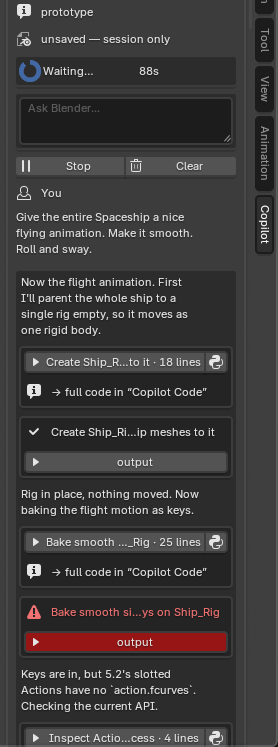
Mid-turn: the indicator is running, reasoning is still arriving, and the tool row
names the call. Code never clutters the transcript — the panel shows an identity row and
mirrors the full text to an addon-owned Copilot Code datablock.
Run it
Blender's Python ships requests and certifi, so there is nothing to pip install.
Target is a real Blender 5.2.x; blender_version_min is pinned to 5.2.0.
Fast loop — symlink the package
EXT="$HOME/Library/Application Support/Blender/5.2/extensions/user_default"
mkdir -p "$EXT"
ln -sfn "$PWD/blender_copilot" "$EXT/blender_copilot"
Restart Blender, then enable Blender Copilot in Preferences → Add-ons. If
user_default is missing from Preferences → Get Extensions → Repositories, add a
local repository first.
Real loop — build and install a package
mkdir -p dist     # the builder does not create this itself
/Applications/Blender.app/Contents/MacOS/Blender -c extension build \
    --source-dir ./blender_copilot --output-dir ./dist

/Applications/Blender.app/Contents/MacOS/Blender -c extension install-file \
    -r user_default -e ./dist/blender_copilot-0.0.1.zip
-e enables it on install. Add validate before build to check the manifest.
Then
Open the 3D Viewport, press N, pick the Copilot tab, and type. Two things worth
knowing first:
- The API key goes in the add-on preferences (masked on screen, plaintext on disk —
see what it does not do), or in
DEEPSEEK_API_KEYandDEEPSEEK_API_URLin the environment that launches Blender. Blender does not read a.envfor you. - The model name is empty out of the box, and falls back to
DEEPSEEK_MODEL, then todeepseek-flash. Take a name from the provider's own docs: the legacydeepseek-v4-flashis still accepted and is silently remapped to a retired model, which is a concrete reason never to hard-code a string from memory.
What is measured, not claimed
This is the part of the project worth your time. Every line came from a probe in
tools/, and the numbers are the numbers the probe printed — including the
ones that killed a design.
| Claim | How it was settled |
|---|---|
| Undo pushes at the end | One push covers a whole multi-operation turn in a single Ctrl+Z. Pushing before the change reverts further back than the change it was protecting — so push-at-end survived the test designed to break it. |
| An unpushed change is worse than unprotected | Ctrl+Z reaches past it and deletes the object. |
| Never push in edit mode | A push there returns ok, records nothing usable, and the following undo deletes the object being edited. So the panel warns in edit mode rather than blocking Send, and refuses the push. |
| Operators called from Python never push undo | Measured — and the reason "just press Ctrl+Z" was never a real gate for arbitrary code. |
| A blocking native call cannot be interrupted | A 1 s alarm still let a numpy call run 5.34 s, so the UI says so instead of promising otherwise. Pure-Python loops can be stopped: SIGALRM does it at 1.04× overhead, where a sys.monitoring LINE hook cannot stop while True: pass at all. |
| The capability guard is hygiene, not containment | 77 attempts: 49 denied, 2 escaped, 11 blocked by absence, 15 allowed. Both escapes go through introspection rather than any named path — two lines with no imports get out. |
| The manifest's network permission is a declaration, not a sandbox | Python sockets work from Blender with global online access off and --offline-mode set. |
| A panel cannot scroll and has no rich text | UILayout.textbox() is the only multi-line input in 5.2.2. Hence newest-turn-first, a bounded transcript, and a companion Text datablock for code and full history. |
| The provider's wire contract | A tool_call with no matching tool result is rejected, HTTP 400 — so the loop's synthetic cancelled results are load-bearing. function.arguments arrives as a JSON string, not an object. A trailing system message is accepted, which is what keeps the cache prefix alive. |
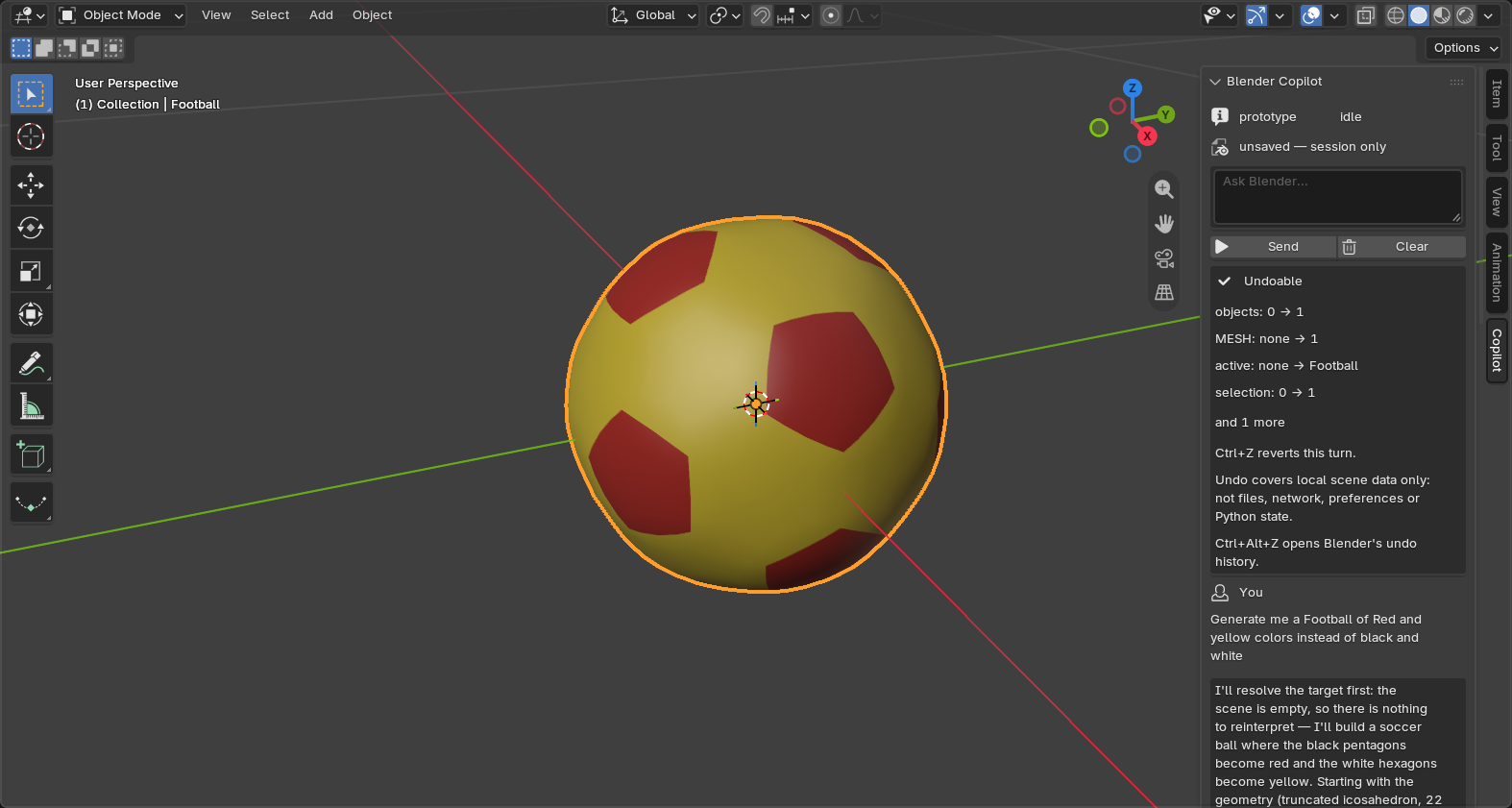
A different task, same panel, before this recording harness existed: one prompt,
three tool calls, a real receipt (objects: 0 → 1), and the provider's own token
counts. Kept here so the five-turn recording is not the only evidence.
What it does not do
Published because a project that only lists its wins is not telling you anything. These are consequences of ratified decisions, not oversights:
- Model-authored code auto-runs, unscoped. No approval gate, no capability
restriction. A gate was proposed and rejected — on the strength of the guard's
own probe, which showed it does not contain. A gate whose evidence says it does not
gate buys false confidence, so the mechanism was not built. The starting point stands:
the model's code runs in your Blender process, and
bpy.app.handlersorbpy.app.timerscan register work that outlives the turn. - The API key is plaintext in
userpref.blend, masked on screen only.SKIP_SAVEwas verified not to keep it out of the file. Use the environment variable if you would rather it never land on disk. - Undo covers local
bpy.dataonly — not files, not subprocesses, not network, not preferences, not Python state. - Stop cannot reach a call that has not returned. It kills the worker and the next
turn, not the
numpycall already inside the interpreter. blender -bis out of scope by construction. Timers and modal operators do not fire headless, and the loop is built on timers.- Turns are slow when the model thinks. 15 minutes for the five above; the model
spent most of it working, and thinking is on by default at the provider and billed as
completion tokens. The byte budget and
Stopexist for exactly that.
Where the plan lives
The work is charted as a wayfinder map: 18 tickets, all resolved, in
.scratch/blender-copilot/ — each decision in exactly
one ticket, with the alternatives and their costs, plus a
ratification record of the one point where a human ruled
(15 accepted, 1 rejected — the approval gate).
Read the map if you want to disagree with a decision: it states what was rejected and why, which is the part that is usually missing.
Project layout
blender_copilot/            the extension — 16 modules, ~9,600 lines
  panel.py                  the panel, its operators, its preferences
  conversation.py           transcript state, and the turn's state machine
  execution.py              the three tools: validation, caps, truncation
  transport.py  _worker.py  the subprocess, ndjson framing, SSE reassembly
  budget.py  context.py     what the next request costs, and the projection into it
  undo.py  undo_blender.py  the push discipline, and the receipt
  store.py  scope.py        history outside the .blend, scoped per file path
tests/                      4 suites, plain CPython, no Blender needed
tools/                      the probes, and the recording harness
docs/media/                 the pictures in this README
docs/ratification.md        the human's rulings
Verify it yourself
# four suites, plain CPython
for t in tests/test_*.py; do python3 "$t" || echo "FAILED $t"; done

# the panel's draw body, headless, with a stub UILayout
/Applications/Blender.app/Contents/MacOS/Blender --background --factory-startup \
    --python tools/panel_draw_smoke.py

# record the five turns yourself (spends a few cents), then compose the media
set -a; . ./.env; set +a
DEMO_LIVE=1 DEMO_UI_SCALE=1.0 python3 tools/bounded_run.py 3600 -- \
    /Applications/Blender.app/Contents/MacOS/Blender \
    --window-geometry 20 20 1790 960 --python tools/demo_capture.py
python3 tools/demo_media.py

# or rebuild the same pictures with no key and no network
python3 tools/bounded_run.py 240 -- \
    /Applications/Blender.app/Contents/MacOS/Blender \
    --window-geometry 20 20 1790 960 --python tools/demo_capture.py
Blender exits 0 even when a --python script raises, so every Blender-side check
prints a verdict token (SMOKE OK, DEMO OK, MEDIA OK) and the caller greps for the
token. Gate on the token, never on the exit status — that is measured, not assumed, and
it is the rule that keeps the probes honest.
Built by XEonAX · bl_ext.user_default.blender_copilot · 0.0.1
No licence chosen yet — nothing here is licensed for reuse until one is.
⭐ Star it if it saves you time, and argue with a decision if you think it is wrong — the map states what was rejected and why, which is the part usually missing.
#blender #bpy #aiagents #llm #deepseek #python #3d
Contributors

51 commits
Similar repos


Languages
Python
98.8%
Shell
1.2%
A Copilot-style AI chat panel that lives inside Blender. The agent loop runs in Blender's own Python process, executes the model's code against your live scene, and wraps every turn in one Ctrl+Z.
Python
0
51 commits
updated Sep 26, 2026
See what people are saying
README
Blender Copilot
Five sentences in. A spaceship out.
A Copilot-style chat panel that lives inside Blender. It runs an agent loop in
Blender's own Python process, executes the model's bpy against your live scene, and
wraps the whole turn in one Ctrl+Z.
No bridge. No sidecar. No second copy of your scene to keep in sync — the loop is
Blender's Python, so bpy.context is live and correct by construction.
Five prompts, one spaceship — recorded from a real Blender 5.2.2 session against a real model. The panel, the loop, the sandbox that runs the model's code, the transcript rows and the undo receipt are the shipped add-on; the code is the model's. The GIF is the build, cut to 18 s; the flight is played at the end of the video below, because a GIF cannot hold motion and an animation that is never played looks exactly like no animation at all.
Why it is different, in three lines
- 🧬 The agent runs inside Blender, not beside it. Same process, same
bpy.context, same selection, same mode, same undo stack. Nothing needs mirroring because nothing is on the other side. - ↩️ One turn = one undo step.
Ctrl+Ztakes back every call the turn made — and the receipt beside the transcript states what that step does not cover. Measured both ways, including the case where pushing early makes undo reach too far. - 🔬 The results that lost are published. A capability guard that a 77-attempt probe showed does not contain was therefore not built. Most numbers below are the numbers that killed a design.
Star it if you want to see where this goes — and read what it does not do before you point it at a real file.
Five sentences, one spaceship
Sent one after another, as a conversation. Each prompt is a step, not a specification — the third only means anything against the object the second one built.
| # | Prompt (verbatim) | What came back |
|---|---|---|
| 1 | Make a scifi looking spaceship. It should look scifi-y | A faceted stealth hull, swept wings and an integrated tail fin, nacelles with glow discs, a canopy, four materials, bevel modifiers — and its own hero camera, three lights and dark world. |
| 2 | Add RCS thrusters to get 6DoF flight | Four RCS pods carrying 24 nozzle bells, given their own materials, then a read-back of every nozzle's exhaust direction. |
| 3 | Make the RCS thrusters match the scifi look. And also position them properly. | It rebuilt the pods three times and ray-cast every nozzle to prove the exhaust path was clear — diagnosing a self-hit on the aft bells, canting the nozzles 35° outboard, moving the aft cassettes out to the wingtips, then re-verifying all 20. |
| 4 | Give the entire Spaceship a nice flying animation. Make it smooth. Roll and sway. | A Ship_Rig empty with all 12 meshes parented to it, baked sinusoidal roll and sway, then "compare evaluated curve values against the exact sine per channel" — plus pre-roll and post-roll keys to fix the tangent at the loop seam. |
| 5 | Add exhaust flames to main thrusters as well as RCS thrusters. animate the RCS thrusters to fire in sync with the animated motion. they should fire the correct ones so that expected motion should happen. | 22 plumes as a single mesh driven by per-nozzle shape keys, flame intensity baked to the ship's own accelerations, then the firing signs rechecked against a volume-based centre of mass. |
The video, in one file: the build at a readable pace, then the animation played at its own frame rate — every frame the model keyframed, at 24 fps, at the end.
https://github.com/user-attachments/assets/517c3c50-036b-459a-ae45-2f910dcc7654
The last frame at full size — a GIF is too small to see the detail and a video is awkward to stop on the frame you want.
The flight as stills, for anyone who looks away during a loop.
| Measured, from that run | |
|---|---|
| Wall clock, all five turns | 917 s (15 min) |
| Model calls | 52, of which 4 were read-only get_rna_info lookups before it touched anything |
| Provider usage | 109,016 prompt tokens — 106,880 of them cached — 1,236 completion, 739 of those reasoning |
| The last turn's receipt | objects: 17 → 18, MESH: 12 → 13 — the flame rig, added as one step |
What the harness stages, and what it does not
Stated plainly, because a recording of an agent should say where the agent stops:
- It empties Blender's default file first (a Cube, a Camera and a Light — the cube sits exactly where a spaceship gets built), opens the sidebar, and re-frames the camera as geometry appears. The model's own "switch 3D viewports to Rendered shading" is what gives the picture its dark backdrop; the world and the lights are the model's, not the harness's.
- It steps the timeline to photograph the animation, one frame per tick, and the composer plays those frames back at the scene's rate. That is the harness pressing play, and nothing else.
- It writes no scene code. In this mode
tools/demo_capture.pycontributes nobpyat all — five sentences go in and the geometry comes back.
The playback rate is not a guess. The capture reads the scene's frame rate and this take
logged scene fps: 24, which is the number the composer used to time the flight — so the
rate the animation was authored at is the rate you see.
The previous take could not say that: it predates the capture logging the frame rate, so its flight was timed off Blender's default 24 fps on faith. Same number, but one was measured and one was assumed.
The idea
Every Blender AI tool has to answer one question: how does the model's code reach your scene? Most answer it with a bridge — a socket, a file mailbox, a Node sidecar, a second process holding a copy of the scene that has to be kept in sync.
This one answers it with exec. The loop runs in Blender's Python process, so
bpy.context is live and correct by construction: the same objects, the same
selection, the same mode, the same undo stack. Nothing needs mirroring because nothing
is on the other side.
That choice has consequences, and the interesting part of this project is that most of them were measured rather than assumed — see what is measured. Some are uncomfortable, and they are written down anyway.
Where this stands. A working vertical slice inside a real Blender 5.2.2: the panel,
the loop, the three tools, per-turn undo, streaming, the context budget and per-.blend
history all run, and every picture here came out of an actual GUI session. It is not
published to the extensions platform yet. There is no LICENSE file in this
repository, so no terms have actually been chosen: the manifest's license key is a
value the extension platform requires to be present (removing it fails validation with
missing "license"), not a grant. Treat reuse as unlicensed until a real one lands.
What is missing is listed under
what it does not do rather than left to be found.
What it does
| Panel | The 3D Viewport sidebar, N → Copilot. Labelled user turns, one bordered box per assistant turn, tool rows with output behind an expander, errors as first-class blocks, and a busy indicator that only redraws while a turn is live. |
| Agent loop | Up to 8 rounds / 24 tool calls per turn (both are levers now), with a repeat-signature stop and a consecutive-failure stop. One step per timer tick — nothing can block the UI thread. |
| Tools | Three, deliberately: run_blender_python (fresh namespace per call, a required purpose, and the full traceback on failure), get_scene_info (counts and a bounded list — never a scene dump), get_rna_info (exact-name lookup against the live build, because a hand-maintained API list rots). |
| Undo | One step per turn, pushed at the end in a finally, labelled in Undo History. The receipt beside the transcript is a pre/post diff of the scene summary. |
| Context | A request-time projection of the conversation, measured in UTF-8 bytes against a 48,000-byte budget and never written back to the store. The live scene summary rides last as a second system message, so the base prompt keeps index 0 and the provider's cache prefix survives — 98% of those 109,016 prompt tokens were cache hits. |
| History | JSON outside the .blend, scoped per file path with an alias on Save-As. 200 messages / 1 MiB, pruned by whole turn. |
| Streaming and Stop | SSE from a subprocess; Stop replaces Send in the same slot, and the panel states exactly what Stop can and cannot interrupt. |
The receipt, and the one Ctrl+Z
A turn that changed the scene leaves one step in Undo History, named after the prompt.
One Ctrl+Z takes the whole turn back — every call in it, not the last one. The receipt
says what the step covers and, in the same box, what it does not: local scene data
only, not files, network, preferences or Python state. That sentence is not decoration;
it is the boundary the probes measured.
How it works
flowchart LR
    subgraph BP["Blender process — main thread"]
        direction TB
        UI["Copilot panel<br/>3D Viewport sidebar"]
        TICK["stream._tick()<br/>one step per timer tick"]
        SBX["sandbox<br/>fresh namespace + bpy prelude"]
        UI -->|Send| TICK
        TICK -->|at most one call| SBX
        SBX --> SCENE[("your live scene")]
        TICK -->|"one push, at the end, in a finally"| UNDO[("undo stack")]
    end
    TICK <-->|"newline-delimited JSON<br/>over stdin / stdout"| W["_worker.py<br/>Blender's own python3.13"]
    W <-->|HTTPS + SSE| API["OpenAI-compatible API<br/>DeepSeek"]
Three decisions are load-bearing, and each was argued rather than assumed:
- HTTP runs in a subprocess, not a thread. Blender's own docs name the long-lived thread plus repeating timer as unsupported, and every shipped Blender download does HTTP in a process. Launch-to-ready measured at 0.021 s, with IPC two orders of magnitude below one timer tick — the safe option was also the cheap one.
- A tick does exactly one thing — drain the reply, or execute one tool call, or
finalize. Not tidiness: the tick that drains a reply carrying
tool_callsis the tick that queues the rows, so executing in the same callback would run the code before the panel had ever drawn itsrunning…row. - The push goes at the end. Measured both ways — see below.
Mid-turn: the indicator is running, reasoning is still arriving, and the tool row
names the call. Code never clutters the transcript — the panel shows an identity row and
mirrors the full text to an addon-owned Copilot Code datablock.
Run it
Blender's Python ships requests and certifi, so there is nothing to pip install.
Target is a real Blender 5.2.x; blender_version_min is pinned to 5.2.0.
Fast loop — symlink the package
EXT="$HOME/Library/Application Support/Blender/5.2/extensions/user_default"
mkdir -p "$EXT"
ln -sfn "$PWD/blender_copilot" "$EXT/blender_copilot"
Restart Blender, then enable Blender Copilot in Preferences → Add-ons. If
user_default is missing from Preferences → Get Extensions → Repositories, add a
local repository first.
Real loop — build and install a package
mkdir -p dist     # the builder does not create this itself
/Applications/Blender.app/Contents/MacOS/Blender -c extension build \
    --source-dir ./blender_copilot --output-dir ./dist

/Applications/Blender.app/Contents/MacOS/Blender -c extension install-file \
    -r user_default -e ./dist/blender_copilot-0.0.1.zip
-e enables it on install. Add validate before build to check the manifest.
Then
Open the 3D Viewport, press N, pick the Copilot tab, and type. Two things worth
knowing first:
- The API key goes in the add-on preferences (masked on screen, plaintext on disk —
see what it does not do), or in
DEEPSEEK_API_KEYandDEEPSEEK_API_URLin the environment that launches Blender. Blender does not read a.envfor you. - The model name is empty out of the box, and falls back to
DEEPSEEK_MODEL, then todeepseek-flash. Take a name from the provider's own docs: the legacydeepseek-v4-flashis still accepted and is silently remapped to a retired model, which is a concrete reason never to hard-code a string from memory.
What is measured, not claimed
This is the part of the project worth your time. Every line came from a probe in
tools/, and the numbers are the numbers the probe printed — including the
ones that killed a design.
| Claim | How it was settled |
|---|---|
| Undo pushes at the end | One push covers a whole multi-operation turn in a single Ctrl+Z. Pushing before the change reverts further back than the change it was protecting — so push-at-end survived the test designed to break it. |
| An unpushed change is worse than unprotected | Ctrl+Z reaches past it and deletes the object. |
| Never push in edit mode | A push there returns ok, records nothing usable, and the following undo deletes the object being edited. So the panel warns in edit mode rather than blocking Send, and refuses the push. |
| Operators called from Python never push undo | Measured — and the reason "just press Ctrl+Z" was never a real gate for arbitrary code. |
| A blocking native call cannot be interrupted | A 1 s alarm still let a numpy call run 5.34 s, so the UI says so instead of promising otherwise. Pure-Python loops can be stopped: SIGALRM does it at 1.04× overhead, where a sys.monitoring LINE hook cannot stop while True: pass at all. |
| The capability guard is hygiene, not containment | 77 attempts: 49 denied, 2 escaped, 11 blocked by absence, 15 allowed. Both escapes go through introspection rather than any named path — two lines with no imports get out. |
| The manifest's network permission is a declaration, not a sandbox | Python sockets work from Blender with global online access off and --offline-mode set. |
| A panel cannot scroll and has no rich text | UILayout.textbox() is the only multi-line input in 5.2.2. Hence newest-turn-first, a bounded transcript, and a companion Text datablock for code and full history. |
| The provider's wire contract | A tool_call with no matching tool result is rejected, HTTP 400 — so the loop's synthetic cancelled results are load-bearing. function.arguments arrives as a JSON string, not an object. A trailing system message is accepted, which is what keeps the cache prefix alive. |
A different task, same panel, before this recording harness existed: one prompt,
three tool calls, a real receipt (objects: 0 → 1), and the provider's own token
counts. Kept here so the five-turn recording is not the only evidence.
What it does not do
Published because a project that only lists its wins is not telling you anything. These are consequences of ratified decisions, not oversights:
- Model-authored code auto-runs, unscoped. No approval gate, no capability
restriction. A gate was proposed and rejected — on the strength of the guard's
own probe, which showed it does not contain. A gate whose evidence says it does not
gate buys false confidence, so the mechanism was not built. The starting point stands:
the model's code runs in your Blender process, and
bpy.app.handlersorbpy.app.timerscan register work that outlives the turn. - The API key is plaintext in
userpref.blend, masked on screen only.SKIP_SAVEwas verified not to keep it out of the file. Use the environment variable if you would rather it never land on disk. - Undo covers local
bpy.dataonly — not files, not subprocesses, not network, not preferences, not Python state. - Stop cannot reach a call that has not returned. It kills the worker and the next
turn, not the
numpycall already inside the interpreter. blender -bis out of scope by construction. Timers and modal operators do not fire headless, and the loop is built on timers.- Turns are slow when the model thinks. 15 minutes for the five above; the model
spent most of it working, and thinking is on by default at the provider and billed as
completion tokens. The byte budget and
Stopexist for exactly that.
Where the plan lives
The work is charted as a wayfinder map: 18 tickets, all resolved, in
.scratch/blender-copilot/ — each decision in exactly
one ticket, with the alternatives and their costs, plus a
ratification record of the one point where a human ruled
(15 accepted, 1 rejected — the approval gate).
Read the map if you want to disagree with a decision: it states what was rejected and why, which is the part that is usually missing.
Project layout
blender_copilot/            the extension — 16 modules, ~9,600 lines
  panel.py                  the panel, its operators, its preferences
  conversation.py           transcript state, and the turn's state machine
  execution.py              the three tools: validation, caps, truncation
  transport.py  _worker.py  the subprocess, ndjson framing, SSE reassembly
  budget.py  context.py     what the next request costs, and the projection into it
  undo.py  undo_blender.py  the push discipline, and the receipt
  store.py  scope.py        history outside the .blend, scoped per file path
tests/                      4 suites, plain CPython, no Blender needed
tools/                      the probes, and the recording harness
docs/media/                 the pictures in this README
docs/ratification.md        the human's rulings
Verify it yourself
# four suites, plain CPython
for t in tests/test_*.py; do python3 "$t" || echo "FAILED $t"; done

# the panel's draw body, headless, with a stub UILayout
/Applications/Blender.app/Contents/MacOS/Blender --background --factory-startup \
    --python tools/panel_draw_smoke.py

# record the five turns yourself (spends a few cents), then compose the media
set -a; . ./.env; set +a
DEMO_LIVE=1 DEMO_UI_SCALE=1.0 python3 tools/bounded_run.py 3600 -- \
    /Applications/Blender.app/Contents/MacOS/Blender \
    --window-geometry 20 20 1790 960 --python tools/demo_capture.py
python3 tools/demo_media.py

# or rebuild the same pictures with no key and no network
python3 tools/bounded_run.py 240 -- \
    /Applications/Blender.app/Contents/MacOS/Blender \
    --window-geometry 20 20 1790 960 --python tools/demo_capture.py
Blender exits 0 even when a --python script raises, so every Blender-side check
prints a verdict token (SMOKE OK, DEMO OK, MEDIA OK) and the caller greps for the
token. Gate on the token, never on the exit status — that is measured, not assumed, and
it is the rule that keeps the probes honest.
Built by XEonAX · bl_ext.user_default.blender_copilot · 0.0.1
No licence chosen yet — nothing here is licensed for reuse until one is.
⭐ Star it if it saves you time, and argue with a decision if you think it is wrong — the map states what was rejected and why, which is the part usually missing.
#blender #bpy #aiagents #llm #deepseek #python #3d
Similar repos
Contributors
51 commits
Languages
Python
98.8%
Shell
1.2%