Official repository for ICM-Bench: identity-centric reasoning over long video memories. Benchmark, video generation, and evaluation code.
See the code



This is the official repository for ICM-Bench, including the video generation pipeline, M3-Agent, Vgent, and HippoRAG2 evaluation integrations, and open-ended answer judging.
Shidu Ren, Yunze Liu, Xing Liu, Chi-Hao Wu, Enmin Zhou, Junxiao Shen
ICM-Bench evaluates whether multimodal agents can remember recurring people and reason about their relationships over time. It contains 839 synthetic clips spanning 141 minutes and 1,217 open-ended questions about six recurring adults in a one-year life album.
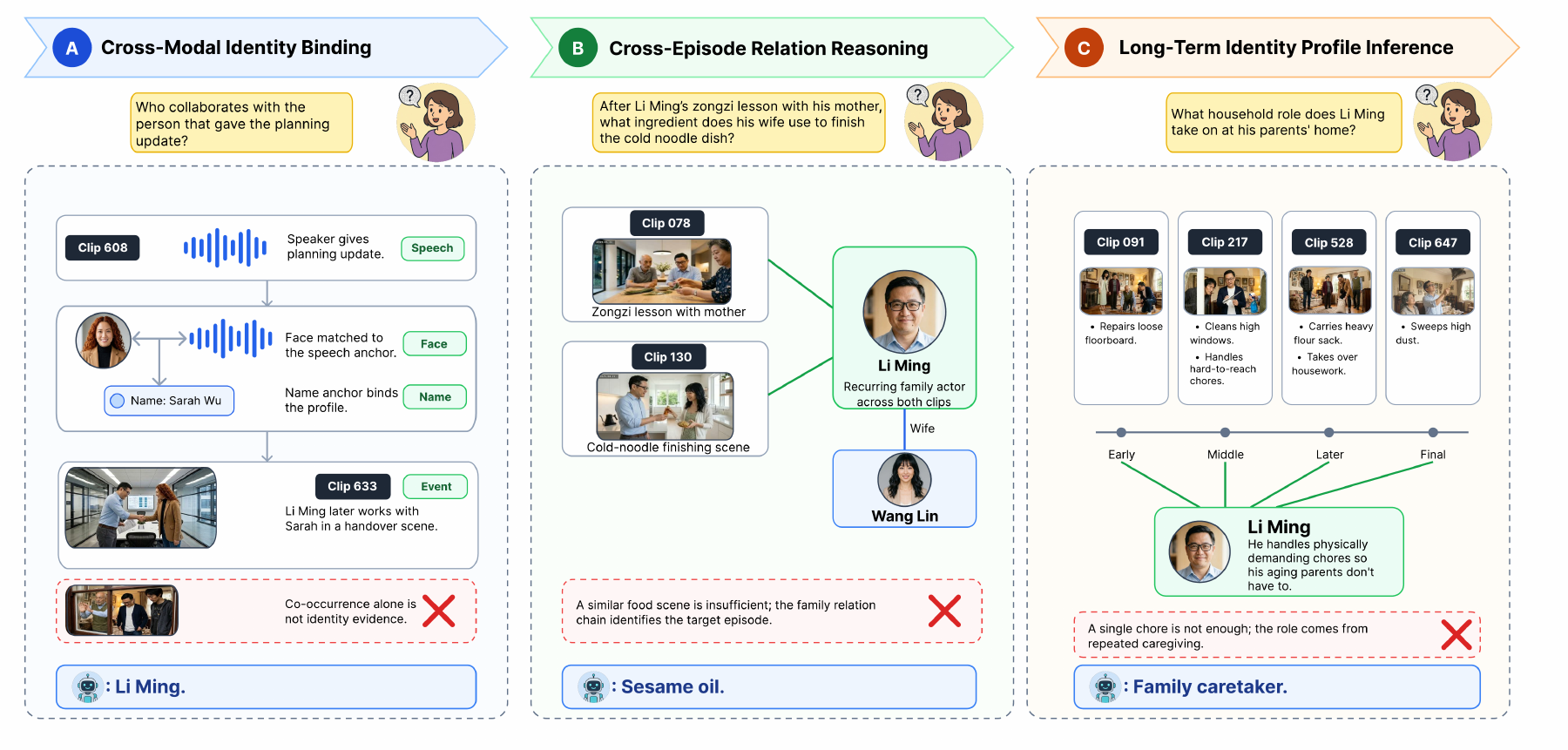
Three memory challenges: linking faces, voices, and names; reasoning across episodes; and inferring a person's recurring roles, habits, and relationships. The panels illustrate the tasks rather than reproduce released questions.
| Question family | Questions | Evaluation focus |
|---|---|---|
| Identity Recall | 400 | Recover an event associated with a person |
| Cross-Episode Identity Retrieval | 500 | Connect person-linked evidence across episodes |
| Long-Term Identity Profile Inference | 317 | Infer recurring behavior and relationships over the timeline |
Clone the repository with its Vgent dependency:
git clone --recurse-submodules https://github.com/Shidu-Ren/ICM-Bench.git
cd ICM-Bench
cp .env.example .env
Set your local data, output, and model directories in .env, together with the API keys needed for your chosen component. Load these settings in each shell:
set -a
source .env
set +a
Generation and the evaluated frameworks use different dependencies. Create a separate environment for each component and follow its setup instructions:
| Component | Setup and usage |
|---|---|
| Video generation | generation/README.md |
| M3-Agent | evaluation/m3_agent/README.md |
| Vgent | evaluation/vgent/README.md |
| HippoRAG2 | evaluation/hipporag2/README.md |
| Answer judging | evaluation/judging/README.md |
The API settings use GOOGLE_API_KEY, OPENAI_API_KEY, and, for compatible endpoints, OPENAI_BASE_URL. The direct caption-memory baseline implementation is not included in this release.
Download the benchmark from Hugging Face:
python -m pip install huggingface_hub
hf download ryanren0330/ICM-Bench \
  --repo-type dataset \
  --local-dir "$ICM_BENCH_DATA_ROOT"

tar -xf "$ICM_BENCH_DATA_ROOT/videos.tar" -C "$ICM_BENCH_DATA_ROOT"
The extracted dataset has the following layout:
ICM-Bench/
├── videos/                         # clip_000.mp4 ... clip_838.mp4
│   └── metadata.jsonl
├── annotations/
│   ├── qa_test.jsonl               # recommended QA file
│   ├── qa_test.json                # the same questions as a JSON array
│   ├── characters.json
│   ├── dataset_statistics.json
│   └── schema.json
└── resources/
    ├── asr_transcripts/            # 829 speakerless transcripts
    └── transcripts_with_speakers/ # 829 reference transcripts
Read the questions with:
import json
import os
from pathlib import Path

root = Path(os.environ["ICM_BENCH_DATA_ROOT"])
with (root / "annotations" / "qa_test.jsonl").open() as f:
    questions = [json.loads(line) for line in f if line.strip()]

print(len(questions))  # 1217
print(questions[0]["question"])
Recall and Retrieval questions use memory clips up to and including each item's before_clip; Profile questions use the full timeline. Video-based settings also receive clip_000, a calibration clip supplying a common face–voice reference.
Use resources/asr_transcripts/ for speakerless transcript inputs. Reference answers, target character IDs, evidence annotations, characters.json, and speaker-labeled transcripts are evaluator-side resources and should not be included in an answerer's input.
Each method directory contains its adapters and upstream implementation or dependency. Follow the evaluation guide for the command sequence from downloaded data to system answers. The shared judge accepts JSONL records containing id, question, answer (the reference), and response:
python -m pip install -r evaluation/judging/requirements.txt
python evaluation/judging/scripts/rejudge_openqa_m3agent_style.py \
  --input "$ICM_BENCH_OUTPUT_ROOT/SYSTEM/answers.jsonl" \
  --output "$ICM_BENCH_OUTPUT_ROOT/SYSTEM/answers.judged.jsonl" \
  --summary "$ICM_BENCH_OUTPUT_ROOT/SYSTEM/answers.judged.summary.json"
The judge compares semantic content rather than exact wording. See answer judging for the Gemini evaluator and the independent OpenAI-compatible judge.
The generation pipeline plans a theme, timeline, cast, and shots; creates character and scene references; renders videos; and produces recurring-character speech and subtitles. Presets are provided in generation/configs/video_series_presets/.
In a dedicated environment, inspect the pilot configuration locally:
cd generation
python -m pip install -r requirements.txt
python -m video_generator.pipeline \
  --config configs/video_config_pilot.yaml \
  --preflight-only
To generate the pilot, remove --preflight-only after configuring your Google API key. FFmpeg is required for video processing. The generation guide covers planning, rendering, voice processing, shot review, and export.
ICM-Bench/
├── assets/             # paper illustration for this README
├── configs/            # example local path configuration
├── generation/         # video pipeline, presets, and rendering utilities
└── evaluation/
    ├── m3_agent/       # M3-Agent implementation and ICM-Bench adapters
    ├── vgent/          # adapters and pinned upstream submodule
    ├── hipporag2/      # HippoRAG2 implementation and corpus/QA adapters
    └── judging/        # semantic-equivalence prompts and evaluators
ICM-Bench code is released under the MIT License, and the dataset under CC BY-NC-SA 4.0. Bundled research code retains its upstream licenses; see NOTICE and upstream sources.
If you use ICM-Bench in your research, please cite:
@article{ren2026icmbench,
  title={ICM-Bench: Person-Level Identity Reasoning in Multimodal Agents with Long-Term Memory},
  author={Ren, Shidu and Liu, Yunze and Liu, Xing and Wu, Chi-Hao and Zhou, Enmin and Shen, Junxiao},
  journal={arXiv preprint arXiv:2609.04438},
  year={2026},
  url={https://arxiv.org/abs/2609.04438}
}
Our evaluation integrations build on M3-Agent, Vgent, and HippoRAG2. We thank their authors for making these frameworks available.
Official repository for ICM-Bench: identity-centric reasoning over long video memories. Benchmark, video generation, and evaluation code.
See the code
This is the official repository for ICM-Bench, including the video generation pipeline, M3-Agent, Vgent, and HippoRAG2 evaluation integrations, and open-ended answer judging.
Shidu Ren, Yunze Liu, Xing Liu, Chi-Hao Wu, Enmin Zhou, Junxiao Shen
ICM-Bench evaluates whether multimodal agents can remember recurring people and reason about their relationships over time. It contains 839 synthetic clips spanning 141 minutes and 1,217 open-ended questions about six recurring adults in a one-year life album.
Three memory challenges: linking faces, voices, and names; reasoning across episodes; and inferring a person's recurring roles, habits, and relationships. The panels illustrate the tasks rather than reproduce released questions.
| Question family | Questions | Evaluation focus |
|---|---|---|
| Identity Recall | 400 | Recover an event associated with a person |
| Cross-Episode Identity Retrieval | 500 | Connect person-linked evidence across episodes |
| Long-Term Identity Profile Inference | 317 | Infer recurring behavior and relationships over the timeline |
Clone the repository with its Vgent dependency:
git clone --recurse-submodules https://github.com/Shidu-Ren/ICM-Bench.git
cd ICM-Bench
cp .env.example .env
Set your local data, output, and model directories in .env, together with the API keys needed for your chosen component. Load these settings in each shell:
set -a
source .env
set +a
Generation and the evaluated frameworks use different dependencies. Create a separate environment for each component and follow its setup instructions:
| Component | Setup and usage |
|---|---|
| Video generation | generation/README.md |
| M3-Agent | evaluation/m3_agent/README.md |
| Vgent | evaluation/vgent/README.md |
| HippoRAG2 | evaluation/hipporag2/README.md |
| Answer judging | evaluation/judging/README.md |
The API settings use GOOGLE_API_KEY, OPENAI_API_KEY, and, for compatible endpoints, OPENAI_BASE_URL. The direct caption-memory baseline implementation is not included in this release.
Download the benchmark from Hugging Face:
python -m pip install huggingface_hub
hf download ryanren0330/ICM-Bench \
  --repo-type dataset \
  --local-dir "$ICM_BENCH_DATA_ROOT"

tar -xf "$ICM_BENCH_DATA_ROOT/videos.tar" -C "$ICM_BENCH_DATA_ROOT"
The extracted dataset has the following layout:
ICM-Bench/
├── videos/                         # clip_000.mp4 ... clip_838.mp4
│   └── metadata.jsonl
├── annotations/
│   ├── qa_test.jsonl               # recommended QA file
│   ├── qa_test.json                # the same questions as a JSON array
│   ├── characters.json
│   ├── dataset_statistics.json
│   └── schema.json
└── resources/
    ├── asr_transcripts/            # 829 speakerless transcripts
    └── transcripts_with_speakers/ # 829 reference transcripts
Read the questions with:
import json
import os
from pathlib import Path

root = Path(os.environ["ICM_BENCH_DATA_ROOT"])
with (root / "annotations" / "qa_test.jsonl").open() as f:
    questions = [json.loads(line) for line in f if line.strip()]

print(len(questions))  # 1217
print(questions[0]["question"])
Recall and Retrieval questions use memory clips up to and including each item's before_clip; Profile questions use the full timeline. Video-based settings also receive clip_000, a calibration clip supplying a common face–voice reference.
Use resources/asr_transcripts/ for speakerless transcript inputs. Reference answers, target character IDs, evidence annotations, characters.json, and speaker-labeled transcripts are evaluator-side resources and should not be included in an answerer's input.
Each method directory contains its adapters and upstream implementation or dependency. Follow the evaluation guide for the command sequence from downloaded data to system answers. The shared judge accepts JSONL records containing id, question, answer (the reference), and response:
python -m pip install -r evaluation/judging/requirements.txt
python evaluation/judging/scripts/rejudge_openqa_m3agent_style.py \
  --input "$ICM_BENCH_OUTPUT_ROOT/SYSTEM/answers.jsonl" \
  --output "$ICM_BENCH_OUTPUT_ROOT/SYSTEM/answers.judged.jsonl" \
  --summary "$ICM_BENCH_OUTPUT_ROOT/SYSTEM/answers.judged.summary.json"
The judge compares semantic content rather than exact wording. See answer judging for the Gemini evaluator and the independent OpenAI-compatible judge.
The generation pipeline plans a theme, timeline, cast, and shots; creates character and scene references; renders videos; and produces recurring-character speech and subtitles. Presets are provided in generation/configs/video_series_presets/.
In a dedicated environment, inspect the pilot configuration locally:
cd generation
python -m pip install -r requirements.txt
python -m video_generator.pipeline \
  --config configs/video_config_pilot.yaml \
  --preflight-only
To generate the pilot, remove --preflight-only after configuring your Google API key. FFmpeg is required for video processing. The generation guide covers planning, rendering, voice processing, shot review, and export.
ICM-Bench/
├── assets/             # paper illustration for this README
├── configs/            # example local path configuration
├── generation/         # video pipeline, presets, and rendering utilities
└── evaluation/
    ├── m3_agent/       # M3-Agent implementation and ICM-Bench adapters
    ├── vgent/          # adapters and pinned upstream submodule
    ├── hipporag2/      # HippoRAG2 implementation and corpus/QA adapters
    └── judging/        # semantic-equivalence prompts and evaluators
ICM-Bench code is released under the MIT License, and the dataset under CC BY-NC-SA 4.0. Bundled research code retains its upstream licenses; see NOTICE and upstream sources.
If you use ICM-Bench in your research, please cite:
@article{ren2026icmbench,
  title={ICM-Bench: Person-Level Identity Reasoning in Multimodal Agents with Long-Term Memory},
  author={Ren, Shidu and Liu, Yunze and Liu, Xing and Wu, Chi-Hao and Zhou, Enmin and Shen, Junxiao},
  journal={arXiv preprint arXiv:2609.04438},
  year={2026},
  url={https://arxiv.org/abs/2609.04438}
}
Our evaluation integrations build on M3-Agent, Vgent, and HippoRAG2. We thank their authors for making these frameworks available.



