The official repo of TeleEgo - A Benchmark for Egocentric AI Assistants.
See the code




📢 Note:This project is still under active development, and the benchmark will be continuously maintained.
If you find this project helpful, please give us a ⭐️ on GitHub for the latest update.
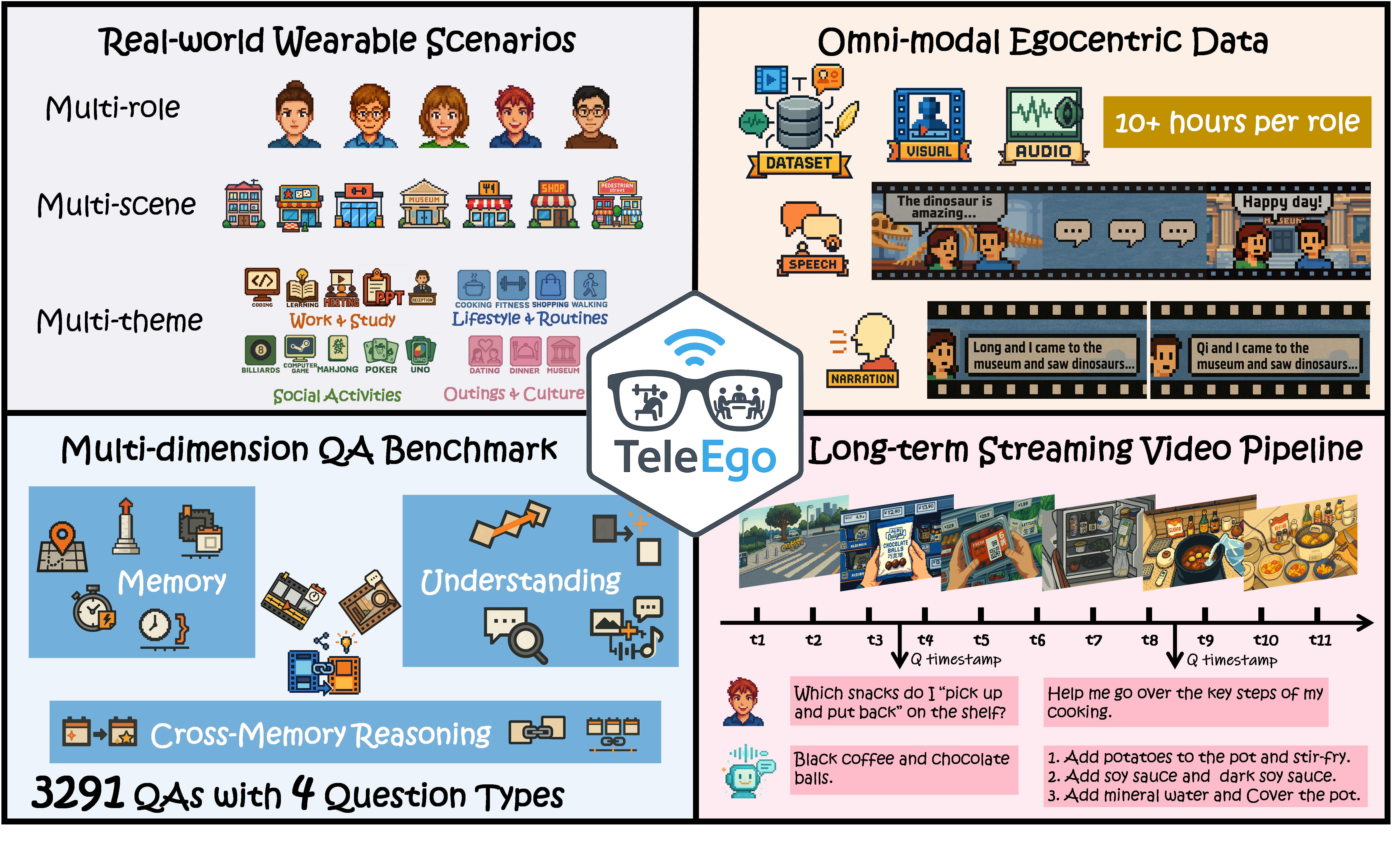
TeleEgo is a comprehensive omni benchmark designed for multi-person, multi-scene, multi-task, and multimodal long-term memory reasoning in egocentric video streams. It reflects realistic personal assistant scenarios where continuous egocentric video data is collected across hours or even days, requiring models to maintain and reason over memory, understanding, and cross-memory reasoning. Omni here means that TeleEgo covers the full spectrum of roles, scenes, tasks, modalities, and memory horizons, offering all-round evaluation for egocentric AI assistants.
TeleEgo provides:
TeleEgo-QA evaluates models along three main dimensions:
Memory
Understanding
Cross-Memory Reasoning
Each QA instance includes:
TeleEgo/
├── teleego_data/                # Dataset samples / metadata
│   ├── outputs/                 # Output results
│   ├── QAs/                     # Question-Answer pairs
│   └── video_merged/            # Merged video files
├── weights/                     # Pre-trained weights (MiniCPM-o, Qwen2.5-Omni, ...)
├── evaluate_gemini25_pro.py     # Evaluation script for Gemini 2.5 Pro
├── evaluate_gpt_4o.py           # Evaluation script for GPT-4o
├── evaluate_minicpm_o.py        # Evaluation script for MiniCPM-o
├── evaluate_qwen25_omni.py      # Evaluation script for Qwen2.5-Omni
├── evaluate_qwen25_vl.py        # Evaluation script for Qwen2.5-VL
├── evaluate_videochat_online.py # Evaluation script for VideoChat
├── metrics.py                   # Evaluation metrics
├── utils.py                     # Utility functions
├── run.sh                       # Execution script
└── README.md                    # This file
Download the dataset from Hugging Face: 🔗 TeleEgo Dataset
Or Baidu Netdisk: 🔗 TeleEgo Dataset
Official transcripts (optional): time-aligned transcripts for every source video session are released separately in 🔗 TeleEgo-Source. Each session provides *_speech.srt (automatically generated, then manually verified, with speaker identities where available) and *_narration.srt (visual narrations of activities, attended objects, scene context, and other salient events). Use these instead of the on-the-fly Whisper ASR in utils.py if you need high-quality speech text.
Organize the dataset in the following structure:
./TeleEgo/teleego_data/
├── QAs/                              # Question-Answer dataset
│   ├── merged_P1_A.json             # QA data for participant P1
│   ├── merged_P2_A.json             # QA data for participant P2
│   ├── merged_P3_A.json             # QA data for participant P3
│   ├── merged_P4_A.json             # QA data for participant P4
│   └── merged_P5_A.json             # QA data for participant P5
├── outputs/                          # Evaluation outputs
│   ├── gemini25_pro/                # Results for Gemini 2.5 Pro
│   ├── gpt-4o/                      # Results for GPT-4o
│   ├── minicpm_o/                   # Results for MiniCPM-o
│   ├── qwen25_omni/                 # Results for Qwen2.5-Omni
│   ├── qwen25_vl/                   # Results for Qwen2.5-VL
│   └── videochat-online/            # Results for VideoChat-Online
└── video_merged/                     # Merged long videos with timestamps
    ├── merged_P1.mp4                # P1's 3-day video merged into one file
    ├── merged_P2.mp4                # P2's 3-day video merged into one file
    ├── merged_P3.mp4                # P3's 3-day video merged into one file
    ├── merged_P4.mp4                # P4's 3-day video merged into one file
    ├── merged_P5.mp4                # P5's 3-day video merged into one file
    ├── timeline_P1.json             # P1's timestamp mapping file
    ├── timeline_P2.json             # P2's timestamp mapping file
    ├── timeline_P3.json             # P3's timestamp mapping file
    ├── timeline_P4.json             # P4's timestamp mapping file
    └── timeline_P5.json             # P5's timestamp mapping file
Set up your environment according to the official requirements of the model you want to evaluate:
run.shTo evaluate a model on a specific GPU, use the following command format:
sh run.sh
Examples:
# Evaluate Qwen2.5-Omni on GPU 0
sh run.sh eval_qwen25_omni 0
Available evaluation functions:
eval_qwen25_omni - Qwen2.5-Omni modeleval_qwen25_vl - Qwen2.5-VL modeleval_minicpm_o - MiniCPM-o modeleval_videochat_online - VideoChat-Online modeleval_gpt_4o - GPT-4o (requires API key)eval_gemini25_pro - Gemini 2.5 Pro (requires API key)After evaluation, the results will be saved in ./teleego_data/outputs/<model_name>/. To compute evaluation metrics:
python metrics.py
This will calculate performance metrics across all evaluation dimensions (Memory, Understanding, Cross-Memory Reasoning).
Submit your results to our 🏆 Online Leaderboard.
If you find our TeleEgo in your research, please cite:
@article{yan2025teleego,
  title={TeleEgo: Benchmarking Egocentric AI Assistants in the Wild},
  author={Yan, Jiaqi and Ren, Ruilong and Liu, Jingren and Xu, Shuning and Wang, Ling and Wang, Yiheng and Zhong, Xinlin and Wang, Yun and Zhang, Long and Chen, Xiangyu and Sun, Changzhi and others},
  journal={arXiv preprint arXiv:2510.23981},
  year={2025}
}
This project is licensed under the MIT License. Dataset usage is restricted under a research-only license.
If you have any questions, please feel free to reach out: [email protected].
TeleEgo is an Omni benchmark, a step toward building personalized AI assistants with true long-term memory, reasoning and decision-making in real-world wearable scenarios.
Made with ❤️ by the Ubiquitous AGI team at TeleAI.

The official repo of TeleEgo - A Benchmark for Egocentric AI Assistants.
See the code
📢 Note:This project is still under active development, and the benchmark will be continuously maintained.
If you find this project helpful, please give us a ⭐️ on GitHub for the latest update.
TeleEgo is a comprehensive omni benchmark designed for multi-person, multi-scene, multi-task, and multimodal long-term memory reasoning in egocentric video streams. It reflects realistic personal assistant scenarios where continuous egocentric video data is collected across hours or even days, requiring models to maintain and reason over memory, understanding, and cross-memory reasoning. Omni here means that TeleEgo covers the full spectrum of roles, scenes, tasks, modalities, and memory horizons, offering all-round evaluation for egocentric AI assistants.
TeleEgo provides:
TeleEgo-QA evaluates models along three main dimensions:
Memory
Understanding
Cross-Memory Reasoning
Each QA instance includes:
TeleEgo/
├── teleego_data/                # Dataset samples / metadata
│   ├── outputs/                 # Output results
│   ├── QAs/                     # Question-Answer pairs
│   └── video_merged/            # Merged video files
├── weights/                     # Pre-trained weights (MiniCPM-o, Qwen2.5-Omni, ...)
├── evaluate_gemini25_pro.py     # Evaluation script for Gemini 2.5 Pro
├── evaluate_gpt_4o.py           # Evaluation script for GPT-4o
├── evaluate_minicpm_o.py        # Evaluation script for MiniCPM-o
├── evaluate_qwen25_omni.py      # Evaluation script for Qwen2.5-Omni
├── evaluate_qwen25_vl.py        # Evaluation script for Qwen2.5-VL
├── evaluate_videochat_online.py # Evaluation script for VideoChat
├── metrics.py                   # Evaluation metrics
├── utils.py                     # Utility functions
├── run.sh                       # Execution script
└── README.md                    # This file
Download the dataset from Hugging Face: 🔗 TeleEgo Dataset
Or Baidu Netdisk: 🔗 TeleEgo Dataset
Official transcripts (optional): time-aligned transcripts for every source video session are released separately in 🔗 TeleEgo-Source. Each session provides *_speech.srt (automatically generated, then manually verified, with speaker identities where available) and *_narration.srt (visual narrations of activities, attended objects, scene context, and other salient events). Use these instead of the on-the-fly Whisper ASR in utils.py if you need high-quality speech text.
Organize the dataset in the following structure:
./TeleEgo/teleego_data/
├── QAs/                              # Question-Answer dataset
│   ├── merged_P1_A.json             # QA data for participant P1
│   ├── merged_P2_A.json             # QA data for participant P2
│   ├── merged_P3_A.json             # QA data for participant P3
│   ├── merged_P4_A.json             # QA data for participant P4
│   └── merged_P5_A.json             # QA data for participant P5
├── outputs/                          # Evaluation outputs
│   ├── gemini25_pro/                # Results for Gemini 2.5 Pro
│   ├── gpt-4o/                      # Results for GPT-4o
│   ├── minicpm_o/                   # Results for MiniCPM-o
│   ├── qwen25_omni/                 # Results for Qwen2.5-Omni
│   ├── qwen25_vl/                   # Results for Qwen2.5-VL
│   └── videochat-online/            # Results for VideoChat-Online
└── video_merged/                     # Merged long videos with timestamps
    ├── merged_P1.mp4                # P1's 3-day video merged into one file
    ├── merged_P2.mp4                # P2's 3-day video merged into one file
    ├── merged_P3.mp4                # P3's 3-day video merged into one file
    ├── merged_P4.mp4                # P4's 3-day video merged into one file
    ├── merged_P5.mp4                # P5's 3-day video merged into one file
    ├── timeline_P1.json             # P1's timestamp mapping file
    ├── timeline_P2.json             # P2's timestamp mapping file
    ├── timeline_P3.json             # P3's timestamp mapping file
    ├── timeline_P4.json             # P4's timestamp mapping file
    └── timeline_P5.json             # P5's timestamp mapping file
Set up your environment according to the official requirements of the model you want to evaluate:
run.shTo evaluate a model on a specific GPU, use the following command format:
sh run.sh
Examples:
# Evaluate Qwen2.5-Omni on GPU 0
sh run.sh eval_qwen25_omni 0
Available evaluation functions:
eval_qwen25_omni - Qwen2.5-Omni modeleval_qwen25_vl - Qwen2.5-VL modeleval_minicpm_o - MiniCPM-o modeleval_videochat_online - VideoChat-Online modeleval_gpt_4o - GPT-4o (requires API key)eval_gemini25_pro - Gemini 2.5 Pro (requires API key)After evaluation, the results will be saved in ./teleego_data/outputs/<model_name>/. To compute evaluation metrics:
python metrics.py
This will calculate performance metrics across all evaluation dimensions (Memory, Understanding, Cross-Memory Reasoning).
Submit your results to our 🏆 Online Leaderboard.
If you find our TeleEgo in your research, please cite:
@article{yan2025teleego,
  title={TeleEgo: Benchmarking Egocentric AI Assistants in the Wild},
  author={Yan, Jiaqi and Ren, Ruilong and Liu, Jingren and Xu, Shuning and Wang, Ling and Wang, Yiheng and Zhong, Xinlin and Wang, Yun and Zhang, Long and Chen, Xiangyu and Sun, Changzhi and others},
  journal={arXiv preprint arXiv:2510.23981},
  year={2025}
}
This project is licensed under the MIT License. Dataset usage is restricted under a research-only license.
If you have any questions, please feel free to reach out: [email protected].
TeleEgo is an Omni benchmark, a step toward building personalized AI assistants with true long-term memory, reasoning and decision-making in real-world wearable scenarios.
Made with ❤️ by the Ubiquitous AGI team at TeleAI.



