
This repository contains a collection of the most influential papers, and benchmarks related to Large Language Models (LLMs) based Agent Planning.
See the codeREADME
Large Language Models for Planning: A Comprehensive and Systematic Survey
Welcome to the Awesome-LLM-Planning repository! This repository contains a collection of the most influential papers, and benchmarks related to Large Language Models (LLMs) based Agent Planning. For a detailed introduction, please refer our survey paper:
Large Language Models for Planning: A Comprehensive and Systematic Survey

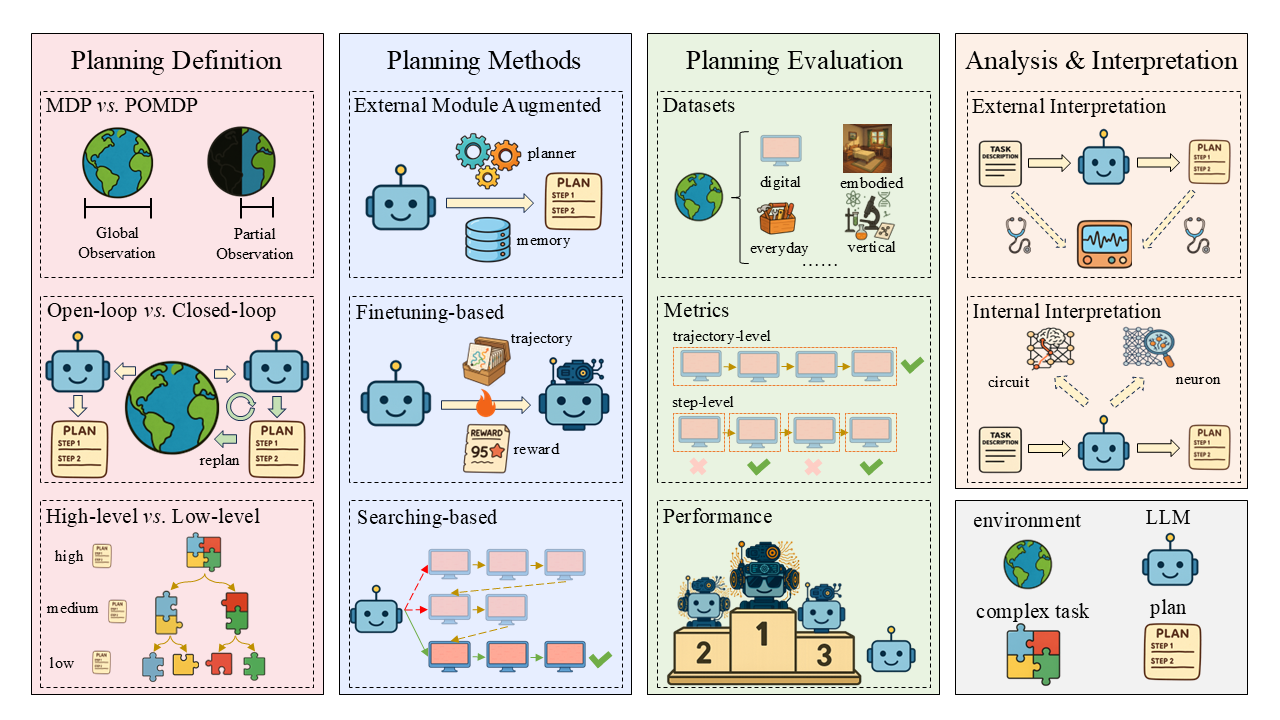
1 Planning Methods
1.1 External Module Augmented Methods
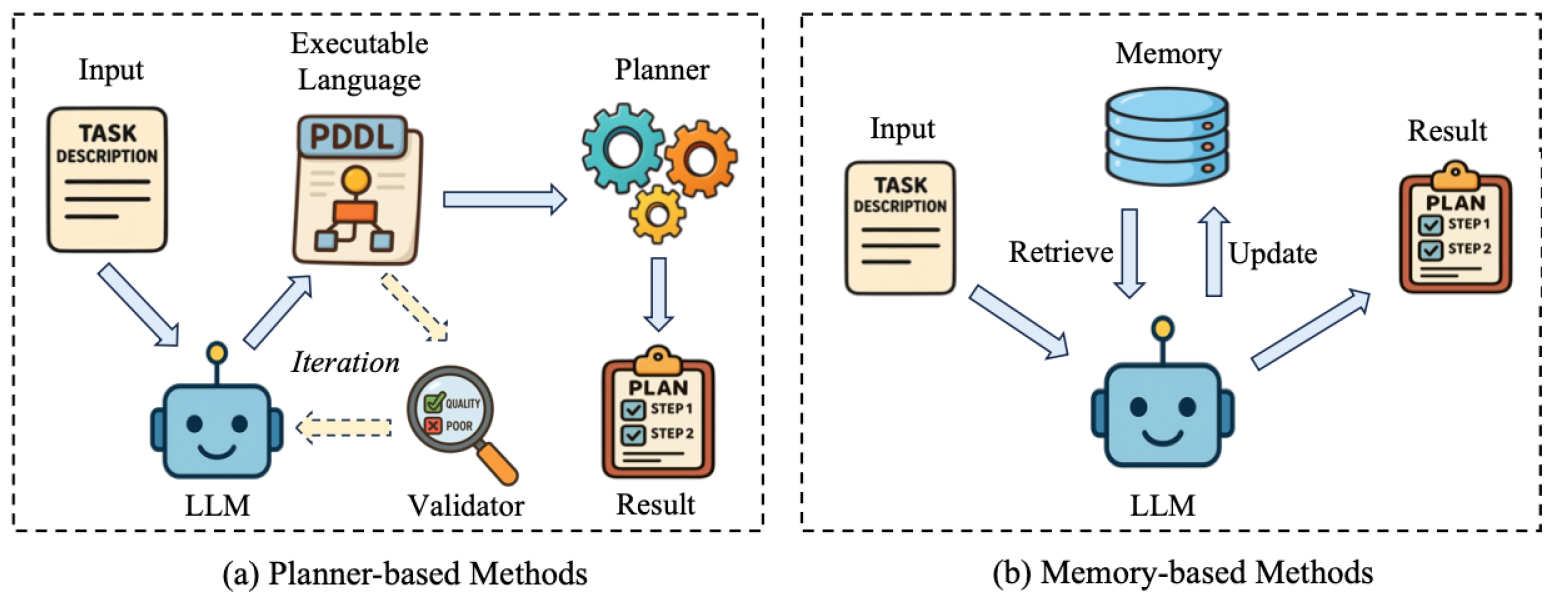
1.1.1 Planner Enhanced Methods
- Hierarchical Planning For Complex Tasks With Knowledge Graph-Rag And Symbolic Verification
- LLM+ Map: Bimanual Robot Task Planning Using Large Language Models And Planning Domain Definition Language
- Robust Planning With Compound LLM Architectures: An LLM-Modulo Approach
- Can Llms Plan Paths With Extra Hints From Solvers?
- Planetarium: A Rigorous Benchmark For Translating Text To Structured Planning Languages
- Dynamic Planning With A LLM
- Trip-Pal: Travel Planning With Guarantees By Combining Large Language Models And Automated Planners
- PDDLEGO: Iterative Planning In Textual Environments
- PROC2PDDL: Open-Domain Planning Representations From Texts
- Leveraging Environment Interaction For Automated PDDL Translation And Planning With Large Language Models
- Position: Llms Can’t Plan, But Can Help Planning In LLM-Modulo Frameworks
- Memorybank: Enhancing Large Language Models With Long-Term Memory
- Explicit Memory Learning With Expectation Maximization
- To The Globe (Ttg): Towards Language-Driven Guaranteed Travel Planning
- Autoplanbench: Automatically Generating Benchmarks For LLM Planners From PDDL
- LLM+P: Empowering Large Language Models with Optimal Planning Proficiency
- Translating Natural Language To Planning Goals With Large-Language Models
- Generative Agents: Interactive Simulacra Of Human Behavior
- Think Before You Act: Decision Transformers With Working Memory
- Leveraging Pre-Trained Large Language Models To Construct And Utilize World Models For Model-Based Task Planning
- Synapse: Trajectory-As-Exemplar Prompting With Memory For Computer Control
- Coupling Large Language Models With Logic Programming For Robust And General Reasoning From Text
- Ldm2: A Large Decision Model Imitating Human Cognition With Dynamic Memory Enhancement
- Learning Adaptive Planning Representations With Natural Language Guidance





1.1.2 Memory Enhanced Methods
- Crafting Personalized Agents Through Retrieval-Augmented Generation On Editable Memory Graphs
- Exploratory Retrieval-Augmented Planning For Continual Embodied Instruction Following
- Large Language Models Are Semi-Parametric Reinforcement Learning Agents
- A Survey On Large Language Model Based Autonomous Agents
- Jarvis-1: Open-World Multi-Task Agents With Memory-Augmented Multimodal Language Models
- Learning Memory Mechanisms For Decision Making Through Demonstrations
- Mot: Memory-Of-Thought Enables Chatgpt To Self-Improve
- Memgpt: Towards Llms As Operating Systems
- Clin: A Continually Learning Language Agent For Rapid Task Adaptation And Generalization
- Open-Ended Instructable Embodied Agents With Memory-Augmented Large Language Models
- Think-In-Memory: Recalling And Post-Thinking Enable Llms With Long-Term Memory
- The Rise And Potential Of Large Language Model Based Agents: A Survey
- Ghost In The Minecraft: Generally Capable Agents For Open-World Environments Via Large Language Models With Text-Based Knowledge And Memory



1.2 Finetuning-based Methods
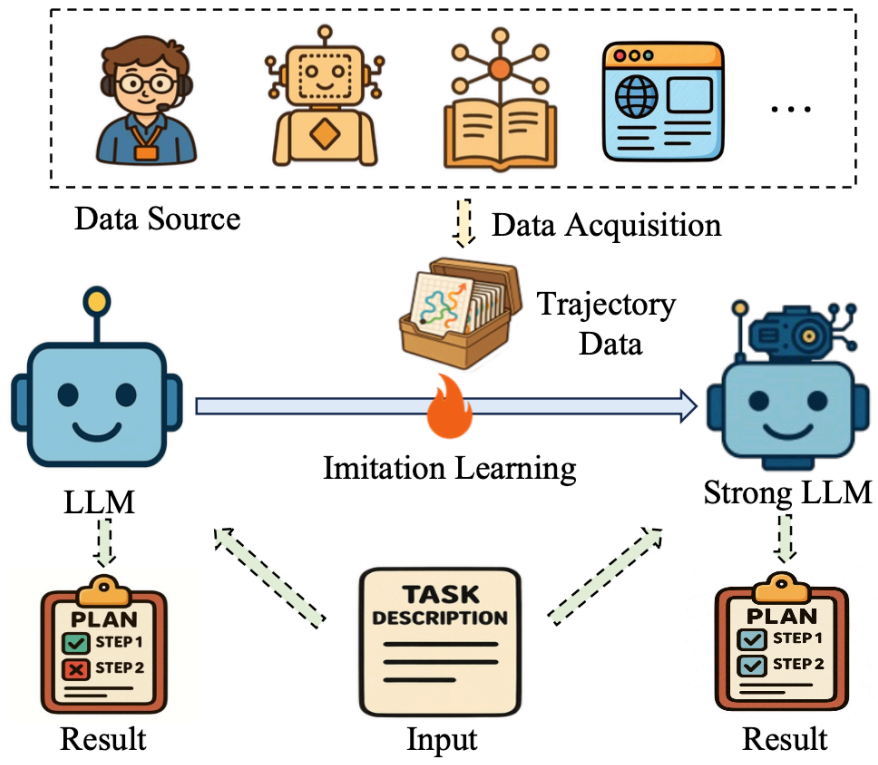
1.2.1 Imitation Learning-based Methods
- Opencodereasoning: Advancing Data Distillation For Competitive Coding
- Agentgen: Enhancing Planning Abilities For Large Language Model Based Agent Via Environment And Task Generation
- Mixture-Of-Agents Enhances Large Language Model Capabilities
- Dualformer: Controllable Fast And Slow Thinking By Learning With Randomized Reasoning Traces
- Selp: Generating Safe And Efficient Task Plans For Robot Agents With Large Language Models
- Knowagent: Knowledge-Augmented Planning For LLM-Based Agents
- Self-Improvement Towards Pareto Optimality: Mitigating Preference Conflicts In Multi-Objective Alignment
- Enhancing Reasoning Capabilities Of Llms Via Principled Synthetic Logic Corpus
- Horizon-Length Prediction: Advancing Fill-In-The-Middle Capabilities For Code Generation With Lookahead Planning
- Cooperative Strategic Planning Enhances Reasoning Capabilities In Large Language Models
- Camphor: Collaborative Agents For Multi-Input Planning And High-Order Reasoning On Device
- Synatra: Turning Indirect Knowledge Into Direct Demonstrations For Digital Agents At Scale
- Learning To Plan Long-Term For Language Modeling
- Retrieve-Plan-Generation: An Iterative Planning And Answering Framework For Knowledge-Intensive LLM Generation
- Ask-Before-Plan: Proactive Language Agents For Real-World Planning
- Learning To Plan For Retrieval-Augmented Large Language Models From Knowledge Graphs
- Distilling Instruction-Following Abilities Of Large Language Models With Task-Aware Curriculum Planning
- Monte Carlo Tree Search Boosts Reasoning Via Iterative Preference Learning
- Multimodal Web Navigation With Instruction-Finetuned Foundation Models
- Agent Planning With World Knowledge Model
- Stream Of Search (Sos): Learning To Search In Language
- Agent-Flan: Designing Data And Methods Of Effective Agent Tuning For Large Language Models
- Beyond A*: Better Planning With Transformers Via Search Dynamics Bootstrapping
- Autoact: Automatic Agent Learning From Scratch Via Self-Planning
- Adapting LLM Agents With Universal Feedback In Communication
- You Only Look At Screens: Multimodal Chain-Of-Action Agents
- Fireact: Toward Language Agent Fine-Tuning
- Training Verifiers To Solve Math Word Problems


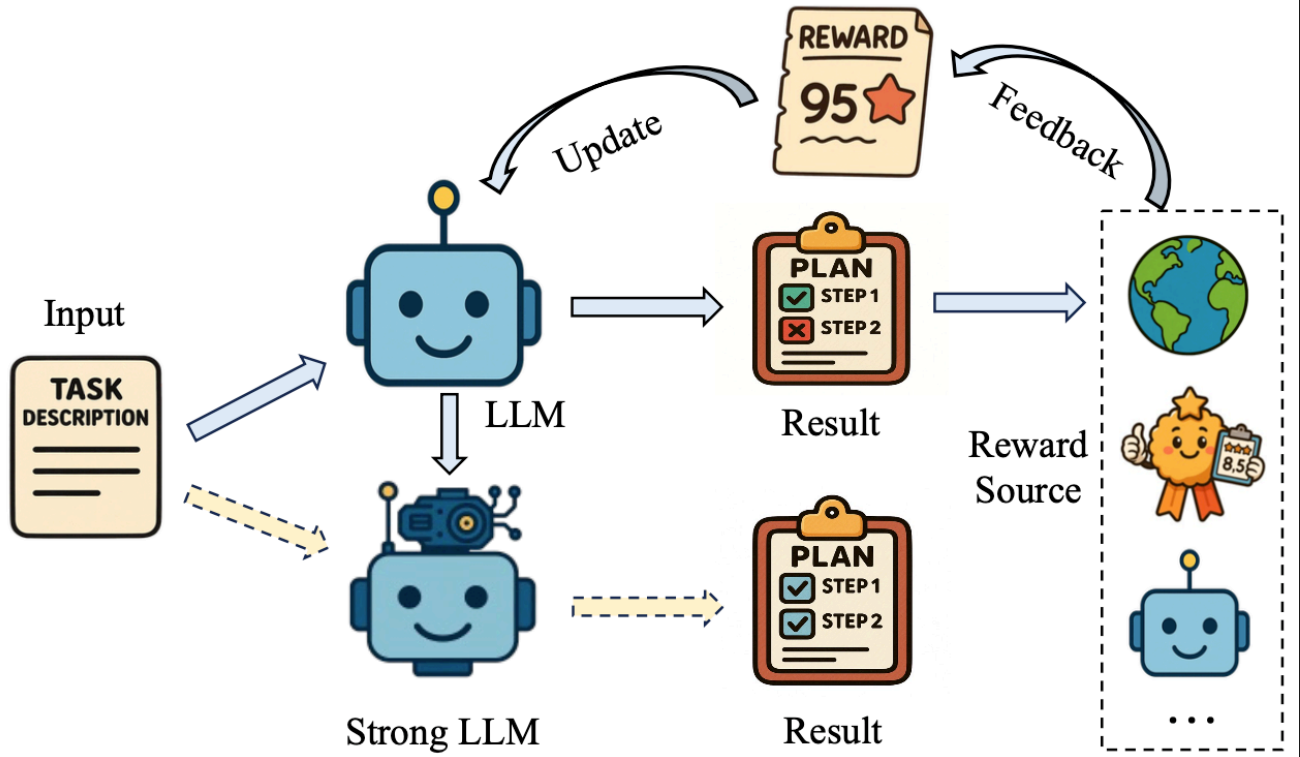
1.2.2 Feedback-based Methods
- Gui-R1: A Generalist R1-Style Vision-Language Action Model For Gui Agents
- Flow Of Reasoning: Training Llms For Divergent Problem Solving With Minimal Examples
- Infigui-R1: Advancing Multimodal Gui Agents From Reactive Actors To Deliberative Reasoners
- Embodied-R: Collaborative Framework For Activating Embodied Spatial Reasoning In Foundation Models Via Reinforcement Learning
- Self-Play Preference Optimization For Language Model Alignment
- Webrl: Training LLM Web Agents Via Self-Evolving Online Curriculum Reinforcement Learning
- Closed-Loop Long-Horizon Robotic Planning Via Equilibrium Sequence Modeling
- Retool: Reinforcement Learning For Strategic Tool Use In Llms
- Training Language Models To Self-Correct Via Reinforcement Learning
- Toolrl: Reward Is All Tool Learning Needs
- Can LLM Be A Good Path Planner Based On Prompt Engineering? Mitigating The Hallucination For Path Planning
- Otc: Optimal Tool Calls Via Reinforcement Learning
- Ui-R1: Enhancing Action Prediction Of Gui Agents By Reinforcement Learning
- Boost, Disentangle, And Customize: A Robust System2-To-System1 Pipeline For Code Generation
- Alphamaze: Enhancing Large Language Models' Spatial Intelligence Via Grpo
- Swe-Rl: Advancing LLM Reasoning Via Reinforcement Learning On Open Software Evolution
- Think Smarter Not Harder: Adaptive Reasoning With Inference Aware Optimization
- Error Classification Of Large Language Models On Math Word Problems: A Dynamically Adaptive Framework
- Enhancing LLM Reasoning Via Critique Models With Test-Time And Training-Time Supervision
- Thinking Llms: General Instruction Following With Thought Generation
- Rest-Mcts*: LLM Self-Training Via Process Reward Guided Tree Search
- Q*: Improving Multi-Step Reasoning For Llms With Deliberative Planning
- Learn Beyond The Answer: Training Language Models With Reflection For Mathematical Reasoning
- Chain Of Preference Optimization: Improving Chain-Of-Thought Reasoning In Llms
- Cpl: Critical Plan Step Learning Boosts LLM Generalization In Reasoning Tasks
- Self-Playing Adversarial Language Game Enhances LLM Reasoning
- Advancing LLM Reasoning Generalists With Preference Trees
- Autowebglm: A Large Language Model-Based Web Navigating Agent
- Llms In The Imaginarium: Tool Learning Through Simulated Trial And Error
- Trial And Error: Exploration-Based Trajectory Optimization For LLM Agents
- React Meets Actre: When Language Agents Enjoy Training Data Autonomy
- Learning Planning-Based Reasoning By Trajectories Collection And Process Reward Synthesizing
- Self-Play Fine-Tuning Converts Weak Language Models To Strong Language Models
- Beyond Human Data: Scaling Self-Training For Problem-Solving With Language Models
- A Real-World Webagent With Planning, Long Context Understanding, And Program Synthesis
- Language Models Can Teach Themselves To Program Better


1.3 Searching-based Methods
1.3.1 Decomposition-based Methods
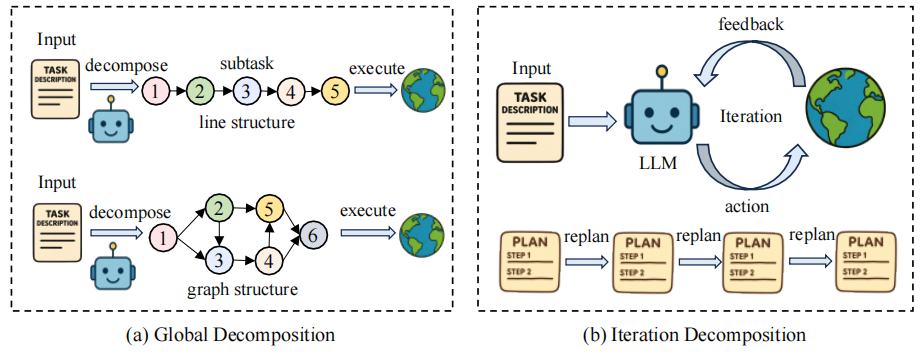
- Verilogcoder: Autonomous Verilog Coding Agents With Graph-Based Planning And Abstract Syntax Tree (Ast)-Based Waveform Tracing Tool
- Agent-Oriented Planning In Multi-Agent Systems
- Optimizing Chain-Of-Thought Reasoning: Tackling Arranging Bottleneck Via Plan Augmentation
- Can We Further Elicit Reasoning In Llms? Critic-Guided Planning With Retrieval-Augmentation For Solving Challenging Tasks
- Oscar: Operating System Control Via State-Aware Reasoning And Re-Planning
- Plan-Rag: Planning-Guided Retrieval Augmented Generation
- Msi-Agent: Incorporating Multi-Scale Insight Into Embodied Agents For Superior Planning And Decision-Making
- Travelagent: An AI Assistant For Personalized Travel Planning
- Meta-Task Planning For Language Agents
- Adapt: As-Needed Decomposition And Planning With Language Models
- A Human-Like Reasoning Framework For Multi-Phases Planning Task With Large Language Models
- Urbanllm: Autonomous Urban Activity Planning And Management With Large Language Models
- Paradise: Evaluating Implicit Planning Skills Of Language Models With Procedural Warnings And Tips Dataset
- Rada: Retrieval-Augmented Web Agent Planning With Llms
- Thoughts To Target: Enhance Planning For Target-Driven Conversation
- Personal Large Language Model Agents: A Case Study On Tailored Travel Planning
- Strength Lies In Differences! Improving Strategy Planning For Non-Collaborative Dialogues Via Diversified User Simulation
- Protrix: Building Models For Planning And Reasoning Over Tables With Sentence Context
- Hugginggpt: Solving AI Tasks With Chatgpt And Its Friends In Hugging Face
- Distilling Script Knowledge From Large Language Models For Constrained Language Planning
- Interpretable Math Word Problem Solution Generation Via Step-By-Step Planning
- Deductive Additivity For Planning Of Natural Language Proofs
- Least-To-Most Prompting Enables Complex Reasoning In Large Language Models


1.3.2 Exploration-based Methods
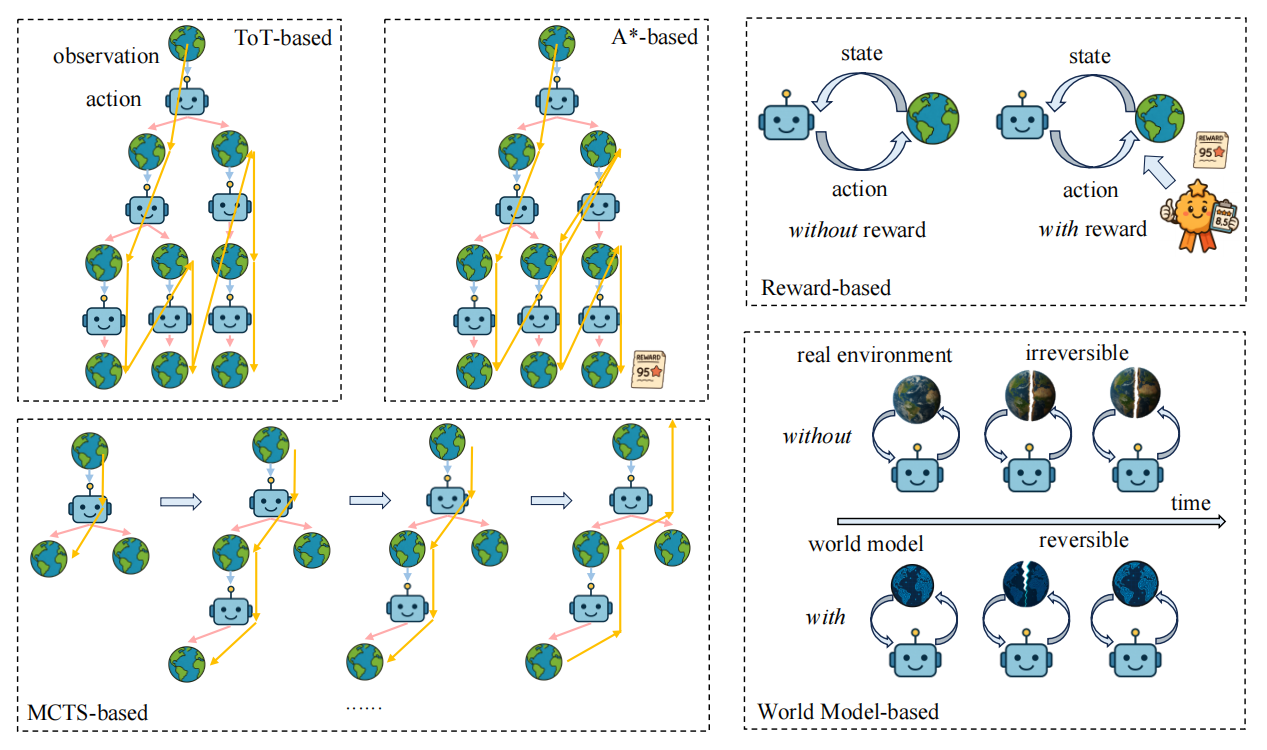
- Worldcoder, A Model-Based LLM Agent: Building World Models By Writing Code And Interacting With The Environment
- Scaling Autonomous Agents Via Automatic Reward Modeling And Planning
- Codetree: Agent-Guided Tree Search For Code Generation With Large Language Models
- Flow-Of-Options: Diversified And Improved LLM Reasoning By Thinking Through Options
- Adaptive Graph Of Thoughts: Test-Time Adaptive Reasoning Unifying Chain, Tree, And Graph Structures
- Step Back To Leap Forward: Self-Backtracking For Boosting Reasoning Of Language Models
- Doubly Robust Monte Carlo Tree Search
- Webpilot: A Versatile And Autonomous Multi-Agent System For Web Task Execution With Strategic Exploration
- Coat: Chain-Of-Associated-Thoughts Framework For Enhancing Large Language Models Reasoning
- Qlass: Boosting Language Agent Inference Via Q-Guided Stepwise Search
- Reflective Planning: Vision-Language Models For Multi-Stage Long-Horizon Robotic Manipulation
- System-1. X: Learning To Balance Fast And Slow Planning With Language Models
- Is Your LLM Secretly A World Model Of The Internet? Model-Based Planning For Web Agents
- Reasonplanner: Enhancing Autonomous Planning In Dynamic Environments With Temporal Knowledge Graphs And Llms
- Tree Search For Language Model Agents
- LLM-A*: Large Language Model Enhanced Incremental Heuristic Search On Path Planning
- Graph Of Thoughts: Solving Elaborate Problems With Large Language Models
- Language Agent Tree Search Unifies Reasoning Acting And Planning In Language Models
- Tree-Planner: Efficient Close-Loop Task Planning With Large Language Models
- Toolllm: Facilitating Large Language Models To Master 16000+ Real-World Apis
- Algorithm Of Thoughts: Enhancing Exploration Of Ideas In Large Language Models
- Toolchain*: Efficient Action Space Navigation In Large Language Models With A* Search
- Thoughtsculpt: Reasoning With Intermediate Revision And Search
- Alphamath Almost Zero: Process Supervision Without Process
- Search-In-The-Chain: Interactively Enhancing Large Language Models With Search For Knowledge-Intensive Tasks
- Tree Of Thoughts: Deliberate Problem Solving With Large Language Models
- Avis: Autonomous Visual Information Seeking With Large Language Model Agent
- Large Language Models As Commonsense Knowledge For Large-Scale Task Planning
- Reasoning With Language Model Is Planning With World Model
- Let'S Verify Step By Step
- Solving Math Word Problems With Process-And Outcome-Based Feedback




1.3.3 Decoding-based Methods
- Non-Myopic Generation Of Language Model For Reasoning And Planning
- Flap: Flow-Adhering Planning With Constrained Decoding In Llms
- Chain-Of-Thought Reasoning Without Prompting
- Don't Throw Away Your Value Model! Generating More Preferable Text With Value-Guided Monte-Carlo Tree Search Decoding
- Contrastive Decoding Improves Reasoning In Large Language Models
- Grounded Decoding: Guiding Text Generation With Grounded Models For Embodied Agents
- Self-Evaluation Guided Beam Search For Reasoning
- Chain-Of-Thought Prompting Elicits Reasoning In Large Language Models

2 Planning Evaluation
2.1 Datasets
2.1.1 Digital Scenarios
2.1.1.1 Web Navigation
- WebLINX: Real-World Website Navigation with Multi-Turn Dialogue
- WebVoyager: Building an End-to-End Web Agent with Large Multimodal Models
- VisualWebArena: Evaluating Multimodal Agents on Realistic Visual Web Tasks
- WebArena: A Realistic Web Environment for Building Autonomous Agents
- Mind2Web: Towards a Generalist Agent for the Web
- WebShop: Towards Scalable Real-World Web Interaction with Grounded Language Agents
- Reinforcement Learning on Web Interfaces Using Workflow-Guided Exploration

2.1.1.2 Mobile Navigation
- A3: Android Agent Arena for Mobile GUI Agents
- AndroidWorld: A Dynamic Benchmarking Environment for Autonomous Agents
- On the Effects of Data Scale on UI Control Agents
- Mobile-Env: Building Qualified Evaluation Benchmarks for LLM-GUI Interaction
- Android in the Wild: A Large-Scale Dataset for Android Device Control
- META-GUI: Towards Multi-modal Conversational Agents on Mobile GUI
- Mapping Natural Language Instructions to Mobile UI Action Sequences


2.1.1.3 Desktop Navigation
- AgentStudio: A Toolkit for Building General Virtual Agents
- OSWorld: Benchmarking Multimodal Agents for Open-Ended Tasks in Real Computer Environments
- TheAgentCompany: Benchmarking LLM Agents on Consequential Real World Tasks
- Windows Agent Arena: Evaluating Multi-Modal OS Agents at Scale
- WorkArena: How Capable Are Web Agents at Solving Common Knowledge Work Tasks?

2.1.2 Embodied Scenarios
2.1.2.1 Household Robot
- PARTNR: A Benchmark for Planning and Reasoning in Embodied Multi-agent Tasks
- LangSuitE: Planning, Controlling and Interacting with Large Language Models in Embodied Text Environments
- ActPlan-1K: Benchmarking the Procedural Planning Ability of Visual Language Models in Household Activities
- Embodied Agent Interface: Benchmarking LLMs for Embodied Decision Making
- LoTa-Bench: Benchmarking Language-oriented Task Planners for Embodied Agents
- GOAT-Bench: A Benchmark for Multi-Modal Lifelong Navigation
- ScienceWorld: Is your Agent Smarter than a 5th Grader?
- BEHAVIOR-1K: A Human-Centered, Embodied AI Benchmark with 1,000 Everyday Activities and Realistic Simulation
- ALFWorld: Aligning Text and Embodied Environments for Interactive Learning
- Watch-And-Help: A Challenge for Social Perception and Human-AI Collaboration
- ALFRED: A Benchmark for Interpreting Grounded Instructions for Everyday Tasks
- VirtualHome: Simulating Household Activities via Programs


2.1.2.2 Manipulation Robot
- EmbodiedBench: Comprehensive Benchmarking Multi-modal Large Language Models for Vision-Driven Embodied Agents
- VLABench: A Large-Scale Benchmark for Language-Conditioned Robotics Manipulation with Long-Horizon Reasoning Tasks
- RoCo: Dialectic Multi-Robot Collaboration with Large Language Models
- VIMA: General Robot Manipulation with Multimodal Prompts
- VLMbench: A Compositional Benchmark for Vision-and-Language Manipulation

2.1.2.3 Minecraft Robot
- Plancraft: an evaluation dataset for planning with LLM agents
- TeamCraft: A Benchmark for Multi-Modal Multi-Agent Systems in Minecraft
- Craftax: A Lightning-Fast Benchmark for Open-Ended Reinforcement Learning
- MinePlanner: A Benchmark for Long-Horizon Planning in Large Minecraft Worlds
- MindAgent: Emergent Gaming Interaction
- MineDojo: Building Open-Ended Embodied Agents with Internet-Scale Knowledge
- On the Utility of Learning about Humans for Human-AI Coordination


2.1.2.4 Autonomous Driving
- AlphaDrive: Unleashing the Power of VLMs in Autonomous Driving via Reinforcement Learning and Reasoning
- PCA-Bench: Evaluating Multimodal Large Language Models in Perception-Cognition-Action Chain
2.1.3 Everyday Scenarios
2.1.3.1 Travel Planning
- ChinaTravel: A Real-World Benchmark for Language Agents in Chinese Travel Planning
- NATURAL PLAN: Benchmarking LLMs on Natural Language Planning
- TravelPlanner: A Benchmark for Real-World Planning with Language Agents
2.1.3.2 Workflow
- Interleaved Scene Graphs for Interleaved Text-and-Image Generation Assessment
- Benchmarking Agentic Workflow Generation
- FlowBench: Revisiting and Benchmarking Workflow-Guided Planning for LLM-based Agents
- Open Grounded Planning: Challenges and Benchmark Construction
- TaskBench: Benchmarking Large Language Models for Task Automation
- TaskLAMA: Probing the Complex Task Understanding of Language Models
- Multimodal Procedural Planning via Dual Text-Image Prompting
- HuggingGPT: Solving AI Tasks with ChatGPT and its Friends in Hugging Face
2.1.3.3 Tool Calling
- ToolComp: A Multi-Tool Reasoning & Process Supervision Benchmark
- ToolSandbox: A Stateful, Conversational, Interactive Evaluation Benchmark for LLM Tool Use Capabilities
- ToolLLM: Facilitating Large Language Models to Master 16000+ Real-world APIs
- AppWorld: A Controllable World of Apps and People for Benchmarking Interactive Coding Agents
- ToolTalk: Evaluating Tool-Usage in a Conversational Setting
- API-Bank: A Comprehensive Benchmark for Tool-Augmented LLMs
2.1.3.4 Code Generation
- Training Software Engineering Agents and Verifiers with SWE-Gym
- SWE-bench: Can Language Models Resolve Real-World GitHub Issues?
- Evaluating Large Language Models Trained on Code


2.1.3.5 Game Playing
- VSP: Assessing the dual challenges of perception and reasoning in spatial planning tasks for VLMs
- PlanBench: An Extensible Benchmark for Evaluating Large Language Models on Planning and Reasoning about Change
- BabyAI: A Platform to Study the Sample Efficiency of Grounded Language Learning
- TextWorld: A Learning Environment for Text-based Games


2.1.4 Vertical Scenarios
2.1.4.1 Machine Learning
- MLE-bench: Evaluating Machine Learning Agents on Machine Learning Engineering
2.1.4.2 AI Research
- CycleResearcher: Improving Automated Research via Automated Review
- ResearchArena: Benchmarking Large Language Models' Ability to Collect and Organize Information as Research Agents
2.1.4.3 Biological Research
- BioPlanner: Automatic Evaluation of LLMs on Protocol Planning in Biology
2.1.4.4 Financial Simulation
- Put Your Money Where Your Mouth Is: Evaluating Strategic Planning and Execution of LLM Agents in an Auction Arena
2.1.4.5 Interior Design
- DStruct2Design: Data and Benchmarks for Data Structure Driven Generative Floor Plan Design
- Tell2Design: A Dataset for Language-Guided Floor Plan Generation
2.1.4.6 Comprehensive
- VisualAgentBench: Towards Large Multimodal Models as Visual Foundation Agents
- AgentBench: Evaluating LLMs as Agents
2.2 Evaluation Metrics
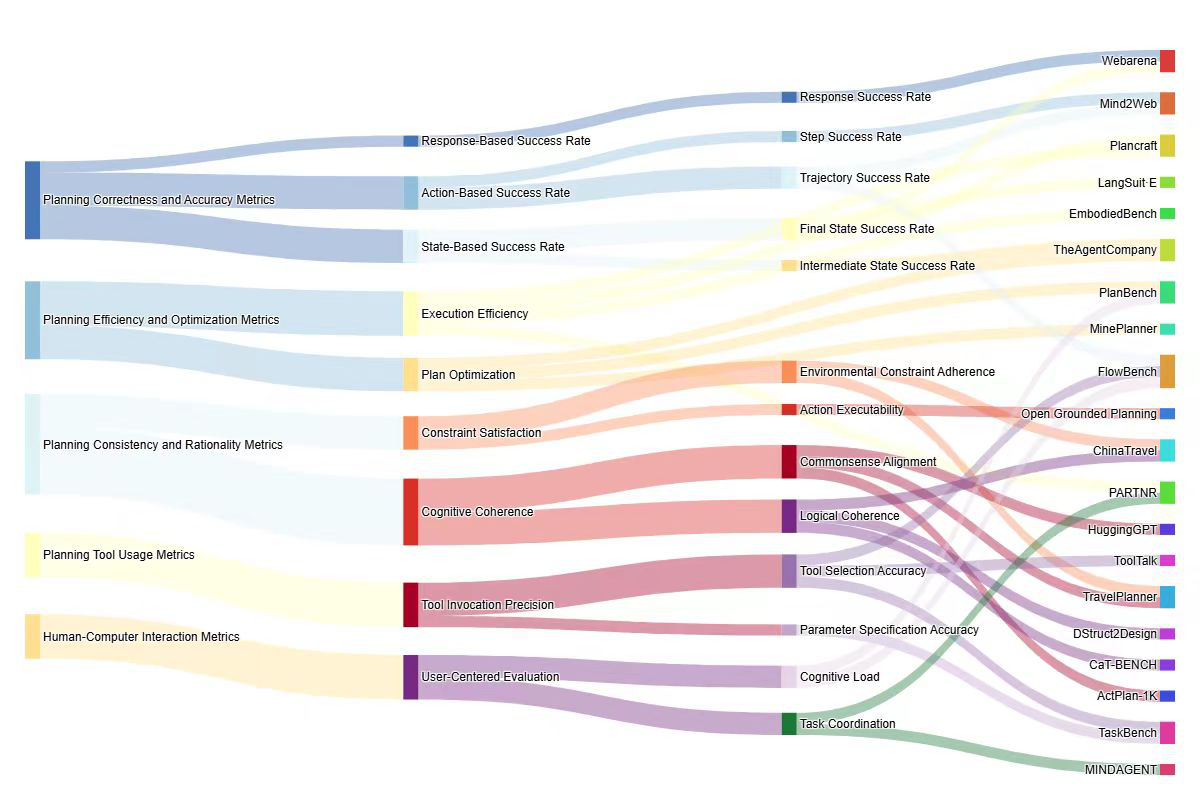
2.3 Performance Comparisons
2.3.1 Web Navigation Performance
- TongUI: Building Generalized GUI Agents by Learning from Multimodal Web Tutorials
- SpiritSight Agent: Advanced GUI Agent with One Look
- UI-E2I-Synth: Advancing GUI Grounding with Large-Scale Instruction Synthesis
- MP-GUI: Modality Perception with MLLMs for GUI Understanding
- Magma: A Foundation Model for Multimodal AI Agents
- Digi-Q: Learning Q-Value Functions for Training Device-Control Agents
- MiniCPM-V: A GPT-4V Level MLLM on Your Phone
- Navigating the Digital World as Humans Do: Universal Visual Grounding for GUI Agents
- UI-TARS: Pioneering Automated GUI Interaction with Native Agents
- Tree Search for Language Model Agents
- GUICourse: From General Vision Language Models to Versatile GUI Agents
- GPT-4V(ision) is a Generalist Web Agent, if Grounded
- SeeClick: Harnessing GUI Grounding for Advanced Visual GUI Agents
- CogAgent: A Visual Language Model for GUI Agents
- Agent Lumos: Unified and Modular Training for Open-Source Language Agents
- Synapse: Trajectory-as-Exemplar Prompting with Memory for Computer Control
- AgentTuning: Enabling Generalized Agent Abilities for LLMs
- Mind2Web: Towards a Generalist Agent for the Web

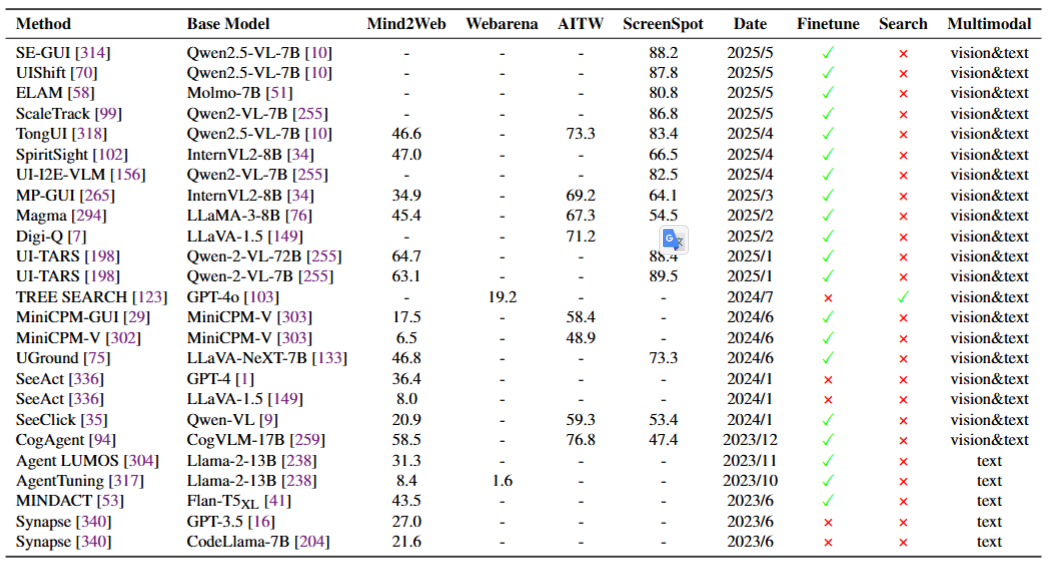
2.3.2 Embodied Scenarios Performance
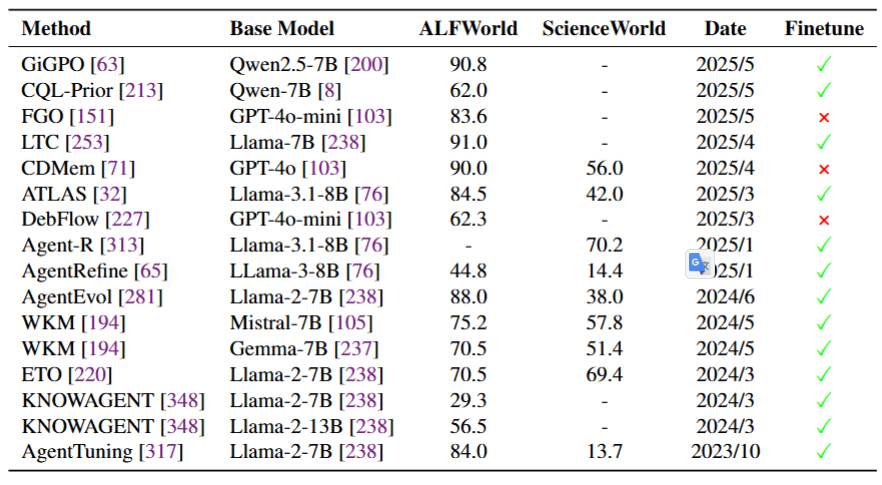
- ATLaS: Agent Tuning via Learning Critical Steps
- DebFlow: Automating Agent Creation via Agent Debate
- AgentRefine: Enhancing Agent Generalization through Refinement Tuning
- KnowAgent: Knowledge-Augmented Planning for LLM-Based Agents
- Agent-R: Training Language Model Agents to Reflect via Iterative Self-Training
- AgentGym: Evolving Large Language Model-based Agents across Diverse Environments
- Agent Planning with World Knowledge Model
- Trial and Error: Exploration-Based Trajectory Optimization for LLM Agents
- AgentTuning: Enabling Generalized Agent Abilities for LLMs

3 Analysis And Interpretation
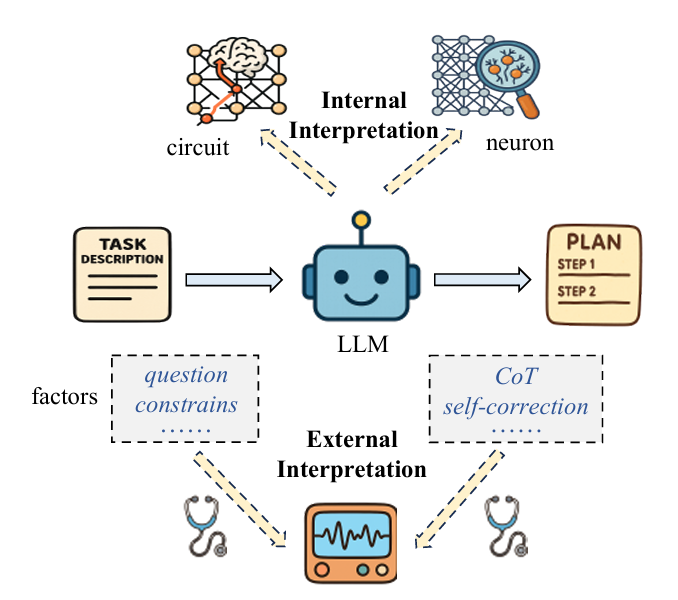
3.1 External Interpretation
- Revealing the Barriers of Language Agents in Planning
- To CoT or not to CoT? Chain-of-thought helps mainly on math and symbolic reasoning
- The pitfalls of next-token prediction
- Chain of Thoughtlessness? An Analysis of CoT in Planning
- Confidence Matters: Revisiting Intrinsic Self-Correction Capabilities of Large Language Models
- Small Language Models Need Strong Verifiers to Self-Correct Reasoning
- A Theoretical Understanding of Self-Correction through In-context Alignment
- Self-Refine: Iterative Refinement with Self-Feedback
3.2 Internal Interpretation
- Do Large Language Models Latently Perform Multi-Hop Reasoning?
- Do language models plan ahead for future tokens?
- Unlocking the Future: Exploring Look-Ahead Planning Mechanistic Interpretability in Large Language Models
- ALPINE: Unveiling the Planning Capability of Autoregressive Learning in Language Models
- Iteration Head: A Mechanistic Study of Chain-of-Thought

Contributors


Similar repos


This repository contains a collection of the most influential papers, and benchmarks related to Large Language Models (LLMs) based Agent Planning.
See the codeREADME
Large Language Models for Planning: A Comprehensive and Systematic Survey
Welcome to the Awesome-LLM-Planning repository! This repository contains a collection of the most influential papers, and benchmarks related to Large Language Models (LLMs) based Agent Planning. For a detailed introduction, please refer our survey paper:
Large Language Models for Planning: A Comprehensive and Systematic Survey
1 Planning Methods
1.1 External Module Augmented Methods
1.1.1 Planner Enhanced Methods
- Hierarchical Planning For Complex Tasks With Knowledge Graph-Rag And Symbolic Verification
- LLM+ Map: Bimanual Robot Task Planning Using Large Language Models And Planning Domain Definition Language
- Robust Planning With Compound LLM Architectures: An LLM-Modulo Approach
- Can Llms Plan Paths With Extra Hints From Solvers?
- Planetarium: A Rigorous Benchmark For Translating Text To Structured Planning Languages
- Dynamic Planning With A LLM
- Trip-Pal: Travel Planning With Guarantees By Combining Large Language Models And Automated Planners
- PDDLEGO: Iterative Planning In Textual Environments
- PROC2PDDL: Open-Domain Planning Representations From Texts
- Leveraging Environment Interaction For Automated PDDL Translation And Planning With Large Language Models
- Position: Llms Can’t Plan, But Can Help Planning In LLM-Modulo Frameworks
- Memorybank: Enhancing Large Language Models With Long-Term Memory
- Explicit Memory Learning With Expectation Maximization
- To The Globe (Ttg): Towards Language-Driven Guaranteed Travel Planning
- Autoplanbench: Automatically Generating Benchmarks For LLM Planners From PDDL
- LLM+P: Empowering Large Language Models with Optimal Planning Proficiency
- Translating Natural Language To Planning Goals With Large-Language Models
- Generative Agents: Interactive Simulacra Of Human Behavior
- Think Before You Act: Decision Transformers With Working Memory
- Leveraging Pre-Trained Large Language Models To Construct And Utilize World Models For Model-Based Task Planning
- Synapse: Trajectory-As-Exemplar Prompting With Memory For Computer Control
- Coupling Large Language Models With Logic Programming For Robust And General Reasoning From Text
- Ldm2: A Large Decision Model Imitating Human Cognition With Dynamic Memory Enhancement
- Learning Adaptive Planning Representations With Natural Language Guidance
1.1.2 Memory Enhanced Methods
- Crafting Personalized Agents Through Retrieval-Augmented Generation On Editable Memory Graphs
- Exploratory Retrieval-Augmented Planning For Continual Embodied Instruction Following
- Large Language Models Are Semi-Parametric Reinforcement Learning Agents
- A Survey On Large Language Model Based Autonomous Agents
- Jarvis-1: Open-World Multi-Task Agents With Memory-Augmented Multimodal Language Models
- Learning Memory Mechanisms For Decision Making Through Demonstrations
- Mot: Memory-Of-Thought Enables Chatgpt To Self-Improve
- Memgpt: Towards Llms As Operating Systems
- Clin: A Continually Learning Language Agent For Rapid Task Adaptation And Generalization
- Open-Ended Instructable Embodied Agents With Memory-Augmented Large Language Models
- Think-In-Memory: Recalling And Post-Thinking Enable Llms With Long-Term Memory
- The Rise And Potential Of Large Language Model Based Agents: A Survey
- Ghost In The Minecraft: Generally Capable Agents For Open-World Environments Via Large Language Models With Text-Based Knowledge And Memory
1.2 Finetuning-based Methods
1.2.1 Imitation Learning-based Methods
- Opencodereasoning: Advancing Data Distillation For Competitive Coding
- Agentgen: Enhancing Planning Abilities For Large Language Model Based Agent Via Environment And Task Generation
- Mixture-Of-Agents Enhances Large Language Model Capabilities
- Dualformer: Controllable Fast And Slow Thinking By Learning With Randomized Reasoning Traces
- Selp: Generating Safe And Efficient Task Plans For Robot Agents With Large Language Models
- Knowagent: Knowledge-Augmented Planning For LLM-Based Agents
- Self-Improvement Towards Pareto Optimality: Mitigating Preference Conflicts In Multi-Objective Alignment
- Enhancing Reasoning Capabilities Of Llms Via Principled Synthetic Logic Corpus
- Horizon-Length Prediction: Advancing Fill-In-The-Middle Capabilities For Code Generation With Lookahead Planning
- Cooperative Strategic Planning Enhances Reasoning Capabilities In Large Language Models
- Camphor: Collaborative Agents For Multi-Input Planning And High-Order Reasoning On Device
- Synatra: Turning Indirect Knowledge Into Direct Demonstrations For Digital Agents At Scale
- Learning To Plan Long-Term For Language Modeling
- Retrieve-Plan-Generation: An Iterative Planning And Answering Framework For Knowledge-Intensive LLM Generation
- Ask-Before-Plan: Proactive Language Agents For Real-World Planning
- Learning To Plan For Retrieval-Augmented Large Language Models From Knowledge Graphs
- Distilling Instruction-Following Abilities Of Large Language Models With Task-Aware Curriculum Planning
- Monte Carlo Tree Search Boosts Reasoning Via Iterative Preference Learning
- Multimodal Web Navigation With Instruction-Finetuned Foundation Models
- Agent Planning With World Knowledge Model
- Stream Of Search (Sos): Learning To Search In Language
- Agent-Flan: Designing Data And Methods Of Effective Agent Tuning For Large Language Models
- Beyond A*: Better Planning With Transformers Via Search Dynamics Bootstrapping
- Autoact: Automatic Agent Learning From Scratch Via Self-Planning
- Adapting LLM Agents With Universal Feedback In Communication
- You Only Look At Screens: Multimodal Chain-Of-Action Agents
- Fireact: Toward Language Agent Fine-Tuning
- Training Verifiers To Solve Math Word Problems
1.2.2 Feedback-based Methods
- Gui-R1: A Generalist R1-Style Vision-Language Action Model For Gui Agents
- Flow Of Reasoning: Training Llms For Divergent Problem Solving With Minimal Examples
- Infigui-R1: Advancing Multimodal Gui Agents From Reactive Actors To Deliberative Reasoners
- Embodied-R: Collaborative Framework For Activating Embodied Spatial Reasoning In Foundation Models Via Reinforcement Learning
- Self-Play Preference Optimization For Language Model Alignment
- Webrl: Training LLM Web Agents Via Self-Evolving Online Curriculum Reinforcement Learning
- Closed-Loop Long-Horizon Robotic Planning Via Equilibrium Sequence Modeling
- Retool: Reinforcement Learning For Strategic Tool Use In Llms
- Training Language Models To Self-Correct Via Reinforcement Learning
- Toolrl: Reward Is All Tool Learning Needs
- Can LLM Be A Good Path Planner Based On Prompt Engineering? Mitigating The Hallucination For Path Planning
- Otc: Optimal Tool Calls Via Reinforcement Learning
- Ui-R1: Enhancing Action Prediction Of Gui Agents By Reinforcement Learning
- Boost, Disentangle, And Customize: A Robust System2-To-System1 Pipeline For Code Generation
- Alphamaze: Enhancing Large Language Models' Spatial Intelligence Via Grpo
- Swe-Rl: Advancing LLM Reasoning Via Reinforcement Learning On Open Software Evolution
- Think Smarter Not Harder: Adaptive Reasoning With Inference Aware Optimization
- Error Classification Of Large Language Models On Math Word Problems: A Dynamically Adaptive Framework
- Enhancing LLM Reasoning Via Critique Models With Test-Time And Training-Time Supervision
- Thinking Llms: General Instruction Following With Thought Generation
- Rest-Mcts*: LLM Self-Training Via Process Reward Guided Tree Search
- Q*: Improving Multi-Step Reasoning For Llms With Deliberative Planning
- Learn Beyond The Answer: Training Language Models With Reflection For Mathematical Reasoning
- Chain Of Preference Optimization: Improving Chain-Of-Thought Reasoning In Llms
- Cpl: Critical Plan Step Learning Boosts LLM Generalization In Reasoning Tasks
- Self-Playing Adversarial Language Game Enhances LLM Reasoning
- Advancing LLM Reasoning Generalists With Preference Trees
- Autowebglm: A Large Language Model-Based Web Navigating Agent
- Llms In The Imaginarium: Tool Learning Through Simulated Trial And Error
- Trial And Error: Exploration-Based Trajectory Optimization For LLM Agents
- React Meets Actre: When Language Agents Enjoy Training Data Autonomy
- Learning Planning-Based Reasoning By Trajectories Collection And Process Reward Synthesizing
- Self-Play Fine-Tuning Converts Weak Language Models To Strong Language Models
- Beyond Human Data: Scaling Self-Training For Problem-Solving With Language Models
- A Real-World Webagent With Planning, Long Context Understanding, And Program Synthesis
- Language Models Can Teach Themselves To Program Better
1.3 Searching-based Methods
1.3.1 Decomposition-based Methods
- Verilogcoder: Autonomous Verilog Coding Agents With Graph-Based Planning And Abstract Syntax Tree (Ast)-Based Waveform Tracing Tool
- Agent-Oriented Planning In Multi-Agent Systems
- Optimizing Chain-Of-Thought Reasoning: Tackling Arranging Bottleneck Via Plan Augmentation
- Can We Further Elicit Reasoning In Llms? Critic-Guided Planning With Retrieval-Augmentation For Solving Challenging Tasks
- Oscar: Operating System Control Via State-Aware Reasoning And Re-Planning
- Plan-Rag: Planning-Guided Retrieval Augmented Generation
- Msi-Agent: Incorporating Multi-Scale Insight Into Embodied Agents For Superior Planning And Decision-Making
- Travelagent: An AI Assistant For Personalized Travel Planning
- Meta-Task Planning For Language Agents
- Adapt: As-Needed Decomposition And Planning With Language Models
- A Human-Like Reasoning Framework For Multi-Phases Planning Task With Large Language Models
- Urbanllm: Autonomous Urban Activity Planning And Management With Large Language Models
- Paradise: Evaluating Implicit Planning Skills Of Language Models With Procedural Warnings And Tips Dataset
- Rada: Retrieval-Augmented Web Agent Planning With Llms
- Thoughts To Target: Enhance Planning For Target-Driven Conversation
- Personal Large Language Model Agents: A Case Study On Tailored Travel Planning
- Strength Lies In Differences! Improving Strategy Planning For Non-Collaborative Dialogues Via Diversified User Simulation
- Protrix: Building Models For Planning And Reasoning Over Tables With Sentence Context
- Hugginggpt: Solving AI Tasks With Chatgpt And Its Friends In Hugging Face
- Distilling Script Knowledge From Large Language Models For Constrained Language Planning
- Interpretable Math Word Problem Solution Generation Via Step-By-Step Planning
- Deductive Additivity For Planning Of Natural Language Proofs
- Least-To-Most Prompting Enables Complex Reasoning In Large Language Models
1.3.2 Exploration-based Methods
- Worldcoder, A Model-Based LLM Agent: Building World Models By Writing Code And Interacting With The Environment
- Scaling Autonomous Agents Via Automatic Reward Modeling And Planning
- Codetree: Agent-Guided Tree Search For Code Generation With Large Language Models
- Flow-Of-Options: Diversified And Improved LLM Reasoning By Thinking Through Options
- Adaptive Graph Of Thoughts: Test-Time Adaptive Reasoning Unifying Chain, Tree, And Graph Structures
- Step Back To Leap Forward: Self-Backtracking For Boosting Reasoning Of Language Models
- Doubly Robust Monte Carlo Tree Search
- Webpilot: A Versatile And Autonomous Multi-Agent System For Web Task Execution With Strategic Exploration
- Coat: Chain-Of-Associated-Thoughts Framework For Enhancing Large Language Models Reasoning
- Qlass: Boosting Language Agent Inference Via Q-Guided Stepwise Search
- Reflective Planning: Vision-Language Models For Multi-Stage Long-Horizon Robotic Manipulation
- System-1. X: Learning To Balance Fast And Slow Planning With Language Models
- Is Your LLM Secretly A World Model Of The Internet? Model-Based Planning For Web Agents
- Reasonplanner: Enhancing Autonomous Planning In Dynamic Environments With Temporal Knowledge Graphs And Llms
- Tree Search For Language Model Agents
- LLM-A*: Large Language Model Enhanced Incremental Heuristic Search On Path Planning
- Graph Of Thoughts: Solving Elaborate Problems With Large Language Models
- Language Agent Tree Search Unifies Reasoning Acting And Planning In Language Models
- Tree-Planner: Efficient Close-Loop Task Planning With Large Language Models
- Toolllm: Facilitating Large Language Models To Master 16000+ Real-World Apis
- Algorithm Of Thoughts: Enhancing Exploration Of Ideas In Large Language Models
- Toolchain*: Efficient Action Space Navigation In Large Language Models With A* Search
- Thoughtsculpt: Reasoning With Intermediate Revision And Search
- Alphamath Almost Zero: Process Supervision Without Process
- Search-In-The-Chain: Interactively Enhancing Large Language Models With Search For Knowledge-Intensive Tasks
- Tree Of Thoughts: Deliberate Problem Solving With Large Language Models
- Avis: Autonomous Visual Information Seeking With Large Language Model Agent
- Large Language Models As Commonsense Knowledge For Large-Scale Task Planning
- Reasoning With Language Model Is Planning With World Model
- Let'S Verify Step By Step
- Solving Math Word Problems With Process-And Outcome-Based Feedback
1.3.3 Decoding-based Methods
- Non-Myopic Generation Of Language Model For Reasoning And Planning
- Flap: Flow-Adhering Planning With Constrained Decoding In Llms
- Chain-Of-Thought Reasoning Without Prompting
- Don't Throw Away Your Value Model! Generating More Preferable Text With Value-Guided Monte-Carlo Tree Search Decoding
- Contrastive Decoding Improves Reasoning In Large Language Models
- Grounded Decoding: Guiding Text Generation With Grounded Models For Embodied Agents
- Self-Evaluation Guided Beam Search For Reasoning
- Chain-Of-Thought Prompting Elicits Reasoning In Large Language Models
2 Planning Evaluation
2.1 Datasets
2.1.1 Digital Scenarios
2.1.1.1 Web Navigation
- WebLINX: Real-World Website Navigation with Multi-Turn Dialogue
- WebVoyager: Building an End-to-End Web Agent with Large Multimodal Models
- VisualWebArena: Evaluating Multimodal Agents on Realistic Visual Web Tasks
- WebArena: A Realistic Web Environment for Building Autonomous Agents
- Mind2Web: Towards a Generalist Agent for the Web
- WebShop: Towards Scalable Real-World Web Interaction with Grounded Language Agents
- Reinforcement Learning on Web Interfaces Using Workflow-Guided Exploration
2.1.1.2 Mobile Navigation
- A3: Android Agent Arena for Mobile GUI Agents
- AndroidWorld: A Dynamic Benchmarking Environment for Autonomous Agents
- On the Effects of Data Scale on UI Control Agents
- Mobile-Env: Building Qualified Evaluation Benchmarks for LLM-GUI Interaction
- Android in the Wild: A Large-Scale Dataset for Android Device Control
- META-GUI: Towards Multi-modal Conversational Agents on Mobile GUI
- Mapping Natural Language Instructions to Mobile UI Action Sequences
2.1.1.3 Desktop Navigation
- AgentStudio: A Toolkit for Building General Virtual Agents
- OSWorld: Benchmarking Multimodal Agents for Open-Ended Tasks in Real Computer Environments
- TheAgentCompany: Benchmarking LLM Agents on Consequential Real World Tasks
- Windows Agent Arena: Evaluating Multi-Modal OS Agents at Scale
- WorkArena: How Capable Are Web Agents at Solving Common Knowledge Work Tasks?
2.1.2 Embodied Scenarios
2.1.2.1 Household Robot
- PARTNR: A Benchmark for Planning and Reasoning in Embodied Multi-agent Tasks
- LangSuitE: Planning, Controlling and Interacting with Large Language Models in Embodied Text Environments
- ActPlan-1K: Benchmarking the Procedural Planning Ability of Visual Language Models in Household Activities
- Embodied Agent Interface: Benchmarking LLMs for Embodied Decision Making
- LoTa-Bench: Benchmarking Language-oriented Task Planners for Embodied Agents
- GOAT-Bench: A Benchmark for Multi-Modal Lifelong Navigation
- ScienceWorld: Is your Agent Smarter than a 5th Grader?
- BEHAVIOR-1K: A Human-Centered, Embodied AI Benchmark with 1,000 Everyday Activities and Realistic Simulation
- ALFWorld: Aligning Text and Embodied Environments for Interactive Learning
- Watch-And-Help: A Challenge for Social Perception and Human-AI Collaboration
- ALFRED: A Benchmark for Interpreting Grounded Instructions for Everyday Tasks
- VirtualHome: Simulating Household Activities via Programs
2.1.2.2 Manipulation Robot
- EmbodiedBench: Comprehensive Benchmarking Multi-modal Large Language Models for Vision-Driven Embodied Agents
- VLABench: A Large-Scale Benchmark for Language-Conditioned Robotics Manipulation with Long-Horizon Reasoning Tasks
- RoCo: Dialectic Multi-Robot Collaboration with Large Language Models
- VIMA: General Robot Manipulation with Multimodal Prompts
- VLMbench: A Compositional Benchmark for Vision-and-Language Manipulation
2.1.2.3 Minecraft Robot
- Plancraft: an evaluation dataset for planning with LLM agents
- TeamCraft: A Benchmark for Multi-Modal Multi-Agent Systems in Minecraft
- Craftax: A Lightning-Fast Benchmark for Open-Ended Reinforcement Learning
- MinePlanner: A Benchmark for Long-Horizon Planning in Large Minecraft Worlds
- MindAgent: Emergent Gaming Interaction
- MineDojo: Building Open-Ended Embodied Agents with Internet-Scale Knowledge
- On the Utility of Learning about Humans for Human-AI Coordination
2.1.2.4 Autonomous Driving
- AlphaDrive: Unleashing the Power of VLMs in Autonomous Driving via Reinforcement Learning and Reasoning
- PCA-Bench: Evaluating Multimodal Large Language Models in Perception-Cognition-Action Chain
2.1.3 Everyday Scenarios
2.1.3.1 Travel Planning
- ChinaTravel: A Real-World Benchmark for Language Agents in Chinese Travel Planning
- NATURAL PLAN: Benchmarking LLMs on Natural Language Planning
- TravelPlanner: A Benchmark for Real-World Planning with Language Agents
2.1.3.2 Workflow
- Interleaved Scene Graphs for Interleaved Text-and-Image Generation Assessment
- Benchmarking Agentic Workflow Generation
- FlowBench: Revisiting and Benchmarking Workflow-Guided Planning for LLM-based Agents
- Open Grounded Planning: Challenges and Benchmark Construction
- TaskBench: Benchmarking Large Language Models for Task Automation
- TaskLAMA: Probing the Complex Task Understanding of Language Models
- Multimodal Procedural Planning via Dual Text-Image Prompting
- HuggingGPT: Solving AI Tasks with ChatGPT and its Friends in Hugging Face
2.1.3.3 Tool Calling
- ToolComp: A Multi-Tool Reasoning & Process Supervision Benchmark
- ToolSandbox: A Stateful, Conversational, Interactive Evaluation Benchmark for LLM Tool Use Capabilities
- ToolLLM: Facilitating Large Language Models to Master 16000+ Real-world APIs
- AppWorld: A Controllable World of Apps and People for Benchmarking Interactive Coding Agents
- ToolTalk: Evaluating Tool-Usage in a Conversational Setting
- API-Bank: A Comprehensive Benchmark for Tool-Augmented LLMs
2.1.3.4 Code Generation
- Training Software Engineering Agents and Verifiers with SWE-Gym
- SWE-bench: Can Language Models Resolve Real-World GitHub Issues?
- Evaluating Large Language Models Trained on Code
2.1.3.5 Game Playing
- VSP: Assessing the dual challenges of perception and reasoning in spatial planning tasks for VLMs
- PlanBench: An Extensible Benchmark for Evaluating Large Language Models on Planning and Reasoning about Change
- BabyAI: A Platform to Study the Sample Efficiency of Grounded Language Learning
- TextWorld: A Learning Environment for Text-based Games
2.1.4 Vertical Scenarios
2.1.4.1 Machine Learning
- MLE-bench: Evaluating Machine Learning Agents on Machine Learning Engineering
2.1.4.2 AI Research
- CycleResearcher: Improving Automated Research via Automated Review
- ResearchArena: Benchmarking Large Language Models' Ability to Collect and Organize Information as Research Agents
2.1.4.3 Biological Research
- BioPlanner: Automatic Evaluation of LLMs on Protocol Planning in Biology
2.1.4.4 Financial Simulation
- Put Your Money Where Your Mouth Is: Evaluating Strategic Planning and Execution of LLM Agents in an Auction Arena
2.1.4.5 Interior Design
- DStruct2Design: Data and Benchmarks for Data Structure Driven Generative Floor Plan Design
- Tell2Design: A Dataset for Language-Guided Floor Plan Generation
2.1.4.6 Comprehensive
- VisualAgentBench: Towards Large Multimodal Models as Visual Foundation Agents
- AgentBench: Evaluating LLMs as Agents
2.2 Evaluation Metrics
2.3 Performance Comparisons
2.3.1 Web Navigation Performance
- TongUI: Building Generalized GUI Agents by Learning from Multimodal Web Tutorials
- SpiritSight Agent: Advanced GUI Agent with One Look
- UI-E2I-Synth: Advancing GUI Grounding with Large-Scale Instruction Synthesis
- MP-GUI: Modality Perception with MLLMs for GUI Understanding
- Magma: A Foundation Model for Multimodal AI Agents
- Digi-Q: Learning Q-Value Functions for Training Device-Control Agents
- MiniCPM-V: A GPT-4V Level MLLM on Your Phone
- Navigating the Digital World as Humans Do: Universal Visual Grounding for GUI Agents
- UI-TARS: Pioneering Automated GUI Interaction with Native Agents
- Tree Search for Language Model Agents
- GUICourse: From General Vision Language Models to Versatile GUI Agents
- GPT-4V(ision) is a Generalist Web Agent, if Grounded
- SeeClick: Harnessing GUI Grounding for Advanced Visual GUI Agents
- CogAgent: A Visual Language Model for GUI Agents
- Agent Lumos: Unified and Modular Training for Open-Source Language Agents
- Synapse: Trajectory-as-Exemplar Prompting with Memory for Computer Control
- AgentTuning: Enabling Generalized Agent Abilities for LLMs
- Mind2Web: Towards a Generalist Agent for the Web
2.3.2 Embodied Scenarios Performance
- ATLaS: Agent Tuning via Learning Critical Steps
- DebFlow: Automating Agent Creation via Agent Debate
- AgentRefine: Enhancing Agent Generalization through Refinement Tuning
- KnowAgent: Knowledge-Augmented Planning for LLM-Based Agents
- Agent-R: Training Language Model Agents to Reflect via Iterative Self-Training
- AgentGym: Evolving Large Language Model-based Agents across Diverse Environments
- Agent Planning with World Knowledge Model
- Trial and Error: Exploration-Based Trajectory Optimization for LLM Agents
- AgentTuning: Enabling Generalized Agent Abilities for LLMs
3 Analysis And Interpretation
3.1 External Interpretation
- Revealing the Barriers of Language Agents in Planning
- To CoT or not to CoT? Chain-of-thought helps mainly on math and symbolic reasoning
- The pitfalls of next-token prediction
- Chain of Thoughtlessness? An Analysis of CoT in Planning
- Confidence Matters: Revisiting Intrinsic Self-Correction Capabilities of Large Language Models
- Small Language Models Need Strong Verifiers to Self-Correct Reasoning
- A Theoretical Understanding of Self-Correction through In-context Alignment
- Self-Refine: Iterative Refinement with Self-Feedback
3.2 Internal Interpretation
- Do Large Language Models Latently Perform Multi-Hop Reasoning?
- Do language models plan ahead for future tokens?
- Unlocking the Future: Exploring Look-Ahead Planning Mechanistic Interpretability in Large Language Models
- ALPINE: Unveiling the Planning Capability of Autoregressive Learning in Language Models
- Iteration Head: A Mechanistic Study of Chain-of-Thought