MeesaJarJar/MeesaMultisMaker

Meesa Multis Maker is a Windows tool by MeesaJarJar for creating and editing Ultima Online multi structures and GUMP graphics. Features an isometric canvas with drag-and-drop placement, transforms (scale/rotate/flip/skew), AI-powered texture regeneration via ComfyUI, MUL/UOP file support, and a built-in pixel painter.

C#

8

22 commits

updated Oct 7, 2026

See the code

README

Meesa Multis Maker

The ultimate tool for creating Ultima Online multi structures and GUMP graphics with AI-powered texture regeneration
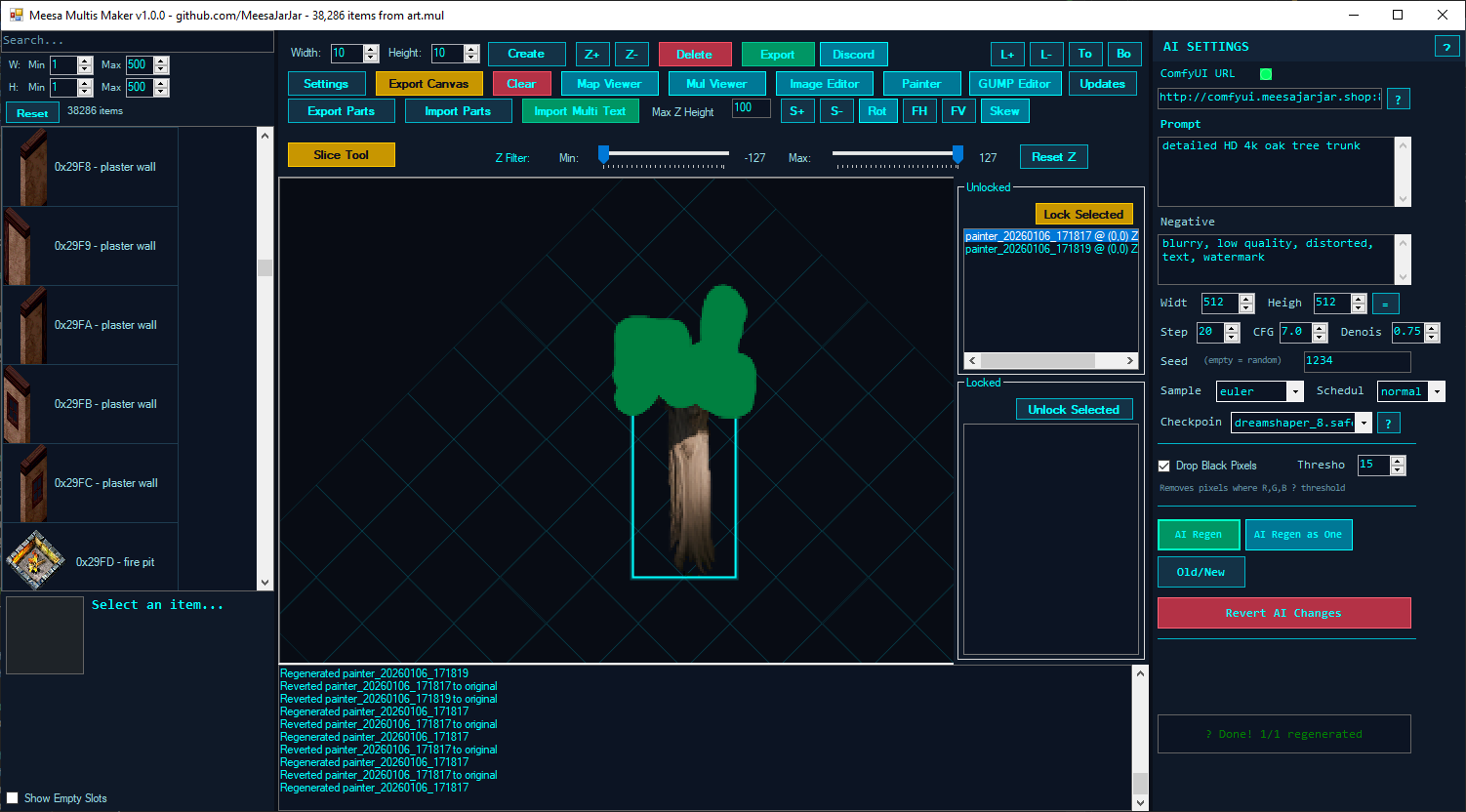
Meesa Multis Maker Main Application

Features � Installation � Getting Started � Editors � AI Integration � Shortcuts � License


Overview

Meesa Multis Maker is a Windows desktop application for composing, editing, exporting, and AI-regenerating isometric game assets used in Ultima Online-style multis and GUMPs. It provides a powerful canvas for placing item art on an isometric diamond grid with support for complex transforms and integrates AI pipelines for texture and static regeneration.

System Requirements

  • OS: Windows 7 or later
  • .NET Framework: 4.8.1 or later
  • Ultima Online Client: Required for MUL/UOP asset files
  • GPU (Optional): NVIDIA GPU recommended for local model inference (LLM, vision, audio gates) and local ComfyUI
  • ComfyUI Server (Optional): For server-based AI image generation
  • Python 3.12 + ffmpeg (Optional): Audio quality gates (vocal bouncer, CLAP match, captions) via pip install faster-whisper laion-clap transformers librosa torch torchvision
  • llama.cpp server binary (Optional): llama-server.exe beside its ggml-*.dll files in MeesaMultisMaker/LLM/bin/ for local LLM/vision features (weights auto-download)
Features

Isometric Canvas Editor (Main Form)

Main Canvas Editor

  • Diamond grid system - Standard 44x44 pixel Ultima Online tile format
  • Multi-object selection - Ctrl+Click for multi-select, marquee selection with Ctrl+Drag
  • Z-ordering and layering - Full control over object depth and draw order
  • Pan & Zoom - Middle-click pan, Ctrl+Scroll to zoom (0.2x to 4x)
  • Snap-to-grid - Objects automatically align to isometric grid positions
  • Z-level filtering - Filter visible objects by Z height range

Building Walls Complex Structures

Transform Tools

  • Scale - Resize objects (0.1x to 10x) with +/- keys
  • Rotate - Free rotation with R key, 15 degree or 90 degree snap with Shift/Ctrl
  • Flip - Horizontal (F) and Vertical (Shift+F) flipping
  • Skew/Distort - Corner-based perspective transform (K key)
  • Pixel Offset - Fine-tune positioning with Alt+Arrow keys

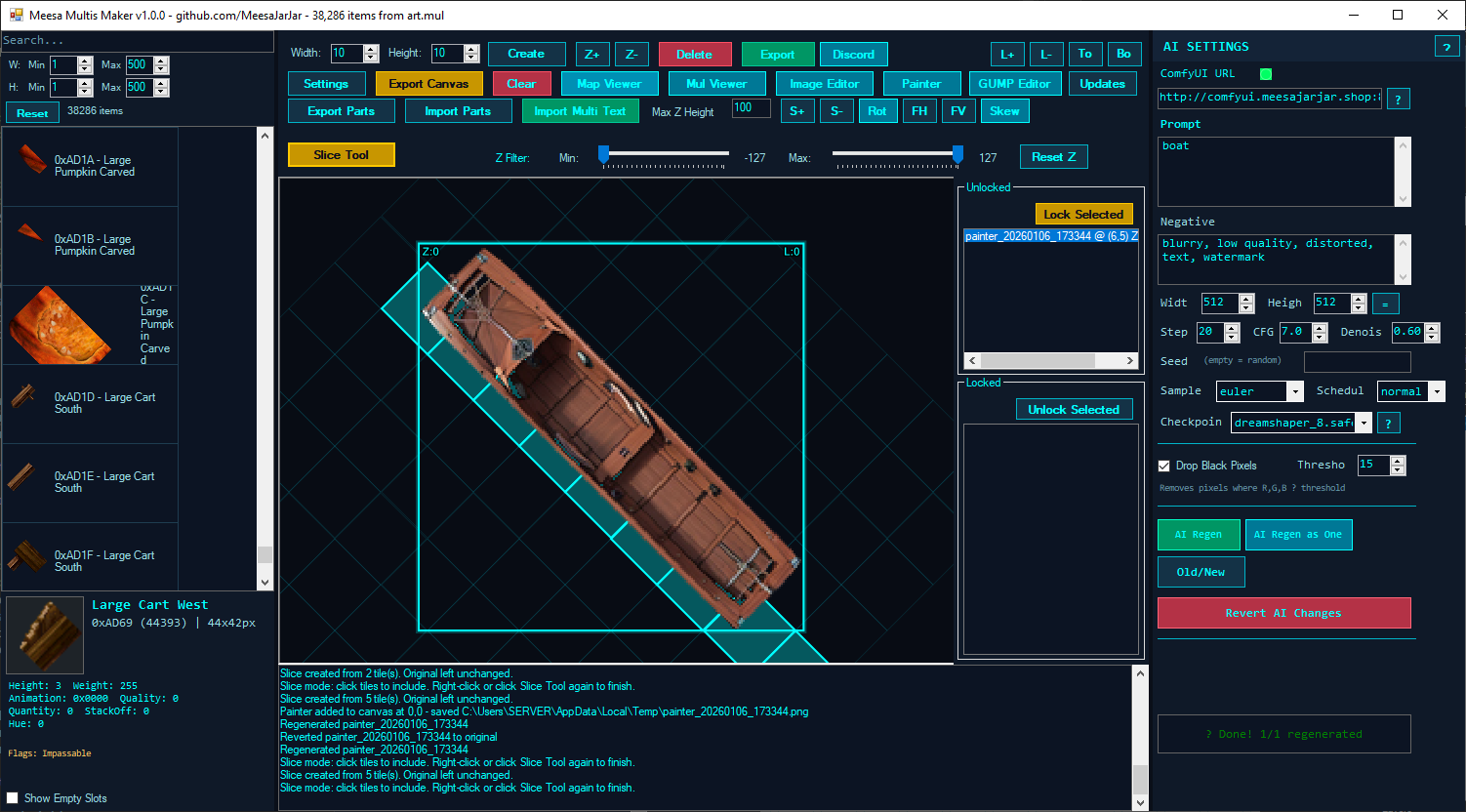
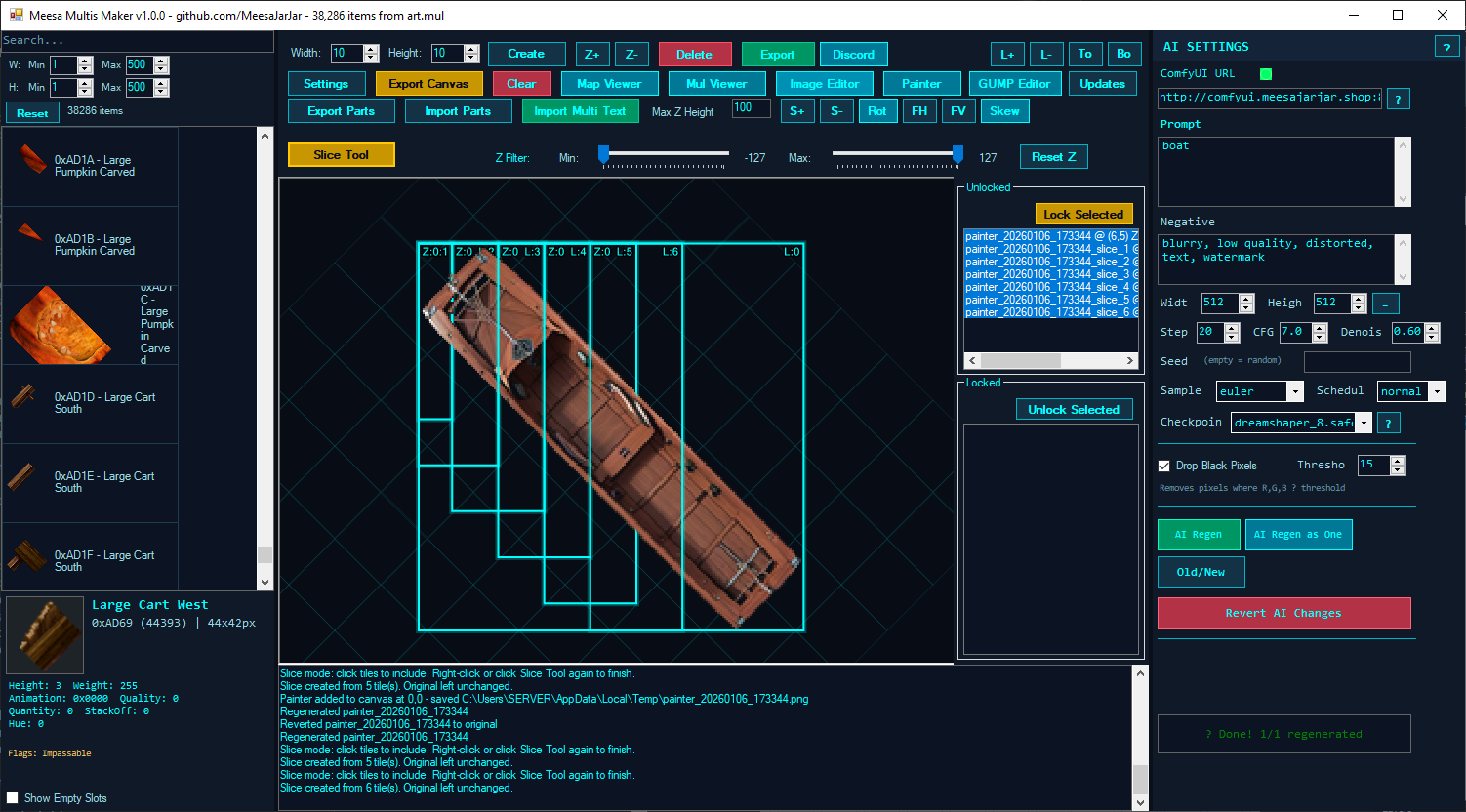
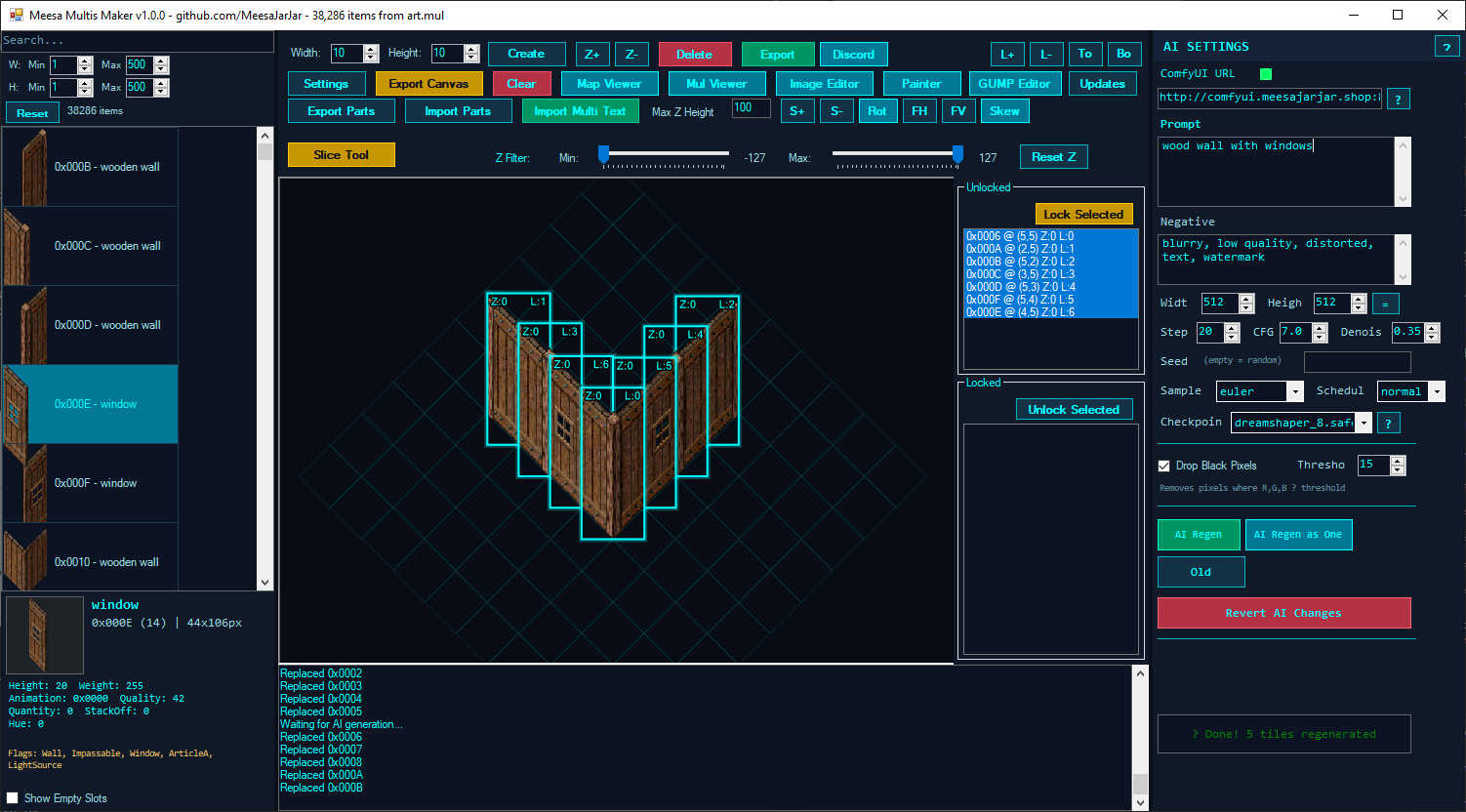
Slice Tool

Slice Tool Slice Tool Result

Create vertical slices of placed images based on selected diamond tiles - perfect for creating building pieces that align perfectly with the isometric grid.

Lock System

  • Lock objects to prevent accidental editing
  • Separate locked/unlocked object lists
  • Multi-select lock/unlock operations

AI Integration (ComfyUI)

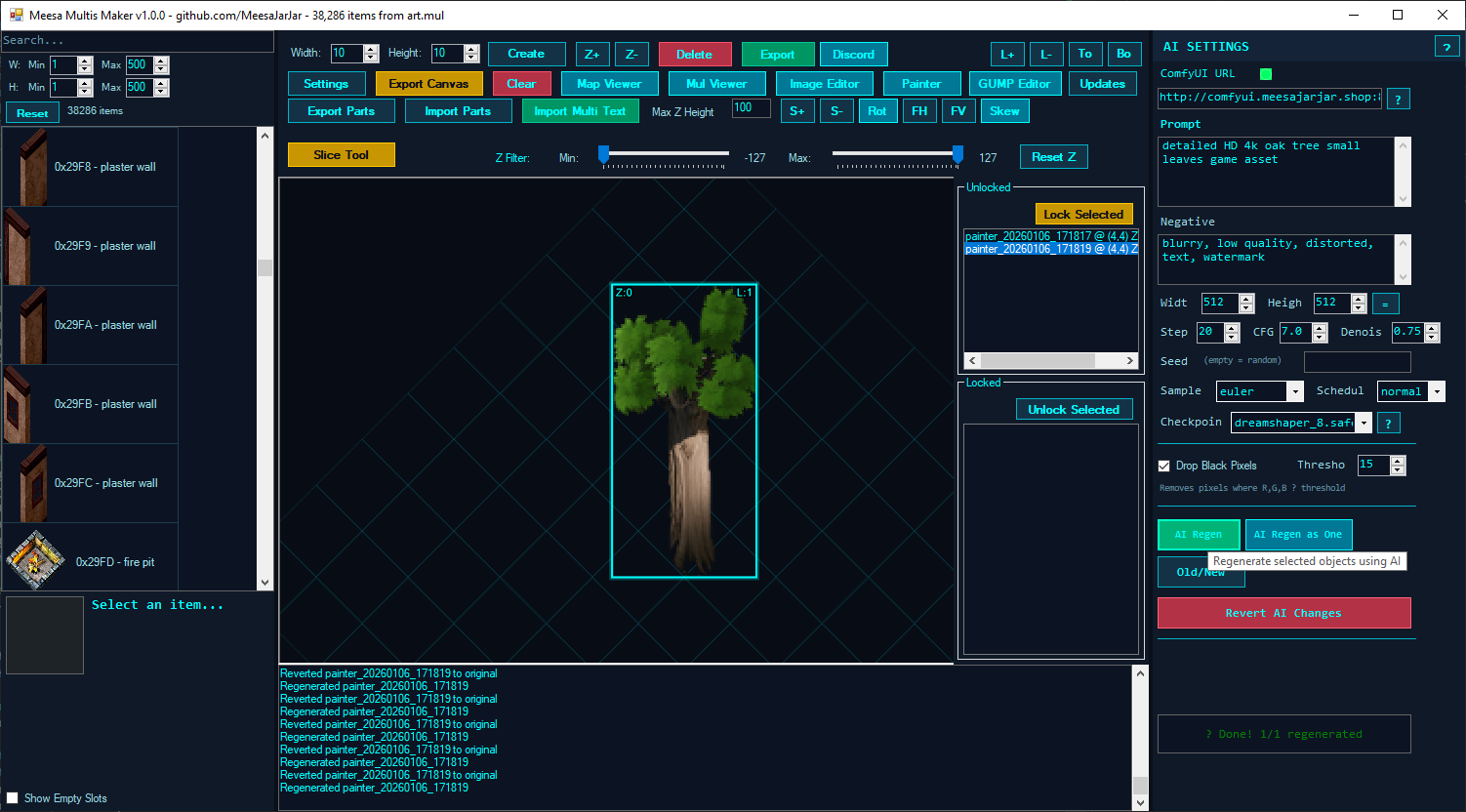
All image generation runs through a ComfyUI server (local or remote):

  • More model options - Use any Stable Diffusion checkpoint, including Flux.2 Klein (flux-2-klein-9b.safetensors + flux2 CLIP + flux2-vae), which gets dedicated inpaint workflows when selected
  • Advanced workflows - Inpainting, ControlNet, and more
  • Remote processing - Can run on a separate machine or cloud

AI Features:

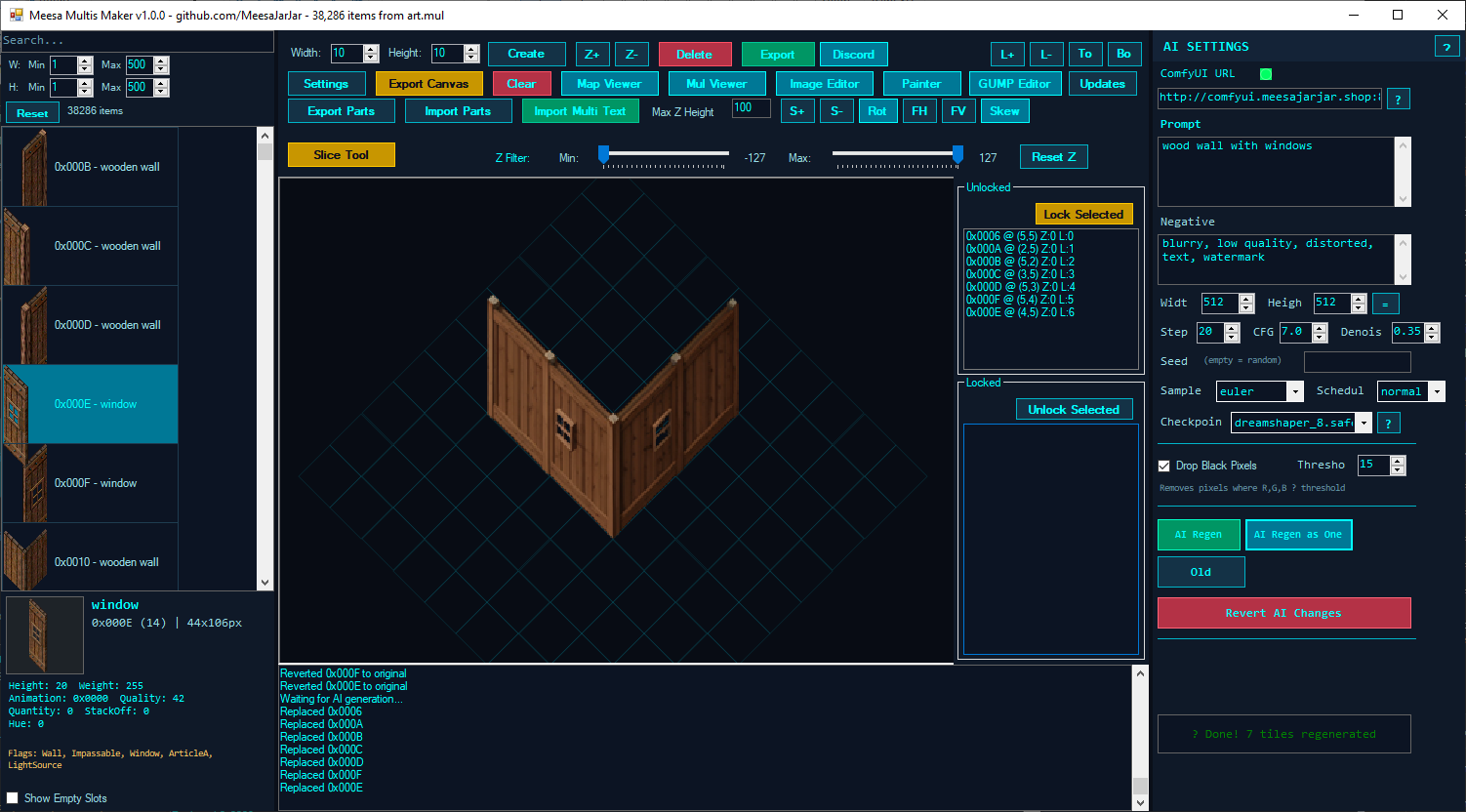
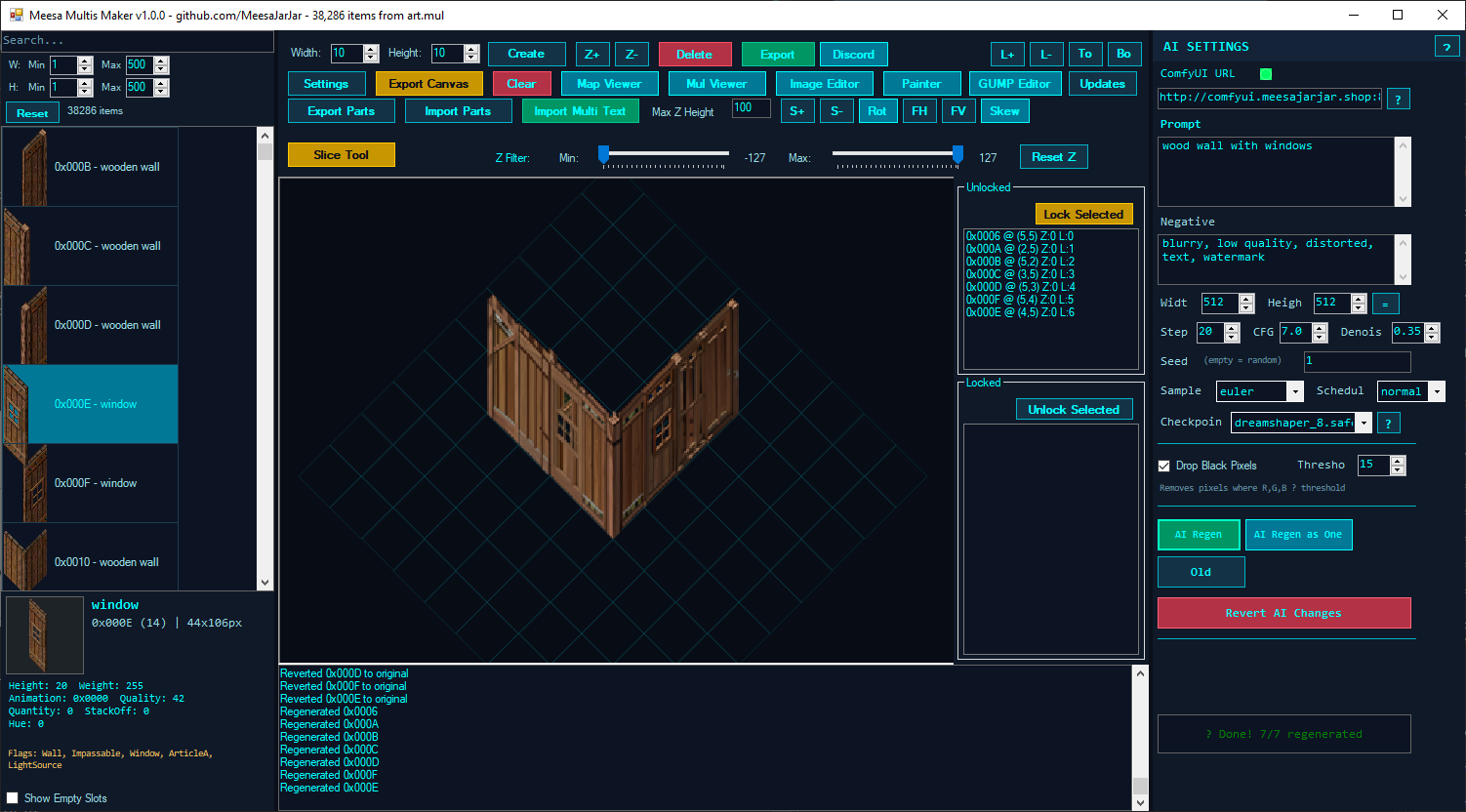
  • Image-to-Image - Transform existing sprites with AI
  • Inpainting - Selective region regeneration with masks
  • Text-to-Image - Generate new assets from text prompts
  • Batch Processing - Regenerate multiple selected objects at once
  • Old/New Toggle - Compare AI-generated results with originals
  • Drop Black Pixels - Automatic background removal (adjustable post-generation)

Import/Export

  • Canvas Export - Save entire canvas as PNG
  • Multi Text Import/Export - Load/save Ultima Online multi format files
  • Parts Export - Export individual components for AI processing
  • MUL File Export - Save directly to Ultima Online asset files

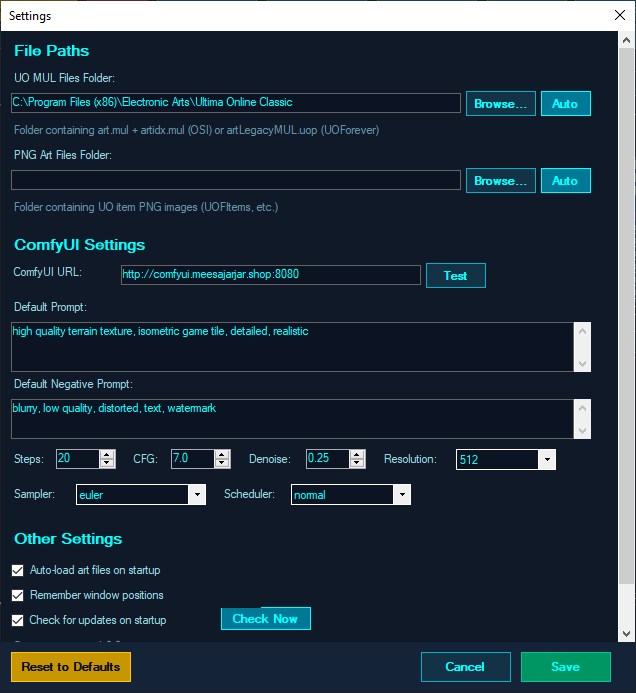
Settings

Settings Panel


Main Editors

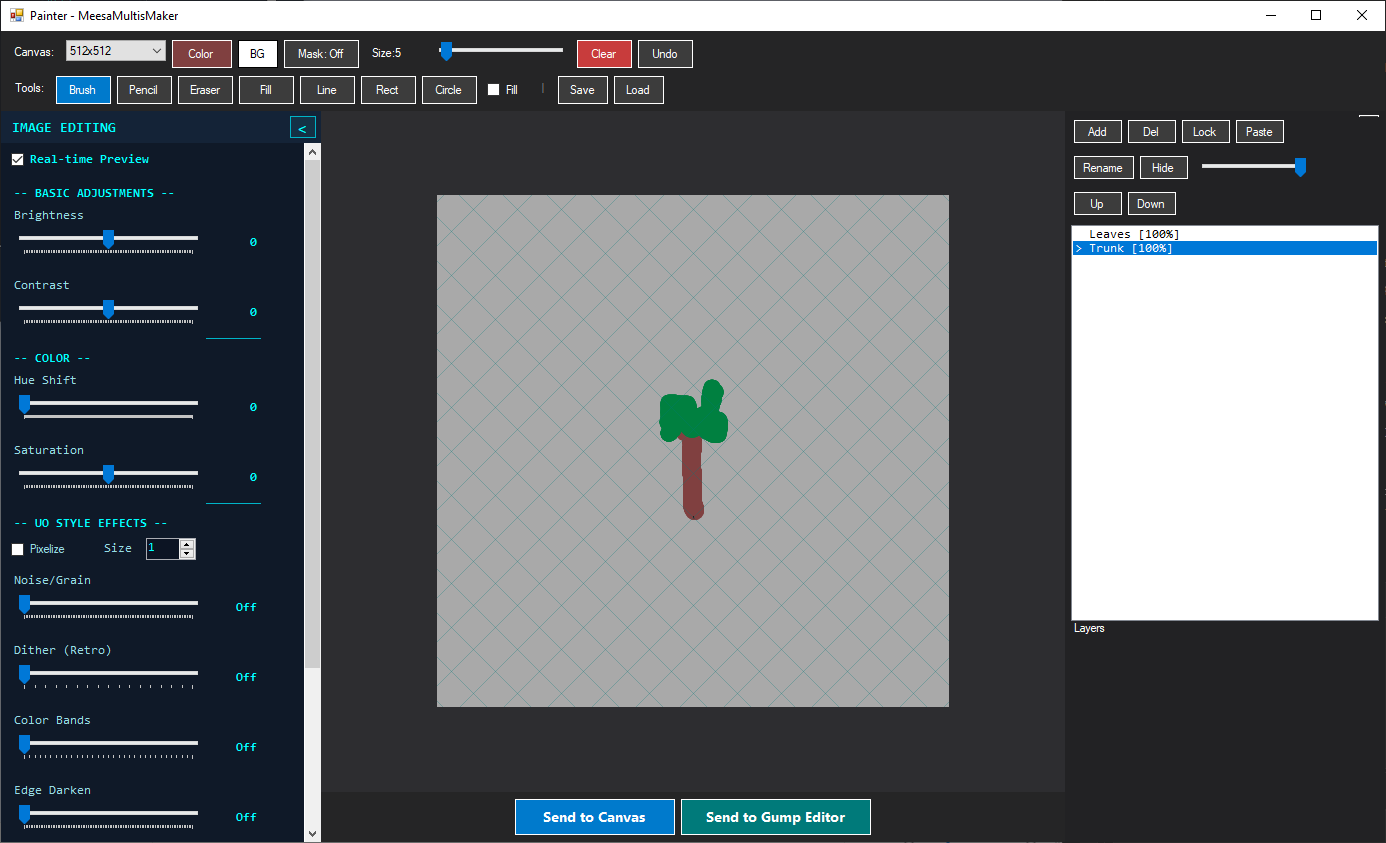
Painter Form

Painter Form

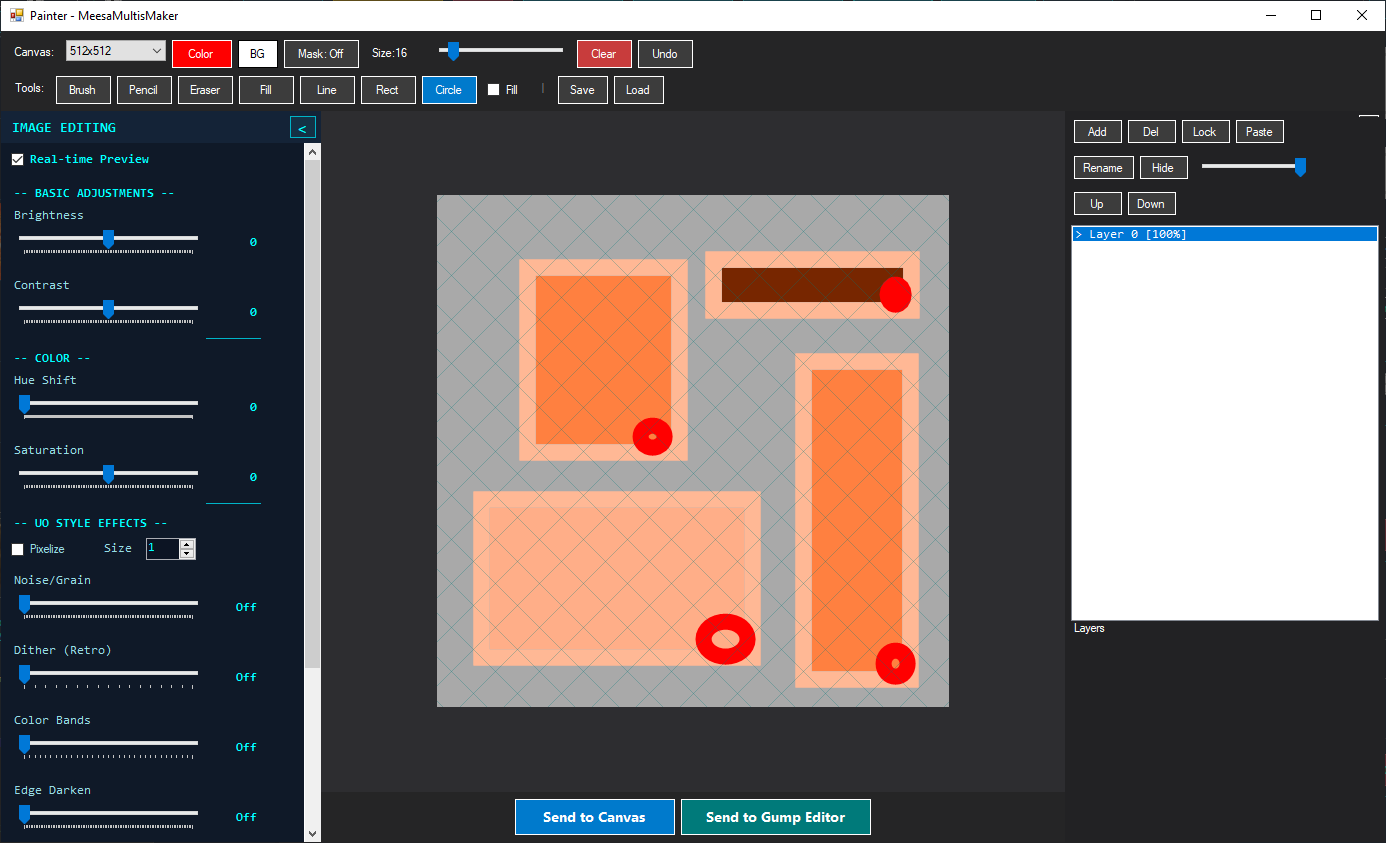
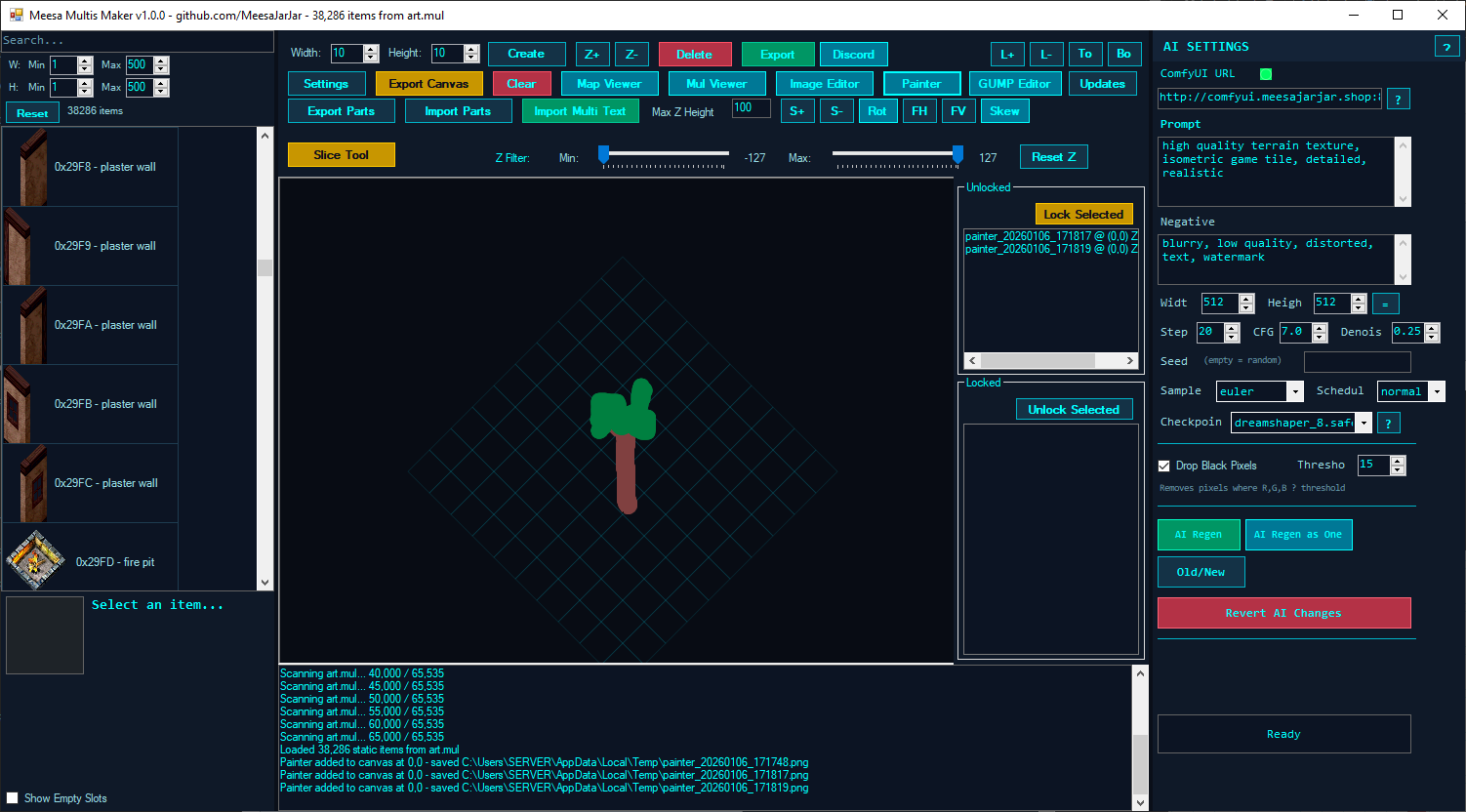
A full-featured layer-based pixel art editor for creating custom sprites.

Painter Layers Painter Drawing

Features:

  • Multiple canvas sizes - 512x512, 768x768, 1024x1024, 1536x1536
  • Layer system - Add, delete, reorder, rename, lock, and adjust opacity
  • Drawing tools:
    • Brush (soft round with anti-aliasing)
    • Pencil (hard pixel-perfect)
    • Eraser
    • Flood fill
    • Line tool
    • Rectangle tool
    • Circle/ellipse tool
  • Fill shapes - Toggle between outline and filled shapes
  • Mask mode - Paint masks for AI inpainting
  • Zoom - Ctrl+Scroll or Ctrl+/Ctrl- to zoom
  • Undo - Per-layer undo history (Ctrl+Z)
  • Clipboard - Paste images directly (Ctrl+V)
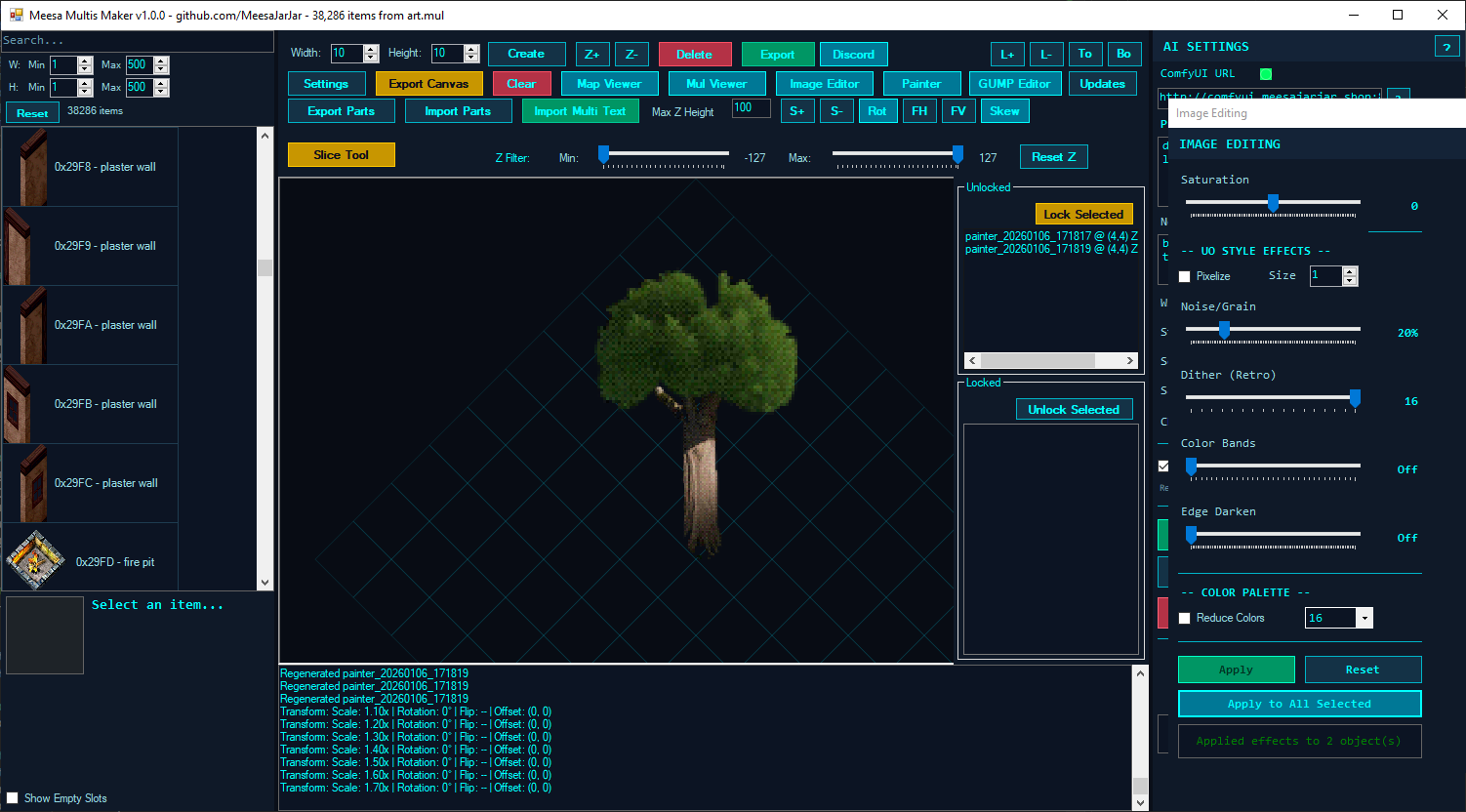
  • Image effects panel - Brightness, contrast, hue, saturation, pixelize, noise, dither
  • Send to Canvas - Export merged image to main form
  • Send to GUMP Editor - Export to GUMP Editor

Painter Effects Painter AI

GUMP Editor

GUMP Editor

Specialized editor for Ultima Online UI graphics (GUMPs).

GUMP Editor Palette

Features:

  • GUMP palette browser - Search and filter available GUMPs
  • Drag-and-drop placement - Add GUMPs to canvas
  • Multi-selection - Select and transform multiple GUMPs
  • Transform tools:
    • Scale (resize with handles or S+/S- buttons)
    • Rotate (15� increments or free rotation)
    • Flip Horizontal / Flip Vertical
    • Skew (adjustable X/Y skew with live preview)
    • Slice (divide gumps into grid pieces)
  • Layer management - Organize GUMPs in layers
  • AI regeneration (ComfyUI):
    • Single GUMP regeneration
    • Multi-GUMP combined regeneration (processes as one image, splits result)
    • Alpha mask preservation
    • Post-generation black pixel adjustment - Toggle and adjust threshold after AI generation
    • Old/New comparison toggle
    • Revert to original
  • Custom image import - Add PNG images as GUMPs
  • Canvas export - Save compositions as PNG

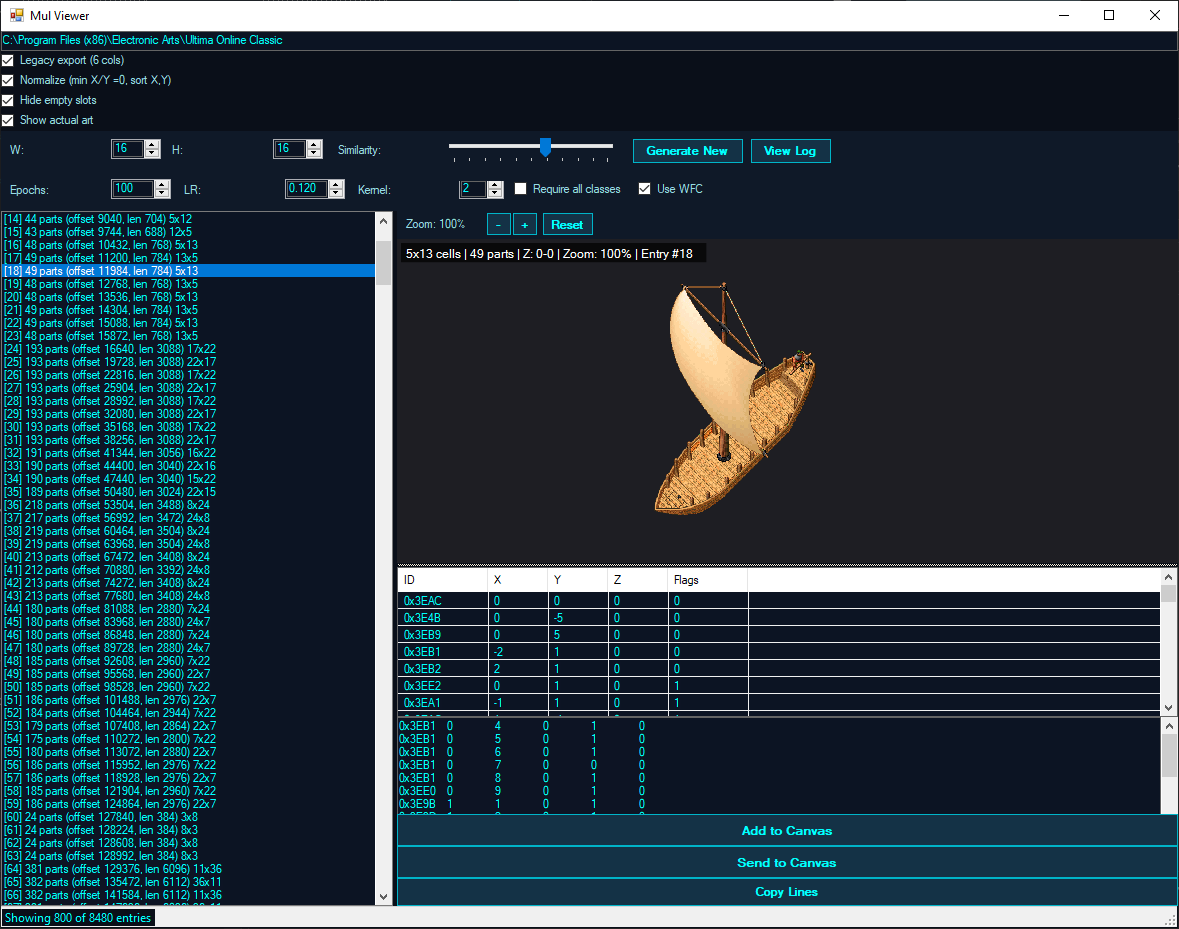
MUL Viewer

MUL Viewer

Browser for viewing and generating multi structures from MUL files.

Features:

  • Multi entry browser - List all multis with dimensions
  • Parts view - See individual components with TileID, X, Y, Z, Flags
  • Preview rendering - Isometric preview with pan and zoom
  • Hide empty entries - Filter out empty multi slots
  • Normalize coordinates - Center multi at origin
  • Export text format - Copy multi definition to clipboard
  • Send to Canvas - Import selected multi to main editor
  • Add to Canvas - Append multi to existing objects

Structure Generation (AI-like):

  • Select one or more multis as training data
  • Configure output dimensions (width x height)
  • Adjust generation parameters:
    • Kernel size
    • Epochs
    • Learning rate
    • Similarity factor
  • Choose algorithm:
    • Neural network (SimpleCnn)
    • Wave Function Collapse (WFC)
  • Generate new structures based on learned patterns

3D Editor

Text-to-3D sprite pipeline ("MultisMaker1"): prompt ComfyUI for a model, orbit it through the 8 UO facings, slice it into floor-aligned UO tiles, and send the tiles to the canvas.

  • Text to PLY - prompt, seed, sampler steps via ComfyUI; optional init image (including straight from the Painter); Use view as input for iterative refine; timestamped .ply outputs
  • Viewport - orbit/zoom, 8 UO facing snap + Set S, UO-mode pitch lock (~26.57), splat-density cap for previews, middle-drag pan on ground plane, Quad Top/Front/Side/Persp views, direction buttons
  • Tile slicing - floor-space hard-cut by splat center (no blend); TILE 44x44, Z_PIXEL 4, FloorGridCells 10; floor grid drives tiles (no manual X/Z counts); origin-relative send, canvas centers batch; calibrated 1 cell = 44px export + zoom; centered crop; dials-baked + slice-time yaw; orbit re-cuts, dials re-cut debounced, EnsureFreshSlice on send/export
  • Tile dock - slice/clear, isolate render path, send-all (TilesReady), export-all, 9-slice expand + hollow, auto-refresh
  • Edit survival - tile list survives delete/clone/undo via Reclassify / RefreshSlicesKeepActive; undo split IsDelete vs mutate
  • Dials + offsets - rotation/scale bake into positions; Scale X/Y/Z lock (default on); OffX/OffY numerics + O0 mirror PixelOffsetX/Y, non-destructive, no bitmap padding
  • Loop mode - auto-resubmit forever (fresh image and/or fresh LLM-dreamed prompt each round)
  • Spintable export - 24-frame rotation sheets (+ GIF)

Animation Editor

Viewer/player/editor for Ultima Online mobile animations (anim.mul family): scrub frames, edit, and export PNG sequences. See the full guides in docs/: ANIMATION_EDITOR_GUIDE.md, ANIMATION_EDITOR_QUICK_REF.md, ANIMATION_EDITOR_TROUBLESHOOTING.md.

Audio Editor

ComfyUI-powered sound design: text-to-SFX, text-to-music, voice cloning / voice design (Qwen TTS), a webcam-driven ambient Watcher that scores the scene with generative foley + music layers, and UO sound.mul / music-folder integration.

  • SFX / Music / Voice tabs - prompt, negative prompt, duration, seed, steps, per-kind workflows (FASTAUDIOTGEN SFX, WORKINGAUDIO Music, Qwen TTS clone/design); category forced SFX/Music; reprompt off by default; saver filename_prefix pinned to short IDs (no Errno 22); upload/audio then upload/image fallback; queue/history polling with fail-fast server errors
  • Filenames + ledgers - short IDs (yyMMdd_HHmmss_kind), never prompt text; master pipe-delimited AudioPrompts.csv (id|created|kind|seed|duration_s|audio_file|prompt) + library.jsonl with prompt/seed/workflow/file/scene/caption
  • Waveform + edits - transport, trim/fade/normalize/gain/resample/mono/reverse/silence-crop/loop-crossfade; edge-silence trim (-45dB + pad + micro-fades); ffmpeg decode to editable WAV + mm_savewav sibling
  • Radio - AutoQueue keeps 1 ahead, tight 750ms end-poll swap; ON AIR mini-views with playheads
  • Watcher sensing + scheduling - webcam via ffmpeg dshow, VL Qwen2-VL-2B via local server; two editable persisted questions (foley/music); sense every N sec (never blocks), 1s scheduler prefetches before clip end reusing freshest prompt; foley length = period, music overlap + 15s minimum hold; adaptive render estimates with EWMA; queue-to-ready timing; 15s failure backoff; layer-disable mid-render keeps file without airing; snapshot force-queues
  • Change-gating - 16x16 gray-hash frame gate (adjustable Δ%, default 4%) + word-Jaccard prompt gate (0.85); static scenes loop on-air file with zero GPU (loop-prepped CrossfadeLoop), dynamic scenes prefetch with lead time
  • Crossfaded swaps - dual-alias MCI flip-flop, 1s foley / 2s music over 12 steps (clamped to 60% body), late renders degrade to fade-in, cancel finishes instantly
  • DJ timeline - vertical cards newest-first (orange foley / cyan music), time/layer/dur/seed header, clip + prompt, live progress, ON AIR pulse, played Xs stamp; click for full PROMPT/SCENE/HEARD, hover tooltip, double-click loads to Clips, Clear, 200 cap
  • Quality gates (optional Python sidecar AudioGateServer.py on 127.0.0.1:18171, killed on close) - Whisper vocal bouncer (≥4 words on instrumental intent → one hardened retry, air best, loser kept); CLAP match floor (reject <0.10 → one retry, air best); LUFS match (-19 music / -16 foley, TP -2, LRA 11, two-pass loudnorm with rate pin); scores in log + timeline/library tags; Bounce vocals / CLAP gate checkboxes
  • Captions (laion/sound-effect-captioning-whisper, lazy load, first 30s) - auto-caption aired + manual/radio takes into library Caption (searchable, backfilled by Describe); Describe buttons on timeline cards + clip panel
  • Manual/radio behavior - same trim + loudnorm; transcribe/CLAP measured + logged (no auto-retry); radio buffers, library appends
  • UO integration - legacy pair + soundLegacyMUL.uop (1655 entries, in-place fixed-size replace + .bak, FitToFrames); Music/Digital/*.mp3 + Config.txt browser; slot play, clip-to-slot, save, fit; 22050 mono conversion for legacy slots
  • Library tab - prompt/kind/scene/caption search, missing-file flags, prune, reuse prompt, play

Image Editor

Image Editor

Quick image effects editor for adjusting brightness, contrast, and applying filters to selected objects.

Map Viewer

World map browser with tile/static editing and AI replacement.

Features:

  • Facet selection - Browse Felucca, Trammel, Ilshenar, Malas, Tokuno, Ter Mur
  • Pan and zoom - Navigate large maps efficiently
  • Minimap generation - Overview of entire map
  • Coordinate navigation - Jump to specific X,Y location
  • Selection modes:
    • Land tiles
    • Statics
    • Lasso selection for irregular areas
  • Z-level filtering - Show statics within Z range
  • Static manipulation:
    • Move with numpad keys (X, Y, Z)
    • PageUp/PageDown for Z adjustment
  • AI tile replacement (ComfyUI):
    • Replace mode - Simple regeneration
    • Context mode - Context-aware inpainting
    • Batch processing of selected tiles
  • Show statics toggle - View map with or without statics
  • TileData display - View item properties

Export Map

Export the currently loaded map as a high-resolution isometric image or a set of tiled JPEG files with an interactive HTML viewer.

Export Options:

  • Zoom (px/tile) - Output resolution from 1 (tiny overview) to 44 (full detail per tile)
  • Include Static Objects - Render statics on top of land tiles with hue, translucency, and partial-hue support
  • Export HTML & Minimap Only - Regenerate the viewer, minimap, and globe texture without re-rendering tiles (useful for quick iteration)
  • Generate Mipmap Only - Rebuild the mipmap pyramid from existing tiles without re-rendering
  • Region selection - Export the entire map or a custom rectangular region (Start X/Y, End X/Y)

Output Modes:

Image SizeOutput
? 100 MPSingle PNG, JPEG, or BMP file
> 100 MPFolder of 512�512 JPEG tiles with HTML viewer

Tiled Export Contents:

  • tile_R_C.jpg - Full-resolution rendered tiles (row R, column C)
  • viewer.html - Interactive pan/zoom map viewer (open in any browser)
  • minimap.jpg - Isometric radar-color overview for quick navigation
  • globe_texture.png - Composited image from the coarsest mipmap level, suitable for projecting onto a 3D globe
  • L1/, L2/, � LN/ - Mipmap tile pyramids for efficient zoomed-out viewing

HTML Viewer Features:

  • Drag to pan, mouse-wheel to zoom
  • Clickable minimap for quick navigation
  • Automatic mipmap level switching when zoomed out
  • Only visible tiles are loaded into the DOM for memory efficiency
  • Zoom buttons: +, ?, 1:1, Fit

Rendering Details:

  • Tiles are rendered using textured isometric projection with deformed terrain (Z-height per corner)
  • NoDraw land tiles and statics are automatically filtered out
  • Statics are drawn with correct depth sorting (painter's algorithm), hue coloring, translucency, and foliage layering
  • Tiles are rendered in parallel across all CPU cores for maximum speed
  • Art assets are pre-loaded and serialized to byte arrays so parallel threads never contend on shared GDI+ objects

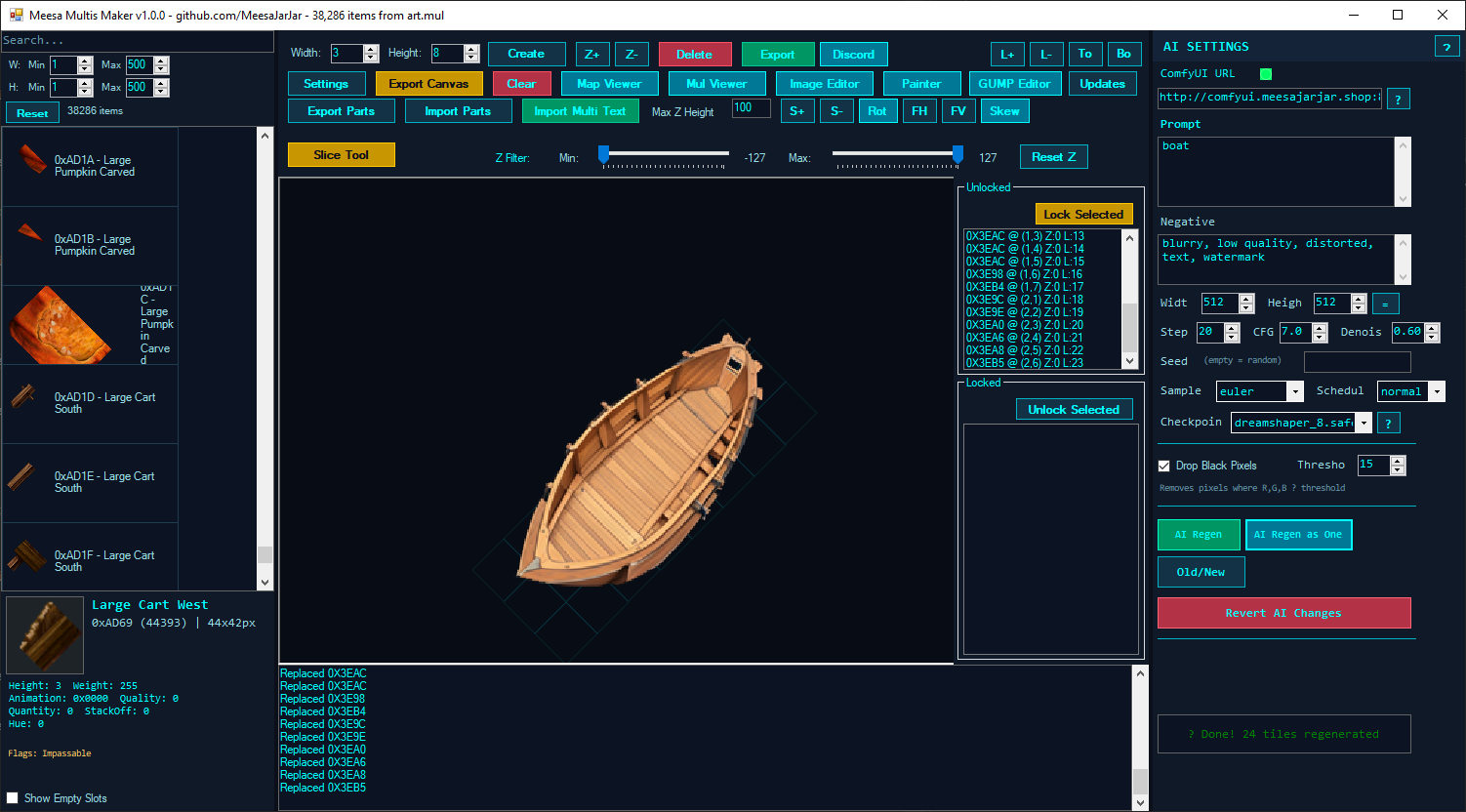
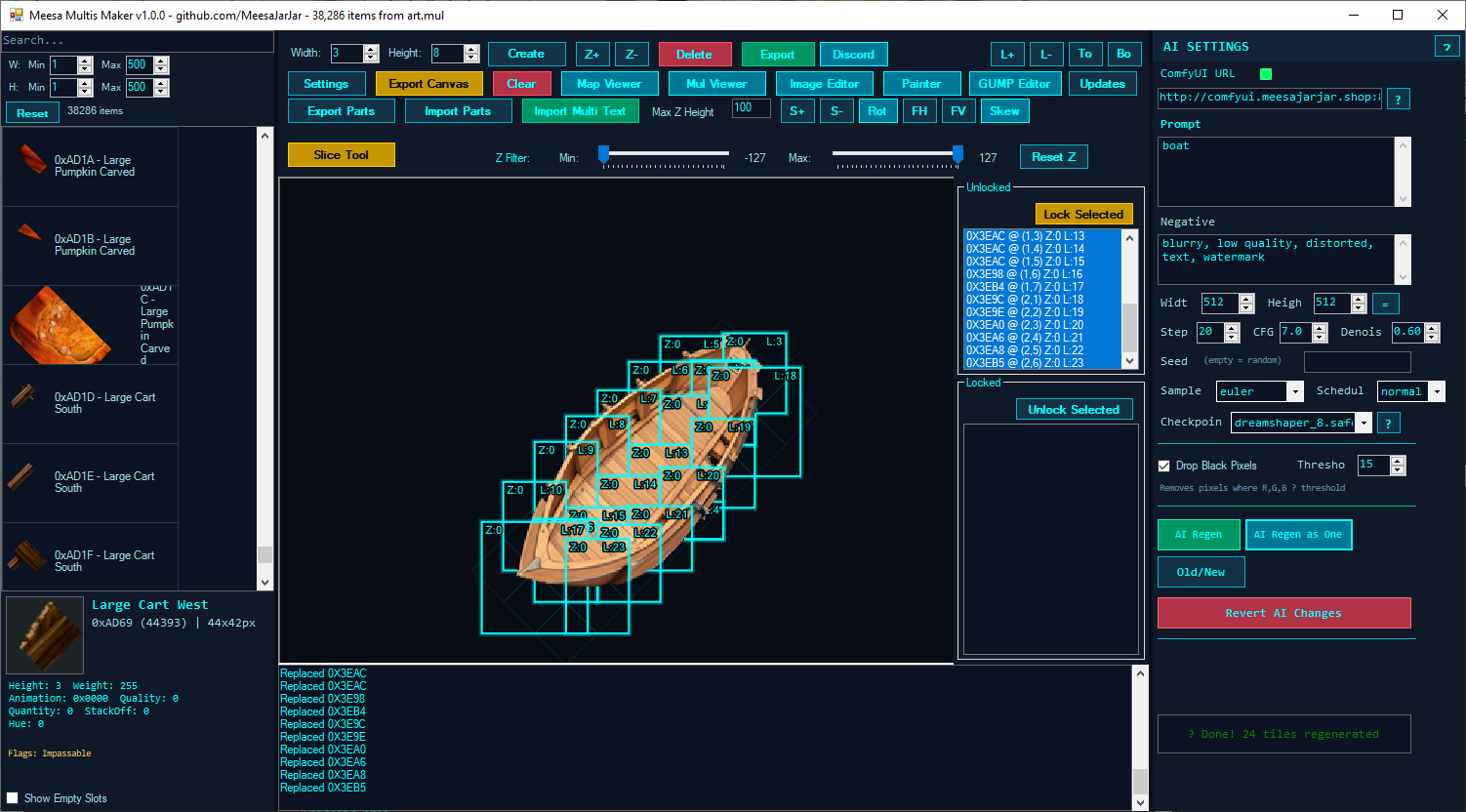
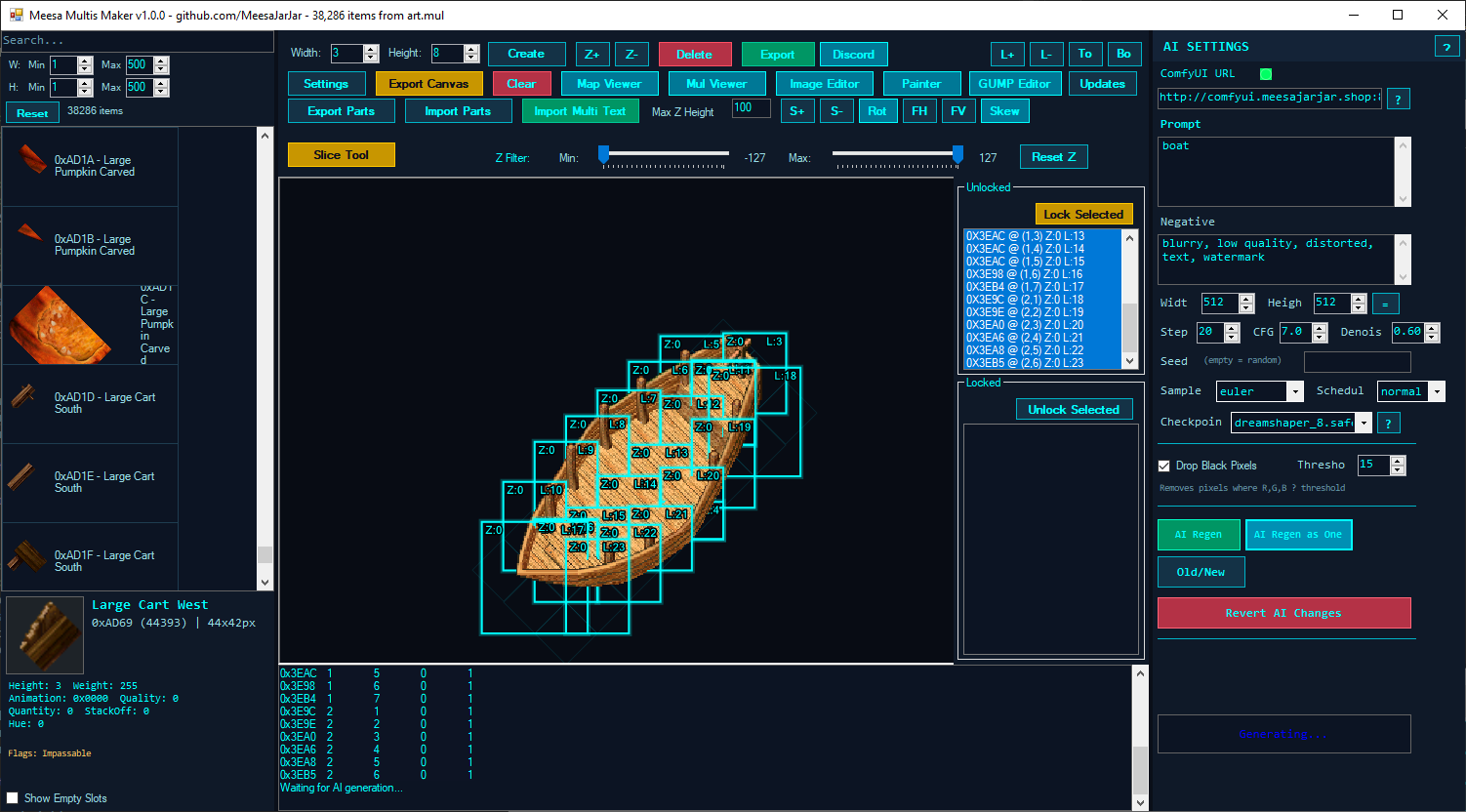
Boat Building 1 Boat Building 2


Installation

Download

  1. Download the latest release from the Releases page
  2. Extract the ZIP file to a folder of your choice
  3. Run MeesaMultisMaker.exe

First Launch

  1. Accept the license agreement
  2. Browse to your Ultima Online installation folder when prompted
    • The application will search common paths automatically:
      • C:\Program Files (x86)\Electronic Arts\Ultima Online Classic
      • C:\Program Files (x86)\UOForever\UO
      • And other common locations

Supported Asset Formats

  • MUL Files - Standard OSI format (art.mul + artidx.mul)
  • UOP Files - Enhanced format (artLegacyMUL.uop)
  • PNG Art Folders - UOFItems-style PNG directories

Getting Started

Basic Workflow

  1. Load Assets - Click "MUL Folder..." to select your Ultima Online installation
  2. Browse Palette - Use the left panel to search and browse available art
  3. Place Objects - Drag items from the palette onto the canvas
  4. Transform - Select objects and use transform tools to position them
  5. Export - Save your creation using the Export button

Creating a Multi Structure

  1. Set grid size using Width/Height controls (e.g., 10x10)
  2. Click "Create Grid" to initialize the canvas
  3. Drag foundation pieces from the palette
  4. Add walls, set appropriate Z levels with Z+/Z- buttons
  5. Layer decorations using L+/L- for draw order
  6. Export as Multi Text for use in-game

AI Integration

All image generation runs through a ComfyUI server (local or remote). Selecting a flux-2-klein checkpoint switches inpaint workflows to the dedicated Flux.2 Klein graph (Flux UNET + flux2 CLIP + Flux2 VAE).

ComfyUI (Server-based)

ComfyUI provides more flexibility with model selection and advanced workflows.

Advantages:

  • ? Wide variety of checkpoint models
  • ? Advanced features (ControlNet, inpainting, etc.)
  • ? Can run on a remote server
  • ? More control over generation parameters

Requirements:

  • Running ComfyUI server (local or remote)
  • Stable Diffusion checkpoint models

Setting Up ComfyUI

Option 1: Google Colab (Free, No GPU Required!)

ComfyUI can run in Google Colab notebooks for free using their T4 free GPUs.

Step 1. Go to https://colab.research.google.com/

Step 2. Click "New notebook" button.

Step 3. Paste this script into the notebook cell:

!git clone https://github.com/comfyanonymous/ComfyUI.git
!pip install -r /content/ComfyUI/requirements.txt
!pip install pinggy
!mkdir -p models/checkpoints
!wget -O models/checkpoints/sd_xl_base_1.0.safetensors \
https://huggingface.co/stabilityai/stable-diffusion-xl-base-1.0/resolve/main/sd_xl_base_1.0.safetensors?download=true

!wget -O /content/ComfyUI/models/checkpoints/dreamshaper_8.safetensors \
https://huggingface.co/jzli/DreamShaper-8/resolve/main/dreamshaper_8.safetensors

import pinggy

tunnel = pinggy.start_tunnel(forwardto="localhost:8188")

print("Public URL(s):")
for url in tunnel.urls:
    print(url)

!cd /content/ComfyUI && python main.py --listen 0.0.0.0

Step 4. Click the Play button to run the script.

Step 5. Copy the pinggy URL and paste it into the ComfyUI URL field. Add :80 to the end.

Example: http://eyzzg-33-125-104-65.a.free.pinggy.link:80

Option 2: Run Your Own ComfyUI Server (Local)
  1. Install ComfyUI

    git clone https://github.com/comfyanonymous/ComfyUI
    cd ComfyUI
    pip install -r requirements.txt
    
  2. Download Required Models Place these in your ComfyUI models/checkpoints folder:

    • DreamShaper 8 - dreamshaper_8.safetensors
    • SD 1.5 - v1-5-pruned-emaonly.ckpt
  3. Start ComfyUI

    python main.py --listen 0.0.0.0 --port 8080
    
  4. Configure in Meesa Multis Maker

    • Select "ComfyUI (Server)" from AI Backend dropdown
    • Set ComfyUI URL to http://localhost:8080

AI Settings Panel Options

SettingDescriptionDefault
AI BackendComfyUI (Server)ComfyUI
PromptPositive prompt for generation(varies)
Negative PromptElements to avoid"blurry, low quality..."
StepsDenoising steps20
CFG ScalePrompt adherence4.0
DenoiseTransformation strength0.55
SamplerSampling methodeuler
SchedulerNoise schedulenormal
ResolutionOutput size512x512
Drop Black PixelsRemove dark backgroundsEnabled
Black ThresholdDarkness cutoff for removal15
Use CaseStepsCFGDenoiseSampler
Quick Preview1540.4euler
Standard Quality2040.55euler
High Quality3050.6dpmpp_2m
Subtle Changes1540.3euler

Prompting Tips

Good prompts for UO-style assets:

  • "isometric game tile, pixel art style, [object description], clean background"
  • "3d model isometric view, [object], black background, studio lighting"
  • "ultima online style, medieval fantasy, [object]"

Negative prompt suggestions:

  • "blurry, low quality, distorted, text, watermark, signature"
  • "modern, sci-fi, photo-realistic" (if you want stylized results)

Keyboard Shortcuts

Canvas Navigation

KeyAction
Middle MousePan canvas
Ctrl + ScrollZoom in/out
EscapeExit current mode (Slice/Skew/Rotate)

Selection

KeyAction
ClickSelect single object
Ctrl + ClickAdd/remove from selection
Ctrl + DragMarquee select
Alt + DragMarquee deselect

Object Manipulation

KeyAction
DeleteDelete selected objects
Numpad 1-9Move in grid directions
Alt + ArrowsPixel offset (fine movement)
Alt + Shift + ArrowsFast pixel offset

Transforms

KeyAction
+ / -Scale up/down
Shift + +/-Scale faster
RToggle rotate mode
Shift + RRotate 15 degrees
Ctrl + RRotate -90 degrees
FFlip horizontal
Shift + FFlip vertical
KToggle skew mode
Shift + KReset skew
Ctrl + TReset all transforms

Editing

KeyAction
Ctrl + CCopy selection
Ctrl + VPaste at cursor
Ctrl + ZUndo
Ctrl + YRedo
HHide selected objects
Shift + HShow all hidden objects

Map Viewer (Statics Selected)

KeyAction
Numpad 8Move X-1, Y-1
Numpad 2Move X+1, Y+1
Numpad 4Move X-1, Y+1
Numpad 6Move X+1, Y-1
Numpad 7Move X-1
Numpad 9Move Y-1
Numpad 1Move Y+1
Numpad 3Move X+1
Page Up / +Move Z+1
Page Down / -Move Z-1
EscapeCancel lasso selection

Painter

KeyAction
Ctrl + ZUndo (per-layer)
Ctrl + VPaste image as layer
Ctrl + NAdd new layer
Ctrl + +/-Zoom in/out
Ctrl + 0Reset zoom

GUMP Editor

KeyAction
DeleteDelete selected gump(s)
Ctrl + ZUndo
Ctrl + YRedo
Ctrl + SExport canvas

Configuration

Settings are stored in:

%APPDATA%\MeesaMultisMaker\config.xml

Audio generations live in Documents\MeesaMultisMaker\Audio\ (library.jsonl prompt ledger, AudioPrompts.csv pipe-delimited prompt log, rendered clips).

Configurable Options

  • MUL folder path
  • PNG art folder path
  • ComfyUI server URL
  • Default AI generation parameters (prompt, steps, CFG, denoise, sampler, scheduler, resolution)
  • Audio watcher cadence, scene-change threshold, vocal bouncer, CLAP gate
  • Update check preferences
  • Window position preferences

Troubleshooting

Common Issues

"Parameter is not valid" error on images

  • This can occur if image data becomes corrupted. Try reloading the application.
  • Ensure your MUL files are not corrupted.

ComfyUI connection fails

  • Verify ComfyUI is running and accessible
  • Check firewall settings
  • Ensure the URL includes the port (e.g., http://localhost:8080)
  • For Google Colab, make sure to add :80 to the pinggy URL
  • Test with "Test Connection" button

Missing art/textures

  • Verify the MUL folder path in settings
  • Check that art.mul and artidx.mul exist (or artLegacyMUL.uop for UOP format)

AI generation produces black images

  • Enable "Drop Black Pixels" option
  • Adjust the "Black Threshold" slider after generation
  • For ComfyUI: Ensure checkpoint models are installed

AI output is wrong size (too large/small)

  • The AI automatically resizes output to match the original image dimensions
  • If using scaled gumps, the output will match the source image size, not the displayed size

Multi generation produces empty results

  • Select at least one multi entry as training data
  • Ensure selected multis have components
  • Try adjusting kernel size and epochs

Google Colab session disconnects

  • Free Colab sessions have time limits and will disconnect after inactivity
  • Simply re-run the script to start a new session
  • You'll get a new pinggy URL each time

Getting Help


File Formats

Multi Text Format

Tab-separated values with columns:

TileID  X   Y   Z   Flags
0x0001  0   0   0   1
0x0002  1   0   0   1

Supported Image Formats

  • PNG (recommended for transparency)
  • BMP
  • JPG/JPEG
  • GIF

MUL Files Used

  • art.mul / artidx.mul - Item and land art
  • artLegacyMUL.uop - UOP format art
  • gumpart.mul / gumpidx.mul - UI graphics
  • gumpartLegacyMUL.uop - UOP format gumps
  • map*.mul - World map data
  • statics*.mul / staidx*.mul - Static objects
  • multi.mul / multi.idx - Multi structures
  • tiledata.mul - Item properties

Credits


Building from Source

Requirements: Windows, .NET SDK (builds the .NET Framework 4.8.1 target), and NuGet restore (automatic).

git clone https://github.com/MeesaJarJar/MeesaMultisMaker.git
cd MeesaMultisMaker
dotnet build MeesaMultisMaker/MeesaMultisMaker.csproj -c Release

The binary lands in MeesaMultisMaker/bin/Release/MeesaMultisMaker.exe. No game files ship with the repo: point the app at your own Ultima Online installation on first launch.

Feature dependencies (all optional, all downloaded on first use except where noted):

  • AI image generation - needs a running ComfyUI server (local or remote); checkpoints (including Flux.2 Klein) live in the server's models/ folders.
  • LLM + vision models - GGUF weights auto-download on first use.
  • llama.cpp server - llama-server.exe is NOT in the repo: download a Windows release from llama.cpp and place it (with its ggml-*.dll files, already in MeesaMultisMaker/LLM/bin/) next to them.
  • Audio quality gates (vocal bouncer, CLAP match, captions) - need Python 3.12, ffmpeg, and pip install faster-whisper laion-clap transformers librosa torch torchvision; without them generation still works, gates report unavailable.
  • Push to MeesaJarJar - currently disabled in code (AppConfig.JarJarPushEnabled = false); the buttons render grayed-out. Flip the flag to restore it against your own server.

License

This project is licensed under the MIT License. See the LICENSE file for full terms.


Contributing

Pull requests are welcome:

  • Bug reports via GitHub Issues
  • Feature requests and suggestions
  • Community tutorials and guides
  • Sharing your creations!

Made with love for the Ultima Online community

Copyright 2024-2026 MeesaJarJar. All rights reserved.

MeesaJarJar/MeesaMultisMaker

Meesa Multis Maker is a Windows tool by MeesaJarJar for creating and editing Ultima Online multi structures and GUMP graphics. Features an isometric canvas with drag-and-drop placement, transforms (scale/rotate/flip/skew), AI-powered texture regeneration via ComfyUI, MUL/UOP file support, and a built-in pixel painter.

C#

8

22 commits

updated Oct 7, 2026

See the code

README

Meesa Multis Maker

The ultimate tool for creating Ultima Online multi structures and GUMP graphics with AI-powered texture regeneration

Meesa Multis Maker Main Application

Features � Installation � Getting Started � Editors � AI Integration � Shortcuts � License


Overview

Meesa Multis Maker is a Windows desktop application for composing, editing, exporting, and AI-regenerating isometric game assets used in Ultima Online-style multis and GUMPs. It provides a powerful canvas for placing item art on an isometric diamond grid with support for complex transforms and integrates AI pipelines for texture and static regeneration.

System Requirements

  • OS: Windows 7 or later
  • .NET Framework: 4.8.1 or later
  • Ultima Online Client: Required for MUL/UOP asset files
  • GPU (Optional): NVIDIA GPU recommended for local model inference (LLM, vision, audio gates) and local ComfyUI
  • ComfyUI Server (Optional): For server-based AI image generation
  • Python 3.12 + ffmpeg (Optional): Audio quality gates (vocal bouncer, CLAP match, captions) via pip install faster-whisper laion-clap transformers librosa torch torchvision
  • llama.cpp server binary (Optional): llama-server.exe beside its ggml-*.dll files in MeesaMultisMaker/LLM/bin/ for local LLM/vision features (weights auto-download)
Features

Isometric Canvas Editor (Main Form)

Main Canvas Editor

  • Diamond grid system - Standard 44x44 pixel Ultima Online tile format
  • Multi-object selection - Ctrl+Click for multi-select, marquee selection with Ctrl+Drag
  • Z-ordering and layering - Full control over object depth and draw order
  • Pan & Zoom - Middle-click pan, Ctrl+Scroll to zoom (0.2x to 4x)
  • Snap-to-grid - Objects automatically align to isometric grid positions
  • Z-level filtering - Filter visible objects by Z height range

Building Walls Complex Structures

Transform Tools

  • Scale - Resize objects (0.1x to 10x) with +/- keys
  • Rotate - Free rotation with R key, 15 degree or 90 degree snap with Shift/Ctrl
  • Flip - Horizontal (F) and Vertical (Shift+F) flipping
  • Skew/Distort - Corner-based perspective transform (K key)
  • Pixel Offset - Fine-tune positioning with Alt+Arrow keys

Slice Tool

Slice Tool Slice Tool Result

Create vertical slices of placed images based on selected diamond tiles - perfect for creating building pieces that align perfectly with the isometric grid.

Lock System

  • Lock objects to prevent accidental editing
  • Separate locked/unlocked object lists
  • Multi-select lock/unlock operations

AI Integration (ComfyUI)

All image generation runs through a ComfyUI server (local or remote):

  • More model options - Use any Stable Diffusion checkpoint, including Flux.2 Klein (flux-2-klein-9b.safetensors + flux2 CLIP + flux2-vae), which gets dedicated inpaint workflows when selected
  • Advanced workflows - Inpainting, ControlNet, and more
  • Remote processing - Can run on a separate machine or cloud

AI Features:

  • Image-to-Image - Transform existing sprites with AI
  • Inpainting - Selective region regeneration with masks
  • Text-to-Image - Generate new assets from text prompts
  • Batch Processing - Regenerate multiple selected objects at once
  • Old/New Toggle - Compare AI-generated results with originals
  • Drop Black Pixels - Automatic background removal (adjustable post-generation)

Import/Export

  • Canvas Export - Save entire canvas as PNG
  • Multi Text Import/Export - Load/save Ultima Online multi format files
  • Parts Export - Export individual components for AI processing
  • MUL File Export - Save directly to Ultima Online asset files

Settings

Settings Panel


Main Editors

Painter Form

Painter Form

A full-featured layer-based pixel art editor for creating custom sprites.
Painter Layers Painter Drawing

Features:

  • Multiple canvas sizes - 512x512, 768x768, 1024x1024, 1536x1536
  • Layer system - Add, delete, reorder, rename, lock, and adjust opacity
  • Drawing tools:
    • Brush (soft round with anti-aliasing)
    • Pencil (hard pixel-perfect)
    • Eraser
    • Flood fill
    • Line tool
    • Rectangle tool
    • Circle/ellipse tool
  • Fill shapes - Toggle between outline and filled shapes
  • Mask mode - Paint masks for AI inpainting
  • Zoom - Ctrl+Scroll or Ctrl+/Ctrl- to zoom
  • Undo - Per-layer undo history (Ctrl+Z)
  • Clipboard - Paste images directly (Ctrl+V)
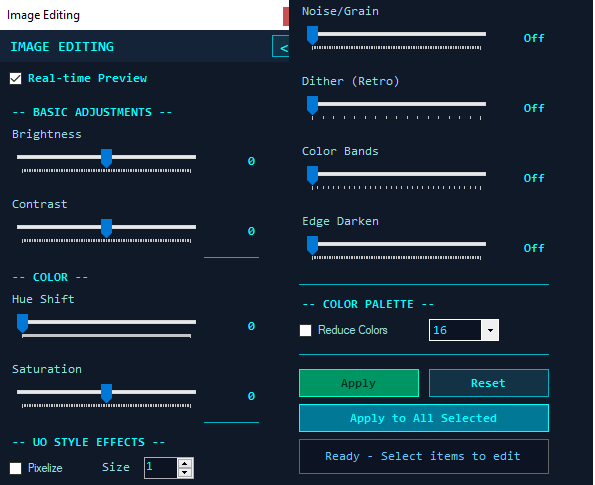
  • Image effects panel - Brightness, contrast, hue, saturation, pixelize, noise, dither
  • Send to Canvas - Export merged image to main form
  • Send to GUMP Editor - Export to GUMP Editor

Painter Effects Painter AI

GUMP Editor

GUMP Editor

Specialized editor for Ultima Online UI graphics (GUMPs).
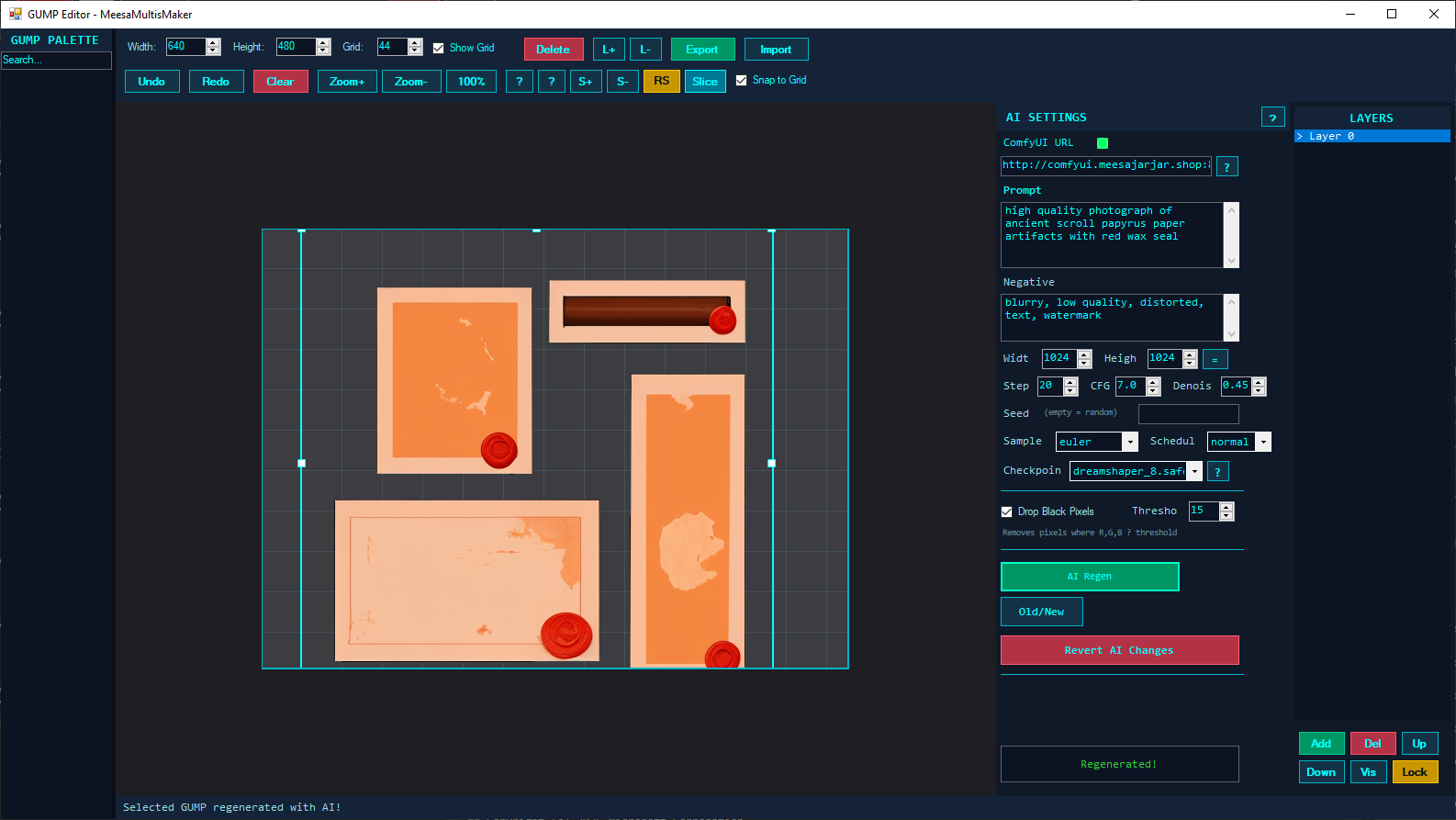
GUMP Editor Palette

Features:

  • GUMP palette browser - Search and filter available GUMPs
  • Drag-and-drop placement - Add GUMPs to canvas
  • Multi-selection - Select and transform multiple GUMPs
  • Transform tools:
    • Scale (resize with handles or S+/S- buttons)
    • Rotate (15� increments or free rotation)
    • Flip Horizontal / Flip Vertical
    • Skew (adjustable X/Y skew with live preview)
    • Slice (divide gumps into grid pieces)
  • Layer management - Organize GUMPs in layers
  • AI regeneration (ComfyUI):
    • Single GUMP regeneration
    • Multi-GUMP combined regeneration (processes as one image, splits result)
    • Alpha mask preservation
    • Post-generation black pixel adjustment - Toggle and adjust threshold after AI generation
    • Old/New comparison toggle
    • Revert to original
  • Custom image import - Add PNG images as GUMPs
  • Canvas export - Save compositions as PNG

MUL Viewer

MUL Viewer

Browser for viewing and generating multi structures from MUL files.

Features:

  • Multi entry browser - List all multis with dimensions
  • Parts view - See individual components with TileID, X, Y, Z, Flags
  • Preview rendering - Isometric preview with pan and zoom
  • Hide empty entries - Filter out empty multi slots
  • Normalize coordinates - Center multi at origin
  • Export text format - Copy multi definition to clipboard
  • Send to Canvas - Import selected multi to main editor
  • Add to Canvas - Append multi to existing objects

Structure Generation (AI-like):

  • Select one or more multis as training data
  • Configure output dimensions (width x height)
  • Adjust generation parameters:
    • Kernel size
    • Epochs
    • Learning rate
    • Similarity factor
  • Choose algorithm:
    • Neural network (SimpleCnn)
    • Wave Function Collapse (WFC)
  • Generate new structures based on learned patterns

3D Editor

Text-to-3D sprite pipeline ("MultisMaker1"): prompt ComfyUI for a model, orbit it through the 8 UO facings, slice it into floor-aligned UO tiles, and send the tiles to the canvas.

  • Text to PLY - prompt, seed, sampler steps via ComfyUI; optional init image (including straight from the Painter); Use view as input for iterative refine; timestamped .ply outputs
  • Viewport - orbit/zoom, 8 UO facing snap + Set S, UO-mode pitch lock (~26.57), splat-density cap for previews, middle-drag pan on ground plane, Quad Top/Front/Side/Persp views, direction buttons
  • Tile slicing - floor-space hard-cut by splat center (no blend); TILE 44x44, Z_PIXEL 4, FloorGridCells 10; floor grid drives tiles (no manual X/Z counts); origin-relative send, canvas centers batch; calibrated 1 cell = 44px export + zoom; centered crop; dials-baked + slice-time yaw; orbit re-cuts, dials re-cut debounced, EnsureFreshSlice on send/export
  • Tile dock - slice/clear, isolate render path, send-all (TilesReady), export-all, 9-slice expand + hollow, auto-refresh
  • Edit survival - tile list survives delete/clone/undo via Reclassify / RefreshSlicesKeepActive; undo split IsDelete vs mutate
  • Dials + offsets - rotation/scale bake into positions; Scale X/Y/Z lock (default on); OffX/OffY numerics + O0 mirror PixelOffsetX/Y, non-destructive, no bitmap padding
  • Loop mode - auto-resubmit forever (fresh image and/or fresh LLM-dreamed prompt each round)
  • Spintable export - 24-frame rotation sheets (+ GIF)

Animation Editor

Viewer/player/editor for Ultima Online mobile animations (anim.mul family): scrub frames, edit, and export PNG sequences. See the full guides in docs/: ANIMATION_EDITOR_GUIDE.md, ANIMATION_EDITOR_QUICK_REF.md, ANIMATION_EDITOR_TROUBLESHOOTING.md.

Audio Editor

ComfyUI-powered sound design: text-to-SFX, text-to-music, voice cloning / voice design (Qwen TTS), a webcam-driven ambient Watcher that scores the scene with generative foley + music layers, and UO sound.mul / music-folder integration.

  • SFX / Music / Voice tabs - prompt, negative prompt, duration, seed, steps, per-kind workflows (FASTAUDIOTGEN SFX, WORKINGAUDIO Music, Qwen TTS clone/design); category forced SFX/Music; reprompt off by default; saver filename_prefix pinned to short IDs (no Errno 22); upload/audio then upload/image fallback; queue/history polling with fail-fast server errors
  • Filenames + ledgers - short IDs (yyMMdd_HHmmss_kind), never prompt text; master pipe-delimited AudioPrompts.csv (id|created|kind|seed|duration_s|audio_file|prompt) + library.jsonl with prompt/seed/workflow/file/scene/caption
  • Waveform + edits - transport, trim/fade/normalize/gain/resample/mono/reverse/silence-crop/loop-crossfade; edge-silence trim (-45dB + pad + micro-fades); ffmpeg decode to editable WAV + mm_savewav sibling
  • Radio - AutoQueue keeps 1 ahead, tight 750ms end-poll swap; ON AIR mini-views with playheads
  • Watcher sensing + scheduling - webcam via ffmpeg dshow, VL Qwen2-VL-2B via local server; two editable persisted questions (foley/music); sense every N sec (never blocks), 1s scheduler prefetches before clip end reusing freshest prompt; foley length = period, music overlap + 15s minimum hold; adaptive render estimates with EWMA; queue-to-ready timing; 15s failure backoff; layer-disable mid-render keeps file without airing; snapshot force-queues
  • Change-gating - 16x16 gray-hash frame gate (adjustable Δ%, default 4%) + word-Jaccard prompt gate (0.85); static scenes loop on-air file with zero GPU (loop-prepped CrossfadeLoop), dynamic scenes prefetch with lead time
  • Crossfaded swaps - dual-alias MCI flip-flop, 1s foley / 2s music over 12 steps (clamped to 60% body), late renders degrade to fade-in, cancel finishes instantly
  • DJ timeline - vertical cards newest-first (orange foley / cyan music), time/layer/dur/seed header, clip + prompt, live progress, ON AIR pulse, played Xs stamp; click for full PROMPT/SCENE/HEARD, hover tooltip, double-click loads to Clips, Clear, 200 cap
  • Quality gates (optional Python sidecar AudioGateServer.py on 127.0.0.1:18171, killed on close) - Whisper vocal bouncer (≥4 words on instrumental intent → one hardened retry, air best, loser kept); CLAP match floor (reject <0.10 → one retry, air best); LUFS match (-19 music / -16 foley, TP -2, LRA 11, two-pass loudnorm with rate pin); scores in log + timeline/library tags; Bounce vocals / CLAP gate checkboxes
  • Captions (laion/sound-effect-captioning-whisper, lazy load, first 30s) - auto-caption aired + manual/radio takes into library Caption (searchable, backfilled by Describe); Describe buttons on timeline cards + clip panel
  • Manual/radio behavior - same trim + loudnorm; transcribe/CLAP measured + logged (no auto-retry); radio buffers, library appends
  • UO integration - legacy pair + soundLegacyMUL.uop (1655 entries, in-place fixed-size replace + .bak, FitToFrames); Music/Digital/*.mp3 + Config.txt browser; slot play, clip-to-slot, save, fit; 22050 mono conversion for legacy slots
  • Library tab - prompt/kind/scene/caption search, missing-file flags, prune, reuse prompt, play

Image Editor

Image Editor

Quick image effects editor for adjusting brightness, contrast, and applying filters to selected objects.

Map Viewer

World map browser with tile/static editing and AI replacement.

Features:

  • Facet selection - Browse Felucca, Trammel, Ilshenar, Malas, Tokuno, Ter Mur
  • Pan and zoom - Navigate large maps efficiently
  • Minimap generation - Overview of entire map
  • Coordinate navigation - Jump to specific X,Y location
  • Selection modes:
    • Land tiles
    • Statics
    • Lasso selection for irregular areas
  • Z-level filtering - Show statics within Z range
  • Static manipulation:
    • Move with numpad keys (X, Y, Z)
    • PageUp/PageDown for Z adjustment
  • AI tile replacement (ComfyUI):
    • Replace mode - Simple regeneration
    • Context mode - Context-aware inpainting
    • Batch processing of selected tiles
  • Show statics toggle - View map with or without statics
  • TileData display - View item properties

Export Map

Export the currently loaded map as a high-resolution isometric image or a set of tiled JPEG files with an interactive HTML viewer.

Export Options:

  • Zoom (px/tile) - Output resolution from 1 (tiny overview) to 44 (full detail per tile)
  • Include Static Objects - Render statics on top of land tiles with hue, translucency, and partial-hue support
  • Export HTML & Minimap Only - Regenerate the viewer, minimap, and globe texture without re-rendering tiles (useful for quick iteration)
  • Generate Mipmap Only - Rebuild the mipmap pyramid from existing tiles without re-rendering
  • Region selection - Export the entire map or a custom rectangular region (Start X/Y, End X/Y)

Output Modes:

Image SizeOutput
? 100 MPSingle PNG, JPEG, or BMP file
> 100 MPFolder of 512�512 JPEG tiles with HTML viewer

Tiled Export Contents:

  • tile_R_C.jpg - Full-resolution rendered tiles (row R, column C)
  • viewer.html - Interactive pan/zoom map viewer (open in any browser)
  • minimap.jpg - Isometric radar-color overview for quick navigation
  • globe_texture.png - Composited image from the coarsest mipmap level, suitable for projecting onto a 3D globe
  • L1/, L2/, � LN/ - Mipmap tile pyramids for efficient zoomed-out viewing

HTML Viewer Features:

  • Drag to pan, mouse-wheel to zoom
  • Clickable minimap for quick navigation
  • Automatic mipmap level switching when zoomed out
  • Only visible tiles are loaded into the DOM for memory efficiency
  • Zoom buttons: +, ?, 1:1, Fit

Rendering Details:

  • Tiles are rendered using textured isometric projection with deformed terrain (Z-height per corner)
  • NoDraw land tiles and statics are automatically filtered out
  • Statics are drawn with correct depth sorting (painter's algorithm), hue coloring, translucency, and foliage layering
  • Tiles are rendered in parallel across all CPU cores for maximum speed
  • Art assets are pre-loaded and serialized to byte arrays so parallel threads never contend on shared GDI+ objects

Boat Building 1 Boat Building 2


Installation

Download

  1. Download the latest release from the Releases page
  2. Extract the ZIP file to a folder of your choice
  3. Run MeesaMultisMaker.exe

First Launch

  1. Accept the license agreement
  2. Browse to your Ultima Online installation folder when prompted
    • The application will search common paths automatically:
      • C:\Program Files (x86)\Electronic Arts\Ultima Online Classic
      • C:\Program Files (x86)\UOForever\UO
      • And other common locations

Supported Asset Formats

  • MUL Files - Standard OSI format (art.mul + artidx.mul)
  • UOP Files - Enhanced format (artLegacyMUL.uop)
  • PNG Art Folders - UOFItems-style PNG directories

Getting Started

Basic Workflow

  1. Load Assets - Click "MUL Folder..." to select your Ultima Online installation
  2. Browse Palette - Use the left panel to search and browse available art
  3. Place Objects - Drag items from the palette onto the canvas
  4. Transform - Select objects and use transform tools to position them
  5. Export - Save your creation using the Export button

Creating a Multi Structure

  1. Set grid size using Width/Height controls (e.g., 10x10)
  2. Click "Create Grid" to initialize the canvas
  3. Drag foundation pieces from the palette
  4. Add walls, set appropriate Z levels with Z+/Z- buttons
  5. Layer decorations using L+/L- for draw order
  6. Export as Multi Text for use in-game

AI Integration

All image generation runs through a ComfyUI server (local or remote). Selecting a flux-2-klein checkpoint switches inpaint workflows to the dedicated Flux.2 Klein graph (Flux UNET + flux2 CLIP + Flux2 VAE).

ComfyUI (Server-based)

ComfyUI provides more flexibility with model selection and advanced workflows.

Advantages:

  • ? Wide variety of checkpoint models
  • ? Advanced features (ControlNet, inpainting, etc.)
  • ? Can run on a remote server
  • ? More control over generation parameters

Requirements:

  • Running ComfyUI server (local or remote)
  • Stable Diffusion checkpoint models

Setting Up ComfyUI

Option 1: Google Colab (Free, No GPU Required!)

ComfyUI can run in Google Colab notebooks for free using their T4 free GPUs.

Step 1. Go to https://colab.research.google.com/

Step 2. Click "New notebook" button.

Step 3. Paste this script into the notebook cell:

!git clone https://github.com/comfyanonymous/ComfyUI.git
!pip install -r /content/ComfyUI/requirements.txt
!pip install pinggy
!mkdir -p models/checkpoints
!wget -O models/checkpoints/sd_xl_base_1.0.safetensors \
https://huggingface.co/stabilityai/stable-diffusion-xl-base-1.0/resolve/main/sd_xl_base_1.0.safetensors?download=true

!wget -O /content/ComfyUI/models/checkpoints/dreamshaper_8.safetensors \
https://huggingface.co/jzli/DreamShaper-8/resolve/main/dreamshaper_8.safetensors

import pinggy

tunnel = pinggy.start_tunnel(forwardto="localhost:8188")

print("Public URL(s):")
for url in tunnel.urls:
    print(url)

!cd /content/ComfyUI && python main.py --listen 0.0.0.0

Step 4. Click the Play button to run the script.

Step 5. Copy the pinggy URL and paste it into the ComfyUI URL field. Add :80 to the end.

Example: http://eyzzg-33-125-104-65.a.free.pinggy.link:80

Option 2: Run Your Own ComfyUI Server (Local)
  1. Install ComfyUI

    git clone https://github.com/comfyanonymous/ComfyUI
    cd ComfyUI
    pip install -r requirements.txt
    
  2. Download Required Models Place these in your ComfyUI models/checkpoints folder:

    • DreamShaper 8 - dreamshaper_8.safetensors
    • SD 1.5 - v1-5-pruned-emaonly.ckpt
  3. Start ComfyUI

    python main.py --listen 0.0.0.0 --port 8080
    
  4. Configure in Meesa Multis Maker

    • Select "ComfyUI (Server)" from AI Backend dropdown
    • Set ComfyUI URL to http://localhost:8080

AI Settings Panel Options

SettingDescriptionDefault
AI BackendComfyUI (Server)ComfyUI
PromptPositive prompt for generation(varies)
Negative PromptElements to avoid"blurry, low quality..."
StepsDenoising steps20
CFG ScalePrompt adherence4.0
DenoiseTransformation strength0.55
SamplerSampling methodeuler
SchedulerNoise schedulenormal
ResolutionOutput size512x512
Drop Black PixelsRemove dark backgroundsEnabled
Black ThresholdDarkness cutoff for removal15
Use CaseStepsCFGDenoiseSampler
Quick Preview1540.4euler
Standard Quality2040.55euler
High Quality3050.6dpmpp_2m
Subtle Changes1540.3euler

Prompting Tips

Good prompts for UO-style assets:

  • "isometric game tile, pixel art style, [object description], clean background"
  • "3d model isometric view, [object], black background, studio lighting"
  • "ultima online style, medieval fantasy, [object]"

Negative prompt suggestions:

  • "blurry, low quality, distorted, text, watermark, signature"
  • "modern, sci-fi, photo-realistic" (if you want stylized results)

Keyboard Shortcuts

Canvas Navigation

KeyAction
Middle MousePan canvas
Ctrl + ScrollZoom in/out
EscapeExit current mode (Slice/Skew/Rotate)

Selection

KeyAction
ClickSelect single object
Ctrl + ClickAdd/remove from selection
Ctrl + DragMarquee select
Alt + DragMarquee deselect

Object Manipulation

KeyAction
DeleteDelete selected objects
Numpad 1-9Move in grid directions
Alt + ArrowsPixel offset (fine movement)
Alt + Shift + ArrowsFast pixel offset

Transforms

KeyAction
+ / -Scale up/down
Shift + +/-Scale faster
RToggle rotate mode
Shift + RRotate 15 degrees
Ctrl + RRotate -90 degrees
FFlip horizontal
Shift + FFlip vertical
KToggle skew mode
Shift + KReset skew
Ctrl + TReset all transforms

Editing

KeyAction
Ctrl + CCopy selection
Ctrl + VPaste at cursor
Ctrl + ZUndo
Ctrl + YRedo
HHide selected objects
Shift + HShow all hidden objects

Map Viewer (Statics Selected)

KeyAction
Numpad 8Move X-1, Y-1
Numpad 2Move X+1, Y+1
Numpad 4Move X-1, Y+1
Numpad 6Move X+1, Y-1
Numpad 7Move X-1
Numpad 9Move Y-1
Numpad 1Move Y+1
Numpad 3Move X+1
Page Up / +Move Z+1
Page Down / -Move Z-1
EscapeCancel lasso selection

Painter

KeyAction
Ctrl + ZUndo (per-layer)
Ctrl + VPaste image as layer
Ctrl + NAdd new layer
Ctrl + +/-Zoom in/out
Ctrl + 0Reset zoom

GUMP Editor

KeyAction
DeleteDelete selected gump(s)
Ctrl + ZUndo
Ctrl + YRedo
Ctrl + SExport canvas

Configuration

Settings are stored in:

%APPDATA%\MeesaMultisMaker\config.xml

Audio generations live in Documents\MeesaMultisMaker\Audio\ (library.jsonl prompt ledger, AudioPrompts.csv pipe-delimited prompt log, rendered clips).

Configurable Options

  • MUL folder path
  • PNG art folder path
  • ComfyUI server URL
  • Default AI generation parameters (prompt, steps, CFG, denoise, sampler, scheduler, resolution)
  • Audio watcher cadence, scene-change threshold, vocal bouncer, CLAP gate
  • Update check preferences
  • Window position preferences

Troubleshooting

Common Issues

"Parameter is not valid" error on images

  • This can occur if image data becomes corrupted. Try reloading the application.
  • Ensure your MUL files are not corrupted.

ComfyUI connection fails

  • Verify ComfyUI is running and accessible
  • Check firewall settings
  • Ensure the URL includes the port (e.g., http://localhost:8080)
  • For Google Colab, make sure to add :80 to the pinggy URL
  • Test with "Test Connection" button

Missing art/textures

  • Verify the MUL folder path in settings
  • Check that art.mul and artidx.mul exist (or artLegacyMUL.uop for UOP format)

AI generation produces black images

  • Enable "Drop Black Pixels" option
  • Adjust the "Black Threshold" slider after generation
  • For ComfyUI: Ensure checkpoint models are installed

AI output is wrong size (too large/small)

  • The AI automatically resizes output to match the original image dimensions
  • If using scaled gumps, the output will match the source image size, not the displayed size

Multi generation produces empty results

  • Select at least one multi entry as training data
  • Ensure selected multis have components
  • Try adjusting kernel size and epochs

Google Colab session disconnects

  • Free Colab sessions have time limits and will disconnect after inactivity
  • Simply re-run the script to start a new session
  • You'll get a new pinggy URL each time

Getting Help


File Formats

Multi Text Format

Tab-separated values with columns:

TileID  X   Y   Z   Flags
0x0001  0   0   0   1
0x0002  1   0   0   1

Supported Image Formats

  • PNG (recommended for transparency)
  • BMP
  • JPG/JPEG
  • GIF

MUL Files Used

  • art.mul / artidx.mul - Item and land art
  • artLegacyMUL.uop - UOP format art
  • gumpart.mul / gumpidx.mul - UI graphics
  • gumpartLegacyMUL.uop - UOP format gumps
  • map*.mul - World map data
  • statics*.mul / staidx*.mul - Static objects
  • multi.mul / multi.idx - Multi structures
  • tiledata.mul - Item properties

Credits


Building from Source

Requirements: Windows, .NET SDK (builds the .NET Framework 4.8.1 target), and NuGet restore (automatic).

git clone https://github.com/MeesaJarJar/MeesaMultisMaker.git
cd MeesaMultisMaker
dotnet build MeesaMultisMaker/MeesaMultisMaker.csproj -c Release

The binary lands in MeesaMultisMaker/bin/Release/MeesaMultisMaker.exe. No game files ship with the repo: point the app at your own Ultima Online installation on first launch.

Feature dependencies (all optional, all downloaded on first use except where noted):

  • AI image generation - needs a running ComfyUI server (local or remote); checkpoints (including Flux.2 Klein) live in the server's models/ folders.
  • LLM + vision models - GGUF weights auto-download on first use.
  • llama.cpp server - llama-server.exe is NOT in the repo: download a Windows release from llama.cpp and place it (with its ggml-*.dll files, already in MeesaMultisMaker/LLM/bin/) next to them.
  • Audio quality gates (vocal bouncer, CLAP match, captions) - need Python 3.12, ffmpeg, and pip install faster-whisper laion-clap transformers librosa torch torchvision; without them generation still works, gates report unavailable.
  • Push to MeesaJarJar - currently disabled in code (AppConfig.JarJarPushEnabled = false); the buttons render grayed-out. Flip the flag to restore it against your own server.

License

This project is licensed under the MIT License. See the LICENSE file for full terms.


Contributing

Pull requests are welcome:

  • Bug reports via GitHub Issues
  • Feature requests and suggestions
  • Community tutorials and guides
  • Sharing your creations!

Made with love for the Ultima Online community

Copyright 2024-2026 MeesaJarJar. All rights reserved.