
Unified local-first memory for AI coding agents — one SQLite store for memories, docs and code, hybrid BM25+vector search, MCP server
Rust
10
179 commits
updated Aug 23, 2026
README




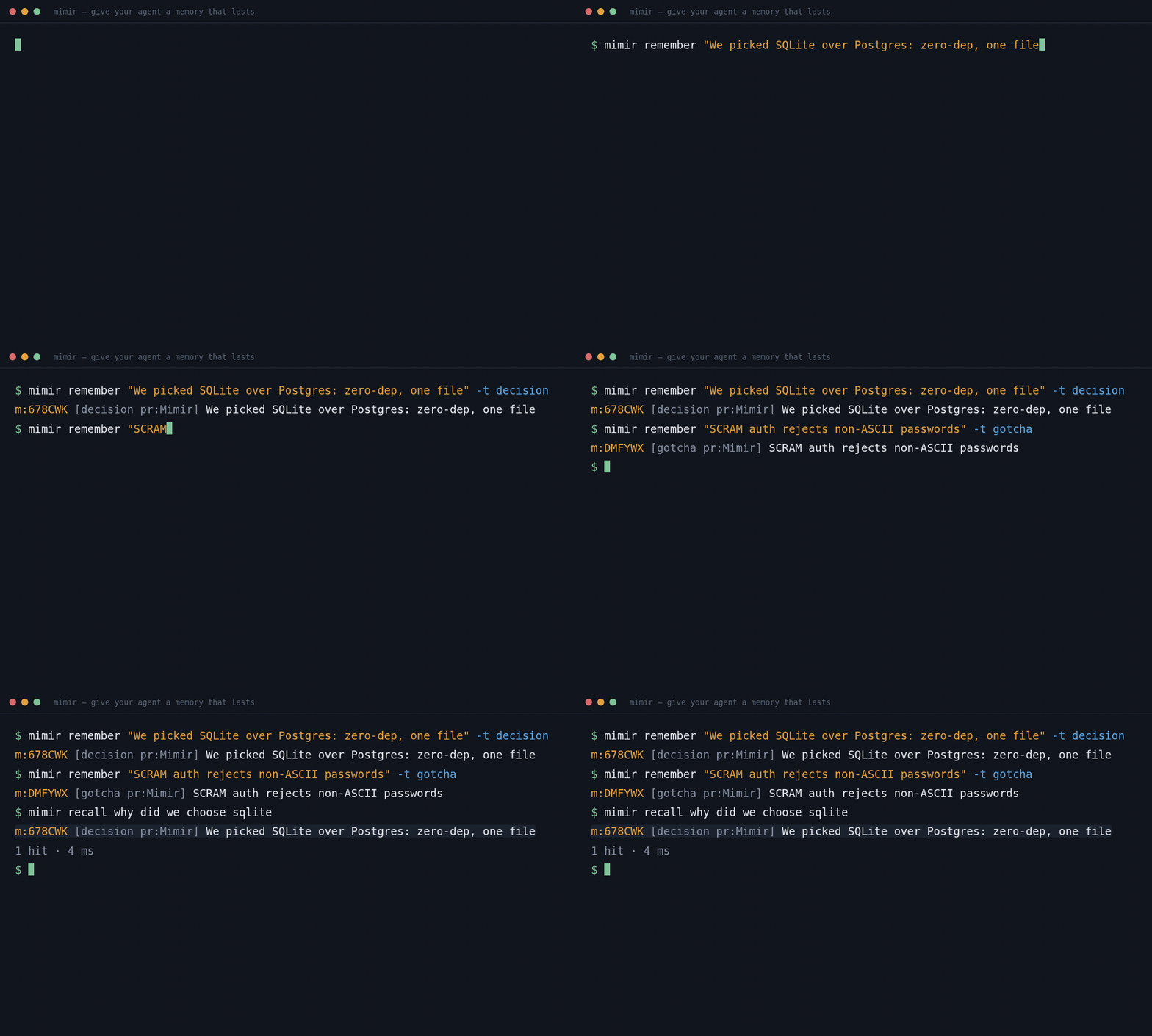
Unified, local-first memory for AI coding agents. One SQLite store where typed memories, indexed docs, and code symbols are all nodes in one graph — searched together by hybrid BM25 + local-ONNX semantic retrieval, and exposed to agents as a single, globally-registered MCP server.
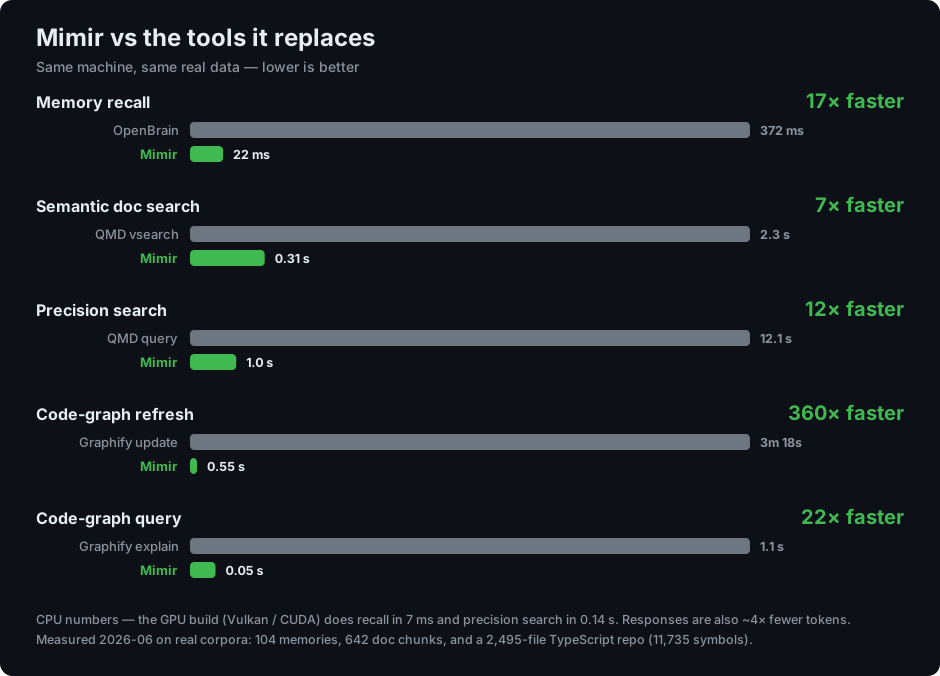
How this was measured. Not a formal benchmark — a switch-over test on my own real data, run on the same machine against the three tools Mimir replaces (OpenBrain, QMD, Graphify): same queries, same corpus, wall-clock timed. Corpus: 104 memories, 642 doc chunks, and a 2,495-file TypeScript repo (11,735 symbols). CPU numbers; the GPU build is faster still (recall 22 ms → 7 ms). Each bar names the operation and the tool it beats — the 360× is one task (code-graph refresh: Graphify's 3m 18s vs Mimir's 0.55s), not a blended average. Numbers move with corpus size and hardware; treat them as "what happened when I switched," not a universal promise.
Why
Mimir replaced three tools that each did their job fine: OpenBrain (semantic memory service), QMD (markdown search), and Graphify (code knowledge graph). The problem was never that they didn't work — it was that they were three daemons, three stores, three query surfaces, and none of them knew about each other. A memory couldn't point at the function it was about; doc search couldn't surface the decision that explained the doc. Running three systems where one could do the job — and do it better, because everything lives in one graph — was too enticing not to build. The speedups in the chart above are real, but they're a side effect; the point is the links.
- One store, every project. A single database with project scoping — cross-project knowledge surfaces wherever it's relevant, project noise doesn't.
- Typed memories.
gotcha,decision,insight,idea,note,person— with tags, links, and automatic near-duplicate refusal. - Docs search. Point it at any folder of markdown; an incremental, hash-driven indexer chunks it heading-aware (code fences never split) and keeps it fresh in milliseconds.
- Hybrid search. FTS5 BM25 (porter-stemmed, stopword-aware) + bge-small
embeddings (quantized ONNX, in-process, no daemon, no API key), fused with
reciprocal-rank fusion. Optional cross-encoder reranking (
--rerank) when you want maximum precision over speed. No model downloaded? Everything still works, BM25-only. - Code graph. Tree-sitter symbol extraction (Rust, TypeScript/JS,
Python, Go, Java, Ruby, C, C++, C#, Kotlin, Swift, PHP, SQL) with
call/import edges:
graph callers,impact(blast radius of a diff),path,hubs— and code symbols participate in semantic recall. Link memories to functions and they surface together. Method calls resolve through the receiver's type where one is legible statically (typed parameters and fields, constructor initializers,self/this), sodb.save()andcache.save()land on different edges instead of a guess at everysavein the repo.graph checkreports drift as an exit code — content-hashed, never writing — for a pre-commit hook or CI. Any query takes--all-projectsto search every repo that has a graph, labelled per project (edges never cross a project, so results are never merged). - Code content search.
mimir code add <dir>indexes source files chunked on tree-sitter symbol boundaries, so recall matches function/method bodies — inline comments, string literals, implementation details — not just signatures. Same incremental, hash-driven indexer as docs; a tunablescoring.code_damp(default 0.85) keeps code's much larger corpus share from drowning out memories. Config/plain-text files a source tree needs but tree-sitter can't parse (.toml,.yaml/.yml,.json,.sh,Dockerfile,Makefile,.env.example,.txt,.rst, …) are chunked too; lockfiles (Cargo.lock,package-lock.json, …) and a real.envare never indexed. Idea credit: @nworks3d's THOR fork of Mimir. - Self-learning. Recall usage strengthens what helps (
markfor explicit feedback); typed half-life decay quiets what doesn't; weekly LLM-free consolidation dedups, flags contradictions, distills clusters, and archives the dead — never destructively. - Made for agents. Default output is one ~25-token line per hit.
The MCP server registers once (
--scope user) and serves every repo, detecting the current project from its working directory. On session start it auto-builds the project's code graph and indexes its markdown (background thread, incremental, milliseconds after first contact) — zero setup per project. Opt out inconfig.toml:[auto] graph/docs = false. - Local and private. A memory tool holding your decisions and notes must be beyond suspicion: everything stays on disk, zero telemetry, ever.
Install
Prebuilt binary (Linux x86_64/aarch64, macOS Apple Silicon):
curl -fsSL https://raw.githubusercontent.com/MakerViking/mimir/main/install.sh | sh
Windows: grab mimir-windows-x86_64.zip from the
latest release and put
mimir.exe on your PATH.
From source (any platform with Rust):
cargo install mimir-mem                 # the binary is named `mimir`
cargo install --path crates/mimir-cli   # …or from a checkout
Use the from-source path on Intel Macs (no prebuilt) and on older Linux / WSL2 distros (the prebuilt Linux binary targets a recent glibc). WSL2 works fine as a sync client; see docs/sync.md for where to run the optional hub.
That's the whole install. CPU-only by default, and it's plenty fast — the GPU build is an optional power-user step, tucked away below.
Optional GPU acceleration (Vulkan / CUDA — opt-in build)
GPU is an opt-in build feature (pick one):
# Cross-vendor: Vulkan (Linux), D3D12 (Windows), Metal (macOS) via Dawn.
# The right choice for AMD/Intel GPUs.
RUST_MIN_STACK=33554432 cargo install mimir-mem --features gpu-webgpu

# NVIDIA CUDA 12/13:
RUST_MIN_STACK=33554432 cargo install mimir-mem --features gpu-cuda
Notes:
RUST_MIN_STACKworks around a rustc/LLVM ThinLTO crash when linking the large onnxruntime GPU binary.- The webgpu build dynamically links
libwebgpu_dawn.so— copy it from the build cache next to the binary (the binary's$ORIGINrpath finds it there), or setLD_LIBRARY_PATH:cp $(find ~/.cache/ort.pyke.io -name 'libwebgpu_dawn.so' | head -1) ~/.cargo/bin/ config.toml: embedding.device = "cpu"forces CPU in a GPU build; the default"auto"falls back to CPU if GPU init fails.
Windows, honestly: the prebuilt mimir.exe is CPU-only, so any GPU
flavor means compiling from source — and on Windows that means installing
Rust (rustup) plus the Visual Studio Build Tools
C++ workload (several GB of toolchain). That's standing up a native dev
environment, not flipping a feature — weigh it against what GPU actually
buys you (bulk indexing and fast --rerank; single-query embeds are
faster on CPU, which is why sessions use CPU by design). If you do build:
- The CUDA Toolkit is not needed to compile — onnxruntime is
downloaded prebuilt during the build. The
gpu-cudabinary does need NVIDIA's CUDA 12/13 + cuDNN 9 runtime DLLs findable at run time (the toolkit installer is the easiest way to get them). - NVIDIA users have a lighter path:
gpu-webgpuuses DirectX 12 on Windows — no CUDA install at all (upstream marks the WebGPU provider experimental). - Smart App Control breaks
cargobuilds entirely (field-reported): build scripts are freshly compiled, unsigned executables, which SAC blocks — for any Rust build, either GPU flavor. Disabling SAC is permanent (Windows won't re-enable it without a reset), so if SAC is on, our honest advice is to stay on the prebuilt CPU binary rather than trade SAC for a GPU build. - Set the stack workaround PowerShell-style:
$env:RUST_MIN_STACK=33554432beforecargo install.
Measured on an RX 6900 XT (Vulkan): bulk embedding 2.3× faster, recall
22 ms → 7 ms, --rerank 1.9 s → 0.14 s.
Quickstart
mimir init                 # creates config + db, downloads the embedding model (~34 MB)
mimir init --no-model      # …or stay BM25-only / offline

# memories
mimir remember "SCRAM auth rejects non-ASCII passwords" -t gotcha --tags auth,postgres
mimir recall postgres password trouble
mimir get m:ABCDEF         # full body (also: mimir get notes.md:10-40)

# docs
mimir docs add ~/notes --name notes
mimir index                # incremental; re-run any time

# precision dial (all optional)
mimir embed --fetch --rerank                  # one-time reranker download (~150 MB)
mimir recall tricky semantic question --rerank  # cross-encoder rescoring (~1 s CPU, ~0.15 s GPU)
# config.toml: embedding.model = "bge-base-en-v1.5" — stronger semantic
# matching at the same query latency (index-time embedding is ~4x slower)
# config.toml: embedding.model = "granite-embedding-small-r2" — same
# precision as the default, ~3x faster per-embed (re-embeds the store)
# config.toml: rerank.model = "jina-reranker-v1-turbo-en-int8" — ~1.2x
# faster reranking, mild risk of reshuffling a top-3 result

# code graph (the MCP server runs build + docs indexing automatically
# on session start — these are for manual/CLI use)
mimir graph build                 # tree-sitter extraction, incremental
mimir graph check                 # exit 1 if the graph lags the tree (CI/hooks)
mimir graph callers resolve_ref   # who calls this?
mimir graph callers resolve_ref --all-projects   # …in every repo with a graph
mimir graph impact $(git diff --name-only)   # blast radius of a change
mimir graph viz --open            # interactive graph map (self-contained HTML)
mimir link m:ABC123 my_function --rel about  # decisions ↔ code
mimir link --scan --all-projects  # auto-link memories to symbols they name

# code content (function/method bodies, not just signatures, in recall)
mimir code add ~/src/myproject --name myproject
mimir index                       # same incremental indexer as docs

# feedback & hygiene
mimir mark m:ABC123 --useful      # strengthen future ranking
mimir consolidate --dry-run       # dedup/contradictions/distill/archive
mimir dashboard --open            # self-contained HTML telemetry panel
mimir report                      # activity table: day/week/month/year/all-time

# escape hatches
mimir import openbrain export.txt | claude-memory <dir> | qmd
mimir export > backup.jsonl       # everything, always yours

# agents (Claude Code etc.) — register once, works in every repo
claude mcp add --scope user mimir -- mimir mcp
Grounding: which memories point at real code
A memory linked to an indexed symbol makes a claim Mimir can re-check. When the symbol goes away, the link is falsified — not the memory, which is often still right, but the connection nobody has revisited since the code moved. That shows up wherever you meet the memory:
mimir grounding                   # 151 grounded, 0 stale, 577 ungrounded
mimir grounding --stale           # the ones whose target is gone
m:QJ18BM [gotcha pr:mimir 08-11 stale-link] retry_with_backoff doubles the delay …
It is reported, never scored: grounding changes what you can see about a memory, not which memories come back. Most memories are legitimately ungrounded — a note about a DNS quirk or a person names no code — so treat it as a signal on the code-referencing subset, not a number to maximise.
Grounding only exists if something creates the links. --all-projects
matters more than it looks: most memories are global, and a scan compares
them against the graph of one project at a time, so scanning only where you
happen to be standing leaves the rest unlinked. On a real 728-memory store,
scanning one project moved grounding from 1.4% to 2.6%; scanning all 24 took
it to 20.7%.
mimir graph build                        # in each project you care about
mimir link --scan --all-projects --dry-run   # see what it would link
mimir link --scan --all-projects             # ~600 links on a mature store
mimir doctor reminds you if you have code graphs and have never scanned,
and goes quiet once you have.
The fast path (recommended setup)
Three commands get you the lowest-latency configuration Mimir has — measured on the same machine as the benchmark above:
mimir daemon &                        # warm engine: /inject answers in ~7-40 ms
mimir init --hooks --auto-recall      # per-prompt recall via the warm path
mimir doctor                          # confirms "daemon: warm (...)"
- With the daemon running, every auto-recall injection is served warm with full hybrid BM25+vector search — ~7 ms on a small store, ~40 ms median on a 102k-node store (measured live; the store grows, the number moves).
- Without it, the hook falls back to the cold CLI path, which defaults
to
cold_mode = "fast"— still ~5–6 ms, lexical + identifier matching only (semantic-only matches wait for the daemon). - Either way the engine's own warm recall is single-digit ms; there is no configuration in which the hook blocks your prompt for half a second.
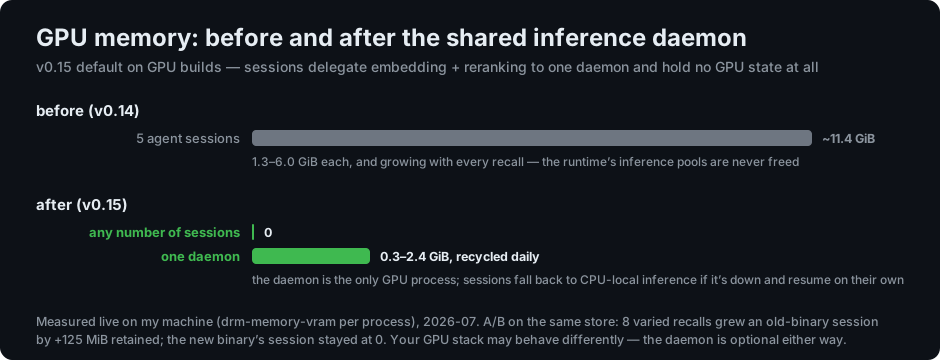
- On GPU builds the daemon is also the only GPU process. It serves
/embedand/rerankalongside/inject, and every MCP session delegates bulk embedding and reranking to it ([daemon] inference = "auto", the default) while running its own query embedder CPU-only — which is measured faster than GPU for single-query embeds. Net: N concurrent agent sessions cost one model's worth of GPU memory instead of N. No daemon, no problem: sessions fall back to fully-local inference automatically;[daemon] inference = "off"restores the old every-process-loads-its-own behavior.
To keep the daemon across reboots, install the systemd user unit:
cp contrib/mimir-daemon.service ~/.config/systemd/user/ && systemctl --user enable --now mimir-daemon.
Default vs quality — one config away
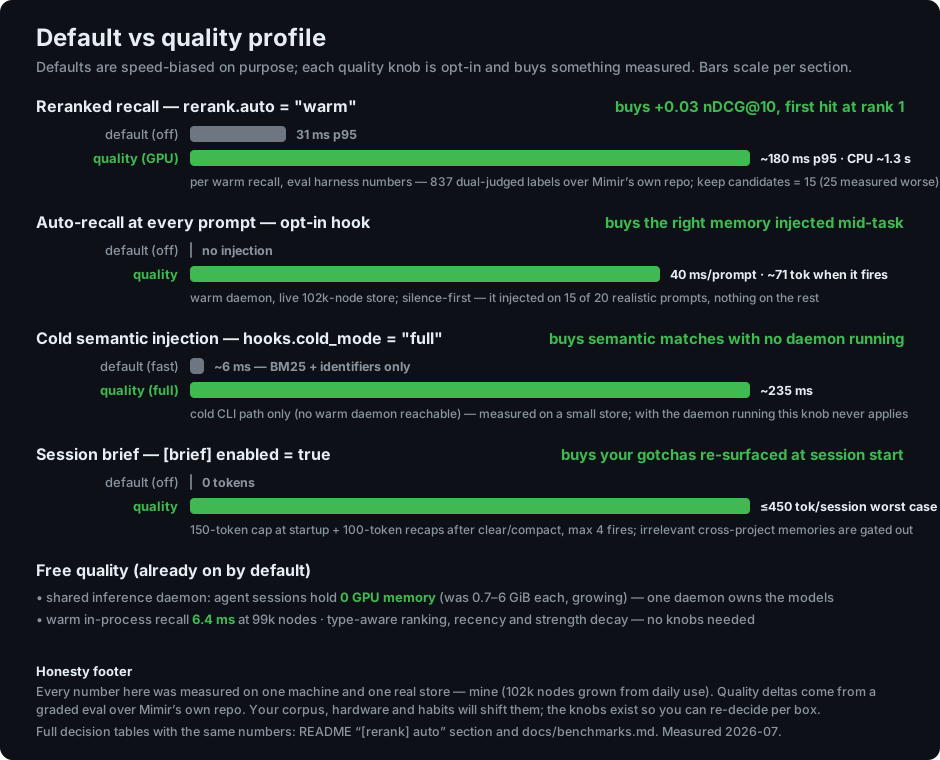
Mimir's defaults are deliberately speed- and token-biased: a fresh install answers fast, injects little, and never surprises a CPU-only box. Everything that trades a little latency (or a bounded token budget) for measurably better retrieval is opt-in — each knob was measured before it earned a place here, and the chart names what every one buys and costs:
The whole quality tier, as config:
[rerank]
auto = "warm"        # +0.03 nDCG@10, first hit at rank 1 · ~0.18 s/recall
                     # on GPU, ~1.3 s on CPU — see the decision table below

[hooks]
cold_mode = "full"   # semantic matching even with no daemon · ~235 ms cold
context_guard = "handoff"  # deliberate /clear + auto-restored handoff memory

[brief]
enabled = true       # gotcha/decision digest at session start · ≤450 tok/session
plus the auto-recall hook at install time (mimir init --hooks --auto-recall) and the daemon itself (above) — which is not a trade-off
but free quality: warm ~40 ms injections and zero GPU memory per session.
One more knob, [scoring] impression_alpha, damps memories that keep
surfacing without ever being opened; it's off by default because it needs
months of usage history to mean anything and has no measured delta yet —
turn it on only once mimir report shows real recall traffic.
Honesty box. Every number above — and in both charts — was measured on one machine and one real store: mine (102k nodes grown from daily use; retrieval-quality deltas from an 837-label graded eval over Mimir's own repo). None of it is a synthetic benchmark, and none of it is a promise: a different corpus, GPU, or working style will shift the numbers, which is exactly why these are knobs and not defaults. If you benchmark Mimir against something else, please say which profile you ran — "defaults" and "quality" are different tools on purpose.
Session brief
On by default (since its eval gate passed — see the caveats below for
the numbers and how to switch it off). A fresh session (or one that just
compacted) has forgotten every gotcha it ever learned — that window is
where an agent drifts into violating a constraint nobody repeated.
mimir brief show (a SessionStart hook entry mimir init --hooks
installs) injects a hard-capped digest of the current project's most
drift-preventing memories — gotchas and decisions, ranked by the signals
the store already has (pin, decayed strength, recency, same-project
affinity), one imperative line each:
Mimir guards (do not violate):
- GOTCHA [m:ABC123]: never test against prod without MIMIR_HOME isolation
- DECISION [m:XY9QRT] (10mo): we chose sqlite over postgres — don't relitigate
Zero authoring required, zero per-prompt cost — it fires once at startup
(default cap 150 tokens / 6 lines) and again after a /clear or compact
with a smaller 100-token recap, at most 4 rendered fires per session:
worst case 450 tokens per session, ever, each fire recorded in the
savings ledger as spend. A recap re-anchors the top guards the wipe made
the agent forget; a startup fire skips what was already shown this session
(and, across sessions, anything briefed in the last 6 hours). Memories
covered by your rules pack, superseded, or below the relevance/quality
bar for this project are never shown; mimir brief previews the exact
output with per-candidate scores so "why did this appear?" always has an
answer.
[brief]
enabled = false       # the kill-switch (default true)
max_tokens = 150      # startup fire cap (recap_tokens = 100 for re-fires)
max_items = 6
Honest caveats: it needs a hook-running client (Claude Code — MCP-only
clients like Claude Desktop don't execute SessionStart hooks and get no
brief). It shipped disabled until its drift-eval gate passed, and the
default flipped only on those numbers (scoped to hook-running clients):
selection catches 96.0 pts of labeled must-know guards at the 150-token
cap vs 4.0 for a hand-written rules pack alone, the 150 cap is where the
marginal-catch curve flattens (85.3/96.0/96.0/96.0 at 100/150/250/400),
zero forbidden guards ever rendered across the fixture families, and a
preregistered repeated-exposure experiment found no boilerplate
blindness — subject compliance held at 0.889 whether the brief had been
seen 1, 5, or 10 times. Configs written by mimir init before the flip
carry an explicit enabled = false and keep it — flip the key in place
(don't append a second [brief] table). The session-boundary briefing
idea comes from @nworks3d's THOR fork of
Mimir (built clean-room from the concept) — thanks!
Context guard
Opt-in, off by default. mimir init --hooks --context-guard pause (or
handoff) adds three more hook entries that estimate how full the
context window is from the transcript file's size (no JSONL parsing,
so it's cheap on every prompt) and act once the estimate crosses
context_guard_threshold_pct (default 45%, of context_window_tokens,
default 200,000):
pausenudges you, at most once per +10 percentage-point band, to deliberately/clearor/compactinstead of leaving it to Claude Code's own auto-compact. If an automatic compact is attempted anyway while still over threshold,PreCompactblocks it — your own/compactis never blocked.handoffdoes the same nudge, plus instructs the agent to save asession-handoff-tagged memory before you clear. The nextSessionStartafter a clear or compact restores the latest handoff memory automatically, so the new session picks up where the old one left off instead of starting cold.
Tune the estimate in config.toml:
[hooks]
context_guard = "pause"              # off (default) | pause | handoff
context_guard_threshold_pct = 45
context_window_tokens = 200000       # raise for a 1M-context model
transcript_bytes_per_token = 8.0     # rough transcript-JSONL average
Guard anchors are a separate, independent opt-in — mimir init --hooks
always installs the hook, but it stays dormant until a memory declares one:
mimir remember "This table needs a migration, not an ALTER" --anchor "schema.sql"
The pattern matches a path suffix, so it fires the moment a matching file
is edited/written or a matching command runs (e.g. psql -f schema.sql)
— surfaced via PreToolUse, before the tool call happens, no prompt
needed. Up to 8 patterns per memory; --anchor is repeatable.
Related: mimir remember --fires-when "phrase" (also repeatable) declares
trigger phrase(s) that bypass auto-recall's inferred-relevance floor on a
close match — for facts that are easy for BM25/vector search to under-rank
but you always want recalled when that phrase comes up.
Already have a memory system?
Don't start from zero — migrate, verify, then retire the old one.
Claude Code auto-memory directories import directly
(mimir import claude-memory ~/.claude/projects/<project>/memory). For
anything else, your agent is the importer — tell it:
Read every entry in [my old memory system] and store each one in Mimir with the
remembertool — pick a fitting type (gotcha/decision/insight/ idea/note/person), keep the original wording, add tags. When done, compare counts withmimir statusand spot-check a few searches withrecall.
Re-running is safe: remember refuses near-duplicates, so a second pass
only fills gaps. Verify before you delete — compare entry counts,
recall a handful of things you actually remember storing — and only then
unplug the old system's MCP server. (And mimir export keeps the exit
door open in the other direction: everything, always yours.)
MCP tools: recall, remember, get, link, graph, mark, status,
outline, peek, and the hygiene set forget / consolidate / supersede
(soft-delete and dry-run by default — permanent deletion stays a human CLI
action).
Works with any MCP client
Nothing here is Claude-specific: mimir mcp is a standard stdio MCP
server, so any MCP-capable agent can use it — Cursor, Windsurf, Cline,
Zed, VS Code (Copilot agent mode), Gemini CLI, Codex CLI, … For clients
configured via JSON, the entry is simply:
{ "mcpServers": { "mimir": { "command": "mimir", "args": ["mcp"] } } }
Clients that can't launch a local process (claude.ai web/mobile, agents on
another machine) can reach a store over the network instead:
mimir mcp --http 127.0.0.1:8077 serves the same tools via Streamable-HTTP —
bind to localhost and front it with TLS + an auth gate, and optionally require
a bearer token (MIMIR_HTTP_TOKEN / --http-token) as defense-in-depth; see
docs/central-memory-hub.md.
The project is detected from the directory the client launches the server
in (override with the MIMIR_PROJECT env var), walking up from there in
order: (1) a VCS / explicit root — .git, .hg, .svn, .jj, or a
touch .mimir marker; else (2) the nearest build file — Cargo.toml,
package.json, pyproject.toml, go.mod, go.work, deno.json, or
pnpm-workspace.yaml; else (3) global scope. Identity is the resolved root
path, so the same folder always maps to the same project, git or not — no
per-project init. Mimir never degrades silently: mimir status always shows
the detected project and how it was found ([via: Cargo.toml]), or, when
nothing matches, says so and points at touch .mimir. And agents without MCP
can just shell out — the CLI's default output is the same token-lean format
the server returns.
A memory's project is decided by the directory your session runs in — not by what you happen to be editing. Start each project's session inside that project's folder so captures tag correctly (every capture confirms its project as
pr:<name>in the output, so a wrong one is visible immediately). Pin a stable identity withmimir project init --syncand commit the.mimirfile. If something still lands in the wrong place, move it withmimir reproject <ref> --project <name>(or--global).
mimir init also installs a set of /m-* slash commands for the agent
CLIs it finds on the machine — Claude Code, Codex, OpenCode, Gemini CLI
and Cursor (the m- prefix keeps them clear of your own commands):
| command | does |
|---|---|
/m-recall <query> | search memories, docs and code |
/m-remember <fact> | capture a memory (typed, tagged, linked) |
/m-graph | open the interactive graph visualization |
/m-impact | blast radius of your uncommitted changes |
/m-scan | auto-link memories to the code they mention |
/m-report | activity table: day/week/month/year/all-time |
/m-stats | open the stats dashboard |
/m-doctor | health check |
Only apps already present get them, and existing command files are never
overwritten, so your edits survive upgrades (re-run mimir init any
time; it's idempotent).
Token savings
Mimir doubles as a token-saving layer for your agent — and it's measured, not
vibes: mimir savings reports the tokens (and dollars) avoided, with a
dashboard panel and a /m-savings command.
outline/peek— read a file's shape (signatures via tree-sitter, plus markdown/JSON/YAML) or a single symbol's body instead of the whole file. Typically ~88–95% fewer tokens than a full read — the biggest single lever.mimir run -- <cmd>— run a command and strip the noise: build/test/ package/infra progress chatter is dropped (errors and warnings are always kept), and high-volumecat/grep/find/ls/kubectl/… output is volume-capped non-lossily (head + tail + every signal line; the bulky middle elided behind a visible marker).mimir init --hookswires this in as a PreToolUse hook so it happens automatically.mimir init --hooks --auto-recall(opt-in, off by default) — injects at most one relevant gotcha/decision memory into each prompt's context via a UserPromptSubmit hook, on top of the static SessionStart rules pack. Errs toward silence: a hit must clear a relevance floor (term overlap, plus lexical+semantic agreement when the embedding model is loaded) before it's ever shown, capped at ~200 tokens. The hook also enriches a thin prompt with up to 8 changed-file stems fromgit diff— it can extend a real overlap, never single-handedly clear the floor on its own. It tries a warmGET /injectendpoint first (one process-wide engine kept alive bymimir mcp --http 127.0.0.1:8077, ~ms once loaded) and falls back to the coldmimir recall-injectCLI path when no daemon answers — same relevance logic either way, only latency differs. That cold fallback defaults to[hooks] cold_mode = "fast"(BM25 + identifier legs only, no ONNX load: ~5-6ms) rather than"full"hybrid search (~230-240ms) — it narrows which matches clear the floor while cold (no purely-semantic hits) without weakening the silence-beats-wrong-injection contract itself; set"full"to trade that latency back for semantic coverage on the cold path. The warm endpoint's address is[hooks] inject_urlinconfig.toml(defaulthttp://127.0.0.1:8077/inject), overridable per-invocation withMIMIR_INJECT_URL.mimir daemonis a short alias formimir mcp --http <addr>that reads that same address, so there's one command and one config key for "start the warm path." Run it as a service with the sample unit at contrib/mimir-daemon.service (cpit to~/.config/systemd/user/, thensystemctl --user enable --now mimir-daemon);mimir doctorreports whether it's actually reachable.- Optional API proxy (
mimir proxy, off by default) — adds prompt-cache breakpoints and lossless repeated-block dedup to Anthropic API traffic. The breakpoint TTL is configurable (--cache-ttl 5m|1h); 5m is the default because a 1h write costs 2x input vs 1.25x, so it only pays off when turns idle more than 5 minutes apart. See docs/proxy.md and docs/benchmarks.md.
Optional: centralized sync
Want your memories on more than one machine? Mimir has an opt-in sync layer
— off by default, with zero added cost and the zero-telemetry promise intact
unless you turn it on. It shares your global memories plus any projects
you opt in (mimir project init --sync gives a project a portable identity;
local-SQLite stays authoritative; merges are last-write-wins), via whichever
path suits you:
- File — point it at a folder Syncthing/Dropbox/iCloud/git already
replicates. No server, no token:
[sync] mode = "file", dir = "~/Synced/mimir". - Server — run a hub with the same binary (
mimir serve), deployable via the includedDockerfile/docker-compose.ymlon a NAS, Pi, VPS, or any Docker host, reached over your tailnet or behind TLS.
Then mimir sync (or enable background sync). Full setup, recipes, and the
security model are in docs/sync.md.
How it works
Everything is a node — memories, files, chunks, projects, collections, tags, annotations — in one SQLite database (WAL, FTS5, no extensions). Embeddings are plain f32 blobs keyed by content hash + model, brute-force scanned in-process (exact, single-digit ms at ≤200k items). Search legs are fused with RRF (k=60); learned strength only ever acts as a tiebreaker. Concurrent CLI + MCP-server access is the normal, supported case.
Ranking has a few tunable knobs in config.toml, all sane by default:
[scoring] recency_alpha (default 0.012) nudges fresher decaying-kind
memories (gotcha/decision/insight/note/idea); type_prior_alpha (default
0.12) nudges gotcha/decision ahead of an equally-matching note/idea;
code_damp (default 0.85) keeps mimir code add content from drowning out
memories; impression_alpha (default 0.0, off) mildly damps a node that's
been shown repeatedly but never opened — opt in once you have enough
recall_event history for it to mean something. That history is itself
bounded by [learn] event_retention_days (default 180, 0 keeps forever):
a background prune drops older recall_event rows on daemon startup and on
the same idle cadence as the WAL checkpoint, sized so 180 days holds 6 of
impression_alpha's 30-day decay half-lives — comfortably more than the
decay ever weights meaningfully; values below a 60-day safety floor are
clamped up (with a log warning) rather than silently starving the signal.
[rerank] auto = "off" | "warm" | "always" (default "off") controls whether a plain recall
auto-reranks without an explicit --rerank. The trade-off, measured on a
graded retrieval eval over this repo's own docs + source (837 dual-judged
labels, 60 queries): reranking the top 15 fused candidates raises nDCG@10
by ~0.03 and puts the first relevant hit at rank 1 almost always. The cost
is where your hardware decides:
| build | cross-encoder cost | per recall (15 candidates) |
|---|---|---|
| CPU | ~84 ms/candidate | ~1.3 s |
| GPU | ~12 ms/candidate | ~0.18 s |
"warm" fires only when reranking is free right now: the model is
already resident in this process, or a live mimir daemon answers for it
([daemon] inference = "auto"). Long-lived processes (the MCP server,
mimir daemon) eager-load a local copy at startup only when no daemon is
reachable; one-shot CLI calls never pay a cold model load. Pick by how you
consume recall:
- GPU build:
"warm"is a straightforward win — the quality gain at ~0.18 s is below anything you'll notice, and withmimir daemonrunning every session shares its one GPU copy. - CPU build, agent-driven recall (MCP):
"warm"is still a reasonable choice — ~1.3 s disappears inside an LLM turn that takes seconds anyway; you're trading invisible latency for better-ordered results. - CPU build, interactive CLI use: leave it
"off"— 1.3 s per recall is very noticeable at a prompt. Explicit--rerankis always there for the queries worth the wait. - The config is per-machine and the cost is hardware-bound: re-decide per box rather than copying a config across machines.
- Keep
candidates = 15: 25+ measured worse (the reranker overrides correct fusion ranks more often than it rescues deep candidates), and cost scales linearly with the count."always"additionally cold-loads the model on demand (same cost as an explicit--rerank, just automatic). Per-prompt auto-recall injection never reranks regardless — only explicitrecallcalls are affected.
State lives in the platform-standard directories
(~/.local/share/mimir, ~/.config/mimir, ~/.cache/mimir on Linux);
set MIMIR_HOME=<dir> to put everything under one directory instead.
Scaling
The exact brute-force vector scan is O(n) in both time and RAM, so recall
latency and memory grow linearly with the embedded-node count. Measured
(CPU, synthetic corpus; cargo test --release scaling_profile -- --ignored --nocapture):
| embedded nodes | warm hybrid recall | matrix RAM |
|---|---|---|
| 50k | ~16 ms | ~75 MB |
| 200k | ~55 ms | ~290 MB |
| 500k | ~130 ms | ~730 MB |
Everyday operations (get/mark/edit, by id) stay flat — microseconds —
at every size. The sweet spot is up to a couple hundred thousand embedded
nodes, where recall is comfortably interactive; beyond that it degrades
gracefully rather than falling over. If a store ever genuinely outgrows
this, the planned path is training-free vector quantization (8–16× less RAM,
exact-ish scan preserved) rather than an approximate index — keeping recall
exact is the point.
Roadmap
v0.4 shipped the complete original blueprint: memories, docs, code graph, hybrid + reranked search, self-learning, importers, prebuilt binaries, and the crates.io release (mimir-mem). Daily use has driven everything since: the token-savings layer (outline/peek, command filters, the optional proxy), opt-in sync with project scoping, six more languages in the code graph (C#, SQL, C++, Kotlin, Swift, PHP), code content in recall, opt-in per-prompt auto-recall, remote MCP over HTTP, agent-side memory hygiene, and concurrency hardening for many simultaneous sessions. Next: whatever using it daily teaches us — see CHANGELOG.md for the full history.
Contributing & security
Bug reports, language adapters, and docs are welcome — see CONTRIBUTING.md. Release history is in CHANGELOG.md. Thanks to @nworks3d for the remote MCP transport and the memory-hygiene tools. For security issues, please follow SECURITY.md (private disclosure) rather than a public issue.
Support
Mimir is free and stays free. If it earns a place in your daily loop, you can support development on Patreon (MuninWorks) — patronage covers the servers, domains, and AI tooling behind this and my other projects.
License
MIT or Apache-2.0, at your option.
Contributors

179 commits
Similar repos


Languages
Rust
96.8%
HTML
1.5%
Shell
1.0%
Unified local-first memory for AI coding agents — one SQLite store for memories, docs and code, hybrid BM25+vector search, MCP server
Rust
10
179 commits
updated Aug 23, 2026
README
Unified, local-first memory for AI coding agents. One SQLite store where typed memories, indexed docs, and code symbols are all nodes in one graph — searched together by hybrid BM25 + local-ONNX semantic retrieval, and exposed to agents as a single, globally-registered MCP server.
How this was measured. Not a formal benchmark — a switch-over test on my own real data, run on the same machine against the three tools Mimir replaces (OpenBrain, QMD, Graphify): same queries, same corpus, wall-clock timed. Corpus: 104 memories, 642 doc chunks, and a 2,495-file TypeScript repo (11,735 symbols). CPU numbers; the GPU build is faster still (recall 22 ms → 7 ms). Each bar names the operation and the tool it beats — the 360× is one task (code-graph refresh: Graphify's 3m 18s vs Mimir's 0.55s), not a blended average. Numbers move with corpus size and hardware; treat them as "what happened when I switched," not a universal promise.
Why
Mimir replaced three tools that each did their job fine: OpenBrain (semantic memory service), QMD (markdown search), and Graphify (code knowledge graph). The problem was never that they didn't work — it was that they were three daemons, three stores, three query surfaces, and none of them knew about each other. A memory couldn't point at the function it was about; doc search couldn't surface the decision that explained the doc. Running three systems where one could do the job — and do it better, because everything lives in one graph — was too enticing not to build. The speedups in the chart above are real, but they're a side effect; the point is the links.
- One store, every project. A single database with project scoping — cross-project knowledge surfaces wherever it's relevant, project noise doesn't.
- Typed memories.
gotcha,decision,insight,idea,note,person— with tags, links, and automatic near-duplicate refusal. - Docs search. Point it at any folder of markdown; an incremental, hash-driven indexer chunks it heading-aware (code fences never split) and keeps it fresh in milliseconds.
- Hybrid search. FTS5 BM25 (porter-stemmed, stopword-aware) + bge-small
embeddings (quantized ONNX, in-process, no daemon, no API key), fused with
reciprocal-rank fusion. Optional cross-encoder reranking (
--rerank) when you want maximum precision over speed. No model downloaded? Everything still works, BM25-only. - Code graph. Tree-sitter symbol extraction (Rust, TypeScript/JS,
Python, Go, Java, Ruby, C, C++, C#, Kotlin, Swift, PHP, SQL) with
call/import edges:
graph callers,impact(blast radius of a diff),path,hubs— and code symbols participate in semantic recall. Link memories to functions and they surface together. Method calls resolve through the receiver's type where one is legible statically (typed parameters and fields, constructor initializers,self/this), sodb.save()andcache.save()land on different edges instead of a guess at everysavein the repo.graph checkreports drift as an exit code — content-hashed, never writing — for a pre-commit hook or CI. Any query takes--all-projectsto search every repo that has a graph, labelled per project (edges never cross a project, so results are never merged). - Code content search.
mimir code add <dir>indexes source files chunked on tree-sitter symbol boundaries, so recall matches function/method bodies — inline comments, string literals, implementation details — not just signatures. Same incremental, hash-driven indexer as docs; a tunablescoring.code_damp(default 0.85) keeps code's much larger corpus share from drowning out memories. Config/plain-text files a source tree needs but tree-sitter can't parse (.toml,.yaml/.yml,.json,.sh,Dockerfile,Makefile,.env.example,.txt,.rst, …) are chunked too; lockfiles (Cargo.lock,package-lock.json, …) and a real.envare never indexed. Idea credit: @nworks3d's THOR fork of Mimir. - Self-learning. Recall usage strengthens what helps (
markfor explicit feedback); typed half-life decay quiets what doesn't; weekly LLM-free consolidation dedups, flags contradictions, distills clusters, and archives the dead — never destructively. - Made for agents. Default output is one ~25-token line per hit.
The MCP server registers once (
--scope user) and serves every repo, detecting the current project from its working directory. On session start it auto-builds the project's code graph and indexes its markdown (background thread, incremental, milliseconds after first contact) — zero setup per project. Opt out inconfig.toml:[auto] graph/docs = false. - Local and private. A memory tool holding your decisions and notes must be beyond suspicion: everything stays on disk, zero telemetry, ever.
Install
Prebuilt binary (Linux x86_64/aarch64, macOS Apple Silicon):
curl -fsSL https://raw.githubusercontent.com/MakerViking/mimir/main/install.sh | sh
Windows: grab mimir-windows-x86_64.zip from the
latest release and put
mimir.exe on your PATH.
From source (any platform with Rust):
cargo install mimir-mem                 # the binary is named `mimir`
cargo install --path crates/mimir-cli   # …or from a checkout
Use the from-source path on Intel Macs (no prebuilt) and on older Linux / WSL2 distros (the prebuilt Linux binary targets a recent glibc). WSL2 works fine as a sync client; see docs/sync.md for where to run the optional hub.
That's the whole install. CPU-only by default, and it's plenty fast — the GPU build is an optional power-user step, tucked away below.
Optional GPU acceleration (Vulkan / CUDA — opt-in build)
GPU is an opt-in build feature (pick one):
# Cross-vendor: Vulkan (Linux), D3D12 (Windows), Metal (macOS) via Dawn.
# The right choice for AMD/Intel GPUs.
RUST_MIN_STACK=33554432 cargo install mimir-mem --features gpu-webgpu

# NVIDIA CUDA 12/13:
RUST_MIN_STACK=33554432 cargo install mimir-mem --features gpu-cuda
Notes:
RUST_MIN_STACKworks around a rustc/LLVM ThinLTO crash when linking the large onnxruntime GPU binary.- The webgpu build dynamically links
libwebgpu_dawn.so— copy it from the build cache next to the binary (the binary's$ORIGINrpath finds it there), or setLD_LIBRARY_PATH:cp $(find ~/.cache/ort.pyke.io -name 'libwebgpu_dawn.so' | head -1) ~/.cargo/bin/ config.toml: embedding.device = "cpu"forces CPU in a GPU build; the default"auto"falls back to CPU if GPU init fails.
Windows, honestly: the prebuilt mimir.exe is CPU-only, so any GPU
flavor means compiling from source — and on Windows that means installing
Rust (rustup) plus the Visual Studio Build Tools
C++ workload (several GB of toolchain). That's standing up a native dev
environment, not flipping a feature — weigh it against what GPU actually
buys you (bulk indexing and fast --rerank; single-query embeds are
faster on CPU, which is why sessions use CPU by design). If you do build:
- The CUDA Toolkit is not needed to compile — onnxruntime is
downloaded prebuilt during the build. The
gpu-cudabinary does need NVIDIA's CUDA 12/13 + cuDNN 9 runtime DLLs findable at run time (the toolkit installer is the easiest way to get them). - NVIDIA users have a lighter path:
gpu-webgpuuses DirectX 12 on Windows — no CUDA install at all (upstream marks the WebGPU provider experimental). - Smart App Control breaks
cargobuilds entirely (field-reported): build scripts are freshly compiled, unsigned executables, which SAC blocks — for any Rust build, either GPU flavor. Disabling SAC is permanent (Windows won't re-enable it without a reset), so if SAC is on, our honest advice is to stay on the prebuilt CPU binary rather than trade SAC for a GPU build. - Set the stack workaround PowerShell-style:
$env:RUST_MIN_STACK=33554432beforecargo install.
Measured on an RX 6900 XT (Vulkan): bulk embedding 2.3× faster, recall
22 ms → 7 ms, --rerank 1.9 s → 0.14 s.
Quickstart
mimir init                 # creates config + db, downloads the embedding model (~34 MB)
mimir init --no-model      # …or stay BM25-only / offline

# memories
mimir remember "SCRAM auth rejects non-ASCII passwords" -t gotcha --tags auth,postgres
mimir recall postgres password trouble
mimir get m:ABCDEF         # full body (also: mimir get notes.md:10-40)

# docs
mimir docs add ~/notes --name notes
mimir index                # incremental; re-run any time

# precision dial (all optional)
mimir embed --fetch --rerank                  # one-time reranker download (~150 MB)
mimir recall tricky semantic question --rerank  # cross-encoder rescoring (~1 s CPU, ~0.15 s GPU)
# config.toml: embedding.model = "bge-base-en-v1.5" — stronger semantic
# matching at the same query latency (index-time embedding is ~4x slower)
# config.toml: embedding.model = "granite-embedding-small-r2" — same
# precision as the default, ~3x faster per-embed (re-embeds the store)
# config.toml: rerank.model = "jina-reranker-v1-turbo-en-int8" — ~1.2x
# faster reranking, mild risk of reshuffling a top-3 result

# code graph (the MCP server runs build + docs indexing automatically
# on session start — these are for manual/CLI use)
mimir graph build                 # tree-sitter extraction, incremental
mimir graph check                 # exit 1 if the graph lags the tree (CI/hooks)
mimir graph callers resolve_ref   # who calls this?
mimir graph callers resolve_ref --all-projects   # …in every repo with a graph
mimir graph impact $(git diff --name-only)   # blast radius of a change
mimir graph viz --open            # interactive graph map (self-contained HTML)
mimir link m:ABC123 my_function --rel about  # decisions ↔ code
mimir link --scan --all-projects  # auto-link memories to symbols they name

# code content (function/method bodies, not just signatures, in recall)
mimir code add ~/src/myproject --name myproject
mimir index                       # same incremental indexer as docs

# feedback & hygiene
mimir mark m:ABC123 --useful      # strengthen future ranking
mimir consolidate --dry-run       # dedup/contradictions/distill/archive
mimir dashboard --open            # self-contained HTML telemetry panel
mimir report                      # activity table: day/week/month/year/all-time

# escape hatches
mimir import openbrain export.txt | claude-memory <dir> | qmd
mimir export > backup.jsonl       # everything, always yours

# agents (Claude Code etc.) — register once, works in every repo
claude mcp add --scope user mimir -- mimir mcp
Grounding: which memories point at real code
A memory linked to an indexed symbol makes a claim Mimir can re-check. When the symbol goes away, the link is falsified — not the memory, which is often still right, but the connection nobody has revisited since the code moved. That shows up wherever you meet the memory:
mimir grounding                   # 151 grounded, 0 stale, 577 ungrounded
mimir grounding --stale           # the ones whose target is gone
m:QJ18BM [gotcha pr:mimir 08-11 stale-link] retry_with_backoff doubles the delay …
It is reported, never scored: grounding changes what you can see about a memory, not which memories come back. Most memories are legitimately ungrounded — a note about a DNS quirk or a person names no code — so treat it as a signal on the code-referencing subset, not a number to maximise.
Grounding only exists if something creates the links. --all-projects
matters more than it looks: most memories are global, and a scan compares
them against the graph of one project at a time, so scanning only where you
happen to be standing leaves the rest unlinked. On a real 728-memory store,
scanning one project moved grounding from 1.4% to 2.6%; scanning all 24 took
it to 20.7%.
mimir graph build                        # in each project you care about
mimir link --scan --all-projects --dry-run   # see what it would link
mimir link --scan --all-projects             # ~600 links on a mature store
mimir doctor reminds you if you have code graphs and have never scanned,
and goes quiet once you have.
The fast path (recommended setup)
Three commands get you the lowest-latency configuration Mimir has — measured on the same machine as the benchmark above:
mimir daemon &                        # warm engine: /inject answers in ~7-40 ms
mimir init --hooks --auto-recall      # per-prompt recall via the warm path
mimir doctor                          # confirms "daemon: warm (...)"
- With the daemon running, every auto-recall injection is served warm with full hybrid BM25+vector search — ~7 ms on a small store, ~40 ms median on a 102k-node store (measured live; the store grows, the number moves).
- Without it, the hook falls back to the cold CLI path, which defaults
to
cold_mode = "fast"— still ~5–6 ms, lexical + identifier matching only (semantic-only matches wait for the daemon). - Either way the engine's own warm recall is single-digit ms; there is no configuration in which the hook blocks your prompt for half a second.
- On GPU builds the daemon is also the only GPU process. It serves
/embedand/rerankalongside/inject, and every MCP session delegates bulk embedding and reranking to it ([daemon] inference = "auto", the default) while running its own query embedder CPU-only — which is measured faster than GPU for single-query embeds. Net: N concurrent agent sessions cost one model's worth of GPU memory instead of N. No daemon, no problem: sessions fall back to fully-local inference automatically;[daemon] inference = "off"restores the old every-process-loads-its-own behavior.
To keep the daemon across reboots, install the systemd user unit:
cp contrib/mimir-daemon.service ~/.config/systemd/user/ && systemctl --user enable --now mimir-daemon.
Default vs quality — one config away
Mimir's defaults are deliberately speed- and token-biased: a fresh install answers fast, injects little, and never surprises a CPU-only box. Everything that trades a little latency (or a bounded token budget) for measurably better retrieval is opt-in — each knob was measured before it earned a place here, and the chart names what every one buys and costs:
The whole quality tier, as config:
[rerank]
auto = "warm"        # +0.03 nDCG@10, first hit at rank 1 · ~0.18 s/recall
                     # on GPU, ~1.3 s on CPU — see the decision table below

[hooks]
cold_mode = "full"   # semantic matching even with no daemon · ~235 ms cold
context_guard = "handoff"  # deliberate /clear + auto-restored handoff memory

[brief]
enabled = true       # gotcha/decision digest at session start · ≤450 tok/session
plus the auto-recall hook at install time (mimir init --hooks --auto-recall) and the daemon itself (above) — which is not a trade-off
but free quality: warm ~40 ms injections and zero GPU memory per session.
One more knob, [scoring] impression_alpha, damps memories that keep
surfacing without ever being opened; it's off by default because it needs
months of usage history to mean anything and has no measured delta yet —
turn it on only once mimir report shows real recall traffic.
Honesty box. Every number above — and in both charts — was measured on one machine and one real store: mine (102k nodes grown from daily use; retrieval-quality deltas from an 837-label graded eval over Mimir's own repo). None of it is a synthetic benchmark, and none of it is a promise: a different corpus, GPU, or working style will shift the numbers, which is exactly why these are knobs and not defaults. If you benchmark Mimir against something else, please say which profile you ran — "defaults" and "quality" are different tools on purpose.
Session brief
On by default (since its eval gate passed — see the caveats below for
the numbers and how to switch it off). A fresh session (or one that just
compacted) has forgotten every gotcha it ever learned — that window is
where an agent drifts into violating a constraint nobody repeated.
mimir brief show (a SessionStart hook entry mimir init --hooks
installs) injects a hard-capped digest of the current project's most
drift-preventing memories — gotchas and decisions, ranked by the signals
the store already has (pin, decayed strength, recency, same-project
affinity), one imperative line each:
Mimir guards (do not violate):
- GOTCHA [m:ABC123]: never test against prod without MIMIR_HOME isolation
- DECISION [m:XY9QRT] (10mo): we chose sqlite over postgres — don't relitigate
Zero authoring required, zero per-prompt cost — it fires once at startup
(default cap 150 tokens / 6 lines) and again after a /clear or compact
with a smaller 100-token recap, at most 4 rendered fires per session:
worst case 450 tokens per session, ever, each fire recorded in the
savings ledger as spend. A recap re-anchors the top guards the wipe made
the agent forget; a startup fire skips what was already shown this session
(and, across sessions, anything briefed in the last 6 hours). Memories
covered by your rules pack, superseded, or below the relevance/quality
bar for this project are never shown; mimir brief previews the exact
output with per-candidate scores so "why did this appear?" always has an
answer.
[brief]
enabled = false       # the kill-switch (default true)
max_tokens = 150      # startup fire cap (recap_tokens = 100 for re-fires)
max_items = 6
Honest caveats: it needs a hook-running client (Claude Code — MCP-only
clients like Claude Desktop don't execute SessionStart hooks and get no
brief). It shipped disabled until its drift-eval gate passed, and the
default flipped only on those numbers (scoped to hook-running clients):
selection catches 96.0 pts of labeled must-know guards at the 150-token
cap vs 4.0 for a hand-written rules pack alone, the 150 cap is where the
marginal-catch curve flattens (85.3/96.0/96.0/96.0 at 100/150/250/400),
zero forbidden guards ever rendered across the fixture families, and a
preregistered repeated-exposure experiment found no boilerplate
blindness — subject compliance held at 0.889 whether the brief had been
seen 1, 5, or 10 times. Configs written by mimir init before the flip
carry an explicit enabled = false and keep it — flip the key in place
(don't append a second [brief] table). The session-boundary briefing
idea comes from @nworks3d's THOR fork of
Mimir (built clean-room from the concept) — thanks!
Context guard
Opt-in, off by default. mimir init --hooks --context-guard pause (or
handoff) adds three more hook entries that estimate how full the
context window is from the transcript file's size (no JSONL parsing,
so it's cheap on every prompt) and act once the estimate crosses
context_guard_threshold_pct (default 45%, of context_window_tokens,
default 200,000):
pausenudges you, at most once per +10 percentage-point band, to deliberately/clearor/compactinstead of leaving it to Claude Code's own auto-compact. If an automatic compact is attempted anyway while still over threshold,PreCompactblocks it — your own/compactis never blocked.handoffdoes the same nudge, plus instructs the agent to save asession-handoff-tagged memory before you clear. The nextSessionStartafter a clear or compact restores the latest handoff memory automatically, so the new session picks up where the old one left off instead of starting cold.
Tune the estimate in config.toml:
[hooks]
context_guard = "pause"              # off (default) | pause | handoff
context_guard_threshold_pct = 45
context_window_tokens = 200000       # raise for a 1M-context model
transcript_bytes_per_token = 8.0     # rough transcript-JSONL average
Guard anchors are a separate, independent opt-in — mimir init --hooks
always installs the hook, but it stays dormant until a memory declares one:
mimir remember "This table needs a migration, not an ALTER" --anchor "schema.sql"
The pattern matches a path suffix, so it fires the moment a matching file
is edited/written or a matching command runs (e.g. psql -f schema.sql)
— surfaced via PreToolUse, before the tool call happens, no prompt
needed. Up to 8 patterns per memory; --anchor is repeatable.
Related: mimir remember --fires-when "phrase" (also repeatable) declares
trigger phrase(s) that bypass auto-recall's inferred-relevance floor on a
close match — for facts that are easy for BM25/vector search to under-rank
but you always want recalled when that phrase comes up.
Already have a memory system?
Don't start from zero — migrate, verify, then retire the old one.
Claude Code auto-memory directories import directly
(mimir import claude-memory ~/.claude/projects/<project>/memory). For
anything else, your agent is the importer — tell it:
Read every entry in [my old memory system] and store each one in Mimir with the
remembertool — pick a fitting type (gotcha/decision/insight/ idea/note/person), keep the original wording, add tags. When done, compare counts withmimir statusand spot-check a few searches withrecall.
Re-running is safe: remember refuses near-duplicates, so a second pass
only fills gaps. Verify before you delete — compare entry counts,
recall a handful of things you actually remember storing — and only then
unplug the old system's MCP server. (And mimir export keeps the exit
door open in the other direction: everything, always yours.)
MCP tools: recall, remember, get, link, graph, mark, status,
outline, peek, and the hygiene set forget / consolidate / supersede
(soft-delete and dry-run by default — permanent deletion stays a human CLI
action).
Works with any MCP client
Nothing here is Claude-specific: mimir mcp is a standard stdio MCP
server, so any MCP-capable agent can use it — Cursor, Windsurf, Cline,
Zed, VS Code (Copilot agent mode), Gemini CLI, Codex CLI, … For clients
configured via JSON, the entry is simply:
{ "mcpServers": { "mimir": { "command": "mimir", "args": ["mcp"] } } }
Clients that can't launch a local process (claude.ai web/mobile, agents on
another machine) can reach a store over the network instead:
mimir mcp --http 127.0.0.1:8077 serves the same tools via Streamable-HTTP —
bind to localhost and front it with TLS + an auth gate, and optionally require
a bearer token (MIMIR_HTTP_TOKEN / --http-token) as defense-in-depth; see
docs/central-memory-hub.md.
The project is detected from the directory the client launches the server
in (override with the MIMIR_PROJECT env var), walking up from there in
order: (1) a VCS / explicit root — .git, .hg, .svn, .jj, or a
touch .mimir marker; else (2) the nearest build file — Cargo.toml,
package.json, pyproject.toml, go.mod, go.work, deno.json, or
pnpm-workspace.yaml; else (3) global scope. Identity is the resolved root
path, so the same folder always maps to the same project, git or not — no
per-project init. Mimir never degrades silently: mimir status always shows
the detected project and how it was found ([via: Cargo.toml]), or, when
nothing matches, says so and points at touch .mimir. And agents without MCP
can just shell out — the CLI's default output is the same token-lean format
the server returns.
A memory's project is decided by the directory your session runs in — not by what you happen to be editing. Start each project's session inside that project's folder so captures tag correctly (every capture confirms its project as
pr:<name>in the output, so a wrong one is visible immediately). Pin a stable identity withmimir project init --syncand commit the.mimirfile. If something still lands in the wrong place, move it withmimir reproject <ref> --project <name>(or--global).
mimir init also installs a set of /m-* slash commands for the agent
CLIs it finds on the machine — Claude Code, Codex, OpenCode, Gemini CLI
and Cursor (the m- prefix keeps them clear of your own commands):
| command | does |
|---|---|
/m-recall <query> | search memories, docs and code |
/m-remember <fact> | capture a memory (typed, tagged, linked) |
/m-graph | open the interactive graph visualization |
/m-impact | blast radius of your uncommitted changes |
/m-scan | auto-link memories to the code they mention |
/m-report | activity table: day/week/month/year/all-time |
/m-stats | open the stats dashboard |
/m-doctor | health check |
Only apps already present get them, and existing command files are never
overwritten, so your edits survive upgrades (re-run mimir init any
time; it's idempotent).
Token savings
Mimir doubles as a token-saving layer for your agent — and it's measured, not
vibes: mimir savings reports the tokens (and dollars) avoided, with a
dashboard panel and a /m-savings command.
outline/peek— read a file's shape (signatures via tree-sitter, plus markdown/JSON/YAML) or a single symbol's body instead of the whole file. Typically ~88–95% fewer tokens than a full read — the biggest single lever.mimir run -- <cmd>— run a command and strip the noise: build/test/ package/infra progress chatter is dropped (errors and warnings are always kept), and high-volumecat/grep/find/ls/kubectl/… output is volume-capped non-lossily (head + tail + every signal line; the bulky middle elided behind a visible marker).mimir init --hookswires this in as a PreToolUse hook so it happens automatically.mimir init --hooks --auto-recall(opt-in, off by default) — injects at most one relevant gotcha/decision memory into each prompt's context via a UserPromptSubmit hook, on top of the static SessionStart rules pack. Errs toward silence: a hit must clear a relevance floor (term overlap, plus lexical+semantic agreement when the embedding model is loaded) before it's ever shown, capped at ~200 tokens. The hook also enriches a thin prompt with up to 8 changed-file stems fromgit diff— it can extend a real overlap, never single-handedly clear the floor on its own. It tries a warmGET /injectendpoint first (one process-wide engine kept alive bymimir mcp --http 127.0.0.1:8077, ~ms once loaded) and falls back to the coldmimir recall-injectCLI path when no daemon answers — same relevance logic either way, only latency differs. That cold fallback defaults to[hooks] cold_mode = "fast"(BM25 + identifier legs only, no ONNX load: ~5-6ms) rather than"full"hybrid search (~230-240ms) — it narrows which matches clear the floor while cold (no purely-semantic hits) without weakening the silence-beats-wrong-injection contract itself; set"full"to trade that latency back for semantic coverage on the cold path. The warm endpoint's address is[hooks] inject_urlinconfig.toml(defaulthttp://127.0.0.1:8077/inject), overridable per-invocation withMIMIR_INJECT_URL.mimir daemonis a short alias formimir mcp --http <addr>that reads that same address, so there's one command and one config key for "start the warm path." Run it as a service with the sample unit at contrib/mimir-daemon.service (cpit to~/.config/systemd/user/, thensystemctl --user enable --now mimir-daemon);mimir doctorreports whether it's actually reachable.- Optional API proxy (
mimir proxy, off by default) — adds prompt-cache breakpoints and lossless repeated-block dedup to Anthropic API traffic. The breakpoint TTL is configurable (--cache-ttl 5m|1h); 5m is the default because a 1h write costs 2x input vs 1.25x, so it only pays off when turns idle more than 5 minutes apart. See docs/proxy.md and docs/benchmarks.md.
Optional: centralized sync
Want your memories on more than one machine? Mimir has an opt-in sync layer
— off by default, with zero added cost and the zero-telemetry promise intact
unless you turn it on. It shares your global memories plus any projects
you opt in (mimir project init --sync gives a project a portable identity;
local-SQLite stays authoritative; merges are last-write-wins), via whichever
path suits you:
- File — point it at a folder Syncthing/Dropbox/iCloud/git already
replicates. No server, no token:
[sync] mode = "file", dir = "~/Synced/mimir". - Server — run a hub with the same binary (
mimir serve), deployable via the includedDockerfile/docker-compose.ymlon a NAS, Pi, VPS, or any Docker host, reached over your tailnet or behind TLS.
Then mimir sync (or enable background sync). Full setup, recipes, and the
security model are in docs/sync.md.
How it works
Everything is a node — memories, files, chunks, projects, collections, tags, annotations — in one SQLite database (WAL, FTS5, no extensions). Embeddings are plain f32 blobs keyed by content hash + model, brute-force scanned in-process (exact, single-digit ms at ≤200k items). Search legs are fused with RRF (k=60); learned strength only ever acts as a tiebreaker. Concurrent CLI + MCP-server access is the normal, supported case.
Ranking has a few tunable knobs in config.toml, all sane by default:
[scoring] recency_alpha (default 0.012) nudges fresher decaying-kind
memories (gotcha/decision/insight/note/idea); type_prior_alpha (default
0.12) nudges gotcha/decision ahead of an equally-matching note/idea;
code_damp (default 0.85) keeps mimir code add content from drowning out
memories; impression_alpha (default 0.0, off) mildly damps a node that's
been shown repeatedly but never opened — opt in once you have enough
recall_event history for it to mean something. That history is itself
bounded by [learn] event_retention_days (default 180, 0 keeps forever):
a background prune drops older recall_event rows on daemon startup and on
the same idle cadence as the WAL checkpoint, sized so 180 days holds 6 of
impression_alpha's 30-day decay half-lives — comfortably more than the
decay ever weights meaningfully; values below a 60-day safety floor are
clamped up (with a log warning) rather than silently starving the signal.
[rerank] auto = "off" | "warm" | "always" (default "off") controls whether a plain recall
auto-reranks without an explicit --rerank. The trade-off, measured on a
graded retrieval eval over this repo's own docs + source (837 dual-judged
labels, 60 queries): reranking the top 15 fused candidates raises nDCG@10
by ~0.03 and puts the first relevant hit at rank 1 almost always. The cost
is where your hardware decides:
| build | cross-encoder cost | per recall (15 candidates) |
|---|---|---|
| CPU | ~84 ms/candidate | ~1.3 s |
| GPU | ~12 ms/candidate | ~0.18 s |
"warm" fires only when reranking is free right now: the model is
already resident in this process, or a live mimir daemon answers for it
([daemon] inference = "auto"). Long-lived processes (the MCP server,
mimir daemon) eager-load a local copy at startup only when no daemon is
reachable; one-shot CLI calls never pay a cold model load. Pick by how you
consume recall:
- GPU build:
"warm"is a straightforward win — the quality gain at ~0.18 s is below anything you'll notice, and withmimir daemonrunning every session shares its one GPU copy. - CPU build, agent-driven recall (MCP):
"warm"is still a reasonable choice — ~1.3 s disappears inside an LLM turn that takes seconds anyway; you're trading invisible latency for better-ordered results. - CPU build, interactive CLI use: leave it
"off"— 1.3 s per recall is very noticeable at a prompt. Explicit--rerankis always there for the queries worth the wait. - The config is per-machine and the cost is hardware-bound: re-decide per box rather than copying a config across machines.
- Keep
candidates = 15: 25+ measured worse (the reranker overrides correct fusion ranks more often than it rescues deep candidates), and cost scales linearly with the count."always"additionally cold-loads the model on demand (same cost as an explicit--rerank, just automatic). Per-prompt auto-recall injection never reranks regardless — only explicitrecallcalls are affected.
State lives in the platform-standard directories
(~/.local/share/mimir, ~/.config/mimir, ~/.cache/mimir on Linux);
set MIMIR_HOME=<dir> to put everything under one directory instead.
Scaling
The exact brute-force vector scan is O(n) in both time and RAM, so recall
latency and memory grow linearly with the embedded-node count. Measured
(CPU, synthetic corpus; cargo test --release scaling_profile -- --ignored --nocapture):
| embedded nodes | warm hybrid recall | matrix RAM |
|---|---|---|
| 50k | ~16 ms | ~75 MB |
| 200k | ~55 ms | ~290 MB |
| 500k | ~130 ms | ~730 MB |
Everyday operations (get/mark/edit, by id) stay flat — microseconds —
at every size. The sweet spot is up to a couple hundred thousand embedded
nodes, where recall is comfortably interactive; beyond that it degrades
gracefully rather than falling over. If a store ever genuinely outgrows
this, the planned path is training-free vector quantization (8–16× less RAM,
exact-ish scan preserved) rather than an approximate index — keeping recall
exact is the point.
Roadmap
v0.4 shipped the complete original blueprint: memories, docs, code graph, hybrid + reranked search, self-learning, importers, prebuilt binaries, and the crates.io release (mimir-mem). Daily use has driven everything since: the token-savings layer (outline/peek, command filters, the optional proxy), opt-in sync with project scoping, six more languages in the code graph (C#, SQL, C++, Kotlin, Swift, PHP), code content in recall, opt-in per-prompt auto-recall, remote MCP over HTTP, agent-side memory hygiene, and concurrency hardening for many simultaneous sessions. Next: whatever using it daily teaches us — see CHANGELOG.md for the full history.
Contributing & security
Bug reports, language adapters, and docs are welcome — see CONTRIBUTING.md. Release history is in CHANGELOG.md. Thanks to @nworks3d for the remote MCP transport and the memory-hygiene tools. For security issues, please follow SECURITY.md (private disclosure) rather than a public issue.
Support
Mimir is free and stays free. If it earns a place in your daily loop, you can support development on Patreon (MuninWorks) — patronage covers the servers, domains, and AI tooling behind this and my other projects.
License
MIT or Apache-2.0, at your option.
Similar repos
Contributors
179 commits
Languages
Rust
96.8%
HTML
1.5%
Shell
1.0%