
A curated list of papers, benchmarks, project pages, and code for proactive agents.
21
35 commits
updated Sep 20, 2026
README
Awesome Proactive Agents
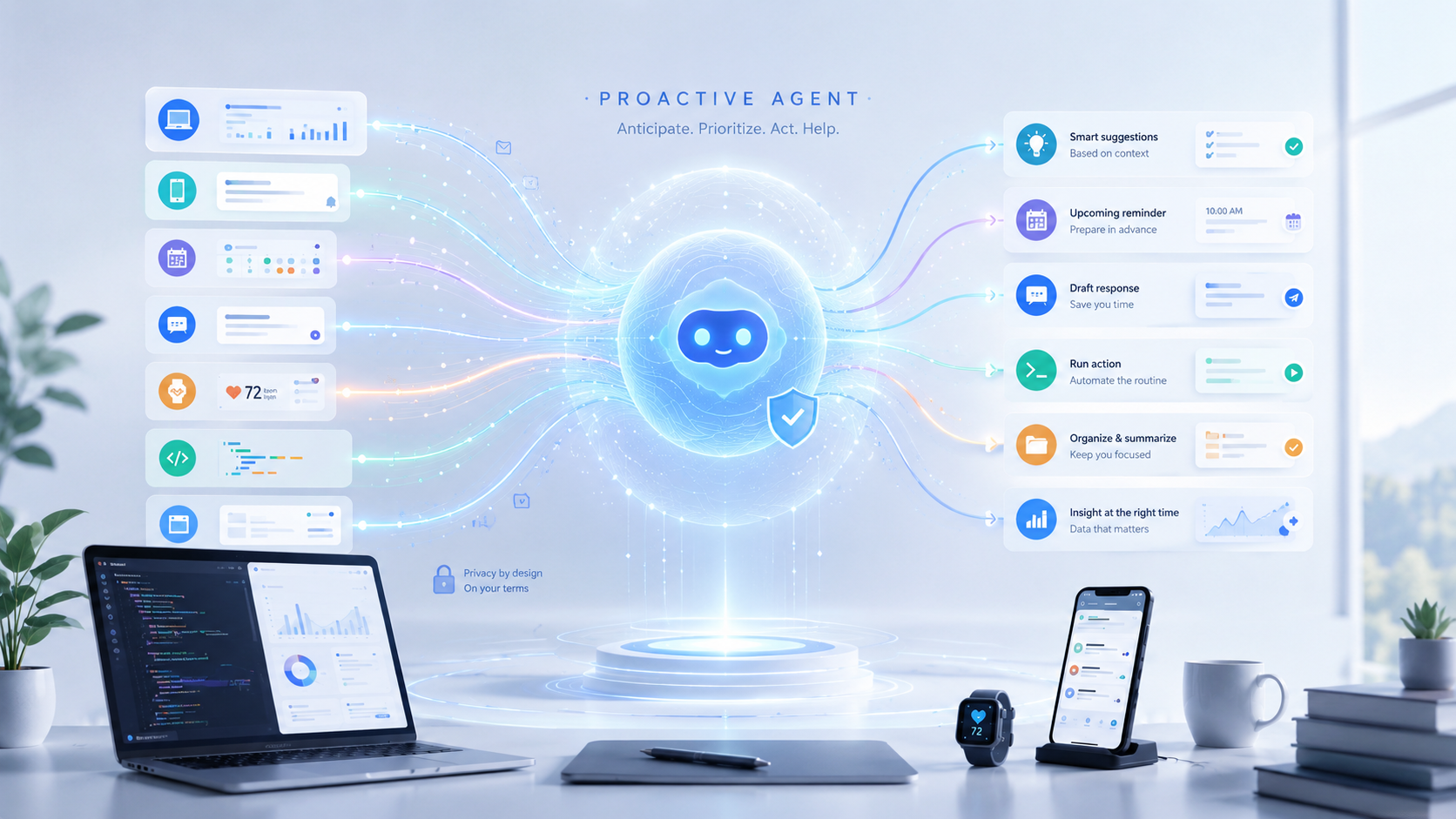




A curated research map for proactive agents: AI systems that infer latent user needs, decide when to intervene, ask for missing context or consent, and initiate useful assistance before a complete explicit command.
If this list is useful, a ⭐ helps others find it.
Companion Guides
- Research Map: question-driven clusters for quickly locating papers by intervention timing, inference, long-term intent, personalization, evaluation, and safety.
- Benchmark Matrix: side-by-side benchmark comparison by domain, input stream, proactive target, user model, data type, and metrics.
Contents
Scope
This list prioritizes papers where proactivity is a central research target. The list is broader than computer-use agents: it includes proactive dialogue, planning, recommendation, wearable assistance, GUI/mobile/OS agents, programming assistants, personalization, memory, benchmarks, optimization, and human factors.
Typical inclusion signals:
- The agent predicts latent intent or missing context before a complete user instruction.
- The agent decides when to ask, suggest, remind, intervene, execute, or stay silent.
- The paper evaluates proactive behavior, intervention timing, user control, consent, interruption cost, or personalization.
- The benchmark or dataset makes proactivity the primary task rather than a side effect of general tool use.
Resource labels:
- Paper: arXiv, ACL Anthology, DOI, OpenReview, ACM, Springer, or official proceedings page.
- Website: project page, conference page, lab page, or documentation.
- Code / Dataset: GitHub, released code, released benchmark, or released dataset.
- Notes: short English decision card with why the paper matters, proactivity signal, evaluation setup, limitations, and use cases.
Must Read
Selected starting points for understanding the field.
| Date | Paper | Why read it first | Resources |
|---|---|---|---|
| 2024-04 | Towards Human-centered Proactive Conversational Agents | Establishes the human-centered dimensions of proactive agents: intelligence, adaptivity, and civility. |   |
| 2024-10 | Proactive Agent | Canonical shift from reactive LLM agents to active assistance over event streams; introduces ProactiveBench. |     |
| 2024-10 | Need Help? | Strong user-study reference for proactive IDE assistance and intervention timing. |  |
| 2025-05 | ContextAgent | Extends proactive agents to open-world sensory contexts and tool calling. |    |
| 2026-02 | ProAgentBench | Real workflow logs reveal why synthetic proactive data can overestimate performance. |   |
| 2026-03 | StreamReady | Learns both what to answer and when enough streaming-video evidence has arrived, with explicit penalties for premature and delayed answers. |  |
| 2026-04 | KnowU-Bench | Closest benchmark to proactive, personalized, consent-aware mobile assistants. |    |
| 2026-05 | π-Bench | Sharp long-horizon benchmark for hidden-intent resolution in personal assistant workflows. |    |
| 2026-08 | VibeLifeBench | Makes act, ask, and stay-silent decisions explicit across multi-week personal-assistant tasks in a changing world. |  |
| 2026-08 | Why2Speak | Treats speaking and remaining silent as an auditable action policy, exposing the capability–faithfulness trade-off in intervention timing. |  |
Papers
Foundations, Surveys and Human Factors
| Date | Title | Venue / Source | Tags | Resources |
|---|---|---|---|---|
| 2024-04 | Towards Human-centered Proactive Conversational Agents | SIGIR 2024 | Definition · Human Factors · Dialogue | |
| 2024-10 | Redefining Proactivity for Information Seeking Dialogue | SICON 2024 | Definition · Dialogue · Intent Inference |  |
| 2025-01 | When AI-Based Agents Are Proactive: Implications for Competence and System Satisfaction in Human-AI Collaboration | BISE 2026 | Human Factors · Intervention Timing · Trust |  |
| 2025-02 | Assistance or Disruption? Exploring and Evaluating the Design and Trade-offs of Proactive AI Programming Support | CHI 2025 | Human Factors · Intervention Timing · IDE |   |
| 2025-03 | Proactive Conversational AI: A Comprehensive Survey of Advancements and Opportunities | ACM TOIS 2025 | Survey · Definition · Dialogue |  |
| 2025-08 | When not to help: planning for lasting human-AI collaboration | arXiv 2508 | Human Factors · Intervention Timing · Trust |  |
| 2025-10 | Check Yourself Before You Wreck Yourself: Selectively Quitting Improves LLM Agent Safety | RegML 2025 Workshop | Safety & Consent · Tool Use · Intervention Timing |  |
| 2026-01 | Developer Interaction Patterns with Proactive AI: A Five-Day Field Study | IUI 2026 | Human Factors · Real-world Data · IDE |   |
| 2026-02 | From Fragmentation to Integration: Exploring the Design Space of AI Agents for Human-as-the-Unit Privacy Management | CHI 2026 | Safety & Consent · Privacy · Human Factors |   |
| 2026-02 | Exploring The Impact of Proactive Generative AI Agent Roles in Time-Sensitive Collaborative Problem-Solving Tasks | CHI 2026 | Human Factors · Collaboration · Intervention Timing |   |
| 2026-06 | Designing for Doubt: The Case for Informed Abstention in Autonomous Agents | AIES 2026 | Safety & Consent · Benchmark · Tool Use |  |
| 2026-07 | AI Assistants Overassist | arXiv 2607 | Human Factors · Intervention Timing · Education |  |
| 2026-08 | VeriForge: Mitigating Latent Knowledge Gaps in Narrative Drafting via Mixed-Initiative Scaffolding | UIST 2026 | Human Factors · Intervention Timing · GUI |  |
| 2026-08 | AI Watchdog: Agent Interfaces for Detecting and Defending Against Manipulative Dark Patterns in AI Conversations | arXiv 2608 | Human Factors · Safety & Consent · Intervention Timing |  |
| 2026-09 | Designing Proactive Thought Partners for Writing | arXiv 2609 | Human Factors · Intervention Timing · Personalization |  |
| 2026-09 | Proactive Service Agents: A Unified Decision Framework, Methods, and Evaluation | arXiv 2609 | Survey · Definition · Safety & Consent |  |
| 2026-09 | When Intelligence Becomes Agency: A Theory of Governed, Proactive Agency for Symbiotic AI Systems | arXiv 2609 | Definition · Safety & Consent · Intervention Timing |  |
| 2026-09 | Oops, Not Now: PEARL, a RAG-Based Support Agent for Gameplay and What Players Want from AI Help | IEEE CoG 2026 | Human Factors · Intervention Timing · Education |  |
| 2026-09 | Breaking Up is Hard to Do: AI Companions that Won't Let Their Users Go | arXiv 2609 | Human Factors · Safety & Consent · Dialogue |  |
Proactive Interaction and Planning
| Date | Title | Venue / Source | Tags | Resources |
|---|---|---|---|---|
| 2024-03 | ProMISe: A Proactive Multi-turn Dialogue Dataset for Information-seeking Intent Resolution | Findings of EACL 2024 | Clarification · Dialogue · Benchmark | |
| 2024-03 | Asking the Right Question at the Right Time: Human and Model Uncertainty Guidance to Ask Clarification Questions | EACL 2024 | Clarification · Dialogue · Intervention Timing | |
| 2024-06 | Ask-before-Plan: Proactive Language Agents for Real-World Planning | Findings of EMNLP 2024 | Clarification · Planning · Intent Inference |  |
| 2024-10 | Proactive Agent: Shifting LLM Agents from Reactive Responses to Active Assistance | ICLR 2025 | Intent Inference · Benchmark · Desktop | |
| 2024-11 | PCQPR: Proactive Conversational Question Planning with Reflection | EMNLP 2024 | Dialogue · Planning · Intent Inference | |
| 2025-01 | Proactive Conversational Agents with Inner Thoughts | CHI 2025 | Dialogue · Intent Inference · Intervention Timing |   |
| 2025-01 | ProTOD: Proactive Task-oriented Dialogue System Based on LLMs | COLING 2025 | Dialogue · Planning · Tool Use | |
| 2025-07 | Tunable LLM-based Proactive Recommendation Agent | ACL 2025 | Recommendation · Personalization · Intent Inference | |
| 2025-09 | PRINCIPLES: Synthetic Strategy Memory for Proactive Dialogue Agents | Findings of EMNLP 2025 | Dialogue · Memory · Simulation |  |
| 2025-10 | ProMediate: A Simulation Testbed for Evaluating Proactive Mediation in Multi-Party Negotiation | Findings of ACL 2026 | Dialogue · Collaboration · Benchmark |  |
| 2026-01 | Proactivity-driven Personalized Agents for Advancing Human Learning through Engagement, Reflection, and Self-Efficacy | ACM CHIIR 2026 Workshop | Personalization · Intent Inference · Education |  |
| 2026-01 | Long-term Task-oriented Agent: Proactive Long-term Intent Maintenance in Dynamic Environments | arXiv 2601 | Long-horizon · Intent Inference · Benchmark |  |
| 2026-01 | Value of Information: A Framework for Human–Agent Communication | ACL 2026 | Clarification · Intervention Timing · Safety & Consent |  |
| 2026-03 | PsyProbe: Proactive and Interpretable Dialogue through User State Modeling for Exploratory Counseling | Findings of EACL 2026 | Dialogue · Intent Inference · Human Factors | |
| 2026-05 | Anticipate and Learn: Unleashing Idle-Time Compute in Proactive Agents | arXiv 2605 | Intent Inference · Memory · Benchmark |   |
| 2026-07 | PROPER Agents: Proactivity Driven Personalized Agents for Advancing Knowledge Gap Navigation | Findings of ACL 2026 | Personalization · Intent Inference · Dialogue |  |
| 2026-07 | ProACT: Towards Breakdown-Aware Proactive Agent in Multi-User Collaboration | arXiv 2607 | Collaboration · Intervention Timing · Benchmark |  |
| 2026-07 | Reasoning While Asking: Transforming Reasoning Large Language Models from Passive Solvers to Proactive Inquirers | ACL 2026 | Clarification · Dialogue · Optimization | |
| 2026-07 | ProMed: Shapley Information Gain Guided Reinforcement Learning for Proactive Medical LLMs | ACL 2026 | Clarification · Dialogue · Optimization |  |
| 2026-07 | "Excuse me, may I say something..." CoLabScience, A Proactive AI Assistant for Biomedical Discovery and LLM-Expert Collaborations | ACL 2026 | Collaboration · Intervention Timing · Benchmark | |
| 2026-07 | Let LLM Tutors Ask First: Proactive LLM-Based Tutoring at Scale in a 1,500-Student Online Classroom | ACL 2026 Industry Track | Education · Intent Inference · Real-world Data | |
| 2026-07 | When and What to Ask: AskBench and Rubric-Guided RLVR for LLM Clarification | Findings of ACL 2026 | Clarification · Benchmark · Optimization | |
| 2026-07 | ProActor: Timing-Aware Reinforcement Learning for Proactive Task Scheduling Agents | ACL 2026 | Intervention Timing · Planning · Optimization | |
| 2026-08 | A Self-Triggered Agentic Push Recommendation System | RecSys 2026 | Recommendation · Intervention Timing · Real-world Data |  |
| 2026-08 | CLAIM: Leading Open-domain Active Clarification of Large Language Models with Uncertainty Measurement | arXiv 2608 | Clarification · Dialogue · Optimization |  |
| 2026-08 | JarvisBench: Always-on Intelligence Between Humans and Agents | arXiv 2608 | Intervention Timing · Collaboration · Benchmark |   |
| 2026-08 | Bridging Search and CRM: Productionizing AI Product Research Agents for Customer Re-Engagement | arXiv 2608 | Recommendation · Personalization · Real-world Data |  |
| 2026-08 | Why2Speak: Faithful Reasoning for Abstaining Action Policies | arXiv 2608 | Intervention Timing · Collaboration · Safety & Consent | |
| 2026-08 | Clarify User Expertise: Towards Proactive Conversational Agents Tailoring Responses to User Proficiency | Findings of EMNLP 2026 | Clarification · Personalization · Dialogue |  |
| 2026-08 | Beyond Information Seeking: Severity-Aware Question Supervision for Proactive Medical Dialogue | arXiv 2608 | Clarification · Dialogue · Optimization |  |
| 2026-08 | From Passive Response to Proactive Correction: Enhancing LLM Robustness Against Input Fact Perturbations | EMNLP 2026 | Intent Inference · Safety & Consent · Dialogue |  |
| 2026-09 | Speak for Me: Giving LLMs the Situational Awareness to Participate in a Meeting | EMNLP 2026 | Collaboration · Intervention Timing · Dialogue |   |
| 2026-09 | Ask Before You Optimize: Dynamic Pre-Formulation Clarification for Interactive Optimization | arXiv 2609 | Clarification · Planning · Benchmark |  |
| 2026-09 | CC-Mediation: Evaluating Large Language Models for Cross-Cultural Conflict Mediation | arXiv 2609 | Dialogue · Intervention Timing · Benchmark |   |
| 2026-09 | IdeaAMBIG: Benchmarking Implementation-Critical Gaps in Research-Idea Specifications | arXiv 2609 | Clarification · Benchmark · Tool Use |  |
| 2026-09 | ProMediConv: Benchmarking Proactive Conversational Agents in Legal Dispute Mediation | Findings of EMNLP 2026 | Dialogue · Collaboration · Benchmark |   |
GUI, Mobile, OS and Coding Agents
| Date | Title | Venue / Source | Tags | Resources |
|---|---|---|---|---|
| 2024-10 | Need Help? Designing Proactive AI Assistants for Programming | CHI 2025 | IDE · Intervention Timing · Human Factors | |
| 2025-03 | CodingGenie: A Proactive LLM-Powered Programming Assistant | FSE 2025 Companion | IDE · Intent Inference · Tool Use |    |
| 2025-07 | FingerTip 20K: A Benchmark for Proactive and Personalized Mobile LLM Agents | ICLR 2026 | Mobile · Personalization · Benchmark |   |
| 2025-07 | ProactiveVA: Proactive Visual Analytics with LLM-Based UI Agent | IEEE VIS 2025 / TVCG 2026 | GUI · Intervention Timing · Human Factors |   |
| 2025-08 | AppAgent-Pro: A Proactive GUI Agent System for Multidomain Information Integration and User Assistance | CIKM 2025 | GUI · Intent Inference · Tool Use |   |
| 2025-09 | VeriOS: Query-Driven Proactive Human-Agent-GUI Interaction for Trustworthy OS Agents | arXiv 2509 | OS · Safety & Consent · Clarification |   |
| 2026-02 | ProAgentBench: Evaluating LLM Agents for Proactive Assistance with Real-World Data | arXiv 2602 | Real-world Data · Intervention Timing · Benchmark | |
| 2026-02 | ProactiveMobile: A Comprehensive Benchmark for Boosting Proactive Intelligence on Mobile Devices | CVPR 2026 | Mobile · Intent Inference · Benchmark |  |
| 2026-03 | PIRA-Bench: A Transition from Reactive GUI Agents to GUI-based Proactive Intent Recommendation Agents | arXiv 2603 | GUI · Intent Inference · Benchmark |  |
| 2026-03 | GUIDE: A Benchmark for Understanding and Assisting Users in Open-Ended GUI Tasks | CVPR 2026 | GUI · Intent Inference · Benchmark |  |
| 2026-03 | Ask or Assume? Uncertainty-Aware Clarification-Seeking in Coding Agents | EMNLP 2026 | IDE · Clarification · Intervention Timing |  |
| 2026-04 | Ambig-SWE: Interactive Agents to Overcome Underspecificity in Software Engineering | ICLR 2026 | IDE · Clarification · Benchmark |  |
| 2026-04 | Help Without Being Asked: A Deployed Proactive Agent System for On-Call Support with Continuous Self-Improvement | arXiv 2604 | Real-world Data · Intervention Timing · Skill Learning |   |
| 2026-04 | Proactive Agent Research Environment: Simulating Active Users to Evaluate Proactive Assistants | arXiv 2604 | Simulation · Intervention Timing · Benchmark |   |
| 2026-04 | KnowU-Bench: Towards Interactive, Proactive, and Personalized Mobile Agent Evaluation | arXiv 2604 | Mobile · Personalization · Safety & Consent | |
| 2026-05 | An Empirical Study of Proactive Coding Assistants in Real-World Software Development | arXiv 2605 | IDE · Real-world Data · Benchmark |  |
| 2026-05 | ToolCUA: Towards Optimal GUI-Tool Path Orchestration for Computer Use Agents | arXiv 2605 | GUI · Tool Use · Optimization |   |
| 2026-04 | From Reactive to Proactive: Assessing the Proactivity of Voice Agents via ProVoice-Bench | Interspeech 2026 | Multimodal / Wearable · Intervention Timing · Benchmark |  |
| 2026-06 | Perceive Before Reasoning: A Pre-Reasoning Perception Framework for Efficient and Reliable Proactive Mobile Agents | arXiv 2606 | Mobile · Intervention Timing · Tool Use |  |
| 2026-07 | InquireMobile: Teaching VLM-based Mobile Agent to Request Human Assistance via Reinforcement Fine-Tuning | ACL 2026 | Mobile · Safety & Consent · Clarification | |
| 2026-07 | PersonalAlign: Hierarchical Implicit Intent Alignment for Personalized GUI Agent with Long-Term User-Centric Records | ACL 2026 | GUI · Personalization · Intent Inference | |
| 2026-08 | Active-SWE: Benchmarking Coding Agents for Proactive Bug Fixing without Issue Reports | arXiv 2608 | IDE · Benchmark · Tool Use |  |
| 2026-08 | ITO: Real-time Browser Tab Orchestration Through Intent Detection | UIST 2026 | GUI · Intent Inference · Human Factors |  |
| 2026-08 | Act2Intention: A Benchmark For Developing Active Mobile Agents Through Inferring User Intention from GUI Actions | arXiv 2608 | Mobile · Intent Inference · Benchmark |   |
| 2026-08 | On the Prospects of Dynamic LLM Conversations in Software Development | arXiv 2608 | IDE · Human Factors · Intervention Timing |  |
| 2026-08 | Towards Cognitive Process-Aware Proactive Writing Support | arXiv 2608 | GUI · Intent Inference · Human Factors |  |
| 2026-08 | InsightToast: Proactive Information Retrieval & Glanceable Visualization in the Side Channel of Data-Rich Meetings | UIST 2026 | GUI · Collaboration · Intervention Timing |  |
| 2026-09 | Beyond Instruction-Driven Editing: Source-Grounded Problem Discovery with User-Governed Repair for Scientific Posters | arXiv 2609 | GUI · Human Factors · Safety & Consent |  |
| 2026-09 | Do GUI Agents Know When Not to Act? Enabling Conflict-Aware Termination for Multimodal GUI Agents | arXiv 2609 | GUI · Safety & Consent · Intervention Timing |   |
Multimodal, Wearable and Embodied Agents
| Date | Title | Venue / Source | Tags | Resources |
|---|---|---|---|---|
| 2024-09 | AssistantX: An LLM-Powered Proactive Assistant in Collaborative Human-Populated Environments | IROS 2025 | Embodied · Collaboration · Planning |  |
| 2024-10 | Satori: Towards Proactive AR Assistant with Belief-Desire-Intention User Modeling | CHI 2025 | Multimodal / Wearable · Intent Inference · Human Factors |   |
| 2025-01 | YETI: Proactive Interventions by Multimodal AI Agents in Augmented Reality Tasks | arXiv 2501 | Multimodal / Wearable · Intervention Timing · Human Factors |  |
| 2025-01 | AiGet: Transforming Everyday Moments into Hidden Knowledge Discovery with AI Assistance on Smart Glasses | CHI 2025 | Multimodal / Wearable · Intent Inference · Personalization |   |
| 2025-02 | WatchGuardian: Enabling User-Defined Personalized Just-in-Time Intervention on Smartwatch | arXiv 2502 | Multimodal / Wearable · Personalization · Intervention Timing |  |
| 2025-02 | Mirai: A Wearable Proactive AI Inner-Voice for Contextual Nudging | CHI EA 2025 | Multimodal / Wearable · Intervention Timing · Human Factors |   |
| 2025-03 | OmniMMI: A Comprehensive Multi-modal Interaction Benchmark in Streaming Video Contexts | CVPR 2025 | Multimodal / Wearable · Intervention Timing · Benchmark |  |
| 2025-05 | ContextAgent: Context-Aware Proactive LLM Agents with Open-World Sensory Perceptions | NeurIPS 2025 | Multimodal / Wearable · Personalization · Tool Use | |
| 2025-05 | PACE: Proactive Assistance in Human-Robot Collaboration Through Action-Completion Estimation | ICRA 2025 | Embodied · Intervention Timing · Optimization |  |
| 2025-06 | Proactive Assistant Dialogue Generation from Streaming Egocentric Videos | EMNLP 2025 | Multimodal / Wearable · Dialogue · Intervention Timing |  |
| 2025-07 | ProMemAssist: Exploring Timely Proactive Assistance Through Working Memory Modeling in Multi-Modal Wearable Devices | UIST 2025 | Multimodal / Wearable · Intervention Timing · Human Factors |   |
| 2025-12 | ProAgent: Harnessing On-Demand Sensory Contexts for Proactive LLM Agent Systems | arXiv 2512 | Multimodal / Wearable · Sensing · Intervention Timing |   |
| 2026-01 | ROMA: Real-time Omni-Multimodal Assistant with Interactive Streaming Understanding | Findings of ACL 2026 | Multimodal / Wearable · Intervention Timing · Optimization |  |
| 2026-01 | Clarify or Answer: Reinforcement Learning for Agentic VQA with Context Under-specification | arXiv 2601 | Multimodal / Wearable · Clarification · Optimization |  |
| 2026-03 | ProactiveBench: Benchmarking Proactiveness in Multimodal Large Language Models | ICLR 2026 | Multimodal / Wearable · Intervention Timing · Benchmark |   |
| 2026-03 | StreamReady: Learning What to Answer and When in Long Streaming Videos | CVPR 2026 | Multimodal / Wearable · Intervention Timing · Benchmark |  |
| 2026-03 | Em-Garde: A Propose-Match Framework for Proactive Streaming Video Understanding | ECCV 2026 | Multimodal / Wearable · Intervention Timing · Optimization |    |
| 2026-04 | AURA: Always-On Understanding and Real-Time Assistance via Video Streams | arXiv 2604 | Multimodal / Wearable · Intervention Timing · Optimization |  |
| 2026-05 | IPIBench: Evaluating Interactive Proactive Intelligence of MLLMs under Continuous Streams | arXiv 2605 | Multimodal / Wearable · Intervention Timing · Benchmark |  |
| 2026-05 | OmniPro: A Comprehensive Benchmark for Omni-Proactive Streaming Video Understanding | arXiv 2605 | Multimodal / Wearable · Intervention Timing · Benchmark |  |
| 2026-05 | EgoPro-Bench: Benchmarking Personalized Proactive Interaction in Egocentric Video Streams | arXiv 2605 | Multimodal / Wearable · Personalization · Benchmark |  |
| 2026-05 | MemEye: A Visual-Centric Evaluation Framework for Multimodal Agent Memory | arXiv 2605 | Memory · Multimodal / Wearable · Benchmark |  |
| 2026-05 | PACT: Proactive Asking for Continual Task Assistance in Human-Robot Collaboration | arXiv 2605 | Embodied · Clarification · Long-horizon |  |
| 2026-07 | Vinci2: Providing Proactive Assistance in Continuous Egocentric Videos | ECCV 2026 | Multimodal / Wearable · Intervention Timing · Memory |  |
| 2026-07 | ChatMuse: Supporting In-Person Small-Group Conversation Experience with a Proactive Assistive AI Agent in Mixed Reality | UIST 2026 | Multimodal / Wearable · Collaboration · Human Factors |  |
| 2026-08 | GROVE: Growing and Reasoning over Temporally Stratified Memory from Streaming Video Experience | arXiv 2608 | Multimodal / Wearable · Memory · Intervention Timing |   |
| 2026-08 | From Sports to Safety: Benchmarking Proactive Risk Inference in MLLMs | arXiv 2608 | Multimodal / Wearable · Safety & Consent · Benchmark |   |
| 2026-08 | StreamArena: Toward Continuous, Interactive, and Long-Horizon Agentic Streaming Video Understanding | arXiv 2608 | Multimodal / Wearable · Long-horizon · Benchmark |  |
| 2026-08 | MOSS-VL Technical Report | arXiv 2608 | Multimodal / Wearable · Intervention Timing · Optimization |   |
| 2026-08 | StreamSoccer: Event-Driven Memory for Streaming Soccer Commentary | arXiv 2608 | Multimodal / Wearable · Intervention Timing · Memory |  |
| 2026-08 | OmniAssistBench: Assistant-style Interaction Benchmark for Omni-LLMs | arXiv 2608 | Multimodal / Wearable · Dialogue · Benchmark |  |
| 2026-08 | When Seeing Is Not Enough: Benchmarking Interactive Visual Grounding in LVLMs | EMNLP 2026 | Multimodal / Wearable · Clarification · Benchmark |  |
| 2026-08 | MMPCBench: Benchmarking Multimodal Large Language Models on Proactive Critique of Flawed Inputs | arXiv 2608 | Multimodal / Wearable · Safety & Consent · Benchmark |   |
| 2026-09 | Time-Aware Assistive Navigation | ICRA 2026 | Multimodal / Wearable · Intervention Timing · Benchmark |  |
| 2026-09 | Ambient @ EgoProactive 2026: Proactive Egocentric Assistance with Visually Grounded Supervision | ECCV 2026 Wearable AI Challenge | Multimodal / Wearable · Intervention Timing · Optimization |   |
| 2026-09 | Omni Interaction Agent Technical Report | arXiv 2609 | Multimodal / Wearable · Dialogue · Intervention Timing |   |
| 2026-09 | Realtime-Venus: A Full-Duplex Interaction System with Asynchronous Delegation | arXiv 2609 | Multimodal / Wearable · Dialogue · Tool Use |  |
| 2026-09 | Full-Duplex Speech Models Take the Floor When Asked, Not When Needed | arXiv 2609 | Multimodal / Wearable · Intervention Timing · Benchmark |  |
Benchmarks, Personalization and Optimization
| Date | Title | Venue / Source | Tags | Resources |
|---|---|---|---|---|
| 2025-08 | ProactiveEval: A Unified Evaluation Framework for Proactive Dialogue Agents | ACL 2026 | Benchmark · Dialogue · Intent Inference |   |
| 2025-09 | ProPerSim: Developing Proactive and Personalized AI Assistants through User-Assistant Simulation | ICLR 2026 | Personalization · Simulation · Benchmark |  |
| 2025-10 | Beyond Reactivity: Measuring Proactive Problem Solving in LLM Agents | arXiv 2510 | Benchmark · Intent Inference · Tool Use |   |
| 2025-10 | AgentFold: Long-Horizon Web Agents with Proactive Context Folding | ICLR 2026 | Long-horizon · Memory · Tool Use |   |
| 2025-11 | Training Proactive and Personalized LLM Agents | COLM 2026 | Personalization · Optimization · Simulation |   |
| 2025-11 | Structured Uncertainty guided Clarification for LLM Agents | Findings of ACL 2026 | Clarification · Tool Use · Benchmark |  |
| 2026-02 | Pushing Forward Pareto Frontiers of Proactive Agents with Behavioral Agentic Optimization | ICML 2026 | Optimization · Human Factors · Safety & Consent |   |
| 2026-03 | ProEvent: An Event-centric Benchmark for Proactive Agents | arXiv 2607 / ACL ARR 2026 | Benchmark · Long-horizon · Intervention Timing |  |
| 2026-04 | SKILL0: In-Context Agentic Reinforcement Learning for Skill Internalization | arXiv 2604 | Optimization · Skill Learning · Memory |   |
| 2026-04 | PASK: Toward Intent-Aware Proactive Agents with Long-Term Memory | arXiv 2604 | Long-horizon · Memory · Intervention Timing |  |
| 2026-05 | CogniFold: Always-On Proactive Memory via Cognitive Folding | arXiv 2605 | Memory · Intent Inference · Benchmark |   |
| 2026-05 | MUSE-Autoskill: Self-Evolving Agents via Skill Creation, Memory, Management, and Evaluation | arXiv 2605 | Optimization · Skill Learning · Memory |  |
| 2026-05 | Do Proactive Agents Really Need an LLM to Decide When to Wake and What to Anchor? | arXiv 2605 | Intervention Timing · Optimization · Tool Use |  |
| 2026-05 | ProactBench: Beyond What The User Asked For | arXiv 2605 | Benchmark · Dialogue · Intent Inference |  |
| 2026-05 | Claw-Anything: Benchmarking Always-On Personal Assistants with Broader Access to User's Digital World | arXiv 2605 | Long-horizon · Benchmark · Tool Use |  |
| 2026-05 | π-Bench: Evaluating Proactive Personal Assistant Agents in Long-Horizon Workflows | arXiv 2605 | Long-horizon · Intent Inference · Benchmark | |
| 2026-05 | VitaBench 2.0: Evaluating Personalized and Proactive Agents in Long-Term User Interactions | arXiv 2605 | Long-horizon · Personalization · Memory |   |
| 2026-06 | Ψ-Bench: Evaluating Persona-Sensitive Influencing in Persuasive Dialogues | arXiv 2606 | Dialogue · Personalization · Benchmark |   |
| 2026-06 | Communication Policy Evolution for Proactive LLM Agents | arXiv 2606 | Dialogue · Intervention Timing · Optimization |  |
| 2026-06 | See, Infer, Intervene: Proactive World Modeling for Goal-Oriented Social Intelligence | arXiv 2606 | Multimodal / Wearable · Intervention Timing · Benchmark |  |
| 2026-07 | Remember When It Matters: Proactive Memory Agent for Long-Horizon Agents | arXiv 2607 | Long-horizon · Memory · Intervention Timing |  |
| 2026-07 | ENPMR-Bench: Benchmarking Proactive Memory Retrieval for Emotional Support Agents | Findings of ACL 2026 | Memory · Dialogue · Benchmark | |
| 2026-08 | Preference-Driven Online Adaptation for Personalized Interaction Initiation in Proactive AI Assistants | arXiv 2608 | Personalization · Intervention Timing · Optimization |  |
| 2026-08 | VibeLifeBench: Can Your Life Agent Be Proactive and Persistent in a Living World? | arXiv 2608 | Long-horizon · Benchmark · Safety & Consent | |
| 2026-08 | Not Just Reason, Not Just Scan: Reinforcement Learning for Proactive Scientific Error Verification over Academic Paper | Findings of EMNLP 2026 | Multimodal / Wearable · Optimization · Safety & Consent |  |
| 2026-09 | RPCBench: A Benchmark for Proactive Premise Critique in LLM-based Recommendation | arXiv 2609 | Recommendation · Benchmark · Safety & Consent |   |
| 2026-09 | Propose to Learn, Learn to Propose: Evaluability-Aware Assistance under Bounded Rationality | arXiv 2609 · Under review | Personalization · Planning · Human Factors |  |
| 2026-09 | New Evidence, Same Choice: Testing Physical Experiment Selection in Vision Language Models | arXiv 2609 | Benchmark · Planning · Tool Use |  |
Benchmarks
For detailed comparison, see BENCHMARKS.md.
| Date | Benchmark | Paper | Environment | What it tests | Resources |
|---|---|---|---|---|---|
| 2024-03 | ProMISe | ProMISe | information-seeking dialogue | proactive clarification for intent resolution | |
| 2024-10 | RealHumanEval | Need Help? | programming tasks | proactive IDE assistance with human users | |
| 2024-10 | ProactiveBench | Proactive Agent | desktop activity events | proactive task prediction and acceptance | |
| 2025-03 | OmniMMI | OmniMMI | continuous audio-visual streams | proactive alerts, turn-taking, and streaming interaction | |
| 2025-05 | ContextAgentBench | ContextAgent | wearable sensory contexts | proactive service prediction and tool calling | |
| 2025-07 | FingerTip 20K | FingerTip 20K | Android trajectories | proactive task suggestion and personalized execution | |
| 2025-08 | ProactiveEval | ProactiveEval | proactive dialogue | target planning and dialogue guidance across six domains | |
| 2025-10 | PROBE | Beyond Reactivity | web problem-solving tasks | bottleneck discovery and autonomous resolution | |
| 2025-11 | UserVille | Training Proactive and Personalized LLM Agents | SWE and deep-research user simulation | productivity, proactivity and personalization under vague prompts | |
| 2025-11 | ClarifyBench | Structured Uncertainty Guided Clarification | dynamic tool-calling tasks | decide which tool argument to clarify and when to stop asking | |
| 2026-01 | ChronosBench | Long-term Task-oriented Agent | dynamic task environments | proactive long-term intent maintenance | |
| 2026-02 | ProAgentBench | ProAgentBench | real workflow logs | when-to-assist and how-to-assist | |
| 2026-02 | ProactiveMobile | ProactiveMobile | mobile device context | latent intent to executable API sequence | |
| 2026-03 | ProEvent | ProEvent | future event tracking | proactive event maintenance and reminders | |
| 2026-03 | PIRA-Bench | PIRA-Bench | continuous GUI screenshots | proactive GUI intent recommendation | |
| 2026-03 | ProReady-QA | StreamReady | long streaming videos with annotated evidence windows | answer only after sufficient evidence appears and avoid both premature and delayed responses | |
| 2026-03 | GUIDE | GUIDE | open-ended GUI workflow videos | behavior state, intent, and help prediction | |
| 2026-03 | ProactiveBench (MLLM) | ProactiveBench / Trento | visual difficulty scenarios | MLLM proactive help-seeking from visual context | |
| 2026-05 | IPIBench | IPIBench | streaming video, multi-turn | interactive proactive monitoring, task management, reactive-proactive coordination | |
| 2026-04 | ProVoice-Bench | ProVoice-Bench | voice interaction streams | proactive voice intervention timing, over-triggering, monitoring | |
| 2026-04 | Pare-Bench | Pare | multi-app FSM environment | active user simulation, intervention timing, multi-app execution | |
| 2026-04 | KnowU-Bench | KnowU-Bench | Android emulator | personalization, proactive tasks, consent and rejection handling | |
| 2026-04 | LatentNeeds-Bench | PASK | real speech transcripts over multi-turn sessions | detect latent demand, assist, or stay silent under latency constraints | |
| 2026-05 | CogEval-Bench | CogniFold | streaming event memory | proactive concept emergence and cognitive-structure formation | |
| 2026-05 | MemEye | MemEye | multimodal long-term memory | visual evidence granularity and temporal state reasoning | |
| 2026-05 | ProCodeBench | Proactive Coding Assistants | real IDE traces | proactive coding intent prediction and sim-to-real evaluation | |
| 2026-05 | ProactBench | Beyond What The User Asked For | synthetic multi-turn conversations | grounded unstated-need inference at emergent, critical, and recovery triggers | |
| 2026-05 | OmniPro | OmniPro | continuous omni-modal video streams | autonomously decide when and what to report across multiple triggers | |
| 2026-05 | EgoPro-Bench | EgoPro-Bench | egocentric streaming videos and user profiles | personalized interaction timing with explicit attention-or-silence labels | |
| 2026-05 | Claw-Anything | Claw-Anything | months of cross-service and multi-device activity | anticipate needs and complete proactive personal-assistant tasks amid noise | |
| 2026-05 | π-Bench | π-Bench | persistent personal workspaces | proactive hidden-intent resolution and checklist completion in long-horizon workflows | |
| 2026-05 | ProActEval | Anticipate and Learn | proactive assistant scenarios | idle-time anticipation, evidence acquisition, user effort and hallucination reduction | |
| 2026-05 | VitaBench 2.0 | VitaBench 2.0 | long-term user interaction sequences | preference extraction, memory use, updates, and proactive missing-information acquisition | |
| 2026-06 | Ψ-Bench | Ψ-Bench | persuasive dialogue | persona-sensitive influencing with simulated clients and user profiles | |
| 2026-06 | GuidanceSalesBench | See, Infer, Intervene | pre-interaction retail videos and customer-state manifests | select greet, elicit, inform, recommend, or hold | |
| 2026-07 | ProACT Collaboration Bench | ProACT | multi-user collaboration | breakdown detection, intervention timing, and non-interruptiveness | |
| 2026-07 | InquireBench | InquireMobile | mobile GUI | proactive confirmation before risky or uncertain actions | |
| 2026-07 | AndroidIntent | PersonalAlign | long-term Android records | vague-intent resolution and instruction-free routine suggestions | |
| 2026-07 | BSDD | CoLabScience | streaming biomedical discussions | when and how to contribute without disrupting collaborators | |
| 2026-07 | ENPMR-Bench | ENPMR-Bench | emotional-support dialogue | latent emotional-need inference and proactive supportive-memory retrieval | |
| 2026-07 | EgoServe | Vinci2 | continuous egocentric video | when-and-whether assistance across four memory horizons | |
| 2026-07 | Int-Bench | AI Assistants Overassist | simulated learners solving 1,500 problems | whether, when, and how much a tutor should intervene | |
| 2026-07 | AskBench | When and What to Ask | interactive intent-deficient and false-premise QA | decide when and what to clarify without sacrificing task performance | |
| 2026-08 | Active-SWE | Active-SWE | repository snapshots without issue reports | autonomous discovery and repair of single, multiple, and potential bugs | |
| 2026-08 | SPRINT | From Sports to Safety | real sports videos | early hazard warning, cause grounding, and false-alarm control | |
| 2026-08 | StreamArena | StreamArena | hour-scale audio-visual streams | proactive monitoring alongside perception, retrospection, and tool use | |
| 2026-08 | VibeLifeBench | VibeLifeBench | simulated multi-week life tasks | autonomous act, ask, and stay-silent decisions under silent world changes and implicit constraints | |
| 2026-08 | JarvisBench | JarvisBench | ongoing single- and multi-agent work | recognize consequential user-owned decisions, request judgment, and route it back to working agents | |
| 2026-08 | Act2Intention Bench | Act2Intention | continuous mobile GUI trajectories | understand, predict, suggest, and execute the next user intention from action history | |
| 2026-08 | StreamSoccer | StreamSoccer | continuous soccer video | causal commentary across current, recent, and historical scopes with rule-assisted mode-or-silence scheduling | |
| 2026-08 | OmniAssistBench | OmniAssistBench | continuous assistant-style video interactions | guide a user through a goal, incorporate visual prompts, and delay responses until the target event | |
| 2026-08 | Interactive Visual Grounding | When Seeing Is Not Enough | ambiguous visual references under multi-turn protocols | ask follow-up questions and synthesize acquired evidence to ground the target | |
| 2026-08 | MMPCBench | MMPCBench | flawed multimodal user inputs | autonomously detect, diagnose, and repair errors without an extra prompt | |
| 2026-09 | PROS-Bench | Beyond Instruction-Driven Editing | source papers paired with editable scientific posters | discover source-grounded problems, obtain user acceptance, repair native objects, and validate outcomes | |
| 2026-09 | RPCBench | RPCBench | evidence-grounded recommendation requests with corrupted premises | proactively detect, localize, and handle premise failures without fabricating unsupported recommendations | |
| 2026-09 | CONFLICTGUI | Do GUI Agents Know When Not to Act? | feasible and conflicting instructions grounded in GUI states | verify feasibility and terminate rather than over-comply when instructions or GUI evidence conflict | |
| 2026-09 | CC-Mediation | CC-Mediation | ten-turn cross-cultural conflict dialogues | decide when to intervene and select a mediation strategy with persistent downstream benefit | |
| 2026-09 | OR-Clarify | Ask Before You Optimize | partially specified operations-research requests with hidden formulation slots | ask only formulation-critical questions, avoid silent assumptions, and stop when ready to model | |
| 2026-09 | TIMELI | Time-Aware Assistive Navigation | egocentric navigation videos and closed-loop urban simulation | decide when to give concise guidance or remain silent for safety | |
| 2026-09 | IdeaAMBIG | IdeaAMBIG | incomplete research-method specifications grounded in papers and code | detect implementation-critical gaps and issue clarification actions instead of assuming | |
| 2026-09 | Physical Experiment Selection | New Evidence, Same Choice | controlled visual-physics measurements with known experiment costs | answer when evidence is sufficient or select the cheapest resolving experiment | |
| 2026-09 | ProMediConv | ProMediConv | multi-stage legal dispute dialogues reconstructed from real cases | select mediation strategies proactively and improve party behavior over the trajectory | |
Tag Vocabulary
Tags are intentionally compact and reusable. They describe the paper's main contribution, not every detail.
| Tag | Meaning |
|---|---|
Definition | Defines or reframes proactive agents, proactive dialogue, or design-space boundaries. |
Survey | Synthesizes a broad proactive-agent subfield or taxonomy. |
Human Factors | Studies interruption, control, satisfaction, workload, adoption, or developer experience. |
Trust | Focuses on competence perception, calibrated reliance, or trustworthy interaction. |
Safety & Consent | Covers confirmation, autonomy boundaries, reversibility, rejection, or risk control. |
Privacy | Centers privacy management, data minimization, or personal-context governance. |
Intervention Timing | Focuses on when an agent should act, ask, suggest, or remain silent. |
Intent Inference | Infers latent goals, hidden constraints, future tasks, or missing information. |
Clarification | Proactively asks questions before planning, execution, or recommendation. |
Dialogue | Proactive behavior in conversational, persuasive, or task-oriented interaction. |
Planning | Proactive decomposition, task planning, scheduling, or future-state reasoning. |
Tool Use | Tool calling, API execution, GUI operation, or action orchestration. |
Recommendation | Proactive recommendation or suggestion ranking. |
Collaboration | Multi-party or human-agent collaborative problem solving. |
Education | Learning, tutoring, reflection, or student engagement contexts. |
Long-horizon | Multi-session, dynamic, future-event, or long-running task maintenance. |
Personalization | User preferences, personas, profiles, long-term user history, or user-specific adaptation. |
Memory | Persistent memory, episodic memory, visual memory, skill memory, or cognitive memory structures. |
Simulation | User simulation, environment simulation, synthetic users, or synthetic workflows. |
Optimization | RL, reward modeling, multi-objective optimization, self-evolution, or behavior tuning. |
Skill Learning | Skill creation, skill internalization, skill memory, or reusable procedure learning. |
Benchmark | Introduces a dataset, evaluation suite, benchmark, simulator, or diagnostic protocol. |
Real-world Data | Uses real user traces, field-study data, or deployment-like logs. |
Desktop | Desktop activity streams, workstation context, or event logs. |
GUI | Graphical interface agents, browser/app screens, or visual UI interaction. |
Mobile | Mobile GUI, Android/iOS workflows, phone sensors, or mobile user context. |
OS | Operating-system agents, cross-app workflows, or OS-level verification. |
IDE | Programming assistants, code editors, or developer tooling. |
Multimodal / Wearable | Video, audio, AR, smart glasses, egocentric streams, or open-world sensory context. |
Sensing | Active context acquisition, sensor selection, or on-demand sensory capture. |
Embodied | Robots, physical environments, or human-populated embodied settings. |
Contributing
Pull requests are welcome.
Before adding a paper, check that it satisfies at least one of:
- It predicts latent user intent before a complete explicit instruction.
- It decides when to intervene, ask, suggest, execute, remind, or stay silent.
- It evaluates proactive assistance, interruption cost, user control, consent, or personalization.
- It contributes a benchmark or dataset where proactivity is the primary task.
Suggested note template:
# Paper Title

## Why It Matters

...

## Proactivity Signal

...

## Evaluation Setup

...

## Key Limitations

...

## Use For

...
Maintained by Low Entropy AI.
Contributors


Similar repos


A curated list of papers, benchmarks, project pages, and code for proactive agents.
21
35 commits
updated Sep 20, 2026
README
Awesome Proactive Agents
A curated research map for proactive agents: AI systems that infer latent user needs, decide when to intervene, ask for missing context or consent, and initiate useful assistance before a complete explicit command.
If this list is useful, a ⭐ helps others find it.
Companion Guides
- Research Map: question-driven clusters for quickly locating papers by intervention timing, inference, long-term intent, personalization, evaluation, and safety.
- Benchmark Matrix: side-by-side benchmark comparison by domain, input stream, proactive target, user model, data type, and metrics.
Contents
Scope
This list prioritizes papers where proactivity is a central research target. The list is broader than computer-use agents: it includes proactive dialogue, planning, recommendation, wearable assistance, GUI/mobile/OS agents, programming assistants, personalization, memory, benchmarks, optimization, and human factors.
Typical inclusion signals:
- The agent predicts latent intent or missing context before a complete user instruction.
- The agent decides when to ask, suggest, remind, intervene, execute, or stay silent.
- The paper evaluates proactive behavior, intervention timing, user control, consent, interruption cost, or personalization.
- The benchmark or dataset makes proactivity the primary task rather than a side effect of general tool use.
Resource labels:
- Paper: arXiv, ACL Anthology, DOI, OpenReview, ACM, Springer, or official proceedings page.
- Website: project page, conference page, lab page, or documentation.
- Code / Dataset: GitHub, released code, released benchmark, or released dataset.
- Notes: short English decision card with why the paper matters, proactivity signal, evaluation setup, limitations, and use cases.
Must Read
Selected starting points for understanding the field.
| Date | Paper | Why read it first | Resources |
|---|---|---|---|
| 2024-04 | Towards Human-centered Proactive Conversational Agents | Establishes the human-centered dimensions of proactive agents: intelligence, adaptivity, and civility. | |
| 2024-10 | Proactive Agent | Canonical shift from reactive LLM agents to active assistance over event streams; introduces ProactiveBench. | |
| 2024-10 | Need Help? | Strong user-study reference for proactive IDE assistance and intervention timing. | |
| 2025-05 | ContextAgent | Extends proactive agents to open-world sensory contexts and tool calling. | |
| 2026-02 | ProAgentBench | Real workflow logs reveal why synthetic proactive data can overestimate performance. | |
| 2026-03 | StreamReady | Learns both what to answer and when enough streaming-video evidence has arrived, with explicit penalties for premature and delayed answers. | |
| 2026-04 | KnowU-Bench | Closest benchmark to proactive, personalized, consent-aware mobile assistants. | |
| 2026-05 | π-Bench | Sharp long-horizon benchmark for hidden-intent resolution in personal assistant workflows. | |
| 2026-08 | VibeLifeBench | Makes act, ask, and stay-silent decisions explicit across multi-week personal-assistant tasks in a changing world. | |
| 2026-08 | Why2Speak | Treats speaking and remaining silent as an auditable action policy, exposing the capability–faithfulness trade-off in intervention timing. | |
Papers
Foundations, Surveys and Human Factors
| Date | Title | Venue / Source | Tags | Resources |
|---|---|---|---|---|
| 2024-04 | Towards Human-centered Proactive Conversational Agents | SIGIR 2024 | Definition · Human Factors · Dialogue | |
| 2024-10 | Redefining Proactivity for Information Seeking Dialogue | SICON 2024 | Definition · Dialogue · Intent Inference | |
| 2025-01 | When AI-Based Agents Are Proactive: Implications for Competence and System Satisfaction in Human-AI Collaboration | BISE 2026 | Human Factors · Intervention Timing · Trust | |
| 2025-02 | Assistance or Disruption? Exploring and Evaluating the Design and Trade-offs of Proactive AI Programming Support | CHI 2025 | Human Factors · Intervention Timing · IDE | |
| 2025-03 | Proactive Conversational AI: A Comprehensive Survey of Advancements and Opportunities | ACM TOIS 2025 | Survey · Definition · Dialogue | |
| 2025-08 | When not to help: planning for lasting human-AI collaboration | arXiv 2508 | Human Factors · Intervention Timing · Trust | |
| 2025-10 | Check Yourself Before You Wreck Yourself: Selectively Quitting Improves LLM Agent Safety | RegML 2025 Workshop | Safety & Consent · Tool Use · Intervention Timing | |
| 2026-01 | Developer Interaction Patterns with Proactive AI: A Five-Day Field Study | IUI 2026 | Human Factors · Real-world Data · IDE | |
| 2026-02 | From Fragmentation to Integration: Exploring the Design Space of AI Agents for Human-as-the-Unit Privacy Management | CHI 2026 | Safety & Consent · Privacy · Human Factors | |
| 2026-02 | Exploring The Impact of Proactive Generative AI Agent Roles in Time-Sensitive Collaborative Problem-Solving Tasks | CHI 2026 | Human Factors · Collaboration · Intervention Timing | |
| 2026-06 | Designing for Doubt: The Case for Informed Abstention in Autonomous Agents | AIES 2026 | Safety & Consent · Benchmark · Tool Use | |
| 2026-07 | AI Assistants Overassist | arXiv 2607 | Human Factors · Intervention Timing · Education | |
| 2026-08 | VeriForge: Mitigating Latent Knowledge Gaps in Narrative Drafting via Mixed-Initiative Scaffolding | UIST 2026 | Human Factors · Intervention Timing · GUI | |
| 2026-08 | AI Watchdog: Agent Interfaces for Detecting and Defending Against Manipulative Dark Patterns in AI Conversations | arXiv 2608 | Human Factors · Safety & Consent · Intervention Timing | |
| 2026-09 | Designing Proactive Thought Partners for Writing | arXiv 2609 | Human Factors · Intervention Timing · Personalization | |
| 2026-09 | Proactive Service Agents: A Unified Decision Framework, Methods, and Evaluation | arXiv 2609 | Survey · Definition · Safety & Consent | |
| 2026-09 | When Intelligence Becomes Agency: A Theory of Governed, Proactive Agency for Symbiotic AI Systems | arXiv 2609 | Definition · Safety & Consent · Intervention Timing | |
| 2026-09 | Oops, Not Now: PEARL, a RAG-Based Support Agent for Gameplay and What Players Want from AI Help | IEEE CoG 2026 | Human Factors · Intervention Timing · Education | |
| 2026-09 | Breaking Up is Hard to Do: AI Companions that Won't Let Their Users Go | arXiv 2609 | Human Factors · Safety & Consent · Dialogue | |
Proactive Interaction and Planning
| Date | Title | Venue / Source | Tags | Resources |
|---|---|---|---|---|
| 2024-03 | ProMISe: A Proactive Multi-turn Dialogue Dataset for Information-seeking Intent Resolution | Findings of EACL 2024 | Clarification · Dialogue · Benchmark | |
| 2024-03 | Asking the Right Question at the Right Time: Human and Model Uncertainty Guidance to Ask Clarification Questions | EACL 2024 | Clarification · Dialogue · Intervention Timing | |
| 2024-06 | Ask-before-Plan: Proactive Language Agents for Real-World Planning | Findings of EMNLP 2024 | Clarification · Planning · Intent Inference | |
| 2024-10 | Proactive Agent: Shifting LLM Agents from Reactive Responses to Active Assistance | ICLR 2025 | Intent Inference · Benchmark · Desktop | |
| 2024-11 | PCQPR: Proactive Conversational Question Planning with Reflection | EMNLP 2024 | Dialogue · Planning · Intent Inference | |
| 2025-01 | Proactive Conversational Agents with Inner Thoughts | CHI 2025 | Dialogue · Intent Inference · Intervention Timing | |
| 2025-01 | ProTOD: Proactive Task-oriented Dialogue System Based on LLMs | COLING 2025 | Dialogue · Planning · Tool Use | |
| 2025-07 | Tunable LLM-based Proactive Recommendation Agent | ACL 2025 | Recommendation · Personalization · Intent Inference | |
| 2025-09 | PRINCIPLES: Synthetic Strategy Memory for Proactive Dialogue Agents | Findings of EMNLP 2025 | Dialogue · Memory · Simulation | |
| 2025-10 | ProMediate: A Simulation Testbed for Evaluating Proactive Mediation in Multi-Party Negotiation | Findings of ACL 2026 | Dialogue · Collaboration · Benchmark | |
| 2026-01 | Proactivity-driven Personalized Agents for Advancing Human Learning through Engagement, Reflection, and Self-Efficacy | ACM CHIIR 2026 Workshop | Personalization · Intent Inference · Education | |
| 2026-01 | Long-term Task-oriented Agent: Proactive Long-term Intent Maintenance in Dynamic Environments | arXiv 2601 | Long-horizon · Intent Inference · Benchmark | |
| 2026-01 | Value of Information: A Framework for Human–Agent Communication | ACL 2026 | Clarification · Intervention Timing · Safety & Consent | |
| 2026-03 | PsyProbe: Proactive and Interpretable Dialogue through User State Modeling for Exploratory Counseling | Findings of EACL 2026 | Dialogue · Intent Inference · Human Factors | |
| 2026-05 | Anticipate and Learn: Unleashing Idle-Time Compute in Proactive Agents | arXiv 2605 | Intent Inference · Memory · Benchmark | |
| 2026-07 | PROPER Agents: Proactivity Driven Personalized Agents for Advancing Knowledge Gap Navigation | Findings of ACL 2026 | Personalization · Intent Inference · Dialogue | |
| 2026-07 | ProACT: Towards Breakdown-Aware Proactive Agent in Multi-User Collaboration | arXiv 2607 | Collaboration · Intervention Timing · Benchmark | |
| 2026-07 | Reasoning While Asking: Transforming Reasoning Large Language Models from Passive Solvers to Proactive Inquirers | ACL 2026 | Clarification · Dialogue · Optimization | |
| 2026-07 | ProMed: Shapley Information Gain Guided Reinforcement Learning for Proactive Medical LLMs | ACL 2026 | Clarification · Dialogue · Optimization | |
| 2026-07 | "Excuse me, may I say something..." CoLabScience, A Proactive AI Assistant for Biomedical Discovery and LLM-Expert Collaborations | ACL 2026 | Collaboration · Intervention Timing · Benchmark | |
| 2026-07 | Let LLM Tutors Ask First: Proactive LLM-Based Tutoring at Scale in a 1,500-Student Online Classroom | ACL 2026 Industry Track | Education · Intent Inference · Real-world Data | |
| 2026-07 | When and What to Ask: AskBench and Rubric-Guided RLVR for LLM Clarification | Findings of ACL 2026 | Clarification · Benchmark · Optimization | |
| 2026-07 | ProActor: Timing-Aware Reinforcement Learning for Proactive Task Scheduling Agents | ACL 2026 | Intervention Timing · Planning · Optimization | |
| 2026-08 | A Self-Triggered Agentic Push Recommendation System | RecSys 2026 | Recommendation · Intervention Timing · Real-world Data | |
| 2026-08 | CLAIM: Leading Open-domain Active Clarification of Large Language Models with Uncertainty Measurement | arXiv 2608 | Clarification · Dialogue · Optimization | |
| 2026-08 | JarvisBench: Always-on Intelligence Between Humans and Agents | arXiv 2608 | Intervention Timing · Collaboration · Benchmark | |
| 2026-08 | Bridging Search and CRM: Productionizing AI Product Research Agents for Customer Re-Engagement | arXiv 2608 | Recommendation · Personalization · Real-world Data | |
| 2026-08 | Why2Speak: Faithful Reasoning for Abstaining Action Policies | arXiv 2608 | Intervention Timing · Collaboration · Safety & Consent | |
| 2026-08 | Clarify User Expertise: Towards Proactive Conversational Agents Tailoring Responses to User Proficiency | Findings of EMNLP 2026 | Clarification · Personalization · Dialogue | |
| 2026-08 | Beyond Information Seeking: Severity-Aware Question Supervision for Proactive Medical Dialogue | arXiv 2608 | Clarification · Dialogue · Optimization | |
| 2026-08 | From Passive Response to Proactive Correction: Enhancing LLM Robustness Against Input Fact Perturbations | EMNLP 2026 | Intent Inference · Safety & Consent · Dialogue | |
| 2026-09 | Speak for Me: Giving LLMs the Situational Awareness to Participate in a Meeting | EMNLP 2026 | Collaboration · Intervention Timing · Dialogue | |
| 2026-09 | Ask Before You Optimize: Dynamic Pre-Formulation Clarification for Interactive Optimization | arXiv 2609 | Clarification · Planning · Benchmark | |
| 2026-09 | CC-Mediation: Evaluating Large Language Models for Cross-Cultural Conflict Mediation | arXiv 2609 | Dialogue · Intervention Timing · Benchmark | |
| 2026-09 | IdeaAMBIG: Benchmarking Implementation-Critical Gaps in Research-Idea Specifications | arXiv 2609 | Clarification · Benchmark · Tool Use | |
| 2026-09 | ProMediConv: Benchmarking Proactive Conversational Agents in Legal Dispute Mediation | Findings of EMNLP 2026 | Dialogue · Collaboration · Benchmark | |
GUI, Mobile, OS and Coding Agents
| Date | Title | Venue / Source | Tags | Resources |
|---|---|---|---|---|
| 2024-10 | Need Help? Designing Proactive AI Assistants for Programming | CHI 2025 | IDE · Intervention Timing · Human Factors | |
| 2025-03 | CodingGenie: A Proactive LLM-Powered Programming Assistant | FSE 2025 Companion | IDE · Intent Inference · Tool Use | |
| 2025-07 | FingerTip 20K: A Benchmark for Proactive and Personalized Mobile LLM Agents | ICLR 2026 | Mobile · Personalization · Benchmark | |
| 2025-07 | ProactiveVA: Proactive Visual Analytics with LLM-Based UI Agent | IEEE VIS 2025 / TVCG 2026 | GUI · Intervention Timing · Human Factors | |
| 2025-08 | AppAgent-Pro: A Proactive GUI Agent System for Multidomain Information Integration and User Assistance | CIKM 2025 | GUI · Intent Inference · Tool Use | |
| 2025-09 | VeriOS: Query-Driven Proactive Human-Agent-GUI Interaction for Trustworthy OS Agents | arXiv 2509 | OS · Safety & Consent · Clarification | |
| 2026-02 | ProAgentBench: Evaluating LLM Agents for Proactive Assistance with Real-World Data | arXiv 2602 | Real-world Data · Intervention Timing · Benchmark | |
| 2026-02 | ProactiveMobile: A Comprehensive Benchmark for Boosting Proactive Intelligence on Mobile Devices | CVPR 2026 | Mobile · Intent Inference · Benchmark | |
| 2026-03 | PIRA-Bench: A Transition from Reactive GUI Agents to GUI-based Proactive Intent Recommendation Agents | arXiv 2603 | GUI · Intent Inference · Benchmark | |
| 2026-03 | GUIDE: A Benchmark for Understanding and Assisting Users in Open-Ended GUI Tasks | CVPR 2026 | GUI · Intent Inference · Benchmark | |
| 2026-03 | Ask or Assume? Uncertainty-Aware Clarification-Seeking in Coding Agents | EMNLP 2026 | IDE · Clarification · Intervention Timing | |
| 2026-04 | Ambig-SWE: Interactive Agents to Overcome Underspecificity in Software Engineering | ICLR 2026 | IDE · Clarification · Benchmark | |
| 2026-04 | Help Without Being Asked: A Deployed Proactive Agent System for On-Call Support with Continuous Self-Improvement | arXiv 2604 | Real-world Data · Intervention Timing · Skill Learning | |
| 2026-04 | Proactive Agent Research Environment: Simulating Active Users to Evaluate Proactive Assistants | arXiv 2604 | Simulation · Intervention Timing · Benchmark | |
| 2026-04 | KnowU-Bench: Towards Interactive, Proactive, and Personalized Mobile Agent Evaluation | arXiv 2604 | Mobile · Personalization · Safety & Consent | |
| 2026-05 | An Empirical Study of Proactive Coding Assistants in Real-World Software Development | arXiv 2605 | IDE · Real-world Data · Benchmark | |
| 2026-05 | ToolCUA: Towards Optimal GUI-Tool Path Orchestration for Computer Use Agents | arXiv 2605 | GUI · Tool Use · Optimization | |
| 2026-04 | From Reactive to Proactive: Assessing the Proactivity of Voice Agents via ProVoice-Bench | Interspeech 2026 | Multimodal / Wearable · Intervention Timing · Benchmark | |
| 2026-06 | Perceive Before Reasoning: A Pre-Reasoning Perception Framework for Efficient and Reliable Proactive Mobile Agents | arXiv 2606 | Mobile · Intervention Timing · Tool Use | |
| 2026-07 | InquireMobile: Teaching VLM-based Mobile Agent to Request Human Assistance via Reinforcement Fine-Tuning | ACL 2026 | Mobile · Safety & Consent · Clarification | |
| 2026-07 | PersonalAlign: Hierarchical Implicit Intent Alignment for Personalized GUI Agent with Long-Term User-Centric Records | ACL 2026 | GUI · Personalization · Intent Inference | |
| 2026-08 | Active-SWE: Benchmarking Coding Agents for Proactive Bug Fixing without Issue Reports | arXiv 2608 | IDE · Benchmark · Tool Use | |
| 2026-08 | ITO: Real-time Browser Tab Orchestration Through Intent Detection | UIST 2026 | GUI · Intent Inference · Human Factors | |
| 2026-08 | Act2Intention: A Benchmark For Developing Active Mobile Agents Through Inferring User Intention from GUI Actions | arXiv 2608 | Mobile · Intent Inference · Benchmark | |
| 2026-08 | On the Prospects of Dynamic LLM Conversations in Software Development | arXiv 2608 | IDE · Human Factors · Intervention Timing | |
| 2026-08 | Towards Cognitive Process-Aware Proactive Writing Support | arXiv 2608 | GUI · Intent Inference · Human Factors | |
| 2026-08 | InsightToast: Proactive Information Retrieval & Glanceable Visualization in the Side Channel of Data-Rich Meetings | UIST 2026 | GUI · Collaboration · Intervention Timing | |
| 2026-09 | Beyond Instruction-Driven Editing: Source-Grounded Problem Discovery with User-Governed Repair for Scientific Posters | arXiv 2609 | GUI · Human Factors · Safety & Consent | |
| 2026-09 | Do GUI Agents Know When Not to Act? Enabling Conflict-Aware Termination for Multimodal GUI Agents | arXiv 2609 | GUI · Safety & Consent · Intervention Timing | |
Multimodal, Wearable and Embodied Agents
| Date | Title | Venue / Source | Tags | Resources |
|---|---|---|---|---|
| 2024-09 | AssistantX: An LLM-Powered Proactive Assistant in Collaborative Human-Populated Environments | IROS 2025 | Embodied · Collaboration · Planning | |
| 2024-10 | Satori: Towards Proactive AR Assistant with Belief-Desire-Intention User Modeling | CHI 2025 | Multimodal / Wearable · Intent Inference · Human Factors | |
| 2025-01 | YETI: Proactive Interventions by Multimodal AI Agents in Augmented Reality Tasks | arXiv 2501 | Multimodal / Wearable · Intervention Timing · Human Factors | |
| 2025-01 | AiGet: Transforming Everyday Moments into Hidden Knowledge Discovery with AI Assistance on Smart Glasses | CHI 2025 | Multimodal / Wearable · Intent Inference · Personalization | |
| 2025-02 | WatchGuardian: Enabling User-Defined Personalized Just-in-Time Intervention on Smartwatch | arXiv 2502 | Multimodal / Wearable · Personalization · Intervention Timing | |
| 2025-02 | Mirai: A Wearable Proactive AI Inner-Voice for Contextual Nudging | CHI EA 2025 | Multimodal / Wearable · Intervention Timing · Human Factors | |
| 2025-03 | OmniMMI: A Comprehensive Multi-modal Interaction Benchmark in Streaming Video Contexts | CVPR 2025 | Multimodal / Wearable · Intervention Timing · Benchmark | |
| 2025-05 | ContextAgent: Context-Aware Proactive LLM Agents with Open-World Sensory Perceptions | NeurIPS 2025 | Multimodal / Wearable · Personalization · Tool Use | |
| 2025-05 | PACE: Proactive Assistance in Human-Robot Collaboration Through Action-Completion Estimation | ICRA 2025 | Embodied · Intervention Timing · Optimization | |
| 2025-06 | Proactive Assistant Dialogue Generation from Streaming Egocentric Videos | EMNLP 2025 | Multimodal / Wearable · Dialogue · Intervention Timing | |
| 2025-07 | ProMemAssist: Exploring Timely Proactive Assistance Through Working Memory Modeling in Multi-Modal Wearable Devices | UIST 2025 | Multimodal / Wearable · Intervention Timing · Human Factors | |
| 2025-12 | ProAgent: Harnessing On-Demand Sensory Contexts for Proactive LLM Agent Systems | arXiv 2512 | Multimodal / Wearable · Sensing · Intervention Timing | |
| 2026-01 | ROMA: Real-time Omni-Multimodal Assistant with Interactive Streaming Understanding | Findings of ACL 2026 | Multimodal / Wearable · Intervention Timing · Optimization | |
| 2026-01 | Clarify or Answer: Reinforcement Learning for Agentic VQA with Context Under-specification | arXiv 2601 | Multimodal / Wearable · Clarification · Optimization | |
| 2026-03 | ProactiveBench: Benchmarking Proactiveness in Multimodal Large Language Models | ICLR 2026 | Multimodal / Wearable · Intervention Timing · Benchmark | |
| 2026-03 | StreamReady: Learning What to Answer and When in Long Streaming Videos | CVPR 2026 | Multimodal / Wearable · Intervention Timing · Benchmark | |
| 2026-03 | Em-Garde: A Propose-Match Framework for Proactive Streaming Video Understanding | ECCV 2026 | Multimodal / Wearable · Intervention Timing · Optimization | |
| 2026-04 | AURA: Always-On Understanding and Real-Time Assistance via Video Streams | arXiv 2604 | Multimodal / Wearable · Intervention Timing · Optimization | |
| 2026-05 | IPIBench: Evaluating Interactive Proactive Intelligence of MLLMs under Continuous Streams | arXiv 2605 | Multimodal / Wearable · Intervention Timing · Benchmark | |
| 2026-05 | OmniPro: A Comprehensive Benchmark for Omni-Proactive Streaming Video Understanding | arXiv 2605 | Multimodal / Wearable · Intervention Timing · Benchmark | |
| 2026-05 | EgoPro-Bench: Benchmarking Personalized Proactive Interaction in Egocentric Video Streams | arXiv 2605 | Multimodal / Wearable · Personalization · Benchmark | |
| 2026-05 | MemEye: A Visual-Centric Evaluation Framework for Multimodal Agent Memory | arXiv 2605 | Memory · Multimodal / Wearable · Benchmark | |
| 2026-05 | PACT: Proactive Asking for Continual Task Assistance in Human-Robot Collaboration | arXiv 2605 | Embodied · Clarification · Long-horizon | |
| 2026-07 | Vinci2: Providing Proactive Assistance in Continuous Egocentric Videos | ECCV 2026 | Multimodal / Wearable · Intervention Timing · Memory | |
| 2026-07 | ChatMuse: Supporting In-Person Small-Group Conversation Experience with a Proactive Assistive AI Agent in Mixed Reality | UIST 2026 | Multimodal / Wearable · Collaboration · Human Factors | |
| 2026-08 | GROVE: Growing and Reasoning over Temporally Stratified Memory from Streaming Video Experience | arXiv 2608 | Multimodal / Wearable · Memory · Intervention Timing | |
| 2026-08 | From Sports to Safety: Benchmarking Proactive Risk Inference in MLLMs | arXiv 2608 | Multimodal / Wearable · Safety & Consent · Benchmark | |
| 2026-08 | StreamArena: Toward Continuous, Interactive, and Long-Horizon Agentic Streaming Video Understanding | arXiv 2608 | Multimodal / Wearable · Long-horizon · Benchmark | |
| 2026-08 | MOSS-VL Technical Report | arXiv 2608 | Multimodal / Wearable · Intervention Timing · Optimization | |
| 2026-08 | StreamSoccer: Event-Driven Memory for Streaming Soccer Commentary | arXiv 2608 | Multimodal / Wearable · Intervention Timing · Memory | |
| 2026-08 | OmniAssistBench: Assistant-style Interaction Benchmark for Omni-LLMs | arXiv 2608 | Multimodal / Wearable · Dialogue · Benchmark | |
| 2026-08 | When Seeing Is Not Enough: Benchmarking Interactive Visual Grounding in LVLMs | EMNLP 2026 | Multimodal / Wearable · Clarification · Benchmark | |
| 2026-08 | MMPCBench: Benchmarking Multimodal Large Language Models on Proactive Critique of Flawed Inputs | arXiv 2608 | Multimodal / Wearable · Safety & Consent · Benchmark | |
| 2026-09 | Time-Aware Assistive Navigation | ICRA 2026 | Multimodal / Wearable · Intervention Timing · Benchmark | |
| 2026-09 | Ambient @ EgoProactive 2026: Proactive Egocentric Assistance with Visually Grounded Supervision | ECCV 2026 Wearable AI Challenge | Multimodal / Wearable · Intervention Timing · Optimization | |
| 2026-09 | Omni Interaction Agent Technical Report | arXiv 2609 | Multimodal / Wearable · Dialogue · Intervention Timing | |
| 2026-09 | Realtime-Venus: A Full-Duplex Interaction System with Asynchronous Delegation | arXiv 2609 | Multimodal / Wearable · Dialogue · Tool Use | |
| 2026-09 | Full-Duplex Speech Models Take the Floor When Asked, Not When Needed | arXiv 2609 | Multimodal / Wearable · Intervention Timing · Benchmark | |
Benchmarks, Personalization and Optimization
| Date | Title | Venue / Source | Tags | Resources |
|---|---|---|---|---|
| 2025-08 | ProactiveEval: A Unified Evaluation Framework for Proactive Dialogue Agents | ACL 2026 | Benchmark · Dialogue · Intent Inference | |
| 2025-09 | ProPerSim: Developing Proactive and Personalized AI Assistants through User-Assistant Simulation | ICLR 2026 | Personalization · Simulation · Benchmark | |
| 2025-10 | Beyond Reactivity: Measuring Proactive Problem Solving in LLM Agents | arXiv 2510 | Benchmark · Intent Inference · Tool Use | |
| 2025-10 | AgentFold: Long-Horizon Web Agents with Proactive Context Folding | ICLR 2026 | Long-horizon · Memory · Tool Use | |
| 2025-11 | Training Proactive and Personalized LLM Agents | COLM 2026 | Personalization · Optimization · Simulation | |
| 2025-11 | Structured Uncertainty guided Clarification for LLM Agents | Findings of ACL 2026 | Clarification · Tool Use · Benchmark | |
| 2026-02 | Pushing Forward Pareto Frontiers of Proactive Agents with Behavioral Agentic Optimization | ICML 2026 | Optimization · Human Factors · Safety & Consent | |
| 2026-03 | ProEvent: An Event-centric Benchmark for Proactive Agents | arXiv 2607 / ACL ARR 2026 | Benchmark · Long-horizon · Intervention Timing | |
| 2026-04 | SKILL0: In-Context Agentic Reinforcement Learning for Skill Internalization | arXiv 2604 | Optimization · Skill Learning · Memory | |
| 2026-04 | PASK: Toward Intent-Aware Proactive Agents with Long-Term Memory | arXiv 2604 | Long-horizon · Memory · Intervention Timing | |
| 2026-05 | CogniFold: Always-On Proactive Memory via Cognitive Folding | arXiv 2605 | Memory · Intent Inference · Benchmark | |
| 2026-05 | MUSE-Autoskill: Self-Evolving Agents via Skill Creation, Memory, Management, and Evaluation | arXiv 2605 | Optimization · Skill Learning · Memory | |
| 2026-05 | Do Proactive Agents Really Need an LLM to Decide When to Wake and What to Anchor? | arXiv 2605 | Intervention Timing · Optimization · Tool Use | |
| 2026-05 | ProactBench: Beyond What The User Asked For | arXiv 2605 | Benchmark · Dialogue · Intent Inference | |
| 2026-05 | Claw-Anything: Benchmarking Always-On Personal Assistants with Broader Access to User's Digital World | arXiv 2605 | Long-horizon · Benchmark · Tool Use | |
| 2026-05 | π-Bench: Evaluating Proactive Personal Assistant Agents in Long-Horizon Workflows | arXiv 2605 | Long-horizon · Intent Inference · Benchmark | |
| 2026-05 | VitaBench 2.0: Evaluating Personalized and Proactive Agents in Long-Term User Interactions | arXiv 2605 | Long-horizon · Personalization · Memory | |
| 2026-06 | Ψ-Bench: Evaluating Persona-Sensitive Influencing in Persuasive Dialogues | arXiv 2606 | Dialogue · Personalization · Benchmark | |
| 2026-06 | Communication Policy Evolution for Proactive LLM Agents | arXiv 2606 | Dialogue · Intervention Timing · Optimization | |
| 2026-06 | See, Infer, Intervene: Proactive World Modeling for Goal-Oriented Social Intelligence | arXiv 2606 | Multimodal / Wearable · Intervention Timing · Benchmark | |
| 2026-07 | Remember When It Matters: Proactive Memory Agent for Long-Horizon Agents | arXiv 2607 | Long-horizon · Memory · Intervention Timing | |
| 2026-07 | ENPMR-Bench: Benchmarking Proactive Memory Retrieval for Emotional Support Agents | Findings of ACL 2026 | Memory · Dialogue · Benchmark | |
| 2026-08 | Preference-Driven Online Adaptation for Personalized Interaction Initiation in Proactive AI Assistants | arXiv 2608 | Personalization · Intervention Timing · Optimization | |
| 2026-08 | VibeLifeBench: Can Your Life Agent Be Proactive and Persistent in a Living World? | arXiv 2608 | Long-horizon · Benchmark · Safety & Consent | |
| 2026-08 | Not Just Reason, Not Just Scan: Reinforcement Learning for Proactive Scientific Error Verification over Academic Paper | Findings of EMNLP 2026 | Multimodal / Wearable · Optimization · Safety & Consent | |
| 2026-09 | RPCBench: A Benchmark for Proactive Premise Critique in LLM-based Recommendation | arXiv 2609 | Recommendation · Benchmark · Safety & Consent | |
| 2026-09 | Propose to Learn, Learn to Propose: Evaluability-Aware Assistance under Bounded Rationality | arXiv 2609 · Under review | Personalization · Planning · Human Factors | |
| 2026-09 | New Evidence, Same Choice: Testing Physical Experiment Selection in Vision Language Models | arXiv 2609 | Benchmark · Planning · Tool Use | |
Benchmarks
For detailed comparison, see BENCHMARKS.md.
| Date | Benchmark | Paper | Environment | What it tests | Resources |
|---|---|---|---|---|---|
| 2024-03 | ProMISe | ProMISe | information-seeking dialogue | proactive clarification for intent resolution | |
| 2024-10 | RealHumanEval | Need Help? | programming tasks | proactive IDE assistance with human users | |
| 2024-10 | ProactiveBench | Proactive Agent | desktop activity events | proactive task prediction and acceptance | |
| 2025-03 | OmniMMI | OmniMMI | continuous audio-visual streams | proactive alerts, turn-taking, and streaming interaction | |
| 2025-05 | ContextAgentBench | ContextAgent | wearable sensory contexts | proactive service prediction and tool calling | |
| 2025-07 | FingerTip 20K | FingerTip 20K | Android trajectories | proactive task suggestion and personalized execution | |
| 2025-08 | ProactiveEval | ProactiveEval | proactive dialogue | target planning and dialogue guidance across six domains | |
| 2025-10 | PROBE | Beyond Reactivity | web problem-solving tasks | bottleneck discovery and autonomous resolution | |
| 2025-11 | UserVille | Training Proactive and Personalized LLM Agents | SWE and deep-research user simulation | productivity, proactivity and personalization under vague prompts | |
| 2025-11 | ClarifyBench | Structured Uncertainty Guided Clarification | dynamic tool-calling tasks | decide which tool argument to clarify and when to stop asking | |
| 2026-01 | ChronosBench | Long-term Task-oriented Agent | dynamic task environments | proactive long-term intent maintenance | |
| 2026-02 | ProAgentBench | ProAgentBench | real workflow logs | when-to-assist and how-to-assist | |
| 2026-02 | ProactiveMobile | ProactiveMobile | mobile device context | latent intent to executable API sequence | |
| 2026-03 | ProEvent | ProEvent | future event tracking | proactive event maintenance and reminders | |
| 2026-03 | PIRA-Bench | PIRA-Bench | continuous GUI screenshots | proactive GUI intent recommendation | |
| 2026-03 | ProReady-QA | StreamReady | long streaming videos with annotated evidence windows | answer only after sufficient evidence appears and avoid both premature and delayed responses | |
| 2026-03 | GUIDE | GUIDE | open-ended GUI workflow videos | behavior state, intent, and help prediction | |
| 2026-03 | ProactiveBench (MLLM) | ProactiveBench / Trento | visual difficulty scenarios | MLLM proactive help-seeking from visual context | |
| 2026-05 | IPIBench | IPIBench | streaming video, multi-turn | interactive proactive monitoring, task management, reactive-proactive coordination | |
| 2026-04 | ProVoice-Bench | ProVoice-Bench | voice interaction streams | proactive voice intervention timing, over-triggering, monitoring | |
| 2026-04 | Pare-Bench | Pare | multi-app FSM environment | active user simulation, intervention timing, multi-app execution | |
| 2026-04 | KnowU-Bench | KnowU-Bench | Android emulator | personalization, proactive tasks, consent and rejection handling | |
| 2026-04 | LatentNeeds-Bench | PASK | real speech transcripts over multi-turn sessions | detect latent demand, assist, or stay silent under latency constraints | |
| 2026-05 | CogEval-Bench | CogniFold | streaming event memory | proactive concept emergence and cognitive-structure formation | |
| 2026-05 | MemEye | MemEye | multimodal long-term memory | visual evidence granularity and temporal state reasoning | |
| 2026-05 | ProCodeBench | Proactive Coding Assistants | real IDE traces | proactive coding intent prediction and sim-to-real evaluation | |
| 2026-05 | ProactBench | Beyond What The User Asked For | synthetic multi-turn conversations | grounded unstated-need inference at emergent, critical, and recovery triggers | |
| 2026-05 | OmniPro | OmniPro | continuous omni-modal video streams | autonomously decide when and what to report across multiple triggers | |
| 2026-05 | EgoPro-Bench | EgoPro-Bench | egocentric streaming videos and user profiles | personalized interaction timing with explicit attention-or-silence labels | |
| 2026-05 | Claw-Anything | Claw-Anything | months of cross-service and multi-device activity | anticipate needs and complete proactive personal-assistant tasks amid noise | |
| 2026-05 | π-Bench | π-Bench | persistent personal workspaces | proactive hidden-intent resolution and checklist completion in long-horizon workflows | |
| 2026-05 | ProActEval | Anticipate and Learn | proactive assistant scenarios | idle-time anticipation, evidence acquisition, user effort and hallucination reduction | |
| 2026-05 | VitaBench 2.0 | VitaBench 2.0 | long-term user interaction sequences | preference extraction, memory use, updates, and proactive missing-information acquisition | |
| 2026-06 | Ψ-Bench | Ψ-Bench | persuasive dialogue | persona-sensitive influencing with simulated clients and user profiles | |
| 2026-06 | GuidanceSalesBench | See, Infer, Intervene | pre-interaction retail videos and customer-state manifests | select greet, elicit, inform, recommend, or hold | |
| 2026-07 | ProACT Collaboration Bench | ProACT | multi-user collaboration | breakdown detection, intervention timing, and non-interruptiveness | |
| 2026-07 | InquireBench | InquireMobile | mobile GUI | proactive confirmation before risky or uncertain actions | |
| 2026-07 | AndroidIntent | PersonalAlign | long-term Android records | vague-intent resolution and instruction-free routine suggestions | |
| 2026-07 | BSDD | CoLabScience | streaming biomedical discussions | when and how to contribute without disrupting collaborators | |
| 2026-07 | ENPMR-Bench | ENPMR-Bench | emotional-support dialogue | latent emotional-need inference and proactive supportive-memory retrieval | |
| 2026-07 | EgoServe | Vinci2 | continuous egocentric video | when-and-whether assistance across four memory horizons | |
| 2026-07 | Int-Bench | AI Assistants Overassist | simulated learners solving 1,500 problems | whether, when, and how much a tutor should intervene | |
| 2026-07 | AskBench | When and What to Ask | interactive intent-deficient and false-premise QA | decide when and what to clarify without sacrificing task performance | |
| 2026-08 | Active-SWE | Active-SWE | repository snapshots without issue reports | autonomous discovery and repair of single, multiple, and potential bugs | |
| 2026-08 | SPRINT | From Sports to Safety | real sports videos | early hazard warning, cause grounding, and false-alarm control | |
| 2026-08 | StreamArena | StreamArena | hour-scale audio-visual streams | proactive monitoring alongside perception, retrospection, and tool use | |
| 2026-08 | VibeLifeBench | VibeLifeBench | simulated multi-week life tasks | autonomous act, ask, and stay-silent decisions under silent world changes and implicit constraints | |
| 2026-08 | JarvisBench | JarvisBench | ongoing single- and multi-agent work | recognize consequential user-owned decisions, request judgment, and route it back to working agents | |
| 2026-08 | Act2Intention Bench | Act2Intention | continuous mobile GUI trajectories | understand, predict, suggest, and execute the next user intention from action history | |
| 2026-08 | StreamSoccer | StreamSoccer | continuous soccer video | causal commentary across current, recent, and historical scopes with rule-assisted mode-or-silence scheduling | |
| 2026-08 | OmniAssistBench | OmniAssistBench | continuous assistant-style video interactions | guide a user through a goal, incorporate visual prompts, and delay responses until the target event | |
| 2026-08 | Interactive Visual Grounding | When Seeing Is Not Enough | ambiguous visual references under multi-turn protocols | ask follow-up questions and synthesize acquired evidence to ground the target | |
| 2026-08 | MMPCBench | MMPCBench | flawed multimodal user inputs | autonomously detect, diagnose, and repair errors without an extra prompt | |
| 2026-09 | PROS-Bench | Beyond Instruction-Driven Editing | source papers paired with editable scientific posters | discover source-grounded problems, obtain user acceptance, repair native objects, and validate outcomes | |
| 2026-09 | RPCBench | RPCBench | evidence-grounded recommendation requests with corrupted premises | proactively detect, localize, and handle premise failures without fabricating unsupported recommendations | |
| 2026-09 | CONFLICTGUI | Do GUI Agents Know When Not to Act? | feasible and conflicting instructions grounded in GUI states | verify feasibility and terminate rather than over-comply when instructions or GUI evidence conflict | |
| 2026-09 | CC-Mediation | CC-Mediation | ten-turn cross-cultural conflict dialogues | decide when to intervene and select a mediation strategy with persistent downstream benefit | |
| 2026-09 | OR-Clarify | Ask Before You Optimize | partially specified operations-research requests with hidden formulation slots | ask only formulation-critical questions, avoid silent assumptions, and stop when ready to model | |
| 2026-09 | TIMELI | Time-Aware Assistive Navigation | egocentric navigation videos and closed-loop urban simulation | decide when to give concise guidance or remain silent for safety | |
| 2026-09 | IdeaAMBIG | IdeaAMBIG | incomplete research-method specifications grounded in papers and code | detect implementation-critical gaps and issue clarification actions instead of assuming | |
| 2026-09 | Physical Experiment Selection | New Evidence, Same Choice | controlled visual-physics measurements with known experiment costs | answer when evidence is sufficient or select the cheapest resolving experiment | |
| 2026-09 | ProMediConv | ProMediConv | multi-stage legal dispute dialogues reconstructed from real cases | select mediation strategies proactively and improve party behavior over the trajectory | |
Tag Vocabulary
Tags are intentionally compact and reusable. They describe the paper's main contribution, not every detail.
| Tag | Meaning |
|---|---|
Definition | Defines or reframes proactive agents, proactive dialogue, or design-space boundaries. |
Survey | Synthesizes a broad proactive-agent subfield or taxonomy. |
Human Factors | Studies interruption, control, satisfaction, workload, adoption, or developer experience. |
Trust | Focuses on competence perception, calibrated reliance, or trustworthy interaction. |
Safety & Consent | Covers confirmation, autonomy boundaries, reversibility, rejection, or risk control. |
Privacy | Centers privacy management, data minimization, or personal-context governance. |
Intervention Timing | Focuses on when an agent should act, ask, suggest, or remain silent. |
Intent Inference | Infers latent goals, hidden constraints, future tasks, or missing information. |
Clarification | Proactively asks questions before planning, execution, or recommendation. |
Dialogue | Proactive behavior in conversational, persuasive, or task-oriented interaction. |
Planning | Proactive decomposition, task planning, scheduling, or future-state reasoning. |
Tool Use | Tool calling, API execution, GUI operation, or action orchestration. |
Recommendation | Proactive recommendation or suggestion ranking. |
Collaboration | Multi-party or human-agent collaborative problem solving. |
Education | Learning, tutoring, reflection, or student engagement contexts. |
Long-horizon | Multi-session, dynamic, future-event, or long-running task maintenance. |
Personalization | User preferences, personas, profiles, long-term user history, or user-specific adaptation. |
Memory | Persistent memory, episodic memory, visual memory, skill memory, or cognitive memory structures. |
Simulation | User simulation, environment simulation, synthetic users, or synthetic workflows. |
Optimization | RL, reward modeling, multi-objective optimization, self-evolution, or behavior tuning. |
Skill Learning | Skill creation, skill internalization, skill memory, or reusable procedure learning. |
Benchmark | Introduces a dataset, evaluation suite, benchmark, simulator, or diagnostic protocol. |
Real-world Data | Uses real user traces, field-study data, or deployment-like logs. |
Desktop | Desktop activity streams, workstation context, or event logs. |
GUI | Graphical interface agents, browser/app screens, or visual UI interaction. |
Mobile | Mobile GUI, Android/iOS workflows, phone sensors, or mobile user context. |
OS | Operating-system agents, cross-app workflows, or OS-level verification. |
IDE | Programming assistants, code editors, or developer tooling. |
Multimodal / Wearable | Video, audio, AR, smart glasses, egocentric streams, or open-world sensory context. |
Sensing | Active context acquisition, sensor selection, or on-demand sensory capture. |
Embodied | Robots, physical environments, or human-populated embodied settings. |
Contributing
Pull requests are welcome.
Before adding a paper, check that it satisfies at least one of:
- It predicts latent user intent before a complete explicit instruction.
- It decides when to intervene, ask, suggest, execute, remind, or stay silent.
- It evaluates proactive assistance, interruption cost, user control, consent, or personalization.
- It contributes a benchmark or dataset where proactivity is the primary task.
Suggested note template:
# Paper Title

## Why It Matters

...

## Proactivity Signal

...

## Evaluation Setup

...

## Key Limitations

...

## Use For

...
Maintained by Low Entropy AI.