
[Survey] Agent and Tool Search: Foundations, Techniques, and Open Challenges
14
5 commits
updated Sep 9, 2026
README
Awesome Agent Search
A curated reading list accompanying Agent and Tool Search: Foundations, Techniques, and Open Challenges






📚 Citation
If you find this survey useful in your research and applications, please cite and ⭐ star to watch the repo for updates:
@article{wu2026agentsearch,
  title={Agent and Tool Search: Foundations, Techniques, and Open Challenges},
  author={Wu, Bin and Rahmani, Hossein A and Kim, To Eun and Mammadli, Arastun and
          Qiao, Shuofei and Fu, Xiao and Ramineni, Varsha and Zhang, Xiaoyu and Meng,
          Chuan and Drayson, George and Chowdhury, Anu and Ramos, Jerome and Maiga,
          Abdine and Yilmaz, Emine},
  year={2026},
  publisher={Preprints}
}
[!TIP] 👋 This repository tracks the fast-moving literature on agent and tool search: how systems discover, represent, retrieve, rank, and evaluate agents and tools for a given task. If you know a paper we're missing, or work in this space yourself, PRs are very welcome (see Contributing).
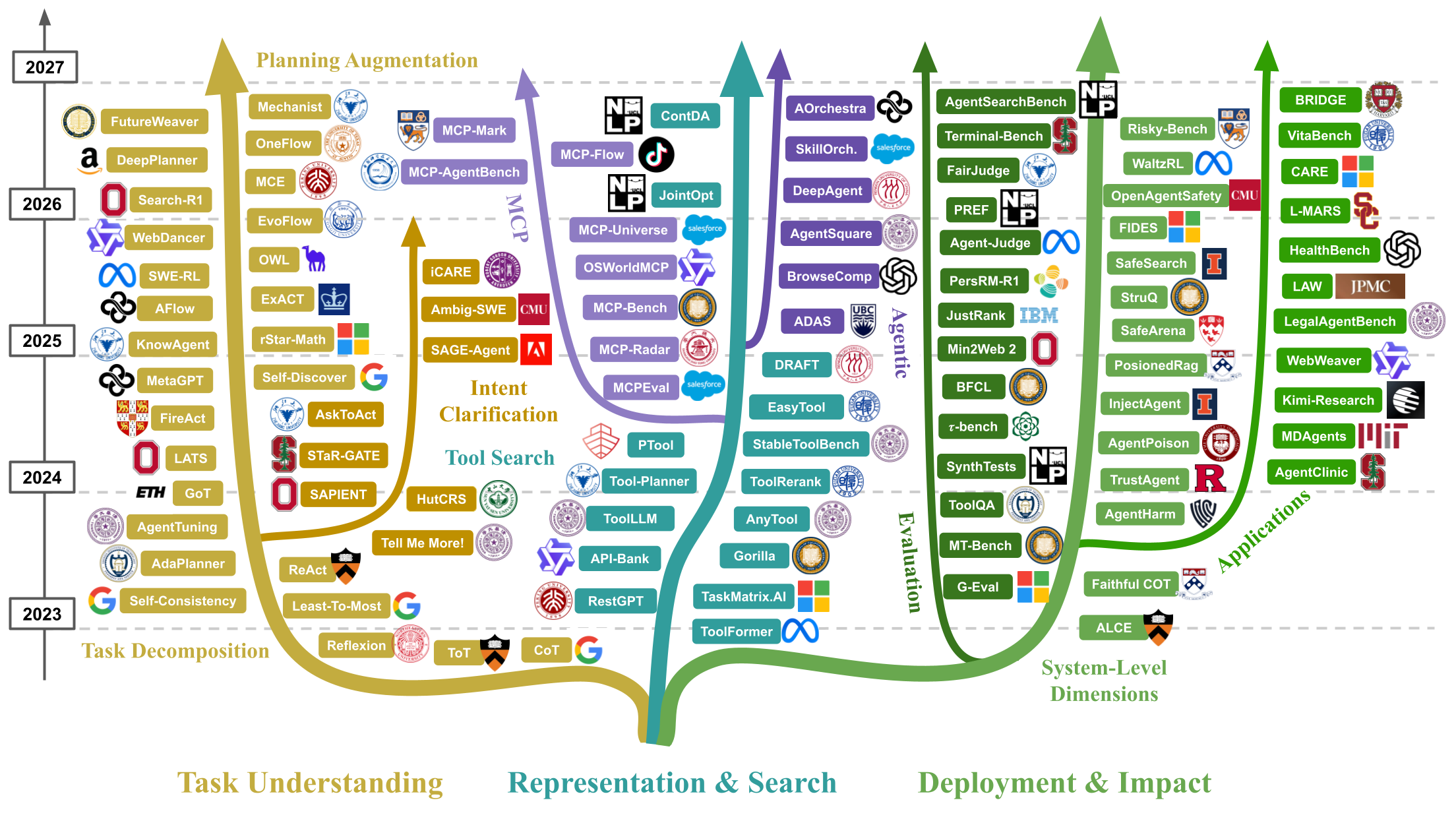
Evolution of research directions related to agent search from 2023 to 2026. Existing work has progressed from task understanding and planning capabilities, through representation and search mechanisms for tools and agents, toward deployment-oriented concerns such as evaluation, safety, robustness, and domain-specific applications. Together, these developments form the broader research landscape that underpins agent search systems.
Motivating Agent Search
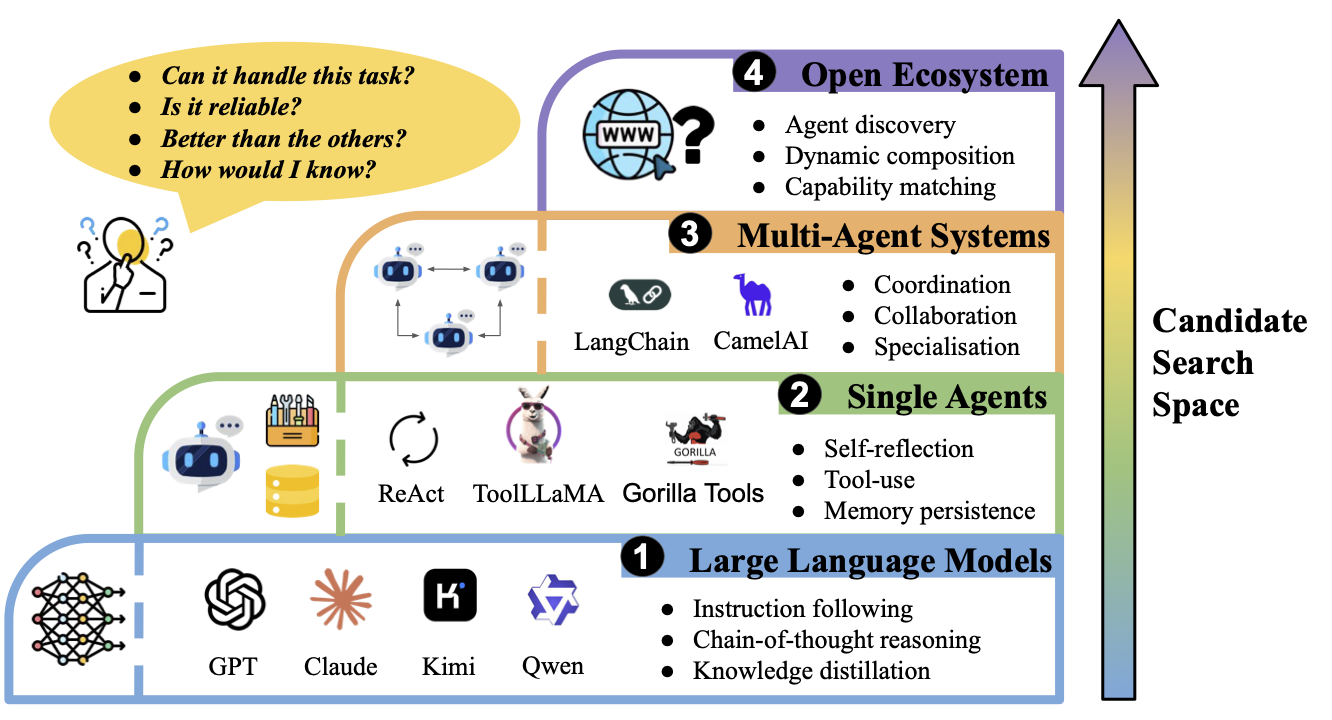
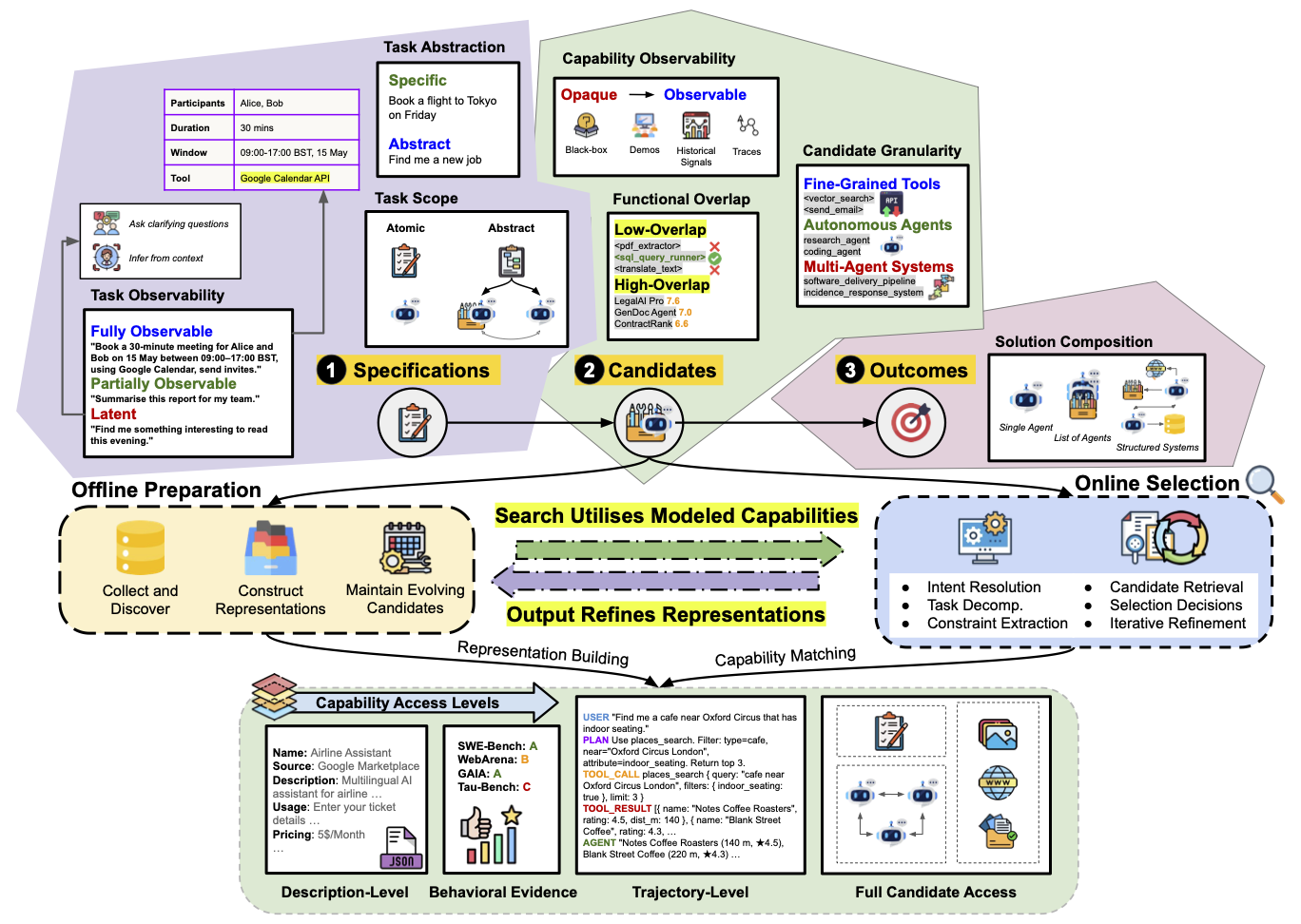
Conceptual Framework of Agent Search
📋 Table of Contents
1. Task Understanding
Transforming user tasks into actionable requirement specifications for downstream agent search — task decomposition, planning augmentation, and proactive intent clarification.
1.1 Task Decomposition
Sequential/global, iterative, and structured (tree/graph) strategies for breaking a task into sub-tasks.
1.2 Planning Augmentation
Agentic post-training (SFT/RL), multi-agent frameworks, and planning offloading to boost planning capability.
1.3 Proactive User Intent Clarification
Closed-ended attribute-based and open-ended language-based clarification; agent-vs-human user intent.
2. Agent Discovery, Representation and Indexing
How agents and tools are discovered as retrieval units, represented for matching, indexed for scalable search, and kept up to date as the candidate ecosystem evolves.
2.1 Units of Discovery
API-level tools, toolkits/packages, and agents as registries/catalogs — the retrieval unit itself.
2.2 Tool Representation Surfaces
Names, natural-language docs, schemas, usage examples, and learned tool tokens/embeddings.
2.3 Indexing and Retrieval Backends
Sparse/dense indexes, rerankers, hierarchical catalogs, query rewriting, and generation-as-retrieval over tool libraries.
2.4 Agent Representations
Policy/prompt, capability/profile, and routing-metadata representations; automated agent design and composition.
2.5 Maintenance: Drift, Updates, and Missing Information
Keeping representations/indexes accurate as tools, APIs, and agents evolve.
3. Retrieval, Reranking, and Selection of Agents
How candidates are ranked and selected once represented and indexed — similarity matching, LLM-based reasoning, structure-aware search, iterative retrieval, and preference-driven recommendation.
3.1 Agent/Tool Selection
Similarity matching, LLM-based (training-free/training-based) selection, and structure-aware retrieval.
3.2 Iterative Tool Retrieval
Reason-act-reflection loops and iterative query reformulation for retrieval that co-evolves with task execution.
3.3 Agent and Tool Recommendation
Mining behavioral history / preferences to personalize agent or tool selection.
4. Evaluation of Agent Search
Intrinsic evaluation of the search process itself, and extrinsic evaluation of downstream task outcomes.
4.1 Intrinsic Evaluation
Retrieval quality, invocation correctness, and tool/agent-use benchmarks assessed against annotated ground truth.
4.2 Extrinsic Evaluation
Downstream task success on agentic/deep-research/web benchmarks, incl. agent-as-a-judge evaluation.
5. System-Level Dimensions
System-level concerns that shape whether agent search is trustworthy, fair, secure, personalized, and inspectable in practice.
5.1 Safety
5.2 Bias and Fairness
5.3 Security Risks
5.4 Personalization
5.5 Transparency and Explainability
6. Applications
6.1 Healthcare
6.2 Law
6.3 Deep Research
📚 Related Resources
The position paper motivating agent search as a distinct problem, its companion benchmark, and the workshop this survey is affiliated with.
| Resource | Description | Links |
|---|---|---|
| AgentSearch: Indexing, Retrieval, and Ranking of AI Agents | Position paper (SIGIR 2026) motivating agent search as a distinct research problem | 📄 Paper |
| Agent-Search Workshop @ SIGIR 2026 | The workshop this survey is affiliated with | 🌐 Website |
| AgentSearchBench: A Benchmark for AI Agent Search in the Wild | Companion benchmark for evaluating agent search systems | 📄 Paper · 🌐 Project Page · 🤗 Dataset · 💻 Code |
🤝 Contributing
This collection is an ongoing effort. We are actively expanding and refining its coverage, and welcome contributions from the community. You can:
- Submit a pull request to add papers or resources
- Open an issue to suggest additional papers or resources
- Email us at
bin.wu.23@ucl.ac.uk
We regularly update the repository to include new research on agent and tool search.




Licensed under MIT.


Similar repos


[Survey] Agent and Tool Search: Foundations, Techniques, and Open Challenges
14
5 commits
updated Sep 9, 2026
README
Awesome Agent Search
A curated reading list accompanying Agent and Tool Search: Foundations, Techniques, and Open Challenges
📚 Citation
If you find this survey useful in your research and applications, please cite and ⭐ star to watch the repo for updates:
@article{wu2026agentsearch,
  title={Agent and Tool Search: Foundations, Techniques, and Open Challenges},
  author={Wu, Bin and Rahmani, Hossein A and Kim, To Eun and Mammadli, Arastun and
          Qiao, Shuofei and Fu, Xiao and Ramineni, Varsha and Zhang, Xiaoyu and Meng,
          Chuan and Drayson, George and Chowdhury, Anu and Ramos, Jerome and Maiga,
          Abdine and Yilmaz, Emine},
  year={2026},
  publisher={Preprints}
}
[!TIP] 👋 This repository tracks the fast-moving literature on agent and tool search: how systems discover, represent, retrieve, rank, and evaluate agents and tools for a given task. If you know a paper we're missing, or work in this space yourself, PRs are very welcome (see Contributing).
Evolution of research directions related to agent search from 2023 to 2026. Existing work has progressed from task understanding and planning capabilities, through representation and search mechanisms for tools and agents, toward deployment-oriented concerns such as evaluation, safety, robustness, and domain-specific applications. Together, these developments form the broader research landscape that underpins agent search systems.
Motivating Agent Search
Conceptual Framework of Agent Search
📋 Table of Contents
1. Task Understanding
Transforming user tasks into actionable requirement specifications for downstream agent search — task decomposition, planning augmentation, and proactive intent clarification.
1.1 Task Decomposition
Sequential/global, iterative, and structured (tree/graph) strategies for breaking a task into sub-tasks.
1.2 Planning Augmentation
Agentic post-training (SFT/RL), multi-agent frameworks, and planning offloading to boost planning capability.
1.3 Proactive User Intent Clarification
Closed-ended attribute-based and open-ended language-based clarification; agent-vs-human user intent.
2. Agent Discovery, Representation and Indexing
How agents and tools are discovered as retrieval units, represented for matching, indexed for scalable search, and kept up to date as the candidate ecosystem evolves.
2.1 Units of Discovery
API-level tools, toolkits/packages, and agents as registries/catalogs — the retrieval unit itself.
2.2 Tool Representation Surfaces
Names, natural-language docs, schemas, usage examples, and learned tool tokens/embeddings.
2.3 Indexing and Retrieval Backends
Sparse/dense indexes, rerankers, hierarchical catalogs, query rewriting, and generation-as-retrieval over tool libraries.
2.4 Agent Representations
Policy/prompt, capability/profile, and routing-metadata representations; automated agent design and composition.
2.5 Maintenance: Drift, Updates, and Missing Information
Keeping representations/indexes accurate as tools, APIs, and agents evolve.
3. Retrieval, Reranking, and Selection of Agents
How candidates are ranked and selected once represented and indexed — similarity matching, LLM-based reasoning, structure-aware search, iterative retrieval, and preference-driven recommendation.
3.1 Agent/Tool Selection
Similarity matching, LLM-based (training-free/training-based) selection, and structure-aware retrieval.
3.2 Iterative Tool Retrieval
Reason-act-reflection loops and iterative query reformulation for retrieval that co-evolves with task execution.
3.3 Agent and Tool Recommendation
Mining behavioral history / preferences to personalize agent or tool selection.
4. Evaluation of Agent Search
Intrinsic evaluation of the search process itself, and extrinsic evaluation of downstream task outcomes.
4.1 Intrinsic Evaluation
Retrieval quality, invocation correctness, and tool/agent-use benchmarks assessed against annotated ground truth.
4.2 Extrinsic Evaluation
Downstream task success on agentic/deep-research/web benchmarks, incl. agent-as-a-judge evaluation.
5. System-Level Dimensions
System-level concerns that shape whether agent search is trustworthy, fair, secure, personalized, and inspectable in practice.
5.1 Safety
5.2 Bias and Fairness
5.3 Security Risks
5.4 Personalization
5.5 Transparency and Explainability
6. Applications
6.1 Healthcare
6.2 Law
6.3 Deep Research
📚 Related Resources
The position paper motivating agent search as a distinct problem, its companion benchmark, and the workshop this survey is affiliated with.
| Resource | Description | Links |
|---|---|---|
| AgentSearch: Indexing, Retrieval, and Ranking of AI Agents | Position paper (SIGIR 2026) motivating agent search as a distinct research problem | 📄 Paper |
| Agent-Search Workshop @ SIGIR 2026 | The workshop this survey is affiliated with | 🌐 Website |
| AgentSearchBench: A Benchmark for AI Agent Search in the Wild | Companion benchmark for evaluating agent search systems | 📄 Paper · 🌐 Project Page · 🤗 Dataset · 💻 Code |
🤝 Contributing
This collection is an ongoing effort. We are actively expanding and refining its coverage, and welcome contributions from the community. You can:
- Submit a pull request to add papers or resources
- Open an issue to suggest additional papers or resources
- Email us at
bin.wu.23@ucl.ac.uk
We regularly update the repository to include new research on agent and tool search.
Licensed under MIT.