
This is the official implementation of AlloSpatial and World2Mind toolkit. [AlloSpatial: Agentic Harness Framework for Spatial Reasoning in Foundation Models]
Python
21
1 commits
updated May 31, 2026
README
AlloSpatial: An Agentic Harness Framework for Spatial Reasoning in Foundation Models
Shouwei Ruan1, Bin Wang2, Zhenyu Wu1, Qihui Zhu1, Yuxiang Zhang2, Hang Su3, Yubin Wang2*
1 Institute of Artificial Intelligence, Beihang University •
2 Huawei Noah's Ark Lab
3 Dept. of Comp. Sci. and Tech., Institute for AI, Tsinghua-Bosch Joint ML Center, THBI Lab, BNRist Center, Tsinghua University
* project leader




AlloSpatial equips multimodal foundation models with allocentric spatial reasoning. It converts egocentric video / multi-view images into structured spatial priors with World2Mind (a cognitive-mapping sandbox), and reasons over them through a Spatial Reasoning Harness that decides when to call the tool, collects evidence, and cross-validates geometry against semantics before answering. The harness works training-free for proprietary models and is internalized into open-weight models (Qwen3-VL) via SFT cold-start + GRPO reinforcement learning.
📰 News
- 🎉 2026.06 — We open-sourced World2Mind along with the AlloSpatial training and inference scripts. Model weights and training datasets will be released in the near future.
- 📝 2026.05 — AlloSpatial is under review.
- 🏆 2026.04 — An early version of our work, World2Mind: Cognition Toolkit for Allocentric Spatial Reasoning in Foundation Models (arXiv:2603.09774), was accepted to the CVPR ViSCALE Workshop.
📦 What's included
| Component | Released |
|---|---|
| World2Mind — cognitive-mapping sandbox (Depth Anything 3 + SAM 3 → AST + route map), HTTP service | ✅ |
| Inference — World2Mind + commercial APIs and open-source / trained models; benchmark scripts | ✅ |
| SFT — cold-start training scripts (ms-swift) | ✅ |
| RL — GRPO training scripts, reward / scheduler plugins, ms-swift patch | ✅ |
Evaluation — vendored lmms-eval with World2Mind / blind / api-baseline adapters | ✅ |
| Training datasets (SFT trajectories, GRPO prompts) | 🚧 |
| Model weights (trained AlloSpatial checkpoints) | 🚧 |
🗂️ Repository layout
AlloSpatial/
├── world2mind/     # cognitive-mapping sandbox (DA3 + SAM3 → point cloud → AST + route map), served over HTTP
├── inference/      # World2Mind + models: commercial APIs (demo_openai) and open-source / trained models (demo_vllm)
├── training/       # SFT (cold start) + GRPO RL: scripts, reward/scheduler plugins, ms-swift patch
├── lmms-eval/      # evaluation framework (vendored) with the World2Mind / blind / api-baseline models
└── requirements.txt
🧩 Framework
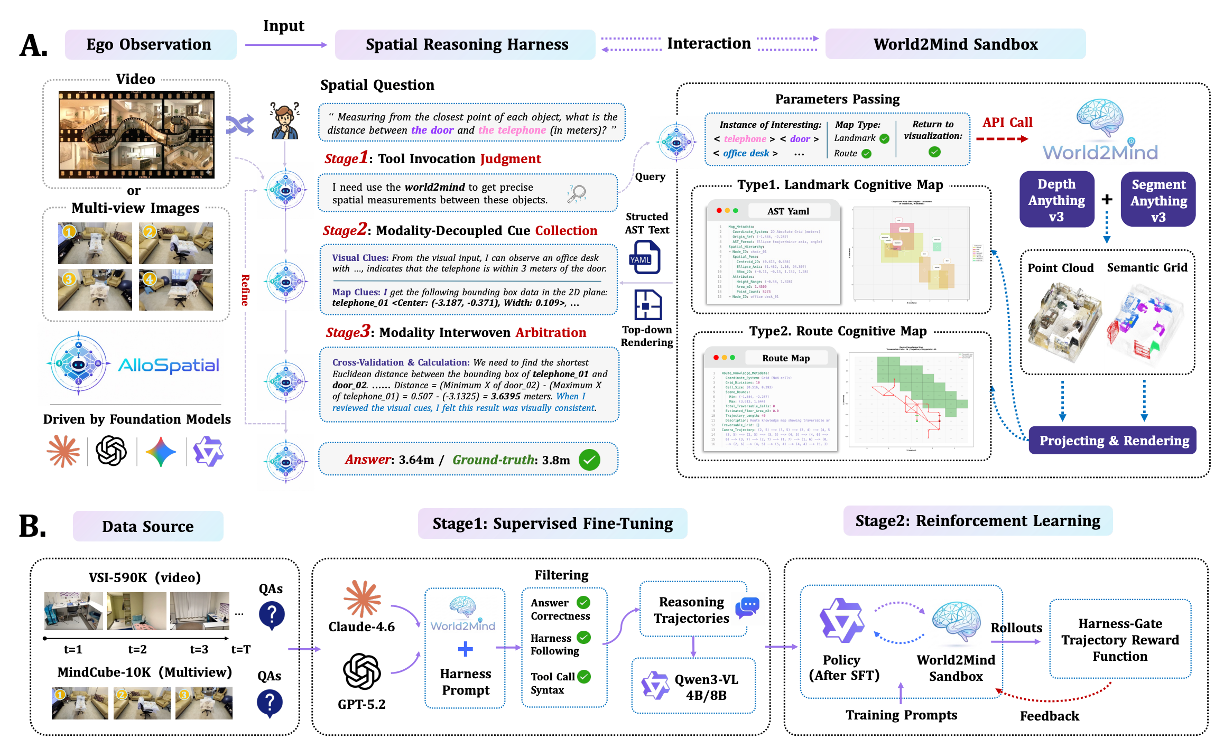
(A) At inference time, AlloSpatial follows a three-stage Spatial Reasoning Harness — tool-invocation judgment, modality-decoupled cue collection, and geometry–semantics arbitration — to invoke World2Mind, acquire allocentric spatial knowledge, and arbitrate evidence before answering. (B) To internalize the harness, high-quality harness-following trajectories are distilled from proprietary models for supervised cold start, then the policy is optimized with live World2Mind interaction and a Harness-Gated Trajectory Reward.
                         ┌──────────────────────────────────────────┐
  video / images  ─────► │  World2Mind service (FastAPI, GPU)        │
                         │  DA3 depth + pose  →  SAM 3 segmentation   │
                         │  → semantic point cloud → AST + route map  │
                         └───────────────▲───────────────┬──────────┘
                                         │  HTTP          │  AST (YAML) + renders
                  tool call (world2mind, │                ▼
                  view_image)            │     ┌──────────────────────────┐
                                         └─────┤  Foundation model (agent) │
                                               │  Spatial Reasoning Harness │
                                               │  Judge→Collect→Arbitrate   │
                                               └──────────────┬─────────────┘
                                                              ▼  <Answer> … </Answer>
The model service is loaded once and reused; the agent (a proprietary API model, a local vLLM/swift server, or a trained AlloSpatial checkpoint) calls it over HTTP during reasoning.
⚙️ Installation
git clone <this-repo> AlloSpatial && cd AlloSpatial

# 1. Core tool dependencies
pip install -r requirements.txt

# 2. Perception models
#    - Depth Anything 3:  pip install "git+https://github.com/ByteDance-Seed/Depth-Anything-3.git"
#    - SAM 3:             install the SAM 3 package and download sam3.pt
#    Then point world2mind/config/default_config.yaml at the weights (da3.model, sam3.model_path).

# 3. Evaluation (vendored lmms-eval)
pip install -e lmms-eval

# 4. Training only: install ms-swift and apply the GRPO patch (see training/patches/README.md)

# Tell the eval models / demos where the tool package lives:
export WORLD2MIND_ROOT="$PWD/world2mind"
🚀 Quickstart
1. Start the World2Mind service
cd world2mind
# edit config/default_config.yaml: da3.model, sam3.model_path, gpu_ids
python start_service.py --gpu_ids 0 --port 8100
curl http://localhost:8100/health
2. World2Mind + a commercial model (training-free)
export OPENAI_API_KEY=...            # and optionally OPENAI_BASE_URL
python inference/demo_openai.py --video /path/to/video.mp4 \
    --query "How many chairs are in the room?" --model gpt-5.2
3. World2Mind + an open-source / trained model
# serve a local model (vLLM or swift) — e.g. a trained AlloSpatial checkpoint
MODEL=/path/to/AlloSpatial-checkpoint bash inference/start_server.sh --port 8003
python inference/demo_vllm.py --video /path/to/video.mp4 \
    --query "Describe the spatial layout" --server-url http://localhost:8003/v1
4. Benchmark evaluation (VSI-Bench / MindCube)
# proprietary model + World2Mind (uses the lmms-eval `world2mind` model)
bash inference/run_benchmark.sh --tasks vsibench_tiny --model gpt-5.2
# local / trained model + World2Mind (uses `world2mind_local`)
bash inference/run_local_benchmark.sh --tasks mindcube_tiny
See world2mind/README.md and inference/README.md for full options.
🏋️ Training
AlloSpatial internalizes the Spatial Reasoning Harness into Qwen3-VL in two stages, both built on ms-swift:
- SFT cold-start (
training/sft/) — supervised fine-tuning on harness-following trajectories so the model learns the tool-call syntax, the Step1–5 reasoning structure, AST/route parsing, and the<Answer>format. - GRPO RL (
training/rl/) — Group Relative/Sequence Policy Optimization with live World2Mind tool calling during rollout and a Harness-Gated Trajectory Reward (structure + accuracy + tool-use + length).
The training datasets (distilled SFT trajectories and GRPO prompts) and the trained model weights are not yet released. The scripts below expect dataset paths you provide; data sources are VSI-590K and the MindCube training set.
Stage 1 — SFT
cd training/sft
BASE_MODEL=Qwen/Qwen3-VL-8B-Instruct \
SFT_DATASET=/path/to/sft_swift.jsonl \
OUTPUT_DIR=./output/AlloSpatial-sft-8B \
bash qwen3-vl.sh
The SFT dataset is an ms-swift messages-format JSONL: each line is
{"messages": [{"role": "system"|"user"|"assistant", "content": ...}], ...} with multimodal
(video/image) content and assistant turns containing the Step1–5 reasoning, <tool_call> blocks, and
the final <Answer>…</Answer>.
Stage 2 — GRPO RL
GRPO runs three cooperating services (typical 8-GPU layout):
GPU 0,1   World2Mind tool service (DA3 + SAM3)   → training/rl/start_world2mind.sh (or _mp.sh for a fleet)
GPU 2,3   vLLM rollout server (model generation) → training/rl/start_vllm_rollout.sh
GPU 4-7   GRPO trainer (ms-swift, ZeRO2)         → training/rl/grpo_qwen3vl_v3.sh  (8B: grpo_qwen3vl_v3-8B.sh)
cd training/rl
python build_grpo_dataset.py          # build the prompt set (VSI-590K + MindCube)
python build_val_dataset.py           # build the VSI-Bench tiny + MindCube tiny val set

# three terminals:
bash start_world2mind.sh              # or: bash start_world2mind_mp.sh
bash start_vllm_rollout.sh
SFT_CHECKPOINT=/path/to/AlloSpatial-sft-4B/checkpoint OUTPUT_DIR=./output/AlloSpatial-grpo-4B \
  bash grpo_qwen3vl_v3.sh
Reward functions (Harness-Gated Trajectory Reward). Default weights
[structure, accuracy, tool_use, length] = [0.15, 0.60, 0.10, 0.15]. HGTR scores the whole trajectory
and applies two gates: accuracy is structure-gated (credited only when the trajectory follows the
harness format), and the tool reward is correctness-tied (granted only when a valid tool call
contributes to a correct answer). See training/README.md and training/rl/README.md for the full
reward, curriculum / adaptive-weight, in-training-evaluation, and env-var reference, and
training/patches/README.md for the required ms-swift patch.
🙏 Acknowledgements
Built on Depth Anything 3, SAM 3, ms-swift, and lmms-eval. Evaluated on VSI-Bench and MindCube. Thanks for these excellent works!
📑 Citation
@article{ruan2026world2mind,
  title={World2Mind: Cognition Toolkit for Allocentric Spatial Reasoning in Foundation Models},
  author={Ruan, Shouwei and Wang, Bin and Wu, Zhenyu and Zhu, Qihui and Zhang, Yuxiang and Su, Hang and Wang, Yubin},
  journal={arXiv preprint arXiv:2603.09774},
  year={2026}
}
Significant stargazers

696 followers · starred Jul 2026
Similar repos


This is the official implementation of AlloSpatial and World2Mind toolkit. [AlloSpatial: Agentic Harness Framework for Spatial Reasoning in Foundation Models]
Python
21
1 commits
updated May 31, 2026
README
AlloSpatial: An Agentic Harness Framework for Spatial Reasoning in Foundation Models
Shouwei Ruan1, Bin Wang2, Zhenyu Wu1, Qihui Zhu1, Yuxiang Zhang2, Hang Su3, Yubin Wang2*
1 Institute of Artificial Intelligence, Beihang University •
2 Huawei Noah's Ark Lab
3 Dept. of Comp. Sci. and Tech., Institute for AI, Tsinghua-Bosch Joint ML Center, THBI Lab, BNRist Center, Tsinghua University
* project leader
AlloSpatial equips multimodal foundation models with allocentric spatial reasoning. It converts egocentric video / multi-view images into structured spatial priors with World2Mind (a cognitive-mapping sandbox), and reasons over them through a Spatial Reasoning Harness that decides when to call the tool, collects evidence, and cross-validates geometry against semantics before answering. The harness works training-free for proprietary models and is internalized into open-weight models (Qwen3-VL) via SFT cold-start + GRPO reinforcement learning.
📰 News
- 🎉 2026.06 — We open-sourced World2Mind along with the AlloSpatial training and inference scripts. Model weights and training datasets will be released in the near future.
- 📝 2026.05 — AlloSpatial is under review.
- 🏆 2026.04 — An early version of our work, World2Mind: Cognition Toolkit for Allocentric Spatial Reasoning in Foundation Models (arXiv:2603.09774), was accepted to the CVPR ViSCALE Workshop.
📦 What's included
| Component | Released |
|---|---|
| World2Mind — cognitive-mapping sandbox (Depth Anything 3 + SAM 3 → AST + route map), HTTP service | ✅ |
| Inference — World2Mind + commercial APIs and open-source / trained models; benchmark scripts | ✅ |
| SFT — cold-start training scripts (ms-swift) | ✅ |
| RL — GRPO training scripts, reward / scheduler plugins, ms-swift patch | ✅ |
Evaluation — vendored lmms-eval with World2Mind / blind / api-baseline adapters | ✅ |
| Training datasets (SFT trajectories, GRPO prompts) | 🚧 |
| Model weights (trained AlloSpatial checkpoints) | 🚧 |
🗂️ Repository layout
AlloSpatial/
├── world2mind/     # cognitive-mapping sandbox (DA3 + SAM3 → point cloud → AST + route map), served over HTTP
├── inference/      # World2Mind + models: commercial APIs (demo_openai) and open-source / trained models (demo_vllm)
├── training/       # SFT (cold start) + GRPO RL: scripts, reward/scheduler plugins, ms-swift patch
├── lmms-eval/      # evaluation framework (vendored) with the World2Mind / blind / api-baseline models
└── requirements.txt
🧩 Framework
(A) At inference time, AlloSpatial follows a three-stage Spatial Reasoning Harness — tool-invocation judgment, modality-decoupled cue collection, and geometry–semantics arbitration — to invoke World2Mind, acquire allocentric spatial knowledge, and arbitrate evidence before answering. (B) To internalize the harness, high-quality harness-following trajectories are distilled from proprietary models for supervised cold start, then the policy is optimized with live World2Mind interaction and a Harness-Gated Trajectory Reward.
                         ┌──────────────────────────────────────────┐
  video / images  ─────► │  World2Mind service (FastAPI, GPU)        │
                         │  DA3 depth + pose  →  SAM 3 segmentation   │
                         │  → semantic point cloud → AST + route map  │
                         └───────────────▲───────────────┬──────────┘
                                         │  HTTP          │  AST (YAML) + renders
                  tool call (world2mind, │                ▼
                  view_image)            │     ┌──────────────────────────┐
                                         └─────┤  Foundation model (agent) │
                                               │  Spatial Reasoning Harness │
                                               │  Judge→Collect→Arbitrate   │
                                               └──────────────┬─────────────┘
                                                              ▼  <Answer> … </Answer>
The model service is loaded once and reused; the agent (a proprietary API model, a local vLLM/swift server, or a trained AlloSpatial checkpoint) calls it over HTTP during reasoning.
⚙️ Installation
git clone <this-repo> AlloSpatial && cd AlloSpatial

# 1. Core tool dependencies
pip install -r requirements.txt

# 2. Perception models
#    - Depth Anything 3:  pip install "git+https://github.com/ByteDance-Seed/Depth-Anything-3.git"
#    - SAM 3:             install the SAM 3 package and download sam3.pt
#    Then point world2mind/config/default_config.yaml at the weights (da3.model, sam3.model_path).

# 3. Evaluation (vendored lmms-eval)
pip install -e lmms-eval

# 4. Training only: install ms-swift and apply the GRPO patch (see training/patches/README.md)

# Tell the eval models / demos where the tool package lives:
export WORLD2MIND_ROOT="$PWD/world2mind"
🚀 Quickstart
1. Start the World2Mind service
cd world2mind
# edit config/default_config.yaml: da3.model, sam3.model_path, gpu_ids
python start_service.py --gpu_ids 0 --port 8100
curl http://localhost:8100/health
2. World2Mind + a commercial model (training-free)
export OPENAI_API_KEY=...            # and optionally OPENAI_BASE_URL
python inference/demo_openai.py --video /path/to/video.mp4 \
    --query "How many chairs are in the room?" --model gpt-5.2
3. World2Mind + an open-source / trained model
# serve a local model (vLLM or swift) — e.g. a trained AlloSpatial checkpoint
MODEL=/path/to/AlloSpatial-checkpoint bash inference/start_server.sh --port 8003
python inference/demo_vllm.py --video /path/to/video.mp4 \
    --query "Describe the spatial layout" --server-url http://localhost:8003/v1
4. Benchmark evaluation (VSI-Bench / MindCube)
# proprietary model + World2Mind (uses the lmms-eval `world2mind` model)
bash inference/run_benchmark.sh --tasks vsibench_tiny --model gpt-5.2
# local / trained model + World2Mind (uses `world2mind_local`)
bash inference/run_local_benchmark.sh --tasks mindcube_tiny
See world2mind/README.md and inference/README.md for full options.
🏋️ Training
AlloSpatial internalizes the Spatial Reasoning Harness into Qwen3-VL in two stages, both built on ms-swift:
- SFT cold-start (
training/sft/) — supervised fine-tuning on harness-following trajectories so the model learns the tool-call syntax, the Step1–5 reasoning structure, AST/route parsing, and the<Answer>format. - GRPO RL (
training/rl/) — Group Relative/Sequence Policy Optimization with live World2Mind tool calling during rollout and a Harness-Gated Trajectory Reward (structure + accuracy + tool-use + length).
The training datasets (distilled SFT trajectories and GRPO prompts) and the trained model weights are not yet released. The scripts below expect dataset paths you provide; data sources are VSI-590K and the MindCube training set.
Stage 1 — SFT
cd training/sft
BASE_MODEL=Qwen/Qwen3-VL-8B-Instruct \
SFT_DATASET=/path/to/sft_swift.jsonl \
OUTPUT_DIR=./output/AlloSpatial-sft-8B \
bash qwen3-vl.sh
The SFT dataset is an ms-swift messages-format JSONL: each line is
{"messages": [{"role": "system"|"user"|"assistant", "content": ...}], ...} with multimodal
(video/image) content and assistant turns containing the Step1–5 reasoning, <tool_call> blocks, and
the final <Answer>…</Answer>.
Stage 2 — GRPO RL
GRPO runs three cooperating services (typical 8-GPU layout):
GPU 0,1   World2Mind tool service (DA3 + SAM3)   → training/rl/start_world2mind.sh (or _mp.sh for a fleet)
GPU 2,3   vLLM rollout server (model generation) → training/rl/start_vllm_rollout.sh
GPU 4-7   GRPO trainer (ms-swift, ZeRO2)         → training/rl/grpo_qwen3vl_v3.sh  (8B: grpo_qwen3vl_v3-8B.sh)
cd training/rl
python build_grpo_dataset.py          # build the prompt set (VSI-590K + MindCube)
python build_val_dataset.py           # build the VSI-Bench tiny + MindCube tiny val set

# three terminals:
bash start_world2mind.sh              # or: bash start_world2mind_mp.sh
bash start_vllm_rollout.sh
SFT_CHECKPOINT=/path/to/AlloSpatial-sft-4B/checkpoint OUTPUT_DIR=./output/AlloSpatial-grpo-4B \
  bash grpo_qwen3vl_v3.sh
Reward functions (Harness-Gated Trajectory Reward). Default weights
[structure, accuracy, tool_use, length] = [0.15, 0.60, 0.10, 0.15]. HGTR scores the whole trajectory
and applies two gates: accuracy is structure-gated (credited only when the trajectory follows the
harness format), and the tool reward is correctness-tied (granted only when a valid tool call
contributes to a correct answer). See training/README.md and training/rl/README.md for the full
reward, curriculum / adaptive-weight, in-training-evaluation, and env-var reference, and
training/patches/README.md for the required ms-swift patch.
🙏 Acknowledgements
Built on Depth Anything 3, SAM 3, ms-swift, and lmms-eval. Evaluated on VSI-Bench and MindCube. Thanks for these excellent works!
📑 Citation
@article{ruan2026world2mind,
  title={World2Mind: Cognition Toolkit for Allocentric Spatial Reasoning in Foundation Models},
  author={Ruan, Shouwei and Wang, Bin and Wu, Zhenyu and Zhu, Qihui and Zhang, Yuxiang and Su, Hang and Wang, Yubin},
  journal={arXiv preprint arXiv:2603.09774},
  year={2026}
}
Similar repos
Significant stargazers
696 followers · starred Jul 2026