What changed in the room? Two phone videos -> shared 3D scene -> moved / added / removed objects, with labels
Python
0
5 commits
updated Oct 14, 2026
Two phone videos of the same room → one shared 3D scene → what was added, removed or moved, drawn on a plan with the frames that prove it.
Successor to spatiality_v2 (one video → 3D + labels).
From two 20–40 second handheld captures, the pipeline runs three stages that feed one viewer:
changes.json with footprints, displacements, support counts and evidence frames, plus a Next.js change survey drawing with accept/reject review.
|
https://github.com/user-attachments/assets/REPLACE-WITH-BEFORE-VIDEO Input: before capture |
https://github.com/user-attachments/assets/REPLACE-WITH-AFTER-VIDEO Input: after capture |
|
https://github.com/user-attachments/assets/REPLACE-WITH-VIEWER-RECORDING Output: change survey, 3D view and review |
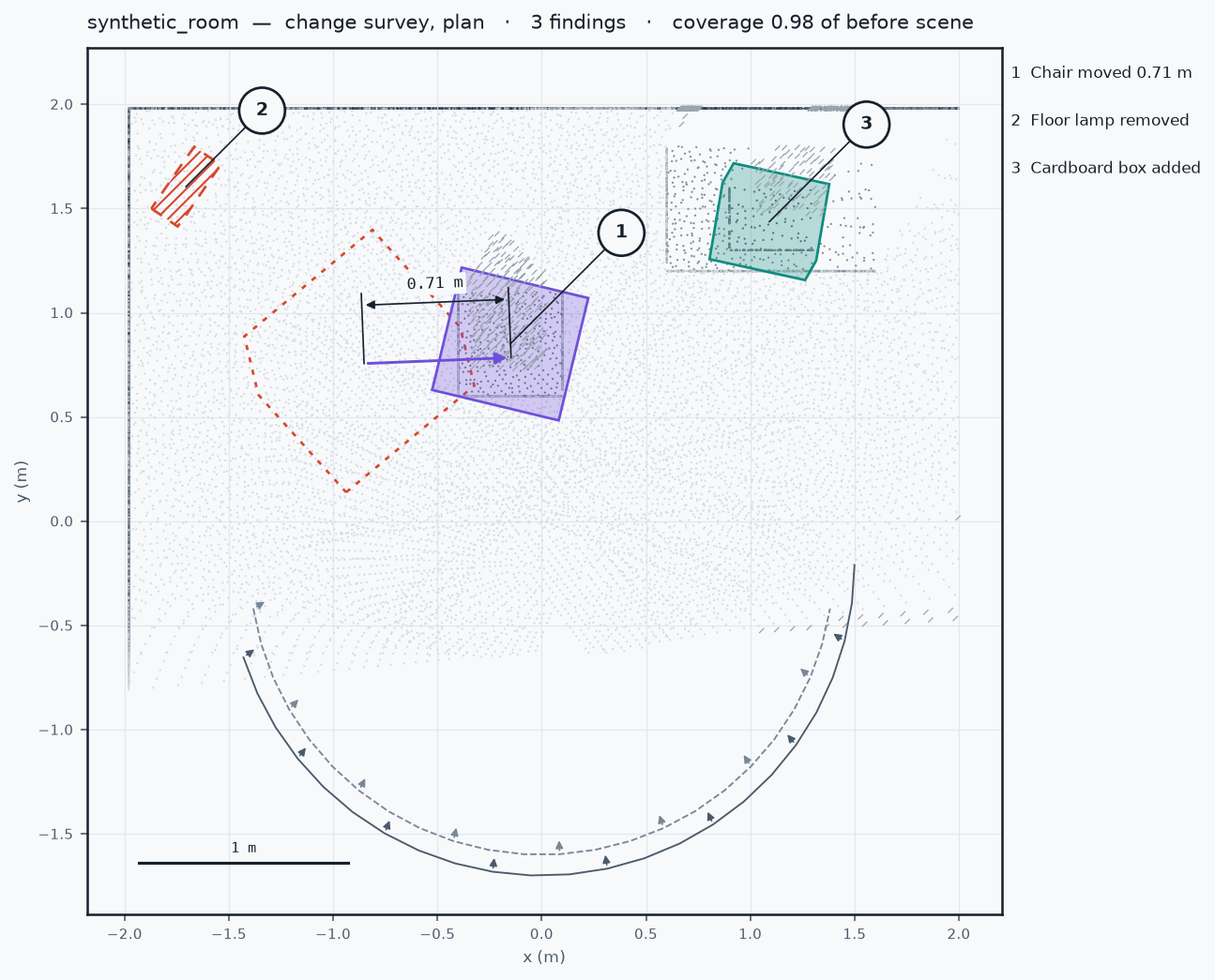 Plan (synthetic room): 1 chair moved 0.71 m, 2 lamp removed, 3 box added; hatched = never re-observed |  3D view, same balloons |
 Detail sheet: evidence frames, measurements, accept / reject |  Findings strip and title block |
Full runtime and cost numbers in Runtime and cost below.
Three paths, in order of setup cost.
The synthetic room: two simulated sweeps with a chair moved, a lamp removed and a box added. Needs Python 3.12, uv, pnpm and ffmpeg.
git clone https://github.com/Harrishayy/spatiality-diff.git && cd spatiality-diff
cd backend && uv venv --python 3.12 && uv pip install -e ".[dev]" && cd ..

PYTHONPATH=tests backend/.venv/bin/python scripts/make_demo.py     # -> outputs/synthetic_room/
cd web && pnpm install && pnpm dev                                    # -> http://localhost:3000/scenes/synthetic_room
Record two sweeps of a room, 20–40 s each, phone held steady, walking a slow arc so most of the room is seen from several angles. Move, add or remove a few objects between them. Start from a different spot the second time.
pip install modal && modal token new
cp .env.example .env                                   # GEMINI_API_KEY for labels (optional)
# Modal workspace secret `huggingface` with HF_TOKEN; VGGT-Omega weights are gated with automated approval.
(cd backend && modal deploy modal_app.py)
(cd backend && modal run modal_app.py --access)        # which checkpoints your token can download

backend/.venv/bin/spatiality-diff run --before before.mp4 --after after.mp4 --out outputs/my_room
cd web && pnpm dev                                     # -> http://localhost:3000/scenes/my_room
spatiality-diff run caches every stage: a re-run after a crash or a parameter change skips the GPU pass.
| Flag | Default | When to change it |
|---|---|---|
--frames-per-video | 60 | Fewer frames = cheaper GPU pass. 40 is fine for a small room. |
--backend | vggt-omega | pi3x for approximate metric scale, vggt for the open VGGT-1B checkpoint. |
--compute | modal | local after running scripts/run_local.py on your own GPU or Apple MPS. |
--scale-m | 0 | Metres per model unit if known; otherwise distances are in model units. |
--no-label | Skip the VLM; findings are still detected, placed and measured. |
uv pip install -e "backend[gpu]"
pip install git+https://github.com/facebookresearch/vggt-omega.git   # or vggt / Pi3
python scripts/run_local.py outputs/my_room --backend vggt-omega      # after frames are extracted
backend/.venv/bin/spatiality-diff run ... --compute local
Input. examples/synthetic_room/{before,after}.mp4: two 6 s clips rendered from the synthetic room (flat colours,
so they exercise the pipeline mechanics, not the model). Real phone clips go in the same place.
Output. outputs/<scene>/:
changes.json            what changed, where (oriented box in the shared frame), how sure, and the evidence
summary.md              the natural-language report
before.ply, after.ply   coloured clouds in the shared frame
before_unobserved.ply   before-points the after capture never looked at (drawn hatched)
blobs/<id>_{before,after}.ply
evidence/<id>_{before,after}.jpg    best frame from each capture with the projected box drawn
cameras.json            per-frame K and cam-from-world for both captures
One finding in changes.json (from the synthetic room):
{"id": "m00", "state": "moved", "label": "chair", "sentence": "Chair moved 0.71 m",
 "confidence": 0.9, "displacement_m": 0.706,
 "before": {"ply": "blobs/m00_before.ply", "centroid": [-0.95, 0.85, 0.44], "obb": {"center": [...], "extent": [...], "rotation": [...]},
            "support": {"free": 11, "looked": 12}},
 "after":  {"ply": "blobs/m00_after.ply",  "centroid": [-0.25, 0.85, 0.44], "obb": {...}, "support": {"free": 9, "looked": 10}},
 "evidence": {"before": {"frame_id": "00007", "crop": "evidence/m00_before.jpg"}, "after": {"frame_id": "00012", "crop": "evidence/m00_after.jpg"}}}
support.free / support.looked is how many frames of the other capture looked at the region and saw free space there.
coverage at the top of the file is the share of the before scene the after capture observed at all, so a result with
zero findings is interpretable. python scripts/render_plan.py outputs/<scene> plan.png draws the plan above as a PNG.
Next.js 16 + React 19 + three.js, reading outputs/ in place. The viewer is drawn the way a surveyor marks a site
drawing rather than as a dashboard. The primary view is a top-down plan: room shaded by height, both camera paths,
every finding as a numbered callout balloon with a footprint. Added is a solid outline with a light fill, removed is
a dashed outline with hatching where the object stood, moved is both footprints with an arrow and a dimension line
in metres. Points the second capture never looked at are drawn with diagonal ticks, so "not inspected" never looks like
"unchanged". A 3D view shows the same scene with the same balloons.
Findings run along the bottom like a revision table. Selecting one opens the detail sheet: the sentence, a why sentence citing the frame counts, the before and after frames, a measurements table, and Accept / Reject. Start review steps through the findings; verdicts persist and are included in Copy changes.json, so a planner consumes the reviewed result. Paper theme by day, blueprint by night.
Keys: p plan, d 3D, b swap base capture, 1..9 select, ← → step, a accept, r reject, esc close.
flowchart LR
    A["📱 before.mp4"] --> F["ffmpeg + blur filter\n~60 keyframes each"]
    B["📱 after.mp4"] --> F
    F --> R["VGGT-Ω, one joint pass\n(Modal A100-40GB, ~90 s)"]
    R --> G["robust ICP on the\nstatic background"]
    G --> D["visibility-aware diff\nfree-space votes per camera"]
    D --> C["DBSCAN blobs\nmoved-pair matching"]
    C --> L["Gemini Flash-Lite\nlabels for the blobs only"]
    L --> O["changes.json · PLYs\nevidence crops · summary.md"]
    O --> V["survey viewer\nplan · 3D · review"]
One paragraph per stage; the alternatives considered and what each choice costs are in
docs/DESIGN_DECISIONS.md, and the model survey behind them in
docs/RESEARCH.md.
One joint pass, not two reconstructions. VGGT-family models take an unordered image set and put every frame in the first frame's coordinate system, so feeding both captures together yields a shared frame and a shared scale with no registration step and one GPU call. The moved objects are conflicting evidence inside the pass, which is why the next stage re-estimates the alignment on the static background only, dropping high-residual clusters between ICP rounds. VGGT-Ω was chosen over VGGT, Pi3X and MapAnything on viewpoint robustness and memory; Pi3X stays as the fallback and gives approximate metric scale.
Visibility, not nearest neighbours. The brief's hard part is telling a real change from a viewpoint gap. A
nearest-neighbour diff between clouds reports every gap as a change. Instead each point is projected into every camera
of the other capture and compared with the depth seen at that pixel: deeper means the ray passed through free space
(vote: gone), equal means the surface is still there (vote: same), shallower means something occludes it (no evidence).
A point is a change only with enough free-space votes and few same votes; a point with no votes is unobserved and is
drawn hatched. A nearest-neighbour guard still vetoes any point with a close neighbour in the other cloud, which
protects against depth-map holes. See diff.py.
Geometry decides, language names. Only the diff blobs go to the VLM, cropped from the frame that sees them best with the projected box drawn on. Two to six calls per scene, under a cent. The VLM can veto a blob as not an object and can veto a moved pairing. The whole-scene segmentation stack from v2 is deliberately absent.
Modal for the GPU, laptop for the rest. Only the model needs a GPU and only for about a minute. Frames, ICP, diff, labelling and the report run on the laptop in seconds, so iteration is fast and the bill is cents.
--scale-m is given or the pi3x backend is
used. The title block on every sheet states the units so the drawing never lies.In priority order; evidence, plug-in points and costs in docs/UPGRADE_PLAN.md.
Measured on the synthetic clips (19 keyframes per capture after the blur filter), Modal A100-40GB.
| Stage | Wall clock |
|---|---|
| Frames (ffmpeg + blur filter) | 0.2 s |
| VGGT-Ω joint pass on Modal, including model load | 90 s |
| Background ICP | 1.2 s |
| Visibility diff + clustering | 1.1 s |
| Report | 0.1 s |
| End to end | 92 s |
| Modal cost per scene | a few cents |
| Gemini cost per scene | under a cent (2–6 Flash-Lite calls) |
backend/spatiality_diff/
  frames.py        ffmpeg extraction, blur filter, even temporal sampling
  recon.py         model backends (vggt-omega | vggt | pi3x), joint pass, split, PLY export
  register.py      robust ICP on the static background
  diff.py          visibility-aware diff, clustering, moved matching       <- the core
  label.py         PydanticAI + Gemini: labels, pair confirmation, summary
  report.py        changes.json, summary.md, PLYs, evidence crops
  cli.py           spatiality-diff run
  modal_client.py  laptop side of the Modal call
backend/modal_app.py    the GPU function (+ check_access)
scripts/run_local.py    same model call on a local GPU / MPS
scripts/make_demo.py    synthetic scene -> outputs/synthetic_room
scripts/render_plan.py  outputs/<scene> -> plan PNG
examples/synthetic_room/  the two test clips
tests/                  synthetic room renderer + diff tests (pytest)
web/                    Next.js survey viewer
docs/                   RESEARCH.md, DESIGN_DECISIONS.md, img/
Tests: PYTHONPATH=tests backend/.venv/bin/python -m pytest tests -q. The synthetic room renders depth maps with
pinhole cameras for two sweeps with different trajectories; the diff must find exactly the moved chair, the removed lamp
and the added box, and must report a cropped second sweep as mostly unobserved rather than mostly removed.
MIT. Model weights carry their own licences (VGGT-Ω and Pi3X non-commercial).
What changed in the room? Two phone videos -> shared 3D scene -> moved / added / removed objects, with labels
Python
0
5 commits
updated Oct 14, 2026
Two phone videos of the same room → one shared 3D scene → what was added, removed or moved, drawn on a plan with the frames that prove it.
Successor to spatiality_v2 (one video → 3D + labels).
From two 20–40 second handheld captures, the pipeline runs three stages that feed one viewer:
changes.json with footprints, displacements, support counts and evidence frames, plus a Next.js change survey drawing with accept/reject review.
|
https://github.com/user-attachments/assets/REPLACE-WITH-BEFORE-VIDEO Input: before capture |
https://github.com/user-attachments/assets/REPLACE-WITH-AFTER-VIDEO Input: after capture |
|
https://github.com/user-attachments/assets/REPLACE-WITH-VIEWER-RECORDING Output: change survey, 3D view and review |
Plan (synthetic room): 1 chair moved 0.71 m, 2 lamp removed, 3 box added; hatched = never re-observed | 3D view, same balloons |
Detail sheet: evidence frames, measurements, accept / reject | Findings strip and title block |
Full runtime and cost numbers in Runtime and cost below.
Three paths, in order of setup cost.
The synthetic room: two simulated sweeps with a chair moved, a lamp removed and a box added. Needs Python 3.12, uv, pnpm and ffmpeg.
git clone https://github.com/Harrishayy/spatiality-diff.git && cd spatiality-diff
cd backend && uv venv --python 3.12 && uv pip install -e ".[dev]" && cd ..

PYTHONPATH=tests backend/.venv/bin/python scripts/make_demo.py     # -> outputs/synthetic_room/
cd web && pnpm install && pnpm dev                                    # -> http://localhost:3000/scenes/synthetic_room
Record two sweeps of a room, 20–40 s each, phone held steady, walking a slow arc so most of the room is seen from several angles. Move, add or remove a few objects between them. Start from a different spot the second time.
pip install modal && modal token new
cp .env.example .env                                   # GEMINI_API_KEY for labels (optional)
# Modal workspace secret `huggingface` with HF_TOKEN; VGGT-Omega weights are gated with automated approval.
(cd backend && modal deploy modal_app.py)
(cd backend && modal run modal_app.py --access)        # which checkpoints your token can download

backend/.venv/bin/spatiality-diff run --before before.mp4 --after after.mp4 --out outputs/my_room
cd web && pnpm dev                                     # -> http://localhost:3000/scenes/my_room
spatiality-diff run caches every stage: a re-run after a crash or a parameter change skips the GPU pass.
| Flag | Default | When to change it |
|---|---|---|
--frames-per-video | 60 | Fewer frames = cheaper GPU pass. 40 is fine for a small room. |
--backend | vggt-omega | pi3x for approximate metric scale, vggt for the open VGGT-1B checkpoint. |
--compute | modal | local after running scripts/run_local.py on your own GPU or Apple MPS. |
--scale-m | 0 | Metres per model unit if known; otherwise distances are in model units. |
--no-label | Skip the VLM; findings are still detected, placed and measured. |
uv pip install -e "backend[gpu]"
pip install git+https://github.com/facebookresearch/vggt-omega.git   # or vggt / Pi3
python scripts/run_local.py outputs/my_room --backend vggt-omega      # after frames are extracted
backend/.venv/bin/spatiality-diff run ... --compute local
Input. examples/synthetic_room/{before,after}.mp4: two 6 s clips rendered from the synthetic room (flat colours,
so they exercise the pipeline mechanics, not the model). Real phone clips go in the same place.
Output. outputs/<scene>/:
changes.json            what changed, where (oriented box in the shared frame), how sure, and the evidence
summary.md              the natural-language report
before.ply, after.ply   coloured clouds in the shared frame
before_unobserved.ply   before-points the after capture never looked at (drawn hatched)
blobs/<id>_{before,after}.ply
evidence/<id>_{before,after}.jpg    best frame from each capture with the projected box drawn
cameras.json            per-frame K and cam-from-world for both captures
One finding in changes.json (from the synthetic room):
{"id": "m00", "state": "moved", "label": "chair", "sentence": "Chair moved 0.71 m",
 "confidence": 0.9, "displacement_m": 0.706,
 "before": {"ply": "blobs/m00_before.ply", "centroid": [-0.95, 0.85, 0.44], "obb": {"center": [...], "extent": [...], "rotation": [...]},
            "support": {"free": 11, "looked": 12}},
 "after":  {"ply": "blobs/m00_after.ply",  "centroid": [-0.25, 0.85, 0.44], "obb": {...}, "support": {"free": 9, "looked": 10}},
 "evidence": {"before": {"frame_id": "00007", "crop": "evidence/m00_before.jpg"}, "after": {"frame_id": "00012", "crop": "evidence/m00_after.jpg"}}}
support.free / support.looked is how many frames of the other capture looked at the region and saw free space there.
coverage at the top of the file is the share of the before scene the after capture observed at all, so a result with
zero findings is interpretable. python scripts/render_plan.py outputs/<scene> plan.png draws the plan above as a PNG.
Next.js 16 + React 19 + three.js, reading outputs/ in place. The viewer is drawn the way a surveyor marks a site
drawing rather than as a dashboard. The primary view is a top-down plan: room shaded by height, both camera paths,
every finding as a numbered callout balloon with a footprint. Added is a solid outline with a light fill, removed is
a dashed outline with hatching where the object stood, moved is both footprints with an arrow and a dimension line
in metres. Points the second capture never looked at are drawn with diagonal ticks, so "not inspected" never looks like
"unchanged". A 3D view shows the same scene with the same balloons.
Findings run along the bottom like a revision table. Selecting one opens the detail sheet: the sentence, a why sentence citing the frame counts, the before and after frames, a measurements table, and Accept / Reject. Start review steps through the findings; verdicts persist and are included in Copy changes.json, so a planner consumes the reviewed result. Paper theme by day, blueprint by night.
Keys: p plan, d 3D, b swap base capture, 1..9 select, ← → step, a accept, r reject, esc close.
flowchart LR
    A["📱 before.mp4"] --> F["ffmpeg + blur filter\n~60 keyframes each"]
    B["📱 after.mp4"] --> F
    F --> R["VGGT-Ω, one joint pass\n(Modal A100-40GB, ~90 s)"]
    R --> G["robust ICP on the\nstatic background"]
    G --> D["visibility-aware diff\nfree-space votes per camera"]
    D --> C["DBSCAN blobs\nmoved-pair matching"]
    C --> L["Gemini Flash-Lite\nlabels for the blobs only"]
    L --> O["changes.json · PLYs\nevidence crops · summary.md"]
    O --> V["survey viewer\nplan · 3D · review"]
One paragraph per stage; the alternatives considered and what each choice costs are in
docs/DESIGN_DECISIONS.md, and the model survey behind them in
docs/RESEARCH.md.
One joint pass, not two reconstructions. VGGT-family models take an unordered image set and put every frame in the first frame's coordinate system, so feeding both captures together yields a shared frame and a shared scale with no registration step and one GPU call. The moved objects are conflicting evidence inside the pass, which is why the next stage re-estimates the alignment on the static background only, dropping high-residual clusters between ICP rounds. VGGT-Ω was chosen over VGGT, Pi3X and MapAnything on viewpoint robustness and memory; Pi3X stays as the fallback and gives approximate metric scale.
Visibility, not nearest neighbours. The brief's hard part is telling a real change from a viewpoint gap. A
nearest-neighbour diff between clouds reports every gap as a change. Instead each point is projected into every camera
of the other capture and compared with the depth seen at that pixel: deeper means the ray passed through free space
(vote: gone), equal means the surface is still there (vote: same), shallower means something occludes it (no evidence).
A point is a change only with enough free-space votes and few same votes; a point with no votes is unobserved and is
drawn hatched. A nearest-neighbour guard still vetoes any point with a close neighbour in the other cloud, which
protects against depth-map holes. See diff.py.
Geometry decides, language names. Only the diff blobs go to the VLM, cropped from the frame that sees them best with the projected box drawn on. Two to six calls per scene, under a cent. The VLM can veto a blob as not an object and can veto a moved pairing. The whole-scene segmentation stack from v2 is deliberately absent.
Modal for the GPU, laptop for the rest. Only the model needs a GPU and only for about a minute. Frames, ICP, diff, labelling and the report run on the laptop in seconds, so iteration is fast and the bill is cents.
--scale-m is given or the pi3x backend is
used. The title block on every sheet states the units so the drawing never lies.In priority order; evidence, plug-in points and costs in docs/UPGRADE_PLAN.md.
Measured on the synthetic clips (19 keyframes per capture after the blur filter), Modal A100-40GB.
| Stage | Wall clock |
|---|---|
| Frames (ffmpeg + blur filter) | 0.2 s |
| VGGT-Ω joint pass on Modal, including model load | 90 s |
| Background ICP | 1.2 s |
| Visibility diff + clustering | 1.1 s |
| Report | 0.1 s |
| End to end | 92 s |
| Modal cost per scene | a few cents |
| Gemini cost per scene | under a cent (2–6 Flash-Lite calls) |
backend/spatiality_diff/
  frames.py        ffmpeg extraction, blur filter, even temporal sampling
  recon.py         model backends (vggt-omega | vggt | pi3x), joint pass, split, PLY export
  register.py      robust ICP on the static background
  diff.py          visibility-aware diff, clustering, moved matching       <- the core
  label.py         PydanticAI + Gemini: labels, pair confirmation, summary
  report.py        changes.json, summary.md, PLYs, evidence crops
  cli.py           spatiality-diff run
  modal_client.py  laptop side of the Modal call
backend/modal_app.py    the GPU function (+ check_access)
scripts/run_local.py    same model call on a local GPU / MPS
scripts/make_demo.py    synthetic scene -> outputs/synthetic_room
scripts/render_plan.py  outputs/<scene> -> plan PNG
examples/synthetic_room/  the two test clips
tests/                  synthetic room renderer + diff tests (pytest)
web/                    Next.js survey viewer
docs/                   RESEARCH.md, DESIGN_DECISIONS.md, img/
Tests: PYTHONPATH=tests backend/.venv/bin/python -m pytest tests -q. The synthetic room renders depth maps with
pinhole cameras for two sweeps with different trajectories; the diff must find exactly the moved chair, the removed lamp
and the added box, and must report a cropped second sweep as mostly unobserved rather than mostly removed.
MIT. Model weights carry their own licences (VGGT-Ω and Pi3X non-commercial).



