An original, open-source, self-hosted workspace for notes, docs and databases.
See the codeA local-first workspace for notes, docs and databases.
An original, open-source, self-hosted alternative to Notion — for teams and individuals. Everything is a page: documents, folders and database rows share one model. It runs on your machine, it is yours to extend, and it also ships as a desktop app that needs nothing else installed.


Notion is a trademark of its respective owner. Noema is not affiliated with, endorsed by, or derived from Notion's source code, assets or trademarks. It implements the same category of product from publicly documented behaviour only. See Notice.
noema-db, port 5433) · TipTap · Tauri 2 for the desktop appdocker compose up for the database, one npm run dev for the app.| Start here | Go deeper |
|---|---|
| Status — what this repository is today | Architecture — how it is put together |
| Implemented today — what works, area by area | Project layout — where the files live |
| Desktop app — the installable build | Scripts — every gate and check |
Quick start — Docker, .env, npm run dev | Where to read next — the full docs set |
| Demo — the two-minute product film | Contributing · Security |
| Screenshots — the interface at a glance | Authors · License |
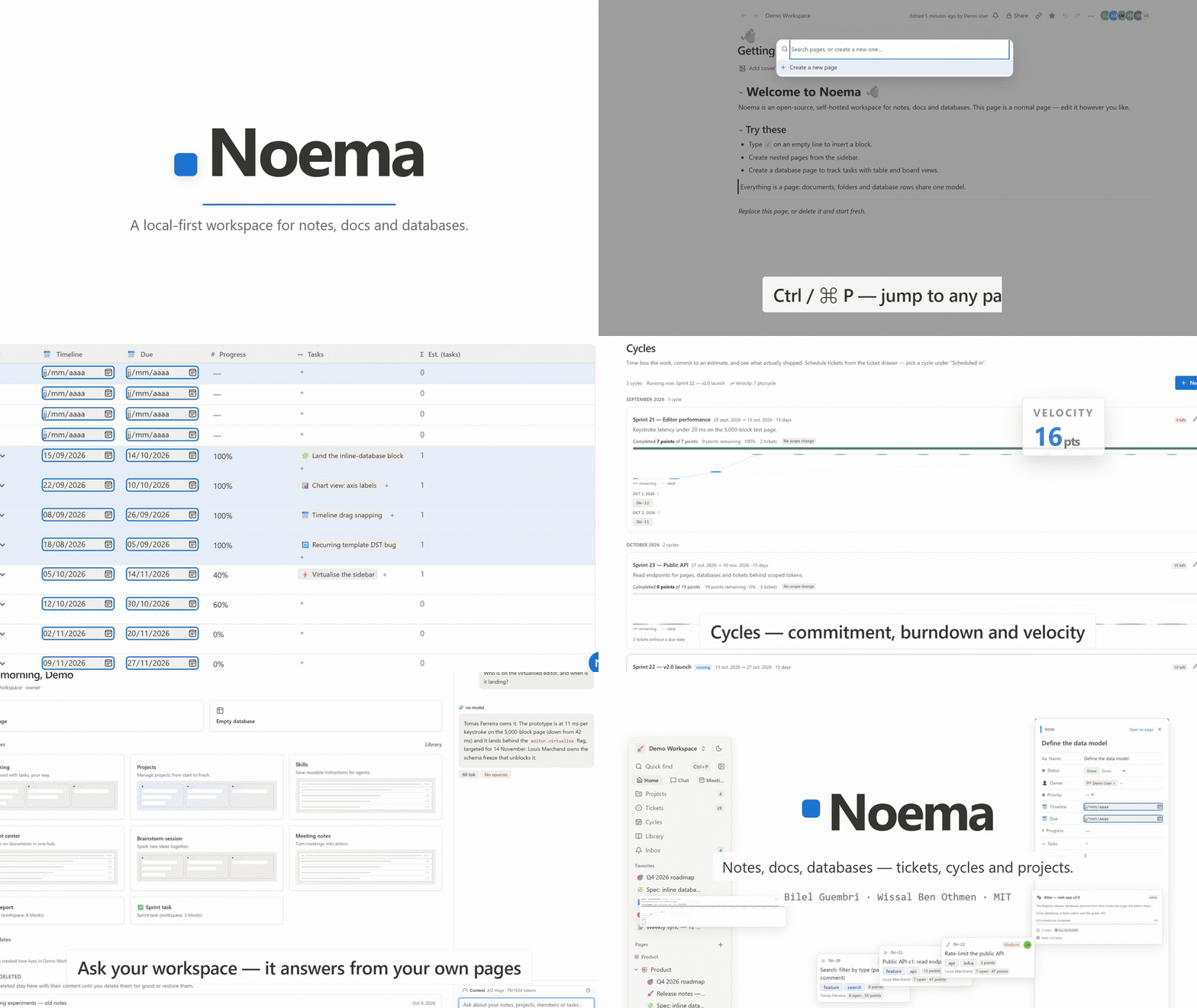
▶ Watch the two-minute product film — one pass over every area: the block editor, seven database views, conditional formatting, tickets with labels and estimates, cycles and burndown, projects and milestones, the workspace roadmap, grounded chat, comments, version history, sharing and the desktop build.
The film is not a screen recording: every frame is composed from captured
screenshots of the running app, so it is reproducible. The project lives in
video/ — npm install && npm run render.
This repository is a working application plus a complete parity tracker.
docs/FEATURE_MATRIX.md
— 563 rows, each with a status and a note explaining the current state. Today:
454 implemented · 87 partial · 0 planned · 22 deliberately out of scope.docs/MISSING_FEATURES.md, generated from the
matrix by npm run docs:gaps, so the two cannot disagree.| Area | What works |
|---|---|
| Auth | Email + password signup/login/logout, hashed passwords (bcrypt), signed JWT session cookie |
| Workspaces | Create workspaces, memberships + roles (OWNER/ADMIN/MEMBER/GUEST), multi-workspace switcher |
| Pages | Infinitely nested page tree, icons, favorites, soft-delete/trash, version snapshots |
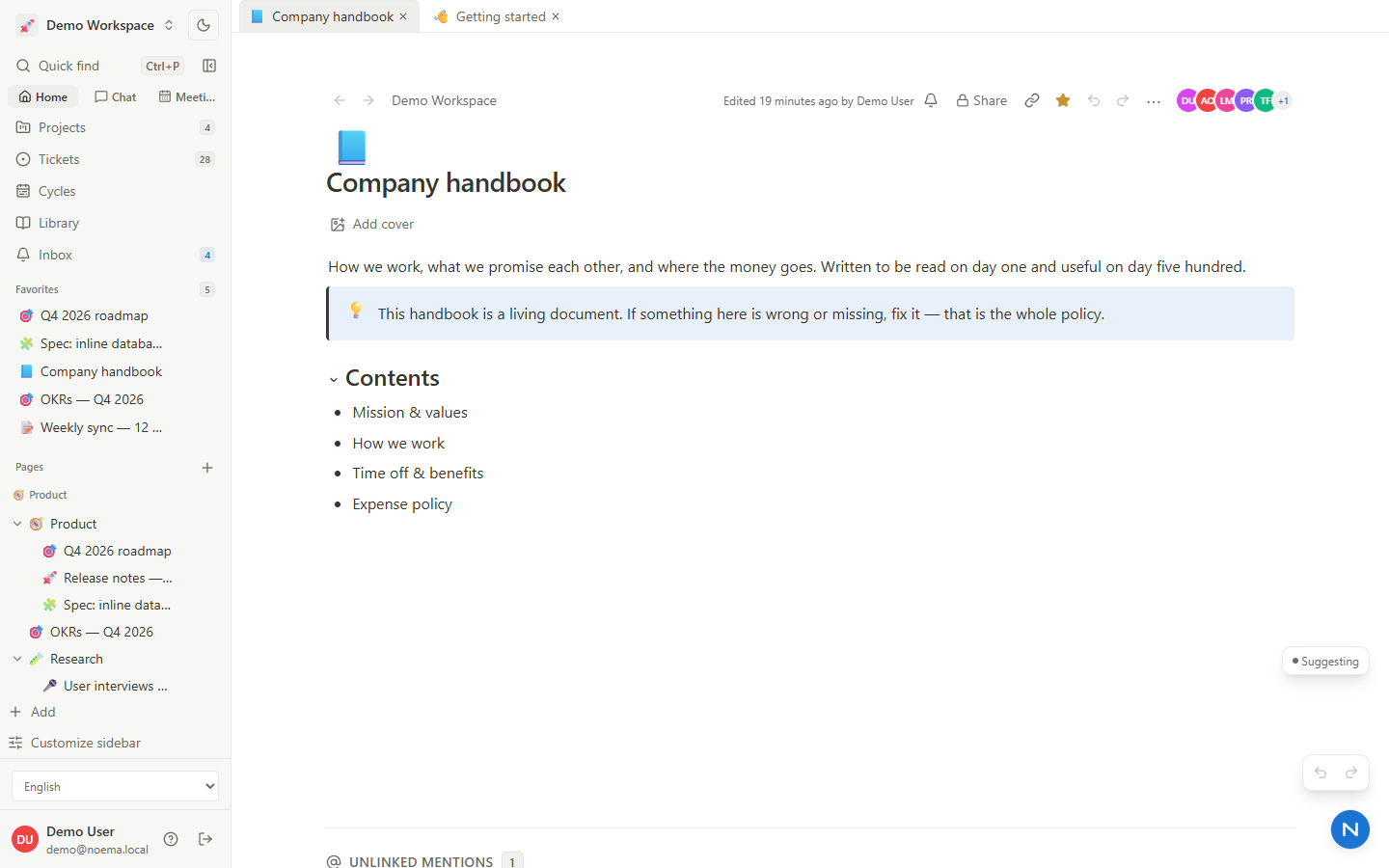
| Editor | TipTap block editor: headings, lists, to-do lists, quote, code, divider, callout, toggle, columns, table, table of contents, inline + block equations (KaTeX), breadcrumb, bookmark & embed (YouTube/Vimeo/Loom/Spotify/Figma…), synced view (page transclusion), @-mentions (pages/people/dates), file & image uploads (paste, drag-drop or picker), rich inline formatting via a selection bubble menu, a keyboard-driven / slash menu, and pointer drag-and-drop reordering |
| Link previews | GET /api/link-preview fetches OpenGraph metadata with an SSRF guard (http(s) only, no private/loopback hosts), size cap and timeout |
| Backlinks | Linked references — pages that @-mention the current page |
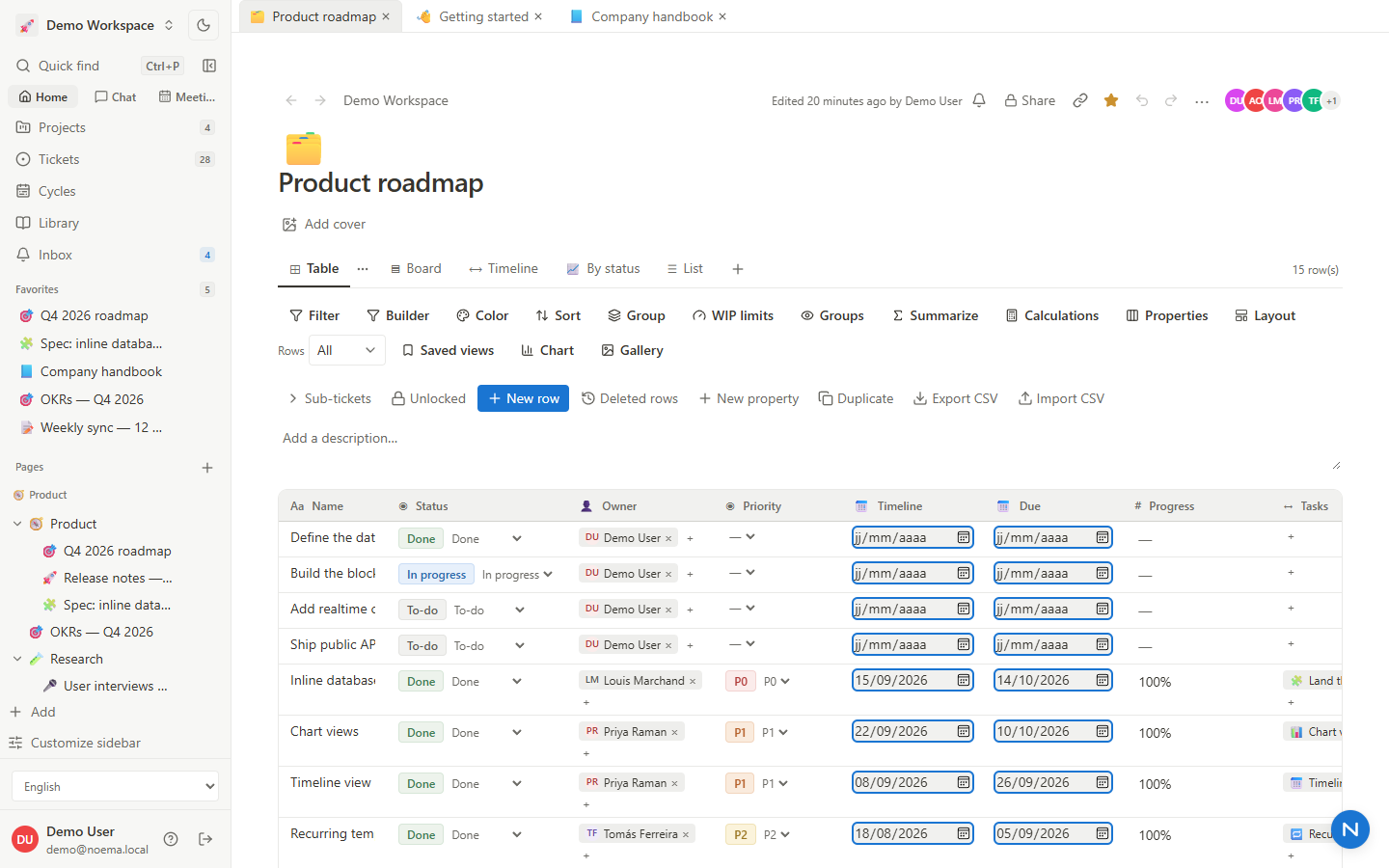
| Databases | Full-page databases with typed properties, Table / Board / List / Gallery / Calendar / Timeline / Chart views, AND/OR + nested filters, sorts, grouping, conditional colors (saved per view), view tabs with an “add view” menu, per-property menus (rename/duplicate/delete/formula), inline cell editing, templates, CSV import/export, open-row-as-page |
| Page chrome | Emoji icons, cover images (presets), breadcrumbs, page options menu (copy link, cover, export, move to workspace, lock, trash), favorites, follow |
| Navigation | Row side-peek, responsive mobile shell (drawer sidebar), ⌘K quick find, breadcrumbs, following/favorites |
| Properties | TEXT, NUMBER, SELECT, MULTI_SELECT, STATUS, DATE, CHECKBOX, URL/EMAIL/PHONE, PEOPLE, FILES, FORMULA (expression engine), RELATION (link to another database), ROLLUP (14 aggregates over related rows), and computed system fields (CREATED_TIME/BY, LAST_EDITED_TIME/BY, UNIQUE_ID) |
| Search | Full-text search across page titles and body content |
| Comments | Page comments, threaded replies, resolve, delete, notifications on reply |
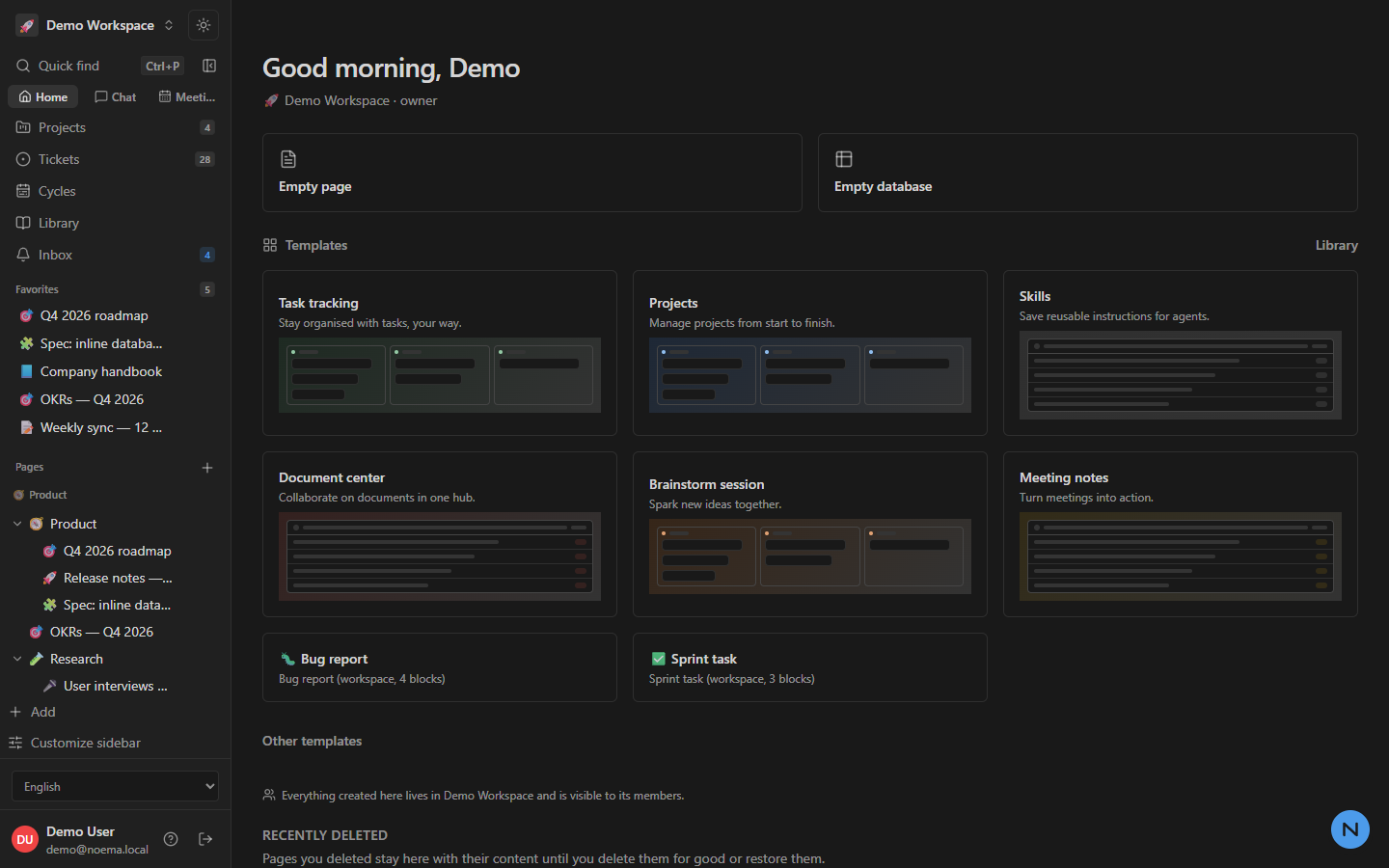
| UX | Notion-white default theme (light) with a dark toggle, ⌘K quick-find command palette, toast notifications, tooltips, responsive sidebar, accessible primitives (Radix) |
| Page settings | Full-width, small text and font (default/serif/mono), saved per page |
| Import / Export | Export a page as Markdown / JSON / HTML, a database as CSV, the whole workspace as a .zip; import Markdown or CSV |
| Sharing | Share to web — publish a page read-only at /s/<token> with optional password + expiry; unpublish; per-member share levels and email invitations (see Permissions) |
| Templates | Template button block + database templates with recurrence (daily/weekly/monthly) materialized by POST /api/cron/templates |
| Public API | GET/POST /api/v1/pages, GET /api/v1/pages/:id, GET /api/v1/search, GET /api/v1/workspaces — authenticated with Bearer API tokens (hashed at rest, managed in workspace settings) |
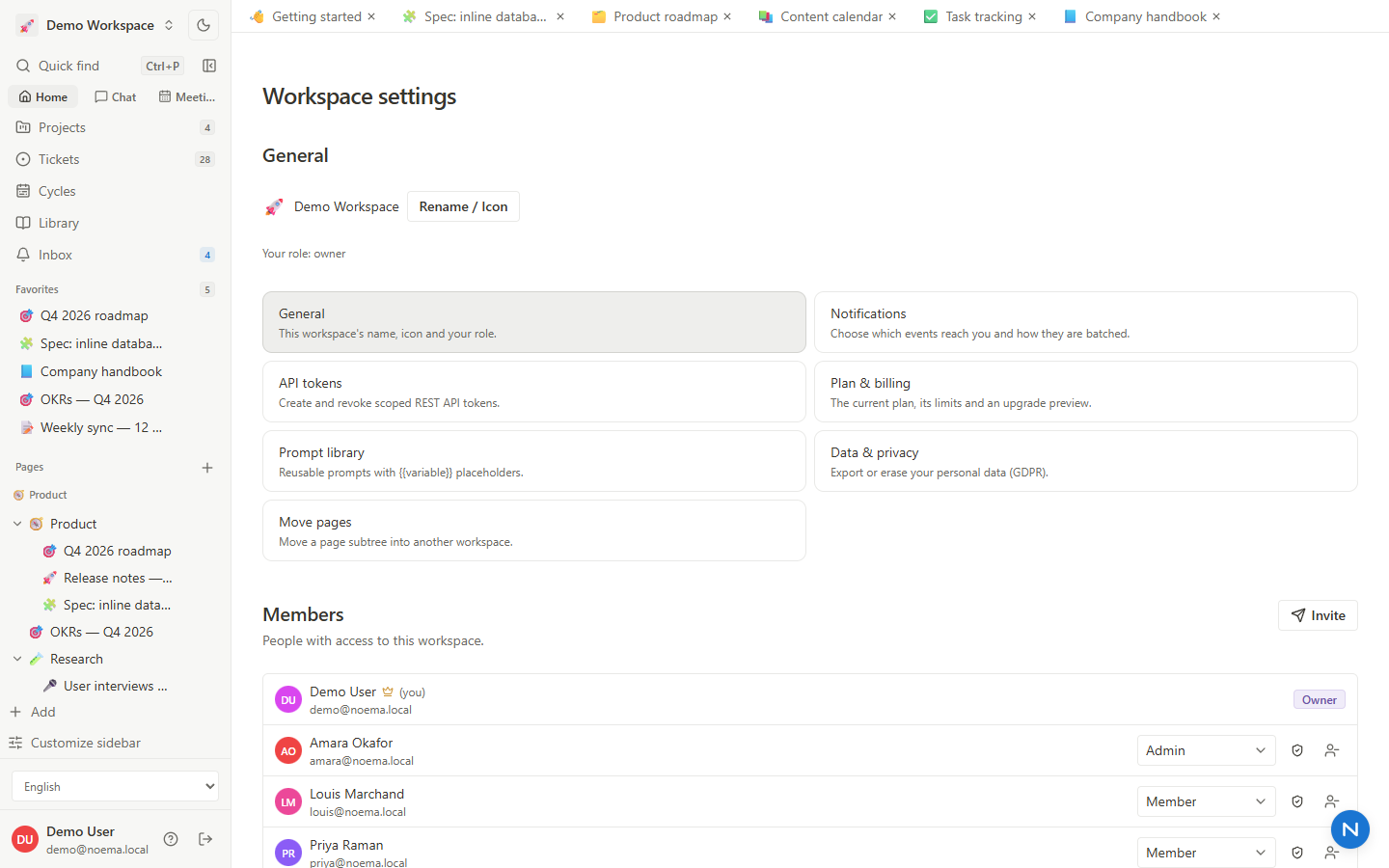
| Workspace settings | Rename, member list, API tokens, workspace export |
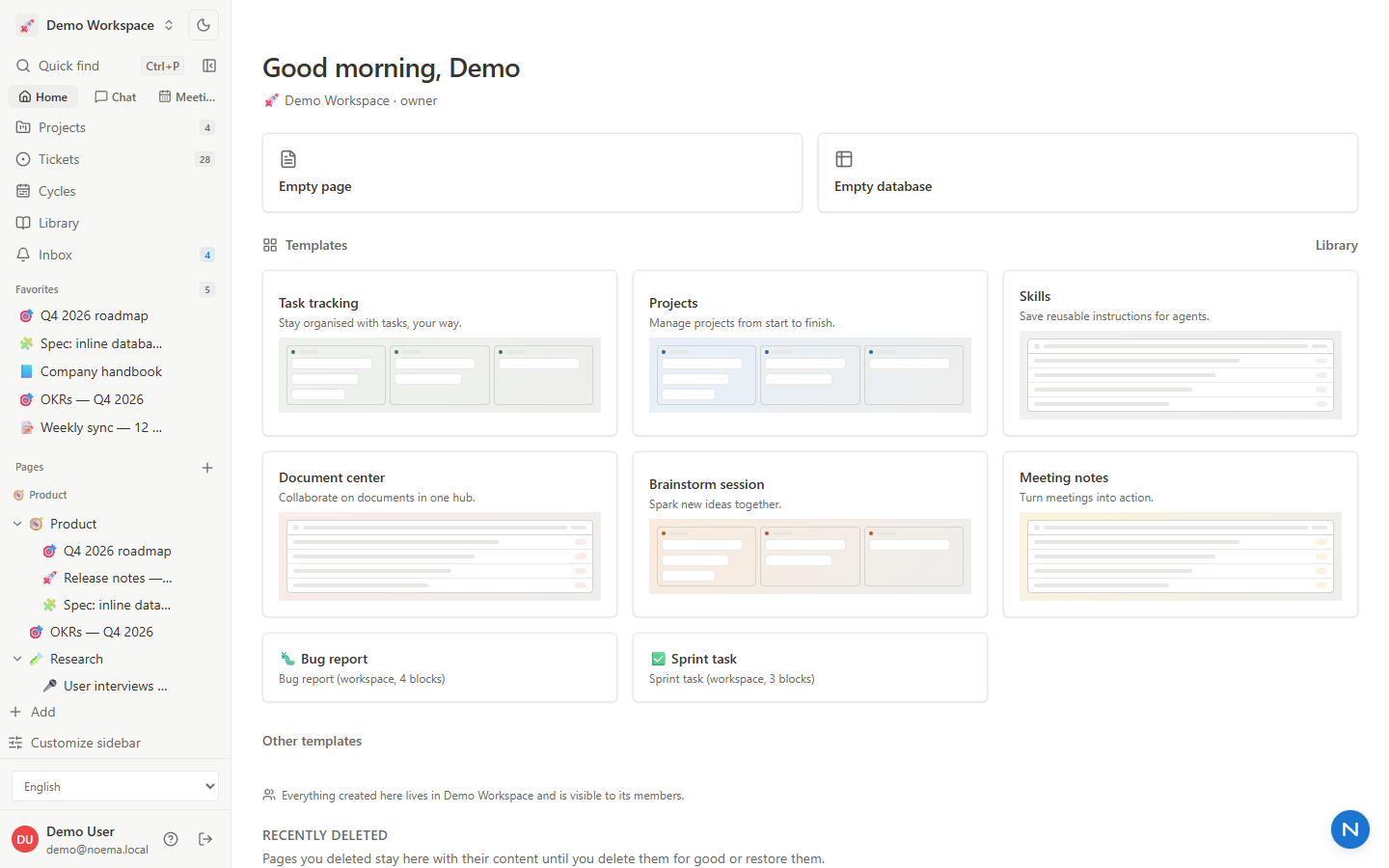
| Home & templates | A greeting home with Empty page / Empty database cards, a workflow template gallery (Task tracking, Projects, Skills, Document center, Brainstorm, Meeting notes) with mini previews, and “Other templates”; POST /api/templates |
| Sidebar chrome | Home / Chat / Meetings tabs, Projects, Library, Teamspaces, Private pages, search, Add, Customize, a footer help menu, and a right-click menu on every page (open, open in new tab, discuss in chat, rename, favorite, copy link, move to teamspace/project, trash) |
| Library | /w/<slug>/library — every database and page in one browsable grid |
| Discussions | Workspace chat: draft-first threads (no empty rows — the thread is created on the first message), first message names it, notes can be pinned to a discussion, and /ask … gets a grounded AI answer; GET/POST /api/chat |
| Meetings | Calendar subscriptions — paste an ICS URL, events are imported/refreshed, and one click turns an event into a meeting-notes page; GET/POST /api/calendar |
| Version history | Slide-over panel (no longer a long list in the page body): who changed what, relative time, character delta, “Renamed to …”, and one-click Restore |
| Block menu | Right-click any block: Turn into, Colour, Ask AI, Move up/down, Duplicate, Comment, Copy link, Edit equation, Delete — plus a Notion-style caret and selection colour |
| AI skills | Selection-toolbar Ask AI: Improve writing, Proofread, Reformat, Make shorter, Explain, Summarize, Translate |
| Undo / redo | Floating undo/redo controls in the editor |
| Inbox | Notification inbox with unread badge and “mark all read” |
| Realtime | Optional Yjs collaboration (npm run collab + NEXT_PUBLIC_COLLAB_URL) with awareness/live cursors and a “Live · N” indicator |
| Webhooks | HMAC-SHA256-signed POST deliveries on page.created, page.updated, row.created, comment.created; managed in workspace settings |
| AI | POST /api/ai (OpenAI-compatible: OpenAI, DeepSeek, Groq, Ollama…) + an Ask AI block (ask + summarize) + a database AI autofill property + AI skills (POST /api/ai/skills); degrades to 503 guidance when unconfigured |
| AI grounding | Ask answers are grounded in your workspace: prompts are reduced to keywords and pages scored by relevance (src/lib/retrieval.ts) |
| Webhook log | Delivery outcomes recorded (WebhookDelivery) with retries (3 attempts, backoff), status/attempts/error shown in settings |
| Exports | … plus PDF (via pdfkit) |
| Database templates | Save any row as a template; create rows from templates |
| i18n / RTL | 5 locales (en/fr/es/de/ar) with correct lang/dir, translated core navigation, and a language switcher |
| Security | bcrypt passwords, HS256 JWT session cookies, 2FA (TOTP) with any authenticator app, API tokens hashed at rest, fixed-window rate limiting on every API route |
| OAuth apps | Register an app in settings; authorization-code flow (/oauth/authorize → /oauth/token) issues Bearer API tokens |
| Page permissions | Per-member page access (Can edit / Can view / No access) that overrides the workspace role for that page |
| Automations | Button properties (set another property to a value on click) and page locking (read-only pages/databases) |
| Importers | Trello JSON → database (lists → status options), Markdown .zip → nested pages, Word .docx → page, Markdown file, Notion API (POST /api/import/notion — integration token + nested child pages) |
| Editor blocks | … + linked database (embedded read-only view of another database) |
| Accessibility | Visible focus rings, a skip-to-content link, lang/dir from locale, labelled landmarks/navs/controls, and a WCAG contrast-audited palette (npm run check:a11y) |
| Formulas | FORMULA properties with an expression engine (prop("Name"), + - * / %, comparisons, if, concat, round, min/max, abs, length, upper/lower, contains, empty, now/today) |
| Quality | Vitest unit tests for the pure logic (block serialisation, database query engine), Playwright e2e, tsc --noEmit, ESLint, npm run check:fast inner-loop gate and npm run check:coherence drift gate |
Everything not yet implemented is enumerated in the feature matrix with a 🧭 Planned status.
The same codebase also builds into a per-user Windows installer: a Tauri 2 shell around a bundled Node runtime and an embedded PostgreSQL (PGlite). It needs nothing else on the machine — no Docker, no external database, no account.
| Install | The NSIS installer (Noema_1.4.1_x64-setup.exe) installs per user into %LOCALAPPDATA%\Noema, and uninstalls from Add/Remove programs. WebView2 is bootstrapped by the installer itself |
| Your data | %APPDATA%\app.noema.desktop — the database, uploads, the session secret and preferences. Uninstalling keeps it unless you tick delete application data |
| Build it | npm run desktop:bundle → src-tauri/target/release/bundle/{nsis,msi} |
| How it boots | The shell starts the bundled server on a free loopback port and opens the window on it. The port is a preference, not a contract: it survives a port change because nothing outside the shell depends on the number |
| One codebase | The desktop build is the site build with NOEMA_STANDALONE=1 — the embedded database replaces Postgres and the shell owns the lifecycle. Nothing is forked |
Packaging, security posture and the install verification harness are documented
in docs/DESKTOP.md.
Every screen is captured from the seeded demo workspace by
scripts/screenshots.mjs — generated, not
hand-taken, so a surface that changes takes its screenshot with it. The full set
of 44, with captions, is in docs/GALLERY.md.
The same shots are laid out beside the feature list in
docs/Noema-features.pdf — a printable feature
sheet, built by npm run features:pdf from the README's own feature tables and
the screenshot report, so the document cannot drift from the product either.
| Workspace home | The block editor |
|---|---|
 |  |
| A database — table view | The same rows as a board |
|---|---|
 | 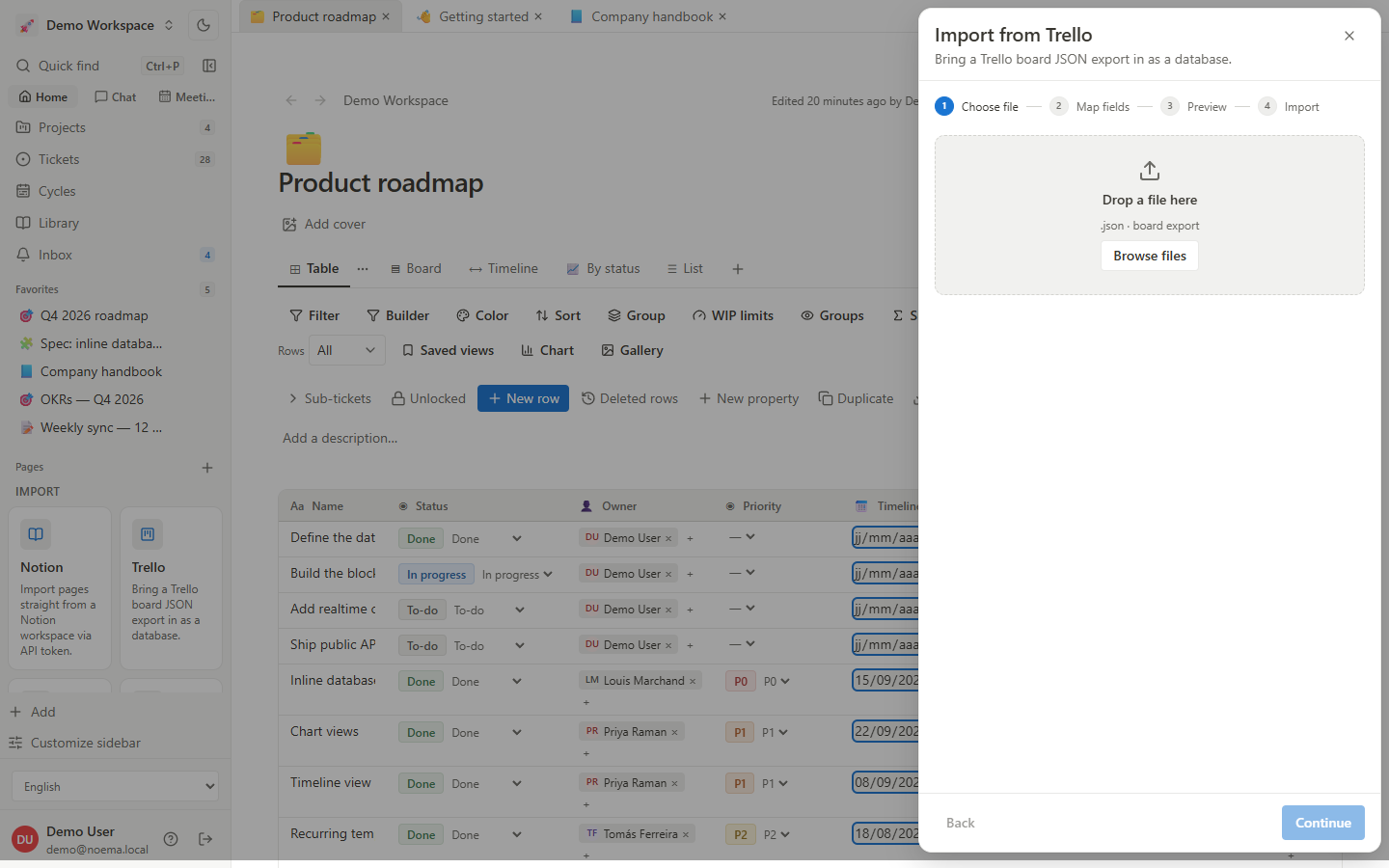 |
| Tickets | Cycles — burndown and scope |
|---|---|
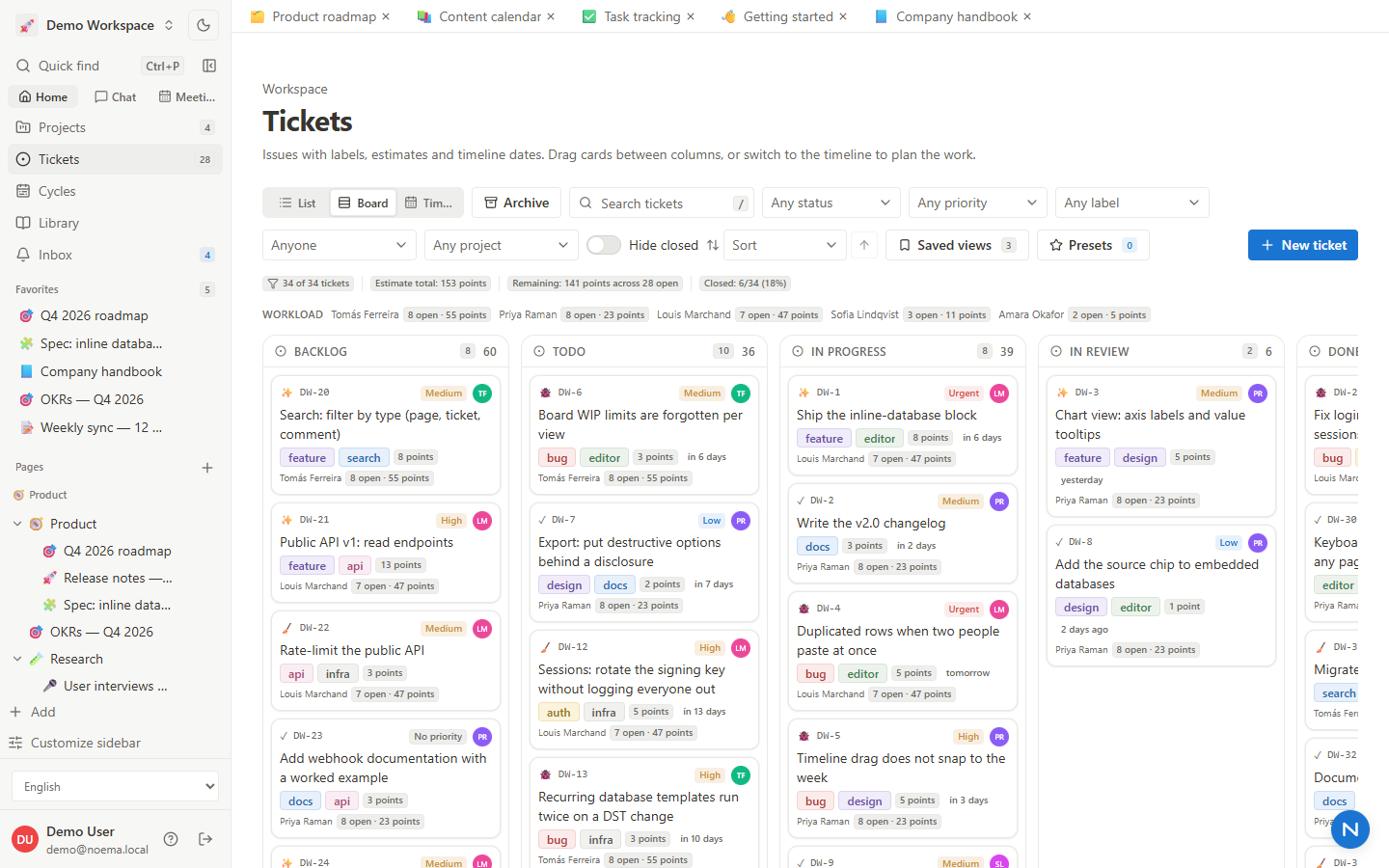 | 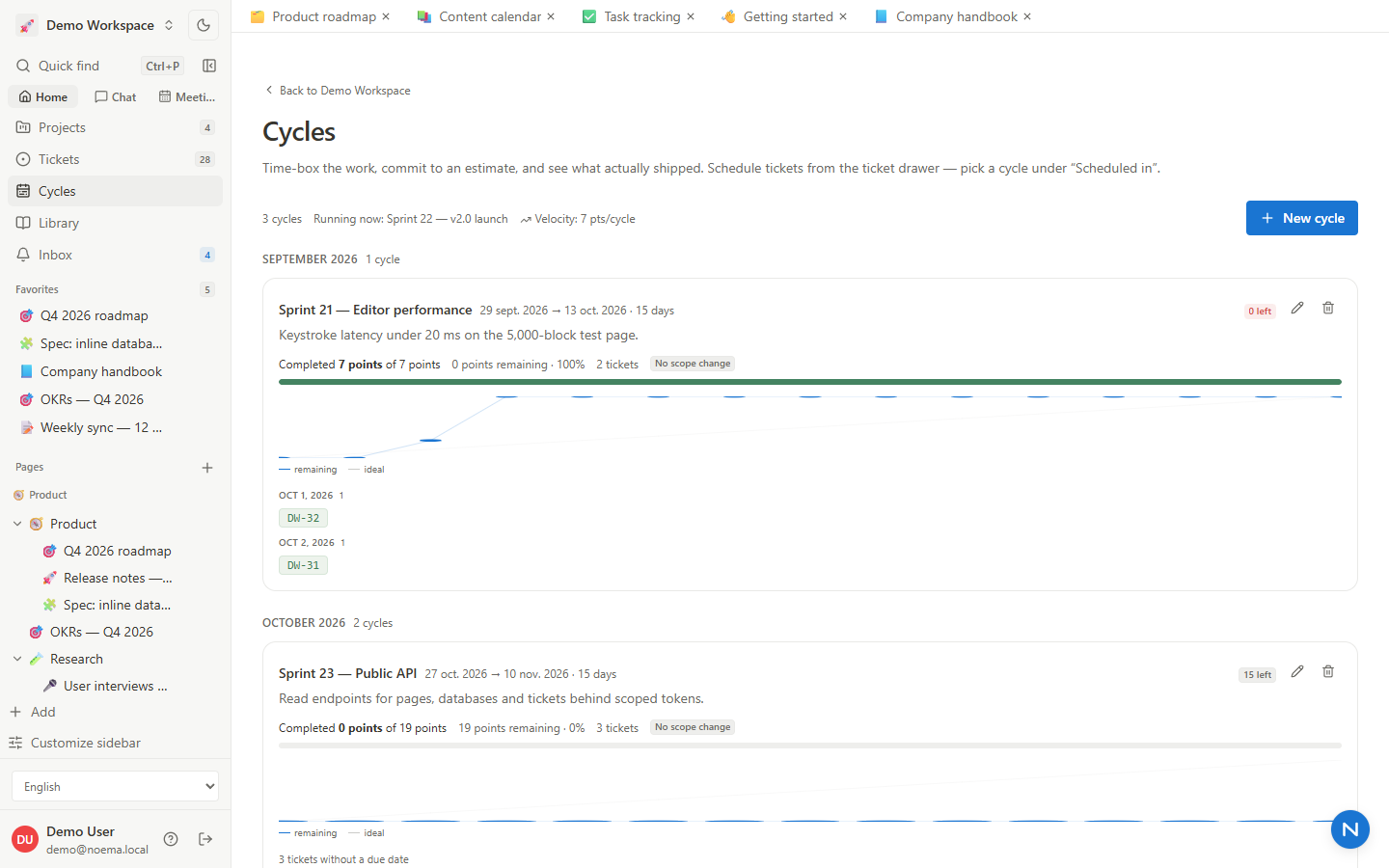 |
| Chat, with the notes it cites | Settings |
|---|---|
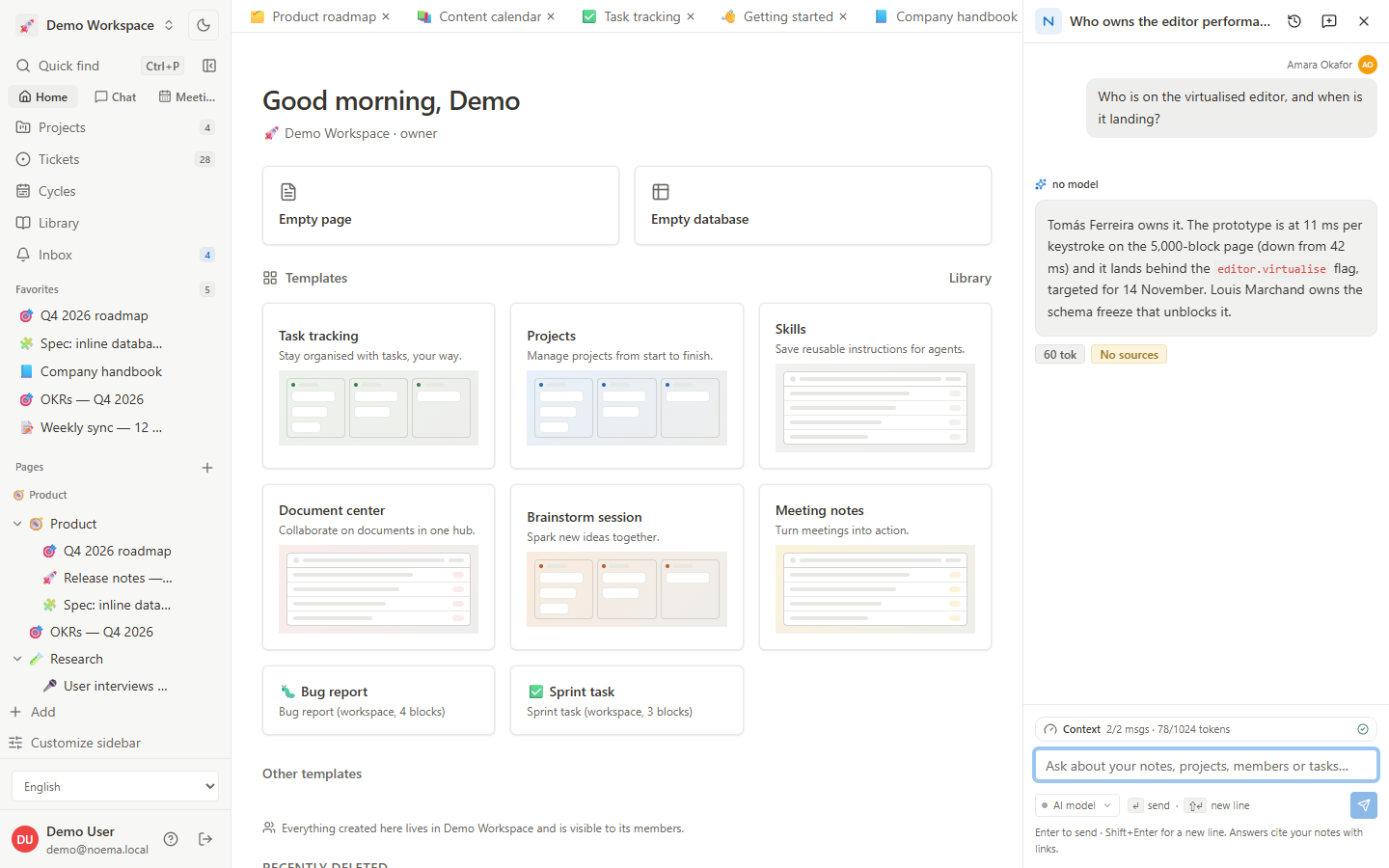 |  |
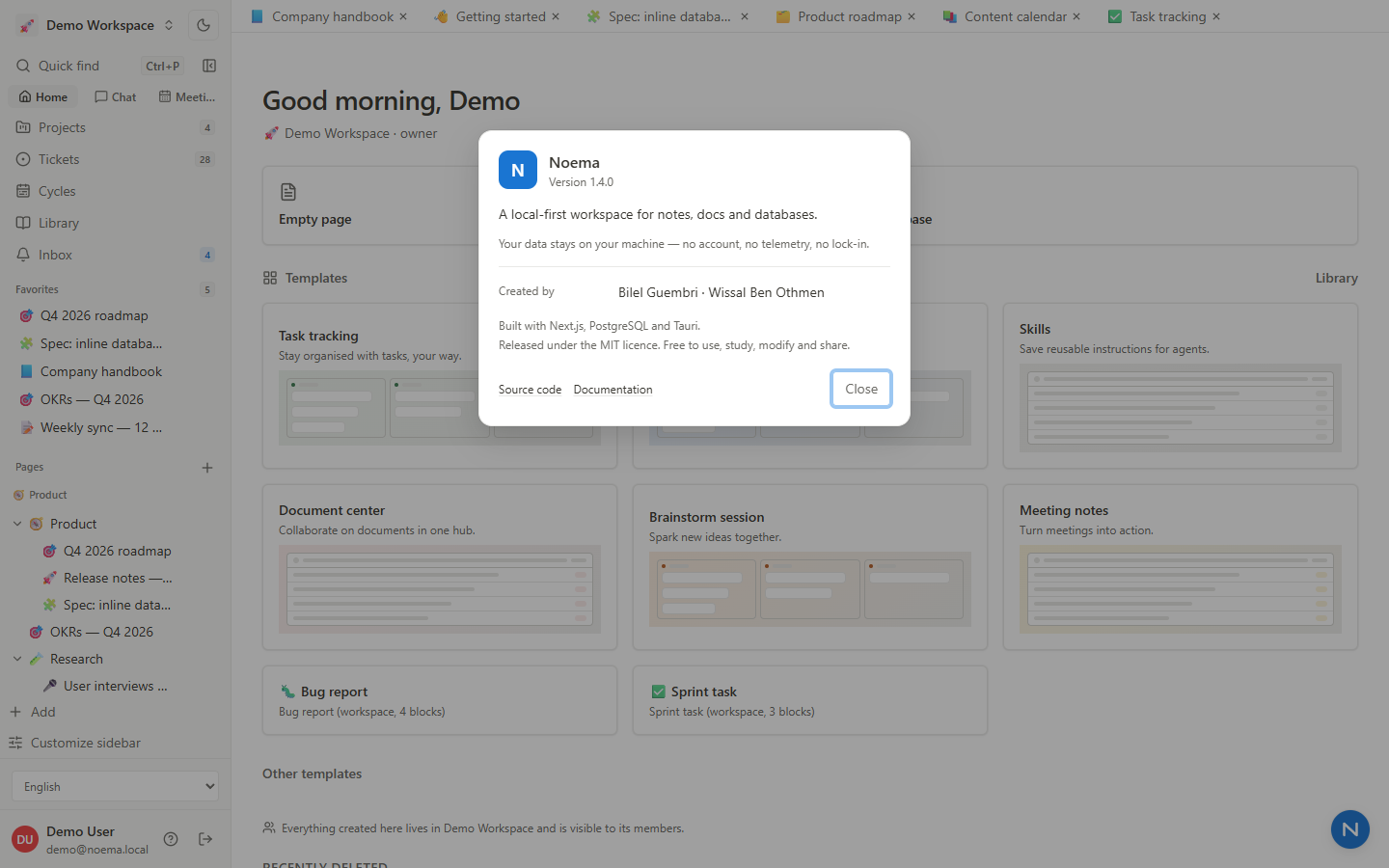
| Dark mode | About — version, credits and licence |
|---|---|
 |  |
The landing page sits at the top of this file. The rest of the interface —
search, databases, tickets, chat, the editor, sharing — is specified in
docs/specs/ and tracked row by row in
docs/FEATURE_MATRIX.md.
Any OpenAI-compatible provider works. Example (DeepSeek):
AI_API_KEY="sk-…"
AI_BASE_URL="https://api.deepseek.com"
AI_MODEL="deepseek-flash"
| Surface | Route | Notes |
|---|---|---|
| Ask / grounded ask | POST /api/ai | { prompt, workspaceId? } — the workspace is searched with keyword extraction + relevance scoring, so answers are grounded in your pages |
| Summarize | POST /api/ai | { mode: "summarize", context } |
| AI autofill (database) | POST /api/ai | { mode: "autofill", prompt } — single value, capped tokens |
| Editor skills | POST /api/ai/skills | { skillId, text } → { text, replacesSelection }; prompts live in src/lib/ai-skills.ts |
| Speech-to-text | POST /api/ai/transcribe | Needs its own key: AI_TRANSCRIBE_API_KEY (+ optional AI_TRANSCRIBE_BASE_URL, AI_TRANSCRIBE_MODEL) because not every chat provider offers audio |
Transport is centralised in src/lib/ai-provider.ts (one place for base URL, model, timeouts and error mapping).
Clicks do nothing / “Saving…” never finishes / comments and chat appear dead. These are all Server Action failures — the UI can't tell you, it just waits. Two known causes:
Origin matches the Host. If you reach the app through a hostname it doesn't know (a LAN IP after a rebuild, 127.0.0.1 vs localhost, or a reverse proxy/tunnel), every action is aborted. Noema allow-lists loopback, this machine's LAN addresses and the usual ports automatically; add anything else (proxy, tunnel) with APP_ORIGINS, then restart:
APP_ORIGINS="noema.example.com,my-tunnel.ngrok.app"
npm run build still holds the previous build's action ids, so every action fails. Hard-reload (Ctrl+Shift+R) after a rebuild.Diagnostics: npm run check:routes prints a Server Action origin matrix (same origin / loopback / LAN must pass, foreign origins must be rejected). Any residual failure now raises a toast (ActionErrorGuard) instead of hanging.
The editor's selection menus (colour, highlight, Ask AI). These render as a panel pinned under the toolbar, measured at click time — they used to be portalled popovers that lost their trigger and appeared in the top-left corner. Escape or a click elsewhere dismisses them.
| Capability | Detail |
|---|---|
| Roles | Owner · admin · member · guest — enforced on the server, never only in the UI |
| Guest page-scoping | A guest opens only the pages shared with them: an explicit PagePermission, a page in a teamspace they belong to, or a page they created — plus ancestors so the tree still renders. Applied to the sidebar tree, search and the page route (a direct URL to an unshared page is a 404, not a leak). Guests cannot edit, invite or upload |
| Teamspaces | Members see and search only their teamspaces; invites are emailed |
| Page shares | Per-member levels (inherit · view · comment · edit · full) and public links with an optional password and expiry |
Storage & backups
| Capability | Detail |
|---|---|
| Storage driver | src/lib/storage.ts defines one interface with two drivers: local filesystem (default, STORAGE_DIR or ./uploads) and S3-compatible (AWS, MinIO, Cloudflare R2, Garage) — selected by setting S3_BUCKET (+ S3_ENDPOINT, S3_REGION, S3_ACCESS_KEY_ID, S3_SECRET_ACCESS_KEY, optional S3_PREFIX) |
| No SDK | The S3 driver signs requests with Signature V4 (signS3Request, unit-tested for determinism, key encoding and presigned GETs) over fetch |
| Authorised reads | Files are never public: /api/files/<workspace>/<name> re-checks the session and workspace membership, validates the key (no traversal) and streams from whichever driver holds the bytes |
| Uploads | Type allow-list + 10 MB cap + Asset row; npm run check:storage asserts the byte-for-byte round trip, the content type, the 404 for a missing key, the traversal refusal, the anonymous refusal and the 415 for a bad type |
| Backups | npm run backup writes backups/noema-<timestamp>.sql (via the database container or a local pg_dump), refuses to keep a suspiciously small file, verifies the core tables are in the dump, keeps the newest 5 and prints the restore command |
Cycles (sprints)
/w/<slug>/cycles turns estimates into a plan:
| Capability | Detail |
|---|---|
| Create a cycle | Name, start/end dates and an optional goal (in the same dialog pattern as every other create flow; validated on the server) |
| Schedule work | The ticket drawer has a Scheduled in selector; tickets keep their project, labels and assignee |
| Commitment | Each cycle shows completed vs committed estimate, remaining points and a percentage, with a progress bar |
| Burndown | Daily remaining points against the ideal straight line, drawn inline (SVG), out of the maths in src/lib/cycles.ts |
| Velocity | The average completed estimate over the last six finished cycles, shown in the header |
| Delete | Deleting a cycle unschedules its tickets — it never deletes them |
Collaboration depth
| Capability | Detail |
|---|---|
| Comments | Anchored to a text selection (the quote is stored and shown), one level of replies, resolve/reopen, and delete for your own |
| Reactions | 👍🎉❤️😄🙌👀❓ picker with optimistic chips and per-person counts (CommentReaction) |
| Mentions | @Ada, @ada, @[email protected] create a page.mention notification for the matching member (never the author); matching lives in a tested pure helper |
| Activity trail | Every workspace, member, page, share and comment mutation writes an Activity row; Settings → Activity shows who did what, human-labelled |
| Sound dates | <LocalTime> renders a deterministic UTC string on the server and the reader's locale after mount, so no page hydrates with mismatched text (React #418 used to detach every handler) |
Search
Content search is Postgres full-text, not a JavaScript scan: every page keeps a
plain-text mirror (Page.searchText) updated on write, indexed with a GIN index over
to_tsvector('english', …). Queries use websearch_to_tsquery with ts_rank ordering,
a to_tsquery prefix pass so typing "road" finds "roadmap", and ts_headline
snippets. Trashed pages are excluded; pages whose mirror predates the feature fall back
to a substring match. Run npm run setup:search after a fresh database (the index is an
expression index, so it lives in SQL rather than in the Prisma schema)
Workspaces
Create, switch and administer workspaces without leaving the sidebar.
| Capability | Detail |
|---|---|
| Switcher | The header menu lists every workspace with its icon, marks the current one (aria-current + a check), shows your role, and offers New workspace and All workspaces |
| Create | Name + icon picker (presets or any emoji), a "Getting started" page, and a 50-workspace cap; the action returns the new slug so the client navigates instead of a redirect being swallowed |
| Identity | Rename or re-icon from Settings → General or the switcher (one dialog for both paths) |
| Members & roles | Promote/demote (admin · member · guest), remove a member (their page permissions are cleared too); owner/admin hierarchy is enforced on the server |
| Leave | Members can leave; the owner is told to transfer or delete instead |
| Transfer ownership | Owner-only, atomic: new owner becomes OWNER, the previous owner becomes ADMIN |
| Entry point | /app redirects to your first workspace, or offers creation when you have none |
Tickets (issues)
/w/<slug>/tickets — a Linear-style tracker on top of the workspace:
| Capability | Detail |
|---|---|
| Keys | Every ticket gets an ordered, workspace-prefixed key (DW-1, DW-2…) from an atomic counter |
| Labels | Workspace-level label catalogue (name, colour, description, usage count) managed in Settings; any ticket can carry many, and you can filter by them |
| Fields | type (task/bug/feature/epic/chore), status (Backlog → Todo → In progress → In review → Done/Cancelled), priority, assignee, reporter, project, milestone, parent/children |
| Estimates | Points / hours / days per ticket, with rollups: total, remaining (open only), per board column and per project |
| Dates → Gantt | Start & due dates drive the Timeline view: dated bars, a today marker, and estimate labels on each bar (undated tickets are shown flagged) |
| Views | List, Board (drag between columns), Timeline, with search + status/priority/label/assignee/project filters and "hide closed" |
| Saved views | Save the current filters, search and view type as a named workspace view; apply or delete it from the Views menu in the toolbar |
| Sub-tickets | Break a ticket down from its drawer: parent link, child list with per-child estimates, a child estimate roll-up, inline Add a sub-ticket, and a sub-count badge in the list |
| Power features | Relations (blocks / blocked by / relates / duplicates), comments, an activity log (created, status, labels, estimate, bulk, archived…), bulk edits, archive, and Create ticket from page in the sidebar's right-click menu |
| Integration | Project pages show ticket counts/estimates; the chat assistant answers about tickets (Reviewed tickets, remaining estimate); GET/POST /api/tickets |
Labels live at Settings → Ticket labels (create, rename, recolour, describe, delete with usage counts) and are shared by every ticket in the workspace. Use npm run seed:tickets to drop in a demo backlog, or Create ticket from page in the sidebar's right-click menu to turn a note into an issue.
The conversation opens as a docked panel in the main area (next to the note it is about) — the sidebar keeps the list and the panel is the conversation.
| Capability | Detail |
|---|---|
| Workspace tools | Each question is routed to the data it needs — the current note, matching notes, members and their roles, projects with milestone progress, and open tasks — and the answer cites where it came from (Reviewed projects · Searched notes) |
| Note access | Mentioned notes become clickable links in the answer (`[[page:id |
| Pinned discussions | Discuss this note opens a conversation pinned to that note; the panel header links back to it |
| Quick prompts | Summarize this note · What are my projects? · Who is on the team? · What should I do next? |
| Providers | Works with any configured provider; the model is shown on each answer and in the composer pill. npm run check:providers proves both providers live |
| Streaming | Answers stream token by token into a live bubble (POST /api/chat/stream), with the question persisted first and the answer once at the end; Regenerate in the answer menu replaces the last reply |
| Rich answers | Replies are rendered as real Markdown — headings, lists, task lists, tables, blockquotes and fenced code with a copy button — by src/components/markdown.tsx. Headings, bullets and tables look like a Notion page; note references stay clickable chips |
| Safe by construction | The renderer emits React elements only (src/lib/markdown.ts → AST → JSX). No dangerouslySetInnerHTML, and safeHref() drops javascript:/data: URLs, so model output cannot inject markup |
| Synthesis first | The prompt asks for the answer in the opening sentence, then supporting detail — short lists and tables rather than walls of prose |
| Insert into a page | The in-editor Ask AI block previews rich text and Insert converts the answer into real blocks (headings, lists, code) instead of flattened paragraphs |
The interface follows the product it mirrors: a white canvas, a #f7f7f5
sidebar and 4–8px radii, driven by CSS custom properties in
src/app/globals.css (--bg --sidebar --surface --fg --muted --accent,
dark variants under .dark).
| Aspect | Choice |
|---|---|
| Type | ui-sans-serif, -apple-system, BlinkMacSystemFont, "Segoe UI", …; 16px/1.6 body, 40px page title with -0.02em tracking, text-wrap: pretty/balance where supported |
| Text column | 720px (Notion's is 708px) for notes, max-w-5xl for database pages, full width when the page opts in |
| Page chrome | Breadcrumb + actions in a sticky bar that reveals a hairline only once content scrolls under it; 180px cover; emoji icon |
| Markdown surfaces | .notion-markdown mirrors the editor typography, so an AI answer, an Ask-AI block and a page all read the same |
| Accessibility | Visible :focus-visible rings, aria-current on the active breadcrumb, prefers-reduced-motion honoured, structural + contrast audit via npm run check:a11y |
| Feedback | Optimistic sends, skeleton "thinking" row, auto-scroll to the newest exchange, notion-empty / notion-skeleton helpers |
Remaining work is enumerated in docs/MISSING_FEATURES.md
(generated from the feature matrix by npm run docs:gaps): of 563 tracked rows,
87 are still partial and 22 are deliberately out of scope — the rest are
implemented — with a priority shortlist at the top.
Type $x^2$ for inline maths or $$…$$ for a block equation and it becomes a
real, editable math node (live KaTeX preview dialog; click any equation to edit).
Pasting text that contains formulas converts them too, and a "looks like maths"
guard leaves prices ($5 and $6) alone.
| Capability | Detail |
|---|---|
| SMTP | Settings → Email & invitations: host/port/TLS/user/password (encrypted at rest), sender + reply-to, Verify & send test, and a delivery log. Env vars SMTP_HOST/SMTP_FROM… work as a fallback. |
| Client invitations | Invite by email and pick the role: Client (guest — view only), Member, or Admin. The invitation is a single-use, 14-day, hashed token; the email carries the accept link and the link is always shown so you can share it by hand when SMTP is not configured. POST /api/invites. |
| Projects & milestones | /w/<slug>/projects: projects with status/start/due dates, milestones (planned → in progress → done), a Gantt timeline with a today marker, notes attached per project (New note in project), and client invitations — a view-only guest scoped to that one project. |
| Note discussions | Right-click a note → Discuss in chat (or the page menu) opens a discussion pinned to that note; messages are answered by the AI grounded in that note plus the rest of the workspace. Type /ask … in any discussion to ask a question. |
| Equations | Inline and block LaTeX with a live KaTeX preview dialog (⌘/Ctrl + slash menu → Equation, or the selection toolbar); click any equation to edit it. |
Settings → AI provider connects your own model. Keys are encrypted with AES-256-GCM (key derived from AUTH_SECRET) and are never sent back to the browser.
| Provider | Endpoint used | Notes |
|---|---|---|
| OpenAI | https://api.openai.com/v1 | GPT-4o family, o-series |
| DeepSeek | https://api.deepseek.com | deepseek-chat / reasoner |
| Google Gemini | …/v1beta/openai | Gemini's OpenAI-compatible surface |
| Custom | your URL | Ollama, vLLM, LiteLLM, Azure proxy… |
Pick a model from the curated list or press Fetch models to pull the provider's live GET /models, then Test connection before saving. Environment variables (AI_API_KEY / AI_BASE_URL / AI_MODEL) stay as the fallback for workspaces without their own configuration.
| Capability | Detail |
|---|---|
| SSO (OIDC) | Set SSO_ISSUER / SSO_CLIENT_ID / SSO_CLIENT_SECRET (optionally SSO_REDIRECT_URI); a Sign in with SSO link appears on /login. /api/auth/sso/start redirects to the provider and /api/auth/sso/callback verifies the id_token (JWKS, issuer + audience + nonce) and provisions the user just-in-time. |
| Teamspaces | Create teamspaces in Workspace settings with per-teamspace membership; root pages assigned to a teamspace (page menu → Move to teamspace) are grouped under it in the sidebar. |
| Transcription | POST /api/ai/transcribe forwards audio to a speech-to-text provider (AI_TRANSCRIBE_API_KEY, optional AI_TRANSCRIBE_BASE_URL / AI_TRANSCRIBE_MODEL); the sidebar Transcribe audio action turns a recording into a page. |
| Comments | Select text in a page → Comment in the selection toolbar or block menu anchors the quote to the composer; quotes render above each comment. |
Requirements: Node.js 24 (the toolchain is typed against Node 24 —
@types/node ^24), npm, Docker.
# 1. Database — Postgres 16 in the `noema-db` container, mapped to localhost:5433
docker compose up -d

# 2. Environment — required keys: DATABASE_URL (already points at :5433), AUTH_SECRET
cp .env.example .env        # then set a real AUTH_SECRET (see .env.example for the generator)

# 3. Install dependencies (postinstall runs `prisma generate`)
npm install

# 4. Create the schema, seed demo content, build the search index
npm run db:push
npm run db:seed
npm run setup:search        # optional: FTS GIN index + searchText backfill (safe to re-run)

# 5. Run
npm run dev                 # http://localhost:3000 (Next.js default port)
.env keys — everything is documented in .env.example:
| Group | Keys | Notes |
|---|---|---|
| Required | DATABASE_URL, AUTH_SECRET | DATABASE_URL must match the docker mapping (localhost:5433, user/db noema) |
| AI (optional) | AI_API_KEY, AI_BASE_URL, AI_MODEL, AI_TRANSCRIBE_* | any OpenAI-compatible provider; see AI configuration |
| SSO (optional) | SSO_ISSUER, SSO_CLIENT_ID, SSO_CLIENT_SECRET, SSO_REDIRECT_URI | enables Sign in with SSO; the local mock IdP used by npm run check:sso is pointed at with these |
| SMTP (optional) | SMTP_HOST, SMTP_PORT, SMTP_SECURE, SMTP_USER, SMTP_PASSWORD, SMTP_FROM, … | invitation emails; without it the invite link is still shown in the UI |
| Notion importer (optional) | NOTION_API_BASE | defaults to https://api.notion.com/v1; checks point it at a local mock (http://localhost:4322/v1) |
| Misc (optional) | APP_URL, APP_ORIGINS, CRON_SECRET, NEXT_PUBLIC_COLLAB_URL | canonical email links, Server-Action origin allow-list, cron guard, realtime collab |
Production: npm run build then npm start. Note that dev and prod share
the same .next directory — never run them at the same time.
A multi-arch (amd64 + arm64) image is published to the GitHub Container
Registry on every main push and v* tag:
cp .env.example .env          # set a real AUTH_SECRET
docker compose --profile app pull app
docker compose --profile app up -d
# http://localhost:3202
It is a standalone, non-root image that runs migrations on start-up, ships a
healthcheck, and is signed with cosign (keyless) with SBOM and provenance
attestations. Full configuration, reverse-proxy notes, signature verification
and the image tags are in docs/DOCKER.md.
| Server | Command | Port |
|---|---|---|
| Dev (Turbopack) | npm run dev | http://localhost:3000 |
| Prod | npm run build && npm start -- --port 3200 | http://localhost:3200 |
Playwright's default baseURL is http://localhost:3200 (see
playwright.config.ts), so start the production server on :3200 before
npm run e2e — or point the suite at any other server with E2E_BASE_URL
(the dev server on :3201 is already running:
E2E_BASE_URL=http://localhost:3201 npx playwright test).
email:    [email protected]
password: password123
The demo account is created by the seed script. Change or remove it before any real deployment.
| Script | Purpose |
|---|---|
npm run dev | Start the dev server (Turbopack) → http://localhost:3000 |
npm run build / npm start | Production build / serve (npm start -- --port 3200 for the e2e default) |
npm run collab | Optional Yjs websocket collaboration server (NEXT_PUBLIC_COLLAB_URL) |
npm run typecheck | tsc --noEmit |
npm run lint | ESLint |
npm run test / npm run test:watch | Full Vitest unit suite / watch mode |
npm run test:changed | Unit tests touching changed files only (--changed --passWithNoTests) |
npm run test:bail | Unit suite that stops at the first failure (--bail=1) |
npm run check:fast | Inner-loop gate: tsc --noEmit + ESLint + changed-file unit tests |
npm run e2e | Full Playwright suite against baseURL (http://localhost:3200, override with E2E_BASE_URL) |
npm run e2e:headed | The same suite in a headed browser |
npm run e2e:bail | Fail-fast e2e triage run (--max-failures=1) |
npm run smoke | Authenticated smoke: signs the demo session and fetches the protected routes |
npm run db:push | Sync Prisma schema to the database |
npm run db:migrate | Create a versioned migration |
npm run db:seed | Seed demo data |
npm run db:studio | Prisma Studio |
npm run setup:search | Creates the full-text GIN index and backfills the Page.searchText mirror (safe to re-run) |
npm run backup | Database dump with a core-table verification and retention (-- --keep N) |
npm run check:a11y | WCAG structural + contrast audit of the rendered shell |
npm run check:sso | OIDC SSO + teamspaces + transcription checks (uses a local mock IdP) |
npm run check:ui | Home gallery, sidebar tabs, discussions and calendar checks (uses a local mock ICS feed) |
npm run check:ai | Full AI suite against the configured provider (ask, grounded ask, summarize, autofill, all 7 skills) |
npm run check:routes | Probes every rendered route and fails on any 5xx |
npm run check:mail | SMTP end-to-end check against a throwaway SMTP server (invitation received, link inside, hashed storage, delivery log) |
npm run check:providers | Verifies every configured provider (DeepSeek + OpenAI) live, and exercises the transcription route with real audio |
npm run check:tickets | Tickets end-to-end: labels, keys, estimates, dates, board movement, relations, comments, bulk edits, activity log |
npm run check:embedded-db | Embedded-database robustness: a real PGlite engine, 24 handshakes aborted mid-flight, then two more Prisma clients — no Postgres, no Docker, no Tauri |
npm run screenshots | Regenerates the gallery in docs/screenshots/ and docs/GALLERY.md from the seeded demo workspace (drives the installed Edge) |
npm run features:pdf | Builds docs/Noema-features.pdf — the feature sheet: every area as bullet points, illustrated with all 44 screenshots, derived from the README's feature tables and the screenshot report (drives the installed Edge) |
npm run check:search | Proves ranking, prefix matching, snippets, trashed-page exclusion, re-indexing and the public API path |
npm run check:storage | Storage round trip through the API: upload, byte-for-byte read, guards (auth, traversal, missing, bad type) |
npm run check:chat-stream | Proves answers stream in chunks, arrive before completion, and persist exactly once |
npm run check:coherence | Fails on drift: orphan actions, native dialogs, unexpected injection sinks, growing action-call drift, shrinking i18n coverage |
npm run audit | Static coherence inventory (same rules as check:coherence) → docs/_audit-raw.json |
npm run check:matrix | Recount the parity status summary (read-only; add -- --write to update the doc) |
node --env-file=.env scripts/check-notion.mjs | Notion API importer check (uses a local mock Notion server) |
npm run seed:tickets | Optional demo backlog: 11 workspace labels, 3 cycles and 34 tickets with estimates, dates, relations, comments and activity (skips if tickets already exist) |
npm run docs:gaps | Regenerates docs/MISSING_FEATURES.md — every partial/planned row, grouped by area, with the priority shortlist |
npm run docs:counts | Recomputes the FEATURE_MATRIX status summary |
noema/
├─ prisma/
│  ├─ schema.prisma        # full domain model
│  └─ seed.ts              # demo workspace, database and rows
├─ src/
│  ├─ app/                 # routes: landing, auth, /w/[slug]/...
│  ├─ components/          # sidebar, editor, database views, comments, UI
│  ├─ lib/                 # auth, db, permissions, blocks, validation, utils
│  └─ server/
│     ├─ actions/          # server actions (auth, workspaces, pages, database, comments)
│     └─ queries.ts        # read model used by server components
├─ docs/
│  ├─ ARCHITECTURE.md
│  ├─ FEATURE_MATRIX.md    # Notion parity tracker (563 feature rows)
│  ├─ specs/               # design specs (saml-sso, relations-rollups, realtime-collab)
│  └─ ROADMAP.md
├─ scripts/
│  └─ check-*.mjs          # the check:* gates above
└─ docker-compose.yml
See docs/ARCHITECTURE.md. Highlights:
Page
rows; databases are pages of type DATABASE whose children are rows.src/server/queries.ts;
mutations are Next.js server actions that re-check workspace access.Page.content, with plaintext/Markdown helpers in src/lib/blocks.ts.Property + PropertyValue (JSON per type) + DatabaseView
decouple the schema from the views (table/board/list/…).Found a vulnerability? Please do not open a public issue — follow
SECURITY.md so it can be handled privately first.
AUTH_SECRET and use secure cookies + HTTPS in production./s/<token> (optional password + expiry) and the
single-use, hashed /invite/<token> invitation links — both re-check access
on the server rather than trusting the URL.npm run check:secrets fails on any
committed key-shaped value, and .env is git-ignored.| Document | What it answers |
|---|---|
docs/TEST_PLAN.md | The exhaustive spec/UX/UI test matrix — including right-click, keyboard, offline and permission cases — and the definition of done |
docs/MISSING_FEATURES.md | Every unfinished feature row, grouped by area |
docs/FEATURE_MATRIX.md | The 563-row Notion parity tracker behind all of the above |
docs/specs/ | Design specs for the big builds — saml-sso.md, relations-rollups.md, realtime-collab.md |
Conversations are addressable: /w/<slug>?chat=<threadId> opens that discussion in the docked panel.
Deleted pages live at /w/<slug>/trash (restore · delete forever · empty trash).
Noema is an independent project. "Notion" is a trademark of its respective owner and is referenced only descriptively for interoperability/education. No Notion source code, assets, copy or branding is included or redistributed.
Contributions are welcome — bug reports, fixes, documentation and translations
alike. Start with CONTRIBUTING.md for setup, the gate
list and commit style, and read CODE_OF_CONDUCT.md
before opening a pull request.
The honest list of what is missing lives in
docs/MISSING_FEATURES.md — it is generated from
the feature matrix, so it never drifts from reality. That is the best place to
find something worth building.
Noema is built by:
See AUTHORS.md for the full list, and
CHANGELOG.md for what changed when.
MIT © 2026 Bilel Guembri, Wissal Ben Othmen.
An original, open-source, self-hosted workspace for notes, docs and databases.
See the codeA local-first workspace for notes, docs and databases.
An original, open-source, self-hosted alternative to Notion — for teams and individuals. Everything is a page: documents, folders and database rows share one model. It runs on your machine, it is yours to extend, and it also ships as a desktop app that needs nothing else installed.
Notion is a trademark of its respective owner. Noema is not affiliated with, endorsed by, or derived from Notion's source code, assets or trademarks. It implements the same category of product from publicly documented behaviour only. See Notice.
noema-db, port 5433) · TipTap · Tauri 2 for the desktop appdocker compose up for the database, one npm run dev for the app.| Start here | Go deeper |
|---|---|
| Status — what this repository is today | Architecture — how it is put together |
| Implemented today — what works, area by area | Project layout — where the files live |
| Desktop app — the installable build | Scripts — every gate and check |
Quick start — Docker, .env, npm run dev | Where to read next — the full docs set |
| Demo — the two-minute product film | Contributing · Security |
| Screenshots — the interface at a glance | Authors · License |
▶ Watch the two-minute product film — one pass over every area: the block editor, seven database views, conditional formatting, tickets with labels and estimates, cycles and burndown, projects and milestones, the workspace roadmap, grounded chat, comments, version history, sharing and the desktop build.
The film is not a screen recording: every frame is composed from captured
screenshots of the running app, so it is reproducible. The project lives in
video/ — npm install && npm run render.
This repository is a working application plus a complete parity tracker.
docs/FEATURE_MATRIX.md
— 563 rows, each with a status and a note explaining the current state. Today:
454 implemented · 87 partial · 0 planned · 22 deliberately out of scope.docs/MISSING_FEATURES.md, generated from the
matrix by npm run docs:gaps, so the two cannot disagree.| Area | What works |
|---|---|
| Auth | Email + password signup/login/logout, hashed passwords (bcrypt), signed JWT session cookie |
| Workspaces | Create workspaces, memberships + roles (OWNER/ADMIN/MEMBER/GUEST), multi-workspace switcher |
| Pages | Infinitely nested page tree, icons, favorites, soft-delete/trash, version snapshots |
| Editor | TipTap block editor: headings, lists, to-do lists, quote, code, divider, callout, toggle, columns, table, table of contents, inline + block equations (KaTeX), breadcrumb, bookmark & embed (YouTube/Vimeo/Loom/Spotify/Figma…), synced view (page transclusion), @-mentions (pages/people/dates), file & image uploads (paste, drag-drop or picker), rich inline formatting via a selection bubble menu, a keyboard-driven / slash menu, and pointer drag-and-drop reordering |
| Link previews | GET /api/link-preview fetches OpenGraph metadata with an SSRF guard (http(s) only, no private/loopback hosts), size cap and timeout |
| Backlinks | Linked references — pages that @-mention the current page |
| Databases | Full-page databases with typed properties, Table / Board / List / Gallery / Calendar / Timeline / Chart views, AND/OR + nested filters, sorts, grouping, conditional colors (saved per view), view tabs with an “add view” menu, per-property menus (rename/duplicate/delete/formula), inline cell editing, templates, CSV import/export, open-row-as-page |
| Page chrome | Emoji icons, cover images (presets), breadcrumbs, page options menu (copy link, cover, export, move to workspace, lock, trash), favorites, follow |
| Navigation | Row side-peek, responsive mobile shell (drawer sidebar), ⌘K quick find, breadcrumbs, following/favorites |
| Properties | TEXT, NUMBER, SELECT, MULTI_SELECT, STATUS, DATE, CHECKBOX, URL/EMAIL/PHONE, PEOPLE, FILES, FORMULA (expression engine), RELATION (link to another database), ROLLUP (14 aggregates over related rows), and computed system fields (CREATED_TIME/BY, LAST_EDITED_TIME/BY, UNIQUE_ID) |
| Search | Full-text search across page titles and body content |
| Comments | Page comments, threaded replies, resolve, delete, notifications on reply |
| UX | Notion-white default theme (light) with a dark toggle, ⌘K quick-find command palette, toast notifications, tooltips, responsive sidebar, accessible primitives (Radix) |
| Page settings | Full-width, small text and font (default/serif/mono), saved per page |
| Import / Export | Export a page as Markdown / JSON / HTML, a database as CSV, the whole workspace as a .zip; import Markdown or CSV |
| Sharing | Share to web — publish a page read-only at /s/<token> with optional password + expiry; unpublish; per-member share levels and email invitations (see Permissions) |
| Templates | Template button block + database templates with recurrence (daily/weekly/monthly) materialized by POST /api/cron/templates |
| Public API | GET/POST /api/v1/pages, GET /api/v1/pages/:id, GET /api/v1/search, GET /api/v1/workspaces — authenticated with Bearer API tokens (hashed at rest, managed in workspace settings) |
| Workspace settings | Rename, member list, API tokens, workspace export |
| Home & templates | A greeting home with Empty page / Empty database cards, a workflow template gallery (Task tracking, Projects, Skills, Document center, Brainstorm, Meeting notes) with mini previews, and “Other templates”; POST /api/templates |
| Sidebar chrome | Home / Chat / Meetings tabs, Projects, Library, Teamspaces, Private pages, search, Add, Customize, a footer help menu, and a right-click menu on every page (open, open in new tab, discuss in chat, rename, favorite, copy link, move to teamspace/project, trash) |
| Library | /w/<slug>/library — every database and page in one browsable grid |
| Discussions | Workspace chat: draft-first threads (no empty rows — the thread is created on the first message), first message names it, notes can be pinned to a discussion, and /ask … gets a grounded AI answer; GET/POST /api/chat |
| Meetings | Calendar subscriptions — paste an ICS URL, events are imported/refreshed, and one click turns an event into a meeting-notes page; GET/POST /api/calendar |
| Version history | Slide-over panel (no longer a long list in the page body): who changed what, relative time, character delta, “Renamed to …”, and one-click Restore |
| Block menu | Right-click any block: Turn into, Colour, Ask AI, Move up/down, Duplicate, Comment, Copy link, Edit equation, Delete — plus a Notion-style caret and selection colour |
| AI skills | Selection-toolbar Ask AI: Improve writing, Proofread, Reformat, Make shorter, Explain, Summarize, Translate |
| Undo / redo | Floating undo/redo controls in the editor |
| Inbox | Notification inbox with unread badge and “mark all read” |
| Realtime | Optional Yjs collaboration (npm run collab + NEXT_PUBLIC_COLLAB_URL) with awareness/live cursors and a “Live · N” indicator |
| Webhooks | HMAC-SHA256-signed POST deliveries on page.created, page.updated, row.created, comment.created; managed in workspace settings |
| AI | POST /api/ai (OpenAI-compatible: OpenAI, DeepSeek, Groq, Ollama…) + an Ask AI block (ask + summarize) + a database AI autofill property + AI skills (POST /api/ai/skills); degrades to 503 guidance when unconfigured |
| AI grounding | Ask answers are grounded in your workspace: prompts are reduced to keywords and pages scored by relevance (src/lib/retrieval.ts) |
| Webhook log | Delivery outcomes recorded (WebhookDelivery) with retries (3 attempts, backoff), status/attempts/error shown in settings |
| Exports | … plus PDF (via pdfkit) |
| Database templates | Save any row as a template; create rows from templates |
| i18n / RTL | 5 locales (en/fr/es/de/ar) with correct lang/dir, translated core navigation, and a language switcher |
| Security | bcrypt passwords, HS256 JWT session cookies, 2FA (TOTP) with any authenticator app, API tokens hashed at rest, fixed-window rate limiting on every API route |
| OAuth apps | Register an app in settings; authorization-code flow (/oauth/authorize → /oauth/token) issues Bearer API tokens |
| Page permissions | Per-member page access (Can edit / Can view / No access) that overrides the workspace role for that page |
| Automations | Button properties (set another property to a value on click) and page locking (read-only pages/databases) |
| Importers | Trello JSON → database (lists → status options), Markdown .zip → nested pages, Word .docx → page, Markdown file, Notion API (POST /api/import/notion — integration token + nested child pages) |
| Editor blocks | … + linked database (embedded read-only view of another database) |
| Accessibility | Visible focus rings, a skip-to-content link, lang/dir from locale, labelled landmarks/navs/controls, and a WCAG contrast-audited palette (npm run check:a11y) |
| Formulas | FORMULA properties with an expression engine (prop("Name"), + - * / %, comparisons, if, concat, round, min/max, abs, length, upper/lower, contains, empty, now/today) |
| Quality | Vitest unit tests for the pure logic (block serialisation, database query engine), Playwright e2e, tsc --noEmit, ESLint, npm run check:fast inner-loop gate and npm run check:coherence drift gate |
Everything not yet implemented is enumerated in the feature matrix with a 🧭 Planned status.
The same codebase also builds into a per-user Windows installer: a Tauri 2 shell around a bundled Node runtime and an embedded PostgreSQL (PGlite). It needs nothing else on the machine — no Docker, no external database, no account.
| Install | The NSIS installer (Noema_1.4.1_x64-setup.exe) installs per user into %LOCALAPPDATA%\Noema, and uninstalls from Add/Remove programs. WebView2 is bootstrapped by the installer itself |
| Your data | %APPDATA%\app.noema.desktop — the database, uploads, the session secret and preferences. Uninstalling keeps it unless you tick delete application data |
| Build it | npm run desktop:bundle → src-tauri/target/release/bundle/{nsis,msi} |
| How it boots | The shell starts the bundled server on a free loopback port and opens the window on it. The port is a preference, not a contract: it survives a port change because nothing outside the shell depends on the number |
| One codebase | The desktop build is the site build with NOEMA_STANDALONE=1 — the embedded database replaces Postgres and the shell owns the lifecycle. Nothing is forked |
Packaging, security posture and the install verification harness are documented
in docs/DESKTOP.md.
Every screen is captured from the seeded demo workspace by
scripts/screenshots.mjs — generated, not
hand-taken, so a surface that changes takes its screenshot with it. The full set
of 44, with captions, is in docs/GALLERY.md.
The same shots are laid out beside the feature list in
docs/Noema-features.pdf — a printable feature
sheet, built by npm run features:pdf from the README's own feature tables and
the screenshot report, so the document cannot drift from the product either.
| Workspace home | The block editor |
|---|---|
| |
| A database — table view | The same rows as a board |
|---|---|
| |
| Tickets | Cycles — burndown and scope |
|---|---|
| |
| Chat, with the notes it cites | Settings |
|---|---|
| |
| Dark mode | About — version, credits and licence |
|---|---|
| |
The landing page sits at the top of this file. The rest of the interface —
search, databases, tickets, chat, the editor, sharing — is specified in
docs/specs/ and tracked row by row in
docs/FEATURE_MATRIX.md.
Any OpenAI-compatible provider works. Example (DeepSeek):
AI_API_KEY="sk-…"
AI_BASE_URL="https://api.deepseek.com"
AI_MODEL="deepseek-flash"
| Surface | Route | Notes |
|---|---|---|
| Ask / grounded ask | POST /api/ai | { prompt, workspaceId? } — the workspace is searched with keyword extraction + relevance scoring, so answers are grounded in your pages |
| Summarize | POST /api/ai | { mode: "summarize", context } |
| AI autofill (database) | POST /api/ai | { mode: "autofill", prompt } — single value, capped tokens |
| Editor skills | POST /api/ai/skills | { skillId, text } → { text, replacesSelection }; prompts live in src/lib/ai-skills.ts |
| Speech-to-text | POST /api/ai/transcribe | Needs its own key: AI_TRANSCRIBE_API_KEY (+ optional AI_TRANSCRIBE_BASE_URL, AI_TRANSCRIBE_MODEL) because not every chat provider offers audio |
Transport is centralised in src/lib/ai-provider.ts (one place for base URL, model, timeouts and error mapping).
Clicks do nothing / “Saving…” never finishes / comments and chat appear dead. These are all Server Action failures — the UI can't tell you, it just waits. Two known causes:
Origin matches the Host. If you reach the app through a hostname it doesn't know (a LAN IP after a rebuild, 127.0.0.1 vs localhost, or a reverse proxy/tunnel), every action is aborted. Noema allow-lists loopback, this machine's LAN addresses and the usual ports automatically; add anything else (proxy, tunnel) with APP_ORIGINS, then restart:
APP_ORIGINS="noema.example.com,my-tunnel.ngrok.app"
npm run build still holds the previous build's action ids, so every action fails. Hard-reload (Ctrl+Shift+R) after a rebuild.Diagnostics: npm run check:routes prints a Server Action origin matrix (same origin / loopback / LAN must pass, foreign origins must be rejected). Any residual failure now raises a toast (ActionErrorGuard) instead of hanging.
The editor's selection menus (colour, highlight, Ask AI). These render as a panel pinned under the toolbar, measured at click time — they used to be portalled popovers that lost their trigger and appeared in the top-left corner. Escape or a click elsewhere dismisses them.
| Capability | Detail |
|---|---|
| Roles | Owner · admin · member · guest — enforced on the server, never only in the UI |
| Guest page-scoping | A guest opens only the pages shared with them: an explicit PagePermission, a page in a teamspace they belong to, or a page they created — plus ancestors so the tree still renders. Applied to the sidebar tree, search and the page route (a direct URL to an unshared page is a 404, not a leak). Guests cannot edit, invite or upload |
| Teamspaces | Members see and search only their teamspaces; invites are emailed |
| Page shares | Per-member levels (inherit · view · comment · edit · full) and public links with an optional password and expiry |
Storage & backups
| Capability | Detail |
|---|---|
| Storage driver | src/lib/storage.ts defines one interface with two drivers: local filesystem (default, STORAGE_DIR or ./uploads) and S3-compatible (AWS, MinIO, Cloudflare R2, Garage) — selected by setting S3_BUCKET (+ S3_ENDPOINT, S3_REGION, S3_ACCESS_KEY_ID, S3_SECRET_ACCESS_KEY, optional S3_PREFIX) |
| No SDK | The S3 driver signs requests with Signature V4 (signS3Request, unit-tested for determinism, key encoding and presigned GETs) over fetch |
| Authorised reads | Files are never public: /api/files/<workspace>/<name> re-checks the session and workspace membership, validates the key (no traversal) and streams from whichever driver holds the bytes |
| Uploads | Type allow-list + 10 MB cap + Asset row; npm run check:storage asserts the byte-for-byte round trip, the content type, the 404 for a missing key, the traversal refusal, the anonymous refusal and the 415 for a bad type |
| Backups | npm run backup writes backups/noema-<timestamp>.sql (via the database container or a local pg_dump), refuses to keep a suspiciously small file, verifies the core tables are in the dump, keeps the newest 5 and prints the restore command |
Cycles (sprints)
/w/<slug>/cycles turns estimates into a plan:
| Capability | Detail |
|---|---|
| Create a cycle | Name, start/end dates and an optional goal (in the same dialog pattern as every other create flow; validated on the server) |
| Schedule work | The ticket drawer has a Scheduled in selector; tickets keep their project, labels and assignee |
| Commitment | Each cycle shows completed vs committed estimate, remaining points and a percentage, with a progress bar |
| Burndown | Daily remaining points against the ideal straight line, drawn inline (SVG), out of the maths in src/lib/cycles.ts |
| Velocity | The average completed estimate over the last six finished cycles, shown in the header |
| Delete | Deleting a cycle unschedules its tickets — it never deletes them |
Collaboration depth
| Capability | Detail |
|---|---|
| Comments | Anchored to a text selection (the quote is stored and shown), one level of replies, resolve/reopen, and delete for your own |
| Reactions | 👍🎉❤️😄🙌👀❓ picker with optimistic chips and per-person counts (CommentReaction) |
| Mentions | @Ada, @ada, @[email protected] create a page.mention notification for the matching member (never the author); matching lives in a tested pure helper |
| Activity trail | Every workspace, member, page, share and comment mutation writes an Activity row; Settings → Activity shows who did what, human-labelled |
| Sound dates | <LocalTime> renders a deterministic UTC string on the server and the reader's locale after mount, so no page hydrates with mismatched text (React #418 used to detach every handler) |
Search
Content search is Postgres full-text, not a JavaScript scan: every page keeps a
plain-text mirror (Page.searchText) updated on write, indexed with a GIN index over
to_tsvector('english', …). Queries use websearch_to_tsquery with ts_rank ordering,
a to_tsquery prefix pass so typing "road" finds "roadmap", and ts_headline
snippets. Trashed pages are excluded; pages whose mirror predates the feature fall back
to a substring match. Run npm run setup:search after a fresh database (the index is an
expression index, so it lives in SQL rather than in the Prisma schema)
Workspaces
Create, switch and administer workspaces without leaving the sidebar.
| Capability | Detail |
|---|---|
| Switcher | The header menu lists every workspace with its icon, marks the current one (aria-current + a check), shows your role, and offers New workspace and All workspaces |
| Create | Name + icon picker (presets or any emoji), a "Getting started" page, and a 50-workspace cap; the action returns the new slug so the client navigates instead of a redirect being swallowed |
| Identity | Rename or re-icon from Settings → General or the switcher (one dialog for both paths) |
| Members & roles | Promote/demote (admin · member · guest), remove a member (their page permissions are cleared too); owner/admin hierarchy is enforced on the server |
| Leave | Members can leave; the owner is told to transfer or delete instead |
| Transfer ownership | Owner-only, atomic: new owner becomes OWNER, the previous owner becomes ADMIN |
| Entry point | /app redirects to your first workspace, or offers creation when you have none |
Tickets (issues)
/w/<slug>/tickets — a Linear-style tracker on top of the workspace:
| Capability | Detail |
|---|---|
| Keys | Every ticket gets an ordered, workspace-prefixed key (DW-1, DW-2…) from an atomic counter |
| Labels | Workspace-level label catalogue (name, colour, description, usage count) managed in Settings; any ticket can carry many, and you can filter by them |
| Fields | type (task/bug/feature/epic/chore), status (Backlog → Todo → In progress → In review → Done/Cancelled), priority, assignee, reporter, project, milestone, parent/children |
| Estimates | Points / hours / days per ticket, with rollups: total, remaining (open only), per board column and per project |
| Dates → Gantt | Start & due dates drive the Timeline view: dated bars, a today marker, and estimate labels on each bar (undated tickets are shown flagged) |
| Views | List, Board (drag between columns), Timeline, with search + status/priority/label/assignee/project filters and "hide closed" |
| Saved views | Save the current filters, search and view type as a named workspace view; apply or delete it from the Views menu in the toolbar |
| Sub-tickets | Break a ticket down from its drawer: parent link, child list with per-child estimates, a child estimate roll-up, inline Add a sub-ticket, and a sub-count badge in the list |
| Power features | Relations (blocks / blocked by / relates / duplicates), comments, an activity log (created, status, labels, estimate, bulk, archived…), bulk edits, archive, and Create ticket from page in the sidebar's right-click menu |
| Integration | Project pages show ticket counts/estimates; the chat assistant answers about tickets (Reviewed tickets, remaining estimate); GET/POST /api/tickets |
Labels live at Settings → Ticket labels (create, rename, recolour, describe, delete with usage counts) and are shared by every ticket in the workspace. Use npm run seed:tickets to drop in a demo backlog, or Create ticket from page in the sidebar's right-click menu to turn a note into an issue.
The conversation opens as a docked panel in the main area (next to the note it is about) — the sidebar keeps the list and the panel is the conversation.
| Capability | Detail |
|---|---|
| Workspace tools | Each question is routed to the data it needs — the current note, matching notes, members and their roles, projects with milestone progress, and open tasks — and the answer cites where it came from (Reviewed projects · Searched notes) |
| Note access | Mentioned notes become clickable links in the answer (`[[page:id |
| Pinned discussions | Discuss this note opens a conversation pinned to that note; the panel header links back to it |
| Quick prompts | Summarize this note · What are my projects? · Who is on the team? · What should I do next? |
| Providers | Works with any configured provider; the model is shown on each answer and in the composer pill. npm run check:providers proves both providers live |
| Streaming | Answers stream token by token into a live bubble (POST /api/chat/stream), with the question persisted first and the answer once at the end; Regenerate in the answer menu replaces the last reply |
| Rich answers | Replies are rendered as real Markdown — headings, lists, task lists, tables, blockquotes and fenced code with a copy button — by src/components/markdown.tsx. Headings, bullets and tables look like a Notion page; note references stay clickable chips |
| Safe by construction | The renderer emits React elements only (src/lib/markdown.ts → AST → JSX). No dangerouslySetInnerHTML, and safeHref() drops javascript:/data: URLs, so model output cannot inject markup |
| Synthesis first | The prompt asks for the answer in the opening sentence, then supporting detail — short lists and tables rather than walls of prose |
| Insert into a page | The in-editor Ask AI block previews rich text and Insert converts the answer into real blocks (headings, lists, code) instead of flattened paragraphs |
The interface follows the product it mirrors: a white canvas, a #f7f7f5
sidebar and 4–8px radii, driven by CSS custom properties in
src/app/globals.css (--bg --sidebar --surface --fg --muted --accent,
dark variants under .dark).
| Aspect | Choice |
|---|---|
| Type | ui-sans-serif, -apple-system, BlinkMacSystemFont, "Segoe UI", …; 16px/1.6 body, 40px page title with -0.02em tracking, text-wrap: pretty/balance where supported |
| Text column | 720px (Notion's is 708px) for notes, max-w-5xl for database pages, full width when the page opts in |
| Page chrome | Breadcrumb + actions in a sticky bar that reveals a hairline only once content scrolls under it; 180px cover; emoji icon |
| Markdown surfaces | .notion-markdown mirrors the editor typography, so an AI answer, an Ask-AI block and a page all read the same |
| Accessibility | Visible :focus-visible rings, aria-current on the active breadcrumb, prefers-reduced-motion honoured, structural + contrast audit via npm run check:a11y |
| Feedback | Optimistic sends, skeleton "thinking" row, auto-scroll to the newest exchange, notion-empty / notion-skeleton helpers |
Remaining work is enumerated in docs/MISSING_FEATURES.md
(generated from the feature matrix by npm run docs:gaps): of 563 tracked rows,
87 are still partial and 22 are deliberately out of scope — the rest are
implemented — with a priority shortlist at the top.
Type $x^2$ for inline maths or $$…$$ for a block equation and it becomes a
real, editable math node (live KaTeX preview dialog; click any equation to edit).
Pasting text that contains formulas converts them too, and a "looks like maths"
guard leaves prices ($5 and $6) alone.
| Capability | Detail |
|---|---|
| SMTP | Settings → Email & invitations: host/port/TLS/user/password (encrypted at rest), sender + reply-to, Verify & send test, and a delivery log. Env vars SMTP_HOST/SMTP_FROM… work as a fallback. |
| Client invitations | Invite by email and pick the role: Client (guest — view only), Member, or Admin. The invitation is a single-use, 14-day, hashed token; the email carries the accept link and the link is always shown so you can share it by hand when SMTP is not configured. POST /api/invites. |
| Projects & milestones | /w/<slug>/projects: projects with status/start/due dates, milestones (planned → in progress → done), a Gantt timeline with a today marker, notes attached per project (New note in project), and client invitations — a view-only guest scoped to that one project. |
| Note discussions | Right-click a note → Discuss in chat (or the page menu) opens a discussion pinned to that note; messages are answered by the AI grounded in that note plus the rest of the workspace. Type /ask … in any discussion to ask a question. |
| Equations | Inline and block LaTeX with a live KaTeX preview dialog (⌘/Ctrl + slash menu → Equation, or the selection toolbar); click any equation to edit it. |
Settings → AI provider connects your own model. Keys are encrypted with AES-256-GCM (key derived from AUTH_SECRET) and are never sent back to the browser.
| Provider | Endpoint used | Notes |
|---|---|---|
| OpenAI | https://api.openai.com/v1 | GPT-4o family, o-series |
| DeepSeek | https://api.deepseek.com | deepseek-chat / reasoner |
| Google Gemini | …/v1beta/openai | Gemini's OpenAI-compatible surface |
| Custom | your URL | Ollama, vLLM, LiteLLM, Azure proxy… |
Pick a model from the curated list or press Fetch models to pull the provider's live GET /models, then Test connection before saving. Environment variables (AI_API_KEY / AI_BASE_URL / AI_MODEL) stay as the fallback for workspaces without their own configuration.
| Capability | Detail |
|---|---|
| SSO (OIDC) | Set SSO_ISSUER / SSO_CLIENT_ID / SSO_CLIENT_SECRET (optionally SSO_REDIRECT_URI); a Sign in with SSO link appears on /login. /api/auth/sso/start redirects to the provider and /api/auth/sso/callback verifies the id_token (JWKS, issuer + audience + nonce) and provisions the user just-in-time. |
| Teamspaces | Create teamspaces in Workspace settings with per-teamspace membership; root pages assigned to a teamspace (page menu → Move to teamspace) are grouped under it in the sidebar. |
| Transcription | POST /api/ai/transcribe forwards audio to a speech-to-text provider (AI_TRANSCRIBE_API_KEY, optional AI_TRANSCRIBE_BASE_URL / AI_TRANSCRIBE_MODEL); the sidebar Transcribe audio action turns a recording into a page. |
| Comments | Select text in a page → Comment in the selection toolbar or block menu anchors the quote to the composer; quotes render above each comment. |
Requirements: Node.js 24 (the toolchain is typed against Node 24 —
@types/node ^24), npm, Docker.
# 1. Database — Postgres 16 in the `noema-db` container, mapped to localhost:5433
docker compose up -d

# 2. Environment — required keys: DATABASE_URL (already points at :5433), AUTH_SECRET
cp .env.example .env        # then set a real AUTH_SECRET (see .env.example for the generator)

# 3. Install dependencies (postinstall runs `prisma generate`)
npm install

# 4. Create the schema, seed demo content, build the search index
npm run db:push
npm run db:seed
npm run setup:search        # optional: FTS GIN index + searchText backfill (safe to re-run)

# 5. Run
npm run dev                 # http://localhost:3000 (Next.js default port)
.env keys — everything is documented in .env.example:
| Group | Keys | Notes |
|---|---|---|
| Required | DATABASE_URL, AUTH_SECRET | DATABASE_URL must match the docker mapping (localhost:5433, user/db noema) |
| AI (optional) | AI_API_KEY, AI_BASE_URL, AI_MODEL, AI_TRANSCRIBE_* | any OpenAI-compatible provider; see AI configuration |
| SSO (optional) | SSO_ISSUER, SSO_CLIENT_ID, SSO_CLIENT_SECRET, SSO_REDIRECT_URI | enables Sign in with SSO; the local mock IdP used by npm run check:sso is pointed at with these |
| SMTP (optional) | SMTP_HOST, SMTP_PORT, SMTP_SECURE, SMTP_USER, SMTP_PASSWORD, SMTP_FROM, … | invitation emails; without it the invite link is still shown in the UI |
| Notion importer (optional) | NOTION_API_BASE | defaults to https://api.notion.com/v1; checks point it at a local mock (http://localhost:4322/v1) |
| Misc (optional) | APP_URL, APP_ORIGINS, CRON_SECRET, NEXT_PUBLIC_COLLAB_URL | canonical email links, Server-Action origin allow-list, cron guard, realtime collab |
Production: npm run build then npm start. Note that dev and prod share
the same .next directory — never run them at the same time.
A multi-arch (amd64 + arm64) image is published to the GitHub Container
Registry on every main push and v* tag:
cp .env.example .env          # set a real AUTH_SECRET
docker compose --profile app pull app
docker compose --profile app up -d
# http://localhost:3202
It is a standalone, non-root image that runs migrations on start-up, ships a
healthcheck, and is signed with cosign (keyless) with SBOM and provenance
attestations. Full configuration, reverse-proxy notes, signature verification
and the image tags are in docs/DOCKER.md.
| Server | Command | Port |
|---|---|---|
| Dev (Turbopack) | npm run dev | http://localhost:3000 |
| Prod | npm run build && npm start -- --port 3200 | http://localhost:3200 |
Playwright's default baseURL is http://localhost:3200 (see
playwright.config.ts), so start the production server on :3200 before
npm run e2e — or point the suite at any other server with E2E_BASE_URL
(the dev server on :3201 is already running:
E2E_BASE_URL=http://localhost:3201 npx playwright test).
email:    [email protected]
password: password123
The demo account is created by the seed script. Change or remove it before any real deployment.
| Script | Purpose |
|---|---|
npm run dev | Start the dev server (Turbopack) → http://localhost:3000 |
npm run build / npm start | Production build / serve (npm start -- --port 3200 for the e2e default) |
npm run collab | Optional Yjs websocket collaboration server (NEXT_PUBLIC_COLLAB_URL) |
npm run typecheck | tsc --noEmit |
npm run lint | ESLint |
npm run test / npm run test:watch | Full Vitest unit suite / watch mode |
npm run test:changed | Unit tests touching changed files only (--changed --passWithNoTests) |
npm run test:bail | Unit suite that stops at the first failure (--bail=1) |
npm run check:fast | Inner-loop gate: tsc --noEmit + ESLint + changed-file unit tests |
npm run e2e | Full Playwright suite against baseURL (http://localhost:3200, override with E2E_BASE_URL) |
npm run e2e:headed | The same suite in a headed browser |
npm run e2e:bail | Fail-fast e2e triage run (--max-failures=1) |
npm run smoke | Authenticated smoke: signs the demo session and fetches the protected routes |
npm run db:push | Sync Prisma schema to the database |
npm run db:migrate | Create a versioned migration |
npm run db:seed | Seed demo data |
npm run db:studio | Prisma Studio |
npm run setup:search | Creates the full-text GIN index and backfills the Page.searchText mirror (safe to re-run) |
npm run backup | Database dump with a core-table verification and retention (-- --keep N) |
npm run check:a11y | WCAG structural + contrast audit of the rendered shell |
npm run check:sso | OIDC SSO + teamspaces + transcription checks (uses a local mock IdP) |
npm run check:ui | Home gallery, sidebar tabs, discussions and calendar checks (uses a local mock ICS feed) |
npm run check:ai | Full AI suite against the configured provider (ask, grounded ask, summarize, autofill, all 7 skills) |
npm run check:routes | Probes every rendered route and fails on any 5xx |
npm run check:mail | SMTP end-to-end check against a throwaway SMTP server (invitation received, link inside, hashed storage, delivery log) |
npm run check:providers | Verifies every configured provider (DeepSeek + OpenAI) live, and exercises the transcription route with real audio |
npm run check:tickets | Tickets end-to-end: labels, keys, estimates, dates, board movement, relations, comments, bulk edits, activity log |
npm run check:embedded-db | Embedded-database robustness: a real PGlite engine, 24 handshakes aborted mid-flight, then two more Prisma clients — no Postgres, no Docker, no Tauri |
npm run screenshots | Regenerates the gallery in docs/screenshots/ and docs/GALLERY.md from the seeded demo workspace (drives the installed Edge) |
npm run features:pdf | Builds docs/Noema-features.pdf — the feature sheet: every area as bullet points, illustrated with all 44 screenshots, derived from the README's feature tables and the screenshot report (drives the installed Edge) |
npm run check:search | Proves ranking, prefix matching, snippets, trashed-page exclusion, re-indexing and the public API path |
npm run check:storage | Storage round trip through the API: upload, byte-for-byte read, guards (auth, traversal, missing, bad type) |
npm run check:chat-stream | Proves answers stream in chunks, arrive before completion, and persist exactly once |
npm run check:coherence | Fails on drift: orphan actions, native dialogs, unexpected injection sinks, growing action-call drift, shrinking i18n coverage |
npm run audit | Static coherence inventory (same rules as check:coherence) → docs/_audit-raw.json |
npm run check:matrix | Recount the parity status summary (read-only; add -- --write to update the doc) |
node --env-file=.env scripts/check-notion.mjs | Notion API importer check (uses a local mock Notion server) |
npm run seed:tickets | Optional demo backlog: 11 workspace labels, 3 cycles and 34 tickets with estimates, dates, relations, comments and activity (skips if tickets already exist) |
npm run docs:gaps | Regenerates docs/MISSING_FEATURES.md — every partial/planned row, grouped by area, with the priority shortlist |
npm run docs:counts | Recomputes the FEATURE_MATRIX status summary |
noema/
├─ prisma/
│  ├─ schema.prisma        # full domain model
│  └─ seed.ts              # demo workspace, database and rows
├─ src/
│  ├─ app/                 # routes: landing, auth, /w/[slug]/...
│  ├─ components/          # sidebar, editor, database views, comments, UI
│  ├─ lib/                 # auth, db, permissions, blocks, validation, utils
│  └─ server/
│     ├─ actions/          # server actions (auth, workspaces, pages, database, comments)
│     └─ queries.ts        # read model used by server components
├─ docs/
│  ├─ ARCHITECTURE.md
│  ├─ FEATURE_MATRIX.md    # Notion parity tracker (563 feature rows)
│  ├─ specs/               # design specs (saml-sso, relations-rollups, realtime-collab)
│  └─ ROADMAP.md
├─ scripts/
│  └─ check-*.mjs          # the check:* gates above
└─ docker-compose.yml
See docs/ARCHITECTURE.md. Highlights:
Page
rows; databases are pages of type DATABASE whose children are rows.src/server/queries.ts;
mutations are Next.js server actions that re-check workspace access.Page.content, with plaintext/Markdown helpers in src/lib/blocks.ts.Property + PropertyValue (JSON per type) + DatabaseView
decouple the schema from the views (table/board/list/…).Found a vulnerability? Please do not open a public issue — follow
SECURITY.md so it can be handled privately first.
AUTH_SECRET and use secure cookies + HTTPS in production./s/<token> (optional password + expiry) and the
single-use, hashed /invite/<token> invitation links — both re-check access
on the server rather than trusting the URL.npm run check:secrets fails on any
committed key-shaped value, and .env is git-ignored.| Document | What it answers |
|---|---|
docs/TEST_PLAN.md | The exhaustive spec/UX/UI test matrix — including right-click, keyboard, offline and permission cases — and the definition of done |
docs/MISSING_FEATURES.md | Every unfinished feature row, grouped by area |
docs/FEATURE_MATRIX.md | The 563-row Notion parity tracker behind all of the above |
docs/specs/ | Design specs for the big builds — saml-sso.md, relations-rollups.md, realtime-collab.md |
Conversations are addressable: /w/<slug>?chat=<threadId> opens that discussion in the docked panel.
Deleted pages live at /w/<slug>/trash (restore · delete forever · empty trash).
Noema is an independent project. "Notion" is a trademark of its respective owner and is referenced only descriptively for interoperability/education. No Notion source code, assets, copy or branding is included or redistributed.
Contributions are welcome — bug reports, fixes, documentation and translations
alike. Start with CONTRIBUTING.md for setup, the gate
list and commit style, and read CODE_OF_CONDUCT.md
before opening a pull request.
The honest list of what is missing lives in
docs/MISSING_FEATURES.md — it is generated from
the feature matrix, so it never drifts from reality. That is the best place to
find something worth building.
Noema is built by:
See AUTHORS.md for the full list, and
CHANGELOG.md for what changed when.
MIT © 2026 Bilel Guembri, Wissal Ben Othmen.



