
Open-source, self-hostable, local-first NotebookLM — hybrid retrieval, deep research, two-voice audio overviews, mind maps and quizzes.
4
stars
136
commits
TypeScript
primary language
May 14, 2026
updated
README
notebooklm-web
An open-source, self-hostable, local-first NotebookLM. Ships as a hosted web app and a native desktop app from one Bun monorepo.
Three-stage hybrid retrieval. Self-critiquing deep research. Two-voice audio overviews. Mind maps, flashcards, quizzes, study guides. Studio outputs that research the notebook before they write. Thirteen AI providers with encrypted credentials. One web app + one desktop app, one shared core.



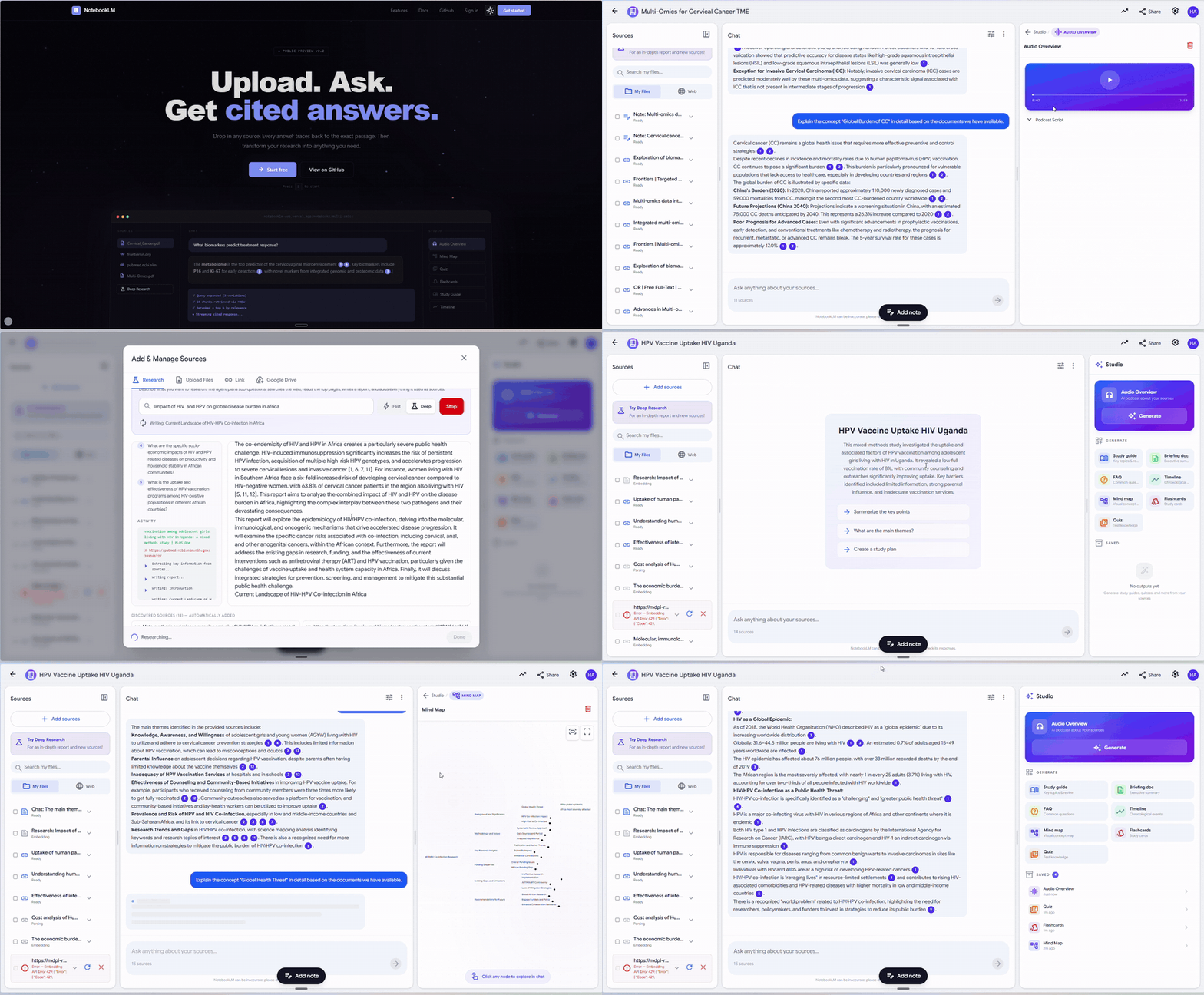
A 28-second tour at 25× speed. Drop in a PDF, chat with citations, run multi-round web research, generate a two-host audio overview, and walk a mind map of your sources.
What you get
- 📚 Drop in any source — PDF (URL or upload, with
%PDFmagic-byte routing), web link (Readability extraction), pasted text. Every source walks the same parse → chunk → embed → store pipe. - 💬 Chat with citations — three-stage retrieval (query expansion → hybrid pgvector + keyword → LLM rerank). Every claim cites the chunk it came from. Click a citation to jump to the source.
- 🔬 Deep research — multi-round web research with self-critique. The agent plans sub-questions aware of your existing notebook, fetches sources via Exa / Tavily / SearxNG, summarises, drafts section by section, scores its own quality, fills gaps in a second round, and cross-references every claim. Output saves as a new source you can chat with.
- 🧪 Studio outputs that research first (new in v0.3.0) — every studio kind (mind map, briefing doc, study guide, FAQ, timeline, flashcards, quiz, audio overview) generates from a citation-grounded research artifact via a six-phase pipeline (recon → plan → retrieve → synthesize → reflect → augment → assemble), cached per
(notebook fingerprint × chat model × user query). Phase progress streams live in the panel. - 🎙️ Two-voice audio overviews — Deepgram Aura on web, Kokoro local in a utility process on desktop. Scripted as a podcast conversation, rendered as MP3, fully offline-capable.
- 🧠 Eight studio kinds — mind maps (markmap, click-to-expand + shift-click-to-chat), flashcards, quizzes (with scoring), study guides, briefing docs, FAQs, timelines, audio overviews, and user-authored notes.
- 🔌 Thirteen AI providers — OpenAI, Anthropic, Google Gemini, Mistral, Cohere, Voyage, Groq, Ollama (self-hosted), OpenRouter, Together AI, xAI, any OpenAI-compatible endpoint, plus a bundled local provider that runs sentence-transformers via
@huggingface/transformerswith zero credentials. Switch per user, no code changes. - 🔐 Encrypted credentials — AES-GCM at rest with versioned keys and userId as AAD. Plaintext API keys never live in the database.
- 📐 Multi-dimensional embeddings — sibling tables for 384 / 768 / 1024 / 1536 / 3072 dims with HNSW cosine indexes. Switching embedding models is non-destructive; retrieval scopes to the user's current model.
- 📡 Streaming everywhere — SSE for deep research and audio overviews, AI SDK
streamTextfor chat, jsonb progress columns for tRPC-polled flows. Every phase the agent takes is a UI event. - 🖥️ Native desktop + hosted web from one codebase — same Hono server, tRPC routers, retrieval pipeline, and React components. Desktop swaps Neon Postgres for PGlite, S3 storage for local-FS, and adds utility-process workers for Kokoro TTS + local embeddings so ONNX work never blocks the window.
Why this project
Most "build a NotebookLM clone" tutorials ship a 200-line demo that breaks the moment you put it in front of a real user. This is the opposite — a real, shipped, opinionated implementation that you can study, fork, run yourself, or use as the substrate for your own product.
The full architectural breakdown — every chapter, every code path, every decision — is in the 45-page whitepaper. If you are building anything RAG-flavoured right now, that PDF is the cheat sheet.
⭐ If this is useful
- Star the repo — the cheapest signal that helps the project find more builders
- Fork it — clone it, run it, rip out what you do not need, ship your version
- Open issues — bug reports, feature requests, architectural feedback all welcome
- Send PRs — see the Contributing section below
- Share it — if you build something on top, link back so others can find your work
Quick start
You will need: Bun and either (a) an API key from at least one of the supported AI providers, or (b) Ollama / the bundled local provider if you want to stay fully offline.
git clone https://github.com/hallelx2/notebooklm-web.git
cd notebooklm-web
bun install
Desktop (recommended for trying it locally)
Native Electron shell with embedded PGlite, local-FS storage, Kokoro TTS, and local embeddings all running in-process. Zero external dependencies.
bun --filter @notebooklm/desktop dev
That spawns Vite on http://localhost:5173 and an Electron window pointed at it. First launch generates per-install encryption keys at ~/.notebooklm/config.json, creates the PGlite data dir, and walks you through onboarding (chat provider + embedding provider — the bundled local provider needs no key). See apps/desktop/README.md for keyboard shortcuts, data layout, and the SearxNG auto-start story.
Prefer prebuilt installers? Grab them from the latest release — Windows .exe, macOS .dmg (arm64), Linux .deb and .AppImage.
Web
Hosted Next.js app, Neon Postgres, S3-compatible storage. Same workbench, same retrieval, same studio kinds.
cp apps/web/.env.example apps/web/.env       # fill in DATABASE_URL, AUTH_SECRET, MASTER_KEY_V1
bun --filter @notebooklm/web db:push         # push the Drizzle schema + create pgvector extension
bun --filter @notebooklm/web db:hnsw         # create HNSW indexes on the embedding sibling tables
bun --filter @notebooklm/web dev             # http://localhost:3000
First-time signup walks you through picking a chat provider and an embedding provider in /settings. Drop in your API keys, pick your models, and start building notebooks.
Stack
| Layer | Tool | Notes |
|---|---|---|
| Monorepo | Bun workspaces | apps/{web,desktop} + packages/{core,server,ui} |
| Web framework | Next.js 16 | App Router, Route Handlers for streaming, Server Components |
| Desktop shell | Electron 33 | Single-instance lock, utility processes for ONNX, electron-builder installers |
| Server | Hono | Single Hono app mounted by Next.js (web) and Vite middleware (desktop dev) / esbuild bundle (desktop prod) |
| RPC | tRPC v11 | Notebooks, sources, studio, providers, AI config |
| Auth | Better Auth | Sessions, OAuth, email/password |
| Database | Drizzle + Neon Postgres (web) / PGlite (desktop) | Same schema, swappable behind PlatformAdapter |
| Vectors | pgvector × 5 sibling tables | 384 / 768 / 1024 / 1536 / 3072 dim, HNSW cosine indexes |
| AI Layer | AI SDK v6 | Uniform LanguageModel interface across 13 providers |
| TTS | Deepgram Aura (web) / Kokoro local in utility process (desktop) | Orion + Asteria voices, MP3 output, fully offline on desktop |
| Embeddings | Provider-chosen or bundled local (@huggingface/transformers sentence-transformer in utility process) | Zero-credential local fallback |
| Web search | Exa + Tavily + SearxNG | Two paid APIs and one OSS fallback. Pluggable order via SEARCH_PROVIDER_ORDER; desktop auto-starts SearxNG via Docker if available. |
| Web extract | @mozilla/readability + %PDF magic-byte sniffing | Routes PDF URLs to unpdf (pdfjs) so academic CDNs work |
| PDF parsing | unpdf | pdfjs-based, with Promise.try polyfill for Node 22 |
| Storage | S3 / R2 / Supabase (web) / local-FS (desktop) | Pluggable behind StorageService |
| Mind maps | markmap-lib | Markdown headings → interactive SVG, shift-click to chat about a node |
| UI | React 19 + Tailwind v4 | Three-pane workbench, modal viewers per studio kind, vertical AppDock on desktop |
Architecture at a glance
Renderer (web or desktop)             Hono server                          packages/core

Workbench UI               →          /api/chat (streamText)        →      retrieve.ts         →   13 LLM providers
sources · chat · studio    →          /api/deep-research (SSE)      →      ingest/             →   Kokoro / Deepgram
                                      /api/studio/audio (SSE)       →      notebook-research/  →   PGlite / Neon
                                      tRPC: notebook · source ·     →      ai/factory          →       + pgvector ×5
                                            studio · provider ·            agent/runtimes/
                                            aiConfig · message
The same Hono app, tRPC routers, retrieval pipeline, and React components run in both apps. The web app mounts Hono via Next.js route handlers; the desktop app mounts it via Vite middleware in dev and an esbuild bundle in prod. Behaviour is identical because the only thing that differs is the PlatformAdapter (DB + storage + auth).
Read the whitepaper for the original four-day build's deep dive — sixteen chapters, ~45 pages, every decision explained. The whitepaper covers the pre-monorepo v0.1.x version; the current code has since moved into the workspace layout below.
Project layout
apps/
  web/                            # Next.js 16 hosted app
    src/app/                      # App Router routes, Route Handlers wrap the Hono app
    .env.example
    drizzle.config.ts
  desktop/                        # Electron shell
    electron/                     # Main process, preload, menu, worker RPC factory
    src/                          # Renderer + TanStack Router + dev-mode Vite middleware
    scripts/                      # Build scripts (api-server bundle, icon, model fetch)
    build/                        # icon source + rendered assets

packages/
  core/                           # Pure logic, no Hono / no Next / no Electron
    src/
      retrieve.ts                 # Three-stage retrieval (expand → vector+keyword → rerank)
      notebook-research.ts        # v0.3.0 — six-phase studio research pipeline
      notebook-text.ts            # Full-doc source assembly + kind-aware summarisation
      ingest/                     # parse · chunk · embed · store
      agent/                      # Agent harness + runtimes (AI SDK adapter, prompts)
      ai/                         # Provider registry + per-user chat/embed factory
      tts/                        # Kokoro local + Deepgram adapters
      storage/                    # S3 / R2 / Supabase / local-FS adapters
      crypto/                     # AES-GCM encrypted credentials
      db/schema.ts                # Drizzle schema, fully portable across web/desktop
  server/                         # The Hono app + tRPC routers + handlers (chat, deep-research, studio, upload)
  ui/                             # Shared React components and views

docs/
  AGENT-HARNESS.md                # Technical vision for pluggable agent runtimes
  ACTIAN-INTEGRATION.md           # Alt-database integration notes
  demo/                           # Demo GIF, MP4, whitepaper PDF

docker/searxng/                   # Docker Compose stack for self-hosted SearxNG
Configuration
Web (apps/web/.env)
Minimum for local dev:
DATABASE_URL="postgres://..."             # Neon, Supabase, or any Postgres with pgvector
AUTH_SECRET="..."                          # 32+ random bytes; openssl rand -base64 32
MASTER_KEY_V1="..."                        # 32 bytes for AES-GCM credential encryption
NEXT_PUBLIC_APP_URL="http://localhost:3000"
Optional but useful:
DEEPGRAM_API_KEY="..."                          # Required for audio overviews on web
EXA_API_KEY="..."                               # Paid; deep-research web search
TAVILY_API_KEY="..."                            # Paid; fallback web search
SEARXNG_URL="http://localhost:8080"             # OSS; self-hosted SearxNG instance
SEARCH_PROVIDER_ORDER="exa,tavily,searxng"      # Comma-separated priority order
SUPABASE_URL="..."                              # If using Supabase Storage
SUPABASE_SERVICE_ROLE_KEY="..."
S3_*                                            # If using S3 / R2 instead
Desktop
Most env vars auto-generated on first launch and persisted to ~/.notebooklm/config.json (mode 0600). See apps/desktop/README.md for the full list — including NOTEBOOKLM_DATA_DIR (override the per-install dir), NOTEBOOKLM_SEARXNG_AUTOSTART, and NOTEBOOKLM_ENABLE_CLAUDE_AGENT_SDK.
User AI provider API keys are not environment variables — users add them through the in-app settings UI per-user, encrypted at rest with the per-install master key.
Self-hosting SearxNG
SearxNG aggregates Google / Bing / DuckDuckGo / Wikipedia behind one JSON API and is the OSS option that lets users run deep-research without paid keys. A ready-to-run Docker setup lives at docker/searxng/:
cd docker/searxng
export SEARXNG_PORT=8888
export SEARXNG_SECRET=$(openssl rand -hex 32)
docker compose up -d

# point the app at it
export SEARXNG_URL=http://localhost:${SEARXNG_PORT}
The desktop app auto-starts the same compose stack on first launch when Docker is available — no setup needed beyond installing Docker Desktop. See docker/searxng/README.md for details, tear-down, and tuning.
Public instances (e.g. https://searx.be) work for testing but rate-limit unpredictably — self-host for production. Full SearxNG reference: https://docs.searxng.org/admin/installation.html
Development
bun --filter @notebooklm/web dev            # Web app on http://localhost:3000
bun --filter @notebooklm/desktop dev        # Desktop app, Vite on :5173 + Electron window
bun --filter @notebooklm/web db:push        # Push Drizzle schema changes (web only — desktop uses stub-adapter)
bun --filter @notebooklm/web db:hnsw        # Create HNSW indexes (idempotent)
bun --filter @notebooklm/web db:reembed     # Backfill embeddings under a different model
bun --filter @notebooklm/web build          # Production build
bun --filter @notebooklm/desktop build      # Renderer only
bun --filter @notebooklm/desktop build:electron  # Full packaged binary -> apps/desktop/release/
bun run lint                                # Biome lint (workspace-wide)
bun run format                              # Biome format
bun run typecheck                           # tsc --noEmit per package
Deploy
Web — built for Vercel. Push to a connected GitHub repo, set env vars in the Vercel dashboard, deploy. Streaming routes use maxDuration: 300 to fit deep-research and audio-generation runs comfortably under the function timeout. Self-hosting works anywhere Node 22+ runs — Docker, Render, Fly, your own VM. The only hard requirement is a Postgres with pgvector enabled.
Desktop — GitHub Actions release-desktop workflow triggers on tag pushes and produces installers for Windows (NSIS .exe), macOS (.dmg arm64), and Linux (.deb + .AppImage). Tag a release locally with git tag v0.3.x && git push origin v0.3.x and the workflow builds and attaches installers to the corresponding GitHub release. Auto-updates handled via electron-updater reading the latest*.yml manifests.
What just shipped (v0.3.0, May 2026)
The most recent release is v0.3.0 — Studio outputs that research before they write. Every studio kind now generates from a citation-grounded research artifact via a six-phase pipeline (recon → plan → retrieve → synthesize → reflect → augment → assemble), cached per (notebook fingerprint × chat model × user query), with live phase streaming into the panel.
Full per-version history is in CHANGELOG.md. Each entry links to its GitHub release for full notes and installers.
Roadmap
Companion documents:
CHANGELOG.md— every release this project has shippedROADMAP.md— phases ahead and what just landedCONTRIBUTING.md— how to land a useful PRdocs/AGENT-HARNESS.md— the technical vision for pluggable agent runtimes
Recently delivered:
- ✅ Bun workspace migration (May 3, PR #1) — Phase 1 done. Repo is now
apps/{web,desktop}+packages/{core,server,ui}. - ✅ Local desktop app (v0.1.x → v0.2.x, May 5–8) — Phase 2 done. Electron shell, PGlite embedded Postgres, Kokoro TTS + local embeddings in utility processes, SearxNG auto-start, installer pipelines for Win/macOS/Linux.
- ✅ Notebook research pipeline for studio outputs (v0.3.0, May 11) — Citation-grounded multi-phase research; partial delivery on the Phase 3 agent harness.
What's next: see ROADMAP.md for the current phase plan. The remaining headline directions are the pluggable agent harness (Claude Agent SDK, OpenAI Agents SDK, Copilot Agent SDK runtimes selectable per task), marketplace and extensions (third-party studio kinds, source-kind plugins, MCP server mode), and collaborative + mobile surfaces.
Contributing
Yes please. The contributions I am most excited to see now that the foundation has shipped:
- 🤖 Agent harness adapters. Claude Agent SDK, OpenAI Agents SDK, Copilot Agent SDK — sit alongside the AI SDK runtime in
packages/core/src/agent/runtimes/, selectable per task. Seedocs/AGENT-HARNESS.md. - 🧠 More local model integrations. Better Ollama UX (auto-detect installed models, one-click pull). Native llama.cpp bindings. GGUF embedding adapters.
- 🗣️ More local TTS adapters. Piper, Coqui XTTS — same interface as the Kokoro adapter, drop-in for audio overviews.
- 🎨 More studio output kinds. One prompt file + one render function in
renderArtifactForKind. Anki export, Mermaid diagrams, podcasts in other languages, custom report templates. - 🔌 More AI providers (the registry is one file:
packages/core/src/ai/providers.ts). - 🔎 More source kinds — Notion, Drive, Linear, GitHub repos, RSS, email.
- 📐 More embedding-dim sibling tables (384/768/1024/1536/3072 today; 2048 and 4096 are interesting).
- 🌐 More web-search providers — Brave, Kagi, DuckDuckGo. Behind the same
SearchProviderinterface as Exa / Tavily / SearxNG. - 🐛 Bug fixes, docs, tests, accessibility improvements.
For non-trivial changes — especially the agent harness and marketplace — open an issue first so we can talk through the shape before you spend hours on it. See CONTRIBUTING.md for the development workflow, commit conventions, and PR checklist.
License
MIT. See LICENSE. Use it, fork it, ship it, charge for it. If you build something cool, I would love to hear about it.
Credits
Built by Halleluyah Darasimi Oludele. The original web version landed in four days (2026-04-21 → 2026-04-24) and is documented in Field Notes Issue 01 — the 45-page whitepaper in this repo. Since then the project has shipped a Bun-workspace monorepo, a native Electron desktop app with offline-capable retrieval + TTS + embeddings, and a multi-phase notebook research pipeline driving every studio output (see CHANGELOG.md).
Contributors

136 commits
Similar repos


Languages
TypeScript
83.7%
HTML
7.2%
JavaScript
6.6%
CSS
2.6%
Open-source, self-hostable, local-first NotebookLM — hybrid retrieval, deep research, two-voice audio overviews, mind maps and quizzes.
4
stars
136
commits
TypeScript
primary language
May 14, 2026
updated
README
notebooklm-web
An open-source, self-hostable, local-first NotebookLM. Ships as a hosted web app and a native desktop app from one Bun monorepo.
Three-stage hybrid retrieval. Self-critiquing deep research. Two-voice audio overviews. Mind maps, flashcards, quizzes, study guides. Studio outputs that research the notebook before they write. Thirteen AI providers with encrypted credentials. One web app + one desktop app, one shared core.
A 28-second tour at 25× speed. Drop in a PDF, chat with citations, run multi-round web research, generate a two-host audio overview, and walk a mind map of your sources.
What you get
- 📚 Drop in any source — PDF (URL or upload, with
%PDFmagic-byte routing), web link (Readability extraction), pasted text. Every source walks the same parse → chunk → embed → store pipe. - 💬 Chat with citations — three-stage retrieval (query expansion → hybrid pgvector + keyword → LLM rerank). Every claim cites the chunk it came from. Click a citation to jump to the source.
- 🔬 Deep research — multi-round web research with self-critique. The agent plans sub-questions aware of your existing notebook, fetches sources via Exa / Tavily / SearxNG, summarises, drafts section by section, scores its own quality, fills gaps in a second round, and cross-references every claim. Output saves as a new source you can chat with.
- 🧪 Studio outputs that research first (new in v0.3.0) — every studio kind (mind map, briefing doc, study guide, FAQ, timeline, flashcards, quiz, audio overview) generates from a citation-grounded research artifact via a six-phase pipeline (recon → plan → retrieve → synthesize → reflect → augment → assemble), cached per
(notebook fingerprint × chat model × user query). Phase progress streams live in the panel. - 🎙️ Two-voice audio overviews — Deepgram Aura on web, Kokoro local in a utility process on desktop. Scripted as a podcast conversation, rendered as MP3, fully offline-capable.
- 🧠 Eight studio kinds — mind maps (markmap, click-to-expand + shift-click-to-chat), flashcards, quizzes (with scoring), study guides, briefing docs, FAQs, timelines, audio overviews, and user-authored notes.
- 🔌 Thirteen AI providers — OpenAI, Anthropic, Google Gemini, Mistral, Cohere, Voyage, Groq, Ollama (self-hosted), OpenRouter, Together AI, xAI, any OpenAI-compatible endpoint, plus a bundled local provider that runs sentence-transformers via
@huggingface/transformerswith zero credentials. Switch per user, no code changes. - 🔐 Encrypted credentials — AES-GCM at rest with versioned keys and userId as AAD. Plaintext API keys never live in the database.
- 📐 Multi-dimensional embeddings — sibling tables for 384 / 768 / 1024 / 1536 / 3072 dims with HNSW cosine indexes. Switching embedding models is non-destructive; retrieval scopes to the user's current model.
- 📡 Streaming everywhere — SSE for deep research and audio overviews, AI SDK
streamTextfor chat, jsonb progress columns for tRPC-polled flows. Every phase the agent takes is a UI event. - 🖥️ Native desktop + hosted web from one codebase — same Hono server, tRPC routers, retrieval pipeline, and React components. Desktop swaps Neon Postgres for PGlite, S3 storage for local-FS, and adds utility-process workers for Kokoro TTS + local embeddings so ONNX work never blocks the window.
Why this project
Most "build a NotebookLM clone" tutorials ship a 200-line demo that breaks the moment you put it in front of a real user. This is the opposite — a real, shipped, opinionated implementation that you can study, fork, run yourself, or use as the substrate for your own product.
The full architectural breakdown — every chapter, every code path, every decision — is in the 45-page whitepaper. If you are building anything RAG-flavoured right now, that PDF is the cheat sheet.
⭐ If this is useful
- Star the repo — the cheapest signal that helps the project find more builders
- Fork it — clone it, run it, rip out what you do not need, ship your version
- Open issues — bug reports, feature requests, architectural feedback all welcome
- Send PRs — see the Contributing section below
- Share it — if you build something on top, link back so others can find your work
Quick start
You will need: Bun and either (a) an API key from at least one of the supported AI providers, or (b) Ollama / the bundled local provider if you want to stay fully offline.
git clone https://github.com/hallelx2/notebooklm-web.git
cd notebooklm-web
bun install
Desktop (recommended for trying it locally)
Native Electron shell with embedded PGlite, local-FS storage, Kokoro TTS, and local embeddings all running in-process. Zero external dependencies.
bun --filter @notebooklm/desktop dev
That spawns Vite on http://localhost:5173 and an Electron window pointed at it. First launch generates per-install encryption keys at ~/.notebooklm/config.json, creates the PGlite data dir, and walks you through onboarding (chat provider + embedding provider — the bundled local provider needs no key). See apps/desktop/README.md for keyboard shortcuts, data layout, and the SearxNG auto-start story.
Prefer prebuilt installers? Grab them from the latest release — Windows .exe, macOS .dmg (arm64), Linux .deb and .AppImage.
Web
Hosted Next.js app, Neon Postgres, S3-compatible storage. Same workbench, same retrieval, same studio kinds.
cp apps/web/.env.example apps/web/.env       # fill in DATABASE_URL, AUTH_SECRET, MASTER_KEY_V1
bun --filter @notebooklm/web db:push         # push the Drizzle schema + create pgvector extension
bun --filter @notebooklm/web db:hnsw         # create HNSW indexes on the embedding sibling tables
bun --filter @notebooklm/web dev             # http://localhost:3000
First-time signup walks you through picking a chat provider and an embedding provider in /settings. Drop in your API keys, pick your models, and start building notebooks.
Stack
| Layer | Tool | Notes |
|---|---|---|
| Monorepo | Bun workspaces | apps/{web,desktop} + packages/{core,server,ui} |
| Web framework | Next.js 16 | App Router, Route Handlers for streaming, Server Components |
| Desktop shell | Electron 33 | Single-instance lock, utility processes for ONNX, electron-builder installers |
| Server | Hono | Single Hono app mounted by Next.js (web) and Vite middleware (desktop dev) / esbuild bundle (desktop prod) |
| RPC | tRPC v11 | Notebooks, sources, studio, providers, AI config |
| Auth | Better Auth | Sessions, OAuth, email/password |
| Database | Drizzle + Neon Postgres (web) / PGlite (desktop) | Same schema, swappable behind PlatformAdapter |
| Vectors | pgvector × 5 sibling tables | 384 / 768 / 1024 / 1536 / 3072 dim, HNSW cosine indexes |
| AI Layer | AI SDK v6 | Uniform LanguageModel interface across 13 providers |
| TTS | Deepgram Aura (web) / Kokoro local in utility process (desktop) | Orion + Asteria voices, MP3 output, fully offline on desktop |
| Embeddings | Provider-chosen or bundled local (@huggingface/transformers sentence-transformer in utility process) | Zero-credential local fallback |
| Web search | Exa + Tavily + SearxNG | Two paid APIs and one OSS fallback. Pluggable order via SEARCH_PROVIDER_ORDER; desktop auto-starts SearxNG via Docker if available. |
| Web extract | @mozilla/readability + %PDF magic-byte sniffing | Routes PDF URLs to unpdf (pdfjs) so academic CDNs work |
| PDF parsing | unpdf | pdfjs-based, with Promise.try polyfill for Node 22 |
| Storage | S3 / R2 / Supabase (web) / local-FS (desktop) | Pluggable behind StorageService |
| Mind maps | markmap-lib | Markdown headings → interactive SVG, shift-click to chat about a node |
| UI | React 19 + Tailwind v4 | Three-pane workbench, modal viewers per studio kind, vertical AppDock on desktop |
Architecture at a glance
Renderer (web or desktop)             Hono server                          packages/core

Workbench UI               →          /api/chat (streamText)        →      retrieve.ts         →   13 LLM providers
sources · chat · studio    →          /api/deep-research (SSE)      →      ingest/             →   Kokoro / Deepgram
                                      /api/studio/audio (SSE)       →      notebook-research/  →   PGlite / Neon
                                      tRPC: notebook · source ·     →      ai/factory          →       + pgvector ×5
                                            studio · provider ·            agent/runtimes/
                                            aiConfig · message
The same Hono app, tRPC routers, retrieval pipeline, and React components run in both apps. The web app mounts Hono via Next.js route handlers; the desktop app mounts it via Vite middleware in dev and an esbuild bundle in prod. Behaviour is identical because the only thing that differs is the PlatformAdapter (DB + storage + auth).
Read the whitepaper for the original four-day build's deep dive — sixteen chapters, ~45 pages, every decision explained. The whitepaper covers the pre-monorepo v0.1.x version; the current code has since moved into the workspace layout below.
Project layout
apps/
  web/                            # Next.js 16 hosted app
    src/app/                      # App Router routes, Route Handlers wrap the Hono app
    .env.example
    drizzle.config.ts
  desktop/                        # Electron shell
    electron/                     # Main process, preload, menu, worker RPC factory
    src/                          # Renderer + TanStack Router + dev-mode Vite middleware
    scripts/                      # Build scripts (api-server bundle, icon, model fetch)
    build/                        # icon source + rendered assets

packages/
  core/                           # Pure logic, no Hono / no Next / no Electron
    src/
      retrieve.ts                 # Three-stage retrieval (expand → vector+keyword → rerank)
      notebook-research.ts        # v0.3.0 — six-phase studio research pipeline
      notebook-text.ts            # Full-doc source assembly + kind-aware summarisation
      ingest/                     # parse · chunk · embed · store
      agent/                      # Agent harness + runtimes (AI SDK adapter, prompts)
      ai/                         # Provider registry + per-user chat/embed factory
      tts/                        # Kokoro local + Deepgram adapters
      storage/                    # S3 / R2 / Supabase / local-FS adapters
      crypto/                     # AES-GCM encrypted credentials
      db/schema.ts                # Drizzle schema, fully portable across web/desktop
  server/                         # The Hono app + tRPC routers + handlers (chat, deep-research, studio, upload)
  ui/                             # Shared React components and views

docs/
  AGENT-HARNESS.md                # Technical vision for pluggable agent runtimes
  ACTIAN-INTEGRATION.md           # Alt-database integration notes
  demo/                           # Demo GIF, MP4, whitepaper PDF

docker/searxng/                   # Docker Compose stack for self-hosted SearxNG
Configuration
Web (apps/web/.env)
Minimum for local dev:
DATABASE_URL="postgres://..."             # Neon, Supabase, or any Postgres with pgvector
AUTH_SECRET="..."                          # 32+ random bytes; openssl rand -base64 32
MASTER_KEY_V1="..."                        # 32 bytes for AES-GCM credential encryption
NEXT_PUBLIC_APP_URL="http://localhost:3000"
Optional but useful:
DEEPGRAM_API_KEY="..."                          # Required for audio overviews on web
EXA_API_KEY="..."                               # Paid; deep-research web search
TAVILY_API_KEY="..."                            # Paid; fallback web search
SEARXNG_URL="http://localhost:8080"             # OSS; self-hosted SearxNG instance
SEARCH_PROVIDER_ORDER="exa,tavily,searxng"      # Comma-separated priority order
SUPABASE_URL="..."                              # If using Supabase Storage
SUPABASE_SERVICE_ROLE_KEY="..."
S3_*                                            # If using S3 / R2 instead
Desktop
Most env vars auto-generated on first launch and persisted to ~/.notebooklm/config.json (mode 0600). See apps/desktop/README.md for the full list — including NOTEBOOKLM_DATA_DIR (override the per-install dir), NOTEBOOKLM_SEARXNG_AUTOSTART, and NOTEBOOKLM_ENABLE_CLAUDE_AGENT_SDK.
User AI provider API keys are not environment variables — users add them through the in-app settings UI per-user, encrypted at rest with the per-install master key.
Self-hosting SearxNG
SearxNG aggregates Google / Bing / DuckDuckGo / Wikipedia behind one JSON API and is the OSS option that lets users run deep-research without paid keys. A ready-to-run Docker setup lives at docker/searxng/:
cd docker/searxng
export SEARXNG_PORT=8888
export SEARXNG_SECRET=$(openssl rand -hex 32)
docker compose up -d

# point the app at it
export SEARXNG_URL=http://localhost:${SEARXNG_PORT}
The desktop app auto-starts the same compose stack on first launch when Docker is available — no setup needed beyond installing Docker Desktop. See docker/searxng/README.md for details, tear-down, and tuning.
Public instances (e.g. https://searx.be) work for testing but rate-limit unpredictably — self-host for production. Full SearxNG reference: https://docs.searxng.org/admin/installation.html
Development
bun --filter @notebooklm/web dev            # Web app on http://localhost:3000
bun --filter @notebooklm/desktop dev        # Desktop app, Vite on :5173 + Electron window
bun --filter @notebooklm/web db:push        # Push Drizzle schema changes (web only — desktop uses stub-adapter)
bun --filter @notebooklm/web db:hnsw        # Create HNSW indexes (idempotent)
bun --filter @notebooklm/web db:reembed     # Backfill embeddings under a different model
bun --filter @notebooklm/web build          # Production build
bun --filter @notebooklm/desktop build      # Renderer only
bun --filter @notebooklm/desktop build:electron  # Full packaged binary -> apps/desktop/release/
bun run lint                                # Biome lint (workspace-wide)
bun run format                              # Biome format
bun run typecheck                           # tsc --noEmit per package
Deploy
Web — built for Vercel. Push to a connected GitHub repo, set env vars in the Vercel dashboard, deploy. Streaming routes use maxDuration: 300 to fit deep-research and audio-generation runs comfortably under the function timeout. Self-hosting works anywhere Node 22+ runs — Docker, Render, Fly, your own VM. The only hard requirement is a Postgres with pgvector enabled.
Desktop — GitHub Actions release-desktop workflow triggers on tag pushes and produces installers for Windows (NSIS .exe), macOS (.dmg arm64), and Linux (.deb + .AppImage). Tag a release locally with git tag v0.3.x && git push origin v0.3.x and the workflow builds and attaches installers to the corresponding GitHub release. Auto-updates handled via electron-updater reading the latest*.yml manifests.
What just shipped (v0.3.0, May 2026)
The most recent release is v0.3.0 — Studio outputs that research before they write. Every studio kind now generates from a citation-grounded research artifact via a six-phase pipeline (recon → plan → retrieve → synthesize → reflect → augment → assemble), cached per (notebook fingerprint × chat model × user query), with live phase streaming into the panel.
Full per-version history is in CHANGELOG.md. Each entry links to its GitHub release for full notes and installers.
Roadmap
Companion documents:
CHANGELOG.md— every release this project has shippedROADMAP.md— phases ahead and what just landedCONTRIBUTING.md— how to land a useful PRdocs/AGENT-HARNESS.md— the technical vision for pluggable agent runtimes
Recently delivered:
- ✅ Bun workspace migration (May 3, PR #1) — Phase 1 done. Repo is now
apps/{web,desktop}+packages/{core,server,ui}. - ✅ Local desktop app (v0.1.x → v0.2.x, May 5–8) — Phase 2 done. Electron shell, PGlite embedded Postgres, Kokoro TTS + local embeddings in utility processes, SearxNG auto-start, installer pipelines for Win/macOS/Linux.
- ✅ Notebook research pipeline for studio outputs (v0.3.0, May 11) — Citation-grounded multi-phase research; partial delivery on the Phase 3 agent harness.
What's next: see ROADMAP.md for the current phase plan. The remaining headline directions are the pluggable agent harness (Claude Agent SDK, OpenAI Agents SDK, Copilot Agent SDK runtimes selectable per task), marketplace and extensions (third-party studio kinds, source-kind plugins, MCP server mode), and collaborative + mobile surfaces.
Contributing
Yes please. The contributions I am most excited to see now that the foundation has shipped:
- 🤖 Agent harness adapters. Claude Agent SDK, OpenAI Agents SDK, Copilot Agent SDK — sit alongside the AI SDK runtime in
packages/core/src/agent/runtimes/, selectable per task. Seedocs/AGENT-HARNESS.md. - 🧠 More local model integrations. Better Ollama UX (auto-detect installed models, one-click pull). Native llama.cpp bindings. GGUF embedding adapters.
- 🗣️ More local TTS adapters. Piper, Coqui XTTS — same interface as the Kokoro adapter, drop-in for audio overviews.
- 🎨 More studio output kinds. One prompt file + one render function in
renderArtifactForKind. Anki export, Mermaid diagrams, podcasts in other languages, custom report templates. - 🔌 More AI providers (the registry is one file:
packages/core/src/ai/providers.ts). - 🔎 More source kinds — Notion, Drive, Linear, GitHub repos, RSS, email.
- 📐 More embedding-dim sibling tables (384/768/1024/1536/3072 today; 2048 and 4096 are interesting).
- 🌐 More web-search providers — Brave, Kagi, DuckDuckGo. Behind the same
SearchProviderinterface as Exa / Tavily / SearxNG. - 🐛 Bug fixes, docs, tests, accessibility improvements.
For non-trivial changes — especially the agent harness and marketplace — open an issue first so we can talk through the shape before you spend hours on it. See CONTRIBUTING.md for the development workflow, commit conventions, and PR checklist.
License
MIT. See LICENSE. Use it, fork it, ship it, charge for it. If you build something cool, I would love to hear about it.
Credits
Built by Halleluyah Darasimi Oludele. The original web version landed in four days (2026-04-21 → 2026-04-24) and is documented in Field Notes Issue 01 — the 45-page whitepaper in this repo. Since then the project has shipped a Bun-workspace monorepo, a native Electron desktop app with offline-capable retrieval + TTS + embeddings, and a multi-phase notebook research pipeline driving every studio output (see CHANGELOG.md).
Similar repos
Contributors
136 commits
Languages
TypeScript
83.7%
HTML
7.2%
JavaScript
6.6%
CSS
2.6%