
Cross-Platform Production-ready C++ inference engine for YOLO models (v5-v12, YOLO26). Unified API for detection, segmentation, pose estimation, OBB, and classification. Built on ONNX Runtime and OpenCV. Optimized for CPU/GPU with quantization support.
See the codeREADME

YOLOs-CPP
Production-Ready YOLO Inference Engine for C++
A blazing-fast, unified C++ inference library for the entire YOLO family




Quick Start · Features · Models · API · Benchmarks · Docs
📰 Latest News
- [2026.08.23] Released ros2_yolos_trt, a ROS 2 TensorRT inference package achieving sub-2 ms inference latency.
- [2026.08.02] Released v1.1.0 with depth estimation, batch inference, in-memory model loading, and Ultralytics parity improvements. See the release notes.
- [2026.08.02] Added monocular metric depth estimation for YOLO26 via
yolos::depth::YOLODepthEstimatorand theimage_depth_inferenceexample. - [2026.08.02] Added batch inference with
batchDetect,batchSegment, andbatchClassify, plus in-memory model loading across all supported tasks. - [2026.04.11] Added YOLOE open-vocabulary detection and segmentation in C++. See the Model Guide and the
image_yoloe_seg/video_yoloe_segexamples. - [2026.01.22] Released YOLOs-CPP-TensorRT, achieving 530+ FPS on NVIDIA GPUs and Jetson platforms.
- [2026.01.22] Released motcpp, a C++ implementation of popular multi-object tracking (MOT) algorithms.
- [2026.01.22] Released the ros2_yolos_cpp ROS 2 integration package.
- [2026.01.18] Released production-ready v1.0.0. Watch the demo.
- [2025.05.15] Added image classification support.
- [2025.04.04] Released Depths-CPP, a new project for real-time metric depth estimation.
- [2025.03.16] Added pose estimation support.
- [2025.02.19] Added YOLOv12 object detection support.
- [2025.02.11] Added oriented bounding box (OBB) support.
- [2025.01.29] Added YOLOv9 object detection support.
- [2025.01.26] Added YOLOv9 segmentation support.
- [2025.01.26] Added segmentation support for YOLOv8 and YOLO11, including quantized models.
- [2024.10.23] Released v0.0.1, the initial YOLOs-CPP release with object detection support.
Why YOLOs-CPP?
YOLOs-CPP is a production-grade inference engine that brings the entire YOLO ecosystem to C++. Unlike scattered implementations, YOLOs-CPP provides a unified, consistent API across all YOLO versions and tasks.
#include "yolos/yolos.hpp"

// One API for all YOLO versions and tasks
auto detector = yolos::det::YOLODetector("yolo11n.onnx", "coco.names");
auto detections = detector.detect(frame);
The Problem
- Fragmented ecosystem: Each YOLO version has different C++ implementations
- Inconsistent APIs: Different interfaces for detection, segmentation, pose
- Production gaps: Most implementations lack proper error handling, testing, and optimization
The Solution
YOLOs-CPP unifies everything under one roof:
| What You Get | Description |
|---|---|
| Unified API | Same interface for YOLOv5 through YOLO26 |
| All Tasks | Detection, Segmentation, Pose, OBB, Classification, Depth, YOLOE open-vocabulary |
| Battle-Tested | 50 Ultralytics-parity tests + 57 self-contained tests, CI/CD pipeline |
| Optimized | Zero-copy preprocessing, batched NMS, GPU acceleration |
| Batch Inference | batchDetect / batchSegment / batchClassify in one ONNX call, with fallback |
| Flexible Loading | Models from a file path or straight from memory (encrypted stores, network streams, embedded resources) |
| Cross-Platform | Linux, Windows, macOS, Docker |
🎬 Demo
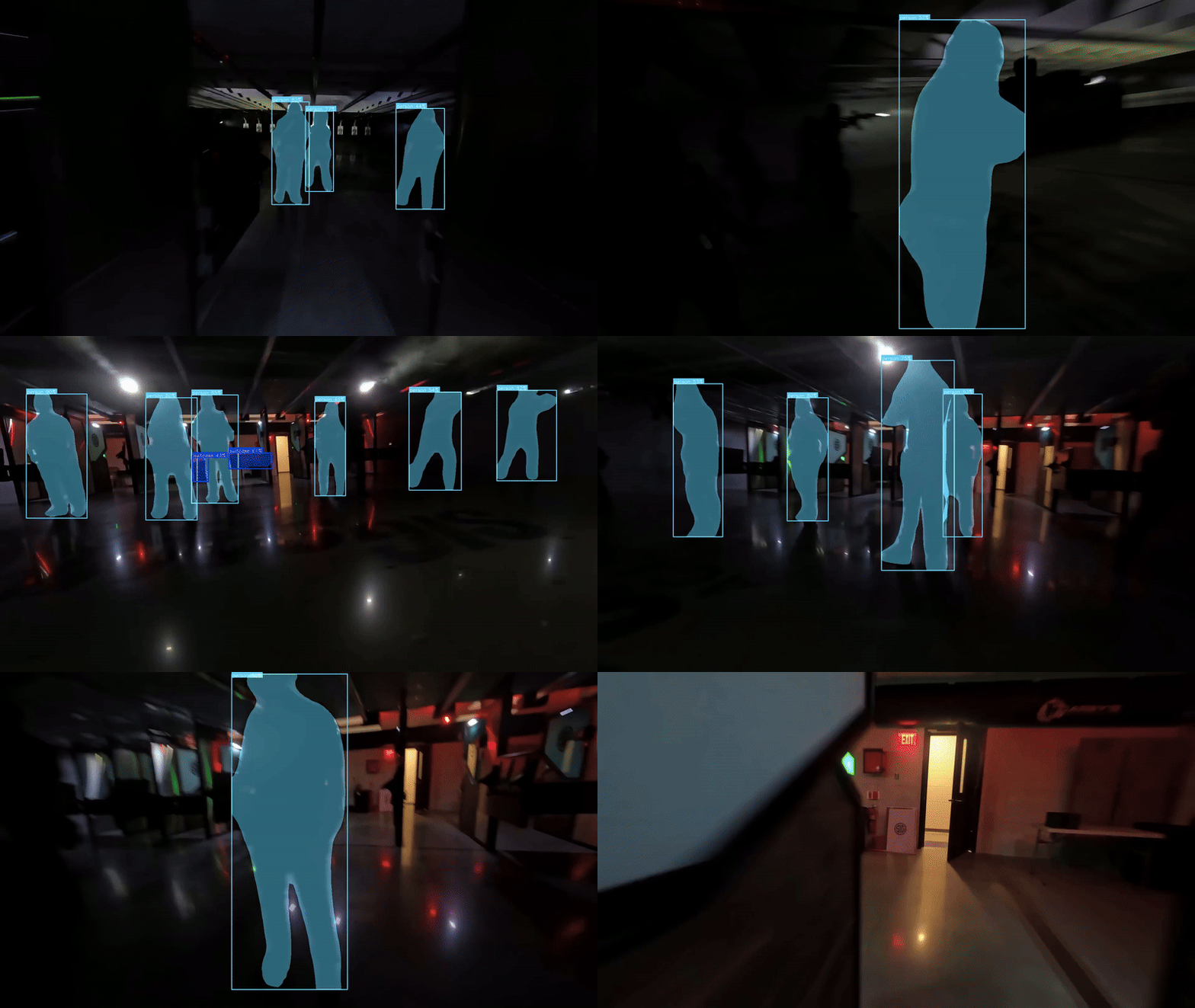
Instance Segmentation |
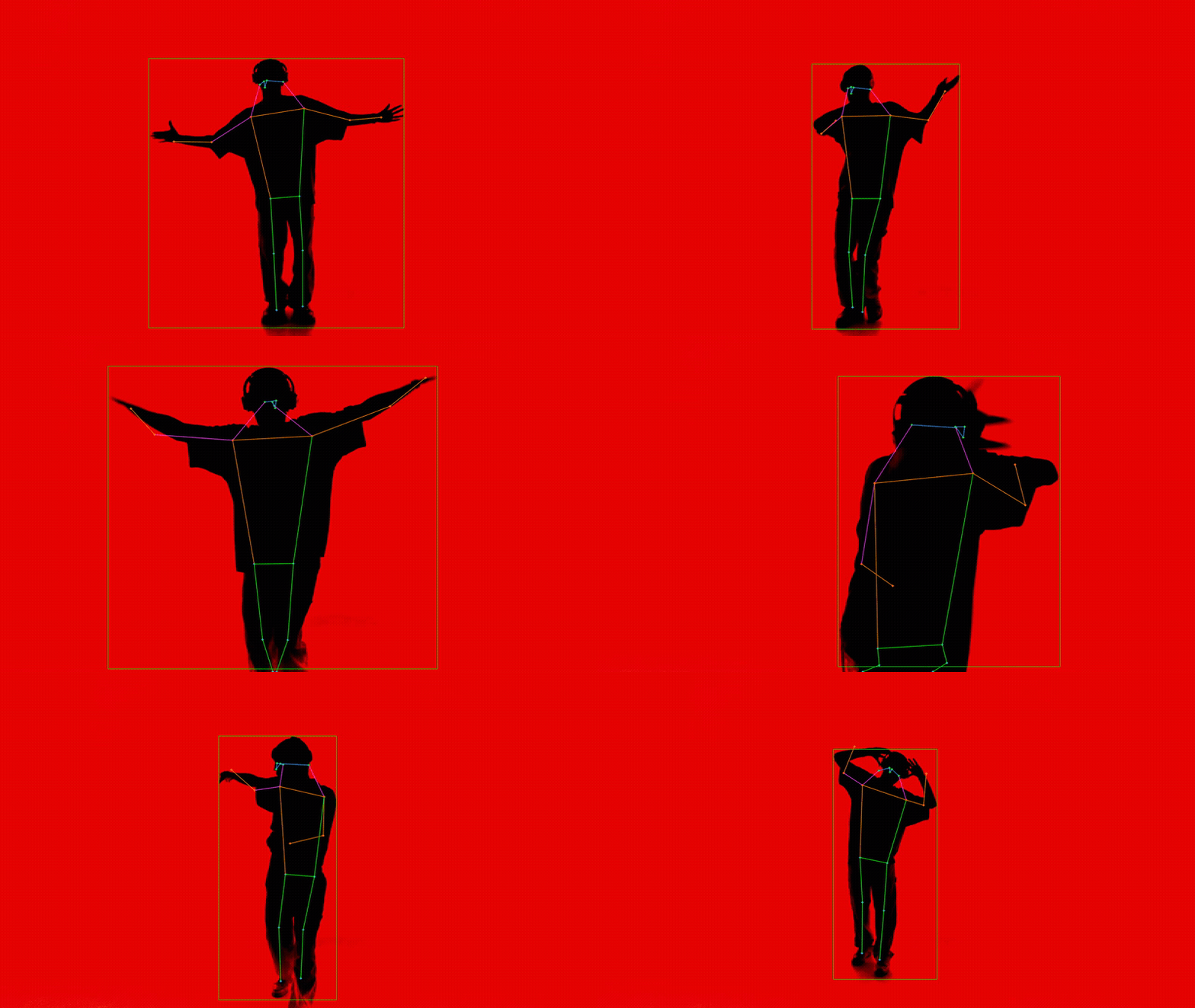
Pose Estimation |
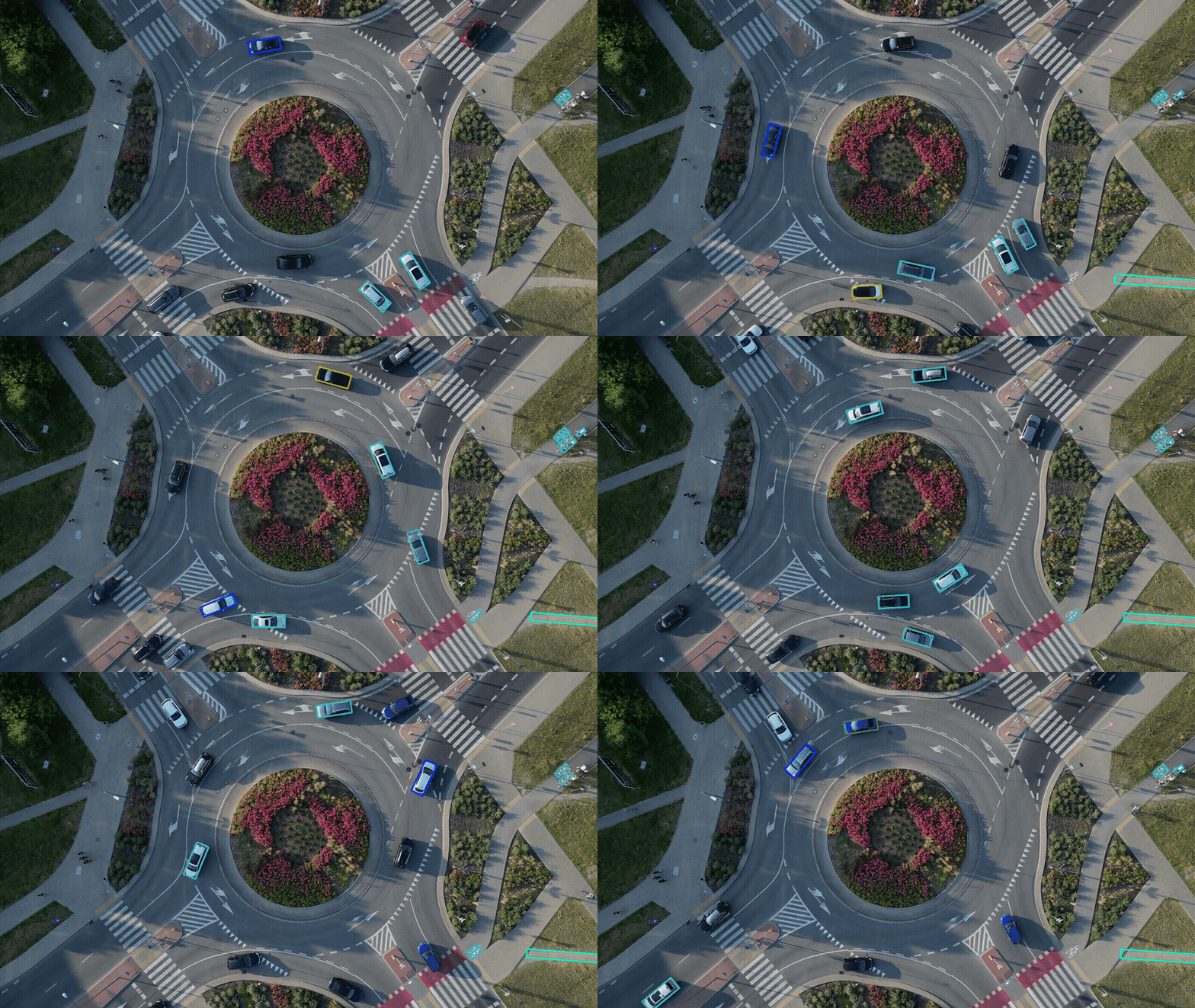
Real-time Detection |
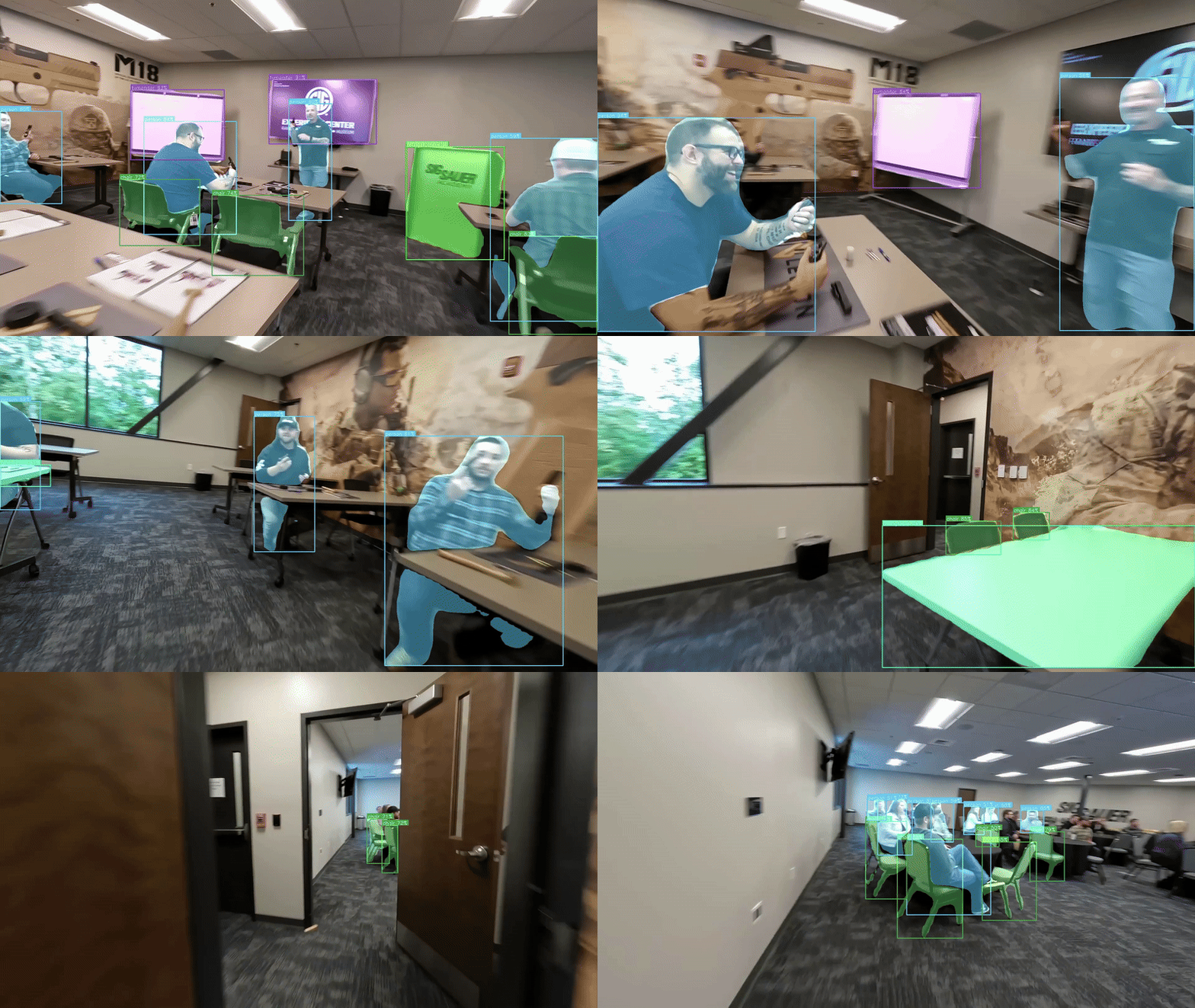
Multi-Object Detection |
⚡ Quick Start
Prerequisites
| Requirement | Version | Notes |
|---|---|---|
| C++ Compiler | C++17 | GCC 9+, Clang 10+, MSVC 2019+ |
| CMake | ≥ 3.16 | |
| OpenCV | ≥ 4.5 | Core, ImgProc, HighGUI |
| ONNX Runtime | ≥ 1.16 | Auto-downloaded by build script |
Installation
# Clone
git clone https://github.com/Geekgineer/YOLOs-CPP.git
cd YOLOs-CPP

# Build (auto-downloads ONNX Runtime)
./build.sh 1.20.1 0   # CPU build
./build.sh 1.20.1 1   # GPU build (requires CUDA)

# Run
./build/image_inference models/yolo11n.onnx data/dog.jpg
📦 Manual CMake Build
# Download ONNX Runtime
wget https://github.com/microsoft/onnxruntime/releases/download/v1.20.1/onnxruntime-linux-x64-1.20.1.tgz
tar -xzf onnxruntime-linux-x64-1.20.1.tgz

# Configure and build
mkdir build && cd build
cmake .. -DONNXRUNTIME_DIR=../onnxruntime-linux-x64-1.20.1 -DCMAKE_BUILD_TYPE=Release
make -j$(nproc)
🐳 Docker
# CPU
docker build -f Dockerfile.cpu -t yolos-cpp:cpu .
docker run --rm -it yolos-cpp:cpu

# GPU (requires nvidia-docker)
docker build -t yolos-cpp:gpu .
docker run --gpus all --rm -it yolos-cpp:gpu
🎯 Features
Supported Models
| Version | Detection | Segmentation | Pose | OBB | Classification | Depth |
|---|---|---|---|---|---|---|
| YOLOv5 | ✅ | — | — | — | — | — |
| YOLOv6 | ✅ | — | — | — | — | — |
| YOLOv7 | ✅ | — | — | — | — | — |
| YOLOv8 | ✅ | ✅ | ✅ | ✅ | ✅ | — |
| YOLOv9 | ✅ | — | — | — | — | — |
| YOLOv10 | ✅ | — | — | — | — | — |
| YOLOv11 | ✅ | ✅ | ✅ | ✅ | ✅ | — |
| YOLOv12 | ✅ | — | — | — | — | — |
| YOLO26 | ✅ | ✅ | ✅ | ✅ | ✅ | ✅ |
| YOLOE (open-vocab) | ✅ | ✅ | — | — | — | — |
Open-vocabulary YOLOE uses ONNX exported after set_classes() (text) or prompt-free *-pf checkpoints; see the guide for how that differs from interactive Python prompts. Export with scripts/export_yoloe_onnx.py, then run ./build/image_yoloe_seg or ./build/video_yoloe_seg, or the benchmarks yoloe-seg task.
Depth estimation is YOLO26-only (
yolo26{n,s,m,l,x}-depth). See Depth Estimation.
Core Capabilities
- 🚀 High Performance: Zero-copy preprocessing, optimized NMS, GPU acceleration
- 🎯 Precision Matched: Identical results to Ultralytics Python (validated by 50 parity tests)
- 📦 Self-Contained: No Python runtime, no external dependencies at runtime
- 🔌 Easy Integration: Header-based library, modern C++17 API
- ⚙️ Flexible: CPU/GPU, dynamic/static input shapes, configurable thresholds
- 📚 Batch Inference: Multiple images per ONNX Runtime call, with automatic per-image fallback for fixed-batch exports
- 🔐 In-Memory Models: Load ONNX bytes directly — no file on disk required
- 📐 Metric Depth: YOLO26 monocular depth estimation returning per-pixel meters
- ⬜ Grayscale Inputs: Single-channel models are detected from the input tensor and preprocessed accordingly
📖 API Reference
Object Detection
#include "yolos/yolos.hpp"

// Initialize
yolos::det::YOLODetector detector("model.onnx", "coco.names", /*gpu=*/true);

// Detect
cv::Mat frame = cv::imread("image.jpg");
auto detections = detector.detect(frame, /*conf=*/0.25f, /*iou=*/0.45f);

// Process results
for (const auto& det : detections) {
    std::cout << "Class: " << det.className
              << " Conf: " << det.confidence
              << " Box: " << det.box << std::endl;
}

// Visualize
detector.drawDetections(frame, detections);
Instance Segmentation
yolos::seg::YOLOSegDetector detector("yolo11n-seg.onnx", "coco.names", true);
auto segments = detector.segment(frame);
detector.drawSegmentations(frame, segments, /*maskAlpha=*/0.5f);
Pose Estimation
yolos::pose::YOLOPoseDetector detector("yolo11n-pose.onnx", "", true);
auto poses = detector.detect(frame);
detector.drawPoses(frame, poses);
Oriented Bounding Boxes (OBB)
yolos::obb::YOLOOBBDetector detector("yolo11n-obb.onnx", "dota.names", true);
auto boxes = detector.detect(frame);
detector.drawOBBs(frame, boxes);
Image Classification
yolos::cls::YOLOClassifier classifier("yolo11n-cls.onnx", "imagenet.names", true);
auto result = classifier.classify(frame);
std::cout << "Predicted: " << result.className << " (" << result.confidence * 100 << "%)" << std::endl;
Batch Inference
One ONNX Runtime call for many images — the throughput win on GPU. Requires a model
exported with dynamic=True; fixed-batch exports fall back to a per-image loop
automatically, so the call works either way. See
Batch Inference.
std::vector<cv::Mat> images = {cv::imread("a.jpg"), cv::imread("b.jpg"), cv::imread("c.jpg")};

yolos::det::YOLODetector detector("yolo11n.onnx", "coco.names", /*gpu=*/true);

// One result vector per input image, in input order
auto results = detector.batchDetect(images, /*conf=*/0.25f, /*iou=*/0.45f);

// Also: batchSegment(), batchClassify(), and batchDetect() for pose and OBB
./build/batch_image_inference models/yolo11n.onnx data/ models/coco.names
In-Memory Model Loading
For encrypted stores, network streams and resources embedded in the binary — the model never needs to exist as a file. See In-Memory Model Loading.
// Bytes from anywhere: decryption, download, embedded array
std::vector<uint8_t> bytes = yolos::utils::readFileBytes("yolo11n.onnx");

// Class names come in as a vector, so no labels file is needed either
yolos::det::YOLODetector detector(bytes.data(), bytes.size(), {"person", "bicycle", "car"});

// ONNX Runtime copied the buffer during construction — safe to wipe it now
auto detections = detector.detect(frame);
Depth Estimation
yolos::depth::YOLODepthEstimator estimator("yolo26n-depth.onnx", true);
cv::Mat depth = estimator.estimate(frame);          // CV_32FC1, meters
std::cout << depth.at<float>(y, x) << " m" << std::endl;
estimator.drawDepth(frame, depth);
./build/image_depth_inference models/yolo26n-depth.onnx data/dog.jpg
Unlike the tasks above, depth takes no labels file and no confidence/IoU thresholds — the model outputs a single dense per-pixel map, not classes to filter. See Depth Estimation for the units and colormap options.
YOLOE (open-vocabulary segmentation)
See Model Guide — YOLOE for export and benchmarks.
#include "yolos/tasks/yoloe.hpp"
yolos::yoloe::YOLOESegDetector det("models/yoloe-26s-seg-text.onnx",
    {"person", "car", "bus", "bicycle", "motorcycle", "truck"}, /*gpu=*/true);
auto segs = det.segment(frame);
det.drawSegmentations(frame, segs);
# Image → image (JPEG/PNG …)
./build/image_yoloe_seg data/photo.jpg out.jpg models/yoloe-26n-seg.onnx "person,car,bus" 0

# Video → MP4
./build/video_yoloe_seg data/Transmission.mp4 out.mp4 models/yoloe-26n-seg.onnx "person,car,bus" 1
📊 Benchmarks
Tested on Intel i7-12700H (CPU) / NVIDIA RTX 3060 (GPU), 640×640 input:
| Model | Task | Device | FPS | Latency | Memory |
|---|---|---|---|---|---|
| YOLOv11n | Detection | CPU | 15 | 67ms | 48MB |
| YOLOv11n | Detection | GPU | 97 | 10ms | 412MB |
| YOLOv8n | Detection | GPU | 86 | 12ms | 398MB |
| YOLO26n | Detection | GPU | 78 | 13ms | 425MB |
| YOLOv11n-seg | Segmentation | GPU | 65 | 15ms | 524MB |
| YOLOv11n-pose | Pose | GPU | 80 | 12ms | 445MB |
Run Your Own Benchmarks
cd benchmarks
./auto_bench.sh 1.20.1 0 yolo11n,yolov8n,yolo26n
Results are saved to benchmarks/results/.
🏗️ Architecture
YOLOs-CPP/
├── include/yolos/           # Core library
│   ├── core/                # Shared utilities
│   │   ├── types.hpp        # Detection, Segmentation result types
│   │   ├── preprocessing.hpp # Letterbox, normalization
│   │   ├── nms.hpp          # Non-maximum suppression
│   │   ├── drawing.hpp      # Visualization utilities
│   │   └── version.hpp      # YOLO version detection
│   ├── tasks/               # Task implementations
│   │   ├── detection.hpp    # Object detection
│   │   ├── segmentation.hpp # Instance segmentation
│   │   ├── pose.hpp         # Pose estimation
│   │   ├── obb.hpp          # Oriented bounding boxes
│   │   ├── classification.hpp
│   │   ├── depth.hpp        # Monocular metric depth (YOLO26)
│   │   └── yoloe.hpp        # YOLOE open-vocabulary (det/seg)
│   └── yolos.hpp            # Main include (includes all)
├── src/                     # Example applications
├── examples/                # Task-specific examples
├── tests/                   # Automated test suite
├── benchmarks/              # Performance benchmarking
└── models/                  # Sample models & labels
📚 Documentation
| Guide | Description |
|---|---|
| Installation | System requirements, build options, troubleshooting |
| Usage Guide | API reference, code examples, best practices |
| Model Guide | Supported models, ONNX export, quantization |
| Development | Architecture, extending the library, debugging |
| Contributing | Code style, PR process, testing |
| Windows Setup | Windows-specific build instructions |
🧪 Testing
YOLOs-CPP includes a comprehensive test suite that validates C++ inference against Ultralytics Python:
cd tests
./test_all.sh        # Run all suites
./test_detection.sh  # Run detection only
Two kinds of test run in every suite. Parity tests compare C++ output against a fresh Ultralytics Python run on the same weights and images. Self-contained tests assert library behaviour directly against synthetic ONNX models or fixed reference values — no downloaded weights and no Ultralytics reference run. 27 of the 57 need nothing but the compiler; the other 30 use Python only to generate a synthetic model.
| Task | Parity | Self-contained | Total | Status |
|---|---|---|---|---|
| Detection | 7 | 3 | 10 | ✅ |
| Segmentation | 8 | — | 8 | ✅ |
| Pose | 7 | — | 7 | ✅ |
| OBB | 7 | — | 7 | ✅ |
| Classification | 6 | 7 | 13 | ✅ |
| Depth | 7 | 25 | 32 | ✅ |
| YOLOE | 8 | — | 8 | ✅ |
| API (batch + in-memory) | — | 22 | 22 | ✅ |
| Total | 50 | 57 | 107 | ✅ |
Each suite runs as its own CI job across the eight tasks above.
🤝 Contributing
We welcome contributions! See our Contributing Guide for details.
# Fork, clone, branch
git checkout -b feature/amazing-feature

# Make changes, test
./tests/test_all.sh

# Commit and PR
git commit -m "feat: add amazing feature"
git push origin feature/amazing-feature
📄 License
This project is licensed under the GNU Affero General Public License v3.0 (AGPL-3.0). See LICENSE for details.
For commercial licensing options, please contact the maintainers.
🙏 Acknowledgments
YOLOs-CPP builds on the shoulders of giants:
- Ultralytics — YOLO models and training
- ONNX Runtime — High-performance inference
- OpenCV — Computer vision primitives
⭐ If YOLOs-CPP helps your project, consider giving it a star!
Made with ❤️ by the YOLOs-CPP Team
Significant stargazers

676 followers · starred May 2025

34 followers · starred Dec 2024
Similar repos





Languages
C++
74.1%
Python
12.5%
Shell
8.0%
CMake
3.9%
Cross-Platform Production-ready C++ inference engine for YOLO models (v5-v12, YOLO26). Unified API for detection, segmentation, pose estimation, OBB, and classification. Built on ONNX Runtime and OpenCV. Optimized for CPU/GPU with quantization support.
See the codeREADME
YOLOs-CPP
Production-Ready YOLO Inference Engine for C++
A blazing-fast, unified C++ inference library for the entire YOLO family
Quick Start · Features · Models · API · Benchmarks · Docs
📰 Latest News
- [2026.08.23] Released ros2_yolos_trt, a ROS 2 TensorRT inference package achieving sub-2 ms inference latency.
- [2026.08.02] Released v1.1.0 with depth estimation, batch inference, in-memory model loading, and Ultralytics parity improvements. See the release notes.
- [2026.08.02] Added monocular metric depth estimation for YOLO26 via
yolos::depth::YOLODepthEstimatorand theimage_depth_inferenceexample. - [2026.08.02] Added batch inference with
batchDetect,batchSegment, andbatchClassify, plus in-memory model loading across all supported tasks. - [2026.04.11] Added YOLOE open-vocabulary detection and segmentation in C++. See the Model Guide and the
image_yoloe_seg/video_yoloe_segexamples. - [2026.01.22] Released YOLOs-CPP-TensorRT, achieving 530+ FPS on NVIDIA GPUs and Jetson platforms.
- [2026.01.22] Released motcpp, a C++ implementation of popular multi-object tracking (MOT) algorithms.
- [2026.01.22] Released the ros2_yolos_cpp ROS 2 integration package.
- [2026.01.18] Released production-ready v1.0.0. Watch the demo.
- [2025.05.15] Added image classification support.
- [2025.04.04] Released Depths-CPP, a new project for real-time metric depth estimation.
- [2025.03.16] Added pose estimation support.
- [2025.02.19] Added YOLOv12 object detection support.
- [2025.02.11] Added oriented bounding box (OBB) support.
- [2025.01.29] Added YOLOv9 object detection support.
- [2025.01.26] Added YOLOv9 segmentation support.
- [2025.01.26] Added segmentation support for YOLOv8 and YOLO11, including quantized models.
- [2024.10.23] Released v0.0.1, the initial YOLOs-CPP release with object detection support.
Why YOLOs-CPP?
YOLOs-CPP is a production-grade inference engine that brings the entire YOLO ecosystem to C++. Unlike scattered implementations, YOLOs-CPP provides a unified, consistent API across all YOLO versions and tasks.
#include "yolos/yolos.hpp"

// One API for all YOLO versions and tasks
auto detector = yolos::det::YOLODetector("yolo11n.onnx", "coco.names");
auto detections = detector.detect(frame);
The Problem
- Fragmented ecosystem: Each YOLO version has different C++ implementations
- Inconsistent APIs: Different interfaces for detection, segmentation, pose
- Production gaps: Most implementations lack proper error handling, testing, and optimization
The Solution
YOLOs-CPP unifies everything under one roof:
| What You Get | Description |
|---|---|
| Unified API | Same interface for YOLOv5 through YOLO26 |
| All Tasks | Detection, Segmentation, Pose, OBB, Classification, Depth, YOLOE open-vocabulary |
| Battle-Tested | 50 Ultralytics-parity tests + 57 self-contained tests, CI/CD pipeline |
| Optimized | Zero-copy preprocessing, batched NMS, GPU acceleration |
| Batch Inference | batchDetect / batchSegment / batchClassify in one ONNX call, with fallback |
| Flexible Loading | Models from a file path or straight from memory (encrypted stores, network streams, embedded resources) |
| Cross-Platform | Linux, Windows, macOS, Docker |
🎬 Demo
|
Instance Segmentation |
Pose Estimation |
|
Real-time Detection |
Multi-Object Detection |
⚡ Quick Start
Prerequisites
| Requirement | Version | Notes |
|---|---|---|
| C++ Compiler | C++17 | GCC 9+, Clang 10+, MSVC 2019+ |
| CMake | ≥ 3.16 | |
| OpenCV | ≥ 4.5 | Core, ImgProc, HighGUI |
| ONNX Runtime | ≥ 1.16 | Auto-downloaded by build script |
Installation
# Clone
git clone https://github.com/Geekgineer/YOLOs-CPP.git
cd YOLOs-CPP

# Build (auto-downloads ONNX Runtime)
./build.sh 1.20.1 0   # CPU build
./build.sh 1.20.1 1   # GPU build (requires CUDA)

# Run
./build/image_inference models/yolo11n.onnx data/dog.jpg
📦 Manual CMake Build
# Download ONNX Runtime
wget https://github.com/microsoft/onnxruntime/releases/download/v1.20.1/onnxruntime-linux-x64-1.20.1.tgz
tar -xzf onnxruntime-linux-x64-1.20.1.tgz

# Configure and build
mkdir build && cd build
cmake .. -DONNXRUNTIME_DIR=../onnxruntime-linux-x64-1.20.1 -DCMAKE_BUILD_TYPE=Release
make -j$(nproc)
🐳 Docker
# CPU
docker build -f Dockerfile.cpu -t yolos-cpp:cpu .
docker run --rm -it yolos-cpp:cpu

# GPU (requires nvidia-docker)
docker build -t yolos-cpp:gpu .
docker run --gpus all --rm -it yolos-cpp:gpu
🎯 Features
Supported Models
| Version | Detection | Segmentation | Pose | OBB | Classification | Depth |
|---|---|---|---|---|---|---|
| YOLOv5 | ✅ | — | — | — | — | — |
| YOLOv6 | ✅ | — | — | — | — | — |
| YOLOv7 | ✅ | — | — | — | — | — |
| YOLOv8 | ✅ | ✅ | ✅ | ✅ | ✅ | — |
| YOLOv9 | ✅ | — | — | — | — | — |
| YOLOv10 | ✅ | — | — | — | — | — |
| YOLOv11 | ✅ | ✅ | ✅ | ✅ | ✅ | — |
| YOLOv12 | ✅ | — | — | — | — | — |
| YOLO26 | ✅ | ✅ | ✅ | ✅ | ✅ | ✅ |
| YOLOE (open-vocab) | ✅ | ✅ | — | — | — | — |
Open-vocabulary YOLOE uses ONNX exported after set_classes() (text) or prompt-free *-pf checkpoints; see the guide for how that differs from interactive Python prompts. Export with scripts/export_yoloe_onnx.py, then run ./build/image_yoloe_seg or ./build/video_yoloe_seg, or the benchmarks yoloe-seg task.
Depth estimation is YOLO26-only (
yolo26{n,s,m,l,x}-depth). See Depth Estimation.
Core Capabilities
- 🚀 High Performance: Zero-copy preprocessing, optimized NMS, GPU acceleration
- 🎯 Precision Matched: Identical results to Ultralytics Python (validated by 50 parity tests)
- 📦 Self-Contained: No Python runtime, no external dependencies at runtime
- 🔌 Easy Integration: Header-based library, modern C++17 API
- ⚙️ Flexible: CPU/GPU, dynamic/static input shapes, configurable thresholds
- 📚 Batch Inference: Multiple images per ONNX Runtime call, with automatic per-image fallback for fixed-batch exports
- 🔐 In-Memory Models: Load ONNX bytes directly — no file on disk required
- 📐 Metric Depth: YOLO26 monocular depth estimation returning per-pixel meters
- ⬜ Grayscale Inputs: Single-channel models are detected from the input tensor and preprocessed accordingly
📖 API Reference
Object Detection
#include "yolos/yolos.hpp"

// Initialize
yolos::det::YOLODetector detector("model.onnx", "coco.names", /*gpu=*/true);

// Detect
cv::Mat frame = cv::imread("image.jpg");
auto detections = detector.detect(frame, /*conf=*/0.25f, /*iou=*/0.45f);

// Process results
for (const auto& det : detections) {
    std::cout << "Class: " << det.className
              << " Conf: " << det.confidence
              << " Box: " << det.box << std::endl;
}

// Visualize
detector.drawDetections(frame, detections);
Instance Segmentation
yolos::seg::YOLOSegDetector detector("yolo11n-seg.onnx", "coco.names", true);
auto segments = detector.segment(frame);
detector.drawSegmentations(frame, segments, /*maskAlpha=*/0.5f);
Pose Estimation
yolos::pose::YOLOPoseDetector detector("yolo11n-pose.onnx", "", true);
auto poses = detector.detect(frame);
detector.drawPoses(frame, poses);
Oriented Bounding Boxes (OBB)
yolos::obb::YOLOOBBDetector detector("yolo11n-obb.onnx", "dota.names", true);
auto boxes = detector.detect(frame);
detector.drawOBBs(frame, boxes);
Image Classification
yolos::cls::YOLOClassifier classifier("yolo11n-cls.onnx", "imagenet.names", true);
auto result = classifier.classify(frame);
std::cout << "Predicted: " << result.className << " (" << result.confidence * 100 << "%)" << std::endl;
Batch Inference
One ONNX Runtime call for many images — the throughput win on GPU. Requires a model
exported with dynamic=True; fixed-batch exports fall back to a per-image loop
automatically, so the call works either way. See
Batch Inference.
std::vector<cv::Mat> images = {cv::imread("a.jpg"), cv::imread("b.jpg"), cv::imread("c.jpg")};

yolos::det::YOLODetector detector("yolo11n.onnx", "coco.names", /*gpu=*/true);

// One result vector per input image, in input order
auto results = detector.batchDetect(images, /*conf=*/0.25f, /*iou=*/0.45f);

// Also: batchSegment(), batchClassify(), and batchDetect() for pose and OBB
./build/batch_image_inference models/yolo11n.onnx data/ models/coco.names
In-Memory Model Loading
For encrypted stores, network streams and resources embedded in the binary — the model never needs to exist as a file. See In-Memory Model Loading.
// Bytes from anywhere: decryption, download, embedded array
std::vector<uint8_t> bytes = yolos::utils::readFileBytes("yolo11n.onnx");

// Class names come in as a vector, so no labels file is needed either
yolos::det::YOLODetector detector(bytes.data(), bytes.size(), {"person", "bicycle", "car"});

// ONNX Runtime copied the buffer during construction — safe to wipe it now
auto detections = detector.detect(frame);
Depth Estimation
yolos::depth::YOLODepthEstimator estimator("yolo26n-depth.onnx", true);
cv::Mat depth = estimator.estimate(frame);          // CV_32FC1, meters
std::cout << depth.at<float>(y, x) << " m" << std::endl;
estimator.drawDepth(frame, depth);
./build/image_depth_inference models/yolo26n-depth.onnx data/dog.jpg
Unlike the tasks above, depth takes no labels file and no confidence/IoU thresholds — the model outputs a single dense per-pixel map, not classes to filter. See Depth Estimation for the units and colormap options.
YOLOE (open-vocabulary segmentation)
See Model Guide — YOLOE for export and benchmarks.
#include "yolos/tasks/yoloe.hpp"
yolos::yoloe::YOLOESegDetector det("models/yoloe-26s-seg-text.onnx",
    {"person", "car", "bus", "bicycle", "motorcycle", "truck"}, /*gpu=*/true);
auto segs = det.segment(frame);
det.drawSegmentations(frame, segs);
# Image → image (JPEG/PNG …)
./build/image_yoloe_seg data/photo.jpg out.jpg models/yoloe-26n-seg.onnx "person,car,bus" 0

# Video → MP4
./build/video_yoloe_seg data/Transmission.mp4 out.mp4 models/yoloe-26n-seg.onnx "person,car,bus" 1
📊 Benchmarks
Tested on Intel i7-12700H (CPU) / NVIDIA RTX 3060 (GPU), 640×640 input:
| Model | Task | Device | FPS | Latency | Memory |
|---|---|---|---|---|---|
| YOLOv11n | Detection | CPU | 15 | 67ms | 48MB |
| YOLOv11n | Detection | GPU | 97 | 10ms | 412MB |
| YOLOv8n | Detection | GPU | 86 | 12ms | 398MB |
| YOLO26n | Detection | GPU | 78 | 13ms | 425MB |
| YOLOv11n-seg | Segmentation | GPU | 65 | 15ms | 524MB |
| YOLOv11n-pose | Pose | GPU | 80 | 12ms | 445MB |
Run Your Own Benchmarks
cd benchmarks
./auto_bench.sh 1.20.1 0 yolo11n,yolov8n,yolo26n
Results are saved to benchmarks/results/.
🏗️ Architecture
YOLOs-CPP/
├── include/yolos/           # Core library
│   ├── core/                # Shared utilities
│   │   ├── types.hpp        # Detection, Segmentation result types
│   │   ├── preprocessing.hpp # Letterbox, normalization
│   │   ├── nms.hpp          # Non-maximum suppression
│   │   ├── drawing.hpp      # Visualization utilities
│   │   └── version.hpp      # YOLO version detection
│   ├── tasks/               # Task implementations
│   │   ├── detection.hpp    # Object detection
│   │   ├── segmentation.hpp # Instance segmentation
│   │   ├── pose.hpp         # Pose estimation
│   │   ├── obb.hpp          # Oriented bounding boxes
│   │   ├── classification.hpp
│   │   ├── depth.hpp        # Monocular metric depth (YOLO26)
│   │   └── yoloe.hpp        # YOLOE open-vocabulary (det/seg)
│   └── yolos.hpp            # Main include (includes all)
├── src/                     # Example applications
├── examples/                # Task-specific examples
├── tests/                   # Automated test suite
├── benchmarks/              # Performance benchmarking
└── models/                  # Sample models & labels
📚 Documentation
| Guide | Description |
|---|---|
| Installation | System requirements, build options, troubleshooting |
| Usage Guide | API reference, code examples, best practices |
| Model Guide | Supported models, ONNX export, quantization |
| Development | Architecture, extending the library, debugging |
| Contributing | Code style, PR process, testing |
| Windows Setup | Windows-specific build instructions |
🧪 Testing
YOLOs-CPP includes a comprehensive test suite that validates C++ inference against Ultralytics Python:
cd tests
./test_all.sh        # Run all suites
./test_detection.sh  # Run detection only
Two kinds of test run in every suite. Parity tests compare C++ output against a fresh Ultralytics Python run on the same weights and images. Self-contained tests assert library behaviour directly against synthetic ONNX models or fixed reference values — no downloaded weights and no Ultralytics reference run. 27 of the 57 need nothing but the compiler; the other 30 use Python only to generate a synthetic model.
| Task | Parity | Self-contained | Total | Status |
|---|---|---|---|---|
| Detection | 7 | 3 | 10 | ✅ |
| Segmentation | 8 | — | 8 | ✅ |
| Pose | 7 | — | 7 | ✅ |
| OBB | 7 | — | 7 | ✅ |
| Classification | 6 | 7 | 13 | ✅ |
| Depth | 7 | 25 | 32 | ✅ |
| YOLOE | 8 | — | 8 | ✅ |
| API (batch + in-memory) | — | 22 | 22 | ✅ |
| Total | 50 | 57 | 107 | ✅ |
Each suite runs as its own CI job across the eight tasks above.
🤝 Contributing
We welcome contributions! See our Contributing Guide for details.
# Fork, clone, branch
git checkout -b feature/amazing-feature

# Make changes, test
./tests/test_all.sh

# Commit and PR
git commit -m "feat: add amazing feature"
git push origin feature/amazing-feature
📄 License
This project is licensed under the GNU Affero General Public License v3.0 (AGPL-3.0). See LICENSE for details.
For commercial licensing options, please contact the maintainers.
🙏 Acknowledgments
YOLOs-CPP builds on the shoulders of giants:
- Ultralytics — YOLO models and training
- ONNX Runtime — High-performance inference
- OpenCV — Computer vision primitives
⭐ If YOLOs-CPP helps your project, consider giving it a star!
Made with ❤️ by the YOLOs-CPP Team
Similar repos
Significant stargazers
676 followers · starred May 2025
34 followers · starred Dec 2024
Languages
C++
74.1%
Python
12.5%
Shell
8.0%
CMake
3.9%