Qwen3.8-Flash-Next on 2× RTX 3090: with 128 GB RAM up to 4,191 tok/s prefill · 111.5 tok/s decode (131K prompt), full 256K window at 2,865 tok/s; with 64 GB RAM 3,410 tok/s prefill · 84 tok/s decode. New: opt-in uncensored mode (runtime abliteration, no new weights).
See the codeUp to 262,144-token context · 2× RTX 3090 (24 GB) · 128 GB system memory
One request: 131,072 input tokens, then 2,048 output tokens, best of 2. Prefill with the new prefill profile (31.3 s to first token), decode with the agent 128K profile. The fast 256K profile reads a full 260,096-token window in 90.8 s (2,865 input tok/s).
New: uncensored mode.
QWEN38_ABLITERATION=orcarouterremoves the model's refusals at runtime: the behaviour of OrcaRouter's uncensored release, with no new weights and no speed cost. How it works.Only 64 GB of RAM? The new 64 GB profile runs the same two cards with half the memory: 3,410 tok/s prefill and 84 tok/s decode on a 131,072-token prompt.
Only one GPU? qwen38-flash-next-3090 runs the same checkpoint on a single RTX 3090 with 64 GB of RAM: up to 2,100 tok/s prefill, 43–51 tok/s decode, 128K context.
Qwen3.8-Flash-Next, with its high sparsity and low active param count is a great candidate for CPU offloading under right setup. This build keeps the full expert set and an FP8 Ngram table in system memory, caches active (LRU) experts on the GPUs, and uses a small MTP3 drafter to recover decode speed.
The checkpoint combines Intel's AutoRound W4A16 target with FP8 PLE/ngram tensors, to fit into 128GB memory. The serving code is a pinned vLLM build plus the patches in this repo.
QWEN38_ABLITERATION=orcarouter gives the served model the behaviour of
orcarouter/Qwen3.8-Flash-Next-Uncensored
without new weights. That release removes one refusal direction r from every matrix that writes to the residual
stream: W' = W − r(rᵀW). The runtime applies the same projection to the outputs of those matrices instead,
which for one direction is the same edit, so the published INT4 experts and every other weight stay as they are.
| Same image and afternoon | Off | On |
|---|---|---|
| Mild borderline requests refused (fake review, lock picking, insult, …), agent 128K profile | 7 of 8 | 0 of 8 |
| Neutral controls and smoke tests (math, tool call, code) | pass | pass |
| 131K prefill, agent 128K profile | 2,909 tok/s | 2,914 tok/s |
| Decode cost per verify step, agent 128K profile | 24.1–27.0 ms | 24.1–27.0 ms |
The 64 GB profile behaves the same (0 of 8 refused, speed within 3% of its published runs). This removes the
model's safety refusals: it follows requests the original model declines. Use it for research, red-teaming or
your own use, and put your own safeguards in front of it before serving anyone else. It works with every profile
and needs an image built from this tree (make build-image) until the next release image. Add to .env:
QWEN38_ABLITERATION=orcarouter
How the direction was recovered and verified, and the limits: docs/abliteration.md.
configs/agent-128k-prefill.env is the agent 128K profile with 8,192-token
prefill chunks instead of 4,096. Every chunk streams all cold experts over PCIe once, so bigger chunks halve that
traffic on long prompts. The VRAM they need comes from the expert cache: 88 instead of 100 experts per layer and
GPU (with 100, 8K chunks run out of VRAM), so decode pulls more experts from system memory. Same image, same day,
two runs each:
| Profile | 131K + 2K: first token | Input tok/s | Decode tok/s | 8K + 2K: input tok/s | Decode tok/s |
|---|---|---|---|---|---|
| Prefill (8K chunks, hot88) | 31.3–36.0 s | 3,643–4,191 | 91.9–101.8 | 3,844–3,851 | 98.9–101.1 |
| Agent 128K (4K chunks, hot100) | 43.1–47.6 s | 2,756–3,045 | 104.8–111.5 | 2,822–2,823 | 103.2–106.2 |
The slower 131K run of each profile is the first request after a start. Choose the prefill profile when long prompts dominate the wait, and the agent profile when long outputs do. Both limit requests to 135,168 tokens, one at a time, and need the same host as the fast 256K profile. Enable it with:
cat configs/agent-128k-prefill.env >> .env
make serve
See the prefill profile results.
configs/2x3090-64gb.env serves the model on two RTX 3090s with 64 GB of system
RAM and a 128K context. The 128 GB profiles keep a pinned copy of every expert (~58 GiB) and the PLE table
(~48 GiB) in RAM. Here each GPU owns its 88 most-used experts per layer outright, and the other experts of its
half live once in RAM (38 GiB for both GPUs). During decode a CPU thread pool per GPU computes them, with the GPU
taking a share over PCIe; prefill streams them to the GPUs. The FP8 PLE table is read in place from the
checkpoint on NVMe.
| 2× RTX 3090, machine limited to 64 GB RAM | First token | Prefill | Decode |
|---|---|---|---|
| 131,099 + 512 tokens | 38.4–38.5 s | 3,401–3,413 tok/s | 84.2–88.8 tok/s |
| 32,799 + 512 | 10.2–10.3 s | 3,200–3,211 tok/s | 77.0–83.9 tok/s |
| 8,218 + 1,024 | 2.6 s | 3,114–3,146 tok/s | 78.2–79.7 tok/s |
| 131,099 + 512, 12 CPU cores (Ryzen 9 9900X layout) | 38.4 s | 3,413 tok/s | 80.7 tok/s |
Prefill is faster than with the 128 GB agent profile only because of the larger prefill chunks. Every chunk streams all of a GPU's cold experts once, and keeping 88 instead of 100 experts per layer on each GPU leaves the VRAM for 8,192-token chunks instead of 4,096. With 4,096 this profile prefills 131K at 2,754 tok/s, a little below the agent profile; the prefill profile gives the 128 GB machines the same 8K chunks. Decode is about a quarter slower and depends on CPU memory bandwidth. Requests are limited to 135,168 tokens, one at a time. CUDA P2P is not needed. Enable it with:
cat configs/2x3090-64gb.env >> .env
make serve
No swap is needed. The container gets the installed RAM minus 8 GiB and sizes its expert arenas from that. See the 64 GB section of the memory guide and the benchmark report. The benchmark host runs both cards at PCIe ×16; desktop boards often split them ×8/×8 (untested, see the report).
Long prompts are 6–8% faster to first token. On async-scheduled profiles, the KV cache leaked one recurrent-state block per prefill chunk in each Mamba layer group, so long requests filled the pool and were preempted several times. With the fix, the fast 256K profile runs with no preemptions:
| Fast 256K profile, release image, 3 runs | September 25 | September 29 |
|---|---|---|
| 131,072 + 2,048: first token | 47.6–48.7 s | 45.0–46.0 s |
| 131,072 + 2,048: input tok/s | 2,693–2,757 | 2,852–2,916 |
| 260,096 + 2,048: first token | 98.0 s | 90.8 s |
| 260,096 + 2,048: input tok/s | 2,653–2,654 | 2,864–2,865 |
Decode, 8K prefill, 256K needle retrieval and prefix-cache reuse are unchanged. See the same-night A/B and validation.
New agent 128K profile. configs/agent-128k.env
halves the context window and spends the freed KV memory on 16 more hot experts
per GPU. Decode then pulls fewer experts from system memory:
| Agent 128K profile, release image | First token | Input tok/s | Decode tok/s |
|---|---|---|---|
| 131,072 + 2,048, best of 2 | 43.3 s | 3,029 | 109.8 |
| 7-prompt decode set (8K–131K) | 116.1 (fast 256K: 104–105) |
Requests are limited to 135,168 tokens in total. See the agent profile results and limits.
The September 25 runtime reads a 131,072-token prompt in 47.6 seconds to first token (2,752 input tok/s), then generates 2,048 tokens at 104.5 tok/s. Both numbers come from the same request on the release image.
| Fast 256K profile | Input + output tokens | First token | Input tok/s | Decode tok/s |
|---|---|---|---|---|
| 128K prompt, release image, best of 3 | 131,072 + 2,048 | 47.6 s | 2,752 | 104.5 |
| 128K prompt, release image, 3 runs | 131,072 + 2,048 | 47.6–48.7 s | 2,693–2,757 | 94.2–104.5 |
| Full 256K window, release image, best of 3 | 260,096 + 2,048 | 98.0 s | 2,654 | 103.1 |
| Full 256K window, release image, 3 runs | 260,096 + 2,048 | 98.0 s | 2,653–2,654 | 92.6–103.1 |
Compared with the September 18 build on the same prompt, the full-window wait fell from 147.0 to 98.0 seconds, and decode rose from 82.6 to 100+ tok/s.
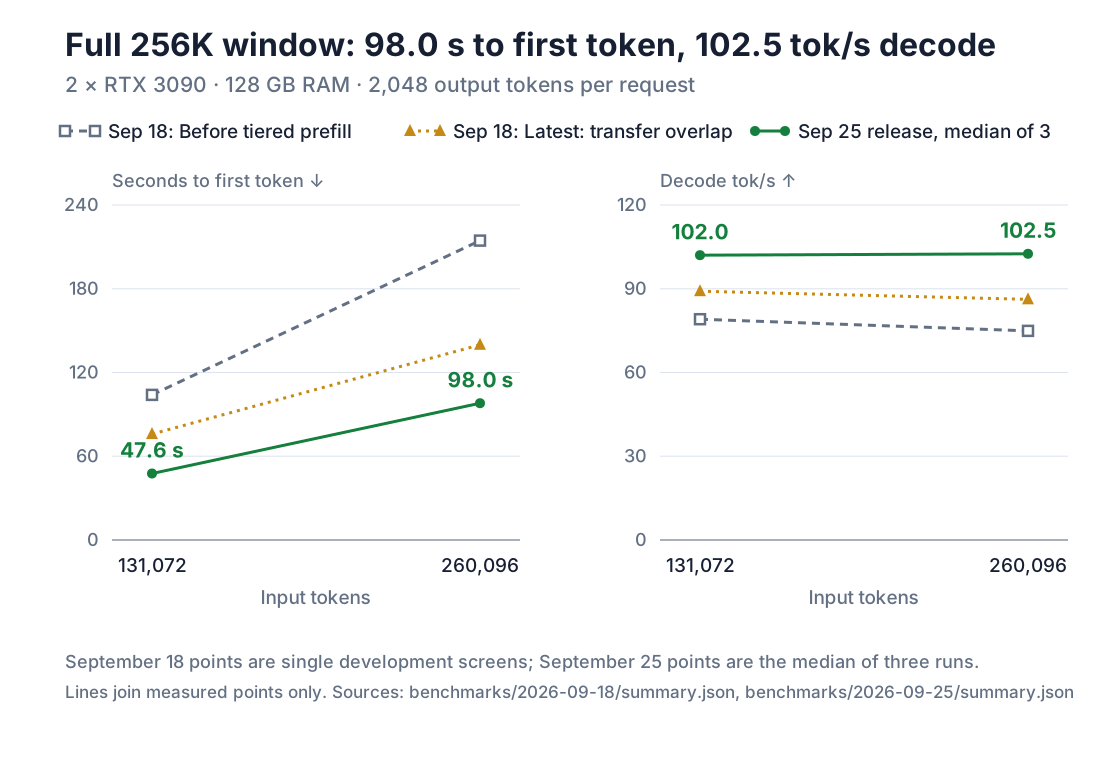
What changed:
Weights, BF16 KV, FP8 PLE, ten-expert routing and the approximate QSA budget are unchanged. Nothing is pruned.
Decode speed depends on free RAM. The runtime keeps about 60 GB of expert weights and the 51.2 GB PLE table in system memory. With another job filling RAM, the same profile gave 91–95 tok/s at full context. See the results, conditions and limits.
The previous build's measurements are in September 18 results.
| Workload | Shape | Speed |
|---|---|---|
| Prefill | 65,536 input tokens | 1,402 prompt tok/s |
| Full-context prefill | 262,016 input + 128 output | 1,275.6 prompt tok/s |
| Warm decode | 128 input + 4,096 output | 135.2 output tok/s |
| Warm decode, repeated | 128 input + 4,096 output | 127.1–134.0 output tok/s |
| Decode after a 262K prompt | 262,016 input + 128 output | 54.5 output tok/s |
| Longest tested sequence | Input + output | 262,144 tokens |
These are single-request measurements. Prefill and decode use different test shapes; 1,402 and 135.2 tok/s did not come from the same request. The chart marks the switch from a 256-token decode test to a 4,096-token test with a dotted line.
The benchmark machine has 8×16 GB DDR4-3200, with all eight memory channels populated. See the hardware details.
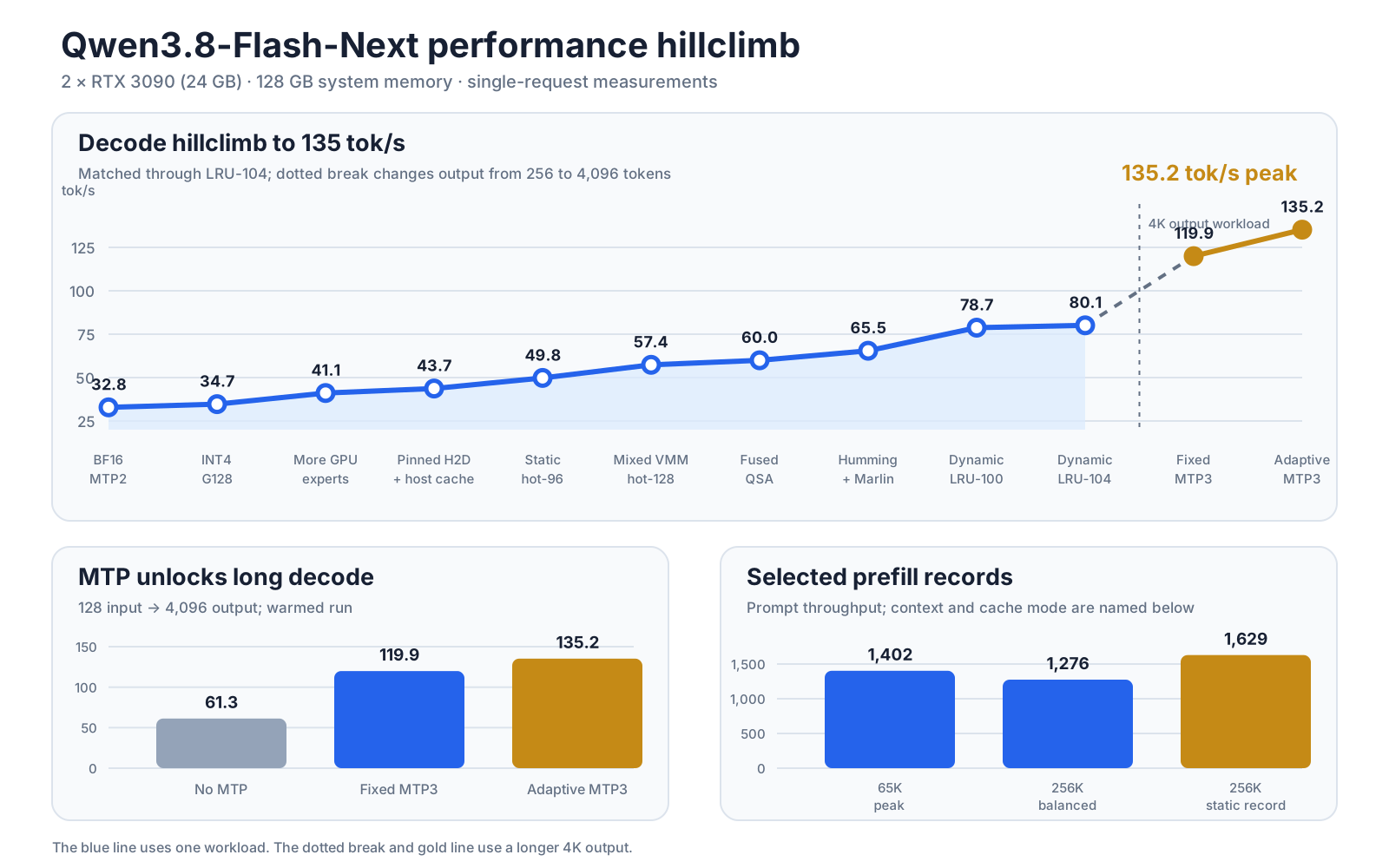
In the blue series, every point uses 128 input tokens and 256 output tokens. Decode rose from 32.83 to 80.08 tok/s on that fixed workload.
BF16 + MTP2 — 32.83 tok/s. The original vLLM baseline.
Intel W4A16 — 34.71 tok/s (+1.88). INT4 cut backbone weight traffic. Layers that Intel left in BF16 stayed in BF16.
Larger GPU expert set — 41.10 tok/s (+6.39). More routed experts stayed in VRAM, so fewer token steps had to fetch an expert from system memory.
Pinned copies and a host cache — 43.68 tok/s (+2.58). Pinned memory made expert transfers cheaper. Chunk caching reduced the cost of a miss.
Static hot-96 cache — 49.81 tok/s (+6.13). The 96 busiest experts stayed on the GPUs. The stable layout also made CUDA graph capture practical.
Mixed VMM hot-128 — 57.37 tok/s (+7.56). The hot set grew to 128 experts while the complete expert pool remained addressable in system memory.
Fused QSA — 59.97 tok/s (+2.60). Fusing sparse-attention selection cut launch overhead and repeated block-selection work.
Humming + Marlin — 65.46 tok/s (+5.49). Humming handled the target MoE path; Marlin handled the quantized MTP draft.
Dynamic LRU-100 — 78.73 tok/s (+13.27). A runtime LRU beat the fixed hot list because it followed the experts used by the current sequence.
Dynamic LRU-104 — 80.08 tok/s (+1.35). Four more resident experts gave a small final gain. The matched test ended at 2.44× its baseline speed.
The gold points use a longer output, so they are not direct continuations of the blue comparison. On the warmed 128-input/4,096-output test:
The longer run amortizes one-time request overhead. MTP accounts for most of the remaining gain: the draft proposes several tokens and the target checks them together. The target still verifies every accepted token.
The original 262,016-input boundary probe measured 54.5 tok/s over just 128 output tokens. That short probe does not establish sustained decode speed or isolate the cost of longer attention. The new experimental result above uses 2,048 output tokens and reaches 86.2 tok/s, so the two tests are not directly comparable. The historical balanced profile prefills its prompt at 1,275.6 tok/s. A static expert cache reached 1,629 prompt tok/s, but its decode behavior was worse, so it is not the default.
| Part | Storage format |
|---|---|
| Target backbone | Intel AutoRound W4A16, symmetric INT4 group-128 |
| Sensitive target layers | Original BF16 |
| 51.2B-parameter PLE table | FP8 E4M3FN with the published scale |
| MTP routed experts | Symmetric INT4 group-32 |
| Other MTP tensors | Original source precision |
| KV cache | BF16 |
The target payload is 116.183 GiB. The compact MTP draft adds 3.855 GiB. Most of the surprising size comes from the PLE table and the tensors that remain BF16, not from an unquantized backbone.
You need Linux, Docker, NVIDIA Container Toolkit, two 24 GB RTX 3090 cards, and 128 GB of system memory. Configure at least 32 GiB of swap on fast NVMe before the first launch; 48–64 GiB is safer. The loader can exceed physical RAM even though steady serving fits much more comfortably.
Download the pinned checkpoint revision:
hf download albucino/Qwen3.8-Flash-Next-W4A16-FP8PLE \
  --revision ef554143369a706525336f6b42a09094835dc077 \
  --local-dir /models/qwen38-flash-next
Build and start the server:
git clone https://github.com/DominikBucko/qwen38-flash-next-2x3090.git
cd qwen38-flash-next-2x3090

cp .env.example .env
# Set MODEL_DIR in .env.

make build-image
make preflight
make serve
The OpenAI-compatible endpoint is http://127.0.0.1:8000/v1.
To skip the local build, pull the published release image (weights stay a
separate download) and pin it by the digest from the release notes:
IMAGE=ghcr.io/dominikbucko/qwen38-flash-next-2x3090@sha256:<digest> make serve.
See Prebuilt image.
For the fast 256K profile, append configs/fast-256k.env
to .env before make serve. It needs working bidirectional CUDA P2P between
the two cards (see the P2P check) and
enough free RAM to keep the PLE table resident, so stop other memory-heavy jobs:
cat configs/fast-256k.env >> .env
make serve
For agent work that stays under 128K, use configs/agent-128k.env
instead. It has the same requirements. The context is 135,168 tokens, and the
KV memory this frees holds 16 more hot experts per GPU: about 110 tok/s decode
and 3,000 input tok/s on a 131,072-token prompt (results).
configs/agent-128k-prefill.env trades some of that decode for up to 4,191
input tok/s (results).
For the uncensored mode, add QWEN38_ABLITERATION=orcarouter to .env with any profile. It removes the model's
safety refusals; see docs/abliteration.md.
Image inputs are optional. See the vision profile and request example.
The default now caches 84 experts per layer to leave more room for prefill.
Context stays at 256K and precision is unchanged. The original hillclimb results
are historical. None of the results is a speed guarantee for your host. Set VLLM_WNA16_STATIC_HOT_CACHE_SIZE=88
in .env to try the tighter profile. Existing .env files keep their old value.
Even hot84 can be tight with other GPU users. Check free -h,
swapon --show, and nvidia-smi first. Then make one change at a time:
VLLM_WNA16_STATIC_HOT_CACHE_SIZE=84; an older .env may still
select 88. If needed, try 80. Each removed slot saves roughly 116 MiB
per GPU across the 48 layers, at the cost of more expert traffic from system memory.KV_CACHE_MEMORY_BYTES from 4429185024 to 4294967296. Keep this
only if the startup log still reports at least 262,144 KV-cache tokens.MAX_NUM_BATCHED_TOKENS from 4096 to 2048. This reduces peak
prefill temporaries but also reduces prefill throughput.Changing MAX_MODEL_LEN alone does not release the explicitly reserved KV
allocation. For the full explanation, including two-client sizing, see
docs/memory.md.
The build scripts pin every upstream commit. They copy Intel's target tensors without another quantization or packing pass.
./scripts/download_sources.sh /models/qwen38-sources
make build-image
./scripts/assemble_with_docker.sh /models/qwen38-sources upload
The assembled HF tree is written to /models/qwen38-sources/upload. See
docs/reproduce.md for source revisions, validation, and
upload commands.
The small JSON summaries are public:
benchmarks/serving-summary.jsonbenchmarks/hillclimb.jsonbenchmarks/agentbench-summary.jsonPrivate AgentBench fixtures, hidden tests, workspaces, and reasoning traces are not included. The default uses approximate QSA. Exact QSA is available as a slower comparison profile.
The runtime code is Apache-2.0. The model keeps the upstream Qwen and third-party
terms listed in THIRD_PARTY_NOTICES.md.
448 followers · starred Sep 2026
16 followers · starred Sep 2026
38 followers · starred Sep 2026
Qwen3.8-Flash-Next on 2× RTX 3090: with 128 GB RAM up to 4,191 tok/s prefill · 111.5 tok/s decode (131K prompt), full 256K window at 2,865 tok/s; with 64 GB RAM 3,410 tok/s prefill · 84 tok/s decode. New: opt-in uncensored mode (runtime abliteration, no new weights).
See the codeUp to 262,144-token context · 2× RTX 3090 (24 GB) · 128 GB system memory
One request: 131,072 input tokens, then 2,048 output tokens, best of 2. Prefill with the new prefill profile (31.3 s to first token), decode with the agent 128K profile. The fast 256K profile reads a full 260,096-token window in 90.8 s (2,865 input tok/s).
New: uncensored mode.
QWEN38_ABLITERATION=orcarouterremoves the model's refusals at runtime: the behaviour of OrcaRouter's uncensored release, with no new weights and no speed cost. How it works.Only 64 GB of RAM? The new 64 GB profile runs the same two cards with half the memory: 3,410 tok/s prefill and 84 tok/s decode on a 131,072-token prompt.
Only one GPU? qwen38-flash-next-3090 runs the same checkpoint on a single RTX 3090 with 64 GB of RAM: up to 2,100 tok/s prefill, 43–51 tok/s decode, 128K context.
Qwen3.8-Flash-Next, with its high sparsity and low active param count is a great candidate for CPU offloading under right setup. This build keeps the full expert set and an FP8 Ngram table in system memory, caches active (LRU) experts on the GPUs, and uses a small MTP3 drafter to recover decode speed.
The checkpoint combines Intel's AutoRound W4A16 target with FP8 PLE/ngram tensors, to fit into 128GB memory. The serving code is a pinned vLLM build plus the patches in this repo.
QWEN38_ABLITERATION=orcarouter gives the served model the behaviour of
orcarouter/Qwen3.8-Flash-Next-Uncensored
without new weights. That release removes one refusal direction r from every matrix that writes to the residual
stream: W' = W − r(rᵀW). The runtime applies the same projection to the outputs of those matrices instead,
which for one direction is the same edit, so the published INT4 experts and every other weight stay as they are.
| Same image and afternoon | Off | On |
|---|---|---|
| Mild borderline requests refused (fake review, lock picking, insult, …), agent 128K profile | 7 of 8 | 0 of 8 |
| Neutral controls and smoke tests (math, tool call, code) | pass | pass |
| 131K prefill, agent 128K profile | 2,909 tok/s | 2,914 tok/s |
| Decode cost per verify step, agent 128K profile | 24.1–27.0 ms | 24.1–27.0 ms |
The 64 GB profile behaves the same (0 of 8 refused, speed within 3% of its published runs). This removes the
model's safety refusals: it follows requests the original model declines. Use it for research, red-teaming or
your own use, and put your own safeguards in front of it before serving anyone else. It works with every profile
and needs an image built from this tree (make build-image) until the next release image. Add to .env:
QWEN38_ABLITERATION=orcarouter
How the direction was recovered and verified, and the limits: docs/abliteration.md.
configs/agent-128k-prefill.env is the agent 128K profile with 8,192-token
prefill chunks instead of 4,096. Every chunk streams all cold experts over PCIe once, so bigger chunks halve that
traffic on long prompts. The VRAM they need comes from the expert cache: 88 instead of 100 experts per layer and
GPU (with 100, 8K chunks run out of VRAM), so decode pulls more experts from system memory. Same image, same day,
two runs each:
| Profile | 131K + 2K: first token | Input tok/s | Decode tok/s | 8K + 2K: input tok/s | Decode tok/s |
|---|---|---|---|---|---|
| Prefill (8K chunks, hot88) | 31.3–36.0 s | 3,643–4,191 | 91.9–101.8 | 3,844–3,851 | 98.9–101.1 |
| Agent 128K (4K chunks, hot100) | 43.1–47.6 s | 2,756–3,045 | 104.8–111.5 | 2,822–2,823 | 103.2–106.2 |
The slower 131K run of each profile is the first request after a start. Choose the prefill profile when long prompts dominate the wait, and the agent profile when long outputs do. Both limit requests to 135,168 tokens, one at a time, and need the same host as the fast 256K profile. Enable it with:
cat configs/agent-128k-prefill.env >> .env
make serve
See the prefill profile results.
configs/2x3090-64gb.env serves the model on two RTX 3090s with 64 GB of system
RAM and a 128K context. The 128 GB profiles keep a pinned copy of every expert (~58 GiB) and the PLE table
(~48 GiB) in RAM. Here each GPU owns its 88 most-used experts per layer outright, and the other experts of its
half live once in RAM (38 GiB for both GPUs). During decode a CPU thread pool per GPU computes them, with the GPU
taking a share over PCIe; prefill streams them to the GPUs. The FP8 PLE table is read in place from the
checkpoint on NVMe.
| 2× RTX 3090, machine limited to 64 GB RAM | First token | Prefill | Decode |
|---|---|---|---|
| 131,099 + 512 tokens | 38.4–38.5 s | 3,401–3,413 tok/s | 84.2–88.8 tok/s |
| 32,799 + 512 | 10.2–10.3 s | 3,200–3,211 tok/s | 77.0–83.9 tok/s |
| 8,218 + 1,024 | 2.6 s | 3,114–3,146 tok/s | 78.2–79.7 tok/s |
| 131,099 + 512, 12 CPU cores (Ryzen 9 9900X layout) | 38.4 s | 3,413 tok/s | 80.7 tok/s |
Prefill is faster than with the 128 GB agent profile only because of the larger prefill chunks. Every chunk streams all of a GPU's cold experts once, and keeping 88 instead of 100 experts per layer on each GPU leaves the VRAM for 8,192-token chunks instead of 4,096. With 4,096 this profile prefills 131K at 2,754 tok/s, a little below the agent profile; the prefill profile gives the 128 GB machines the same 8K chunks. Decode is about a quarter slower and depends on CPU memory bandwidth. Requests are limited to 135,168 tokens, one at a time. CUDA P2P is not needed. Enable it with:
cat configs/2x3090-64gb.env >> .env
make serve
No swap is needed. The container gets the installed RAM minus 8 GiB and sizes its expert arenas from that. See the 64 GB section of the memory guide and the benchmark report. The benchmark host runs both cards at PCIe ×16; desktop boards often split them ×8/×8 (untested, see the report).
Long prompts are 6–8% faster to first token. On async-scheduled profiles, the KV cache leaked one recurrent-state block per prefill chunk in each Mamba layer group, so long requests filled the pool and were preempted several times. With the fix, the fast 256K profile runs with no preemptions:
| Fast 256K profile, release image, 3 runs | September 25 | September 29 |
|---|---|---|
| 131,072 + 2,048: first token | 47.6–48.7 s | 45.0–46.0 s |
| 131,072 + 2,048: input tok/s | 2,693–2,757 | 2,852–2,916 |
| 260,096 + 2,048: first token | 98.0 s | 90.8 s |
| 260,096 + 2,048: input tok/s | 2,653–2,654 | 2,864–2,865 |
Decode, 8K prefill, 256K needle retrieval and prefix-cache reuse are unchanged. See the same-night A/B and validation.
New agent 128K profile. configs/agent-128k.env
halves the context window and spends the freed KV memory on 16 more hot experts
per GPU. Decode then pulls fewer experts from system memory:
| Agent 128K profile, release image | First token | Input tok/s | Decode tok/s |
|---|---|---|---|
| 131,072 + 2,048, best of 2 | 43.3 s | 3,029 | 109.8 |
| 7-prompt decode set (8K–131K) | 116.1 (fast 256K: 104–105) |
Requests are limited to 135,168 tokens in total. See the agent profile results and limits.
The September 25 runtime reads a 131,072-token prompt in 47.6 seconds to first token (2,752 input tok/s), then generates 2,048 tokens at 104.5 tok/s. Both numbers come from the same request on the release image.
| Fast 256K profile | Input + output tokens | First token | Input tok/s | Decode tok/s |
|---|---|---|---|---|
| 128K prompt, release image, best of 3 | 131,072 + 2,048 | 47.6 s | 2,752 | 104.5 |
| 128K prompt, release image, 3 runs | 131,072 + 2,048 | 47.6–48.7 s | 2,693–2,757 | 94.2–104.5 |
| Full 256K window, release image, best of 3 | 260,096 + 2,048 | 98.0 s | 2,654 | 103.1 |
| Full 256K window, release image, 3 runs | 260,096 + 2,048 | 98.0 s | 2,653–2,654 | 92.6–103.1 |
Compared with the September 18 build on the same prompt, the full-window wait fell from 147.0 to 98.0 seconds, and decode rose from 82.6 to 100+ tok/s.
What changed:
Weights, BF16 KV, FP8 PLE, ten-expert routing and the approximate QSA budget are unchanged. Nothing is pruned.
Decode speed depends on free RAM. The runtime keeps about 60 GB of expert weights and the 51.2 GB PLE table in system memory. With another job filling RAM, the same profile gave 91–95 tok/s at full context. See the results, conditions and limits.
The previous build's measurements are in September 18 results.
| Workload | Shape | Speed |
|---|---|---|
| Prefill | 65,536 input tokens | 1,402 prompt tok/s |
| Full-context prefill | 262,016 input + 128 output | 1,275.6 prompt tok/s |
| Warm decode | 128 input + 4,096 output | 135.2 output tok/s |
| Warm decode, repeated | 128 input + 4,096 output | 127.1–134.0 output tok/s |
| Decode after a 262K prompt | 262,016 input + 128 output | 54.5 output tok/s |
| Longest tested sequence | Input + output | 262,144 tokens |
These are single-request measurements. Prefill and decode use different test shapes; 1,402 and 135.2 tok/s did not come from the same request. The chart marks the switch from a 256-token decode test to a 4,096-token test with a dotted line.
The benchmark machine has 8×16 GB DDR4-3200, with all eight memory channels populated. See the hardware details.
In the blue series, every point uses 128 input tokens and 256 output tokens. Decode rose from 32.83 to 80.08 tok/s on that fixed workload.
BF16 + MTP2 — 32.83 tok/s. The original vLLM baseline.
Intel W4A16 — 34.71 tok/s (+1.88). INT4 cut backbone weight traffic. Layers that Intel left in BF16 stayed in BF16.
Larger GPU expert set — 41.10 tok/s (+6.39). More routed experts stayed in VRAM, so fewer token steps had to fetch an expert from system memory.
Pinned copies and a host cache — 43.68 tok/s (+2.58). Pinned memory made expert transfers cheaper. Chunk caching reduced the cost of a miss.
Static hot-96 cache — 49.81 tok/s (+6.13). The 96 busiest experts stayed on the GPUs. The stable layout also made CUDA graph capture practical.
Mixed VMM hot-128 — 57.37 tok/s (+7.56). The hot set grew to 128 experts while the complete expert pool remained addressable in system memory.
Fused QSA — 59.97 tok/s (+2.60). Fusing sparse-attention selection cut launch overhead and repeated block-selection work.
Humming + Marlin — 65.46 tok/s (+5.49). Humming handled the target MoE path; Marlin handled the quantized MTP draft.
Dynamic LRU-100 — 78.73 tok/s (+13.27). A runtime LRU beat the fixed hot list because it followed the experts used by the current sequence.
Dynamic LRU-104 — 80.08 tok/s (+1.35). Four more resident experts gave a small final gain. The matched test ended at 2.44× its baseline speed.
The gold points use a longer output, so they are not direct continuations of the blue comparison. On the warmed 128-input/4,096-output test:
The longer run amortizes one-time request overhead. MTP accounts for most of the remaining gain: the draft proposes several tokens and the target checks them together. The target still verifies every accepted token.
The original 262,016-input boundary probe measured 54.5 tok/s over just 128 output tokens. That short probe does not establish sustained decode speed or isolate the cost of longer attention. The new experimental result above uses 2,048 output tokens and reaches 86.2 tok/s, so the two tests are not directly comparable. The historical balanced profile prefills its prompt at 1,275.6 tok/s. A static expert cache reached 1,629 prompt tok/s, but its decode behavior was worse, so it is not the default.
| Part | Storage format |
|---|---|
| Target backbone | Intel AutoRound W4A16, symmetric INT4 group-128 |
| Sensitive target layers | Original BF16 |
| 51.2B-parameter PLE table | FP8 E4M3FN with the published scale |
| MTP routed experts | Symmetric INT4 group-32 |
| Other MTP tensors | Original source precision |
| KV cache | BF16 |
The target payload is 116.183 GiB. The compact MTP draft adds 3.855 GiB. Most of the surprising size comes from the PLE table and the tensors that remain BF16, not from an unquantized backbone.
You need Linux, Docker, NVIDIA Container Toolkit, two 24 GB RTX 3090 cards, and 128 GB of system memory. Configure at least 32 GiB of swap on fast NVMe before the first launch; 48–64 GiB is safer. The loader can exceed physical RAM even though steady serving fits much more comfortably.
Download the pinned checkpoint revision:
hf download albucino/Qwen3.8-Flash-Next-W4A16-FP8PLE \
  --revision ef554143369a706525336f6b42a09094835dc077 \
  --local-dir /models/qwen38-flash-next
Build and start the server:
git clone https://github.com/DominikBucko/qwen38-flash-next-2x3090.git
cd qwen38-flash-next-2x3090

cp .env.example .env
# Set MODEL_DIR in .env.

make build-image
make preflight
make serve
The OpenAI-compatible endpoint is http://127.0.0.1:8000/v1.
To skip the local build, pull the published release image (weights stay a
separate download) and pin it by the digest from the release notes:
IMAGE=ghcr.io/dominikbucko/qwen38-flash-next-2x3090@sha256:<digest> make serve.
See Prebuilt image.
For the fast 256K profile, append configs/fast-256k.env
to .env before make serve. It needs working bidirectional CUDA P2P between
the two cards (see the P2P check) and
enough free RAM to keep the PLE table resident, so stop other memory-heavy jobs:
cat configs/fast-256k.env >> .env
make serve
For agent work that stays under 128K, use configs/agent-128k.env
instead. It has the same requirements. The context is 135,168 tokens, and the
KV memory this frees holds 16 more hot experts per GPU: about 110 tok/s decode
and 3,000 input tok/s on a 131,072-token prompt (results).
configs/agent-128k-prefill.env trades some of that decode for up to 4,191
input tok/s (results).
For the uncensored mode, add QWEN38_ABLITERATION=orcarouter to .env with any profile. It removes the model's
safety refusals; see docs/abliteration.md.
Image inputs are optional. See the vision profile and request example.
The default now caches 84 experts per layer to leave more room for prefill.
Context stays at 256K and precision is unchanged. The original hillclimb results
are historical. None of the results is a speed guarantee for your host. Set VLLM_WNA16_STATIC_HOT_CACHE_SIZE=88
in .env to try the tighter profile. Existing .env files keep their old value.
Even hot84 can be tight with other GPU users. Check free -h,
swapon --show, and nvidia-smi first. Then make one change at a time:
VLLM_WNA16_STATIC_HOT_CACHE_SIZE=84; an older .env may still
select 88. If needed, try 80. Each removed slot saves roughly 116 MiB
per GPU across the 48 layers, at the cost of more expert traffic from system memory.KV_CACHE_MEMORY_BYTES from 4429185024 to 4294967296. Keep this
only if the startup log still reports at least 262,144 KV-cache tokens.MAX_NUM_BATCHED_TOKENS from 4096 to 2048. This reduces peak
prefill temporaries but also reduces prefill throughput.Changing MAX_MODEL_LEN alone does not release the explicitly reserved KV
allocation. For the full explanation, including two-client sizing, see
docs/memory.md.
The build scripts pin every upstream commit. They copy Intel's target tensors without another quantization or packing pass.
./scripts/download_sources.sh /models/qwen38-sources
make build-image
./scripts/assemble_with_docker.sh /models/qwen38-sources upload
The assembled HF tree is written to /models/qwen38-sources/upload. See
docs/reproduce.md for source revisions, validation, and
upload commands.
The small JSON summaries are public:
benchmarks/serving-summary.jsonbenchmarks/hillclimb.jsonbenchmarks/agentbench-summary.jsonPrivate AgentBench fixtures, hidden tests, workspaces, and reasoning traces are not included. The default uses approximate QSA. Exact QSA is available as a slower comparison profile.
The runtime code is Apache-2.0. The model keeps the upstream Qwen and third-party
terms listed in THIRD_PARTY_NOTICES.md.
448 followers · starred Sep 2026
16 followers · starred Sep 2026
38 followers · starred Sep 2026