Scientific literature discovery and local paper linkage workspace. Just drag and drop a single paper and watch the network grow
Python
15
69 commits
updated Oct 15, 2026



Download for Mac (Apple Silicon) | Download for Windows (x64, 1.8.0) | Release Notes | Run from Source
Why Pulse? Most research-mapping tools live entirely in the browser. They store your reading lists on remote servers and send what you upload to third-party cloud language models.
If you are working on an unpublished manuscript, a confidential grant proposal, a patent application, or sensitive clinical data, that's a security and privacy risk.
Pulse is built to be local-first. Your library, PDFs, reading notes, and AI analysis stay strictly on your computer.
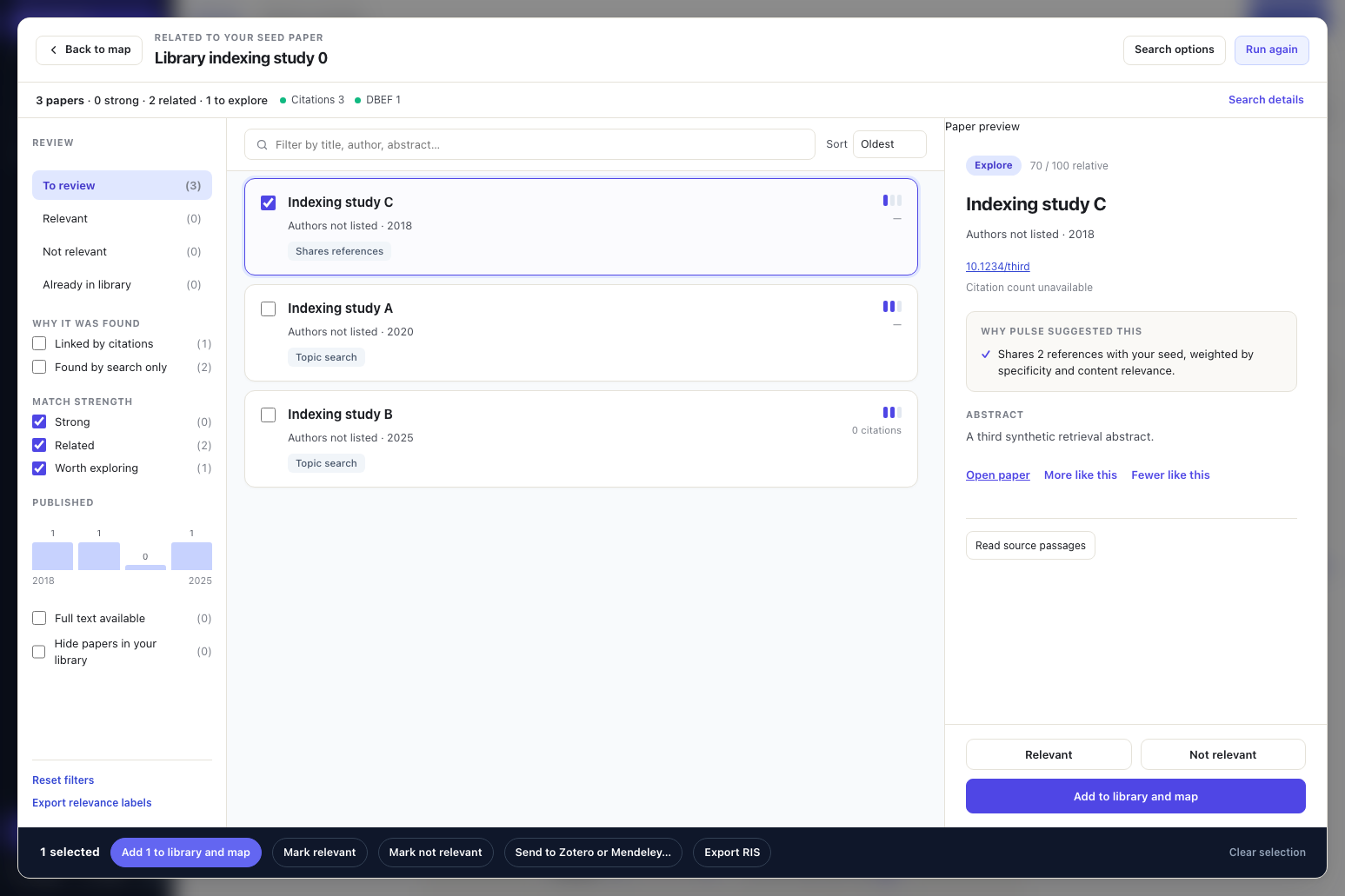
See the 1.8.3 notes.
1.8.0 added the direct-citation influence bonus, a persistent HTTP cache and keyless arXiv search; see the 1.8.0 notes. Full measurements and limits are in the 1.8.1 notes.
select=), reusable HTTP connections, and background pre-warming of references and DBEF pivots when you select or add a paper.Type a concept, key phrases or a research question into Find papers and press Enter. No seed paper is required. Pulse uses the configured AI to extract focused keywords and close synonyms, searches the selected literature indexes, and ranks results against the original topic. The original phrase always remains a query; if AI is unavailable, Pulse falls back to phrase search with a clear notice.
2026a/2026b suffixes. Bibliography tails survive long PDF imports and workspace recovery.DBEF shared-reference discovery replaces the old co-citation and first-four-reference network searches. It weights reference overlap by specificity and title/abstract relevance, adjusts for bibliography length and recent citation velocity, and balances reference pivots across selected seeds. The supplied scorer is built into the app without extra Python packages or model downloads.
Repeated equivalent provider queries and concurrent identical metadata requests now share work. Direct citations, semantic recommendations, selected literature indexes and optional full-text search remain complementary routes. The clearer statuses, linked previews and paper-link fixes from 1.7.9 remain included. See the DBEF implementation guide for equations, limits and validation.
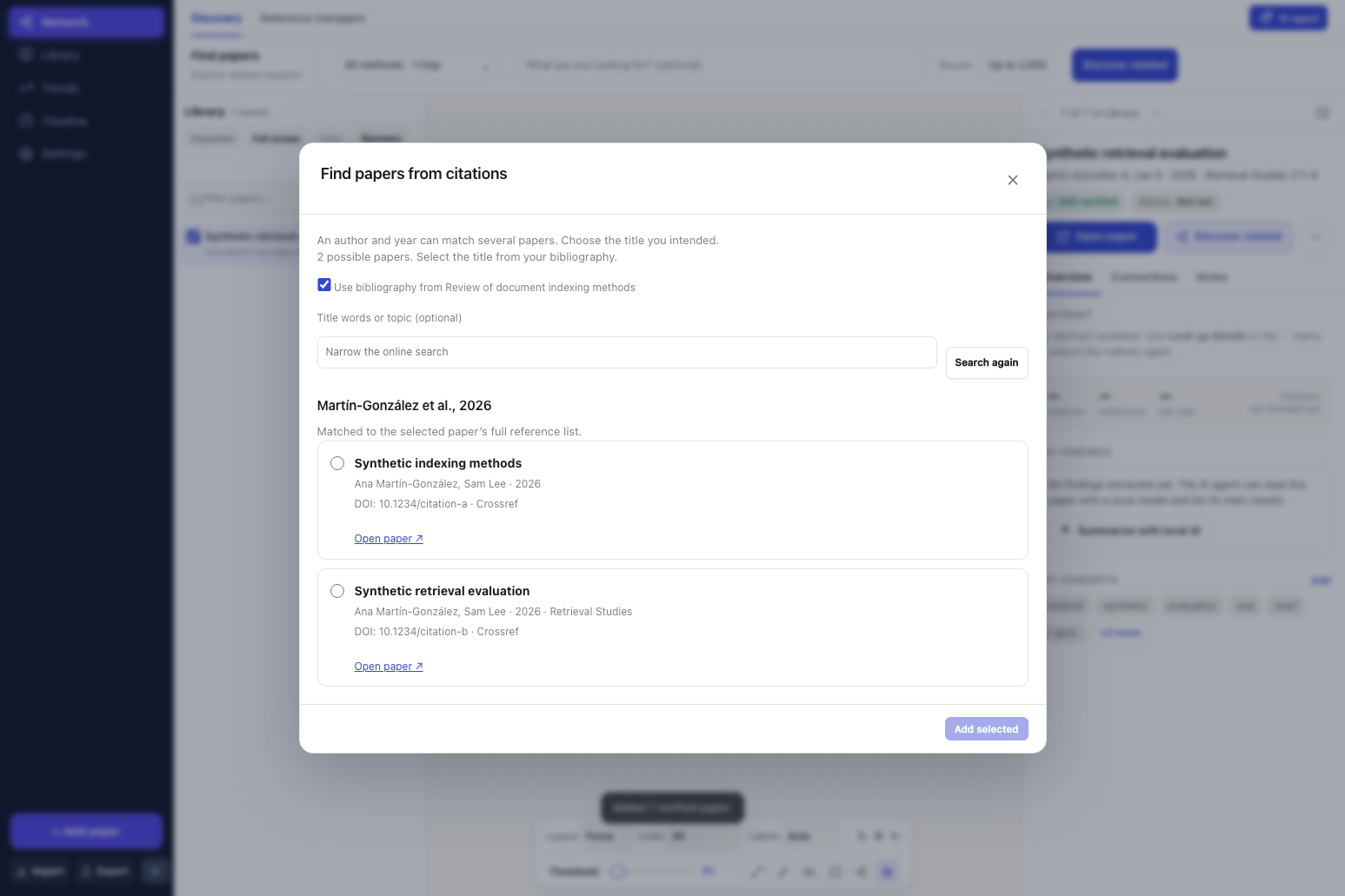
Find a paper from an in-text citation: paste (Martín-González et al., 2026) or Smith & Lee (2024) into Add paper. Pulse searches Crossref and OpenAlex by author and year, shows possible titles and indexed DOIs, and lets you choose the paper. Accents, compound surnames, grouped citations and year suffixes are supported; optional title words refine ambiguous searches. Short citations never become placeholder papers or silently select the first result.
1.7.10 raised the default to 500 results, with 1,000 and 2,000 options; 1.7.12 returned the default to 200 for faster searches, and larger counts remain available. A requested count is a maximum, not a guarantee of that many matches.
Pulse connects the entire workflow of literature exploration into one cohesive desktop application:
| Feature | Where it lives |
|---|---|
| Your Library & Notes | On your computer only (~/Library/Application Support/pulse on macOS, %LOCALAPPDATA%\Pulse on Windows). |
| PDFs & Extracted Text | Read, indexed, and stored entirely on your computer. Never uploaded. |
| AI Summaries & Analysis | Processed by local Ollama models on your GPU/CPU. |
| Concept Search Keywords | Extracted by the configured AI, locally by default. If you configure cloud AI, your typed topic is sent to that provider. Extracted phrases and the original topic are sent to the selected scholarly indexes. |
| Accounts & Tracking | None. No account required, no telemetry, no tracking cookies. |
| Scholarly Lookups | Pulse sends public paper identifiers (DOIs, titles, search keywords) to open scholarly APIs (Crossref, OpenAlex, OpenCitations, Europe PMC, arXiv, Semantic Scholar, CORE) just like a web browser lookup. Selecting a paper may prefetch its OpenAlex record so the next search starts faster; responses are cached on your computer for up to 24 hours. |
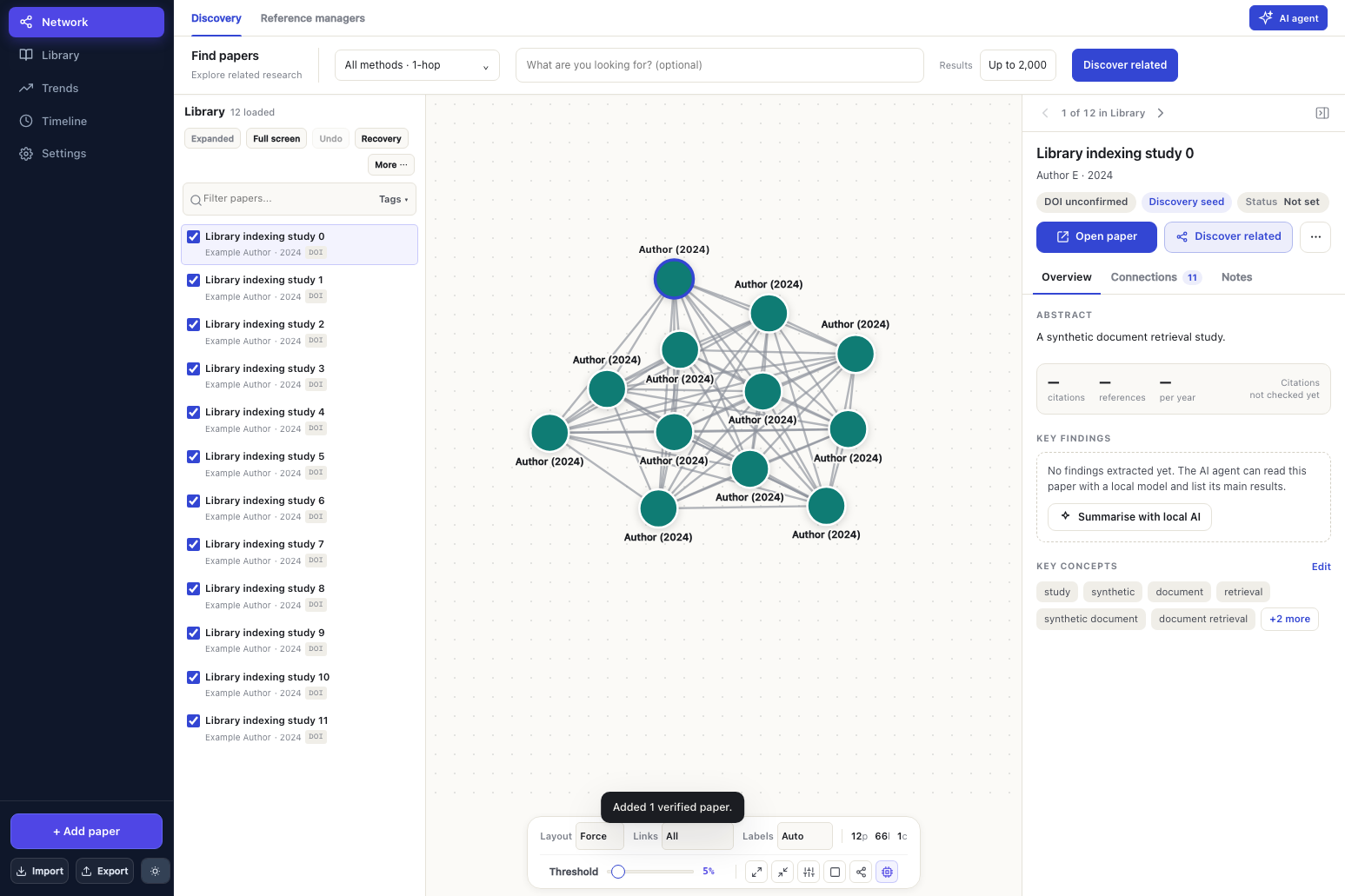
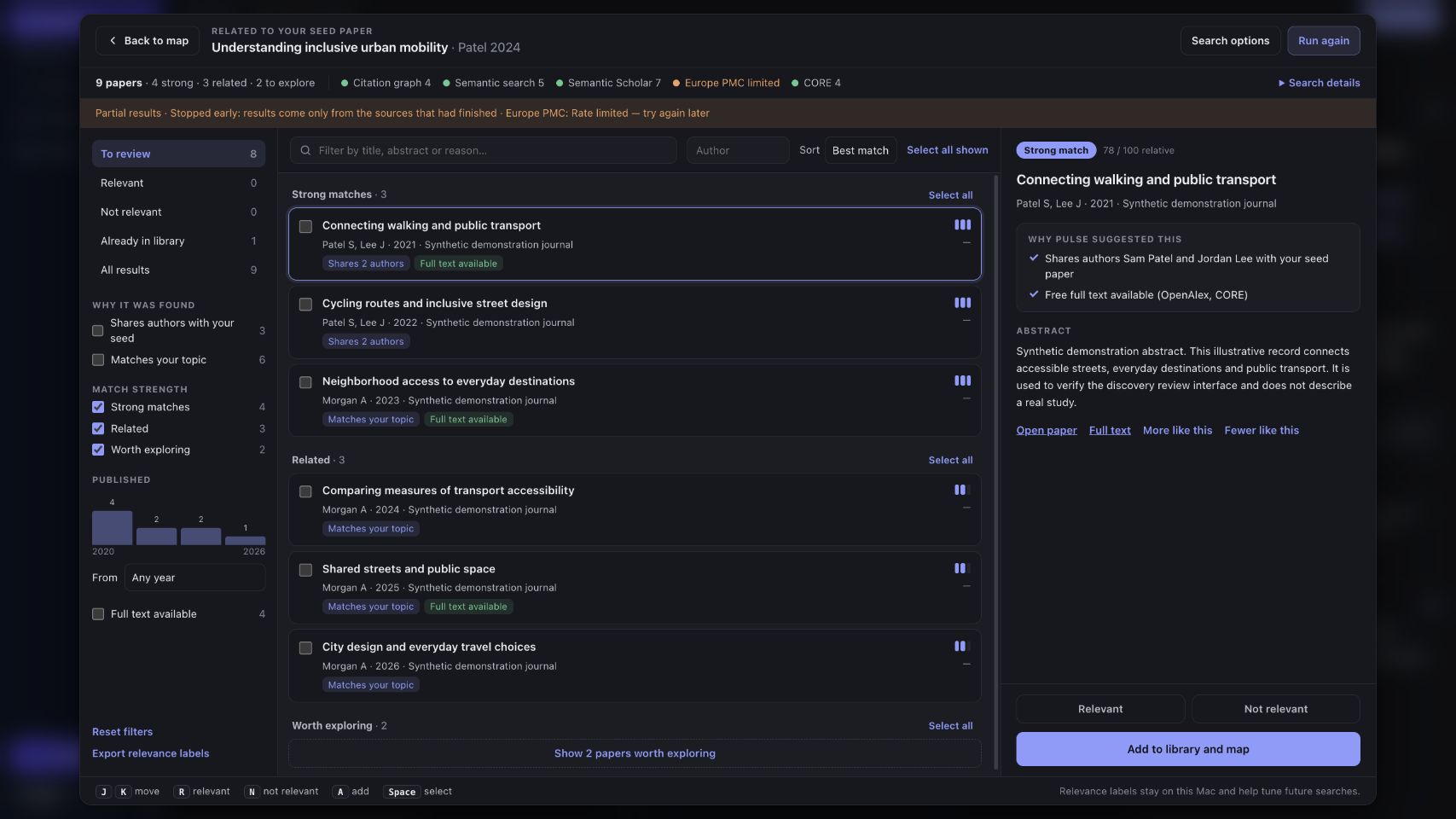
| Interactive Timeline View | Dark Mode Review Workspace |
|---|---|
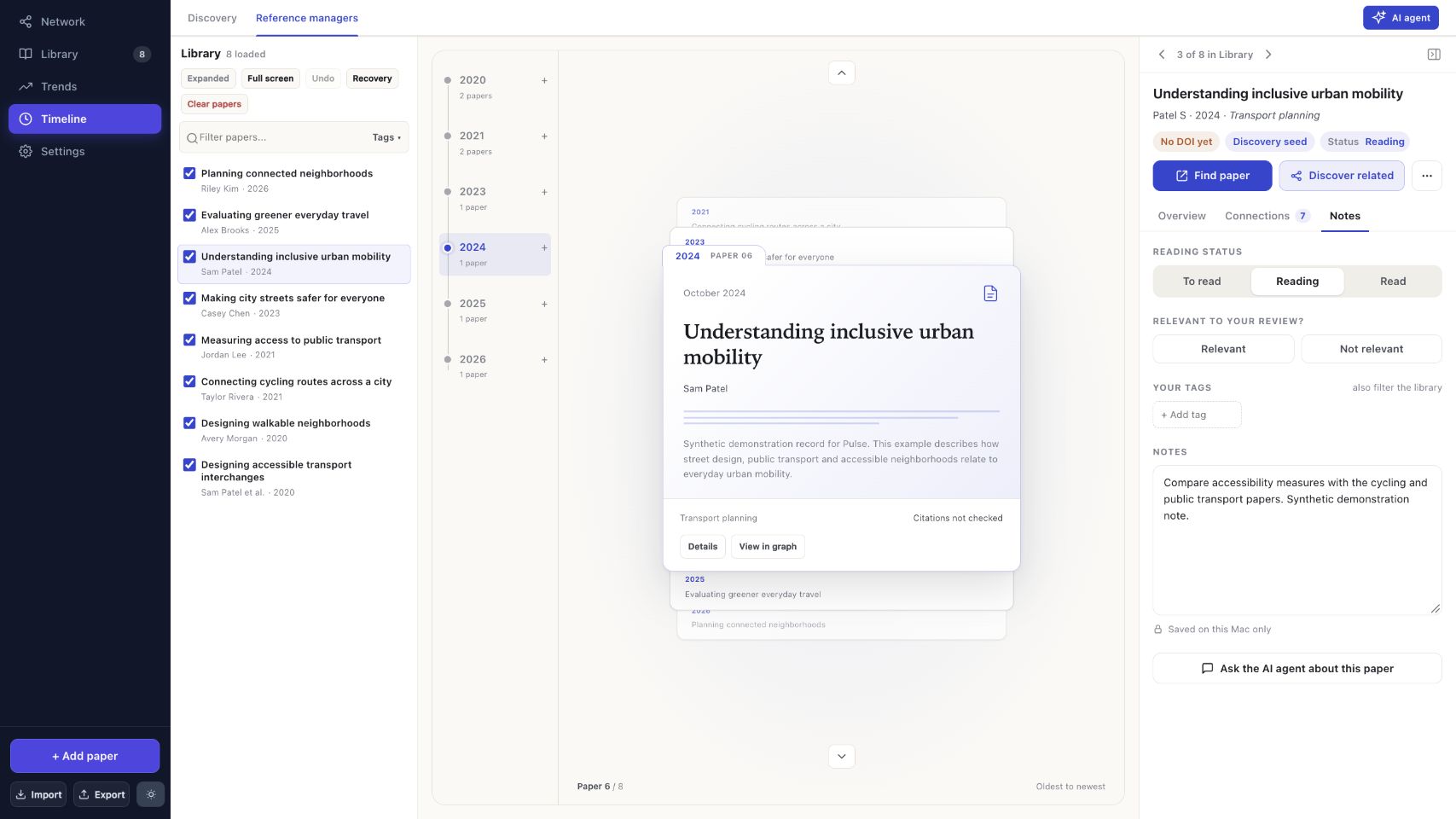 |  |
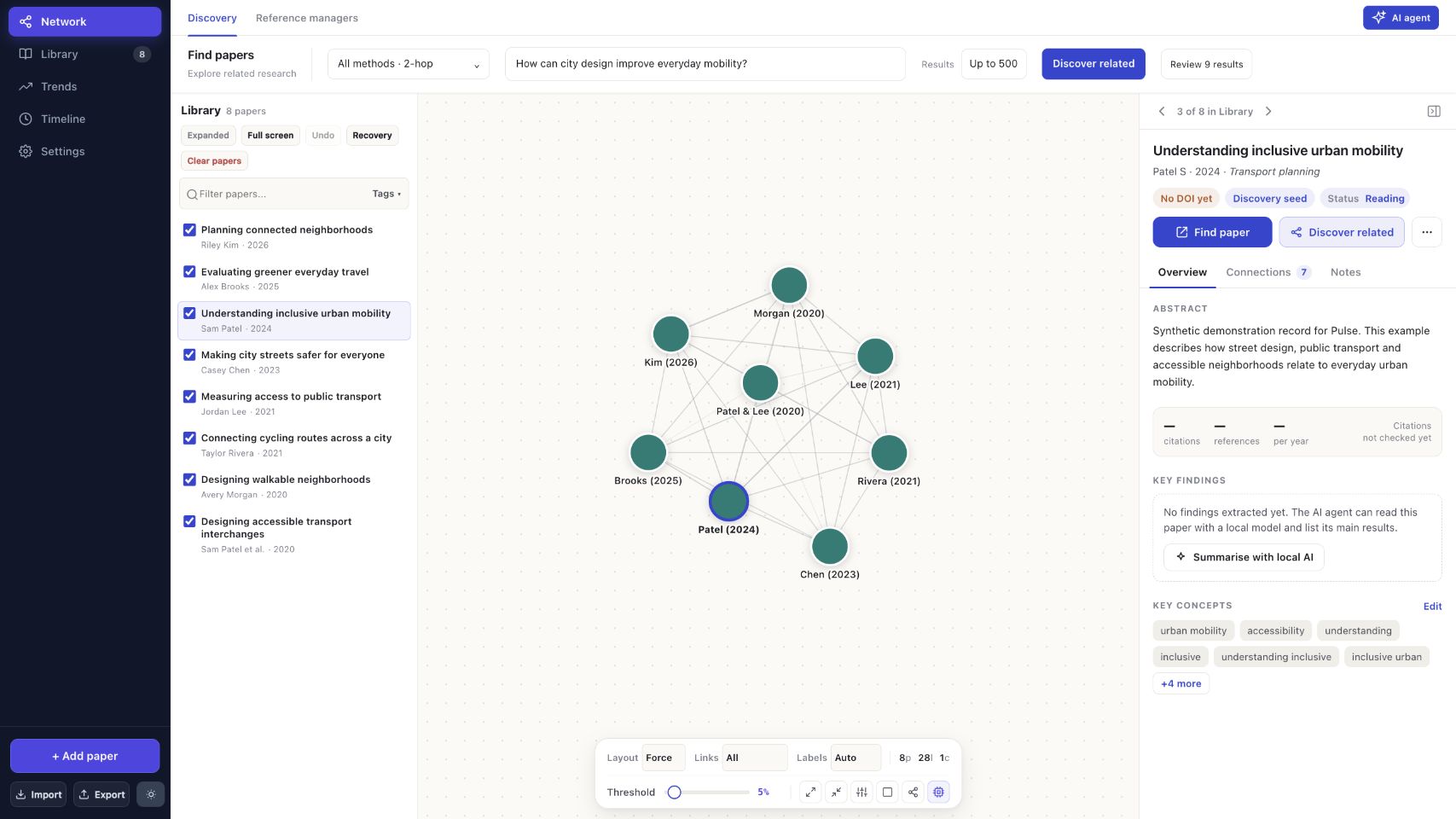
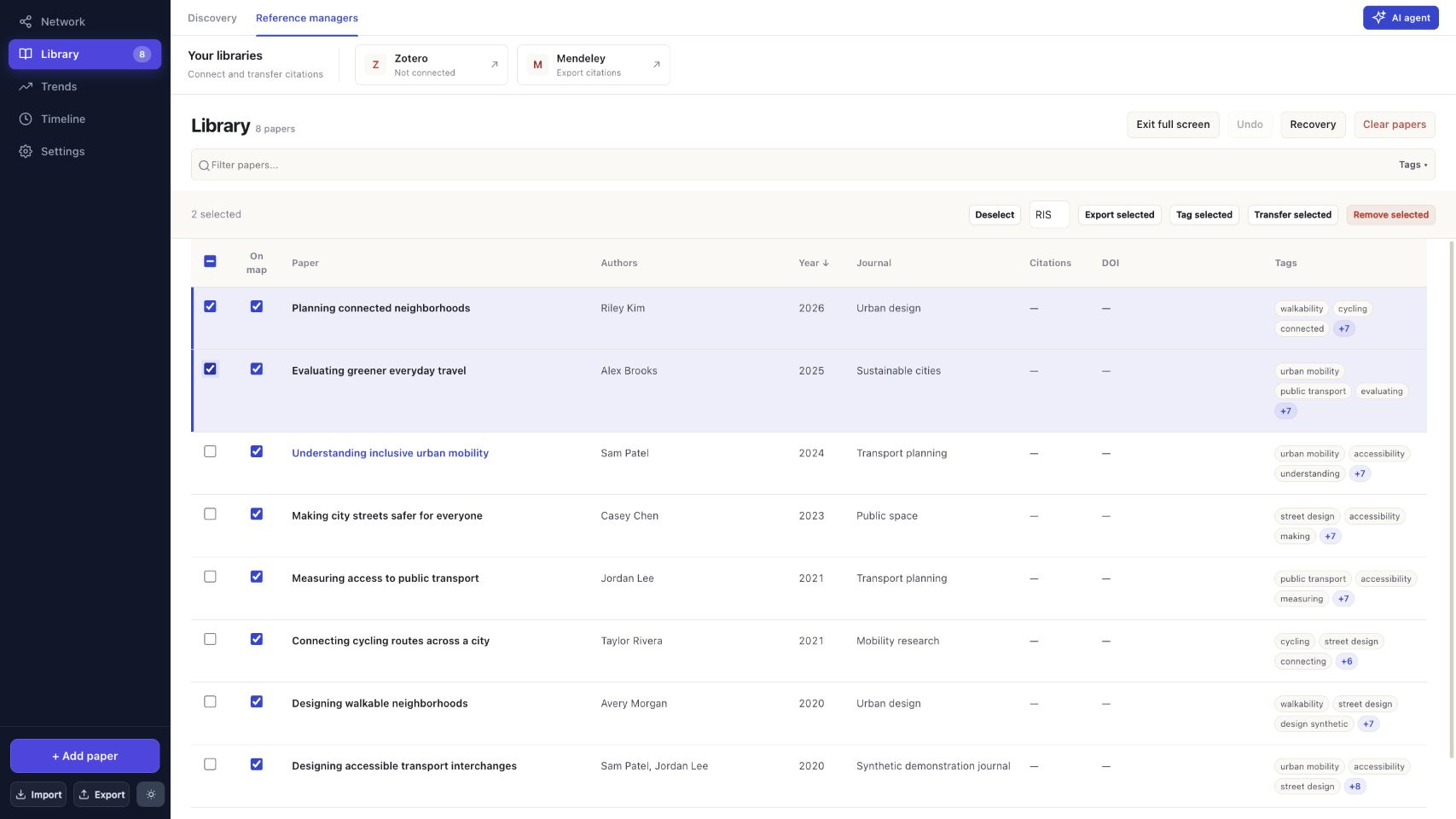
| Comprehensive Paper Inspector | Full-Screen Library Table |
|---|---|
 |  |
brew install python). Because Pulse is ad-hoc signed, if macOS blocks the first launch, right-click the app and choose Open, or run the Allow-Pulse-Tauri.command included in the DMG.Pulse functions as a complete citation mapper and bibliography tool without AI. If you want local AI summaries, reading notes, and passage synthesis:
# Embedding model for semantic search & meaning matching
ollama pull nomic-embed-text

# Fast lightweight reviewer
ollama pull llama3.2:3b

# Detailed paper synthesis & reports
ollama pull qwen2.5:7b
Developers and researchers who wish to run directly from source or customize the algorithms:
# Clone the repository
git clone https://github.com/7drbw7mdgf-lgtm/Pulse.git
cd Pulse

# Install frontend and backend dependencies
npm ci
python3 -m venv .venv
source .venv/bin/activate
pip install -r local-web/requirements.txt

# Start the desktop application
npm start
Pulse includes a built-in MCP server for integrating your local library into Claude Desktop or other MCP-compatible tools. Point your MCP client to:
python3 /path/to/Pulse/local-web/pulse-backend/pulse_mcp.py
The offline ranker, visible result bands, citation-hop cap and CORE recovery from 1.7.7 remain in place. Both desktop installers now include the portable offline ranker. See the 1.7.8 release notes. Timing measurements use synthetic inputs on the test Mac and do not establish live search latency or real-world recall.
Pulse is open-source software licensed under the MIT License. Free for personal, academic, and commercial use.
Scientific literature discovery and local paper linkage workspace. Just drag and drop a single paper and watch the network grow
Python
15
69 commits
updated Oct 15, 2026
Download for Mac (Apple Silicon) | Download for Windows (x64, 1.8.0) | Release Notes | Run from Source
Why Pulse? Most research-mapping tools live entirely in the browser. They store your reading lists on remote servers and send what you upload to third-party cloud language models.
If you are working on an unpublished manuscript, a confidential grant proposal, a patent application, or sensitive clinical data, that's a security and privacy risk.
Pulse is built to be local-first. Your library, PDFs, reading notes, and AI analysis stay strictly on your computer.
See the 1.8.3 notes.
1.8.0 added the direct-citation influence bonus, a persistent HTTP cache and keyless arXiv search; see the 1.8.0 notes. Full measurements and limits are in the 1.8.1 notes.
select=), reusable HTTP connections, and background pre-warming of references and DBEF pivots when you select or add a paper.Type a concept, key phrases or a research question into Find papers and press Enter. No seed paper is required. Pulse uses the configured AI to extract focused keywords and close synonyms, searches the selected literature indexes, and ranks results against the original topic. The original phrase always remains a query; if AI is unavailable, Pulse falls back to phrase search with a clear notice.
2026a/2026b suffixes. Bibliography tails survive long PDF imports and workspace recovery.DBEF shared-reference discovery replaces the old co-citation and first-four-reference network searches. It weights reference overlap by specificity and title/abstract relevance, adjusts for bibliography length and recent citation velocity, and balances reference pivots across selected seeds. The supplied scorer is built into the app without extra Python packages or model downloads.
Repeated equivalent provider queries and concurrent identical metadata requests now share work. Direct citations, semantic recommendations, selected literature indexes and optional full-text search remain complementary routes. The clearer statuses, linked previews and paper-link fixes from 1.7.9 remain included. See the DBEF implementation guide for equations, limits and validation.
Find a paper from an in-text citation: paste (Martín-González et al., 2026) or Smith & Lee (2024) into Add paper. Pulse searches Crossref and OpenAlex by author and year, shows possible titles and indexed DOIs, and lets you choose the paper. Accents, compound surnames, grouped citations and year suffixes are supported; optional title words refine ambiguous searches. Short citations never become placeholder papers or silently select the first result.
1.7.10 raised the default to 500 results, with 1,000 and 2,000 options; 1.7.12 returned the default to 200 for faster searches, and larger counts remain available. A requested count is a maximum, not a guarantee of that many matches.
Pulse connects the entire workflow of literature exploration into one cohesive desktop application:
| Feature | Where it lives |
|---|---|
| Your Library & Notes | On your computer only (~/Library/Application Support/pulse on macOS, %LOCALAPPDATA%\Pulse on Windows). |
| PDFs & Extracted Text | Read, indexed, and stored entirely on your computer. Never uploaded. |
| AI Summaries & Analysis | Processed by local Ollama models on your GPU/CPU. |
| Concept Search Keywords | Extracted by the configured AI, locally by default. If you configure cloud AI, your typed topic is sent to that provider. Extracted phrases and the original topic are sent to the selected scholarly indexes. |
| Accounts & Tracking | None. No account required, no telemetry, no tracking cookies. |
| Scholarly Lookups | Pulse sends public paper identifiers (DOIs, titles, search keywords) to open scholarly APIs (Crossref, OpenAlex, OpenCitations, Europe PMC, arXiv, Semantic Scholar, CORE) just like a web browser lookup. Selecting a paper may prefetch its OpenAlex record so the next search starts faster; responses are cached on your computer for up to 24 hours. |
| Interactive Timeline View | Dark Mode Review Workspace |
|---|---|
| |
| Comprehensive Paper Inspector | Full-Screen Library Table |
|---|---|
| |
brew install python). Because Pulse is ad-hoc signed, if macOS blocks the first launch, right-click the app and choose Open, or run the Allow-Pulse-Tauri.command included in the DMG.Pulse functions as a complete citation mapper and bibliography tool without AI. If you want local AI summaries, reading notes, and passage synthesis:
# Embedding model for semantic search & meaning matching
ollama pull nomic-embed-text

# Fast lightweight reviewer
ollama pull llama3.2:3b

# Detailed paper synthesis & reports
ollama pull qwen2.5:7b
Developers and researchers who wish to run directly from source or customize the algorithms:
# Clone the repository
git clone https://github.com/7drbw7mdgf-lgtm/Pulse.git
cd Pulse

# Install frontend and backend dependencies
npm ci
python3 -m venv .venv
source .venv/bin/activate
pip install -r local-web/requirements.txt

# Start the desktop application
npm start
Pulse includes a built-in MCP server for integrating your local library into Claude Desktop or other MCP-compatible tools. Point your MCP client to:
python3 /path/to/Pulse/local-web/pulse-backend/pulse_mcp.py
The offline ranker, visible result bands, citation-hop cap and CORE recovery from 1.7.7 remain in place. Both desktop installers now include the portable offline ranker. See the 1.7.8 release notes. Timing measurements use synthetic inputs on the test Mac and do not establish live search latency or real-world recall.
Pulse is open-source software licensed under the MIT License. Free for personal, academic, and commercial use.



