
Open-source personalized scientific discovery feed powered by arXiv, OpenAlex, PubMed and more.
See the codeSee what people are saying (1)
README
PaperTok
A personalized way to discover scientific research.
Open PaperTok · Latest release: 0.2
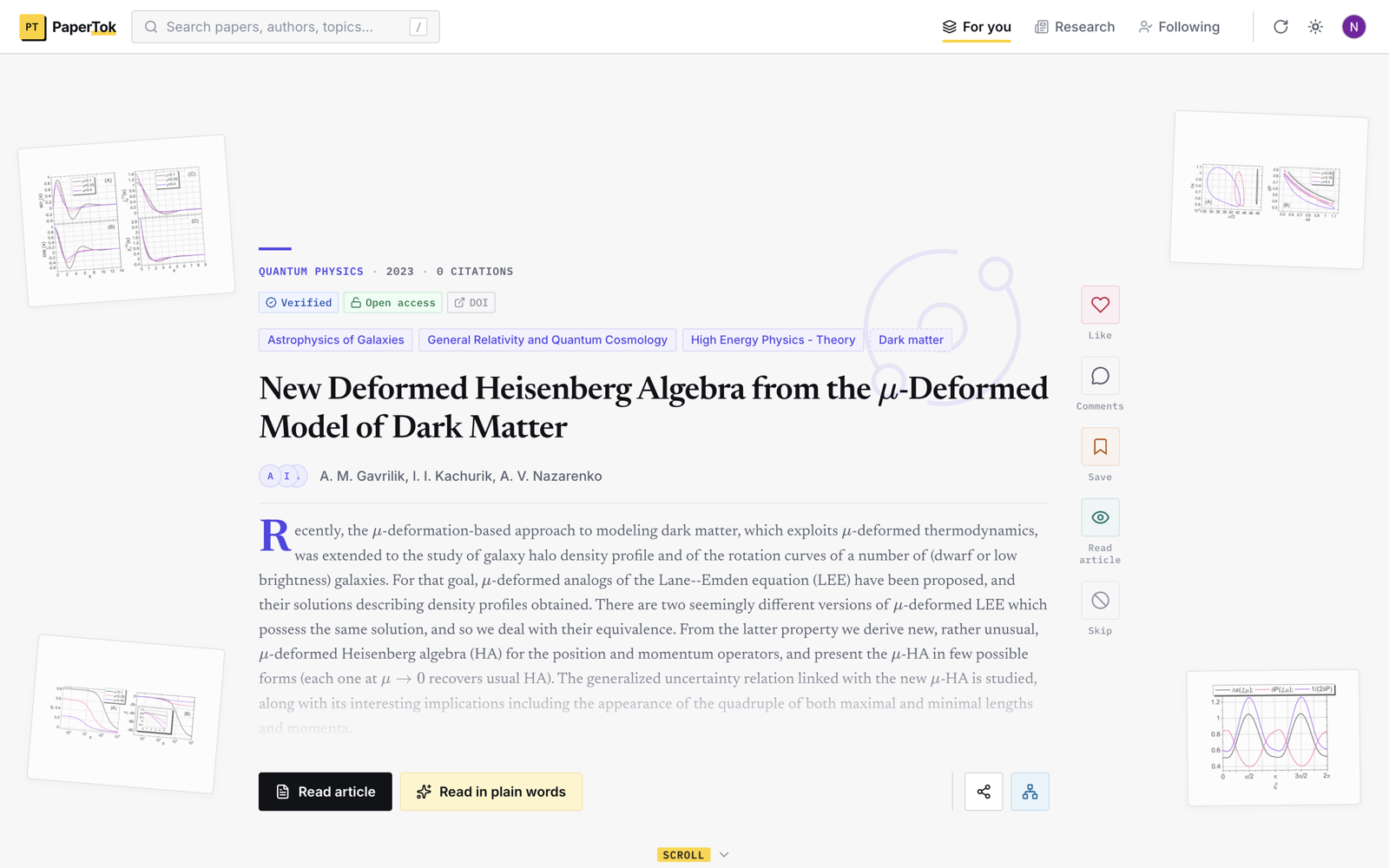
PaperTok is an open-source web app for discovering research papers through a scrollable, personalized feed.
I started building it as a physics student because I kept running into the same problem: there is an enormous amount of interesting research available online, but discovering papers outside of a very specific search can still be surprisingly difficult.
PaperTok tries to make that process feel more natural.
Instead of knowing exactly what to search for, you can browse papers, interact with the ones that interest you, follow scientific topics and researchers, and gradually get recommendations that better match what you care about.
PaperTok is currently under active development. It is a personal open-source project and not affiliated with arXiv, OpenAlex, PubMed, or any other data provider.
The interface supports Spanish and English. PaperTok selects a default from the visitor's region and also provides a manual language setting.
What PaperTok does
PaperTok brings scientific literature from multiple sources into a common discovery experience.
The main feed is personalized using signals such as:
- scientific fields and categories you are interested in
- papers you interact with
- learned affinities with research topics
- authors, topics, institutions and projects you follow
- publication recency
- citation information
- semantic concepts
- exploration outside your usual interests
- content diversity
The goal is not simply to rank the most popular papers, but to help each person discover research that is relevant to them while still leaving room for unexpected and interesting results.
A tour of PaperTok
The current look comes from an editorial redesign — serif headlines, ruled sections, one accent of yellow — whose visual direction was set by Samuel's initial UI redesign. Version 0.2 carries it through the whole app. The full changelog with screenshots lives in the 0.2 release notes; these are the highlights.
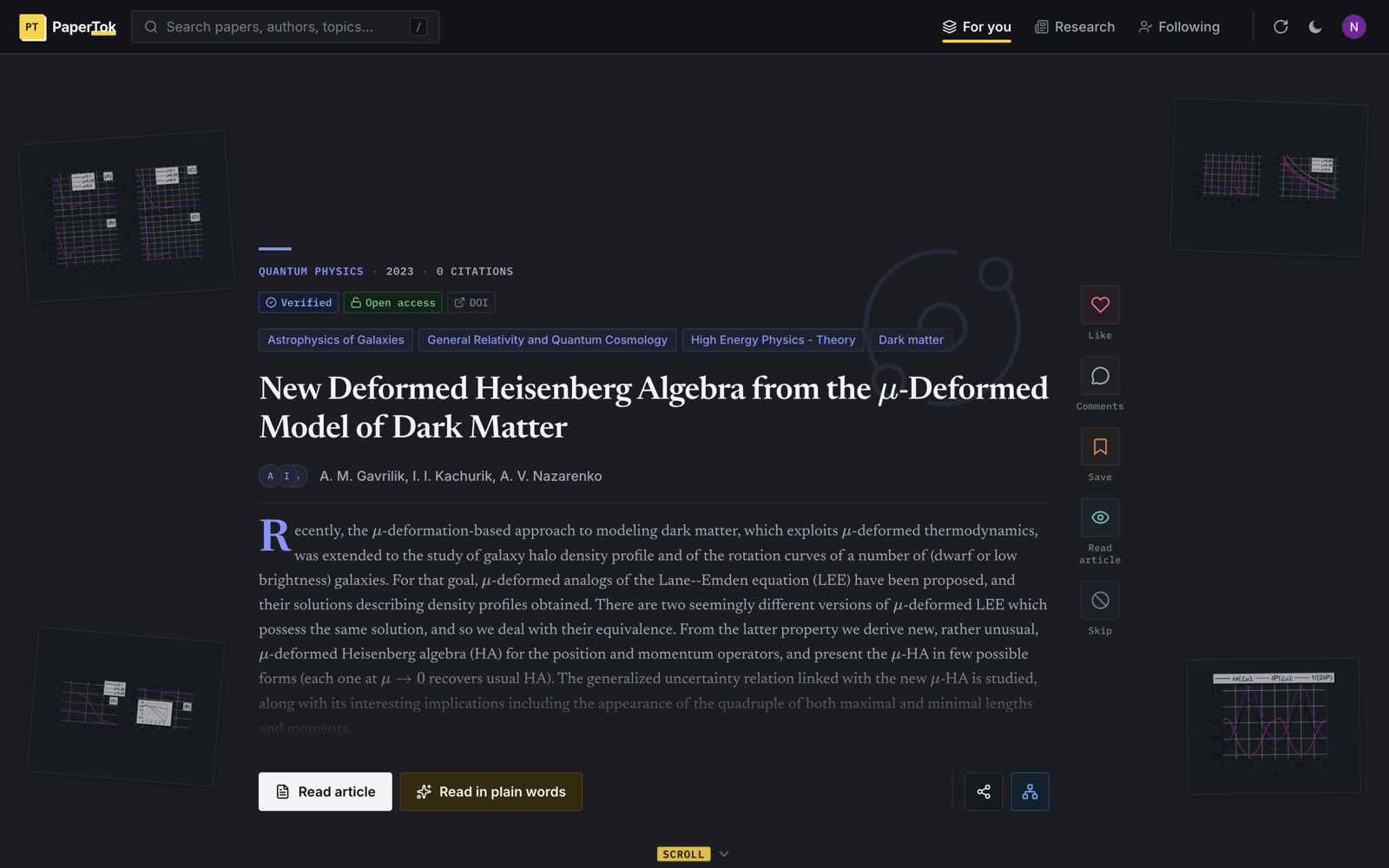
Dark mode. The theme opens as a circle from the toggle itself, follows your system until you choose, and is decided before the first paint — no white flash.
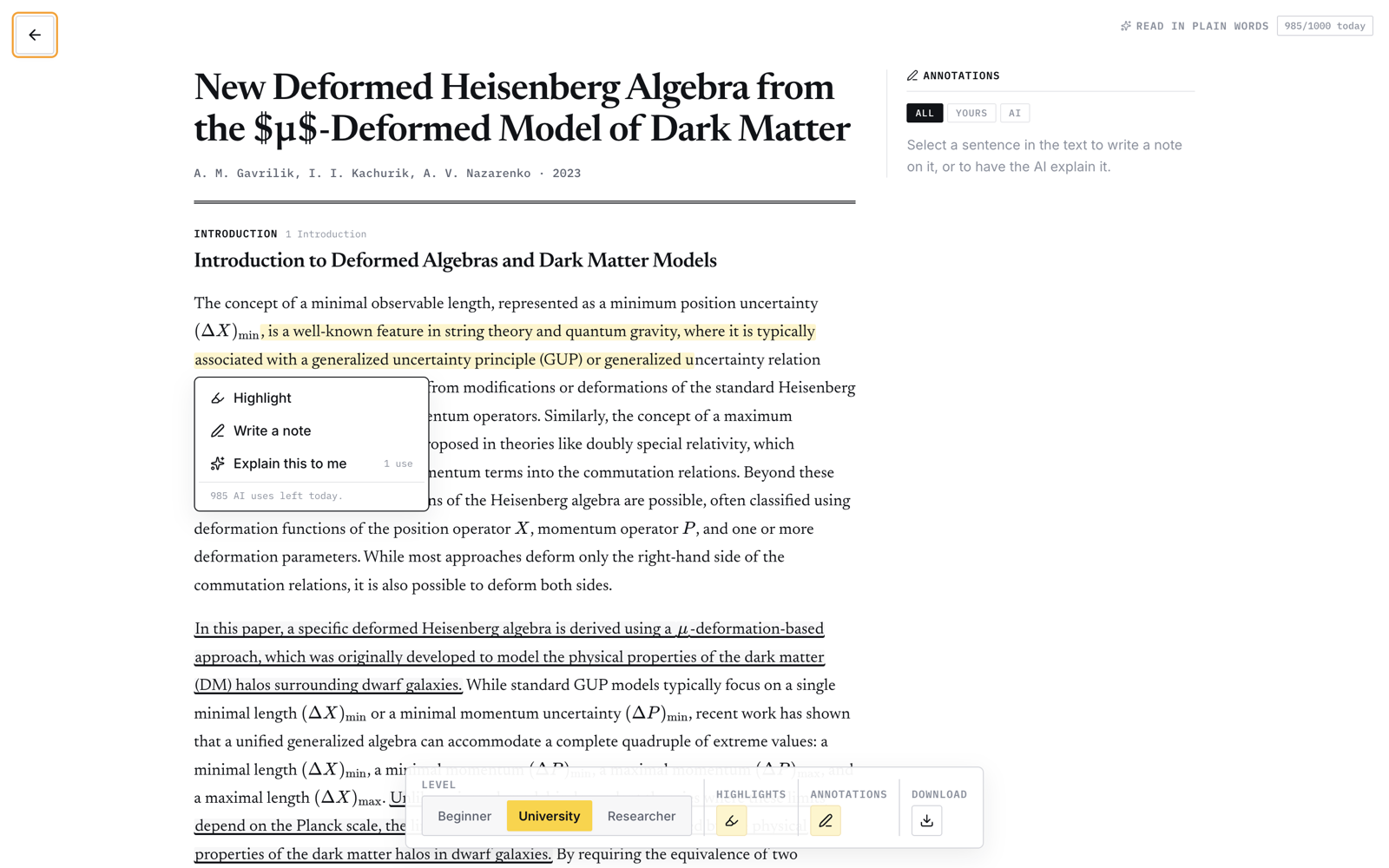
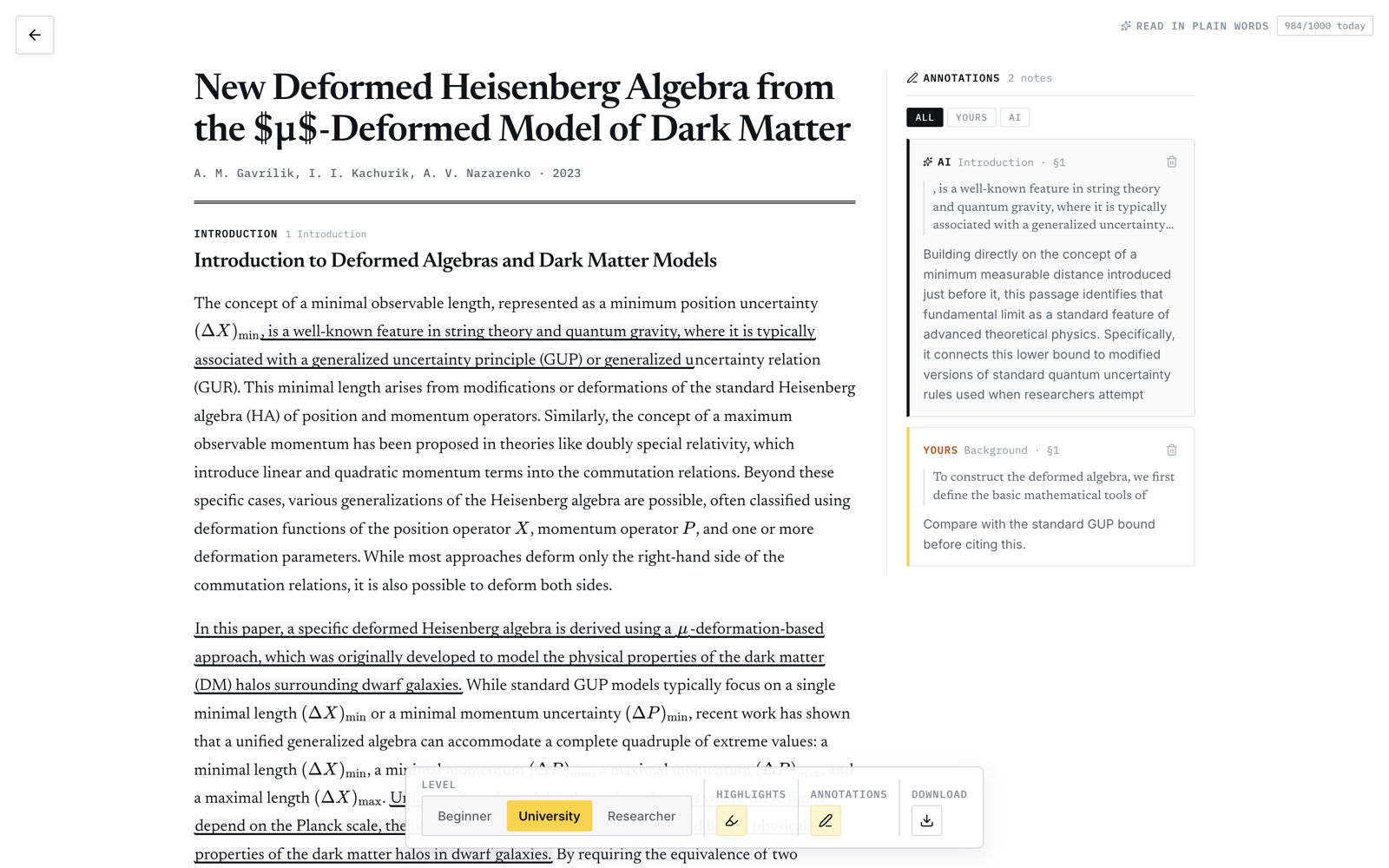
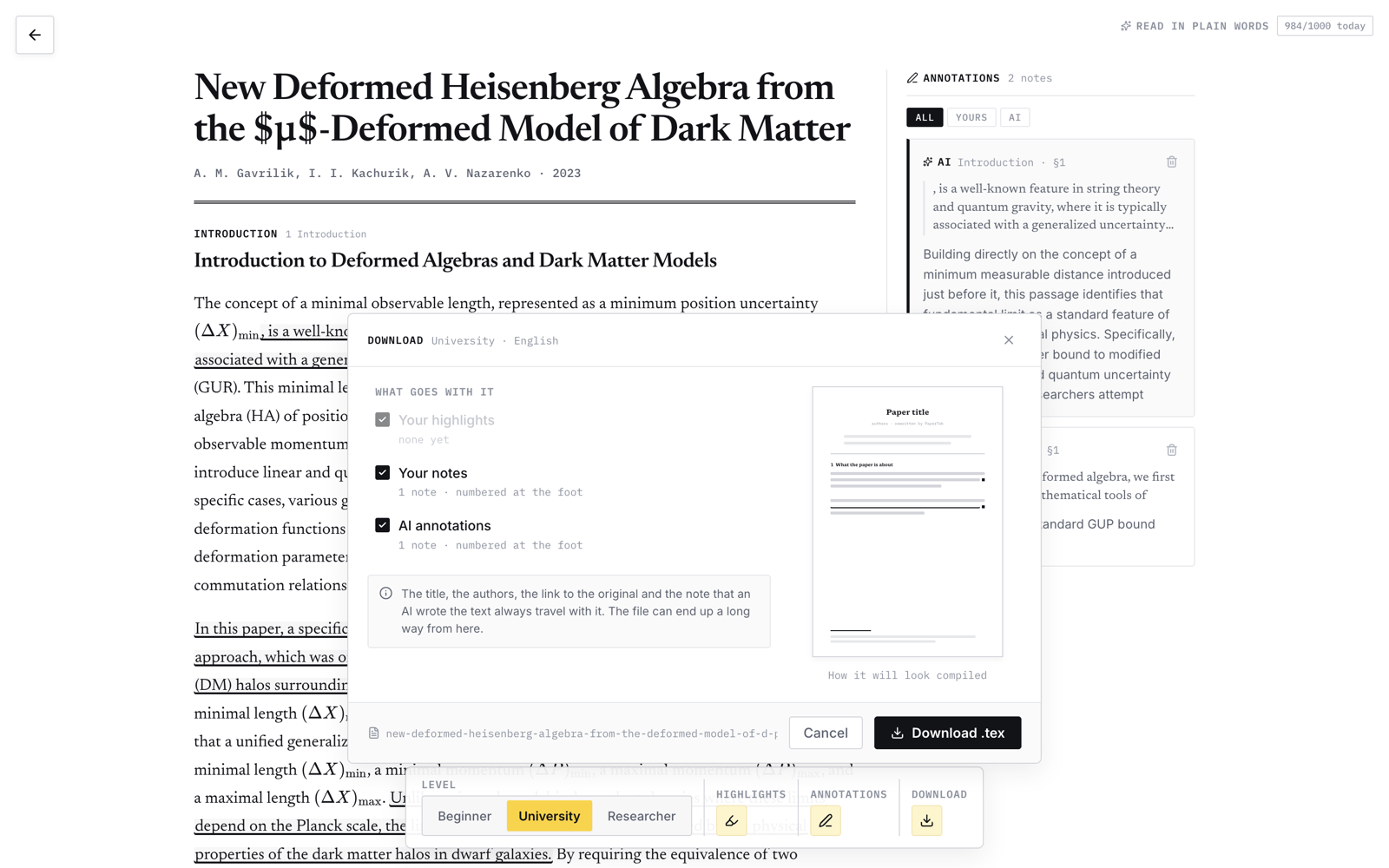
A reader that works with you. "Read in plain words" rewrites any paper at three levels (Beginner, University, Researcher). Select a passage and a menu appears over it: highlight it, write a note on it, or have the AI explain it — the AI option states its price before you spend it, and a failed request is refunded. Everything lands in an annotations rail, your notes with a yellow rule, the AI's with an ink one, saved per paper and account.
Export to LaTeX. Take the rewrite with you as a .tex that compiles with pdfLaTeX as-is — choose which of your highlights and notes travel with it. The title, authors, link to the original and the notice that an AI wrote the text always ship with the file.
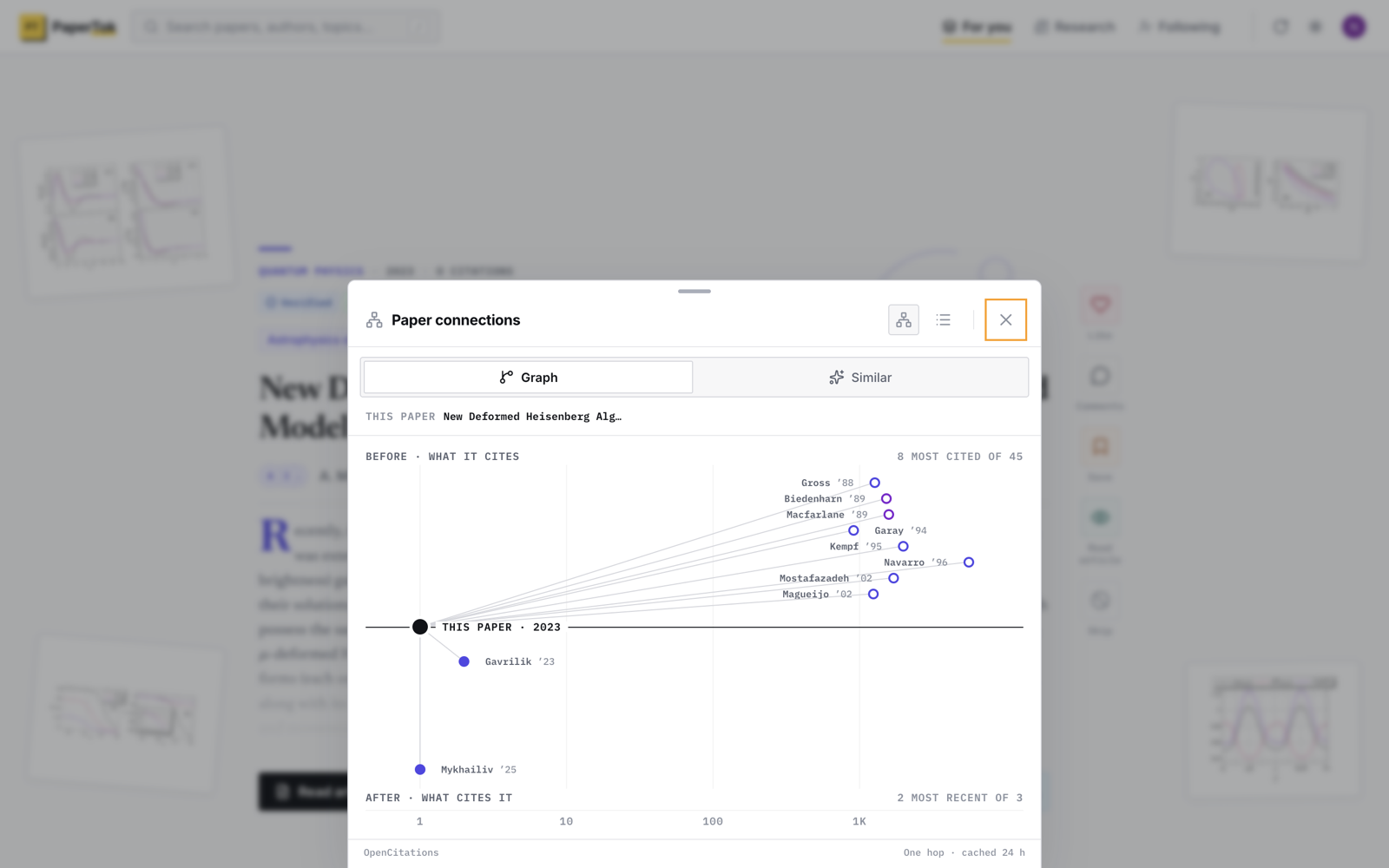
A citation map on every paper. Papers with an identifier get a Paper connections view: the paper on a timeline rule, what it cites above, what cites it below, citations on a logarithmic axis. Walk the graph node by node with a breadcrumb trail back. Works with unknown data are counted honestly instead of being invented into a position.
Search that always lands. Press / anywhere: papers, users, authors, institutions, topics and projects, and every result leads to a real destination — a paper opens its public page instantly, entities open their explorer profiles.
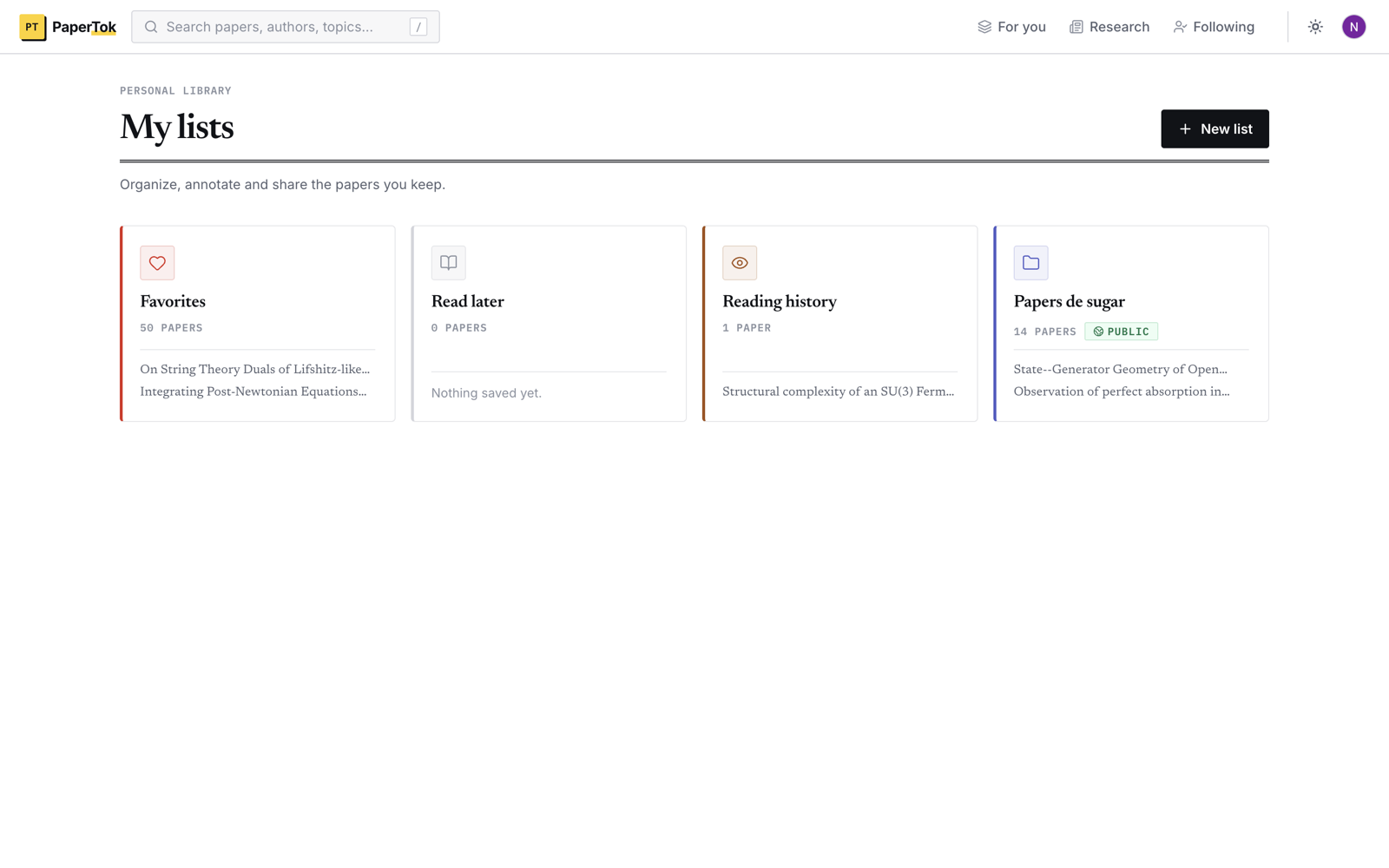
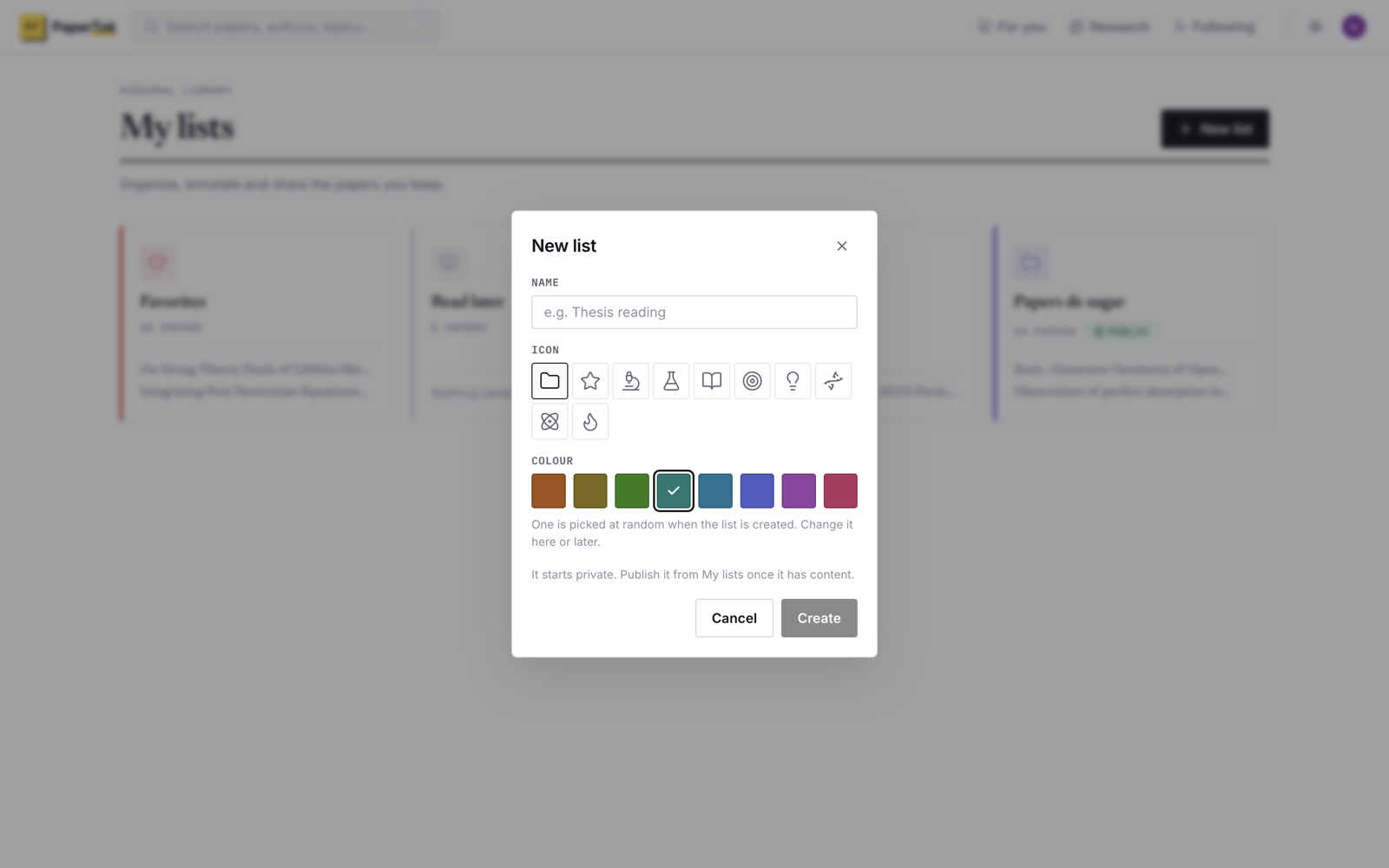
A personal library, in color. Lists carry one of eight colors generated under three constraints (shared lightness, capped chroma, minimum contrast), visible from the library to your public profile.
Honest labels. Every card answers whether a paper passed peer review ("Preprint" / "Verified") and whether you can actually read it ("Open access" / "Open version" / "Subscription") — and shows nothing rather than guessing when the record doesn't say.
Installable. Add PaperTok to your home screen and it opens standalone, with its own icon and a theme-tinted system bar. (No offline mode yet — it still needs the network.)
Research
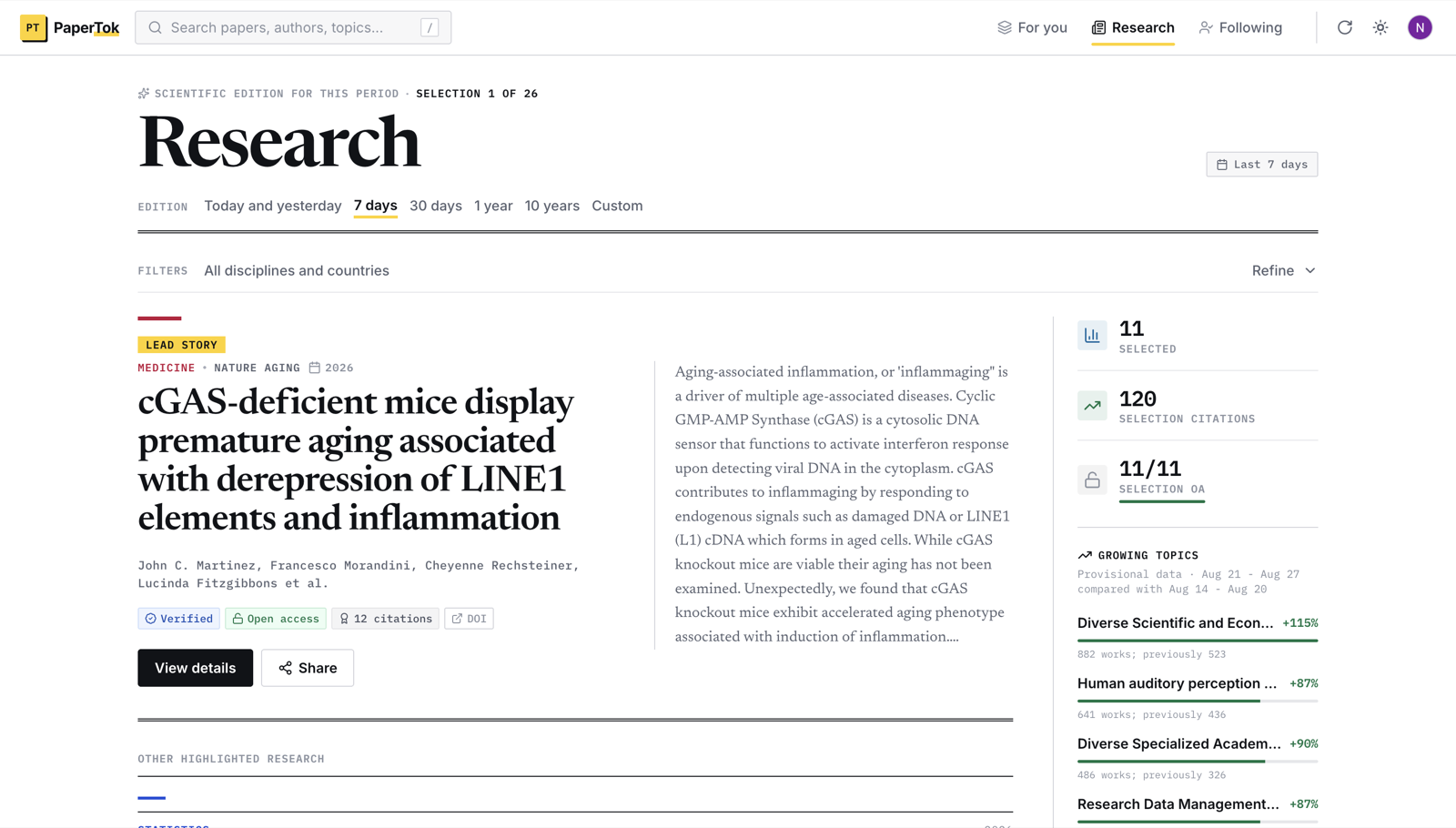
PaperTok also includes a Research section designed for exploring important research over different time periods.
It collects candidates from several scientific sources and ranks them using a combination of relevance, scientific impact, recency and diversity.
The report is intended to answer a slightly different question from the main feed:
What research is worth paying attention to right now?
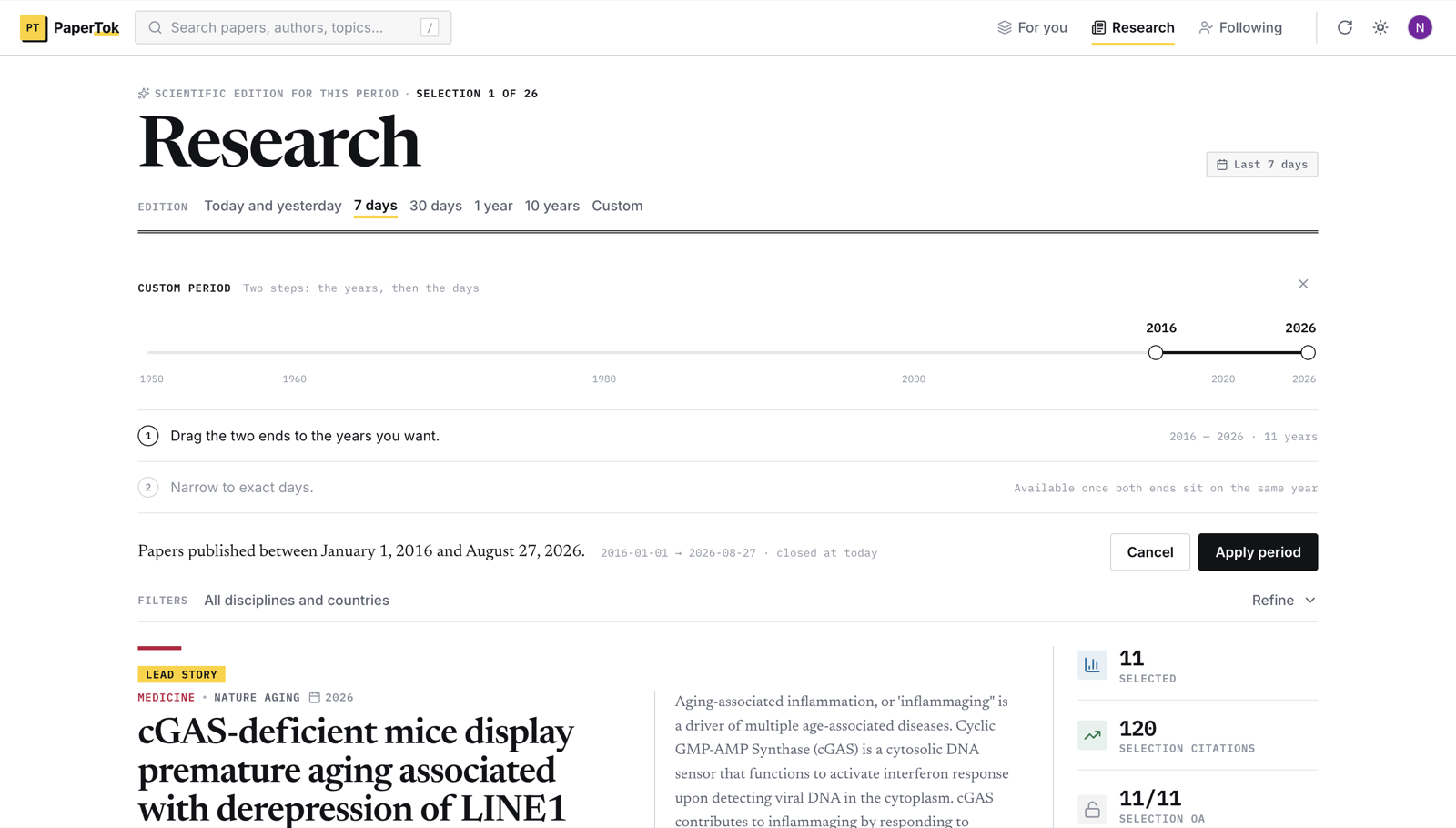
Since 0.2, each edition is laid out like the front section of a newspaper — a lead story, strips and briefs on a six-column measure — with a composition seeded from the edition's identity, so the same edition always renders the same way. Selections page in batches of eleven with explicit closings instead of silently truncating, and next to the fixed periods there is a custom one: drag a year range from 1950 to today, and narrow down to exact days.
Rather than only showing papers from a single database, PaperTok normalizes papers from different providers into a common format before ranking them.
Data sources
PaperTok uses open scientific infrastructure wherever possible.
Core sources include:
- arXiv — preprints across physics, mathematics, computer science and other fields
- OpenAlex — publication metadata, citations, concepts, institutions and open-access information
- PubMed — biomedical and life-science literature
- OpenReview — current conference and journal submissions in machine learning and computer science
- NIH iCite — citation and translation metrics for PubMed-indexed papers
- Hugging Face Hub — AI papers and their linked models, datasets, code and project pages
The project also contains integrations and enrichment tools for additional scientific services and domain-specific sources.
PaperTok does not host research papers itself. Links to papers, PDFs and metadata are obtained from their respective providers.
Recommendation system
The recommendation engine is intentionally built inside the project rather than relying on a black-box recommendation API.
Each candidate paper can receive signals based on:
Explicit preferences
Fields and categories selected by the user.
Learned affinity
Interactions gradually modify the user's affinity with scientific categories and concepts.
Following
Papers can be boosted when they relate to followed authors, topics, institutions or projects.
Recency
New research receives a bounded recency signal.
Scientific impact
Citation information can contribute to ranking without allowing highly cited papers to dominate everything else.
Semantic relevance
Scientific concepts associated with papers can be compared with learned user interests.
Exploration
Some results intentionally come from outside the strongest known preferences to avoid creating an overly narrow feed.
Diversity
The ranking tries to avoid long sequences containing only one type of publication or source.
The recommendation system is still experimental, and one of the main reasons this project is open source is to make its behavior inspectable and easier to improve.
Architecture
PaperTok is primarily built with:
- React
- Vite
- Firebase
- React Router
- Framer Motion
- KaTeX
The frontend is deployed through Vercel (Git-connected: a push to main is a production
deploy, any other branch or PR gets a preview URL). DNS for papertok.app is managed in
Cloudflare.
A Cloudflare Worker is used for server-side functionality such as caching scientific queries, protecting provider credentials and proxying APIs that should not be called directly from the browser. It also serves the AI features — plain-words rewriting and passage explanations — behind a server-enforced daily allowance that reserves usage before the model runs and refunds it on failure.
This keeps the main application lightweight while allowing integrations that require server-side secrets.
Running PaperTok locally
Clone the repository:
git clone https://github.com/mugar123/papertok.git
cd papertok
Install dependencies:
npm install
Start the development server:
npm run dev
Then open the local URL shown by Vite.
You can also create a production build with:
npm run build
and run the test suite with:
npm test
Some integrations require additional environment variables or API credentials. The frontend can still be developed independently, while server-side integrations are handled through the Worker.
See worker/README.md for information about the server-side configuration.
Repository structure
papertok/
├── src/                    React app, scientific services and recommendation logic
├── worker/                 Cloudflare Worker, AI and notifications
├── public/                 Static assets
├── docs/                   Architecture and development guides
├── scripts/diagnostics/    Manual provider and proxy probes
└── vercel.json             Vercel build, SPA fallback, auth proxy and cache headers
Documentation
- Release notes for 0.2
- Architecture
- Development guide
- Public discovery and sharing
- Worker configuration
- Contributing
- Agent guidance
Why I built it
I'm an undergraduate physics student, and PaperTok started as a project to solve a problem I had myself.
When learning about a field, I often don't know the title of the paper I want to read, the author who wrote it, or even the exact keywords I should search for. Traditional search is excellent once you know what you are looking for, but I wanted to experiment with another part of the process: discovery.
What happens if scientific literature is something you can explore?
PaperTok is my attempt to find out.
It has also become a way for me to learn software development, recommendation systems, scientific APIs and open-source development while building something connected to the field I study.
Project status
PaperTok is a work in progress.
Things may change quickly, APIs may occasionally fail, and parts of the architecture are still being redesigned as the project grows.
Current areas of development include:
- improving recommendation quality
- expanding and improving scientific data sources
- better deduplication across providers
- scientific discovery and trend tools
- offline support for the installed app (a service worker)
- a three-state theme control (light / system / dark)
- performance and reliability
- documentation and testing
- making the project easier for other people to contribute to
Contributing
Contributions, suggestions and bug reports are welcome.
If you find something that could be improved, feel free to open an issue or submit a pull request.
Since PaperTok is still evolving quickly, opening an issue before working on a large change is recommended so we can discuss the approach first.
See CONTRIBUTING.md for setup, verification and security guidance.
Donors
PaperTok is a personal open-source project, and some people have chosen to support it with their own money. Thank you.


Acknowledgements
PaperTok relies on the work of open scientific infrastructure projects and research databases that make scholarly metadata accessible to developers and researchers.
In particular, the project would not be possible without services such as arXiv, OpenAlex and PubMed.
The visual direction of the current interface grew out of the initial UI redesign by Samuel — the 0.2 release carries his design through the whole app.
License
PaperTok is available under the MIT License.
Built by Nicolás Muñoz while studying physics and learning how better tools for scientific discovery could work.
Contributors


Similar repos


Languages
HTML
72.0%
JavaScript
24.8%
CSS
3.1%
Open-source personalized scientific discovery feed powered by arXiv, OpenAlex, PubMed and more.
See the codeSee what people are saying (1)
README
PaperTok
A personalized way to discover scientific research.
Open PaperTok · Latest release: 0.2
PaperTok is an open-source web app for discovering research papers through a scrollable, personalized feed.
I started building it as a physics student because I kept running into the same problem: there is an enormous amount of interesting research available online, but discovering papers outside of a very specific search can still be surprisingly difficult.
PaperTok tries to make that process feel more natural.
Instead of knowing exactly what to search for, you can browse papers, interact with the ones that interest you, follow scientific topics and researchers, and gradually get recommendations that better match what you care about.
PaperTok is currently under active development. It is a personal open-source project and not affiliated with arXiv, OpenAlex, PubMed, or any other data provider.
The interface supports Spanish and English. PaperTok selects a default from the visitor's region and also provides a manual language setting.
What PaperTok does
PaperTok brings scientific literature from multiple sources into a common discovery experience.
The main feed is personalized using signals such as:
- scientific fields and categories you are interested in
- papers you interact with
- learned affinities with research topics
- authors, topics, institutions and projects you follow
- publication recency
- citation information
- semantic concepts
- exploration outside your usual interests
- content diversity
The goal is not simply to rank the most popular papers, but to help each person discover research that is relevant to them while still leaving room for unexpected and interesting results.
A tour of PaperTok
The current look comes from an editorial redesign — serif headlines, ruled sections, one accent of yellow — whose visual direction was set by Samuel's initial UI redesign. Version 0.2 carries it through the whole app. The full changelog with screenshots lives in the 0.2 release notes; these are the highlights.
Dark mode. The theme opens as a circle from the toggle itself, follows your system until you choose, and is decided before the first paint — no white flash.
A reader that works with you. "Read in plain words" rewrites any paper at three levels (Beginner, University, Researcher). Select a passage and a menu appears over it: highlight it, write a note on it, or have the AI explain it — the AI option states its price before you spend it, and a failed request is refunded. Everything lands in an annotations rail, your notes with a yellow rule, the AI's with an ink one, saved per paper and account.
Export to LaTeX. Take the rewrite with you as a .tex that compiles with pdfLaTeX as-is — choose which of your highlights and notes travel with it. The title, authors, link to the original and the notice that an AI wrote the text always ship with the file.
A citation map on every paper. Papers with an identifier get a Paper connections view: the paper on a timeline rule, what it cites above, what cites it below, citations on a logarithmic axis. Walk the graph node by node with a breadcrumb trail back. Works with unknown data are counted honestly instead of being invented into a position.
Search that always lands. Press / anywhere: papers, users, authors, institutions, topics and projects, and every result leads to a real destination — a paper opens its public page instantly, entities open their explorer profiles.
A personal library, in color. Lists carry one of eight colors generated under three constraints (shared lightness, capped chroma, minimum contrast), visible from the library to your public profile.
Honest labels. Every card answers whether a paper passed peer review ("Preprint" / "Verified") and whether you can actually read it ("Open access" / "Open version" / "Subscription") — and shows nothing rather than guessing when the record doesn't say.
Installable. Add PaperTok to your home screen and it opens standalone, with its own icon and a theme-tinted system bar. (No offline mode yet — it still needs the network.)
Research
PaperTok also includes a Research section designed for exploring important research over different time periods.
It collects candidates from several scientific sources and ranks them using a combination of relevance, scientific impact, recency and diversity.
The report is intended to answer a slightly different question from the main feed:
What research is worth paying attention to right now?
Since 0.2, each edition is laid out like the front section of a newspaper — a lead story, strips and briefs on a six-column measure — with a composition seeded from the edition's identity, so the same edition always renders the same way. Selections page in batches of eleven with explicit closings instead of silently truncating, and next to the fixed periods there is a custom one: drag a year range from 1950 to today, and narrow down to exact days.
Rather than only showing papers from a single database, PaperTok normalizes papers from different providers into a common format before ranking them.
Data sources
PaperTok uses open scientific infrastructure wherever possible.
Core sources include:
- arXiv — preprints across physics, mathematics, computer science and other fields
- OpenAlex — publication metadata, citations, concepts, institutions and open-access information
- PubMed — biomedical and life-science literature
- OpenReview — current conference and journal submissions in machine learning and computer science
- NIH iCite — citation and translation metrics for PubMed-indexed papers
- Hugging Face Hub — AI papers and their linked models, datasets, code and project pages
The project also contains integrations and enrichment tools for additional scientific services and domain-specific sources.
PaperTok does not host research papers itself. Links to papers, PDFs and metadata are obtained from their respective providers.
Recommendation system
The recommendation engine is intentionally built inside the project rather than relying on a black-box recommendation API.
Each candidate paper can receive signals based on:
Explicit preferences
Fields and categories selected by the user.
Learned affinity
Interactions gradually modify the user's affinity with scientific categories and concepts.
Following
Papers can be boosted when they relate to followed authors, topics, institutions or projects.
Recency
New research receives a bounded recency signal.
Scientific impact
Citation information can contribute to ranking without allowing highly cited papers to dominate everything else.
Semantic relevance
Scientific concepts associated with papers can be compared with learned user interests.
Exploration
Some results intentionally come from outside the strongest known preferences to avoid creating an overly narrow feed.
Diversity
The ranking tries to avoid long sequences containing only one type of publication or source.
The recommendation system is still experimental, and one of the main reasons this project is open source is to make its behavior inspectable and easier to improve.
Architecture
PaperTok is primarily built with:
- React
- Vite
- Firebase
- React Router
- Framer Motion
- KaTeX
The frontend is deployed through Vercel (Git-connected: a push to main is a production
deploy, any other branch or PR gets a preview URL). DNS for papertok.app is managed in
Cloudflare.
A Cloudflare Worker is used for server-side functionality such as caching scientific queries, protecting provider credentials and proxying APIs that should not be called directly from the browser. It also serves the AI features — plain-words rewriting and passage explanations — behind a server-enforced daily allowance that reserves usage before the model runs and refunds it on failure.
This keeps the main application lightweight while allowing integrations that require server-side secrets.
Running PaperTok locally
Clone the repository:
git clone https://github.com/mugar123/papertok.git
cd papertok
Install dependencies:
npm install
Start the development server:
npm run dev
Then open the local URL shown by Vite.
You can also create a production build with:
npm run build
and run the test suite with:
npm test
Some integrations require additional environment variables or API credentials. The frontend can still be developed independently, while server-side integrations are handled through the Worker.
See worker/README.md for information about the server-side configuration.
Repository structure
papertok/
├── src/                    React app, scientific services and recommendation logic
├── worker/                 Cloudflare Worker, AI and notifications
├── public/                 Static assets
├── docs/                   Architecture and development guides
├── scripts/diagnostics/    Manual provider and proxy probes
└── vercel.json             Vercel build, SPA fallback, auth proxy and cache headers
Documentation
- Release notes for 0.2
- Architecture
- Development guide
- Public discovery and sharing
- Worker configuration
- Contributing
- Agent guidance
Why I built it
I'm an undergraduate physics student, and PaperTok started as a project to solve a problem I had myself.
When learning about a field, I often don't know the title of the paper I want to read, the author who wrote it, or even the exact keywords I should search for. Traditional search is excellent once you know what you are looking for, but I wanted to experiment with another part of the process: discovery.
What happens if scientific literature is something you can explore?
PaperTok is my attempt to find out.
It has also become a way for me to learn software development, recommendation systems, scientific APIs and open-source development while building something connected to the field I study.
Project status
PaperTok is a work in progress.
Things may change quickly, APIs may occasionally fail, and parts of the architecture are still being redesigned as the project grows.
Current areas of development include:
- improving recommendation quality
- expanding and improving scientific data sources
- better deduplication across providers
- scientific discovery and trend tools
- offline support for the installed app (a service worker)
- a three-state theme control (light / system / dark)
- performance and reliability
- documentation and testing
- making the project easier for other people to contribute to
Contributing
Contributions, suggestions and bug reports are welcome.
If you find something that could be improved, feel free to open an issue or submit a pull request.
Since PaperTok is still evolving quickly, opening an issue before working on a large change is recommended so we can discuss the approach first.
See CONTRIBUTING.md for setup, verification and security guidance.
Donors
PaperTok is a personal open-source project, and some people have chosen to support it with their own money. Thank you.
Acknowledgements
PaperTok relies on the work of open scientific infrastructure projects and research databases that make scholarly metadata accessible to developers and researchers.
In particular, the project would not be possible without services such as arXiv, OpenAlex and PubMed.
The visual direction of the current interface grew out of the initial UI redesign by Samuel — the 0.2 release carries his design through the whole app.
License
PaperTok is available under the MIT License.
Built by Nicolás Muñoz while studying physics and learning how better tools for scientific discovery could work.
Similar repos
Contributors
Languages
HTML
72.0%
JavaScript
24.8%
CSS
3.1%