
[ICLR 2024] Domain-Agnostic Molecular Generation with Chemical Feedback
See the codeREADME
⚗️ MolGen
Domain-Agnostic Molecular Generation with Chemical Feedback


🔔 News
2024-2We've released ChatCell, a new paradigm that leverages natural language to make single-cell analysis more accessible and intuitive. Please visit our homepage and Github page for more information.2024-1Our paper Domain-Agnostic Molecular Generation with Chemical Feedback is accepted by ICLR 2024.2024-1Our paper Mol-Instructions: A Large-Scale Biomolecular Instruction Dataset for Large Language Models is accepted by ICLR 2024.2023-10We open-source MolGen-7b, which now supports de novo molecule generation!2023-6We open-source KnowLM, a knowledgeable LLM framework with pre-training and instruction fine-tuning code (supports multi-machine multi-GPU setup).2023-6We release Mol-Instructions, a large-scale biomolecule instruction dataset for large language models.2023-5We propose Knowledge graph-enhanced molecular contrAstive learning with fuNctional prOmpt (KANO) onNature Machine Intelligence, exploiting fundamental domain knowledge in both pre-training and fine-tuning.2023-4We provide a NLP for science paper-list at https://github.com/zjunlp/NLP4Science_Papers.2023-3We release our pre-trained and fine-tuned model on 🤗 Hugging Face at MolGen-large and MolGen-large-opt.2023-2We provide a demo on 🤗 Hugging Face at Space.
📕 Requirements
To run the codes, You can configure dependencies by restoring our environment:
conda env create -f environment.yaml
and then:
conda activate my_env
📚 Resource Download
You can download the pre-trained and fine-tuned models via Huggingface: MolGen-large and MolGen-large-opt.
You can also download the model using the following link: https://drive.google.com/drive/folders/1Eelk_RX1I26qLa9c4SZq6Tv-AAbDXgrW?usp=sharing
Moreover, the dataset used for downstream tasks can be found here.
The expected structure of files is:
moldata
├── checkpoint
│   ├── molgen.pkl              # pre-trained model
│   ├── syn_qed_model.pkl       # fine-tuned model for QED optimization on synthetic data
│   ├── syn_plogp_model.pkl     # fine-tuned model for p-logP optimization on synthetic data
│   ├── np_qed_model.pkl        # fine-tuned model for QED optimization on natural product data
│   ├── np_plogp_model.pkl      # fine-tuned model for p-logP optimization on natural product data
├── finetune
│   ├── np_test.csv             # nature product test data
│   ├── np_train.csv            # nature product train data
│   ├── plogp_test.csv          # synthetic test data for plogp optimization
│   ├── qed_test.csv            # synthetic test data for plogp optimization
│   └── zinc250k.csv            # synthetic train data
├── generate                    # generate molecules
├── output                      # molecule candidates
└── vocab_list
    └── zinc.npy                # SELFIES alphabet
🚀 How to run
-
Fine-tune
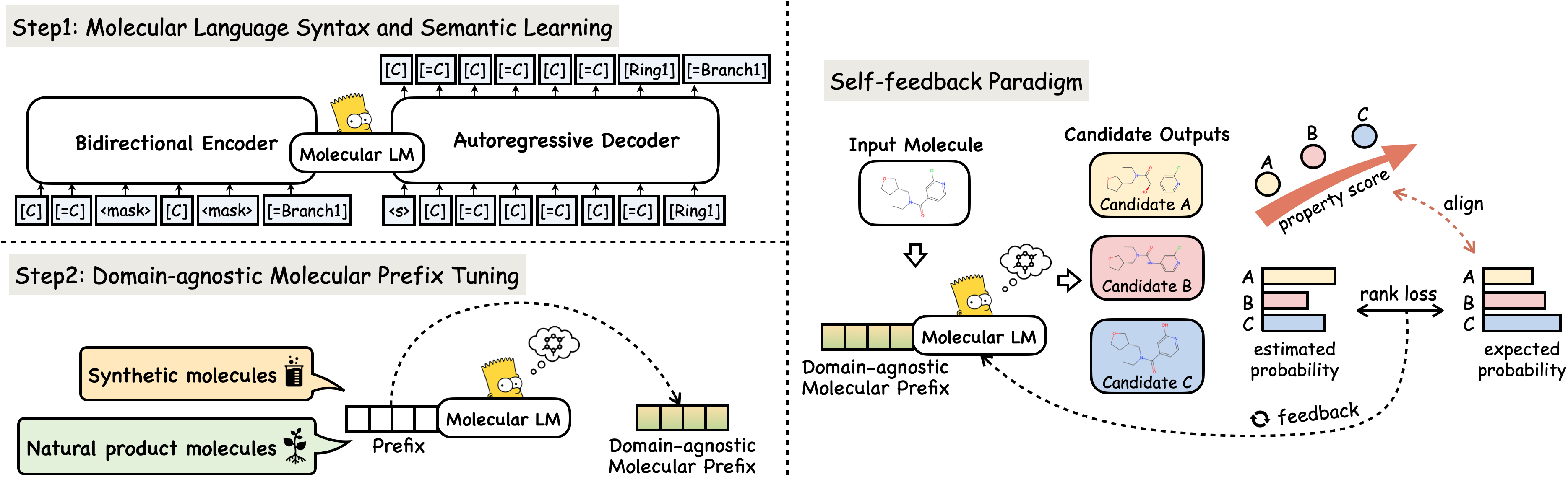
- First, preprocess the finetuning dataset by generating candidate molecules using our pre-trained model. The preprocessed data will be stored in the folder
output.
cd MolGen bash preprocess.sh- Then utilize the self-feedback paradigm. The fine-tuned model will be stored in the folder
checkpoint.
bash finetune.sh - First, preprocess the finetuning dataset by generating candidate molecules using our pre-trained model. The preprocessed data will be stored in the folder
-
Generate
To generate molecules, run this script. Please specify the
checkpoint_pathto determine whether to use the pre-trained model or the fine-tuned model.cd MolGen bash generate.sh
🥽 Experiments
We conduct experiments on well-known benchmarks to confirm MolGen's optimization capabilities, encompassing penalized logP, QED, and molecular docking properties. For detailed experimental settings and analysis, please refer to our paper.
-
MolGen captures real-word molecular distributions
-
MolGen mitigates molecular hallucinations
Targeted molecule discovery
Constrained molecular optimization
Citation
If you use or extend our work, please cite the paper as follows:
@inproceedings{fang2023domain,
  author       = {Yin Fang and
                  Ningyu Zhang and
                  Zhuo Chen and
                  Xiaohui Fan and
                  Huajun Chen},
  title        = {Domain-Agnostic Molecular Generation with Chemical feedback},
  booktitle    = {{ICLR}},
  publisher    = {OpenReview.net},
  year         = {2024},
  url          = {https://openreview.net/pdf?id=9rPyHyjfwP}
}
Contributors


Similar repos




Languages
Python
98.0%
Shell
2.0%
[ICLR 2024] Domain-Agnostic Molecular Generation with Chemical Feedback
See the codeREADME
⚗️ MolGen
Domain-Agnostic Molecular Generation with Chemical Feedback
🔔 News
2024-2We've released ChatCell, a new paradigm that leverages natural language to make single-cell analysis more accessible and intuitive. Please visit our homepage and Github page for more information.2024-1Our paper Domain-Agnostic Molecular Generation with Chemical Feedback is accepted by ICLR 2024.2024-1Our paper Mol-Instructions: A Large-Scale Biomolecular Instruction Dataset for Large Language Models is accepted by ICLR 2024.2023-10We open-source MolGen-7b, which now supports de novo molecule generation!2023-6We open-source KnowLM, a knowledgeable LLM framework with pre-training and instruction fine-tuning code (supports multi-machine multi-GPU setup).2023-6We release Mol-Instructions, a large-scale biomolecule instruction dataset for large language models.2023-5We propose Knowledge graph-enhanced molecular contrAstive learning with fuNctional prOmpt (KANO) onNature Machine Intelligence, exploiting fundamental domain knowledge in both pre-training and fine-tuning.2023-4We provide a NLP for science paper-list at https://github.com/zjunlp/NLP4Science_Papers.2023-3We release our pre-trained and fine-tuned model on 🤗 Hugging Face at MolGen-large and MolGen-large-opt.2023-2We provide a demo on 🤗 Hugging Face at Space.
📕 Requirements
To run the codes, You can configure dependencies by restoring our environment:
conda env create -f environment.yaml
and then:
conda activate my_env
📚 Resource Download
You can download the pre-trained and fine-tuned models via Huggingface: MolGen-large and MolGen-large-opt.
You can also download the model using the following link: https://drive.google.com/drive/folders/1Eelk_RX1I26qLa9c4SZq6Tv-AAbDXgrW?usp=sharing
Moreover, the dataset used for downstream tasks can be found here.
The expected structure of files is:
moldata
├── checkpoint
│   ├── molgen.pkl              # pre-trained model
│   ├── syn_qed_model.pkl       # fine-tuned model for QED optimization on synthetic data
│   ├── syn_plogp_model.pkl     # fine-tuned model for p-logP optimization on synthetic data
│   ├── np_qed_model.pkl        # fine-tuned model for QED optimization on natural product data
│   ├── np_plogp_model.pkl      # fine-tuned model for p-logP optimization on natural product data
├── finetune
│   ├── np_test.csv             # nature product test data
│   ├── np_train.csv            # nature product train data
│   ├── plogp_test.csv          # synthetic test data for plogp optimization
│   ├── qed_test.csv            # synthetic test data for plogp optimization
│   └── zinc250k.csv            # synthetic train data
├── generate                    # generate molecules
├── output                      # molecule candidates
└── vocab_list
    └── zinc.npy                # SELFIES alphabet
🚀 How to run
-
Fine-tune
- First, preprocess the finetuning dataset by generating candidate molecules using our pre-trained model. The preprocessed data will be stored in the folder
output.
cd MolGen bash preprocess.sh- Then utilize the self-feedback paradigm. The fine-tuned model will be stored in the folder
checkpoint.
bash finetune.sh - First, preprocess the finetuning dataset by generating candidate molecules using our pre-trained model. The preprocessed data will be stored in the folder
-
Generate
To generate molecules, run this script. Please specify the
checkpoint_pathto determine whether to use the pre-trained model or the fine-tuned model.cd MolGen bash generate.sh
🥽 Experiments
We conduct experiments on well-known benchmarks to confirm MolGen's optimization capabilities, encompassing penalized logP, QED, and molecular docking properties. For detailed experimental settings and analysis, please refer to our paper.
-
MolGen captures real-word molecular distributions
-
MolGen mitigates molecular hallucinations
Targeted molecule discovery
Constrained molecular optimization
Citation
If you use or extend our work, please cite the paper as follows:
@inproceedings{fang2023domain,
  author       = {Yin Fang and
                  Ningyu Zhang and
                  Zhuo Chen and
                  Xiaohui Fan and
                  Huajun Chen},
  title        = {Domain-Agnostic Molecular Generation with Chemical feedback},
  booktitle    = {{ICLR}},
  publisher    = {OpenReview.net},
  year         = {2024},
  url          = {https://openreview.net/pdf?id=9rPyHyjfwP}
}
Similar repos
Contributors
Languages
Python
98.0%
Shell
2.0%