
The Next Step Forward in Multimodal LLM Alignment
See the codeREADME

[📖 arXiv Paper] [📊 MM-RLHF Data] [📝 Homepage]
[🏆 Reward Model] [🔮 MM-RewardBench] [🔮 MM-SafetyBench] [📈 Evaluation Suite]
The Next Step Forward in Multimodal LLM Alignment
[2025/05/01] 🔥 MM-RLHF has now been accepted by ICML 2025.
[2025/03/04] 🔥 MM-RLHF is now available on model scope.
[2025/02/27] 🔥 MM-RLHF is now fully supported by swift. Simply process your data using scripts/convert_to_swift.py and execute the scripts/swift.sh command to get started.
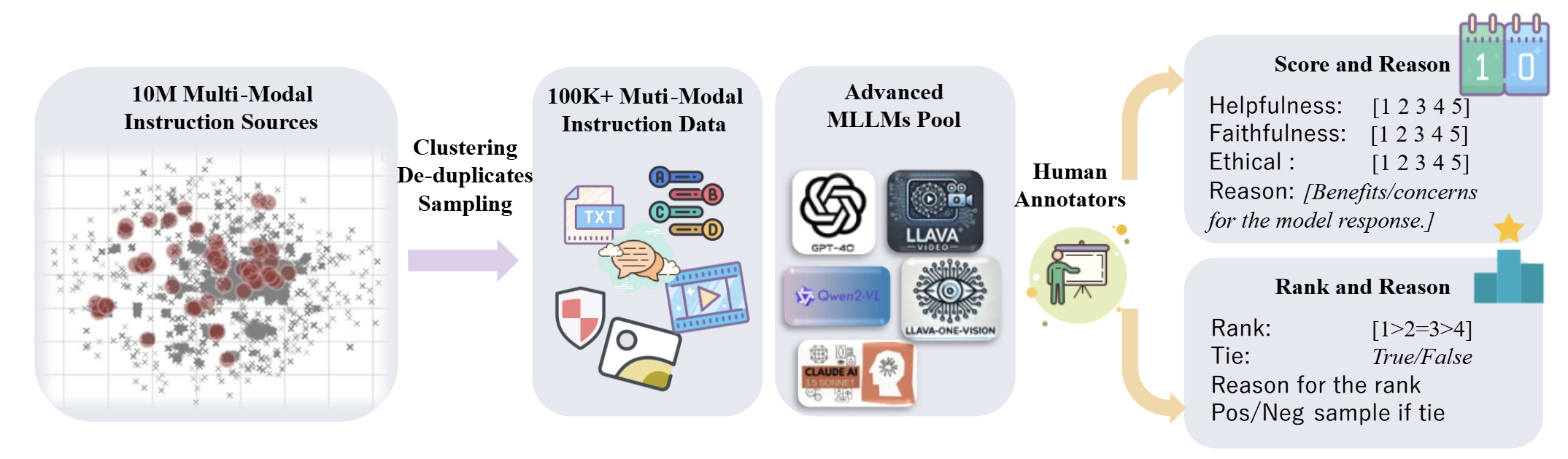
[2025/02/10] 🔥 We are proud to open-source MM-RLHF, a comprehensive project for aligning Multimodal Large Language Models (MLLMs) with human preferences. This release includes:
- A high-quality MLLM alignment dataset (120K samples, created by over 50 experts over two months, including ratings and manual annotations across eight dimensions.).
- A strong Critique-Based MLLM reward model which is trained on human annotations, achieving state-of-the-art (SOTA) performance on public benchmarks.
- A novel alignment algorithm MM-DPO, effectively integrates reward signals to improve the data efficiency of DPO training..
- Two new benchmarks designed for the reward model and multimodal safety, addressing gaps in existing benchmarks in these areas..
Our dataset and algorithms enable consistent performance improvements across 10 dimensions and 27 benchmarks for open-source MLLMs.
Key Components
1. MM-RLHF Dataset (data.jsonl in MM-RLHF Data)
- 20k instructions covering image understanding, video understanding, and safety-related tasks.
- Each instruction includes 3-5 model-generated responses, along with human-annotated scores, rankings, and fine-grained textual feedback.
- 80k comparison pairs derived from ranked samples for each instruction, suitable for RLHF training.
2. Critique-Based MLLM Reward Model
- We release the MM-RLHF-Reward-7B, a Critique-Based Reward Model that generates critiques of candidate texts before assigning scores, offering enhanced interpretability and more informative feedback.
- Includes the training algorithm for the reward model, enabling researchers to reproduce and extend our work.
3. MM-DPO Algorithm
- Complete training code for MM-DPO, a novel alignment algorithm that achieves significant performance gains with simple adjustments to the DPO framework.
4. MM-RLHF Benchmarks
- MM-RLHF-RewardBench: Evaluates the quality of reward models.
- MM-RLHF-SafetyBench: Focuses on MLLM safety, including tasks like adversarial attacks, red teaming, jailbreaking, and harmful content detection.
Models & Scripts
Installation
1. Clone this repository and navigate to the LLaVA folder:
git clone https://github.com/yfzhang114/MM-RLHF
cd MM-RLHF
Install the inference package:
conda create -n llava python=3.10 -y
conda activate llava
pip install --upgrade pip  # Enable PEP 660 support.
pip install -e .
pip install -e ".[train]"
pip install flash-attn --no-build-isolation
2. Data Preparation
Download 📊 MM-RLHF Data, unzip the image and video datasets, and the final structure should look like this:
MM-RLHF
-- | long
-- | mcq
-- | safety
-- | short
-- | data.jsonl
-- | dpo_pairs.jsonl
Here, data.jsonl contains all labeled information, and dpo_pairs.jsonl contains pairs of different ranks used for subsequent DPO and reward model training. The other folders contain the image and video frames.
3. Critique-Based MLLM Reward Model:
Specify the model to learn the critic and provide the reward's loss weight, such as critic_rewards_weight and float_rewards_weight.
sh scripts/train/critic_reward_7b.sh
4. MM-DPO Training:
Step 1: Precompute Logits with Reference Model
To save GPU memory during DPO training, precompute logits using the reference model. Specify DATA_PATH and OUTPUT_DATA_PATH in the script.
sh scripts/train/generate_ref_logits.sh
The output file will add elements like "reference_chosen_logp" and "reference_rejected_logp" to the data.
Step 2: Run DPO Algorithm with Precomputed Logits
sh scripts/train/dpo_ov7b.sh
5. Evaluation
For alignment models, the evaluation code is available in the mmrlhf-eval repository. This code provides various evaluation tasks that test the alignment capabilities of your model across multiple benchmarks. These benchmarks include standard tests for model robustness, safety, and hallucination handling in multimodal contexts.
For reward models, we offer the MM-RLHF-RewardBench (available on Hugging Face at MM-RLHF-RewardBench) for detailed evaluation. To perform the evaluation, download the required images and the mm_reward_bench.jsonl file from the repository and place them in the appropriate directories. Then, follow these steps:
-
Download the dataset and necessary files:
- Ensure the repository contains the image data and the
mm_reward_bench.jsonlfile in the designated folder (path_to_data/).
- Ensure the repository contains the image data and the
-
Run the reward model evaluation: This step involves evaluating the reward model against the dataset by running the following command:
python llava/eval/eval_mm_reward_bench.py --model-path your_reward_model --question-file path_to_data/mm_reward_bench.jsonl --answers-file your_answer_file -
Calculate performance metrics: After generating the answer file, you can calculate the performance of your reward model by running the following command:
python llava/eval/cal_performance_mmreward_bench.py --input_file your_answer_file
Citation
If you find it useful for your research and applications, please cite related papers/blogs using this BibTeX:
@article{zhang2025mm,
  title={MM-RLHF: The Next Step Forward in Multimodal LLM Alignment},
  author={Zhang, Yi-Fan and Yu, Tao and Tian, Haochen and Fu, Chaoyou and Li, Peiyan and Zeng, Jianshu and Xie, Wulin and Shi, Yang and Zhang, Huanyu and Wu, Junkang and others},
  journal={arXiv preprint arXiv:2502.10391},
  year={2025}
}
Related Projects
- MME-RealWorld: Could Your Multimodal LLM Challenge High-Resolution Real-World Scenarios that are Difficult for Humans?
- MME-Survey: A Comprehensive Survey on Evaluation of Multimodal LLMs
- Beyond LLaVA-HD: Diving into High-Resolution Large Multimodal Models
- VITA-1.5: Towards GPT-4o Level Real-Time Vision and Speech Interaction
Contributors

19 commits
Similar repos





Languages
Python
99.4%
The Next Step Forward in Multimodal LLM Alignment
See the codeREADME
[📖 arXiv Paper] [📊 MM-RLHF Data] [📝 Homepage]
[🏆 Reward Model] [🔮 MM-RewardBench] [🔮 MM-SafetyBench] [📈 Evaluation Suite]
The Next Step Forward in Multimodal LLM Alignment
[2025/05/01] 🔥 MM-RLHF has now been accepted by ICML 2025.
[2025/03/04] 🔥 MM-RLHF is now available on model scope.
[2025/02/27] 🔥 MM-RLHF is now fully supported by swift. Simply process your data using scripts/convert_to_swift.py and execute the scripts/swift.sh command to get started.
[2025/02/10] 🔥 We are proud to open-source MM-RLHF, a comprehensive project for aligning Multimodal Large Language Models (MLLMs) with human preferences. This release includes:
- A high-quality MLLM alignment dataset (120K samples, created by over 50 experts over two months, including ratings and manual annotations across eight dimensions.).
- A strong Critique-Based MLLM reward model which is trained on human annotations, achieving state-of-the-art (SOTA) performance on public benchmarks.
- A novel alignment algorithm MM-DPO, effectively integrates reward signals to improve the data efficiency of DPO training..
- Two new benchmarks designed for the reward model and multimodal safety, addressing gaps in existing benchmarks in these areas..
Our dataset and algorithms enable consistent performance improvements across 10 dimensions and 27 benchmarks for open-source MLLMs.
Key Components
1. MM-RLHF Dataset (data.jsonl in MM-RLHF Data)
- 20k instructions covering image understanding, video understanding, and safety-related tasks.
- Each instruction includes 3-5 model-generated responses, along with human-annotated scores, rankings, and fine-grained textual feedback.
- 80k comparison pairs derived from ranked samples for each instruction, suitable for RLHF training.
2. Critique-Based MLLM Reward Model
- We release the MM-RLHF-Reward-7B, a Critique-Based Reward Model that generates critiques of candidate texts before assigning scores, offering enhanced interpretability and more informative feedback.
- Includes the training algorithm for the reward model, enabling researchers to reproduce and extend our work.
3. MM-DPO Algorithm
- Complete training code for MM-DPO, a novel alignment algorithm that achieves significant performance gains with simple adjustments to the DPO framework.
4. MM-RLHF Benchmarks
- MM-RLHF-RewardBench: Evaluates the quality of reward models.
- MM-RLHF-SafetyBench: Focuses on MLLM safety, including tasks like adversarial attacks, red teaming, jailbreaking, and harmful content detection.
Models & Scripts
Installation
1. Clone this repository and navigate to the LLaVA folder:
git clone https://github.com/yfzhang114/MM-RLHF
cd MM-RLHF
Install the inference package:
conda create -n llava python=3.10 -y
conda activate llava
pip install --upgrade pip  # Enable PEP 660 support.
pip install -e .
pip install -e ".[train]"
pip install flash-attn --no-build-isolation
2. Data Preparation
Download 📊 MM-RLHF Data, unzip the image and video datasets, and the final structure should look like this:
MM-RLHF
-- | long
-- | mcq
-- | safety
-- | short
-- | data.jsonl
-- | dpo_pairs.jsonl
Here, data.jsonl contains all labeled information, and dpo_pairs.jsonl contains pairs of different ranks used for subsequent DPO and reward model training. The other folders contain the image and video frames.
3. Critique-Based MLLM Reward Model:
Specify the model to learn the critic and provide the reward's loss weight, such as critic_rewards_weight and float_rewards_weight.
sh scripts/train/critic_reward_7b.sh
4. MM-DPO Training:
Step 1: Precompute Logits with Reference Model
To save GPU memory during DPO training, precompute logits using the reference model. Specify DATA_PATH and OUTPUT_DATA_PATH in the script.
sh scripts/train/generate_ref_logits.sh
The output file will add elements like "reference_chosen_logp" and "reference_rejected_logp" to the data.
Step 2: Run DPO Algorithm with Precomputed Logits
sh scripts/train/dpo_ov7b.sh
5. Evaluation
For alignment models, the evaluation code is available in the mmrlhf-eval repository. This code provides various evaluation tasks that test the alignment capabilities of your model across multiple benchmarks. These benchmarks include standard tests for model robustness, safety, and hallucination handling in multimodal contexts.
For reward models, we offer the MM-RLHF-RewardBench (available on Hugging Face at MM-RLHF-RewardBench) for detailed evaluation. To perform the evaluation, download the required images and the mm_reward_bench.jsonl file from the repository and place them in the appropriate directories. Then, follow these steps:
-
Download the dataset and necessary files:
- Ensure the repository contains the image data and the
mm_reward_bench.jsonlfile in the designated folder (path_to_data/).
- Ensure the repository contains the image data and the
-
Run the reward model evaluation: This step involves evaluating the reward model against the dataset by running the following command:
python llava/eval/eval_mm_reward_bench.py --model-path your_reward_model --question-file path_to_data/mm_reward_bench.jsonl --answers-file your_answer_file -
Calculate performance metrics: After generating the answer file, you can calculate the performance of your reward model by running the following command:
python llava/eval/cal_performance_mmreward_bench.py --input_file your_answer_file
Citation
If you find it useful for your research and applications, please cite related papers/blogs using this BibTeX:
@article{zhang2025mm,
  title={MM-RLHF: The Next Step Forward in Multimodal LLM Alignment},
  author={Zhang, Yi-Fan and Yu, Tao and Tian, Haochen and Fu, Chaoyou and Li, Peiyan and Zeng, Jianshu and Xie, Wulin and Shi, Yang and Zhang, Huanyu and Wu, Junkang and others},
  journal={arXiv preprint arXiv:2502.10391},
  year={2025}
}
Related Projects
- MME-RealWorld: Could Your Multimodal LLM Challenge High-Resolution Real-World Scenarios that are Difficult for Humans?
- MME-Survey: A Comprehensive Survey on Evaluation of Multimodal LLMs
- Beyond LLaVA-HD: Diving into High-Resolution Large Multimodal Models
- VITA-1.5: Towards GPT-4o Level Real-Time Vision and Speech Interaction
Similar repos
Contributors
19 commits
Languages
Python
99.4%