Scalable pipeline for synthesizing verifiable RLVR training data for computer-use agents
See the code📄 Paper | 📝 Blog | 🤗 Dataset | 🔎 Data Viewer | 🤖 Models (coming soon) | 🧩 CUA-Gym-Hub




CUA-Gym is a scalable pipeline for synthesizing verifiable RLVR training data for computer-use agents (CUAs). Given a topic, it jointly produces task instructions, environment states, and reward functions as verified triples — using coding agents to handle the engineering work previously requiring human experts.
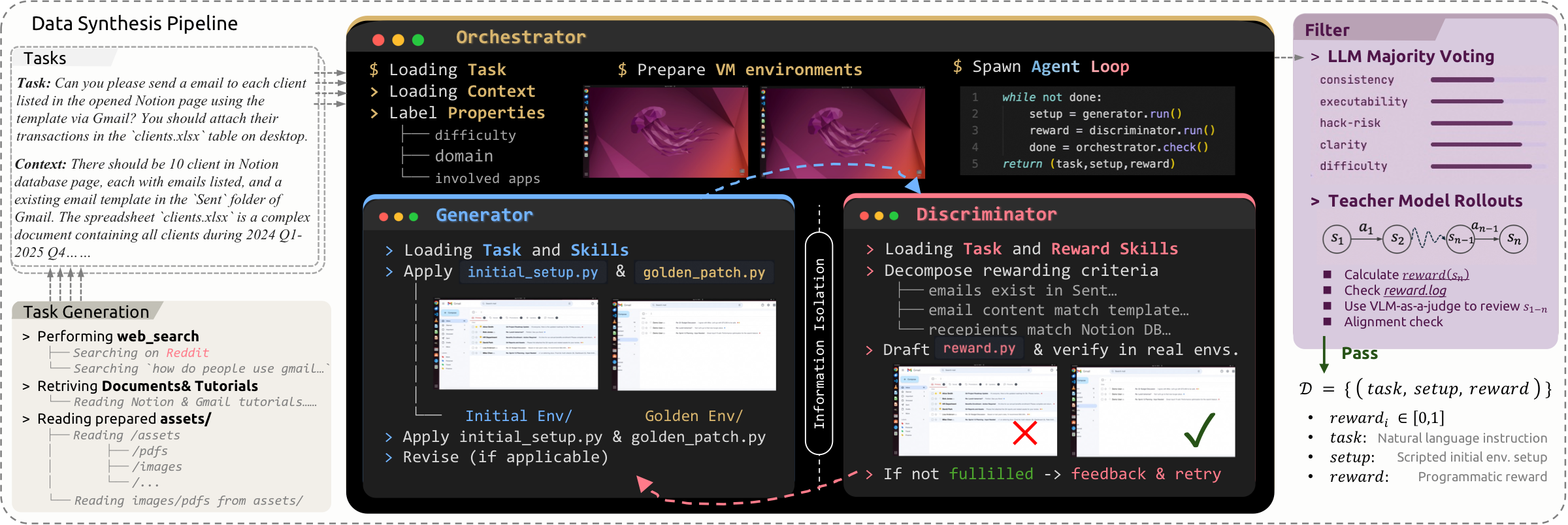
Training computer-use agents with reinforcement learning requires a consistent triple of (task instruction, executable environment, verifiable reward). Hand-authoring even one such triple takes hours; CUA-Gym automates this at scale.
Pipeline. Three coordinated agents run per task:
setup-gen): constructs the initial and golden environment states (initial_setup.py, golden_patch.py)reward-gen): writes reward.py from the task description alone, without access to Generator's code (information barrier)reward(golden)=1.0 and reward(initial)=0.0 both hold under executionFiltering. Verified tuples pass through an LLM majority-vote filter (filter/majority_vote_filter.py) that rejects tasks where the reward is fragile, ambiguous, or inconsistent. Teacher rollouts provide a second filter stage.
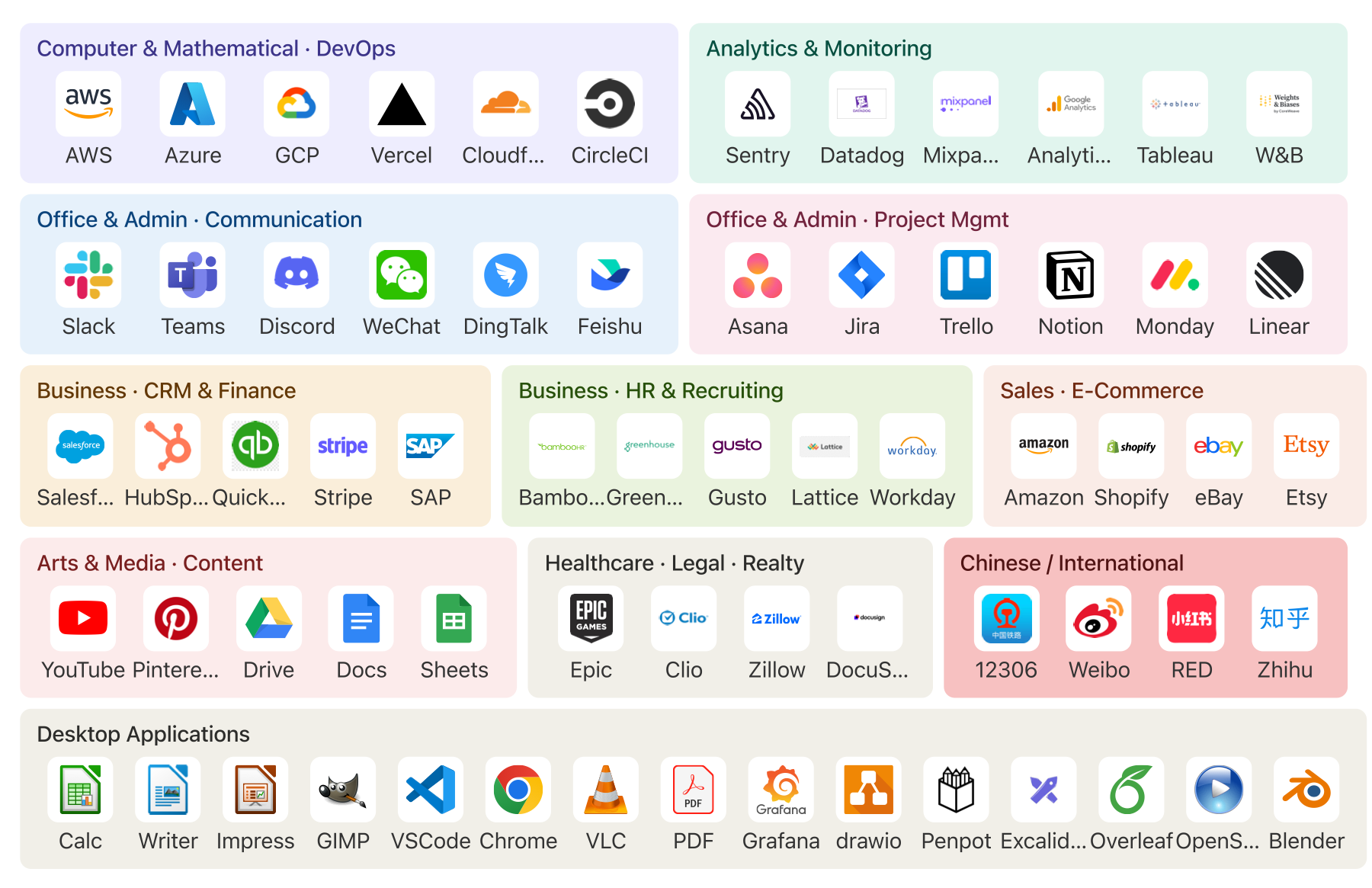
Environments. CUA-Gym covers 110 environments: 16 desktop applications and 94 synthesized mock web applications grounded in real-world software-use distributions.
Dataset. The resulting CUA-Gym dataset contains 32,112 verified RLVR training tuples.
Comparison with existing CUA RLVR datasets:
| Dataset | Platform | Data size | Env. size | Reward | Open |
|---|---|---|---|---|---|
| GUI-Genesis | Mobile | 969 | 1 | Programmatic | No |
| WebArena-Infinity | Web | 1,260 | 10 | Programmatic | Yes |
| InfiniteWeb | Web | 600 | — | Programmatic | No★ |
| UltraCUA | Desktop | 17,000 | 9 | Programmatic | No★ |
| Gym-Anything | Desktop | 7,277 | 193 | VLM | Yes |
| CUA-Gym | Desktop + Web | 32,122 | 110 | Programmatic | Yes |
★ partial release.
Install
git clone https://github.com/xlang-ai/CUA-Gym
cd CUA-Gym
pip install -e ".[dev]"
cp .env.example .env  # fill in OPENAI_API_KEY and ALIYUN_* credentials
Generate tasks for a domain
Invoke the task-gen agent from the CUA-Gym directory in Claude Code:
Generate 50 LibreOffice Calc tasks covering formatting and formula operations.
Output: output/task_generation/<topic>.json
Run the adversarial co-generation loop
python scripts/batch_orchestrator.py output/task_generation/calc_formatting.json
Verified tuples land in output/final/<task_id>/.
Run the majority-vote filter
export OPENAI_API_KEY=sk-...
python filter/majority_vote_filter.py \
  --tasks-dir output/final \
  --votes 3 \
  --model gpt-4o \
  --write
Download the pre-built dataset
huggingface-cli download xlangai/CUA-Gym --repo-type dataset --local-dir data/
CUA-Gym-Hub is the environment layer of CUA-Gym: a suite of self-contained mock web applications designed for scalable RL training. Each environment looks and behaves like a realistic web product, while exposing a unified state API for deterministic reset, inspection, mutation, and reward verification.
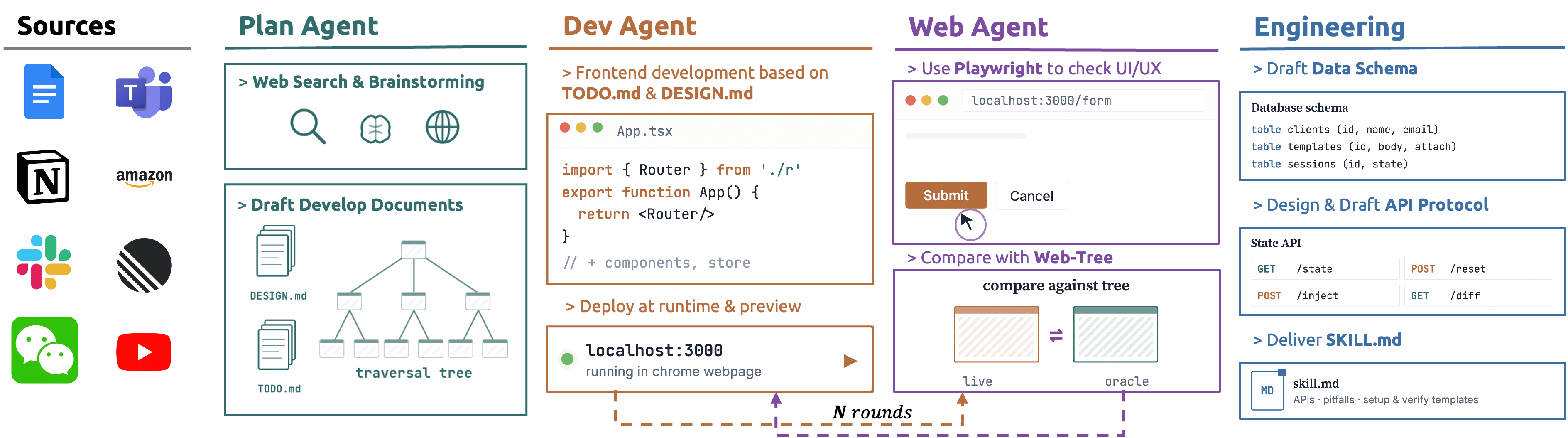
CUA-Gym-Hub is built by a multi-agent environment synthesis pipeline. Given a target application seed, the system drafts the product specification, implements the mock web app, exercises the UI with Playwright, and iterates until the live interface and API protocol match the specification.
Two design choices make each mock usable as an RL training environment: (1) state injection — a task ships its own JSON initial state alongside its reward.py, so a single mock can host arbitrarily many distinct task worlds with no code change; and (2) session isolation — every URL carries a session id, so parallel RL workers training on the same mock never see one another's mutations. See hub/README.md for the full design rationale and HTTP state API.
What CUA-Gym-Hub provides:
Run a mock app locally
cd hub/websites/notion_mock
npm install
npm run dev          # http://localhost:5173
Inspect environment state
curl "http://localhost:5173/go?sid=task_001"
# → {"initial_state": {...}, "current_state": {...}, "state_diff": {...}}
Every mock supports the same session-scoped state API (/go, /post, /state, /upload, /files/...). For production-style deployment using npm run preview + a reverse proxy, see hub/DEPLOY.md. For the full environment list, schema contract, and app-specific notes, see hub/README.md.
CUA-Gym releases executable RLVR task bundles for computer-use agents. Each row in the Hugging Face Dataset Viewer is a task-level index entry: it contains the natural-language instruction, environment metadata, setup references, and reward-function reference needed to reconstruct the original task bundle.
Important Notice. Some web task setup and reward files require CUA-Gym-Hub endpoints. The public dataset stores these endpoints as placeholders such as
__CUA_GYM_GMAIL_URL__, not as hard-coded hosted URLs. For reliable use, deploy the corresponding CUA-Gym-Hub apps yourself, set theCUA_GYM_*_URLvariables inurl_variables.json, and materialize the task files before running setup or reward code. The release-hostedxlang.aiendpoints are for reference and smoke tests, not for large-scale downstream experiments.
👉 CUA-Gym Hugging Face Dataset
Install the standard Hugging Face dataset tooling:
pip install -U datasets huggingface_hub
Load the task index directly in Python:
from datasets import load_dataset

tasks = load_dataset("xlangai/CUA-Gym", "tasks", split="train")
example = tasks[0]

print(example["instruction"])
print(example["app_type"], example["platform"], example["setup_kind"])
Or download the full dataset repository locally:
huggingface-cli download xlangai/CUA-Gym \
  --repo-type dataset \
  --local-dir ./CUA-Gym-data
If you plan to execute web tasks, extract the raw bundles and replace endpoint placeholders with your own deployment URLs:
mkdir -p ./cua_gym_tasks
tar --zstd -xf ./CUA-Gym-data/artifacts/cua_gym_tasks_v1.tar.zst -C ./cua_gym_tasks

cat > .env.cua-gym <<'EOF'
CUA_GYM_GMAIL_URL=https://your-gmail-mock.example.com
CUA_GYM_SLACK_URL=https://your-slack-mock.example.com
CUA_GYM_NOTION_URL=https://your-notion-mock.example.com
EOF

python scripts/materialize_dataset_urls.py ./cua_gym_tasks \
  --manifest ./CUA-Gym-data/url_variables.json \
  --env-file .env.cua-gym
The dataset is organized around one viewer-friendly table plus executable artifacts:
data/
  tasks.parquet
artifacts/
  cua_gym_tasks_v1.tar.zst
url_variables.json
scripts/
  materialize_dataset_urls.py
Each task bundle contains:
<task_id>/
  task.json
  reward.py
  initial_setup.py | initial_setup.sh | initial_setup.xlsx | initial_setup.docx | initial_setup.pptx
To execute a task, extract the artifact archive, read <task_id>/task.json, run the listed setup steps in the target environment, let the agent interact with the environment, and finally run <task_id>/reward.py to compute the programmatic score.
CUA-Gym improves computer-use agents through verifiable RL training over both desktop and web environments. We evaluate trained models on OSWorld-Verified and WebArena, covering realistic multi-step software and browser tasks. CUA-Gym models deliver strong gains over their base models, with the A17B model setting a new open-source state-of-the-art on both benchmarks.
| Model | OSWorld-Verified | WebArena |
|---|---|---|
| Claude Sonnet 4.6 | 72.9 | 65.6 |
| Claude Opus 4.7 | 78.0 | — |
| GPT-5.5 | 78.7 | — |
| EvoCUA-8B | 46.1 | — |
| EvoCUA-32B | 56.7 | — |
| Kimi-K2.6 | 73.1 | — |
| Qwen3.5-35B-A3B (base) | 54.5 | 40.8 |
| Qwen3.5-397B-A17B (base) | 62.2 | 54.0 |
| CUA-Gym-A3B | 62.1 | 44.5 |
| CUA-Gym-A17B | 72.6 | 56.0 |
Both models set state-of-the-art among open-source CUAs at their respective scales. CUA-Gym-A3B matches the much larger A17B base at ~10× fewer active parameters.
@misc{wang2026cuagymscalingverifiabletraining,
      title={CUA-Gym: Scaling Verifiable Training Environments and Tasks for Computer-Use Agents},
      author={Bowen Wang and Dunjie Lu and Junli Wang and Tianyi Bai and Shixuan Liu and Zhipeng Zhang and Haiquan Wang and Hao Hu and Tianbao Xie and Shuai Bai and Dayiheng Liu and Que Shen and Junyang Lin and Tao Yu},
      year={2026},
      eprint={2605.25624},
      archivePrefix={arXiv},
      primaryClass={cs.AI},
      url={https://arxiv.org/abs/2605.25624},
}
CUA-Gym may be used for research, educational, and commercial purposes under the following licenses:
If you use CUA-Gym, including its code, tools, CUA-Gym-Hub environments, dataset, models, or generated task artifacts, in any report, technical report, publication, thesis, presentation, blog post, documentation, or other publicly shared material, please include an explicit acknowledgement and cite the CUA-Gym paper.
701 followers · starred May 2026
620 followers · starred May 2026
382 followers · starred May 2026
1,518 followers · starred Oct 2026
Scalable pipeline for synthesizing verifiable RLVR training data for computer-use agents
See the code📄 Paper | 📝 Blog | 🤗 Dataset | 🔎 Data Viewer | 🤖 Models (coming soon) | 🧩 CUA-Gym-Hub
CUA-Gym is a scalable pipeline for synthesizing verifiable RLVR training data for computer-use agents (CUAs). Given a topic, it jointly produces task instructions, environment states, and reward functions as verified triples — using coding agents to handle the engineering work previously requiring human experts.
Training computer-use agents with reinforcement learning requires a consistent triple of (task instruction, executable environment, verifiable reward). Hand-authoring even one such triple takes hours; CUA-Gym automates this at scale.
Pipeline. Three coordinated agents run per task:
setup-gen): constructs the initial and golden environment states (initial_setup.py, golden_patch.py)reward-gen): writes reward.py from the task description alone, without access to Generator's code (information barrier)reward(golden)=1.0 and reward(initial)=0.0 both hold under executionFiltering. Verified tuples pass through an LLM majority-vote filter (filter/majority_vote_filter.py) that rejects tasks where the reward is fragile, ambiguous, or inconsistent. Teacher rollouts provide a second filter stage.
Environments. CUA-Gym covers 110 environments: 16 desktop applications and 94 synthesized mock web applications grounded in real-world software-use distributions.
Dataset. The resulting CUA-Gym dataset contains 32,112 verified RLVR training tuples.
Comparison with existing CUA RLVR datasets:
| Dataset | Platform | Data size | Env. size | Reward | Open |
|---|---|---|---|---|---|
| GUI-Genesis | Mobile | 969 | 1 | Programmatic | No |
| WebArena-Infinity | Web | 1,260 | 10 | Programmatic | Yes |
| InfiniteWeb | Web | 600 | — | Programmatic | No★ |
| UltraCUA | Desktop | 17,000 | 9 | Programmatic | No★ |
| Gym-Anything | Desktop | 7,277 | 193 | VLM | Yes |
| CUA-Gym | Desktop + Web | 32,122 | 110 | Programmatic | Yes |
★ partial release.
Install
git clone https://github.com/xlang-ai/CUA-Gym
cd CUA-Gym
pip install -e ".[dev]"
cp .env.example .env  # fill in OPENAI_API_KEY and ALIYUN_* credentials
Generate tasks for a domain
Invoke the task-gen agent from the CUA-Gym directory in Claude Code:
Generate 50 LibreOffice Calc tasks covering formatting and formula operations.
Output: output/task_generation/<topic>.json
Run the adversarial co-generation loop
python scripts/batch_orchestrator.py output/task_generation/calc_formatting.json
Verified tuples land in output/final/<task_id>/.
Run the majority-vote filter
export OPENAI_API_KEY=sk-...
python filter/majority_vote_filter.py \
  --tasks-dir output/final \
  --votes 3 \
  --model gpt-4o \
  --write
Download the pre-built dataset
huggingface-cli download xlangai/CUA-Gym --repo-type dataset --local-dir data/
CUA-Gym-Hub is the environment layer of CUA-Gym: a suite of self-contained mock web applications designed for scalable RL training. Each environment looks and behaves like a realistic web product, while exposing a unified state API for deterministic reset, inspection, mutation, and reward verification.
CUA-Gym-Hub is built by a multi-agent environment synthesis pipeline. Given a target application seed, the system drafts the product specification, implements the mock web app, exercises the UI with Playwright, and iterates until the live interface and API protocol match the specification.
Two design choices make each mock usable as an RL training environment: (1) state injection — a task ships its own JSON initial state alongside its reward.py, so a single mock can host arbitrarily many distinct task worlds with no code change; and (2) session isolation — every URL carries a session id, so parallel RL workers training on the same mock never see one another's mutations. See hub/README.md for the full design rationale and HTTP state API.
What CUA-Gym-Hub provides:
Run a mock app locally
cd hub/websites/notion_mock
npm install
npm run dev          # http://localhost:5173
Inspect environment state
curl "http://localhost:5173/go?sid=task_001"
# → {"initial_state": {...}, "current_state": {...}, "state_diff": {...}}
Every mock supports the same session-scoped state API (/go, /post, /state, /upload, /files/...). For production-style deployment using npm run preview + a reverse proxy, see hub/DEPLOY.md. For the full environment list, schema contract, and app-specific notes, see hub/README.md.
CUA-Gym releases executable RLVR task bundles for computer-use agents. Each row in the Hugging Face Dataset Viewer is a task-level index entry: it contains the natural-language instruction, environment metadata, setup references, and reward-function reference needed to reconstruct the original task bundle.
Important Notice. Some web task setup and reward files require CUA-Gym-Hub endpoints. The public dataset stores these endpoints as placeholders such as
__CUA_GYM_GMAIL_URL__, not as hard-coded hosted URLs. For reliable use, deploy the corresponding CUA-Gym-Hub apps yourself, set theCUA_GYM_*_URLvariables inurl_variables.json, and materialize the task files before running setup or reward code. The release-hostedxlang.aiendpoints are for reference and smoke tests, not for large-scale downstream experiments.
👉 CUA-Gym Hugging Face Dataset
Install the standard Hugging Face dataset tooling:
pip install -U datasets huggingface_hub
Load the task index directly in Python:
from datasets import load_dataset

tasks = load_dataset("xlangai/CUA-Gym", "tasks", split="train")
example = tasks[0]

print(example["instruction"])
print(example["app_type"], example["platform"], example["setup_kind"])
Or download the full dataset repository locally:
huggingface-cli download xlangai/CUA-Gym \
  --repo-type dataset \
  --local-dir ./CUA-Gym-data
If you plan to execute web tasks, extract the raw bundles and replace endpoint placeholders with your own deployment URLs:
mkdir -p ./cua_gym_tasks
tar --zstd -xf ./CUA-Gym-data/artifacts/cua_gym_tasks_v1.tar.zst -C ./cua_gym_tasks

cat > .env.cua-gym <<'EOF'
CUA_GYM_GMAIL_URL=https://your-gmail-mock.example.com
CUA_GYM_SLACK_URL=https://your-slack-mock.example.com
CUA_GYM_NOTION_URL=https://your-notion-mock.example.com
EOF

python scripts/materialize_dataset_urls.py ./cua_gym_tasks \
  --manifest ./CUA-Gym-data/url_variables.json \
  --env-file .env.cua-gym
The dataset is organized around one viewer-friendly table plus executable artifacts:
data/
  tasks.parquet
artifacts/
  cua_gym_tasks_v1.tar.zst
url_variables.json
scripts/
  materialize_dataset_urls.py
Each task bundle contains:
<task_id>/
  task.json
  reward.py
  initial_setup.py | initial_setup.sh | initial_setup.xlsx | initial_setup.docx | initial_setup.pptx
To execute a task, extract the artifact archive, read <task_id>/task.json, run the listed setup steps in the target environment, let the agent interact with the environment, and finally run <task_id>/reward.py to compute the programmatic score.
CUA-Gym improves computer-use agents through verifiable RL training over both desktop and web environments. We evaluate trained models on OSWorld-Verified and WebArena, covering realistic multi-step software and browser tasks. CUA-Gym models deliver strong gains over their base models, with the A17B model setting a new open-source state-of-the-art on both benchmarks.
| Model | OSWorld-Verified | WebArena |
|---|---|---|
| Claude Sonnet 4.6 | 72.9 | 65.6 |
| Claude Opus 4.7 | 78.0 | — |
| GPT-5.5 | 78.7 | — |
| EvoCUA-8B | 46.1 | — |
| EvoCUA-32B | 56.7 | — |
| Kimi-K2.6 | 73.1 | — |
| Qwen3.5-35B-A3B (base) | 54.5 | 40.8 |
| Qwen3.5-397B-A17B (base) | 62.2 | 54.0 |
| CUA-Gym-A3B | 62.1 | 44.5 |
| CUA-Gym-A17B | 72.6 | 56.0 |
Both models set state-of-the-art among open-source CUAs at their respective scales. CUA-Gym-A3B matches the much larger A17B base at ~10× fewer active parameters.
@misc{wang2026cuagymscalingverifiabletraining,
      title={CUA-Gym: Scaling Verifiable Training Environments and Tasks for Computer-Use Agents},
      author={Bowen Wang and Dunjie Lu and Junli Wang and Tianyi Bai and Shixuan Liu and Zhipeng Zhang and Haiquan Wang and Hao Hu and Tianbao Xie and Shuai Bai and Dayiheng Liu and Que Shen and Junyang Lin and Tao Yu},
      year={2026},
      eprint={2605.25624},
      archivePrefix={arXiv},
      primaryClass={cs.AI},
      url={https://arxiv.org/abs/2605.25624},
}
CUA-Gym may be used for research, educational, and commercial purposes under the following licenses:
If you use CUA-Gym, including its code, tools, CUA-Gym-Hub environments, dataset, models, or generated task artifacts, in any report, technical report, publication, thesis, presentation, blog post, documentation, or other publicly shared material, please include an explicit acknowledgement and cite the CUA-Gym paper.
701 followers · starred May 2026
620 followers · starred May 2026
382 followers · starred May 2026
1,518 followers · starred Oct 2026