Multi-Granularity Conditioning with Music-Aware Position Encoding for Long-Form Music Generation


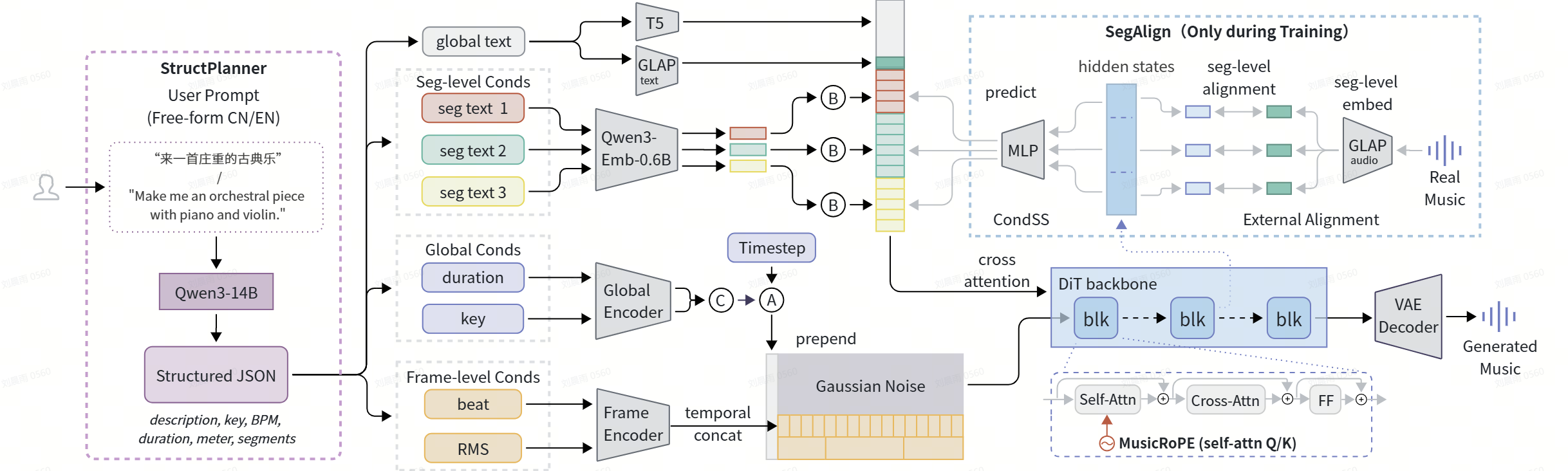
A DiT-based latent diffusion model for long-form instrumental music generation with multi-granularity conditioning (global, segment, and frame level) — up to ~180 seconds of 44.1 kHz stereo audio.
pip install -e .
Or with uv (recommended):
uv sync
source .venv/bin/activate   # or prefix commands with `uv run`
MuseGran provides two model variants:
| MuseGran-Qo (quality-oriented) | MuseGran-Co (control-oriented) | |
|---|---|---|
| Global text prompt | ✓ | ✓ |
| Key | ✓ | ✓ |
| Beat / downbeat | ✓ | ✓ |
| Segment structure | — | ✓ |
| Checkpoint | musegran_qo.ckpt | musegran_co.ckpt |
| Strength | better musicality | fine-grained arrangement control |
Download the model weights from the model release and place them in pretrained_models/ (model configs are versioned in this repo under configs/model/, no download needed):
pretrained_models/
├── diffusion/
│   ├── musegran_co.ckpt          # MuseGran-Co (control-oriented)
│   └── musegran_qo.ckpt          # MuseGran-Qo (quality-oriented)
├── vae/
│   └── vae_sr.ckpt               # Oobleck VAE with super-resolution decoder
└── structplanner_lora/
    └── adapter_model.safetensors # Fine-tuned LoRA weights (step 29500)
Copy the StructPlanner adapter config from this repo next to the adapter weights:
cp configs/structplanner/adapter_config.json pretrained_models/structplanner_lora/
External model weights (Qwen3-14B, Qwen3-Embedding-0.6B, GLAP, T5) are loaded from HuggingFace or a local path on first run.
python inference.py --prompt "Ambient electronica with pads" --bpm 90 --key "C minor" --duration 120
{"prompt": "A calming journey through acoustic instruments", "bpm": 76.0, "key": "F major", "duration_seconds": 140}
python inference.py --test_jsonl ./inference_samples/prompts_qo.jsonl
python inference.py --structure_json ./inference_samples/prompts_co_single.json
python inference.py --test_jsonl ./inference_samples/prompts_co_batch.jsonl
StructPlanner is a Qwen3-14B model fine-tuned with LoRA that converts prompts in both CN/EN into a complete structured spec (key, BPM, meter, per-segment style/dynamics/instrumentation, and text descriptions) — an alternative to hand-writing the structure for Co inference.
Enable it with --structplanner; --duration, --bpm, --key are ignored (all parameters come from the generated spec):
python inference.py --prompt "安静的钢琴曲" --structplanner
python inference.py --prompt "Epic orchestral battle music" --structplanner
Training data is a JSONL file (one sample per line). See data/train_examples.jsonl for complete examples.
Example audio: The two clips in
data/examples/audio/are sampled from the Free Music Archive (FMA), filtered to commercially-usable licenses (CC BY, CC BY-SA, CC BY-ND, Public Domain, Commercial Use). See the FMA search filter for details. Note thatbeat_pathandvae_latent_pathreferenced indata/train_examples.jsonlare not included; generate beat annotations with madmom or BeatNet, and VAE latents via the provided VAE checkpoint.
The following tools were used to generate the annotations in data/train_examples.jsonl and can be used to prepare your own dataset:
| Field | Tool |
|---|---|
key, bpm | Essentia |
beat_path | madmom / BeatNet |
detailed_prompt, genre, instruments, mood | MusicFlamingo |
structure_segments_json (segmentation) | SongFormer |
structure_segments_json (per-segment text) | MusicFlamingo |
During training, the text input is randomly selected from prompt, detailed_prompt, or shuffled keywords (from genre/instruments/mood) for robustness to varied text inputs at inference time.
Training periodically generates demo audio and scores them. Install these dependencies before starting training if you want automatic evaluation:
git clone https://github.com/facebookresearch/audiobox-aesthetics
cd audiobox-aesthetics && pip install -e . && cd ..

git clone https://github.com/ASLP-lab/SongEval score_tools/songeval/SongEval
python train.py --config configs/training/default.yaml
Training configs are in configs/training/. Command-line arguments override config values.
The paper is accepted at IEEE SLT 2026; a formal BibTeX entry will be added once it is published.
The code and model weights are released under the Apache License 2.0 (see LICENSE).
This project is inspired by stable-audio-tools and MusiConGen.
581 followers · starred Sep 2026
219 followers · starred Sep 2026
Multi-Granularity Conditioning with Music-Aware Position Encoding for Long-Form Music Generation
A DiT-based latent diffusion model for long-form instrumental music generation with multi-granularity conditioning (global, segment, and frame level) — up to ~180 seconds of 44.1 kHz stereo audio.
pip install -e .
Or with uv (recommended):
uv sync
source .venv/bin/activate   # or prefix commands with `uv run`
MuseGran provides two model variants:
| MuseGran-Qo (quality-oriented) | MuseGran-Co (control-oriented) | |
|---|---|---|
| Global text prompt | ✓ | ✓ |
| Key | ✓ | ✓ |
| Beat / downbeat | ✓ | ✓ |
| Segment structure | — | ✓ |
| Checkpoint | musegran_qo.ckpt | musegran_co.ckpt |
| Strength | better musicality | fine-grained arrangement control |
Download the model weights from the model release and place them in pretrained_models/ (model configs are versioned in this repo under configs/model/, no download needed):
pretrained_models/
├── diffusion/
│   ├── musegran_co.ckpt          # MuseGran-Co (control-oriented)
│   └── musegran_qo.ckpt          # MuseGran-Qo (quality-oriented)
├── vae/
│   └── vae_sr.ckpt               # Oobleck VAE with super-resolution decoder
└── structplanner_lora/
    └── adapter_model.safetensors # Fine-tuned LoRA weights (step 29500)
Copy the StructPlanner adapter config from this repo next to the adapter weights:
cp configs/structplanner/adapter_config.json pretrained_models/structplanner_lora/
External model weights (Qwen3-14B, Qwen3-Embedding-0.6B, GLAP, T5) are loaded from HuggingFace or a local path on first run.
python inference.py --prompt "Ambient electronica with pads" --bpm 90 --key "C minor" --duration 120
{"prompt": "A calming journey through acoustic instruments", "bpm": 76.0, "key": "F major", "duration_seconds": 140}
python inference.py --test_jsonl ./inference_samples/prompts_qo.jsonl
python inference.py --structure_json ./inference_samples/prompts_co_single.json
python inference.py --test_jsonl ./inference_samples/prompts_co_batch.jsonl
StructPlanner is a Qwen3-14B model fine-tuned with LoRA that converts prompts in both CN/EN into a complete structured spec (key, BPM, meter, per-segment style/dynamics/instrumentation, and text descriptions) — an alternative to hand-writing the structure for Co inference.
Enable it with --structplanner; --duration, --bpm, --key are ignored (all parameters come from the generated spec):
python inference.py --prompt "安静的钢琴曲" --structplanner
python inference.py --prompt "Epic orchestral battle music" --structplanner
Training data is a JSONL file (one sample per line). See data/train_examples.jsonl for complete examples.
Example audio: The two clips in
data/examples/audio/are sampled from the Free Music Archive (FMA), filtered to commercially-usable licenses (CC BY, CC BY-SA, CC BY-ND, Public Domain, Commercial Use). See the FMA search filter for details. Note thatbeat_pathandvae_latent_pathreferenced indata/train_examples.jsonlare not included; generate beat annotations with madmom or BeatNet, and VAE latents via the provided VAE checkpoint.
The following tools were used to generate the annotations in data/train_examples.jsonl and can be used to prepare your own dataset:
| Field | Tool |
|---|---|
key, bpm | Essentia |
beat_path | madmom / BeatNet |
detailed_prompt, genre, instruments, mood | MusicFlamingo |
structure_segments_json (segmentation) | SongFormer |
structure_segments_json (per-segment text) | MusicFlamingo |
During training, the text input is randomly selected from prompt, detailed_prompt, or shuffled keywords (from genre/instruments/mood) for robustness to varied text inputs at inference time.
Training periodically generates demo audio and scores them. Install these dependencies before starting training if you want automatic evaluation:
git clone https://github.com/facebookresearch/audiobox-aesthetics
cd audiobox-aesthetics && pip install -e . && cd ..

git clone https://github.com/ASLP-lab/SongEval score_tools/songeval/SongEval
python train.py --config configs/training/default.yaml
Training configs are in configs/training/. Command-line arguments override config values.
The paper is accepted at IEEE SLT 2026; a formal BibTeX entry will be added once it is published.
The code and model weights are released under the Apache License 2.0 (see LICENSE).
This project is inspired by stable-audio-tools and MusiConGen.
581 followers · starred Sep 2026
219 followers · starred Sep 2026



