
LLM‑driven autoregressive flow matching for unified speech‑music‑sound‑effect audio scene generation
Python
99
0 commits
updated Aug 13, 2026
README
MiDashengLM-Gen
Unified Audio Scene Generation via LLM-Driven Autoregressive Flow Matching




MiDashengLM-Gen is an end-to-end framework that uses a pre-trained Large Language Model and audio tokenizer as the backbone, combined with per-token conditional flow matching for autoregressive, variable-length mixed-audio scene generation. It generates coherent 16 kHz audio scenes that simultaneously blend speech, music, sound effects, and environmental acoustics from structured text descriptions.
Highlights
- Autoregressive generation with per-token flow matching — combines LLM sequence modeling with continuous flow-based generation, enabling variable-length output via a learned stop head
- LLM-conditioned high-dimensional audio latents — generates over 768-dimensional semantic-acoustic latents (25 Hz) conditioned on LLM hidden states, achieving rich acoustic modeling without quantization artifacts
- Audio-text alignment pre-training — bridges the modality gap by mapping audio latents into the LLM's token space before generation training, critical for cross-modal synthesis
- Strong speech intelligibility with competitive mixed-audio quality — approaches dedicated TTS performance on Seed-TTS while maintaining mixed-audio scene generation, and supports 9 languages with emotion control
Architecture
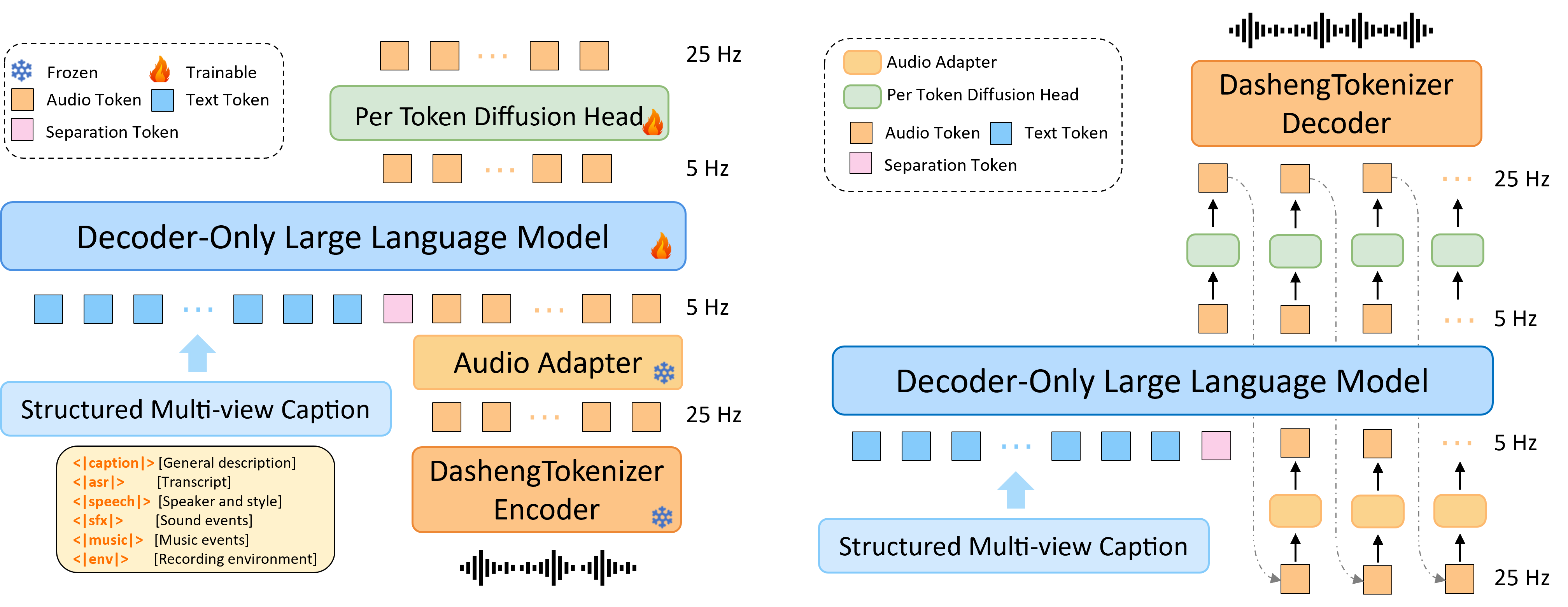
Left: training pipeline with flow matching loss. Right: autoregressive inference pipeline.
Key components:
| Component | Details |
|---|---|
| Audio Tokenizer | DashengTokenizer → 768-dim latents @ 25 Hz, downsampled to 5 Hz via audio projector |
| LLM Backbone | Qwen3-1.7B, fully fine-tuned |
| Flow Matching DiT | 16 layers, hidden dim 2048, 8 heads, MLP ratio 4.0 |
| Inference | 10-step Euler ODE solver, CFG scale 2.0 |
| Stop Head | Learned binary classifier for variable-length truncation |
| Output | 16 kHz mono WAV, auto-truncated |
Input Format
Input uses structured multi-view captions with special tokens to describe different aspects of an audio scene. Use <|unknown|> for absent elements.
| Token | Description | Example |
|---|---|---|
<|caption|> | Overall scene description | A comedian delivering a punchline followed by uproarious crowd laughter and an upbeat jazz band hit |
<|asr|> | Speech transcript | And that is why I never buy cheap luggage anymore! |
<|speech|> | Speaker characteristics (voice, emotion, style) | expressive comedic male voice |
<|sfx|> | Sound effects | uproarious crowd laughter |
<|music|> | Music description | sudden upbeat jazz band sting |
<|env|> | Environment / ambience | intimate comedy club |
Quick Start (HuggingFace)
pip install torch torchaudio "transformers>=4.51" einops safetensors soundfile tqdm numpy x-transformers
from transformers import AutoModel
import soundfile as sf

model = AutoModel.from_pretrained("mispeech/midashenglm-gen", trust_remote_code=True)
model = model.cuda()

result = model.generate(
    "<|caption|> A comedian delivering a punchline followed by uproarious crowd laughter and an upbeat jazz band hit "
    "<|asr|> And that is why I never buy cheap luggage anymore! "
    "<|speech|> expressive comedic male voice "
    "<|music|> sudden upbeat jazz band sting "
    "<|sfx|> uproarious crowd laughter "
    "<|env|> intimate comedy club"
)

sf.write("output.wav", result["audio"], result["sample_rate"])
Batch generation:
texts = [
    "<|caption|> A comedian delivering a punchline followed by uproarious crowd laughter and an upbeat jazz band hit <|asr|> And that is why I never buy cheap luggage anymore! <|speech|> expressive comedic male voice <|music|> sudden upbeat jazz band sting <|sfx|> uproarious crowd laughter <|env|> intimate comedy club",
    "<|caption|> Upbeat instrumental music with occasional whistling and low audio quality. <|asr|> <|unknown|> <|speech|> <|unknown|> <|sfx|> Intermittent whistling emerges in later segment alongside persistent instrumental playback. <|music|> Bright melodic composition with guitar, piano, and rhythmic percussion elements, maintaining a consistently upbeat character. <|env|> Low-fidelity recording with compressed dynamics and limited frequency response.",
]
result = model.generate(texts)
for i, audio in enumerate(result["audio"]):
    sf.write(f"output_{i}.wav", audio, result["sample_rate"])
Generation parameters:
result = model.generate(
    "...",
    eval_cfg=2.0,           # Classifier-free guidance scale
    stop_threshold=0.5,     # Stop prediction threshold
    min_stop_step=5,        # Minimum steps before stopping
    seed=42,                # Random seed for reproducibility
)
| Parameter | Default | Description |
|---|---|---|
eval_cfg | 2.0 | Classifier-free guidance scale |
stop_threshold | 0.5 | Stop probability threshold for audio truncation |
min_stop_step | 5 | Minimum generation steps before stopping |
seed | None | Random seed for reproducibility |
Advanced Usage (from source)
For checkpoint-based inference or local evaluation, clone this repository and use infer.py directly.
Installation
uv sync
# Run inference with:
#   uv run python infer.py ...   (recommended, auto-uses .venv)
# OR
#   source .venv/bin/activate && python infer.py ...
Single Text Generation
# Checkpoint auto-downloaded from Zenodo on first run
uv run python infer.py \
    --text "<|caption|> A comedian delivering a punchline followed by uproarious crowd laughter and an upbeat jazz band hit <|asr|> And that is why I never buy cheap luggage anymore! <|speech|> expressive comedic male voice <|music|> sudden upbeat jazz band sting <|sfx|> uproarious crowd laughter <|env|> intimate comedy club" \
    --output_dir ./output

# Or specify checkpoint path explicitly
uv run python infer.py \
    --resume /path/to/DashengLM-Gen-checkpoint.pth \
    --text "<|caption|> A comedian delivering a punchline followed by uproarious crowd laughter and an upbeat jazz band hit <|asr|> And that is why I never buy cheap luggage anymore! <|speech|> expressive comedic male voice <|music|> sudden upbeat jazz band sting <|sfx|> uproarious crowd laughter <|env|> intimate comedy club" \
    --output_dir ./output
Batch Generation (JSONL)
Each line is a JSON object with audio_id and caption (or content):
{"audio_id": "sample_001", "caption": "<|caption|> A comedian delivering a punchline followed by uproarious crowd laughter and an upbeat jazz band hit <|asr|> And that is why I never buy cheap luggage anymore! <|speech|> expressive comedic male voice <|music|> sudden upbeat jazz band sting <|sfx|> uproarious crowd laughter <|env|> intimate comedy club"}
uv run python infer.py \
    --resume /path/to/DashengLM-Gen-checkpoint.pth \
    --input_list /path/to/your_input.jsonl \
    --output_dir ./output
Parameters
| Parameter | Default | Description |
|---|---|---|
--resume | (optional) | Path to checkpoint. If omitted, auto-downloads from Zenodo |
--text | — | Single text input |
--input_list | — | JSONL file for batch generation |
--output_dir | ./output | Output directory |
--eval_cfg | 2.0 | Classifier-free guidance strength |
--batch_size | 16 | Batch size for inference |
--seq_len | from ckpt | Max audio token length |
--seed | 0 | Random seed |
--quiet | — | Suppress progress bar |
--stop_threshold | 0.5 | Stop probability threshold for audio truncation |
--min_stop_step | 5 | Minimum generation steps before stopping |
Output
- 16 kHz mono WAV files
- Auto-truncated by stop prediction
- Batch mode: named by
audio_idfield; single mode:output.wav
Citation
If you use this work, please cite:
@article{sun2026midashenglmgen,
  title={MiDashengLM-Gen: Unified Audio Scene Generation via LLM-Driven Autoregressive Flow Matching},
  author={Sun, Xingwei and Dinkel, Heinrich and Li, Gang and Mei, Jiahao and Niu, Yadong and Han, Zerui and Jiang, Yuepeng and Zhou, Jiahao and Fan, Lichun and Luan, Jian},
  journal={arXiv preprint},
  eprint={2608.11804},
  archivePrefix={arXiv},
  year={2026}
}
License
This project is licensed under the Apache License 2.0.
Use Restrictions
You are solely responsible for your use of MiDashengLM-Gen and any outputs, actions, or consequences arising therefrom, and you agree not to use MiDashengLM-Gen or any derivatives thereof:
- For any unlawful, fraudulent, or malicious purpose, or in any manner that violates any applicable laws or regulations;
- To infringe upon the intellectual property rights, privacy rights, publicity rights, or other lawful rights or interests of any third party;
- To exploit, harm, harass, defame, unlawfully discriminate against, or otherwise adversely affect any individual or group, including minors or vulnerable persons;
- For any military purpose or application.
Similar repos






Languages
Python
100.0%
LLM‑driven autoregressive flow matching for unified speech‑music‑sound‑effect audio scene generation
Python
99
0 commits
updated Aug 13, 2026
README
MiDashengLM-Gen
Unified Audio Scene Generation via LLM-Driven Autoregressive Flow Matching
MiDashengLM-Gen is an end-to-end framework that uses a pre-trained Large Language Model and audio tokenizer as the backbone, combined with per-token conditional flow matching for autoregressive, variable-length mixed-audio scene generation. It generates coherent 16 kHz audio scenes that simultaneously blend speech, music, sound effects, and environmental acoustics from structured text descriptions.
Highlights
- Autoregressive generation with per-token flow matching — combines LLM sequence modeling with continuous flow-based generation, enabling variable-length output via a learned stop head
- LLM-conditioned high-dimensional audio latents — generates over 768-dimensional semantic-acoustic latents (25 Hz) conditioned on LLM hidden states, achieving rich acoustic modeling without quantization artifacts
- Audio-text alignment pre-training — bridges the modality gap by mapping audio latents into the LLM's token space before generation training, critical for cross-modal synthesis
- Strong speech intelligibility with competitive mixed-audio quality — approaches dedicated TTS performance on Seed-TTS while maintaining mixed-audio scene generation, and supports 9 languages with emotion control
Architecture
Left: training pipeline with flow matching loss. Right: autoregressive inference pipeline.
Key components:
| Component | Details |
|---|---|
| Audio Tokenizer | DashengTokenizer → 768-dim latents @ 25 Hz, downsampled to 5 Hz via audio projector |
| LLM Backbone | Qwen3-1.7B, fully fine-tuned |
| Flow Matching DiT | 16 layers, hidden dim 2048, 8 heads, MLP ratio 4.0 |
| Inference | 10-step Euler ODE solver, CFG scale 2.0 |
| Stop Head | Learned binary classifier for variable-length truncation |
| Output | 16 kHz mono WAV, auto-truncated |
Input Format
Input uses structured multi-view captions with special tokens to describe different aspects of an audio scene. Use <|unknown|> for absent elements.
| Token | Description | Example |
|---|---|---|
<|caption|> | Overall scene description | A comedian delivering a punchline followed by uproarious crowd laughter and an upbeat jazz band hit |
<|asr|> | Speech transcript | And that is why I never buy cheap luggage anymore! |
<|speech|> | Speaker characteristics (voice, emotion, style) | expressive comedic male voice |
<|sfx|> | Sound effects | uproarious crowd laughter |
<|music|> | Music description | sudden upbeat jazz band sting |
<|env|> | Environment / ambience | intimate comedy club |
Quick Start (HuggingFace)
pip install torch torchaudio "transformers>=4.51" einops safetensors soundfile tqdm numpy x-transformers
from transformers import AutoModel
import soundfile as sf

model = AutoModel.from_pretrained("mispeech/midashenglm-gen", trust_remote_code=True)
model = model.cuda()

result = model.generate(
    "<|caption|> A comedian delivering a punchline followed by uproarious crowd laughter and an upbeat jazz band hit "
    "<|asr|> And that is why I never buy cheap luggage anymore! "
    "<|speech|> expressive comedic male voice "
    "<|music|> sudden upbeat jazz band sting "
    "<|sfx|> uproarious crowd laughter "
    "<|env|> intimate comedy club"
)

sf.write("output.wav", result["audio"], result["sample_rate"])
Batch generation:
texts = [
    "<|caption|> A comedian delivering a punchline followed by uproarious crowd laughter and an upbeat jazz band hit <|asr|> And that is why I never buy cheap luggage anymore! <|speech|> expressive comedic male voice <|music|> sudden upbeat jazz band sting <|sfx|> uproarious crowd laughter <|env|> intimate comedy club",
    "<|caption|> Upbeat instrumental music with occasional whistling and low audio quality. <|asr|> <|unknown|> <|speech|> <|unknown|> <|sfx|> Intermittent whistling emerges in later segment alongside persistent instrumental playback. <|music|> Bright melodic composition with guitar, piano, and rhythmic percussion elements, maintaining a consistently upbeat character. <|env|> Low-fidelity recording with compressed dynamics and limited frequency response.",
]
result = model.generate(texts)
for i, audio in enumerate(result["audio"]):
    sf.write(f"output_{i}.wav", audio, result["sample_rate"])
Generation parameters:
result = model.generate(
    "...",
    eval_cfg=2.0,           # Classifier-free guidance scale
    stop_threshold=0.5,     # Stop prediction threshold
    min_stop_step=5,        # Minimum steps before stopping
    seed=42,                # Random seed for reproducibility
)
| Parameter | Default | Description |
|---|---|---|
eval_cfg | 2.0 | Classifier-free guidance scale |
stop_threshold | 0.5 | Stop probability threshold for audio truncation |
min_stop_step | 5 | Minimum generation steps before stopping |
seed | None | Random seed for reproducibility |
Advanced Usage (from source)
For checkpoint-based inference or local evaluation, clone this repository and use infer.py directly.
Installation
uv sync
# Run inference with:
#   uv run python infer.py ...   (recommended, auto-uses .venv)
# OR
#   source .venv/bin/activate && python infer.py ...
Single Text Generation
# Checkpoint auto-downloaded from Zenodo on first run
uv run python infer.py \
    --text "<|caption|> A comedian delivering a punchline followed by uproarious crowd laughter and an upbeat jazz band hit <|asr|> And that is why I never buy cheap luggage anymore! <|speech|> expressive comedic male voice <|music|> sudden upbeat jazz band sting <|sfx|> uproarious crowd laughter <|env|> intimate comedy club" \
    --output_dir ./output

# Or specify checkpoint path explicitly
uv run python infer.py \
    --resume /path/to/DashengLM-Gen-checkpoint.pth \
    --text "<|caption|> A comedian delivering a punchline followed by uproarious crowd laughter and an upbeat jazz band hit <|asr|> And that is why I never buy cheap luggage anymore! <|speech|> expressive comedic male voice <|music|> sudden upbeat jazz band sting <|sfx|> uproarious crowd laughter <|env|> intimate comedy club" \
    --output_dir ./output
Batch Generation (JSONL)
Each line is a JSON object with audio_id and caption (or content):
{"audio_id": "sample_001", "caption": "<|caption|> A comedian delivering a punchline followed by uproarious crowd laughter and an upbeat jazz band hit <|asr|> And that is why I never buy cheap luggage anymore! <|speech|> expressive comedic male voice <|music|> sudden upbeat jazz band sting <|sfx|> uproarious crowd laughter <|env|> intimate comedy club"}
uv run python infer.py \
    --resume /path/to/DashengLM-Gen-checkpoint.pth \
    --input_list /path/to/your_input.jsonl \
    --output_dir ./output
Parameters
| Parameter | Default | Description |
|---|---|---|
--resume | (optional) | Path to checkpoint. If omitted, auto-downloads from Zenodo |
--text | — | Single text input |
--input_list | — | JSONL file for batch generation |
--output_dir | ./output | Output directory |
--eval_cfg | 2.0 | Classifier-free guidance strength |
--batch_size | 16 | Batch size for inference |
--seq_len | from ckpt | Max audio token length |
--seed | 0 | Random seed |
--quiet | — | Suppress progress bar |
--stop_threshold | 0.5 | Stop probability threshold for audio truncation |
--min_stop_step | 5 | Minimum generation steps before stopping |
Output
- 16 kHz mono WAV files
- Auto-truncated by stop prediction
- Batch mode: named by
audio_idfield; single mode:output.wav
Citation
If you use this work, please cite:
@article{sun2026midashenglmgen,
  title={MiDashengLM-Gen: Unified Audio Scene Generation via LLM-Driven Autoregressive Flow Matching},
  author={Sun, Xingwei and Dinkel, Heinrich and Li, Gang and Mei, Jiahao and Niu, Yadong and Han, Zerui and Jiang, Yuepeng and Zhou, Jiahao and Fan, Lichun and Luan, Jian},
  journal={arXiv preprint},
  eprint={2608.11804},
  archivePrefix={arXiv},
  year={2026}
}
License
This project is licensed under the Apache License 2.0.
Use Restrictions
You are solely responsible for your use of MiDashengLM-Gen and any outputs, actions, or consequences arising therefrom, and you agree not to use MiDashengLM-Gen or any derivatives thereof:
- For any unlawful, fraudulent, or malicious purpose, or in any manner that violates any applicable laws or regulations;
- To infringe upon the intellectual property rights, privacy rights, publicity rights, or other lawful rights or interests of any third party;
- To exploit, harm, harass, defame, unlawfully discriminate against, or otherwise adversely affect any individual or group, including minors or vulnerable persons;
- For any military purpose or application.
Similar repos
Languages
Python
100.0%