
[CVPR 2024] The official implementation of paper "synthesize, diagnose, and optimize: towards fine-grained vision-language understanding"
See the codeREADME
SPEC: Synthesize, Diagnose, and Optimize: Towards Fine-Grained Vision-Language Understanding


:fire: News
Jun. 17, 2025🔥 We have released the checkpoints of our fine-tuned model.
Apr. 13, 2024We released the SPEC dataset and the code for evaluation, sorry for the delay :relaxed:.Feb. 28, 2024Our work has been accepted by CVPR 2024 :tada:.
:mag: SPEC Benchmark
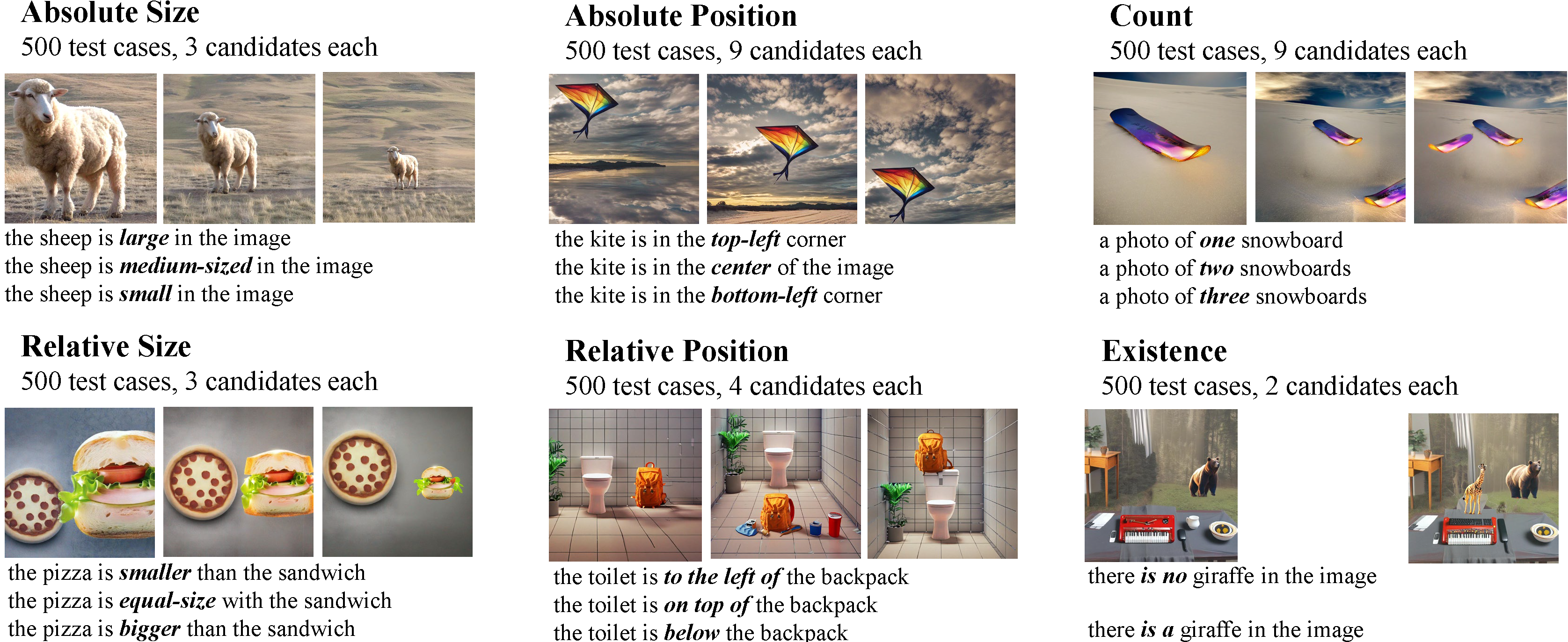
To evaluate the understanding capability of visual-language models on fine-grained concepts, we propose a new benchmark, SPEC, which consists of six distinct subsets, distributed across the dimensions of Size, Position, Existence, and Count. Each test case consists of an image candidate set, which differs only in certain visual concepts, and a text candidate set, which differs only in the corresponding language concept.
:wrench: Usage
install
git clone https://github.com/wjpoom/SPEC.git
cd SPEC/
pip install -e .
prepare data
- run the following code in Python shell, replace
/path/to/save/datawith a specified dir to store the data.
import zipfile
import os
from huggingface_hub import hf_hub_download

data_root = '/path/to/save/data'
hf_hub_download(repo_id='wjpoom/SPEC', repo_type='dataset', filename='data.zip', local_dir=data_root)

with zipfile.ZipFile(os.path.join(data_root, 'data.zip'), 'r') as zip_ref:
    zip_ref.extractall(os.path.join(data_root))

os.remove(os.path.join(data_root, 'data.zip'))
explore the dataset
- We provide a 📓notebook that enables you to visually explore the test samples in the SPEC dataset.
- Run this notebook either locally or online using Colab.
reproduce the results
- In our paper, we evaluated four popular VLMs using our SPEC dataset, namely: CLIP, BLIP, FLAVA and CoCa.
- To reproduce the results with these VLMs, you can run this script.
- You can also reproduce with this local notebook or the online Colab notebook.
evaluate custom VLMs
- If you want to evaluate your custom model on SPEC, you can follow the instructions in this document.
:space_invader: Model weights
pip install open_clip_torch
mkdir checkpoints
huggingface-cli download wjpoom/SPEC-CLIP-ViT-B-32 --local-dir checkpoints/SPEC-CLIP-ViT-B-32
import torch
from PIL import Image
import open_clip

model, _, preprocess = open_clip.create_model_and_transforms('ViT-B-32', pretrained='checkpoints/SPEC-CLIP-ViT-B-32', load_weights_only=False)
model.eval()
tokenizer = open_clip.get_tokenizer('ViT-B-32')

image = preprocess(Image.open("assets/image.png")).unsqueeze(0)
text = tokenizer([
    "the broccoli is situated above the backpack.",
    "the broccoli is situated to the right of the backpack",
    "the broccoli is positioned on the left of the backpack.",
    "the broccoli is placed beneath the backpack."
    ])

with torch.no_grad(), torch.autocast("cuda"):
    image_features = model.encode_image(image)
    text_features = model.encode_text(text)
    image_features /= image_features.norm(dim=-1, keepdim=True)
    text_features /= text_features.norm(dim=-1, keepdim=True)

    text_probs = (100.0 * image_features @ text_features.T).softmax(dim=-1)

print("Label probs:", text_probs)
:memo: TODO
- Release the checkpoint of fine-tuned model
- Release the testing set of SPEC benchmark
- Release the evaluation code of SPEC
:clap: Acknowledgement
Part of this repository is built upon ARO, thanks for the well-organized codebase.
Contact Us
Feel free to contact us if you have any questions or suggestions
Email (Wujian Peng): wjpeng24@m.fudan.edu.cn
:black_nib: Citation
If you use our code or data in this repo or find our work helpful, please consider giving a citation:
@inproceedings{peng2024synthesize,
  title={Synthesize diagnose and optimize: Towards fine-grained vision-language understanding},
  author={Peng, Wujian and Xie, Sicheng and You, Zuyao and Lan, Shiyi and Wu, Zuxuan},
  booktitle={Proceedings of the IEEE/CVF Conference on Computer Vision and Pattern Recognition},
  pages={13279--13288},
  year={2024}
}


Similar repos



Languages
Jupyter Notebook
98.6%
Python
1.4%
[CVPR 2024] The official implementation of paper "synthesize, diagnose, and optimize: towards fine-grained vision-language understanding"
See the codeREADME
SPEC: Synthesize, Diagnose, and Optimize: Towards Fine-Grained Vision-Language Understanding
:fire: News
Jun. 17, 2025🔥 We have released the checkpoints of our fine-tuned model.
Apr. 13, 2024We released the SPEC dataset and the code for evaluation, sorry for the delay :relaxed:.Feb. 28, 2024Our work has been accepted by CVPR 2024 :tada:.
:mag: SPEC Benchmark
To evaluate the understanding capability of visual-language models on fine-grained concepts, we propose a new benchmark, SPEC, which consists of six distinct subsets, distributed across the dimensions of Size, Position, Existence, and Count. Each test case consists of an image candidate set, which differs only in certain visual concepts, and a text candidate set, which differs only in the corresponding language concept.
:wrench: Usage
install
git clone https://github.com/wjpoom/SPEC.git
cd SPEC/
pip install -e .
prepare data
- run the following code in Python shell, replace
/path/to/save/datawith a specified dir to store the data.
import zipfile
import os
from huggingface_hub import hf_hub_download

data_root = '/path/to/save/data'
hf_hub_download(repo_id='wjpoom/SPEC', repo_type='dataset', filename='data.zip', local_dir=data_root)

with zipfile.ZipFile(os.path.join(data_root, 'data.zip'), 'r') as zip_ref:
    zip_ref.extractall(os.path.join(data_root))

os.remove(os.path.join(data_root, 'data.zip'))
explore the dataset
- We provide a 📓notebook that enables you to visually explore the test samples in the SPEC dataset.
- Run this notebook either locally or online using Colab.
reproduce the results
- In our paper, we evaluated four popular VLMs using our SPEC dataset, namely: CLIP, BLIP, FLAVA and CoCa.
- To reproduce the results with these VLMs, you can run this script.
- You can also reproduce with this local notebook or the online Colab notebook.
evaluate custom VLMs
- If you want to evaluate your custom model on SPEC, you can follow the instructions in this document.
:space_invader: Model weights
pip install open_clip_torch
mkdir checkpoints
huggingface-cli download wjpoom/SPEC-CLIP-ViT-B-32 --local-dir checkpoints/SPEC-CLIP-ViT-B-32
import torch
from PIL import Image
import open_clip

model, _, preprocess = open_clip.create_model_and_transforms('ViT-B-32', pretrained='checkpoints/SPEC-CLIP-ViT-B-32', load_weights_only=False)
model.eval()
tokenizer = open_clip.get_tokenizer('ViT-B-32')

image = preprocess(Image.open("assets/image.png")).unsqueeze(0)
text = tokenizer([
    "the broccoli is situated above the backpack.",
    "the broccoli is situated to the right of the backpack",
    "the broccoli is positioned on the left of the backpack.",
    "the broccoli is placed beneath the backpack."
    ])

with torch.no_grad(), torch.autocast("cuda"):
    image_features = model.encode_image(image)
    text_features = model.encode_text(text)
    image_features /= image_features.norm(dim=-1, keepdim=True)
    text_features /= text_features.norm(dim=-1, keepdim=True)

    text_probs = (100.0 * image_features @ text_features.T).softmax(dim=-1)

print("Label probs:", text_probs)
:memo: TODO
- Release the checkpoint of fine-tuned model
- Release the testing set of SPEC benchmark
- Release the evaluation code of SPEC
:clap: Acknowledgement
Part of this repository is built upon ARO, thanks for the well-organized codebase.
Contact Us
Feel free to contact us if you have any questions or suggestions
Email (Wujian Peng): wjpeng24@m.fudan.edu.cn
:black_nib: Citation
If you use our code or data in this repo or find our work helpful, please consider giving a citation:
@inproceedings{peng2024synthesize,
  title={Synthesize diagnose and optimize: Towards fine-grained vision-language understanding},
  author={Peng, Wujian and Xie, Sicheng and You, Zuyao and Lan, Shiyi and Wu, Zuxuan},
  booktitle={Proceedings of the IEEE/CVF Conference on Computer Vision and Pattern Recognition},
  pages={13279--13288},
  year={2024}
}
Similar repos
Languages
Jupyter Notebook
98.6%
Python
1.4%