A better framework for multi-instrument automatic music transcription.
See the code
AMTFlow is a modular framework for instrument-aware, multi-instrument automatic music transcription. It recognizes the instruments in a recording, routes them to a pretrained AMT model as its instrument conditioning, and writes MIDI in which every note carries its instrument. Source separation is optional; by default the whole mix is transcribed. Each stage is a pluggable module: source separation, instrument recognition, family routing and the AMT model itself (MuScriptor by default).
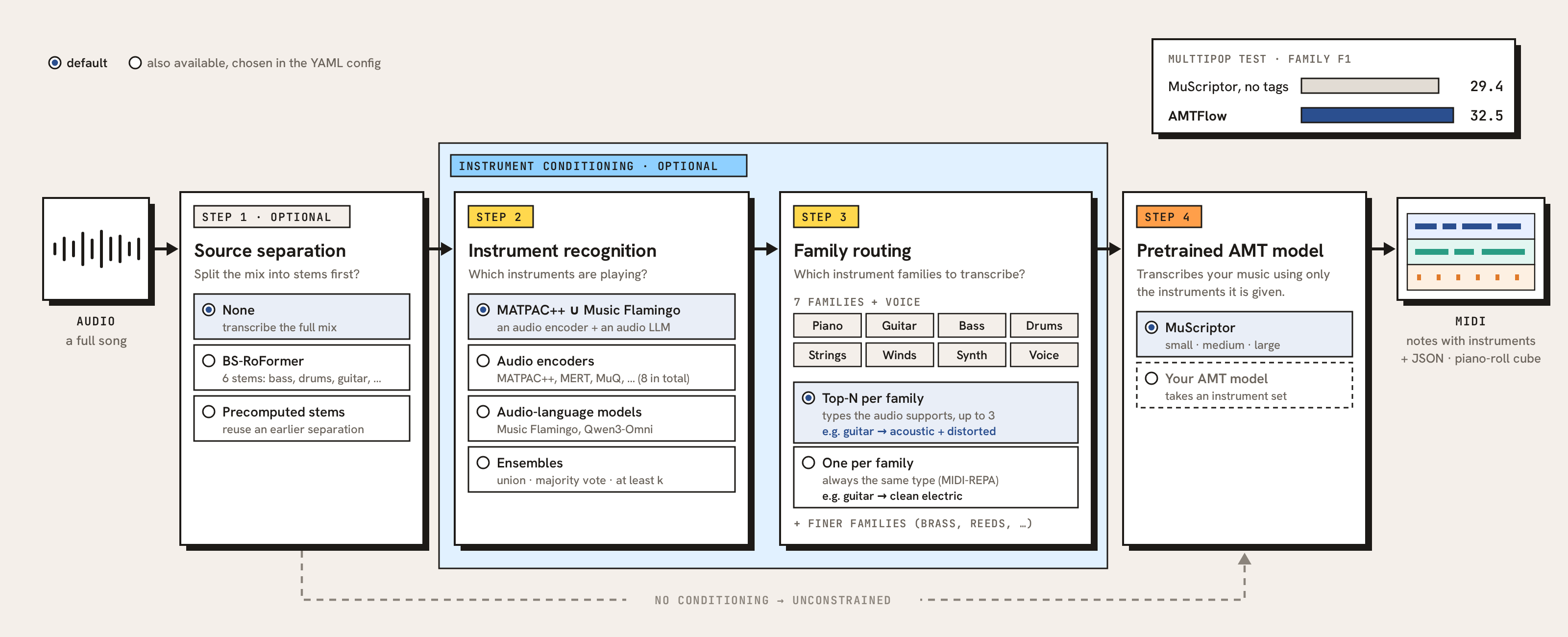
(Click the image to try the live demo.)
On real pop recordings, AMTFlow improves on unconditioned MuScriptor, the model it drives, and on earlier multi-instrument systems. MulTTiPop test set, 392 segments, note-onset F1 ×100, 50 ms (details):
| system | exact instrument | instrument family | instrument-agnostic |
|---|---|---|---|
| MT3 | 10.7 | 15.5 | 28.1 |
| YourMT3+ | 11.5 | 18.9 | 29.3 |
| MuScriptor medium, no instrument tags | 17.2 | 29.4 | 43.0 |
AMTFlow (default, same MuScriptor medium) | 18.3 | 32.5 | 44.0 |
git clone https://github.com/vaclisinc/AMTFlow && cd AMTFlow && uv sync
uv run amtflow transcribe song.wav --out out/
# song.wav: 131 notes; mix: acoustic_piano, acoustic_guitar, electric_bass, drums -> out/clips/song.mid
Weights download on first use. MuScriptor is gated: accept its terms on
Hugging Face and run
hf auth login once. The default pipeline needs a CUDA GPU with about 18 GB of free
memory.
Paste this into Claude Code, Codex or any coding agent, with your file paths filled in:
Set up AMTFlow (https://github.com/vaclisinc/AMTFlow) and transcribe my audio.
1. Clone it, read AGENTS.md and docs/usage.md, and install it with `uv sync`.
2. Check that a CUDA GPU with about 18 GB free is available and that I am logged in
   to Hugging Face with access to MuScriptor/muscriptor-medium. If not, tell me
   exactly what to do and stop.
3. Run `uv run amtflow transcribe <files> --out out/` with the default config.
4. For each file, report the detected instruments, the number of notes and the
   path of the MIDI file.

My audio files: <paths>
The figure above is the whole pipeline. Each step is a module you pick in a YAML config:
Skip steps 2 and 3 and the AMT model runs unconstrained. Adding a model takes a class and a config entry (docs/extending.md). Every module and option is listed in docs/usage.md.
--config takes one of these, or your own YAML that starts with extends: default.yaml.
| recipe | what it does |
|---|---|
default | the setup above; best on full songs |
paper | the MIDI-REPA pipeline: made for vocal-removed music, so no voice; one instrument per family, MuScriptor large |
fast | about 6x faster, about 1 F1 point lower |
stems, stems-click | separate stems first; one MIDI part per stem (uv sync --extra separation) |
vote | majority vote of several recognizers |
fine, fine-voice | finer families such as brass, reeds, organ, voice |
probe
recognizer (head: openmic/<encoder>-mlp) and downloaded automatically.results/: GuitarSet, MulTTiPop and OpenMIC-2018,
each with its protocol, per-item scores and configs.The code is MIT. The default pipeline downloads model weights with non-commercial licenses: MuScriptor (CC BY-NC 4.0) and Music Flamingo (NVIDIA OneWay Noncommercial). MATPAC++ is Apache 2.0, and the BS-RoFormer weights used by the stem recipes are CC BY-NC-SA 4.0.
AMTFlow is the transcription pipeline of the MIDI-REPA paper. If you use it, please cite:
@misc{yu2026midirepa,
      title={MIDI-REPA: Improving Text-to-Music Generation with Symbolic Representation Alignment},
      author={Song-Ze Yu and Fang-Duo Tsai and Yi-Hsuan Yang},
      year={2026},
      eprint={2610.20967},
      archivePrefix={arXiv},
      primaryClass={cs.SD},
      url={https://arxiv.org/abs/2610.20967},
}
A better framework for multi-instrument automatic music transcription.
See the code
AMTFlow is a modular framework for instrument-aware, multi-instrument automatic music transcription. It recognizes the instruments in a recording, routes them to a pretrained AMT model as its instrument conditioning, and writes MIDI in which every note carries its instrument. Source separation is optional; by default the whole mix is transcribed. Each stage is a pluggable module: source separation, instrument recognition, family routing and the AMT model itself (MuScriptor by default).
(Click the image to try the live demo.)
On real pop recordings, AMTFlow improves on unconditioned MuScriptor, the model it drives, and on earlier multi-instrument systems. MulTTiPop test set, 392 segments, note-onset F1 ×100, 50 ms (details):
| system | exact instrument | instrument family | instrument-agnostic |
|---|---|---|---|
| MT3 | 10.7 | 15.5 | 28.1 |
| YourMT3+ | 11.5 | 18.9 | 29.3 |
| MuScriptor medium, no instrument tags | 17.2 | 29.4 | 43.0 |
AMTFlow (default, same MuScriptor medium) | 18.3 | 32.5 | 44.0 |
git clone https://github.com/vaclisinc/AMTFlow && cd AMTFlow && uv sync
uv run amtflow transcribe song.wav --out out/
# song.wav: 131 notes; mix: acoustic_piano, acoustic_guitar, electric_bass, drums -> out/clips/song.mid
Weights download on first use. MuScriptor is gated: accept its terms on
Hugging Face and run
hf auth login once. The default pipeline needs a CUDA GPU with about 18 GB of free
memory.
Paste this into Claude Code, Codex or any coding agent, with your file paths filled in:
Set up AMTFlow (https://github.com/vaclisinc/AMTFlow) and transcribe my audio.
1. Clone it, read AGENTS.md and docs/usage.md, and install it with `uv sync`.
2. Check that a CUDA GPU with about 18 GB free is available and that I am logged in
   to Hugging Face with access to MuScriptor/muscriptor-medium. If not, tell me
   exactly what to do and stop.
3. Run `uv run amtflow transcribe <files> --out out/` with the default config.
4. For each file, report the detected instruments, the number of notes and the
   path of the MIDI file.

My audio files: <paths>
The figure above is the whole pipeline. Each step is a module you pick in a YAML config:
Skip steps 2 and 3 and the AMT model runs unconstrained. Adding a model takes a class and a config entry (docs/extending.md). Every module and option is listed in docs/usage.md.
--config takes one of these, or your own YAML that starts with extends: default.yaml.
| recipe | what it does |
|---|---|
default | the setup above; best on full songs |
paper | the MIDI-REPA pipeline: made for vocal-removed music, so no voice; one instrument per family, MuScriptor large |
fast | about 6x faster, about 1 F1 point lower |
stems, stems-click | separate stems first; one MIDI part per stem (uv sync --extra separation) |
vote | majority vote of several recognizers |
fine, fine-voice | finer families such as brass, reeds, organ, voice |
probe
recognizer (head: openmic/<encoder>-mlp) and downloaded automatically.results/: GuitarSet, MulTTiPop and OpenMIC-2018,
each with its protocol, per-item scores and configs.The code is MIT. The default pipeline downloads model weights with non-commercial licenses: MuScriptor (CC BY-NC 4.0) and Music Flamingo (NVIDIA OneWay Noncommercial). MATPAC++ is Apache 2.0, and the BS-RoFormer weights used by the stem recipes are CC BY-NC-SA 4.0.
AMTFlow is the transcription pipeline of the MIDI-REPA paper. If you use it, please cite:
@misc{yu2026midirepa,
      title={MIDI-REPA: Improving Text-to-Music Generation with Symbolic Representation Alignment},
      author={Song-Ze Yu and Fang-Duo Tsai and Yi-Hsuan Yang},
      year={2026},
      eprint={2610.20967},
      archivePrefix={arXiv},
      primaryClass={cs.SD},
      url={https://arxiv.org/abs/2610.20967},
}



