An efficient GPU support for LLM inference with x-bit quantization (e.g. FP6,FP5).
See the codeSix-bit quantization (FP6) can achieve better trade-offs between model quality and inference cost compard to 4-bit and 8-bit quantization counterparts, reducing the size of large language models (LLMs) effectively and preserving the model quality consistently across varied applications. To support 6-bit inference of LLMs effective on modern GPUs, we provide the official implementation of FP6-LLM, achieving significant speedups of linear layers and GPU memory reduction over the fp16/int8 baselines.
Our long-term goal is to support various quantization methods by providing extensible & high-performance GPU kernels for mixed-input matrix multiplication, using the unified design scheme presented in our paper, which is recently accepted by USENIX ATC24.
Currently, we have tested FP6_e3m2 and FP5_e2m2. However, our code is templated and easy to support different combination of eXmY if necessary.
The current release contains:
Our future plan includes but not limited to :
git clone https://github.com/usyd-fsalab/fp6_llm.git
cd fp6_llm
pip install .
cd fp6_llm && make
We provide scripts to verify the correctness of FP6-LLM. The outputs of FP6-LLM are compared to the outputs of the FP16 baseliness (the official implementation of linear layer in PyTorch and NVIDIA cuBLAS).
cd ../tests/python
./run.sh
cd ../cpp
make
./run.sh
We implemented the CUDA kernel supporting matrix multiply C = A × B, where A is the weight matrix of shape [OC, IC] in FP6 and B is the activation matrix of shape [IC, BS] in FP16. C and B are column-major matrices. The CUDA kernels can be launched via PyTorch APIs or C++ APIs. Currently:
For more details of using FP6-LLM APIs, please see the source code of the C++/Python Test.
To use the PyTorch APIs of FP6-LLM, you only need to import the python module:
import fp6_llm
fp6_pakced_weight = fp6_llm.weight_prepacking_cpu(fp6_weight)

Arguments:
    fp6_weight:         int tensor of shape [OC, IC // 16 * 3];     // 3 INT32 words contains 16 FP6 weights.
Return:
    fp6_pakced_weight:  int tensor of shape [OC, IC // 16 * 3];     // 3 INT32 words contains 16 FP6 weights.
fp16_output=fp6_llm.linear_forward_cuda(fp6_packed_weight, fp16_scale, fp16_input, splitK)

Arguments:
    fp6_packed_weight:  int tensor of shape [OC, IC // 16 * 3];     // 3 INT32 words contains 16 FP6 weights.
    fp16_scale:         tensor of shape [OC];                       // half tensor
    fp16_input:         tensor of shape [B, IC];                    // half tensor
    splitK:             int value, spliting the MatMul problem along K dimension for higher GPU utilization, default 1.
Return:
    fp16_output:        tensor of shape [B, OC];                    // half tensor
import fp6_llm
SplitK = fp6_llm.HeuristicFuntion_SplitK(M, N, Number_GPU_SMs)

Arguments:
    M is the number of rows of the weight matrix, N is the inference batch size. More specifically, the shape of the MulMal: (M, K) * (K, N) -> (M, N),
    Number_GPU_SMs is the number of Stream Multiprocessors of the GPU you are using. For A100 GPUs, Number_GPU_SMs=108.
fp16_tensor=fp6_llm.weight_dequant_cpu(fp6_tensor, fp16_scale)

Arguments:
    fp6_tensor:         int  tensor of shape [OC, IC // 16 * 3];   // 3 INT32 words contains 16 FP6  weights.
    fp16_scale:         half tensor of shape [OC];                 // for row-wise quantization.
Return:
    fp16_tensor:        half tensor of shape [OC, IC].
To use the C++ APIs of FP6-LLM, you need to include this head file of FP6-LLM in your C++ codes:
#include "fp6_linear.cuh"
Besides, you need to link the dynamic linkable library (fp6.so) under this directory during compilation.
void weight_matrix_prepacking(int* packed_weights,                  // [Output] prepacked FP6 weight matrix
                              int *FP6Weights,                      // [Input]  original FP6 weight matrix
                              size_t M,                             // OC
                              size_t K);                            // IC
cudaError_t fp6_linear_kernel(cudaStream_t    stream,               // CUDA stream to execute the GPU kernel.
                              const uint4     *Weight,              // [Input]  Pointer to the FP6 weight matrix.
                              const half      *Scales,              // [Input]  Pointer to the FP16 quantization scales.
                              const half      *B,                   // [Input]  Pointer to the FP16 input activation.
                              half            *C,                   // [Output] Pointer to the FP16 output activation.
                              const size_t    M_Global,             // OC
                              const size_t    N_Global,             // BS
                              const size_t    K_Global,             // IC
                              float           *Reduction_Workspace, // Pointer to the temporary workspace for splitK reduction. Workspace_Size = Split_K * M_Global * N_Global * sizeof(fp32)
                              int             Split_K);             // splitK
void DeQuantMatrix_FP6_To_FP16(half* A_16bit_h,                     // [Output] Pointer to the dequantized FP16 weight. matrix.
                               unsigned char* A_6bit_h,             // [Input]  Pointer to the quantized FP6 weight matrix.
                               size_t M,                            // OC
                               size_t K,                            // IC
                               half* scale);                        // [Input]  Pointer to the FP16 quantization scales.
Similar to FP6 APIs, except that two more parameters (EXPONENT, MANTISSA) are required. More detailed will be provided soon.
FP6 quantization is a practical alternative to further democratize the deployment of LLMs without significantly sacrificing model quality on complex tasks and various model sizes.

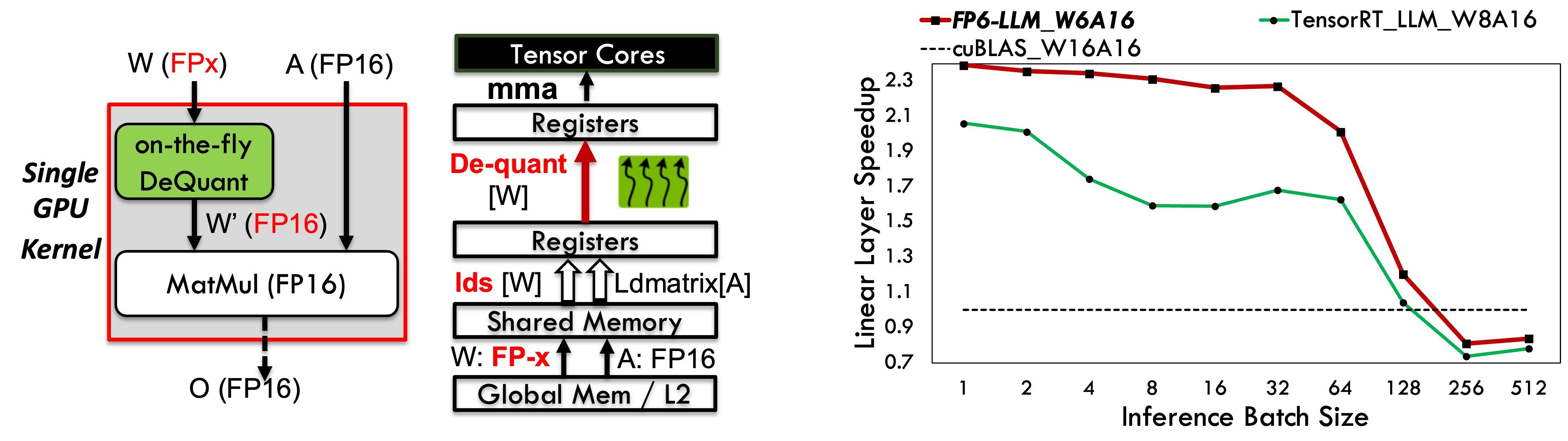
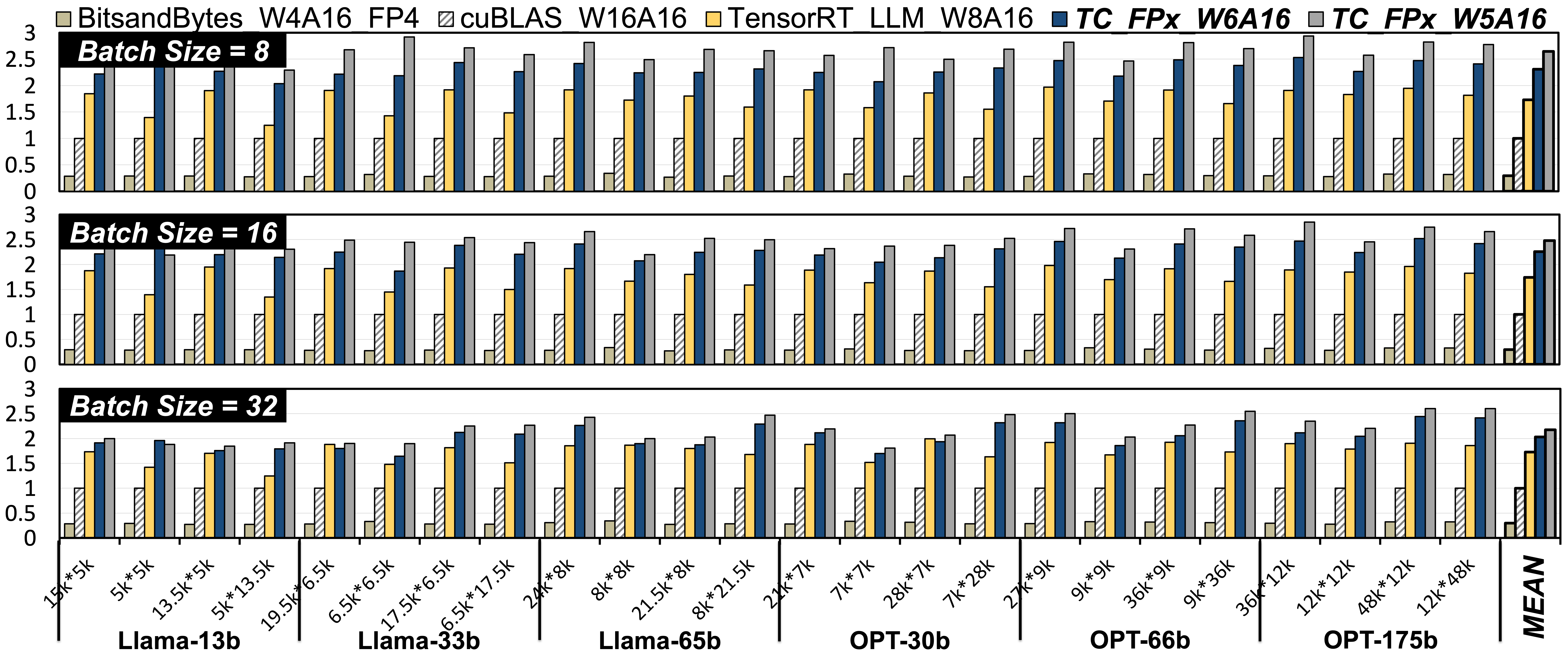
Compared to the FP16 baselines (cuBLAS), INT8 quantization (TensorRT_LLM), and FP4 quantization (bitsandbytes):
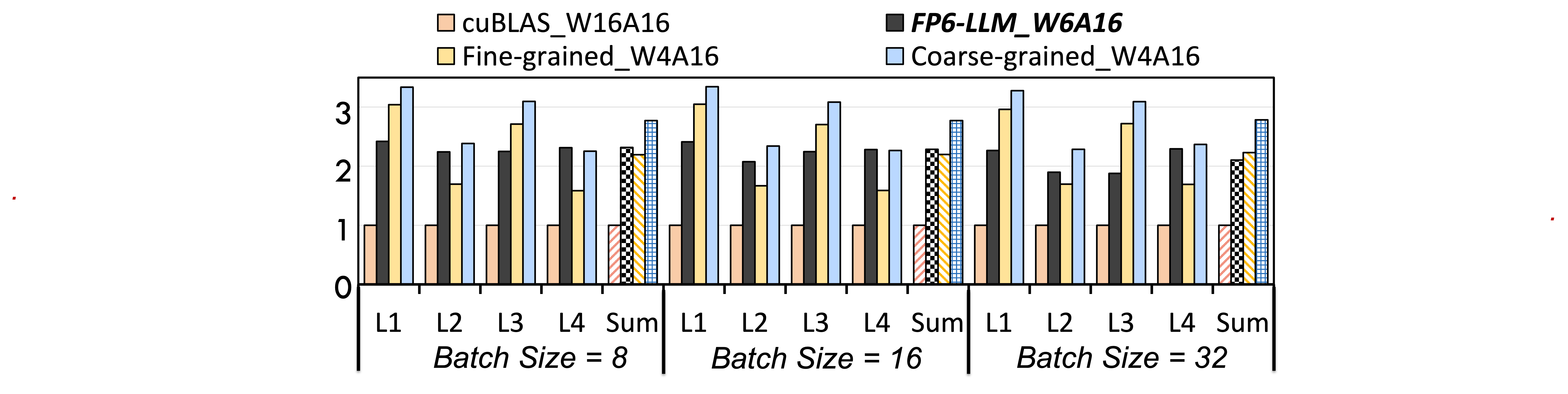
Compared to baselines for INT4 quantization (TensorRT_LLM):
Experimental settings and baselines:
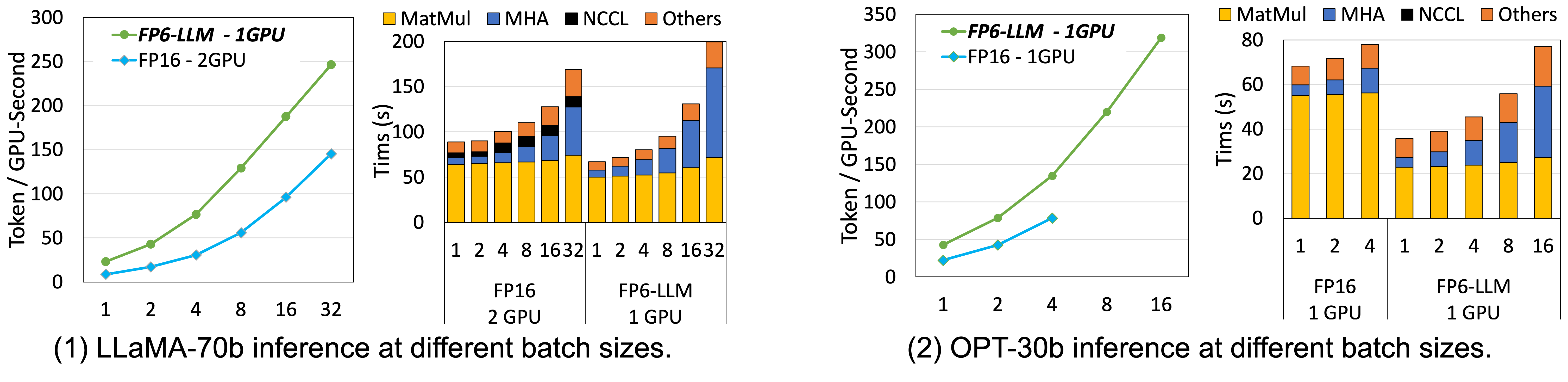
Results of LLaMA-70b:
Results of OPT-30b:
Inference latency breakdown of LLaMA-70b:
Inference latency breakdown of OPT-30b:
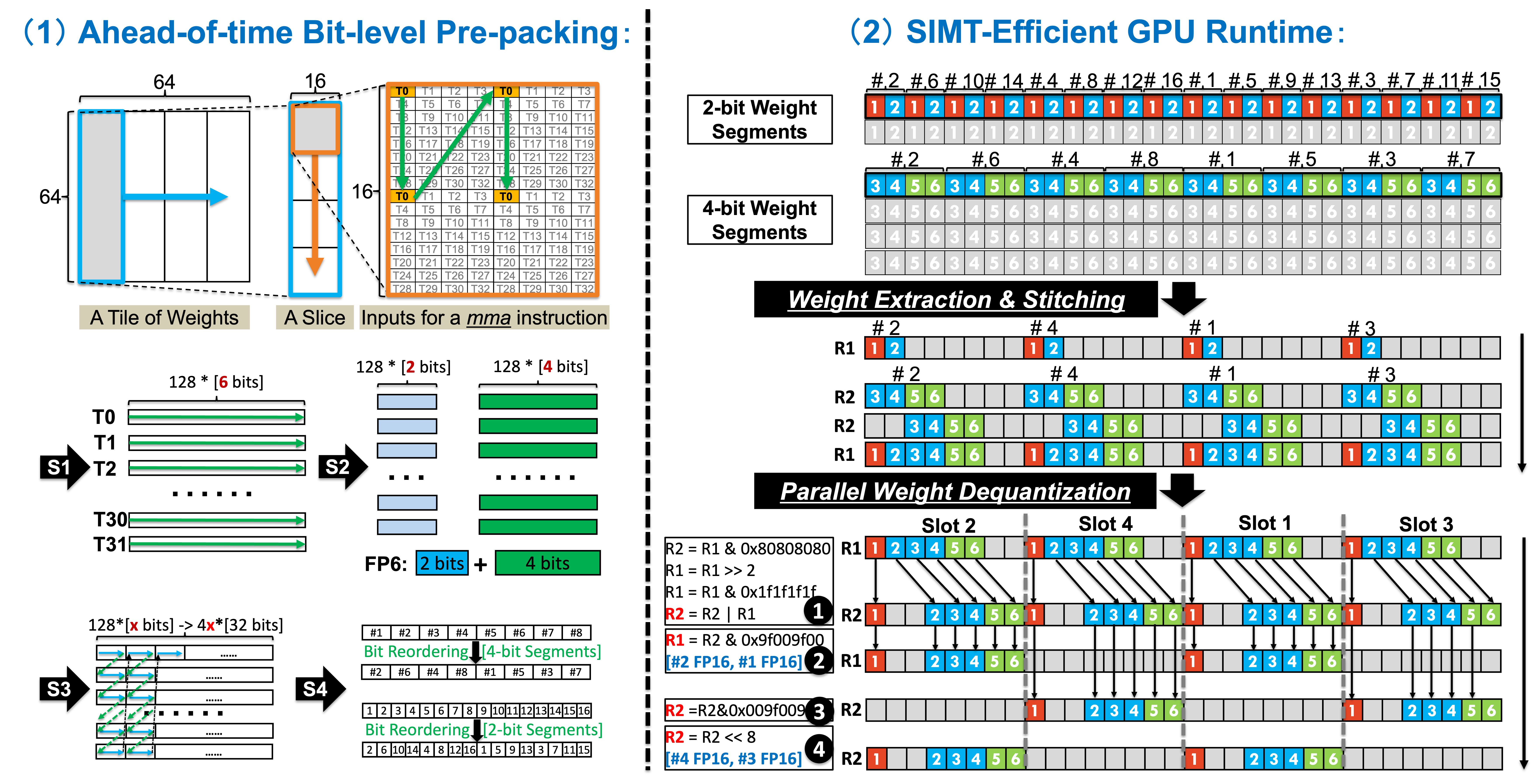
We propose TC-FPx, the first full-stack GPU system design scheme with unified Tensor Core support of float-point weights for various quantization bit-width (6-bit, 5-bit, 3-bit, etc.), mitigating the "memory wall" issues during LLM inference. TC-FPx breaks the limitations of the underlying GPU hardware, allowing the GPU to support linear layer calculations involving model weights of arbitrary bit width. In TC-FPx, Tensor Cores are utilized for intensive computation of matrix multiplications, while SIMT cores are effectively leveraged for weight dequantization, transforming the x-bit model weights to FP16 type during runtime before feeding them to Tensor Cores.
FP6-LLM is already integrated in DeepSpeed and this new feature will be available soon. Given that easy-to-use PyTorch and C++ APIs are provided, FP6-LLM can be easily integrated to any inference frameworks as an useful component. We welcome collaborations to integrate FP6-LLM into other inference frameworks. We also welcome all AI developers/practitioners/researchers to join this on-going project, fully exploring the potential of different quantization methods.
If you find FP6-LLM useful or relevant to your research, please kindly cite our paper:
@misc{xia2024fp6llm,
      title={FP6-LLM: Efficiently Serving Large Language Models Through FP6-Centric Algorithm-System Co-Design},
      author={Haojun Xia and Zhen Zheng and Xiaoxia Wu and Shiyang Chen and Zhewei Yao and Stephen Youn and Arash Bakhtiari and Michael Wyatt and Donglin Zhuang and Zhongzhu Zhou and Olatunji Ruwase and Yuxiong He and Shuaiwen Leon Song},
      year={2024},
      eprint={2401.14112},
      archivePrefix={arXiv},
      primaryClass={cs.LG}
}
378 followers · starred May 2024
114 followers · starred May 2024
954 followers · starred Apr 2024
2,003 followers · starred Mar 2024
An efficient GPU support for LLM inference with x-bit quantization (e.g. FP6,FP5).
See the codeSix-bit quantization (FP6) can achieve better trade-offs between model quality and inference cost compard to 4-bit and 8-bit quantization counterparts, reducing the size of large language models (LLMs) effectively and preserving the model quality consistently across varied applications. To support 6-bit inference of LLMs effective on modern GPUs, we provide the official implementation of FP6-LLM, achieving significant speedups of linear layers and GPU memory reduction over the fp16/int8 baselines.
Our long-term goal is to support various quantization methods by providing extensible & high-performance GPU kernels for mixed-input matrix multiplication, using the unified design scheme presented in our paper, which is recently accepted by USENIX ATC24.
Currently, we have tested FP6_e3m2 and FP5_e2m2. However, our code is templated and easy to support different combination of eXmY if necessary.
The current release contains:
Our future plan includes but not limited to :
git clone https://github.com/usyd-fsalab/fp6_llm.git
cd fp6_llm
pip install .
cd fp6_llm && make
We provide scripts to verify the correctness of FP6-LLM. The outputs of FP6-LLM are compared to the outputs of the FP16 baseliness (the official implementation of linear layer in PyTorch and NVIDIA cuBLAS).
cd ../tests/python
./run.sh
cd ../cpp
make
./run.sh
We implemented the CUDA kernel supporting matrix multiply C = A × B, where A is the weight matrix of shape [OC, IC] in FP6 and B is the activation matrix of shape [IC, BS] in FP16. C and B are column-major matrices. The CUDA kernels can be launched via PyTorch APIs or C++ APIs. Currently:
For more details of using FP6-LLM APIs, please see the source code of the C++/Python Test.
To use the PyTorch APIs of FP6-LLM, you only need to import the python module:
import fp6_llm
fp6_pakced_weight = fp6_llm.weight_prepacking_cpu(fp6_weight)

Arguments:
    fp6_weight:         int tensor of shape [OC, IC // 16 * 3];     // 3 INT32 words contains 16 FP6 weights.
Return:
    fp6_pakced_weight:  int tensor of shape [OC, IC // 16 * 3];     // 3 INT32 words contains 16 FP6 weights.
fp16_output=fp6_llm.linear_forward_cuda(fp6_packed_weight, fp16_scale, fp16_input, splitK)

Arguments:
    fp6_packed_weight:  int tensor of shape [OC, IC // 16 * 3];     // 3 INT32 words contains 16 FP6 weights.
    fp16_scale:         tensor of shape [OC];                       // half tensor
    fp16_input:         tensor of shape [B, IC];                    // half tensor
    splitK:             int value, spliting the MatMul problem along K dimension for higher GPU utilization, default 1.
Return:
    fp16_output:        tensor of shape [B, OC];                    // half tensor
import fp6_llm
SplitK = fp6_llm.HeuristicFuntion_SplitK(M, N, Number_GPU_SMs)

Arguments:
    M is the number of rows of the weight matrix, N is the inference batch size. More specifically, the shape of the MulMal: (M, K) * (K, N) -> (M, N),
    Number_GPU_SMs is the number of Stream Multiprocessors of the GPU you are using. For A100 GPUs, Number_GPU_SMs=108.
fp16_tensor=fp6_llm.weight_dequant_cpu(fp6_tensor, fp16_scale)

Arguments:
    fp6_tensor:         int  tensor of shape [OC, IC // 16 * 3];   // 3 INT32 words contains 16 FP6  weights.
    fp16_scale:         half tensor of shape [OC];                 // for row-wise quantization.
Return:
    fp16_tensor:        half tensor of shape [OC, IC].
To use the C++ APIs of FP6-LLM, you need to include this head file of FP6-LLM in your C++ codes:
#include "fp6_linear.cuh"
Besides, you need to link the dynamic linkable library (fp6.so) under this directory during compilation.
void weight_matrix_prepacking(int* packed_weights,                  // [Output] prepacked FP6 weight matrix
                              int *FP6Weights,                      // [Input]  original FP6 weight matrix
                              size_t M,                             // OC
                              size_t K);                            // IC
cudaError_t fp6_linear_kernel(cudaStream_t    stream,               // CUDA stream to execute the GPU kernel.
                              const uint4     *Weight,              // [Input]  Pointer to the FP6 weight matrix.
                              const half      *Scales,              // [Input]  Pointer to the FP16 quantization scales.
                              const half      *B,                   // [Input]  Pointer to the FP16 input activation.
                              half            *C,                   // [Output] Pointer to the FP16 output activation.
                              const size_t    M_Global,             // OC
                              const size_t    N_Global,             // BS
                              const size_t    K_Global,             // IC
                              float           *Reduction_Workspace, // Pointer to the temporary workspace for splitK reduction. Workspace_Size = Split_K * M_Global * N_Global * sizeof(fp32)
                              int             Split_K);             // splitK
void DeQuantMatrix_FP6_To_FP16(half* A_16bit_h,                     // [Output] Pointer to the dequantized FP16 weight. matrix.
                               unsigned char* A_6bit_h,             // [Input]  Pointer to the quantized FP6 weight matrix.
                               size_t M,                            // OC
                               size_t K,                            // IC
                               half* scale);                        // [Input]  Pointer to the FP16 quantization scales.
Similar to FP6 APIs, except that two more parameters (EXPONENT, MANTISSA) are required. More detailed will be provided soon.
FP6 quantization is a practical alternative to further democratize the deployment of LLMs without significantly sacrificing model quality on complex tasks and various model sizes.
Compared to the FP16 baselines (cuBLAS), INT8 quantization (TensorRT_LLM), and FP4 quantization (bitsandbytes):
Compared to baselines for INT4 quantization (TensorRT_LLM):
Experimental settings and baselines:
Results of LLaMA-70b:
Results of OPT-30b:
Inference latency breakdown of LLaMA-70b:
Inference latency breakdown of OPT-30b:
We propose TC-FPx, the first full-stack GPU system design scheme with unified Tensor Core support of float-point weights for various quantization bit-width (6-bit, 5-bit, 3-bit, etc.), mitigating the "memory wall" issues during LLM inference. TC-FPx breaks the limitations of the underlying GPU hardware, allowing the GPU to support linear layer calculations involving model weights of arbitrary bit width. In TC-FPx, Tensor Cores are utilized for intensive computation of matrix multiplications, while SIMT cores are effectively leveraged for weight dequantization, transforming the x-bit model weights to FP16 type during runtime before feeding them to Tensor Cores.
FP6-LLM is already integrated in DeepSpeed and this new feature will be available soon. Given that easy-to-use PyTorch and C++ APIs are provided, FP6-LLM can be easily integrated to any inference frameworks as an useful component. We welcome collaborations to integrate FP6-LLM into other inference frameworks. We also welcome all AI developers/practitioners/researchers to join this on-going project, fully exploring the potential of different quantization methods.
If you find FP6-LLM useful or relevant to your research, please kindly cite our paper:
@misc{xia2024fp6llm,
      title={FP6-LLM: Efficiently Serving Large Language Models Through FP6-Centric Algorithm-System Co-Design},
      author={Haojun Xia and Zhen Zheng and Xiaoxia Wu and Shiyang Chen and Zhewei Yao and Stephen Youn and Arash Bakhtiari and Michael Wyatt and Donglin Zhuang and Zhongzhu Zhou and Olatunji Ruwase and Yuxiong He and Shuaiwen Leon Song},
      year={2024},
      eprint={2401.14112},
      archivePrefix={arXiv},
      primaryClass={cs.LG}
}
378 followers · starred May 2024
114 followers · starred May 2024
954 followers · starred Apr 2024
2,003 followers · starred Mar 2024



