An acceleration library that supports arbitrary bit-width combinatorial quantization operations
C++
249
27 commits
updated Sep 30, 2024
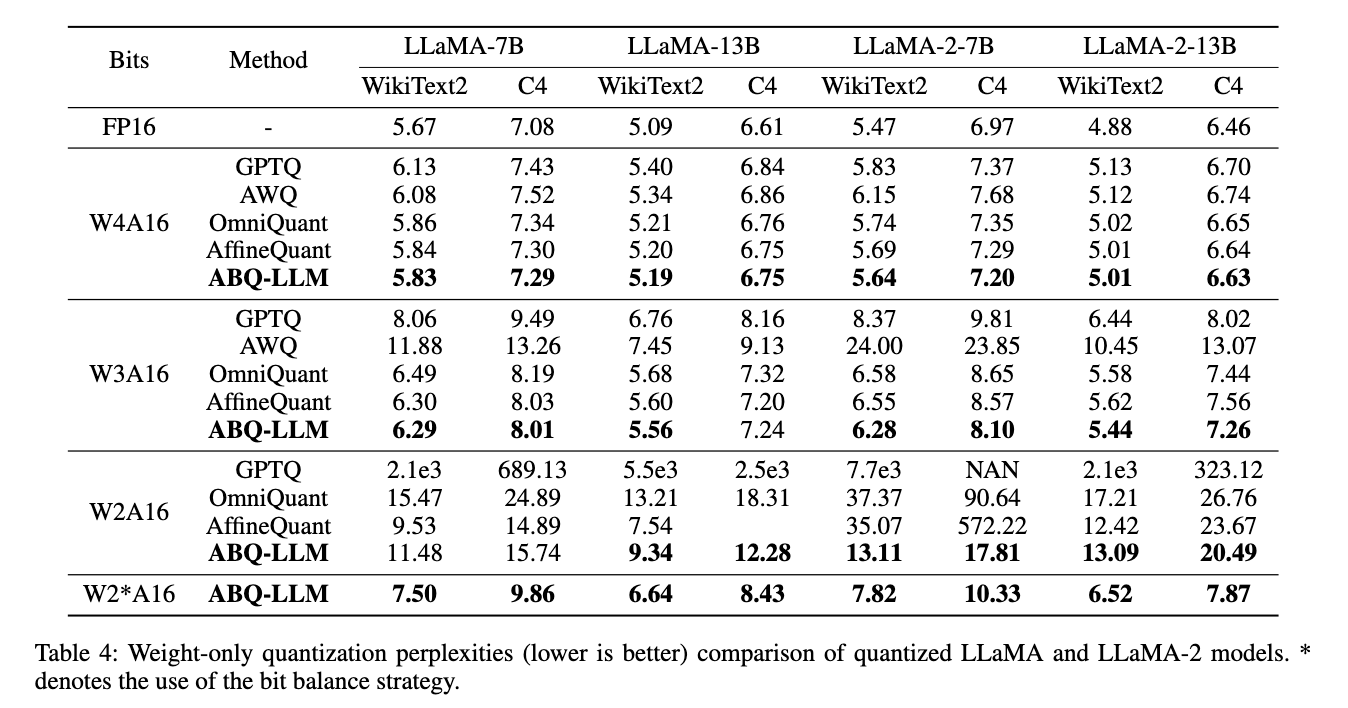
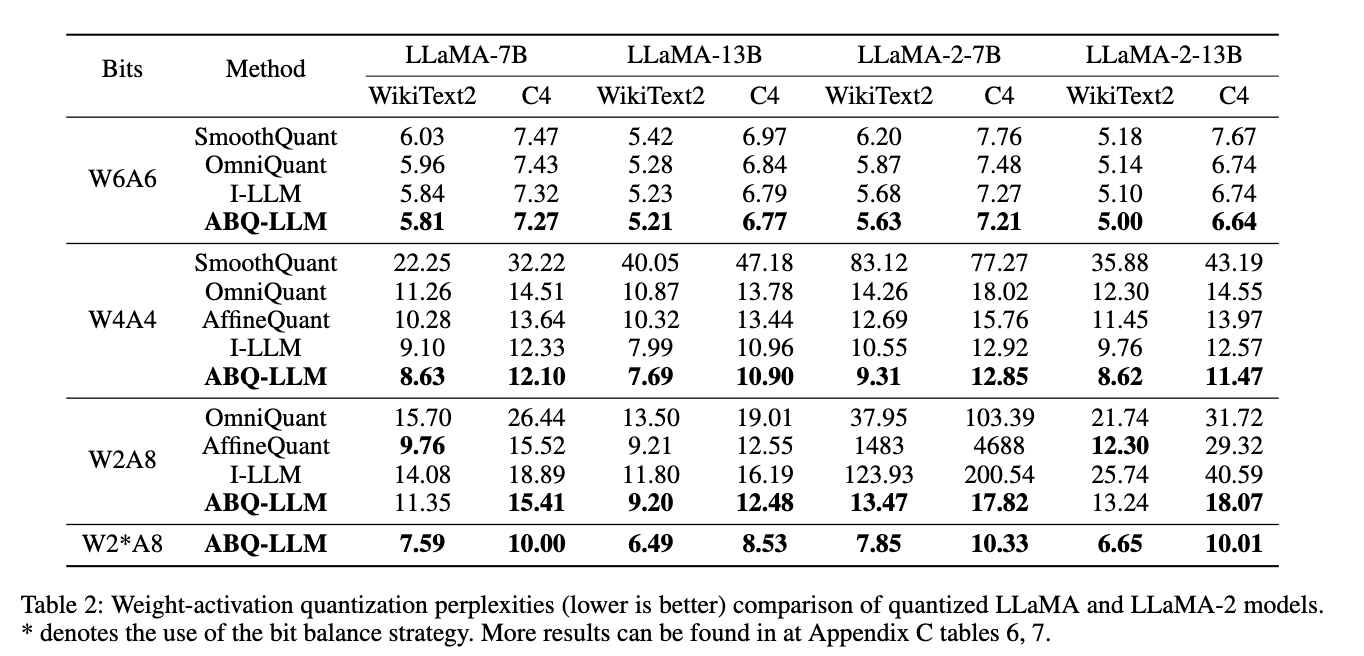
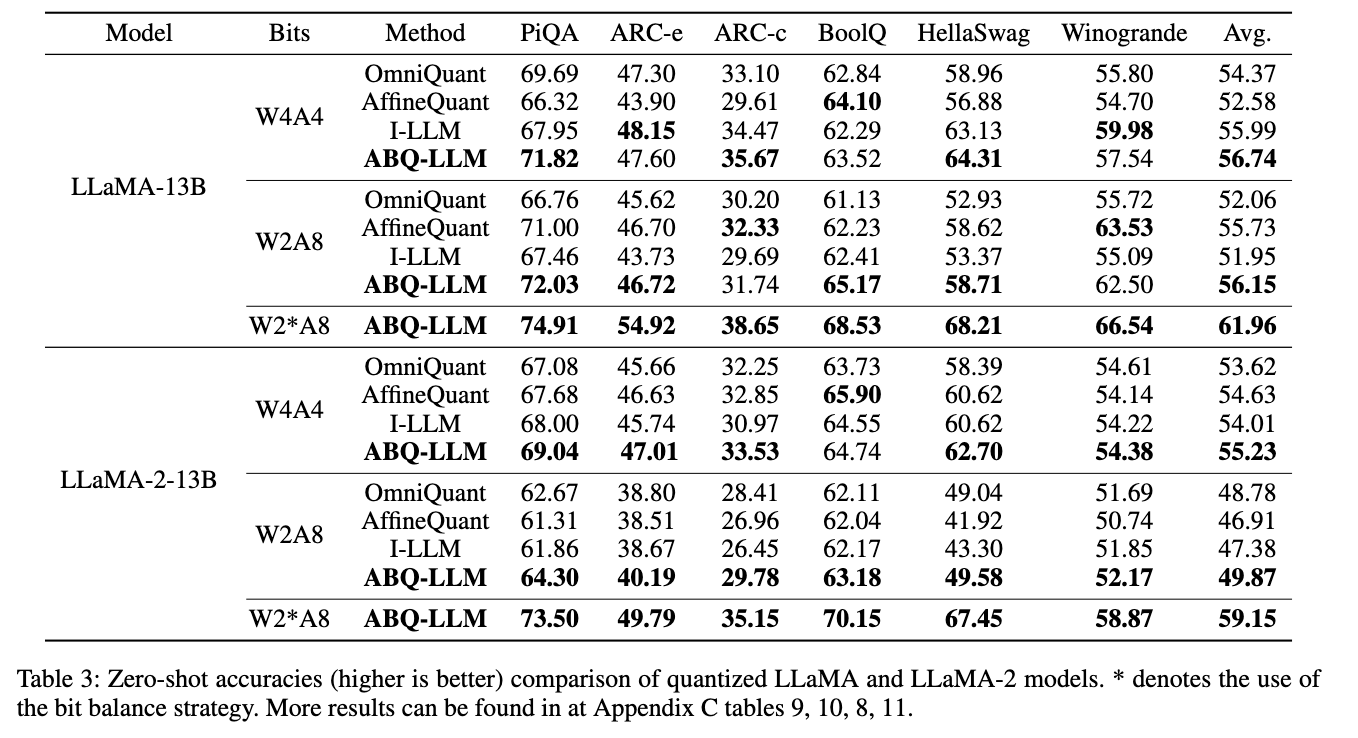
ABQ-LLM is a novel arbitrary bit quantization scheme that achieves excellent performance under various quantization settings while enabling efficient arbitrary bit computation at the inference level.
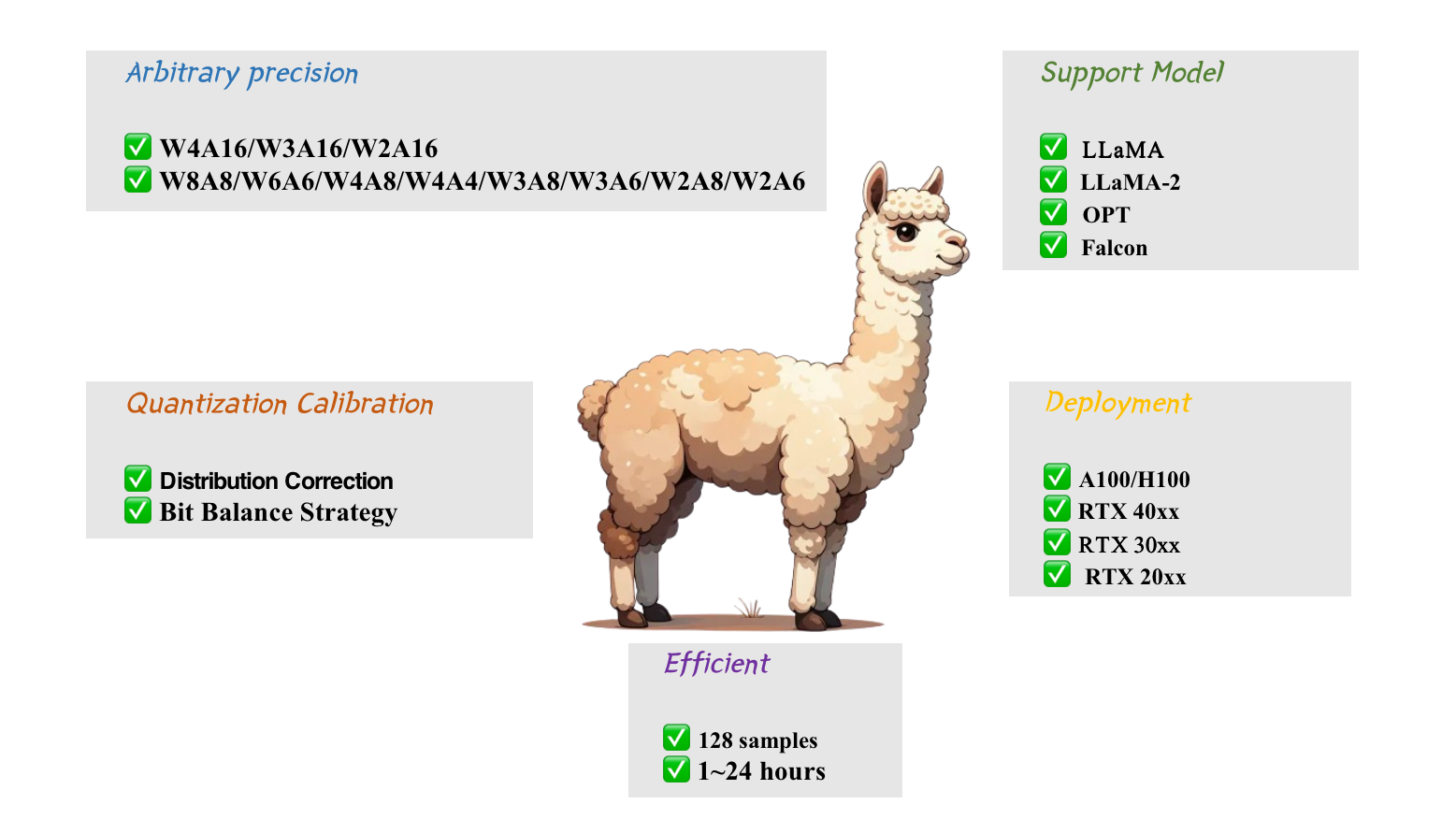 The current release version supports the following features:
conda create -n abq-llm python=3.10.0 -y
conda activate abq-llm
git clone https://github.com/bytedance/ABQ-LLM.git
cd ./ABQ-LLM/algorithm
pip install --upgrade pip
pip install -r requirements.txt
You can actually compile and test our quantized inference Kernel, but you need to install the basic CUDA Toolkit.
git submodule init
git submodule update
We provide pre-trained ABQ-LLM model zoo for multiple model families, including LLaMa-1&2, OPT. The detailed support list:
| Models | Sizes | W4A16 | W3A16 | W2A16 | W2A16g128 | W2A16g64 |
|---|---|---|---|---|---|---|
| LLaMA | 7B/13B | ✅ | ✅ | ✅ | ✅ | ✅ |
| LLaMA-2 | 7B/13B | ✅ | ✅ | ✅ | ✅ | ✅ |
| Models | Sizes | W8A8 | W4A8 | W6A6 | W4A6 | W4A4 | W3A8 | W3A6 | W2A8 | W2A6 |
|---|---|---|---|---|---|---|---|---|---|---|
| LLaMA | 7B/13B | ✅ | ✅ | ✅ | ✅ | ✅ | ✅ | ✅ | ✅ | ✅ |
| LLaMA-2 | 7B/13B | ✅ | ✅ | ✅ | ✅ | ✅ | ✅ | ✅ | ✅ | ✅ |
We provide the pre-trained ABQ- LLM model weight in hugginface, you can verify the model performance by the following commands.
CUDA_VISIBLE_DEVICES=0 python run_pretrain_abq_model.py \
--model /PATH/TO/LLaMA/llama-7b-ABQ \
--wbits 4 --abits 4
We also provide full script to run ABQ-LLM in ./algorithm/scripts/. We use LLaMa-7B as an example here:
python generate_act_scale_shift.py --model /PATH/TO/LLaMA/llama-7b
# W3A16
CUDA_VISIBLE_DEVICES=0 python main.py \
--model /PATH/TO/LLaMA/llama-7b  \
--epochs 20 --output_dir ./log/llama-7b-w3a16 \
--eval_ppl --wbits 3 --abits 16  --lwc --let

# W3A16g128
CUDA_VISIBLE_DEVICES=0 python main.py \
--model /PATH/TO/LLaMA/llama-7b  \
--epochs 20 --output_dir ./log/llama-7b-w3a16g128 \
--eval_ppl --wbits 3 --abits 16 --group_size 128 --lwc --let
# W4A4
CUDA_VISIBLE_DEVICES=0 python main.py \
--model /PATH/TO/LLaMA/llama-7b  \
--epochs 20 --output_dir ./log/llama-7b-w4a4 \
--eval_ppl --wbits 4 --abits 4 --lwc --let \
--tasks piqa,arc_easy,arc_challenge,boolq,hellaswag,winogrande
More detailed and optional arguments:
--model: the local model path or huggingface format.--wbits: weight quantization bits.--abits: activation quantization bits.--group_size: group size of weight quantization. If no set, use per-channel quantization for weight as default.--lwc: activate the Learnable Weight Clipping (LWC).--let: activate the Learnable Equivalent Transformation (LET).--lwc_lr: learning rate of LWC parameters, 1e-2 as default.--let_lr: learning rate of LET parameters, 5e-3 as default.--epochs: training epochs. You can set it as 0 to evaluate pre-trained ABQ-LLM checkpoints.--nsamples: number of calibration samples, 128 as default.--eval_ppl: evaluating the perplexity of quantized models.--tasks: evaluating zero-shot tasks.--multigpu: to inference larger network on multiple GPUs--real_quant: real quantization, which can see memory reduce. Note that due to the limitations of AutoGPTQ kernels, the real quantization of weight-only quantization can only lead memory reduction, but with slower inference speed.--save_dir: saving the quantization model for further exploration.By default, w2a2, w3a3, w4a4, w5a5, w6a6, w7a7, w8a8 are compiled, and the kernel of w2a4, w2a6, w2a8, and w4a8 quantization combination is compiled. Each quantization scheme corresponds to dozens of kernel implementation schemes to build its search space.
# linux
cd engine
bash build.sh

# windows
cd engine
build.bat
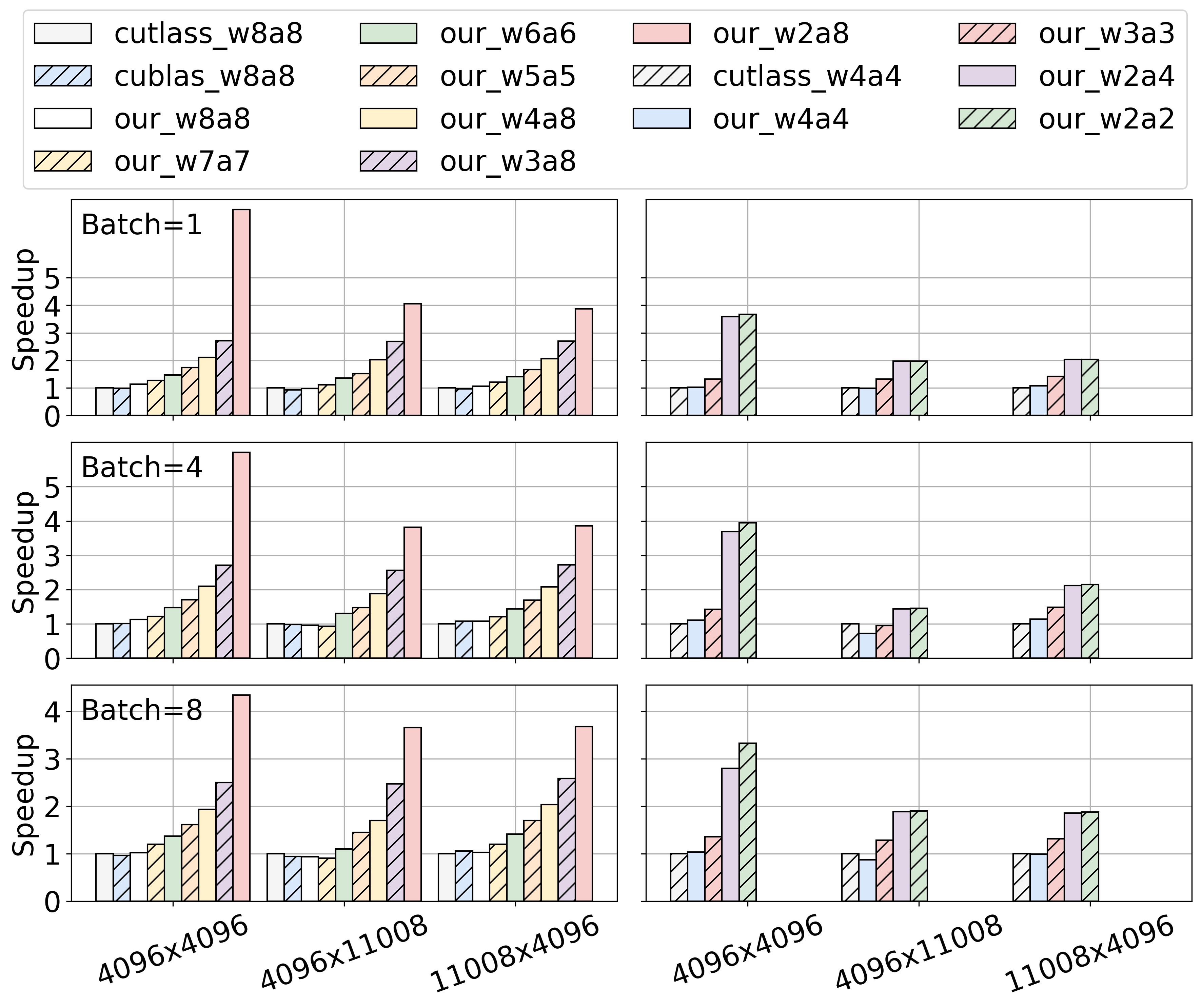
For the typical GEMM operation of the llama model, different quantization combinations (w2a2, w3a3, w4a4,w5a5, w6a6, w7a7, w8a8, w2a4, w2a6, w2a8, w4a8) are tested to obtain the optimal performance in the search space of each quantization combination.
# linux
bash test.sh
# windows
test.bat
We reconstructed the quantized matrix multiplication operation in a clever way, decomposing it into a series of binary matrix multiplications, and performed a high degree of template and computational model abstraction.
Based on the above optimizations, you can quickly expand our code to support new quantization combinations, such as wpaq. You only need to add wpaq instantiation definition and declaration files in engine/mma_any/aq_wmma_impl and then recompile.
The performance upper limit depends on how the search space is defined (the instantiated function configuration). For related experience, please refer to the paper or the existing implementation in this directory.
cd fastertransformer
bash build.sh
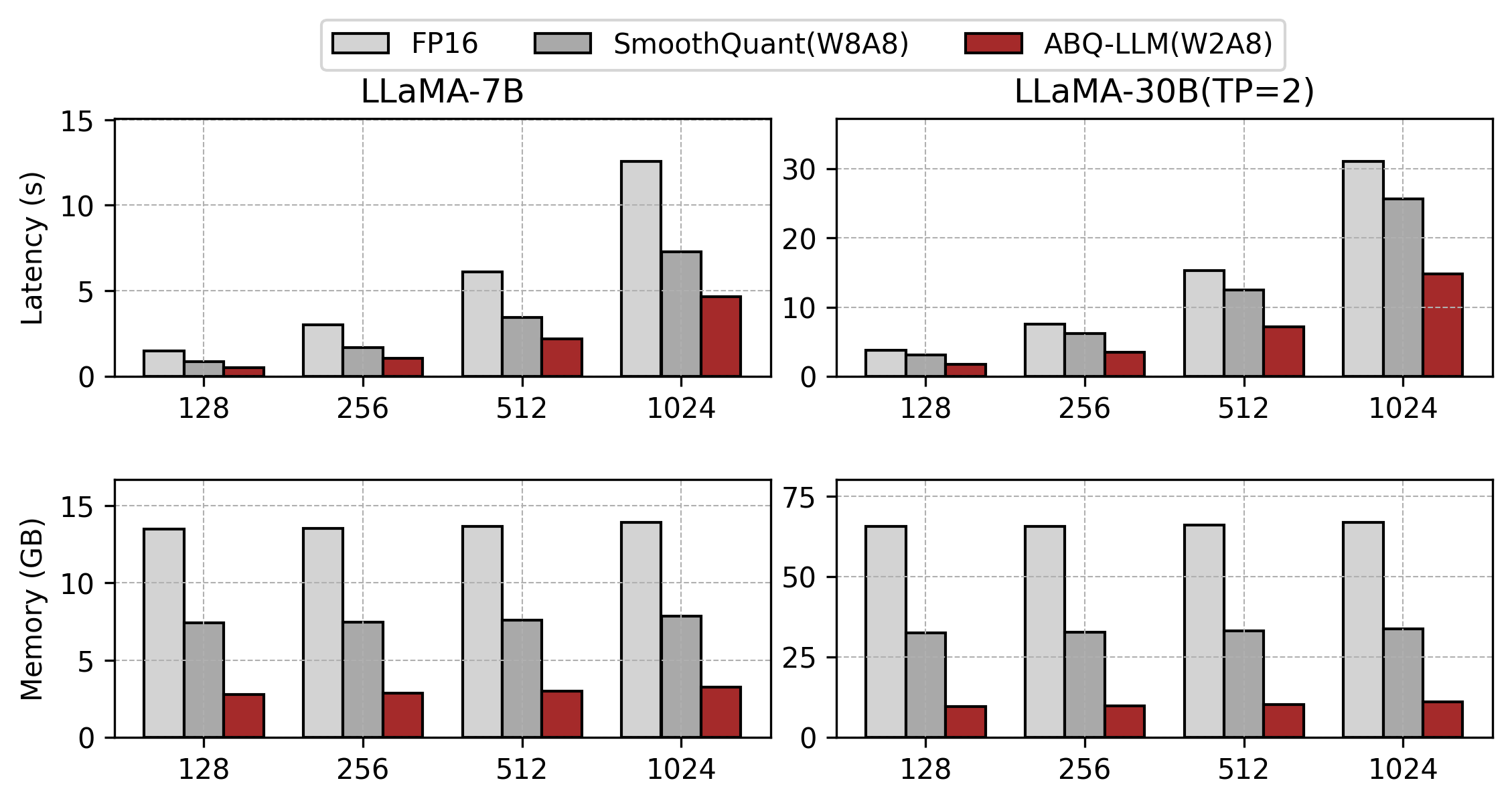
fp16:  int8_mode=0
w8a16: int8_mode=1
w8a8:  int8_mode=2
w4a16: int8_mode=4
w2a8:  int8_mode=5
cd build_release
./bin/llama_example
cd build_release
mpirun -n 2 ./bin/llama_example
SmoothQuant: Accurate and Efficient Post-Training Quantization for Large Language Models
AWQ: Activation-aware Weight Quantization for LLM Compression and Acceleration
GPTQ: Accurate Post-training Compression for Generative Pretrained Transformers
RPTQ: Reorder-Based Post-Training Quantization for Large Language Models
OmniQuant is a simple and powerful quantization technique for LLMs
If you use our ABQ-LLM approach in your research, please cite our paper:
@article{zeng2024abq,
  title={ABQ-LLM: Arbitrary-Bit Quantized Inference Acceleration for Large Language Models},
  author={Zeng, Chao and Liu, Songwei and Xie, Yusheng and Liu, Hong and Wang, Xiaojian and Wei, Miao and Yang, Shu and Chen, Fangmin and Mei, Xing},
  journal={arXiv preprint arXiv:2408.08554},
  year={2024}
}
An acceleration library that supports arbitrary bit-width combinatorial quantization operations
C++
249
27 commits
updated Sep 30, 2024
ABQ-LLM is a novel arbitrary bit quantization scheme that achieves excellent performance under various quantization settings while enabling efficient arbitrary bit computation at the inference level.
The current release version supports the following features:
conda create -n abq-llm python=3.10.0 -y
conda activate abq-llm
git clone https://github.com/bytedance/ABQ-LLM.git
cd ./ABQ-LLM/algorithm
pip install --upgrade pip
pip install -r requirements.txt
You can actually compile and test our quantized inference Kernel, but you need to install the basic CUDA Toolkit.
git submodule init
git submodule update
We provide pre-trained ABQ-LLM model zoo for multiple model families, including LLaMa-1&2, OPT. The detailed support list:
| Models | Sizes | W4A16 | W3A16 | W2A16 | W2A16g128 | W2A16g64 |
|---|---|---|---|---|---|---|
| LLaMA | 7B/13B | ✅ | ✅ | ✅ | ✅ | ✅ |
| LLaMA-2 | 7B/13B | ✅ | ✅ | ✅ | ✅ | ✅ |
| Models | Sizes | W8A8 | W4A8 | W6A6 | W4A6 | W4A4 | W3A8 | W3A6 | W2A8 | W2A6 |
|---|---|---|---|---|---|---|---|---|---|---|
| LLaMA | 7B/13B | ✅ | ✅ | ✅ | ✅ | ✅ | ✅ | ✅ | ✅ | ✅ |
| LLaMA-2 | 7B/13B | ✅ | ✅ | ✅ | ✅ | ✅ | ✅ | ✅ | ✅ | ✅ |
We provide the pre-trained ABQ- LLM model weight in hugginface, you can verify the model performance by the following commands.
CUDA_VISIBLE_DEVICES=0 python run_pretrain_abq_model.py \
--model /PATH/TO/LLaMA/llama-7b-ABQ \
--wbits 4 --abits 4
We also provide full script to run ABQ-LLM in ./algorithm/scripts/. We use LLaMa-7B as an example here:
python generate_act_scale_shift.py --model /PATH/TO/LLaMA/llama-7b
# W3A16
CUDA_VISIBLE_DEVICES=0 python main.py \
--model /PATH/TO/LLaMA/llama-7b  \
--epochs 20 --output_dir ./log/llama-7b-w3a16 \
--eval_ppl --wbits 3 --abits 16  --lwc --let

# W3A16g128
CUDA_VISIBLE_DEVICES=0 python main.py \
--model /PATH/TO/LLaMA/llama-7b  \
--epochs 20 --output_dir ./log/llama-7b-w3a16g128 \
--eval_ppl --wbits 3 --abits 16 --group_size 128 --lwc --let
# W4A4
CUDA_VISIBLE_DEVICES=0 python main.py \
--model /PATH/TO/LLaMA/llama-7b  \
--epochs 20 --output_dir ./log/llama-7b-w4a4 \
--eval_ppl --wbits 4 --abits 4 --lwc --let \
--tasks piqa,arc_easy,arc_challenge,boolq,hellaswag,winogrande
More detailed and optional arguments:
--model: the local model path or huggingface format.--wbits: weight quantization bits.--abits: activation quantization bits.--group_size: group size of weight quantization. If no set, use per-channel quantization for weight as default.--lwc: activate the Learnable Weight Clipping (LWC).--let: activate the Learnable Equivalent Transformation (LET).--lwc_lr: learning rate of LWC parameters, 1e-2 as default.--let_lr: learning rate of LET parameters, 5e-3 as default.--epochs: training epochs. You can set it as 0 to evaluate pre-trained ABQ-LLM checkpoints.--nsamples: number of calibration samples, 128 as default.--eval_ppl: evaluating the perplexity of quantized models.--tasks: evaluating zero-shot tasks.--multigpu: to inference larger network on multiple GPUs--real_quant: real quantization, which can see memory reduce. Note that due to the limitations of AutoGPTQ kernels, the real quantization of weight-only quantization can only lead memory reduction, but with slower inference speed.--save_dir: saving the quantization model for further exploration.By default, w2a2, w3a3, w4a4, w5a5, w6a6, w7a7, w8a8 are compiled, and the kernel of w2a4, w2a6, w2a8, and w4a8 quantization combination is compiled. Each quantization scheme corresponds to dozens of kernel implementation schemes to build its search space.
# linux
cd engine
bash build.sh

# windows
cd engine
build.bat
For the typical GEMM operation of the llama model, different quantization combinations (w2a2, w3a3, w4a4,w5a5, w6a6, w7a7, w8a8, w2a4, w2a6, w2a8, w4a8) are tested to obtain the optimal performance in the search space of each quantization combination.
# linux
bash test.sh
# windows
test.bat
We reconstructed the quantized matrix multiplication operation in a clever way, decomposing it into a series of binary matrix multiplications, and performed a high degree of template and computational model abstraction.
Based on the above optimizations, you can quickly expand our code to support new quantization combinations, such as wpaq. You only need to add wpaq instantiation definition and declaration files in engine/mma_any/aq_wmma_impl and then recompile.
The performance upper limit depends on how the search space is defined (the instantiated function configuration). For related experience, please refer to the paper or the existing implementation in this directory.
cd fastertransformer
bash build.sh
fp16:  int8_mode=0
w8a16: int8_mode=1
w8a8:  int8_mode=2
w4a16: int8_mode=4
w2a8:  int8_mode=5
cd build_release
./bin/llama_example
cd build_release
mpirun -n 2 ./bin/llama_example
SmoothQuant: Accurate and Efficient Post-Training Quantization for Large Language Models
AWQ: Activation-aware Weight Quantization for LLM Compression and Acceleration
GPTQ: Accurate Post-training Compression for Generative Pretrained Transformers
RPTQ: Reorder-Based Post-Training Quantization for Large Language Models
OmniQuant is a simple and powerful quantization technique for LLMs
If you use our ABQ-LLM approach in your research, please cite our paper:
@article{zeng2024abq,
  title={ABQ-LLM: Arbitrary-Bit Quantized Inference Acceleration for Large Language Models},
  author={Zeng, Chao and Liu, Songwei and Xie, Yusheng and Liu, Hong and Wang, Xiaojian and Wei, Miao and Yang, Shu and Chen, Fangmin and Mei, Xing},
  journal={arXiv preprint arXiv:2408.08554},
  year={2024}
}



