60 zero-shot information-extraction & classification systems (57 benchmarked) across 32 families — extractor encoders, zero-shot classifiers, cross-encoder rerankers, typed-decision engines — local, Ollaya-served & hosted (OpenRouter, Cloudflare, TypeSafe); measured accuracy/latency/cost benchmarks, 9-language suite, web UI
Python
7
216 commits
updated Oct 10, 2026
Seventy-six zero-shot systems (seventy-three of them benchmarked) across thirty-five information-extraction and classification families — extractor encoders, a purpose-built classifier, cross-encoder rerankers, and typed-decision engines (local and cloud, the hosted ones behind OpenRouter's decision and rerank endpoints plus Fastino's API, plus ten models served by the local Ollaya daemon) — demoed, benchmarked, and cross-compared in one repo with a web UI.
Just here for the results? Skip to the benchmark charts.
| System | Kind | Size | License | Cost |
|---|---|---|---|---|
GLiNER 2.5 (fastino/gliner2.5-*) | local extractor encoder (boundary arch) | 74M / 194M / 287M | Apache 2.0 | $0 · local |
GLiNER2.5-Decide (fastino/GLiNER2.5-Decide) | local decision-tuned classifier in the GLiNER 2.5 family (spans + label heads, one pass) | 340M | Apache 2.0 | $0 · local |
GLiFormer (knowledgator/gliformer-*) | local extractor encoder (layout-aware DeBERTa) | ~190M / 575.6M | Apache 2.0 | $0 · local |
GLiREL (jackboyla/glirel-large-v0) | local zero-shot relation extractor (label-prompted encoder over entity pairs) | ~467M | CC BY-NC-SA 4.0 | $0 · local |
GLiNER-relex (knowledgator/gliner-relex-multi-v1.0) | local joint extractor (zero-shot NER + relations in one pass, multilingual) | ~319M | Apache 2.0 | $0 · local |
ReLiK (relik-ie/relik-relation-extraction-small) | local retriever-reader relation extractor (closed Wikidata-property vocabulary: E5-small retriever + DeBERTa-v3 reader, untyped reader spans) | 33.4M retriever + 146.5M reader (~180M) | HF card Apache 2.0; repo has no LICENSE file and its README footer says CC BY-NC-SA 4.0 | $0 · local |
GLiClass (knowledgator/gliclass-*-v3.0) | local zero-shot classifier (all labels, one pass) | 33M / 151M / 187M / 439M | Apache 2.0 | $0 · local |
| mxbai-rerank-base-v2 · mxbai-rerank-large-v2 · bge-reranker-v2-m3 · GTE-rerank-ModernBERT-base · nemotron-rerank-1b-v2 | local cross-encoder rerankers (score text+label pairs, argmax = decision) | 494M / 1.54B / 568M / 150M / 1.24B | Apache 2.0 (nemotron: openmdw-1.1 + Llama 3.2 Community License) | $0 · local |
Laya (laya) | local typed-decision engine (choice/score/noul) | 421M (322M multilingual) | Apache 2.0 | $0 · local |
von-1.0 (von-sdk) | local typed-decision engine (System One protocol; the HF card now describes von-1.2 — this repo pins the von-1.0 weights) | 396M | Apache 2.0 | $0 · local |
Kev (jaredpalmer/kev-0.8b) | local decision engine (open-weight Jev lookalike, System One contract) | 0.8B (9.3M trained) | Apache 2.0 | $0 · local |
| AgentJev | local decision engine (candidate head over Qwen3-0.6B, own API) | 0.6B | Apache 2.0 | $0 · local |
decider (decider-ai) | local decision engine (System One contract) | 0.8B | Apache 2.0 | $0 · local |
OpenThai-SystemOne (openthai-systemone) | local decision engine (Thai/English, System One contract) | 0.8B | Apache 2.0 package; weights gated on HF | $0 · local |
JevK5-Lite (jevk5 runtime) | local decision classifier (label-head encoder, one pass) | 437M | Apache 2.0 | $0 · local |
MoJev 0.85B (engines/mojev_engine/, adapted) | local decision engine (packed one-pass candidate scoring; choice/score/noul in one forward, Qwen3.5 + fla) | 0.85B | engine MIT; checkpoint card MIT (Qwen base-model license on the encoder weights) | $0 · local |
Lumma-Fev (FrontiersMind/Lumma-fev-0.1b/0.6b/4b, lumma-fev package) | local typed-decision engine (single forward over state+questions, no generation) | 154M / 649M / 4.2B | Apache 2.0 | $0 · local |
Intern-Decision (internlm/Intern-Decision-{0.8B,2B,4B}, runtime ships in the HF repos) | local multimodal decision LLM (Qwen3.5 fine-tune; one causal forward, option-symbol logits at masked decision slots, calibrated probabilities; the snapshots' vision tower accepts 1–8 images per request) | 853M / 2.2B / 4.5B | Apache 2.0 (Qwen3.5 upstream weights also Apache 2.0) | $0 · local |
K2-Type 0.9B (jev/ runtime ships in the HF snapshot; loaded in-process) | local Jev-style typed-decision model (state encoded once, block-causal mask isolates each question, a pointer head scores every option in one forward — no generation) | 0.9B (1.08B stored) | Apache 2.0 | $0 · local |
Decision 2.0 (vllm-sr/Decision-2.0-{Kai-0.6B,Eos-0.8B,Sol-2B}, decision2/ runtime ships in the HF snapshots) | local typed-decision family behind Ollaya's decision (Qwen backbone + trained candidate head scoring option descriptions, one batched forward — no generation; self-verifying snapshots) | 597M / 753M / 1.88B | Apache 2.0 | $0 · local |
d1 (LiquidAI/d1-3B + LiquidAI/d1-omni-600M, engines/d1_client.py loads the HF snapshots in-process) | local decision model (LiquidAI's open d1 line on LFM2.5-VL backbones: the state is encoded once and every typed question answered from one batched scoring forward, no generation; the d1 runner packs single-question requests together and shares the trunk across multi-question branches; text + image state, 17-language card — the omni sibling adds 16 kHz speech state) | 3.12B / 587M | LFM Open License v1.0 | $0 · local |
NLI (nli / nli:modernbert-large via Ollaya) | local zero-shot NLI entailment classifiers (MoritzLaurer; one premise–hypothesis pair per option) | 435M / 396M | MIT (deberta card notes non-commercial training-data parts) · Apache 2.0 (modernbert) | $0 · local |
decision (decision via Ollaya) | local decision engine (vLLM Semantic Router Decision 1.0: Qwen3.5-0.8B backbone + endpoint head, one forward pass per question) | 0.75B | Apache 2.0 | $0 · local |
JevK5 4B (jevk5 via Ollaya, Q8_0 GGUF) | local decision LLM (the full JevK5 v0.3 on llama.cpp; letters' logits, one pass per question) | 4B | Apache 2.0 | $0 · local |
Winnow E4B (winnow:e4b via Ollaya, Q8_0 GGUF) | local decision LLM (EldanRing, fine-tuned from Gemma 4 E4B on llama.cpp; option letters' logits) | E4B (8 GB Q8_0) | Apache 2.0 | $0 · local |
Decima (decima / decima:small) · snap (snap) · Arbiter (arbiter) · Credence (credence), all via Ollaya | local decision models (Madani's Decima pair: mmBERT / multilingual-e5-small encoders + a late-interaction option scorer — order-invariant — and an ordinal score head, billed as fastest on CPU; logitlab's snap1-2b: MiniCPM5-2B fine-tune, Q8_0 on llama.cpp; Codekins' Arbiter: Gemma 3 4B IT + LoRA behind a fixed 24-slot head, noul + choice ≤16 options + 6-level score; Txoka's Credence v1: MiCA refinements of Winnow-E4B, two Q8_0 checkpoints trading accuracy vs calibration) | 122M / 321M / 2B / 4.3B / 7.5B | Apache-2.0 runtime; per-model weight licenses on the Ollaya catalog pages | $0 · local |
Jev (jev-latest via System One API) | cloud typed-decision engine (choice/score/noul) | closed | proprietary API | metered · $5.3e-6/q ‡ |
Kev 4B (jaredpalmer/kev-4b via OpenRouter) | cloud decision engine (same System One contract as local Kev, hosted) | 4B | proprietary API | metered · $1.5e-6/q † |
Solar Decide (upstage/solar-decide via OpenRouter) | cloud typed-decision engine (Upstage System One endpoint on Solar Mini 4: choice/score/noul with calibrated probabilities, no prose — one forward, output tokens free, 524K context) | 35B MoE (3B active) | proprietary API | metered · $1.8e-5/q † |
Solar Decide Flash (upstage/solar-decide-flash via OpenRouter) | cloud typed-decision engine (Solar Decide's low-latency sibling on the same Upstage System One endpoint and Solar Mini 4 base: same choice/score/noul contract, output tokens free) | undisclosed · Solar Mini 4 base | proprietary API | metered · $1.8e-5/q † |
Clef / Clef-flash / Clef-omni (clef / clef-flash / clef-omni on Cloudflare Workers AI) | cloud typed-decision engines (Cloudflare's Jev-API-compatible decision models over frozen Qwen3.8-27B / Qwen3.5-9B / Qwen3-Omni-30B-A3B + rank-256 routing adapters: choice/score/noul probabilities from one non-autoregressive scoring pass, 64k context; clef is vision-capable, and the omni fine-tune released 2026-10-09 extends images[] state with audio[] and videos[]) | 27B / 9B / 30B MoE (3B active) | API metered · Apache 2.0 weights on HF | metered · $2.3e-5 / $8.6e-6 / $1.4e-5/q |
GLiDE (fastino/GLiDE on the Fastino API) | cloud typed-decision engine (Fastino's "thinking decision model": one fast scoring pass plus adaptive reasoning when the leading option is uncertain; choice/score/noul with calibrated probabilities, 40k context, thinking tokens priced $0) | undisclosed | API metered · research tier | metered · $1.2e-5/q |
GLiNER2.5 base / multi (fastino/gliner2.5-base-v1 / fastino/gliner2.5-multi-v1 on the Fastino API) | cloud extractors — the hosted twins of the local GLiNER2.5-base / multi checkpoints (NER + classification per text over the chat-completions endpoint; the small checkpoint has no hosted twin) | 194M / 287M | API metered · Apache 2.0 weights | metered · $3.9e-7/q |
GLiNER2.5-Decide (fastino/GLiNER-2.5-Decide on the Fastino API — hosted id hyphenated, HF repo not) | cloud decision encoder — the hosted twin of the local decision-tuned sibling (classification primary, extraction still supported; rides the chat-completions schema, not GLiDE's System One endpoint) | 340M | API metered · Apache 2.0 weights | metered · $3.9e-7/q |
TypeLLM (typellm-latest on the TypeLLM API) | cloud type-safe generation harness (SGLang constrained decoding over a hosted Qwen3.8-27B: JSON-Schema fields answered by one-token enum picks, optional per-question thinking at its own price; vision-capable, up to 8 images per request) | 27B | Apache 2.0 (harness) · proprietary API | metered · $2.6e-6 plain / $1.0e-4 thinking /q † |
Span-01 / Span-01 Lite (respan/span-01*) | cloud behavior scorer (one noul probability per label, argmax = decision) | closed | proprietary API | metered · $9.0e-7/q · Lite free † |
Decider V1 / V1.1 27B (perplexity/pplx-decider-*) | cloud decision model (Perplexity's Decisions-API entry: typed probabilistic answers — choice with per-option probabilities, noul, score rubrics — up to 128 questions per request; text/JSON state, image modality listed but not live yet) | 27B | proprietary API | metered · $4.4e-6 (V1) / $2.2e-6 (V1.1) /q |
Decision-1 (microsoft/microsoft-decision-1) | cloud decision model (Microsoft's Model Foundry entry: Qwen3.5-9B post-trained for single-pass scoring, "updated continually while the API shape stays the same"; Azure is the only endpoint and it satisfies this account's enforced ZDR) | 9B | proprietary API | metered · $2.1e-6/q |
Drex v1.5 (nace-ai/drex-v1.5) | cloud decision model (Nace.AI's MiMo-V2.6-Distill-Qwen-9B on the System One contract; the card claims Decision Index 0.2.1 rank 1; open weights plus an Apache-2.0 runtime adapted from Kev — the local fp32 twin needs ~36 GB and GGUF serving waits on Nace's llama.cpp/Ollaya fork, so it is benched hosted) | 9B | Nace.AI Open RAIL-M weights · Apache 2.0 runtime | metered · $1.4e-6/q |
d1 (liquid/d1) | cloud decision model (Liquid AI's structured decisions on the System One contract: choice/score/noul with calibrated probabilities) | undisclosed | proprietary API | metered · $2.7e-6/q † |
Tev1 4B (togethercomputer/tev1-4b-experimental) | cloud decision model (experimental Qwen3.5-4B SFT choosing one of 2–24 labeled options; keeps Qwen's next-token head, and OpenRouter serves it on the systemone schema anyway; the data recipe and training code are published) | 4B | proprietary API · open recipe | metered · $4.8e-6/q |
Mercury Decide (inception/mercury-decide:free) | cloud decision model (Inception's diffusion LM making typed decisions with calibrated probabilities, up to 14 decisions/s; same /v1/systemone schema as Jev) | undisclosed | proprietary API | free tier † |
| Qwen3-Reranker 8B · Voyage rerank-2.5 (+lite) · Cohere Rerank (4 Pro / 4 Fast / v3.5), all via OpenRouter | cloud rerankers (same (instruction, label) argmax mapping as the local ones) | 8B / closed / closed | proprietary API | metered · $1.4e-6–$2.5e-3/q |
† Non-ZDR endpoints: these providers may retain request data (OpenRouter's
account privacy settings gate this — the account used here allows them).
Solar Decide and Solar Decide Flash are the † systems with a ZDR
Upstage endpoint on OpenRouter; the runs here used default routing, so
both stay non-ZDR.
The Decisions family splits: Perplexity's Deciders and Together's Tev1
report retainsPrompts: false (no †), while one of d1's providers and
Mercury's :free tier retain prompts, so they carry the †.
The Clef trio runs directly on Workers AI (not via OpenRouter) under
Cloudflare's commitment to not read, store, or train on requests, so
they carry no † — and their weights are open, so they can also run local.
GLiDE runs on Fastino's own API, whose model catalog marks every model
ZDR, so GLiDE and the hosted GLiNER twins also carry no †. TypeLLM's
API publishes no data-retention commitment, so its two entries keep
the †.
Every local system in the repo keeps text on the machine. The Cost column
marks who bills per request: $0 · local systems cost no API money
(only CPU time), metered systems bill per token/search with the
measured $ per mixed-pool question shown (see Measured cost per
hosted run); ‡ Jev's provider reports
tokens but no $, so its figures are derived — list price × measured
tokens, the same rule as the Clef family's and GLiDE's numbers.
Four mechanism families are represented — extractors (GLiNER 2.5,
GLiFormer: spans/entities/relations/records, plus GLiREL: zero-shot
relations over entity pairs it is handed, GLiNER-relex: joint NER +
relations in one pass, and ReLiK: retriever-reader relations over a
closed Wikidata-property vocabulary — no free-text labels, every
prediction is a real Wikidata property; its demoed NER+relation
sibling types spans from a fixed 10-type Wikipedia set),
classifiers (GLiClass:
all labels in one forward pass), cross-encoder rerankers as decision
engines (score one (instruction, label) pair per label, argmax — local
trio + six hosted), and typed-decision engines (ask choice /
score / noul questions over a JSON state, all answered in one
call — Laya, von, the local open-weight Jev lookalikes Kev /
AgentJev / decider / OpenThai / JevK5-Lite,
MoJev, Lumma-Fev (FrontiersMind: every question scored on its
own row over the state, all rows one forward pass), internlm's
Intern-Decision (Qwen3.5 fine-tune: option-symbol logits read at the
masked <decision> slots of one causal forward over an assistant JSON
skeleton — the causal-forward letter-logit cousin of the GGUF
letter-logit LLMs, with a per-checkpoint calibration temperature),
cloud Jev / Kev 4B /
Upstage's Solar Decide and its low-latency Flash sibling (the Solar Mini 4 MoE behind the same System One
contract — calibrated choice probabilities and score/noul read straight
off the option logits, no generation) /
Fastino's GLiDE (the GLiNER maker's hosted "thinking decision model" —
one fast pass, extra reasoning allocated only when uncertain) /
TypeLLM's hosted API (the type-safe generation harness over a served
Qwen3.8-27B — JSON-Schema-constrained answers with optional
per-question thinking, the schema-guaranteed cousin of the System One
contract, Jev-inspired) /
Span-01, and the ten Ollaya-served
models — NLI entailment classifiers, the Semantic-Router decision, the
full JevK5 4B, Winnow E4B, Madani's Decima pair, logitlab's snap1-2b,
Codekins' Arbiter and Txoka's Credence). The GLiNER lineage
forked between Fastino (GLiNER 2.5, original author Urchade Zaratiana)
and Knowledgator (classic gliner — GLiNER-relex is that line's joint
NER+relations checkpoint — plus GLiFormer and GLiClass); GLiREL
(jackboyla) grows out of the same architecture into relation extraction,
and Laya's card positions itself as the open local counterpart of cloud
Jev.
Measured on CPU, zero-shot, identical label sets and descriptions,
out-of-the-box defaults; every case runs 5 times. Full detail in
results/bench_results.json; methodology
in bench.py.
Classification accuracy (mean latency ± std per text):
| System | Sentiment (24) | Topic (12) | s/text (sentiment+topic mean) |
|---|---|---|---|
| GLiNER2.5-small | 83.3% | 100% | 0.053±0.019 |
| GLiNER2.5-base | 100% | 100% | 0.105±0.007 |
| GLiNER2.5-multi | 100% | 100% | 0.126±0.014 |
| GLiFormer-base | 100% | 75.0% | 0.118±0.013 |
| GLiFormer-large | 100% | 83.3% | 0.399±0.035 |
| Laya (local) | 95.8% | 83.3% | 0.164±0.009 (batched ÷ n) |
| Jev (cloud) | 100% | 100% | 0.052±0.002 (batched ÷ n) |
NER, strict document+span+label match over 30 gold entities (decision engines have no span output):
| System | Precision | Recall | F1 | s/text |
|---|---|---|---|---|
| GLiNER2.5-small | 0.78 | 0.97 | 0.87 | 0.051±0.015 |
| GLiNER2.5-base | 0.94 | 1.00 | 0.97 | 0.111±0.007 |
| GLiNER2.5-multi | 0.97 | 1.00 | 0.98 | 0.127±0.037 |
| GLiFormer-base | 1.00 | 1.00 | 1.00 | 0.129±0.023 |
| GLiFormer-large | 0.97 | 1.00 | 0.98 | 0.447±0.066 |
Every system was fully deterministic — identical predictions on all 5 runs including the cloud API; only latency varies (σ ≈ 0.002–0.07 s).
Caveats worth knowing:
instructions (fine on Jev)
collapse Laya onto one label (58.3%); benchmarked with strings, where
it scores 95.8%.bench_spectrum.py — the headline comparison. Every system answers the
same one mixed pool of 48 classification questions (sentiment + topic,
varying difficulty); the nine local extractors and the three hosted GLiNER
twins also answer 18 NER questions.
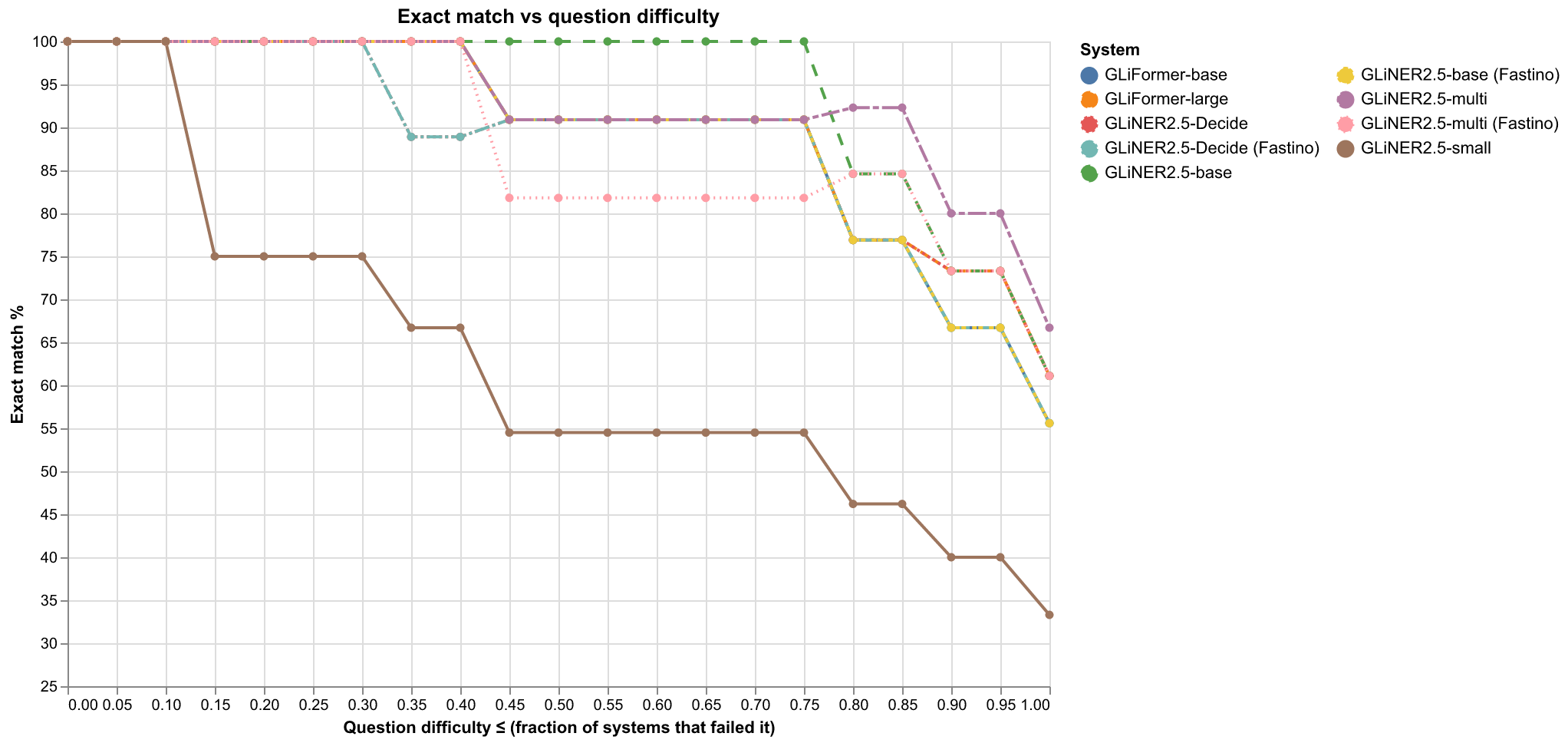
Question difficulty is measured as the fraction of answering systems
that got it wrong; the web UI plots accuracy along that spectrum, and
per-question predictions live in results/bench_spectrum_results.json.
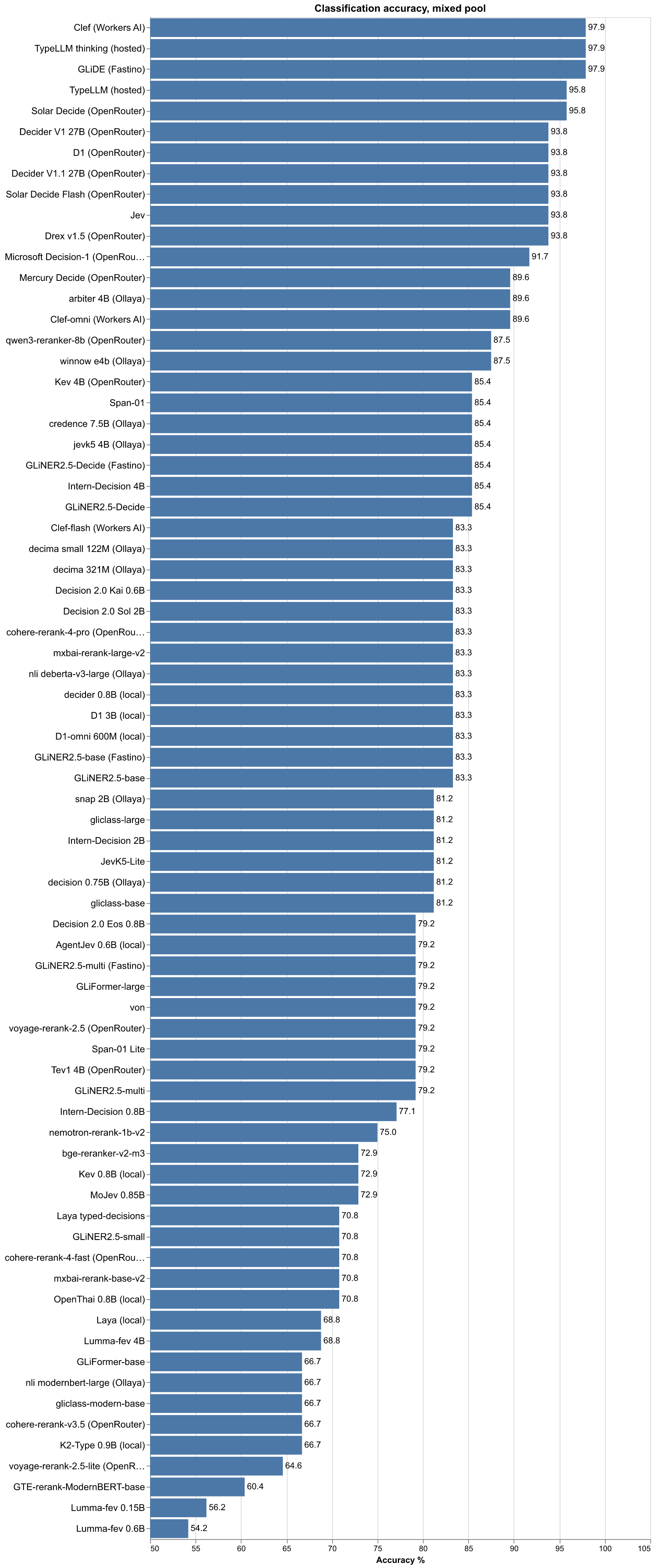
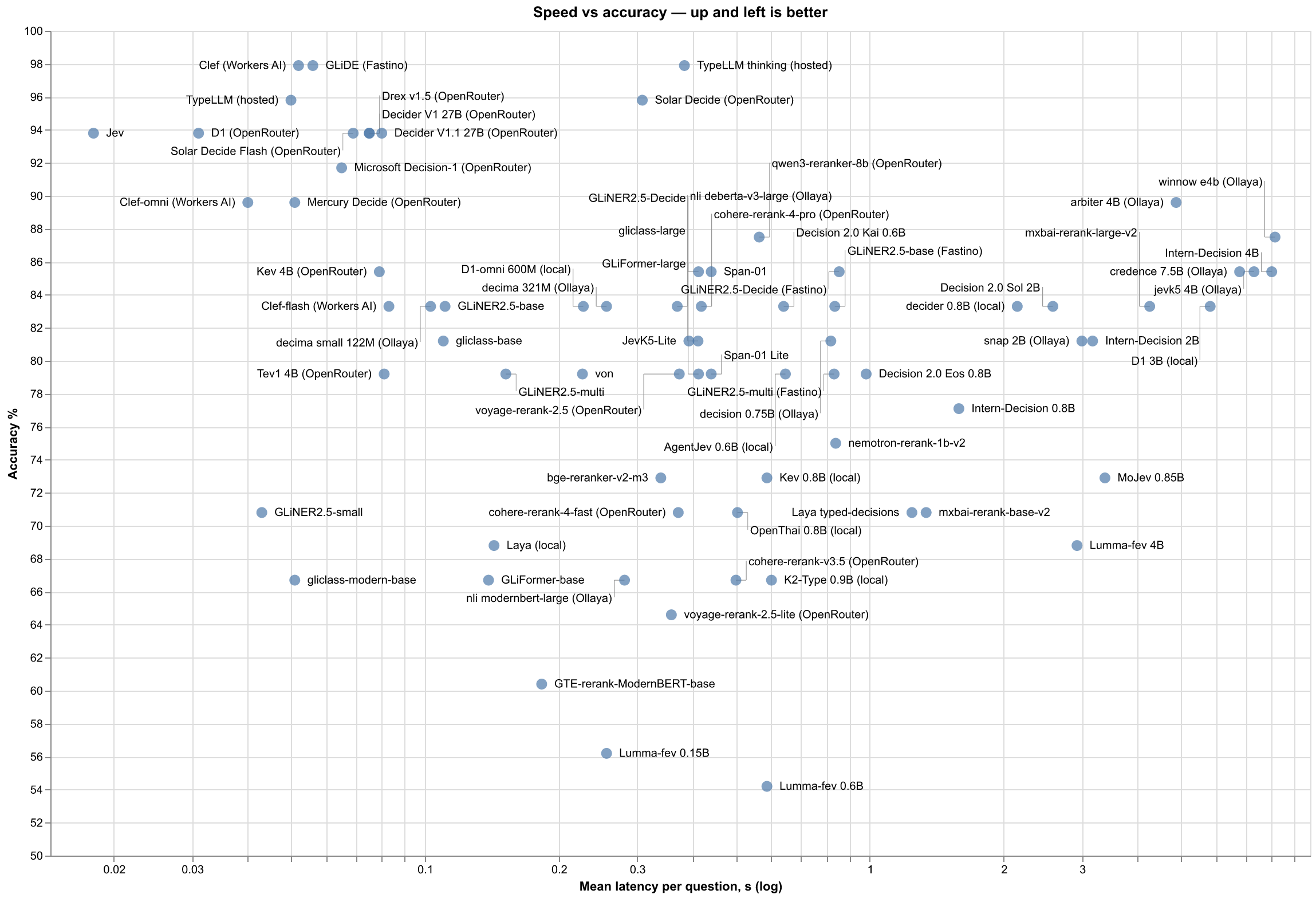
Classification accuracy on the mixed pool (48 questions), NER scored as exact span-set match (18 questions). † = hosted via OpenRouter (non-ZDR):
| System | Classification | s/question | NER exact | s/question |
|---|---|---|---|---|
| Clef (Workers AI) | 97.9% | 0.052 | n/a | |
| GLiDE (Fastino) | 97.9% | 0.056 | n/a | |
| TypeLLM thinking (hosted) † | 97.9% | 0.383 | n/a | |
| TypeLLM (hosted) † | 95.8% | 0.050 | n/a | |
| Solar Decide (OpenRouter) † | 95.8% | 0.308 | n/a | |
| Jev (cloud) | 93.8% | 0.018 | n/a | |
| D1 (OpenRouter) † | 93.8% | 0.031 | n/a | |
| Solar Decide Flash (OpenRouter) † | 93.8% | 0.069 | n/a | |
| Decider V1 27B (OpenRouter) | 93.8% | 0.075 | n/a | |
| Decider V1.1 27B (OpenRouter) | 93.8% | 0.080 | n/a | |
| Drex v1.5 (OpenRouter) | 93.8% | 0.075 | n/a | |
| Microsoft Decision-1 (OpenRouter) | 91.7% | 0.065 | n/a | |
| Mercury Decide (OpenRouter) † | 89.6% | 0.051 | n/a | |
| Clef-omni (Workers AI) | 89.6% | 0.040 | n/a | |
| arbiter 4B (Ollaya) | 89.6% | 4.878 | n/a | |
| winnow e4b (Ollaya) | 87.5% | 8.138 | n/a | |
| qwen3-reranker-8b (OpenRouter) † | 87.5% | 0.564 | n/a | |
| GLiNER2.5-Decide | 85.4% | 0.412 | 61% | 0.476 |
| GLiNER2.5-Decide (Fastino) | 85.4% | 0.853 | 56% | 0.832 |
| Kev 4B (OpenRouter) † | 85.4% | 0.079 | n/a | |
| Span-01 † | 85.4% | 0.440 | n/a | |
| jevk5 4B (Ollaya) | 85.4% | 7.299 | n/a | |
| credence 7.5B (Ollaya) | 85.4% | 6.775 | n/a | |
| Intern-Decision 4B | 85.4% | 8.0 | n/a | |
| GLiNER2.5-base | 83.3% | 0.111 | 61% | 0.135 |
| GLiNER2.5-base (Fastino) | 83.3% | 0.834 | 56% | 0.856 |
| Clef-flash (Workers AI) | 83.3% | 0.083 | n/a | |
| decider 0.8B (local) | 83.3% | 2.144 | n/a | |
| cohere-rerank-4-pro (OpenRouter) † | 83.3% | 0.418 | n/a | |
| nli deberta-v3-large (Ollaya) | 83.3% | 0.369 | n/a | |
| Decision 2.0 Kai 0.6B (local) | 83.3% | 0.640 | n/a | |
| Decision 2.0 Sol 2B (local) | 83.3% | 2.578 | n/a | |
| D1 3B (local) | 83.3% | 5.818 | n/a | |
| D1-omni 600M (local) | 83.3% | 0.227 | n/a | |
| decima 321M (Ollaya) | 83.3% | 0.256 | n/a | |
| decima small 122M (Ollaya) | 83.3% | 0.103 | n/a | |
| mxbai-rerank-large-v2 | 83.3% | 4.255 | n/a | |
| gliclass-base | 81.2% | 0.110 | n/a | |
| decision 0.75B (Ollaya) | 81.2% | 0.817 | n/a | |
| gliclass-large | 81.2% | 0.411 | n/a | |
| JevK5-Lite | 81.2% | 0.392 | n/a | |
| snap 2B (Ollaya) | 81.2% | 2.995 | n/a | |
| Intern-Decision 2B | 81.2% | 3.166 | n/a | |
| GLiNER2.5-multi | 79.2% | 0.152 | 67% | 0.180 |
| Tev1 4B (OpenRouter) | 79.2% | 0.081 | n/a | |
| GLiNER2.5-multi (Fastino) | 79.2% | 0.831 | 61% | 0.849 |
| GLiFormer-large | 79.2% | 0.412 | 61% | 0.411 |
| von-1.0 (option-marker) | 79.2% | 0.226 | n/a | |
| AgentJev 0.6B (local) | 79.2% | 0.646 | n/a | |
| Span-01 Lite † | 79.2% | 0.440 | n/a | |
| voyage-rerank-2.5 (OpenRouter) † | 79.2% | 0.373 | n/a | |
| Decision 2.0 Eos 0.8B (local) | 79.2% | 0.981 | n/a | |
| Intern-Decision 0.8B | 77.1% | 1.585 | n/a | |
| nemotron-rerank-1b-v2 | 75.0% | 0.838 | n/a | |
| Kev 0.8B (local) | 72.9% | 0.587 | n/a | |
| bge-reranker-v2-m3 | 72.9% | 0.339 | n/a | |
| MoJev 0.85B | 72.9% | 3.375 | n/a | |
| GLiNER2.5-small | 70.8% | 0.043 | 33% | 0.053 |
| OpenThai 0.8B (local) | 70.8% | 0.504 | n/a | |
| Laya typed-decisions | 70.8% | 1.243 | n/a | |
| mxbai-rerank-base-v2 | 70.8% | 1.338 | n/a | |
| cohere-rerank-4-fast (OpenRouter) † | 70.8% | 0.371 | n/a | |
| Laya (local) | 68.8% | 0.143 | n/a | |
| Lumma-fev 4B | 68.8% | 2.921 | n/a | |
| cohere-rerank-v3.5 (OpenRouter) † | 66.7% | 0.500 | n/a | |
| nli modernbert-large (Ollaya) | 66.7% | 0.281 | n/a | |
| GLiFormer-base | 66.7% | 0.139 | 56% | 0.145 |
| gliclass-modern-base | 66.7% | 0.051 | n/a | |
| K2-Type 0.9B (local) | 66.7% | 0.601 | n/a | |
| voyage-rerank-2.5-lite (OpenRouter) † | 64.6% | 0.358 | n/a | |
| GTE-rerank-ModernBERT-base | 60.4% | 0.183 | n/a | |
| Lumma-fev 0.15B | 56.2% | 0.256 | n/a | |
| Lumma-fev 0.6B | 54.2% | 0.587 | n/a |
Takeaways:
/v1/systemone contract,
typed answers with calibrated probabilities, decisions themselves
free — only input bills). Perplexity's Decider V1/V1.1 27B and
Liquid's d1 tie cloud Jev at 93.8% (d1 at 0.031 s/question is the
fastest hosted decision here), Mercury lands 89.6% on the free
tier; Together's experimental Tev1 4B — a Qwen3.5-4B SFT that keeps the plain
next-token head — misses the boundary topics and lands with the
79.2% locals. Decider V1.1 is the value pick: same 5,273 input
tokens as V1 at half the list price ($0.02 vs $0.04/M — $2.2e-6/q,
the cheapest of the paid Decisions arrivals).
All five join the 100% multilingual club on arrival (below);
gpt-6-luna-decisions sits this one out (OpenAI's endpoint retains
prompts, blocked by the account's ZDR enforcement — noted below).business. Thinking bills 9,376 tokens
on the 48-question run at $0.50/M — ~39× its input cost — so the
accurate mode runs $1.0e-4/q against the plain mode's $2.6e-6/q (the
cheapest hosted decision here after kev-4b and Span-01), at 0.383 vs
0.050 s/question. Both entries batch each 24-question task into one
request and join the 100% multilingual club (below).technology, gold politics) —
the same boundary question Solar got wrong — while it solves the
football-club share-price question that was Clef's only miss. It
batches each 24-question task into one request like clef, and its
payloads run even tighter (~1.9k input tokens per request vs clef's
~2.3k), so $0.15/M lands at $1.2e-5/q — roughly half clef's cost at
the same accuracy, with the adaptive-thinking output tokens priced
$0. It also joins the 100% multilingual club on arrival (below),
under a ZDR catalog listing.sports, a government AI strategy read
technology); it matches Clef's perfect multilingual run
(below) at 0.885 s/text. It batches each 24-question task into one
request like kev, but Solar's tokenizer runs long on English (~8.7k
input tokens per batched request), so it bills ~$1.8e-5/question —
12× kev-4b, still 110× below cohere 4-fast.decision's tier — 88.9% overall at 100% Sinhala (Icelandic and
Welsh 66.7%) — while the 2B sits between the two at 90.7% (72% rare
tier, 66.7% Sinhala).jev/serve.py hardcodes CUDA, so
engines/k2type_client.py loads the snapshot's own runtime
in-process on this CPU-only machine (fp32, ~13 s load, warm predict
~0.65 s); on the house request-shape probe every shape (text as
state vs restated, bare labels vs described criteria) ties 8/8 with
identical picks, so the benches keep the house shape for
comparability.engines/decision2_client.py re-binds it with POSIX separators — the manifest's own byte verification passes untouched (measured: every file verifies individually, the combined digest differs only by separator keying). Multilingual scales with size: 74% (Kai) → 80% (Eos) → 83% (Sol, perfect on the popular and medium tiers, 50% rare). On the house request-shape probe (eight easy-tier sentiment texts, Kai) every shape — house restated-text, kev state-as-text, bare-label criteria — ties 8/8 with identical picks..venv-von).Each hosted system's results entry carries the provider's own usage
accounting — the usage block billed per API response, never
reconstructed from list prices. Measured on these exact runs (one pass;
48 mixed-pool questions / 54 multilingual texts). Four exceptions:
Cloudflare, TypeSafe, Fastino and TypeLLM report tokens but no $, so the
Clef, Clef-flash, Clef-omni, GLiDE, Jev, TypeLLM and hosted-GLiNER-twin
rows are list price ($0.24 / $0.09 / $0.15 / $0.15 / $0.042 / $0.05 /
$0.03 per M input;
TypeLLM adds $0.50 per M thinking tokens) × measured tokens:
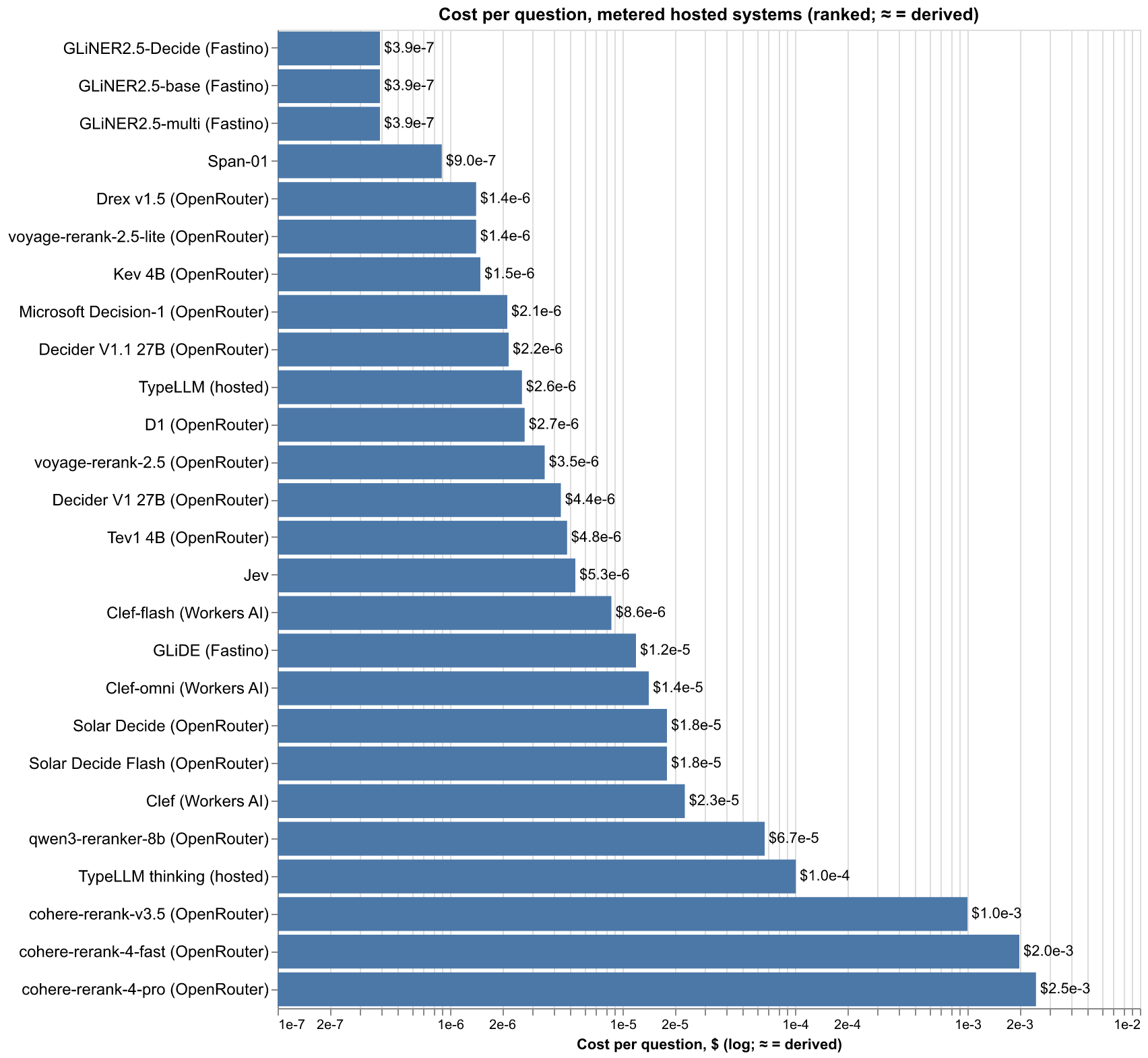
| System | 48-q run | 54-text run | $ / question |
|---|---|---|---|
| Span-01 Lite † | $0 | $0 | $0 (free tier) |
| Mercury Decide (OpenRouter) † | $0 | $0 | $0 (free tier) |
| GLiNER2.5-base / -multi / -Decide (Fastino) | $0.000026 | $0.000031 | $0.00000039 |
| Span-01 † | $0.000043 | $0.000040 | $0.0000009 |
| voyage-rerank-2.5-lite † | $0.000068 | $0.000115 | $0.0000014 |
| Drex v1.5 (OpenRouter) | $0.000068 | $0.000101 | $0.0000014 |
| Kev 4B (OpenRouter) | $0.000072 | $0.000106 | $0.0000015 |
| Microsoft Decision-1 (OpenRouter) | $0.000103 | $0.000149 | $0.0000021 |
| Decider V1.1 27B (OpenRouter) | $0.000105 | $0.000127 | $0.0000022 |
| TypeLLM (hosted) † | $0.00013 | $0.00017 | $0.0000026 |
| D1 (OpenRouter) † | $0.000130 | $0.000163 | $0.0000030 |
| voyage-rerank-2.5 † | $0.000170 | $0.000287 | $0.0000035 |
| Decider V1 27B (OpenRouter) | $0.000211 | $0.000254 | $0.0000044 |
| Tev1 4B (OpenRouter) | $0.000229 | $0.000269 | $0.0000050 |
| Jev (cloud) ‡ | $0.00026 | $0.00027 | $0.0000053 |
| Clef-flash (Workers AI) | $0.00041 | $0.00078 | $0.0000086 |
| GLiDE (Fastino) | $0.00057 | $0.00071 | $0.0000120 |
| Clef-omni (Workers AI) | $0.00068 | $0.0013 | $0.000014 |
| Solar Decide (OpenRouter) † | $0.00087 | $0.0010 | $0.0000181 |
| Solar Decide Flash (OpenRouter) † | $0.00087 | $0.0010 | $0.0000181 |
| Clef (Workers AI) | $0.0011 | $0.0021 | $0.000023 |
| qwen3-reranker-8b † | $0.0032 | $0.0036 | $0.0000667 |
| TypeLLM thinking (hosted) † | $0.0048 | $0.0048 | $0.00010 |
| cohere-rerank-v3.5 † | $0.048 | $0.054 | $0.0010 |
| cohere-rerank-4-fast † | $0.096 | $0.108 | $0.0020 |
| cohere-rerank-4-pro † | $0.120 | $0.135 | $0.0025 |
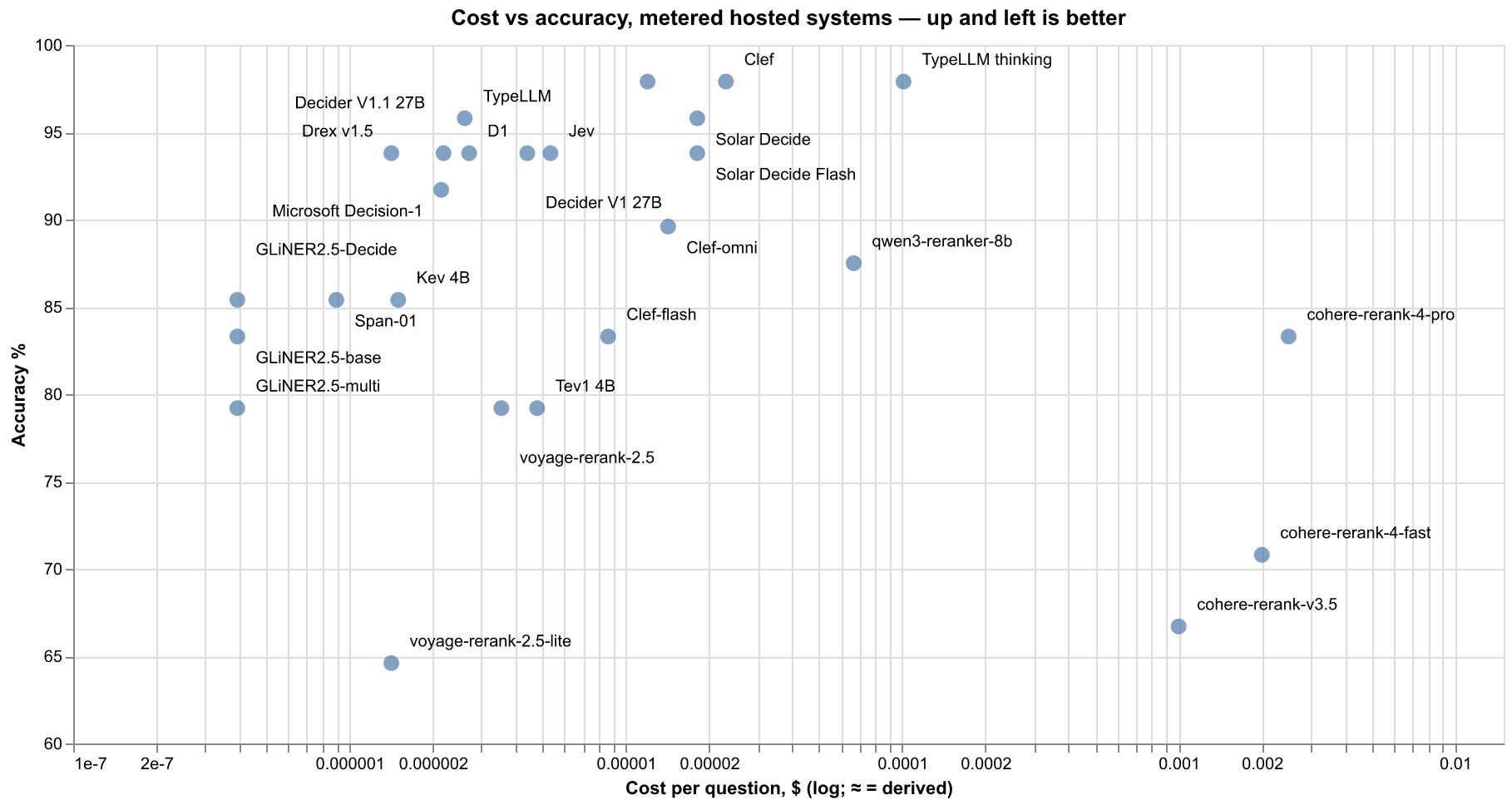
The cost charts plot the metered systems only — free tiers bill $0
(Span-01 Lite's plain id is priced $0.0, same as its :free twin;
Nemotron runs on :free) and stay off them. The Clef family, GLiDE,
Jev, the hosted GLiNER twins and TypeLLM report tokens but no
provider $, so all chart at derived numbers
matching their table rows above: list price × measured tokens,
computed by app.cost_summary_frame from the prices recorded in
engines/clef_client.py, engines/fastino_client.py,
engines/jev_client.py and engines/typellm_client.py (Jev: 6,094 /
6,430 input tokens across its 2 + 1 batched requests × $0.042/1M;
GLiDE: 3,833 / 4,741 input tokens × $0.15/1M — its usage block also
reports thinking output_tokens, priced $0 so they add nothing;
TypeLLM: input + thinking tokens at $0.05 + $0.50 per M — plain
2,507 / 3,487 input with no thinking, thinking mode 3,226 / 4,291
input plus 9,376 / 9,237 thinking, so reasoning is ~97% of that
mode's bill; the hosted GLiNER twins: 864 / 1,048 input tokens ×
$0.03/1M over 66 spectrum requests each — 48 classification + 18
NER, one request per question),
and marked "≈ derived" in the UI. What
the measurements say that the price lists don't: the GLiNER twins are
the cheapest metered rows on the board at $3.9e-7/question — a GLiNER
request is just the sentence plus a small schema (~13 input tokens a
question); Cohere bills ~2.5 search
units per rerank request (a 48-q run on 4-pro costs $0.12, not the
naive 48 × $0.001); kev-4b and Span-01 sit near $1e-6/question — kev
batches each 24-question task into one request, Span's payloads are
tiny. solar-decide batches like kev but bills by input token, and
Solar's tokenizer is English-verbose (~8.7k tokens per batched
request), landing it at $1.8e-5/question; clef batches too and is
3× cheaper per question despite the higher list price, because the
Qwen tokenizer packs the same 24-question request into ~2.3k tokens.
Not benched on OpenRouter on
purpose: typesafe/jev-1.13
(RBAC-gated; Jev measured via TypeSafe directly) and
typesafe/jev-router (a chat router, not a typed-decision endpoint).
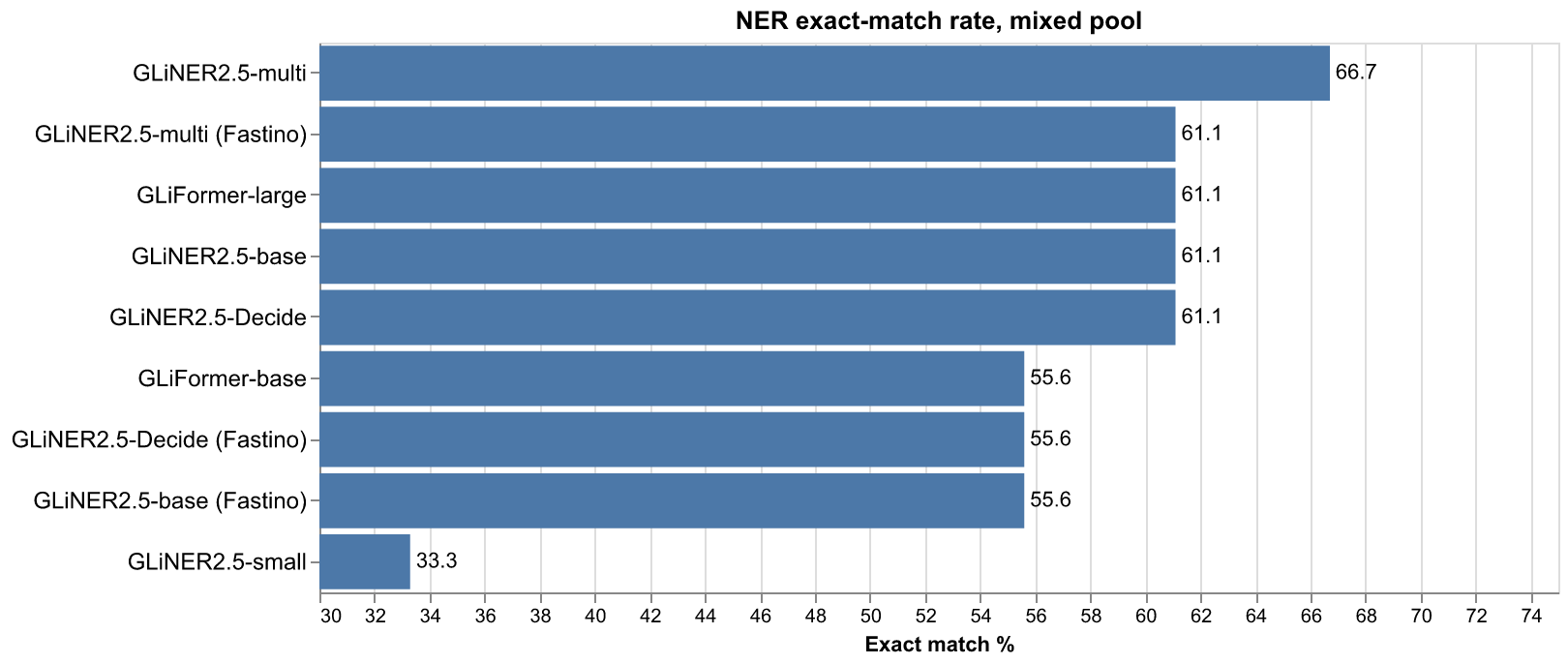
The web UI renders these as interactive charts; the same charts, as
images (regenerate with python make_chart_images.py):
Classification (48-question mixed pool)
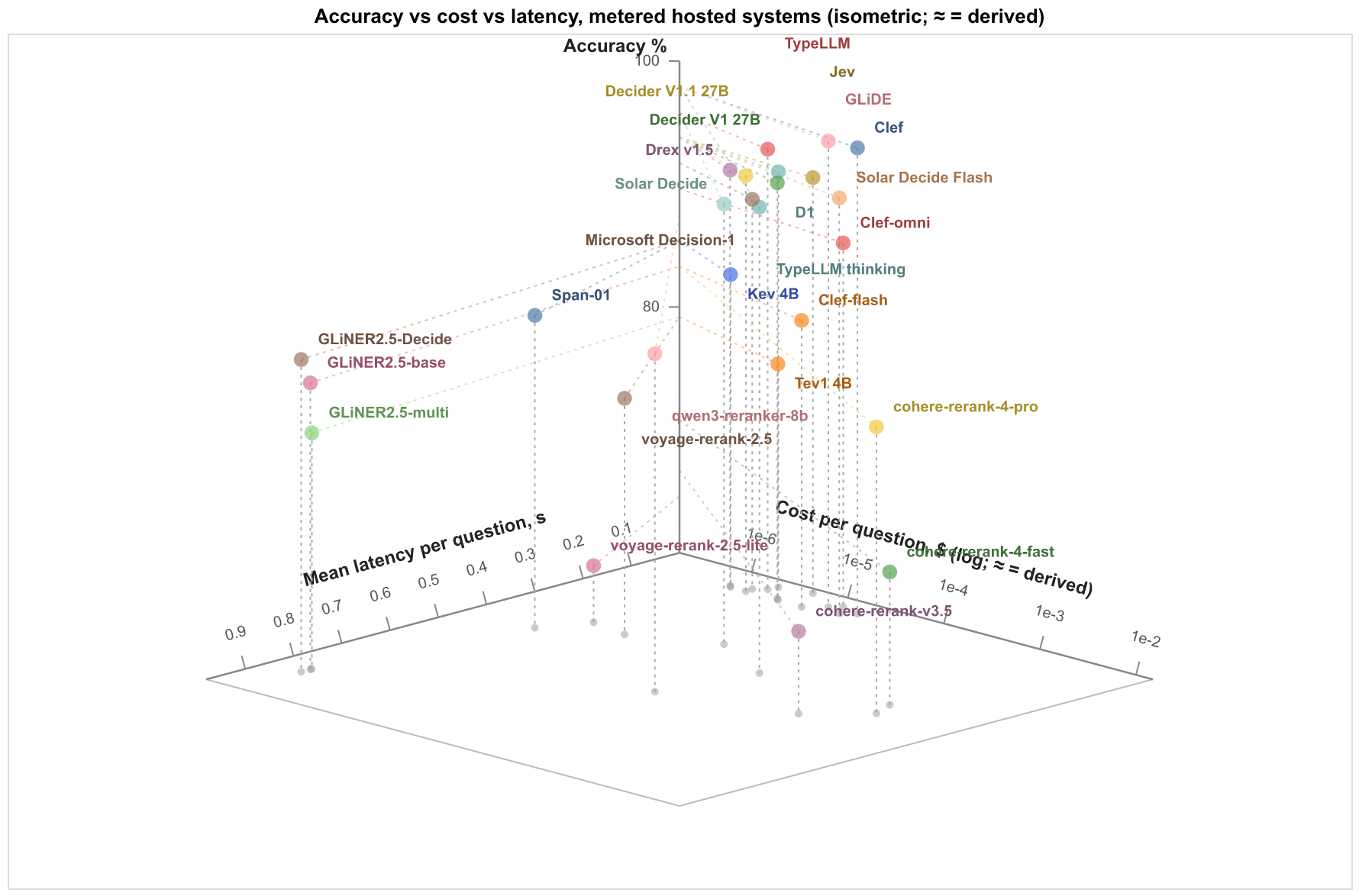
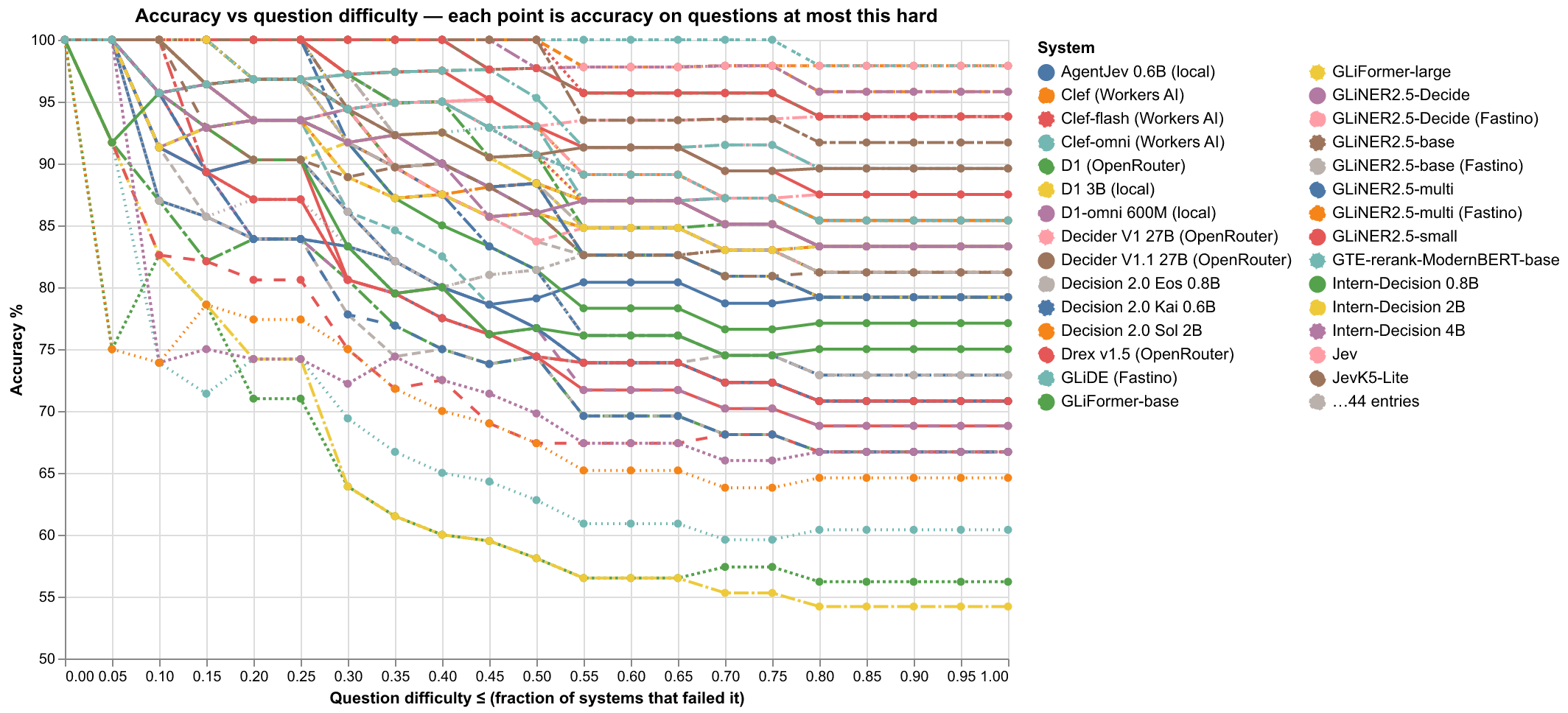
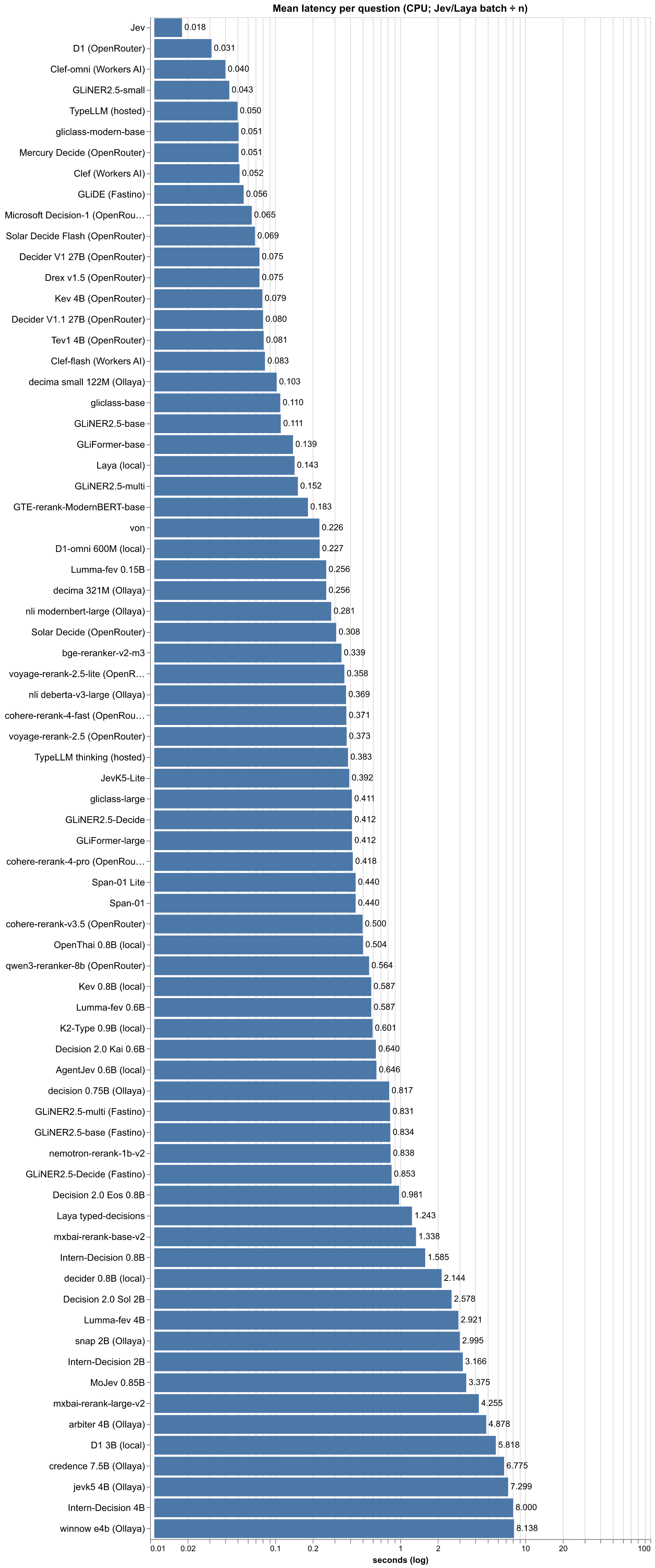
NER exact-match (18 questions, extractors only)
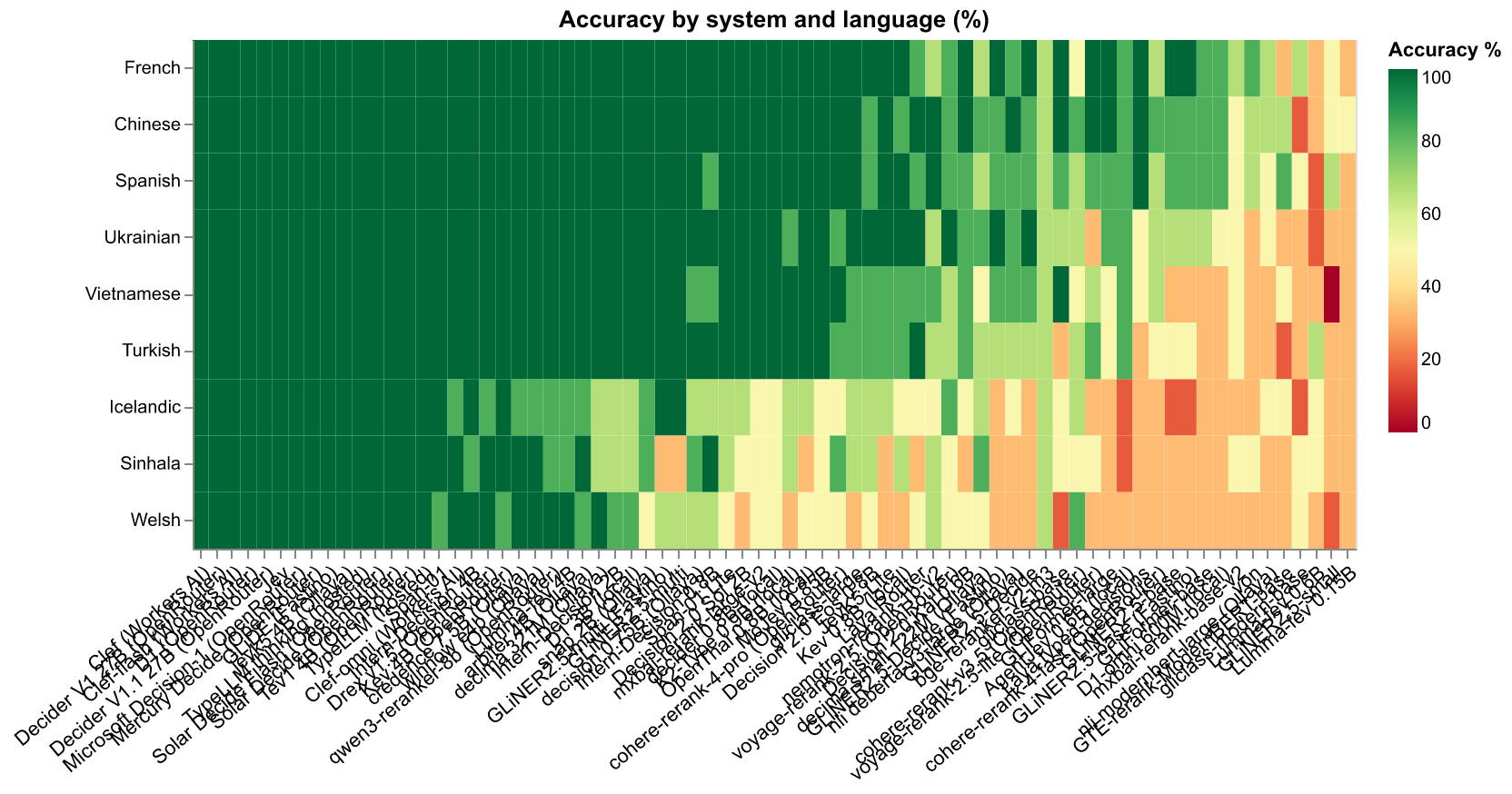
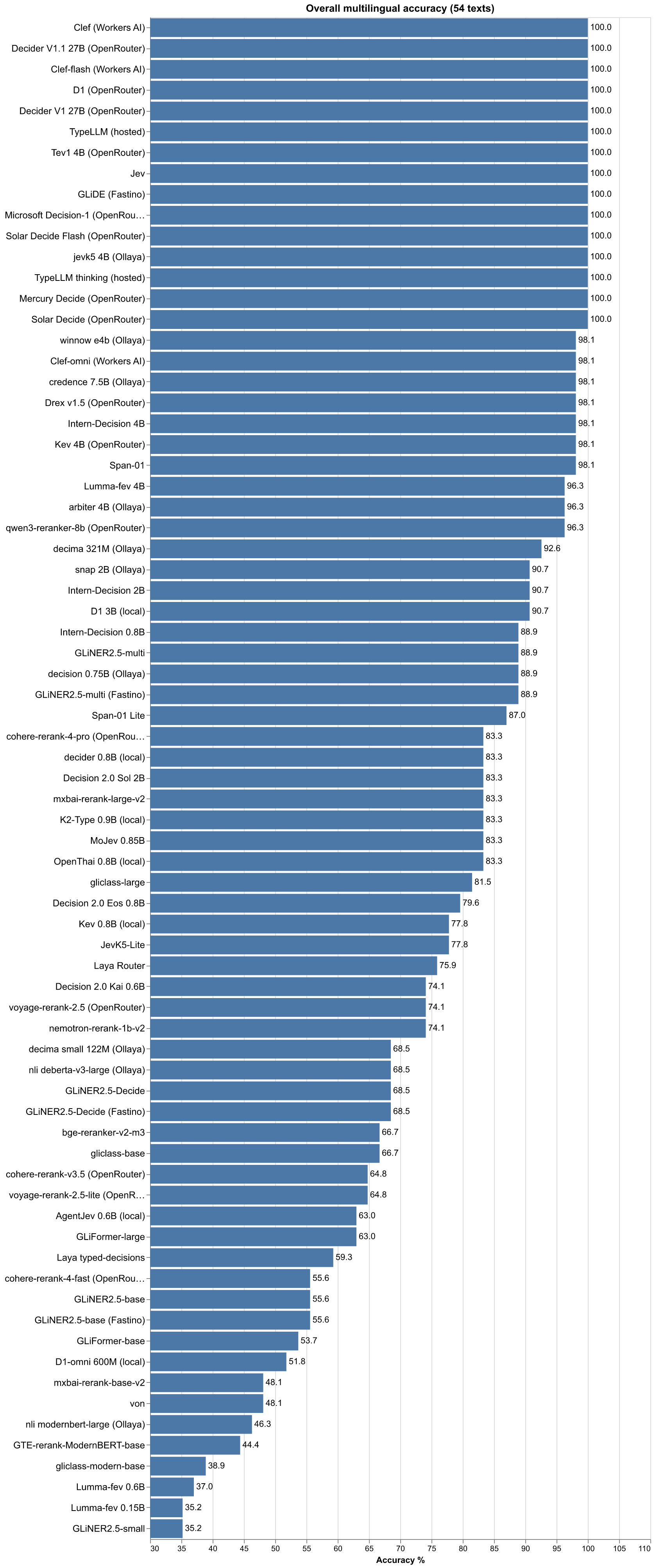
bench_multilingual.py — the same six sentence meanings per language
(2 positive / 2 negative / 2 neutral sentiment), labels in English.
Popular: Spanish, French, Chinese · Medium: Vietnamese, Turkish,
Ukrainian · Rare: Sinhala, Icelandic, Welsh. Sentences were verified
by blind back-translation through an independent model instance (it
caught 8 errors, including a sentiment-flipping Sinhala word). All 85
systems answer the same 54 texts.
| System | Popular | Medium | Rare | All |
|---|---|---|---|---|
| Jev (cloud) | 100% | 100% | 100% | 100% |
| jevk5 4B (Ollaya) | 100% | 100% | 100% | 100% |
| Solar Decide (OpenRouter) † | 100% | 100% | 100% | 100% |
| Solar Decide Flash (OpenRouter) † | 100% | 100% | 100% | 100% |
| Clef (Workers AI) | 100% | 100% | 100% | 100% |
| Clef-flash (Workers AI) | 100% | 100% | 100% | 100% |
| GLiDE (Fastino) | 100% | 100% | 100% | 100% |
| TypeLLM (hosted) † | 100% | 100% | 100% | 100% |
| TypeLLM thinking (hosted) † | 100% | 100% | 100% | 100% |
| Decider V1 27B (OpenRouter) | 100% | 100% | 100% | 100% |
| Decider V1.1 27B (OpenRouter) | 100% | 100% | 100% | 100% |
| D1 (OpenRouter) † | 100% | 100% | 100% | 100% |
| Tev1 4B (OpenRouter) | 100% | 100% | 100% | 100% |
| Mercury Decide (OpenRouter) † | 100% | 100% | 100% | 100% |
| Microsoft Decision-1 (OpenRouter) | 100% | 100% | 100% | 100% |
| winnow e4b (Ollaya) | 100% | 100% | 94% | 98% |
| Span-01 † | 100% | 100% | 94% | 98% |
| Kev 4B (OpenRouter) † | 100% | 100% | 94% | 98% |
| Intern-Decision 4B | 100% | 100% | 94% | 98% |
| credence 7.5B (Ollaya) | 100% | 100% | 94% | 98% |
| Clef-omni (Workers AI) | 100% | 100% | 94% | 98% |
| Drex v1.5 (OpenRouter) | 100% | 100% | 94% | 98% |
| qwen3-reranker-8b (OpenRouter) † | 100% | 100% | 89% | 96% |
| Lumma-fev 4B | 100% | 100% | 89% | 96% |
| arbiter 4B (Ollaya) | 100% | 100% | 89% | 96% |
| decima 321M (Ollaya) | 100% | 100% | 78% | 93% |
| Intern-Decision 2B | 100% | 100% | 72% | 91% |
| D1 3B (local) | 100% | 100% | 72% | 91% |
| snap 2B (Ollaya) | 100% | 100% | 72% | 91% |
| GLiNER2.5-multi (mDeBERTa) | 100% | 100% | 67% | 89% |
| GLiNER2.5-multi (Fastino) | 100% | 100% | 67% | 89% |
| decision 0.75B (Ollaya) | 100% | 94% | 72% | 89% |
| Intern-Decision 0.8B | 94% | 94% | 78% | 89% |
| Span-01 Lite † | 100% | 100% | 61% | 87% |
| decider 0.8B (local) | 100% | 100% | 50% | 83% |
| OpenThai 0.8B (local) | 100% | 100% | 50% | 83% |
| MoJev 0.85B | 100% | 100% | 50% | 83% |
| Decision 2.0 Sol 2B (local) | 100% | 100% | 50% | 83% |
| mxbai-rerank-large-v2 | 100% | 100% | 50% | 83% |
| K2-Type 0.9B (local) | 100% | 94% | 56% | 83% |
| cohere-rerank-4-pro (OpenRouter) † | 100% | 89% | 61% | 83% |
| gliclass-large | 100% | 89% | 56% | 81% |
| Decision 2.0 Eos 0.8B (local) | 89% | 89% | 61% | 80% |
| Kev 0.8B (local) | 94% | 89% | 50% | 78% |
| JevK5-Lite | 100% | 89% | 44% | 78% |
| Laya Router (mmBERT) | 89% | 94% | 44% | 76% |
| Decision 2.0 Kai 0.6B (local) | 94% | 83% | 44% | 74% |
| voyage-rerank-2.5 (OpenRouter) † | 83% | 78% | 61% | 74% |
| nemotron-rerank-1b-v2 | 89% | 72% | 61% | 74% |
| nli deberta-v3-large (Ollaya) | 89% | 78% | 39% | 69% |
| GLiNER2.5-Decide | 89% | 83% | 33% | 69% |
| GLiNER2.5-Decide (Fastino) | 89% | 83% | 33% | 69% |
| decima small 122M (Ollaya) | 72% | 67% | 67% | 69% |
| gliclass-base | 94% | 67% | 39% | 67% |
| bge-reranker-v2-m3 | 67% | 67% | 67% | 67% |
| cohere-rerank-v3.5 (OpenRouter) † | 67% | 67% | 67% | 65% |
| voyage-rerank-2.5-lite (OpenRouter) † | 94% | 61% | 39% | 65% |
| GLiFormer-large | 94% | 61% | 33% | 63% |
| AgentJev 0.6B (local) | 83% | 83% | 22% | 63% |
| Laya typed-decisions | 100% | 44% | 33% | 59% |
| GLiNER2.5-base | 89% | 50% | 28% | 56% |
| GLiNER2.5-base (Fastino) | 89% | 50% | 28% | 56% |
| cohere-rerank-4-fast (OpenRouter) † | 72% | 61% | 33% | 56% |
| GLiFormer-base | 83% | 44% | 33% | 54% |
| D1-omni 600M (local) | 83% | 39% | 33% | 52% |
| von-1.0 (option-marker) | 72% | 33% | 39% | 48% |
| mxbai-rerank-base-v2 | 56% | 50% | 39% | 48% |
| nli modernbert-large (Ollaya) | 61% | 39% | 39% | 46% |
| GTE-rerank-ModernBERT-base | 61% | 33% | 39% | 44% |
| gliclass-modern-base | 44% | 33% | 39% | 39% |
| Lumma-fev 0.6B | 28% | 39% | 44% | 37% |
| GLiNER2.5-small | 56% | 22% | 28% | 35% |
| Lumma-fev 0.15B | 39% | 33% | 33% | 35% |
Highlights:
decision (vLLM Semantic Router) is the best small local
multilingual engine at 89% — GLiNER2.5-multi's equal overall, with a
different rare-tier profile (72% vs 67%).| Capability | GLiNER 2.5 | GLiNER 2.5 (Fastino) | GLiFormer | GLiClass | Rerankers | Laya | von | Jev | Kev | AgentJev | decider | OpenThai | JevK5-Lite | MoJev | NLI (Ollaya) | decision (Ollaya) | JevK5 4B (Ollaya) | winnow (Ollaya) | Lumma | Intern-Decision | K2-Type | Decision 2.0 | d1 | Decima (Ollaya) | snap/Arbiter/Credence (Ollaya) | Decisions (cloud) |
|---|---|---|---|---|---|---|---|---|---|---|---|---|---|---|---|---|---|---|---|---|---|---|---|---|---|---|
| Ability group | Extractor | Extractor (hosted twin, Fastino API) | Extractor | Classifier | Cross-encoder rerankers (decision via argmax) | Decision engine | Decision engine | Decision engine (cloud) | Decision engine (local, open weights) | Decision engine (local, open weights) | Decision engine (local, open weights) | Decision engine (local, open weights) | Decision engine (local, label-head encoder) | Decision engine (local, packed one-pass scoring) | Decision engine (local, NLI entailment) | Decision engine (local, endpoint head) | Decision engine (local, GGUF letter-logit LLM) | Decision engine (local, GGUF letter-logit LLM) | Decision engine (local, one forward over packed questions) | Decision engine (local, masked-slot symbol logits) | Decision engine (local, pointer head over packed questions) | Decision engine (local, trained candidate head) | Decision engine (local, trunk-encoded batched scoring) | Decision engine (local, encoder + late-interaction option scorer) | Decision engines (local, Ollaya — GGUF letter-logits + Arbiter's fixed-slot head) | Decision engines (cloud — System One: OpenRouter's Decisions family + Cloudflare's Clef-omni) |
| Zero-shot NER spans | ✅ | ✅ | ✅ | ❌ | ❌ | ❌ | ❌ | ❌ | ❌ | ❌ | ❌ | ❌ | ❌ | ❌ | ❌ | ❌ | ❌ | ❌ | ❌ | ❌ | ❌ | ❌ | ❌ | ❌ | ❌ | ❌ |
| Text classification | ✅ | ✅ | ✅ | ✅ | ✅ via argmax | ✅ choice | ✅ choice | ✅ choice | ✅ choice | ✅ choice | ✅ choice | ✅ choice | ✅ choice | ✅ choice | ✅ choice | ✅ choice | ✅ choice | ✅ choice | ✅ choice | ✅ choice | ✅ choice | ✅ choice | ✅ choice | ✅ choice | ✅ choice | ✅ choice |
| All labels scored in one pass | ✅ | ✅ (all labels ride one request's schema) | ✅ | ✅ (its core design) | ❌ one pair per label | ✅ | ✅ | ✅ one request | ✅ one request | ✅ one request | ✅ one request | ✅ one request | ✅ one pass | ✅ packed | ✅ all option pairs, one batched pass | ❌ one row per question | ❌ one pass per question | ❌ one question at a time (state evaluated once per request) | ✅ (all questions one forward) | ✅ (per text, all questions one forward — up to 16 questions/request) | ✅ (all questions one forward) | ✅ (all questions one forward) | ✅ (state trunk once, questions as branches) | ✅ (all options, one late-interaction pass) | Arbiter ✅ (fixed 24-slot head); snap/Credence one question per request | ✅ one request (up to 128 questions) |
| Relations | ✅ + JointIE graph | ✅ | ✅ joint head | ❌ | ❌ | ❌ | ❌ | ❌ | ❌ | ❌ | ❌ | ❌ | ❌ | ❌ | ❌ | ❌ | ❌ | ❌ | ❌ | ❌ | ❌ | ❌ | ❌ | ❌ | ❌ | ❌ |
| Span attributes (per-entity sentiment) | ✅ | ✅ (multi twin) | ❌ | ❌ | ❌ | ❌ | ❌ | ❌ | ❌ | ❌ | ❌ | ❌ | ❌ | ❌ | ❌ | ❌ | ❌ | ❌ | ❌ | ❌ | ❌ | ❌ | ❌ | ❌ | ❌ | ❌ |
| Structured records | ✅ flat, anchor-based | ✅ | ✅ nested Pydantic | ❌ | ❌ | ❌ | ❌ | ❌ | ❌ | ❌ | ❌ | ❌ | ❌ | ❌ | ❌ | ❌ | ❌ | ❌ | ❌ | ❌ | ❌ | ❌ | ❌ | ❌ | ❌ | ❌ |
| Ordinal score rubrics | ✅ via Decide (demoed) | ✅ via Decide twin (classifications demoed) | ❌ | ❌ | ❌ | ✅ score | ✅ rate (demoed) | ✅ score (demoed) | ✅ score (demoed) | ✅ score (demoed) | ✅ score (demoed) | ✅ score (demoed) | ❌ (lite is classification-only) | ✅ score (demoed) | ✅ score (demoed) | ✅ score (demoed) | ✅ score (demoed) | ✅ score (demoed) | ✅ score | ✅ score | ✅ score | ✅ score | ✅ score (demoed) | ✅ (ordinal score head) | Arbiter ✅ (6 fixed levels); snap/Credence choice-only benched | ✅ score |
| Yes/no judgments | ❌ | ❌ | ❌ | ❌ | ❌ | ✅ noul | ✅ judge (demoed) | ✅ noul (demoed) | ✅ noul (demoed) | ✅ boolean (demoed) | ✅ noul (demoed) | ✅ noul (demoed) | ❌ | ✅ noul (demoed) | ✅ noul | ✅ noul | ✅ (true/false read as A/B) | ✅ (labels read as letters) | ✅ noul | ✅ noul | ✅ noul | ✅ noul | ✅ noul (demoed) | ❌ | Arbiter ✅ noul (card); snap/Credence unbenched | ✅ noul |
| Text embeddings | ❌ | ❌ | ✅ 1024-d | ❌ (reranker-capable) | ❌ (cross-encoders only) | ❌ | ❌ | ❌ | ❌ | ❌ | ❌ | ❌ | ❌ | ❌ | ❌ | ❌ | ❌ | ❌ | ❌ | ❌ | ❌ | ❌ | ❌ | ❌ | ❌ | ❌ |
| Multilingual | ✅ multi ckpt (89% over 9 langs here) | ✅ multi twin (89% over 9 langs here, = local) | ❌ English (63%) | ✅ large 81% over 9 langs | bge-v2-m3 67% over 9 langs; mxbai 48% / GTE 44% | ✅ Router, 100+ langs (76%) | option-marker: 48% over 9 langs | ✅ 100% incl. Sinhala | ✅ 78% over 9 langs | 63% over 9 langs | 83% over 9 langs | 83% over 9 langs | ✅ 78% over 9 langs | ✅ 83% over 9 langs | deberta 69% / modernbert 46% over 9 langs | ✅ 89% over 9 langs (best local tie) | ✅ 100% incl. Sinhala (only local 100%) | ✅ 98% over 9 langs (100% Sinhala) | ✅ 96% over 9 langs (4B; small ckpts 35–37%, English-centric) | ✅ 98% over 9 langs (4B; 0.8B 89%, 2B 91%) | ✅ 83% over 9 langs (rare-tier 56%) | 74–83% over 9 langs by size (Sol 83%); rare tier 44–61% | ✅ 91% (3B, 17-lang card; omni 52%) | ✅ 93% (321M; small 69%) | snap 91%, Arbiter 96% (89% rare); Credence 98% (94% rare — ties winnow's best local rare tier) | ✅ 100% over 9 langs (six of seven; Decision-1 perfect, Drex/Clef-omni 98%) |
| Runs offline / data local | ✅ | ❌ (Fastino API, ZDR) | ✅ | ✅ | ✅ | ✅ | ✅ | ❌ | ✅ | ✅ | ✅ | ✅ | ✅ | ✅ | ✅ | ✅ | ✅ | ✅ | ✅ | ✅ | ✅ | ✅ | ✅ | ✅ | ✅ | ❌ |
| Image input | ❌ | ❌ | ❌ | ❌ | hosted Nemotron VL only (image documents, demos/nemotron_vl_demo.py); local trio + Cohere/Voyage are text-only | ❌ | ❌ | ❌ | ❌ | ❌ | ❌ | ❌ | ❌ | ❌ | ❌ | ❌ | ❌ | ❌ | ❌ | ✅ (vision tower + projector ship in every snapshot; 1–8 images per request, same one forward — demos/intern_decision_image_demo.py) | ❌ | ❌ | ✅ (LFM2.5-VL tower in both checkpoints, demos/d1_demo.py; omni adds 16 kHz speech state) | ❌ | ❌ (Credence ships a vision-tagged variant) | ❌ (Decider lists image modality; text/JSON state only so far — Clef-omni accepts images[]/audio[]/videos[] state, audio/video untested here) |
| Cost | free | $0.03/1M input (output $0) | free | free | free | free | free | $0.042/1M input | free (CPU time) | free (CPU time) | free (CPU time) | free (CPU time) | free (CPU time) | free (CPU time) | free (CPU time) | free (CPU time) | free (CPU time) | free (CPU time) | free (CPU time) | free (CPU time) | free (CPU time) | free (CPU time) | free (CPU time) | free (CPU time) | free (CPU time) | $0.02–$0.15/1M input, decisions free; Mercury on the :free tier |
| License | Apache 2.0 | Apache 2.0 weights; metered hosted API | Apache 2.0 | Apache 2.0 | Apache 2.0 | Apache 2.0 | Apache 2.0 | proprietary API | Apache 2.0 | Apache 2.0 | Apache 2.0 | Apache 2.0 (package); weights gated | Apache 2.0 | MIT (engine; Qwen base-model license on encoder weights) | MIT (deberta card notes non-commercial training-data parts); Apache 2.0 (modernbert) | Apache 2.0 | Apache 2.0 (NOTICE: some training questions written by an OpenAI model) | Apache 2.0 | Apache 2.0 | Apache 2.0 (Qwen3.5 upstream weights also Apache 2.0) | Apache 2.0 | Apache 2.0 | LFM Open License v1.0 | per-model on the Ollaya catalog (runtime Apache 2.0) | per-model on the Ollaya catalog (runtime Apache 2.0) | proprietary API (Tev1's data recipe + training code are open; Drex weights Open RAIL-M, runtime Apache 2.0) |
| Batch shape | per text | per text, one request (all labels in the schema) | per text (batch_size) | per text, all labels | per text, one pair per label | all questions, one pass | per text | all questions, one request | all questions, one request | all questions, one request | all questions, one request | all questions, one request | per text, all heads + labels | per text, all packed candidates | per text, one pair per option | per text, one row per question | per text, one request per question | per text, one request per question | per text, all questions one forward | per text, all questions one forward | per text, all questions one forward | per text, all questions one forward | per text, trunk + question branches one forward | per text, all options one pass | per text, one request per question | all questions, one request (spectrum batches 24) |
Python 3.10+ for the main environment; 3.12+ for von (tested on 3.13,
Windows, CPU-only) and 3.11 for relik. Shell commands assume a POSIX
shell — Git Bash on Windows works; the NAME=value server launches in
particular will not parse in PowerShell/cmd.
uv venv .venv
uv pip install --python .venv -r requirements.txt --overrides overrides.txt
# so1 (upstream has since published open-alternative-jev on PyPI under
# Apache-2.0; this venv keeps the git install from its MIT days):
uv pip install --python .venv "open-alternative-jev @ git+https://github.com/ikermoel/open-alternative-jev"
# the three cross-encoder rerankers run in-process in the main venv;
# the reranker-as-decision-engine path needs sentence-transformers:
uv pip install --python .venv sentence-transformers==5.7.0
# von needs transformers 5.x, so it lives in its own venv:
uv venv --python 3.13 .venv-von
uv pip install --python .venv-von -r requirements-von.txt
# relik needs torch 2.3.1 + faiss-cpu, so Python 3.11 and its own venv
# (on Windows `import relik` additionally needs the csv shim that
# engines/relik_client.py installs — no site-packages patching):
uv venv --python 3.11 .venv-relik
uv pip install --python .venv-relik -r requirements-relik.txt
# GLiNER-X (Knowledgator's mT5-encoder multilingual family) loads through
# the classic gliner package with the stanza extra (per the model card);
# a fresh gliner[stanza] resolve wants transformers 5.x, so it gets its
# own venv instead of touching the pinned main stack:
uv venv .venv-glinerx
uv pip install --python .venv-glinerx "gliner[stanza]"
# the checkpoints' config sets words_splitter_type=stanza, so the word
# splitter language-detects every text and lazily builds a stanza
# tokenize pipeline per language — the first bench run downloads those
# per-language models (Windows cache:
# %LOCALAPPDATA%/StanfordNLP/stanza/Cache) and the multilingual bench
# warms them untimed before its timed loop
# Kev (Jev's open-weights lookalike) serves the same System One contract
# locally; it needs transformers >=5.17, so it runs from its own clone:
git clone https://github.com/jaredpalmer/kev.git ../kev
cd ../kev && uv sync --extra serve && cd -
# start it before benchmarking "Kev 0.8B (local)":
uv run --extra serve --project ../kev python -m kev.serve \
    --run jaredpalmer/kev-0.8b --port 8009
# AgentJev (own /api/evaluate contract) also runs from its own clone;
# weights convert to .pt once (see its model card):
git clone https://github.com/malevrigns/agent-jev.git ../agent-jev
# decider + OpenThai-SystemOne also serve the System One contract; both
# live in a shared transformers-5 CPU venv (here C:/venvs/agent-jev):
uv venv C:/venvs/agent-jev
uv pip install --python C:/venvs/agent-jev/Scripts/python.exe \
    "decider-ai[serve]" "openthai-systemone[server]" onnxruntime
# start them (separate terminals) before benchmarking; both lazy-load
# weights on the first request, so the benchmarks fire one untimed
# warm-up question first:
DECIDER_MODEL=Mapika/decider-0.8b DECIDER_DEVICE=cpu \
    C:/venvs/agent-jev/Scripts/python -m uvicorn decider.serve:app --port 8018
OPENTHAI_SYSTEMONE_MODEL=iapp/OpenThai-SystemOne \
    C:/venvs/agent-jev/Scripts/python -m uvicorn \
    openthai_systemone.server:app --port 8029
# demos/systemone_locals_demo.py tours the kev (:8009), decider (:8018)
# and AgentJev (:8149) servers — start them for the demo too; AgentJev's
# start line is in bench_spectrum.py's header comment.
# Verdict runs in-process (no server) from the Verdict-open-jev checkout;
# set VERDICT_HOME if it is not at C:\src\verdict (its artifacts download
# from heman10x/rlcd-modernbert-151m), and run the benchmarks with the
# agent-jev venv python.
# JevK5-Lite, LFM2.5-RLCD 350M and MoJev 0.85B also run in .venv-von
# (transformers 5.17 is already pinned there): the jevk5 lite runtime plus
# jsonschema. The LFM engine itself is vendored in engines/rlcd_engine/ (engine
# code MIT; the LiquidAI/LFM2.5-350M weights it loads are under the LFM
# Open License v1.0). MoJev is a 0.85B Qwen3.5 + fla packed one-pass scorer
# whose scorer class loads from the checkpoint via trust_remote_code; its
# request path is adapted in engines/mojev_engine/ (MIT). Certo (engines/certo_engine/,
# vendored from the certo repo, MIT) and nanodiff (engines/nanodiff_engine/,
# vendored from BY571/nanoDiff + the pngwn release, MIT) run in the main
# venv — nothing extra to install beyond sentence-transformers above:
uv pip install --python .venv-von/Scripts/python.exe "jevk5[lite]==0.3.1" jsonschema
# Lumma-Fev (FrontiersMind's typed-decision family) also runs in .venv-von:
# it needs transformers >=5.4,<6
uv pip install --python .venv-von/Scripts/python.exe lumma-fev
# Julia 1 (SupersonicLabs' typed-decision model, Python 3.11+) also runs
# in .venv-von: the HF repo is a complete snapshot (fp32 weights + the
# `julia` runtime package). It is installed --no-deps because its
# pyproject pins transformers >=5.0,<5.1 while .venv-von keeps 5.17 (the
# one drift is handled in engines/julia_client.py):
git clone https://huggingface.co/SupersonicLabs/Julia-1 ../Julia-1
uv pip install --python .venv-von/Scripts/python.exe --no-deps -e ../Julia-1
# the engine runs 16 torch CPU threads by default; JULIA_CPU_THREADS overrides
# Intern-Decision (internlm's Qwen3.5 decision fine-tunes, Apache 2.0 + a
# second Apache-2.0 LICENSE-QWEN file for the upstream weights) also runs
# in .venv-von — nothing to pip-install: the runtime ships INSIDE each HF
# snapshot (a standalone inference.py; engines/intern_decision_client.py
# sys.path-inserts the snapshot dir and imports it). Pull the three
# snapshots into C:\src (INTERN_DECISION_HOME overrides the base dir):
python -c "from huggingface_hub import snapshot_download; [snapshot_download(f'internlm/Intern-Decision-{s}', local_dir=f'C:/src/Intern-Decision-{s}') for s in ('0.8B', '2B', '4B')]"
# do NOT install the snapshots' requirements.txt — it pins
# torch==2.9.1/transformers==5.14.1, while .venv-von's newer stack
# (torch 2.14, transformers 5.17) already satisfies the runtime;
# torchvision is there unpinned for the multimodal processor
# K2-Type 0.9B (IFM's Jev-style typed-decision model, Apache 2.0) also
# runs in .venv-von — nothing to pip-install: the minimal jev/ runtime
# ships inside the HF snapshot and engines/k2type_client.py imports it
# from there (the upstream `python -m jev.serve` server hardcodes one
# CUDA GPU; the in-process loader runs the same weights fp32 on the
# CPU). Pull the snapshot into C:\src (K2TYPE_HOME overrides the whole
# path) and, like Intern-Decision, do NOT install its requirements.txt:
.venv-von/Scripts/python -c "from huggingface_hub import snapshot_download; snapshot_download('IFM/K2-Type-0.9B', local_dir='C:/src/K2-Type-0.9B')"
# Decision 2.0 (vLLM Semantic Router's second generation, the line behind
# Ollaya's `decision`) also runs in .venv-von — nothing to pip-install:
# the self-verifying decision2/ runtime ships inside each HF snapshot
# (from_pretrained SHA-256-checks every packaged byte against MODEL_MANIFEST.json;
# engines/decision2_client.py imports it from there and re-binds the
# vendored checkpoint fingerprint with POSIX path separators — on Windows
# its backslash keying breaks the manifest identity check while every
# byte still verifies). Pull the three snapshots into C:\src (~8 GB;
# DECISION2_HOME overrides the base dir):
.venv-von/Scripts/python -c "from huggingface_hub import snapshot_download; [snapshot_download(f'vllm-sr/Decision-2.0-{n}', local_dir=f'C:/src/Decision-2.0-{n}') for n in ('Kai-0.6B', 'Eos-0.8B', 'Sol-2B')]"
# Liquid's d1 pair runs in .venv-von as well (its trust_remote_code
# AutoModel needs the same transformers >=5.14): two more snapshots
# into C:\src (D1_HOME overrides the base dir):
.venv-von/Scripts/python -c "from huggingface_hub import snapshot_download; [snapshot_download(f'LiquidAI/{n}', local_dir=f'C:/src/{n}') for n in ('d1-3B', 'd1-omni-600M')]"
# the ten Ollaya systems run on Ollaya's own daemon (Windows/macOS/Linux,
# user-level install; Apache-2.0 runtime, no Python deps). Install the CLI
# (0.11+ for decima, 0.10+ for snap — 0.12.1 verified here), pull each
# model once (~35 GB total; weights come pinned from their authors' HF
# repos), and keep the server running while benchmarking:
powershell -NoProfile -Command "irm https://ollaya.dev/install.ps1 | iex"   # Windows
curl -fsSL https://ollaya.dev/install.sh | sh   # Linux/macOS
ollaya pull nli && ollaya pull nli:modernbert-large && ollaya pull decision
ollaya pull jevk5 && ollaya pull winnow:e4b
ollaya pull decima && ollaya pull decima:small && ollaya pull snap
ollaya pull arbiter && ollaya pull credence
ollaya serve   # TypeSafe-compatible /v1/systemone on 127.0.0.1:11435
Use uv for this install: overrides.txt deliberately overrides GLiClass
0.1.20's transformers ≥5 metadata with the validated 4.57.6 version required
by GLiNER2. This is an explicit compatibility exception for that pinned
GLiClass release; plain pip dependency resolution cannot install this mix.
Altair is included explicitly for the benchmark charts. protobuf and
sentencepiece are included explicitly because gliner2[local] does not
pull them in and the DeBERTa tokenizer needs them. Model checkpoints
(~0.3–2.3 GB each) download from Hugging Face on first run. Cloud keys
live in a repo-root .env (gitignored): TYPESAFE_API_KEY for Jev
(paid API, see engines/jev_client.py) and OPENROUTER_API_KEY for
the hosted OpenRouter systems (see engines/openrouter_client.py).
GLiDE runs on Fastino's own API (see engines/fastino_client.py):
put FASTINO_API_KEY in the same .env (input $0.15/M tokens,
thinking tokens $0).
TypeLLM runs on its own hosted API (see engines/typellm_client.py):
put TYPELLM_API_KEY in the same .env (input $0.05/M, thinking
$0.50/M, answer tokens free).
Clef / Clef-flash run on Cloudflare Workers AI (see
engines/clef_client.py): either a one-time cf auth login (the
client reads and auto-refreshes the cf CLI's OAuth session token;
add CLOUDFLARE_ACCOUNT_ID to .env to skip the per-run
cf auth whoami lookup) or a Workers AI token as
CLOUDFLARE_AUTH_TOKEN + CLOUDFLARE_ACCOUNT_ID in the same .env.
.venv/Scripts/python demos/demo.py       # GLiNER 2.5 tour: entities,
                                         # classification, relations, JointIE,
                                         # span attributes, records — ends
                                         # with the decision-tuned sibling
                                         # GLiNER2.5-Decide (--model decide
                                         # tours only that checkpoint)
.venv/Scripts/python demos/demo_gliformer.py   # GLiFormer tour + embeddings,
                                         # incl. parse_pdf: layout-aware
                                         # extraction over a PDF (pymupdf
                                         # sample; `uv pip install --python
                                         # .venv pymupdf` first)
                                          # (--model base or large)
.venv/Scripts/python demos/demo_glirel.py      # GLiREL zero-shot relations
                                         # (GLiNER 2.5 base supplies the
                                         # entity spans it scores pairs of)
.venv/Scripts/python demos/demo_gliner_relex.py # GLiNER-relex: joint NER +
                                         # relations in one pass (multilingual)
.venv-relik/Scripts/python demos/demo_relik.py  # ReLiK retriever-reader
                                         # relations (closed Wikidata
                                         # vocabulary; Python 3.11 venv)
                                         # + typed NER+relation sibling (stop 5)
.venv/Scripts/python demos/demo_laya.py        # Laya tour + multilingual Router
.venv/Scripts/python demos/demo_jev.py         # Jev tour (2 paid API requests)
.venv-von/Scripts/python demos/jevk5_demo.py   # JevK5-Lite tour (label-head
                                         # encoder; transformers-5 venv)
.venv-von/Scripts/python demos/lfm_rlcd_demo.py # LFM2.5-RLCD constrained-decoding
                                          # tour (vendored engines/rlcd_engine/)
                                          # + the autoregressive-baseline stop
.venv/Scripts/python demos/reranker_demo.py    # three cross-encoder rerankers as
                                         # decision engines: pair scores +
                                         # argmax (sentence-transformers)
.venv/Scripts/python demos/certo_demo.py       # Certo 421M calibrated decide()
                                         # tour (vendored engines/certo_engine/)
.venv/Scripts/python demos/nanodiff_demo.py    # nanodiff 350M diffusion-LM tour
                                         # (~10 s/question; vendored
                                         # engines/nanodiff_engine/)
.venv/Scripts/python demos/nanodiff_demo.py --v2
                                         # same tour on the v2 retrain
.venv/Scripts/python demos/nemotron_vl_demo.py  # Nemotron Rerank VL image
                                         # documents: three PIL-drawn page
                                         # screenshots ranked as base64
                                         # data-URI documents against a text
                                         # query, next to the same pages as
                                         # plain text (OpenRouter free tier)
C:/venvs/agent-jev/Scripts/python demos/verdict_demo.py
                                         # Verdict 151M tour: one evaluate()
                                         # answers a Choice + a Score rubric
                                         # + a Noul proposition over one
                                         # ticket, then the abstention probe
                                         # fires on an unrelated context
                                         # (agent-jev venv; VERDICT_HOME)
.venv/Scripts/python demos/openthai_demo.py     # OpenThai-SystemOne tour: the
                                         # score + noul questions the benches
                                         # never ask, over a Thai and the
                                         # shared English ticket (needs the
                                         # :8029 server from the setup block)
.venv-von/Scripts/python demos/mojev_demo.py   # MoJev 0.85B packed one-pass
                                         # scoring (transformers-5 venv) incl.
                                         # noul + score rubric and
                                         # choice+noul+score in ONE packed forward
.venv/Scripts/python demos/systemone_locals_demo.py  # kev / decider / AgentJev:
                                         # the score + yes/no questions the
                                         # benches never ask, three engines
                                         # side by side (needs the
                                         # :8009/:8018/:8149 servers from the
                                         # setup block; the AgentJev start
                                         # line is in bench_spectrum.py)
.venv-von/Scripts/python demos/lumma_demo.py   # Lumma-Fev typed-decision tour:
                                         # one decide() answers a choice, a
                                         # noul and a score question at once
                                         # (--model 0.6b or 4b picks a bigger
                                         # checkpoint; transformers-5 venv)
.venv-von/Scripts/python demos/julia_demo.py
                                         # Julia 1 typed-decision tour: one
                                         # predict() answers a choice, a noul
                                         # and a score question in one batch
                                         # (transformers-5 venv)
.venv-von/Scripts/python demos/intern_decision_demo.py
                                         # Intern-Decision tour: one
                                         # predict() scores a choice, a noul
                                         # and a score rubric in one causal
                                         # forward (--model 2b or 4b picks a
                                         # bigger checkpoint; transformers-5
                                         # venv)
.venv-von/Scripts/python demos/intern_decision_image_demo.py
                                         # Intern-Decision MULTIMODAL tour:
                                         # three Pillow-drawn images (ticket
                                         # screenshot, receipt, revenue
                                         # chart), each answered with a
                                         # choice + noul + score rubric in
                                         # the same one forward — the vision
                                         # tower + projector ship in every
                                         # snapshot (~3.4 s vs ~1.3 s
                                         # text-only on the 0.8B here)
.venv-von/Scripts/python demos/k2type_demo.py
                                         # K2-Type 0.9B tour: one
                                         # predict() answers a choice, a
                                         # noul and a score rubric in
                                         # one block-causal forward
.venv-von/Scripts/python demos/decision2_demo.py
                                         # Decision 2.0 tour: the model
                                         # card's damaged-order example — a choice, a
                                         # noul and a score rubric in ONE predict() batch
                                         # (--size eos-0.8b / sol-2b; transformers-5 venv)
                                         # (transformers-5 venv)
.venv-von/Scripts/python demos/von_demo.py --tour
                                         # von tour: shared-text choice, then
                                         # judge + rate on one shared sample
                                         # (serve stays the no-flag default
                                         # both von tab sections spawn)
.venv/Scripts/python demos/ollaya_demo.py      # tour of the ten Ollaya-
                                         # served models (needs `ollaya
                                         # serve`; --models=nli,decision
                                         # picks a subset)
.venv-glinerx/Scripts/python demos/glinerx_demo.py --tour
                                         # GLiNER-X tour: multilingual NER
                                         # (mT5 encoder + stanza word
                                         # splitter) + the NER-only
                                         # classification caveat
                                         # (.venv-glinerx; see setup)

.venv/Scripts/python bench.py            # flat suite, 5 runs per case
                                         # (--repeats N) → results/bench_results.json
.venv/Scripts/python bench_spectrum.py --system <name>   # one mixed pool per
                                         # system → results/bench_spectrum_results.json
                                         # (73 systems; von, JevK5-Lite,
                                         # MoJev 0.85B, Lumma-Fev,
                                         # Intern-Decision, K2-Type,
                                         # Decision 2.0 and D1 (d1-3B +
                                         # d1-omni):
                                         # same command
                                         # under .venv-von/Scripts/python)
# decider/OpenThai speak plain HTTP, so any interpreter works
.venv/Scripts/python bench_multilingual.py --system <name>
                                         # 9 languages, all 73 systems →
                                         # results/bench_multilingual_results.json
                                         # (same interpreter rules)
.venv-von/Scripts/python bench_multilingual.py --system "Lumma-fev 0.15B"
                                         # (also "Lumma-fev 0.6B" / "Lumma-fev 4B")
.venv-von/Scripts/python bench_multilingual.py \
    --system "Intern-Decision 0.8B"      # (also 2B / 4B)
.venv-von/Scripts/python bench_multilingual.py \
    --system "K2-Type 0.9B (local)"
.venv-von/Scripts/python bench_multilingual.py \
    --system "Decision 2.0 Kai 0.6B"   # (also Eos 0.8B / Sol 2B)
# the ten Ollaya systems speak plain HTTP to the local daemon, so the
# main venv runs them too (`ollaya serve` must be up, models pulled):
.venv/Scripts/python bench_spectrum.py --system "nli deberta-v3-large (Ollaya)"
.venv/Scripts/python bench_spectrum.py --system "decision 0.75B (Ollaya)"
.venv/Scripts/python bench_spectrum.py --system "jevk5 4B (Ollaya)"
.venv/Scripts/python bench_spectrum.py --system "winnow e4b (Ollaya)"
# Lumma-Fev runs in-process from .venv-von (transformers >=5.4,<6):
.venv-von/Scripts/python bench_spectrum.py --system "Lumma-fev 0.15B"
.venv-von/Scripts/python bench_spectrum.py --system "Lumma-fev 0.6B"
.venv-von/Scripts/python bench_spectrum.py --system "Lumma-fev 4B"
# Julia 1 runs in-process from .venv-von (see the setup block):
.venv-von/Scripts/python bench_spectrum.py --system "Julia 1 144M"
# Intern-Decision runs in-process from .venv-von (runtime ships in the
# snapshots; INTERN_DECISION_HOME overrides the C:\src base):
.venv-von/Scripts/python bench_spectrum.py --system "Intern-Decision 0.8B"
.venv-von/Scripts/python bench_spectrum.py --system "Intern-Decision 2B"
.venv-von/Scripts/python bench_spectrum.py --system "Intern-Decision 4B"
# K2-Type runs in-process from .venv-von (runtime ships in the
# snapshot; K2TYPE_HOME overrides the C:\src path):
.venv-von/Scripts/python bench_spectrum.py --system "K2-Type 0.9B (local)"
# Decision 2.0 runs in-process from .venv-von (self-verifying runtime
# ships in the snapshots; DECISION2_HOME overrides the C:\src base):
.venv-von/Scripts/python bench_spectrum.py --system "Decision 2.0 Kai 0.6B"
.venv-von/Scripts/python bench_spectrum.py --system "Decision 2.0 Eos 0.8B"
.venv-von/Scripts/python bench_spectrum.py --system "Decision 2.0 Sol 2B"
.venv/Scripts/python app.py              # web UI at http://127.0.0.1:7860
app.py serves a live demo tab per family — GLiNER 2.5 (checkpoint
selector includes GLiNER2.5-Decide, plus a Decide score-rubric
section), GLiFormer, GLiREL, GLiNER-relex,
ReLiK, GLiNER-X (small/base/large checkpoint dropdown), GLiClass,
Rerankers, Laya, von, JevK5-Lite, LFM2.5-RLCD, Certo,
MoJev, nanodiff (v1/v2 checkpoint radio), Lumma (0.15B/0.6B/4B
checkpoint dropdown), Julia,
Intern-Decision (0.8B/2B/4B checkpoint dropdown), K2-Type, Decision 2.0 (Kai/Eos/Sol checkpoint dropdown), d1 (d1-3B + d1-omni checkpoint dropdown), so1 (choice plus a
yes_no/scale section),
Jev (cloud), and hosted decision APIs (all twenty-eight systems: Kev 4B,
Solar Decide and its Flash sibling, the seven Decisions family arrivals,
Span-01/Lite and six rerankers via OpenRouter — one
metered API request per click, needs OPENROUTER_API_KEY — plus the three Clef models on
Cloudflare Workers AI — needs a one-time cf auth login
or a Workers AI token in .env — Fastino's GLiDE and the three hosted
GLiNER twins — needs
FASTINO_API_KEY in .env — and TypeLLM's two entries — needs
TYPELLM_API_KEY in .env; its demo also takes an image, the API's
vision input), plus Ollaya (the ten daemon-served
decision models behind a model dropdown — needs the local ollaya serve,
free), plus benchmark tabs (classification /
extraction / multilingual: tables and charts from
results/bench_*_results.json, including the cost-vs-accuracy charts) and
a Compare tab (feature matrix). The remaining local engines (Kev,
AgentJev, decider, OpenThai, Verdict) run as separate servers or venvs
and are covered by the benchmark and compare tabs.
The .venv-von systems (von, JevK5-Lite, LFM2.5-RLCD, MoJev, Lumma,
Julia, Intern-Decision, K2-Type, Decision 2.0, d1) spawn one-shot demos/*_demo.py --serve runners, each loading
its model once per click in a single .venv-von process; nanodiff does
the same under the main venv, and ReLiK spawns demos/relik_demo.py
from .venv-relik
(first click loads the pipeline and, once, downloads ~700 MB), while
GLiNER-X spawns demos/glinerx_demo.py from .venv-glinerx (first
click loads the checkpoint; the very first use also downloads the
weights and stanza's per-language tokenize models). von's
shared loader (engines/von_client.py) pins the
upstream SDK and model revision and requires the complete
option_marker.pt state dict — missing or incompatible weights fail
before inference; there is no random-head fallback (first use downloads
~3 GB). The von tab's second section demos the two question types behind
choice through the same runner: judge (the SDK's noul — the probability
the condition holds) and rate (the expectation over an ordered rubric).
Regression tests run without model downloads or cloud credentials:
.venv/Scripts/python -m unittest discover -s tests -v
Version coverage per family (every listed size is benchmarked, except the extra Laya checkpoints noted below):
| Checkpoint | Params | Notes |
|---|---|---|
fastino/gliner2.5-small-v1 | 74M | DeBERTa-v3-xsmall, fast CPU — benchmarked |
fastino/gliner2.5-base-v1 | 194M | default English — benchmarked |
fastino/gliner2.5-multi-v1 | 287M | mDeBERTa, multilingual — benchmarked; largest 2.5, no large exists |
fastino/GLiNER2.5-Decide | 340M | decision-tuned sibling — benchmarked; best local cls on the mixed pool |
knowledgator/gliformer-base-v1 | ~190M | benchmarked; best NER F1 here |
knowledgator/gliformer-large-v1 | 575.6M | benchmarked; family is base+large only, no small |
knowledgator/gliner-x-small | 300M | mT5-encoder span-level gliner, stanza word splitter; HF-card-only release 2026-04-29 — culled from the benchmark (data in TRIALS.md) |
knowledgator/gliner-x-base | 494M | same mT5 generation at the middle scale — culled from the benchmark (data in TRIALS.md) |
knowledgator/gliner-x-large | 865M | largest of the three — NER exact 61% (level with GLiNER2.5-base) but NER-only: classification collapses at every size; culled from the benchmark (data in TRIALS.md) |
convaiinnovations/laya (+multilingual, typed-decisions) | 421M / 322M | English root benchmarked; subfolders exist for the other two |
jaredpalmer/kev-0.8b | 0.8B (9.3M trained) | Qwen3.5 base + LoRA/head; 4B/9B siblings exist but are impractical on CPU — 0.8B benchmarked |
aimeigaoshou/agent-jev | 0.6B | Qwen3 base, LM head swapped for a candidate head; single checkpoint — benchmarked |
Mapika/decider-0.8b | 0.8B (752M) | Qwen3.5-0.8B-Base fine-tune, PyPI decider-ai System One server — benchmarked |
iapp/OpenThai-SystemOne | 0.8B | Qwen3.5 Gated DeltaNet hybrid + 256-way slot head, Thai/English — benchmarked (weights gated on HF) |
heman10x/rlcd-modernbert-151m | 151M | ModernBERT-base decision head with trained abstention ("Verdict") — culled from the benchmark (data in TRIALS.md) |
alibiserikbay/JevK5-Lite | 437M | lite build of JevK5 (JevBench #3): label-head DeBERTa-v3-large encoder, jevk5 package — benchmarked |
notnotsamuel/LFM2.5-350M-RLCD | 350M | LFM2.5 backbone + RLCD training; vendored constrained-decoding engine (engines/rlcd_engine/) — culled from the benchmark (data in TRIALS.md) |
mixedbread-ai/mxbai-rerank-base-v2 | 494M | cross-encoder reranker, (instruction, label) pair scoring — benchmarked as a decision engine |
BAAI/bge-reranker-v2-m3 | 568M | XLM-RoBERTa-large cross-encoder, multilingual — benchmarked; best reranker here (72.9%) |
Alibaba-NLP/gte-rerank-modernbert-base | 150M | ModernBERT-base cross-encoder — benchmarked |
altslate/certo-decision-model | 421M | ModernBERT-large + calibrated per-option score head; vendored engine (engines/certo_engine/) — culled from the benchmark (data in TRIALS.md) |
MoLeMo-Lab/mojev | 0.85B | Qwen3.5 + fla packed one-pass scorer, loads via trust_remote_code; adapted engine (engines/mojev_engine/) — benchmarked; noul/score + one-packed-forward tour added |
pngwn/nanodiff-350m-typed-decisions-lam1 | 350M | bidirectional diffusion LM (architecture repo BY571/nanoDiff; the card lists the base as Sebasdi/nanodiff-350m-base); vendored engine (engines/nanodiff_engine/) — culled from the benchmark (data in TRIALS.md) |
pngwn/nanodiff-350m-typed-decisions-v2 | 350M | v2 retrain of the typed-decisions run (step 3000; the checkpoint's embedded args say lam=1.0, seed 1337 — the same run the …-v2-lam1 repo, created empty on HF, was meant to publish); same vendored engine, loadable unchanged — culled from the benchmark (data in TRIALS.md) |
FrontiersMind/Lumma-fev-0.1b | 154M | card name "Lumma-Fev-0.15B"; causal backbone + pointer head over choice/score/noul rows, lumma-fev package — benchmarked |
FrontiersMind/Lumma-fev-0.6b | 649M | same pointer-head architecture at the middle scale — benchmarked |
FrontiersMind/Lumma-fev-4b | 4.2B | largest checkpoint practical on this 32 GB CPU machine — benchmarked |
FrontiersMind/Lumma-fev-9b | 7.9B | not run: ~16 GB bf16 weights, ≈2× the 4B's CPU forward pass; card self-reports only +0.01 average over the 4B (same skip call as winnow:12b / kev-9b) |
SupersonicLabs/Julia-1 | 144.3M | mmBERT-small (multilingual ModernBERT) backbone + decision head, julia runtime package ships in the HF repo; fp32 weights 550.5 MiB; historical card benchmarks used 1,024-token encoding — culled from the benchmark (data in TRIALS.md) |
SupersonicLabs/Julia-1-ONNX | 144.3M | ONNX/WebGPU export of the same checkpoint for browsers — not run (redundant here; the torch path is benchmarked above) |
internlm/Intern-Decision-0.8B | 853M | Qwen3.5-0.8B decision fine-tune; one causal forward over a masked assistant JSON skeleton, option-symbol logits at the <decision> slots; the runtime ships inside the snapshot and each size's inference.py carries its own calibration temperature — benchmarked |
internlm/Intern-Decision-2B | 2.2B | Qwen3.5-2B decision fine-tune, same masked-slot mechanism at the middle scale (own calibration temperature) — benchmarked |
internlm/Intern-Decision-4B | 4.5B | Qwen3.5-4B decision fine-tune, largest of the three (own calibration temperature) — benchmarked |
IFM/K2-Type-0.9B | 0.9B (1.08B stored) | Jev-style typed-decision model on the K2-Horizon-0.9B backbone; state encoded once, block-causal attention mask isolates each question, a pointer head scores every option's hidden state in one forward (fitted temperature 1.478, 0.762 JevBench public); the jev/ runtime ships in the snapshot and the upstream server is CUDA-only — benchmarked via the in-process fp32 CPU loader (K2TYPE_HOME overrides the path) |
vllm-sr/Decision-2.0-Kai-0.6B | 597M | Decision 2.0 Kai (the line behind Ollaya's decision; Qwen3-0.6B-Base backbone + trained candidate head scoring option descriptions, one batched forward, no generation; adds score-bias offsets and an 8,192-token budget); self-verifying snapshot — benchmarked via the in-process fp32 CPU loader (DECISION2_HOME prefix override; the loader re-keys the vendored fingerprint's path separators on Windows) |
vllm-sr/Decision-2.0-Eos-0.8B | 753M | Decision 2.0 Eos — fine-tune of Decision-1.0-Eos, same candidate-head mechanism at a 16,384-token budget — benchmarked |
vllm-sr/Decision-2.0-Sol-2B | 1.88B | Decision 2.0 Sol — the 2B fine-tune, the largest benched size of the family (16,384-token budget) — benchmarked |
Ollaya nli / nli:modernbert-large | 435M / 396M | MoritzLaurer NLI classifiers (DeBERTa-v3-large / ModernBERT-large), entailment-scored options — both benchmarked |
Ollaya decision | 0.75B | vLLM Semantic Router Decision 1.0 (Qwen3.5-0.8B + endpoint head) — benchmarked; larger Nox 4B / Lux 9B compute fp32 (17/32 GB) and are not in the library |
Ollaya jevk5 | 4B | the full JevK5 v0.3 (Q8_0 GGUF on llama.cpp) — benchmarked alongside the in-process Lite build |
Ollaya winnow:e4b | E4B (8 GB Q8_0) | EldanRing Winnow, Gemma 4 E4B fine-tune on llama.cpp — benchmarked; 12B sibling skipped (see below) |
LiquidAI/d1-3B | 3.12B | Liquid's open d1 on LFM2.5-VL-3B (text + image state, 17-language card, GGUF + w8a8 variants on HF): state trunk encoded once, questions scored as branches of one batched forward, no generation — benchmarked via the in-process trust-remote-code loader (D1_HOME overrides the base dir) |
LiquidAI/d1-omni-600M | 587M | the omni sibling — same trunk+branch scoring plus a 16 kHz speech-state tower; ties the 3B on the English pool at ~25× the speed, collapses off-English (51.8%) — benchmarked |
Ollaya decima / decima:small | 321M / 122M | A. M. Madani's Decima pair (mmBERT / multilingual-e5-small encoders + order-invariant late-interaction option scorer + ordinal score head) — both benchmarked |
Ollaya snap | 2B | logitlab's snap1-2b (MiniCPM5-2B fine-tune, Q8_0 on llama.cpp; a q4_k_m variant scores 0.660 vs 0.648 on Ollaya's suite) — benchmarked |
Ollaya arbiter | 4.3B (8.8 GB Q8_0) | Codekins' Arbiter (Zyot Lab): Gemma 3 4B IT + LoRA behind a fixed 24-slot head (noul + choice ≤16 options + 6-level score) — benchmarked; new best local classifier |
Ollaya credence | 7.5B (8.7 GB Q8_0) | Txoka's Credence v1 — MiCA refinements of Winnow-E4B in two checkpoints trading accuracy vs calibration — benchmarked |
akhilaaa3/Jev-Omni | 12B | multimodal (text/image/audio/video) Gemma 4 fine-tune, own API — not run: needs a CUDA GPU and ~50 GB fp32 weights |
fastino/gliner2-{base,large,multi}-v1 | — | older span-architecture line, different loader — not run |
gliner-community/gliner_*-v2.5 | — | classic gliner package line — not run |
Systems we looked at but never ran on this CPU-only bench. Every number in this section is borrowed (JevBench or the project's own report), not measured here — the tables above only carry numbers from our pools.
Blocked by hardware or runtime:
| System | Why not run here |
|---|---|
akhilaaa3/Jev-Omni | 12B multimodal Gemma 4 fine-tune; needs CUDA and ~50 GB fp32 weights |
nace-ai/drex-v1.5 (local twin) | the hosted Drex is benched via OpenRouter; locally the 9B fp32 weights need ~36 GB (this box has 31.4) and the GGUF path waits on Nace's llama.cpp/Ollaya fork |
Cloudflare/clef-omni (local twin) | open weights on HF, but the 30B MoE towers past this CPU box; benched hosted on Workers AI |
jevos 1B | 17-layer MiniCPM Noul-only GGUF over llama.cpp CPU — the noul-only contract would need the Span-01 per-label mapping; niche next to the systems here |
| jevlike / PocketJev / jev-visual / jevmlx / JEVfire | demos or Apple/CUDA-only runtimes from the awesome-jev catalog, not schema-driven engines for this bench |
| kev 4B / 9B (local) | kev-0.8b's larger siblings; impractical on CPU (4B benched via OpenRouter) |
Mapika/decider-2b, decider-35b-a3b | larger decider siblings of the benchmarked decider-0.8b; GPU-priced |
Ollaya winnow:12b | the E4B's 12.7 GB Q8_0 sibling — ~2–3× the already-slowest-here e4b on CPU; e4b is also the more accurate tag on Ollaya's typed-decisions (0.722 vs 0.702) |
Ollaya decider:2b / decider:4b | Ollaya computes fp32, so the 2b needs ~8 GB and the 4b ~17 GB of weights alone; decider-0.8b is benched in-process and decision covers the Ollaya path |
Ollaya kev:7.9b | the same fp32 rule puts the 7.9B at ~30 GB of weights; kev-0.8b local + kev-4b hosted already cover the family |
vllm-sr/Decision-2.0-{Nox-4B,Lux-9B,Vega-27B} | Decision 2.0's larger sizes — fp32 CPU residency for the 4B alone approaches this 32 GB box and the 9B/27B are far past it; the benchmarked Kai/Eos/Sol trio covers the family (Nox/Lux also noted on the Ollaya decision row) |
fastino/gliner2-{base,large,multi}-v1 | older span-architecture GLiNER 2 line, different loader |
gliner-community/gliner_*-v2.5 | classic gliner line (LUKE-descended); a one-off CPU trial of gliner_large-v2.5 scored 56.2% classification / 67% NER at ~0.4 s/question — dominated by GLiNER2.5-base, so not added |
Blocked by the account's data policy:
| System | Why not run here |
|---|---|
openai/gpt-6-luna-decisions | GPT-6 Luna behind OpenAI's Decisions API entry on OpenRouter ($0.10/M input, decisions free, 1.05M context) — its only endpoint reports retainsPrompts: true, and this account enforces ZDR, so OpenRouter refuses to route to it; running it would mean weakening the account's privacy settings |
Not a typed-decision engine, so out of scope for the Jev-activity comparison (the one other model on Ollaya's list we checked): qwen3guard is a safety guard — it answers its own four built-in safety questions in 119 languages, not arbitrary choice/score/noul questions over caller labels. The rest of Ollaya's registry (laya, gliclass, decider, kev, von) is already benchmarked here through the systems' own native runtimes above.
Seen only on the JevBench v1.4.2 leaderboard (its composite is a harmonic mean of Intelligence/Calibration/Speed/Cost — a different metric from the accuracy-only scores in this README):
| System | JevBench v1.4.2 (borrowed) |
|---|---|
| decider-4b v2 | #1 at 64.13 — but Jev 1.13.0 (#2, 63.29) keeps the Intelligence (53.1 vs 49.4) and Calibration (76.3 vs 75.0) leads; decider wins Speed (92.9 vs 83.3) and Cost. We benchmarked decider-0.8b only |
| JevK5 v0.2.0 | #3 at 62.04 — its lite build (alibiserikbay/JevK5-Lite) is benchmarked above |
| Cygnet | #4 at 61.76 |
| Hopper | #5 at 59.43 |
From the Decision Index 0.2
(another independent leaderboard, balanced skill over 43 benchmarks
where Jev scores 51.67; borrowed, not measured here): decision 17.49
with ECE 0.083, kev:0.8b 13.26, decider:2b 26.11.
New candidates don't go straight onto the spectra: every new system — hosted or community — is first screened on a fixed 12-question mini-pool from this repo's graded questions (one warm-up, per-question timing, the same engine clients and phrasing as the benchmark; 12/12 graduates). Failed, unrunnable and gated candidates are recorded with their numbers in TRIALS.md — the data is kept, out of these tables' way. Two pool graduates hold benchmark rows: GLiNER2.5-Decide and JevK5-Lite (both 12/12). Twelve benched systems sit below the bar or at the culled level — LFM2.5-RLCD, the nanodiff pair, Certo, Verdict, Julia 1, so1, the GLiNER-X trio, gliclass-edge and nemotron-rerank-vl-1b — archived with their full recorded data and charts in TRIALS.md.
| File | What it is |
|---|---|
TRIALS.md | the trial-pool gate every new candidate passes (12-question mini-pool, 12/12 graduates) — the committed record of graduates, failures and unrunnables |
demos/demo.py / demos/demo_gliformer.py / demos/demo_glirel.py / demos/demo_gliner_relex.py / demos/demo_relik.py / demos/demo_laya.py / demos/demo_jev.py | scripted tours, one per system, shared sample texts |
demos/demo_gliformer.py stop 7 | parse_pdf: entity extraction over a pymupdf-drawn two-page ticket PDF (words + boxes + rendered page image; card-size pages — A4 at the encoder's fixed 144 dpi wants ~8 GB CPU RAM) |
demos/jevk5_demo.py | JevK5-Lite tour + one-shot runner (--serve) inside .venv-von, spawned by its web-UI tab |
demos/lfm_rlcd_demo.py | LFM2.5-RLCD tour (incl. the autoregressive-baseline stop) + one-shot runner (--serve) inside .venv-von, spawned by its web-UI tab |
demos/reranker_demo.py | three cross-encoder rerankers as decision engines: (instruction, label) pair scores + argmax (main venv, sentence-transformers) |
demos/certo_demo.py | Certo 421M calibrated decide() tour incl. the abstain_below threshold stop (vendored engines/certo_engine/, main venv) |
demos/mojev_demo.py | MoJev 0.85B tour (incl. noul + score rubric; choice+noul+score in one packed forward) + one-shot runner (--serve) inside .venv-von, spawned by its web-UI tab |
demos/nanodiff_demo.py | nanodiff 350M diffusion-LM tour (incl. predict_multi: three typed questions in one forward; --v2 runs the v2 retrain) + one-shot runner (--serve, --v2) in the main venv, spawned by its web-UI tab |
demos/nemotron_vl_demo.py | Nemotron Rerank VL image-document tour: PIL-drawn page screenshots as base64 data-URI documents through OpenRouter's structured rerank documents, vs the same pages as plain text (main venv, network) |
demos/verdict_demo.py | Verdict (RLCD 151M) tour: Choice + Score + Noul in one evaluate() and an abstention probe, plus a one-shot runner (--serve) — run under the agent-jev venv python |
demos/openthai_demo.py | OpenThai-SystemOne tour: score + noul over a Thai and the shared English ticket via the local :8029 System One server, plus a one-shot runner (--serve) |
demos/systemone_locals_demo.py | kev 0.8B / decider 0.8B / AgentJev 0.6B tour: the score + yes/no questions the benches never ask, three engines side by side over the shared ticket, plus a one-shot runner (--serve) — needs the local :8009/:8018/:8149 servers |
demos/lumma_demo.py | Lumma-Fev tour (all three question types in one decide()) + one-shot runner (--serve) inside .venv-von, spawned by its web-UI tab |
demos/julia_demo.py | Julia 1 tour (all three question types in one predict() batch) + one-shot runner (--serve) inside .venv-von, spawned by its web-UI tab |
demos/intern_decision_demo.py | Intern-Decision tour (all three question types in one predict() forward) + one-shot runner (--serve) inside .venv-von, spawned by its web-UI tab |
demos/intern_decision_image_demo.py | Intern-Decision multimodal tour: Pillow-drawn ticket/receipt/chart images answered with choice+noul+score questions in one forward (the snapshots' vision tower + projector) + one-shot runner (--serve) inside .venv-von, spawned by the web-UI tab's image section |
demos/k2type_demo.py | K2-Type 0.9B tour (choice + noul + score rubric in one block-causal forward) + one-shot runner (--serve) inside .venv-von, spawned by its web-UI tab |
demos/decision2_demo.py | Decision 2.0 tour (the model card's choice + noul + score example in one predict(), --size picks the checkpoint) + one-shot runner (--serve --size S) inside .venv-von, spawned by its web-UI tab |
demos/d1_demo.py | Liquid d1 tour (typed questions in one predict; shared-text sentiment; a Pillow-drawn circles image question; --model d1-omni-600M adds a SAPI 16 kHz speech-state stop with money/weather noul probes; predict_batch packing) + one-shot runner (--serve --model ...) inside .venv-von, spawned by its web-UI tab |
engines/julia_client.py | loader for the local ../Julia-1 snapshot (JULIA_HOME override; the julia runtime package ships in the HF repo), with the transformers-5.17 forward-specialization guard and the JULIA_CPU_THREADS note |
engines/intern_decision_client.py | loader for the local C:\src\Intern-Decision-{0.8B,2B,4B} snapshots (INTERN_DECISION_HOME prefix override; the runtime is a standalone inference.py inside each snapshot, imported per size so each checkpoint's own calibration temperature applies) |
engines/k2type_client.py | in-process loader for the local C:\src\K2-Type-0.9B snapshot (K2TYPE_HOME override; sys.path-inserts the snapshot and imports its own jev/ runtime on the CPU because the upstream jev/serve.py hardcodes CUDA — to_record/answer mirror serve.py, so the local path answers exactly like the upstream server) |
engines/decision2_client.py | in-process loader for the local C:\src\Decision-2.0-{Kai,Eos,Sol} snapshots (DECISION2_HOME prefix override; sys.path-inserts each snapshot and imports its own decision2/ runtime fp32 on the CPU, one size per process; re-binds the vendored checkpoint fingerprint with POSIX path separators — on Windows its backslash keying breaks the manifest identity check while every packaged byte still verifies) |
engines/d1_client.py | in-process loader for Liquid's open d1 (D1_HOME prefix override, default C:\src; trust_remote_code AutoModel route into the snapshot's own d1 runner; predict() guards kwargs so the same client serves d1-3B and the omni sibling, whose system_one takes a 4th audio arg — 16 kHz mono int16 numpy) |
engines/ollaya_client.py | keyless System One client for the local Ollaya daemon (name → tag registry; records the state-is-the-text and described-criteria request findings) |
demos/ollaya_demo.py | tour of the ten Ollaya-served models: typed questions in one request, shared-text sentiment, score rubric |
app.py | Gradio web UI: live tab per family + benchmark + compare |
demos/von_demo.py | von tour (shared-text choice, then a judge and a rate stop on one shared sample) + one-shot runner (--serve, choice and judge_rate modes) inside .venv-von, spawned by both von tab sections |
engines/von_client.py | pinned, complete option-marker checkpoint loader (decide/judge/rate wrappers over evaluate_choice/evaluate_noul/evaluate_score) shared by demo, tab and benchmarks |
demos/relik_demo.py | one-shot ReLiK runner inside .venv-relik, spawned by the ReLiK tab |
demos/glinerx_demo.py | GLiNER-X tour (--tour: multilingual NER + the NER-only classification caveat) + one-shot runner (JSON over stdin) inside .venv-glinerx, spawned by its web-UI tab |
engines/relik_client.py | Windows csv shim (SapienzaNLP/relik#39) + strict loader for the ReLiK pipeline, parametrized so the tour can load the joint NER+relation sibling (two relik 1.0.7 load fixes; the benched default is forwarded verbatim) |
engines/glinerx_client.py | registry + loader for the GLiNER-X family through the classic gliner package with the stanza extra (.venv-glinerx; the loader names the venv when the stack is missing) plus the vendor multitask classification mapping (prompt + single-label reduction) and the per-language stanza-splitter warm-up — with the probe notes that established the checkpoints are NER-only |
engines/jev_client.py | dependency-free Python client for the TypeSafe System One API (also used against the local Kev server) |
engines/agentjev_client.py | dependency-free client for the local AgentJev loopback API |
engines/openrouter_client.py | dependency-free client for OpenRouter's /systemone and /rerank endpoints (hosted Kev 4B, Solar Decide, Span-01, six rerankers; OPENROUTER_API_KEY in repo-root .env) |
engines/clef_client.py | dependency-free client for the Clef / Clef-flash decision models on Cloudflare Workers AI (same System One contract behind the v4 REST envelope; cf CLI session token with auto-refresh, or CLOUDFLARE_AUTH_TOKEN + CLOUDFLARE_ACCOUNT_ID in repo-root .env) |
engines/fastino_client.py | dependency-free client for Fastino's hosted models: the GLiDE decision model (same System One contract, flat payload) plus the hosted GLiNER twins (the local GLiNER2.5 base/multi/Decide checkpoints over the OpenAI-compatible chat-completions endpoint with a schema body; FASTINO_API_KEY in repo-root .env) |
engines/typellm_client.py | dependency-free client for TypeLLM's hosted API (JSON-Schema enum questions via POST /v1/generate, images as base64 data URIs; TYPELLM_API_KEY in repo-root .env) |
engines/{rlcd,certo,mojev,nanodiff}_engine/ | vendored inference packages for the local decision systems (attribution headers with source repo, revision and license inside each) |
bench.py | flat-suite benchmark driver (classification + NER, 5× determinism) |
bench_spectrum.py | the headline mixed-pool benchmark, one run per --system |
bench_graded.py | question pools for the mixed-pool benchmark (source for bench_spectrum.py) |
bench_multilingual.py | 9-language zero-shot suite, all 73 systems (Sinhala/Icelandic/Welsh in the rare tier) |
make_chart_images.py | renders the benchmark charts to docs/charts/*.png for this README |
results/bench_*_results.json | latest results, rendered by the web UI |
MIT — see LICENSE. Model licenses belong to their authors
(Apache 2.0 for the open model families — Lumma-Fev's checkpoints and the
lumma-fev package, SupersonicLabs' Julia 1 model and its julia
runtime package, internlm's Intern-Decision checkpoints and IFM's
K2-Type-0.9B snapshot (its jev/ runtime included) and vLLM Semantic
Router's Decision 2.0 snapshots (their decision2/ runtimes included) —
the Intern-Decision repos additionally carry a LICENSE-QWEN file keeping
the Qwen3.5 upstream weights under Alibaba Cloud's Apache 2.0; so1's
library and the vendored
engines/*_engine/ packages are MIT; the LiquidAI/LFM2.5-350M weights
behind LFM2.5-RLCD are under the LFM Open License v1.0); Jev access is
subject to TypeSafe AI's terms. ReLiK's licensing is ambiguous and
recorded as-is: the relik repo carries no LICENSE file, its README
footer calls the data and software CC BY-NC-SA 4.0, and the model card
says Apache 2.0. The Ollaya-served models keep their authors' licenses
(NLI: MIT with a non-commercial-training-data note on the DeBERTa card /
Apache 2.0; decision, JevK5 4B and Winnow E4B: Apache 2.0 — JevK5's
NOTICE says part of its training questions were written by an OpenAI
model), and the Ollaya runtime itself is Apache 2.0.
60 zero-shot information-extraction & classification systems (57 benchmarked) across 32 families — extractor encoders, zero-shot classifiers, cross-encoder rerankers, typed-decision engines — local, Ollaya-served & hosted (OpenRouter, Cloudflare, TypeSafe); measured accuracy/latency/cost benchmarks, 9-language suite, web UI
Python
7
216 commits
updated Oct 10, 2026
Seventy-six zero-shot systems (seventy-three of them benchmarked) across thirty-five information-extraction and classification families — extractor encoders, a purpose-built classifier, cross-encoder rerankers, and typed-decision engines (local and cloud, the hosted ones behind OpenRouter's decision and rerank endpoints plus Fastino's API, plus ten models served by the local Ollaya daemon) — demoed, benchmarked, and cross-compared in one repo with a web UI.
Just here for the results? Skip to the benchmark charts.
| System | Kind | Size | License | Cost |
|---|---|---|---|---|
GLiNER 2.5 (fastino/gliner2.5-*) | local extractor encoder (boundary arch) | 74M / 194M / 287M | Apache 2.0 | $0 · local |
GLiNER2.5-Decide (fastino/GLiNER2.5-Decide) | local decision-tuned classifier in the GLiNER 2.5 family (spans + label heads, one pass) | 340M | Apache 2.0 | $0 · local |
GLiFormer (knowledgator/gliformer-*) | local extractor encoder (layout-aware DeBERTa) | ~190M / 575.6M | Apache 2.0 | $0 · local |
GLiREL (jackboyla/glirel-large-v0) | local zero-shot relation extractor (label-prompted encoder over entity pairs) | ~467M | CC BY-NC-SA 4.0 | $0 · local |
GLiNER-relex (knowledgator/gliner-relex-multi-v1.0) | local joint extractor (zero-shot NER + relations in one pass, multilingual) | ~319M | Apache 2.0 | $0 · local |
ReLiK (relik-ie/relik-relation-extraction-small) | local retriever-reader relation extractor (closed Wikidata-property vocabulary: E5-small retriever + DeBERTa-v3 reader, untyped reader spans) | 33.4M retriever + 146.5M reader (~180M) | HF card Apache 2.0; repo has no LICENSE file and its README footer says CC BY-NC-SA 4.0 | $0 · local |
GLiClass (knowledgator/gliclass-*-v3.0) | local zero-shot classifier (all labels, one pass) | 33M / 151M / 187M / 439M | Apache 2.0 | $0 · local |
| mxbai-rerank-base-v2 · mxbai-rerank-large-v2 · bge-reranker-v2-m3 · GTE-rerank-ModernBERT-base · nemotron-rerank-1b-v2 | local cross-encoder rerankers (score text+label pairs, argmax = decision) | 494M / 1.54B / 568M / 150M / 1.24B | Apache 2.0 (nemotron: openmdw-1.1 + Llama 3.2 Community License) | $0 · local |
Laya (laya) | local typed-decision engine (choice/score/noul) | 421M (322M multilingual) | Apache 2.0 | $0 · local |
von-1.0 (von-sdk) | local typed-decision engine (System One protocol; the HF card now describes von-1.2 — this repo pins the von-1.0 weights) | 396M | Apache 2.0 | $0 · local |
Kev (jaredpalmer/kev-0.8b) | local decision engine (open-weight Jev lookalike, System One contract) | 0.8B (9.3M trained) | Apache 2.0 | $0 · local |
| AgentJev | local decision engine (candidate head over Qwen3-0.6B, own API) | 0.6B | Apache 2.0 | $0 · local |
decider (decider-ai) | local decision engine (System One contract) | 0.8B | Apache 2.0 | $0 · local |
OpenThai-SystemOne (openthai-systemone) | local decision engine (Thai/English, System One contract) | 0.8B | Apache 2.0 package; weights gated on HF | $0 · local |
JevK5-Lite (jevk5 runtime) | local decision classifier (label-head encoder, one pass) | 437M | Apache 2.0 | $0 · local |
MoJev 0.85B (engines/mojev_engine/, adapted) | local decision engine (packed one-pass candidate scoring; choice/score/noul in one forward, Qwen3.5 + fla) | 0.85B | engine MIT; checkpoint card MIT (Qwen base-model license on the encoder weights) | $0 · local |
Lumma-Fev (FrontiersMind/Lumma-fev-0.1b/0.6b/4b, lumma-fev package) | local typed-decision engine (single forward over state+questions, no generation) | 154M / 649M / 4.2B | Apache 2.0 | $0 · local |
Intern-Decision (internlm/Intern-Decision-{0.8B,2B,4B}, runtime ships in the HF repos) | local multimodal decision LLM (Qwen3.5 fine-tune; one causal forward, option-symbol logits at masked decision slots, calibrated probabilities; the snapshots' vision tower accepts 1–8 images per request) | 853M / 2.2B / 4.5B | Apache 2.0 (Qwen3.5 upstream weights also Apache 2.0) | $0 · local |
K2-Type 0.9B (jev/ runtime ships in the HF snapshot; loaded in-process) | local Jev-style typed-decision model (state encoded once, block-causal mask isolates each question, a pointer head scores every option in one forward — no generation) | 0.9B (1.08B stored) | Apache 2.0 | $0 · local |
Decision 2.0 (vllm-sr/Decision-2.0-{Kai-0.6B,Eos-0.8B,Sol-2B}, decision2/ runtime ships in the HF snapshots) | local typed-decision family behind Ollaya's decision (Qwen backbone + trained candidate head scoring option descriptions, one batched forward — no generation; self-verifying snapshots) | 597M / 753M / 1.88B | Apache 2.0 | $0 · local |
d1 (LiquidAI/d1-3B + LiquidAI/d1-omni-600M, engines/d1_client.py loads the HF snapshots in-process) | local decision model (LiquidAI's open d1 line on LFM2.5-VL backbones: the state is encoded once and every typed question answered from one batched scoring forward, no generation; the d1 runner packs single-question requests together and shares the trunk across multi-question branches; text + image state, 17-language card — the omni sibling adds 16 kHz speech state) | 3.12B / 587M | LFM Open License v1.0 | $0 · local |
NLI (nli / nli:modernbert-large via Ollaya) | local zero-shot NLI entailment classifiers (MoritzLaurer; one premise–hypothesis pair per option) | 435M / 396M | MIT (deberta card notes non-commercial training-data parts) · Apache 2.0 (modernbert) | $0 · local |
decision (decision via Ollaya) | local decision engine (vLLM Semantic Router Decision 1.0: Qwen3.5-0.8B backbone + endpoint head, one forward pass per question) | 0.75B | Apache 2.0 | $0 · local |
JevK5 4B (jevk5 via Ollaya, Q8_0 GGUF) | local decision LLM (the full JevK5 v0.3 on llama.cpp; letters' logits, one pass per question) | 4B | Apache 2.0 | $0 · local |
Winnow E4B (winnow:e4b via Ollaya, Q8_0 GGUF) | local decision LLM (EldanRing, fine-tuned from Gemma 4 E4B on llama.cpp; option letters' logits) | E4B (8 GB Q8_0) | Apache 2.0 | $0 · local |
Decima (decima / decima:small) · snap (snap) · Arbiter (arbiter) · Credence (credence), all via Ollaya | local decision models (Madani's Decima pair: mmBERT / multilingual-e5-small encoders + a late-interaction option scorer — order-invariant — and an ordinal score head, billed as fastest on CPU; logitlab's snap1-2b: MiniCPM5-2B fine-tune, Q8_0 on llama.cpp; Codekins' Arbiter: Gemma 3 4B IT + LoRA behind a fixed 24-slot head, noul + choice ≤16 options + 6-level score; Txoka's Credence v1: MiCA refinements of Winnow-E4B, two Q8_0 checkpoints trading accuracy vs calibration) | 122M / 321M / 2B / 4.3B / 7.5B | Apache-2.0 runtime; per-model weight licenses on the Ollaya catalog pages | $0 · local |
Jev (jev-latest via System One API) | cloud typed-decision engine (choice/score/noul) | closed | proprietary API | metered · $5.3e-6/q ‡ |
Kev 4B (jaredpalmer/kev-4b via OpenRouter) | cloud decision engine (same System One contract as local Kev, hosted) | 4B | proprietary API | metered · $1.5e-6/q † |
Solar Decide (upstage/solar-decide via OpenRouter) | cloud typed-decision engine (Upstage System One endpoint on Solar Mini 4: choice/score/noul with calibrated probabilities, no prose — one forward, output tokens free, 524K context) | 35B MoE (3B active) | proprietary API | metered · $1.8e-5/q † |
Solar Decide Flash (upstage/solar-decide-flash via OpenRouter) | cloud typed-decision engine (Solar Decide's low-latency sibling on the same Upstage System One endpoint and Solar Mini 4 base: same choice/score/noul contract, output tokens free) | undisclosed · Solar Mini 4 base | proprietary API | metered · $1.8e-5/q † |
Clef / Clef-flash / Clef-omni (clef / clef-flash / clef-omni on Cloudflare Workers AI) | cloud typed-decision engines (Cloudflare's Jev-API-compatible decision models over frozen Qwen3.8-27B / Qwen3.5-9B / Qwen3-Omni-30B-A3B + rank-256 routing adapters: choice/score/noul probabilities from one non-autoregressive scoring pass, 64k context; clef is vision-capable, and the omni fine-tune released 2026-10-09 extends images[] state with audio[] and videos[]) | 27B / 9B / 30B MoE (3B active) | API metered · Apache 2.0 weights on HF | metered · $2.3e-5 / $8.6e-6 / $1.4e-5/q |
GLiDE (fastino/GLiDE on the Fastino API) | cloud typed-decision engine (Fastino's "thinking decision model": one fast scoring pass plus adaptive reasoning when the leading option is uncertain; choice/score/noul with calibrated probabilities, 40k context, thinking tokens priced $0) | undisclosed | API metered · research tier | metered · $1.2e-5/q |
GLiNER2.5 base / multi (fastino/gliner2.5-base-v1 / fastino/gliner2.5-multi-v1 on the Fastino API) | cloud extractors — the hosted twins of the local GLiNER2.5-base / multi checkpoints (NER + classification per text over the chat-completions endpoint; the small checkpoint has no hosted twin) | 194M / 287M | API metered · Apache 2.0 weights | metered · $3.9e-7/q |
GLiNER2.5-Decide (fastino/GLiNER-2.5-Decide on the Fastino API — hosted id hyphenated, HF repo not) | cloud decision encoder — the hosted twin of the local decision-tuned sibling (classification primary, extraction still supported; rides the chat-completions schema, not GLiDE's System One endpoint) | 340M | API metered · Apache 2.0 weights | metered · $3.9e-7/q |
TypeLLM (typellm-latest on the TypeLLM API) | cloud type-safe generation harness (SGLang constrained decoding over a hosted Qwen3.8-27B: JSON-Schema fields answered by one-token enum picks, optional per-question thinking at its own price; vision-capable, up to 8 images per request) | 27B | Apache 2.0 (harness) · proprietary API | metered · $2.6e-6 plain / $1.0e-4 thinking /q † |
Span-01 / Span-01 Lite (respan/span-01*) | cloud behavior scorer (one noul probability per label, argmax = decision) | closed | proprietary API | metered · $9.0e-7/q · Lite free † |
Decider V1 / V1.1 27B (perplexity/pplx-decider-*) | cloud decision model (Perplexity's Decisions-API entry: typed probabilistic answers — choice with per-option probabilities, noul, score rubrics — up to 128 questions per request; text/JSON state, image modality listed but not live yet) | 27B | proprietary API | metered · $4.4e-6 (V1) / $2.2e-6 (V1.1) /q |
Decision-1 (microsoft/microsoft-decision-1) | cloud decision model (Microsoft's Model Foundry entry: Qwen3.5-9B post-trained for single-pass scoring, "updated continually while the API shape stays the same"; Azure is the only endpoint and it satisfies this account's enforced ZDR) | 9B | proprietary API | metered · $2.1e-6/q |
Drex v1.5 (nace-ai/drex-v1.5) | cloud decision model (Nace.AI's MiMo-V2.6-Distill-Qwen-9B on the System One contract; the card claims Decision Index 0.2.1 rank 1; open weights plus an Apache-2.0 runtime adapted from Kev — the local fp32 twin needs ~36 GB and GGUF serving waits on Nace's llama.cpp/Ollaya fork, so it is benched hosted) | 9B | Nace.AI Open RAIL-M weights · Apache 2.0 runtime | metered · $1.4e-6/q |
d1 (liquid/d1) | cloud decision model (Liquid AI's structured decisions on the System One contract: choice/score/noul with calibrated probabilities) | undisclosed | proprietary API | metered · $2.7e-6/q † |
Tev1 4B (togethercomputer/tev1-4b-experimental) | cloud decision model (experimental Qwen3.5-4B SFT choosing one of 2–24 labeled options; keeps Qwen's next-token head, and OpenRouter serves it on the systemone schema anyway; the data recipe and training code are published) | 4B | proprietary API · open recipe | metered · $4.8e-6/q |
Mercury Decide (inception/mercury-decide:free) | cloud decision model (Inception's diffusion LM making typed decisions with calibrated probabilities, up to 14 decisions/s; same /v1/systemone schema as Jev) | undisclosed | proprietary API | free tier † |
| Qwen3-Reranker 8B · Voyage rerank-2.5 (+lite) · Cohere Rerank (4 Pro / 4 Fast / v3.5), all via OpenRouter | cloud rerankers (same (instruction, label) argmax mapping as the local ones) | 8B / closed / closed | proprietary API | metered · $1.4e-6–$2.5e-3/q |
† Non-ZDR endpoints: these providers may retain request data (OpenRouter's
account privacy settings gate this — the account used here allows them).
Solar Decide and Solar Decide Flash are the † systems with a ZDR
Upstage endpoint on OpenRouter; the runs here used default routing, so
both stay non-ZDR.
The Decisions family splits: Perplexity's Deciders and Together's Tev1
report retainsPrompts: false (no †), while one of d1's providers and
Mercury's :free tier retain prompts, so they carry the †.
The Clef trio runs directly on Workers AI (not via OpenRouter) under
Cloudflare's commitment to not read, store, or train on requests, so
they carry no † — and their weights are open, so they can also run local.
GLiDE runs on Fastino's own API, whose model catalog marks every model
ZDR, so GLiDE and the hosted GLiNER twins also carry no †. TypeLLM's
API publishes no data-retention commitment, so its two entries keep
the †.
Every local system in the repo keeps text on the machine. The Cost column
marks who bills per request: $0 · local systems cost no API money
(only CPU time), metered systems bill per token/search with the
measured $ per mixed-pool question shown (see Measured cost per
hosted run); ‡ Jev's provider reports
tokens but no $, so its figures are derived — list price × measured
tokens, the same rule as the Clef family's and GLiDE's numbers.
Four mechanism families are represented — extractors (GLiNER 2.5,
GLiFormer: spans/entities/relations/records, plus GLiREL: zero-shot
relations over entity pairs it is handed, GLiNER-relex: joint NER +
relations in one pass, and ReLiK: retriever-reader relations over a
closed Wikidata-property vocabulary — no free-text labels, every
prediction is a real Wikidata property; its demoed NER+relation
sibling types spans from a fixed 10-type Wikipedia set),
classifiers (GLiClass:
all labels in one forward pass), cross-encoder rerankers as decision
engines (score one (instruction, label) pair per label, argmax — local
trio + six hosted), and typed-decision engines (ask choice /
score / noul questions over a JSON state, all answered in one
call — Laya, von, the local open-weight Jev lookalikes Kev /
AgentJev / decider / OpenThai / JevK5-Lite,
MoJev, Lumma-Fev (FrontiersMind: every question scored on its
own row over the state, all rows one forward pass), internlm's
Intern-Decision (Qwen3.5 fine-tune: option-symbol logits read at the
masked <decision> slots of one causal forward over an assistant JSON
skeleton — the causal-forward letter-logit cousin of the GGUF
letter-logit LLMs, with a per-checkpoint calibration temperature),
cloud Jev / Kev 4B /
Upstage's Solar Decide and its low-latency Flash sibling (the Solar Mini 4 MoE behind the same System One
contract — calibrated choice probabilities and score/noul read straight
off the option logits, no generation) /
Fastino's GLiDE (the GLiNER maker's hosted "thinking decision model" —
one fast pass, extra reasoning allocated only when uncertain) /
TypeLLM's hosted API (the type-safe generation harness over a served
Qwen3.8-27B — JSON-Schema-constrained answers with optional
per-question thinking, the schema-guaranteed cousin of the System One
contract, Jev-inspired) /
Span-01, and the ten Ollaya-served
models — NLI entailment classifiers, the Semantic-Router decision, the
full JevK5 4B, Winnow E4B, Madani's Decima pair, logitlab's snap1-2b,
Codekins' Arbiter and Txoka's Credence). The GLiNER lineage
forked between Fastino (GLiNER 2.5, original author Urchade Zaratiana)
and Knowledgator (classic gliner — GLiNER-relex is that line's joint
NER+relations checkpoint — plus GLiFormer and GLiClass); GLiREL
(jackboyla) grows out of the same architecture into relation extraction,
and Laya's card positions itself as the open local counterpart of cloud
Jev.
Measured on CPU, zero-shot, identical label sets and descriptions,
out-of-the-box defaults; every case runs 5 times. Full detail in
results/bench_results.json; methodology
in bench.py.
Classification accuracy (mean latency ± std per text):
| System | Sentiment (24) | Topic (12) | s/text (sentiment+topic mean) |
|---|---|---|---|
| GLiNER2.5-small | 83.3% | 100% | 0.053±0.019 |
| GLiNER2.5-base | 100% | 100% | 0.105±0.007 |
| GLiNER2.5-multi | 100% | 100% | 0.126±0.014 |
| GLiFormer-base | 100% | 75.0% | 0.118±0.013 |
| GLiFormer-large | 100% | 83.3% | 0.399±0.035 |
| Laya (local) | 95.8% | 83.3% | 0.164±0.009 (batched ÷ n) |
| Jev (cloud) | 100% | 100% | 0.052±0.002 (batched ÷ n) |
NER, strict document+span+label match over 30 gold entities (decision engines have no span output):
| System | Precision | Recall | F1 | s/text |
|---|---|---|---|---|
| GLiNER2.5-small | 0.78 | 0.97 | 0.87 | 0.051±0.015 |
| GLiNER2.5-base | 0.94 | 1.00 | 0.97 | 0.111±0.007 |
| GLiNER2.5-multi | 0.97 | 1.00 | 0.98 | 0.127±0.037 |
| GLiFormer-base | 1.00 | 1.00 | 1.00 | 0.129±0.023 |
| GLiFormer-large | 0.97 | 1.00 | 0.98 | 0.447±0.066 |
Every system was fully deterministic — identical predictions on all 5 runs including the cloud API; only latency varies (σ ≈ 0.002–0.07 s).
Caveats worth knowing:
instructions (fine on Jev)
collapse Laya onto one label (58.3%); benchmarked with strings, where
it scores 95.8%.bench_spectrum.py — the headline comparison. Every system answers the
same one mixed pool of 48 classification questions (sentiment + topic,
varying difficulty); the nine local extractors and the three hosted GLiNER
twins also answer 18 NER questions.
Question difficulty is measured as the fraction of answering systems
that got it wrong; the web UI plots accuracy along that spectrum, and
per-question predictions live in results/bench_spectrum_results.json.
Classification accuracy on the mixed pool (48 questions), NER scored as exact span-set match (18 questions). † = hosted via OpenRouter (non-ZDR):
| System | Classification | s/question | NER exact | s/question |
|---|---|---|---|---|
| Clef (Workers AI) | 97.9% | 0.052 | n/a | |
| GLiDE (Fastino) | 97.9% | 0.056 | n/a | |
| TypeLLM thinking (hosted) † | 97.9% | 0.383 | n/a | |
| TypeLLM (hosted) † | 95.8% | 0.050 | n/a | |
| Solar Decide (OpenRouter) † | 95.8% | 0.308 | n/a | |
| Jev (cloud) | 93.8% | 0.018 | n/a | |
| D1 (OpenRouter) † | 93.8% | 0.031 | n/a | |
| Solar Decide Flash (OpenRouter) † | 93.8% | 0.069 | n/a | |
| Decider V1 27B (OpenRouter) | 93.8% | 0.075 | n/a | |
| Decider V1.1 27B (OpenRouter) | 93.8% | 0.080 | n/a | |
| Drex v1.5 (OpenRouter) | 93.8% | 0.075 | n/a | |
| Microsoft Decision-1 (OpenRouter) | 91.7% | 0.065 | n/a | |
| Mercury Decide (OpenRouter) † | 89.6% | 0.051 | n/a | |
| Clef-omni (Workers AI) | 89.6% | 0.040 | n/a | |
| arbiter 4B (Ollaya) | 89.6% | 4.878 | n/a | |
| winnow e4b (Ollaya) | 87.5% | 8.138 | n/a | |
| qwen3-reranker-8b (OpenRouter) † | 87.5% | 0.564 | n/a | |
| GLiNER2.5-Decide | 85.4% | 0.412 | 61% | 0.476 |
| GLiNER2.5-Decide (Fastino) | 85.4% | 0.853 | 56% | 0.832 |
| Kev 4B (OpenRouter) † | 85.4% | 0.079 | n/a | |
| Span-01 † | 85.4% | 0.440 | n/a | |
| jevk5 4B (Ollaya) | 85.4% | 7.299 | n/a | |
| credence 7.5B (Ollaya) | 85.4% | 6.775 | n/a | |
| Intern-Decision 4B | 85.4% | 8.0 | n/a | |
| GLiNER2.5-base | 83.3% | 0.111 | 61% | 0.135 |
| GLiNER2.5-base (Fastino) | 83.3% | 0.834 | 56% | 0.856 |
| Clef-flash (Workers AI) | 83.3% | 0.083 | n/a | |
| decider 0.8B (local) | 83.3% | 2.144 | n/a | |
| cohere-rerank-4-pro (OpenRouter) † | 83.3% | 0.418 | n/a | |
| nli deberta-v3-large (Ollaya) | 83.3% | 0.369 | n/a | |
| Decision 2.0 Kai 0.6B (local) | 83.3% | 0.640 | n/a | |
| Decision 2.0 Sol 2B (local) | 83.3% | 2.578 | n/a | |
| D1 3B (local) | 83.3% | 5.818 | n/a | |
| D1-omni 600M (local) | 83.3% | 0.227 | n/a | |
| decima 321M (Ollaya) | 83.3% | 0.256 | n/a | |
| decima small 122M (Ollaya) | 83.3% | 0.103 | n/a | |
| mxbai-rerank-large-v2 | 83.3% | 4.255 | n/a | |
| gliclass-base | 81.2% | 0.110 | n/a | |
| decision 0.75B (Ollaya) | 81.2% | 0.817 | n/a | |
| gliclass-large | 81.2% | 0.411 | n/a | |
| JevK5-Lite | 81.2% | 0.392 | n/a | |
| snap 2B (Ollaya) | 81.2% | 2.995 | n/a | |
| Intern-Decision 2B | 81.2% | 3.166 | n/a | |
| GLiNER2.5-multi | 79.2% | 0.152 | 67% | 0.180 |
| Tev1 4B (OpenRouter) | 79.2% | 0.081 | n/a | |
| GLiNER2.5-multi (Fastino) | 79.2% | 0.831 | 61% | 0.849 |
| GLiFormer-large | 79.2% | 0.412 | 61% | 0.411 |
| von-1.0 (option-marker) | 79.2% | 0.226 | n/a | |
| AgentJev 0.6B (local) | 79.2% | 0.646 | n/a | |
| Span-01 Lite † | 79.2% | 0.440 | n/a | |
| voyage-rerank-2.5 (OpenRouter) † | 79.2% | 0.373 | n/a | |
| Decision 2.0 Eos 0.8B (local) | 79.2% | 0.981 | n/a | |
| Intern-Decision 0.8B | 77.1% | 1.585 | n/a | |
| nemotron-rerank-1b-v2 | 75.0% | 0.838 | n/a | |
| Kev 0.8B (local) | 72.9% | 0.587 | n/a | |
| bge-reranker-v2-m3 | 72.9% | 0.339 | n/a | |
| MoJev 0.85B | 72.9% | 3.375 | n/a | |
| GLiNER2.5-small | 70.8% | 0.043 | 33% | 0.053 |
| OpenThai 0.8B (local) | 70.8% | 0.504 | n/a | |
| Laya typed-decisions | 70.8% | 1.243 | n/a | |
| mxbai-rerank-base-v2 | 70.8% | 1.338 | n/a | |
| cohere-rerank-4-fast (OpenRouter) † | 70.8% | 0.371 | n/a | |
| Laya (local) | 68.8% | 0.143 | n/a | |
| Lumma-fev 4B | 68.8% | 2.921 | n/a | |
| cohere-rerank-v3.5 (OpenRouter) † | 66.7% | 0.500 | n/a | |
| nli modernbert-large (Ollaya) | 66.7% | 0.281 | n/a | |
| GLiFormer-base | 66.7% | 0.139 | 56% | 0.145 |
| gliclass-modern-base | 66.7% | 0.051 | n/a | |
| K2-Type 0.9B (local) | 66.7% | 0.601 | n/a | |
| voyage-rerank-2.5-lite (OpenRouter) † | 64.6% | 0.358 | n/a | |
| GTE-rerank-ModernBERT-base | 60.4% | 0.183 | n/a | |
| Lumma-fev 0.15B | 56.2% | 0.256 | n/a | |
| Lumma-fev 0.6B | 54.2% | 0.587 | n/a |
Takeaways:
/v1/systemone contract,
typed answers with calibrated probabilities, decisions themselves
free — only input bills). Perplexity's Decider V1/V1.1 27B and
Liquid's d1 tie cloud Jev at 93.8% (d1 at 0.031 s/question is the
fastest hosted decision here), Mercury lands 89.6% on the free
tier; Together's experimental Tev1 4B — a Qwen3.5-4B SFT that keeps the plain
next-token head — misses the boundary topics and lands with the
79.2% locals. Decider V1.1 is the value pick: same 5,273 input
tokens as V1 at half the list price ($0.02 vs $0.04/M — $2.2e-6/q,
the cheapest of the paid Decisions arrivals).
All five join the 100% multilingual club on arrival (below);
gpt-6-luna-decisions sits this one out (OpenAI's endpoint retains
prompts, blocked by the account's ZDR enforcement — noted below).business. Thinking bills 9,376 tokens
on the 48-question run at $0.50/M — ~39× its input cost — so the
accurate mode runs $1.0e-4/q against the plain mode's $2.6e-6/q (the
cheapest hosted decision here after kev-4b and Span-01), at 0.383 vs
0.050 s/question. Both entries batch each 24-question task into one
request and join the 100% multilingual club (below).technology, gold politics) —
the same boundary question Solar got wrong — while it solves the
football-club share-price question that was Clef's only miss. It
batches each 24-question task into one request like clef, and its
payloads run even tighter (~1.9k input tokens per request vs clef's
~2.3k), so $0.15/M lands at $1.2e-5/q — roughly half clef's cost at
the same accuracy, with the adaptive-thinking output tokens priced
$0. It also joins the 100% multilingual club on arrival (below),
under a ZDR catalog listing.sports, a government AI strategy read
technology); it matches Clef's perfect multilingual run
(below) at 0.885 s/text. It batches each 24-question task into one
request like kev, but Solar's tokenizer runs long on English (~8.7k
input tokens per batched request), so it bills ~$1.8e-5/question —
12× kev-4b, still 110× below cohere 4-fast.decision's tier — 88.9% overall at 100% Sinhala (Icelandic and
Welsh 66.7%) — while the 2B sits between the two at 90.7% (72% rare
tier, 66.7% Sinhala).jev/serve.py hardcodes CUDA, so
engines/k2type_client.py loads the snapshot's own runtime
in-process on this CPU-only machine (fp32, ~13 s load, warm predict
~0.65 s); on the house request-shape probe every shape (text as
state vs restated, bare labels vs described criteria) ties 8/8 with
identical picks, so the benches keep the house shape for
comparability.engines/decision2_client.py re-binds it with POSIX separators — the manifest's own byte verification passes untouched (measured: every file verifies individually, the combined digest differs only by separator keying). Multilingual scales with size: 74% (Kai) → 80% (Eos) → 83% (Sol, perfect on the popular and medium tiers, 50% rare). On the house request-shape probe (eight easy-tier sentiment texts, Kai) every shape — house restated-text, kev state-as-text, bare-label criteria — ties 8/8 with identical picks..venv-von).Each hosted system's results entry carries the provider's own usage
accounting — the usage block billed per API response, never
reconstructed from list prices. Measured on these exact runs (one pass;
48 mixed-pool questions / 54 multilingual texts). Four exceptions:
Cloudflare, TypeSafe, Fastino and TypeLLM report tokens but no $, so the
Clef, Clef-flash, Clef-omni, GLiDE, Jev, TypeLLM and hosted-GLiNER-twin
rows are list price ($0.24 / $0.09 / $0.15 / $0.15 / $0.042 / $0.05 /
$0.03 per M input;
TypeLLM adds $0.50 per M thinking tokens) × measured tokens:
| System | 48-q run | 54-text run | $ / question |
|---|---|---|---|
| Span-01 Lite † | $0 | $0 | $0 (free tier) |
| Mercury Decide (OpenRouter) † | $0 | $0 | $0 (free tier) |
| GLiNER2.5-base / -multi / -Decide (Fastino) | $0.000026 | $0.000031 | $0.00000039 |
| Span-01 † | $0.000043 | $0.000040 | $0.0000009 |
| voyage-rerank-2.5-lite † | $0.000068 | $0.000115 | $0.0000014 |
| Drex v1.5 (OpenRouter) | $0.000068 | $0.000101 | $0.0000014 |
| Kev 4B (OpenRouter) | $0.000072 | $0.000106 | $0.0000015 |
| Microsoft Decision-1 (OpenRouter) | $0.000103 | $0.000149 | $0.0000021 |
| Decider V1.1 27B (OpenRouter) | $0.000105 | $0.000127 | $0.0000022 |
| TypeLLM (hosted) † | $0.00013 | $0.00017 | $0.0000026 |
| D1 (OpenRouter) † | $0.000130 | $0.000163 | $0.0000030 |
| voyage-rerank-2.5 † | $0.000170 | $0.000287 | $0.0000035 |
| Decider V1 27B (OpenRouter) | $0.000211 | $0.000254 | $0.0000044 |
| Tev1 4B (OpenRouter) | $0.000229 | $0.000269 | $0.0000050 |
| Jev (cloud) ‡ | $0.00026 | $0.00027 | $0.0000053 |
| Clef-flash (Workers AI) | $0.00041 | $0.00078 | $0.0000086 |
| GLiDE (Fastino) | $0.00057 | $0.00071 | $0.0000120 |
| Clef-omni (Workers AI) | $0.00068 | $0.0013 | $0.000014 |
| Solar Decide (OpenRouter) † | $0.00087 | $0.0010 | $0.0000181 |
| Solar Decide Flash (OpenRouter) † | $0.00087 | $0.0010 | $0.0000181 |
| Clef (Workers AI) | $0.0011 | $0.0021 | $0.000023 |
| qwen3-reranker-8b † | $0.0032 | $0.0036 | $0.0000667 |
| TypeLLM thinking (hosted) † | $0.0048 | $0.0048 | $0.00010 |
| cohere-rerank-v3.5 † | $0.048 | $0.054 | $0.0010 |
| cohere-rerank-4-fast † | $0.096 | $0.108 | $0.0020 |
| cohere-rerank-4-pro † | $0.120 | $0.135 | $0.0025 |
The cost charts plot the metered systems only — free tiers bill $0
(Span-01 Lite's plain id is priced $0.0, same as its :free twin;
Nemotron runs on :free) and stay off them. The Clef family, GLiDE,
Jev, the hosted GLiNER twins and TypeLLM report tokens but no
provider $, so all chart at derived numbers
matching their table rows above: list price × measured tokens,
computed by app.cost_summary_frame from the prices recorded in
engines/clef_client.py, engines/fastino_client.py,
engines/jev_client.py and engines/typellm_client.py (Jev: 6,094 /
6,430 input tokens across its 2 + 1 batched requests × $0.042/1M;
GLiDE: 3,833 / 4,741 input tokens × $0.15/1M — its usage block also
reports thinking output_tokens, priced $0 so they add nothing;
TypeLLM: input + thinking tokens at $0.05 + $0.50 per M — plain
2,507 / 3,487 input with no thinking, thinking mode 3,226 / 4,291
input plus 9,376 / 9,237 thinking, so reasoning is ~97% of that
mode's bill; the hosted GLiNER twins: 864 / 1,048 input tokens ×
$0.03/1M over 66 spectrum requests each — 48 classification + 18
NER, one request per question),
and marked "≈ derived" in the UI. What
the measurements say that the price lists don't: the GLiNER twins are
the cheapest metered rows on the board at $3.9e-7/question — a GLiNER
request is just the sentence plus a small schema (~13 input tokens a
question); Cohere bills ~2.5 search
units per rerank request (a 48-q run on 4-pro costs $0.12, not the
naive 48 × $0.001); kev-4b and Span-01 sit near $1e-6/question — kev
batches each 24-question task into one request, Span's payloads are
tiny. solar-decide batches like kev but bills by input token, and
Solar's tokenizer is English-verbose (~8.7k tokens per batched
request), landing it at $1.8e-5/question; clef batches too and is
3× cheaper per question despite the higher list price, because the
Qwen tokenizer packs the same 24-question request into ~2.3k tokens.
Not benched on OpenRouter on
purpose: typesafe/jev-1.13
(RBAC-gated; Jev measured via TypeSafe directly) and
typesafe/jev-router (a chat router, not a typed-decision endpoint).
The web UI renders these as interactive charts; the same charts, as
images (regenerate with python make_chart_images.py):
Classification (48-question mixed pool)
NER exact-match (18 questions, extractors only)
bench_multilingual.py — the same six sentence meanings per language
(2 positive / 2 negative / 2 neutral sentiment), labels in English.
Popular: Spanish, French, Chinese · Medium: Vietnamese, Turkish,
Ukrainian · Rare: Sinhala, Icelandic, Welsh. Sentences were verified
by blind back-translation through an independent model instance (it
caught 8 errors, including a sentiment-flipping Sinhala word). All 85
systems answer the same 54 texts.
| System | Popular | Medium | Rare | All |
|---|---|---|---|---|
| Jev (cloud) | 100% | 100% | 100% | 100% |
| jevk5 4B (Ollaya) | 100% | 100% | 100% | 100% |
| Solar Decide (OpenRouter) † | 100% | 100% | 100% | 100% |
| Solar Decide Flash (OpenRouter) † | 100% | 100% | 100% | 100% |
| Clef (Workers AI) | 100% | 100% | 100% | 100% |
| Clef-flash (Workers AI) | 100% | 100% | 100% | 100% |
| GLiDE (Fastino) | 100% | 100% | 100% | 100% |
| TypeLLM (hosted) † | 100% | 100% | 100% | 100% |
| TypeLLM thinking (hosted) † | 100% | 100% | 100% | 100% |
| Decider V1 27B (OpenRouter) | 100% | 100% | 100% | 100% |
| Decider V1.1 27B (OpenRouter) | 100% | 100% | 100% | 100% |
| D1 (OpenRouter) † | 100% | 100% | 100% | 100% |
| Tev1 4B (OpenRouter) | 100% | 100% | 100% | 100% |
| Mercury Decide (OpenRouter) † | 100% | 100% | 100% | 100% |
| Microsoft Decision-1 (OpenRouter) | 100% | 100% | 100% | 100% |
| winnow e4b (Ollaya) | 100% | 100% | 94% | 98% |
| Span-01 † | 100% | 100% | 94% | 98% |
| Kev 4B (OpenRouter) † | 100% | 100% | 94% | 98% |
| Intern-Decision 4B | 100% | 100% | 94% | 98% |
| credence 7.5B (Ollaya) | 100% | 100% | 94% | 98% |
| Clef-omni (Workers AI) | 100% | 100% | 94% | 98% |
| Drex v1.5 (OpenRouter) | 100% | 100% | 94% | 98% |
| qwen3-reranker-8b (OpenRouter) † | 100% | 100% | 89% | 96% |
| Lumma-fev 4B | 100% | 100% | 89% | 96% |
| arbiter 4B (Ollaya) | 100% | 100% | 89% | 96% |
| decima 321M (Ollaya) | 100% | 100% | 78% | 93% |
| Intern-Decision 2B | 100% | 100% | 72% | 91% |
| D1 3B (local) | 100% | 100% | 72% | 91% |
| snap 2B (Ollaya) | 100% | 100% | 72% | 91% |
| GLiNER2.5-multi (mDeBERTa) | 100% | 100% | 67% | 89% |
| GLiNER2.5-multi (Fastino) | 100% | 100% | 67% | 89% |
| decision 0.75B (Ollaya) | 100% | 94% | 72% | 89% |
| Intern-Decision 0.8B | 94% | 94% | 78% | 89% |
| Span-01 Lite † | 100% | 100% | 61% | 87% |
| decider 0.8B (local) | 100% | 100% | 50% | 83% |
| OpenThai 0.8B (local) | 100% | 100% | 50% | 83% |
| MoJev 0.85B | 100% | 100% | 50% | 83% |
| Decision 2.0 Sol 2B (local) | 100% | 100% | 50% | 83% |
| mxbai-rerank-large-v2 | 100% | 100% | 50% | 83% |
| K2-Type 0.9B (local) | 100% | 94% | 56% | 83% |
| cohere-rerank-4-pro (OpenRouter) † | 100% | 89% | 61% | 83% |
| gliclass-large | 100% | 89% | 56% | 81% |
| Decision 2.0 Eos 0.8B (local) | 89% | 89% | 61% | 80% |
| Kev 0.8B (local) | 94% | 89% | 50% | 78% |
| JevK5-Lite | 100% | 89% | 44% | 78% |
| Laya Router (mmBERT) | 89% | 94% | 44% | 76% |
| Decision 2.0 Kai 0.6B (local) | 94% | 83% | 44% | 74% |
| voyage-rerank-2.5 (OpenRouter) † | 83% | 78% | 61% | 74% |
| nemotron-rerank-1b-v2 | 89% | 72% | 61% | 74% |
| nli deberta-v3-large (Ollaya) | 89% | 78% | 39% | 69% |
| GLiNER2.5-Decide | 89% | 83% | 33% | 69% |
| GLiNER2.5-Decide (Fastino) | 89% | 83% | 33% | 69% |
| decima small 122M (Ollaya) | 72% | 67% | 67% | 69% |
| gliclass-base | 94% | 67% | 39% | 67% |
| bge-reranker-v2-m3 | 67% | 67% | 67% | 67% |
| cohere-rerank-v3.5 (OpenRouter) † | 67% | 67% | 67% | 65% |
| voyage-rerank-2.5-lite (OpenRouter) † | 94% | 61% | 39% | 65% |
| GLiFormer-large | 94% | 61% | 33% | 63% |
| AgentJev 0.6B (local) | 83% | 83% | 22% | 63% |
| Laya typed-decisions | 100% | 44% | 33% | 59% |
| GLiNER2.5-base | 89% | 50% | 28% | 56% |
| GLiNER2.5-base (Fastino) | 89% | 50% | 28% | 56% |
| cohere-rerank-4-fast (OpenRouter) † | 72% | 61% | 33% | 56% |
| GLiFormer-base | 83% | 44% | 33% | 54% |
| D1-omni 600M (local) | 83% | 39% | 33% | 52% |
| von-1.0 (option-marker) | 72% | 33% | 39% | 48% |
| mxbai-rerank-base-v2 | 56% | 50% | 39% | 48% |
| nli modernbert-large (Ollaya) | 61% | 39% | 39% | 46% |
| GTE-rerank-ModernBERT-base | 61% | 33% | 39% | 44% |
| gliclass-modern-base | 44% | 33% | 39% | 39% |
| Lumma-fev 0.6B | 28% | 39% | 44% | 37% |
| GLiNER2.5-small | 56% | 22% | 28% | 35% |
| Lumma-fev 0.15B | 39% | 33% | 33% | 35% |
Highlights:
decision (vLLM Semantic Router) is the best small local
multilingual engine at 89% — GLiNER2.5-multi's equal overall, with a
different rare-tier profile (72% vs 67%).| Capability | GLiNER 2.5 | GLiNER 2.5 (Fastino) | GLiFormer | GLiClass | Rerankers | Laya | von | Jev | Kev | AgentJev | decider | OpenThai | JevK5-Lite | MoJev | NLI (Ollaya) | decision (Ollaya) | JevK5 4B (Ollaya) | winnow (Ollaya) | Lumma | Intern-Decision | K2-Type | Decision 2.0 | d1 | Decima (Ollaya) | snap/Arbiter/Credence (Ollaya) | Decisions (cloud) |
|---|---|---|---|---|---|---|---|---|---|---|---|---|---|---|---|---|---|---|---|---|---|---|---|---|---|---|
| Ability group | Extractor | Extractor (hosted twin, Fastino API) | Extractor | Classifier | Cross-encoder rerankers (decision via argmax) | Decision engine | Decision engine | Decision engine (cloud) | Decision engine (local, open weights) | Decision engine (local, open weights) | Decision engine (local, open weights) | Decision engine (local, open weights) | Decision engine (local, label-head encoder) | Decision engine (local, packed one-pass scoring) | Decision engine (local, NLI entailment) | Decision engine (local, endpoint head) | Decision engine (local, GGUF letter-logit LLM) | Decision engine (local, GGUF letter-logit LLM) | Decision engine (local, one forward over packed questions) | Decision engine (local, masked-slot symbol logits) | Decision engine (local, pointer head over packed questions) | Decision engine (local, trained candidate head) | Decision engine (local, trunk-encoded batched scoring) | Decision engine (local, encoder + late-interaction option scorer) | Decision engines (local, Ollaya — GGUF letter-logits + Arbiter's fixed-slot head) | Decision engines (cloud — System One: OpenRouter's Decisions family + Cloudflare's Clef-omni) |
| Zero-shot NER spans | ✅ | ✅ | ✅ | ❌ | ❌ | ❌ | ❌ | ❌ | ❌ | ❌ | ❌ | ❌ | ❌ | ❌ | ❌ | ❌ | ❌ | ❌ | ❌ | ❌ | ❌ | ❌ | ❌ | ❌ | ❌ | ❌ |
| Text classification | ✅ | ✅ | ✅ | ✅ | ✅ via argmax | ✅ choice | ✅ choice | ✅ choice | ✅ choice | ✅ choice | ✅ choice | ✅ choice | ✅ choice | ✅ choice | ✅ choice | ✅ choice | ✅ choice | ✅ choice | ✅ choice | ✅ choice | ✅ choice | ✅ choice | ✅ choice | ✅ choice | ✅ choice | ✅ choice |
| All labels scored in one pass | ✅ | ✅ (all labels ride one request's schema) | ✅ | ✅ (its core design) | ❌ one pair per label | ✅ | ✅ | ✅ one request | ✅ one request | ✅ one request | ✅ one request | ✅ one request | ✅ one pass | ✅ packed | ✅ all option pairs, one batched pass | ❌ one row per question | ❌ one pass per question | ❌ one question at a time (state evaluated once per request) | ✅ (all questions one forward) | ✅ (per text, all questions one forward — up to 16 questions/request) | ✅ (all questions one forward) | ✅ (all questions one forward) | ✅ (state trunk once, questions as branches) | ✅ (all options, one late-interaction pass) | Arbiter ✅ (fixed 24-slot head); snap/Credence one question per request | ✅ one request (up to 128 questions) |
| Relations | ✅ + JointIE graph | ✅ | ✅ joint head | ❌ | ❌ | ❌ | ❌ | ❌ | ❌ | ❌ | ❌ | ❌ | ❌ | ❌ | ❌ | ❌ | ❌ | ❌ | ❌ | ❌ | ❌ | ❌ | ❌ | ❌ | ❌ | ❌ |
| Span attributes (per-entity sentiment) | ✅ | ✅ (multi twin) | ❌ | ❌ | ❌ | ❌ | ❌ | ❌ | ❌ | ❌ | ❌ | ❌ | ❌ | ❌ | ❌ | ❌ | ❌ | ❌ | ❌ | ❌ | ❌ | ❌ | ❌ | ❌ | ❌ | ❌ |
| Structured records | ✅ flat, anchor-based | ✅ | ✅ nested Pydantic | ❌ | ❌ | ❌ | ❌ | ❌ | ❌ | ❌ | ❌ | ❌ | ❌ | ❌ | ❌ | ❌ | ❌ | ❌ | ❌ | ❌ | ❌ | ❌ | ❌ | ❌ | ❌ | ❌ |
| Ordinal score rubrics | ✅ via Decide (demoed) | ✅ via Decide twin (classifications demoed) | ❌ | ❌ | ❌ | ✅ score | ✅ rate (demoed) | ✅ score (demoed) | ✅ score (demoed) | ✅ score (demoed) | ✅ score (demoed) | ✅ score (demoed) | ❌ (lite is classification-only) | ✅ score (demoed) | ✅ score (demoed) | ✅ score (demoed) | ✅ score (demoed) | ✅ score (demoed) | ✅ score | ✅ score | ✅ score | ✅ score | ✅ score (demoed) | ✅ (ordinal score head) | Arbiter ✅ (6 fixed levels); snap/Credence choice-only benched | ✅ score |
| Yes/no judgments | ❌ | ❌ | ❌ | ❌ | ❌ | ✅ noul | ✅ judge (demoed) | ✅ noul (demoed) | ✅ noul (demoed) | ✅ boolean (demoed) | ✅ noul (demoed) | ✅ noul (demoed) | ❌ | ✅ noul (demoed) | ✅ noul | ✅ noul | ✅ (true/false read as A/B) | ✅ (labels read as letters) | ✅ noul | ✅ noul | ✅ noul | ✅ noul | ✅ noul (demoed) | ❌ | Arbiter ✅ noul (card); snap/Credence unbenched | ✅ noul |
| Text embeddings | ❌ | ❌ | ✅ 1024-d | ❌ (reranker-capable) | ❌ (cross-encoders only) | ❌ | ❌ | ❌ | ❌ | ❌ | ❌ | ❌ | ❌ | ❌ | ❌ | ❌ | ❌ | ❌ | ❌ | ❌ | ❌ | ❌ | ❌ | ❌ | ❌ | ❌ |
| Multilingual | ✅ multi ckpt (89% over 9 langs here) | ✅ multi twin (89% over 9 langs here, = local) | ❌ English (63%) | ✅ large 81% over 9 langs | bge-v2-m3 67% over 9 langs; mxbai 48% / GTE 44% | ✅ Router, 100+ langs (76%) | option-marker: 48% over 9 langs | ✅ 100% incl. Sinhala | ✅ 78% over 9 langs | 63% over 9 langs | 83% over 9 langs | 83% over 9 langs | ✅ 78% over 9 langs | ✅ 83% over 9 langs | deberta 69% / modernbert 46% over 9 langs | ✅ 89% over 9 langs (best local tie) | ✅ 100% incl. Sinhala (only local 100%) | ✅ 98% over 9 langs (100% Sinhala) | ✅ 96% over 9 langs (4B; small ckpts 35–37%, English-centric) | ✅ 98% over 9 langs (4B; 0.8B 89%, 2B 91%) | ✅ 83% over 9 langs (rare-tier 56%) | 74–83% over 9 langs by size (Sol 83%); rare tier 44–61% | ✅ 91% (3B, 17-lang card; omni 52%) | ✅ 93% (321M; small 69%) | snap 91%, Arbiter 96% (89% rare); Credence 98% (94% rare — ties winnow's best local rare tier) | ✅ 100% over 9 langs (six of seven; Decision-1 perfect, Drex/Clef-omni 98%) |
| Runs offline / data local | ✅ | ❌ (Fastino API, ZDR) | ✅ | ✅ | ✅ | ✅ | ✅ | ❌ | ✅ | ✅ | ✅ | ✅ | ✅ | ✅ | ✅ | ✅ | ✅ | ✅ | ✅ | ✅ | ✅ | ✅ | ✅ | ✅ | ✅ | ❌ |
| Image input | ❌ | ❌ | ❌ | ❌ | hosted Nemotron VL only (image documents, demos/nemotron_vl_demo.py); local trio + Cohere/Voyage are text-only | ❌ | ❌ | ❌ | ❌ | ❌ | ❌ | ❌ | ❌ | ❌ | ❌ | ❌ | ❌ | ❌ | ❌ | ✅ (vision tower + projector ship in every snapshot; 1–8 images per request, same one forward — demos/intern_decision_image_demo.py) | ❌ | ❌ | ✅ (LFM2.5-VL tower in both checkpoints, demos/d1_demo.py; omni adds 16 kHz speech state) | ❌ | ❌ (Credence ships a vision-tagged variant) | ❌ (Decider lists image modality; text/JSON state only so far — Clef-omni accepts images[]/audio[]/videos[] state, audio/video untested here) |
| Cost | free | $0.03/1M input (output $0) | free | free | free | free | free | $0.042/1M input | free (CPU time) | free (CPU time) | free (CPU time) | free (CPU time) | free (CPU time) | free (CPU time) | free (CPU time) | free (CPU time) | free (CPU time) | free (CPU time) | free (CPU time) | free (CPU time) | free (CPU time) | free (CPU time) | free (CPU time) | free (CPU time) | free (CPU time) | $0.02–$0.15/1M input, decisions free; Mercury on the :free tier |
| License | Apache 2.0 | Apache 2.0 weights; metered hosted API | Apache 2.0 | Apache 2.0 | Apache 2.0 | Apache 2.0 | Apache 2.0 | proprietary API | Apache 2.0 | Apache 2.0 | Apache 2.0 | Apache 2.0 (package); weights gated | Apache 2.0 | MIT (engine; Qwen base-model license on encoder weights) | MIT (deberta card notes non-commercial training-data parts); Apache 2.0 (modernbert) | Apache 2.0 | Apache 2.0 (NOTICE: some training questions written by an OpenAI model) | Apache 2.0 | Apache 2.0 | Apache 2.0 (Qwen3.5 upstream weights also Apache 2.0) | Apache 2.0 | Apache 2.0 | LFM Open License v1.0 | per-model on the Ollaya catalog (runtime Apache 2.0) | per-model on the Ollaya catalog (runtime Apache 2.0) | proprietary API (Tev1's data recipe + training code are open; Drex weights Open RAIL-M, runtime Apache 2.0) |
| Batch shape | per text | per text, one request (all labels in the schema) | per text (batch_size) | per text, all labels | per text, one pair per label | all questions, one pass | per text | all questions, one request | all questions, one request | all questions, one request | all questions, one request | all questions, one request | per text, all heads + labels | per text, all packed candidates | per text, one pair per option | per text, one row per question | per text, one request per question | per text, one request per question | per text, all questions one forward | per text, all questions one forward | per text, all questions one forward | per text, all questions one forward | per text, trunk + question branches one forward | per text, all options one pass | per text, one request per question | all questions, one request (spectrum batches 24) |
Python 3.10+ for the main environment; 3.12+ for von (tested on 3.13,
Windows, CPU-only) and 3.11 for relik. Shell commands assume a POSIX
shell — Git Bash on Windows works; the NAME=value server launches in
particular will not parse in PowerShell/cmd.
uv venv .venv
uv pip install --python .venv -r requirements.txt --overrides overrides.txt
# so1 (upstream has since published open-alternative-jev on PyPI under
# Apache-2.0; this venv keeps the git install from its MIT days):
uv pip install --python .venv "open-alternative-jev @ git+https://github.com/ikermoel/open-alternative-jev"
# the three cross-encoder rerankers run in-process in the main venv;
# the reranker-as-decision-engine path needs sentence-transformers:
uv pip install --python .venv sentence-transformers==5.7.0
# von needs transformers 5.x, so it lives in its own venv:
uv venv --python 3.13 .venv-von
uv pip install --python .venv-von -r requirements-von.txt
# relik needs torch 2.3.1 + faiss-cpu, so Python 3.11 and its own venv
# (on Windows `import relik` additionally needs the csv shim that
# engines/relik_client.py installs — no site-packages patching):
uv venv --python 3.11 .venv-relik
uv pip install --python .venv-relik -r requirements-relik.txt
# GLiNER-X (Knowledgator's mT5-encoder multilingual family) loads through
# the classic gliner package with the stanza extra (per the model card);
# a fresh gliner[stanza] resolve wants transformers 5.x, so it gets its
# own venv instead of touching the pinned main stack:
uv venv .venv-glinerx
uv pip install --python .venv-glinerx "gliner[stanza]"
# the checkpoints' config sets words_splitter_type=stanza, so the word
# splitter language-detects every text and lazily builds a stanza
# tokenize pipeline per language — the first bench run downloads those
# per-language models (Windows cache:
# %LOCALAPPDATA%/StanfordNLP/stanza/Cache) and the multilingual bench
# warms them untimed before its timed loop
# Kev (Jev's open-weights lookalike) serves the same System One contract
# locally; it needs transformers >=5.17, so it runs from its own clone:
git clone https://github.com/jaredpalmer/kev.git ../kev
cd ../kev && uv sync --extra serve && cd -
# start it before benchmarking "Kev 0.8B (local)":
uv run --extra serve --project ../kev python -m kev.serve \
    --run jaredpalmer/kev-0.8b --port 8009
# AgentJev (own /api/evaluate contract) also runs from its own clone;
# weights convert to .pt once (see its model card):
git clone https://github.com/malevrigns/agent-jev.git ../agent-jev
# decider + OpenThai-SystemOne also serve the System One contract; both
# live in a shared transformers-5 CPU venv (here C:/venvs/agent-jev):
uv venv C:/venvs/agent-jev
uv pip install --python C:/venvs/agent-jev/Scripts/python.exe \
    "decider-ai[serve]" "openthai-systemone[server]" onnxruntime
# start them (separate terminals) before benchmarking; both lazy-load
# weights on the first request, so the benchmarks fire one untimed
# warm-up question first:
DECIDER_MODEL=Mapika/decider-0.8b DECIDER_DEVICE=cpu \
    C:/venvs/agent-jev/Scripts/python -m uvicorn decider.serve:app --port 8018
OPENTHAI_SYSTEMONE_MODEL=iapp/OpenThai-SystemOne \
    C:/venvs/agent-jev/Scripts/python -m uvicorn \
    openthai_systemone.server:app --port 8029
# demos/systemone_locals_demo.py tours the kev (:8009), decider (:8018)
# and AgentJev (:8149) servers — start them for the demo too; AgentJev's
# start line is in bench_spectrum.py's header comment.
# Verdict runs in-process (no server) from the Verdict-open-jev checkout;
# set VERDICT_HOME if it is not at C:\src\verdict (its artifacts download
# from heman10x/rlcd-modernbert-151m), and run the benchmarks with the
# agent-jev venv python.
# JevK5-Lite, LFM2.5-RLCD 350M and MoJev 0.85B also run in .venv-von
# (transformers 5.17 is already pinned there): the jevk5 lite runtime plus
# jsonschema. The LFM engine itself is vendored in engines/rlcd_engine/ (engine
# code MIT; the LiquidAI/LFM2.5-350M weights it loads are under the LFM
# Open License v1.0). MoJev is a 0.85B Qwen3.5 + fla packed one-pass scorer
# whose scorer class loads from the checkpoint via trust_remote_code; its
# request path is adapted in engines/mojev_engine/ (MIT). Certo (engines/certo_engine/,
# vendored from the certo repo, MIT) and nanodiff (engines/nanodiff_engine/,
# vendored from BY571/nanoDiff + the pngwn release, MIT) run in the main
# venv — nothing extra to install beyond sentence-transformers above:
uv pip install --python .venv-von/Scripts/python.exe "jevk5[lite]==0.3.1" jsonschema
# Lumma-Fev (FrontiersMind's typed-decision family) also runs in .venv-von:
# it needs transformers >=5.4,<6
uv pip install --python .venv-von/Scripts/python.exe lumma-fev
# Julia 1 (SupersonicLabs' typed-decision model, Python 3.11+) also runs
# in .venv-von: the HF repo is a complete snapshot (fp32 weights + the
# `julia` runtime package). It is installed --no-deps because its
# pyproject pins transformers >=5.0,<5.1 while .venv-von keeps 5.17 (the
# one drift is handled in engines/julia_client.py):
git clone https://huggingface.co/SupersonicLabs/Julia-1 ../Julia-1
uv pip install --python .venv-von/Scripts/python.exe --no-deps -e ../Julia-1
# the engine runs 16 torch CPU threads by default; JULIA_CPU_THREADS overrides
# Intern-Decision (internlm's Qwen3.5 decision fine-tunes, Apache 2.0 + a
# second Apache-2.0 LICENSE-QWEN file for the upstream weights) also runs
# in .venv-von — nothing to pip-install: the runtime ships INSIDE each HF
# snapshot (a standalone inference.py; engines/intern_decision_client.py
# sys.path-inserts the snapshot dir and imports it). Pull the three
# snapshots into C:\src (INTERN_DECISION_HOME overrides the base dir):
python -c "from huggingface_hub import snapshot_download; [snapshot_download(f'internlm/Intern-Decision-{s}', local_dir=f'C:/src/Intern-Decision-{s}') for s in ('0.8B', '2B', '4B')]"
# do NOT install the snapshots' requirements.txt — it pins
# torch==2.9.1/transformers==5.14.1, while .venv-von's newer stack
# (torch 2.14, transformers 5.17) already satisfies the runtime;
# torchvision is there unpinned for the multimodal processor
# K2-Type 0.9B (IFM's Jev-style typed-decision model, Apache 2.0) also
# runs in .venv-von — nothing to pip-install: the minimal jev/ runtime
# ships inside the HF snapshot and engines/k2type_client.py imports it
# from there (the upstream `python -m jev.serve` server hardcodes one
# CUDA GPU; the in-process loader runs the same weights fp32 on the
# CPU). Pull the snapshot into C:\src (K2TYPE_HOME overrides the whole
# path) and, like Intern-Decision, do NOT install its requirements.txt:
.venv-von/Scripts/python -c "from huggingface_hub import snapshot_download; snapshot_download('IFM/K2-Type-0.9B', local_dir='C:/src/K2-Type-0.9B')"
# Decision 2.0 (vLLM Semantic Router's second generation, the line behind
# Ollaya's `decision`) also runs in .venv-von — nothing to pip-install:
# the self-verifying decision2/ runtime ships inside each HF snapshot
# (from_pretrained SHA-256-checks every packaged byte against MODEL_MANIFEST.json;
# engines/decision2_client.py imports it from there and re-binds the
# vendored checkpoint fingerprint with POSIX path separators — on Windows
# its backslash keying breaks the manifest identity check while every
# byte still verifies). Pull the three snapshots into C:\src (~8 GB;
# DECISION2_HOME overrides the base dir):
.venv-von/Scripts/python -c "from huggingface_hub import snapshot_download; [snapshot_download(f'vllm-sr/Decision-2.0-{n}', local_dir=f'C:/src/Decision-2.0-{n}') for n in ('Kai-0.6B', 'Eos-0.8B', 'Sol-2B')]"
# Liquid's d1 pair runs in .venv-von as well (its trust_remote_code
# AutoModel needs the same transformers >=5.14): two more snapshots
# into C:\src (D1_HOME overrides the base dir):
.venv-von/Scripts/python -c "from huggingface_hub import snapshot_download; [snapshot_download(f'LiquidAI/{n}', local_dir=f'C:/src/{n}') for n in ('d1-3B', 'd1-omni-600M')]"
# the ten Ollaya systems run on Ollaya's own daemon (Windows/macOS/Linux,
# user-level install; Apache-2.0 runtime, no Python deps). Install the CLI
# (0.11+ for decima, 0.10+ for snap — 0.12.1 verified here), pull each
# model once (~35 GB total; weights come pinned from their authors' HF
# repos), and keep the server running while benchmarking:
powershell -NoProfile -Command "irm https://ollaya.dev/install.ps1 | iex"   # Windows
curl -fsSL https://ollaya.dev/install.sh | sh   # Linux/macOS
ollaya pull nli && ollaya pull nli:modernbert-large && ollaya pull decision
ollaya pull jevk5 && ollaya pull winnow:e4b
ollaya pull decima && ollaya pull decima:small && ollaya pull snap
ollaya pull arbiter && ollaya pull credence
ollaya serve   # TypeSafe-compatible /v1/systemone on 127.0.0.1:11435
Use uv for this install: overrides.txt deliberately overrides GLiClass
0.1.20's transformers ≥5 metadata with the validated 4.57.6 version required
by GLiNER2. This is an explicit compatibility exception for that pinned
GLiClass release; plain pip dependency resolution cannot install this mix.
Altair is included explicitly for the benchmark charts. protobuf and
sentencepiece are included explicitly because gliner2[local] does not
pull them in and the DeBERTa tokenizer needs them. Model checkpoints
(~0.3–2.3 GB each) download from Hugging Face on first run. Cloud keys
live in a repo-root .env (gitignored): TYPESAFE_API_KEY for Jev
(paid API, see engines/jev_client.py) and OPENROUTER_API_KEY for
the hosted OpenRouter systems (see engines/openrouter_client.py).
GLiDE runs on Fastino's own API (see engines/fastino_client.py):
put FASTINO_API_KEY in the same .env (input $0.15/M tokens,
thinking tokens $0).
TypeLLM runs on its own hosted API (see engines/typellm_client.py):
put TYPELLM_API_KEY in the same .env (input $0.05/M, thinking
$0.50/M, answer tokens free).
Clef / Clef-flash run on Cloudflare Workers AI (see
engines/clef_client.py): either a one-time cf auth login (the
client reads and auto-refreshes the cf CLI's OAuth session token;
add CLOUDFLARE_ACCOUNT_ID to .env to skip the per-run
cf auth whoami lookup) or a Workers AI token as
CLOUDFLARE_AUTH_TOKEN + CLOUDFLARE_ACCOUNT_ID in the same .env.
.venv/Scripts/python demos/demo.py       # GLiNER 2.5 tour: entities,
                                         # classification, relations, JointIE,
                                         # span attributes, records — ends
                                         # with the decision-tuned sibling
                                         # GLiNER2.5-Decide (--model decide
                                         # tours only that checkpoint)
.venv/Scripts/python demos/demo_gliformer.py   # GLiFormer tour + embeddings,
                                         # incl. parse_pdf: layout-aware
                                         # extraction over a PDF (pymupdf
                                         # sample; `uv pip install --python
                                         # .venv pymupdf` first)
                                          # (--model base or large)
.venv/Scripts/python demos/demo_glirel.py      # GLiREL zero-shot relations
                                         # (GLiNER 2.5 base supplies the
                                         # entity spans it scores pairs of)
.venv/Scripts/python demos/demo_gliner_relex.py # GLiNER-relex: joint NER +
                                         # relations in one pass (multilingual)
.venv-relik/Scripts/python demos/demo_relik.py  # ReLiK retriever-reader
                                         # relations (closed Wikidata
                                         # vocabulary; Python 3.11 venv)
                                         # + typed NER+relation sibling (stop 5)
.venv/Scripts/python demos/demo_laya.py        # Laya tour + multilingual Router
.venv/Scripts/python demos/demo_jev.py         # Jev tour (2 paid API requests)
.venv-von/Scripts/python demos/jevk5_demo.py   # JevK5-Lite tour (label-head
                                         # encoder; transformers-5 venv)
.venv-von/Scripts/python demos/lfm_rlcd_demo.py # LFM2.5-RLCD constrained-decoding
                                          # tour (vendored engines/rlcd_engine/)
                                          # + the autoregressive-baseline stop
.venv/Scripts/python demos/reranker_demo.py    # three cross-encoder rerankers as
                                         # decision engines: pair scores +
                                         # argmax (sentence-transformers)
.venv/Scripts/python demos/certo_demo.py       # Certo 421M calibrated decide()
                                         # tour (vendored engines/certo_engine/)
.venv/Scripts/python demos/nanodiff_demo.py    # nanodiff 350M diffusion-LM tour
                                         # (~10 s/question; vendored
                                         # engines/nanodiff_engine/)
.venv/Scripts/python demos/nanodiff_demo.py --v2
                                         # same tour on the v2 retrain
.venv/Scripts/python demos/nemotron_vl_demo.py  # Nemotron Rerank VL image
                                         # documents: three PIL-drawn page
                                         # screenshots ranked as base64
                                         # data-URI documents against a text
                                         # query, next to the same pages as
                                         # plain text (OpenRouter free tier)
C:/venvs/agent-jev/Scripts/python demos/verdict_demo.py
                                         # Verdict 151M tour: one evaluate()
                                         # answers a Choice + a Score rubric
                                         # + a Noul proposition over one
                                         # ticket, then the abstention probe
                                         # fires on an unrelated context
                                         # (agent-jev venv; VERDICT_HOME)
.venv/Scripts/python demos/openthai_demo.py     # OpenThai-SystemOne tour: the
                                         # score + noul questions the benches
                                         # never ask, over a Thai and the
                                         # shared English ticket (needs the
                                         # :8029 server from the setup block)
.venv-von/Scripts/python demos/mojev_demo.py   # MoJev 0.85B packed one-pass
                                         # scoring (transformers-5 venv) incl.
                                         # noul + score rubric and
                                         # choice+noul+score in ONE packed forward
.venv/Scripts/python demos/systemone_locals_demo.py  # kev / decider / AgentJev:
                                         # the score + yes/no questions the
                                         # benches never ask, three engines
                                         # side by side (needs the
                                         # :8009/:8018/:8149 servers from the
                                         # setup block; the AgentJev start
                                         # line is in bench_spectrum.py)
.venv-von/Scripts/python demos/lumma_demo.py   # Lumma-Fev typed-decision tour:
                                         # one decide() answers a choice, a
                                         # noul and a score question at once
                                         # (--model 0.6b or 4b picks a bigger
                                         # checkpoint; transformers-5 venv)
.venv-von/Scripts/python demos/julia_demo.py
                                         # Julia 1 typed-decision tour: one
                                         # predict() answers a choice, a noul
                                         # and a score question in one batch
                                         # (transformers-5 venv)
.venv-von/Scripts/python demos/intern_decision_demo.py
                                         # Intern-Decision tour: one
                                         # predict() scores a choice, a noul
                                         # and a score rubric in one causal
                                         # forward (--model 2b or 4b picks a
                                         # bigger checkpoint; transformers-5
                                         # venv)
.venv-von/Scripts/python demos/intern_decision_image_demo.py
                                         # Intern-Decision MULTIMODAL tour:
                                         # three Pillow-drawn images (ticket
                                         # screenshot, receipt, revenue
                                         # chart), each answered with a
                                         # choice + noul + score rubric in
                                         # the same one forward — the vision
                                         # tower + projector ship in every
                                         # snapshot (~3.4 s vs ~1.3 s
                                         # text-only on the 0.8B here)
.venv-von/Scripts/python demos/k2type_demo.py
                                         # K2-Type 0.9B tour: one
                                         # predict() answers a choice, a
                                         # noul and a score rubric in
                                         # one block-causal forward
.venv-von/Scripts/python demos/decision2_demo.py
                                         # Decision 2.0 tour: the model
                                         # card's damaged-order example — a choice, a
                                         # noul and a score rubric in ONE predict() batch
                                         # (--size eos-0.8b / sol-2b; transformers-5 venv)
                                         # (transformers-5 venv)
.venv-von/Scripts/python demos/von_demo.py --tour
                                         # von tour: shared-text choice, then
                                         # judge + rate on one shared sample
                                         # (serve stays the no-flag default
                                         # both von tab sections spawn)
.venv/Scripts/python demos/ollaya_demo.py      # tour of the ten Ollaya-
                                         # served models (needs `ollaya
                                         # serve`; --models=nli,decision
                                         # picks a subset)
.venv-glinerx/Scripts/python demos/glinerx_demo.py --tour
                                         # GLiNER-X tour: multilingual NER
                                         # (mT5 encoder + stanza word
                                         # splitter) + the NER-only
                                         # classification caveat
                                         # (.venv-glinerx; see setup)

.venv/Scripts/python bench.py            # flat suite, 5 runs per case
                                         # (--repeats N) → results/bench_results.json
.venv/Scripts/python bench_spectrum.py --system <name>   # one mixed pool per
                                         # system → results/bench_spectrum_results.json
                                         # (73 systems; von, JevK5-Lite,
                                         # MoJev 0.85B, Lumma-Fev,
                                         # Intern-Decision, K2-Type,
                                         # Decision 2.0 and D1 (d1-3B +
                                         # d1-omni):
                                         # same command
                                         # under .venv-von/Scripts/python)
# decider/OpenThai speak plain HTTP, so any interpreter works
.venv/Scripts/python bench_multilingual.py --system <name>
                                         # 9 languages, all 73 systems →
                                         # results/bench_multilingual_results.json
                                         # (same interpreter rules)
.venv-von/Scripts/python bench_multilingual.py --system "Lumma-fev 0.15B"
                                         # (also "Lumma-fev 0.6B" / "Lumma-fev 4B")
.venv-von/Scripts/python bench_multilingual.py \
    --system "Intern-Decision 0.8B"      # (also 2B / 4B)
.venv-von/Scripts/python bench_multilingual.py \
    --system "K2-Type 0.9B (local)"
.venv-von/Scripts/python bench_multilingual.py \
    --system "Decision 2.0 Kai 0.6B"   # (also Eos 0.8B / Sol 2B)
# the ten Ollaya systems speak plain HTTP to the local daemon, so the
# main venv runs them too (`ollaya serve` must be up, models pulled):
.venv/Scripts/python bench_spectrum.py --system "nli deberta-v3-large (Ollaya)"
.venv/Scripts/python bench_spectrum.py --system "decision 0.75B (Ollaya)"
.venv/Scripts/python bench_spectrum.py --system "jevk5 4B (Ollaya)"
.venv/Scripts/python bench_spectrum.py --system "winnow e4b (Ollaya)"
# Lumma-Fev runs in-process from .venv-von (transformers >=5.4,<6):
.venv-von/Scripts/python bench_spectrum.py --system "Lumma-fev 0.15B"
.venv-von/Scripts/python bench_spectrum.py --system "Lumma-fev 0.6B"
.venv-von/Scripts/python bench_spectrum.py --system "Lumma-fev 4B"
# Julia 1 runs in-process from .venv-von (see the setup block):
.venv-von/Scripts/python bench_spectrum.py --system "Julia 1 144M"
# Intern-Decision runs in-process from .venv-von (runtime ships in the
# snapshots; INTERN_DECISION_HOME overrides the C:\src base):
.venv-von/Scripts/python bench_spectrum.py --system "Intern-Decision 0.8B"
.venv-von/Scripts/python bench_spectrum.py --system "Intern-Decision 2B"
.venv-von/Scripts/python bench_spectrum.py --system "Intern-Decision 4B"
# K2-Type runs in-process from .venv-von (runtime ships in the
# snapshot; K2TYPE_HOME overrides the C:\src path):
.venv-von/Scripts/python bench_spectrum.py --system "K2-Type 0.9B (local)"
# Decision 2.0 runs in-process from .venv-von (self-verifying runtime
# ships in the snapshots; DECISION2_HOME overrides the C:\src base):
.venv-von/Scripts/python bench_spectrum.py --system "Decision 2.0 Kai 0.6B"
.venv-von/Scripts/python bench_spectrum.py --system "Decision 2.0 Eos 0.8B"
.venv-von/Scripts/python bench_spectrum.py --system "Decision 2.0 Sol 2B"
.venv/Scripts/python app.py              # web UI at http://127.0.0.1:7860
app.py serves a live demo tab per family — GLiNER 2.5 (checkpoint
selector includes GLiNER2.5-Decide, plus a Decide score-rubric
section), GLiFormer, GLiREL, GLiNER-relex,
ReLiK, GLiNER-X (small/base/large checkpoint dropdown), GLiClass,
Rerankers, Laya, von, JevK5-Lite, LFM2.5-RLCD, Certo,
MoJev, nanodiff (v1/v2 checkpoint radio), Lumma (0.15B/0.6B/4B
checkpoint dropdown), Julia,
Intern-Decision (0.8B/2B/4B checkpoint dropdown), K2-Type, Decision 2.0 (Kai/Eos/Sol checkpoint dropdown), d1 (d1-3B + d1-omni checkpoint dropdown), so1 (choice plus a
yes_no/scale section),
Jev (cloud), and hosted decision APIs (all twenty-eight systems: Kev 4B,
Solar Decide and its Flash sibling, the seven Decisions family arrivals,
Span-01/Lite and six rerankers via OpenRouter — one
metered API request per click, needs OPENROUTER_API_KEY — plus the three Clef models on
Cloudflare Workers AI — needs a one-time cf auth login
or a Workers AI token in .env — Fastino's GLiDE and the three hosted
GLiNER twins — needs
FASTINO_API_KEY in .env — and TypeLLM's two entries — needs
TYPELLM_API_KEY in .env; its demo also takes an image, the API's
vision input), plus Ollaya (the ten daemon-served
decision models behind a model dropdown — needs the local ollaya serve,
free), plus benchmark tabs (classification /
extraction / multilingual: tables and charts from
results/bench_*_results.json, including the cost-vs-accuracy charts) and
a Compare tab (feature matrix). The remaining local engines (Kev,
AgentJev, decider, OpenThai, Verdict) run as separate servers or venvs
and are covered by the benchmark and compare tabs.
The .venv-von systems (von, JevK5-Lite, LFM2.5-RLCD, MoJev, Lumma,
Julia, Intern-Decision, K2-Type, Decision 2.0, d1) spawn one-shot demos/*_demo.py --serve runners, each loading
its model once per click in a single .venv-von process; nanodiff does
the same under the main venv, and ReLiK spawns demos/relik_demo.py
from .venv-relik
(first click loads the pipeline and, once, downloads ~700 MB), while
GLiNER-X spawns demos/glinerx_demo.py from .venv-glinerx (first
click loads the checkpoint; the very first use also downloads the
weights and stanza's per-language tokenize models). von's
shared loader (engines/von_client.py) pins the
upstream SDK and model revision and requires the complete
option_marker.pt state dict — missing or incompatible weights fail
before inference; there is no random-head fallback (first use downloads
~3 GB). The von tab's second section demos the two question types behind
choice through the same runner: judge (the SDK's noul — the probability
the condition holds) and rate (the expectation over an ordered rubric).
Regression tests run without model downloads or cloud credentials:
.venv/Scripts/python -m unittest discover -s tests -v
Version coverage per family (every listed size is benchmarked, except the extra Laya checkpoints noted below):
| Checkpoint | Params | Notes |
|---|---|---|
fastino/gliner2.5-small-v1 | 74M | DeBERTa-v3-xsmall, fast CPU — benchmarked |
fastino/gliner2.5-base-v1 | 194M | default English — benchmarked |
fastino/gliner2.5-multi-v1 | 287M | mDeBERTa, multilingual — benchmarked; largest 2.5, no large exists |
fastino/GLiNER2.5-Decide | 340M | decision-tuned sibling — benchmarked; best local cls on the mixed pool |
knowledgator/gliformer-base-v1 | ~190M | benchmarked; best NER F1 here |
knowledgator/gliformer-large-v1 | 575.6M | benchmarked; family is base+large only, no small |
knowledgator/gliner-x-small | 300M | mT5-encoder span-level gliner, stanza word splitter; HF-card-only release 2026-04-29 — culled from the benchmark (data in TRIALS.md) |
knowledgator/gliner-x-base | 494M | same mT5 generation at the middle scale — culled from the benchmark (data in TRIALS.md) |
knowledgator/gliner-x-large | 865M | largest of the three — NER exact 61% (level with GLiNER2.5-base) but NER-only: classification collapses at every size; culled from the benchmark (data in TRIALS.md) |
convaiinnovations/laya (+multilingual, typed-decisions) | 421M / 322M | English root benchmarked; subfolders exist for the other two |
jaredpalmer/kev-0.8b | 0.8B (9.3M trained) | Qwen3.5 base + LoRA/head; 4B/9B siblings exist but are impractical on CPU — 0.8B benchmarked |
aimeigaoshou/agent-jev | 0.6B | Qwen3 base, LM head swapped for a candidate head; single checkpoint — benchmarked |
Mapika/decider-0.8b | 0.8B (752M) | Qwen3.5-0.8B-Base fine-tune, PyPI decider-ai System One server — benchmarked |
iapp/OpenThai-SystemOne | 0.8B | Qwen3.5 Gated DeltaNet hybrid + 256-way slot head, Thai/English — benchmarked (weights gated on HF) |
heman10x/rlcd-modernbert-151m | 151M | ModernBERT-base decision head with trained abstention ("Verdict") — culled from the benchmark (data in TRIALS.md) |
alibiserikbay/JevK5-Lite | 437M | lite build of JevK5 (JevBench #3): label-head DeBERTa-v3-large encoder, jevk5 package — benchmarked |
notnotsamuel/LFM2.5-350M-RLCD | 350M | LFM2.5 backbone + RLCD training; vendored constrained-decoding engine (engines/rlcd_engine/) — culled from the benchmark (data in TRIALS.md) |
mixedbread-ai/mxbai-rerank-base-v2 | 494M | cross-encoder reranker, (instruction, label) pair scoring — benchmarked as a decision engine |
BAAI/bge-reranker-v2-m3 | 568M | XLM-RoBERTa-large cross-encoder, multilingual — benchmarked; best reranker here (72.9%) |
Alibaba-NLP/gte-rerank-modernbert-base | 150M | ModernBERT-base cross-encoder — benchmarked |
altslate/certo-decision-model | 421M | ModernBERT-large + calibrated per-option score head; vendored engine (engines/certo_engine/) — culled from the benchmark (data in TRIALS.md) |
MoLeMo-Lab/mojev | 0.85B | Qwen3.5 + fla packed one-pass scorer, loads via trust_remote_code; adapted engine (engines/mojev_engine/) — benchmarked; noul/score + one-packed-forward tour added |
pngwn/nanodiff-350m-typed-decisions-lam1 | 350M | bidirectional diffusion LM (architecture repo BY571/nanoDiff; the card lists the base as Sebasdi/nanodiff-350m-base); vendored engine (engines/nanodiff_engine/) — culled from the benchmark (data in TRIALS.md) |
pngwn/nanodiff-350m-typed-decisions-v2 | 350M | v2 retrain of the typed-decisions run (step 3000; the checkpoint's embedded args say lam=1.0, seed 1337 — the same run the …-v2-lam1 repo, created empty on HF, was meant to publish); same vendored engine, loadable unchanged — culled from the benchmark (data in TRIALS.md) |
FrontiersMind/Lumma-fev-0.1b | 154M | card name "Lumma-Fev-0.15B"; causal backbone + pointer head over choice/score/noul rows, lumma-fev package — benchmarked |
FrontiersMind/Lumma-fev-0.6b | 649M | same pointer-head architecture at the middle scale — benchmarked |
FrontiersMind/Lumma-fev-4b | 4.2B | largest checkpoint practical on this 32 GB CPU machine — benchmarked |
FrontiersMind/Lumma-fev-9b | 7.9B | not run: ~16 GB bf16 weights, ≈2× the 4B's CPU forward pass; card self-reports only +0.01 average over the 4B (same skip call as winnow:12b / kev-9b) |
SupersonicLabs/Julia-1 | 144.3M | mmBERT-small (multilingual ModernBERT) backbone + decision head, julia runtime package ships in the HF repo; fp32 weights 550.5 MiB; historical card benchmarks used 1,024-token encoding — culled from the benchmark (data in TRIALS.md) |
SupersonicLabs/Julia-1-ONNX | 144.3M | ONNX/WebGPU export of the same checkpoint for browsers — not run (redundant here; the torch path is benchmarked above) |
internlm/Intern-Decision-0.8B | 853M | Qwen3.5-0.8B decision fine-tune; one causal forward over a masked assistant JSON skeleton, option-symbol logits at the <decision> slots; the runtime ships inside the snapshot and each size's inference.py carries its own calibration temperature — benchmarked |
internlm/Intern-Decision-2B | 2.2B | Qwen3.5-2B decision fine-tune, same masked-slot mechanism at the middle scale (own calibration temperature) — benchmarked |
internlm/Intern-Decision-4B | 4.5B | Qwen3.5-4B decision fine-tune, largest of the three (own calibration temperature) — benchmarked |
IFM/K2-Type-0.9B | 0.9B (1.08B stored) | Jev-style typed-decision model on the K2-Horizon-0.9B backbone; state encoded once, block-causal attention mask isolates each question, a pointer head scores every option's hidden state in one forward (fitted temperature 1.478, 0.762 JevBench public); the jev/ runtime ships in the snapshot and the upstream server is CUDA-only — benchmarked via the in-process fp32 CPU loader (K2TYPE_HOME overrides the path) |
vllm-sr/Decision-2.0-Kai-0.6B | 597M | Decision 2.0 Kai (the line behind Ollaya's decision; Qwen3-0.6B-Base backbone + trained candidate head scoring option descriptions, one batched forward, no generation; adds score-bias offsets and an 8,192-token budget); self-verifying snapshot — benchmarked via the in-process fp32 CPU loader (DECISION2_HOME prefix override; the loader re-keys the vendored fingerprint's path separators on Windows) |
vllm-sr/Decision-2.0-Eos-0.8B | 753M | Decision 2.0 Eos — fine-tune of Decision-1.0-Eos, same candidate-head mechanism at a 16,384-token budget — benchmarked |
vllm-sr/Decision-2.0-Sol-2B | 1.88B | Decision 2.0 Sol — the 2B fine-tune, the largest benched size of the family (16,384-token budget) — benchmarked |
Ollaya nli / nli:modernbert-large | 435M / 396M | MoritzLaurer NLI classifiers (DeBERTa-v3-large / ModernBERT-large), entailment-scored options — both benchmarked |
Ollaya decision | 0.75B | vLLM Semantic Router Decision 1.0 (Qwen3.5-0.8B + endpoint head) — benchmarked; larger Nox 4B / Lux 9B compute fp32 (17/32 GB) and are not in the library |
Ollaya jevk5 | 4B | the full JevK5 v0.3 (Q8_0 GGUF on llama.cpp) — benchmarked alongside the in-process Lite build |
Ollaya winnow:e4b | E4B (8 GB Q8_0) | EldanRing Winnow, Gemma 4 E4B fine-tune on llama.cpp — benchmarked; 12B sibling skipped (see below) |
LiquidAI/d1-3B | 3.12B | Liquid's open d1 on LFM2.5-VL-3B (text + image state, 17-language card, GGUF + w8a8 variants on HF): state trunk encoded once, questions scored as branches of one batched forward, no generation — benchmarked via the in-process trust-remote-code loader (D1_HOME overrides the base dir) |
LiquidAI/d1-omni-600M | 587M | the omni sibling — same trunk+branch scoring plus a 16 kHz speech-state tower; ties the 3B on the English pool at ~25× the speed, collapses off-English (51.8%) — benchmarked |
Ollaya decima / decima:small | 321M / 122M | A. M. Madani's Decima pair (mmBERT / multilingual-e5-small encoders + order-invariant late-interaction option scorer + ordinal score head) — both benchmarked |
Ollaya snap | 2B | logitlab's snap1-2b (MiniCPM5-2B fine-tune, Q8_0 on llama.cpp; a q4_k_m variant scores 0.660 vs 0.648 on Ollaya's suite) — benchmarked |
Ollaya arbiter | 4.3B (8.8 GB Q8_0) | Codekins' Arbiter (Zyot Lab): Gemma 3 4B IT + LoRA behind a fixed 24-slot head (noul + choice ≤16 options + 6-level score) — benchmarked; new best local classifier |
Ollaya credence | 7.5B (8.7 GB Q8_0) | Txoka's Credence v1 — MiCA refinements of Winnow-E4B in two checkpoints trading accuracy vs calibration — benchmarked |
akhilaaa3/Jev-Omni | 12B | multimodal (text/image/audio/video) Gemma 4 fine-tune, own API — not run: needs a CUDA GPU and ~50 GB fp32 weights |
fastino/gliner2-{base,large,multi}-v1 | — | older span-architecture line, different loader — not run |
gliner-community/gliner_*-v2.5 | — | classic gliner package line — not run |
Systems we looked at but never ran on this CPU-only bench. Every number in this section is borrowed (JevBench or the project's own report), not measured here — the tables above only carry numbers from our pools.
Blocked by hardware or runtime:
| System | Why not run here |
|---|---|
akhilaaa3/Jev-Omni | 12B multimodal Gemma 4 fine-tune; needs CUDA and ~50 GB fp32 weights |
nace-ai/drex-v1.5 (local twin) | the hosted Drex is benched via OpenRouter; locally the 9B fp32 weights need ~36 GB (this box has 31.4) and the GGUF path waits on Nace's llama.cpp/Ollaya fork |
Cloudflare/clef-omni (local twin) | open weights on HF, but the 30B MoE towers past this CPU box; benched hosted on Workers AI |
jevos 1B | 17-layer MiniCPM Noul-only GGUF over llama.cpp CPU — the noul-only contract would need the Span-01 per-label mapping; niche next to the systems here |
| jevlike / PocketJev / jev-visual / jevmlx / JEVfire | demos or Apple/CUDA-only runtimes from the awesome-jev catalog, not schema-driven engines for this bench |
| kev 4B / 9B (local) | kev-0.8b's larger siblings; impractical on CPU (4B benched via OpenRouter) |
Mapika/decider-2b, decider-35b-a3b | larger decider siblings of the benchmarked decider-0.8b; GPU-priced |
Ollaya winnow:12b | the E4B's 12.7 GB Q8_0 sibling — ~2–3× the already-slowest-here e4b on CPU; e4b is also the more accurate tag on Ollaya's typed-decisions (0.722 vs 0.702) |
Ollaya decider:2b / decider:4b | Ollaya computes fp32, so the 2b needs ~8 GB and the 4b ~17 GB of weights alone; decider-0.8b is benched in-process and decision covers the Ollaya path |
Ollaya kev:7.9b | the same fp32 rule puts the 7.9B at ~30 GB of weights; kev-0.8b local + kev-4b hosted already cover the family |
vllm-sr/Decision-2.0-{Nox-4B,Lux-9B,Vega-27B} | Decision 2.0's larger sizes — fp32 CPU residency for the 4B alone approaches this 32 GB box and the 9B/27B are far past it; the benchmarked Kai/Eos/Sol trio covers the family (Nox/Lux also noted on the Ollaya decision row) |
fastino/gliner2-{base,large,multi}-v1 | older span-architecture GLiNER 2 line, different loader |
gliner-community/gliner_*-v2.5 | classic gliner line (LUKE-descended); a one-off CPU trial of gliner_large-v2.5 scored 56.2% classification / 67% NER at ~0.4 s/question — dominated by GLiNER2.5-base, so not added |
Blocked by the account's data policy:
| System | Why not run here |
|---|---|
openai/gpt-6-luna-decisions | GPT-6 Luna behind OpenAI's Decisions API entry on OpenRouter ($0.10/M input, decisions free, 1.05M context) — its only endpoint reports retainsPrompts: true, and this account enforces ZDR, so OpenRouter refuses to route to it; running it would mean weakening the account's privacy settings |
Not a typed-decision engine, so out of scope for the Jev-activity comparison (the one other model on Ollaya's list we checked): qwen3guard is a safety guard — it answers its own four built-in safety questions in 119 languages, not arbitrary choice/score/noul questions over caller labels. The rest of Ollaya's registry (laya, gliclass, decider, kev, von) is already benchmarked here through the systems' own native runtimes above.
Seen only on the JevBench v1.4.2 leaderboard (its composite is a harmonic mean of Intelligence/Calibration/Speed/Cost — a different metric from the accuracy-only scores in this README):
| System | JevBench v1.4.2 (borrowed) |
|---|---|
| decider-4b v2 | #1 at 64.13 — but Jev 1.13.0 (#2, 63.29) keeps the Intelligence (53.1 vs 49.4) and Calibration (76.3 vs 75.0) leads; decider wins Speed (92.9 vs 83.3) and Cost. We benchmarked decider-0.8b only |
| JevK5 v0.2.0 | #3 at 62.04 — its lite build (alibiserikbay/JevK5-Lite) is benchmarked above |
| Cygnet | #4 at 61.76 |
| Hopper | #5 at 59.43 |
From the Decision Index 0.2
(another independent leaderboard, balanced skill over 43 benchmarks
where Jev scores 51.67; borrowed, not measured here): decision 17.49
with ECE 0.083, kev:0.8b 13.26, decider:2b 26.11.
New candidates don't go straight onto the spectra: every new system — hosted or community — is first screened on a fixed 12-question mini-pool from this repo's graded questions (one warm-up, per-question timing, the same engine clients and phrasing as the benchmark; 12/12 graduates). Failed, unrunnable and gated candidates are recorded with their numbers in TRIALS.md — the data is kept, out of these tables' way. Two pool graduates hold benchmark rows: GLiNER2.5-Decide and JevK5-Lite (both 12/12). Twelve benched systems sit below the bar or at the culled level — LFM2.5-RLCD, the nanodiff pair, Certo, Verdict, Julia 1, so1, the GLiNER-X trio, gliclass-edge and nemotron-rerank-vl-1b — archived with their full recorded data and charts in TRIALS.md.
| File | What it is |
|---|---|
TRIALS.md | the trial-pool gate every new candidate passes (12-question mini-pool, 12/12 graduates) — the committed record of graduates, failures and unrunnables |
demos/demo.py / demos/demo_gliformer.py / demos/demo_glirel.py / demos/demo_gliner_relex.py / demos/demo_relik.py / demos/demo_laya.py / demos/demo_jev.py | scripted tours, one per system, shared sample texts |
demos/demo_gliformer.py stop 7 | parse_pdf: entity extraction over a pymupdf-drawn two-page ticket PDF (words + boxes + rendered page image; card-size pages — A4 at the encoder's fixed 144 dpi wants ~8 GB CPU RAM) |
demos/jevk5_demo.py | JevK5-Lite tour + one-shot runner (--serve) inside .venv-von, spawned by its web-UI tab |
demos/lfm_rlcd_demo.py | LFM2.5-RLCD tour (incl. the autoregressive-baseline stop) + one-shot runner (--serve) inside .venv-von, spawned by its web-UI tab |
demos/reranker_demo.py | three cross-encoder rerankers as decision engines: (instruction, label) pair scores + argmax (main venv, sentence-transformers) |
demos/certo_demo.py | Certo 421M calibrated decide() tour incl. the abstain_below threshold stop (vendored engines/certo_engine/, main venv) |
demos/mojev_demo.py | MoJev 0.85B tour (incl. noul + score rubric; choice+noul+score in one packed forward) + one-shot runner (--serve) inside .venv-von, spawned by its web-UI tab |
demos/nanodiff_demo.py | nanodiff 350M diffusion-LM tour (incl. predict_multi: three typed questions in one forward; --v2 runs the v2 retrain) + one-shot runner (--serve, --v2) in the main venv, spawned by its web-UI tab |
demos/nemotron_vl_demo.py | Nemotron Rerank VL image-document tour: PIL-drawn page screenshots as base64 data-URI documents through OpenRouter's structured rerank documents, vs the same pages as plain text (main venv, network) |
demos/verdict_demo.py | Verdict (RLCD 151M) tour: Choice + Score + Noul in one evaluate() and an abstention probe, plus a one-shot runner (--serve) — run under the agent-jev venv python |
demos/openthai_demo.py | OpenThai-SystemOne tour: score + noul over a Thai and the shared English ticket via the local :8029 System One server, plus a one-shot runner (--serve) |
demos/systemone_locals_demo.py | kev 0.8B / decider 0.8B / AgentJev 0.6B tour: the score + yes/no questions the benches never ask, three engines side by side over the shared ticket, plus a one-shot runner (--serve) — needs the local :8009/:8018/:8149 servers |
demos/lumma_demo.py | Lumma-Fev tour (all three question types in one decide()) + one-shot runner (--serve) inside .venv-von, spawned by its web-UI tab |
demos/julia_demo.py | Julia 1 tour (all three question types in one predict() batch) + one-shot runner (--serve) inside .venv-von, spawned by its web-UI tab |
demos/intern_decision_demo.py | Intern-Decision tour (all three question types in one predict() forward) + one-shot runner (--serve) inside .venv-von, spawned by its web-UI tab |
demos/intern_decision_image_demo.py | Intern-Decision multimodal tour: Pillow-drawn ticket/receipt/chart images answered with choice+noul+score questions in one forward (the snapshots' vision tower + projector) + one-shot runner (--serve) inside .venv-von, spawned by the web-UI tab's image section |
demos/k2type_demo.py | K2-Type 0.9B tour (choice + noul + score rubric in one block-causal forward) + one-shot runner (--serve) inside .venv-von, spawned by its web-UI tab |
demos/decision2_demo.py | Decision 2.0 tour (the model card's choice + noul + score example in one predict(), --size picks the checkpoint) + one-shot runner (--serve --size S) inside .venv-von, spawned by its web-UI tab |
demos/d1_demo.py | Liquid d1 tour (typed questions in one predict; shared-text sentiment; a Pillow-drawn circles image question; --model d1-omni-600M adds a SAPI 16 kHz speech-state stop with money/weather noul probes; predict_batch packing) + one-shot runner (--serve --model ...) inside .venv-von, spawned by its web-UI tab |
engines/julia_client.py | loader for the local ../Julia-1 snapshot (JULIA_HOME override; the julia runtime package ships in the HF repo), with the transformers-5.17 forward-specialization guard and the JULIA_CPU_THREADS note |
engines/intern_decision_client.py | loader for the local C:\src\Intern-Decision-{0.8B,2B,4B} snapshots (INTERN_DECISION_HOME prefix override; the runtime is a standalone inference.py inside each snapshot, imported per size so each checkpoint's own calibration temperature applies) |
engines/k2type_client.py | in-process loader for the local C:\src\K2-Type-0.9B snapshot (K2TYPE_HOME override; sys.path-inserts the snapshot and imports its own jev/ runtime on the CPU because the upstream jev/serve.py hardcodes CUDA — to_record/answer mirror serve.py, so the local path answers exactly like the upstream server) |
engines/decision2_client.py | in-process loader for the local C:\src\Decision-2.0-{Kai,Eos,Sol} snapshots (DECISION2_HOME prefix override; sys.path-inserts each snapshot and imports its own decision2/ runtime fp32 on the CPU, one size per process; re-binds the vendored checkpoint fingerprint with POSIX path separators — on Windows its backslash keying breaks the manifest identity check while every packaged byte still verifies) |
engines/d1_client.py | in-process loader for Liquid's open d1 (D1_HOME prefix override, default C:\src; trust_remote_code AutoModel route into the snapshot's own d1 runner; predict() guards kwargs so the same client serves d1-3B and the omni sibling, whose system_one takes a 4th audio arg — 16 kHz mono int16 numpy) |
engines/ollaya_client.py | keyless System One client for the local Ollaya daemon (name → tag registry; records the state-is-the-text and described-criteria request findings) |
demos/ollaya_demo.py | tour of the ten Ollaya-served models: typed questions in one request, shared-text sentiment, score rubric |
app.py | Gradio web UI: live tab per family + benchmark + compare |
demos/von_demo.py | von tour (shared-text choice, then a judge and a rate stop on one shared sample) + one-shot runner (--serve, choice and judge_rate modes) inside .venv-von, spawned by both von tab sections |
engines/von_client.py | pinned, complete option-marker checkpoint loader (decide/judge/rate wrappers over evaluate_choice/evaluate_noul/evaluate_score) shared by demo, tab and benchmarks |
demos/relik_demo.py | one-shot ReLiK runner inside .venv-relik, spawned by the ReLiK tab |
demos/glinerx_demo.py | GLiNER-X tour (--tour: multilingual NER + the NER-only classification caveat) + one-shot runner (JSON over stdin) inside .venv-glinerx, spawned by its web-UI tab |
engines/relik_client.py | Windows csv shim (SapienzaNLP/relik#39) + strict loader for the ReLiK pipeline, parametrized so the tour can load the joint NER+relation sibling (two relik 1.0.7 load fixes; the benched default is forwarded verbatim) |
engines/glinerx_client.py | registry + loader for the GLiNER-X family through the classic gliner package with the stanza extra (.venv-glinerx; the loader names the venv when the stack is missing) plus the vendor multitask classification mapping (prompt + single-label reduction) and the per-language stanza-splitter warm-up — with the probe notes that established the checkpoints are NER-only |
engines/jev_client.py | dependency-free Python client for the TypeSafe System One API (also used against the local Kev server) |
engines/agentjev_client.py | dependency-free client for the local AgentJev loopback API |
engines/openrouter_client.py | dependency-free client for OpenRouter's /systemone and /rerank endpoints (hosted Kev 4B, Solar Decide, Span-01, six rerankers; OPENROUTER_API_KEY in repo-root .env) |
engines/clef_client.py | dependency-free client for the Clef / Clef-flash decision models on Cloudflare Workers AI (same System One contract behind the v4 REST envelope; cf CLI session token with auto-refresh, or CLOUDFLARE_AUTH_TOKEN + CLOUDFLARE_ACCOUNT_ID in repo-root .env) |
engines/fastino_client.py | dependency-free client for Fastino's hosted models: the GLiDE decision model (same System One contract, flat payload) plus the hosted GLiNER twins (the local GLiNER2.5 base/multi/Decide checkpoints over the OpenAI-compatible chat-completions endpoint with a schema body; FASTINO_API_KEY in repo-root .env) |
engines/typellm_client.py | dependency-free client for TypeLLM's hosted API (JSON-Schema enum questions via POST /v1/generate, images as base64 data URIs; TYPELLM_API_KEY in repo-root .env) |
engines/{rlcd,certo,mojev,nanodiff}_engine/ | vendored inference packages for the local decision systems (attribution headers with source repo, revision and license inside each) |
bench.py | flat-suite benchmark driver (classification + NER, 5× determinism) |
bench_spectrum.py | the headline mixed-pool benchmark, one run per --system |
bench_graded.py | question pools for the mixed-pool benchmark (source for bench_spectrum.py) |
bench_multilingual.py | 9-language zero-shot suite, all 73 systems (Sinhala/Icelandic/Welsh in the rare tier) |
make_chart_images.py | renders the benchmark charts to docs/charts/*.png for this README |
results/bench_*_results.json | latest results, rendered by the web UI |
MIT — see LICENSE. Model licenses belong to their authors
(Apache 2.0 for the open model families — Lumma-Fev's checkpoints and the
lumma-fev package, SupersonicLabs' Julia 1 model and its julia
runtime package, internlm's Intern-Decision checkpoints and IFM's
K2-Type-0.9B snapshot (its jev/ runtime included) and vLLM Semantic
Router's Decision 2.0 snapshots (their decision2/ runtimes included) —
the Intern-Decision repos additionally carry a LICENSE-QWEN file keeping
the Qwen3.5 upstream weights under Alibaba Cloud's Apache 2.0; so1's
library and the vendored
engines/*_engine/ packages are MIT; the LiquidAI/LFM2.5-350M weights
behind LFM2.5-RLCD are under the LFM Open License v1.0); Jev access is
subject to TypeSafe AI's terms. ReLiK's licensing is ambiguous and
recorded as-is: the relik repo carries no LICENSE file, its README
footer calls the data and software CC BY-NC-SA 4.0, and the model card
says Apache 2.0. The Ollaya-served models keep their authors' licenses
(NLI: MIT with a non-commercial-training-data note on the DeBERTa card /
Apache 2.0; decision, JevK5 4B and Winnow E4B: Apache 2.0 — JevK5's
NOTICE says part of its training questions were written by an OpenAI
model), and the Ollaya runtime itself is Apache 2.0.



