
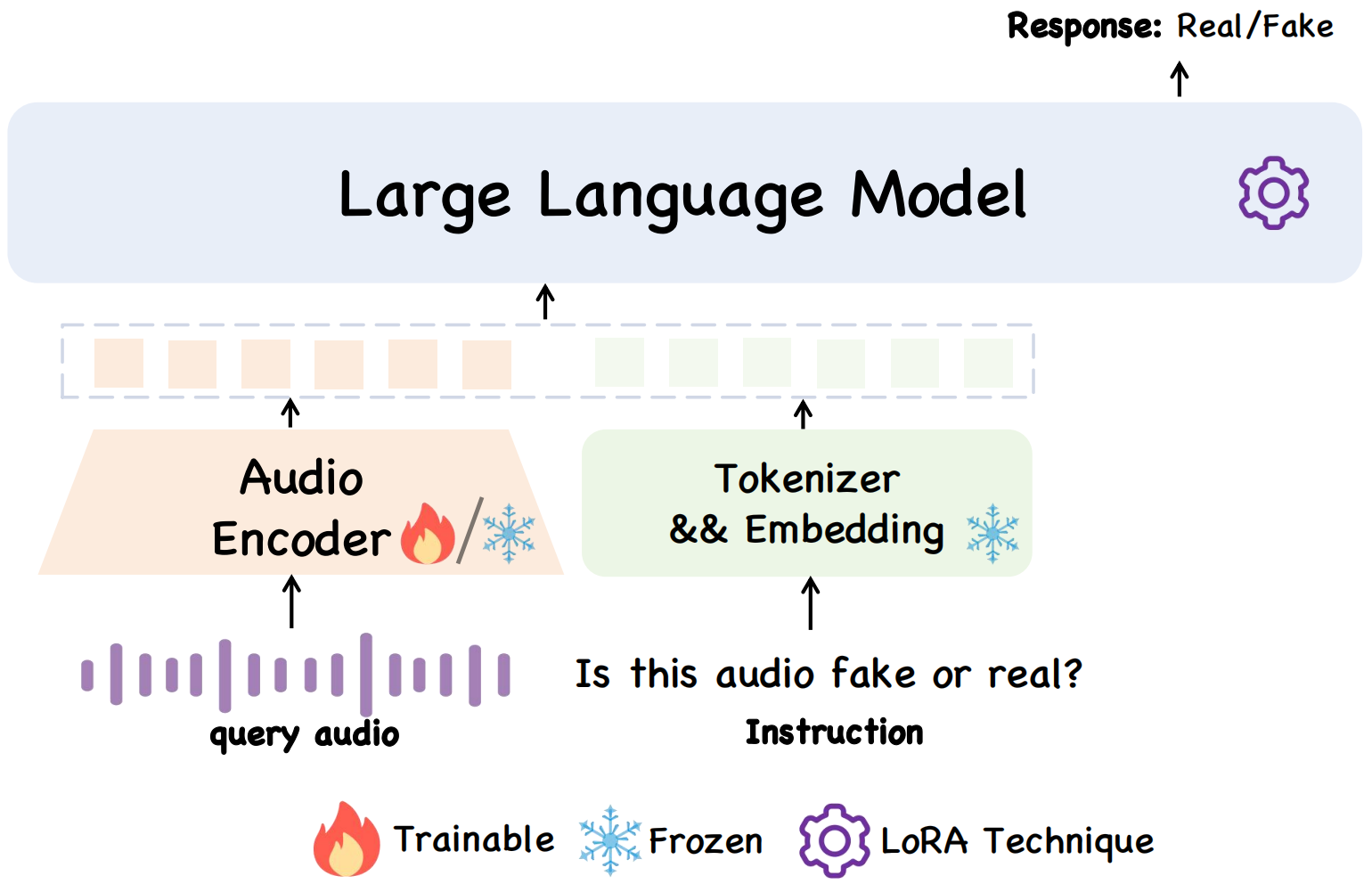
[ACMMM2025] Official code for ALLM4ADD
Hao Gu1, Jiangyan Yi2†, Chenglong Wang3, Jianhua Tao2,
Zheng Lian1, Jiayi He1, Yong Ren1, Yujie Chen4, Zhengqi Wen5
1Institute of Automation, Chinese Academy of Sciences
2Department of Automation, Tsinghua University
3Taizhou University
4Anhui University
5Beijing National Research Center for Information Science and Technology
†Corresponding author.
🔥[2025/7/5] Our work has been finally accepted by ACMMM 2025. This is the first work that fake audio detection with Audio LLM
Install dependencies:
conda create -n qwen_audio_sft python=3.10
conda activate qwen_audio_sft
pip install -r requiremet.txt
pip install deepspeed==0.10.3
You should first prepare the dataset as in data/asv_fake_audio.jsonl:
{"messages": [{"role": "user", "audio": "/data3/renyong/xule/ASVspoof2019/LA/train/wav/LA_T_4132181.wav",
            "content": "Is this audio real or fake?"}, {"role": "assistant", "content": "Fake."}]}
bash audio_8.sh
python infer_eer_8.py
finetune.py ---> frozen the audio encoder
finetune_audio.py ---> train the audio encoder
after you train the audio encoder, change the infer_eer_8.py
# non_lora_trainables = torch.load(os.path.join(peft_model_id, 'non_lora_trainables.bin'), map_location='cpu')
# non_lora_trainables = {(k[11:] if k.startswith('base_model.') else k): v for k, v in non_lora_trainables.items()}
# non_lora_trainables = {(k[6:] if k.startswith('model.') else k): v for k, v in non_lora_trainables.items()}
# merged_model.load_state_dict(non_lora_trainables, strict=False)
to
non_lora_trainables = torch.load(os.path.join(peft_model_id, 'non_lora_trainables.bin'), map_location='cpu')
non_lora_trainables = {(k[11:] if k.startswith('base_model.') else k): v for k, v in non_lora_trainables.items()}
non_lora_trainables = {(k[6:] if k.startswith('model.') else k): v for k, v in non_lora_trainables.items()}
merged_model.load_state_dict(non_lora_trainables, strict=False)
Then you can inference the speech llm that audio encoder is trainable
We are thankful to LLaVA, Qwen-audio for releasing their models and code as open-source contributions.
If you have any problem, please tell me: email: [email protected] wechat: 18862041656
@inproceedings{10.1145/3746027.3755851,
author = {Gu, Hao and Yi, Jiangyan and Wang, Chenglong and Tao, Jianhua and Lian, Zheng and He, Jiayi and Ren, Yong and Chen, Yujie and Wen, Zhengqi},
title = {ALLM4ADD: Unlocking the Capabilities of Audio Large Language Models for Audio Deepfake Detection},
year = {2025},
isbn = {9798400720352},
publisher = {Association for Computing Machinery},
address = {New York, NY, USA},
url = {https://doi.org/10.1145/3746027.3755851},
doi = {10.1145/3746027.3755851},
abstract = {Audio deepfake detection (ADD) has grown increasingly important due to the rise of high-fidelity audio generative models and their potential for misuse. Given that audio large language models (ALLMs) have made significant progress in various audio processing tasks, a heuristic question arises: Can ALLMs be leveraged to solve ADD?. In this paper, we first conduct a comprehensive zero-shot evaluation of ALLMs on ADD, revealing their ineffectiveness. To this end, we propose ALLM4ADD, an ALLM-driven framework for ADD. Specifically, we reformulate ADD task as an audio question answering problem, prompting the model with the question: ''Is this audio fake or real?''. We then perform supervised fine-tuning to enable the ALLM to assess the authenticity of query audio. Extensive experiments are conducted to demonstrate that our ALLM-based method can achieve superior performance in fake audio detection, particularly in data-scarce scenarios. As a pioneering study, we anticipate that this work will inspire the research community to leverage ALLMs to develop more effective ADD systems. Code is available at https://github.com/ucas-hao/qwen_audio_for_add.git.},
booktitle = {Proceedings of the 33rd ACM International Conference on Multimedia},
pages = {11736–11745},
numpages = {10},
keywords = {audio deepfake detection, audio large language model},
location = {Dublin, Ireland},
series = {MM '25}
}



