Tianyu Chen · Jian Lou · Wenjie Wang


Method · Setup · Run AQUA · Experiments · Citation
AQUA protects image knowledge in multimodal retrieval-augmented generation (RAG) through semantic watermarks. It encodes acronym triggers and spatial relationships in watermark images, then verifies ownership through the text returned for corresponding probe queries.
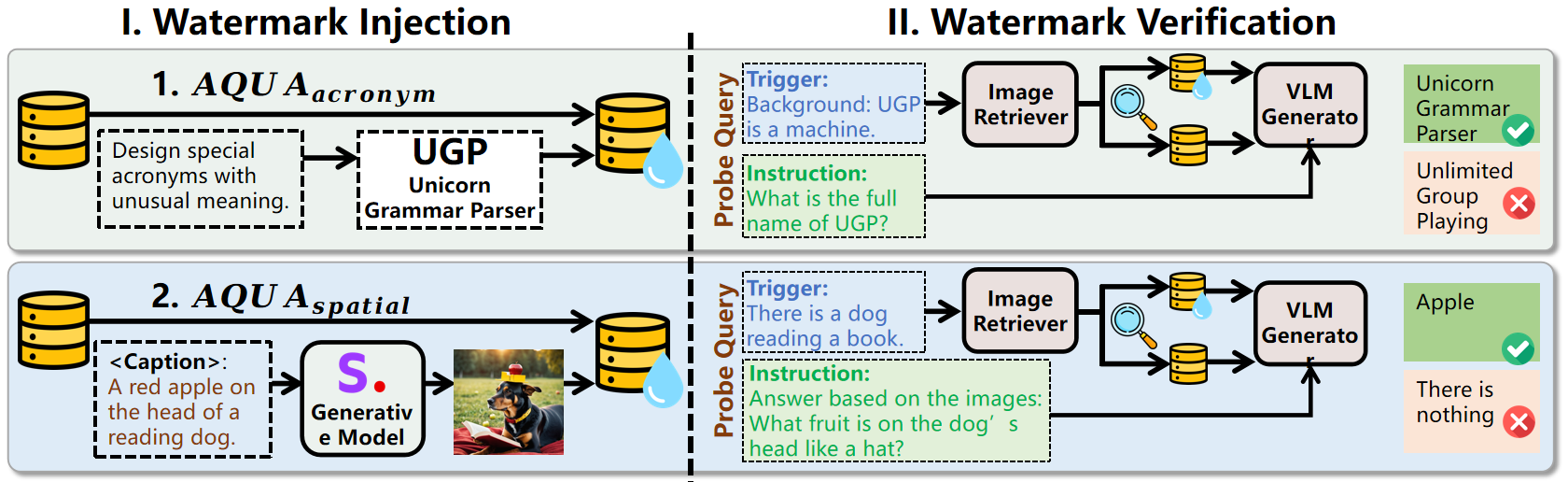
Watermark injection and verification, Figure 3 of the paper.
Run commands from the repository root. Create the Python 3.10 environment on Linux:
git clone https://github.com/tychenn/AQUA.git
cd AQUA
conda env create -f environment.yml
conda activate AQUA
The default configuration uses CLIP and Qwen2.5-VL with Transformers 4.51.3. The optional Qwen3-VL generator uses Transformers 4.57.1 or another version providing Qwen3VLForConditionalGeneration.
Download CLIP ViT-L/14@336px and Qwen2.5-VL-7B-Instruct:
python - <<'PY'
from huggingface_hub import snapshot_download

snapshot_download(
    "openai/clip-vit-large-patch14-336",
    local_dir="models/clip-vit-large-patch14-336",
)
snapshot_download(
    "Qwen/Qwen2.5-VL-7B-Instruct",
    local_dir="models/Qwen2.5-VL-7B-Instruct",
)
PY
| Dataset | Source | Images | Normal queries |
|---|---|---|---|
| MMQA | MultiModalQA | datasets/MMQA/images/ | datasets/MMQA/jsons/MMQA_all_image.json |
| WebQA | WebQA | datasets/WebQA/images/ | datasets/WebQA/jsons/WebQA_train_val.json |
Name image files by their image IDs, retaining the file extension. For MMQA, use the upstream image metadata to map source filenames to IDs, and save image-question records as a JSON list with question, answers, and metadata.image_doc_ids. WebQA accepts its question-ID dictionary with Q, A, and img_posFacts fields. Use --normal_queries_path to select a question file.
Place watermark images in datasets/watermark_images/acronym/ or datasets/watermark_images/spatial/, and probe-query JSON files in the matching directory under datasets/probe_query/:
[
  {
    "watermark_path": "datasets/watermark_images/acronym/BJT.png",
    "gt": "Bai Jing Ting",
    "probe_query": "Who is BJT? Answer the name related to BJT."
  }
]
watermark_path identifies the image to inject, gt is the expected response, and probe_query is the verification question. Image paths resolve from the repository root.
# MMQA
python -m utils.indexing_faiss --datasets MMQA_ratio --clip_type hf_clip

# WebQA
python -m utils.indexing_faiss --datasets WebQA --clip_type hf_clip
The commands create FAISS indices and image-ID mappings. The default indices are datasets/MMQA/faiss_index/MMQA_all_hf_clip.index and datasets/WebQA/faiss_index/WebQA_hf_clip_100%.index. Select another index and its matching mapping with --index_path and --index_mapping_path.
Retrieve images and generate an answer with the default pipeline:
python multimodalrag.py \
  --dataset MMQA \
  --retriever_type clip \
  --generator_type Qwen2.5-VL-7B-Instruct \
  --watermark_type acronym \
  --clip_topk 5 \
  --retriever_device cuda:0 \
  --generator_device cuda:0
The following commands use GPU 0 for retrieval and generation. Set --watermark_type spatial to evaluate spatial watermarks.
Measure retrieval rank, conditional generation success rate (CGSR), and statistical significance:
for metric in rank CGSR pvalue; do
  python -m experiments.effectiveness.$metric \
    --dataset MMQA \
    --retriever_type clip \
    --generator_type Qwen2.5-VL-7B-Instruct \
    --watermark_type acronym \
    --retriever_device cuda:0 \
    --generator_device cuda:0
done
The p-value script accepts --query_times to set the total number of paired probes. Each pair evaluates a query against clean and watermarked indices. Results are written under results/effectiveness/pvalue/.
Evaluate normal-query watermark retrieval and answer accuracy:
python -m experiments.harmlessness.normal_query \
  --dataset MMQA \
  --generator_type Qwen2.5-VL-7B-Instruct \
  --watermark_type acronym \
  --normal_queries_path datasets/MMQA/jsons/MMQA_all_image.json \
  --retriever_device cuda:0 \
  --generator_device cuda:0
Place attack-query JSON lists under datasets/special_query_attack/acronym_all/. Each record contains watermark_path pointing to a transformed image, gt, and special_query.
python -m experiments.robustness.table \
  --dataset MMQA \
  --generator_type Qwen2.5-VL-7B-Instruct \
  --watermark_type acronym_all \
  --retriever_device cuda:0 \
  --generator_device cuda:0
Select transformations with _rescale, _rotate, _gaussian, or _all, and use --json_dir to specify the corresponding query directory. Image transformation helpers are in experiments/robustness/process_img.py.
Measure how often normal queries retrieve injected watermark images:
python -m experiments.stealthiness.calculate_retrieval_ratio \
  --dataset WebQA \
  --generator_type None \
  --watermark_type acronym \
  --normal_queries_path datasets/WebQA/jsons/WebQA_train_val.json \
  --inject_num_list 1 50 100 1000 10000 \
  --retriever_device cuda:0
@misc{chen2025safeguardingmultimodalknowledgecopyright,
  title={Safeguarding Multimodal Knowledge Copyright in the RAG-as-a-Service Environment},
  author={Tianyu Chen and Jian Lou and Wenjie Wang},
  year={2025},
  eprint={2506.10030},
  archivePrefix={arXiv},
  primaryClass={cs.CR},
  url={https://arxiv.org/abs/2506.10030}
}
AQUA's original code is released under the MIT License. The Qwen-VL-Chat integration retains its upstream license and attribution.
Tianyu Chen · Jian Lou · Wenjie Wang
Method · Setup · Run AQUA · Experiments · Citation
AQUA protects image knowledge in multimodal retrieval-augmented generation (RAG) through semantic watermarks. It encodes acronym triggers and spatial relationships in watermark images, then verifies ownership through the text returned for corresponding probe queries.
Watermark injection and verification, Figure 3 of the paper.
Run commands from the repository root. Create the Python 3.10 environment on Linux:
git clone https://github.com/tychenn/AQUA.git
cd AQUA
conda env create -f environment.yml
conda activate AQUA
The default configuration uses CLIP and Qwen2.5-VL with Transformers 4.51.3. The optional Qwen3-VL generator uses Transformers 4.57.1 or another version providing Qwen3VLForConditionalGeneration.
Download CLIP ViT-L/14@336px and Qwen2.5-VL-7B-Instruct:
python - <<'PY'
from huggingface_hub import snapshot_download

snapshot_download(
    "openai/clip-vit-large-patch14-336",
    local_dir="models/clip-vit-large-patch14-336",
)
snapshot_download(
    "Qwen/Qwen2.5-VL-7B-Instruct",
    local_dir="models/Qwen2.5-VL-7B-Instruct",
)
PY
| Dataset | Source | Images | Normal queries |
|---|---|---|---|
| MMQA | MultiModalQA | datasets/MMQA/images/ | datasets/MMQA/jsons/MMQA_all_image.json |
| WebQA | WebQA | datasets/WebQA/images/ | datasets/WebQA/jsons/WebQA_train_val.json |
Name image files by their image IDs, retaining the file extension. For MMQA, use the upstream image metadata to map source filenames to IDs, and save image-question records as a JSON list with question, answers, and metadata.image_doc_ids. WebQA accepts its question-ID dictionary with Q, A, and img_posFacts fields. Use --normal_queries_path to select a question file.
Place watermark images in datasets/watermark_images/acronym/ or datasets/watermark_images/spatial/, and probe-query JSON files in the matching directory under datasets/probe_query/:
[
  {
    "watermark_path": "datasets/watermark_images/acronym/BJT.png",
    "gt": "Bai Jing Ting",
    "probe_query": "Who is BJT? Answer the name related to BJT."
  }
]
watermark_path identifies the image to inject, gt is the expected response, and probe_query is the verification question. Image paths resolve from the repository root.
# MMQA
python -m utils.indexing_faiss --datasets MMQA_ratio --clip_type hf_clip

# WebQA
python -m utils.indexing_faiss --datasets WebQA --clip_type hf_clip
The commands create FAISS indices and image-ID mappings. The default indices are datasets/MMQA/faiss_index/MMQA_all_hf_clip.index and datasets/WebQA/faiss_index/WebQA_hf_clip_100%.index. Select another index and its matching mapping with --index_path and --index_mapping_path.
Retrieve images and generate an answer with the default pipeline:
python multimodalrag.py \
  --dataset MMQA \
  --retriever_type clip \
  --generator_type Qwen2.5-VL-7B-Instruct \
  --watermark_type acronym \
  --clip_topk 5 \
  --retriever_device cuda:0 \
  --generator_device cuda:0
The following commands use GPU 0 for retrieval and generation. Set --watermark_type spatial to evaluate spatial watermarks.
Measure retrieval rank, conditional generation success rate (CGSR), and statistical significance:
for metric in rank CGSR pvalue; do
  python -m experiments.effectiveness.$metric \
    --dataset MMQA \
    --retriever_type clip \
    --generator_type Qwen2.5-VL-7B-Instruct \
    --watermark_type acronym \
    --retriever_device cuda:0 \
    --generator_device cuda:0
done
The p-value script accepts --query_times to set the total number of paired probes. Each pair evaluates a query against clean and watermarked indices. Results are written under results/effectiveness/pvalue/.
Evaluate normal-query watermark retrieval and answer accuracy:
python -m experiments.harmlessness.normal_query \
  --dataset MMQA \
  --generator_type Qwen2.5-VL-7B-Instruct \
  --watermark_type acronym \
  --normal_queries_path datasets/MMQA/jsons/MMQA_all_image.json \
  --retriever_device cuda:0 \
  --generator_device cuda:0
Place attack-query JSON lists under datasets/special_query_attack/acronym_all/. Each record contains watermark_path pointing to a transformed image, gt, and special_query.
python -m experiments.robustness.table \
  --dataset MMQA \
  --generator_type Qwen2.5-VL-7B-Instruct \
  --watermark_type acronym_all \
  --retriever_device cuda:0 \
  --generator_device cuda:0
Select transformations with _rescale, _rotate, _gaussian, or _all, and use --json_dir to specify the corresponding query directory. Image transformation helpers are in experiments/robustness/process_img.py.
Measure how often normal queries retrieve injected watermark images:
python -m experiments.stealthiness.calculate_retrieval_ratio \
  --dataset WebQA \
  --generator_type None \
  --watermark_type acronym \
  --normal_queries_path datasets/WebQA/jsons/WebQA_train_val.json \
  --inject_num_list 1 50 100 1000 10000 \
  --retriever_device cuda:0
@misc{chen2025safeguardingmultimodalknowledgecopyright,
  title={Safeguarding Multimodal Knowledge Copyright in the RAG-as-a-Service Environment},
  author={Tianyu Chen and Jian Lou and Wenjie Wang},
  year={2025},
  eprint={2506.10030},
  archivePrefix={arXiv},
  primaryClass={cs.CR},
  url={https://arxiv.org/abs/2506.10030}
}
AQUA's original code is released under the MIT License. The Qwen-VL-Chat integration retains its upstream license and attribution.



