Firewall for the agentic era
See the code
Stop runaway loops. Block data exfiltration. Enforce policy. No SDK required.






1. Uncontrolled Cost & Runaway Loops
Autonomous AI agents are expensive when running unsupervised. A single stuck retry loop, recursive reasoning stall, or cascade failure can burn hundreds of dollars in API credits within minutes. Upstream provider dashboards only give post-hoc metrics and alerts after the damage has already hit your card. Loopers intercepts traffic in real time and cuts off spending before the bill is generated.
2. Runtime Tool Poisoning & Data Exfiltration
Autonomous agents ingest external web pages, parse tool responses, and execute commands. A compromised MCP server, poisoned tool response, or indirect prompt injection can turn your agent into an exfiltration vector. Outbound LLM completions frequently leak credentials, PII, or internal network IPs back to untrusted contexts. Without a runtime firewall inspecting bidirectional traffic, agents operate completely unshielded.
3. Lack of Deterministic Policy Governance
As agent systems scale, relying on prompt instructions for safety and operational boundaries fails. Safety directives placed in system prompts can be overridden by jailbreaks or forgotten across long context windows. Loopers introduces a deterministic, stateful enforcement layer: declarative policies that quarantine, block, mutate, or escalate live requests at the network boundary.
Loopers is created and actively maintained by Varad Khoriya and Mayank Agrawal (part of the Loopers organization).
The project was born when an autonomous test agent got stuck in a recursive loop and ran up an unexpected bill during local development. After analyzing the root cause, it became clear that major AI platforms only offer passive telemetry rather than active circuit breakers. We built Loopers to establish an open-source, bare-metal firewall standard for autonomous agent systems.
Have questions, suggestions, or need help integrating? Join the community on GitHub Discussions or submit an issue on GitHub Issues.
AI Agents & LLMs: See AGENT_README.md for dense machine-readable context and configuration schemas.
Loopers is a stateful, runtime security firewall for autonomous AI agents.
It is not an AI gateway, model router, prompt management platform, or agent orchestration framework.
| Capability | AI Gateways (LiteLLM, PortKey, OpenRouter) | Loopers AI Firewall |
|---|---|---|
| Primary Focus | Traffic routing, model aggregation, latency | Security boundaries, budget enforcement, threat termination |
| Budget Enforcement | Post-request tracking or passive webhook alerts | Pre-call atomic leases with 0% over-charge by design |
| Streaming Enforcement | Passes stream chunks transparently | Active chunk-by-chunk SSE inspection; severs connections mid-stream |
| Syntactic Normalization | None | 5-stage de-obfuscation (Unicode homoglyphs, invisible runes, base64 decoding, token collapse) |
| Outbound DLP Gate | None | Real-time scanning & redaction of PII, secrets, and private IPs |
| Agent Behavioral Risk | Stateless per request | Persistent cross-session risk scoring (0–100) & automated quarantine |
| Runaway Loop Breaker | None | Real-time 3-engine detection (Fingerprint, Velocity, Stall) |
| Multi-Turn Drift Protection | Stateless per request | Active containment scoring against initial session anchor ($T_1$) |
| Compliance Presets | None | Out-of-the-box zero-dependency policies for OWASP LLM Top 10, NIST AI RMF 1.0, and EU AI Act |
| Tool Blast Radius Scoring | None | Deterministic risk scoring (0–100) & tier classification on tool verbs, targets, wildcards, and egress |
| Tool Execution FSM | None | Stateful tool sequencing (e.g. require dry run before bash execution) |
| Human-in-the-Loop Escalation | None | Suspends live HTTP requests for Redis Pub/Sub approval |
| Zero-Storage Pass-Through | Often caches prompts / logs payloads | Provider keys & payloads stay strictly in-memory (never persisted) |
| Failure Mode | Fail-open for maximum availability | Fail-closed by design (blocks traffic if state/Redis drops) |
┌──────────────────────────────────────────────────────────────────────────┐
│                             Agent Runtime                                │
│       (Aider / OpenHands / Claude Code / Custom Agent / Python SDK)      │
└────────────────────────────────────┬─────────────────────────────────────┘
                                     │ HTTP (e.g., OPENAI_BASE_URL)
                                     ▼
┌──────────────────────────────────────────────────────────────────────────┐
│                        Loopers Firewall (:8080)                          │
│                                                                          │
│  [1. Key Auth & DPoP] ──► [2. Risk Score & Quarantine Gate]              │
│            │                                                             │
│  [3. Syntactic Normalizer] ──► [4. Pre-Call Budget Lease]                │
│            │                                                             │
│  [5. Policy Engine & FSM] ──► [6. Multi-Engine Loop Detector]            │
│            │                                                             │
│  [7. Upstream Provider Proxy] ──► [8. Outbound DLP & SSE Cutoff]         │
│            │                                                             │
│  [9. Cost Reconcile & Risk Update]                                       │
│                                                                          │
│  Admin Server (:9090): /metrics (Prometheus) | /health                   │
│  Telemetry: OpenTelemetry Traces (OTLP gRPC/HTTP) | HMAC Webhooks        │
└───────────────────┬──────────────────────────────────┬───────────────────┘
                    │                                  │
                    ▼                                  ▼
          ┌───────────────────┐              ┌───────────────────┐
          │     Redis 7+      │              │ Upstream Provider │
          │ (Atomic Leases,   │              │ (OpenAI, Anthropic│
          │  Risk Scores,     │              │  Gemini, Bedrock, │
          │  FSM Session State│              │  Groq, Ollama...) │
          │  Quarantine Keys) │              └───────────────────┘
          └───────────────────┘
lp-...). Loopers verifies the HMAC-SHA256 hash against Redis. If DPoP is configured, proof-of-possession is validated against the sender's public key.403 Forbidden. If permanently blocked (score > 90), traffic is dropped.internal/syntactic), resolving Unicode homoglyphs (Cyrillic, Greek, Math Bold), stripping zero-width/bidi runes, recursively decoding nested Base64/URL percent escapes, and collapsing delimited tokens (i.g.n.o.r.e). Both raw and canonical normalized_prompt are exposed to the policy engine.pricing.yaml and atomically reserves this quota in Redis across minute, hourly, daily, weekly, and monthly sliding windows. If limits are reached, the call is blocked before hitting the provider.escalate policy triggers, Loopers suspends the live HTTP connection and awaits human/admin approval via Redis Pub/Sub.X-Loopers-Provider-Key or configuration) and forwards the sanitized payload to the LLM provider. The Loopers proxy key is never sent upstream.secret_accessed), and risk decay over time..internal hostnames), and quarantine lockouts on secret leaks (AWS, OpenAI, GitHub tokens, private keys) across both JSON and streaming SSE responses.../) and indirect prompt injection patterns.allow: Passes request through to the upstream provider.deny: Rejects the request with a structured error payload.escalate: Suspends live HTTP request and waits up to 60s for external human approval via Redis Pub/Sub.quarantine: Freezes the agent key in Redis across all endpoints for a defined lockout duration.transform: Mutates payload fields (e.g., redactions, parameter replacements) in-flight.dry_run_command before allowing destructive execute_bash calls).server.shadow_mode: true) to audit policies against live traffic without impacting production workflows.X-Loopers-Model-Override and X-Loopers-Model-Map headers without modifying agent codebases.loopers verify): Validates past execution trace logs against current policy cards offline, providing verifiable compliance reporting for CI/CD gates.Loopers includes pre-configured security presets that can be enabled instantly via --presets or in loopers.yaml:
| Preset | Target & Scope | What It Enforces |
|---|---|---|
safety | LLM Prompts & MCP Tools | Blocks SSNs, credentials, API keys, common prompt injection signatures (ignore previous instructions, dan mode), and destructive bash commands (rm -rf, sudo, chmod 777, curl, nc -e). |
safety_drift | Multi-Turn LLM Dialogues | Prevents multi-turn goal hijacking and conversational context divergence. Evaluates prompt similarity against the initial session anchor ($T_1$) and blocks turns that deviate from the authorized session objective. |
pci | LLM Prompts & Payloads | Enforces PCI-DSS input sanitization by blocking 16-digit credit card numbers, CVV/CVC codes, and SQL injection signatures (UNION SELECT, DROP TABLE, OR 1=1). |
mcp_sandbox | MCP Tool Invocations | Prevents path traversal (../) in filesystem arguments and enforces stateful tool chaining: requires dry_run_command to be executed within the last 2 steps before running execute_bash. |
zero_trust | Agent Identity & Risk | Denies LLM and MCP tool access to any agent with a persistent risk score above 75. Automatically escalates send_email tool calls to human review if the agent holds a secret_accessed taint flag. |
Enable presets on startup:
loopers serve --presets safety,safety_drift,pci,mcp_sandbox
# Via Homebrew (macOS / Linux)
brew install cursed-me/tap/loopers

# Via Docker
docker pull ghcr.io/try-loopers/loopers:latest

# Build from Source
git clone https://github.com/try-loopers/loopers-oss.git
cd loopers-oss
go install ./cmd/loopers
# Start local Redis instance
docker run -d --name loopers-redis -p 6379:6379 redis:7-alpine

# Initialize Loopers configuration wizard (creates loopers.yaml and docker-compose.yml)
loopers init

# Run system diagnostic checks
loopers doctor
Note: For native installs, ensure the pricing.yaml file from the repository root is present in your working directory, as Loopers requires it at startup.
loopers keys create --name dev-agent --provider openai
Note: This generates a raw proxy key (e.g. lp-a1b2c3d4...) and its SHA-256 hash. Save the raw key immediately.
# Set hourly and daily spending limits on the key hash
loopers budget set <KEY_HASH> --daily 5.00 --hourly 1.00

# Verify current budget allocations
loopers budget status <KEY_HASH>
# Run in development mode
SERVER_INSECURE_DEV=true loopers serve --presets safety
If you want to run Redis and the Loopers firewall together using Docker Compose:
# 1. Start Redis cache dependency
docker-compose up -d redis

# 2. Run the Loopers firewall locally
SERVER_INSECURE_DEV=true loopers serve --presets safety
[!WARNING]
SERVER_INSECURE_DEV=truedisables TLS enforcement for local testing. In production environments, configure valid TLS certificates inloopers.yaml.
export LOOPERS_PROXY_KEY="lp-your-proxy-key"
export OPENAI_API_KEY="sk-your-actual-provider-key"

# Wrap any agent CLI tool directly. Auto-detection supports:
# aider, openhands, pi, claude, codex, opencode, gemini, dsh, deepseek-harness, deepseek.
# Other tools require setting LOOPERS_PROVIDER explicitly.
loopers exec -- aider
Point your agent client directly to the Loopers proxy endpoint:
export OPENAI_BASE_URL="http://localhost:8080/lp-your-proxy-key/openai/v1"
export OPENAI_API_KEY="sk-your-actual-provider-key"

aider
from loopers_client import LoopersOpenAI

client = LoopersOpenAI(
    loopers_url="http://localhost:8080",
    loopers_key="lp-your-proxy-key",
    provider_key="sk-your-actual-provider-key",
    session_budget=2.00,  # Cap session spend at $2.00
    max_steps=20          # Terminate if session exceeds 20 turns
)

response = client.chat.completions.create(
    model="gpt-4o",
    messages=[{"role": "user", "content": "Analyze system logs and report findings."}]
)
print(response.choices[0].message.content)
| Command | Description |
|---|---|
loopers serve | Starts the firewall proxy server and admin metrics listener. Accepts --presets and --config. |
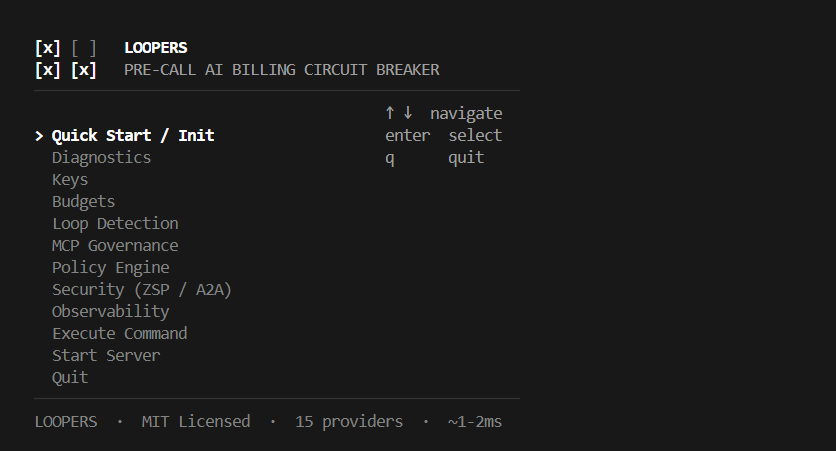
loopers init | Interactive terminal UI (TUI) wizard to generate a production-ready loopers.yaml. |
loopers doctor | Verifies Redis connectivity, pricing configuration, policy directories, and dependencies. |
loopers exec -- <cmd> | Wraps and executes agent CLI binaries with transparent proxy injection and auto-detected providers. |
loopers verify -t <trace> | Audits historical agent execution traces offline against security policies. Supports --format json for CI/CD. |
loopers keys create | Provisions a new agent proxy key (lp-...) with associated identity metadata and provider bindings. |
loopers keys list | Lists all registered agent proxy keys, provider assignments, and active statuses. |
loopers keys revoke <hash> | Instantly revokes a proxy key, preventing all subsequent inbound agent traffic. |
loopers budget set <hash> | Sets minute, hourly, daily, weekly, or monthly spending limits for an agent key. |
loopers budget status <hash> | Displays real-time window consumption, remaining balance, and lease allocations. |
Loopers runs an isolated admin server on :9090 exposing Prometheus metrics at /metrics:
| Metric Name | Type | Description |
|---|---|---|
loopers_requests_total | Counter | Total AI requests processed partitioned by provider, model, and status. |
loopers_budget_blocks_total | Counter | Total requests blocked by budget governance per provider and window. |
loopers_loop_blocks_total | Counter | Total requests halted by loop detection engines (fingerprint, velocity, stall). |
loopers_spend_usd_total | Counter | Cumulative USD spend tracked per provider and key_hash. |
loopers_dlp_redactions_total | Counter | Total outbound LLM completions redacted by semantic DLP. |
loopers_dlp_quarantines_total | Counter | Total agent keys locked out due to secret exfiltration detection. |
loopers_policy_escalations_total | Counter | Total policy decisions suspended and escalated for human approval. |
loopers_mcp_tool_calls_total | Counter | Total MCP tool invocations tracked per tool_name and status. |
A pre-configured Grafana Dashboard is provided in the repository for turnkey deployment.
Loopers exports standard OpenTelemetry spans via OTLP (gRPC/HTTP) adhering to gen_ai.* semantic conventions. Configure your collector in loopers.yaml:
otel:
  enabled: true
  endpoint: "localhost:4317"
  protocol: "grpc"
  sampling_rate: 1.0
Note: All security enforcement actions (blocks, quarantines, escalations) are traced at 100% fidelity regardless of the configured sampling rate.
Configure HMAC-SHA256 signed webhooks to alert external incident systems on security anomalies and budget thresholds:
alerting:
  webhook_url: "https://ops.example.com/alerts"
  webhook_secret: "env:LOOPERS_WEBHOOK_SECRET"
  thresholds:
    - percent: 50
      message: "Agent budget at 50% capacity"
    - percent: 90
      message: "Agent budget near exhaustion — cutoff imminent"
Explore our comprehensive guides and architectural documentation:
We welcome contributions from the open-source community!
Loopers is distributed under the MIT License.
Firewall for the agentic era
See the code
Stop runaway loops. Block data exfiltration. Enforce policy. No SDK required.
1. Uncontrolled Cost & Runaway Loops
Autonomous AI agents are expensive when running unsupervised. A single stuck retry loop, recursive reasoning stall, or cascade failure can burn hundreds of dollars in API credits within minutes. Upstream provider dashboards only give post-hoc metrics and alerts after the damage has already hit your card. Loopers intercepts traffic in real time and cuts off spending before the bill is generated.
2. Runtime Tool Poisoning & Data Exfiltration
Autonomous agents ingest external web pages, parse tool responses, and execute commands. A compromised MCP server, poisoned tool response, or indirect prompt injection can turn your agent into an exfiltration vector. Outbound LLM completions frequently leak credentials, PII, or internal network IPs back to untrusted contexts. Without a runtime firewall inspecting bidirectional traffic, agents operate completely unshielded.
3. Lack of Deterministic Policy Governance
As agent systems scale, relying on prompt instructions for safety and operational boundaries fails. Safety directives placed in system prompts can be overridden by jailbreaks or forgotten across long context windows. Loopers introduces a deterministic, stateful enforcement layer: declarative policies that quarantine, block, mutate, or escalate live requests at the network boundary.
Loopers is created and actively maintained by Varad Khoriya and Mayank Agrawal (part of the Loopers organization).
The project was born when an autonomous test agent got stuck in a recursive loop and ran up an unexpected bill during local development. After analyzing the root cause, it became clear that major AI platforms only offer passive telemetry rather than active circuit breakers. We built Loopers to establish an open-source, bare-metal firewall standard for autonomous agent systems.
Have questions, suggestions, or need help integrating? Join the community on GitHub Discussions or submit an issue on GitHub Issues.
AI Agents & LLMs: See AGENT_README.md for dense machine-readable context and configuration schemas.
Loopers is a stateful, runtime security firewall for autonomous AI agents.
It is not an AI gateway, model router, prompt management platform, or agent orchestration framework.
| Capability | AI Gateways (LiteLLM, PortKey, OpenRouter) | Loopers AI Firewall |
|---|---|---|
| Primary Focus | Traffic routing, model aggregation, latency | Security boundaries, budget enforcement, threat termination |
| Budget Enforcement | Post-request tracking or passive webhook alerts | Pre-call atomic leases with 0% over-charge by design |
| Streaming Enforcement | Passes stream chunks transparently | Active chunk-by-chunk SSE inspection; severs connections mid-stream |
| Syntactic Normalization | None | 5-stage de-obfuscation (Unicode homoglyphs, invisible runes, base64 decoding, token collapse) |
| Outbound DLP Gate | None | Real-time scanning & redaction of PII, secrets, and private IPs |
| Agent Behavioral Risk | Stateless per request | Persistent cross-session risk scoring (0–100) & automated quarantine |
| Runaway Loop Breaker | None | Real-time 3-engine detection (Fingerprint, Velocity, Stall) |
| Multi-Turn Drift Protection | Stateless per request | Active containment scoring against initial session anchor ($T_1$) |
| Compliance Presets | None | Out-of-the-box zero-dependency policies for OWASP LLM Top 10, NIST AI RMF 1.0, and EU AI Act |
| Tool Blast Radius Scoring | None | Deterministic risk scoring (0–100) & tier classification on tool verbs, targets, wildcards, and egress |
| Tool Execution FSM | None | Stateful tool sequencing (e.g. require dry run before bash execution) |
| Human-in-the-Loop Escalation | None | Suspends live HTTP requests for Redis Pub/Sub approval |
| Zero-Storage Pass-Through | Often caches prompts / logs payloads | Provider keys & payloads stay strictly in-memory (never persisted) |
| Failure Mode | Fail-open for maximum availability | Fail-closed by design (blocks traffic if state/Redis drops) |
┌──────────────────────────────────────────────────────────────────────────┐
│                             Agent Runtime                                │
│       (Aider / OpenHands / Claude Code / Custom Agent / Python SDK)      │
└────────────────────────────────────┬─────────────────────────────────────┘
                                     │ HTTP (e.g., OPENAI_BASE_URL)
                                     ▼
┌──────────────────────────────────────────────────────────────────────────┐
│                        Loopers Firewall (:8080)                          │
│                                                                          │
│  [1. Key Auth & DPoP] ──► [2. Risk Score & Quarantine Gate]              │
│            │                                                             │
│  [3. Syntactic Normalizer] ──► [4. Pre-Call Budget Lease]                │
│            │                                                             │
│  [5. Policy Engine & FSM] ──► [6. Multi-Engine Loop Detector]            │
│            │                                                             │
│  [7. Upstream Provider Proxy] ──► [8. Outbound DLP & SSE Cutoff]         │
│            │                                                             │
│  [9. Cost Reconcile & Risk Update]                                       │
│                                                                          │
│  Admin Server (:9090): /metrics (Prometheus) | /health                   │
│  Telemetry: OpenTelemetry Traces (OTLP gRPC/HTTP) | HMAC Webhooks        │
└───────────────────┬──────────────────────────────────┬───────────────────┘
                    │                                  │
                    ▼                                  ▼
          ┌───────────────────┐              ┌───────────────────┐
          │     Redis 7+      │              │ Upstream Provider │
          │ (Atomic Leases,   │              │ (OpenAI, Anthropic│
          │  Risk Scores,     │              │  Gemini, Bedrock, │
          │  FSM Session State│              │  Groq, Ollama...) │
          │  Quarantine Keys) │              └───────────────────┘
          └───────────────────┘
lp-...). Loopers verifies the HMAC-SHA256 hash against Redis. If DPoP is configured, proof-of-possession is validated against the sender's public key.403 Forbidden. If permanently blocked (score > 90), traffic is dropped.internal/syntactic), resolving Unicode homoglyphs (Cyrillic, Greek, Math Bold), stripping zero-width/bidi runes, recursively decoding nested Base64/URL percent escapes, and collapsing delimited tokens (i.g.n.o.r.e). Both raw and canonical normalized_prompt are exposed to the policy engine.pricing.yaml and atomically reserves this quota in Redis across minute, hourly, daily, weekly, and monthly sliding windows. If limits are reached, the call is blocked before hitting the provider.escalate policy triggers, Loopers suspends the live HTTP connection and awaits human/admin approval via Redis Pub/Sub.X-Loopers-Provider-Key or configuration) and forwards the sanitized payload to the LLM provider. The Loopers proxy key is never sent upstream.secret_accessed), and risk decay over time..internal hostnames), and quarantine lockouts on secret leaks (AWS, OpenAI, GitHub tokens, private keys) across both JSON and streaming SSE responses.../) and indirect prompt injection patterns.allow: Passes request through to the upstream provider.deny: Rejects the request with a structured error payload.escalate: Suspends live HTTP request and waits up to 60s for external human approval via Redis Pub/Sub.quarantine: Freezes the agent key in Redis across all endpoints for a defined lockout duration.transform: Mutates payload fields (e.g., redactions, parameter replacements) in-flight.dry_run_command before allowing destructive execute_bash calls).server.shadow_mode: true) to audit policies against live traffic without impacting production workflows.X-Loopers-Model-Override and X-Loopers-Model-Map headers without modifying agent codebases.loopers verify): Validates past execution trace logs against current policy cards offline, providing verifiable compliance reporting for CI/CD gates.Loopers includes pre-configured security presets that can be enabled instantly via --presets or in loopers.yaml:
| Preset | Target & Scope | What It Enforces |
|---|---|---|
safety | LLM Prompts & MCP Tools | Blocks SSNs, credentials, API keys, common prompt injection signatures (ignore previous instructions, dan mode), and destructive bash commands (rm -rf, sudo, chmod 777, curl, nc -e). |
safety_drift | Multi-Turn LLM Dialogues | Prevents multi-turn goal hijacking and conversational context divergence. Evaluates prompt similarity against the initial session anchor ($T_1$) and blocks turns that deviate from the authorized session objective. |
pci | LLM Prompts & Payloads | Enforces PCI-DSS input sanitization by blocking 16-digit credit card numbers, CVV/CVC codes, and SQL injection signatures (UNION SELECT, DROP TABLE, OR 1=1). |
mcp_sandbox | MCP Tool Invocations | Prevents path traversal (../) in filesystem arguments and enforces stateful tool chaining: requires dry_run_command to be executed within the last 2 steps before running execute_bash. |
zero_trust | Agent Identity & Risk | Denies LLM and MCP tool access to any agent with a persistent risk score above 75. Automatically escalates send_email tool calls to human review if the agent holds a secret_accessed taint flag. |
Enable presets on startup:
loopers serve --presets safety,safety_drift,pci,mcp_sandbox
# Via Homebrew (macOS / Linux)
brew install cursed-me/tap/loopers

# Via Docker
docker pull ghcr.io/try-loopers/loopers:latest

# Build from Source
git clone https://github.com/try-loopers/loopers-oss.git
cd loopers-oss
go install ./cmd/loopers
# Start local Redis instance
docker run -d --name loopers-redis -p 6379:6379 redis:7-alpine

# Initialize Loopers configuration wizard (creates loopers.yaml and docker-compose.yml)
loopers init

# Run system diagnostic checks
loopers doctor
Note: For native installs, ensure the pricing.yaml file from the repository root is present in your working directory, as Loopers requires it at startup.
loopers keys create --name dev-agent --provider openai
Note: This generates a raw proxy key (e.g. lp-a1b2c3d4...) and its SHA-256 hash. Save the raw key immediately.
# Set hourly and daily spending limits on the key hash
loopers budget set <KEY_HASH> --daily 5.00 --hourly 1.00

# Verify current budget allocations
loopers budget status <KEY_HASH>
# Run in development mode
SERVER_INSECURE_DEV=true loopers serve --presets safety
If you want to run Redis and the Loopers firewall together using Docker Compose:
# 1. Start Redis cache dependency
docker-compose up -d redis

# 2. Run the Loopers firewall locally
SERVER_INSECURE_DEV=true loopers serve --presets safety
[!WARNING]
SERVER_INSECURE_DEV=truedisables TLS enforcement for local testing. In production environments, configure valid TLS certificates inloopers.yaml.
export LOOPERS_PROXY_KEY="lp-your-proxy-key"
export OPENAI_API_KEY="sk-your-actual-provider-key"

# Wrap any agent CLI tool directly. Auto-detection supports:
# aider, openhands, pi, claude, codex, opencode, gemini, dsh, deepseek-harness, deepseek.
# Other tools require setting LOOPERS_PROVIDER explicitly.
loopers exec -- aider
Point your agent client directly to the Loopers proxy endpoint:
export OPENAI_BASE_URL="http://localhost:8080/lp-your-proxy-key/openai/v1"
export OPENAI_API_KEY="sk-your-actual-provider-key"

aider
from loopers_client import LoopersOpenAI

client = LoopersOpenAI(
    loopers_url="http://localhost:8080",
    loopers_key="lp-your-proxy-key",
    provider_key="sk-your-actual-provider-key",
    session_budget=2.00,  # Cap session spend at $2.00
    max_steps=20          # Terminate if session exceeds 20 turns
)

response = client.chat.completions.create(
    model="gpt-4o",
    messages=[{"role": "user", "content": "Analyze system logs and report findings."}]
)
print(response.choices[0].message.content)
| Command | Description |
|---|---|
loopers serve | Starts the firewall proxy server and admin metrics listener. Accepts --presets and --config. |
loopers init | Interactive terminal UI (TUI) wizard to generate a production-ready loopers.yaml. |
loopers doctor | Verifies Redis connectivity, pricing configuration, policy directories, and dependencies. |
loopers exec -- <cmd> | Wraps and executes agent CLI binaries with transparent proxy injection and auto-detected providers. |
loopers verify -t <trace> | Audits historical agent execution traces offline against security policies. Supports --format json for CI/CD. |
loopers keys create | Provisions a new agent proxy key (lp-...) with associated identity metadata and provider bindings. |
loopers keys list | Lists all registered agent proxy keys, provider assignments, and active statuses. |
loopers keys revoke <hash> | Instantly revokes a proxy key, preventing all subsequent inbound agent traffic. |
loopers budget set <hash> | Sets minute, hourly, daily, weekly, or monthly spending limits for an agent key. |
loopers budget status <hash> | Displays real-time window consumption, remaining balance, and lease allocations. |
Loopers runs an isolated admin server on :9090 exposing Prometheus metrics at /metrics:
| Metric Name | Type | Description |
|---|---|---|
loopers_requests_total | Counter | Total AI requests processed partitioned by provider, model, and status. |
loopers_budget_blocks_total | Counter | Total requests blocked by budget governance per provider and window. |
loopers_loop_blocks_total | Counter | Total requests halted by loop detection engines (fingerprint, velocity, stall). |
loopers_spend_usd_total | Counter | Cumulative USD spend tracked per provider and key_hash. |
loopers_dlp_redactions_total | Counter | Total outbound LLM completions redacted by semantic DLP. |
loopers_dlp_quarantines_total | Counter | Total agent keys locked out due to secret exfiltration detection. |
loopers_policy_escalations_total | Counter | Total policy decisions suspended and escalated for human approval. |
loopers_mcp_tool_calls_total | Counter | Total MCP tool invocations tracked per tool_name and status. |
A pre-configured Grafana Dashboard is provided in the repository for turnkey deployment.
Loopers exports standard OpenTelemetry spans via OTLP (gRPC/HTTP) adhering to gen_ai.* semantic conventions. Configure your collector in loopers.yaml:
otel:
  enabled: true
  endpoint: "localhost:4317"
  protocol: "grpc"
  sampling_rate: 1.0
Note: All security enforcement actions (blocks, quarantines, escalations) are traced at 100% fidelity regardless of the configured sampling rate.
Configure HMAC-SHA256 signed webhooks to alert external incident systems on security anomalies and budget thresholds:
alerting:
  webhook_url: "https://ops.example.com/alerts"
  webhook_secret: "env:LOOPERS_WEBHOOK_SECRET"
  thresholds:
    - percent: 50
      message: "Agent budget at 50% capacity"
    - percent: 90
      message: "Agent budget near exhaustion — cutoff imminent"
Explore our comprehensive guides and architectural documentation:
We welcome contributions from the open-source community!
Loopers is distributed under the MIT License.



