
Typed decisions (choice/score/noul) from one encoder pass - faster, better-calibrated successor to Laya, Jev wire compatible
See the codeSee what people are saying
README

Typed decisions — choice, score, noul — about any text or JSON state, from one encoder pass.
Every question of a call shares one encoding of the state: 3 ms for one question, 11 ms for ten questions over a 500-token document.
A self-hosted, Jev-compatible, faster and better-calibrated successor to Laya.








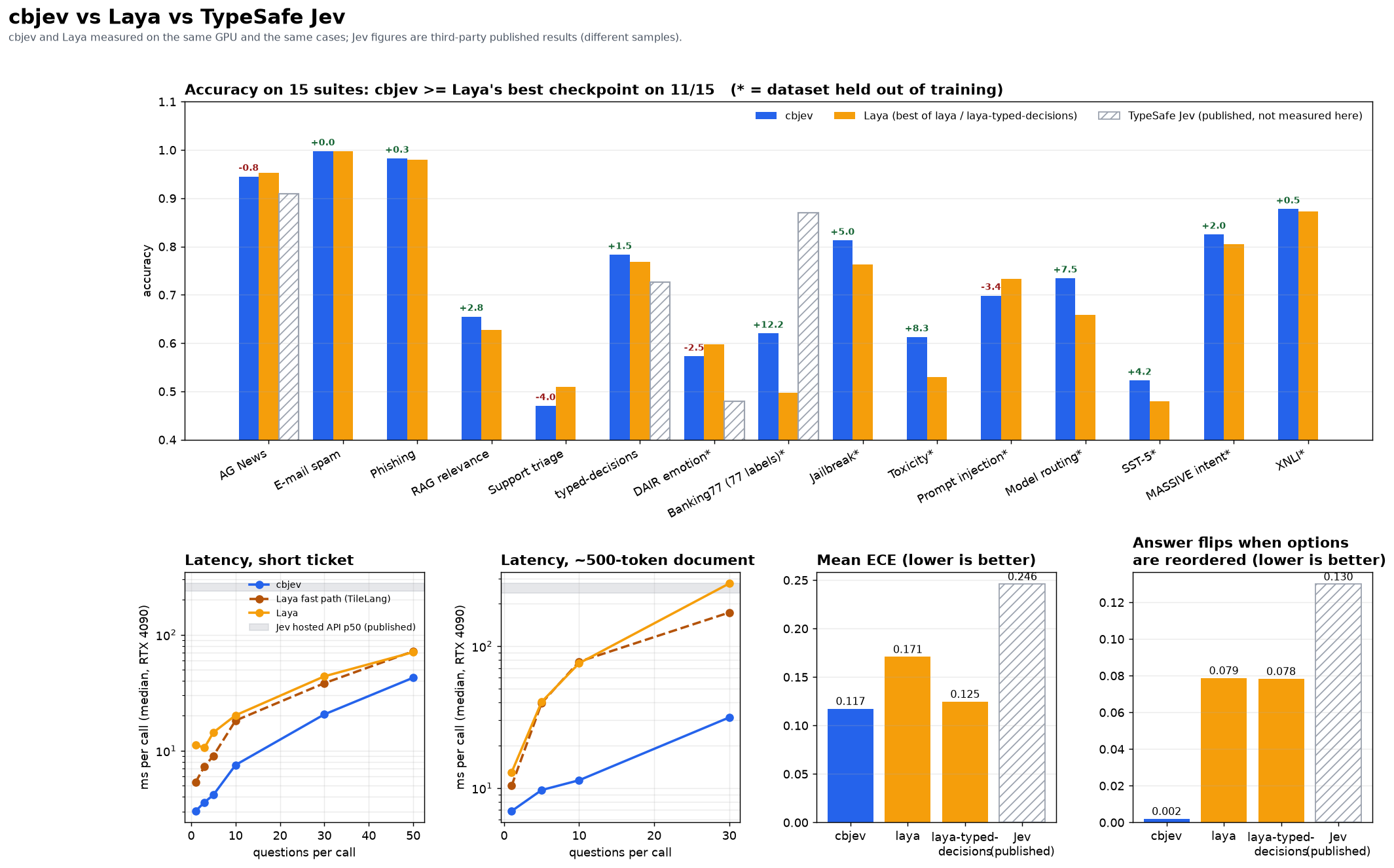
Results at a glance
Measured on one RTX 4090, cbjev and Laya side by side on byte-identical cases (BENCHMARKS.md). Jev numbers are third-party published figures; there was no TypeSafe API access, so they are indicative only.
| cbjev | Laya (best of its checkpoints) | TypeSafe Jev (published) | |
|---|---|---|---|
| mean accuracy, 15 English suites | 0.741 | 0.710 (laya-typed-decisions) | — |
| suites where cbjev >= Laya's better checkpoint | 11 / 15 | ||
| typed-decisions, 2,000 decisions | 0.783 | 0.768 | 0.727 |
| AG News | 0.945 | 0.953 | 0.910 |
| DAIR emotion (held out) | 0.573 | 0.598 | 0.480 |
| Banking77, all 77 labels in one question (held out) | 0.620 | 0.497 | 0.870 (72 labels) |
| mean ECE (lower is better) | 0.117 | 0.125 | 0.246 |
| answer flips when options are reordered | 0.2 % | 7.8 % | 13 % |
| MASSIVE intent, 51 languages, macro accuracy | 0.436 | 0.401 | — |
| MASSIVE, languages where cbjev >= Laya | 45 / 51 | ||
| 1 question, short ticket | 3.0 ms | 5.4 ms (TileLang fast path) | 236–276 ms (hosted API) |
| 10 questions, short ticket | 7.5 ms | 18.2 ms | |
| 10 questions, ~500-token document | 11.4 ms | 75.8 ms | |
| 30 questions, ~500-token document | 31.4 ms | 172.4 ms |
cbjev is faster than both Laya paths in every one of the 10 latency cases measured, by 1.5x (one question on a long document) to 6.9x (ten questions on a document).
What is different from Laya
Laya encodes the state once per question: ten questions about a 500-token document means ten 500-token sequences. cbjev packs a call into one row — the state once, then every question as its own segment:
Laya   [CLS] q1 [SEP] opts [SEP] state [SEP]      (x N questions)
cbjev  [CLS] q1 | q2 | ... | qN | state [SEP]     (once)
The attention mask keeps questions from seeing each other, while the state reads all of them. Each
question segment restarts its positions right after [CLS], so with a single question the row is
token-for-token and position-for-position exactly what a Laya checkpoint was trained on — which is why
fine-tuning from Laya starts from Laya's full ability instead of relearning it.
On top of that:
- Own encoder forward. A from-scratch ModernBERT/mmBERT implementation (
cbjev/model.py) with an explicit attention mask, bf16 matmuls over an fp32 residual stream, and CUDA-graph replay per shape bucket (cbjev/engine.py) — a call is one graph launch instead of ~300 kernel launches. - Cheaper CPU side. The state is tokenized once per call, question text is tokenized once and cached, and everything is shipped to the GPU in one pinned copy.
- Retrained checkpoints. Fine-tuned from Laya on 35 public datasets in many question framings, distilled against both English Laya checkpoints, with temperatures fitted on a held-back dev split.
- Optional order voting.
cbjev.load(order_votes=2)also asks every choice/score question with its options reversed and averages the answers — one extra short segment, not another pass. - Laya checkpoints still run.
cbjev.load("laya")runs the original weights in their own layout (verified to match Laya's probabilities within bf16 rounding).
Install
python -m venv .venv
.venv/bin/pip install -e .            # core
.venv/bin/pip install -e ".[serve]"   # + HTTP server
Weights download on first use from Hugging Face:
0010101010-1/cbjev (English at the root,
multilingual/ for the multilingual checkpoint). To use weights you trained yourself, put them in
$CBJEV_HOME/cbjev/ and $CBJEV_HOME/cbjev-multilingual/ (default ~/.cache/cbjev) or pass a path to
cbjev.load(...); see Training.
Quickstart
import cbjev

agent = cbjev.load()                                   # English checkpoint, GPU if available
res = agent.predict(
    {"subject": "Duplicate charge on invoice #4411",
     "body": "We were billed twice for March. Refund it today or we cancel."},
    {
        "department": {"type": "choice", "instructions": "Which team should handle this?",
                       "criteria": {"billing": "invoices, payments, refunds", "technical": "bugs, outages",
                                    "sales": "pricing, contracts", "other": "everything else"}},
        "urgency": {"type": "score", "instructions": "How urgent is it?",
                    "criteria": ["can wait", "this week", "today", "blocking right now"]},
        "churn": {"type": "noul", "instructions": "Does the customer threaten to cancel their subscription?"},
    },
)
res["answers"]["department"]["choice"]      # 'billing'
res["answers"]["churn"]["noul"]             # P(true), ~0.78
Many states at once: agent.predict_batch(states, questions).
Routing between languages
from cbjev import Router
router = Router()                                      # english + multilingual, loaded lazily
router.predict({"body": "Mir wurde zweimal abgebucht"}, questions)["routing"]
# {'model': 'multilingual', 'reason': "Latin script, language looks like 'de'"}
HTTP server (Jev wire format)
cbjev-serve                              # 127.0.0.1:8000, POST /v1/systemone
CBJEV_API_KEY=secret CBJEV_DEVICE=cuda CBJEV_PRELOAD=1 cbjev-serve
Command line
cbjev "I was charged twice, please refund"            # routing decision only, no model load
cbjev "I was charged twice, please refund" --predict  # triage preset answers as JSON
Presets and e-mail
cbjev.triage_questions(), guard_questions(), moderation_questions(), router_questions(),
email_questions(); cbjev.email_state(subject, body) strips quoted history, signatures and
disclaimers before the model sees an e-mail.
Benchmarks
See BENCHMARKS.md for every number, how it was measured, and how to reproduce it.
python benchmarks/accuracy.py --engines laya,laya-td,cbjev --out benchmarks/results/accuracy.json
python benchmarks/speed.py    --engines laya,laya-fast,cbjev --out benchmarks/results/speed.json
python benchmarks/plot.py
Training
python training/build.py --out .work/data                  # 35 public datasets -> cases + teacher answers
python training/train.py --data .work/data --out ~/.cache/cbjev/cbjev --repeat typed_decisions=8
python training/calibrate.py --ckpt ~/.cache/cbjev/cbjev --data .work/data
training/duty.py --duty 0.5 -- <command> runs any of these on part of the GPU if you share the machine.
Honest limits
- Not better everywhere. Against the better of Laya's two English checkpoints, cbjev trails on 4 of 15 suites: AG News (-0.8 points, 3 cases of 400), DAIR emotion (-2.5), prompt injection (-3.4, 116 cases, half of them German) and support triage (-4.0). Five training rounds and several weight soups moved these by a point or two at most, so treat them as real.
- Many labels still hurt. Banking77 with all 77 intents in one question: 0.620, better than Laya's 0.497 but well behind Jev's published 0.870. Prefer <= 30 options per question.
- The English checkpoint is English. German injection prompts are where it misses most; route
non-English text to
cbjev-multilingual(theRouterdoes this). - Answers can depend on the other questions in the call. The state reads every question of the call, so adding or removing a question can move another question's probabilities slightly. On single-question calls cbjev reads exactly the sequence Laya would.
- Train-split suites are not zero-shot. Six suites use datasets whose train split is in the mix (Laya's documentation lists the same datasets in its own). The nine held-out suites are the fair zero-shot test, and cbjev leads on seven of them.
- The training mix was iterated with the benchmark suites in view. Calibration temperatures were fitted only on the dev split, never on benchmark cases, but choices such as the per-source teacher mix were made after looking at benchmark results.
- Weights live on Hugging Face, not in git (about 800 MB each);
cbjev.load()fetches them, andtraining/rebuilds them from scratch in about an hour per checkpoint on an RTX 4090.
Support the project
If cbjev saves you time or GPU money, you can buy me a coffee:

License
GPL-3.0-or-later (see LICENSE). cbjev's checkpoints are fine-tuned from the Apache-2.0 Laya
checkpoints by Convai Innovations; see NOTICE for attribution and the datasets used.
Similar repos






Languages
Python
100.0%
Typed decisions (choice/score/noul) from one encoder pass - faster, better-calibrated successor to Laya, Jev wire compatible
See the codeSee what people are saying
README
Typed decisions — choice, score, noul — about any text or JSON state, from one encoder pass.
Every question of a call shares one encoding of the state: 3 ms for one question, 11 ms for ten questions over a 500-token document.
A self-hosted, Jev-compatible, faster and better-calibrated successor to Laya.
Results at a glance
Measured on one RTX 4090, cbjev and Laya side by side on byte-identical cases (BENCHMARKS.md). Jev numbers are third-party published figures; there was no TypeSafe API access, so they are indicative only.
| cbjev | Laya (best of its checkpoints) | TypeSafe Jev (published) | |
|---|---|---|---|
| mean accuracy, 15 English suites | 0.741 | 0.710 (laya-typed-decisions) | — |
| suites where cbjev >= Laya's better checkpoint | 11 / 15 | ||
| typed-decisions, 2,000 decisions | 0.783 | 0.768 | 0.727 |
| AG News | 0.945 | 0.953 | 0.910 |
| DAIR emotion (held out) | 0.573 | 0.598 | 0.480 |
| Banking77, all 77 labels in one question (held out) | 0.620 | 0.497 | 0.870 (72 labels) |
| mean ECE (lower is better) | 0.117 | 0.125 | 0.246 |
| answer flips when options are reordered | 0.2 % | 7.8 % | 13 % |
| MASSIVE intent, 51 languages, macro accuracy | 0.436 | 0.401 | — |
| MASSIVE, languages where cbjev >= Laya | 45 / 51 | ||
| 1 question, short ticket | 3.0 ms | 5.4 ms (TileLang fast path) | 236–276 ms (hosted API) |
| 10 questions, short ticket | 7.5 ms | 18.2 ms | |
| 10 questions, ~500-token document | 11.4 ms | 75.8 ms | |
| 30 questions, ~500-token document | 31.4 ms | 172.4 ms |
cbjev is faster than both Laya paths in every one of the 10 latency cases measured, by 1.5x (one question on a long document) to 6.9x (ten questions on a document).
What is different from Laya
Laya encodes the state once per question: ten questions about a 500-token document means ten 500-token sequences. cbjev packs a call into one row — the state once, then every question as its own segment:
Laya   [CLS] q1 [SEP] opts [SEP] state [SEP]      (x N questions)
cbjev  [CLS] q1 | q2 | ... | qN | state [SEP]     (once)
The attention mask keeps questions from seeing each other, while the state reads all of them. Each
question segment restarts its positions right after [CLS], so with a single question the row is
token-for-token and position-for-position exactly what a Laya checkpoint was trained on — which is why
fine-tuning from Laya starts from Laya's full ability instead of relearning it.
On top of that:
- Own encoder forward. A from-scratch ModernBERT/mmBERT implementation (
cbjev/model.py) with an explicit attention mask, bf16 matmuls over an fp32 residual stream, and CUDA-graph replay per shape bucket (cbjev/engine.py) — a call is one graph launch instead of ~300 kernel launches. - Cheaper CPU side. The state is tokenized once per call, question text is tokenized once and cached, and everything is shipped to the GPU in one pinned copy.
- Retrained checkpoints. Fine-tuned from Laya on 35 public datasets in many question framings, distilled against both English Laya checkpoints, with temperatures fitted on a held-back dev split.
- Optional order voting.
cbjev.load(order_votes=2)also asks every choice/score question with its options reversed and averages the answers — one extra short segment, not another pass. - Laya checkpoints still run.
cbjev.load("laya")runs the original weights in their own layout (verified to match Laya's probabilities within bf16 rounding).
Install
python -m venv .venv
.venv/bin/pip install -e .            # core
.venv/bin/pip install -e ".[serve]"   # + HTTP server
Weights download on first use from Hugging Face:
0010101010-1/cbjev (English at the root,
multilingual/ for the multilingual checkpoint). To use weights you trained yourself, put them in
$CBJEV_HOME/cbjev/ and $CBJEV_HOME/cbjev-multilingual/ (default ~/.cache/cbjev) or pass a path to
cbjev.load(...); see Training.
Quickstart
import cbjev

agent = cbjev.load()                                   # English checkpoint, GPU if available
res = agent.predict(
    {"subject": "Duplicate charge on invoice #4411",
     "body": "We were billed twice for March. Refund it today or we cancel."},
    {
        "department": {"type": "choice", "instructions": "Which team should handle this?",
                       "criteria": {"billing": "invoices, payments, refunds", "technical": "bugs, outages",
                                    "sales": "pricing, contracts", "other": "everything else"}},
        "urgency": {"type": "score", "instructions": "How urgent is it?",
                    "criteria": ["can wait", "this week", "today", "blocking right now"]},
        "churn": {"type": "noul", "instructions": "Does the customer threaten to cancel their subscription?"},
    },
)
res["answers"]["department"]["choice"]      # 'billing'
res["answers"]["churn"]["noul"]             # P(true), ~0.78
Many states at once: agent.predict_batch(states, questions).
Routing between languages
from cbjev import Router
router = Router()                                      # english + multilingual, loaded lazily
router.predict({"body": "Mir wurde zweimal abgebucht"}, questions)["routing"]
# {'model': 'multilingual', 'reason': "Latin script, language looks like 'de'"}
HTTP server (Jev wire format)
cbjev-serve                              # 127.0.0.1:8000, POST /v1/systemone
CBJEV_API_KEY=secret CBJEV_DEVICE=cuda CBJEV_PRELOAD=1 cbjev-serve
Command line
cbjev "I was charged twice, please refund"            # routing decision only, no model load
cbjev "I was charged twice, please refund" --predict  # triage preset answers as JSON
Presets and e-mail
cbjev.triage_questions(), guard_questions(), moderation_questions(), router_questions(),
email_questions(); cbjev.email_state(subject, body) strips quoted history, signatures and
disclaimers before the model sees an e-mail.
Benchmarks
See BENCHMARKS.md for every number, how it was measured, and how to reproduce it.
python benchmarks/accuracy.py --engines laya,laya-td,cbjev --out benchmarks/results/accuracy.json
python benchmarks/speed.py    --engines laya,laya-fast,cbjev --out benchmarks/results/speed.json
python benchmarks/plot.py
Training
python training/build.py --out .work/data                  # 35 public datasets -> cases + teacher answers
python training/train.py --data .work/data --out ~/.cache/cbjev/cbjev --repeat typed_decisions=8
python training/calibrate.py --ckpt ~/.cache/cbjev/cbjev --data .work/data
training/duty.py --duty 0.5 -- <command> runs any of these on part of the GPU if you share the machine.
Honest limits
- Not better everywhere. Against the better of Laya's two English checkpoints, cbjev trails on 4 of 15 suites: AG News (-0.8 points, 3 cases of 400), DAIR emotion (-2.5), prompt injection (-3.4, 116 cases, half of them German) and support triage (-4.0). Five training rounds and several weight soups moved these by a point or two at most, so treat them as real.
- Many labels still hurt. Banking77 with all 77 intents in one question: 0.620, better than Laya's 0.497 but well behind Jev's published 0.870. Prefer <= 30 options per question.
- The English checkpoint is English. German injection prompts are where it misses most; route
non-English text to
cbjev-multilingual(theRouterdoes this). - Answers can depend on the other questions in the call. The state reads every question of the call, so adding or removing a question can move another question's probabilities slightly. On single-question calls cbjev reads exactly the sequence Laya would.
- Train-split suites are not zero-shot. Six suites use datasets whose train split is in the mix (Laya's documentation lists the same datasets in its own). The nine held-out suites are the fair zero-shot test, and cbjev leads on seven of them.
- The training mix was iterated with the benchmark suites in view. Calibration temperatures were fitted only on the dev split, never on benchmark cases, but choices such as the per-source teacher mix were made after looking at benchmark results.
- Weights live on Hugging Face, not in git (about 800 MB each);
cbjev.load()fetches them, andtraining/rebuilds them from scratch in about an hour per checkpoint on an RTX 4090.
Support the project
If cbjev saves you time or GPU money, you can buy me a coffee:
License
GPL-3.0-or-later (see LICENSE). cbjev's checkpoints are fine-tuned from the Apache-2.0 Laya
checkpoints by Convai Innovations; see NOTICE for attribution and the datasets used.
Similar repos
Languages
Python
100.0%