BioDockify Pharma AI is the AI Pharmaceutical Research Assistant for Researcher, integrating intelligent agents, molecular modeling, literature intelligence, and computational drug discovery. Designed to transform scientific ideas into reproducible research, faster discoveries, and real-world pharmaceutical innovation.
See the code





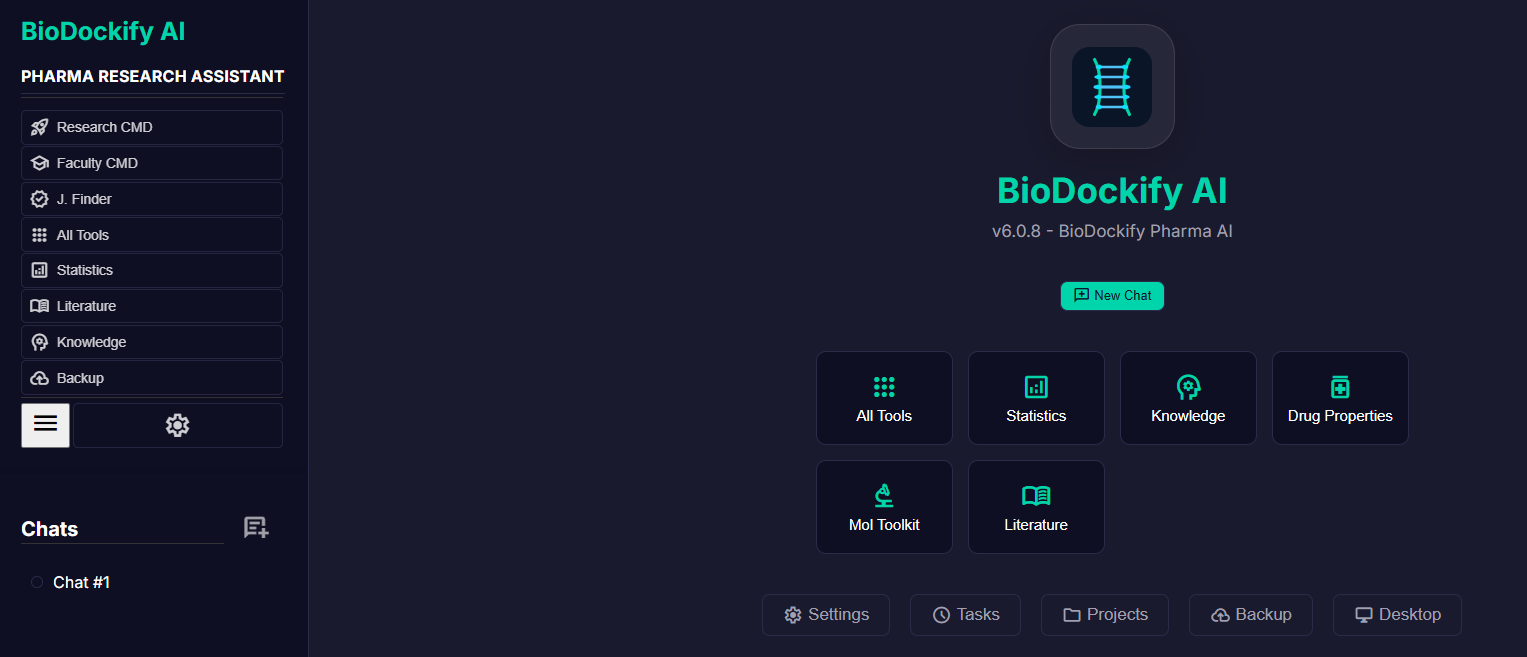
BioDockify Pharma AI is a pharmaceutical research platform built on the Agent Zero v2.0 core, with 22+ integrated modules covering all 8 pharmacy departments. It features AutoDock Vina molecular docking with MM-GBSA free energy scoring, 56 biostatistics analysis types (SPSS/jamovi-level), 12 advanced Academic Writer skills (EQUATOR reporting guidelines, PRISMA systematic review pipeline, per-section quality scoring, De-AIGC rewrite, claim verification), 7-level drug interaction database (50+ clinically significant pairs), Perplexity-style citation system with hybrid search (BM25 + FAISS + RRF), Obsidian bidirectional sync, a Knowledge Base with retrieval-grounded RAG chat, an Academic Writer with pharma-specific claim verification and ICH compliance checks, a 36,145-journal recommender, 4 AI sub-agents, and bulletproof backup to PC.
BioDockify Pharma AI is a pharmaceutical research fork of Agent Zero, an open-source agentic framework created and maintained by Jan Tomasek and the Agent Zero team.
BioDockify Pharma AI is NOT standalone software. It is built on Agent Zero, which is free and open-source. All core framework functionality, architecture, and capabilities belong to Agent Zero.
We thank Jan Tomasek and the Agent Zero team for their dedication to open AI software.
Runs fully offline. No cloud. No API spend. No PHI/compound data egress.
BioDockify supports any OpenAI-compatible local LLM through its AI Engine module. Bonsai-8B is one model option (installed separately), but you can use any model via Ollama, LM Studio, or any OpenAI-compatible server.
| Feature | Details |
|---|---|
| Supported models | Any OpenAI-compatible model via Ollama, LM Studio, vLLM, mlx_lm.server, or llama.cpp |
| Setup | Install Ollama/LM Studio on host → set in Settings → Models. Works fully offline. |
| Pharma Prompt Library | 8 domain templates: Literature Review, MOA, Docking, ADMET, Claims, Thesis, ICH Compliance |
| In-app panel | Right-canvas rail → "BioDockify AI Engine" (brain icon) → 4 tabs: Status, Models, Runtimes, Benchmark |
| Benchmark | Built-in tok/s test with Good/OK/Slow verdict |
| Model catalog | Data-driven (modules/local_llm/models.json) — adding models is a JSON edit, zero code changes |
| Runtime registry | Data-driven (modules/local_llm/runtimes.json) — host Ollama, host LM Studio, future vLLM, future MLX |
| Privacy | No telemetry, no egress, HIPAA/GDPR friendly, fully reproducible thesis work |
| Smoke tests | 27/27 pass (tests/test_local_llm.py) |
| # | Module | Function | Backend |
|---|---|---|---|
| 1 | Research Command Center | Auto-research pipeline + Literature Search + Wet Lab tracking | 23 REST endpoints |
| 2 | Molecular Toolkit | ADMET + Docking (Vina + MM-GBSA) + Inline 3D Analysis (interactions, clusters, residue energy) | RDKit + Vina + Meeko |
| 3 | Statistics | 56 analysis types + auto-analyze + PDF report with BioDockify letterhead | scipy + pandas + matplotlib |
| 4 | Academic Writer | 8-tab: Lit Review, Paper, Thesis (PhD/M.Pharm/B.Pharm/Pharm.D), Grant, Regulatory, Citation, Lecture, Slides + "Use KB Sources" button (loads by category, 100K char budget, real citations from KB) + Pharma Scorecard (8 dimensions) + Claim Verification (6 pharma claim types) | Thesis + Slides + Grant APIs + KB integration |
| 5 | Faculty CMD | 9 tabs: Syllabus, Lectures, Tasks, Semester, Lesson, Notes, Slides, Plagiarism, Questions | faculty_tools |
| 6 | Journal Finder | 36,145 journals + verify + deep research + fake detector + dossier | journals.db + 6 live APIs |
| 7 | QSAR Modeler | 6 regression + 3 classification, batch predict, read-across, feature selection | RDKit + scikit-learn |
| 8 | Pharmacophore | 5 tabs: Protein-based, Screen, Batch, Models, Target ID | RDKit |
| 9 | Drug Analysis | 3Dmol.js viewer + Properties (hERG/AMES/pKa/BBB) + Filters + Optimization + PubChem | RDKit + PubChem |
| 10 | Docking Analysis | 3D receptor+ligand viewer, interactions, PLIF, clusters, external file upload | 3Dmol.js + RDKit |
| 11 | Knowledge Base | Open Notebook LM-style: Notebooks, Sources, Notes, Chat, AI transformations, podcast, source filters (by module + time), category sidebar, DOCX export, full text extraction (PDF/DOCX/XLSX) | auto_store |
| 13 | System Health | Platform-aware health badges (Vina/MM-GBSA/RDKit/Meeko), Docker vs Windows | health.py |
| 14 | Deep Research | 5-database collection (PubMed, S2, Crossref, OpenAlex, arXiv), relevance scanning | 5 live APIs |
| 15 | Backup & Recovery | Full system backup/restore + Save to PC + Restore from PC + daily auto-backup | backup APIs |
| 16 | Formulation Lab | Release kinetics (5 models), dissolution f2, nanoparticle, ICH stability, excipients, DOE/RSM | scipy + numpy |
| 17 | Clinical Pharmacy | DDI (15 pairs), TDM, renal dose (CKD-EPI), hepatic (Child-Pugh), Naranjo ADR | drug DB |
| 18 | Pharma Analysis | ICH Q2(R2) validation, f2, forced degradation, chromatography, LOD/LOQ | ICH methods |
| 19 | Natural Products | Phytochemical screening (7 classes), extraction yield, IC50 4PL, plant DB, dereplication | RDKit |
| 20 | Regulatory Affairs | eCTD/CTD structure, 40+ ICH guidelines, stability planner, BE report, IND/NDA checklists | ICH database |
| 21 | Pharmacology | Receptor binding (Kd/Bmax), dose-response 4PL (EC50/IC50), Schild pA2, operational model (τ/KA), selectivity, receptor DB, in-vivo design, NCA PK/PD analysis | scipy + RDKit |
| 22 | Medicinal Chemistry | Murcko scaffolds, MMPA, Butina clustering, SMARTS search, SA score, retrosynthesis, named reactions, protecting groups, toxicophore scan, stereo analysis | RDKit |
| — | All Tools | Quick-launch grid for all modules | N/A |
| Category | Analysis Types |
|---|---|
| Core (v7.0.6) | descriptive, correlation, ttest, anova, chisquare, mannwhitney, wilcoxon, kruskalwallis, friedman, fisher, normality, homogeneity, roc, power, survival, pdf_report |
| Post-hoc (v7.5.3) | tukey_hsd, bonferroni_posthoc, dunnett_posthoc, scheffe_posthoc, dunns |
| Parametric (v7.5.3) | z_test, ancova, manova, repeated_measures_anova, mixed_effects, mixed_model, glm |
| Non-parametric (v7.5.3) | sign_test, mcnemar, cmh |
| Chi-square (v7.5.3) | chi_square_goodness, chi_square_independence |
| Regression (v7.5.3) | logistic_regression, poisson_regression, negative_binomial, multiple_regression, polynomial_regression |
| Survival (v7.5.3) | kaplan_meier, log_rank, cox_ph |
| Equivalence (v7.5.3) | tost, crossover, bioavailability, non_inferiority, equivalence |
| PK/PD (v7.5.3) | nca_pk, auc, cmax_tmax, half_life, clearance, pk_bioavailability, pd_response, compartmental, dose_proportionality, pk_summary |
| Meta-analysis (v7.5.3) | meta_analysis |
| Feature | Description |
|---|---|
| KB Sources Integration | "Use KB Sources" button loads articles by category (literature, docking, pharmacology, etc.) with 100K char budget |
| Pharma Scorecard | 8-dimension quality score: Study Design Rigor (20%), Statistical Analysis (15%), Safety Reporting (15%), Efficacy Evidence (15%), PK/PD Integration (10%), Regulatory Compliance (10%), Citation Quality (10%), Writing Clarity (5%) |
| Claim Verification | 6 pharma claim types: efficacy, safety, PK/PD, mechanism, comparative, dosing. Verdict: SUPPORTED/CONTRADICTED/INSUFFICIENT/HALLUCINATED |
| ICH Compliance | CONSORT (RCTs), STROBE (observational), PRISMA (systematic reviews), ARRIVE (animal studies), ICH E3 (clinical study reports), ICH M4 (CTD structure) |
| Original Module | Now Accessible Via |
|---|---|
| Drug Properties | Drug Analysis → Properties tab |
| Drug Analysis (PAINS/Brenk/NIH) | Drug Analysis → Filters tab |
| Molecular Optimizer | Drug Analysis → Optimize tab |
| Literature Search (10 DB) | Research CMD → Literature tab |
| Wet Lab Manager | Research CMD → Wet Lab tab |
| Grant Writer | Academic Writer → Grant tab |
| Regulatory (FDA/EMA) | Academic Writer → Regulatory tab |
| Citation Manager | Academic Writer → Citations tab |
| Slides Generator | Faculty CMD → Slides tab |
| Lecture Builder | Faculty CMD → Lectures tab |
| Docking Deep Analysis | Molecular Toolkit → Analysis tab |
| PK/PD Dashboard | Pharmacology → NCA tab |
After AutoDock Vina completes, MM-GBSA free energy scoring runs automatically (CPU-only, no GPU required):
| Term | Description |
|---|---|
| MM | Molecular mechanics energy from Vina (VdW + electrostatics) |
| GB | Generalized Born desolvation penalty |
| SA | Solvent-accessible surface area hydrophobic penalty |
| Interaction | Protein-ligand close contact bonus |
Output: Per-pose MM-GBSA energies, Z-scores, and consensus with Vina (0.4*Vina_Z + 0.6*MMGBSA_Z). Displayed as a table in the Docking results.
| Agent | Role | Tools |
|---|---|---|
| Researcher | Deep research, literature synthesis, drug discovery | 10 literature APIs, PRISMA screening, BioNER, web scraping, patent/trial APIs |
| Biostatistician | SPSS-level analysis, clinical trials, PK/PD modeling | 56 analysis types, 8 chart types, data transform/reduction, PCA, survival, meta-analysis |
| Writer | Academic writing, thesis, papers, slides, lectures, journal selection | All writing APIs, 36,145-journal database, pharma scorecard, claim verification |
| Hacker | Code execution, web scraping, automation, debugging | Python/JS execution, browser tools, system repair |
docker compose up -d and open http://localhostThat's it. BioDockify starts with all features ready. Connect a local LLM via Ollama/LM Studio for offline AI, or use any cloud provider.
docker compose up -d
# Visit http://localhost
# Local AI downloads automatically on first start
# Subsequent starts are instant
| Option | Setup | Privacy | Cost |
|---|---|---|---|
| Host Ollama | Install Ollama on host, set in Settings | Full (no egress) | Free |
| Cloud providers (OpenRouter, OpenAI, Anthropic, etc.) | Add API key in Settings → API Keys | Low (data sent to cloud) | Per-token |
| Host Ollama | Install Ollama on host, configure in Settings | Full (no egress) | Free |
| Host LM Studio | Install LM Studio on host, configure in Settings | Full (no egress) | Free |
You can mix: local Ollama for main (offline) + cloud for utility (optional). Fully user-driven.
services:
  biodockify:
    image: tajo9128/biodockify-pharma-ai:latest
    container_name: biodockify
    ports:
      - "80:80"
    volumes:
      # 1) ALL DATA — change host path to YOUR folder
      - F:/biodockify_pharma_usr:/a0/usr
      # 2) BACKUPS — change host path to YOUR backup folder
      - F:/biodockify-backups:/app/data
      # 3) DOCKER SOCKET (for volume listing)
      - /var/run/docker.sock:/var/run/docker.sock
    environment:
      - TZ=Asia/Kolkata
      # Optional cloud API keys (not required — local AI works without them)
      # - OPENAI_API_KEY=sk-your-key-here
      # - ANTHROPIC_API_KEY=sk-ant-your-key-here
      # - OPENROUTER_API_KEY=sk-or-your-key-here
    extra_hosts:
      - "host.docker.internal:host-gateway"
    restart: unless-stopped
Option A — In-app (recommended): Open Backup & Recovery panel → click "Save to PC" → .zip downloads to your Downloads folder.
Option B — Script (Windows): Double-click backup-data.bat to save all research data (workspace + agent memory + knowledge base) to your Desktop.
Option C — Automatic: Backups run daily at 3 AM + on every container restart. They appear in ~/biodockify-backups/ on your PC.
All research data lives in folders YOU create on your PC. Delete the container? Your data stays. Recreate it? Point to the same folders.
Step 1 — Create 2 folders on your PC:
F:\biodockify_pharma_usr     ← ALL your research data lives here
F:\biodockify-backups        ← backups go here
Step 2 — Edit docker-compose.yml, set your paths:
⚠️ Windows users: use forward slashes (
F:/folder) NOT backslashes. Copy path from Explorer → replace all\with/. Example:F:\biodockify_pharma_usr→F:/biodockify_pharma_usr
volumes:
  # YOUR data folder → container path (do not change /a0/usr)
  - F:/biodockify_pharma_usr:/a0/usr

  # YOUR backup folder → container path (do not change /app/data)
  - F:/biodockify-backups:/app/data
Step 3 — Start:
docker compose up -d
Backup & Restore:
F:/biodockify-backups folderUpgrading:
docker compose down
docker compose pull
docker compose up -d        # same folders → data comes back
User Request
     ↓
Agent0 (Main Orchestrator)
     ↓
├─→ Researcher ─→ Hacker (if blocked)
│         ↓
│    Biostatistician (SPSS-level stats) + QSAR (predictions)
│         ↓
│    Pharmacophore (feature detection)
│         ↓
├─→ Molecular Toolkit (Docking: Vina → MM-GBSA)
│         ↓
│    Deep Analysis (3D View, Interactions, Clusters)
│         ↓
├─→ Pipeline Engine (25-stage autonomous workflow)
│    Debate → Experiment → Self-Heal → Verify → Quality Gate → HITL
│         ↓
└─→ Writer (output) + Journal Recommender (36,145 journals) + Mol Optimizer
| Feature | Details |
|---|---|
| 7 Drug-likeness Filters | Lipinski Ro5, Veber, Egan, Ghose, Muegge, Golden Triangle, QED |
| BOILED-Egg Model | Proper ellipse math (Daina 2016) + graphical plot with compound plotted |
| PAINS/Brenk Alerts | RDKit FilterCatalog (480+ curated filters), not hand-written SMARTS |
| CYP450 Inhibition | 5 isoforms (1A2, 2C9, 2C19, 2D6, 3A4) with SMARTS patterns |
| Toxicity Panel | hERG, Ames mutagenicity, P-gp substrate, bioaccumulation |
| Batch Mode | Process thousands of compounds at once, distribution plots, CSV export |
| 6-Tab UI | Overview, Drug Filters, Pharmacokinetics, Toxicity, BOILED-Egg, Raw Data |
| Feature | Details |
|---|---|
| Frontier Orbitals | HOMO, LUMO, gap energies (eV) |
| Chemical Reactivity | Hardness, softness, electronegativity, electrophilicity index |
| Drug-like Gap | Identifies typical drug range (5-9 eV) |
| Energy Diagram | Publication-quality matplotlib plot |
| Batch Mode | Multiple molecules with gap distribution |
| Category | Count | Examples |
|---|---|---|
| Basic | 24 | MolWt, LogP, TPSA, HBD, HBA, RotBonds |
| Topological | 17 | Chi0-4, Kappa1-3, BalabanJ, BertzCT |
| Electronic | 8 | EState indices, partial charges |
| Surface (VSA) | 36 | SlogP_VSA1-12, SMR_VSA1-10, PEOE_VSA1-14 |
| BCUT | 8 | BCUT2D_MW/CHG/LOGP/MR |
| Autocorrelation | 8 | Autocorr2D vectors |
| Fragment | 80+ | fr_ether, fr_halogen, fr_benzene, fr_sulfone |
| Drug-likeness | 7 | Fragment/Lead/Drug/Non-drug categories |
8 interactive Plotly dashboards: Property Distributions, Correlation Heatmap, Chemical Space PCA, Drug-likeness Analysis, 3D Chemical Space, Parallel Coordinates, Scatter Matrix, Summary Table.
Models: PLS, Ridge, Lasso, ElasticNet, KNN, DecisionTree, RandomForest, GradientBoosting, ExtraTrees, AdaBoost, Bagging, SVR, KernelRidge, MLP, XGBoost, LightGBM, CatBoost, Voting, Stacking.
2D plot, 3D HTML, distance CSV, distance heatmap, distribution plot, feature CSV, fingerprint summary, properties CSV.
database: "all" searches all 10 in parallel: europe_pmc, pubmed, semantic_scholar, biorxiv, arxiv, google_scholar, scopus, wos, elsevier, springer.
linux/amd64 only, provenance disabled (fixes pull failures)biodockify_pharma_usr + backup bind mountdocker compose up does everythingThe biggest architectural change: llama-server is now bundled inside the BioDockify Docker image itself. No separate sidecar container, no extra image pull, no profiles, no scripts for students to run.
| Before (v7.5.2) | After (v7.5.8) |
|---|---|
| No local AI option | Bonsai-8B bundled (1-bit, ~1.15 GB, ready immediately) |
| Only cloud API keys | Works fully offline — no cloud, no egress, no API spend |
| 0 statistics types (original had 16) | 56 analysis types (restored from original BioDockify) |
| No pharma prompt templates | 8 pharma-specific prompt templates (literature, MOA, docking, ADMET, claims, thesis, ICH) |
| No claim verification | 6-type pharma claim verification (efficacy, safety, PK/PD, mechanism, comparative, dosing) |
| No pharma scorecard | 8-dimension quality scorecard (study design, stats, safety, efficacy, PK/PD, regulatory, citations, writing) |
| No ICH compliance checks | CONSORT/STROBE/PRISMA/ARRIVE/ICH compliance checking |
| No in-app model manager | 4-tab AI Engine panel (Status, Models, Runtimes, Benchmark) |
| No benchmark | Built-in tok/s benchmark with Good/OK/Slow verdict |
| 3 stability sprints | 5 stability sprints completed (security, backend, frontend, Docker, docs) |
| No smoke tests for AI | 27 smoke tests guarding AI Engine against regressions |
ghcr.io/ggml-org/llama.cpp:server, copies to /opt/llama-server/, registers with ldconfig/opt/llama-server/models/ (no download needed)| Version | Date | Key Changes |
|---|---|---|
| v7.5.8 | 2026-07-19 | Fix: copy ALL llama.cpp shared libraries (not just binary) |
| v7.5.7 | 2026-07-19 | Bundle llama-server inside BioDockify image (one docker compose up) |
| v7.5.6 | 2026-07-19 | Fix GGUF filename case (Bonsai-8B-Q1_0.gguf) + image namespace (ggml-org) |
| v7.5.5 | 2026-07-19 | Critical fix: wrong llama.cpp image tag + env vars; Runtime Manager + Model Manager UI + benchmark |
| v7.5.4 | 2026-07-19 | BioDockify AI Engine (local LLM), model catalog, pharma prompts, install scripts |
| v7.5.3 | 2026-07-18 | Statistics module full restoration (16 → 56 analysis types), PDF reports |
| v7.5.2 | 2026-07-18 | 5 stability sprints: security, backend, frontend, Docker, documentation |
auto_store/a0/usr, /a0/.a0proj, /a0/data~/biodockify-backups:/a0/usr/backupsThis release upgrades the Academic Writer, expands all 8 pharmacy departments, and refactors the module architecture for testability.
[kb:1], [web:2], [page:3], [pubmed:5]modules/ directories: clinical (7 files), formulation (4),
pharma_analysis (3), natural_products (4)modules/pharma_utils/ — shared calculations (f2, Cheng-Prusoff, SST,
content uniformity, Beers, DOE, Chou-Talalay, SAR)modules/obsidian/ — bidirectional sync enginemodules/rag/ — citations, hybrid search, table chunkermodules/writing/ — 12 advanced writing skills| Version | Key Changes |
|---|---|
| v7.9.2 | Phase 3 architecture refactor — proper module directories |
| v7.9.1 | Expanded clinical DB + new clinical tools + plant DB |
| v7.9.0 | Pharma Utilities Module — 9 shared calculations |
| v7.8.0 | 7 advanced writing skills (PaperForge + Rigorous inspired) |
| v7.7.1 | 5 advanced research skills (EQUATOR, AI disclosure, PRISMA, peer review, integrity gate) |
| v7.6.5 | Rollback Bonsai bundling to ~13 GB working image |
| v7.6.0 | Graphify knowledge graph for AI agent codebase understanding |
| v7.5.9 | Obsidian bidirectional sync |
| v7.5.8 | BioDockify AI Engine bundled (one docker compose up) |
| v7.5.5 | Critical llama.cpp fix + Runtime Manager + Model Manager UI + benchmark |
| v7.5.4 | AI Engine (local LLM), model catalog, pharma prompts, install scripts |
| v7.5.3 | Statistics module full restoration (16→56 analysis types) |
| v7.5.2 | 5 stability sprints: security, backend, frontend, Docker, docs |
Image: tajo9128/biodockify-pharma-ai:latest
https://hub.docker.com/r/tajo9128/biodockify-pharma-ai
BioDockify Pharma AI is open-source under the MIT License, inherited from the Agent Zero framework by Jan Tomasek. See the original repository for framework license details.
BioDockify Pharma AI is the AI Pharmaceutical Research Assistant for Researcher, integrating intelligent agents, molecular modeling, literature intelligence, and computational drug discovery. Designed to transform scientific ideas into reproducible research, faster discoveries, and real-world pharmaceutical innovation.
See the code
BioDockify Pharma AI is a pharmaceutical research platform built on the Agent Zero v2.0 core, with 22+ integrated modules covering all 8 pharmacy departments. It features AutoDock Vina molecular docking with MM-GBSA free energy scoring, 56 biostatistics analysis types (SPSS/jamovi-level), 12 advanced Academic Writer skills (EQUATOR reporting guidelines, PRISMA systematic review pipeline, per-section quality scoring, De-AIGC rewrite, claim verification), 7-level drug interaction database (50+ clinically significant pairs), Perplexity-style citation system with hybrid search (BM25 + FAISS + RRF), Obsidian bidirectional sync, a Knowledge Base with retrieval-grounded RAG chat, an Academic Writer with pharma-specific claim verification and ICH compliance checks, a 36,145-journal recommender, 4 AI sub-agents, and bulletproof backup to PC.
BioDockify Pharma AI is a pharmaceutical research fork of Agent Zero, an open-source agentic framework created and maintained by Jan Tomasek and the Agent Zero team.
BioDockify Pharma AI is NOT standalone software. It is built on Agent Zero, which is free and open-source. All core framework functionality, architecture, and capabilities belong to Agent Zero.
We thank Jan Tomasek and the Agent Zero team for their dedication to open AI software.
Runs fully offline. No cloud. No API spend. No PHI/compound data egress.
BioDockify supports any OpenAI-compatible local LLM through its AI Engine module. Bonsai-8B is one model option (installed separately), but you can use any model via Ollama, LM Studio, or any OpenAI-compatible server.
| Feature | Details |
|---|---|
| Supported models | Any OpenAI-compatible model via Ollama, LM Studio, vLLM, mlx_lm.server, or llama.cpp |
| Setup | Install Ollama/LM Studio on host → set in Settings → Models. Works fully offline. |
| Pharma Prompt Library | 8 domain templates: Literature Review, MOA, Docking, ADMET, Claims, Thesis, ICH Compliance |
| In-app panel | Right-canvas rail → "BioDockify AI Engine" (brain icon) → 4 tabs: Status, Models, Runtimes, Benchmark |
| Benchmark | Built-in tok/s test with Good/OK/Slow verdict |
| Model catalog | Data-driven (modules/local_llm/models.json) — adding models is a JSON edit, zero code changes |
| Runtime registry | Data-driven (modules/local_llm/runtimes.json) — host Ollama, host LM Studio, future vLLM, future MLX |
| Privacy | No telemetry, no egress, HIPAA/GDPR friendly, fully reproducible thesis work |
| Smoke tests | 27/27 pass (tests/test_local_llm.py) |
| # | Module | Function | Backend |
|---|---|---|---|
| 1 | Research Command Center | Auto-research pipeline + Literature Search + Wet Lab tracking | 23 REST endpoints |
| 2 | Molecular Toolkit | ADMET + Docking (Vina + MM-GBSA) + Inline 3D Analysis (interactions, clusters, residue energy) | RDKit + Vina + Meeko |
| 3 | Statistics | 56 analysis types + auto-analyze + PDF report with BioDockify letterhead | scipy + pandas + matplotlib |
| 4 | Academic Writer | 8-tab: Lit Review, Paper, Thesis (PhD/M.Pharm/B.Pharm/Pharm.D), Grant, Regulatory, Citation, Lecture, Slides + "Use KB Sources" button (loads by category, 100K char budget, real citations from KB) + Pharma Scorecard (8 dimensions) + Claim Verification (6 pharma claim types) | Thesis + Slides + Grant APIs + KB integration |
| 5 | Faculty CMD | 9 tabs: Syllabus, Lectures, Tasks, Semester, Lesson, Notes, Slides, Plagiarism, Questions | faculty_tools |
| 6 | Journal Finder | 36,145 journals + verify + deep research + fake detector + dossier | journals.db + 6 live APIs |
| 7 | QSAR Modeler | 6 regression + 3 classification, batch predict, read-across, feature selection | RDKit + scikit-learn |
| 8 | Pharmacophore | 5 tabs: Protein-based, Screen, Batch, Models, Target ID | RDKit |
| 9 | Drug Analysis | 3Dmol.js viewer + Properties (hERG/AMES/pKa/BBB) + Filters + Optimization + PubChem | RDKit + PubChem |
| 10 | Docking Analysis | 3D receptor+ligand viewer, interactions, PLIF, clusters, external file upload | 3Dmol.js + RDKit |
| 11 | Knowledge Base | Open Notebook LM-style: Notebooks, Sources, Notes, Chat, AI transformations, podcast, source filters (by module + time), category sidebar, DOCX export, full text extraction (PDF/DOCX/XLSX) | auto_store |
| 13 | System Health | Platform-aware health badges (Vina/MM-GBSA/RDKit/Meeko), Docker vs Windows | health.py |
| 14 | Deep Research | 5-database collection (PubMed, S2, Crossref, OpenAlex, arXiv), relevance scanning | 5 live APIs |
| 15 | Backup & Recovery | Full system backup/restore + Save to PC + Restore from PC + daily auto-backup | backup APIs |
| 16 | Formulation Lab | Release kinetics (5 models), dissolution f2, nanoparticle, ICH stability, excipients, DOE/RSM | scipy + numpy |
| 17 | Clinical Pharmacy | DDI (15 pairs), TDM, renal dose (CKD-EPI), hepatic (Child-Pugh), Naranjo ADR | drug DB |
| 18 | Pharma Analysis | ICH Q2(R2) validation, f2, forced degradation, chromatography, LOD/LOQ | ICH methods |
| 19 | Natural Products | Phytochemical screening (7 classes), extraction yield, IC50 4PL, plant DB, dereplication | RDKit |
| 20 | Regulatory Affairs | eCTD/CTD structure, 40+ ICH guidelines, stability planner, BE report, IND/NDA checklists | ICH database |
| 21 | Pharmacology | Receptor binding (Kd/Bmax), dose-response 4PL (EC50/IC50), Schild pA2, operational model (τ/KA), selectivity, receptor DB, in-vivo design, NCA PK/PD analysis | scipy + RDKit |
| 22 | Medicinal Chemistry | Murcko scaffolds, MMPA, Butina clustering, SMARTS search, SA score, retrosynthesis, named reactions, protecting groups, toxicophore scan, stereo analysis | RDKit |
| — | All Tools | Quick-launch grid for all modules | N/A |
| Category | Analysis Types |
|---|---|
| Core (v7.0.6) | descriptive, correlation, ttest, anova, chisquare, mannwhitney, wilcoxon, kruskalwallis, friedman, fisher, normality, homogeneity, roc, power, survival, pdf_report |
| Post-hoc (v7.5.3) | tukey_hsd, bonferroni_posthoc, dunnett_posthoc, scheffe_posthoc, dunns |
| Parametric (v7.5.3) | z_test, ancova, manova, repeated_measures_anova, mixed_effects, mixed_model, glm |
| Non-parametric (v7.5.3) | sign_test, mcnemar, cmh |
| Chi-square (v7.5.3) | chi_square_goodness, chi_square_independence |
| Regression (v7.5.3) | logistic_regression, poisson_regression, negative_binomial, multiple_regression, polynomial_regression |
| Survival (v7.5.3) | kaplan_meier, log_rank, cox_ph |
| Equivalence (v7.5.3) | tost, crossover, bioavailability, non_inferiority, equivalence |
| PK/PD (v7.5.3) | nca_pk, auc, cmax_tmax, half_life, clearance, pk_bioavailability, pd_response, compartmental, dose_proportionality, pk_summary |
| Meta-analysis (v7.5.3) | meta_analysis |
| Feature | Description |
|---|---|
| KB Sources Integration | "Use KB Sources" button loads articles by category (literature, docking, pharmacology, etc.) with 100K char budget |
| Pharma Scorecard | 8-dimension quality score: Study Design Rigor (20%), Statistical Analysis (15%), Safety Reporting (15%), Efficacy Evidence (15%), PK/PD Integration (10%), Regulatory Compliance (10%), Citation Quality (10%), Writing Clarity (5%) |
| Claim Verification | 6 pharma claim types: efficacy, safety, PK/PD, mechanism, comparative, dosing. Verdict: SUPPORTED/CONTRADICTED/INSUFFICIENT/HALLUCINATED |
| ICH Compliance | CONSORT (RCTs), STROBE (observational), PRISMA (systematic reviews), ARRIVE (animal studies), ICH E3 (clinical study reports), ICH M4 (CTD structure) |
| Original Module | Now Accessible Via |
|---|---|
| Drug Properties | Drug Analysis → Properties tab |
| Drug Analysis (PAINS/Brenk/NIH) | Drug Analysis → Filters tab |
| Molecular Optimizer | Drug Analysis → Optimize tab |
| Literature Search (10 DB) | Research CMD → Literature tab |
| Wet Lab Manager | Research CMD → Wet Lab tab |
| Grant Writer | Academic Writer → Grant tab |
| Regulatory (FDA/EMA) | Academic Writer → Regulatory tab |
| Citation Manager | Academic Writer → Citations tab |
| Slides Generator | Faculty CMD → Slides tab |
| Lecture Builder | Faculty CMD → Lectures tab |
| Docking Deep Analysis | Molecular Toolkit → Analysis tab |
| PK/PD Dashboard | Pharmacology → NCA tab |
After AutoDock Vina completes, MM-GBSA free energy scoring runs automatically (CPU-only, no GPU required):
| Term | Description |
|---|---|
| MM | Molecular mechanics energy from Vina (VdW + electrostatics) |
| GB | Generalized Born desolvation penalty |
| SA | Solvent-accessible surface area hydrophobic penalty |
| Interaction | Protein-ligand close contact bonus |
Output: Per-pose MM-GBSA energies, Z-scores, and consensus with Vina (0.4*Vina_Z + 0.6*MMGBSA_Z). Displayed as a table in the Docking results.
| Agent | Role | Tools |
|---|---|---|
| Researcher | Deep research, literature synthesis, drug discovery | 10 literature APIs, PRISMA screening, BioNER, web scraping, patent/trial APIs |
| Biostatistician | SPSS-level analysis, clinical trials, PK/PD modeling | 56 analysis types, 8 chart types, data transform/reduction, PCA, survival, meta-analysis |
| Writer | Academic writing, thesis, papers, slides, lectures, journal selection | All writing APIs, 36,145-journal database, pharma scorecard, claim verification |
| Hacker | Code execution, web scraping, automation, debugging | Python/JS execution, browser tools, system repair |
docker compose up -d and open http://localhostThat's it. BioDockify starts with all features ready. Connect a local LLM via Ollama/LM Studio for offline AI, or use any cloud provider.
docker compose up -d
# Visit http://localhost
# Local AI downloads automatically on first start
# Subsequent starts are instant
| Option | Setup | Privacy | Cost |
|---|---|---|---|
| Host Ollama | Install Ollama on host, set in Settings | Full (no egress) | Free |
| Cloud providers (OpenRouter, OpenAI, Anthropic, etc.) | Add API key in Settings → API Keys | Low (data sent to cloud) | Per-token |
| Host Ollama | Install Ollama on host, configure in Settings | Full (no egress) | Free |
| Host LM Studio | Install LM Studio on host, configure in Settings | Full (no egress) | Free |
You can mix: local Ollama for main (offline) + cloud for utility (optional). Fully user-driven.
services:
  biodockify:
    image: tajo9128/biodockify-pharma-ai:latest
    container_name: biodockify
    ports:
      - "80:80"
    volumes:
      # 1) ALL DATA — change host path to YOUR folder
      - F:/biodockify_pharma_usr:/a0/usr
      # 2) BACKUPS — change host path to YOUR backup folder
      - F:/biodockify-backups:/app/data
      # 3) DOCKER SOCKET (for volume listing)
      - /var/run/docker.sock:/var/run/docker.sock
    environment:
      - TZ=Asia/Kolkata
      # Optional cloud API keys (not required — local AI works without them)
      # - OPENAI_API_KEY=sk-your-key-here
      # - ANTHROPIC_API_KEY=sk-ant-your-key-here
      # - OPENROUTER_API_KEY=sk-or-your-key-here
    extra_hosts:
      - "host.docker.internal:host-gateway"
    restart: unless-stopped
Option A — In-app (recommended): Open Backup & Recovery panel → click "Save to PC" → .zip downloads to your Downloads folder.
Option B — Script (Windows): Double-click backup-data.bat to save all research data (workspace + agent memory + knowledge base) to your Desktop.
Option C — Automatic: Backups run daily at 3 AM + on every container restart. They appear in ~/biodockify-backups/ on your PC.
All research data lives in folders YOU create on your PC. Delete the container? Your data stays. Recreate it? Point to the same folders.
Step 1 — Create 2 folders on your PC:
F:\biodockify_pharma_usr     ← ALL your research data lives here
F:\biodockify-backups        ← backups go here
Step 2 — Edit docker-compose.yml, set your paths:
⚠️ Windows users: use forward slashes (
F:/folder) NOT backslashes. Copy path from Explorer → replace all\with/. Example:F:\biodockify_pharma_usr→F:/biodockify_pharma_usr
volumes:
  # YOUR data folder → container path (do not change /a0/usr)
  - F:/biodockify_pharma_usr:/a0/usr

  # YOUR backup folder → container path (do not change /app/data)
  - F:/biodockify-backups:/app/data
Step 3 — Start:
docker compose up -d
Backup & Restore:
F:/biodockify-backups folderUpgrading:
docker compose down
docker compose pull
docker compose up -d        # same folders → data comes back
User Request
     ↓
Agent0 (Main Orchestrator)
     ↓
├─→ Researcher ─→ Hacker (if blocked)
│         ↓
│    Biostatistician (SPSS-level stats) + QSAR (predictions)
│         ↓
│    Pharmacophore (feature detection)
│         ↓
├─→ Molecular Toolkit (Docking: Vina → MM-GBSA)
│         ↓
│    Deep Analysis (3D View, Interactions, Clusters)
│         ↓
├─→ Pipeline Engine (25-stage autonomous workflow)
│    Debate → Experiment → Self-Heal → Verify → Quality Gate → HITL
│         ↓
└─→ Writer (output) + Journal Recommender (36,145 journals) + Mol Optimizer
| Feature | Details |
|---|---|
| 7 Drug-likeness Filters | Lipinski Ro5, Veber, Egan, Ghose, Muegge, Golden Triangle, QED |
| BOILED-Egg Model | Proper ellipse math (Daina 2016) + graphical plot with compound plotted |
| PAINS/Brenk Alerts | RDKit FilterCatalog (480+ curated filters), not hand-written SMARTS |
| CYP450 Inhibition | 5 isoforms (1A2, 2C9, 2C19, 2D6, 3A4) with SMARTS patterns |
| Toxicity Panel | hERG, Ames mutagenicity, P-gp substrate, bioaccumulation |
| Batch Mode | Process thousands of compounds at once, distribution plots, CSV export |
| 6-Tab UI | Overview, Drug Filters, Pharmacokinetics, Toxicity, BOILED-Egg, Raw Data |
| Feature | Details |
|---|---|
| Frontier Orbitals | HOMO, LUMO, gap energies (eV) |
| Chemical Reactivity | Hardness, softness, electronegativity, electrophilicity index |
| Drug-like Gap | Identifies typical drug range (5-9 eV) |
| Energy Diagram | Publication-quality matplotlib plot |
| Batch Mode | Multiple molecules with gap distribution |
| Category | Count | Examples |
|---|---|---|
| Basic | 24 | MolWt, LogP, TPSA, HBD, HBA, RotBonds |
| Topological | 17 | Chi0-4, Kappa1-3, BalabanJ, BertzCT |
| Electronic | 8 | EState indices, partial charges |
| Surface (VSA) | 36 | SlogP_VSA1-12, SMR_VSA1-10, PEOE_VSA1-14 |
| BCUT | 8 | BCUT2D_MW/CHG/LOGP/MR |
| Autocorrelation | 8 | Autocorr2D vectors |
| Fragment | 80+ | fr_ether, fr_halogen, fr_benzene, fr_sulfone |
| Drug-likeness | 7 | Fragment/Lead/Drug/Non-drug categories |
8 interactive Plotly dashboards: Property Distributions, Correlation Heatmap, Chemical Space PCA, Drug-likeness Analysis, 3D Chemical Space, Parallel Coordinates, Scatter Matrix, Summary Table.
Models: PLS, Ridge, Lasso, ElasticNet, KNN, DecisionTree, RandomForest, GradientBoosting, ExtraTrees, AdaBoost, Bagging, SVR, KernelRidge, MLP, XGBoost, LightGBM, CatBoost, Voting, Stacking.
2D plot, 3D HTML, distance CSV, distance heatmap, distribution plot, feature CSV, fingerprint summary, properties CSV.
database: "all" searches all 10 in parallel: europe_pmc, pubmed, semantic_scholar, biorxiv, arxiv, google_scholar, scopus, wos, elsevier, springer.
linux/amd64 only, provenance disabled (fixes pull failures)biodockify_pharma_usr + backup bind mountdocker compose up does everythingThe biggest architectural change: llama-server is now bundled inside the BioDockify Docker image itself. No separate sidecar container, no extra image pull, no profiles, no scripts for students to run.
| Before (v7.5.2) | After (v7.5.8) |
|---|---|
| No local AI option | Bonsai-8B bundled (1-bit, ~1.15 GB, ready immediately) |
| Only cloud API keys | Works fully offline — no cloud, no egress, no API spend |
| 0 statistics types (original had 16) | 56 analysis types (restored from original BioDockify) |
| No pharma prompt templates | 8 pharma-specific prompt templates (literature, MOA, docking, ADMET, claims, thesis, ICH) |
| No claim verification | 6-type pharma claim verification (efficacy, safety, PK/PD, mechanism, comparative, dosing) |
| No pharma scorecard | 8-dimension quality scorecard (study design, stats, safety, efficacy, PK/PD, regulatory, citations, writing) |
| No ICH compliance checks | CONSORT/STROBE/PRISMA/ARRIVE/ICH compliance checking |
| No in-app model manager | 4-tab AI Engine panel (Status, Models, Runtimes, Benchmark) |
| No benchmark | Built-in tok/s benchmark with Good/OK/Slow verdict |
| 3 stability sprints | 5 stability sprints completed (security, backend, frontend, Docker, docs) |
| No smoke tests for AI | 27 smoke tests guarding AI Engine against regressions |
ghcr.io/ggml-org/llama.cpp:server, copies to /opt/llama-server/, registers with ldconfig/opt/llama-server/models/ (no download needed)| Version | Date | Key Changes |
|---|---|---|
| v7.5.8 | 2026-07-19 | Fix: copy ALL llama.cpp shared libraries (not just binary) |
| v7.5.7 | 2026-07-19 | Bundle llama-server inside BioDockify image (one docker compose up) |
| v7.5.6 | 2026-07-19 | Fix GGUF filename case (Bonsai-8B-Q1_0.gguf) + image namespace (ggml-org) |
| v7.5.5 | 2026-07-19 | Critical fix: wrong llama.cpp image tag + env vars; Runtime Manager + Model Manager UI + benchmark |
| v7.5.4 | 2026-07-19 | BioDockify AI Engine (local LLM), model catalog, pharma prompts, install scripts |
| v7.5.3 | 2026-07-18 | Statistics module full restoration (16 → 56 analysis types), PDF reports |
| v7.5.2 | 2026-07-18 | 5 stability sprints: security, backend, frontend, Docker, documentation |
auto_store/a0/usr, /a0/.a0proj, /a0/data~/biodockify-backups:/a0/usr/backupsThis release upgrades the Academic Writer, expands all 8 pharmacy departments, and refactors the module architecture for testability.
[kb:1], [web:2], [page:3], [pubmed:5]modules/ directories: clinical (7 files), formulation (4),
pharma_analysis (3), natural_products (4)modules/pharma_utils/ — shared calculations (f2, Cheng-Prusoff, SST,
content uniformity, Beers, DOE, Chou-Talalay, SAR)modules/obsidian/ — bidirectional sync enginemodules/rag/ — citations, hybrid search, table chunkermodules/writing/ — 12 advanced writing skills| Version | Key Changes |
|---|---|
| v7.9.2 | Phase 3 architecture refactor — proper module directories |
| v7.9.1 | Expanded clinical DB + new clinical tools + plant DB |
| v7.9.0 | Pharma Utilities Module — 9 shared calculations |
| v7.8.0 | 7 advanced writing skills (PaperForge + Rigorous inspired) |
| v7.7.1 | 5 advanced research skills (EQUATOR, AI disclosure, PRISMA, peer review, integrity gate) |
| v7.6.5 | Rollback Bonsai bundling to ~13 GB working image |
| v7.6.0 | Graphify knowledge graph for AI agent codebase understanding |
| v7.5.9 | Obsidian bidirectional sync |
| v7.5.8 | BioDockify AI Engine bundled (one docker compose up) |
| v7.5.5 | Critical llama.cpp fix + Runtime Manager + Model Manager UI + benchmark |
| v7.5.4 | AI Engine (local LLM), model catalog, pharma prompts, install scripts |
| v7.5.3 | Statistics module full restoration (16→56 analysis types) |
| v7.5.2 | 5 stability sprints: security, backend, frontend, Docker, docs |
Image: tajo9128/biodockify-pharma-ai:latest
https://hub.docker.com/r/tajo9128/biodockify-pharma-ai
BioDockify Pharma AI is open-source under the MIT License, inherited from the Agent Zero framework by Jan Tomasek. See the original repository for framework license details.



