Games where the moves are chosen by a small System 1 decision model instead of a search algorithm or an LLM.
Python
0
16 commits
updated Oct 16, 2026
Five games where the moves are chosen by a small System 1 decision model instead of a search algorithm or an LLM: 2048, a Chrome-dino-style runner, Chess, Flappy Bird and Sudoku. Each turn the situation is described in text, the model picks one of the options, and you watch it happen in the browser — alone, many at once to compare players (all five), or head-to-head (Chess: two models play each other).
Seven models are supported (plus baseline players) and can be switched from the UI, in every game:
| Model | Package | Checkpoint | Size |
|---|---|---|---|
| Laya | laya | convaiinnovations/laya | ~420M |
| Jev-BERTa | jev-berta | leobitz/jev-berta-base-zeroshot-classifier | ~198M |
| Drex | hosted API, docs | drex-latest (via POST /v1/systemone) | remote |
| Kev-0.8B | github.com/jaredpalmer/kev (run yourself) | jaredpalmer/kev-0.8b | ~0.8B |
| GLiNER2.5-Decide | gliner2 | fastino/GLiNER2.5-Decide | ~340M |
| Bev-Decider-0.4B | bev-decider | avbiswas/bev-decider-0.4B | ~0.4B |
| DecisionMaster | local package ../decision-master | leobitz/decision-master-base (gated on the Hub) | Qwen3-based |
Laya, Jev, GLiNER, Bev and DecisionMaster are local, non-generative classifiers: they score a list of candidate
answers against a context and return probabilities. None of the seven was trained on any of these
games. Each is loaded once and shared between all five games (models.py), not duplicated
per game.
A visual walkthrough of the running app. Expand any example; click an image or its full-size link to inspect the details. These are real browser captures, with live decisions and results from local runs.
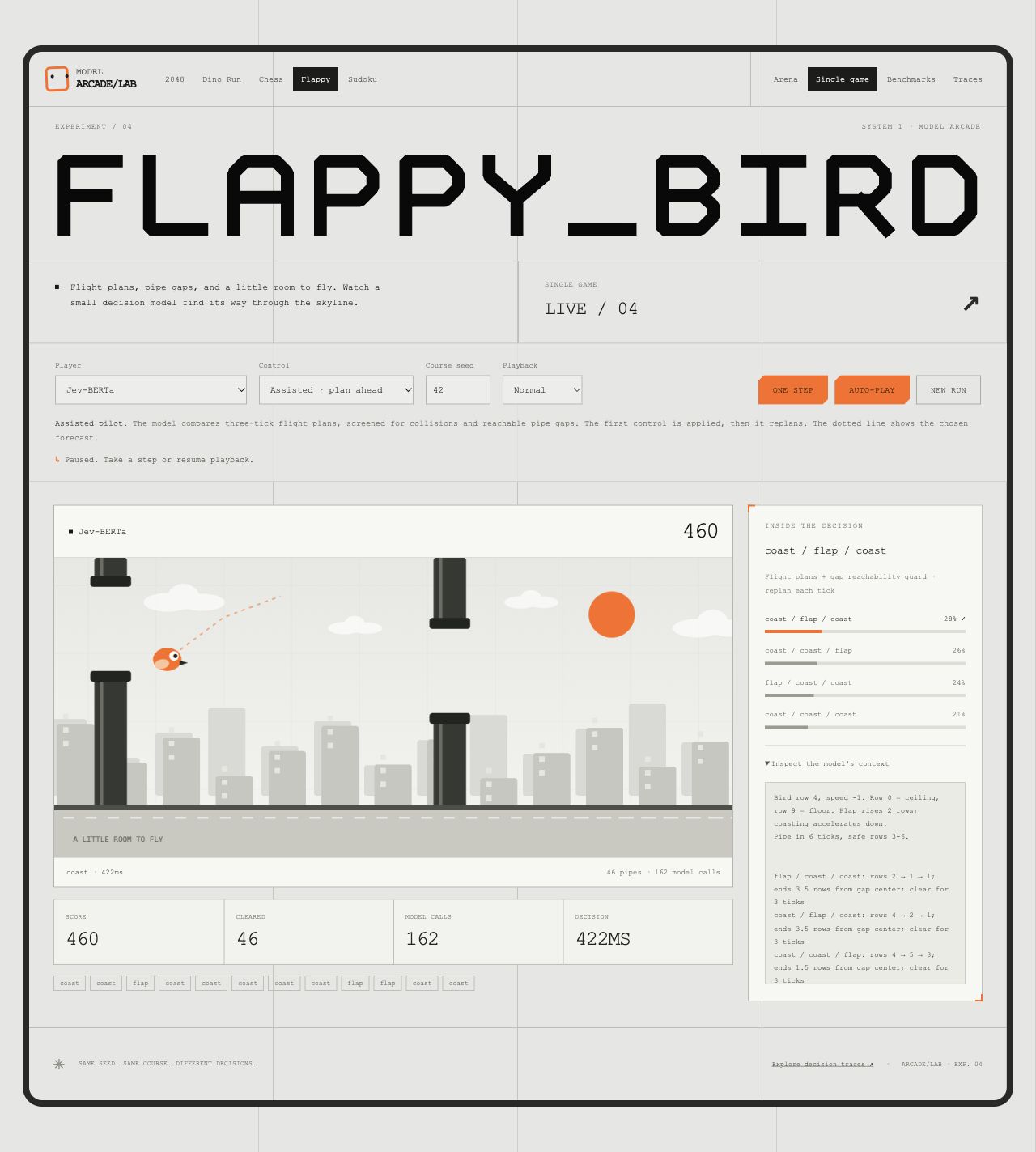
Jev-BERTa in assisted mode: the dotted line previews the chosen flight plan, probability bars compare the options, and the expanded context shows the text and trajectories sent to the model. Score, pipes cleared, model calls, and latency remain visible.
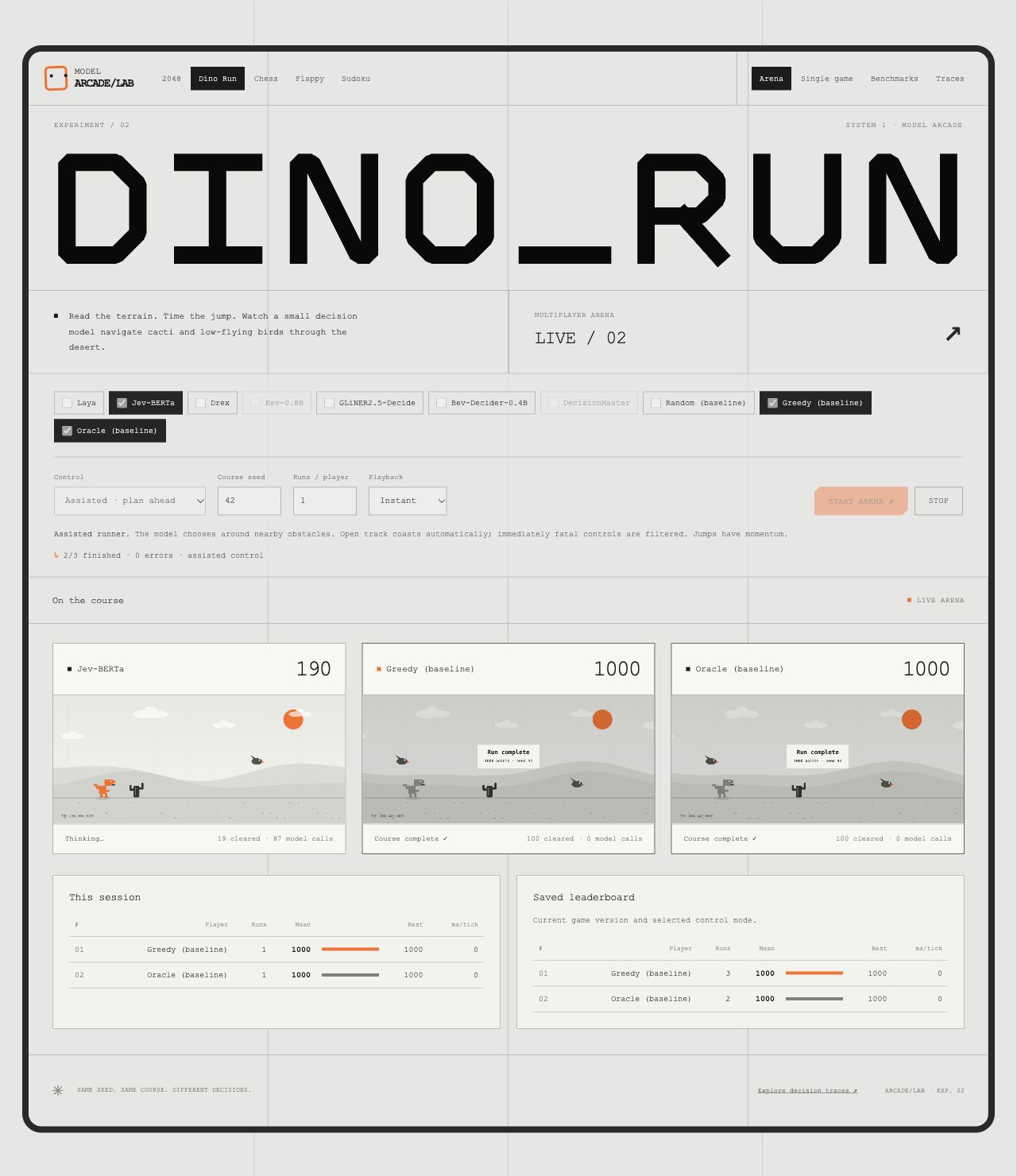
Jev-BERTa, Greedy, and Oracle run side by side on seed 42. Each card shows its score, control, progress, and model-call count. Players advance at their own inference speed; the screenshot was taken while the model was still running and both baselines had finished.
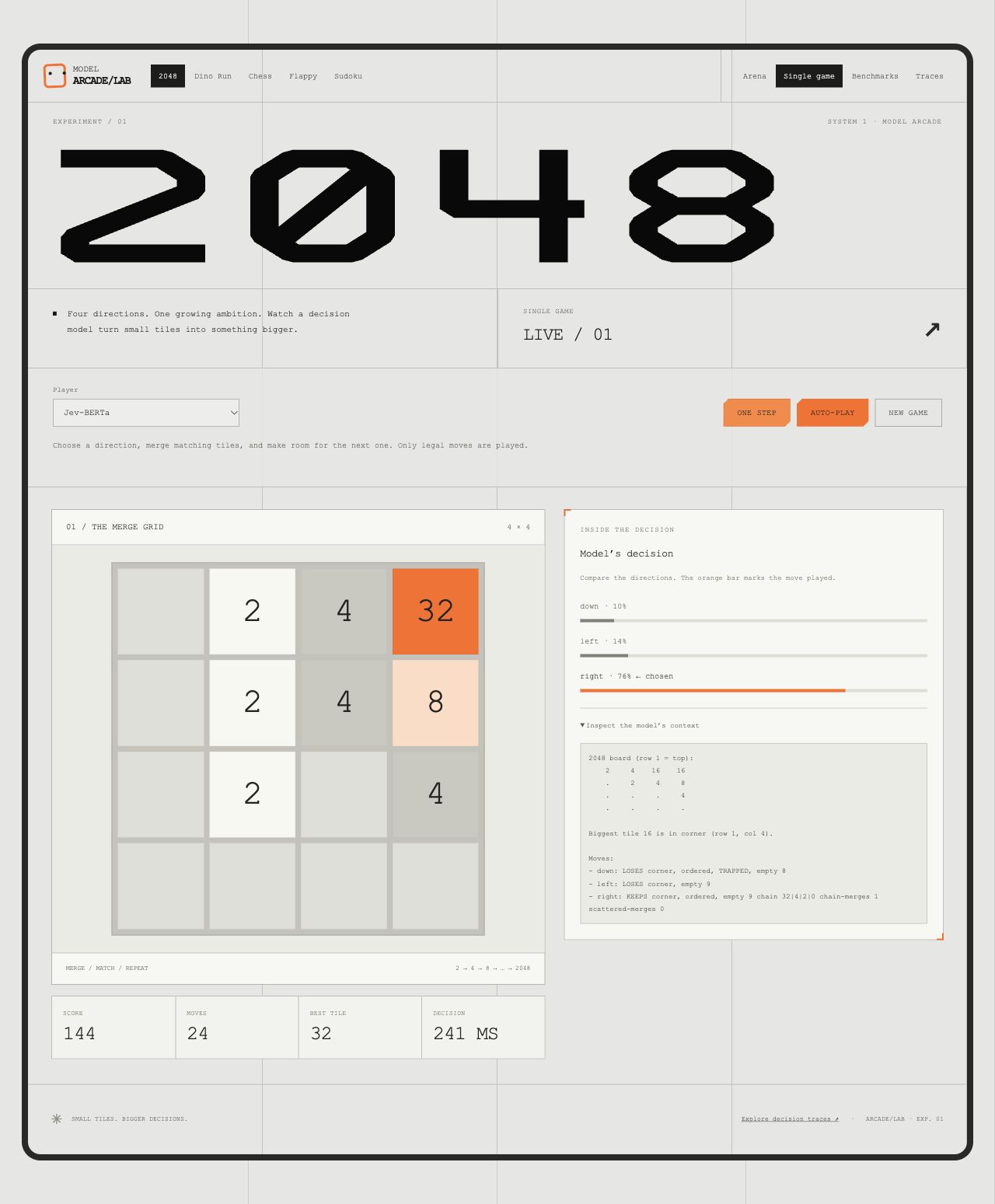
The board, score, move count, and largest tile appear beside the chosen direction, per-option probabilities, and the exact board description used for the decision.
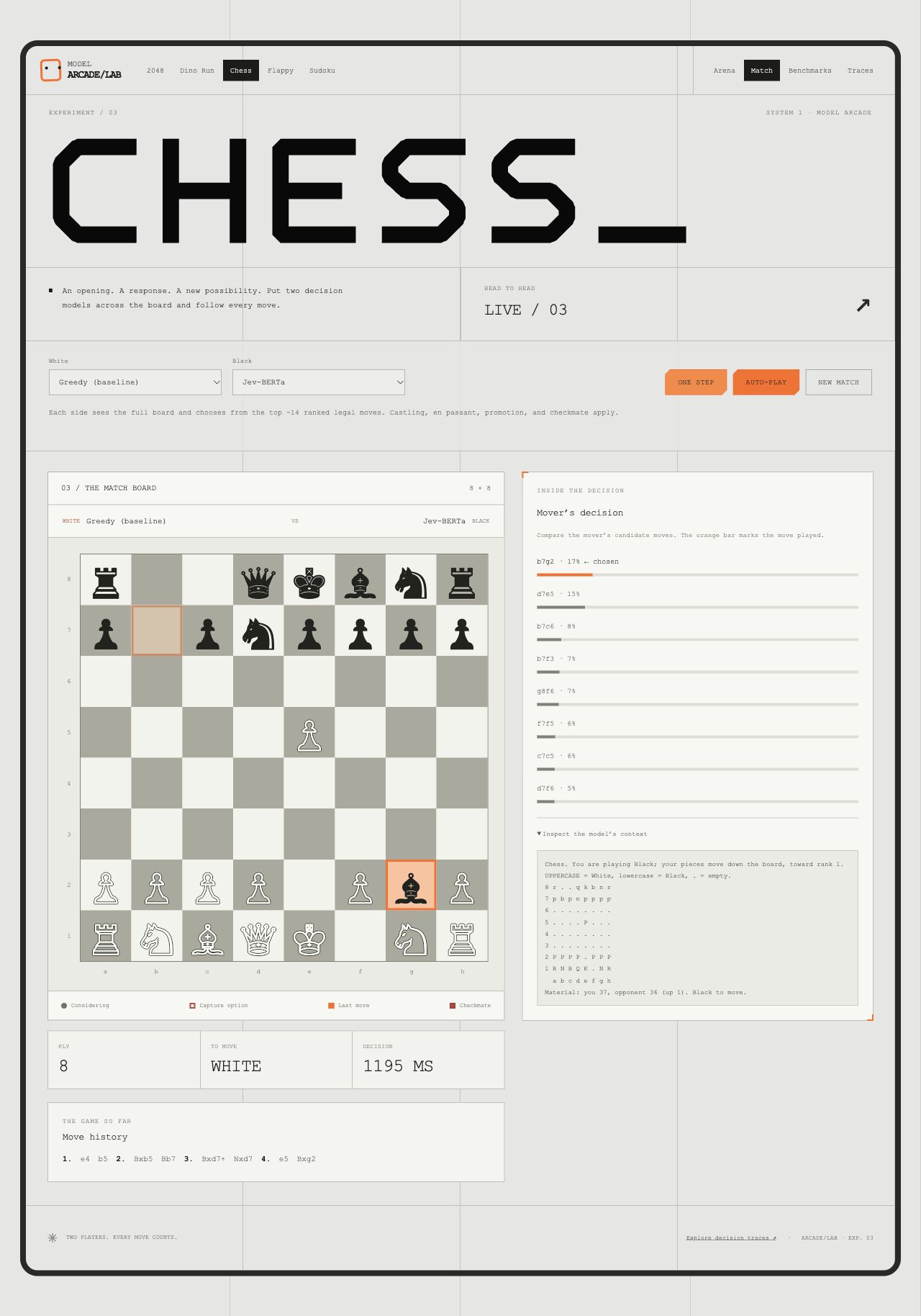
Greedy plays White against Jev-BERTa as Black. The highlighted squares show the bishop capture just played; the right column shows the mover’s probabilities and board context, with move history below the board.
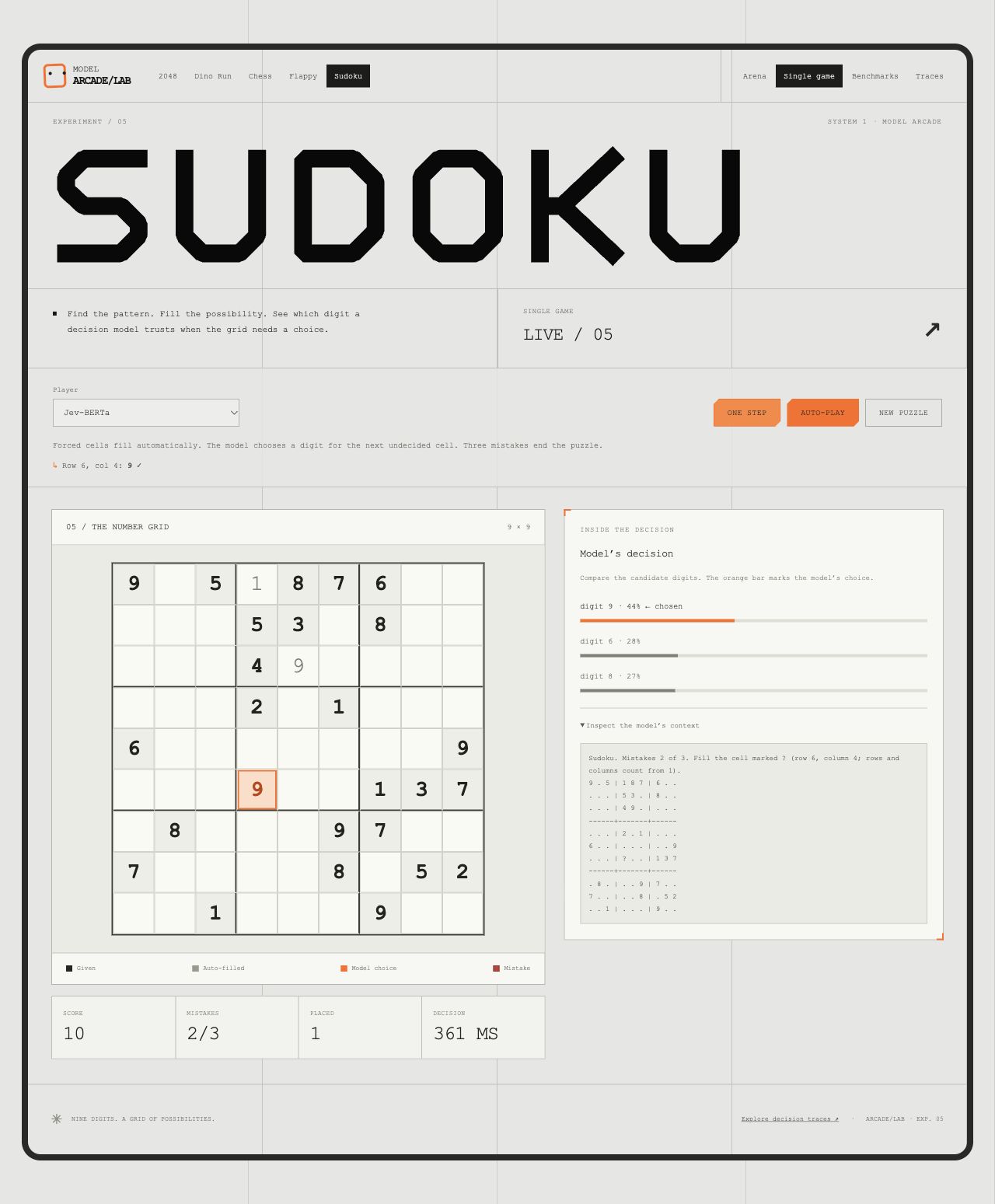
Jev-BERTa correctly chooses digit 9 for row 6, column 4, after two earlier mistakes. The orange target cell, candidate probabilities, model context, mistake counter, and differently styled given/auto-filled/model-placed cells explain what happened in that step.
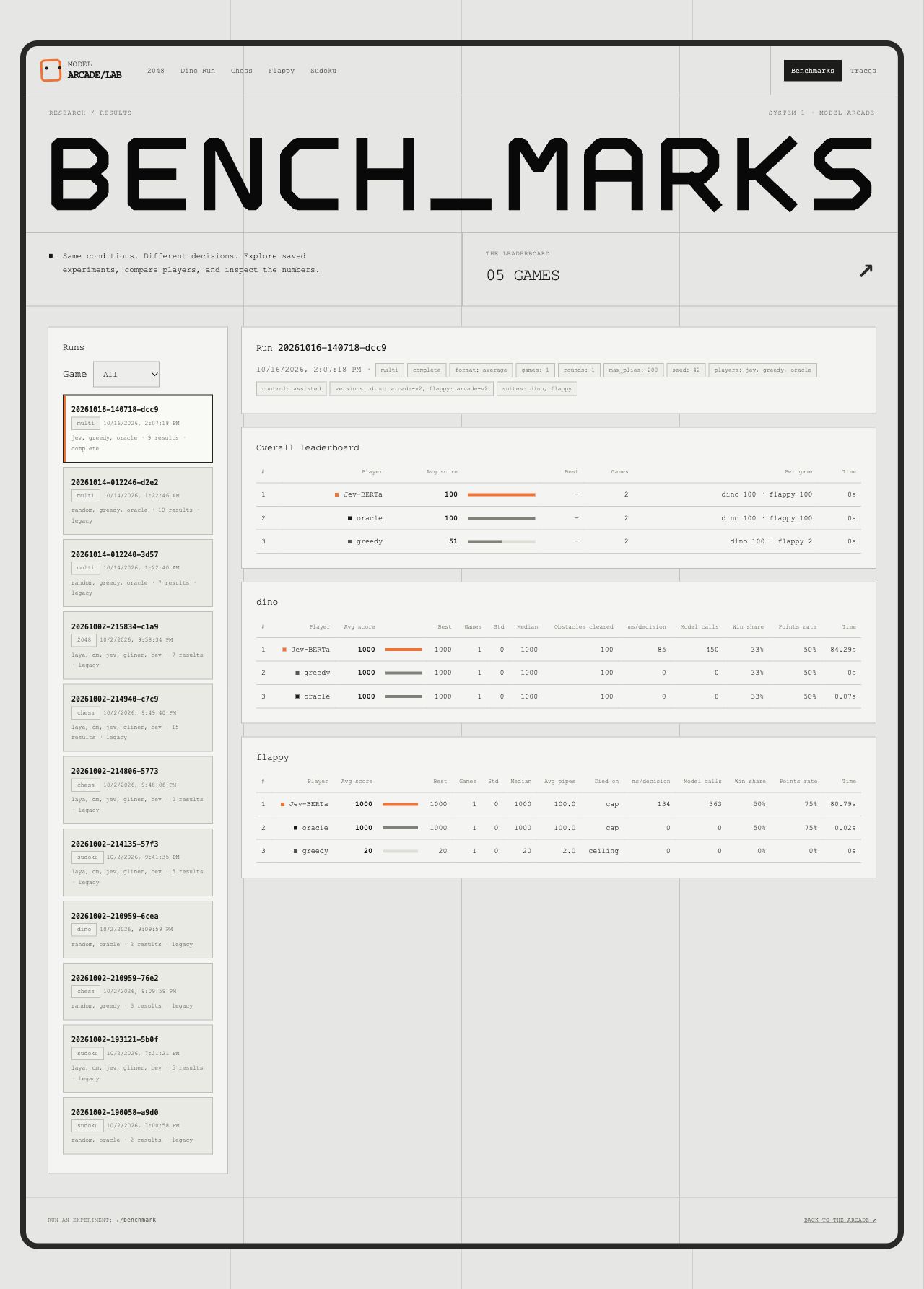
A completed Dino + Flappy run shows its players, seed 42, assisted control, game versions, overall leaderboard, per-game scores, model calls, and decision timing. This screenshot uses one seed to demonstrate the interface; use more seeds for performance comparisons.
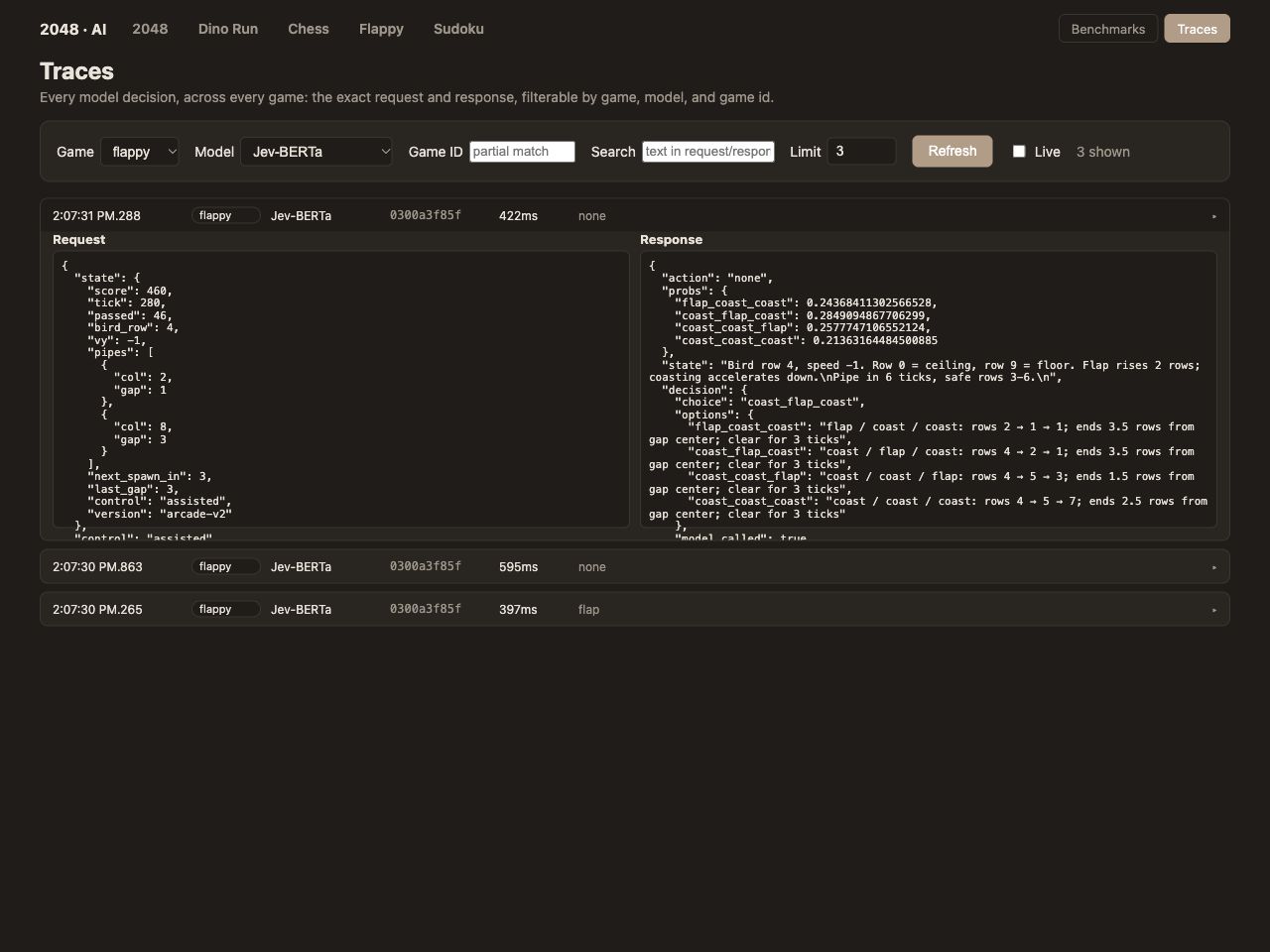
The trace browser is filtered to Flappy / Jev-BERTa, with one decision expanded. Request JSON, action probabilities, model context, selected flight plan, and latency can be inspected together. Live polling is paused to keep the view still.
Run the guided launcher with ./benchmark, or repeat the recorded comparison:
./benchmark --game dino,flappy --players jev greedy oracle --games 1 --seed 42
Actual console-output excerpts from that run, shown as text rather than a native Terminal screenshot:
/ ·················· 0/3 5s elapsed dino/jev · seed 42 · step 28 · score 20
OVERALL LEADERBOARD · mean of per-game 0–100 points

#  player  overall  dino  flappy
-  ------  -------  ----  ------
1     jev    100.0   100     100
2  oracle    100.0   100     100
3  greedy     51.0   100       2
The live line reports completed games, elapsed time, player, seed, step, and score; an ETA appears after a game has completed. The final tables rank each game and the overall suite. This is a one-seed assisted demonstration, not an estimate of unaided model ability.
Capture settings and reproduction steps are in the screenshot guide.
For the public project/benchmark website, use the standalone website folder:
cd website
docker compose up --build -d
The website defaults to https://arcade.afroawi.com behind host Nginx, with the app bound to 127.0.0.1:28481. It reads benchmark folders, explains the project, accepts model/game suggestions into a persistent private review queue, and includes contribution and PR guides. Nginx/HTTPS setup and local HTTP overrides are documented in that folder. It runs independently of the model/game environment below. See CONTRIBUTING.md to add a model or a game with or without a browser UI.
Requires Python 3.10+. The server starts immediately; each local model loads on its first decision. The first use of an uncached model downloads its checkpoint (which can take a few minutes).
python3 -m venv .venv && source .venv/bin/activate
pip install laya chess gliner2 peft bev-decider git+https://github.com/leobitz/jev-berta.git
# optional: DecisionMaster — see its section below (needs --no-deps and gated weights)
python server.py
Open http://localhost:8048 — it redirects to the 2048 arena. Use the nav at the top of every page to switch game (2048 / Dino Run / Chess / Flappy / Sudoku) and mode:
| Arena (many games/matches at once) | The other mode | |
|---|---|---|
| 2048 | /2048 | /2048/play — one move at a time |
| Dino Run | /dino | /dino/play — one obstacle at a time |
| Chess | /chess — every pair plays each other | /chess/play — pick White and Black, one ply at a time |
| Flappy | /flappy | /flappy/play — one tick at a time |
| Sudoku | /sudoku — every board gets the same puzzle | /sudoku/play — one decision at a time |
All five games share the same gray grid, geometric headings, sharp board cards, and orange controls in both modes. Single-game views pair the board with decision probabilities and an expandable model context; arenas show live cards and saved leaderboards.
There's also http://localhost:8048/traces — every model decision across all five games, with filters (see Traces below).
Drex is a hosted API, so it needs a key (get one from the Drex dashboard). Copy .env.example
to .env and fill it in, then restart the server:
cp .env.example .env # then set DREX_API_KEY=...
.env is git-ignored. Without a key, Drex appears greyed out with a hint and everything else works.
Optional: DREX_MODEL (default drex-latest) and DREX_CONCURRENCY (default 2, the free-tier limit; paid allows 16).
The client retries on 429/529 (honouring retry-after-ms). Note: state text is sent to Drex's servers.
../decision-master is a sibling checkout of a Qwen3-based model that scores a variable-size list
of candidates. DecisionMasterBackend uses its JEV-style decide_jev(), which takes the same
(state, instructions, criteria) shape as every other backend here. Three things to know:
pyproject.toml pins transformers<5, but this project
runs transformers 5.x for the other models. Its own test suite passes on 5.17, so install it
with --no-deps rather than letting pip downgrade everything else:
pip install --no-deps -e ../decision-masterleobitz/decision-master-base returns a 401 unless your
Hugging Face account has been granted access and you're authenticated — put HF_TOKEN=... in
.env (or run hf auth login), or point DECISION_MASTER_MODEL at a local checkpoint directory
(config.json + model.safetensors + tokenizer files). Until one of those is true it shows
greyed out in every game with that reason, like an unconfigured Drex.leobitz/decision-master-base (~1.1 GB) downloads and loads (CPU, float32), and it plays in every
game. I first checked the integration against a tiny random-weight checkpoint while access was
missing; the numbers in the Flappy Bird and Sudoku sections are from the
real model. It hasn't been benchmarked on 2048, Dino Run or Chess.Kev (github.com/jaredpalmer/kev) is a small, openly-released
decision model you host and run locally — no hosted API, no key. It speaks the exact same
/v1/systemone contract as Drex, so models.py's KevBackend is really a Drex client pointed at
localhost instead of a key. Two catches worth knowing before you set it up:
kev is a different, unrelated project (a boto3-based
document store) — don't pip install kev. The real thing only exists as the GitHub repo above.pyproject.toml pins torch>=2.6,<2.9, which conflicts with this project's own torch (used
by Laya/Jev). Give it a separate venv, not this project's .venv.HF_HUB_DISABLE_XET=1 before running kev.serve (this project's own .venv sets it
automatically for its own downloads — see Notes — but Kev's separate venv needs it set by hand).git clone https://github.com/jaredpalmer/kev.git kev-repo && cd kev-repo
python3.13 -m venv .venv && source .venv/bin/activate # a separate venv from this project's
pip install -e ".[serve]" # pulls in mlx-lm on Apple Silicon
HF_HUB_DISABLE_XET=1 python -m kev.serve --run jaredpalmer/kev-0.8b --port 8009
Leave that running in its own terminal (first run downloads the base model + adapter), then back
in this project's server it's picked up automatically — KevBackend.availability() just checks
whether 127.0.0.1:8009 is reachable. No .env entry is needed unless you changed the port/host
or started the Kev server with KEV_API_KEY (see .env.example for KEV_URL/KEV_API_KEY/
KEV_MODEL/KEV_CONCURRENCY). Without it running, Kev just appears greyed out like an unconfigured
Drex.
From this folder, run ./benchmark for an interactive launcher. No activated venv is needed:
it uses this checkout's .venv automatically. ./benchmark --quick runs a fast, seeded Dino + Flappy
baseline comparison with progress and ranked tables. Nothing new needs installing.
./benchmark                                      # guided setup in a terminal
./benchmark --quick                              # baselines, 3 identical seeds each
./benchmark --game dino,flappy --players jev greedy oracle --games 10
./benchmark --game all --players baselines --games 3 --max-plies 80
./benchmark --game flappy --players jev greedy --control raw --games 5
The console shows elapsed time, estimated time remaining, current player/seed/tick and score, then
per-game and overall leaderboards. Use --json results/run.json --csv results/run.csv to export;
--plain for log-friendly output; --no-save to keep the run out of the saved Benchmarks page.
All three competition formats still work. The old bench_*.py commands now use the same runner.
See BENCHMARKING.md for options and interpretation.
Full guide: BENCHMARKING.md — the unified
benchmark.pyrunner with competition formats (average,versus,round-robin) and multi-game suites with an overall leaderboard. The per-game scripts below are the simple way to run one comparison.
Each game has a small script that plays many games with no server and no browser — the quickest way to compare players. Run them from the activated venv, from this directory:
| Script | What it does | Default players (no names given) |
|---|---|---|
bench.py | Plays 2048 to the end, N times per player | random, greedy, laya, jev |
bench_dino.py | Plays Dino Run to a crash or the cap, N times per player | laya, jev, random, greedy, oracle |
bench_chess.py | Every pair of the given players plays once, alternating colors | greedy, random |
bench_flappy.py | Plays Flappy Bird until a crash or the cap, N runs per player (run i uses seed i: identical pipes) | laya, jev, random, greedy, oracle |
bench_sudoku.py | Solves N seeded puzzles per player (puzzle i from seed i: identical puzzles) | laya, jev, random, greedy, oracle |
python bench.py 8                    # 8 games each, default players
python bench.py 8 kev gliner bev     # 8 games each, only those three (random/greedy always included)
python bench_dino.py 5 gliner
python bench_chess.py 200 greedy random laya jev kev gliner bev   # every pair plays once, 200-ply cap
python bench_flappy.py 5 random greedy oracle gliner             # 5 runs on identical pipes
python bench_sudoku.py 10 greedy oracle laya dm                  # 10 identical puzzles
Player names: laya, jev, drex, kev, gliner, bev, dm, plus each game's own baselines (random and
greedy for 2048/Chess; random and oracle for Dino; random, greedy and oracle for Flappy/Sudoku). The first argument is always the game
count (2048/Dino) or the max-plies cutoff (Chess). These scripts check availability and use the same progress display as benchmark.py.
Unavailable backends are skipped. A player that fails mid-run is excluded from paired comparisons;
other players continue. Use --fail-fast on the unified runner to stop on the first error.
Results print as plain text to the terminal; the bench_*.py scripts also record each run to bench_runs.jsonl (see Benchmark runs & the Benchmarks page). This is separate from
the Arena's saved results_*.json and the Traces log, which only capture games played
through the web UI.
Each game's Arena page runs several auto-play games (or, for Chess, matches) side by side and compares players.
results_2048.json / results_dino.json / results_chess.json on
the server, so results survive restarts. Stopped or unfinished games are not saved — only a
genuine finish (crash/checkmate/no legal move, or the move/obstacle/ply cap) is recorded. Delete
a results_*.json file to reset it.arcade-v2 plus
control mode, keeping older mechanics and raw/assisted leaderboards separate.GET /api/<game>/models), so a newly registered model
shows up on that game's pages automatically, with no UI changes.browser (JS game) --grid + model--> server.py --> engine2048.py --> models.py --> Laya / Jev / Drex
^ |
+----------------------------- chosen move --------------------------+
engine2048.candidates() lists the legal moves and removes any that
would pull the biggest tile out of its corner, unless that's the only option.engine2048.describe() renders the board and one terse line per candidate, e.g.
- left: KEEPS corner, ordered, empty 11 chain 64|64|0|0 chain-merges 1 scattered-merges 1 CORNER-MERGE-READY.Strategy given to the model: keep the biggest tile in a corner, line up the next-biggest along the edge, grow the tile beside the corner until it equals it, then merge. The corner rule is enforced in code (step 1); the rest is only described in the prompt.
Benchmark (python bench.py 8, headless, seeded games, small sample, CPU only):
| Player | Avg score | Typical best tile |
|---|---|---|
| random | ~690–1150 | 32–128 |
| Laya | ~1160 | 32–256 |
| Jev-BERTa | ~925 | 32–128 |
| Kev-0.8B | ~950 | 32–256 |
| GLiNER2.5-Decide | ~940 | 64–128 |
| Bev-Decider-0.4B | ~925 | 32–128 |
| greedy (merge score, then empty cells) | ~3340 | 256 |
Honest takeaway: all six models play at roughly random level, with Laya and Kev perhaps slightly ahead. They can't plan ahead, and richer prompts made them worse — offering all four directions plus per-move lookahead text (no code-enforced rules) scored much lower (Laya ~790, Jev ~645) and made them pick illegal directions 10-20% of the time, so that mode was reverted. What helps is enforcing rules in code. A trivial greedy heuristic beats all six, so treat this as a demo of wiring decision models into a loop, not as a strong 2048 agent.
Desert sprint (/dino, /dino/play) is an animated canvas runner: layered desert hills,
clouds, a pixel dinosaur, cacti and flapping birds. Real vertical collision bounds replace the old
obstacle/action lookup. A jump follows a five-tick arc (heights 2, 3, 3, 2, 0), and cannot be
cancelled; ducking reduces the grounded dinosaur's height. Cacti must be jumped, low birds ducked,
and high birds avoided by staying low. The course speeds up through shorter obstacle spacing.
jump, duck, or none.
Forced controls and idle ticks do not count as model calls.Both modes use server-authoritative state via POST /api/dino/games and
POST /api/dino/games/<id>/step. The browser only animates snapshots. The exact same Python
physics runs in headless benchmarks. Seed i is shared across players; subsequent repeats use
seed i + 1. Results include the seed, control mode, model-call count, and arcade-v2 version.
The single-run page offers step, auto-play/pause, replayable course seeds and playback speed, with the selected control, probabilities and model context alongside the scene. The arena runs players side by side and saves finished runs once on the server; stopped runs are not scored. Old grid-game scores are kept on disk but excluded from the new leaderboard.
Real chess (via python-chess) — legal moves, castling,
en passant, promotion, check/checkmate and draw detection all apply. Unlike 2048/Dino, this game is
adversarial: two models play each other, alternating colors, so it's a genuinely different
architecture — see below.
browser (JS)  --{white, black}-->  server.py  --keeps the chess.Board per match-->  enginechess.py  -->  models.py  -->  Laya / Jev / Drex
     ^                                                                                    |
     +-------------------------------- move played this ply ---------------------------- +
chess.Board lives on the server (server.py's MATCHES), and the browser just asks
POST /api/chess/matches/<id>/step to play the next ply and render whatever FEN comes back.enginechess.shortlist() ranks legal moves in code (captures by value, checks,
checkmate, mild center pull, a small penalty for heading into a draw by repetition) and caps the
list at 14 — the model still makes the final pick, just among good candidates rather than the
full list. Two guards live purely in code, not the model's judgment: promoting to anything but a
queen is never offered (it's legal but almost never correct, and just an extra way to blunder —
the same "obviously-bad option, so don't offer it" idea as 2048's corner guard), and a move that
would trigger a draw by repetition is deprioritized (not banned — genuine repetition, like
perpetual check, is still available if nothing better exists). A busy midgame position runs ~300
tokens total.<SAN>: <tags>, e.g. Bxb5: captures pawn (+1), advances forward or O-O: castles kingside, king safety.random (uniform over every legal move, not just the shortlist) and greedy
(always the top-ranked shortlisted move — captures/checks/center — no model involved).GET /api/chess/matches/<id>/candidates, which computes the shortlist without calling any model.
The move actually played is then outlined; a checkmate outlines the whole board and the mated
king's square in red. Both boards are 340px (Arena) / 600px (Match) so the Arena grid holds two
per row.Benchmark: python bench_chess.py 200 greedy random laya jev kev gliner bev plays every pair
once and prints a W/L/D tally (200 = max plies before calling it a draw). No strong-play baseline is
included — building a real chess engine is out of scope here — so treat match results as "which
model reasons about a shortlisted position better than another," not absolute skill.
Honest takeaway: captures are real and render correctly (python-chess owns the rules; nothing is faked), but "does it play with a strategy" has a mixed answer per model. Sampling 25 midgame positions where a capture was available and code-ranked highest: Jev-BERTa took it 24/25 times, Greedy 25/25 (by construction), random 2/25 (as expected), but Laya took it only 6-9/25 — it frequently passes on an objectively good, clearly-labeled capture. Left to play a full game, Laya vs Jev tends to drift into repeated back-and-forth moves once material settles (now nudged away from actual repetition by the shortlist penalty, but the underlying "no multi-move plan" limitation remains) rather than building toward anything. Kev-0.8B was the pleasant surprise — in one small run it beat Random by checkmate in 30 plies and drew Greedy — noticeably more coherent here than in Dino Run, for whatever that's worth over such a small sample. GLiNER2.5-Decide drew both Greedy (fivefold repetition) and Random (ply limit) in its own small run — competent enough to avoid losing quickly, without forcing a decisive result either. Bev-Decider-0.4B also drew both Greedy and Random on ply limits in its small run — like GLiNER, safe but not sharp here, a contrast with its weaker Dino Run showing. Treat Chess like 2048 and Dino Run: a demo of wiring decision models into a real, rules-correct game loop, not a strong chess engine.
Sky passage (/flappy, /flappy/play) replaces the tile grid with an animated skyline,
solid pipes, a bird with visible climb/fall motion and a dotted forecast of its selected flight path.
The underlying discrete physics remain explicit: flap sets vertical speed to −2, gravity adds 1
up to +2, and the pipe gap is four rows tall. Touching a pipe, ceiling or floor ends the run.
flap / none choice every tick, with no trajectory filter.This is deliberately a model plus a physics helper in assisted mode. Its results do not measure
unaided model control and must be compared separately from raw mode and the old grid version.
Both the arena and CLI record the mode and arcade-v2 version. The saved arena leaderboard
filters by both. Earlier README scores describe different mechanics and have been removed.
Like Dino, the server owns the state and seeded RNG (POST /api/flappy/games, then
POST /api/flappy/games/<id>/step); the browser renders it with no duplicated physics. You can
watch one decision at a time, inspect its options/context, pause, change playback speed, or compare
many players on identical seeded courses.
Each step the engine fills in every cell that has exactly one legal digit, then asks the model about the next cell that needs a real decision: which digit goes here?, among the digits still legal there. A wrong digit is a mistake (it isn't placed, and is excluded from that cell next time); three mistakes end the game. Score = 10 per correct decision, +100 for solving.
?. Each option reads
5: other cells that can still take it — row 0, column 3, box 1: a 0 means the digit has
nowhere else to go in that row/column/box, so it must be the answer (the instructions say so).
That's a rule a model has to apply, not an answer handed over — which is exactly what's being measured.POST /api/sudoku/games, then POST /api/sudoku/games/<id>/step). Auto-filled cells show
grey, the model's correct placements orange, and a wrong guess highlights the target cell in red.Baselines: random (a random legal digit), greedy (applies the "0 elsewhere" rule literally —
no model), oracle (reads the solution).
Honest takeaway (10 identical puzzles, python bench_sudoku.py 10 …):
| Player | Avg score | Solved | Avg mistakes | Avg correct decisions |
|---|---|---|---|---|
| random | 31.0 | 1/10 | 2.80 | 2.1 |
| Laya | 29.0 | 1/10 | 2.80 | 1.9 |
| Jev-BERTa | 55.0 | 2/10 | 2.80 | 3.5 |
| GLiNER2.5-Decide | 48.0 | 1/10 | 2.80 | 3.8 |
| Bev-Decider-0.4B | 1.0 | 0/10 | 3.00 | 0.1 |
| DecisionMaster | 26.0 | 1/10 | 2.90 | 1.6 |
| greedy | 230.0 | 10/10 | 0.60 | 13.0 |
| oracle | 236.0 | 10/10 | 0.00 | 13.6 |
Every model is at or near random level, while a ten-line rule that follows the instructions solves all ten. The models aren't applying the stated rule — the information needed is in front of them in each option. Bev is the worst (0.1 correct decisions per game: it nearly always loses its three mistakes immediately). The tiny sample (10 puzzles) matters for the one-or-two-solves differences between Jev, GLiNER, Laya and random, which aren't meaningful. Kev wasn't running for this benchmark.
http://localhost:8048/traces logs and lets you browse every model decision, across all five games, on its own page.
/games/<id>/step)
appends one record: game, model, a game_id (2048/Dino: a random id the browser
mints per game/run and sends along; Chess: the match id), the exact request and response bodies,
and latency. It's server-side, so it captures Arena runs too, not just the single-game pages.traces.jsonl — one JSON object per line, append-only, git-ignored. A request
returns at most 20,000 recent trace lines before applying filters.response.error), so it's a reasonable first stop when a model behaves
oddly or a hosted call (Drex) fails.Local models (Laya, Jev) aren't safe to call concurrently, and Drex's free tier allows only 2
requests at once — server.py enforces this with one semaphore per backend, shared across all
five games (so any mix of arenas running at the same time still queue correctly behind one Laya
lock, not five).
GPU-backed backends share one more lock. Laya and Bev-Decider run on the Apple GPU (MPS).
Metal aborts the entire process — failed assertion 'A command encoder is already encoding to this command buffer', no Python traceback — if two threads use the GPU at once, and the
per-backend semaphores don't stop two different GPU models overlapping. A Sudoku Arena with
Laya and Bev ticked killed the server exactly that way. models.GPU_LOCK now serializes all
GPU-backed calls (DecisionMaster only when DECISION_MASTER_DEVICE puts it on a GPU). Verified by
running 14 games across 7 backends concurrently: 0 errors, server still up.
| File | Purpose |
|---|---|
models.py | Shared model backends (Laya/Jev/Drex), cached by name and reused by all games |
engine2048.py | 2048 rules, state description, move filtering, model-backed players |
enginedino.py | Dino Run rules, state description, model-backed players |
enginechess.py | Chess rules (via python-chess), move shortlisting, state description, model-backed players |
engineflappy.py | Flappy Bird physics, state description, model-backed players, exact-DP oracle |
enginesudoku.py | Sudoku generation (unique solutions, seeded), auto-fill, state description, model-backed players |
server.py | HTTP server, pages, model availability, traces/results, Chess/Sudoku sessions, and Dino/Flappy /games sessions |
arena_2048.html / play_2048.html | 2048 arena and single-game pages |
arena_dino.html / play_dino.html | Dino Run arena and single-game pages |
arena_chess.html / play_chess.html | Chess arena (round-robin) and one-match pages |
arena_flappy.html / play_flappy.html | Flappy Bird arena and single-game pages |
arena_sudoku.html / play_sudoku.html | Sudoku arena (same puzzle per run) and single-game pages |
style.css | Shared base design |
arcade.css | Shared design for all five games and the benchmark browser |
arcade.js | Dino/Flappy animation and controls (no game physics) |
benchmark, benchmark_console.py | Venv-aware launcher and dependency-free terminal progress dashboard |
tests/test_arcade.py | Physics, model-control, API, persistence and benchmark regressions |
website/ | Standalone Docker Compose project/benchmark site, persistent model/game suggestions, and contribution guides |
.env.example | Template for your API key (copy to .env) |
results_<game>.json | Saved arena results per game (created on first finish, git-ignored) |
benchmark.py | Unified headless runner: any game(s) × any players, with average / versus / round-robin formats and an overall leaderboard — see BENCHMARKING.md |
runs.py, benchmarks.html | Run grouping for saved bench results (bench_runs.jsonl) and the /benchmarks page |
bench.py / bench_dino.py / bench_chess.py / bench_flappy.py / bench_sudoku.py | Headless benchmarks against each game's baselines |
JevBackend casts it to float32.jev-berta chunks how many (state, candidate) rows it encodes in one
forward pass per predict() call — JEV_BATCH_SIZE in .env (default 4). Matters most for
Chess, which can offer up to 14 choices in a single call.predict() raises if given fewer than two
choices, which a forced-move position (common near checkmate) would otherwise hit. enginechess. Player.decide() plays a single legal move directly without calling any backend, same as
2048/Dino's "only one option" shortcuts.gliner2's classify_text normally reports just the argmax. GlinerBackend gets the full
distribution anyway by passing the documented multi_label=True, cls_threshold=0.0, class_act="softmax" classification kwargs: every label clears the zero threshold, so the "which
labels passed" list ends up being all of them, each with its true softmax probability.decide() isn't wrapped in an "answers" key the way Laya's system_one() is
— it returns {question_id: {...}} directly. BevBackend accounts for this; worth knowing if
you compare the two APIs directly, since they otherwise look identical (same typed-question shape).models.py sets HF_HUB_DISABLE_XET=1 by default (a real env var
still overrides it). HF's newer "Xet" CDN backend has repeatedly stalled at 0 bytes on large
checkpoints here (hit this with both Kev's and Bev-Decider's weights) while the classic HTTP path
downloads fine. This only covers downloads inside this project's own process — Kev runs as its
own separate server/venv, so its README documents setting the same variable there too.Backend subclass in models.py implementing answer(state, instructions, criteria), register it in BACKENDS, then in each game's engine call
model_player("your_name") and add it to that game's PLAYERS. It appears on both of that
game's pages automatically. A backend can opt out at runtime via availability() (Drex does
this when no key is set).engine<name>.py with a Player base class, model_player() built on
models.get_backend, a PLAYERS dict and get_player(); add it to GAMES in server.py; add
arena_<name>.html / play_<name>.html styled with style.css, and a nav entry linking to the
other pages. Follow the server-authoritative pattern in Chess (MATCHES) or Dino/Flappy (ARCADE) so browser
and headless runs share one engine.Every headless bench (bench.py, bench_dino.py, bench_chess.py, bench_flappy.py, bench_sudoku.py)
creates one run (printed as run <id>) and saves each player's result under it in bench_runs.jsonl
(see runs.py). Open http://localhost:8048/benchmarks to browse runs, filter by game, and see each run
as a ranked table (score bars, game-specific columns; chess shows standings plus every game). The data is
also at GET /api/benchmarks and GET /api/benchmarks/<run_id>.
Run .venv/bin/python -B -m unittest discover -s tests -v for the regression suite. It uses
local temporary result files and baseline/stub players; it does not download weights or call APIs.
The oracle regression checks 20 seeded, 100-obstacle/pipe courses for each updated arcade game.
Games where the moves are chosen by a small System 1 decision model instead of a search algorithm or an LLM.
Python
0
16 commits
updated Oct 16, 2026
Five games where the moves are chosen by a small System 1 decision model instead of a search algorithm or an LLM: 2048, a Chrome-dino-style runner, Chess, Flappy Bird and Sudoku. Each turn the situation is described in text, the model picks one of the options, and you watch it happen in the browser — alone, many at once to compare players (all five), or head-to-head (Chess: two models play each other).
Seven models are supported (plus baseline players) and can be switched from the UI, in every game:
| Model | Package | Checkpoint | Size |
|---|---|---|---|
| Laya | laya | convaiinnovations/laya | ~420M |
| Jev-BERTa | jev-berta | leobitz/jev-berta-base-zeroshot-classifier | ~198M |
| Drex | hosted API, docs | drex-latest (via POST /v1/systemone) | remote |
| Kev-0.8B | github.com/jaredpalmer/kev (run yourself) | jaredpalmer/kev-0.8b | ~0.8B |
| GLiNER2.5-Decide | gliner2 | fastino/GLiNER2.5-Decide | ~340M |
| Bev-Decider-0.4B | bev-decider | avbiswas/bev-decider-0.4B | ~0.4B |
| DecisionMaster | local package ../decision-master | leobitz/decision-master-base (gated on the Hub) | Qwen3-based |
Laya, Jev, GLiNER, Bev and DecisionMaster are local, non-generative classifiers: they score a list of candidate
answers against a context and return probabilities. None of the seven was trained on any of these
games. Each is loaded once and shared between all five games (models.py), not duplicated
per game.
A visual walkthrough of the running app. Expand any example; click an image or its full-size link to inspect the details. These are real browser captures, with live decisions and results from local runs.
Jev-BERTa in assisted mode: the dotted line previews the chosen flight plan, probability bars compare the options, and the expanded context shows the text and trajectories sent to the model. Score, pipes cleared, model calls, and latency remain visible.
Jev-BERTa, Greedy, and Oracle run side by side on seed 42. Each card shows its score, control, progress, and model-call count. Players advance at their own inference speed; the screenshot was taken while the model was still running and both baselines had finished.
The board, score, move count, and largest tile appear beside the chosen direction, per-option probabilities, and the exact board description used for the decision.
Greedy plays White against Jev-BERTa as Black. The highlighted squares show the bishop capture just played; the right column shows the mover’s probabilities and board context, with move history below the board.
Jev-BERTa correctly chooses digit 9 for row 6, column 4, after two earlier mistakes. The orange target cell, candidate probabilities, model context, mistake counter, and differently styled given/auto-filled/model-placed cells explain what happened in that step.
A completed Dino + Flappy run shows its players, seed 42, assisted control, game versions, overall leaderboard, per-game scores, model calls, and decision timing. This screenshot uses one seed to demonstrate the interface; use more seeds for performance comparisons.
The trace browser is filtered to Flappy / Jev-BERTa, with one decision expanded. Request JSON, action probabilities, model context, selected flight plan, and latency can be inspected together. Live polling is paused to keep the view still.
Run the guided launcher with ./benchmark, or repeat the recorded comparison:
./benchmark --game dino,flappy --players jev greedy oracle --games 1 --seed 42
Actual console-output excerpts from that run, shown as text rather than a native Terminal screenshot:
/ ·················· 0/3 5s elapsed dino/jev · seed 42 · step 28 · score 20
OVERALL LEADERBOARD · mean of per-game 0–100 points

#  player  overall  dino  flappy
-  ------  -------  ----  ------
1     jev    100.0   100     100
2  oracle    100.0   100     100
3  greedy     51.0   100       2
The live line reports completed games, elapsed time, player, seed, step, and score; an ETA appears after a game has completed. The final tables rank each game and the overall suite. This is a one-seed assisted demonstration, not an estimate of unaided model ability.
Capture settings and reproduction steps are in the screenshot guide.
For the public project/benchmark website, use the standalone website folder:
cd website
docker compose up --build -d
The website defaults to https://arcade.afroawi.com behind host Nginx, with the app bound to 127.0.0.1:28481. It reads benchmark folders, explains the project, accepts model/game suggestions into a persistent private review queue, and includes contribution and PR guides. Nginx/HTTPS setup and local HTTP overrides are documented in that folder. It runs independently of the model/game environment below. See CONTRIBUTING.md to add a model or a game with or without a browser UI.
Requires Python 3.10+. The server starts immediately; each local model loads on its first decision. The first use of an uncached model downloads its checkpoint (which can take a few minutes).
python3 -m venv .venv && source .venv/bin/activate
pip install laya chess gliner2 peft bev-decider git+https://github.com/leobitz/jev-berta.git
# optional: DecisionMaster — see its section below (needs --no-deps and gated weights)
python server.py
Open http://localhost:8048 — it redirects to the 2048 arena. Use the nav at the top of every page to switch game (2048 / Dino Run / Chess / Flappy / Sudoku) and mode:
| Arena (many games/matches at once) | The other mode | |
|---|---|---|
| 2048 | /2048 | /2048/play — one move at a time |
| Dino Run | /dino | /dino/play — one obstacle at a time |
| Chess | /chess — every pair plays each other | /chess/play — pick White and Black, one ply at a time |
| Flappy | /flappy | /flappy/play — one tick at a time |
| Sudoku | /sudoku — every board gets the same puzzle | /sudoku/play — one decision at a time |
All five games share the same gray grid, geometric headings, sharp board cards, and orange controls in both modes. Single-game views pair the board with decision probabilities and an expandable model context; arenas show live cards and saved leaderboards.
There's also http://localhost:8048/traces — every model decision across all five games, with filters (see Traces below).
Drex is a hosted API, so it needs a key (get one from the Drex dashboard). Copy .env.example
to .env and fill it in, then restart the server:
cp .env.example .env # then set DREX_API_KEY=...
.env is git-ignored. Without a key, Drex appears greyed out with a hint and everything else works.
Optional: DREX_MODEL (default drex-latest) and DREX_CONCURRENCY (default 2, the free-tier limit; paid allows 16).
The client retries on 429/529 (honouring retry-after-ms). Note: state text is sent to Drex's servers.
../decision-master is a sibling checkout of a Qwen3-based model that scores a variable-size list
of candidates. DecisionMasterBackend uses its JEV-style decide_jev(), which takes the same
(state, instructions, criteria) shape as every other backend here. Three things to know:
pyproject.toml pins transformers<5, but this project
runs transformers 5.x for the other models. Its own test suite passes on 5.17, so install it
with --no-deps rather than letting pip downgrade everything else:
pip install --no-deps -e ../decision-masterleobitz/decision-master-base returns a 401 unless your
Hugging Face account has been granted access and you're authenticated — put HF_TOKEN=... in
.env (or run hf auth login), or point DECISION_MASTER_MODEL at a local checkpoint directory
(config.json + model.safetensors + tokenizer files). Until one of those is true it shows
greyed out in every game with that reason, like an unconfigured Drex.leobitz/decision-master-base (~1.1 GB) downloads and loads (CPU, float32), and it plays in every
game. I first checked the integration against a tiny random-weight checkpoint while access was
missing; the numbers in the Flappy Bird and Sudoku sections are from the
real model. It hasn't been benchmarked on 2048, Dino Run or Chess.Kev (github.com/jaredpalmer/kev) is a small, openly-released
decision model you host and run locally — no hosted API, no key. It speaks the exact same
/v1/systemone contract as Drex, so models.py's KevBackend is really a Drex client pointed at
localhost instead of a key. Two catches worth knowing before you set it up:
kev is a different, unrelated project (a boto3-based
document store) — don't pip install kev. The real thing only exists as the GitHub repo above.pyproject.toml pins torch>=2.6,<2.9, which conflicts with this project's own torch (used
by Laya/Jev). Give it a separate venv, not this project's .venv.HF_HUB_DISABLE_XET=1 before running kev.serve (this project's own .venv sets it
automatically for its own downloads — see Notes — but Kev's separate venv needs it set by hand).git clone https://github.com/jaredpalmer/kev.git kev-repo && cd kev-repo
python3.13 -m venv .venv && source .venv/bin/activate # a separate venv from this project's
pip install -e ".[serve]" # pulls in mlx-lm on Apple Silicon
HF_HUB_DISABLE_XET=1 python -m kev.serve --run jaredpalmer/kev-0.8b --port 8009
Leave that running in its own terminal (first run downloads the base model + adapter), then back
in this project's server it's picked up automatically — KevBackend.availability() just checks
whether 127.0.0.1:8009 is reachable. No .env entry is needed unless you changed the port/host
or started the Kev server with KEV_API_KEY (see .env.example for KEV_URL/KEV_API_KEY/
KEV_MODEL/KEV_CONCURRENCY). Without it running, Kev just appears greyed out like an unconfigured
Drex.
From this folder, run ./benchmark for an interactive launcher. No activated venv is needed:
it uses this checkout's .venv automatically. ./benchmark --quick runs a fast, seeded Dino + Flappy
baseline comparison with progress and ranked tables. Nothing new needs installing.
./benchmark                                      # guided setup in a terminal
./benchmark --quick                              # baselines, 3 identical seeds each
./benchmark --game dino,flappy --players jev greedy oracle --games 10
./benchmark --game all --players baselines --games 3 --max-plies 80
./benchmark --game flappy --players jev greedy --control raw --games 5
The console shows elapsed time, estimated time remaining, current player/seed/tick and score, then
per-game and overall leaderboards. Use --json results/run.json --csv results/run.csv to export;
--plain for log-friendly output; --no-save to keep the run out of the saved Benchmarks page.
All three competition formats still work. The old bench_*.py commands now use the same runner.
See BENCHMARKING.md for options and interpretation.
Full guide: BENCHMARKING.md — the unified
benchmark.pyrunner with competition formats (average,versus,round-robin) and multi-game suites with an overall leaderboard. The per-game scripts below are the simple way to run one comparison.
Each game has a small script that plays many games with no server and no browser — the quickest way to compare players. Run them from the activated venv, from this directory:
| Script | What it does | Default players (no names given) |
|---|---|---|
bench.py | Plays 2048 to the end, N times per player | random, greedy, laya, jev |
bench_dino.py | Plays Dino Run to a crash or the cap, N times per player | laya, jev, random, greedy, oracle |
bench_chess.py | Every pair of the given players plays once, alternating colors | greedy, random |
bench_flappy.py | Plays Flappy Bird until a crash or the cap, N runs per player (run i uses seed i: identical pipes) | laya, jev, random, greedy, oracle |
bench_sudoku.py | Solves N seeded puzzles per player (puzzle i from seed i: identical puzzles) | laya, jev, random, greedy, oracle |
python bench.py 8                    # 8 games each, default players
python bench.py 8 kev gliner bev     # 8 games each, only those three (random/greedy always included)
python bench_dino.py 5 gliner
python bench_chess.py 200 greedy random laya jev kev gliner bev   # every pair plays once, 200-ply cap
python bench_flappy.py 5 random greedy oracle gliner             # 5 runs on identical pipes
python bench_sudoku.py 10 greedy oracle laya dm                  # 10 identical puzzles
Player names: laya, jev, drex, kev, gliner, bev, dm, plus each game's own baselines (random and
greedy for 2048/Chess; random and oracle for Dino; random, greedy and oracle for Flappy/Sudoku). The first argument is always the game
count (2048/Dino) or the max-plies cutoff (Chess). These scripts check availability and use the same progress display as benchmark.py.
Unavailable backends are skipped. A player that fails mid-run is excluded from paired comparisons;
other players continue. Use --fail-fast on the unified runner to stop on the first error.
Results print as plain text to the terminal; the bench_*.py scripts also record each run to bench_runs.jsonl (see Benchmark runs & the Benchmarks page). This is separate from
the Arena's saved results_*.json and the Traces log, which only capture games played
through the web UI.
Each game's Arena page runs several auto-play games (or, for Chess, matches) side by side and compares players.
results_2048.json / results_dino.json / results_chess.json on
the server, so results survive restarts. Stopped or unfinished games are not saved — only a
genuine finish (crash/checkmate/no legal move, or the move/obstacle/ply cap) is recorded. Delete
a results_*.json file to reset it.arcade-v2 plus
control mode, keeping older mechanics and raw/assisted leaderboards separate.GET /api/<game>/models), so a newly registered model
shows up on that game's pages automatically, with no UI changes.browser (JS game) --grid + model--> server.py --> engine2048.py --> models.py --> Laya / Jev / Drex
^ |
+----------------------------- chosen move --------------------------+
engine2048.candidates() lists the legal moves and removes any that
would pull the biggest tile out of its corner, unless that's the only option.engine2048.describe() renders the board and one terse line per candidate, e.g.
- left: KEEPS corner, ordered, empty 11 chain 64|64|0|0 chain-merges 1 scattered-merges 1 CORNER-MERGE-READY.Strategy given to the model: keep the biggest tile in a corner, line up the next-biggest along the edge, grow the tile beside the corner until it equals it, then merge. The corner rule is enforced in code (step 1); the rest is only described in the prompt.
Benchmark (python bench.py 8, headless, seeded games, small sample, CPU only):
| Player | Avg score | Typical best tile |
|---|---|---|
| random | ~690–1150 | 32–128 |
| Laya | ~1160 | 32–256 |
| Jev-BERTa | ~925 | 32–128 |
| Kev-0.8B | ~950 | 32–256 |
| GLiNER2.5-Decide | ~940 | 64–128 |
| Bev-Decider-0.4B | ~925 | 32–128 |
| greedy (merge score, then empty cells) | ~3340 | 256 |
Honest takeaway: all six models play at roughly random level, with Laya and Kev perhaps slightly ahead. They can't plan ahead, and richer prompts made them worse — offering all four directions plus per-move lookahead text (no code-enforced rules) scored much lower (Laya ~790, Jev ~645) and made them pick illegal directions 10-20% of the time, so that mode was reverted. What helps is enforcing rules in code. A trivial greedy heuristic beats all six, so treat this as a demo of wiring decision models into a loop, not as a strong 2048 agent.
Desert sprint (/dino, /dino/play) is an animated canvas runner: layered desert hills,
clouds, a pixel dinosaur, cacti and flapping birds. Real vertical collision bounds replace the old
obstacle/action lookup. A jump follows a five-tick arc (heights 2, 3, 3, 2, 0), and cannot be
cancelled; ducking reduces the grounded dinosaur's height. Cacti must be jumped, low birds ducked,
and high birds avoided by staying low. The course speeds up through shorter obstacle spacing.
jump, duck, or none.
Forced controls and idle ticks do not count as model calls.Both modes use server-authoritative state via POST /api/dino/games and
POST /api/dino/games/<id>/step. The browser only animates snapshots. The exact same Python
physics runs in headless benchmarks. Seed i is shared across players; subsequent repeats use
seed i + 1. Results include the seed, control mode, model-call count, and arcade-v2 version.
The single-run page offers step, auto-play/pause, replayable course seeds and playback speed, with the selected control, probabilities and model context alongside the scene. The arena runs players side by side and saves finished runs once on the server; stopped runs are not scored. Old grid-game scores are kept on disk but excluded from the new leaderboard.
Real chess (via python-chess) — legal moves, castling,
en passant, promotion, check/checkmate and draw detection all apply. Unlike 2048/Dino, this game is
adversarial: two models play each other, alternating colors, so it's a genuinely different
architecture — see below.
browser (JS)  --{white, black}-->  server.py  --keeps the chess.Board per match-->  enginechess.py  -->  models.py  -->  Laya / Jev / Drex
     ^                                                                                    |
     +-------------------------------- move played this ply ---------------------------- +
chess.Board lives on the server (server.py's MATCHES), and the browser just asks
POST /api/chess/matches/<id>/step to play the next ply and render whatever FEN comes back.enginechess.shortlist() ranks legal moves in code (captures by value, checks,
checkmate, mild center pull, a small penalty for heading into a draw by repetition) and caps the
list at 14 — the model still makes the final pick, just among good candidates rather than the
full list. Two guards live purely in code, not the model's judgment: promoting to anything but a
queen is never offered (it's legal but almost never correct, and just an extra way to blunder —
the same "obviously-bad option, so don't offer it" idea as 2048's corner guard), and a move that
would trigger a draw by repetition is deprioritized (not banned — genuine repetition, like
perpetual check, is still available if nothing better exists). A busy midgame position runs ~300
tokens total.<SAN>: <tags>, e.g. Bxb5: captures pawn (+1), advances forward or O-O: castles kingside, king safety.random (uniform over every legal move, not just the shortlist) and greedy
(always the top-ranked shortlisted move — captures/checks/center — no model involved).GET /api/chess/matches/<id>/candidates, which computes the shortlist without calling any model.
The move actually played is then outlined; a checkmate outlines the whole board and the mated
king's square in red. Both boards are 340px (Arena) / 600px (Match) so the Arena grid holds two
per row.Benchmark: python bench_chess.py 200 greedy random laya jev kev gliner bev plays every pair
once and prints a W/L/D tally (200 = max plies before calling it a draw). No strong-play baseline is
included — building a real chess engine is out of scope here — so treat match results as "which
model reasons about a shortlisted position better than another," not absolute skill.
Honest takeaway: captures are real and render correctly (python-chess owns the rules; nothing is faked), but "does it play with a strategy" has a mixed answer per model. Sampling 25 midgame positions where a capture was available and code-ranked highest: Jev-BERTa took it 24/25 times, Greedy 25/25 (by construction), random 2/25 (as expected), but Laya took it only 6-9/25 — it frequently passes on an objectively good, clearly-labeled capture. Left to play a full game, Laya vs Jev tends to drift into repeated back-and-forth moves once material settles (now nudged away from actual repetition by the shortlist penalty, but the underlying "no multi-move plan" limitation remains) rather than building toward anything. Kev-0.8B was the pleasant surprise — in one small run it beat Random by checkmate in 30 plies and drew Greedy — noticeably more coherent here than in Dino Run, for whatever that's worth over such a small sample. GLiNER2.5-Decide drew both Greedy (fivefold repetition) and Random (ply limit) in its own small run — competent enough to avoid losing quickly, without forcing a decisive result either. Bev-Decider-0.4B also drew both Greedy and Random on ply limits in its small run — like GLiNER, safe but not sharp here, a contrast with its weaker Dino Run showing. Treat Chess like 2048 and Dino Run: a demo of wiring decision models into a real, rules-correct game loop, not a strong chess engine.
Sky passage (/flappy, /flappy/play) replaces the tile grid with an animated skyline,
solid pipes, a bird with visible climb/fall motion and a dotted forecast of its selected flight path.
The underlying discrete physics remain explicit: flap sets vertical speed to −2, gravity adds 1
up to +2, and the pipe gap is four rows tall. Touching a pipe, ceiling or floor ends the run.
flap / none choice every tick, with no trajectory filter.This is deliberately a model plus a physics helper in assisted mode. Its results do not measure
unaided model control and must be compared separately from raw mode and the old grid version.
Both the arena and CLI record the mode and arcade-v2 version. The saved arena leaderboard
filters by both. Earlier README scores describe different mechanics and have been removed.
Like Dino, the server owns the state and seeded RNG (POST /api/flappy/games, then
POST /api/flappy/games/<id>/step); the browser renders it with no duplicated physics. You can
watch one decision at a time, inspect its options/context, pause, change playback speed, or compare
many players on identical seeded courses.
Each step the engine fills in every cell that has exactly one legal digit, then asks the model about the next cell that needs a real decision: which digit goes here?, among the digits still legal there. A wrong digit is a mistake (it isn't placed, and is excluded from that cell next time); three mistakes end the game. Score = 10 per correct decision, +100 for solving.
?. Each option reads
5: other cells that can still take it — row 0, column 3, box 1: a 0 means the digit has
nowhere else to go in that row/column/box, so it must be the answer (the instructions say so).
That's a rule a model has to apply, not an answer handed over — which is exactly what's being measured.POST /api/sudoku/games, then POST /api/sudoku/games/<id>/step). Auto-filled cells show
grey, the model's correct placements orange, and a wrong guess highlights the target cell in red.Baselines: random (a random legal digit), greedy (applies the "0 elsewhere" rule literally —
no model), oracle (reads the solution).
Honest takeaway (10 identical puzzles, python bench_sudoku.py 10 …):
| Player | Avg score | Solved | Avg mistakes | Avg correct decisions |
|---|---|---|---|---|
| random | 31.0 | 1/10 | 2.80 | 2.1 |
| Laya | 29.0 | 1/10 | 2.80 | 1.9 |
| Jev-BERTa | 55.0 | 2/10 | 2.80 | 3.5 |
| GLiNER2.5-Decide | 48.0 | 1/10 | 2.80 | 3.8 |
| Bev-Decider-0.4B | 1.0 | 0/10 | 3.00 | 0.1 |
| DecisionMaster | 26.0 | 1/10 | 2.90 | 1.6 |
| greedy | 230.0 | 10/10 | 0.60 | 13.0 |
| oracle | 236.0 | 10/10 | 0.00 | 13.6 |
Every model is at or near random level, while a ten-line rule that follows the instructions solves all ten. The models aren't applying the stated rule — the information needed is in front of them in each option. Bev is the worst (0.1 correct decisions per game: it nearly always loses its three mistakes immediately). The tiny sample (10 puzzles) matters for the one-or-two-solves differences between Jev, GLiNER, Laya and random, which aren't meaningful. Kev wasn't running for this benchmark.
http://localhost:8048/traces logs and lets you browse every model decision, across all five games, on its own page.
/games/<id>/step)
appends one record: game, model, a game_id (2048/Dino: a random id the browser
mints per game/run and sends along; Chess: the match id), the exact request and response bodies,
and latency. It's server-side, so it captures Arena runs too, not just the single-game pages.traces.jsonl — one JSON object per line, append-only, git-ignored. A request
returns at most 20,000 recent trace lines before applying filters.response.error), so it's a reasonable first stop when a model behaves
oddly or a hosted call (Drex) fails.Local models (Laya, Jev) aren't safe to call concurrently, and Drex's free tier allows only 2
requests at once — server.py enforces this with one semaphore per backend, shared across all
five games (so any mix of arenas running at the same time still queue correctly behind one Laya
lock, not five).
GPU-backed backends share one more lock. Laya and Bev-Decider run on the Apple GPU (MPS).
Metal aborts the entire process — failed assertion 'A command encoder is already encoding to this command buffer', no Python traceback — if two threads use the GPU at once, and the
per-backend semaphores don't stop two different GPU models overlapping. A Sudoku Arena with
Laya and Bev ticked killed the server exactly that way. models.GPU_LOCK now serializes all
GPU-backed calls (DecisionMaster only when DECISION_MASTER_DEVICE puts it on a GPU). Verified by
running 14 games across 7 backends concurrently: 0 errors, server still up.
| File | Purpose |
|---|---|
models.py | Shared model backends (Laya/Jev/Drex), cached by name and reused by all games |
engine2048.py | 2048 rules, state description, move filtering, model-backed players |
enginedino.py | Dino Run rules, state description, model-backed players |
enginechess.py | Chess rules (via python-chess), move shortlisting, state description, model-backed players |
engineflappy.py | Flappy Bird physics, state description, model-backed players, exact-DP oracle |
enginesudoku.py | Sudoku generation (unique solutions, seeded), auto-fill, state description, model-backed players |
server.py | HTTP server, pages, model availability, traces/results, Chess/Sudoku sessions, and Dino/Flappy /games sessions |
arena_2048.html / play_2048.html | 2048 arena and single-game pages |
arena_dino.html / play_dino.html | Dino Run arena and single-game pages |
arena_chess.html / play_chess.html | Chess arena (round-robin) and one-match pages |
arena_flappy.html / play_flappy.html | Flappy Bird arena and single-game pages |
arena_sudoku.html / play_sudoku.html | Sudoku arena (same puzzle per run) and single-game pages |
style.css | Shared base design |
arcade.css | Shared design for all five games and the benchmark browser |
arcade.js | Dino/Flappy animation and controls (no game physics) |
benchmark, benchmark_console.py | Venv-aware launcher and dependency-free terminal progress dashboard |
tests/test_arcade.py | Physics, model-control, API, persistence and benchmark regressions |
website/ | Standalone Docker Compose project/benchmark site, persistent model/game suggestions, and contribution guides |
.env.example | Template for your API key (copy to .env) |
results_<game>.json | Saved arena results per game (created on first finish, git-ignored) |
benchmark.py | Unified headless runner: any game(s) × any players, with average / versus / round-robin formats and an overall leaderboard — see BENCHMARKING.md |
runs.py, benchmarks.html | Run grouping for saved bench results (bench_runs.jsonl) and the /benchmarks page |
bench.py / bench_dino.py / bench_chess.py / bench_flappy.py / bench_sudoku.py | Headless benchmarks against each game's baselines |
JevBackend casts it to float32.jev-berta chunks how many (state, candidate) rows it encodes in one
forward pass per predict() call — JEV_BATCH_SIZE in .env (default 4). Matters most for
Chess, which can offer up to 14 choices in a single call.predict() raises if given fewer than two
choices, which a forced-move position (common near checkmate) would otherwise hit. enginechess. Player.decide() plays a single legal move directly without calling any backend, same as
2048/Dino's "only one option" shortcuts.gliner2's classify_text normally reports just the argmax. GlinerBackend gets the full
distribution anyway by passing the documented multi_label=True, cls_threshold=0.0, class_act="softmax" classification kwargs: every label clears the zero threshold, so the "which
labels passed" list ends up being all of them, each with its true softmax probability.decide() isn't wrapped in an "answers" key the way Laya's system_one() is
— it returns {question_id: {...}} directly. BevBackend accounts for this; worth knowing if
you compare the two APIs directly, since they otherwise look identical (same typed-question shape).models.py sets HF_HUB_DISABLE_XET=1 by default (a real env var
still overrides it). HF's newer "Xet" CDN backend has repeatedly stalled at 0 bytes on large
checkpoints here (hit this with both Kev's and Bev-Decider's weights) while the classic HTTP path
downloads fine. This only covers downloads inside this project's own process — Kev runs as its
own separate server/venv, so its README documents setting the same variable there too.Backend subclass in models.py implementing answer(state, instructions, criteria), register it in BACKENDS, then in each game's engine call
model_player("your_name") and add it to that game's PLAYERS. It appears on both of that
game's pages automatically. A backend can opt out at runtime via availability() (Drex does
this when no key is set).engine<name>.py with a Player base class, model_player() built on
models.get_backend, a PLAYERS dict and get_player(); add it to GAMES in server.py; add
arena_<name>.html / play_<name>.html styled with style.css, and a nav entry linking to the
other pages. Follow the server-authoritative pattern in Chess (MATCHES) or Dino/Flappy (ARCADE) so browser
and headless runs share one engine.Every headless bench (bench.py, bench_dino.py, bench_chess.py, bench_flappy.py, bench_sudoku.py)
creates one run (printed as run <id>) and saves each player's result under it in bench_runs.jsonl
(see runs.py). Open http://localhost:8048/benchmarks to browse runs, filter by game, and see each run
as a ranked table (score bars, game-specific columns; chess shows standings plus every game). The data is
also at GET /api/benchmarks and GET /api/benchmarks/<run_id>.
Run .venv/bin/python -B -m unittest discover -s tests -v for the regression suite. It uses
local temporary result files and baseline/stub players; it does not download weights or call APIs.
The oracle regression checks 20 seeded, 100-obstacle/pipe courses for each updated arcade game.



