
See what people are saying
README

PrintCraft
The PDF workbench; an open-source, clean-room reimplementation of Adobe Acrobat, rebuilt in pure Rust.
Read, organize, combine, split and secure PDFs in a fast, native app, written in Rust from the ground up.
macOS · Windows · Linux · the web





PrintCraft on getartcraft.com · ArtCraft · All Crafting Apps
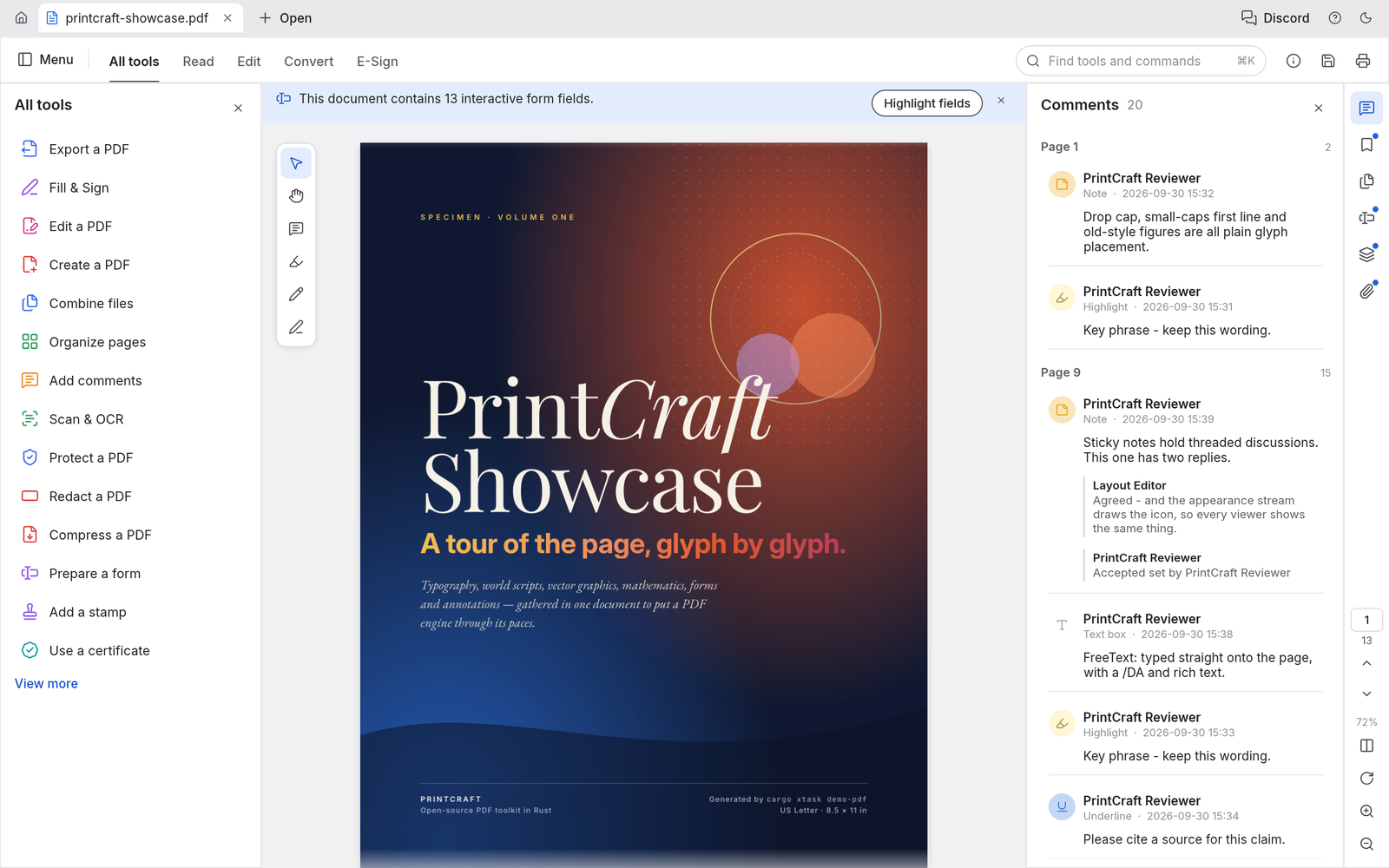
The PrintCraft Showcase, a 13-page specimen PDF, open with the All tools panel and threaded comments.
[!NOTE] ArtCraft is a community of artists from all walks of life. Digital, generative, music, games — if you make things, you're one of us. Come say hi on Discord.
Highlights · Read · Find · Organize · Combine & split · Protect · Forms & layers · Everywhere · Agents · How it's built · Get started · What's next · Crafting Apps
Community
PrintCraft is part of ArtCraft. Come say hello, get help and follow development:
- Discord: discord.gg/artcraft. This is the fastest way to get help and share feedback. The app has a Discord button in its title bar.
- Web page: getartcraft.com/apps/printcraft
- Source: github.com/storytold/printcraft
The ArtCraft name and logos in docs/brand/ belong to Storyteller and are not open source (see docs/brand/LICENSE-brand.txt). Forks must remove them.
Highlights
FaithfulReal-world typography: world scripts, vertical Japanese, colour emoji, gradients, soft masks and transparency. All of it renders the way the author intended. |
FearlessEvery save appends your changes and leaves the original bytes untouched. Writes are atomic, undo runs deep, and nothing is lost if you close by mistake. |
YoursNo account, no telemetry, no cloud. It works offline and opens instantly. The engine, CLI and app are all open source. |
Read anything, beautifully
PrintCraft renders PDFs with care for the details that make a page feel right: kerning and ligatures, right-to-left and complex scripts, vertical CJK, colour emoji, shadings, blend modes, soft masks and optional content.
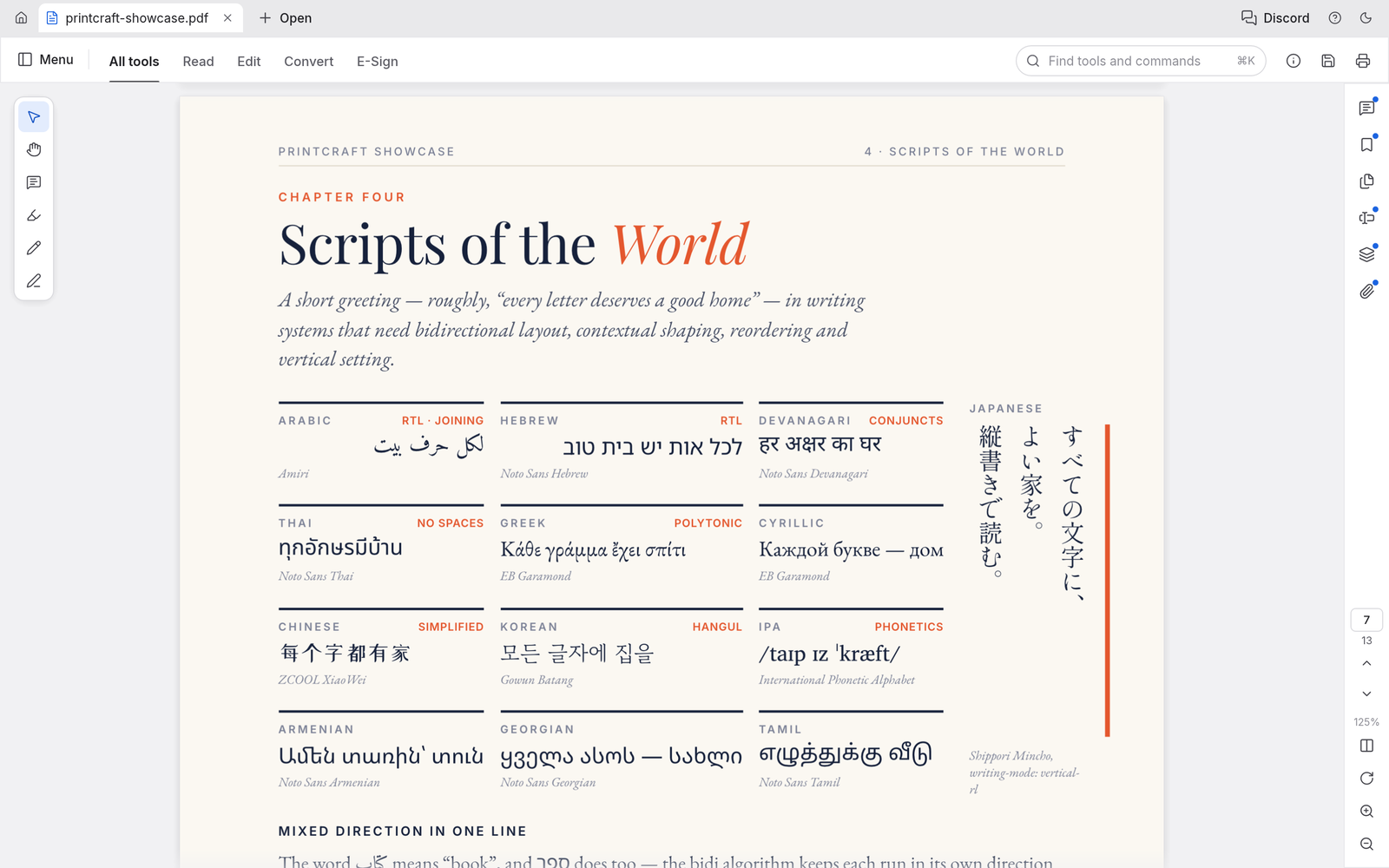
Twelve writing systems on one page, plus vertical Japanese, at 125%.
- Deep zoom stays sharp. Large pages render in tiles, so text stays crisp at any magnification.
- Built to survive bad files. Every page renders in isolation and damaged documents are repaired. Across the 983-file pdf.js test corpus the result is 0 crashes.
- Layouts for every task: continuous, single page, two-up, view rotation, full screen and a distraction-free Read mode.
- Light and dark themes, both designed to be easy on the eyes for long sessions.
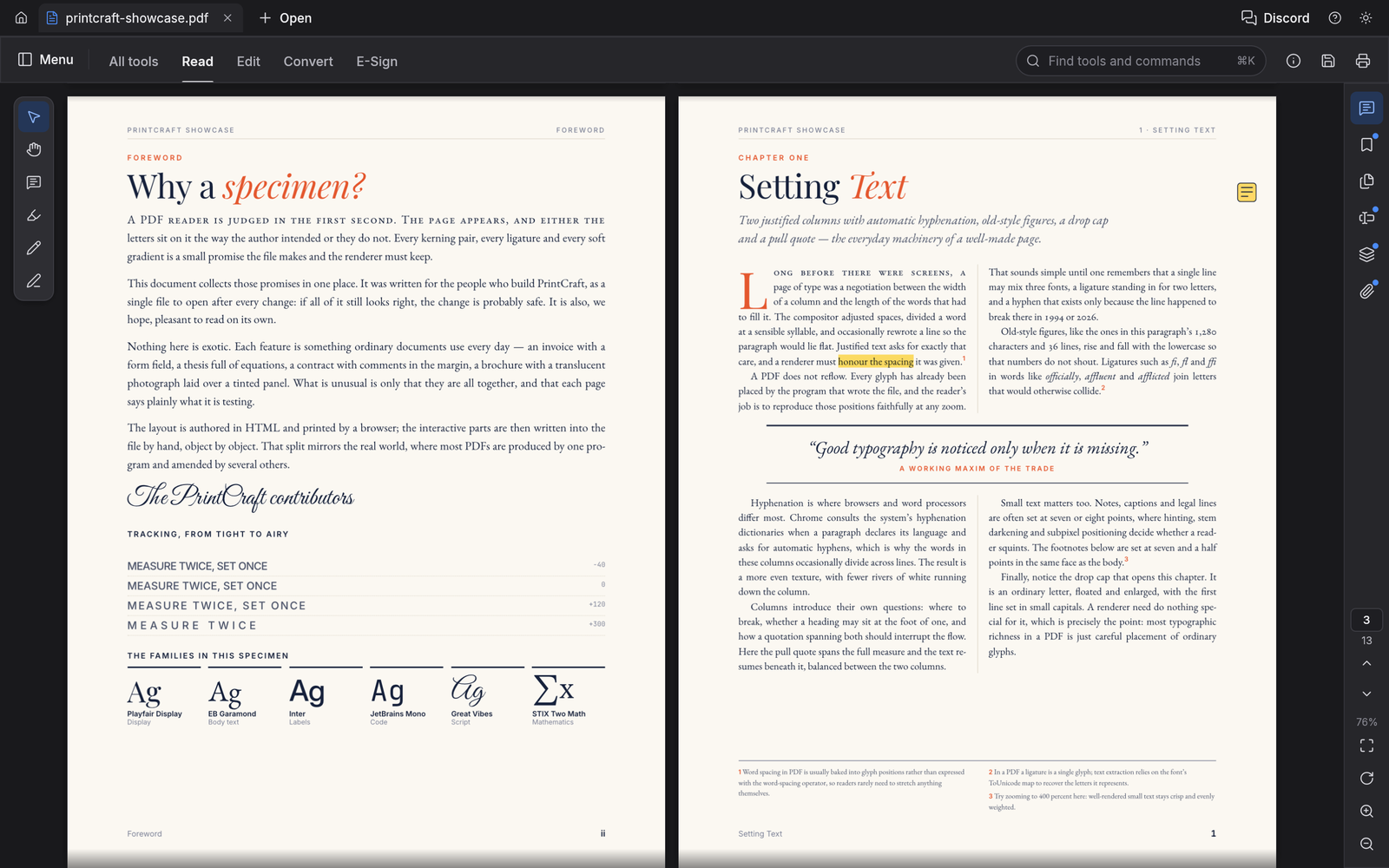 | 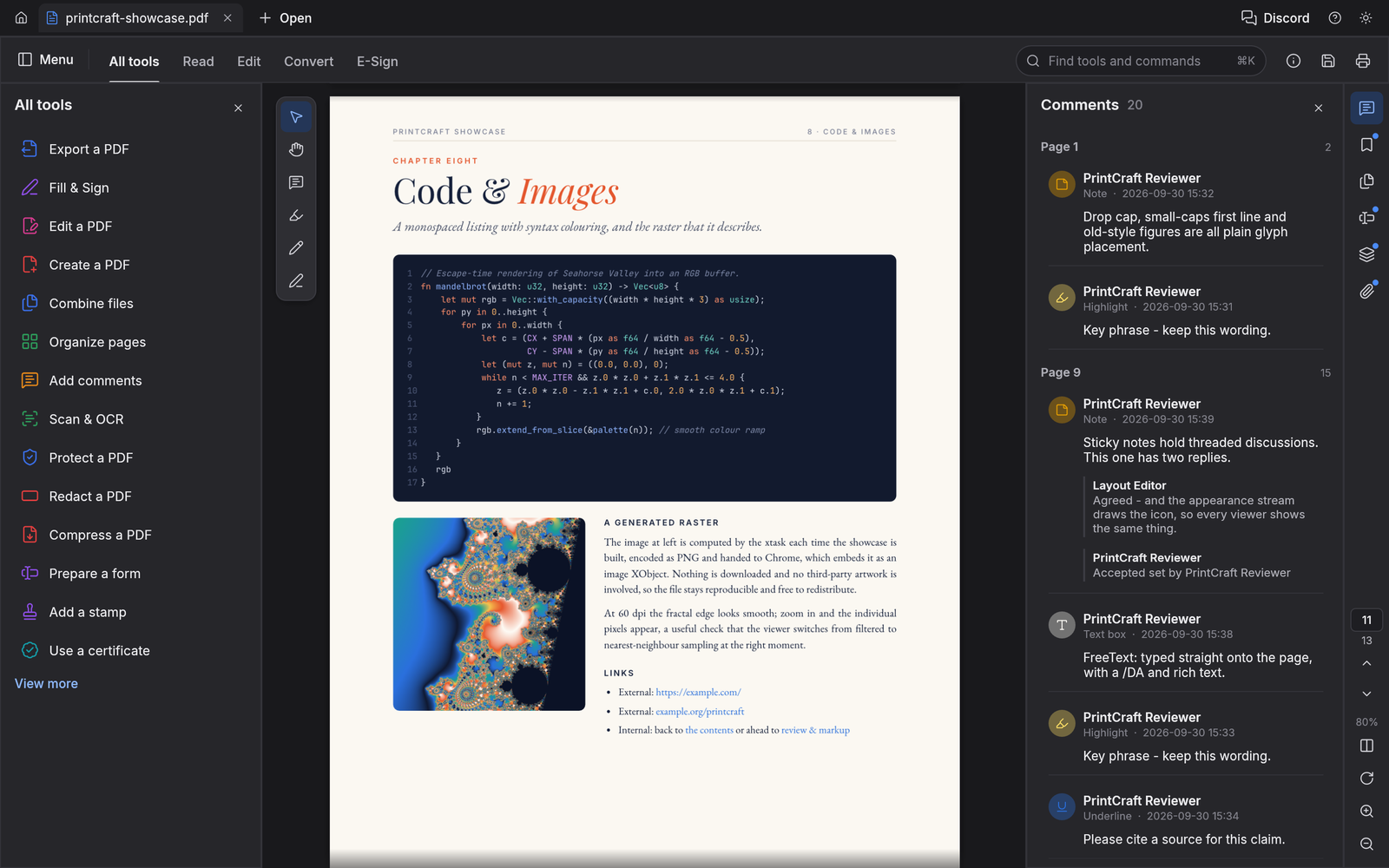 |
| Two-up Read mode, ready for long reading | The dark theme, with the comments panel open |
Find it, select it, copy it
Search the whole document as you type, step through matches with ⌘G, and select text that comes out in the right reading order. That holds for columns, right-to-left runs and CJK too.
Navigate long documents
Bookmarks, page thumbnails and the document's own page labels (i, ii, 1, 2…) keep you oriented in long documents.
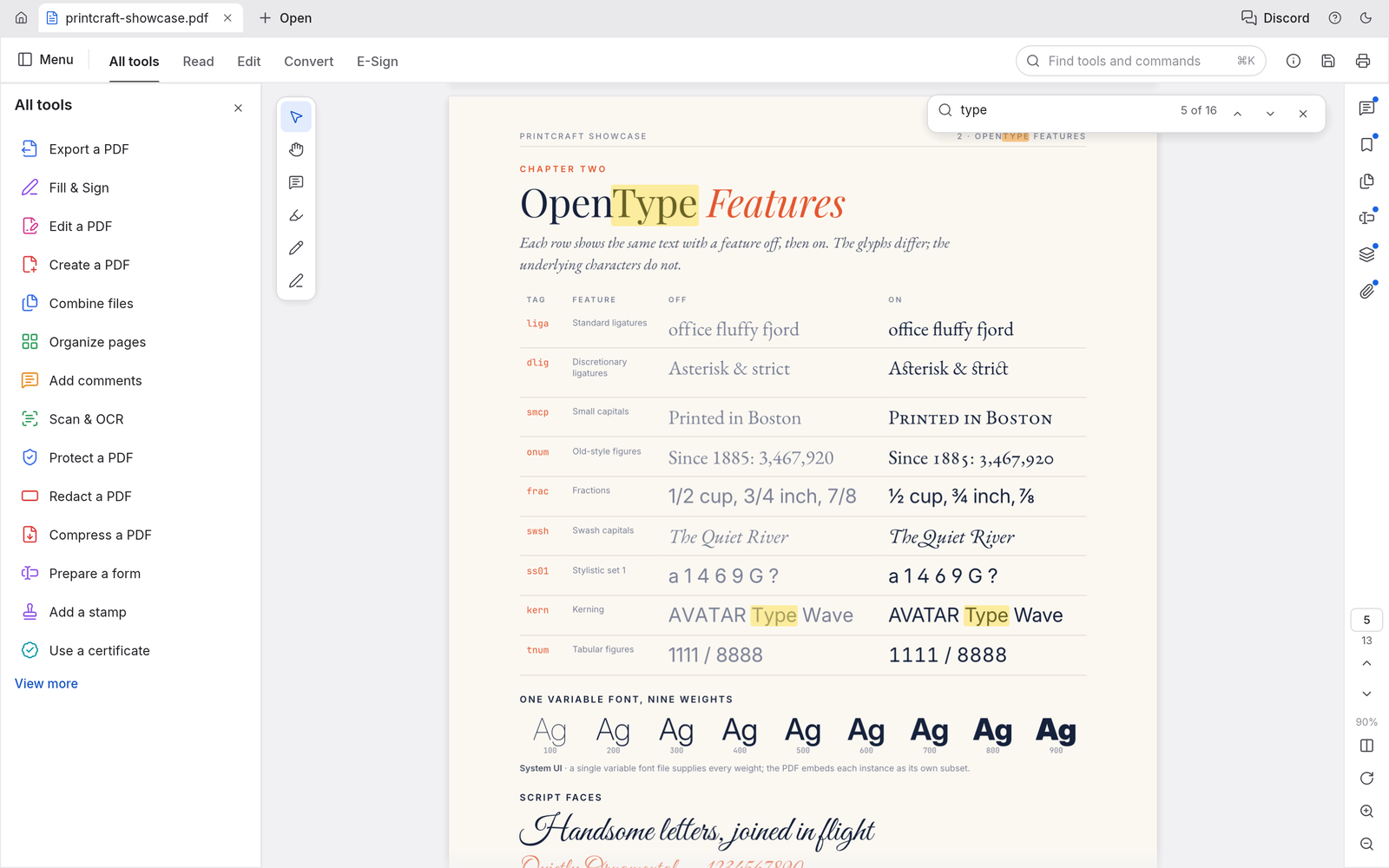 | 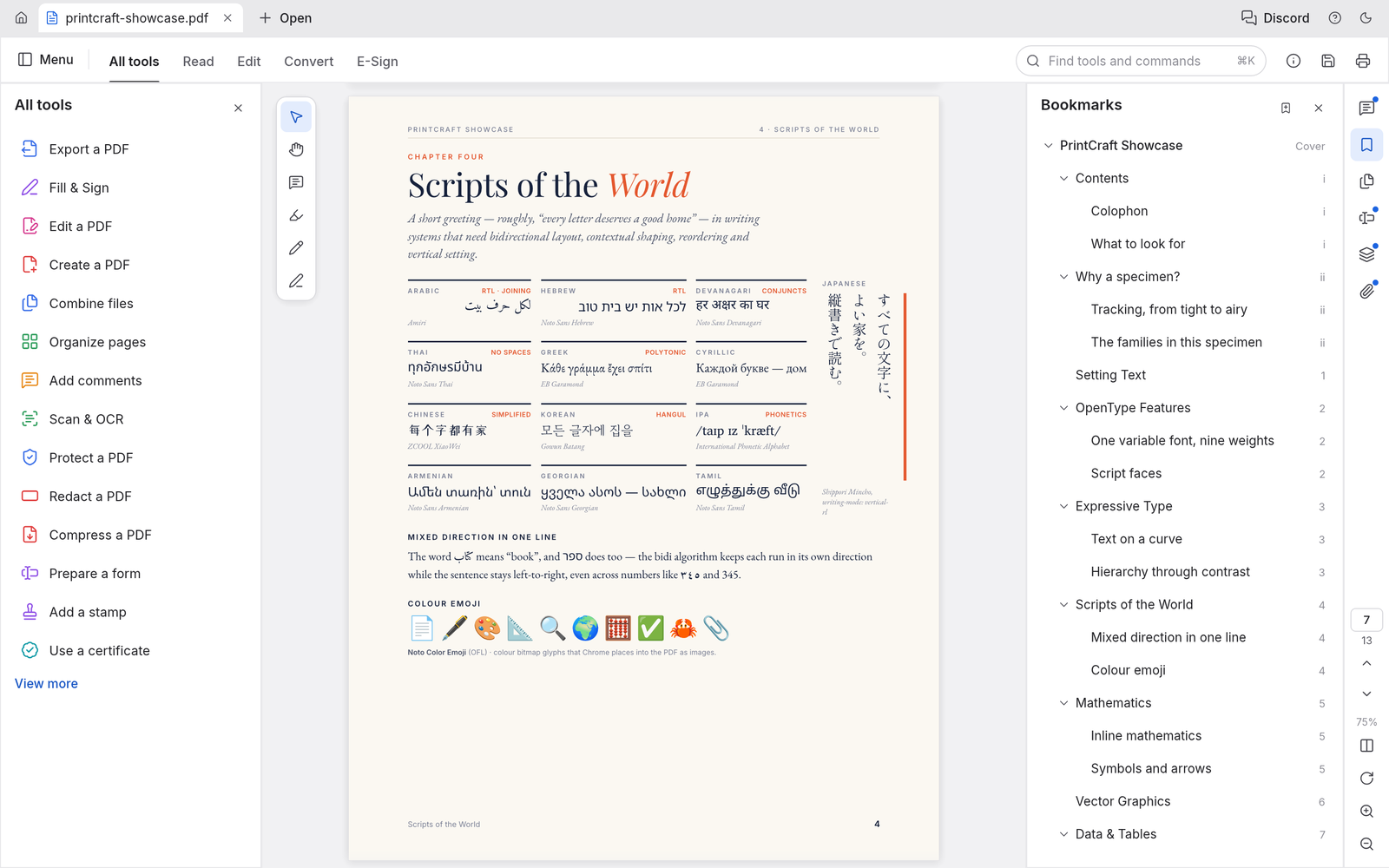 |
| Find as you type: match 10 of 16 | Nested bookmarks with the document's own page labels |
Organize pages like cards on a table
Open Organize pages to see every page at once:
- Select pages: click, ⌘-click or ⇧-click.
- Change them: rotate, delete, insert blank pages, insert pages from another file, and move them earlier or later.
- Undo anything: ⌘Z, then save.
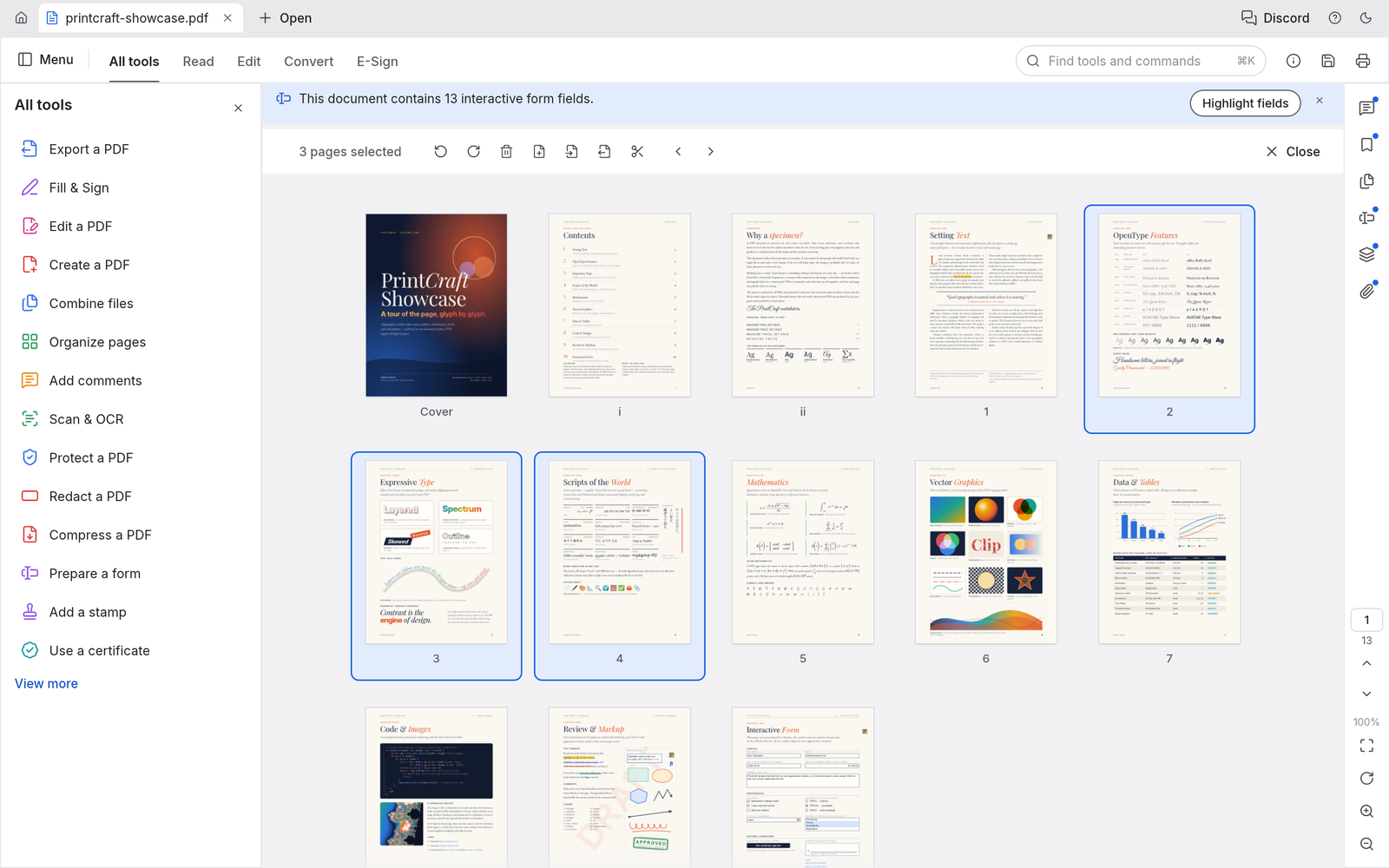
Organize pages with three pages selected and the page tools in the toolbar above.
|
Undo that goes the distance. Each change is one step in a history you can walk backwards and forwards. The Edit menu names the step ("Undo Rotate pages"), and undo still works after you save. Saves you can trust:
Unsaved documents carry a dot on their tab, and closing or quitting asks before anything is lost. Changes are autosaved every minute. If PrintCraft ever quits unexpectedly, it offers to recover your work the next time it opens. Encrypted documents stay encrypted on disk. | 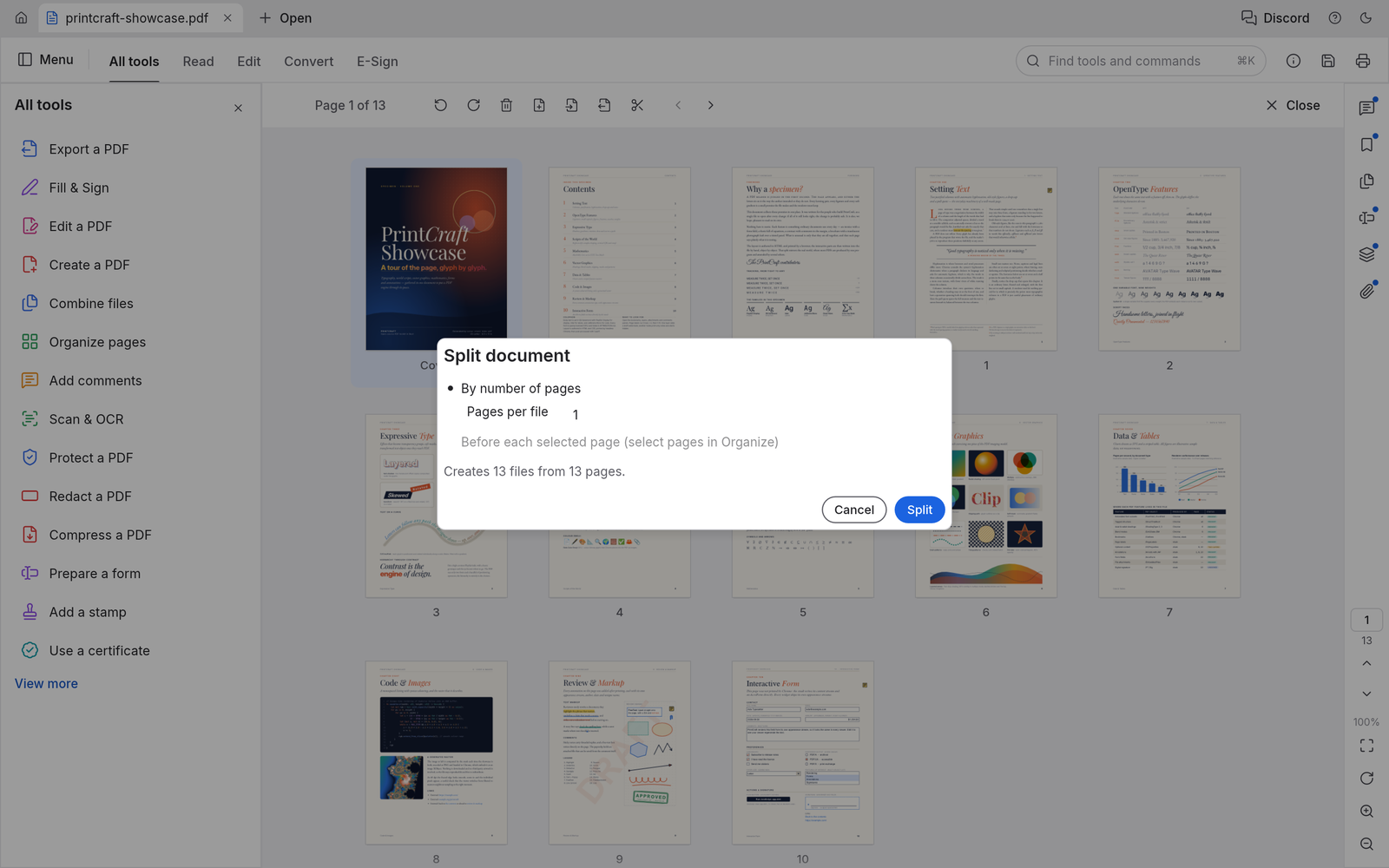 Split document: one page per file makes 13 files. |
Combine and split without losing a thing
Combine files merges any number of PDFs into one. Each file gets a bookmark, with its own bookmarks nested underneath.
Extract copies the pages you select into a new document. Split divides a document every n pages, or before the pages you choose.
Nothing quietly disappears along the way:
- links and named destinations are rewired to the copied pages;
- form fields stay interactive;
- layers keep their on/off defaults;
- attachments come along.
Every page of a combined document renders pixel-identical to its source.
printcraft-cli combine report.pdf appendix.pdf --out combined.pdf
printcraft-cli extract report.pdf --pages 1,3,5 --out highlights.pdf
printcraft-cli split   report.pdf --every 10 --out-dir parts/
Open protected documents and respect their rules
PrintCraft implements the PDF standard security handler completely:
- every revision, from 40-bit RC4 to AES-256;
- user and owner passwords, including Unicode passwords normalised with SASLprep;
- crypt filters and attachment-only encryption.
Documents restricted by their author show a clear notice, and PrintCraft honours their permissions. Enter the owner password and the restrictions lift. Edits to encrypted documents are saved encrypted, under the same keys.
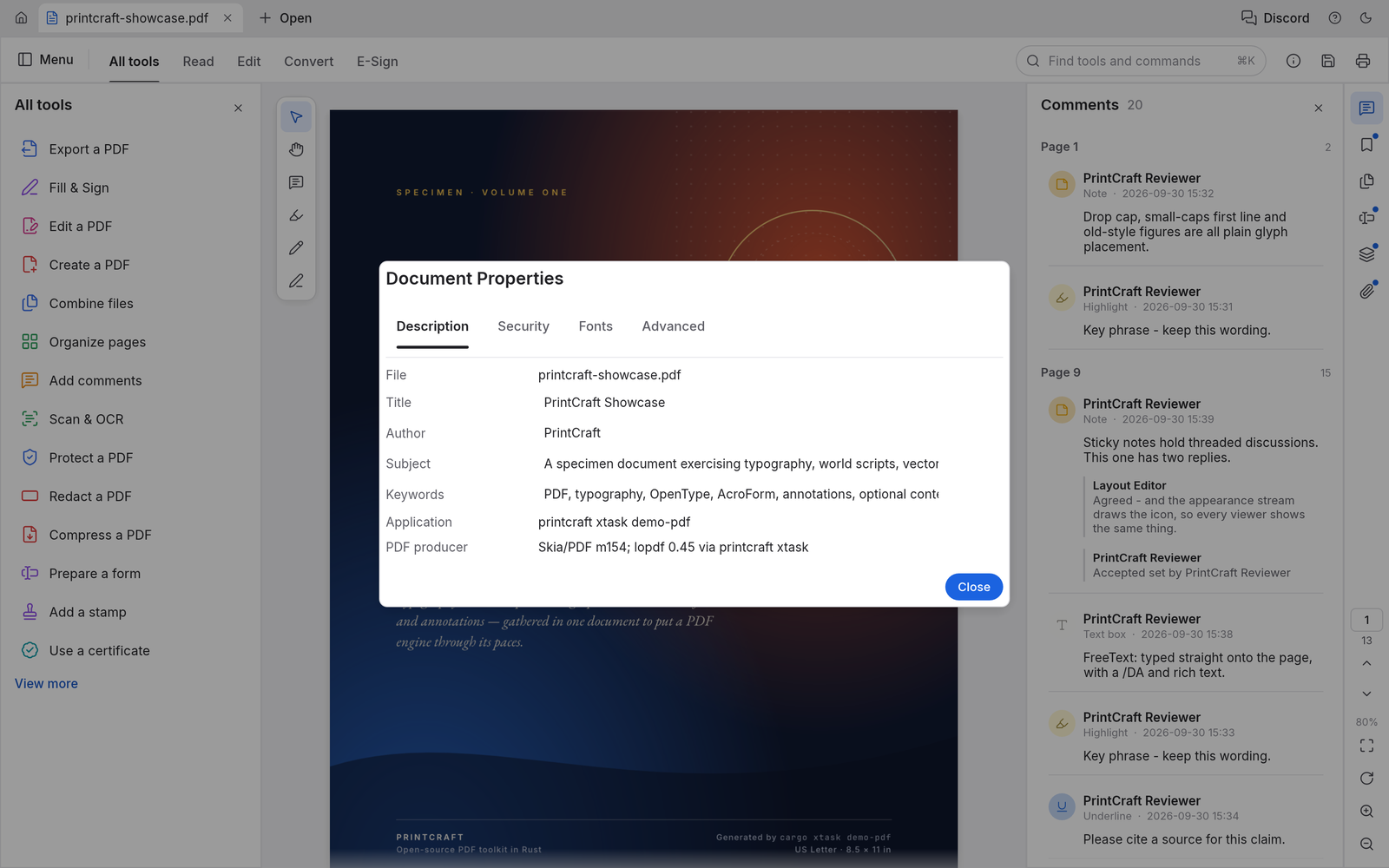 Document Properties, Description tab |
Document Properties shows:
|
Comments, forms, layers and attachments
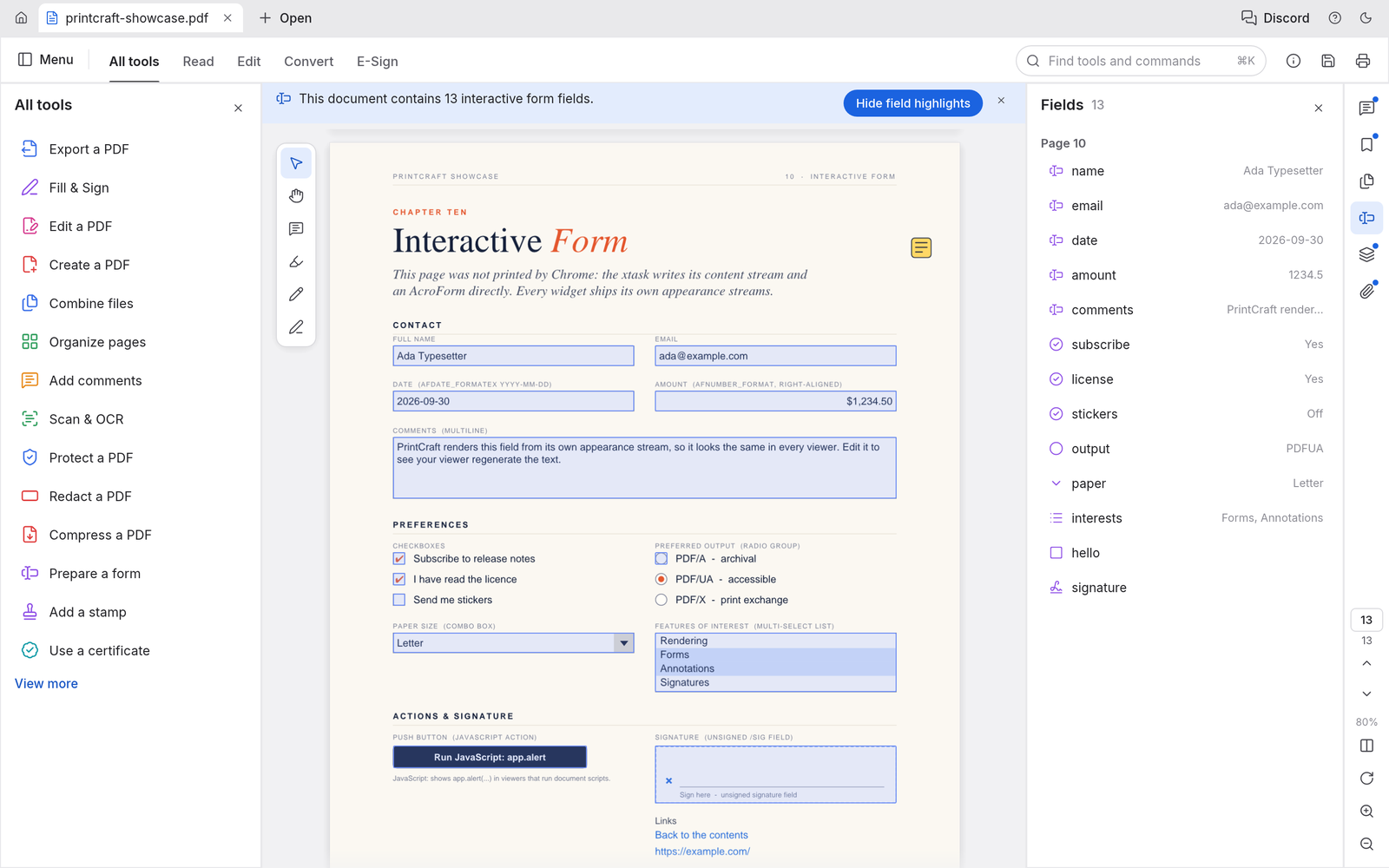 | 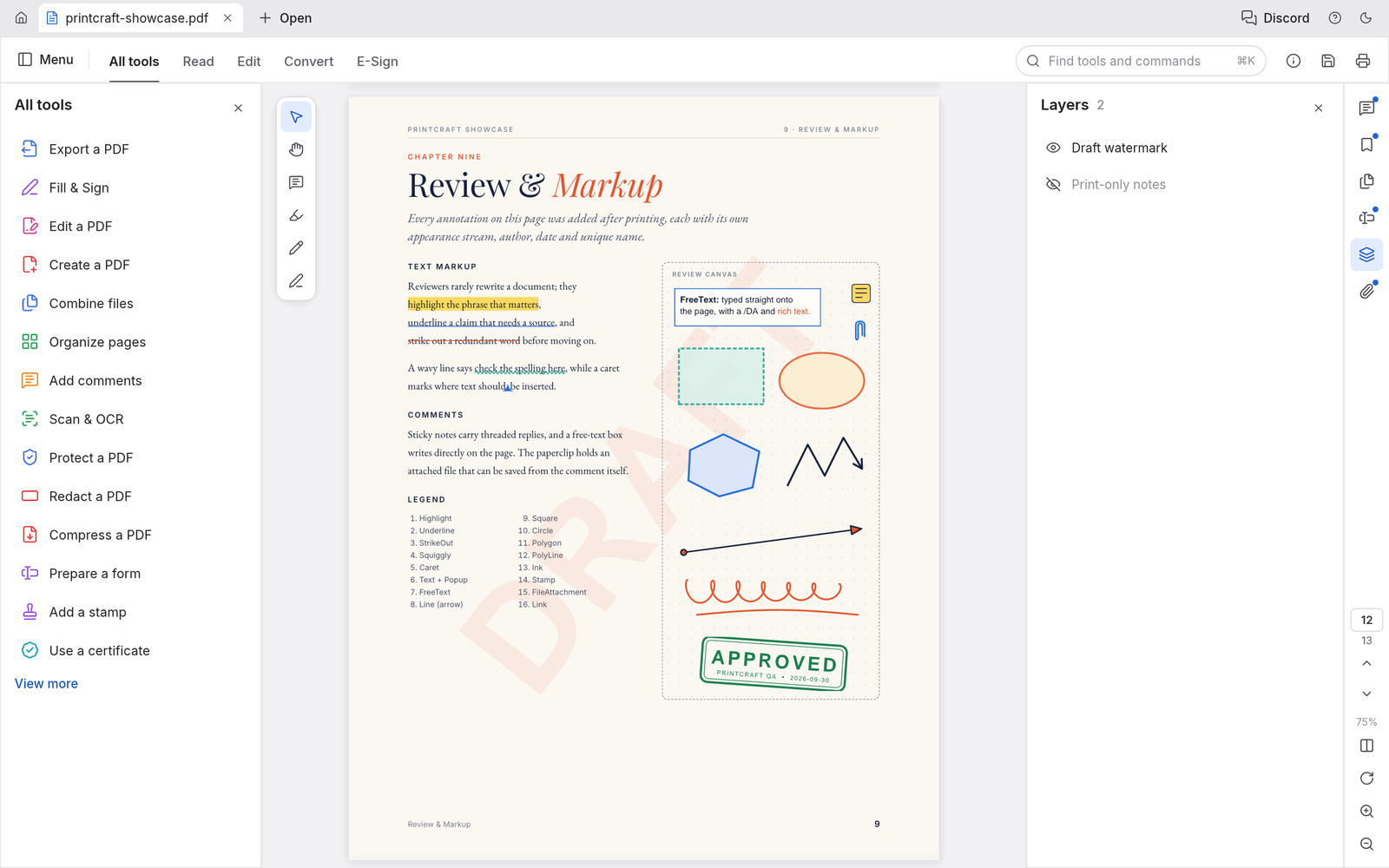 |
| Forms: every field with its current value, field highlighting, and checkboxes, radio buttons, lists and signatures drawn the way their author designed them. | Layers: switch optional content on and off and the page re-renders instantly. Comments appear as threaded conversations, and attachments can be opened or saved. |
Every tool, one keystroke away
Press ⌘K to search every tool and command, or browse the All tools catalogue. Tools that are still in development are marked with the milestone that will ship them.
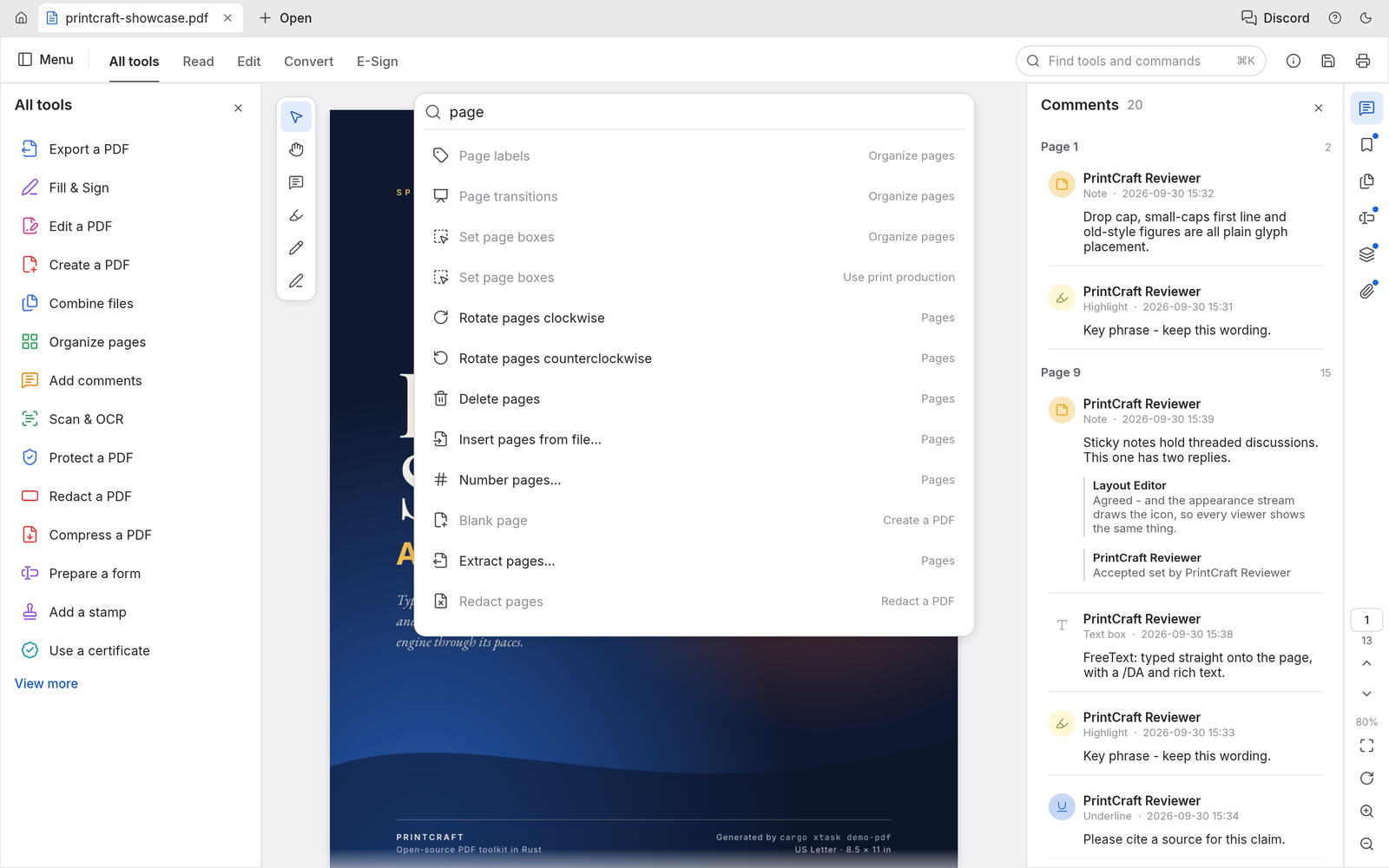 | 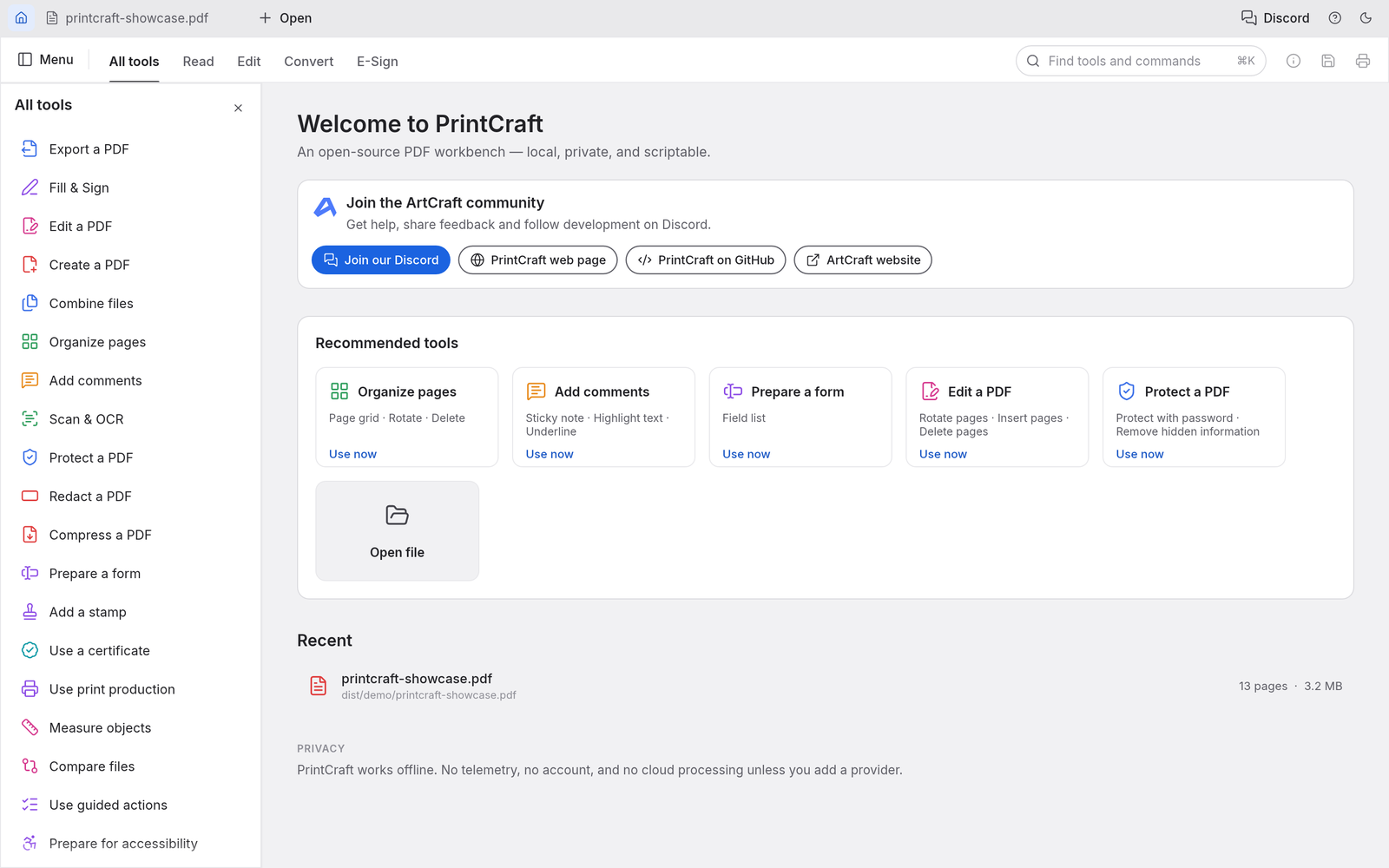 |
| The ⌘K command palette | The home screen and the All tools catalogue |
Runs everywhere, stays yours
- Native on macOS, Windows and Linux, and in the browser through WebAssembly, from the same Rust codebase.
- Private by design. Documents never leave your machine. There's no account, no telemetry and no cloud processing.
- Engine first. Parsing, rendering and editing live in reusable library crates. The interface is one swappable layer on top.
- Scriptable. The
printcraft-clitool (see Built for agents, too) covers inspecting, rendering, extracting text, editing, combining, extracting pages and splitting. Robustness sweeps run on the same engine as the app.
printcraft-cli info  form.pdf                                  # structure as JSON
printcraft-cli text  paper.pdf --page 3                        # reading-order text
printcraft-cli edit  in.pdf --rotate 1,2:90 --delete 5 --title "Q3" --out out.pdf
Built for agents, too
Every engine feature is reachable without the GUI, through one table of JSON-Schema-described tools: open, inspect, render pages to PNG, extract and find text, rotate, delete, move and insert pages, edit bookmarks and page labels, add, reply to, restyle and delete comments (highlight a phrase just by naming it), list and fill in form fields, protect with passwords, set metadata, undo and redo, save, combine, extract and split. Three front doors share it:
-
printcraft-cli run, for one-off calls and JSON scripts:printcraft-cli tools # every tool and its JSON Schema printcraft-cli run text_find doc=1 query=invoice # key=value; values parse as JSON printcraft-cli run --script review.json # e.g. comment_add {"type": "highlight", "find": "total due"} printcraft-cli run --script steps.json --root ./work # several steps in one session -
An MCP server, for AI agents such as Claude. It is opt-in: PrintCraft never starts it on its own, and it opens no network port. It runs only while an agent launches
printcraft-cli mcp, talks over stdin/stdout, and stops when the agent disconnects. To enable it, add it to your agent's MCP configuration:{ "mcpServers": { "printcraft": { "command": "printcraft-cli", "args": ["mcp", "--root", "/path/to/your/pdfs"] } } }--rootconfines every file the agent can read or write to one directory. Builds that should not include the server at all can usecargo build -p printcraft-cli --no-default-features. -
The Rust API (
printcraft_automation::Automation::call), for embedding.
Edits stay in memory, undoable, until doc_save. Saving to the same file appends an incremental update, so the original bytes are preserved, and the write is atomic. Unsaved changes are never discarded silently.
Driving the app itself
Start the desktop app with printcraft --control /tmp/pc.json and an agent can see and operate the real interface: the widget tree with labels and positions (from the accessibility tree), clicks, typing, keys, commands, view options and screenshots. This is also off by default. It listens only on loopback, and every connection must present the random token written to that file, which only you can read.
printcraft-cli ui --control /tmp/pc.json inspect query=rotate      # find widgets
printcraft-cli ui --control /tmp/pc.json click label="Organize pages"
printcraft-cli ui --control /tmp/pc.json key key=K modifiers='["command"]'
printcraft-cli ui --control /tmp/pc.json command id=comment.square   # pick a tool, then draw:
printcraft-cli ui --control /tmp/pc.json drag from='[400,300]' to='[600,420]'
printcraft-cli ui --control /tmp/pc.json screenshot --out window.png
How it's built
PrintCraft is a Cargo workspace of focused crates, layered so the core never depends on the UI:
| Crate | What it does |
|---|---|
printcraft-filters | Every PDF stream filter (Flate, LZW, ASCII85, RunLength, predictors), encode and decode, property-tested |
printcraft-crypt | The standard security handler: RC4, AES-128/256, revisions 2–6, permissions |
printcraft-cos | The PDF object layer: tolerant parsing, repair, copy-on-write edits, incremental and full writing |
printcraft-organize | Page operations, combine / extract / split, bookmarks, page labels, document information |
printcraft-fonts | Font metrics and encodings for generated appearances |
printcraft-annot | Comments: builders and appearance streams for notes, text markup, shapes, ink and text boxes; replies, status, edits |
printcraft-forms | Interactive forms: the field model, filling with regenerated appearances, Clear form |
printcraft-render | Rendering, inspection and text extraction with reading order |
printcraft-engine | The façade every frontend uses: sessions, edits, undo, saving, the tool catalogue |
printcraft-automation | Agent control: the headless tool table, printcraft-cli run, and the opt-in MCP server |
printcraft-ui-egui | The desktop and web interface |
Quality gates. Every change passes the same automated checks:
- formatting, and Clippy with warnings as errors;
- 200+ unit, property and UI tests;
- crate-layering rules and a WebAssembly build check;
- an asset-licence audit.
On top of those, two corpus sweeps run over real-world files:
- Opening and rendering: of the 983 pdf.js test files, 963 open and render cleanly, with 0 crashes.
- Open, edit and save round trips: 958 succeed.
The output is verified with independent tools: hayro, qpdf and poppler.
PrintCraft is a clean-room implementation. Its behaviour comes from the ISO 32000 specification and black-box observation, never from anyone else's code. Every icon, font and image is openly licensed and listed in ATTRIBUTION.md.
Get started
git clone https://github.com/storytold/printcraft
cd printcraft
cargo run --release -p printcraft -- some.pdf     # desktop app
cargo xtask demo-pdf                              # build the showcase PDF used in these screenshots
cargo xtask screenshots                           # regenerate every screenshot in this README
What's next
PrintCraft is young and moving fast. The aim is a workbench where you can view, organize, annotate, fill, sign and edit PDFs, at parity with Acrobat Pro.
Available today:
- viewing, search and navigation;
- organizing pages, combining, extracting and splitting; bookmarks and page labels;
- commenting: sticky notes, highlight / underline / strikethrough, text boxes, freehand drawing, lines, arrows, rectangles and ovals, with replies, status, colours, moving, resizing and a searchable Comments panel;
- filling in forms: text fields, check boxes, radio buttons, combo and list boxes, Tab between fields, Clear form;
- password protection: a password to open, permissions (printing, changes, copying), AES-256, removing security;
- document information;
- opening encrypted documents, honouring their permissions, and saving them encrypted;
- undo and safe saving;
- autosave with crash recovery;
- a single command registry behind menus, shortcuts and the palette;
- agent control through the CLI and an opt-in MCP server.
On the roadmap:
| Next up | Milestone |
|---|---|
| Page boxes | M4 |
| Callouts, clouds, stamps, FDF/XFDF, comment summaries | M5 |
| Authoring forms, JavaScript (formatting, calculations) | M6 |
| Editing text and images in place, headers, watermarks | M7 |
| Certificate security, redaction, sanitizing | M8 |
| Digital signatures (PAdES) | M9 |
| OCR, export to Office formats, printing | M10 |
| Optimize, preflight, PDF/A | M11 |
| Accessibility, compare, measure | M12 |
The full plan, with progress and estimates, is in ROADMAP.md.
The Crafting Apps
PrintCraft is one of the Crafting Apps: free, open-source creative tools from the ArtCraft team, each written from scratch in Rust and each able to stand on its own.
| App | What it's for | Code | Learn more | |
|---|---|---|---|---|
 | PhotoCraft | Image editing: layers, masks, type and real PSD files | GitHub | Website |
 | VectorCraft | Vector illustration | GitHub | Website |
 | FilmCraft | Video editing, color and sound | GitHub | Website |
 | LightCraft | Photo library and raw development | GitHub | Website |
 | PrintCraft | Reading, organizing and protecting PDFs · you are here | GitHub | Website |
 | EffectCraft | Motion graphics and visual effects | GitHub | Website |
 | DesignCraft | Page layout and publishing | GitHub | Website |
And ArtCraft itself, our AI image and video studio for artists who want real control.
Come make things with us
Our Discord is where artists of every kind hang out: people who paint, shoot, draw, cut film, set type, and people still figuring out what they like to make. Share what you're working on, ask for help, tell us what's broken, or tell us what you wish these tools could do. Whatever your medium and however long you've been at it, you're welcome here.
discord.gg/artcraft · getartcraft.com · The Crafting Apps · PrintCraft
Licence
MIT OR Apache-2.0 (LICENSE-MIT, LICENSE-APACHE). Every icon, font and image is openly licensed and listed, with its author and source, in ATTRIBUTION.md. The policy is in AGENTS.md, and required notices are in NOTICE. Contributors and agents: read AGENTS.md and CLAUDE.md.
Adobe, Photoshop, Illustrator, Premiere Pro, Lightroom, Acrobat, After Effects and InDesign are trademarks or registered trademarks of Adobe Inc. in the United States and/or other countries. PrintCraft is an independent, open-source project and is not affiliated with, sponsored by or endorsed by Adobe Inc.; these names are used only to describe the workflows it is compatible with.

Made by the ArtCraft team and community.


See what people are saying
README
PrintCraft
The PDF workbench; an open-source, clean-room reimplementation of Adobe Acrobat, rebuilt in pure Rust.
Read, organize, combine, split and secure PDFs in a fast, native app, written in Rust from the ground up.
macOS · Windows · Linux · the web
PrintCraft on getartcraft.com · ArtCraft · All Crafting Apps
The PrintCraft Showcase, a 13-page specimen PDF, open with the All tools panel and threaded comments.
[!NOTE] ArtCraft is a community of artists from all walks of life. Digital, generative, music, games — if you make things, you're one of us. Come say hi on Discord.
Highlights · Read · Find · Organize · Combine & split · Protect · Forms & layers · Everywhere · Agents · How it's built · Get started · What's next · Crafting Apps
Community
PrintCraft is part of ArtCraft. Come say hello, get help and follow development:
- Discord: discord.gg/artcraft. This is the fastest way to get help and share feedback. The app has a Discord button in its title bar.
- Web page: getartcraft.com/apps/printcraft
- Source: github.com/storytold/printcraft
The ArtCraft name and logos in docs/brand/ belong to Storyteller and are not open source (see docs/brand/LICENSE-brand.txt). Forks must remove them.
Highlights
FaithfulReal-world typography: world scripts, vertical Japanese, colour emoji, gradients, soft masks and transparency. All of it renders the way the author intended. |
FearlessEvery save appends your changes and leaves the original bytes untouched. Writes are atomic, undo runs deep, and nothing is lost if you close by mistake. |
YoursNo account, no telemetry, no cloud. It works offline and opens instantly. The engine, CLI and app are all open source. |
Read anything, beautifully
PrintCraft renders PDFs with care for the details that make a page feel right: kerning and ligatures, right-to-left and complex scripts, vertical CJK, colour emoji, shadings, blend modes, soft masks and optional content.
Twelve writing systems on one page, plus vertical Japanese, at 125%.
- Deep zoom stays sharp. Large pages render in tiles, so text stays crisp at any magnification.
- Built to survive bad files. Every page renders in isolation and damaged documents are repaired. Across the 983-file pdf.js test corpus the result is 0 crashes.
- Layouts for every task: continuous, single page, two-up, view rotation, full screen and a distraction-free Read mode.
- Light and dark themes, both designed to be easy on the eyes for long sessions.
| |
| Two-up Read mode, ready for long reading | The dark theme, with the comments panel open |
Find it, select it, copy it
Search the whole document as you type, step through matches with ⌘G, and select text that comes out in the right reading order. That holds for columns, right-to-left runs and CJK too.
Navigate long documents
Bookmarks, page thumbnails and the document's own page labels (i, ii, 1, 2…) keep you oriented in long documents.
| |
| Find as you type: match 10 of 16 | Nested bookmarks with the document's own page labels |
Organize pages like cards on a table
Open Organize pages to see every page at once:
- Select pages: click, ⌘-click or ⇧-click.
- Change them: rotate, delete, insert blank pages, insert pages from another file, and move them earlier or later.
- Undo anything: ⌘Z, then save.
Organize pages with three pages selected and the page tools in the toolbar above.
|
Undo that goes the distance. Each change is one step in a history you can walk backwards and forwards. The Edit menu names the step ("Undo Rotate pages"), and undo still works after you save. Saves you can trust:
Unsaved documents carry a dot on their tab, and closing or quitting asks before anything is lost. Changes are autosaved every minute. If PrintCraft ever quits unexpectedly, it offers to recover your work the next time it opens. Encrypted documents stay encrypted on disk. | Split document: one page per file makes 13 files. |
Combine and split without losing a thing
Combine files merges any number of PDFs into one. Each file gets a bookmark, with its own bookmarks nested underneath.
Extract copies the pages you select into a new document. Split divides a document every n pages, or before the pages you choose.
Nothing quietly disappears along the way:
- links and named destinations are rewired to the copied pages;
- form fields stay interactive;
- layers keep their on/off defaults;
- attachments come along.
Every page of a combined document renders pixel-identical to its source.
printcraft-cli combine report.pdf appendix.pdf --out combined.pdf
printcraft-cli extract report.pdf --pages 1,3,5 --out highlights.pdf
printcraft-cli split   report.pdf --every 10 --out-dir parts/
Open protected documents and respect their rules
PrintCraft implements the PDF standard security handler completely:
- every revision, from 40-bit RC4 to AES-256;
- user and owner passwords, including Unicode passwords normalised with SASLprep;
- crypt filters and attachment-only encryption.
Documents restricted by their author show a clear notice, and PrintCraft honours their permissions. Enter the owner password and the restrictions lift. Edits to encrypted documents are saved encrypted, under the same keys.
Document Properties, Description tab |
Document Properties shows:
|
Comments, forms, layers and attachments
| |
| Forms: every field with its current value, field highlighting, and checkboxes, radio buttons, lists and signatures drawn the way their author designed them. | Layers: switch optional content on and off and the page re-renders instantly. Comments appear as threaded conversations, and attachments can be opened or saved. |
Every tool, one keystroke away
Press ⌘K to search every tool and command, or browse the All tools catalogue. Tools that are still in development are marked with the milestone that will ship them.
| |
| The ⌘K command palette | The home screen and the All tools catalogue |
Runs everywhere, stays yours
- Native on macOS, Windows and Linux, and in the browser through WebAssembly, from the same Rust codebase.
- Private by design. Documents never leave your machine. There's no account, no telemetry and no cloud processing.
- Engine first. Parsing, rendering and editing live in reusable library crates. The interface is one swappable layer on top.
- Scriptable. The
printcraft-clitool (see Built for agents, too) covers inspecting, rendering, extracting text, editing, combining, extracting pages and splitting. Robustness sweeps run on the same engine as the app.
printcraft-cli info  form.pdf                                  # structure as JSON
printcraft-cli text  paper.pdf --page 3                        # reading-order text
printcraft-cli edit  in.pdf --rotate 1,2:90 --delete 5 --title "Q3" --out out.pdf
Built for agents, too
Every engine feature is reachable without the GUI, through one table of JSON-Schema-described tools: open, inspect, render pages to PNG, extract and find text, rotate, delete, move and insert pages, edit bookmarks and page labels, add, reply to, restyle and delete comments (highlight a phrase just by naming it), list and fill in form fields, protect with passwords, set metadata, undo and redo, save, combine, extract and split. Three front doors share it:
-
printcraft-cli run, for one-off calls and JSON scripts:printcraft-cli tools # every tool and its JSON Schema printcraft-cli run text_find doc=1 query=invoice # key=value; values parse as JSON printcraft-cli run --script review.json # e.g. comment_add {"type": "highlight", "find": "total due"} printcraft-cli run --script steps.json --root ./work # several steps in one session -
An MCP server, for AI agents such as Claude. It is opt-in: PrintCraft never starts it on its own, and it opens no network port. It runs only while an agent launches
printcraft-cli mcp, talks over stdin/stdout, and stops when the agent disconnects. To enable it, add it to your agent's MCP configuration:{ "mcpServers": { "printcraft": { "command": "printcraft-cli", "args": ["mcp", "--root", "/path/to/your/pdfs"] } } }--rootconfines every file the agent can read or write to one directory. Builds that should not include the server at all can usecargo build -p printcraft-cli --no-default-features. -
The Rust API (
printcraft_automation::Automation::call), for embedding.
Edits stay in memory, undoable, until doc_save. Saving to the same file appends an incremental update, so the original bytes are preserved, and the write is atomic. Unsaved changes are never discarded silently.
Driving the app itself
Start the desktop app with printcraft --control /tmp/pc.json and an agent can see and operate the real interface: the widget tree with labels and positions (from the accessibility tree), clicks, typing, keys, commands, view options and screenshots. This is also off by default. It listens only on loopback, and every connection must present the random token written to that file, which only you can read.
printcraft-cli ui --control /tmp/pc.json inspect query=rotate      # find widgets
printcraft-cli ui --control /tmp/pc.json click label="Organize pages"
printcraft-cli ui --control /tmp/pc.json key key=K modifiers='["command"]'
printcraft-cli ui --control /tmp/pc.json command id=comment.square   # pick a tool, then draw:
printcraft-cli ui --control /tmp/pc.json drag from='[400,300]' to='[600,420]'
printcraft-cli ui --control /tmp/pc.json screenshot --out window.png
How it's built
PrintCraft is a Cargo workspace of focused crates, layered so the core never depends on the UI:
| Crate | What it does |
|---|---|
printcraft-filters | Every PDF stream filter (Flate, LZW, ASCII85, RunLength, predictors), encode and decode, property-tested |
printcraft-crypt | The standard security handler: RC4, AES-128/256, revisions 2–6, permissions |
printcraft-cos | The PDF object layer: tolerant parsing, repair, copy-on-write edits, incremental and full writing |
printcraft-organize | Page operations, combine / extract / split, bookmarks, page labels, document information |
printcraft-fonts | Font metrics and encodings for generated appearances |
printcraft-annot | Comments: builders and appearance streams for notes, text markup, shapes, ink and text boxes; replies, status, edits |
printcraft-forms | Interactive forms: the field model, filling with regenerated appearances, Clear form |
printcraft-render | Rendering, inspection and text extraction with reading order |
printcraft-engine | The façade every frontend uses: sessions, edits, undo, saving, the tool catalogue |
printcraft-automation | Agent control: the headless tool table, printcraft-cli run, and the opt-in MCP server |
printcraft-ui-egui | The desktop and web interface |
Quality gates. Every change passes the same automated checks:
- formatting, and Clippy with warnings as errors;
- 200+ unit, property and UI tests;
- crate-layering rules and a WebAssembly build check;
- an asset-licence audit.
On top of those, two corpus sweeps run over real-world files:
- Opening and rendering: of the 983 pdf.js test files, 963 open and render cleanly, with 0 crashes.
- Open, edit and save round trips: 958 succeed.
The output is verified with independent tools: hayro, qpdf and poppler.
PrintCraft is a clean-room implementation. Its behaviour comes from the ISO 32000 specification and black-box observation, never from anyone else's code. Every icon, font and image is openly licensed and listed in ATTRIBUTION.md.
Get started
git clone https://github.com/storytold/printcraft
cd printcraft
cargo run --release -p printcraft -- some.pdf     # desktop app
cargo xtask demo-pdf                              # build the showcase PDF used in these screenshots
cargo xtask screenshots                           # regenerate every screenshot in this README
What's next
PrintCraft is young and moving fast. The aim is a workbench where you can view, organize, annotate, fill, sign and edit PDFs, at parity with Acrobat Pro.
Available today:
- viewing, search and navigation;
- organizing pages, combining, extracting and splitting; bookmarks and page labels;
- commenting: sticky notes, highlight / underline / strikethrough, text boxes, freehand drawing, lines, arrows, rectangles and ovals, with replies, status, colours, moving, resizing and a searchable Comments panel;
- filling in forms: text fields, check boxes, radio buttons, combo and list boxes, Tab between fields, Clear form;
- password protection: a password to open, permissions (printing, changes, copying), AES-256, removing security;
- document information;
- opening encrypted documents, honouring their permissions, and saving them encrypted;
- undo and safe saving;
- autosave with crash recovery;
- a single command registry behind menus, shortcuts and the palette;
- agent control through the CLI and an opt-in MCP server.
On the roadmap:
| Next up | Milestone |
|---|---|
| Page boxes | M4 |
| Callouts, clouds, stamps, FDF/XFDF, comment summaries | M5 |
| Authoring forms, JavaScript (formatting, calculations) | M6 |
| Editing text and images in place, headers, watermarks | M7 |
| Certificate security, redaction, sanitizing | M8 |
| Digital signatures (PAdES) | M9 |
| OCR, export to Office formats, printing | M10 |
| Optimize, preflight, PDF/A | M11 |
| Accessibility, compare, measure | M12 |
The full plan, with progress and estimates, is in ROADMAP.md.
The Crafting Apps
PrintCraft is one of the Crafting Apps: free, open-source creative tools from the ArtCraft team, each written from scratch in Rust and each able to stand on its own.
| App | What it's for | Code | Learn more | |
|---|---|---|---|---|
| PhotoCraft | Image editing: layers, masks, type and real PSD files | GitHub | Website |
| VectorCraft | Vector illustration | GitHub | Website |
| FilmCraft | Video editing, color and sound | GitHub | Website |
| LightCraft | Photo library and raw development | GitHub | Website |
| PrintCraft | Reading, organizing and protecting PDFs · you are here | GitHub | Website |
| EffectCraft | Motion graphics and visual effects | GitHub | Website |
| DesignCraft | Page layout and publishing | GitHub | Website |
And ArtCraft itself, our AI image and video studio for artists who want real control.
Come make things with us
Our Discord is where artists of every kind hang out: people who paint, shoot, draw, cut film, set type, and people still figuring out what they like to make. Share what you're working on, ask for help, tell us what's broken, or tell us what you wish these tools could do. Whatever your medium and however long you've been at it, you're welcome here.
discord.gg/artcraft · getartcraft.com · The Crafting Apps · PrintCraft
Licence
MIT OR Apache-2.0 (LICENSE-MIT, LICENSE-APACHE). Every icon, font and image is openly licensed and listed, with its author and source, in ATTRIBUTION.md. The policy is in AGENTS.md, and required notices are in NOTICE. Contributors and agents: read AGENTS.md and CLAUDE.md.
Adobe, Photoshop, Illustrator, Premiere Pro, Lightroom, Acrobat, After Effects and InDesign are trademarks or registered trademarks of Adobe Inc. in the United States and/or other countries. PrintCraft is an independent, open-source project and is not affiliated with, sponsored by or endorsed by Adobe Inc.; these names are used only to describe the workflows it is compatible with.
Made by the ArtCraft team and community.
Similar repos
Languages
Rust
97.0%
HTML
2.0%