Repo to demonstrate Agent Gateway capabilities - Free for Individuals
0
0 commits
updated Oct 16, 2026
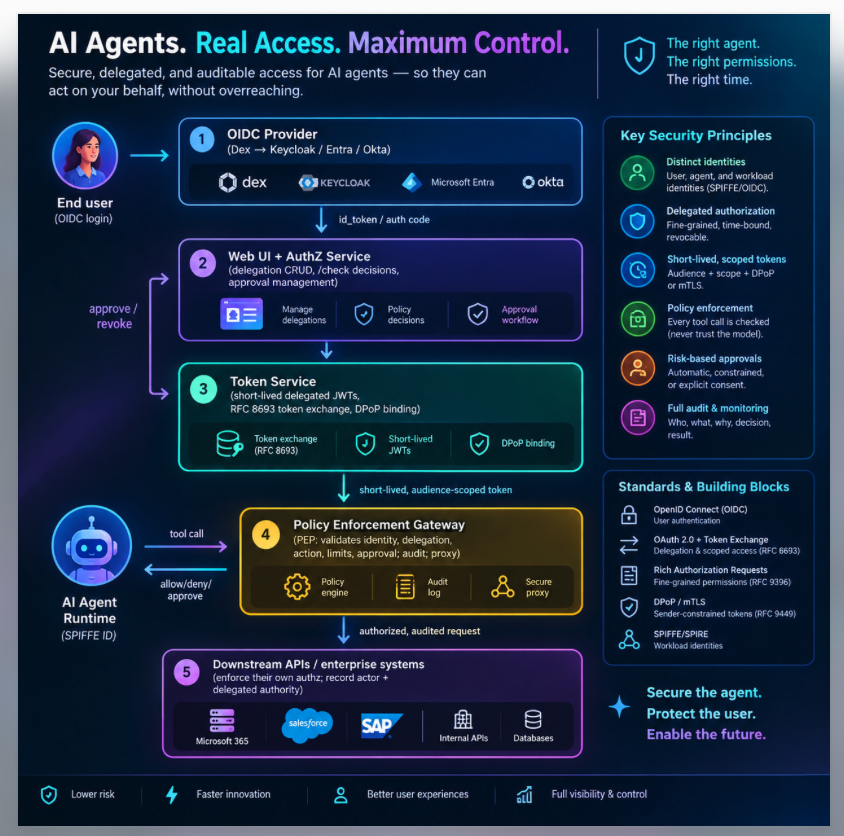
Status note on the diagram. Two panels describe the target design and are not implemented yet: DPoP / RFC 9449 (sender-constrained, key-bound tokens) and Rich Authorization Requests / RFC 9396 (structured negotiation of fine-grained permissions at the token endpoint). Everything else shown — OIDC sign-in (Dex ships; Keycloak / Entra / Okta connect via
OIDC_ISSUER_URL), delegations, RFC 8693 token exchange, short-lived scoped tokens, the PEP with approval + audit, SPIFFE/SPIRE workload identity — is live in the shipped images. Progress is tracked in the project's roadmap; Production deployments relying on either panel should ask the vendor before designing around them.
📑 Reading the docs: all links in this README are relative so the repository stays portable. If a documentation link lands on a 404 in your git server's front page, open
README.mdfrom the file view (…/src/branch/main/README.md) or browse thedocs/folder — the same relative paths resolve correctly there (and always will on GitHub).
🚧 Early preview — and your feedback sets the direction. Agent Gateway is a new project, published so you can pull it, run it and try it. Nothing here is frozen: what gets built next (agent-request flows, fine-grained delegations, per-tool MCP enforcement, DPoP/RAR…) is decided largely by what users tell us matters. If you run the demos, deploy it to your own stack, or just disagree with a design choice — write to [email protected] or open an issue on this repository; both go straight into the roadmap. Everything is free (including a non-expiring licence by email) — see Pricing.
Public demo repository. Pull the pre-built Docker images, run one compose stack, and see a complete authorization system for AI agents live: SSO delegations, short-lived agent credentials, spend caps with automatic approvals, single-use human approvals for high-risk actions, instant revocation, and an immutable audit trail.
💡 Fastest path: Quickstart → two minutes to a running stack. Then run the demos (scripted, graphical and policy playground).
AI agents call tools that do real things — payments, deployments, data exports. "Trust me, the agent knows what it's doing" is not a control you can put in front of an auditor. Agent Gateway puts a policy enforcement point in front of every tool call:
approval.required webhook to your automation (Slack, Teams,
n8n, PagerDuty — setup in docs/Notifications.md)
and the console shows a pending badge, so the human is told, not polled. A named human approves
(or denies) the exact action hash — single-use, replay-proof. OIDC (Okta / Entra / Keycloak / Dex)
Human ──────────────► ┌─────────────────────────────┐
│ authz (decision point) │ delegations, policy,
│ :8081 │ user identity (OIDC)
╰──────────┬──────────────────╯
│ mint scoped token
┌──────────▼──────────────────┐
AI Agent ──token──► │ gateway (enforcement point)│ every call: resolve
│ :8080 │ principal → policy →
╰──────────┬──────────────────╯ approve? → audit
│ forward only if allowed · held → approval.required webhook
┌──────────▼──────────────────┐
│ your tools / internal APIs │
╰─────────────────────────────┘
Held for approval? The gateway pushes an HMAC-signed approval.required
webhook to your automation (Slack / Teams / n8n / PagerDuty — setup in
[docs/Notifications.md](docs/Notifications.md)); the console shows a
pending badge + toast.
Supporting services:
tokensvc :8082 mints short-lived, delegation-scoped JWTs
web :8083 admin UI: delegations, approvals, audit + guided demo
postgres :5432 durable store (delegations, approvals, audit)
redis :6379 instant token revocation + decision cache
Deep dive: docs/Architecture.md.
| Path | What it is |
|---|---|
demo/ | One-command demo stack: docker-compose.yml, Dex config, demo keys, scripted walkthrough (demo.sh), and the default OPA policy (policies/) with a policy-engine override (docker-compose.opa.yml) |
docs/Deployment-Guide.md | From Docker Hub images to a highly available enterprise deployment (Kubernetes, OIDC against any IdP, SPIFFE mTLS, Postgres/Redis HA, SIEM integration) |
docs/Agent-Identity.md | How proliferating agents are admitted, what stops name-impersonation, the credential ceremony |
docs/Integration-Patterns.md | Inserting the gateway between existing agents and back ends/MCP servers with zero or one-line changes |
docs/Local-Agents.md | Personal/local agent runtimes (OpenClaw, Hermes, your own) — per-skill delegations, MCP adapter, spend caps, phone-side revoke |
docs/Architecture.md | How the pieces fit, the policy model, security properties |
docs/Policy-and-OPA.md | Policy as code: the OPA/Rego engine — decision contract, authoring, testing, hot reload |
docs/Demos.md | Runbook for the demos and what each step proves |
docs/Security-and-Licensing.md | How image encryption + vendor licence + your keys work at runtime |
docs/Commercial-Licence.md | Licence terms: what you get, what is not warranted, liability limits, indemnity |
docs/Pricing.md | Licensing tiers and buying path |
LICENSE | MIT for this repository's documentation and demo assets |
Requirements: Docker Engine 24+, docker compose, curl, jq optional.
cd demo
docker compose up -d          # 7 containers, first pull takes a minute
./demo.sh                     # scripted end-to-end walkthrough
Then open:
| URL | What |
|---|---|
| http://localhost:8083/demo.html | Graphical guided demo (animated, interactive — great to show people) |
| http://localhost:8083 | Admin console: create/revoke delegations, decide approvals, full audit trail |
| http://localhost:8083/policy.html | OPA policy playground — edit the live Rego policy and watch hot reload (needs demo/docker-compose.opa.yml) |
| http://localhost:8080/v1/* | The gateway itself — this is the endpoint your agents call |
The bundled development SSO has two fixture human accounts ([email protected],
[email protected]) — they exist only in the demo IdP so logins work with no
setup. In production you point OIDC_ISSUER_URL at your own enterprise IdP;
your real users sign in with corporate credentials and the console instead
shows "Signed in as · verified ✓" bound to the verified subject.
Everything runs from published images on Docker Hub
(stevef1uk/agent-gateway-{authz,gateway,tokensvc,web}) — no source, no build.
The included demo/keys/ are development fixtures matching the keys baked into
those images; regenerate through the vendor for your own customers
(Security-and-Licensing.md).
cd demo && docker compose up -d
./demo.sh
See it walk the entire story live, step by step — SSO sign-in → delegation → agent token → €150 order auto-allowed (HTTP 200) → €250 order held (HTTP 202 + approval id) → you approve → order executes → revoke → next agent call denied (HTTP 403) with the token still valid on the wire.
Open http://localhost:8083/demo.html on the same stack.
Nine interactive steps with animated request flows, a live spend-cap meter, health pills for every service and a live audit feed. Sign-in is one click (the IdP is relayed by the web tier — no /etc/hosts or extra setup on your machine) and all calls are real — nothing simulated. This is the demo to run on screen in a meeting.
Bring the stack up with the policy engine switched on:
cd demo
docker compose -f docker-compose.yml -f docker-compose.opa.yml up -d
Then open http://localhost:8083/policy.html. It shows the live Rego policy
the authorization service is enforcing, lets you edit and apply it, and runs
decision probes against the running engine — so you watch the hot reload
take effect in seconds. Apply compiles your edit first, so an edit that does
not compile is called out with the exact compiler error instead of appearing to
do nothing; breaking the policy on purpose is refused and the previous policy
keeps serving; Restore initial policy puts the committed
version back, and Reload from file re-reads it after a host-side
git restore (the page also refreshes itself when the file changes on disk).
Full story: docs/Policy-and-OPA.md and
docs/Demos.md.
| Service | URL |
|---|---|
| Web console | http://localhost:8083 |
| Guided demo (graphical) | http://localhost:8083/demo.html |
| OPA policy playground | http://localhost:8083/policy.html (needs the policy override) |
| Gateway (PEP) | http://localhost:8080 |
| Authz service | http://localhost:8081 |
| Token service | http://localhost:8082 |
| OIDC provider (Dex) | http://localhost:5556 |
When you are done playing: docs/Deployment-Guide.md covers production operation of the same images — Postgres/Redis HA, Kubernetes, any OIDC IdP, SPIFFE/workload identity (mTLS), licence lifecycle, upgrade procedures and a troubleshooting reference.
The product is free — including a non-expiring licence token by email. What is paid is the author's time and commercial terms:
| Tier | Price | What you get |
|---|---|---|
| Users & Developers | free | full product, non-expiring licence by email, community support |
| Business | book me for a week | hands-on deployment, IdP/agent/HA integration with your team, enablement |
| Software Licence | €5,000 one-off | full source, royalty-free, perpetual |
Support is email at every tier, best-effort — no SLA at this stage. Every tier runs under the same commercial licence (AS-IS, no fitness warranty, liability capped — see docs/Commercial-Licence.md). Details and rationale: docs/Pricing.md.
Documentation and demo assets in this repository: MIT (see LICENSE).
The software itself is distributed as pre-built Docker images under a
commercial licence from the vendor — terms, warranty disclaimer and
liability limits at docs/Commercial-Licence.md.
In brief: the software is provided AS IS, with all faults, without warranty
of fitness for any particular purpose; you evaluate it before production
use; liability is capped at fees paid in the preceding 12 months (nil on free
tiers); and every consequential action an agent takes under a delegation
remains your organisation's responsibility.
Repo to demonstrate Agent Gateway capabilities - Free for Individuals
0
0 commits
updated Oct 16, 2026
Status note on the diagram. Two panels describe the target design and are not implemented yet: DPoP / RFC 9449 (sender-constrained, key-bound tokens) and Rich Authorization Requests / RFC 9396 (structured negotiation of fine-grained permissions at the token endpoint). Everything else shown — OIDC sign-in (Dex ships; Keycloak / Entra / Okta connect via
OIDC_ISSUER_URL), delegations, RFC 8693 token exchange, short-lived scoped tokens, the PEP with approval + audit, SPIFFE/SPIRE workload identity — is live in the shipped images. Progress is tracked in the project's roadmap; Production deployments relying on either panel should ask the vendor before designing around them.
📑 Reading the docs: all links in this README are relative so the repository stays portable. If a documentation link lands on a 404 in your git server's front page, open
README.mdfrom the file view (…/src/branch/main/README.md) or browse thedocs/folder — the same relative paths resolve correctly there (and always will on GitHub).
🚧 Early preview — and your feedback sets the direction. Agent Gateway is a new project, published so you can pull it, run it and try it. Nothing here is frozen: what gets built next (agent-request flows, fine-grained delegations, per-tool MCP enforcement, DPoP/RAR…) is decided largely by what users tell us matters. If you run the demos, deploy it to your own stack, or just disagree with a design choice — write to [email protected] or open an issue on this repository; both go straight into the roadmap. Everything is free (including a non-expiring licence by email) — see Pricing.
Public demo repository. Pull the pre-built Docker images, run one compose stack, and see a complete authorization system for AI agents live: SSO delegations, short-lived agent credentials, spend caps with automatic approvals, single-use human approvals for high-risk actions, instant revocation, and an immutable audit trail.
💡 Fastest path: Quickstart → two minutes to a running stack. Then run the demos (scripted, graphical and policy playground).
AI agents call tools that do real things — payments, deployments, data exports. "Trust me, the agent knows what it's doing" is not a control you can put in front of an auditor. Agent Gateway puts a policy enforcement point in front of every tool call:
approval.required webhook to your automation (Slack, Teams,
n8n, PagerDuty — setup in docs/Notifications.md)
and the console shows a pending badge, so the human is told, not polled. A named human approves
(or denies) the exact action hash — single-use, replay-proof. OIDC (Okta / Entra / Keycloak / Dex)
Human ──────────────► ┌─────────────────────────────┐
│ authz (decision point) │ delegations, policy,
│ :8081 │ user identity (OIDC)
╰──────────┬──────────────────╯
│ mint scoped token
┌──────────▼──────────────────┐
AI Agent ──token──► │ gateway (enforcement point)│ every call: resolve
│ :8080 │ principal → policy →
╰──────────┬──────────────────╯ approve? → audit
│ forward only if allowed · held → approval.required webhook
┌──────────▼──────────────────┐
│ your tools / internal APIs │
╰─────────────────────────────┘
Held for approval? The gateway pushes an HMAC-signed approval.required
webhook to your automation (Slack / Teams / n8n / PagerDuty — setup in
[docs/Notifications.md](docs/Notifications.md)); the console shows a
pending badge + toast.
Supporting services:
tokensvc :8082 mints short-lived, delegation-scoped JWTs
web :8083 admin UI: delegations, approvals, audit + guided demo
postgres :5432 durable store (delegations, approvals, audit)
redis :6379 instant token revocation + decision cache
Deep dive: docs/Architecture.md.
| Path | What it is |
|---|---|
demo/ | One-command demo stack: docker-compose.yml, Dex config, demo keys, scripted walkthrough (demo.sh), and the default OPA policy (policies/) with a policy-engine override (docker-compose.opa.yml) |
docs/Deployment-Guide.md | From Docker Hub images to a highly available enterprise deployment (Kubernetes, OIDC against any IdP, SPIFFE mTLS, Postgres/Redis HA, SIEM integration) |
docs/Agent-Identity.md | How proliferating agents are admitted, what stops name-impersonation, the credential ceremony |
docs/Integration-Patterns.md | Inserting the gateway between existing agents and back ends/MCP servers with zero or one-line changes |
docs/Local-Agents.md | Personal/local agent runtimes (OpenClaw, Hermes, your own) — per-skill delegations, MCP adapter, spend caps, phone-side revoke |
docs/Architecture.md | How the pieces fit, the policy model, security properties |
docs/Policy-and-OPA.md | Policy as code: the OPA/Rego engine — decision contract, authoring, testing, hot reload |
docs/Demos.md | Runbook for the demos and what each step proves |
docs/Security-and-Licensing.md | How image encryption + vendor licence + your keys work at runtime |
docs/Commercial-Licence.md | Licence terms: what you get, what is not warranted, liability limits, indemnity |
docs/Pricing.md | Licensing tiers and buying path |
LICENSE | MIT for this repository's documentation and demo assets |
Requirements: Docker Engine 24+, docker compose, curl, jq optional.
cd demo
docker compose up -d          # 7 containers, first pull takes a minute
./demo.sh                     # scripted end-to-end walkthrough
Then open:
| URL | What |
|---|---|
| http://localhost:8083/demo.html | Graphical guided demo (animated, interactive — great to show people) |
| http://localhost:8083 | Admin console: create/revoke delegations, decide approvals, full audit trail |
| http://localhost:8083/policy.html | OPA policy playground — edit the live Rego policy and watch hot reload (needs demo/docker-compose.opa.yml) |
| http://localhost:8080/v1/* | The gateway itself — this is the endpoint your agents call |
The bundled development SSO has two fixture human accounts ([email protected],
[email protected]) — they exist only in the demo IdP so logins work with no
setup. In production you point OIDC_ISSUER_URL at your own enterprise IdP;
your real users sign in with corporate credentials and the console instead
shows "Signed in as · verified ✓" bound to the verified subject.
Everything runs from published images on Docker Hub
(stevef1uk/agent-gateway-{authz,gateway,tokensvc,web}) — no source, no build.
The included demo/keys/ are development fixtures matching the keys baked into
those images; regenerate through the vendor for your own customers
(Security-and-Licensing.md).
cd demo && docker compose up -d
./demo.sh
See it walk the entire story live, step by step — SSO sign-in → delegation → agent token → €150 order auto-allowed (HTTP 200) → €250 order held (HTTP 202 + approval id) → you approve → order executes → revoke → next agent call denied (HTTP 403) with the token still valid on the wire.
Open http://localhost:8083/demo.html on the same stack.
Nine interactive steps with animated request flows, a live spend-cap meter, health pills for every service and a live audit feed. Sign-in is one click (the IdP is relayed by the web tier — no /etc/hosts or extra setup on your machine) and all calls are real — nothing simulated. This is the demo to run on screen in a meeting.
Bring the stack up with the policy engine switched on:
cd demo
docker compose -f docker-compose.yml -f docker-compose.opa.yml up -d
Then open http://localhost:8083/policy.html. It shows the live Rego policy
the authorization service is enforcing, lets you edit and apply it, and runs
decision probes against the running engine — so you watch the hot reload
take effect in seconds. Apply compiles your edit first, so an edit that does
not compile is called out with the exact compiler error instead of appearing to
do nothing; breaking the policy on purpose is refused and the previous policy
keeps serving; Restore initial policy puts the committed
version back, and Reload from file re-reads it after a host-side
git restore (the page also refreshes itself when the file changes on disk).
Full story: docs/Policy-and-OPA.md and
docs/Demos.md.
| Service | URL |
|---|---|
| Web console | http://localhost:8083 |
| Guided demo (graphical) | http://localhost:8083/demo.html |
| OPA policy playground | http://localhost:8083/policy.html (needs the policy override) |
| Gateway (PEP) | http://localhost:8080 |
| Authz service | http://localhost:8081 |
| Token service | http://localhost:8082 |
| OIDC provider (Dex) | http://localhost:5556 |
When you are done playing: docs/Deployment-Guide.md covers production operation of the same images — Postgres/Redis HA, Kubernetes, any OIDC IdP, SPIFFE/workload identity (mTLS), licence lifecycle, upgrade procedures and a troubleshooting reference.
The product is free — including a non-expiring licence token by email. What is paid is the author's time and commercial terms:
| Tier | Price | What you get |
|---|---|---|
| Users & Developers | free | full product, non-expiring licence by email, community support |
| Business | book me for a week | hands-on deployment, IdP/agent/HA integration with your team, enablement |
| Software Licence | €5,000 one-off | full source, royalty-free, perpetual |
Support is email at every tier, best-effort — no SLA at this stage. Every tier runs under the same commercial licence (AS-IS, no fitness warranty, liability capped — see docs/Commercial-Licence.md). Details and rationale: docs/Pricing.md.
Documentation and demo assets in this repository: MIT (see LICENSE).
The software itself is distributed as pre-built Docker images under a
commercial licence from the vendor — terms, warranty disclaimer and
liability limits at docs/Commercial-Licence.md.
In brief: the software is provided AS IS, with all faults, without warranty
of fitness for any particular purpose; you evaluate it before production
use; liability is capped at fees paid in the preceding 12 months (nil on free
tiers); and every consequential action an agent takes under a delegation
remains your organisation's responsibility.



