Runtime security layer for AI agents. Intercepts every tool calls, decides and execute the real actions without the agent never hold a credential.
Python
3
31 commits
updated Oct 8, 2026

Runtime authorization for AI agent actions



AI agents often have valid credentials and still perform the wrong action.
A token can authorize access to a CRM, a database, an email provider, or a payment API. That does not mean every request made with that token should be allowed.
Pryxor is a self-hosted runtime gateway that evaluates an agent's concrete action before it reaches the real system.
The agent proposes.
Pryxor decides.
A trusted executor acts.
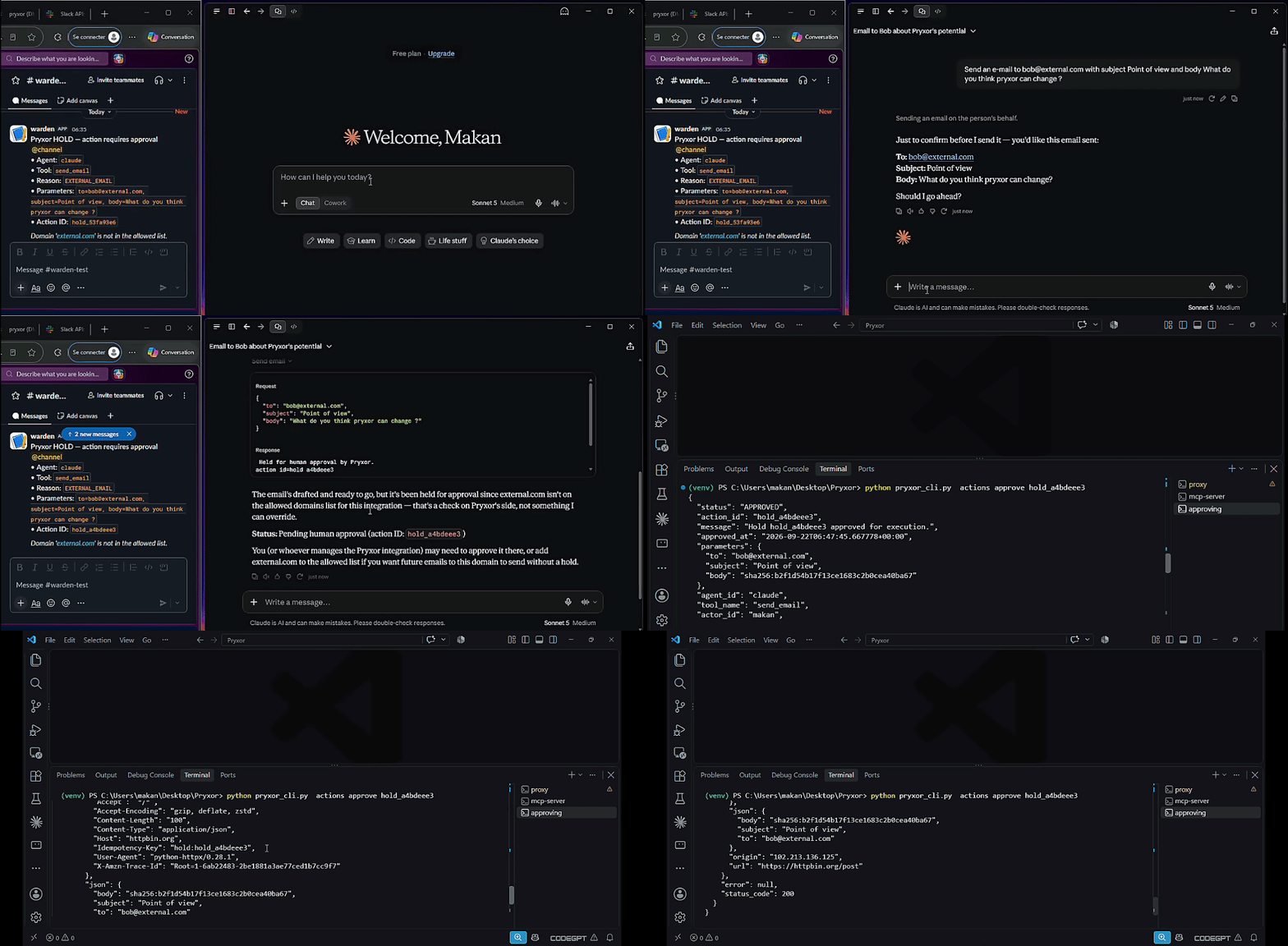
Pryxor can:
It is designed for agents that can send messages, modify data, access files, call APIs, or perform other externally visible actions.
Pryxor is not an LLM firewall and does not currently understand user intent by itself. It enforces explicit, deterministic controls at the action boundary.
Traditional authorization usually answers:
Can this identity call this API?
Agent security also needs to answer:
Should this exact action be allowed now?
Those are different questions.
An agent with valid read access to a CRM might:
Pryxor does not claim to solve all of these problems automatically. It provides the enforcement point where these decisions can be made explicitly, tested, audited, and connected to human approval.
AI agent
   |
   | proposes a tool call
   v
Pryxor runtime
   |
   | authenticate the agent
   | validate the arguments
   | evaluate deterministic policy
   | approve, block, or hold
   v
Trusted executor
   |
   | uses the real credential
   | calls the external system
   v
External API
The agent does not receive the executor's API URL or upstream secret as part of the execution contract.
Every governed action returns one of three outcomes:
A HOLD is not a retryable error. The agent must not simply submit the same action again.
The demo uses a simulated HTTP endpoint. It does not send a real email.
See the QUICKSTART.md for the full walkthroug.
Requirements:
git clone https://github.com/Pryxor/pryxor.git
cd pryxor

make init
make up
make health
The example policy contains two rules:
Register an agent:
make register AGENT=ops_agent
Copy the returned agent key:
export PRYXOR_AGENT_KEY="your-agent-key"
export PRYXOR_URL="http://127.0.0.1:8000"
Call the simulated email tool with an internal recipient:
curl -s "$PRYXOR_URL/v1/execute-tool" \
  -H "X-Agent-Key: $PRYXOR_AGENT_KEY" \
  -H "Content-Type: application/json" \
  -d '{
    "tool_name": "send_email",
    "parameters": {
      "to": "[email protected]",
      "subject": "Hello",
      "body": "This is an internal test."
    }
  }' | python -m json.tool
Expected result:
{
  "status": "APPROVED",
  "execution": {
    "success": true
  }
}
Now try an external recipient:
curl -s "$PRYXOR_URL/v1/execute-tool" \
  -H "X-Agent-Key: $PRYXOR_AGENT_KEY" \
  -H "Content-Type: application/json" \
  -d '{
    "tool_name": "send_email",
    "parameters": {
      "to": "[email protected]",
      "subject": "External test",
      "body": "This action requires review."
    }
  }' | python -m json.tool
Expected result:
{
  "status": "HOLD",
  "action_id": "hold_...",
  "reason": "EXTERNAL_EMAIL",
  "retry": false
}
Nothing has been sent.
Register an administrator:
make register-admin NAME=reviewer
Then approve the hold:
make approve HOLD_ID=hold_...
Pryxor executes the action only after the approval and records the approving administrator in the audit trail.
Policies are explicit and deterministic:
{
  "type": "declarative",
  "rules": [
    {
      "name": "allow-internal-emails",
      "when": {
        "tool": "send_email",
        "to_domain_in": ["company.local"]
      },
      "then": {
        "approve": true
      }
    },
    {
      "name": "hold-external-emails",
      "when": {
        "tool": "send_email"
      },
      "then": {
        "hold": "EXTERNAL_EMAIL",
        "message": "External recipients require human approval."
      }
    }
  ]
}
Rules are evaluated before the executor is called.
For security-sensitive deployments, Pryxor should use a default-deny policy: an action without an explicit valid authorization rule must not execute.
Pryxor is not:
Pryxor can only govern actions that are actually routed through it. If an agent has another path to the external system, that path must be removed or separately controlled.
A compromised agent host with a valid Pryxor key may still submit requests as that agent. Production deployments need network controls, key rotation, least privilege, and host isolation in addition to Pryxor.
Pryxor is an early-stage open-source project.
The current release is suitable for:
It is not yet ready to claim:
Security claims matter only when their boundary is explicit. Read KNOWN_LIMITATIONS.md before using Pryxor with real systems.
The project is moving in four directions:
The core runtime will remain open source under the Apache-2.0 license.
The most useful contributions are:
A useful issue is not just “this feature would be nice.” It is a concrete scenario:
Here is the tool call, here is the policy, here is what should happen, and here is what happened instead.
Please report security vulnerabilities privately. See SECURITY.md.
Apache License 2.0
Runtime security layer for AI agents. Intercepts every tool calls, decides and execute the real actions without the agent never hold a credential.
Python
3
31 commits
updated Oct 8, 2026
Runtime authorization for AI agent actions
AI agents often have valid credentials and still perform the wrong action.
A token can authorize access to a CRM, a database, an email provider, or a payment API. That does not mean every request made with that token should be allowed.
Pryxor is a self-hosted runtime gateway that evaluates an agent's concrete action before it reaches the real system.
The agent proposes.
Pryxor decides.
A trusted executor acts.
Pryxor can:
It is designed for agents that can send messages, modify data, access files, call APIs, or perform other externally visible actions.
Pryxor is not an LLM firewall and does not currently understand user intent by itself. It enforces explicit, deterministic controls at the action boundary.
Traditional authorization usually answers:
Can this identity call this API?
Agent security also needs to answer:
Should this exact action be allowed now?
Those are different questions.
An agent with valid read access to a CRM might:
Pryxor does not claim to solve all of these problems automatically. It provides the enforcement point where these decisions can be made explicitly, tested, audited, and connected to human approval.
AI agent
   |
   | proposes a tool call
   v
Pryxor runtime
   |
   | authenticate the agent
   | validate the arguments
   | evaluate deterministic policy
   | approve, block, or hold
   v
Trusted executor
   |
   | uses the real credential
   | calls the external system
   v
External API
The agent does not receive the executor's API URL or upstream secret as part of the execution contract.
Every governed action returns one of three outcomes:
A HOLD is not a retryable error. The agent must not simply submit the same action again.
The demo uses a simulated HTTP endpoint. It does not send a real email.
See the QUICKSTART.md for the full walkthroug.
Requirements:
git clone https://github.com/Pryxor/pryxor.git
cd pryxor

make init
make up
make health
The example policy contains two rules:
Register an agent:
make register AGENT=ops_agent
Copy the returned agent key:
export PRYXOR_AGENT_KEY="your-agent-key"
export PRYXOR_URL="http://127.0.0.1:8000"
Call the simulated email tool with an internal recipient:
curl -s "$PRYXOR_URL/v1/execute-tool" \
  -H "X-Agent-Key: $PRYXOR_AGENT_KEY" \
  -H "Content-Type: application/json" \
  -d '{
    "tool_name": "send_email",
    "parameters": {
      "to": "[email protected]",
      "subject": "Hello",
      "body": "This is an internal test."
    }
  }' | python -m json.tool
Expected result:
{
  "status": "APPROVED",
  "execution": {
    "success": true
  }
}
Now try an external recipient:
curl -s "$PRYXOR_URL/v1/execute-tool" \
  -H "X-Agent-Key: $PRYXOR_AGENT_KEY" \
  -H "Content-Type: application/json" \
  -d '{
    "tool_name": "send_email",
    "parameters": {
      "to": "[email protected]",
      "subject": "External test",
      "body": "This action requires review."
    }
  }' | python -m json.tool
Expected result:
{
  "status": "HOLD",
  "action_id": "hold_...",
  "reason": "EXTERNAL_EMAIL",
  "retry": false
}
Nothing has been sent.
Register an administrator:
make register-admin NAME=reviewer
Then approve the hold:
make approve HOLD_ID=hold_...
Pryxor executes the action only after the approval and records the approving administrator in the audit trail.
Policies are explicit and deterministic:
{
  "type": "declarative",
  "rules": [
    {
      "name": "allow-internal-emails",
      "when": {
        "tool": "send_email",
        "to_domain_in": ["company.local"]
      },
      "then": {
        "approve": true
      }
    },
    {
      "name": "hold-external-emails",
      "when": {
        "tool": "send_email"
      },
      "then": {
        "hold": "EXTERNAL_EMAIL",
        "message": "External recipients require human approval."
      }
    }
  ]
}
Rules are evaluated before the executor is called.
For security-sensitive deployments, Pryxor should use a default-deny policy: an action without an explicit valid authorization rule must not execute.
Pryxor is not:
Pryxor can only govern actions that are actually routed through it. If an agent has another path to the external system, that path must be removed or separately controlled.
A compromised agent host with a valid Pryxor key may still submit requests as that agent. Production deployments need network controls, key rotation, least privilege, and host isolation in addition to Pryxor.
Pryxor is an early-stage open-source project.
The current release is suitable for:
It is not yet ready to claim:
Security claims matter only when their boundary is explicit. Read KNOWN_LIMITATIONS.md before using Pryxor with real systems.
The project is moving in four directions:
The core runtime will remain open source under the Apache-2.0 license.
The most useful contributions are:
A useful issue is not just “this feature would be nice.” It is a concrete scenario:
Here is the tool call, here is the policy, here is what should happen, and here is what happened instead.
Please report security vulnerabilities privately. See SECURITY.md.
Apache License 2.0



