A modern, user friendly, generic, type-safe and fast C99 container library: String, Vector, Sorted and Unordered Map and Set, Deque, Forward List, Smart Pointers, Bitset and Random numbers.
C
1,993
3,097 commits
updated Oct 12, 2026
STC is a comprehensive, generic, typesafe container and algorithm library for C99/C11. It has excellent ergonomics and requires hardly any boilerplate code. The library adds many missing features to C, like common data containers, algorithms, and abstractions found in contemporary system languages like Zig, Rust, and C++. Containers and algorithms are templated or generic, which allows for a fully typesafe, compact, and high performance implementation.
Release Candidate 5 has fixed lots of smaller bugs and C++ incompabilities in Coroutines, Regex and CSpan, and now have proper C-linkage when called from C++.
A number of deprecated symbols in common.h and coroutine.h are removed.
Apologies for the multiple API changes particularly on the coroutine, cspan and cregex modules after V5.1. From upcoming V6.0 release, API is planned to be stable and changes will be made backward compatible.
V6.0:
V5.1:
#define
prior to including the container (using c_class_key, c_pro_key, and c_comp_key option traits).T as a shorthand for i_type.V5.0.2:
c_foreach (...) => for (c_each(...)), and c_forrange(...) => for (c_range(...)), etc.V5.0:
#define i_aux <TYPE>.algorithm.hT lets you define container type plus i_key and i_val (or i_opt) all in one line.i_class_key and i_class_val to specify types with _drop() and _clone() functions defined.i_pro_key and i_pro_val to specify cstr, box and arc types (users may also define pro-types).c_filter (ranges-like), c_shuffle, c_reverse.
See also version history for breaking changes in V5.0.c_static_assert(), c_as_mut(), c_safe_cast() and macros for safe integer type casting.STC uses meson build system. Make sure to have meson and ninja installed, e.g. as a python pip package from a bash shell:
pip install meson ninja
export LIBRARY_PATH=$LIBRARY_PATH:~/.local/lib
export CPATH=$CPATH:~/.local/include
export CC=gcc
To create a build folder and to set the install folder to e.g. ~/.local:
meson setup --buildtype debug build --prefix ~/.local
cd build
ninja
ninja install
STC is mixed "headers-only" / traditional library, i.e the templated container headers (and the sort/lower_bound algorithms) can simply be included - they have no library dependencies. By default, all templated functions are static (many inlined). This is often optimal for both performance and compiled binary size. However, for frequently used container type instances (more than 2-3 TUs), consider creating a separate header file for them, e.g.:
// intvec.h
#ifndef INTVEC_H_
#define INTVEC_H_
#define i_header // header definitions only
#define T intvec, int
#include <stc/vec.h>
#endif
So anyone may use the shared vec-type. Implement the shared functions in one C file (if several containers are shared, you may define STC_IMPLEMENT on top of the file once instead):
// shared.c
#define i_implement // implement the shared intvec.
#include "intvec.h"
The non-templated types cstr, csview, cregex, cspan and random, are built as a library (libstc), and is using the meson build system. However, the most common functions in csview and random are inlined. The bitset cbits, the zero-terminated string view zsview and algorthm are all fully inlined and need no linking with the stc-library.
STC containers have similar functionality to the C++ STL standard containers. All containers except for a few, like cstr and cbits are generic/templated. No type casting is used, so containers are type-safe like templated types in C++. To specify template parameters with STC, you define them as macros prior to including the container, e.g.
#define T Floats, float  // Container type (name, element type)
#include <stc/vec.h>     // "instantiate" the desired container type
#include <stdio.h>

int main(void)
{
    Floats nums = {0};
    Floats_push(&nums, 30.f);
    Floats_push(&nums, 10.f);
    Floats_push(&nums, 20.f);

    for (int i = 0; i < Floats_size(&nums); ++i)
        printf(" %g", nums.data[i]);

    for (c_each(i, Floats, nums))     // Alternative and recommended way to iterate.
        printf(" %g", *i.ref);      // i.ref is a pointer to the current element.

    Floats_drop(&nums); // cleanup memory
}
Switching to a different container type, e.g. a sorted set (sset):
[ Run this code ]
#define T Floats, float
#include <stc/sortedset.h> // Use a sorted set instead
#include <stdio.h>

int main(void)
{
    Floats nums = {0};
    Floats_push(&nums, 30.f);
    Floats_push(&nums, 10.f);
    Floats_push(&nums, 20.f);

    // print the numbers (sorted)
    for (c_each(i, Floats, nums))
        printf(" %g", *i.ref);

    Floats_drop(&nums);
}
For associative containers and priority queues (hmap, hset, smap, sset, pqueue), comparison/lookup functions
are assumed to be defined. I.e. if they are not specified with template parameters, it assumes default
comparison operators works. To enable search/sort for the remaining containers (stack, vec, queue, deque),
define i_cmp or i_eq and/or i_less for the element type. If the element type is an integral type,
just define i_use_cmp (will use == and < operators for comparisons).
If an element destructor i_keydrop is defined, i_keyclone function is required.
Alternatively #define i_opt c_no_clone to disable container cloning.
Let's make a vector of vectors, which can be cloned. All of its element vectors will be destroyed when destroying the Vec2D.
[ Run this code ]
#include <stdio.h>
#include <stc/algorithm.h>

#define T Vec, float
#define i_use_cmp        // enable default ==, < and hash operations
#include <stc/vec.h>

#define T Vec2D
#define i_class_key Vec   // Use i_class_key when key type has "members" _clone() and _drop().
#define i_use_eq         // vec does not have _cmp(), but it has _eq()
#include <stc/vec.h>

// The above may be written as a one-liners (note the c_-prefix instead of i_):
// #define T Vec, float, (c_use_cmp)
// #include <stc/vec.h>
// #define T Vec2D, Vec, (c_class_key | c_use_eq)
// #include <stc/vec.h>

int main(void)
{
    Vec* v;
    Vec2D vec_a = {0};                  // All containers in STC can be initialized with {0}.
    v = Vec2D_push(&vec_a, Vec_init()); // push() returns a pointer to the new element in vec.
    Vec_push(v, 10.f);
    Vec_push(v, 20.f);

    v = Vec2D_push(&vec_a, Vec_init());
    Vec_push(v, 30.f);
    Vec_push(v, 40.f);

    Vec2D vec_b = c_make(Vec2D, {
        c_make(Vec, {10.f, 20.f}),
        c_make(Vec, {30.f, 40.f}),
    });
    printf("vec_a == vec_b is %s.\n", Vec2D_eq(&vec_a, &vec_b) ? "true":"false");

    Vec2D clone = Vec2D_clone(vec_a);   // Make a deep-copy of vec

    for (c_each(i, Vec2D, clone))         // Loop through the cloned vector
        for (c_each(j, Vec, *i.ref))
            printf(" %g", *j.ref);

    c_drop(Vec2D, &vec_a, &vec_b, &clone);  // Free all 9 vectors.
}
This example uses four different container types:
[ Run this code ]
#include <stdio.h>

#define T hset_int, int
#include <stc/hashset.h>   // unordered/hash set (assume i_key is basic type, uses `==` operator)

struct Point { float x, y; };
// Define cvec_pnt and enable linear search by defining i_eq
#define T vec_pnt, struct Point
#define i_eq(a, b) (a->x == b->x && a->y == b->y)
#include <stc/vec.h>    // vector of struct Point

// enable sort/search. Use native `<` and `==` operators
#define T list_int, int, (c_use_cmp)
#include <stc/list.h>   // singly linked list

#define T smap_int, int, int
#include <stc/sortedmap.h>  // sorted map int => int

int main(void)
{
    // Define four empty containers
    hset_int set = {0};
    vec_pnt vec = {0};
    list_int lst = {0};
    smap_int map = {0};
    c_defer( // Drop the containers at scope exit
        hset_int_drop(&set),
        vec_pnt_drop(&vec),
        list_int_drop(&lst),
        smap_int_drop(&map)
    ){
        enum{N = 5};
        int nums[N] = {10, 20, 30, 40, 50};
        struct Point pts[N] = {{10, 1}, {20, 2}, {30, 3}, {40, 4}, {50, 5}};
        int pairs[N][2] = {{20, 2}, {10, 1}, {30, 3}, {40, 4}, {50, 5}};

        // Add some elements to each container
        for (int i = 0; i < N; ++i) {
            hset_int_insert(&set, nums[i]);
            vec_pnt_push(&vec, pts[i]);
            list_int_push_back(&lst, nums[i]);
            smap_int_insert(&map, pairs[i][0], pairs[i][1]);
        }

        // Find an element in each container
        hset_int_iter i1 = hset_int_find(&set, 20);
        vec_pnt_iter i2 = vec_pnt_find(&vec, (struct Point){20, 2});
        list_int_iter i3 = list_int_find(&lst, 20);
        smap_int_iter i4 = smap_int_find(&map, 20);

        printf("\nFound: %d, (%g, %g), %d, [%d: %d]\n",
                *i1.ref, i2.ref->x, i2.ref->y, *i3.ref,
                i4.ref->first, i4.ref->second);

        // Erase all the elements found
        hset_int_erase_at(&set, i1);
        vec_pnt_erase_at(&vec, i2);
        list_int_erase_at(&lst, i3);
        smap_int_erase_at(&map, i4);

        printf("After erasing the elements found:");
        printf("\n set:");
        for (c_each(i, hset_int, set))
            printf(" %d", *i.ref);

        printf("\n vec:");
        for (c_each(i, vec_pnt, vec))
            printf(" (%g, %g)", i.ref->x, i.ref->y);

        printf("\n lst:");
        for (c_each(i, list_int, lst))
            printf(" %d", *i.ref);

        printf("\n map:");
        for (c_each(i, smap_int, map))
            printf(" [%d: %d]", i.ref->first, i.ref->second);
    }
}
STC is a fast and memory efficient library, and code compiles fast:
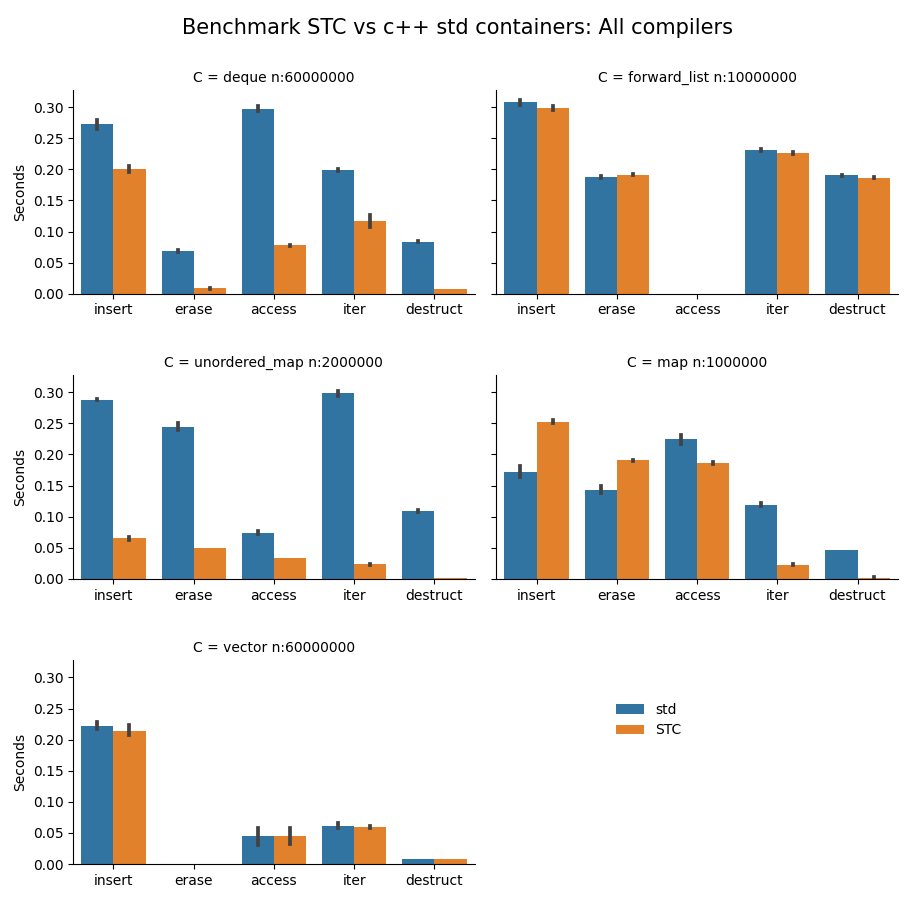
Benchmark notes:
uint64_t and pairs of uint64_t for the maps.T or
i_key (+ i_val for maps). In this case, STC assumes that the elements are of basic types.
For non-trivial types, additional template parameters must be given.const char*
as lookup type. Therefore it is not needed to construct (or destroy) a cstr in order
to lookup a cstr object. Also, one may pass a c-string literal to one of the
emplace-functions to implicitly insert a cstr object, i.e. vec_cstr_emplace(&vec, "Hello")
as an alternative to vec_cstr_push(&vec, cstr_from("Hello")).#define T MyInts, int
#include <stc/list.h>
...
MyInts ints = c_make(MyInts, {3, 5, 9, 7, 2});
for (c_each(it, MyInts, ints)) *it.ref += 42;
Naming conventions
c, e.g. cstr, cbits, cregex.c_, e.g. c_each, c_make.i_, e.g. i_key, T.{0} (also cstr), i.e. no heap allocation initially.Common types defined for any container type Cnt:
Functions defined for most container types:
The container template parameters are specified with a #define i_xxxx statement. Each templated
type instantiation requires an #include statement, even if the same container base type was
included earlier. Normally it is sufficient to only define T before including a container:
#define T ContainerType, KeyType[, ValType][, (Traits)]
Examples of container definitions:
A sortedmap of int => float:
#define T IntfMap, int, float
#include <stc/sortedmap.h>
A hashmap of int => string
#define T StrMap, int, cstr, (c_pro_val) // cstr is a "pro" type
#include <stc/hashmap.h>
A vector of searchable string vectors:
#define T StrVec, cstr, (c_pro_key | c_use_eq) // enable vector linear search (find).
#include <stc/vec.h>
#define T StrVecVec, StrVec, (c_class_key) // container as element has "class" properties
#include <stc/vec.h>
There are a number of trait flags which can be specified as the thrird (fourth for maps)
comma-separated argument to the T template/macro definition. They associate/binds the key
(and val) element type names with a set of common "member" function names or properties of the types.
The associated/bound member functions are only required to be implemented if the container
actually needs them. Trait flags works as boolean properties, and may be combined using
the | operator, conventionally enclosed in parentheses. The complete list of trait flags:
c_class_val, but also expects member _from(), which converts from ValType_raw to ValType, specifically for the _emplace*() container functions.Other traits that can be combined with the | operator:
< comparison on integral types, or _cmp() for c_pro_key/c_class_key/c_compare_key elements.== on integral types, or the _eq() member for "pro/class/cmp" elements.c_pro_key (or c_pro_val for maps)c_class_key (or c_class_val for maps)c_comp_keyWhen c_comp_key trait is specified, the following KeyType member functions names are bound:
int         KeyType_cmp(const KeyType* x, const KeyType* y);  // c_comp_key, or c_class_key
bool        KeyType_eq(const KeyType* x, const KeyType* y);   // c_comp_key, or (c_class_key | c_use_eq)
size_t      KeyType_hash(const KeyType* kp);                  // c_comp_key, or (c_class_key | c_use_eq)
NB: The above functions are expected for container types that requires them, without specifying the traits.
When c_class_key trait is specified, the following KeyType member functions names are bound:
KeyType     KeyType_clone(KeyType k);                         // c_class_key
void        KeyType_drop(KeyType* kp);                        // c_class_key
When c_class_val trait is specified, the following ValType member functions names are bound:
ValType     ValType_clone(ValType v);                         // c_class_val
void        ValType_drop(ValType* vp);                        // c_class_val
Notes:
< and == operators by default, whereas when c_class_key/c_pro_key are specified
it uses the _cmp() member function by default. However the _cmp() member is also used for
equality comparison, so in order to use the _eq() member, c_use_eq must be specified!i_cmp / i_eq / i_hash macros when needed, or make it
into a "keyclass" (or even "keypro") by defining required member functions.When c_pro_key is specified, the following KeyType member functions names are bound:
KeyType     KeyType_clone(KeyType k);                                      // c_pro_key
void        KeyType_drop(KeyType* kp);                                     // c_pro_key
KeyType     KeyType_from(KeyType_raw r);                                   // c_pro_key
KeyType_raw KeyType_toraw(const KeyType* kp);                              // c_pro_key
int         KeyType_raw_cmp(const KeyType_raw* rx, const KeyType_raw* ry); // c_pro_key
bool        KeyType_raw_eq(const KeyType_raw* rx, const KeyType_raw* ry);  // (c_pro_key | c_use_eq)
size_t      KeyType_raw_hash(const KeyType_raw* rp);                       // c_pro_key
When c_pro_val is specified: ValType element member functions names are bound:
ValType     ValType_clone(ValType k);                                      // c_pro_val
void        ValType_drop(ValType* kp);                                     // c_pro_val
ValType     ValType_from(ValType_raw r);                                   // c_pro_val
ValType_raw ValType_toraw(const ValType* kp);                              // c_pro_val
The assosicated element member functions defined from using traits template parameters may also be
specified/overridden by defining specific template parameters before including the container.
Only i_key is strictly required to be defined for simple non-maps:
i_key KeyType - Element key type.i_cmp Func - Three-way comparison of two RawKeyType elements, given as pointers.i_less Func - Comparison of two RawKeyType elements. Alternative to specifying i_cmp.i_eq Func - Equality comparison of two RawKeyType. Defaults to !i_cmp(x,y).i_hash Func - Hash function taking a RawKeyType pointer. Companion with i_eq.i_keyclone Func - required if i_keydrop is defined (exception for arc, as it shares).i_keydrop Func - Destroy key - defaults to empty destructor.i_keyraw RawKeyType - Alternative key type. Defaults to KeyTypei_keyfrom Func - Create a KeyType instance from a RawKeyType.i_keytoraw Func - Conversion from KeyType to RawKeyType.i_val ValType - required for hmap and smap containers.i_valclone Func - required if i_valdrop is defined (exception for arc, as it shares).i_valdrop Func - Destroy mapped val - defaults to empty destructor.i_valraw RawValType - Alternative mapped type. Defaults to ValTypei_valfrom Func - Create a ValType instance from a RawValType.i_valtoraw Func - Conversion from ValType* to RawValType.Normally it is simplest to specify the traits template parameters via the Traits argument to T,
however they can be specified as separate template parameters as well. Specifically, i_comp_key
can be specified as a different type than i_key (c_comp_key always makes it equal to i_key).
This enables a container to be associated with an additional alternative "raw" input key/val-type,
and one may specify convertion functions between them. Specifically the string, cstr and smart
pointers, box and arc uses this to enhance ergonmics, but every container may gain efficiency
and usage enhancements from this general built-in mechanism.
i_comp_key RawType - Defines i_keyraw and binds i_cmp, i_eq, and i_hash to
RawType_cmp(), RawType_eq(), and RawType_hash() comparison functions/macro names. In addition
i_keyfrom, i_keytoraw are bound to conversion functions KeyType_from(RawType*) and KeyType_toraw().
i_class_key KeyType
i_comp_key or i_keyraw are also specified, comparison functions associated with i_comp_key are
also bound.i_pro_key KeyType - Use with "pro"-element types, i.e. library types like cstr, box and arc.
It combines the i_class_key and i_comp_key properties. Defining i_pro_key is equal to defining
i_key, i_keyclone, i_keydrop, i_keyraw, i_keyfrom, i_keytoraw, i_cmp, i_eq, i_hash
will all be textually bound to function names. See the vikings.c example on how to create and instantiate
a self-made pro-type.i_class_val MappedType - Analogous to the i_class_key, except for comparison and hash funcs.i_pro_val MappedType - Comparison/lookup functions are not relevant for the mapped type, so this defines
i_val, i_valclone, i_valdrop, i_valraw, i_valfrom, i_valtoraw will all be defined/bound.i_keyraw RawType - Lookup/emplace-function argument "raw" type. Defaults to i_key.i_keyfrom Func(r) - Conversion func from a i_keyraw to return a i_key type.i_keytoraw Func(p) - Conversion func from a i_key pointer to a i_keyraw type. [required] if i_keyraw was defined. By default, it returns the dereferenced i_key value.i_valraw RawType - Emplace-function argument "raw" type. Defaults to i_val.i_valfrom Func(r) - Conversion func from a i_valraw to return a i_val type.i_valtoraw Func(p) - Conversion func from a i_val pointer to a i_valraw type.The table below shows the template parameters which must be defined to support element search/lookup and sort for various container type instantiations.
For the containers marked optional, the features are disabled if the template parameter(s) are not defined. Note that the (integral type) columns also applies to "special" key-types, specified with i_class_key (so not only for true integral types like int or float).
| Container | search (integral type) | sort (integral type) | | | search (struct elem) | sort (struct elem) | optional |
|---|---|---|---|---|---|---|
| vec, deque, list | i_use_cmp | i_use_cmp | i_eq | i_cmp / i_less | yes | |
| stack | n/a | i_use_cmp | n/a | i_cmp / i_less | yes | |
| box, arc | i_use_cmp | i_use_cmp | i_eq + i_hash | i_cmp / i_less | yes | |
| hmap, hset | n/a | i_eq + i_hash | n/a | no | ||
| smap, sset | i_cmp / i_less | i_cmp / i_less | no | |||
| pqueue | n/a | n/a | i_cmp / i_less | no | ||
| queue | n/a | n/a | n/a | n/a | n/a |
STC, like c++ STL, has two sets of methods for adding elements to containers. One set begins with emplace, e.g. vec_X_emplace_back(). This is an ergonomic alternative to vec_X_push_back() when dealing non-trivial container elements, e.g. strings, shared pointers or other elements using dynamic memory or shared resources.
The emplace methods construct / clone the given raw-type element when it is added to the container (specified normally using i_pro_key/i_pro_val or i_comp_key or the c_-option variants). In contrast, the non-emplace methods moves the element into the container.
Note: For containers with integral/trivial element types, or when neither i_keyraw/i_valraw is defined,
the emplace functions are not available (or needed), as it can easier lead to mistakes.
| non-emplace: Move | emplace: Embedded copy | Container |
|---|---|---|
| insert(), push() | emplace() | hmap, smap, hset, sset |
| insert_or_assign() | emplace_or_assign() | hmap, smap |
| push() | emplace() | queue, pqueue, stack |
| push_back(), push() | emplace_back() | deque, list, vec |
| push_front() | emplace_front() | deque, list |
Strings are the most commonly used non-trivial data type. STC containers have proper pre-defined definitions for cstr container elements, so they are fail-safe to use both with the emplace and non-emplace methods:
#include <stc/cstr.h>

#define i_pro_key cstr  // use i_pro_key for "pro" types like cstr, arc, box
#include <stc/vec.h>   // vector of string (cstr)
...
vec_cstr vec = {0};
cstr s = cstr_lit("a string literal");
const char* hello = "Hello";

vec_cstr_push(&vec, cstr_from(hello);    // make a cstr from const char* and move it onto vec
vec_cstr_push(&vec, cstr_clone(s));      // make a cstr clone and move it onto vec

vec_cstr_emplace(&vec, "Yay, literal");  // internally make a cstr from const char*
vec_cstr_emplace(&vec, cstr_clone(s));   // <-- COMPILE ERROR: expects const char*
vec_cstr_emplace(&vec, cstr_str(&s));    // Ok: const char* input type.

cstr_drop(&s)
vec_cstr_drop(&vec);
This is made possible because the type configuration may be given an optional conversion/"rawvalue"-type as template parameter, along with a back and forth conversion methods to the container value type.
Rawvalues are primarily beneficial for lookup and map insertions, however the
emplace methods constructs cstr-objects from the rawvalues, but only when required:
hmap_cstr_emplace(&map, "Hello", "world");
// Two cstr-objects were constructed by emplace

hmap_cstr_emplace(&map, "Hello", "again");
// No cstr was constructed because "Hello" was already in the map.

hmap_cstr_put(&map, "Hello", "there");
// Only cstr_lit("there") constructed. "world" was destructed and replaced.

hmap_cstr_insert(&map, cstr_lit("Hello"), cstr_lit("you"));
// Two cstr's constructed outside call, but both destructed by insert
// because "Hello" existed. No mem-leak but less efficient.

it = hmap_cstr_find(&map, "Hello");
// No cstr constructed for lookup, although keys are cstr-type.
Apart from strings, maps and sets are normally used with trivial value types. However, the last example on the hmap page demonstrates how to specify a map with non-trivial keys.
| Name | Description | Container |
|---|---|---|
| erase() | key based | smap, sset, hmap, hset, cstr |
| erase_at() | iterator based | smap, sset, hmap, hset, vec, deque, list |
| erase_range() | iterator based | smap, sset, vec, deque, list |
| erase_n() | index based | vec, deque, cstr |
| remove() | remove all matching values | list |
Define T and/or i_key:
// #define T MyVec, int // shorthand
#define T MyVec
#define i_key int
#include <stc/vec.h>

MyVec vec = {0};
MyVec_push(&vec, 42);
...
Pre-declare templated container in header file. The container can then e.g. be a member of a struct defined in a header file.
i_aux AuxType parameter, the declaration
must also add it as the last argument: declare_vec_aux(VecType, Element, AuxType).(c_declared) option must be specified when defining the container.
See example below.// Dataset.h
#ifndef Dataset_H_
#define Dataset_H_
#include <stc/types.h> // include various container data structure templates
// declare PointVec as a vec. Also struct Point may be incomplete/undeclared.
declare_vec(PointVec, struct Point);
typedef struct Dataset {
PointVec vertices;
PointVec colors;
} Dataset;
void Dataset_drop(Dataset* self);
...
#endif
Define and use the "private" container in the c-file:
// Dataset.c
#include "Dataset.h"
#include "Point.h"      // struct Point must be defined here.

#define T PointVec, struct Point, (c_declared) // pre-declared.
#include <stc/vec.h>    // Implements PointVec with static linking by default
...
Sometimes it is useful to extend a container type to store extra data, e.g. a comparison
or allocator function pointer or a context which the function pointers can use. Most
libraries solve this by adding an opaque pointer (void*) or function pointer(s) into
the data structure for the user to manage. Because most containers are templated,
an auxiliary template parameter, i_aux may be defined to extend the container with
typesafe custom attributes.
The example below shows how to customize containers to work with PostgreSQL memory management.
It adds a MemoryContext to each container by defining the i_aux template parameter.
i_aux may define a struct on the fly, or refer to an already defined type.
Note that pgs_realloc and pgs_free is also passed the
allocated size of the given pointer, unlike standard realloc and free.
self->aux is accessible from the following template parameters / container combinations:
i_allocator: all containersi_eq : all containersi_cmp, i_less: all containers except hmap and hseti_hash: hmap and hset// pgs_alloc.h
#define pgs_malloc(sz) MemoryContextAlloc(self->aux.memctx, sz)
#define pgs_calloc(n, sz) MemoryContextAllocZero(self->aux.memctx, (n)*(sz))
#define pgs_realloc(p, old_sz, sz) (p ? repalloc(p, sz) : pgs_malloc(sz))
#define pgs_free(p, sz) (p ? pfree(p) : (void)0) // pfree/repalloc does not accept NULL.
#define i_aux struct { MemoryContext memctx; }
#define i_allocator pgs
#define i_no_clone
Usage is straight forward:
#define T IMap, int, int
#include "pgs_alloc.h"
#include <stc/sortedmap.h>

void maptest()
{
    IMap map = {.aux={
        AllocSetContextCreate(CurrentMemoryContext, "MapContext", ALLOCSET_DEFAULT_SIZES)
    }};
    for (c_range(i, 1, 16))
        IMap_insert(&map, i*i, i); // uses pgs_realloc()

    for (c_each(i, IMap, map))
        printf("%d:%d ", i.ref->first, i.ref->second);

    IMap_drop(&map); // uses psg_free()
    MemoryContextDelete(map.aux.memctx);
}
Another example is to sort struct elements by the active field and reverse flag:
[ Run this code ]
#include <stdio.h>
#include <time.h>
#include <stc/cstr.h>
#include <c11/fmt.h>

typedef struct {
    cstr fileName;
    cstr directory;
    isize_t size;
    time_t lastWriteTime;
}  FileMetaData;

enum FMDActive {FMD_fileName, FMD_directory, FMD_size, FMD_lastWriteTime, FMD_LAST};
typedef struct { enum FMDActive activeField; bool reverse; } FMDVectorSorting;

int FileMetaData_cmp(const FMDVectorSorting*, const FileMetaData*, const FileMetaData*);
void FileMetaData_drop(FileMetaData*);

#define T FMDVector, FileMetaData, (c_class_key | c_no_clone)
#define i_aux FMDVectorSorting
#define i_cmp(x, y) FileMetaData_cmp(&self->aux, x, y)
#include <stc/stack.h>
// --------------

int FileMetaData_cmp(const FMDVectorSorting* aux, const FileMetaData* a, const FileMetaData* b) {
    int dir = aux->reverse ? -1 : 1;
    switch (aux->activeField) {
        case FMD_fileName: return dir*cstr_cmp(&a->fileName, &b->fileName);
        case FMD_directory: return dir*cstr_cmp(&a->directory, &b->directory);
        case FMD_size: return dir*c_default_cmp(&a->size, &b->size);
        case FMD_lastWriteTime: return dir*c_default_cmp(&a->lastWriteTime, &b->lastWriteTime);
        default:;
    }
    return 0;
}

void FileMetaData_drop(FileMetaData* fmd) {
    cstr_drop(&fmd->fileName);
    cstr_drop(&fmd->directory);
}

int main(void) {
    FMDVector vec = c_make(FMDVector, {
        {cstr_from("WScript.cpp"), cstr_from("code/unix"), 3624, 123567},
        {cstr_from("CanvasBackground.cpp"), cstr_from("code/unix/canvas"), 38273, 12398},
        {cstr_from("Brush_test.cpp"), cstr_from("code/tests"), 67236, 7823},
    });

    vec.aux.reverse = true;
    for (c_range_t(enum FMDActive, field, FMD_LAST)) {
        vec.aux.activeField = field;
        FMDVector_sort(&vec);

        for (c_each(i, FMDVector, vec)) {
            fmt_println("{:30}{:30}{:10}{:10}",
                        cstr_str(&i.ref->fileName), cstr_str(&i.ref->directory),
                        i.ref->size, i.ref->lastWriteTime);
        }
        puts("");
    }
    FMDVector_drop(&vec);
}
It is possible to extend the functionality of templated container by adding functions to them,
while having all the input and derived/defaulted template parameters available. Below we add
an alias function _len() for _size() in a new file "extvec.h", which can be used like stc/vec.h:
// extvec.h
#define i_extend
#include <stc/vec.h>

STC_INLINE isize_t _c_MEMB(_len)(Self* self) {
    return _c_MEMB(_size)(self);
}

#include <stc/sys/finalize.h>
STC is generally very memory efficient. Memory usage for the different containers:
level, but has no parent node.cregex.cstr and csview.zsview, some API changes.Container_is_empty().random numbers.c_makec_foritemsc_each_kv (changed API).c_<xxxx>() in common.h.c_svfmt(sv)c_svarg(sv)cco_yield.c_fortoken() to make it consistent with all other c_for*(), i.e, input object is third last.vec.h renamed from cvec.hdeque.h renamed from cdeq.hlist.h renamed from clist.hstack.h renamed from cstack.hqueue.h renamed from cqueue.hpqueue.h renamed from cpque.hhmap.h renamed from cmap.hhset.h renamed from cset.hsmap.h renamed from csmap.hsset.h renamed from csset.hzsview.h renamed from czview.hrandom.h renamed from crand.htypes.h renamed from forward.hi_implement before including."stc/algorithm.h""stc/coroutine.h"
"stc/random.h" with the new API.
_uniform and _normal.i_use_cmp to enable comparison for built-in i_key types (<, ==).i_class_key still expects comparison functions to be defined.i_import (i_extern deprecated).
i_import before #include <stc/cstr.h> will also define full utf8 case conversions.i_import before #include <stc/cregex.h> will also define cstr + utf8 tables.c_as_mut() typesafe macro.c_flt_counter(i)c_flt_getcount(i)Major changes:
c_ARGSV() => c_svarg(): csview print arg. Note c_sv() is shorthand for csview_from().c_forfilter: container iteration with "piped" filtering using && operator. 4 built-in filters.c_foritems: macro replacing c_forarray and c_apply. Iterate a compound literal list.*_range* function names.(top 24 of 33)
307 followers · starred Dec 2024
822 followers · starred Feb 2023
141 followers · starred May 2025
165 followers · starred Oct 2020
A modern, user friendly, generic, type-safe and fast C99 container library: String, Vector, Sorted and Unordered Map and Set, Deque, Forward List, Smart Pointers, Bitset and Random numbers.
C
1,993
3,097 commits
updated Oct 12, 2026
STC is a comprehensive, generic, typesafe container and algorithm library for C99/C11. It has excellent ergonomics and requires hardly any boilerplate code. The library adds many missing features to C, like common data containers, algorithms, and abstractions found in contemporary system languages like Zig, Rust, and C++. Containers and algorithms are templated or generic, which allows for a fully typesafe, compact, and high performance implementation.
Release Candidate 5 has fixed lots of smaller bugs and C++ incompabilities in Coroutines, Regex and CSpan, and now have proper C-linkage when called from C++.
A number of deprecated symbols in common.h and coroutine.h are removed.
Apologies for the multiple API changes particularly on the coroutine, cspan and cregex modules after V5.1. From upcoming V6.0 release, API is planned to be stable and changes will be made backward compatible.
V6.0:
V5.1:
#define
prior to including the container (using c_class_key, c_pro_key, and c_comp_key option traits).T as a shorthand for i_type.V5.0.2:
c_foreach (...) => for (c_each(...)), and c_forrange(...) => for (c_range(...)), etc.V5.0:
#define i_aux <TYPE>.algorithm.hT lets you define container type plus i_key and i_val (or i_opt) all in one line.i_class_key and i_class_val to specify types with _drop() and _clone() functions defined.i_pro_key and i_pro_val to specify cstr, box and arc types (users may also define pro-types).c_filter (ranges-like), c_shuffle, c_reverse.
See also version history for breaking changes in V5.0.c_static_assert(), c_as_mut(), c_safe_cast() and macros for safe integer type casting.STC uses meson build system. Make sure to have meson and ninja installed, e.g. as a python pip package from a bash shell:
pip install meson ninja
export LIBRARY_PATH=$LIBRARY_PATH:~/.local/lib
export CPATH=$CPATH:~/.local/include
export CC=gcc
To create a build folder and to set the install folder to e.g. ~/.local:
meson setup --buildtype debug build --prefix ~/.local
cd build
ninja
ninja install
STC is mixed "headers-only" / traditional library, i.e the templated container headers (and the sort/lower_bound algorithms) can simply be included - they have no library dependencies. By default, all templated functions are static (many inlined). This is often optimal for both performance and compiled binary size. However, for frequently used container type instances (more than 2-3 TUs), consider creating a separate header file for them, e.g.:
// intvec.h
#ifndef INTVEC_H_
#define INTVEC_H_
#define i_header // header definitions only
#define T intvec, int
#include <stc/vec.h>
#endif
So anyone may use the shared vec-type. Implement the shared functions in one C file (if several containers are shared, you may define STC_IMPLEMENT on top of the file once instead):
// shared.c
#define i_implement // implement the shared intvec.
#include "intvec.h"
The non-templated types cstr, csview, cregex, cspan and random, are built as a library (libstc), and is using the meson build system. However, the most common functions in csview and random are inlined. The bitset cbits, the zero-terminated string view zsview and algorthm are all fully inlined and need no linking with the stc-library.
STC containers have similar functionality to the C++ STL standard containers. All containers except for a few, like cstr and cbits are generic/templated. No type casting is used, so containers are type-safe like templated types in C++. To specify template parameters with STC, you define them as macros prior to including the container, e.g.
#define T Floats, float  // Container type (name, element type)
#include <stc/vec.h>     // "instantiate" the desired container type
#include <stdio.h>

int main(void)
{
    Floats nums = {0};
    Floats_push(&nums, 30.f);
    Floats_push(&nums, 10.f);
    Floats_push(&nums, 20.f);

    for (int i = 0; i < Floats_size(&nums); ++i)
        printf(" %g", nums.data[i]);

    for (c_each(i, Floats, nums))     // Alternative and recommended way to iterate.
        printf(" %g", *i.ref);      // i.ref is a pointer to the current element.

    Floats_drop(&nums); // cleanup memory
}
Switching to a different container type, e.g. a sorted set (sset):
[ Run this code ]
#define T Floats, float
#include <stc/sortedset.h> // Use a sorted set instead
#include <stdio.h>

int main(void)
{
    Floats nums = {0};
    Floats_push(&nums, 30.f);
    Floats_push(&nums, 10.f);
    Floats_push(&nums, 20.f);

    // print the numbers (sorted)
    for (c_each(i, Floats, nums))
        printf(" %g", *i.ref);

    Floats_drop(&nums);
}
For associative containers and priority queues (hmap, hset, smap, sset, pqueue), comparison/lookup functions
are assumed to be defined. I.e. if they are not specified with template parameters, it assumes default
comparison operators works. To enable search/sort for the remaining containers (stack, vec, queue, deque),
define i_cmp or i_eq and/or i_less for the element type. If the element type is an integral type,
just define i_use_cmp (will use == and < operators for comparisons).
If an element destructor i_keydrop is defined, i_keyclone function is required.
Alternatively #define i_opt c_no_clone to disable container cloning.
Let's make a vector of vectors, which can be cloned. All of its element vectors will be destroyed when destroying the Vec2D.
[ Run this code ]
#include <stdio.h>
#include <stc/algorithm.h>

#define T Vec, float
#define i_use_cmp        // enable default ==, < and hash operations
#include <stc/vec.h>

#define T Vec2D
#define i_class_key Vec   // Use i_class_key when key type has "members" _clone() and _drop().
#define i_use_eq         // vec does not have _cmp(), but it has _eq()
#include <stc/vec.h>

// The above may be written as a one-liners (note the c_-prefix instead of i_):
// #define T Vec, float, (c_use_cmp)
// #include <stc/vec.h>
// #define T Vec2D, Vec, (c_class_key | c_use_eq)
// #include <stc/vec.h>

int main(void)
{
    Vec* v;
    Vec2D vec_a = {0};                  // All containers in STC can be initialized with {0}.
    v = Vec2D_push(&vec_a, Vec_init()); // push() returns a pointer to the new element in vec.
    Vec_push(v, 10.f);
    Vec_push(v, 20.f);

    v = Vec2D_push(&vec_a, Vec_init());
    Vec_push(v, 30.f);
    Vec_push(v, 40.f);

    Vec2D vec_b = c_make(Vec2D, {
        c_make(Vec, {10.f, 20.f}),
        c_make(Vec, {30.f, 40.f}),
    });
    printf("vec_a == vec_b is %s.\n", Vec2D_eq(&vec_a, &vec_b) ? "true":"false");

    Vec2D clone = Vec2D_clone(vec_a);   // Make a deep-copy of vec

    for (c_each(i, Vec2D, clone))         // Loop through the cloned vector
        for (c_each(j, Vec, *i.ref))
            printf(" %g", *j.ref);

    c_drop(Vec2D, &vec_a, &vec_b, &clone);  // Free all 9 vectors.
}
This example uses four different container types:
[ Run this code ]
#include <stdio.h>

#define T hset_int, int
#include <stc/hashset.h>   // unordered/hash set (assume i_key is basic type, uses `==` operator)

struct Point { float x, y; };
// Define cvec_pnt and enable linear search by defining i_eq
#define T vec_pnt, struct Point
#define i_eq(a, b) (a->x == b->x && a->y == b->y)
#include <stc/vec.h>    // vector of struct Point

// enable sort/search. Use native `<` and `==` operators
#define T list_int, int, (c_use_cmp)
#include <stc/list.h>   // singly linked list

#define T smap_int, int, int
#include <stc/sortedmap.h>  // sorted map int => int

int main(void)
{
    // Define four empty containers
    hset_int set = {0};
    vec_pnt vec = {0};
    list_int lst = {0};
    smap_int map = {0};
    c_defer( // Drop the containers at scope exit
        hset_int_drop(&set),
        vec_pnt_drop(&vec),
        list_int_drop(&lst),
        smap_int_drop(&map)
    ){
        enum{N = 5};
        int nums[N] = {10, 20, 30, 40, 50};
        struct Point pts[N] = {{10, 1}, {20, 2}, {30, 3}, {40, 4}, {50, 5}};
        int pairs[N][2] = {{20, 2}, {10, 1}, {30, 3}, {40, 4}, {50, 5}};

        // Add some elements to each container
        for (int i = 0; i < N; ++i) {
            hset_int_insert(&set, nums[i]);
            vec_pnt_push(&vec, pts[i]);
            list_int_push_back(&lst, nums[i]);
            smap_int_insert(&map, pairs[i][0], pairs[i][1]);
        }

        // Find an element in each container
        hset_int_iter i1 = hset_int_find(&set, 20);
        vec_pnt_iter i2 = vec_pnt_find(&vec, (struct Point){20, 2});
        list_int_iter i3 = list_int_find(&lst, 20);
        smap_int_iter i4 = smap_int_find(&map, 20);

        printf("\nFound: %d, (%g, %g), %d, [%d: %d]\n",
                *i1.ref, i2.ref->x, i2.ref->y, *i3.ref,
                i4.ref->first, i4.ref->second);

        // Erase all the elements found
        hset_int_erase_at(&set, i1);
        vec_pnt_erase_at(&vec, i2);
        list_int_erase_at(&lst, i3);
        smap_int_erase_at(&map, i4);

        printf("After erasing the elements found:");
        printf("\n set:");
        for (c_each(i, hset_int, set))
            printf(" %d", *i.ref);

        printf("\n vec:");
        for (c_each(i, vec_pnt, vec))
            printf(" (%g, %g)", i.ref->x, i.ref->y);

        printf("\n lst:");
        for (c_each(i, list_int, lst))
            printf(" %d", *i.ref);

        printf("\n map:");
        for (c_each(i, smap_int, map))
            printf(" [%d: %d]", i.ref->first, i.ref->second);
    }
}
STC is a fast and memory efficient library, and code compiles fast:
Benchmark notes:
uint64_t and pairs of uint64_t for the maps.T or
i_key (+ i_val for maps). In this case, STC assumes that the elements are of basic types.
For non-trivial types, additional template parameters must be given.const char*
as lookup type. Therefore it is not needed to construct (or destroy) a cstr in order
to lookup a cstr object. Also, one may pass a c-string literal to one of the
emplace-functions to implicitly insert a cstr object, i.e. vec_cstr_emplace(&vec, "Hello")
as an alternative to vec_cstr_push(&vec, cstr_from("Hello")).#define T MyInts, int
#include <stc/list.h>
...
MyInts ints = c_make(MyInts, {3, 5, 9, 7, 2});
for (c_each(it, MyInts, ints)) *it.ref += 42;
Naming conventions
c, e.g. cstr, cbits, cregex.c_, e.g. c_each, c_make.i_, e.g. i_key, T.{0} (also cstr), i.e. no heap allocation initially.Common types defined for any container type Cnt:
Functions defined for most container types:
The container template parameters are specified with a #define i_xxxx statement. Each templated
type instantiation requires an #include statement, even if the same container base type was
included earlier. Normally it is sufficient to only define T before including a container:
#define T ContainerType, KeyType[, ValType][, (Traits)]
Examples of container definitions:
A sortedmap of int => float:
#define T IntfMap, int, float
#include <stc/sortedmap.h>
A hashmap of int => string
#define T StrMap, int, cstr, (c_pro_val) // cstr is a "pro" type
#include <stc/hashmap.h>
A vector of searchable string vectors:
#define T StrVec, cstr, (c_pro_key | c_use_eq) // enable vector linear search (find).
#include <stc/vec.h>
#define T StrVecVec, StrVec, (c_class_key) // container as element has "class" properties
#include <stc/vec.h>
There are a number of trait flags which can be specified as the thrird (fourth for maps)
comma-separated argument to the T template/macro definition. They associate/binds the key
(and val) element type names with a set of common "member" function names or properties of the types.
The associated/bound member functions are only required to be implemented if the container
actually needs them. Trait flags works as boolean properties, and may be combined using
the | operator, conventionally enclosed in parentheses. The complete list of trait flags:
c_class_val, but also expects member _from(), which converts from ValType_raw to ValType, specifically for the _emplace*() container functions.Other traits that can be combined with the | operator:
< comparison on integral types, or _cmp() for c_pro_key/c_class_key/c_compare_key elements.== on integral types, or the _eq() member for "pro/class/cmp" elements.c_pro_key (or c_pro_val for maps)c_class_key (or c_class_val for maps)c_comp_keyWhen c_comp_key trait is specified, the following KeyType member functions names are bound:
int         KeyType_cmp(const KeyType* x, const KeyType* y);  // c_comp_key, or c_class_key
bool        KeyType_eq(const KeyType* x, const KeyType* y);   // c_comp_key, or (c_class_key | c_use_eq)
size_t      KeyType_hash(const KeyType* kp);                  // c_comp_key, or (c_class_key | c_use_eq)
NB: The above functions are expected for container types that requires them, without specifying the traits.
When c_class_key trait is specified, the following KeyType member functions names are bound:
KeyType     KeyType_clone(KeyType k);                         // c_class_key
void        KeyType_drop(KeyType* kp);                        // c_class_key
When c_class_val trait is specified, the following ValType member functions names are bound:
ValType     ValType_clone(ValType v);                         // c_class_val
void        ValType_drop(ValType* vp);                        // c_class_val
Notes:
< and == operators by default, whereas when c_class_key/c_pro_key are specified
it uses the _cmp() member function by default. However the _cmp() member is also used for
equality comparison, so in order to use the _eq() member, c_use_eq must be specified!i_cmp / i_eq / i_hash macros when needed, or make it
into a "keyclass" (or even "keypro") by defining required member functions.When c_pro_key is specified, the following KeyType member functions names are bound:
KeyType     KeyType_clone(KeyType k);                                      // c_pro_key
void        KeyType_drop(KeyType* kp);                                     // c_pro_key
KeyType     KeyType_from(KeyType_raw r);                                   // c_pro_key
KeyType_raw KeyType_toraw(const KeyType* kp);                              // c_pro_key
int         KeyType_raw_cmp(const KeyType_raw* rx, const KeyType_raw* ry); // c_pro_key
bool        KeyType_raw_eq(const KeyType_raw* rx, const KeyType_raw* ry);  // (c_pro_key | c_use_eq)
size_t      KeyType_raw_hash(const KeyType_raw* rp);                       // c_pro_key
When c_pro_val is specified: ValType element member functions names are bound:
ValType     ValType_clone(ValType k);                                      // c_pro_val
void        ValType_drop(ValType* kp);                                     // c_pro_val
ValType     ValType_from(ValType_raw r);                                   // c_pro_val
ValType_raw ValType_toraw(const ValType* kp);                              // c_pro_val
The assosicated element member functions defined from using traits template parameters may also be
specified/overridden by defining specific template parameters before including the container.
Only i_key is strictly required to be defined for simple non-maps:
i_key KeyType - Element key type.i_cmp Func - Three-way comparison of two RawKeyType elements, given as pointers.i_less Func - Comparison of two RawKeyType elements. Alternative to specifying i_cmp.i_eq Func - Equality comparison of two RawKeyType. Defaults to !i_cmp(x,y).i_hash Func - Hash function taking a RawKeyType pointer. Companion with i_eq.i_keyclone Func - required if i_keydrop is defined (exception for arc, as it shares).i_keydrop Func - Destroy key - defaults to empty destructor.i_keyraw RawKeyType - Alternative key type. Defaults to KeyTypei_keyfrom Func - Create a KeyType instance from a RawKeyType.i_keytoraw Func - Conversion from KeyType to RawKeyType.i_val ValType - required for hmap and smap containers.i_valclone Func - required if i_valdrop is defined (exception for arc, as it shares).i_valdrop Func - Destroy mapped val - defaults to empty destructor.i_valraw RawValType - Alternative mapped type. Defaults to ValTypei_valfrom Func - Create a ValType instance from a RawValType.i_valtoraw Func - Conversion from ValType* to RawValType.Normally it is simplest to specify the traits template parameters via the Traits argument to T,
however they can be specified as separate template parameters as well. Specifically, i_comp_key
can be specified as a different type than i_key (c_comp_key always makes it equal to i_key).
This enables a container to be associated with an additional alternative "raw" input key/val-type,
and one may specify convertion functions between them. Specifically the string, cstr and smart
pointers, box and arc uses this to enhance ergonmics, but every container may gain efficiency
and usage enhancements from this general built-in mechanism.
i_comp_key RawType - Defines i_keyraw and binds i_cmp, i_eq, and i_hash to
RawType_cmp(), RawType_eq(), and RawType_hash() comparison functions/macro names. In addition
i_keyfrom, i_keytoraw are bound to conversion functions KeyType_from(RawType*) and KeyType_toraw().
i_class_key KeyType
i_comp_key or i_keyraw are also specified, comparison functions associated with i_comp_key are
also bound.i_pro_key KeyType - Use with "pro"-element types, i.e. library types like cstr, box and arc.
It combines the i_class_key and i_comp_key properties. Defining i_pro_key is equal to defining
i_key, i_keyclone, i_keydrop, i_keyraw, i_keyfrom, i_keytoraw, i_cmp, i_eq, i_hash
will all be textually bound to function names. See the vikings.c example on how to create and instantiate
a self-made pro-type.i_class_val MappedType - Analogous to the i_class_key, except for comparison and hash funcs.i_pro_val MappedType - Comparison/lookup functions are not relevant for the mapped type, so this defines
i_val, i_valclone, i_valdrop, i_valraw, i_valfrom, i_valtoraw will all be defined/bound.i_keyraw RawType - Lookup/emplace-function argument "raw" type. Defaults to i_key.i_keyfrom Func(r) - Conversion func from a i_keyraw to return a i_key type.i_keytoraw Func(p) - Conversion func from a i_key pointer to a i_keyraw type. [required] if i_keyraw was defined. By default, it returns the dereferenced i_key value.i_valraw RawType - Emplace-function argument "raw" type. Defaults to i_val.i_valfrom Func(r) - Conversion func from a i_valraw to return a i_val type.i_valtoraw Func(p) - Conversion func from a i_val pointer to a i_valraw type.The table below shows the template parameters which must be defined to support element search/lookup and sort for various container type instantiations.
For the containers marked optional, the features are disabled if the template parameter(s) are not defined. Note that the (integral type) columns also applies to "special" key-types, specified with i_class_key (so not only for true integral types like int or float).
| Container | search (integral type) | sort (integral type) | | | search (struct elem) | sort (struct elem) | optional |
|---|---|---|---|---|---|---|
| vec, deque, list | i_use_cmp | i_use_cmp | i_eq | i_cmp / i_less | yes | |
| stack | n/a | i_use_cmp | n/a | i_cmp / i_less | yes | |
| box, arc | i_use_cmp | i_use_cmp | i_eq + i_hash | i_cmp / i_less | yes | |
| hmap, hset | n/a | i_eq + i_hash | n/a | no | ||
| smap, sset | i_cmp / i_less | i_cmp / i_less | no | |||
| pqueue | n/a | n/a | i_cmp / i_less | no | ||
| queue | n/a | n/a | n/a | n/a | n/a |
STC, like c++ STL, has two sets of methods for adding elements to containers. One set begins with emplace, e.g. vec_X_emplace_back(). This is an ergonomic alternative to vec_X_push_back() when dealing non-trivial container elements, e.g. strings, shared pointers or other elements using dynamic memory or shared resources.
The emplace methods construct / clone the given raw-type element when it is added to the container (specified normally using i_pro_key/i_pro_val or i_comp_key or the c_-option variants). In contrast, the non-emplace methods moves the element into the container.
Note: For containers with integral/trivial element types, or when neither i_keyraw/i_valraw is defined,
the emplace functions are not available (or needed), as it can easier lead to mistakes.
| non-emplace: Move | emplace: Embedded copy | Container |
|---|---|---|
| insert(), push() | emplace() | hmap, smap, hset, sset |
| insert_or_assign() | emplace_or_assign() | hmap, smap |
| push() | emplace() | queue, pqueue, stack |
| push_back(), push() | emplace_back() | deque, list, vec |
| push_front() | emplace_front() | deque, list |
Strings are the most commonly used non-trivial data type. STC containers have proper pre-defined definitions for cstr container elements, so they are fail-safe to use both with the emplace and non-emplace methods:
#include <stc/cstr.h>

#define i_pro_key cstr  // use i_pro_key for "pro" types like cstr, arc, box
#include <stc/vec.h>   // vector of string (cstr)
...
vec_cstr vec = {0};
cstr s = cstr_lit("a string literal");
const char* hello = "Hello";

vec_cstr_push(&vec, cstr_from(hello);    // make a cstr from const char* and move it onto vec
vec_cstr_push(&vec, cstr_clone(s));      // make a cstr clone and move it onto vec

vec_cstr_emplace(&vec, "Yay, literal");  // internally make a cstr from const char*
vec_cstr_emplace(&vec, cstr_clone(s));   // <-- COMPILE ERROR: expects const char*
vec_cstr_emplace(&vec, cstr_str(&s));    // Ok: const char* input type.

cstr_drop(&s)
vec_cstr_drop(&vec);
This is made possible because the type configuration may be given an optional conversion/"rawvalue"-type as template parameter, along with a back and forth conversion methods to the container value type.
Rawvalues are primarily beneficial for lookup and map insertions, however the
emplace methods constructs cstr-objects from the rawvalues, but only when required:
hmap_cstr_emplace(&map, "Hello", "world");
// Two cstr-objects were constructed by emplace

hmap_cstr_emplace(&map, "Hello", "again");
// No cstr was constructed because "Hello" was already in the map.

hmap_cstr_put(&map, "Hello", "there");
// Only cstr_lit("there") constructed. "world" was destructed and replaced.

hmap_cstr_insert(&map, cstr_lit("Hello"), cstr_lit("you"));
// Two cstr's constructed outside call, but both destructed by insert
// because "Hello" existed. No mem-leak but less efficient.

it = hmap_cstr_find(&map, "Hello");
// No cstr constructed for lookup, although keys are cstr-type.
Apart from strings, maps and sets are normally used with trivial value types. However, the last example on the hmap page demonstrates how to specify a map with non-trivial keys.
| Name | Description | Container |
|---|---|---|
| erase() | key based | smap, sset, hmap, hset, cstr |
| erase_at() | iterator based | smap, sset, hmap, hset, vec, deque, list |
| erase_range() | iterator based | smap, sset, vec, deque, list |
| erase_n() | index based | vec, deque, cstr |
| remove() | remove all matching values | list |
Define T and/or i_key:
// #define T MyVec, int // shorthand
#define T MyVec
#define i_key int
#include <stc/vec.h>

MyVec vec = {0};
MyVec_push(&vec, 42);
...
Pre-declare templated container in header file. The container can then e.g. be a member of a struct defined in a header file.
i_aux AuxType parameter, the declaration
must also add it as the last argument: declare_vec_aux(VecType, Element, AuxType).(c_declared) option must be specified when defining the container.
See example below.// Dataset.h
#ifndef Dataset_H_
#define Dataset_H_
#include <stc/types.h> // include various container data structure templates
// declare PointVec as a vec. Also struct Point may be incomplete/undeclared.
declare_vec(PointVec, struct Point);
typedef struct Dataset {
PointVec vertices;
PointVec colors;
} Dataset;
void Dataset_drop(Dataset* self);
...
#endif
Define and use the "private" container in the c-file:
// Dataset.c
#include "Dataset.h"
#include "Point.h"      // struct Point must be defined here.

#define T PointVec, struct Point, (c_declared) // pre-declared.
#include <stc/vec.h>    // Implements PointVec with static linking by default
...
Sometimes it is useful to extend a container type to store extra data, e.g. a comparison
or allocator function pointer or a context which the function pointers can use. Most
libraries solve this by adding an opaque pointer (void*) or function pointer(s) into
the data structure for the user to manage. Because most containers are templated,
an auxiliary template parameter, i_aux may be defined to extend the container with
typesafe custom attributes.
The example below shows how to customize containers to work with PostgreSQL memory management.
It adds a MemoryContext to each container by defining the i_aux template parameter.
i_aux may define a struct on the fly, or refer to an already defined type.
Note that pgs_realloc and pgs_free is also passed the
allocated size of the given pointer, unlike standard realloc and free.
self->aux is accessible from the following template parameters / container combinations:
i_allocator: all containersi_eq : all containersi_cmp, i_less: all containers except hmap and hseti_hash: hmap and hset// pgs_alloc.h
#define pgs_malloc(sz) MemoryContextAlloc(self->aux.memctx, sz)
#define pgs_calloc(n, sz) MemoryContextAllocZero(self->aux.memctx, (n)*(sz))
#define pgs_realloc(p, old_sz, sz) (p ? repalloc(p, sz) : pgs_malloc(sz))
#define pgs_free(p, sz) (p ? pfree(p) : (void)0) // pfree/repalloc does not accept NULL.
#define i_aux struct { MemoryContext memctx; }
#define i_allocator pgs
#define i_no_clone
Usage is straight forward:
#define T IMap, int, int
#include "pgs_alloc.h"
#include <stc/sortedmap.h>

void maptest()
{
    IMap map = {.aux={
        AllocSetContextCreate(CurrentMemoryContext, "MapContext", ALLOCSET_DEFAULT_SIZES)
    }};
    for (c_range(i, 1, 16))
        IMap_insert(&map, i*i, i); // uses pgs_realloc()

    for (c_each(i, IMap, map))
        printf("%d:%d ", i.ref->first, i.ref->second);

    IMap_drop(&map); // uses psg_free()
    MemoryContextDelete(map.aux.memctx);
}
Another example is to sort struct elements by the active field and reverse flag:
[ Run this code ]
#include <stdio.h>
#include <time.h>
#include <stc/cstr.h>
#include <c11/fmt.h>

typedef struct {
    cstr fileName;
    cstr directory;
    isize_t size;
    time_t lastWriteTime;
}  FileMetaData;

enum FMDActive {FMD_fileName, FMD_directory, FMD_size, FMD_lastWriteTime, FMD_LAST};
typedef struct { enum FMDActive activeField; bool reverse; } FMDVectorSorting;

int FileMetaData_cmp(const FMDVectorSorting*, const FileMetaData*, const FileMetaData*);
void FileMetaData_drop(FileMetaData*);

#define T FMDVector, FileMetaData, (c_class_key | c_no_clone)
#define i_aux FMDVectorSorting
#define i_cmp(x, y) FileMetaData_cmp(&self->aux, x, y)
#include <stc/stack.h>
// --------------

int FileMetaData_cmp(const FMDVectorSorting* aux, const FileMetaData* a, const FileMetaData* b) {
    int dir = aux->reverse ? -1 : 1;
    switch (aux->activeField) {
        case FMD_fileName: return dir*cstr_cmp(&a->fileName, &b->fileName);
        case FMD_directory: return dir*cstr_cmp(&a->directory, &b->directory);
        case FMD_size: return dir*c_default_cmp(&a->size, &b->size);
        case FMD_lastWriteTime: return dir*c_default_cmp(&a->lastWriteTime, &b->lastWriteTime);
        default:;
    }
    return 0;
}

void FileMetaData_drop(FileMetaData* fmd) {
    cstr_drop(&fmd->fileName);
    cstr_drop(&fmd->directory);
}

int main(void) {
    FMDVector vec = c_make(FMDVector, {
        {cstr_from("WScript.cpp"), cstr_from("code/unix"), 3624, 123567},
        {cstr_from("CanvasBackground.cpp"), cstr_from("code/unix/canvas"), 38273, 12398},
        {cstr_from("Brush_test.cpp"), cstr_from("code/tests"), 67236, 7823},
    });

    vec.aux.reverse = true;
    for (c_range_t(enum FMDActive, field, FMD_LAST)) {
        vec.aux.activeField = field;
        FMDVector_sort(&vec);

        for (c_each(i, FMDVector, vec)) {
            fmt_println("{:30}{:30}{:10}{:10}",
                        cstr_str(&i.ref->fileName), cstr_str(&i.ref->directory),
                        i.ref->size, i.ref->lastWriteTime);
        }
        puts("");
    }
    FMDVector_drop(&vec);
}
It is possible to extend the functionality of templated container by adding functions to them,
while having all the input and derived/defaulted template parameters available. Below we add
an alias function _len() for _size() in a new file "extvec.h", which can be used like stc/vec.h:
// extvec.h
#define i_extend
#include <stc/vec.h>

STC_INLINE isize_t _c_MEMB(_len)(Self* self) {
    return _c_MEMB(_size)(self);
}

#include <stc/sys/finalize.h>
STC is generally very memory efficient. Memory usage for the different containers:
level, but has no parent node.cregex.cstr and csview.zsview, some API changes.Container_is_empty().random numbers.c_makec_foritemsc_each_kv (changed API).c_<xxxx>() in common.h.c_svfmt(sv)c_svarg(sv)cco_yield.c_fortoken() to make it consistent with all other c_for*(), i.e, input object is third last.vec.h renamed from cvec.hdeque.h renamed from cdeq.hlist.h renamed from clist.hstack.h renamed from cstack.hqueue.h renamed from cqueue.hpqueue.h renamed from cpque.hhmap.h renamed from cmap.hhset.h renamed from cset.hsmap.h renamed from csmap.hsset.h renamed from csset.hzsview.h renamed from czview.hrandom.h renamed from crand.htypes.h renamed from forward.hi_implement before including."stc/algorithm.h""stc/coroutine.h"
"stc/random.h" with the new API.
_uniform and _normal.i_use_cmp to enable comparison for built-in i_key types (<, ==).i_class_key still expects comparison functions to be defined.i_import (i_extern deprecated).
i_import before #include <stc/cstr.h> will also define full utf8 case conversions.i_import before #include <stc/cregex.h> will also define cstr + utf8 tables.c_as_mut() typesafe macro.c_flt_counter(i)c_flt_getcount(i)Major changes:
c_ARGSV() => c_svarg(): csview print arg. Note c_sv() is shorthand for csview_from().c_forfilter: container iteration with "piped" filtering using && operator. 4 built-in filters.c_foritems: macro replacing c_forarray and c_apply. Iterate a compound literal list.*_range* function names.(top 24 of 33)
307 followers · starred Dec 2024
822 followers · starred Feb 2023
141 followers · starred May 2025
165 followers · starred Oct 2020