This project reimplements a large slice of the C++ Standard Library (containers,
algorithms, smart pointers, …) together with many Python-style conveniences
(statistics, random, secrets, json, regex, …) in pure C17. The goal is
to give C developers familiar, well-documented building blocks — dynamic arrays,
maps, strings, JSON, networking, big integers, and much more — without leaving the C
ecosystem.
Zero memory leaks. Every module, test suite, and README example is verified
under Valgrind (--leak-check=full) — 0 leaks, 0 errors. Network/socket code is
additionally checked for descriptor leaks (--track-fds=yes).
Cross-platform. Builds and runs on Windows (MSVC and MinGW-w64) and
Linux (GCC/Clang), with POSIX/Win32 backends behind one API. Compiles cleanly
under -Wall -Wextra.
Pure C17. No C++ — just portable standard C with thin platform shims.
40+ modules. Containers, algorithms, smart pointers, strings, JSON/XML/CSV/INI, networking (TCP/UDP/HTTP), crypto & JWT, arbitrary-precision math, graphics, and more.
Familiar APIs. Modeled on the C++ STL (vector, map, unique_ptr, …) and the
Python standard library (random, statistics, json, regex, turtle, …).
Heavily tested with true results. Deep per-module test suites, plus runnable examples in every README whose shown output is captured from a real run.
Fast & predictable. Efficient data structures (geometric vector growth
with inlined push_back/at, O(1) average hashmap, O(log n) map), clear
ownership rules and deallocators.
CMake build. Build the whole library, a single module, or one example at a time, with GCC, Clang, or MSVC.
The library aims to be fast where it counts. The table below pits each C
container against its C++ <stl> counterpart on the same workload, the same
data, and the same compiler family at -O2. Both programs walk an identical
deterministic key stream and compute identical checksums, so they do exactly the
same work — only the container implementation differs.
Environment: Windows 10, MinGW-w64 GCC / G++ 14.2.0, -O2, single thread,
best of three runs (lower is better). Absolute numbers vary by machine; the
ratio is what carries over.
| C container ↔ C++ STL | Workload (N) | C STL | C++ STL | C ÷ C++ |
|---|---|---|---|---|
vector ↔ std::vector<int> | push_back + sum, 10,000,000 | 0.041 s | 0.031 s | 1.3× |
map ↔ std::map<int,int> (ordered / RB-tree) | insert + lookup, 1,000,000 | 1.00 s | 1.20 s | 0.83× |
hashmap ↔ std::unordered_map<int,int> | insert + lookup, 1,000,000 | 0.231 s | 0.364 s | 0.63× |
set ↔ std::set<int> (ordered / RB-tree) | insert + lookup, 1,000,000 | 1.17 s | 1.05 s | 1.1× |
priority_queue ↔ std::priority_queue<int> | push + pop (heap-sort), 1,000,000 | 0.156 s | 0.108 s | 1.4× |
deque ↔ std::deque<int> | push_back + iterate + pop_front, 1,000,000 | 0.009 s | 0.004 s | 2.2× |
list ↔ std::list<int> | push_back + iterate + teardown, 1,000,000 | 0.093 s | 0.075 s | 1.2× |
forward_list ↔ std::forward_list<int> | push_front + iterate + teardown, 1,000,000 | 0.080 s | 0.076 s | 1.05× |
queue ↔ std::queue<int> | enqueue + dequeue (FIFO), 1,000,000 | 0.006 s | 0.003 s | 2.0× |
stack ↔ std::stack<int> | push + pop (LIFO), 1,000,000 | 0.005 s | 0.003 s | 1.7× |
C ÷ C++ is the C time divided by the C++ time — below 1.0 means the C
library is faster.
map and hashmap. Both allocate their tree nodes /
buckets from a pooled slab allocator, so a million inserts cost a handful of
big mallocs instead of a million tiny ones, beating the STL's per-node new.set — near parity. Same pooled-slab, inline-element RB-tree as
map. Lookups are actually a hair faster than std::set; inserts are a
little slower, so it nets ~1.1×. Unlike map (which stores caller-owned
pointers and skips the copy), set has value semantics and deep-copies each
element exactly like std::set, so it can't win the copy back — and its node
carries the publicly-inspectable key/left/right/parent/color fields
(the test suite walks them to check the red-black invariants), which a templated
std::set node doesn't expose. A large RB-tree is cache-miss-bound, so that
slightly larger node is the whole gap.vector and priority_queue. Both are tight loops over
raw ints. The C vector now inlines push_back/at at the call site just
like std::vector and closes most of the gap (~1.3×); the small residual is the
type-erased ABI — a runtime itemSize stride and a size-dispatched element copy
where C++ has a compile-time sizeof(int), plus the bounds check in vector_at
that operator[] skips. The C priority_queue size-dispatches its heap moves
the same way (~1.4×); its residual is the comparator — one indirect call
through a function pointer per comparison, which std::priority_queue inlines
from its template argument. Either way it's a small fixed per-element cost — the
price of a uniform C API — not a worse complexity.deque. The C deque stores elements inline in byte-budgeted
block buffers (one allocation per block, not one malloc per element) and
inlines front / back / at with shift-indexed block math like
std::deque, so it lands at ~2.2×; the residual is the out-of-line
push_back / pop_front calls that std::deque inlines from templates.list. Each node stores its element inline in the same allocation
(one malloc per node, like std::list) instead of a second heap block per
element, which roughly halves the allocation/teardown cost and lands it at
~1.2×. The residual is a slightly larger node — the type-erased API keeps a
value pointer and aligns the inline element for any type — plus the
out-of-line per-node call std::list inlines.forward_list — at parity. It already uses the same single-node-
allocation, inline-element design as std::forward_list, so push_front /
iterate / teardown match it within measurement noise (≈1.05×). No type-erasure
penalty survives here because the per-node malloc dominates and both pay it
once per element.queue. The C queue is a contiguous vector used as a ring:
enqueue appends and dequeue advances a front index (an O(1) bump, not a
buffer shift), with the dead front prefix reclaimed in bulk when the buffer
fills — so both ends are amortized O(1), like std::queue. The hot ops are
inlined; the ~2× residual is the per-element copy into the contiguous buffer
vs std::queue's deque node writes. (Previously dequeue shifted the whole
buffer — O(n), an O(n²) drain; that's fixed.)stack. LIFO at the back of a contiguous vector, so push and pop
are already O(1). push / top / pop / empty are now inlined in the header
(the way std::stack inlines through its container), which cut it from ~3.3× to
~1.7×; the residual is the vector's amortized realloc-copy on growth vs
std::stack's default deque adding blocks — in exchange the C stack keeps its
elements fully contiguous.Reproduce it yourself — a C and a C++ program over the identical key stream:
# C  (link the containers used + algorithm, which queue depends on):
gcc -O2 bench.c vector/vector.c queue/queue.c priority_queue/priority_queue.c \
    hashmap/hashmap.c map/map.c algorithm/algorithm.c -I. -o bench_c && ./bench_c
# C++:
g++ -O2 -std=c++17 bench.cpp -o bench_cpp && ./bench_cpp
I undertake this project out of a deep affection for the C programming language. C remains an essential tool for any computer engineer, providing the foundation needed to build efficient and robust software. This effort aims to enrich the language with the conveniences found in higher-level standard libraries.
Every module lives in its own directory with a .c source, a .h header, and a
README.md containing a full API reference and runnable examples.
| Module | Analogous to | Description |
|---|---|---|
array | std::array | Fixed-size array wrapper with bounds-checked access. |
vector | std::vector | Dynamic, automatically resizing array with memory pooling. |
string | std::string | Growable string with a rich manipulation API (string/std_string.h). |
list | std::list | Doubly linked list. |
forward_list | std::forward_list | Singly linked list. |
deque | std::deque | Double-ended queue with fast insertion/removal at both ends. |
queue | std::queue | FIFO queue. |
stack | std::stack | LIFO stack. |
priority_queue | std::priority_queue | Heap-backed priority queue with a custom comparator. |
span | std::span | Non-owning view over a contiguous sequence. |
bitset | std::bitset | Fixed-size sequence of bits with bitwise operations. |
map | std::map | Ordered associative container (Red-Black tree, O(log n)). |
hashmap | std::unordered_map | Hash table with O(1) average insert/lookup and automatic rehashing. |
set | std::set | Ordered, unique associative container (Red-Black tree, O(log n)); |
tuple | std::tuple | Fixed-size heterogeneous collection. |
variant | std::variant | Type-safe tagged union with a visitor interface. |
uniqueptr | std::unique_ptr | RAII smart pointer with automatic, scope-based cleanup. |
| Module | Description |
|---|---|
algorithm | Generic algorithms inspired by <algorithm>: sort, search, transform, accumulate, … |
sort | Stand-alone sorting library: 8+ algorithms, benchmarking and search helpers. |
statistics | Mean, median, variance, … (mirrors Python's statistics). |
random | Pseudo-random numbers and sequence helpers (mirrors Python's random). |
secrets | Cryptographically secure random numbers/tokens and constant-time comparison. |
uuid | RFC 9562 Universally Unique Identifiers (v4/v7/v3/v5, Nil/Max), mirroring Python's uuid. |
numbers | Mathematical constants (header-only, like C++20 <numbers>). |
matrix | Matrix creation, manipulation and linear-algebra operations. |
bigint | Arbitrary-precision integers (backed by GMP). |
bigfloat | Arbitrary-precision floating point (backed by MPFR). |
evalexpr | Runtime arithmetic-expression evaluator. |
| Module | Description |
|---|---|
fmt | Formatting / I/O library inspired by Go's fmt, with Unicode support. |
encoding | Base64 / Base32 / Base16 / URL encoding and decoding. |
json | Parse, generate and manipulate JSON. |
xml | Parse, create, modify and traverse XML documents. |
csv | Read, write and manipulate CSV files. |
config | Read/modify/save INI-style configuration files. |
regex | Regular-expression compile/match/search (PCRE on Windows, POSIX on Linux). |
cli | Command-line argument/option/sub-command parser. |
log | Leveled logging (DEBUG…FATAL) to console and/or file. |
file_io | FileReader / FileWriter with text and binary (UTF-8/UTF-16) modes. |
dir | Directory and filesystem manipulation. |
| Module | Description |
|---|---|
time | Time measurement and manipulation (time/std_time.h). |
date | Gregorian and Persian calendar dates, conversions and arithmetic. |
| Module | Description |
|---|---|
sysinfo | OS / hardware information (Windows & Linux). |
concurrent | Threads, mutexes, condition variables, semaphore and a thread pool. |
serial_port | Serial-port (RS-232) communication. |
| Module | Description |
|---|---|
crypto | Hashing, encryption/decryption and other primitives (backed by OpenSSL). |
jwt | JSON Web Token creation/verification (HS/RS/ES/PS families). |
| Module | Description |
|---|---|
network | TCP and UDP sockets plus a small HTTP server/client. |
database | PostgreSQL client built on libpq (optional — only built when libpq is present). |
| Module | Description |
|---|---|
plot | 2-D plotting (line/scatter/bar) built on raylib. |
turtle | Turtle graphics, inspired by Python's turtle (built on raylib). |
| Module | Description |
|---|---|
unittest | Lightweight unit-testing framework (assertions, suites, fixtures). |
To build the whole project you need:
Build tools
Third-party libraries (installed system-wide via your package manager)
| Library | Used by | Required? |
|---|---|---|
OpenSSL (libssl, libcrypto) | crypto, jwt, network | Yes |
| raylib | plot, turtle | Yes |
| GMP | bigint | Yes |
| MPFR | bigfloat | Yes |
| PostgreSQL / libpq | database | Optional — the database module is skipped automatically if libpq is missing |
| pthreads | concurrent, network | Provided by the toolchain (winpthread on Windows) |
The project no longer uses the old
compile.pyscript — the build is CMake-only.
Install MSYS2 (this project assumes it lives at C:\msys64).
Open the “MSYS2 MinGW x64” shell and run:
pacman -Syu          # update once (re-open the shell if it asks you to)

pacman -S --needed \
  mingw-w64-x86_64-toolchain \
  mingw-w64-x86_64-clang \
  mingw-w64-x86_64-cmake \
  mingw-w64-x86_64-ninja \
  mingw-w64-x86_64-openssl \
  mingw-w64-x86_64-raylib \
  mingw-w64-x86_64-gmp \
  mingw-w64-x86_64-mpfr \
  mingw-w64-x86_64-postgresql
Always build from the MinGW x64 shell (not the plain MSYS shell) so that
C:\msys64\mingw64\bin is on the PATH and CMake picks up the right compiler and
libraries.
sudo apt update
sudo apt install \
  build-essential clang cmake ninja-build pkg-config \
  libssl-dev libgmp-dev libmpfr-dev libpq-dev libraylib-dev
libraylib-devis available on Debian 12+ / Ubuntu 22.04+. On older releases, install raylib from source (https://github.com/raysan5/raylib) or omit theplot/turtlemodules.
sudo dnf install \
  gcc clang cmake ninja-build pkgconf-pkg-config \
  openssl-devel gmp-devel mpfr-devel libpq-devel raylib-devel
All commands are run from the project root (c_std/).
# Configure (Ninja generator recommended). Omit -G for the platform default.
cmake -S . -B build -G Ninja

# Build the library, the main demo
cmake --build build

# Build and run the main demo (runs from the project root so ./sources is reachable)
cmake --build build --target run
Binaries are written to build/bin/.
The project is fully modular — you can compile a single module or a single example without building the rest:
# Compile just one module's objects
cmake --build build --target vector

# Compile every module library (no executables)
cmake --build build --target modules
The build is compiler-agnostic and targets the C17 standard.
# GCC (default on MSYS2 / Linux)
cmake -S . -B build -G Ninja -DCMAKE_C_COMPILER=gcc

# Clang
cmake -S . -B build -G Ninja -DCMAKE_C_COMPILER=clang
# On MSYS2, `clang` is usually the CLANG64 toolchain, whose linker does not search
# the MinGW-w64 library directory. If you installed the dependencies into mingw64,
# point clang's linker at them:
#   cmake -S . -B build -G Ninja -DCMAKE_C_COMPILER=clang \
#         -DCMAKE_EXE_LINKER_FLAGS="-LC:/msys64/mingw64/lib"

# MSVC — from an “x64 Native Tools Command Prompt for VS”
cmake -S . -B build -G "Ninja"            # or: -G "Visual Studio 17 2022"
cmake --build build --config Release
On MSVC, install the third-party libraries with vcpkg
(vcpkg install openssl raylib gmp mpfr libpq) and pass
-DCMAKE_TOOLCHAIN_FILE=<vcpkg>/scripts/buildsystems/vcpkg.cmake when configuring.
| Option | Default | Effect |
|---|---|---|
C_STD_BUILD_MAIN | ON | Build the main demo executable. |
The examples/ directory contains a small, self-contained program for (almost)
every module — examples/<module>_example.c — taken from that module's README.md.
Each one is compiled by CMake into its own executable named <module>_example, so
you can build and run them individually (see
Build / run one piece at a time).
A few examples are compile-only because they need external resources at run time:
network (sockets), database (a running PostgreSQL server), serial_port
(hardware), and plot / turtle (open a graphical window).
A taste of a few modules. Each snippet is a complete program; the per-module
README.md files have many more (with expected output).
#include "vector/vector.h"
#include "fmt/fmt.h"

int main(void) {
    Vector* v = vector_create(sizeof(int));
    for (int i = 1; i <= 5; ++i) {
        vector_push_back(v, &i);
    }

    int sum = 0;
    for (size_t i = 0; i < vector_size(v); ++i) {
        sum += *(int*)vector_at(v, i);
    }

    fmt_printf("size=%zu sum=%d\n", vector_size(v), sum);
    vector_deallocate(v);
    return 0;
}
size=5 sum=15
#include "json/json.h"
#include "fmt/fmt.h"

int main(void) {
    JsonElement* root = json_parse("{\"lib\": \"c_std\", \"version\": 1.0, \"tags\": [\"c\", \"stl\"]}");

    json_print(root);
    json_deallocate(root);

    return 0;
}
{
    "lib": "c_std",
    "tags": [
      "c",
      "stl"
  ],
    "version": 1
}
#include "csv/csv.h"
#include "fmt/fmt.h"
#include <stdlib.h>

int main(void) {
    CsvFile* csv = csv_file_create(',');
    CsvRow*  row = csv_row_create();

    csv_row_append_cell(row, "Alice");
    csv_row_append_cell(row, "30");
    csv_file_append_row(csv, row);

    char* out = csv_file_export_to_string(csv);
    fmt_printf("%s", out);

    free(out);
    csv_file_destroy(csv);
    return 0;
}
Alice,30
#include "config/config.h"
#include "fmt/fmt.h"
#include <stdio.h>

int main(void) {
    /* write a small INI file, then load and read it */
    FILE* f = fopen("app.ini", "w");
    fputs("[server]\nhost = localhost\nport = 8080\n", f);
    fclose(f);

    ConfigFile* cfg = config_create("app.ini");
    fmt_printf("host=%s port=%d\n",
               config_get_value(cfg, "server", "host"),
               config_get_int(cfg, "server", "port", 0));

    config_deallocate(cfg);
    remove("app.ini");

    return 0;
}
host=localhost port=8080
#include "random/random.h"
#include "fmt/fmt.h"

int main(void) {
    random_seed(42);
    fmt_printf("dice rolls: %d %d %d\n", random_randint(1, 6), random_randint(1, 6), random_randint(1, 6));

    return 0;
}
dice rolls: 4 5 1
#include "crypto/crypto.h"
#include "fmt/fmt.h"
#include <stdlib.h>

int main(void) {
    size_t   n;
    uint8_t* h   = crypto_hash_string("hello", CRYPTO_SHA256, &n);
    char*    hex = crypto_hash_to_hex(h, n);

    fmt_printf("sha256(\"hello\") = %s\n", hex);

    free(hex);
    free(h);

    return 0;
}
sha256("hello") = 2cf24dba5fb0a30e26e83b2ac5b9e29e1b161e5c1fa7425e73043362938b9824
#include "concurrent/concurrent.h"
#include "fmt/fmt.h"

static int worker(void* arg) { *(int*)arg += 41; return 0; }

int main(void) {
    int value = 1;
    Thread t;

    thread_create(&t, worker, &value);
    thread_join(t, NULL);
    fmt_printf("value=%d\n", value);

    return 0;
}
value=42
#include "concurrent/thread_pool.h"
#include "concurrent/concurrent.h"
#include "fmt/fmt.h"

static Mutex m;
static int counter = 0;

static int task(void* arg) {
    (void)arg;

    mutex_lock(&m);
    counter++;
    mutex_unlock(&m);

    return 0;
}

int main(void) {
    mutex_init(&m, MUTEX_PLAIN);
    ThreadPool* pool = thread_pool_create(4);


    for (int i = 0; i < 100; ++i) {
        thread_pool_add_task(pool, task, NULL);
    }
    thread_pool_wait(pool);
    fmt_printf("ran %d tasks\n", counter);

    thread_pool_destroy(pool);
    mutex_destroy(&m);

    return 0;
}
ran 100 tasks
#include "network/udp.h"
#include "fmt/fmt.h"

int main(void) {
    udp_init();
    UdpSocket sock;

    udp_socket_create(&sock);
    udp_bind(sock, NULL, 0);                 /* any address, kernel-chosen port */

    char host[INET6_ADDRSTRLEN];
    unsigned short port = 0;

    udp_get_local_address(sock, host, sizeof(host), &port);
    fmt_printf("udp socket bound to an ephemeral port: %s\n", port != 0 ? "yes" : "no");

    udp_close(sock);
    udp_cleanup();

    return 0;
}
udp socket bound to an ephemeral port: yes
#include "network/tcp.h"
#include "fmt/fmt.h"

int main(void) {
    tcp_init();
    TcpSocket server;

    tcp_socket_create(&server);
    tcp_set_reuse_addr(server, true);
    tcp_bind(server, "127.0.0.1", 0);        /* ephemeral port */
    tcp_listen(server, 1);

    char host[INET6_ADDRSTRLEN];
    unsigned short port = 0;

    tcp_get_sock_name(server, host, sizeof(host), &port);
    fmt_printf("tcp server on %s, port assigned: %s\n", host, port != 0 ? "yes" : "no");

    tcp_close(server);
    tcp_cleanup();

    return 0;
}
tcp server on 127.0.0.1, port assigned: yes
#include "network/http.h"
#include "fmt/fmt.h"
#include <stdlib.h>

int main(void) {
    HttpResponse res = {0};

    http_set_status(&res, 200, "OK");
    http_set_body(&res, "Hello, world!");

    char* raw = http_serialize_response(&res);
    fmt_printf("%s", raw);

    free(raw);
    http_free_response(&res);

    return 0;
}
HTTP/1.1 200 OK
Content-Type: text/plain

Hello, world!
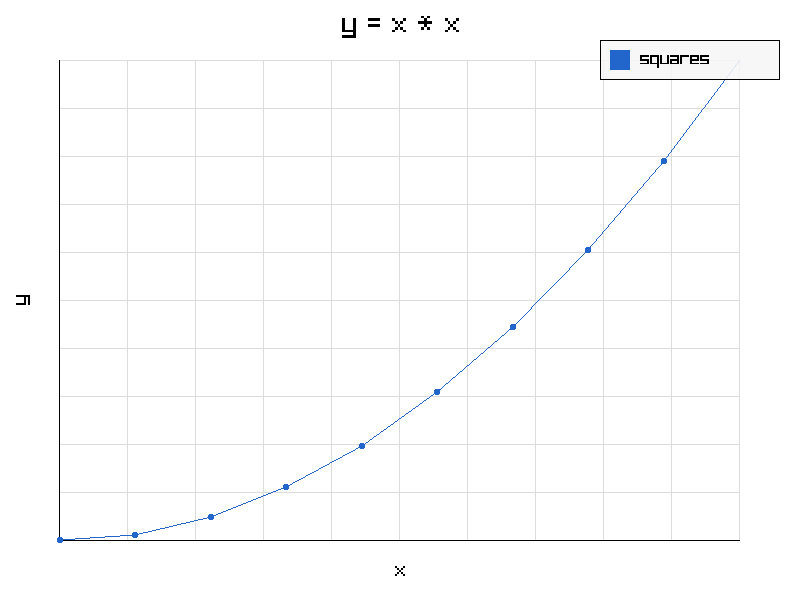
#include "plot/plot.h"

int main(void) {
    Plot* p = plot_create("y = x * x", "x", "y");

    float ys[10];
    for (int i = 0; i < 10; ++i) ys[i] = (float)(i * i);

    PlotColor blue = {34, 102, 204, 255};
    plot_add_line(p, ys, 10, "squares", blue);

    plot_export_image(p, "plot_example.png");   /* writes a PNG to disk */
    plot_destroy(p);

    return 0;
}
turtle is built on raylib; here we draw four nested squares and save the
canvas with the built-in turtle_save_image (a wrapper over raylib's
TakeScreenshot, so you don't need to include raylib.h). Turtle coordinates
are screen pixels (origin top-left).
#include "turtle/turtle.h"

int main(void) {
    Turtle* t = turtle_create();

    turtle_init_window(420, 420, "c_std turtle");
    turtle_set_fps(60);
    turtle_set_speed(t, 100);                    /* fast (0 would never finish) */
    turtle_set_background_color(t, 255, 255, 255, 255);
    turtle_pen_size(t, 4);

    unsigned char colors[4][3] = {{220,50,50}, {40,160,60}, {40,90,210}, {200,140,30}};
    for (int s = 0; s < 4; ++s) {
        float side = 80.0f + s * 60.0f;

        turtle_pen_up(t);
        turtle_set_position(t, 210.0f - side / 2.0f, 210.0f + side / 2.0f);  /* center it */
        turtle_set_heading(t, 0);
        turtle_pen_down(t);
        turtle_set_pen_color_rgb(t, colors[s][0], colors[s][1], colors[s][2], 255);

        for (int i = 0; i < 4; ++i) {            /* one square */
            turtle_forward(t, side);
            turtle_right(t, 90);
        }
    }
    turtle_draw(t);

    turtle_save_image("turtle_example.png");     /* built-in screenshot helper */
    turtle_deallocate(t);
    turtle_close_window();

    return 0;
}

Each module ships its own README.md with a complete API reference, function
descriptions, and runnable examples that include their expected output. Start with
the module directory you are interested in — e.g. vector/README.md,
json/README.md, or algorithm/README.md.
Contributions are welcome — extending libraries, improving performance, or fixing
bugs. Fork the repository, make your changes, and submit a pull request. New modules
just need their directory added to the C_STD_MODULES list in CMakeLists.txt.
This project is open-source and available under the ISC License.
20,771 followers · starred Jan 2024
805 followers · starred Jan 2024
1,334 followers · starred Jan 2024
229 followers · starred Jan 2024
This project reimplements a large slice of the C++ Standard Library (containers,
algorithms, smart pointers, …) together with many Python-style conveniences
(statistics, random, secrets, json, regex, …) in pure C17. The goal is
to give C developers familiar, well-documented building blocks — dynamic arrays,
maps, strings, JSON, networking, big integers, and much more — without leaving the C
ecosystem.
Zero memory leaks. Every module, test suite, and README example is verified
under Valgrind (--leak-check=full) — 0 leaks, 0 errors. Network/socket code is
additionally checked for descriptor leaks (--track-fds=yes).
Cross-platform. Builds and runs on Windows (MSVC and MinGW-w64) and
Linux (GCC/Clang), with POSIX/Win32 backends behind one API. Compiles cleanly
under -Wall -Wextra.
Pure C17. No C++ — just portable standard C with thin platform shims.
40+ modules. Containers, algorithms, smart pointers, strings, JSON/XML/CSV/INI, networking (TCP/UDP/HTTP), crypto & JWT, arbitrary-precision math, graphics, and more.
Familiar APIs. Modeled on the C++ STL (vector, map, unique_ptr, …) and the
Python standard library (random, statistics, json, regex, turtle, …).
Heavily tested with true results. Deep per-module test suites, plus runnable examples in every README whose shown output is captured from a real run.
Fast & predictable. Efficient data structures (geometric vector growth
with inlined push_back/at, O(1) average hashmap, O(log n) map), clear
ownership rules and deallocators.
CMake build. Build the whole library, a single module, or one example at a time, with GCC, Clang, or MSVC.
The library aims to be fast where it counts. The table below pits each C
container against its C++ <stl> counterpart on the same workload, the same
data, and the same compiler family at -O2. Both programs walk an identical
deterministic key stream and compute identical checksums, so they do exactly the
same work — only the container implementation differs.
Environment: Windows 10, MinGW-w64 GCC / G++ 14.2.0, -O2, single thread,
best of three runs (lower is better). Absolute numbers vary by machine; the
ratio is what carries over.
| C container ↔ C++ STL | Workload (N) | C STL | C++ STL | C ÷ C++ |
|---|---|---|---|---|
vector ↔ std::vector<int> | push_back + sum, 10,000,000 | 0.041 s | 0.031 s | 1.3× |
map ↔ std::map<int,int> (ordered / RB-tree) | insert + lookup, 1,000,000 | 1.00 s | 1.20 s | 0.83× |
hashmap ↔ std::unordered_map<int,int> | insert + lookup, 1,000,000 | 0.231 s | 0.364 s | 0.63× |
set ↔ std::set<int> (ordered / RB-tree) | insert + lookup, 1,000,000 | 1.17 s | 1.05 s | 1.1× |
priority_queue ↔ std::priority_queue<int> | push + pop (heap-sort), 1,000,000 | 0.156 s | 0.108 s | 1.4× |
deque ↔ std::deque<int> | push_back + iterate + pop_front, 1,000,000 | 0.009 s | 0.004 s | 2.2× |
list ↔ std::list<int> | push_back + iterate + teardown, 1,000,000 | 0.093 s | 0.075 s | 1.2× |
forward_list ↔ std::forward_list<int> | push_front + iterate + teardown, 1,000,000 | 0.080 s | 0.076 s | 1.05× |
queue ↔ std::queue<int> | enqueue + dequeue (FIFO), 1,000,000 | 0.006 s | 0.003 s | 2.0× |
stack ↔ std::stack<int> | push + pop (LIFO), 1,000,000 | 0.005 s | 0.003 s | 1.7× |
C ÷ C++ is the C time divided by the C++ time — below 1.0 means the C
library is faster.
map and hashmap. Both allocate their tree nodes /
buckets from a pooled slab allocator, so a million inserts cost a handful of
big mallocs instead of a million tiny ones, beating the STL's per-node new.set — near parity. Same pooled-slab, inline-element RB-tree as
map. Lookups are actually a hair faster than std::set; inserts are a
little slower, so it nets ~1.1×. Unlike map (which stores caller-owned
pointers and skips the copy), set has value semantics and deep-copies each
element exactly like std::set, so it can't win the copy back — and its node
carries the publicly-inspectable key/left/right/parent/color fields
(the test suite walks them to check the red-black invariants), which a templated
std::set node doesn't expose. A large RB-tree is cache-miss-bound, so that
slightly larger node is the whole gap.vector and priority_queue. Both are tight loops over
raw ints. The C vector now inlines push_back/at at the call site just
like std::vector and closes most of the gap (~1.3×); the small residual is the
type-erased ABI — a runtime itemSize stride and a size-dispatched element copy
where C++ has a compile-time sizeof(int), plus the bounds check in vector_at
that operator[] skips. The C priority_queue size-dispatches its heap moves
the same way (~1.4×); its residual is the comparator — one indirect call
through a function pointer per comparison, which std::priority_queue inlines
from its template argument. Either way it's a small fixed per-element cost — the
price of a uniform C API — not a worse complexity.deque. The C deque stores elements inline in byte-budgeted
block buffers (one allocation per block, not one malloc per element) and
inlines front / back / at with shift-indexed block math like
std::deque, so it lands at ~2.2×; the residual is the out-of-line
push_back / pop_front calls that std::deque inlines from templates.list. Each node stores its element inline in the same allocation
(one malloc per node, like std::list) instead of a second heap block per
element, which roughly halves the allocation/teardown cost and lands it at
~1.2×. The residual is a slightly larger node — the type-erased API keeps a
value pointer and aligns the inline element for any type — plus the
out-of-line per-node call std::list inlines.forward_list — at parity. It already uses the same single-node-
allocation, inline-element design as std::forward_list, so push_front /
iterate / teardown match it within measurement noise (≈1.05×). No type-erasure
penalty survives here because the per-node malloc dominates and both pay it
once per element.queue. The C queue is a contiguous vector used as a ring:
enqueue appends and dequeue advances a front index (an O(1) bump, not a
buffer shift), with the dead front prefix reclaimed in bulk when the buffer
fills — so both ends are amortized O(1), like std::queue. The hot ops are
inlined; the ~2× residual is the per-element copy into the contiguous buffer
vs std::queue's deque node writes. (Previously dequeue shifted the whole
buffer — O(n), an O(n²) drain; that's fixed.)stack. LIFO at the back of a contiguous vector, so push and pop
are already O(1). push / top / pop / empty are now inlined in the header
(the way std::stack inlines through its container), which cut it from ~3.3× to
~1.7×; the residual is the vector's amortized realloc-copy on growth vs
std::stack's default deque adding blocks — in exchange the C stack keeps its
elements fully contiguous.Reproduce it yourself — a C and a C++ program over the identical key stream:
# C  (link the containers used + algorithm, which queue depends on):
gcc -O2 bench.c vector/vector.c queue/queue.c priority_queue/priority_queue.c \
    hashmap/hashmap.c map/map.c algorithm/algorithm.c -I. -o bench_c && ./bench_c
# C++:
g++ -O2 -std=c++17 bench.cpp -o bench_cpp && ./bench_cpp
I undertake this project out of a deep affection for the C programming language. C remains an essential tool for any computer engineer, providing the foundation needed to build efficient and robust software. This effort aims to enrich the language with the conveniences found in higher-level standard libraries.
Every module lives in its own directory with a .c source, a .h header, and a
README.md containing a full API reference and runnable examples.
| Module | Analogous to | Description |
|---|---|---|
array | std::array | Fixed-size array wrapper with bounds-checked access. |
vector | std::vector | Dynamic, automatically resizing array with memory pooling. |
string | std::string | Growable string with a rich manipulation API (string/std_string.h). |
list | std::list | Doubly linked list. |
forward_list | std::forward_list | Singly linked list. |
deque | std::deque | Double-ended queue with fast insertion/removal at both ends. |
queue | std::queue | FIFO queue. |
stack | std::stack | LIFO stack. |
priority_queue | std::priority_queue | Heap-backed priority queue with a custom comparator. |
span | std::span | Non-owning view over a contiguous sequence. |
bitset | std::bitset | Fixed-size sequence of bits with bitwise operations. |
map | std::map | Ordered associative container (Red-Black tree, O(log n)). |
hashmap | std::unordered_map | Hash table with O(1) average insert/lookup and automatic rehashing. |
set | std::set | Ordered, unique associative container (Red-Black tree, O(log n)); |
tuple | std::tuple | Fixed-size heterogeneous collection. |
variant | std::variant | Type-safe tagged union with a visitor interface. |
uniqueptr | std::unique_ptr | RAII smart pointer with automatic, scope-based cleanup. |
| Module | Description |
|---|---|
algorithm | Generic algorithms inspired by <algorithm>: sort, search, transform, accumulate, … |
sort | Stand-alone sorting library: 8+ algorithms, benchmarking and search helpers. |
statistics | Mean, median, variance, … (mirrors Python's statistics). |
random | Pseudo-random numbers and sequence helpers (mirrors Python's random). |
secrets | Cryptographically secure random numbers/tokens and constant-time comparison. |
uuid | RFC 9562 Universally Unique Identifiers (v4/v7/v3/v5, Nil/Max), mirroring Python's uuid. |
numbers | Mathematical constants (header-only, like C++20 <numbers>). |
matrix | Matrix creation, manipulation and linear-algebra operations. |
bigint | Arbitrary-precision integers (backed by GMP). |
bigfloat | Arbitrary-precision floating point (backed by MPFR). |
evalexpr | Runtime arithmetic-expression evaluator. |
| Module | Description |
|---|---|
fmt | Formatting / I/O library inspired by Go's fmt, with Unicode support. |
encoding | Base64 / Base32 / Base16 / URL encoding and decoding. |
json | Parse, generate and manipulate JSON. |
xml | Parse, create, modify and traverse XML documents. |
csv | Read, write and manipulate CSV files. |
config | Read/modify/save INI-style configuration files. |
regex | Regular-expression compile/match/search (PCRE on Windows, POSIX on Linux). |
cli | Command-line argument/option/sub-command parser. |
log | Leveled logging (DEBUG…FATAL) to console and/or file. |
file_io | FileReader / FileWriter with text and binary (UTF-8/UTF-16) modes. |
dir | Directory and filesystem manipulation. |
| Module | Description |
|---|---|
time | Time measurement and manipulation (time/std_time.h). |
date | Gregorian and Persian calendar dates, conversions and arithmetic. |
| Module | Description |
|---|---|
sysinfo | OS / hardware information (Windows & Linux). |
concurrent | Threads, mutexes, condition variables, semaphore and a thread pool. |
serial_port | Serial-port (RS-232) communication. |
| Module | Description |
|---|---|
crypto | Hashing, encryption/decryption and other primitives (backed by OpenSSL). |
jwt | JSON Web Token creation/verification (HS/RS/ES/PS families). |
| Module | Description |
|---|---|
network | TCP and UDP sockets plus a small HTTP server/client. |
database | PostgreSQL client built on libpq (optional — only built when libpq is present). |
| Module | Description |
|---|---|
plot | 2-D plotting (line/scatter/bar) built on raylib. |
turtle | Turtle graphics, inspired by Python's turtle (built on raylib). |
| Module | Description |
|---|---|
unittest | Lightweight unit-testing framework (assertions, suites, fixtures). |
To build the whole project you need:
Build tools
Third-party libraries (installed system-wide via your package manager)
| Library | Used by | Required? |
|---|---|---|
OpenSSL (libssl, libcrypto) | crypto, jwt, network | Yes |
| raylib | plot, turtle | Yes |
| GMP | bigint | Yes |
| MPFR | bigfloat | Yes |
| PostgreSQL / libpq | database | Optional — the database module is skipped automatically if libpq is missing |
| pthreads | concurrent, network | Provided by the toolchain (winpthread on Windows) |
The project no longer uses the old
compile.pyscript — the build is CMake-only.
Install MSYS2 (this project assumes it lives at C:\msys64).
Open the “MSYS2 MinGW x64” shell and run:
pacman -Syu          # update once (re-open the shell if it asks you to)

pacman -S --needed \
  mingw-w64-x86_64-toolchain \
  mingw-w64-x86_64-clang \
  mingw-w64-x86_64-cmake \
  mingw-w64-x86_64-ninja \
  mingw-w64-x86_64-openssl \
  mingw-w64-x86_64-raylib \
  mingw-w64-x86_64-gmp \
  mingw-w64-x86_64-mpfr \
  mingw-w64-x86_64-postgresql
Always build from the MinGW x64 shell (not the plain MSYS shell) so that
C:\msys64\mingw64\bin is on the PATH and CMake picks up the right compiler and
libraries.
sudo apt update
sudo apt install \
  build-essential clang cmake ninja-build pkg-config \
  libssl-dev libgmp-dev libmpfr-dev libpq-dev libraylib-dev
libraylib-devis available on Debian 12+ / Ubuntu 22.04+. On older releases, install raylib from source (https://github.com/raysan5/raylib) or omit theplot/turtlemodules.
sudo dnf install \
  gcc clang cmake ninja-build pkgconf-pkg-config \
  openssl-devel gmp-devel mpfr-devel libpq-devel raylib-devel
All commands are run from the project root (c_std/).
# Configure (Ninja generator recommended). Omit -G for the platform default.
cmake -S . -B build -G Ninja

# Build the library, the main demo
cmake --build build

# Build and run the main demo (runs from the project root so ./sources is reachable)
cmake --build build --target run
Binaries are written to build/bin/.
The project is fully modular — you can compile a single module or a single example without building the rest:
# Compile just one module's objects
cmake --build build --target vector

# Compile every module library (no executables)
cmake --build build --target modules
The build is compiler-agnostic and targets the C17 standard.
# GCC (default on MSYS2 / Linux)
cmake -S . -B build -G Ninja -DCMAKE_C_COMPILER=gcc

# Clang
cmake -S . -B build -G Ninja -DCMAKE_C_COMPILER=clang
# On MSYS2, `clang` is usually the CLANG64 toolchain, whose linker does not search
# the MinGW-w64 library directory. If you installed the dependencies into mingw64,
# point clang's linker at them:
#   cmake -S . -B build -G Ninja -DCMAKE_C_COMPILER=clang \
#         -DCMAKE_EXE_LINKER_FLAGS="-LC:/msys64/mingw64/lib"

# MSVC — from an “x64 Native Tools Command Prompt for VS”
cmake -S . -B build -G "Ninja"            # or: -G "Visual Studio 17 2022"
cmake --build build --config Release
On MSVC, install the third-party libraries with vcpkg
(vcpkg install openssl raylib gmp mpfr libpq) and pass
-DCMAKE_TOOLCHAIN_FILE=<vcpkg>/scripts/buildsystems/vcpkg.cmake when configuring.
| Option | Default | Effect |
|---|---|---|
C_STD_BUILD_MAIN | ON | Build the main demo executable. |
The examples/ directory contains a small, self-contained program for (almost)
every module — examples/<module>_example.c — taken from that module's README.md.
Each one is compiled by CMake into its own executable named <module>_example, so
you can build and run them individually (see
Build / run one piece at a time).
A few examples are compile-only because they need external resources at run time:
network (sockets), database (a running PostgreSQL server), serial_port
(hardware), and plot / turtle (open a graphical window).
A taste of a few modules. Each snippet is a complete program; the per-module
README.md files have many more (with expected output).
#include "vector/vector.h"
#include "fmt/fmt.h"

int main(void) {
    Vector* v = vector_create(sizeof(int));
    for (int i = 1; i <= 5; ++i) {
        vector_push_back(v, &i);
    }

    int sum = 0;
    for (size_t i = 0; i < vector_size(v); ++i) {
        sum += *(int*)vector_at(v, i);
    }

    fmt_printf("size=%zu sum=%d\n", vector_size(v), sum);
    vector_deallocate(v);
    return 0;
}
size=5 sum=15
#include "json/json.h"
#include "fmt/fmt.h"

int main(void) {
    JsonElement* root = json_parse("{\"lib\": \"c_std\", \"version\": 1.0, \"tags\": [\"c\", \"stl\"]}");

    json_print(root);
    json_deallocate(root);

    return 0;
}
{
    "lib": "c_std",
    "tags": [
      "c",
      "stl"
  ],
    "version": 1
}
#include "csv/csv.h"
#include "fmt/fmt.h"
#include <stdlib.h>

int main(void) {
    CsvFile* csv = csv_file_create(',');
    CsvRow*  row = csv_row_create();

    csv_row_append_cell(row, "Alice");
    csv_row_append_cell(row, "30");
    csv_file_append_row(csv, row);

    char* out = csv_file_export_to_string(csv);
    fmt_printf("%s", out);

    free(out);
    csv_file_destroy(csv);
    return 0;
}
Alice,30
#include "config/config.h"
#include "fmt/fmt.h"
#include <stdio.h>

int main(void) {
    /* write a small INI file, then load and read it */
    FILE* f = fopen("app.ini", "w");
    fputs("[server]\nhost = localhost\nport = 8080\n", f);
    fclose(f);

    ConfigFile* cfg = config_create("app.ini");
    fmt_printf("host=%s port=%d\n",
               config_get_value(cfg, "server", "host"),
               config_get_int(cfg, "server", "port", 0));

    config_deallocate(cfg);
    remove("app.ini");

    return 0;
}
host=localhost port=8080
#include "random/random.h"
#include "fmt/fmt.h"

int main(void) {
    random_seed(42);
    fmt_printf("dice rolls: %d %d %d\n", random_randint(1, 6), random_randint(1, 6), random_randint(1, 6));

    return 0;
}
dice rolls: 4 5 1
#include "crypto/crypto.h"
#include "fmt/fmt.h"
#include <stdlib.h>

int main(void) {
    size_t   n;
    uint8_t* h   = crypto_hash_string("hello", CRYPTO_SHA256, &n);
    char*    hex = crypto_hash_to_hex(h, n);

    fmt_printf("sha256(\"hello\") = %s\n", hex);

    free(hex);
    free(h);

    return 0;
}
sha256("hello") = 2cf24dba5fb0a30e26e83b2ac5b9e29e1b161e5c1fa7425e73043362938b9824
#include "concurrent/concurrent.h"
#include "fmt/fmt.h"

static int worker(void* arg) { *(int*)arg += 41; return 0; }

int main(void) {
    int value = 1;
    Thread t;

    thread_create(&t, worker, &value);
    thread_join(t, NULL);
    fmt_printf("value=%d\n", value);

    return 0;
}
value=42
#include "concurrent/thread_pool.h"
#include "concurrent/concurrent.h"
#include "fmt/fmt.h"

static Mutex m;
static int counter = 0;

static int task(void* arg) {
    (void)arg;

    mutex_lock(&m);
    counter++;
    mutex_unlock(&m);

    return 0;
}

int main(void) {
    mutex_init(&m, MUTEX_PLAIN);
    ThreadPool* pool = thread_pool_create(4);


    for (int i = 0; i < 100; ++i) {
        thread_pool_add_task(pool, task, NULL);
    }
    thread_pool_wait(pool);
    fmt_printf("ran %d tasks\n", counter);

    thread_pool_destroy(pool);
    mutex_destroy(&m);

    return 0;
}
ran 100 tasks
#include "network/udp.h"
#include "fmt/fmt.h"

int main(void) {
    udp_init();
    UdpSocket sock;

    udp_socket_create(&sock);
    udp_bind(sock, NULL, 0);                 /* any address, kernel-chosen port */

    char host[INET6_ADDRSTRLEN];
    unsigned short port = 0;

    udp_get_local_address(sock, host, sizeof(host), &port);
    fmt_printf("udp socket bound to an ephemeral port: %s\n", port != 0 ? "yes" : "no");

    udp_close(sock);
    udp_cleanup();

    return 0;
}
udp socket bound to an ephemeral port: yes
#include "network/tcp.h"
#include "fmt/fmt.h"

int main(void) {
    tcp_init();
    TcpSocket server;

    tcp_socket_create(&server);
    tcp_set_reuse_addr(server, true);
    tcp_bind(server, "127.0.0.1", 0);        /* ephemeral port */
    tcp_listen(server, 1);

    char host[INET6_ADDRSTRLEN];
    unsigned short port = 0;

    tcp_get_sock_name(server, host, sizeof(host), &port);
    fmt_printf("tcp server on %s, port assigned: %s\n", host, port != 0 ? "yes" : "no");

    tcp_close(server);
    tcp_cleanup();

    return 0;
}
tcp server on 127.0.0.1, port assigned: yes
#include "network/http.h"
#include "fmt/fmt.h"
#include <stdlib.h>

int main(void) {
    HttpResponse res = {0};

    http_set_status(&res, 200, "OK");
    http_set_body(&res, "Hello, world!");

    char* raw = http_serialize_response(&res);
    fmt_printf("%s", raw);

    free(raw);
    http_free_response(&res);

    return 0;
}
HTTP/1.1 200 OK
Content-Type: text/plain

Hello, world!
#include "plot/plot.h"

int main(void) {
    Plot* p = plot_create("y = x * x", "x", "y");

    float ys[10];
    for (int i = 0; i < 10; ++i) ys[i] = (float)(i * i);

    PlotColor blue = {34, 102, 204, 255};
    plot_add_line(p, ys, 10, "squares", blue);

    plot_export_image(p, "plot_example.png");   /* writes a PNG to disk */
    plot_destroy(p);

    return 0;
}
turtle is built on raylib; here we draw four nested squares and save the
canvas with the built-in turtle_save_image (a wrapper over raylib's
TakeScreenshot, so you don't need to include raylib.h). Turtle coordinates
are screen pixels (origin top-left).
#include "turtle/turtle.h"

int main(void) {
    Turtle* t = turtle_create();

    turtle_init_window(420, 420, "c_std turtle");
    turtle_set_fps(60);
    turtle_set_speed(t, 100);                    /* fast (0 would never finish) */
    turtle_set_background_color(t, 255, 255, 255, 255);
    turtle_pen_size(t, 4);

    unsigned char colors[4][3] = {{220,50,50}, {40,160,60}, {40,90,210}, {200,140,30}};
    for (int s = 0; s < 4; ++s) {
        float side = 80.0f + s * 60.0f;

        turtle_pen_up(t);
        turtle_set_position(t, 210.0f - side / 2.0f, 210.0f + side / 2.0f);  /* center it */
        turtle_set_heading(t, 0);
        turtle_pen_down(t);
        turtle_set_pen_color_rgb(t, colors[s][0], colors[s][1], colors[s][2], 255);

        for (int i = 0; i < 4; ++i) {            /* one square */
            turtle_forward(t, side);
            turtle_right(t, 90);
        }
    }
    turtle_draw(t);

    turtle_save_image("turtle_example.png");     /* built-in screenshot helper */
    turtle_deallocate(t);
    turtle_close_window();

    return 0;
}
Each module ships its own README.md with a complete API reference, function
descriptions, and runnable examples that include their expected output. Start with
the module directory you are interested in — e.g. vector/README.md,
json/README.md, or algorithm/README.md.
Contributions are welcome — extending libraries, improving performance, or fixing
bugs. Fork the repository, make your changes, and submit a pull request. New modules
just need their directory added to the C_STD_MODULES list in CMakeLists.txt.
This project is open-source and available under the ISC License.
20,771 followers · starred Jan 2024
805 followers · starred Jan 2024
1,334 followers · starred Jan 2024
229 followers · starred Jan 2024