
FlashRec is a CUDA-graph engine for generative recommendation: wide beam search (3–5 SID steps, n=50–512+) over a trie-constrained catalog, in-process FP8 serving, and ranked beams on /v1/chat/completions.
Python
106
8 commits
updated Sep 12, 2026
See what people are saying
README





Features | Quickstart | Documentation | Examples | Architecture | API | Evaluation | FAQ | 简体中文
An inference engine for generative recommendation, based on mini-sglang: wide beam search over a semantic-ID catalog, executed inside CUDA graphs.
Generative recommendation (GenRec) formulates item retrieval as the generation of semantic IDs (SIDs): short, fixed-depth token sequences that index an item catalog. A typical request decodes 3–5 steps at a beam width of 50–512 or more, with every continuation restricted to the valid-SID catalog. General-purpose LLM engines are optimized for long-sequence, single-path decoding; a wide-beam request occupies the engine, and throughput does not scale with concurrency. FlashRec is designed for this workload.
Features
The engine targets short SID depth, wide beam, and catalog-constrained decoding.
Throughput scales with beam width n and concurrency; the illegal-SID rate is
0 under the trie constraint. Measurements are in Evaluation.
| FlashRec | General LLM engines | |
|---|---|---|
| Depth / width | 3–5 steps × 50–512+ beams | hundreds–thousands of steps × 1 sequence |
| Vocabulary | valid-SID continuations (trie) | full, unconstrained |
| Wide-beam graphs | including expansion, captured at multiples of n, one replay | capture often sized for decode batch; wide beam runs eager |
| Illegal SIDs | 0 | ~17–27%, filtered after the fact |
| Concurrency | beam-row slot budget; rows from different requests share a step | one wide-beam request occupies the engine; throughput roughly flat |
Decoding
- CUDA graphs. Beam widths from 50 to 512+ run in captured graphs, including the beam-expansion step. Capture sizes extend to multiples of the configured width, so a wide beam is a single graph replay.
- SID constraint. A fused CUDA kernel (dense or CSR-sparse trie) restricts
decoding to a catalog of valid semantic IDs.
lm_headis evaluated only over the SID token range. Illegal SIDs are never candidates, soinvalid_rateis 0; open-vocabulary baselines leave ~17–27% of beams illegal. - Scheduling. Requests are admitted into decode waves between steps under a beam-row slot budget, so beam rows from different requests share a step. A radix prefix KV cache with longest-prefix-match scheduling reduces the cost of shared prompts; aging prevents starvation.
Serving
- In-process serving. HTTP, scheduling, weights, and the KV pool share one process and one address space.
- FP8 by default. W8A8 per-channel weights and
fp8_e4m3KV, with fused RMSNorm→FP8, SiLU→FP8, and QK-RoPE+KV-write. On 1.7B-class checkpoints atn ≤ 128the main gain is weight and KV-cache footprint; atn = 512the two precisions converge on throughput, where the step is bound by bookkeeping. - API. Ranked beams on
/v1/chat/completions. Deterministic top-k attemperature = 0; Gumbel top-k without replacement above it. - Profiler.
/start_profile//stop_profilecompatible withsglang.bench_serving --profile.
Quickstart
pip install -e .

# Public GenRec checkpoint used in the documentation.
hf download OpenOneRec/OneRec-1.7B --local-dir ./OneRec-1.7B

# Build a SID catalog from OpenOneRec RecIF-Bench benchmark_data.
flashrec --catalog /path/to/OpenOneRec-RecIF/benchmark_data

# Serve, constrained to that catalog. Layout is inferred from the tokenizer.
flashrec --serve --model-path ./OneRec-1.7B --port 8000 --host 0.0.0.0 \
  --beam-width 512 --max-tokens 5 \
  --sid-vocab-file data/catalogs/sid2pid_beamrec_l4.json
curl -s http://127.0.0.1:8000/v1/chat/completions \
  -H 'Content-Type: application/json' \
  -d '{"messages":[{"role":"user","content":"..."}],
       "n":32,"max_tokens":5,"temperature":0}'
Each beam is returned as one choices[] entry, ranked best-first, with its
score under sglext.sequence_score. With --sid-vocab-file the SID layout is
inferred from the checkpoint tokenizer. If the catalog is unset, the engine
decodes over the full vocabulary (connectivity check only). Wide beam
(n ≥ 512) also requires --cuda-graph-max-bs 4096 --batch-slots 4096.
The server binds 127.0.0.1 and has no authentication. Bind a public address
only on a trusted network or behind an authenticating proxy.
Runnable offline and HTTP clients: Examples. Flags: Configuration.
Evaluation
Throughput, retrieval metrics, and HuggingFace codebook overlap were measured on
an NVIDIA RTX 5090. See
Evaluation. Unless noted otherwise, FlashRec runs FP8 with
a SID trie; the baselines are open-vocabulary. SGLang-master
(PR #31626) and
SGLang 0801
(cswuyg/sglang feature/beam_search_update_0801)
are separate engines; do not collapse them into one row.
Evaluation covers:
- OneRec: the OpenOneRec RecIF-Bench video task with OneRec-1.7B
- SoHuRec-1.7B / SoHuRec-0.6B: Sohu internal generative-recommendation serving traffic on the corresponding models
Speed-ups are FlashRec relative to that baseline. Do not divide OneRec QPS by SoHuRec QPS (prompt length differs by about 8×).
| Baseline | Setting | Relative throughput |
|---|---|---|
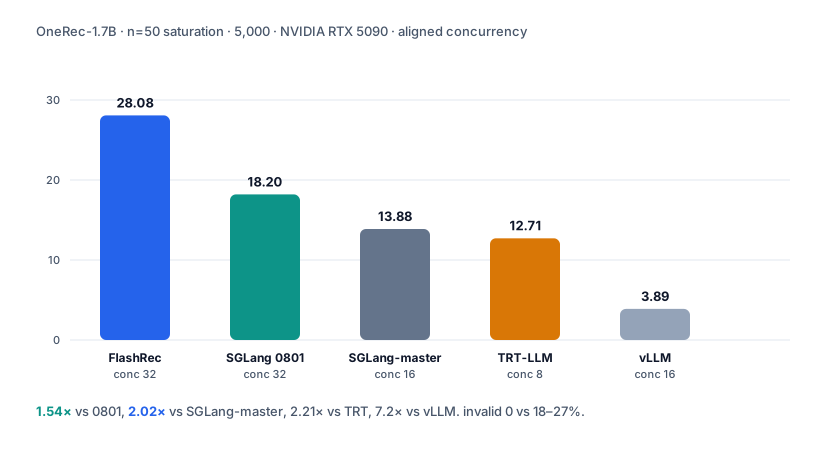
| SGLang 0801 | OneRec, n=50 saturation | 1.54× (recall@32 0.034 both; invalid 0 vs 0.270) |
| SGLang-master | OneRec, n=50 saturation | 2.02× (recall@32 0.034 both; invalid 0 vs 0.260) |
| TensorRT-LLM | OneRec, n=50 saturation | 2.21× |
| vLLM | OneRec, n=50 saturation | 7.2× |
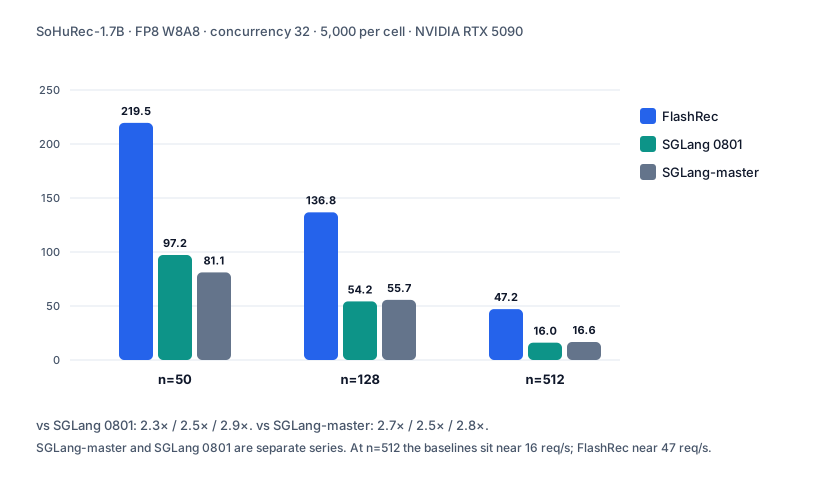
| SGLang 0801 | SoHuRec-1.7B, n=50–512 saturation | 2.3–3.0× |
| SGLang-master | SoHuRec-1.7B, n=50–512 saturation | 2.5–2.9× |
| SGLang 0801 | SoHuRec, n=1000, concurrency 1 | 2.1–2.2× (dies at conc ≥ 8) |
| SGLang-master | SoHuRec, n=1000, concurrency 1 | 2.1–2.2× (dies at conc ≥ 8) |
On OneRec, FlashRec has invalid_rate = 0; open-vocabulary engines leave about
17–27% of beams illegal. The quality gap is whether SID constraint is on,
not the engine. Do not cite FlashRec concurrency-1 recall@32 (unique-beam
collapse). When citing, state the device, trie vs open-vocabulary, concurrency,
and sample count.
OneRec
OpenOneRec RecIF-Bench video,
model OneRec-1.7B. 5,000
samples, n=50 saturation (highest completed concurrency per engine).
| Engine | Constraint | QPS | conc | recall@32 (conc=8) | invalid |
|---|---|---|---|---|---|
| FlashRec | SID trie | 28.08 | 32 | 0.034 | 0 |
| SGLang 0801 | open-vocab | 18.20 | 32 | 0.034 | 0.270 |
| SGLang-master | open-vocab | 13.88 | 16 | 0.034 | 0.260 |
| TensorRT-LLM | open-vocab | 12.71 | 8 | 0.034 | 0.259 |
| vLLM | open-vocab | 3.89 | 16 | 0.034 | 0.260 |
1.54× vs SGLang 0801, 2.02× vs SGLang-master, 2.21× vs
TensorRT-LLM, 7.2× vs vLLM. At n=1000 FlashRec saturates at 4.62 QPS;
SGLang-master and SGLang 0801 only hold concurrency 1 (2.5–3.0). Full matrices:
Evaluation.
On SoHuRec serving prompts: at n=50, 1.7B FlashRec saturates at 220 QPS
and 0.6B at 303 QPS; at n=512, 1.7B FlashRec is ~48 QPS vs 0801 /
SGLang-master ~16 QPS; at n=1000 FlashRec saturates at 24.6 QPS
(1.7B) and 32 QPS (0.6B), and SGLang-master and SGLang 0801 only hold concurrency 1.
Numerical match vs HuggingFace
Codebook-constrained beam search (no SID trie) against transformers, not
retrieval recall. HuggingFace is a BF16 reference; FlashRec is measured in
BF16 and in FP8. See Evaluation; commands in
Examples.
- OneRec-1.7B (RTX 5090): BF16 matches HuggingFace's best SID at every width
(
n = 1–512); beam-set overlap 86–92%. FP8 swaps top-1 atn = 1on a 0.125-nat near-tie; overlap is 80% atn = 20and 70–76% atn ≥ 50. HuggingFace's best sequence is inside the FlashRec beam fromn = 20. The public checkpoint is not FP8-trained; that drop is on-load quantization, not a framework bug. - SoHuRec-1.7B / SoHuRec-0.6B (FP8-trained, RTX 5090, FP8 decoder GEMM on both sides):
beam-set overlap 88–96% / 88–93%; prefill top-1 is 100% on SoHuRec-1.7B and
94% on SoHuRec-0.6B (noisy tail, rank corr 0.641; set overlap still about 90%).
n = 512is the mean of the first 3 prompts (HuggingFace OOMs on a longer remaining prompt). Prefer an FP8-trained checkpoint for production FP8 serving.
Supported models
Qwen3 dense: Qwen3-0.6B / 1.7B / 4B / 8B / 14B, OneRec-1.7B, SoHuRec-1.7B /
SoHuRec-0.6B, and Qwen3-based GenRec checkpoints. Architectural parameters (GQA, head_dim, qk-norm, tied
embeddings) are read from config.json; validated at the 1.7B scale. Broader
dense and MoE coverage is on the Roadmap.
Both BF16 checkpoints (quantized on load to W8A8 per-channel under the default
--quantization fp8) and pre-quantized FP8 checkpoints carrying weight_scale
are supported; any other --quantization value runs in BF16.
Model size is bound by device memory — roughly up to 14B in FP8 on 32 GB.
Sequence length is capped by --max-seq-len (default 4096) and stays inside the
checkpoint's native positional range. The engine serves beam search over a
semantic-ID catalog.
Architecture
A request is served in the same process that owns the weights and the KV pool: HTTP, scheduling, and the model share one address space.
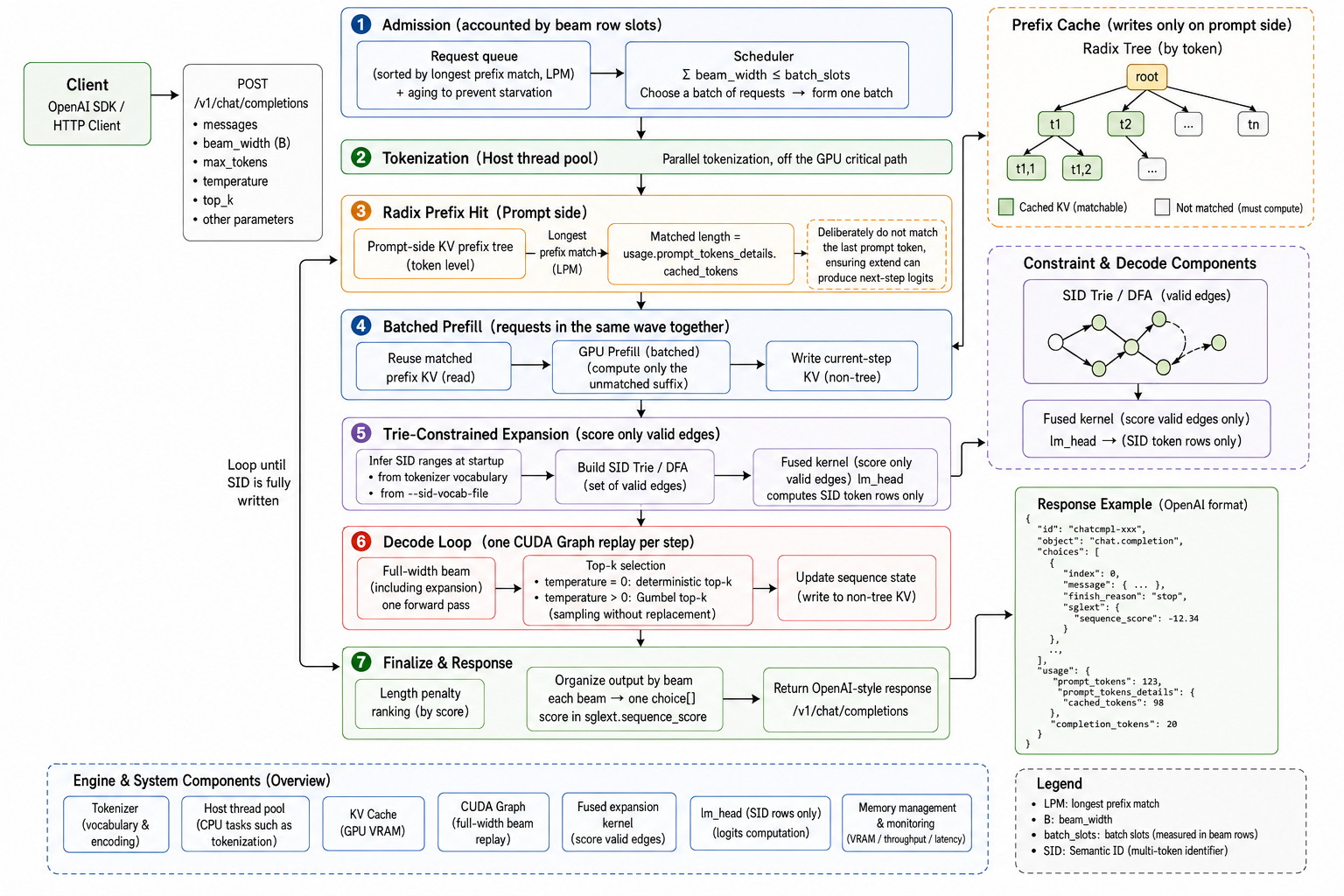
The pipeline admits requests by longest-prefix-match, tokenizes off the GPU
path, reuses radix prefix KV, prefills only the miss suffix, scores valid SID
edges through a fused trie kernel, and decodes inside a CUDA-graph replay.
Module layout follows
mini-sglang; at runtime the engine
depends on sgl-kernel, flashinfer_python, and triton. Request path, design
notes, and module map: Architecture.
Documentation
Documentation · Architecture · API · Configuration · Evaluation · FAQ · Examples · Changelog
Development
Install the hooks once per clone; they then run on every commit and match what CI enforces:
pip install pre-commit && pre-commit install
pre-commit run --all-files     # check the whole tree
Unit tests run on CPU:
python -m pytest
Optional integration checks — live parity against an SGLang beam server, and an
accuracy comparison against HuggingFace transformers — are documented in
Configuration, along with the
profiling/trace interface.
# Codebook-constrained vs HuggingFace (needs CUDA + OneRec-1.7B)
FLASHREC_DIFF_MODEL=./OneRec-1.7B \
  PYTHONPATH=python python -m unittest tests.test_beam_search_diff -v

FLASHREC_DIFF_MODEL=./OneRec-1.7B \
FLASHREC_DIFF_BEAMS=1,20,50,128,512 \
FLASHREC_DIFF_QUANT=bf16 \
  PYTHONPATH=python python -m unittest tests.test_beam_search_diff.TestBeamSearchDiff -v
Numbers: Numerical match vs HuggingFace.
FLASHREC_DIFF_QUANT=fp8 (default) is the serving path.
Roadmap
- Broader GenRec model coverage: Llama / Qwen / GLM dense backbones and sparse models such as Qwen3-MoE
- Tensor and expert parallelism for 30B–200B-class MoE and larger dense recommendation models
- NVFP4 and native Blackwell storage
- Reproducible RecIF coverage across video / ad / product, and published PyPI wheels
Contributing
Contributions are welcome. See Contributing for development setup, tests, and the pull-request process. Participation is governed by the Code of Conduct. Vulnerabilities go through the private disclosure process in Security.
Acknowledgements
- SGLang
- mini-sglang — layout reference
- OpenOneRec (Kuaishou) — OneRec-1.7B and RecIF-Bench
- cswuyg/sglang
feature/beam_search_update_0801— beam semantics alignment and accuracy tests
Citation
@software{flashrec,
  title  = {FlashRec: A Wide-Beam Inference Engine for Generative Recommendation},
  author = {Wang, Chongyang and {sohu-mptc}},
  year   = {2026},
  url    = {https://github.com/sohu-mptc/FlashRec}
}
GitHub also exposes this via CITATION.cff.
License
Apache-2.0, see LICENSE.
Similar repos






Languages
Python
89.4%
Shell
5.8%
Cuda
4.8%
FlashRec is a CUDA-graph engine for generative recommendation: wide beam search (3–5 SID steps, n=50–512+) over a trie-constrained catalog, in-process FP8 serving, and ranked beams on /v1/chat/completions.
Python
106
8 commits
updated Sep 12, 2026
See what people are saying
README
Features | Quickstart | Documentation | Examples | Architecture | API | Evaluation | FAQ | 简体中文
An inference engine for generative recommendation, based on mini-sglang: wide beam search over a semantic-ID catalog, executed inside CUDA graphs.
Generative recommendation (GenRec) formulates item retrieval as the generation of semantic IDs (SIDs): short, fixed-depth token sequences that index an item catalog. A typical request decodes 3–5 steps at a beam width of 50–512 or more, with every continuation restricted to the valid-SID catalog. General-purpose LLM engines are optimized for long-sequence, single-path decoding; a wide-beam request occupies the engine, and throughput does not scale with concurrency. FlashRec is designed for this workload.
Features
The engine targets short SID depth, wide beam, and catalog-constrained decoding.
Throughput scales with beam width n and concurrency; the illegal-SID rate is
0 under the trie constraint. Measurements are in Evaluation.
| FlashRec | General LLM engines | |
|---|---|---|
| Depth / width | 3–5 steps × 50–512+ beams | hundreds–thousands of steps × 1 sequence |
| Vocabulary | valid-SID continuations (trie) | full, unconstrained |
| Wide-beam graphs | including expansion, captured at multiples of n, one replay | capture often sized for decode batch; wide beam runs eager |
| Illegal SIDs | 0 | ~17–27%, filtered after the fact |
| Concurrency | beam-row slot budget; rows from different requests share a step | one wide-beam request occupies the engine; throughput roughly flat |
Decoding
- CUDA graphs. Beam widths from 50 to 512+ run in captured graphs, including the beam-expansion step. Capture sizes extend to multiples of the configured width, so a wide beam is a single graph replay.
- SID constraint. A fused CUDA kernel (dense or CSR-sparse trie) restricts
decoding to a catalog of valid semantic IDs.
lm_headis evaluated only over the SID token range. Illegal SIDs are never candidates, soinvalid_rateis 0; open-vocabulary baselines leave ~17–27% of beams illegal. - Scheduling. Requests are admitted into decode waves between steps under a beam-row slot budget, so beam rows from different requests share a step. A radix prefix KV cache with longest-prefix-match scheduling reduces the cost of shared prompts; aging prevents starvation.
Serving
- In-process serving. HTTP, scheduling, weights, and the KV pool share one process and one address space.
- FP8 by default. W8A8 per-channel weights and
fp8_e4m3KV, with fused RMSNorm→FP8, SiLU→FP8, and QK-RoPE+KV-write. On 1.7B-class checkpoints atn ≤ 128the main gain is weight and KV-cache footprint; atn = 512the two precisions converge on throughput, where the step is bound by bookkeeping. - API. Ranked beams on
/v1/chat/completions. Deterministic top-k attemperature = 0; Gumbel top-k without replacement above it. - Profiler.
/start_profile//stop_profilecompatible withsglang.bench_serving --profile.
Quickstart
pip install -e .

# Public GenRec checkpoint used in the documentation.
hf download OpenOneRec/OneRec-1.7B --local-dir ./OneRec-1.7B

# Build a SID catalog from OpenOneRec RecIF-Bench benchmark_data.
flashrec --catalog /path/to/OpenOneRec-RecIF/benchmark_data

# Serve, constrained to that catalog. Layout is inferred from the tokenizer.
flashrec --serve --model-path ./OneRec-1.7B --port 8000 --host 0.0.0.0 \
  --beam-width 512 --max-tokens 5 \
  --sid-vocab-file data/catalogs/sid2pid_beamrec_l4.json
curl -s http://127.0.0.1:8000/v1/chat/completions \
  -H 'Content-Type: application/json' \
  -d '{"messages":[{"role":"user","content":"..."}],
       "n":32,"max_tokens":5,"temperature":0}'
Each beam is returned as one choices[] entry, ranked best-first, with its
score under sglext.sequence_score. With --sid-vocab-file the SID layout is
inferred from the checkpoint tokenizer. If the catalog is unset, the engine
decodes over the full vocabulary (connectivity check only). Wide beam
(n ≥ 512) also requires --cuda-graph-max-bs 4096 --batch-slots 4096.
The server binds 127.0.0.1 and has no authentication. Bind a public address
only on a trusted network or behind an authenticating proxy.
Runnable offline and HTTP clients: Examples. Flags: Configuration.
Evaluation
Throughput, retrieval metrics, and HuggingFace codebook overlap were measured on
an NVIDIA RTX 5090. See
Evaluation. Unless noted otherwise, FlashRec runs FP8 with
a SID trie; the baselines are open-vocabulary. SGLang-master
(PR #31626) and
SGLang 0801
(cswuyg/sglang feature/beam_search_update_0801)
are separate engines; do not collapse them into one row.
Evaluation covers:
- OneRec: the OpenOneRec RecIF-Bench video task with OneRec-1.7B
- SoHuRec-1.7B / SoHuRec-0.6B: Sohu internal generative-recommendation serving traffic on the corresponding models
Speed-ups are FlashRec relative to that baseline. Do not divide OneRec QPS by SoHuRec QPS (prompt length differs by about 8×).
| Baseline | Setting | Relative throughput |
|---|---|---|
| SGLang 0801 | OneRec, n=50 saturation | 1.54× (recall@32 0.034 both; invalid 0 vs 0.270) |
| SGLang-master | OneRec, n=50 saturation | 2.02× (recall@32 0.034 both; invalid 0 vs 0.260) |
| TensorRT-LLM | OneRec, n=50 saturation | 2.21× |
| vLLM | OneRec, n=50 saturation | 7.2× |
| SGLang 0801 | SoHuRec-1.7B, n=50–512 saturation | 2.3–3.0× |
| SGLang-master | SoHuRec-1.7B, n=50–512 saturation | 2.5–2.9× |
| SGLang 0801 | SoHuRec, n=1000, concurrency 1 | 2.1–2.2× (dies at conc ≥ 8) |
| SGLang-master | SoHuRec, n=1000, concurrency 1 | 2.1–2.2× (dies at conc ≥ 8) |
On OneRec, FlashRec has invalid_rate = 0; open-vocabulary engines leave about
17–27% of beams illegal. The quality gap is whether SID constraint is on,
not the engine. Do not cite FlashRec concurrency-1 recall@32 (unique-beam
collapse). When citing, state the device, trie vs open-vocabulary, concurrency,
and sample count.
OneRec
OpenOneRec RecIF-Bench video,
model OneRec-1.7B. 5,000
samples, n=50 saturation (highest completed concurrency per engine).
| Engine | Constraint | QPS | conc | recall@32 (conc=8) | invalid |
|---|---|---|---|---|---|
| FlashRec | SID trie | 28.08 | 32 | 0.034 | 0 |
| SGLang 0801 | open-vocab | 18.20 | 32 | 0.034 | 0.270 |
| SGLang-master | open-vocab | 13.88 | 16 | 0.034 | 0.260 |
| TensorRT-LLM | open-vocab | 12.71 | 8 | 0.034 | 0.259 |
| vLLM | open-vocab | 3.89 | 16 | 0.034 | 0.260 |
1.54× vs SGLang 0801, 2.02× vs SGLang-master, 2.21× vs
TensorRT-LLM, 7.2× vs vLLM. At n=1000 FlashRec saturates at 4.62 QPS;
SGLang-master and SGLang 0801 only hold concurrency 1 (2.5–3.0). Full matrices:
Evaluation.
On SoHuRec serving prompts: at n=50, 1.7B FlashRec saturates at 220 QPS
and 0.6B at 303 QPS; at n=512, 1.7B FlashRec is ~48 QPS vs 0801 /
SGLang-master ~16 QPS; at n=1000 FlashRec saturates at 24.6 QPS
(1.7B) and 32 QPS (0.6B), and SGLang-master and SGLang 0801 only hold concurrency 1.
Numerical match vs HuggingFace
Codebook-constrained beam search (no SID trie) against transformers, not
retrieval recall. HuggingFace is a BF16 reference; FlashRec is measured in
BF16 and in FP8. See Evaluation; commands in
Examples.
- OneRec-1.7B (RTX 5090): BF16 matches HuggingFace's best SID at every width
(
n = 1–512); beam-set overlap 86–92%. FP8 swaps top-1 atn = 1on a 0.125-nat near-tie; overlap is 80% atn = 20and 70–76% atn ≥ 50. HuggingFace's best sequence is inside the FlashRec beam fromn = 20. The public checkpoint is not FP8-trained; that drop is on-load quantization, not a framework bug. - SoHuRec-1.7B / SoHuRec-0.6B (FP8-trained, RTX 5090, FP8 decoder GEMM on both sides):
beam-set overlap 88–96% / 88–93%; prefill top-1 is 100% on SoHuRec-1.7B and
94% on SoHuRec-0.6B (noisy tail, rank corr 0.641; set overlap still about 90%).
n = 512is the mean of the first 3 prompts (HuggingFace OOMs on a longer remaining prompt). Prefer an FP8-trained checkpoint for production FP8 serving.
Supported models
Qwen3 dense: Qwen3-0.6B / 1.7B / 4B / 8B / 14B, OneRec-1.7B, SoHuRec-1.7B /
SoHuRec-0.6B, and Qwen3-based GenRec checkpoints. Architectural parameters (GQA, head_dim, qk-norm, tied
embeddings) are read from config.json; validated at the 1.7B scale. Broader
dense and MoE coverage is on the Roadmap.
Both BF16 checkpoints (quantized on load to W8A8 per-channel under the default
--quantization fp8) and pre-quantized FP8 checkpoints carrying weight_scale
are supported; any other --quantization value runs in BF16.
Model size is bound by device memory — roughly up to 14B in FP8 on 32 GB.
Sequence length is capped by --max-seq-len (default 4096) and stays inside the
checkpoint's native positional range. The engine serves beam search over a
semantic-ID catalog.
Architecture
A request is served in the same process that owns the weights and the KV pool: HTTP, scheduling, and the model share one address space.
The pipeline admits requests by longest-prefix-match, tokenizes off the GPU
path, reuses radix prefix KV, prefills only the miss suffix, scores valid SID
edges through a fused trie kernel, and decodes inside a CUDA-graph replay.
Module layout follows
mini-sglang; at runtime the engine
depends on sgl-kernel, flashinfer_python, and triton. Request path, design
notes, and module map: Architecture.
Documentation
Documentation · Architecture · API · Configuration · Evaluation · FAQ · Examples · Changelog
Development
Install the hooks once per clone; they then run on every commit and match what CI enforces:
pip install pre-commit && pre-commit install
pre-commit run --all-files     # check the whole tree
Unit tests run on CPU:
python -m pytest
Optional integration checks — live parity against an SGLang beam server, and an
accuracy comparison against HuggingFace transformers — are documented in
Configuration, along with the
profiling/trace interface.
# Codebook-constrained vs HuggingFace (needs CUDA + OneRec-1.7B)
FLASHREC_DIFF_MODEL=./OneRec-1.7B \
  PYTHONPATH=python python -m unittest tests.test_beam_search_diff -v

FLASHREC_DIFF_MODEL=./OneRec-1.7B \
FLASHREC_DIFF_BEAMS=1,20,50,128,512 \
FLASHREC_DIFF_QUANT=bf16 \
  PYTHONPATH=python python -m unittest tests.test_beam_search_diff.TestBeamSearchDiff -v
Numbers: Numerical match vs HuggingFace.
FLASHREC_DIFF_QUANT=fp8 (default) is the serving path.
Roadmap
- Broader GenRec model coverage: Llama / Qwen / GLM dense backbones and sparse models such as Qwen3-MoE
- Tensor and expert parallelism for 30B–200B-class MoE and larger dense recommendation models
- NVFP4 and native Blackwell storage
- Reproducible RecIF coverage across video / ad / product, and published PyPI wheels
Contributing
Contributions are welcome. See Contributing for development setup, tests, and the pull-request process. Participation is governed by the Code of Conduct. Vulnerabilities go through the private disclosure process in Security.
Acknowledgements
- SGLang
- mini-sglang — layout reference
- OpenOneRec (Kuaishou) — OneRec-1.7B and RecIF-Bench
- cswuyg/sglang
feature/beam_search_update_0801— beam semantics alignment and accuracy tests
Citation
@software{flashrec,
  title  = {FlashRec: A Wide-Beam Inference Engine for Generative Recommendation},
  author = {Wang, Chongyang and {sohu-mptc}},
  year   = {2026},
  url    = {https://github.com/sohu-mptc/FlashRec}
}
GitHub also exposes this via CITATION.cff.
License
Apache-2.0, see LICENSE.
Similar repos
Languages
Python
89.4%
Shell
5.8%
Cuda
4.8%