
100 original tasks comparing Jev with Qwen3.5 0.8B, 2B and 4B across three reasoning budgets; reproducible results and token logprobs.
Python
1
3 commits
updated Sep 19, 2026
README
Jev Frontier 100
Jev scores 77.0%; Qwen3.5 2B with a 2,048-token thinking budget scores 82.0%; Qwen3.5 4B with the same budget scores 96.7%. This small benchmark makes Jev's observed reasoning limits tangible through nine local-model settings.
中文 · All 100 questions · Answers · Protocol
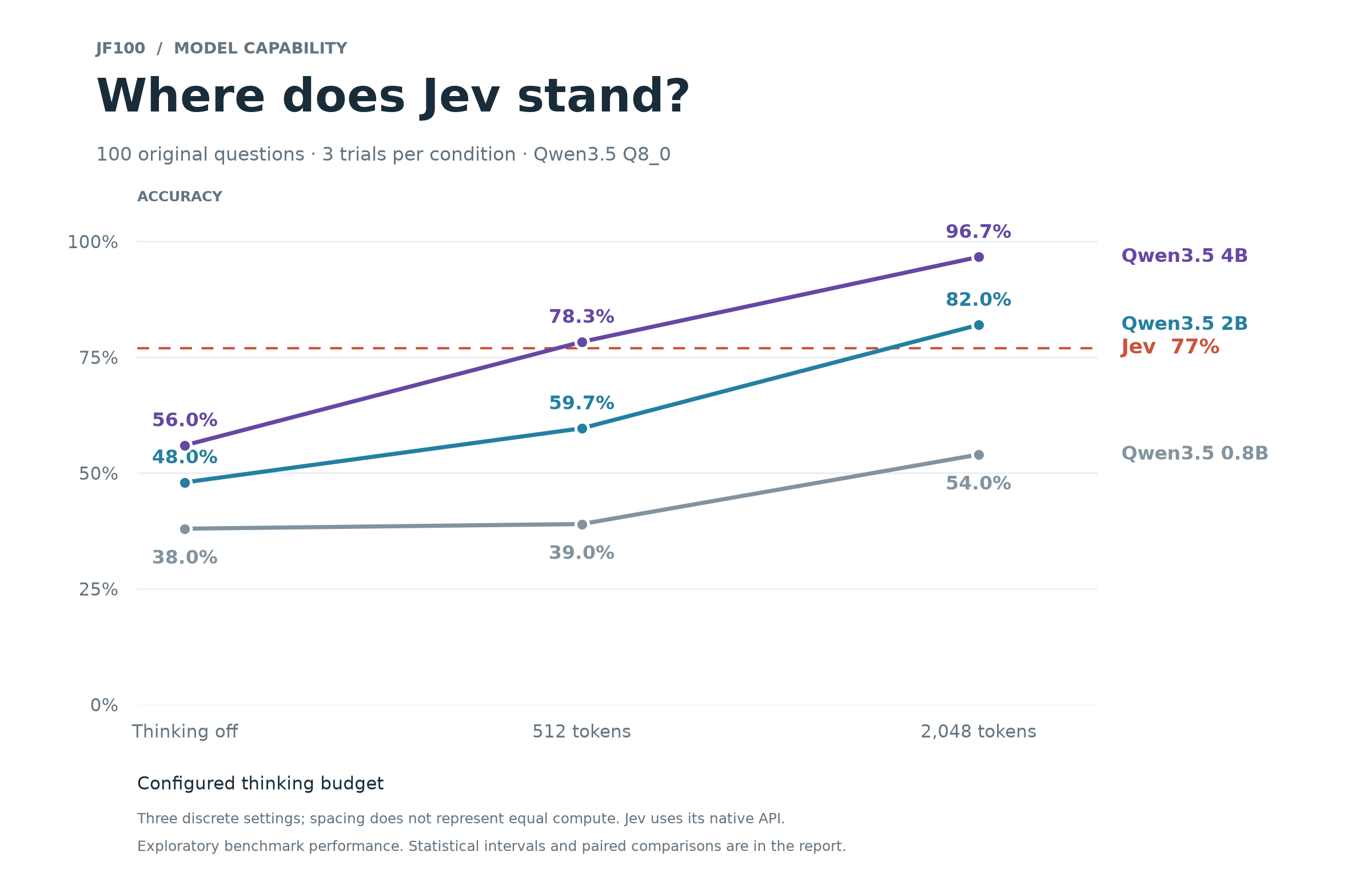
What the results say
| Thinking budget | Qwen3.5 0.8B | Qwen3.5 2B | Qwen3.5 4B |
|---|---|---|---|
| Off | 38.0% | 48.0% | 56.0% |
| 512 tokens | 39.0% | 59.7% | 78.3% |
| 2,048 tokens | 54.0% | 82.0% | 96.7% |
Jev 1.13.0: 77.0%. Each condition contains 100 questions × 3 trials. All 3,000 retained responses produced valid final answers. No majority vote or best-of selection is used.
- Below 4B with sufficient thinking: 4B/2,048 exceeds Jev by 19.7 percentage points; the 95% paired-template bootstrap interval is +12.7 to +26.7.
- Near 2B with sufficient thinking in aggregate: 2B/2,048 exceeds Jev by 5.0 points, with an interval of −2.3 to +12.3. This supports a descriptive comparison, not a statistical proof of equivalence.
- Budget matters: 4B with thinking disabled scores 56.0%; at 512 it scores 78.3%. “Jev is weaker than a 4B model” needs the thinking condition attached.
- Similar totals do not imply similar skills: Jev scores well on short code semantics and formal logic, while 2B/2,048 is stronger on these relationship tracking and algorithm tasks. See domain results.
This measures performance on a synthetic, English, four-choice task set under specified interfaces and compute budgets. It does not establish a universal intelligence ceiling, model parameter equivalence, or general coding ability. The near-ceiling 4B result also exposes the limits of this small dataset.
The benchmark
100 original AI-assisted questions: ten each in customer service, policy rules, discourse, formal logic, relations, mathematics, temporal reasoning, code semantics, algorithms and evidence integration. There are 50 counterfactual pairs, 60 executable-oracle answers, and 30/40/30 designed easy/medium/hard items. Difficulty labels have not been independently calibrated. The dataset has not received independent human expert review.
Qwen uses Q8_0 weights, temperature 1, seeds 101/202/303, and native llama-server reasoning budgets. Each trial rotates option positions; seeds and positions therefore vary together. A thinking cap is followed by final-answer generation, with total generation limited to budget + 128. Jev uses its native Choice API. All questions, gold answers and completed trial results are unchanged.
The published conditions were selected after observing experimental results. This is an exploratory release, not a blind preregistration. The release protocol restates the retained setup; original protocol/config hashes are in data/release_provenance.json. Jev's completed reference was reused and its reconstructed inputs checked against request hashes.
Inspect and reproduce
Python 3.10+; grading has no third-party dependencies.
python -m pip install -e '.[plots]'
python -m unittest discover -s tests -v
# Recompute all published scores, paired intervals and confidence diagnostics offline:
python -m jf100.budget_report v0.2-budget --from-public
python scripts/plot_budget_results.py v0.2-budget
To run a fresh experiment, install the Q8_0 Ollama tags used here and a
llama-server build supporting reasoning_budget_tokens and token logprobs:
ollama pull qwen3.5:0.8b
ollama pull qwen3.5:2b-q8_0
ollama pull qwen3.5:4b-q8_0
export JF100_LLAMA_SERVER=/absolute/path/to/llama-server
# Set JEV_KEY in your environment. Never commit it.
python -m jf100 --run-id replication
Ollama supplies local model metadata on port 11434; a separate native
llama-server runs on loopback port 11438 with 16 slots and 32K context per slot.
Override JF100_OLLAMA_URL or JF100_LLAMA_PORT if needed. Only one model size
loads at a time. Repeating the command resumes completed checkpoints. Do not
start two evaluators against the same run directory.
Measured hardware: Apple M5 Max, 128 GiB unified memory. Backend/model hashes and configuration are in run_config.json and model_metadata.json. GPU scheduling, quantization and backend versions can affect reproducibility. Recorded latency is descriptive under shared batching, not a controlled speed comparison.
Inputs, outputs and confidence
Compact per-request outcomes include grades, request hashes, token counts, answer-token logprobs/probabilities and Jev confidence. Every input can be reconstructed from the frozen questions and trial index. This is sufficient to recompute published accuracy and intervals.
Full request bodies and all response attempts, including thinking, final text,
token IDs, bytes, logprobs and top-5 alternatives, are retained locally in
runs/. They are excluded from Git because of size. scripts/export_raw.py
creates a compressed, hash-checked release asset without modifying the originals.
Download the full 3,000-record archive and its checksum from the v0.2.0 release.
See the data layout.
The Qwen score is the raw probability of the emitted answer-letter token where exact alignment is possible. It is not normalized over four answer choices and is not automatically a probability of correctness. Jev's returned confidence has a different definition. Reliability plots and Brier scores are exploratory proxy diagnostics; missing alignments and sample coverage are reported explicitly.
License and contributions
MIT for original code and questions. Model weights are not distributed. Dataset card · Contributing · Citation. Report ambiguous questions by item ID; scored question revisions require a new dataset version. Suggestions for harder, independently reviewed items are welcome.
Contributors

3 commits
Similar repos


Languages
Python
100.0%
100 original tasks comparing Jev with Qwen3.5 0.8B, 2B and 4B across three reasoning budgets; reproducible results and token logprobs.
Python
1
3 commits
updated Sep 19, 2026
README
Jev Frontier 100
Jev scores 77.0%; Qwen3.5 2B with a 2,048-token thinking budget scores 82.0%; Qwen3.5 4B with the same budget scores 96.7%. This small benchmark makes Jev's observed reasoning limits tangible through nine local-model settings.
中文 · All 100 questions · Answers · Protocol
What the results say
| Thinking budget | Qwen3.5 0.8B | Qwen3.5 2B | Qwen3.5 4B |
|---|---|---|---|
| Off | 38.0% | 48.0% | 56.0% |
| 512 tokens | 39.0% | 59.7% | 78.3% |
| 2,048 tokens | 54.0% | 82.0% | 96.7% |
Jev 1.13.0: 77.0%. Each condition contains 100 questions × 3 trials. All 3,000 retained responses produced valid final answers. No majority vote or best-of selection is used.
- Below 4B with sufficient thinking: 4B/2,048 exceeds Jev by 19.7 percentage points; the 95% paired-template bootstrap interval is +12.7 to +26.7.
- Near 2B with sufficient thinking in aggregate: 2B/2,048 exceeds Jev by 5.0 points, with an interval of −2.3 to +12.3. This supports a descriptive comparison, not a statistical proof of equivalence.
- Budget matters: 4B with thinking disabled scores 56.0%; at 512 it scores 78.3%. “Jev is weaker than a 4B model” needs the thinking condition attached.
- Similar totals do not imply similar skills: Jev scores well on short code semantics and formal logic, while 2B/2,048 is stronger on these relationship tracking and algorithm tasks. See domain results.
This measures performance on a synthetic, English, four-choice task set under specified interfaces and compute budgets. It does not establish a universal intelligence ceiling, model parameter equivalence, or general coding ability. The near-ceiling 4B result also exposes the limits of this small dataset.
The benchmark
100 original AI-assisted questions: ten each in customer service, policy rules, discourse, formal logic, relations, mathematics, temporal reasoning, code semantics, algorithms and evidence integration. There are 50 counterfactual pairs, 60 executable-oracle answers, and 30/40/30 designed easy/medium/hard items. Difficulty labels have not been independently calibrated. The dataset has not received independent human expert review.
Qwen uses Q8_0 weights, temperature 1, seeds 101/202/303, and native llama-server reasoning budgets. Each trial rotates option positions; seeds and positions therefore vary together. A thinking cap is followed by final-answer generation, with total generation limited to budget + 128. Jev uses its native Choice API. All questions, gold answers and completed trial results are unchanged.
The published conditions were selected after observing experimental results. This is an exploratory release, not a blind preregistration. The release protocol restates the retained setup; original protocol/config hashes are in data/release_provenance.json. Jev's completed reference was reused and its reconstructed inputs checked against request hashes.
Inspect and reproduce
Python 3.10+; grading has no third-party dependencies.
python -m pip install -e '.[plots]'
python -m unittest discover -s tests -v
# Recompute all published scores, paired intervals and confidence diagnostics offline:
python -m jf100.budget_report v0.2-budget --from-public
python scripts/plot_budget_results.py v0.2-budget
To run a fresh experiment, install the Q8_0 Ollama tags used here and a
llama-server build supporting reasoning_budget_tokens and token logprobs:
ollama pull qwen3.5:0.8b
ollama pull qwen3.5:2b-q8_0
ollama pull qwen3.5:4b-q8_0
export JF100_LLAMA_SERVER=/absolute/path/to/llama-server
# Set JEV_KEY in your environment. Never commit it.
python -m jf100 --run-id replication
Ollama supplies local model metadata on port 11434; a separate native
llama-server runs on loopback port 11438 with 16 slots and 32K context per slot.
Override JF100_OLLAMA_URL or JF100_LLAMA_PORT if needed. Only one model size
loads at a time. Repeating the command resumes completed checkpoints. Do not
start two evaluators against the same run directory.
Measured hardware: Apple M5 Max, 128 GiB unified memory. Backend/model hashes and configuration are in run_config.json and model_metadata.json. GPU scheduling, quantization and backend versions can affect reproducibility. Recorded latency is descriptive under shared batching, not a controlled speed comparison.
Inputs, outputs and confidence
Compact per-request outcomes include grades, request hashes, token counts, answer-token logprobs/probabilities and Jev confidence. Every input can be reconstructed from the frozen questions and trial index. This is sufficient to recompute published accuracy and intervals.
Full request bodies and all response attempts, including thinking, final text,
token IDs, bytes, logprobs and top-5 alternatives, are retained locally in
runs/. They are excluded from Git because of size. scripts/export_raw.py
creates a compressed, hash-checked release asset without modifying the originals.
Download the full 3,000-record archive and its checksum from the v0.2.0 release.
See the data layout.
The Qwen score is the raw probability of the emitted answer-letter token where exact alignment is possible. It is not normalized over four answer choices and is not automatically a probability of correctness. Jev's returned confidence has a different definition. Reliability plots and Brier scores are exploratory proxy diagnostics; missing alignments and sample coverage are reported explicitly.
License and contributions
MIT for original code and questions. Model weights are not distributed. Dataset card · Contributing · Citation. Report ambiguous questions by item ID; scored question revisions require a new dataset version. Suggestions for harder, independently reviewed items are welcome.
Similar repos
Contributors
3 commits
Languages
Python
100.0%