Just a VLM Agent Can Play Robots
See the codeEnglish | 简体中文

Yanzhe Chen* ·
Zechen Bai* ·
Zhijun Cao* ·
Wenzheng Zeng* ·
Kevin Qinghong Lin
Yiqi Lin ·
Guoqiang Liang ·
Kevin Yuchen Ma ·
Qiming Huang ·
Mike Zheng Shou†
* equal contribution · † corresponding author
Show Lab @ National University of Singapore
📄 Arxiv Paper | 🤗 Daily Paper | 🦾 Models | 📊 Dataset | 🌐 Project Page | 💬 X (Twitter)
https://github.com/user-attachments/assets/bd2d31db-f5c5-4554-85bb-2aa206876ac7
2026.09 Beyond Show-Harness, we release Awesome Multimodal Embodied Agents, our survey of the Agent + Robot landscape from computer-use to robot-use.2026.09 Public release: the harness, GUMI collectors, the plugin suite, and the training pipeline.2026.09 Six LoRA adapters on 🤗 Show-Harness-VLMs and the demonstration corpus on 🤗 Show-Harness-Data.
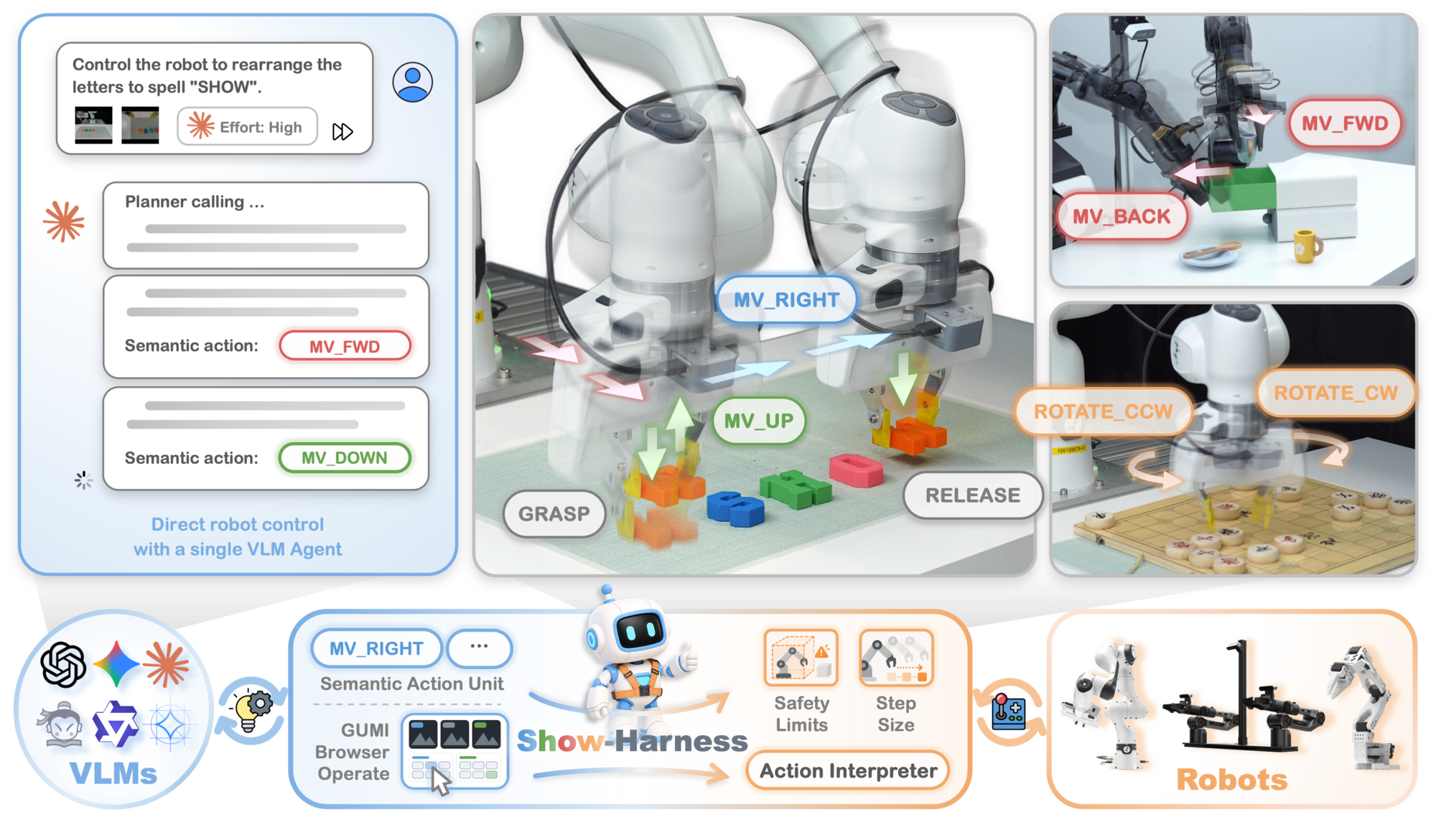
Show-Harness is an embodied harness: a compact semantic interface that lets a vision-language model "play" a robot. The model reasons over discrete, incremental action units; embodiment-specific interpreters ground each unit into motion, deterministically — so the VLM stays directly responsible for every physical decision.
Through the same interface, a closed-source frontier VLM controls a robot zero-shot, and a small open model becomes a capable policy with less than a few H200 GPU-hours of fine-tuning.
Separate venvs, because their pins conflict. Start with base; add the rest only when
you need them. bash scripts/setup.sh with no arguments prints which already exist.
| build it with | what it is for | |
|---|---|---|
.venv | bash scripts/setup.sh base | the harness: collect, run a robot, drive a served VLM |
.venv-vllm | bash scripts/setup.sh serve | serving a VLM locally (scripts/serve_vlm.sh) |
<checkout>/.venv | bash scripts/setup.sh libero <checkout> | a LIBERO / LIBERO-plus / LIBERO-PRO checkout; the harness is installed into it and run from there (docs/simulators.md) |
bash scripts/setup.sh base --real adds the Franka/Piper hardware layer (RealSense, ROS
shims, teleop window). Zero-shot and sim work do not need it.
Serving is its own process, so the harness talks to any OpenAI-compatible endpoint — a
hosted model, or a colleague's server — without .venv-vllm existing at all.
Training is self-contained under train/ and builds its own venvs against upstream LLaMA-Factory (bash train/scripts/setup_llamafactory.sh); nothing in the sections above depends on it.
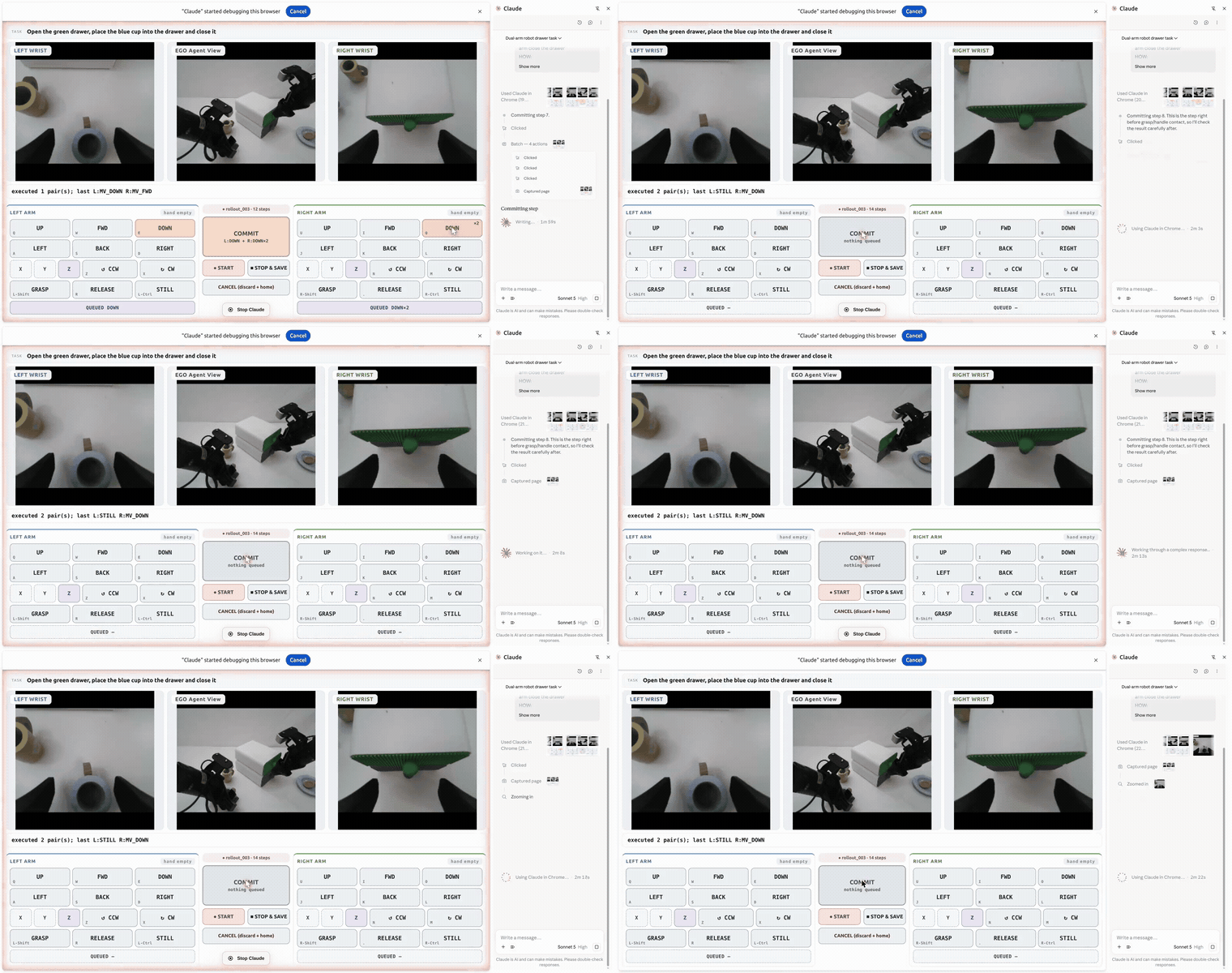
GUMI maps every action unit to a key or button, so a human — or a GUI-driving
agent — demonstrates a task by playing the robot in the browser, and every step
is recorded as a training-ready (observation, action) pair. It drives the real
rigs below; a synthetic tabletop world (--sim) lets you try the interface
before any hardware is set up:
bash scripts/setup.sh base
.venv/bin/python gumi/collect_rollouts_web.py data/rollouts_demo --sim
# open http://localhost:8600 and drive the gripper with WASD / arrow keys
The same servers run against the real Franka/Piper rigs (drop --sim), and the
same key bindings power live human takeover during autonomous rollouts. See
gumi/README.md for the keyboard UI, the dual-arm UI, and the
agent operators.
configs/site/franka.yaml.example to configs/site/franka.yaml and
fill in your robot address and camera serials (Piper:
site/piper_arms.yaml.example).configs/secrets.env.example to configs/secrets.env and add an API
key for the backend you use (GEMINI_API_KEY by default), or serve a local
VLM with scripts/serve_vlm.sh.python scripts/check_setup.py --robot-config configs/robot_franka.yamlpython scripts/run_real.py --robot-config configs/robot_franka.yamlThe full walkthroughs are in docs/franka.md and docs/piper.md; simulators in docs/simulators.md.
| Path | What it is |
|---|---|
core/ | The interaction loop: runners for both modes, config layering, logging, the shared action vocabulary, and the provider-agnostic VLM client + roles (core/vlm/) |
plugins/ | Harness plugins — each mounts on one stage of the loop and is toggled from the plugins: config block (plugins/README.md) |
interpreters/ | Embodiment interpreters: Franka (impedance), AgileX Piper (joint streaming), Isaac-Lab sims |
gumi/ | GUMI: browser teleoperation + agent operators; every step is recorded as a ready (observation, action) training pair |
configs/ | Layered configs: shipped defaults + your site identity + optional overlays (configs/README.md) |
prompts/ | Controller prompts (zero-shot) and the versioned prompt contracts of fine-tuned checkpoints |
scripts/ | Rig bring-up, calibration capture, serving, data collection, and per-simulator batch evaluation (scripts/<sim>/eval_batch.sh) |
train/ | The fine-tuning pipeline: data conversion, dataset registration, LoRA configs (train/README.md) |
models/ | Chat templates, downloaded adapters, the HuggingFace cache (models/README.md) |
docs/ | Per-rig runbooks and the fine-tuned mode guide |
Zero-shot — a frontier VLM operates the full plugin harness with no
robot-specific training (scripts/run_real.py, scripts/run_real_dual.py).
Fine-tuned — a small VLM fine-tuned on GUMI demonstrations emits one
action token per step, planner-free (scripts/run_real_mvtoken.py). The real-robot
configs default to vlm_backend: qwen3_5_2b (the qwen3_5_2b_showharness_ft
adapter); serve your own checkpoint
instead and select it with vlm_backend: finetuned_local. See
docs/finetuned.md, including the training contracts
that must not drift.
Switching embodiments changes only the interpreter and its
configs/primitives_<embodiment>.yaml; the model-facing vocabulary and prompts
stay the same.
Five LoRA adapters trained on the real corpus, one per backbone, at
showlab/Show-Harness-VLMs:
qwen3_5_0_8b, qwen3_5_2b, qwen3_5_4b, qwen3_5_9b, gemma4_e4b; plus
qwen3_5_2b_sim, the simulation policy, which runs in RoboLab. The
demonstrations they were trained on are at
showlab/Show-Harness-Data
(real Franka/Piper rollouts plus RoboLab and ManiSkill).
Fetch an adapter with the base model it needs, serve it, drive the robot:
# 1) fetch the adapter together with the base model it needs
ADAPTER=qwen3_5_2b WITH_BASE=1 bash scripts/model/download_vlm_model.sh

# 2) serve it — the script activates .venv-vllm itself
MODEL=Qwen/Qwen3.5-2B \
  LORA=qwen3_5_2b_showharness_ft=models/Show-Harness-VLMs/qwen3_5_2b \
  FAMILY=qwen3_5 bash scripts/serve_vlm.sh

# 3) drive the robot
python scripts/run_real_mvtoken.py --robot-config configs/robot_franka_ft.yaml
FAMILY picks a jinja template from models/chat_templates/. Training never reads one —
LlamaFactory renders the conversation itself — so these exist only to make vLLM reproduce
that rendering at serve time. A base model's own template does not, and the mismatch fails
silently — see models/README.md.
To fine-tune your own, train/ takes rollouts (yours or the released set) to a LoRA on any of the three supported families.
Each plugin mounts on one stage of the loop, is toggled by one boolean, and leaves the loop byte-identical when disabled.
| Stage | Plugin (paper) | Code |
|---|---|---|
| Perception | Multi-View Guidance | view-role prompt scaffolding + core/prompting/wrist_marker.py (plugins/view_select on the dual rig) |
| Perception | Proprioception | plugins/proprioception |
| Reasoning | Subtask Planning | plugins/subgoal |
| Reasoning | Situated Planning | plugins/deepplan |
| Reasoning | Action Chunking | plugins/action_chunk |
| Reasoning | Adaptive Step | plugins/variable_step |
| Reasoning | Visual Prompt | plugins/affordance |
| Action | Action History | plugins/mem_text |
| Action | Failure Recovery | plugins/recovery (+ plugins/auto_release in the fine-tuned mode) |
plugins/README.md documents the contract for writing your own.
Show-Harness builds on the following open-source work:
Thanks to all Show Lab @ NUS members for their support.
If you find Show-Harness useful, please cite:
@article{chen2026show,
  title={Show-harness: Just a vlm agent can play robots},
  author={Chen, Yanzhe and Bai, Zechen and Cao, Zhijun and Zeng, Wenzheng and Lin, Kevin Qinghong and Lin, Yiqi and Liang, Guoqiang and Ma, Kevin Yuchen and Huang, Qiming and Shou, Mike Zheng},
  journal={arXiv preprint arXiv:2609.10522},
  year={2026}
}
If you like the project, please give us a star ⭐ — it is how we hear that it is useful.
202 followers · starred Sep 2026
136 followers · starred Sep 2026
196 followers · starred Sep 2026
72 followers · starred Sep 2026
Just a VLM Agent Can Play Robots
See the codeEnglish | 简体中文
Yanzhe Chen* ·
Zechen Bai* ·
Zhijun Cao* ·
Wenzheng Zeng* ·
Kevin Qinghong Lin
Yiqi Lin ·
Guoqiang Liang ·
Kevin Yuchen Ma ·
Qiming Huang ·
Mike Zheng Shou†
* equal contribution · † corresponding author
Show Lab @ National University of Singapore
📄 Arxiv Paper | 🤗 Daily Paper | 🦾 Models | 📊 Dataset | 🌐 Project Page | 💬 X (Twitter)
https://github.com/user-attachments/assets/bd2d31db-f5c5-4554-85bb-2aa206876ac7
2026.09 Beyond Show-Harness, we release Awesome Multimodal Embodied Agents, our survey of the Agent + Robot landscape from computer-use to robot-use.2026.09 Public release: the harness, GUMI collectors, the plugin suite, and the training pipeline.2026.09 Six LoRA adapters on 🤗 Show-Harness-VLMs and the demonstration corpus on 🤗 Show-Harness-Data.
Show-Harness is an embodied harness: a compact semantic interface that lets a vision-language model "play" a robot. The model reasons over discrete, incremental action units; embodiment-specific interpreters ground each unit into motion, deterministically — so the VLM stays directly responsible for every physical decision.
Through the same interface, a closed-source frontier VLM controls a robot zero-shot, and a small open model becomes a capable policy with less than a few H200 GPU-hours of fine-tuning.
Separate venvs, because their pins conflict. Start with base; add the rest only when
you need them. bash scripts/setup.sh with no arguments prints which already exist.
| build it with | what it is for | |
|---|---|---|
.venv | bash scripts/setup.sh base | the harness: collect, run a robot, drive a served VLM |
.venv-vllm | bash scripts/setup.sh serve | serving a VLM locally (scripts/serve_vlm.sh) |
<checkout>/.venv | bash scripts/setup.sh libero <checkout> | a LIBERO / LIBERO-plus / LIBERO-PRO checkout; the harness is installed into it and run from there (docs/simulators.md) |
bash scripts/setup.sh base --real adds the Franka/Piper hardware layer (RealSense, ROS
shims, teleop window). Zero-shot and sim work do not need it.
Serving is its own process, so the harness talks to any OpenAI-compatible endpoint — a
hosted model, or a colleague's server — without .venv-vllm existing at all.
Training is self-contained under train/ and builds its own venvs against upstream LLaMA-Factory (bash train/scripts/setup_llamafactory.sh); nothing in the sections above depends on it.
GUMI maps every action unit to a key or button, so a human — or a GUI-driving
agent — demonstrates a task by playing the robot in the browser, and every step
is recorded as a training-ready (observation, action) pair. It drives the real
rigs below; a synthetic tabletop world (--sim) lets you try the interface
before any hardware is set up:
bash scripts/setup.sh base
.venv/bin/python gumi/collect_rollouts_web.py data/rollouts_demo --sim
# open http://localhost:8600 and drive the gripper with WASD / arrow keys
The same servers run against the real Franka/Piper rigs (drop --sim), and the
same key bindings power live human takeover during autonomous rollouts. See
gumi/README.md for the keyboard UI, the dual-arm UI, and the
agent operators.
configs/site/franka.yaml.example to configs/site/franka.yaml and
fill in your robot address and camera serials (Piper:
site/piper_arms.yaml.example).configs/secrets.env.example to configs/secrets.env and add an API
key for the backend you use (GEMINI_API_KEY by default), or serve a local
VLM with scripts/serve_vlm.sh.python scripts/check_setup.py --robot-config configs/robot_franka.yamlpython scripts/run_real.py --robot-config configs/robot_franka.yamlThe full walkthroughs are in docs/franka.md and docs/piper.md; simulators in docs/simulators.md.
| Path | What it is |
|---|---|
core/ | The interaction loop: runners for both modes, config layering, logging, the shared action vocabulary, and the provider-agnostic VLM client + roles (core/vlm/) |
plugins/ | Harness plugins — each mounts on one stage of the loop and is toggled from the plugins: config block (plugins/README.md) |
interpreters/ | Embodiment interpreters: Franka (impedance), AgileX Piper (joint streaming), Isaac-Lab sims |
gumi/ | GUMI: browser teleoperation + agent operators; every step is recorded as a ready (observation, action) training pair |
configs/ | Layered configs: shipped defaults + your site identity + optional overlays (configs/README.md) |
prompts/ | Controller prompts (zero-shot) and the versioned prompt contracts of fine-tuned checkpoints |
scripts/ | Rig bring-up, calibration capture, serving, data collection, and per-simulator batch evaluation (scripts/<sim>/eval_batch.sh) |
train/ | The fine-tuning pipeline: data conversion, dataset registration, LoRA configs (train/README.md) |
models/ | Chat templates, downloaded adapters, the HuggingFace cache (models/README.md) |
docs/ | Per-rig runbooks and the fine-tuned mode guide |
Zero-shot — a frontier VLM operates the full plugin harness with no
robot-specific training (scripts/run_real.py, scripts/run_real_dual.py).
Fine-tuned — a small VLM fine-tuned on GUMI demonstrations emits one
action token per step, planner-free (scripts/run_real_mvtoken.py). The real-robot
configs default to vlm_backend: qwen3_5_2b (the qwen3_5_2b_showharness_ft
adapter); serve your own checkpoint
instead and select it with vlm_backend: finetuned_local. See
docs/finetuned.md, including the training contracts
that must not drift.
Switching embodiments changes only the interpreter and its
configs/primitives_<embodiment>.yaml; the model-facing vocabulary and prompts
stay the same.
Five LoRA adapters trained on the real corpus, one per backbone, at
showlab/Show-Harness-VLMs:
qwen3_5_0_8b, qwen3_5_2b, qwen3_5_4b, qwen3_5_9b, gemma4_e4b; plus
qwen3_5_2b_sim, the simulation policy, which runs in RoboLab. The
demonstrations they were trained on are at
showlab/Show-Harness-Data
(real Franka/Piper rollouts plus RoboLab and ManiSkill).
Fetch an adapter with the base model it needs, serve it, drive the robot:
# 1) fetch the adapter together with the base model it needs
ADAPTER=qwen3_5_2b WITH_BASE=1 bash scripts/model/download_vlm_model.sh

# 2) serve it — the script activates .venv-vllm itself
MODEL=Qwen/Qwen3.5-2B \
  LORA=qwen3_5_2b_showharness_ft=models/Show-Harness-VLMs/qwen3_5_2b \
  FAMILY=qwen3_5 bash scripts/serve_vlm.sh

# 3) drive the robot
python scripts/run_real_mvtoken.py --robot-config configs/robot_franka_ft.yaml
FAMILY picks a jinja template from models/chat_templates/. Training never reads one —
LlamaFactory renders the conversation itself — so these exist only to make vLLM reproduce
that rendering at serve time. A base model's own template does not, and the mismatch fails
silently — see models/README.md.
To fine-tune your own, train/ takes rollouts (yours or the released set) to a LoRA on any of the three supported families.
Each plugin mounts on one stage of the loop, is toggled by one boolean, and leaves the loop byte-identical when disabled.
| Stage | Plugin (paper) | Code |
|---|---|---|
| Perception | Multi-View Guidance | view-role prompt scaffolding + core/prompting/wrist_marker.py (plugins/view_select on the dual rig) |
| Perception | Proprioception | plugins/proprioception |
| Reasoning | Subtask Planning | plugins/subgoal |
| Reasoning | Situated Planning | plugins/deepplan |
| Reasoning | Action Chunking | plugins/action_chunk |
| Reasoning | Adaptive Step | plugins/variable_step |
| Reasoning | Visual Prompt | plugins/affordance |
| Action | Action History | plugins/mem_text |
| Action | Failure Recovery | plugins/recovery (+ plugins/auto_release in the fine-tuned mode) |
plugins/README.md documents the contract for writing your own.
Show-Harness builds on the following open-source work:
Thanks to all Show Lab @ NUS members for their support.
If you find Show-Harness useful, please cite:
@article{chen2026show,
  title={Show-harness: Just a vlm agent can play robots},
  author={Chen, Yanzhe and Bai, Zechen and Cao, Zhijun and Zeng, Wenzheng and Lin, Kevin Qinghong and Lin, Yiqi and Liang, Guoqiang and Ma, Kevin Yuchen and Huang, Qiming and Shou, Mike Zheng},
  journal={arXiv preprint arXiv:2609.10522},
  year={2026}
}
If you like the project, please give us a star ⭐ — it is how we hear that it is useful.
202 followers · starred Sep 2026
136 followers · starred Sep 2026
196 followers · starred Sep 2026
72 followers · starred Sep 2026






