
News: We add many jev+robot in infrastructure. A curated collection of papers and resources on robot-use agents, tool-based robot control, embodied agent runtimes, and self-evolving robotic systems.
51
25 commits
updated Sep 26, 2026
README
Awesome-Robot-Use-Agent
News: We add many jev+robot demos in Infrastructure and Benchmarks! Please refer these.

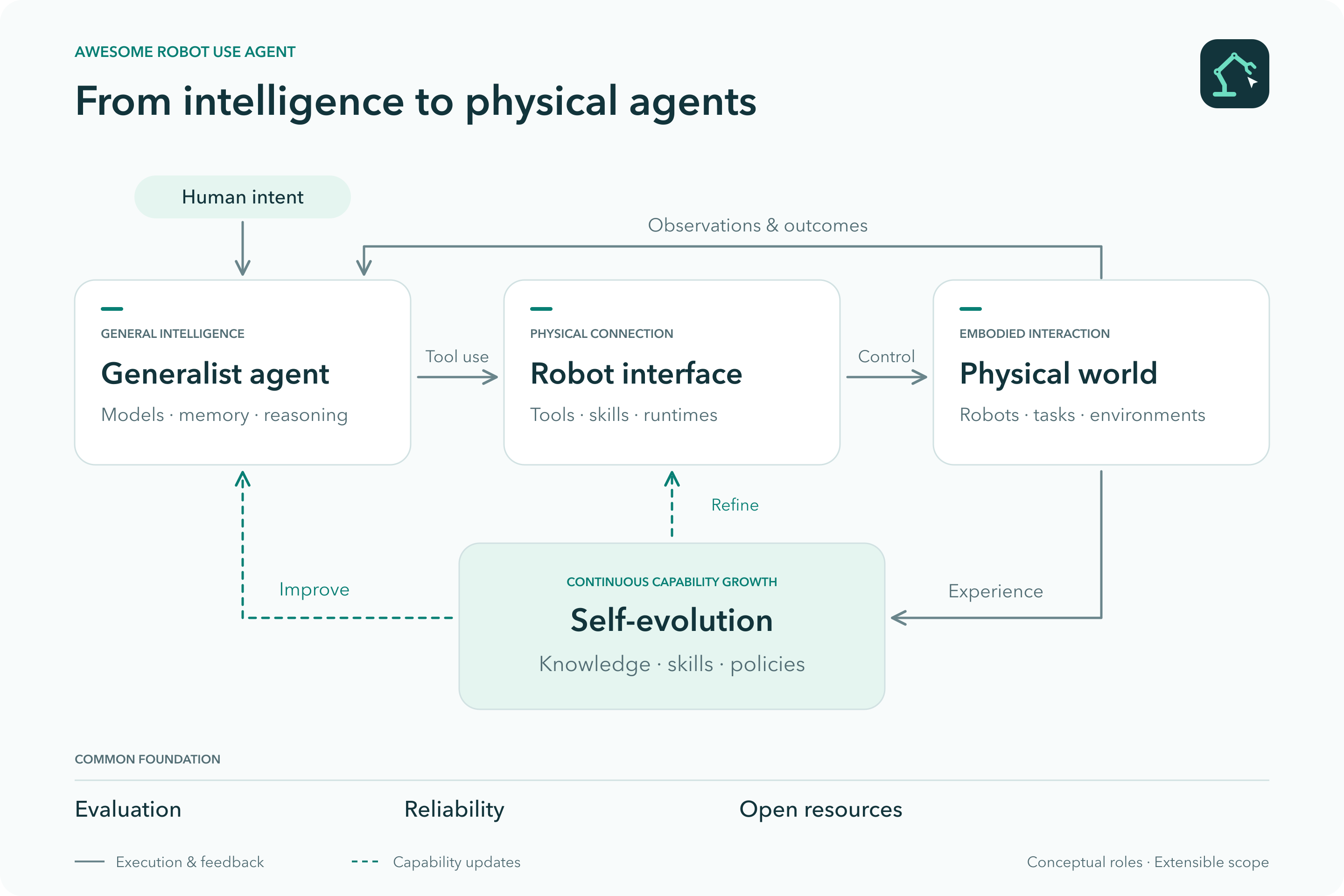
A curated list of research on general-purpose AI agents that perceive, program, and operate robots through tools, interfaces, and reusable skills.
Inspired by Phillip Isola's Robot-Use Agents. The emphasis is on how general-purpose intelligence can be connected to different robots and how improvements can spread through models, software interfaces, and reusable capabilities.
Contents
- General-Purpose Robot-Use Agents
- Reasoning-Acting and Dual-System Architectures
- Self-Evolving Robot Agents
- Embodied Agent Operating Systems and Runtimes
- Programming and Spatial Action Interfaces
- Planning, Skill Orchestration and Memory
- Language-Native Actions and Cross-Embodiment Transfer
- Infrastructure and Benchmarks
- Perspectives and Reports
General-Purpose Robot-Use Agents
General-purpose models operating robots through reusable harnesses, tools, and visual interfaces.
-
Know Your Body: A Harness for Direct and Self-Improving Robot Control with VLMs — KnowBody; body-grounded robot control and iterative improvement through execution feedback, evaluated on a small real-robot task suite.
-
Generalizing Manipulation Skills with a Local Coding Agent — A local open-weight VLM writes and executes perception and control code for real-world UR3e manipulation, with documented skills and in-session reuse.
-
AR-WAM: A Visual-Conditioned Agent-Ready World Action Model for Robotic Manipulation — Agent-ready manipulation through visual grounding, operation tokens, and
detect/execute/queryinterfaces. -
Structured World-State Reasoning for Agentic Robotic Search — WORLDS maintains a persistent world-state graph and lets agents request, verify, and revise observations before selecting a target.
-
Transferring the Intelligence of VLMs to Robotic Control — RoboDawn
-
RoboFind: Multi-Agent Personalized Object Search for People Who Are Blind or Have Low Vision
-
Navi-Agent: Unlocalized Monocular Navigation Agent — Previously reported; coordinate-free spatial memory for closed-loop navigation, progress verification and recovery.
-
In-Context Robot Learning with VLM Agents — GPT-Policy; in-context adaptation without parameter updates.
-
WetRobo: A Reproducible Robot Kit for Coding Agents in Biological Laboratories — Laboratory robotics.
-
HarnessVLN: Unifying Training-Free Embodied Navigation through an Agent Harness — Navigation.
-
EMERGE-Policy: A Robot Mind Emerges Beyond a Single Policy
-
Agent as Policy for Robotic Manipulation
-
Show-Harness: Just a VLM Agent Can Play Robots
-
VIA: Visual Interface Agent for Robot Control
-
CaP-X: A Framework for Benchmarking and Improving Coding Agents for Robot Manipulation
-
Guava: An Effective and Universal Harness for Embodied Manipulation
-
ETA: A New Agentic Paradigm for Embodied Tasks
-
Maestro: Orchestrating Robotics Modules with Vision-Language Models for Zero-Shot Generalist Robots



























Reasoning-Acting and Dual-System Architectures
Architectures that organize reasoning and robot execution through intermediate plans, coupled reasoning and action modules, or adaptive think/act scheduling. Includes learned-policy building blocks and agent-level systems. For author-described System 1 (e.g., Jev-like system) /System 2 models (VLM-like models), fixed-rate and asynchronous coupling are distinguished from adaptive reasoning. Related task-time memory and recovery methods remain under Planning, Skill Orchestration and Memory.
- DSWAM: A Dual-System World Action Foundation Model for Fine-Grained Robot Manipulation — System 1 WAM execution with an optional System 2 subtask planner; video co-training without future-video generation at inference.
- Fast-ThinkAct: Efficient Vision-Language-Action Reasoning via Verbalizable Latent Planning — Preference-guided distillation compresses reasoning into verbalizable latents for action policies; evaluated in simulation and embodied reasoning benchmarks.
- ThinkAct: Vision-Language-Action Reasoning via Reinforced Visual Latent Planning — Action-aligned reinforcement learning connects a vision-language reasoner to a diffusion policy through visual plan latents; simulation evaluation.
- Fast-in-Slow: A Dual-System Foundation Model Unifying Fast Manipulation within Slow Reasoning — Partially shared System 1/System 2 parameters with asynchronous observations and action generation; simulation and real-robot evaluation.
- Agentic Robot: A Brain-Inspired Framework for Vision-Language-Action Models in Embodied Agents — Planner–executor–verifier coordination with subgoal verification and recovery; evaluated on LIBERO.
- OneTwoVLA: A Unified Vision-Language-Action Model with Adaptive Reasoning — A unified VLA predicts reasoning or action mode tokens to think at critical moments and otherwise execute action chunks.
- GR00T N1: An Open Foundation Model for Generalist Humanoid Robots — An Eagle-2 vision-language System 2 conditions a flow-matching System 1 action module, jointly trained across heterogeneous data.
- Hi Robot: Open-Ended Instruction Following with Hierarchical Vision-Language-Action Models — A high-level VLM guides a low-level VLA through language; planning refreshes periodically and on user feedback.
- Robotic Control via Embodied Chain-of-Thought Reasoning — ECoT; a VLA reasons about plans, sub-tasks, motion and visually grounded state before predicting robot actions.














Self-Evolving Robot Agents
Systems that turn experience into reusable knowledge, skill programs, improved policies, or validated capability upgrades. Includes human-guided methods and learned-policy precursors where noted.
Memory and Knowledge Evolution
- MessyMem: Learning-from-Doing Memory for Mobile Manipulation
- Robo-Cortex: A Self-Evolving Embodied Agent via Dual-Grain Cognitive Memory and Autonomous Knowledge Induction
- Distilling and Retrieving Generalizable Knowledge for Robot Manipulation via Language Corrections




Skill and Program Evolution
-
HarnessPAI: An Evolving Harness for Physical AI — Coding agents refine executable robot harnesses between rollouts using execution feedback, while keeping the underlying action backends frozen.
-
RACaP: Agentic Reasoning, Acting, and Coding as Policies for Evolvable Robot Learning — Combines reasoning, acting, and code evolution to build reusable robot APIs and harness memory; evaluated in simulation.
-
AdaHVLA: Adaptive Harnesses for Long-Horizon Vision-Language-Action Execution — Refines code-based coordination between reasoning agents and frozen VLAs through rollout evidence and persistent revision memory; simulation benchmarks and a real-world quadruped deployment case.
-
Learning and Transferring Closed-Loop Robot Software — Coding-agent optimization and reuse of closed-loop robot programs in simulation.
-
Self-Evolving Embodied Agents via Skill-Harness Evolution — SHAPER; frozen-model skill and harness optimization.
-
ASPIRE: Agentic /Skills Discovery for Robotics
-
Lifelong Robot Library Learning: Bootstrapping Composable and Generalizable Skills for Embodied Control with Language Models
-
Eureka: Human-Level Reward Design via Coding Large Language Models
-
DrEureka: Language Model Guided Sim-To-Real Transfer













Autonomous Data Collection and Policy Improvement
- KnowDemo: Knowledge-Guided Robot Demonstration Generation from Human Videos — VLM-based task-knowledge extraction for generating diverse, validated robot demonstrations.
- MAGMA-GEN: Validated Recovery Supervision from Ambiguous Failures via Counterfactual Re-Execution — Simulation-validated recovery data for fine-tuning tool-using robot language policies.
- RoboClaw: An Agentic Framework for Scalable Long-Horizon Robotic Tasks
- Zero2Skill: Bootstrapping Robot Skills through Autonomous Data Collection, Training, and Deployment
- ENPIRE: Agentic Robot Policy Self-Improvement in the Real World — Coding-agent-driven real-world policy and algorithm improvement.
- HARBOR: A Harness Framework for Agentic Robot Reinforcement Learning
- AutoRT: Embodied Foundation Models for Large Scale Orchestration of Robotic Agents
- Autonomous Improvement of Instruction Following Skills via Foundation Models
- RoboCat: A Self-Improving Generalist Agent for Robotic Manipulation
- RISE: Self-Improving Robot Policy with Compositional World Model
- AllDayNav: Lifelong Navigation via Real-World Reinforcement Learning


















Capability Upgrades and Regression Control
- Learning Without Losing Identity: Capability Evolution for Embodied Agents
- Governed Capability Evolution: Lifecycle-Time Compatibility Checking and Rollback for AI-Component-Based Systems, with Embodied Agents as Case Study




Related system-level memory and learning mechanisms: PhyAgentOS, ABot-Claw, and WCM. Execution-time recovery methods are listed under Safe Planning, Verification and Failure Recovery.
Embodied Agent Operating Systems and Runtimes
Persistent embodied-agent systems that organize robot capabilities, state, resources, execution checks, and feedback across tasks or robots.
- RegenHarness: A Robot Agent Harness with Evidence-Gated Recursive Self-Improvement — Evidence-gated skill execution, versioned task state, bounded recovery, and a protocol for regression-checked harness configuration updates; demonstrated through quadruped inspection cases.
- NIMO Controller: a self-driving laboratory orchestrator based on the Model Context Protocol — MCP-based tool discovery and experimental workflow orchestration for AI agents and human users in self-driving laboratories.
- Retriever: Composing the Perception-Reasoning-Action Loop for Long-Horizon Manipulation — Asynchronous runtime and deterministic replay.
- Harness Robotic OS: A Unified Embodied-Agent Runtime for Closed-Loop Quadruped Inspection
- PhyAgentOS: A Self-Evolving Operating System for Embodied Agents with Decoupled Cognitive Planning and Physical Execution
- RoboOS: A Hierarchical Embodied Framework for Cross-Embodiment and Multi-Agent Collaboration
- ROSClaw: An OpenClaw ROS 2 Framework for Agentic Robot Control and Interaction
- ABot-Claw: A Foundation for Persistent, Cooperative, and Self-Evolving Robotic Agents
- AEROS: A Single-Agent Operating Architecture with Embodied Capability Modules
- HoloAgent-0: A Unified Embodied Agent Framework with 3D Spatial Memory
- EmbodiedSkills: A Unified Framework for Orchestrating, Training, and Deploying VLA Agents
- WCM: World-Cognition Model for Generalizable Human-Robot Interaction
- EMOS: Embodiment-aware Heterogeneous Multi-robot Operating System with LLM Agents






















Programming and Spatial Action Interfaces
-
RAPID: Robot Agentic Programming from Demonstrations — Converts visual demonstrations into robot programs through task specifications, reusable primitives, and interactive verification.
-
Coding Agents for Generalized Task and Motion Planning Problems — Coding agents synthesize reusable planning programs for simulated environments; held-out evaluation executes fixed programs without test-time LLM calls.
-
ManiSkillFormer: Demonstration-Free Compositional Manipulation via Geometric Contracts and Agentic Skill Graph
-
AntiGrounding: Executable Robot Trajectories as Visual Prompts for VLM-Guided Manipulation — VLM selection of executable trajectories through a visual interface and an initialized digital twin.
-
Auto-HSI: Personalized human control of a robot swarm on demand by using LLMs for online automatic code generation — Human-in-the-loop interface.
-
KINO: A Keyframe Interface for VLM Planning and Whole-Body Control in Humanoid Loco-Manipulation — Learned low-level controller.
-
AnchorVLN: Geometry-Anchored Vision-Language Grounding Reasoning for Open-Vocabulary Navigation
-
GTA-2: A Multi-VLM Framework for Synthesizing Robot Manipulation Skills via Grounded Task Axes
-
Evolve Vision-Language-Action Model into an Agent with On-the-fly Tool-use
-
Code as Policies: Language Model Programs for Embodied Control
-
ProgPrompt: Generating Situated Robot Task Plans using Large Language Models
-
ChatGPT for Robotics: Design Principles and Model Abilities
-
VoxPoser: Composable 3D Value Maps for Robotic Manipulation with Language Models
-
ReKep: Spatio-Temporal Reasoning of Relational Keypoint Constraints for Robotic Manipulation
-
PIVOT: Iterative Visual Prompting Elicits Actionable Knowledge for VLMs
-
MOKA: Open-World Robotic Manipulation through Mark-Based Visual Prompting
-
SoFar: Language-Grounded Orientation Bridges Spatial Reasoning and Object Manipulation
-
LangNav: Language as a Perceptual Representation for Navigation
-
LM-Nav: Robotic Navigation with Large Pre-Trained Models of Language, Vision, and Action
-
Language to Rewards for Robotic Skill Synthesis
-
Trust the PRoC3S: Solving Long-Horizon Robotics Problems with LLMs and Constraint Satisfaction

































Planning, Skill Orchestration and Memory
Agents that select and coordinate robot capabilities, track state, verify outcomes, and recover from failures.
Task Planning, Skill Orchestration and Memory
Task decomposition, reusable skill orchestration, and task-time memory. Includes learned hierarchical planners and action models where applicable. Cross-cutting reasoning/action coupling and System 1/System 2 designs are listed under Reasoning-Acting and Dual-System Architectures.
-
NavProbe: Evidence-Grounded Reasoning with Active Memory Retrieval for Zero-Shot Navigation — A hierarchical VLM navigation agent that retrieves visual and geometric evidence to revise subgoals and select parameterized navigation skills.
-
World Action Planner: Generalizable Decision-Making with Action-Conditioned World Models — VLM action plans are refined through action-conditioned world-model imagination, optimization and search; simulation evaluation.
-
MistyPilot: Enabling Social-Robot Control through Multi-Agent LLM Skill Orchestration — Natural-language skill orchestration, sensor-event binding, and dialogue-state management on a physical social robot.
-
Bridging Thought and Action: Taming Long-Horizon Instability in Open-Source LLM Agents with a MetaTool-Enhanced ROS Framework
-
2AM: Grounding Agent-Side Memory as Guidance for Steerable Action Models in Long-Horizon Manipulation
-
Memory as Plans: World-Action Modeling with Memory-Grounded Planning
-
Towards Long-horizon Embodied Agents with Tool-Aligned Vision-Language-Action Models
-
Do As I Can, Not As I Say: Grounding Language in Robotic Affordances
-
SayCanPay: Heuristic Planning with Large Language Models using Learnable Domain Knowledge — Offline action-sequence search; simulation evaluation.
-
Inner Monologue: Embodied Reasoning through Planning with Language Models
-
SayPlan: Grounding Large Language Models using 3D Scene Graphs for Scalable Robot Task Planning
-
RoboStream: Weaving Spatio-Temporal Reasoning with Memory in Vision-Language Models for Robotics
-
Towards the Harness of Embodied Agents
-
Harness VLA: Steering Frozen VLAs into Reliable Manipulation Primitives via Memory-Guided Agents
-
Being-0: A Humanoid Robotic Agent with Vision-Language Models and Modular Skills
-
MOSAIC: Modular Foundation Models for Assistive and Interactive Cooking
-
Creative Robot Tool Use with Large Language Models — RoboTool; executable plans over parameterized skills.

























Safe Planning, Verification and Failure Recovery
Methods that assess risks, verify execution, and trigger corrective planning or recovery. Failure-recovery benchmarks are listed under Infrastructure and Benchmarks.
-
FRAMES: Failure Recovery And Monitoring of Embodied Skills for Humanoid Loco-Manipulation — A planner, VLM monitor, recovery agent, and memory module form a failure-aware supervisory loop for humanoid skills.
-
CommitFlow: Semantic Commitment Verification and Local Correction for Long-Horizon Robot Manipulation VLA Execution — Frozen-policy execution harness with semantic commitment monitoring, local correction and stage-level verification.
-
When Should a Failing Robot Ask? Initiating Corrective Human-Robot Dialogue from Audited Sensor Evidence — Evidence-aware choice between autonomous action, additional sensing and human assistance after failure.
-
Coding Agents with an Obstacle-Aware Harness for Safe Robot Manipulation — SafeHarness; obstacle-aware route verification, replanning, and contact execution, evaluated in simulation.
-
GAVEL: Graph World Models for Verified and Efficient Long-Horizon LLM Task Planning
-
Safe Task Planning with Long-Term Graph Memory for Embodied Agents
-
VLA-Corrector: Stage-Aware Observable State Understanding for Prompt-Based Closed-Loop Recovery of Vision-Language-Action Policies
-
CoPAL: Corrective Planning of Robot Actions with Large Language Models
-
REFLECT: Summarizing Robot Experiences for Failure Explanation and Correction
-
DoReMi: Grounding Language Model by Detecting and Recovering from Plan-Execution Misalignment
-
AHA: A Vision-Language-Model for Detecting and Reasoning Over Failures in Robotic Manipulation
-
Robots That Ask For Help: Uncertainty Alignment for Large Language Model Planners — KnowNo; calibrated uncertainty and human clarification.
















Multi-Robot Coordination
Task allocation, communication, and organizational structures for teams of robots or embodied agents. ORCH is evaluated in simulation; system-level runtimes are listed under Embodied Agent Operating Systems and Runtimes.
- AeroWeaver: An Embodied-Agent Harness for Weaving Aerial Skills into Distributed, Adaptive Swarm Execution — Simulation.
- ORCH: Organizational Principles Enable Collective Intelligence in Embodied AI
- RoCo: Dialectic Multi-Robot Collaboration with Large Language Models
- SMART-LLM: Smart Multi-Agent Robot Task Planning using Large Language Models







Language-Native Actions and Cross-Embodiment Transfer
Related learned-policy methods that preserve language interfaces or reduce adaptation to new embodiments; these generally involve robotics training.
- Actions as Language: Fine-Tuning VLMs into VLAs Without Catastrophic Forgetting
- LAP: Language-Action Pre-Training Enables Zero-shot Cross-Embodiment Transfer
- VLA-0: Building State-of-the-Art VLAs with Zero Modification
- LLARVA: Vision-Action Instruction Tuning Enhances Robot Learning
- LLaRA: Supercharging Robot Learning Data for Vision-Language Policy
- CLAP: Direct VLM-to-VLA Adaptation via Language-Action Grounding
- RT-H: Action Hierarchies Using Language
- RT-2: Vision-Language-Action Models Transfer Web Knowledge to Robotic Control
- In-Context World Modeling for Robotic Control














Infrastructure and Benchmarks
Jev+Robot
-
robo-jev: A 10 Hz Typed-Decision Layer for Physical Robots — A System-One-style decision layer that scores typed robot actions, stop conditions, gripper states, paths, speed, and force for a deterministic executor.
-
EmbodiedJev: MuJoCo Robot Decision Workbench — Browser-based MuJoCo and Franka Panda workbench supporting Jev, Claude, OpenAI-compatible APIs, and local MiniCPM models with visible observe–decide–execute–feedback loops.
-
RoboJEV: Two-Stage JEV Control of a Franka Panda in MuJoCo — Two-stage typed decisions for task intent followed by Cartesian motion and gripper commands, evaluated with independent physical success checks.
-
Jev Robot Control — Reproducible xArm7 MuJoCo comparison of Jev, GPT-6 Astra, and GPT-4.1 mini with archived trajectories, offline verification, and replay.


Robot integration, deployment, latency, runtime reliability, and evaluation of model-plus-interface systems. Includes benchmarks for memory, safety, and recovery, as well as surveys of robot policy verification.
- EmbodiedSWE: Coding Agents for Long Horizon Dexterous Robotics — A simulation benchmark for coding agents and a pipeline that diversifies verified solutions into demonstrations for robot policy learning.
- From Rollout to Reset: A Graph-Based Harness for Autonomous Long-Horizon Manipulation Evaluation — HALTER; scene-graph-based evaluation, reset planning, and reset verification on a physical robot.
- VABench: Measuring Embodied Spatial Intelligence through Visual Demonstrations, Active Perception, and Metric Control — Simulation benchmark for general-purpose MLLMs using active camera control, Cartesian action commands, and execution feedback.
- Towards Embodied Air-Ground Cooperative Object Search: Benchmark, Dataset and Agentic Method — AGOS; simulated aerial-ground collaboration.
- FluxVLA Engine: A One-Stop VLA Engineering Platform for Embodied Intelligence — Engineering platform.
- No Free Checker: A Survey of Verifiers for Robot Policies — Survey.
- EvoNav-Bench: Benchmarking Lifelong Navigation in Evolving Environments
- ReactHuman: A Physics-Grounded Benchmark for Human-Like Reactive Decision-Making in Embodied Multimodal LLMs
- MEMOBench: A Process Level Memory Benchmark for Robotic Manipulation
- LIBERO-RECOVER: Beyond Task Success Towards Failure Recovery in Robotic Manipulation Models
- Enabling Novel Mission Operations and Interactions with ROSA: The Robot Operating System Agent
- RoboScript: Code Generation for Free-Form Manipulation Tasks across Real and Simulation — ROS-based deployment and code-generation benchmark.
- SPINE: Bridging the Cyber-Physical Gap with Agentic AI
- Harness Engineering for Physical AI: Robot Middleware Is the Harness Layer
- Reducing Latency in LLM-Based Natural Language Commands Processing for Robot Navigation
- EmbodiedBench: Comprehensive Benchmarking Multi-modal Large Language Models for Vision-Driven Embodied Agents
- Embodied Agent Interface: Benchmarking LLMs for Embodied Decision Making
- PARTNR: A Benchmark for Planning and Reasoning in Embodied Multi-agent Tasks




























Perspectives and Reports
These are essays, research blogs, and evaluations; they are listed separately from papers.
- Robot-Use Agents — Phillip Isola, 2026. Perspective.
- Claude plays robotics — Anthropic, 2026. Research report.
- Introducing Waddle: agents that control robots — Waddle Labs, 2026. Research blog / demo.
- GPT-6 Astra on robotic manipulation — Robocurve, 2026. Independent evaluation.
- Introducing Auto Engineering for Robotics - General Robotics, 2026. Blog / demo.

Contributors

22 commits

3 commits
Similar repos


News: We add many jev+robot in infrastructure. A curated collection of papers and resources on robot-use agents, tool-based robot control, embodied agent runtimes, and self-evolving robotic systems.
51
25 commits
updated Sep 26, 2026
README
Awesome-Robot-Use-Agent
News: We add many jev+robot demos in Infrastructure and Benchmarks! Please refer these.
A curated list of research on general-purpose AI agents that perceive, program, and operate robots through tools, interfaces, and reusable skills.
Inspired by Phillip Isola's Robot-Use Agents. The emphasis is on how general-purpose intelligence can be connected to different robots and how improvements can spread through models, software interfaces, and reusable capabilities.
Contents
- General-Purpose Robot-Use Agents
- Reasoning-Acting and Dual-System Architectures
- Self-Evolving Robot Agents
- Embodied Agent Operating Systems and Runtimes
- Programming and Spatial Action Interfaces
- Planning, Skill Orchestration and Memory
- Language-Native Actions and Cross-Embodiment Transfer
- Infrastructure and Benchmarks
- Perspectives and Reports
General-Purpose Robot-Use Agents
General-purpose models operating robots through reusable harnesses, tools, and visual interfaces.
-
Know Your Body: A Harness for Direct and Self-Improving Robot Control with VLMs — KnowBody; body-grounded robot control and iterative improvement through execution feedback, evaluated on a small real-robot task suite.
-
Generalizing Manipulation Skills with a Local Coding Agent — A local open-weight VLM writes and executes perception and control code for real-world UR3e manipulation, with documented skills and in-session reuse.
-
AR-WAM: A Visual-Conditioned Agent-Ready World Action Model for Robotic Manipulation — Agent-ready manipulation through visual grounding, operation tokens, and
detect/execute/queryinterfaces. -
Structured World-State Reasoning for Agentic Robotic Search — WORLDS maintains a persistent world-state graph and lets agents request, verify, and revise observations before selecting a target.
-
Transferring the Intelligence of VLMs to Robotic Control — RoboDawn
-
RoboFind: Multi-Agent Personalized Object Search for People Who Are Blind or Have Low Vision
-
Navi-Agent: Unlocalized Monocular Navigation Agent — Previously reported; coordinate-free spatial memory for closed-loop navigation, progress verification and recovery.
-
In-Context Robot Learning with VLM Agents — GPT-Policy; in-context adaptation without parameter updates.
-
WetRobo: A Reproducible Robot Kit for Coding Agents in Biological Laboratories — Laboratory robotics.
-
HarnessVLN: Unifying Training-Free Embodied Navigation through an Agent Harness — Navigation.
-
EMERGE-Policy: A Robot Mind Emerges Beyond a Single Policy
-
Agent as Policy for Robotic Manipulation
-
Show-Harness: Just a VLM Agent Can Play Robots
-
VIA: Visual Interface Agent for Robot Control
-
CaP-X: A Framework for Benchmarking and Improving Coding Agents for Robot Manipulation
-
Guava: An Effective and Universal Harness for Embodied Manipulation
-
ETA: A New Agentic Paradigm for Embodied Tasks
-
Maestro: Orchestrating Robotics Modules with Vision-Language Models for Zero-Shot Generalist Robots
Reasoning-Acting and Dual-System Architectures
Architectures that organize reasoning and robot execution through intermediate plans, coupled reasoning and action modules, or adaptive think/act scheduling. Includes learned-policy building blocks and agent-level systems. For author-described System 1 (e.g., Jev-like system) /System 2 models (VLM-like models), fixed-rate and asynchronous coupling are distinguished from adaptive reasoning. Related task-time memory and recovery methods remain under Planning, Skill Orchestration and Memory.
- DSWAM: A Dual-System World Action Foundation Model for Fine-Grained Robot Manipulation — System 1 WAM execution with an optional System 2 subtask planner; video co-training without future-video generation at inference.
- Fast-ThinkAct: Efficient Vision-Language-Action Reasoning via Verbalizable Latent Planning — Preference-guided distillation compresses reasoning into verbalizable latents for action policies; evaluated in simulation and embodied reasoning benchmarks.
- ThinkAct: Vision-Language-Action Reasoning via Reinforced Visual Latent Planning — Action-aligned reinforcement learning connects a vision-language reasoner to a diffusion policy through visual plan latents; simulation evaluation.
- Fast-in-Slow: A Dual-System Foundation Model Unifying Fast Manipulation within Slow Reasoning — Partially shared System 1/System 2 parameters with asynchronous observations and action generation; simulation and real-robot evaluation.
- Agentic Robot: A Brain-Inspired Framework for Vision-Language-Action Models in Embodied Agents — Planner–executor–verifier coordination with subgoal verification and recovery; evaluated on LIBERO.
- OneTwoVLA: A Unified Vision-Language-Action Model with Adaptive Reasoning — A unified VLA predicts reasoning or action mode tokens to think at critical moments and otherwise execute action chunks.
- GR00T N1: An Open Foundation Model for Generalist Humanoid Robots — An Eagle-2 vision-language System 2 conditions a flow-matching System 1 action module, jointly trained across heterogeneous data.
- Hi Robot: Open-Ended Instruction Following with Hierarchical Vision-Language-Action Models — A high-level VLM guides a low-level VLA through language; planning refreshes periodically and on user feedback.
- Robotic Control via Embodied Chain-of-Thought Reasoning — ECoT; a VLA reasons about plans, sub-tasks, motion and visually grounded state before predicting robot actions.
Self-Evolving Robot Agents
Systems that turn experience into reusable knowledge, skill programs, improved policies, or validated capability upgrades. Includes human-guided methods and learned-policy precursors where noted.
Memory and Knowledge Evolution
- MessyMem: Learning-from-Doing Memory for Mobile Manipulation
- Robo-Cortex: A Self-Evolving Embodied Agent via Dual-Grain Cognitive Memory and Autonomous Knowledge Induction
- Distilling and Retrieving Generalizable Knowledge for Robot Manipulation via Language Corrections
Skill and Program Evolution
-
HarnessPAI: An Evolving Harness for Physical AI — Coding agents refine executable robot harnesses between rollouts using execution feedback, while keeping the underlying action backends frozen.
-
RACaP: Agentic Reasoning, Acting, and Coding as Policies for Evolvable Robot Learning — Combines reasoning, acting, and code evolution to build reusable robot APIs and harness memory; evaluated in simulation.
-
AdaHVLA: Adaptive Harnesses for Long-Horizon Vision-Language-Action Execution — Refines code-based coordination between reasoning agents and frozen VLAs through rollout evidence and persistent revision memory; simulation benchmarks and a real-world quadruped deployment case.
-
Learning and Transferring Closed-Loop Robot Software — Coding-agent optimization and reuse of closed-loop robot programs in simulation.
-
Self-Evolving Embodied Agents via Skill-Harness Evolution — SHAPER; frozen-model skill and harness optimization.
-
ASPIRE: Agentic /Skills Discovery for Robotics
-
Lifelong Robot Library Learning: Bootstrapping Composable and Generalizable Skills for Embodied Control with Language Models
-
Eureka: Human-Level Reward Design via Coding Large Language Models
-
DrEureka: Language Model Guided Sim-To-Real Transfer
Autonomous Data Collection and Policy Improvement
- KnowDemo: Knowledge-Guided Robot Demonstration Generation from Human Videos — VLM-based task-knowledge extraction for generating diverse, validated robot demonstrations.
- MAGMA-GEN: Validated Recovery Supervision from Ambiguous Failures via Counterfactual Re-Execution — Simulation-validated recovery data for fine-tuning tool-using robot language policies.
- RoboClaw: An Agentic Framework for Scalable Long-Horizon Robotic Tasks
- Zero2Skill: Bootstrapping Robot Skills through Autonomous Data Collection, Training, and Deployment
- ENPIRE: Agentic Robot Policy Self-Improvement in the Real World — Coding-agent-driven real-world policy and algorithm improvement.
- HARBOR: A Harness Framework for Agentic Robot Reinforcement Learning
- AutoRT: Embodied Foundation Models for Large Scale Orchestration of Robotic Agents
- Autonomous Improvement of Instruction Following Skills via Foundation Models
- RoboCat: A Self-Improving Generalist Agent for Robotic Manipulation
- RISE: Self-Improving Robot Policy with Compositional World Model
- AllDayNav: Lifelong Navigation via Real-World Reinforcement Learning
Capability Upgrades and Regression Control
- Learning Without Losing Identity: Capability Evolution for Embodied Agents
- Governed Capability Evolution: Lifecycle-Time Compatibility Checking and Rollback for AI-Component-Based Systems, with Embodied Agents as Case Study
Related system-level memory and learning mechanisms: PhyAgentOS, ABot-Claw, and WCM. Execution-time recovery methods are listed under Safe Planning, Verification and Failure Recovery.
Embodied Agent Operating Systems and Runtimes
Persistent embodied-agent systems that organize robot capabilities, state, resources, execution checks, and feedback across tasks or robots.
- RegenHarness: A Robot Agent Harness with Evidence-Gated Recursive Self-Improvement — Evidence-gated skill execution, versioned task state, bounded recovery, and a protocol for regression-checked harness configuration updates; demonstrated through quadruped inspection cases.
- NIMO Controller: a self-driving laboratory orchestrator based on the Model Context Protocol — MCP-based tool discovery and experimental workflow orchestration for AI agents and human users in self-driving laboratories.
- Retriever: Composing the Perception-Reasoning-Action Loop for Long-Horizon Manipulation — Asynchronous runtime and deterministic replay.
- Harness Robotic OS: A Unified Embodied-Agent Runtime for Closed-Loop Quadruped Inspection
- PhyAgentOS: A Self-Evolving Operating System for Embodied Agents with Decoupled Cognitive Planning and Physical Execution
- RoboOS: A Hierarchical Embodied Framework for Cross-Embodiment and Multi-Agent Collaboration
- ROSClaw: An OpenClaw ROS 2 Framework for Agentic Robot Control and Interaction
- ABot-Claw: A Foundation for Persistent, Cooperative, and Self-Evolving Robotic Agents
- AEROS: A Single-Agent Operating Architecture with Embodied Capability Modules
- HoloAgent-0: A Unified Embodied Agent Framework with 3D Spatial Memory
- EmbodiedSkills: A Unified Framework for Orchestrating, Training, and Deploying VLA Agents
- WCM: World-Cognition Model for Generalizable Human-Robot Interaction
- EMOS: Embodiment-aware Heterogeneous Multi-robot Operating System with LLM Agents
Programming and Spatial Action Interfaces
-
RAPID: Robot Agentic Programming from Demonstrations — Converts visual demonstrations into robot programs through task specifications, reusable primitives, and interactive verification.
-
Coding Agents for Generalized Task and Motion Planning Problems — Coding agents synthesize reusable planning programs for simulated environments; held-out evaluation executes fixed programs without test-time LLM calls.
-
ManiSkillFormer: Demonstration-Free Compositional Manipulation via Geometric Contracts and Agentic Skill Graph
-
AntiGrounding: Executable Robot Trajectories as Visual Prompts for VLM-Guided Manipulation — VLM selection of executable trajectories through a visual interface and an initialized digital twin.
-
Auto-HSI: Personalized human control of a robot swarm on demand by using LLMs for online automatic code generation — Human-in-the-loop interface.
-
KINO: A Keyframe Interface for VLM Planning and Whole-Body Control in Humanoid Loco-Manipulation — Learned low-level controller.
-
AnchorVLN: Geometry-Anchored Vision-Language Grounding Reasoning for Open-Vocabulary Navigation
-
GTA-2: A Multi-VLM Framework for Synthesizing Robot Manipulation Skills via Grounded Task Axes
-
Evolve Vision-Language-Action Model into an Agent with On-the-fly Tool-use
-
Code as Policies: Language Model Programs for Embodied Control
-
ProgPrompt: Generating Situated Robot Task Plans using Large Language Models
-
ChatGPT for Robotics: Design Principles and Model Abilities
-
VoxPoser: Composable 3D Value Maps for Robotic Manipulation with Language Models
-
ReKep: Spatio-Temporal Reasoning of Relational Keypoint Constraints for Robotic Manipulation
-
PIVOT: Iterative Visual Prompting Elicits Actionable Knowledge for VLMs
-
MOKA: Open-World Robotic Manipulation through Mark-Based Visual Prompting
-
SoFar: Language-Grounded Orientation Bridges Spatial Reasoning and Object Manipulation
-
LangNav: Language as a Perceptual Representation for Navigation
-
LM-Nav: Robotic Navigation with Large Pre-Trained Models of Language, Vision, and Action
-
Language to Rewards for Robotic Skill Synthesis
-
Trust the PRoC3S: Solving Long-Horizon Robotics Problems with LLMs and Constraint Satisfaction
Planning, Skill Orchestration and Memory
Agents that select and coordinate robot capabilities, track state, verify outcomes, and recover from failures.
Task Planning, Skill Orchestration and Memory
Task decomposition, reusable skill orchestration, and task-time memory. Includes learned hierarchical planners and action models where applicable. Cross-cutting reasoning/action coupling and System 1/System 2 designs are listed under Reasoning-Acting and Dual-System Architectures.
-
NavProbe: Evidence-Grounded Reasoning with Active Memory Retrieval for Zero-Shot Navigation — A hierarchical VLM navigation agent that retrieves visual and geometric evidence to revise subgoals and select parameterized navigation skills.
-
World Action Planner: Generalizable Decision-Making with Action-Conditioned World Models — VLM action plans are refined through action-conditioned world-model imagination, optimization and search; simulation evaluation.
-
MistyPilot: Enabling Social-Robot Control through Multi-Agent LLM Skill Orchestration — Natural-language skill orchestration, sensor-event binding, and dialogue-state management on a physical social robot.
-
Bridging Thought and Action: Taming Long-Horizon Instability in Open-Source LLM Agents with a MetaTool-Enhanced ROS Framework
-
2AM: Grounding Agent-Side Memory as Guidance for Steerable Action Models in Long-Horizon Manipulation
-
Memory as Plans: World-Action Modeling with Memory-Grounded Planning
-
Towards Long-horizon Embodied Agents with Tool-Aligned Vision-Language-Action Models
-
Do As I Can, Not As I Say: Grounding Language in Robotic Affordances
-
SayCanPay: Heuristic Planning with Large Language Models using Learnable Domain Knowledge — Offline action-sequence search; simulation evaluation.
-
Inner Monologue: Embodied Reasoning through Planning with Language Models
-
SayPlan: Grounding Large Language Models using 3D Scene Graphs for Scalable Robot Task Planning
-
RoboStream: Weaving Spatio-Temporal Reasoning with Memory in Vision-Language Models for Robotics
-
Towards the Harness of Embodied Agents
-
Harness VLA: Steering Frozen VLAs into Reliable Manipulation Primitives via Memory-Guided Agents
-
Being-0: A Humanoid Robotic Agent with Vision-Language Models and Modular Skills
-
MOSAIC: Modular Foundation Models for Assistive and Interactive Cooking
-
Creative Robot Tool Use with Large Language Models — RoboTool; executable plans over parameterized skills.
Safe Planning, Verification and Failure Recovery
Methods that assess risks, verify execution, and trigger corrective planning or recovery. Failure-recovery benchmarks are listed under Infrastructure and Benchmarks.
-
FRAMES: Failure Recovery And Monitoring of Embodied Skills for Humanoid Loco-Manipulation — A planner, VLM monitor, recovery agent, and memory module form a failure-aware supervisory loop for humanoid skills.
-
CommitFlow: Semantic Commitment Verification and Local Correction for Long-Horizon Robot Manipulation VLA Execution — Frozen-policy execution harness with semantic commitment monitoring, local correction and stage-level verification.
-
When Should a Failing Robot Ask? Initiating Corrective Human-Robot Dialogue from Audited Sensor Evidence — Evidence-aware choice between autonomous action, additional sensing and human assistance after failure.
-
Coding Agents with an Obstacle-Aware Harness for Safe Robot Manipulation — SafeHarness; obstacle-aware route verification, replanning, and contact execution, evaluated in simulation.
-
GAVEL: Graph World Models for Verified and Efficient Long-Horizon LLM Task Planning
-
Safe Task Planning with Long-Term Graph Memory for Embodied Agents
-
VLA-Corrector: Stage-Aware Observable State Understanding for Prompt-Based Closed-Loop Recovery of Vision-Language-Action Policies
-
CoPAL: Corrective Planning of Robot Actions with Large Language Models
-
REFLECT: Summarizing Robot Experiences for Failure Explanation and Correction
-
DoReMi: Grounding Language Model by Detecting and Recovering from Plan-Execution Misalignment
-
AHA: A Vision-Language-Model for Detecting and Reasoning Over Failures in Robotic Manipulation
-
Robots That Ask For Help: Uncertainty Alignment for Large Language Model Planners — KnowNo; calibrated uncertainty and human clarification.
Multi-Robot Coordination
Task allocation, communication, and organizational structures for teams of robots or embodied agents. ORCH is evaluated in simulation; system-level runtimes are listed under Embodied Agent Operating Systems and Runtimes.
- AeroWeaver: An Embodied-Agent Harness for Weaving Aerial Skills into Distributed, Adaptive Swarm Execution — Simulation.
- ORCH: Organizational Principles Enable Collective Intelligence in Embodied AI
- RoCo: Dialectic Multi-Robot Collaboration with Large Language Models
- SMART-LLM: Smart Multi-Agent Robot Task Planning using Large Language Models
Language-Native Actions and Cross-Embodiment Transfer
Related learned-policy methods that preserve language interfaces or reduce adaptation to new embodiments; these generally involve robotics training.
- Actions as Language: Fine-Tuning VLMs into VLAs Without Catastrophic Forgetting
- LAP: Language-Action Pre-Training Enables Zero-shot Cross-Embodiment Transfer
- VLA-0: Building State-of-the-Art VLAs with Zero Modification
- LLARVA: Vision-Action Instruction Tuning Enhances Robot Learning
- LLaRA: Supercharging Robot Learning Data for Vision-Language Policy
- CLAP: Direct VLM-to-VLA Adaptation via Language-Action Grounding
- RT-H: Action Hierarchies Using Language
- RT-2: Vision-Language-Action Models Transfer Web Knowledge to Robotic Control
- In-Context World Modeling for Robotic Control
Infrastructure and Benchmarks
Jev+Robot
-
robo-jev: A 10 Hz Typed-Decision Layer for Physical Robots — A System-One-style decision layer that scores typed robot actions, stop conditions, gripper states, paths, speed, and force for a deterministic executor.
-
EmbodiedJev: MuJoCo Robot Decision Workbench — Browser-based MuJoCo and Franka Panda workbench supporting Jev, Claude, OpenAI-compatible APIs, and local MiniCPM models with visible observe–decide–execute–feedback loops.
-
RoboJEV: Two-Stage JEV Control of a Franka Panda in MuJoCo — Two-stage typed decisions for task intent followed by Cartesian motion and gripper commands, evaluated with independent physical success checks.
-
Jev Robot Control — Reproducible xArm7 MuJoCo comparison of Jev, GPT-6 Astra, and GPT-4.1 mini with archived trajectories, offline verification, and replay.
Robot integration, deployment, latency, runtime reliability, and evaluation of model-plus-interface systems. Includes benchmarks for memory, safety, and recovery, as well as surveys of robot policy verification.
- EmbodiedSWE: Coding Agents for Long Horizon Dexterous Robotics — A simulation benchmark for coding agents and a pipeline that diversifies verified solutions into demonstrations for robot policy learning.
- From Rollout to Reset: A Graph-Based Harness for Autonomous Long-Horizon Manipulation Evaluation — HALTER; scene-graph-based evaluation, reset planning, and reset verification on a physical robot.
- VABench: Measuring Embodied Spatial Intelligence through Visual Demonstrations, Active Perception, and Metric Control — Simulation benchmark for general-purpose MLLMs using active camera control, Cartesian action commands, and execution feedback.
- Towards Embodied Air-Ground Cooperative Object Search: Benchmark, Dataset and Agentic Method — AGOS; simulated aerial-ground collaboration.
- FluxVLA Engine: A One-Stop VLA Engineering Platform for Embodied Intelligence — Engineering platform.
- No Free Checker: A Survey of Verifiers for Robot Policies — Survey.
- EvoNav-Bench: Benchmarking Lifelong Navigation in Evolving Environments
- ReactHuman: A Physics-Grounded Benchmark for Human-Like Reactive Decision-Making in Embodied Multimodal LLMs
- MEMOBench: A Process Level Memory Benchmark for Robotic Manipulation
- LIBERO-RECOVER: Beyond Task Success Towards Failure Recovery in Robotic Manipulation Models
- Enabling Novel Mission Operations and Interactions with ROSA: The Robot Operating System Agent
- RoboScript: Code Generation for Free-Form Manipulation Tasks across Real and Simulation — ROS-based deployment and code-generation benchmark.
- SPINE: Bridging the Cyber-Physical Gap with Agentic AI
- Harness Engineering for Physical AI: Robot Middleware Is the Harness Layer
- Reducing Latency in LLM-Based Natural Language Commands Processing for Robot Navigation
- EmbodiedBench: Comprehensive Benchmarking Multi-modal Large Language Models for Vision-Driven Embodied Agents
- Embodied Agent Interface: Benchmarking LLMs for Embodied Decision Making
- PARTNR: A Benchmark for Planning and Reasoning in Embodied Multi-agent Tasks
Perspectives and Reports
These are essays, research blogs, and evaluations; they are listed separately from papers.
- Robot-Use Agents — Phillip Isola, 2026. Perspective.
- Claude plays robotics — Anthropic, 2026. Research report.
- Introducing Waddle: agents that control robots — Waddle Labs, 2026. Research blog / demo.
- GPT-6 Astra on robotic manipulation — Robocurve, 2026. Independent evaluation.
- Introducing Auto Engineering for Robotics - General Robotics, 2026. Blog / demo.
Similar repos
Contributors
22 commits
3 commits