📄 Paper: 
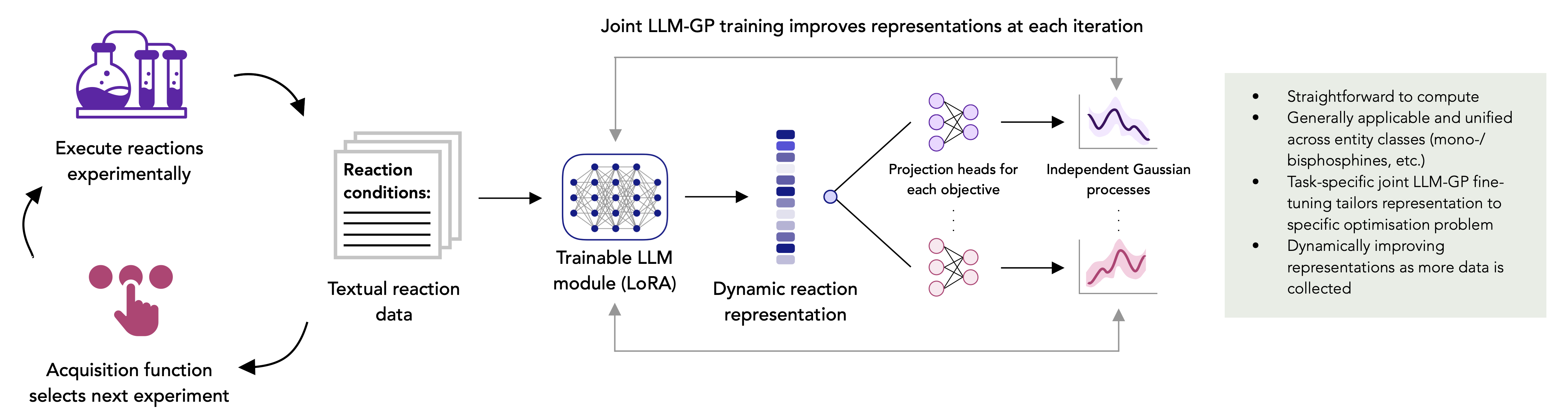
We present a general framework for multi-objective reaction optimisation that requires no descriptor computation or feature engineering. Textual descriptions of reaction conditions — ligands, additives, solvents, catalysts — are encoded by a fine-tuned language model and passed through objective-specific projection heads into independent surrogate models, jointly trained end-to-end. The representation adapts to the reaction system and objectives of the optimisation campaign at hand.
Requires Python 3.10+.
git clone https://github.com/schwallergroup/alice.git
cd alice
Three dependency files are provided:
| File | Use |
|---|---|
environment.yml | Minimal conda environment — start here |
requirements.txt | The same minimal set-up, for pip |
environment.lock.yml | Transitive freeze of the environment used in this work (linux-64) |
Quick start (conda):
conda env create -f environment.yml
conda activate alice
pip install -e .
Quick start (pip):
conda create -n alice python=3.10 -y
conda activate alice
pip install -r requirements.txt
pip install -e .
Exact environment used in this work (linux-64 only):
conda env create -f environment.lock.yml
conda activate alice
pip install -e .
All experiments in the manuscript were run on NVIDIA A100 GPUs with torch 2.8.0 (CUDA 12.8).
The configs/ directory contains the configuration files used for the
experiments in the manuscript, one per reaction dataset and representation:
configs/
├── ni_suzuki/             # Ni-catalysed Suzuki coupling
├── pd_suzuki/             # Pd-catalysed Suzuki coupling
└── pd_sulfonamide/        # Pd-catalysed sulfonamide C–N coupling
Each dataset provides three representations:
| Config | Representation |
|---|---|
<name>_desc.yaml | Numerical descriptors from descriptor libraries + OHE |
<name>_ohe.yaml | One-hot encoding |
<name>_llm.yaml | Fine-tuned LLM embeddings |
Launch a single run with:
python train_master.py --config configs/<dataset>/<config>.yaml
W&B cloud tracking can be disabled by using (this still writes the local result CSV files and plots):
WANDB_MODE=disabled python train_master.py --config configs/<dataset>/<config>.yaml
The experiments in the manuscript were run as 20-seed W&B sweeps in configs/:
configs/
├── sweep_ni_suzuki.yaml
├── sweep_pd_sulfonamide.yaml
└── sweep_pd_suzuki.yaml
After logging in to W&B, initialize a sweep from the repository root using:
# to switch between featurisation methods, change parameters.config.value in the sweep file.
wandb sweep configs/<sweep_file>.yaml
# W&B will then print a sweep identifier of the form below which you can use to start the run:
wandb agent <entity>/<project>/<sweep-id>
The data/ directory holds the three retrospective benchmark datasets used for evaluation in the manuscript, and the experimental data collected in the two prospective reaction optimisation campaigns.
data/
├── benchmark_datasets/
│   ├── ni_suzuki/             # Ni-catalysed Suzuki coupling
│   ├── pd_suzuki/             # Pd-catalysed Suzuki coupling
│   └── pd_sulfonamide/        # Pd-catalysed sulfonamide C–N coupling
└── prospective_campaigns/     # results of the two prospective optimisation campaigns
The two datasets ni_suzuki and pd_suzuki are measured HTE plates
covering a designed subset of their parameter space; pd_sulfonamide is a
virtual dataset enumerating the full grid.
Each dataset ships the same reaction data in three representations, so that the featurizers can be compared on identical data:
| File | Representation |
|---|---|
<dataset>_desc.csv | Numerical descriptors from descriptor libraries + OHE |
<dataset>_ohe.csv | One-hot encoding |
<dataset>_prompt.csv | Natural-language reaction prompt, consumed by the LLM featurizers |
Results of the two prospective optimisation campaigns, in SURF format — one row per reaction, with CAS numbers and SMILES for every component:
| File | Reaction | Objectives |
|---|---|---|
asymmetric_hydrogenation_surf_reaction_data.csv | Asymmetric hydrogenation | conversion, de (syn), ee (syn) |
pd_catalysed_cyanation_surf_reaction_data.csv | Pd-catalysed cyanation | conversion, selectivity |
Each file contains 192 reactions — two 96-well HTE BO rounds, indexed by the
BO round column.
@misc{sin2026dynamic,
  title         = {Dynamic language model representations for multi-objective reaction optimisation},
  author        = {Sin, Joshua W. and Segura, David Ming and Ranković, Bojana and Chau, Siu Lun and Lutz, Marius D. R. and Anelli, Andrea and Burwood, Ryan P. and Püntener, Kurt and Notheis, Maximilian J. and Bigler, Raphael and Schwaller, Philippe},
  year          = {2026},
  eprint        = {2609.11790},
  archivePrefix = {arXiv},
  primaryClass  = {cs.LG},
  doi           = {10.48550/arXiv.2609.11790},
  url           = {https://arxiv.org/abs/2609.11790}
}
This project is licensed under the Apache 2.0 License. See the LICENSE file for details.
This work was supported by NCCR Catalysis (grant no. 225147), a National Centre of Competence in Research funded by the Swiss National Science Foundation, and by the Swiss National Science Foundation (SNSF) [226509].
📄 Paper:
We present a general framework for multi-objective reaction optimisation that requires no descriptor computation or feature engineering. Textual descriptions of reaction conditions — ligands, additives, solvents, catalysts — are encoded by a fine-tuned language model and passed through objective-specific projection heads into independent surrogate models, jointly trained end-to-end. The representation adapts to the reaction system and objectives of the optimisation campaign at hand.
Requires Python 3.10+.
git clone https://github.com/schwallergroup/alice.git
cd alice
Three dependency files are provided:
| File | Use |
|---|---|
environment.yml | Minimal conda environment — start here |
requirements.txt | The same minimal set-up, for pip |
environment.lock.yml | Transitive freeze of the environment used in this work (linux-64) |
Quick start (conda):
conda env create -f environment.yml
conda activate alice
pip install -e .
Quick start (pip):
conda create -n alice python=3.10 -y
conda activate alice
pip install -r requirements.txt
pip install -e .
Exact environment used in this work (linux-64 only):
conda env create -f environment.lock.yml
conda activate alice
pip install -e .
All experiments in the manuscript were run on NVIDIA A100 GPUs with torch 2.8.0 (CUDA 12.8).
The configs/ directory contains the configuration files used for the
experiments in the manuscript, one per reaction dataset and representation:
configs/
├── ni_suzuki/             # Ni-catalysed Suzuki coupling
├── pd_suzuki/             # Pd-catalysed Suzuki coupling
└── pd_sulfonamide/        # Pd-catalysed sulfonamide C–N coupling
Each dataset provides three representations:
| Config | Representation |
|---|---|
<name>_desc.yaml | Numerical descriptors from descriptor libraries + OHE |
<name>_ohe.yaml | One-hot encoding |
<name>_llm.yaml | Fine-tuned LLM embeddings |
Launch a single run with:
python train_master.py --config configs/<dataset>/<config>.yaml
W&B cloud tracking can be disabled by using (this still writes the local result CSV files and plots):
WANDB_MODE=disabled python train_master.py --config configs/<dataset>/<config>.yaml
The experiments in the manuscript were run as 20-seed W&B sweeps in configs/:
configs/
├── sweep_ni_suzuki.yaml
├── sweep_pd_sulfonamide.yaml
└── sweep_pd_suzuki.yaml
After logging in to W&B, initialize a sweep from the repository root using:
# to switch between featurisation methods, change parameters.config.value in the sweep file.
wandb sweep configs/<sweep_file>.yaml
# W&B will then print a sweep identifier of the form below which you can use to start the run:
wandb agent <entity>/<project>/<sweep-id>
The data/ directory holds the three retrospective benchmark datasets used for evaluation in the manuscript, and the experimental data collected in the two prospective reaction optimisation campaigns.
data/
├── benchmark_datasets/
│   ├── ni_suzuki/             # Ni-catalysed Suzuki coupling
│   ├── pd_suzuki/             # Pd-catalysed Suzuki coupling
│   └── pd_sulfonamide/        # Pd-catalysed sulfonamide C–N coupling
└── prospective_campaigns/     # results of the two prospective optimisation campaigns
The two datasets ni_suzuki and pd_suzuki are measured HTE plates
covering a designed subset of their parameter space; pd_sulfonamide is a
virtual dataset enumerating the full grid.
Each dataset ships the same reaction data in three representations, so that the featurizers can be compared on identical data:
| File | Representation |
|---|---|
<dataset>_desc.csv | Numerical descriptors from descriptor libraries + OHE |
<dataset>_ohe.csv | One-hot encoding |
<dataset>_prompt.csv | Natural-language reaction prompt, consumed by the LLM featurizers |
Results of the two prospective optimisation campaigns, in SURF format — one row per reaction, with CAS numbers and SMILES for every component:
| File | Reaction | Objectives |
|---|---|---|
asymmetric_hydrogenation_surf_reaction_data.csv | Asymmetric hydrogenation | conversion, de (syn), ee (syn) |
pd_catalysed_cyanation_surf_reaction_data.csv | Pd-catalysed cyanation | conversion, selectivity |
Each file contains 192 reactions — two 96-well HTE BO rounds, indexed by the
BO round column.
@misc{sin2026dynamic,
  title         = {Dynamic language model representations for multi-objective reaction optimisation},
  author        = {Sin, Joshua W. and Segura, David Ming and Ranković, Bojana and Chau, Siu Lun and Lutz, Marius D. R. and Anelli, Andrea and Burwood, Ryan P. and Püntener, Kurt and Notheis, Maximilian J. and Bigler, Raphael and Schwaller, Philippe},
  year          = {2026},
  eprint        = {2609.11790},
  archivePrefix = {arXiv},
  primaryClass  = {cs.LG},
  doi           = {10.48550/arXiv.2609.11790},
  url           = {https://arxiv.org/abs/2609.11790}
}
This project is licensed under the Apache 2.0 License. See the LICENSE file for details.
This work was supported by NCCR Catalysis (grant no. 225147), a National Centre of Competence in Research funded by the Swiss National Science Foundation, and by the Swiss National Science Foundation (SNSF) [226509].



