Interactive 2D & 3D browser visualizer for Microsoft GraphRAG pipelines and Graphify codebase knowledge graphs. 100% client-side & private.
See the codeInteractive 2D & 3D Dual-Engine Visualizer for Microsoft GraphRAG and Graphify Codebase Knowledge Graphs.


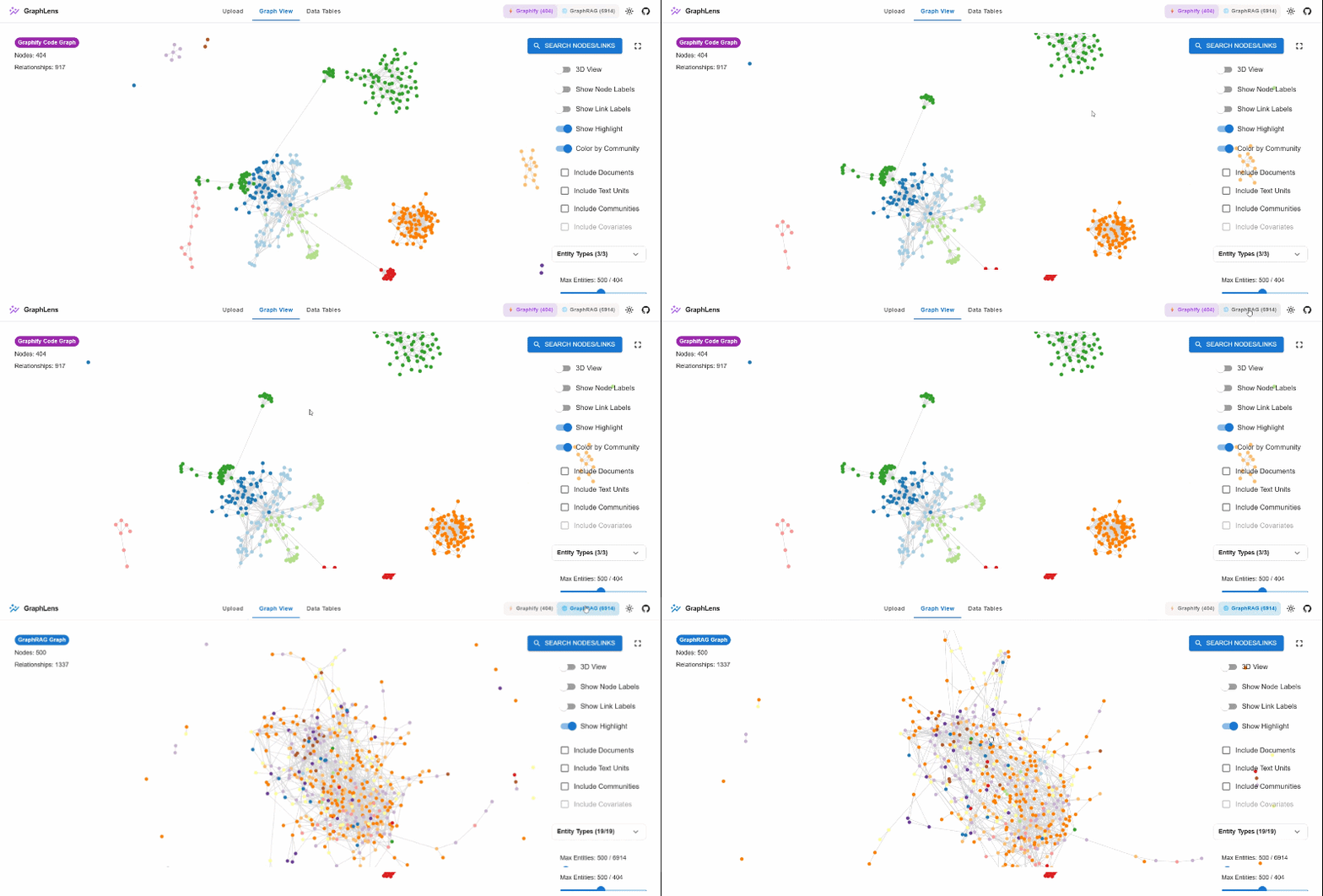
GraphLens is an open-source, client-side knowledge graph visualizer designed to seamlessly explore both Microsoft GraphRAG LLM pipelines and Graphify codebase structural graphs.
Everything runs directly in your browser using Web Workers and WebGL—ensuring zero setup, high performance, and complete data privacy without sending any files to external servers.
hyparquet) and JSON parsing. No backend required and no tracking telemetry.Fuse.js with detail drawers showing connected neighbors and attributes.material-react-table.Drag & drop your graphify-out/ folder or individual files into GraphLens:
| File | Format | Status | Description |
|---|---|---|---|
graph.json | JSON | Required | Complete AST code graph: nodes (functions, classes, modules), directional edges, communities, and file locations. |
GRAPH_REPORT.md | Markdown | Optional | Unlocks the Architecture & God Nodes report tab with cohesion metrics and community summaries. |
manifest.json | JSON | Optional | Unlocks the Files Manifest table showing source files, LoC, and extracted symbol counts. |
.graphify_labels.json | JSON | Optional | Human-readable community cluster titles (falls back to graph.json community names). |
Tip: You can also click "Load Example Graphify Dataset" on the upload screen to explore preloaded sample data immediately.
Drag & drop your .parquet files or place them into public/artifacts/:
| GraphRAG v2.x | GraphRAG v1.x (Legacy) | Data Type | Description |
|---|---|---|---|
entities.parquet | create_final_entities.parquet | Entities | Extracted named entities, semantic categories, and descriptions |
relationships.parquet | create_final_relationships.parquet | Edges | Directed relationships between entities with weights |
documents.parquet | create_final_documents.parquet | Documents | Source raw documents |
text_units.parquet | create_final_text_units.parquet | Chunks | Text chunk units derived from documents |
communities.parquet | create_final_communities.parquet | Clusters | Hierarchical communities detected across entities |
community_reports.parquet | create_final_community_reports.parquet | Reports | LLM synthesis reports and findings per community |
covariates.parquet | create_final_covariates.parquet | Claims | Extracted claim covariates |
Tip: Click "Load Example GraphRAG Dataset" on the upload screen to test GraphRAG visualization without uploading any files.
| Node Type | Engine | Description |
|---|---|---|
FUNCTION, CLASS, MODULE, INTERFACE | Graphify | Code symbols extracted via AST analysis |
COMMUNITY | Graphify & GraphRAG | Clustered module or semantic community |
| Extracted Semantic Types (PERSON, ORG, GEO, etc.) | GraphRAG | LLM-extracted domain entities |
RAW_DOCUMENT | GraphRAG | Source raw documents |
CHUNK | GraphRAG | Text chunk units with token counts |
FINDING | GraphRAG | Key community findings and explanations |
COVARIATE | GraphRAG | Claims, temporal metadata, and covariate entities |
| Source Node | Edge Type | Target Node | Engine | Description |
|---|---|---|---|---|
| Function / Class | calls | Function / Method | Graphify | Execution or invocation call |
| Module / Class | contains | Function / Class | Graphify | Structural hierarchy & membership |
| File / Module | imports | Module / Package | Graphify | Module import dependency |
| Class | extends | Base Class | Graphify | Class inheritance / interface implementation |
| Symbol | references | Symbol / File | Graphify | Variable, symbol, or type reference |
| Entity | RELATED | Entity | GraphRAG | Semantic relationship with weight |
| Text Unit | PART_OF | Document | GraphRAG | Chunk belongs to source document |
| Text Unit | HAS_ENTITY | Entity | GraphRAG | Text unit references extracted entity |
| Text Unit | HAS_COVARIATE | Covariate | GraphRAG | Text unit contains claim/covariate |
| Community | HAS_FINDING | Finding | GraphRAG | Community report links to finding |
| Entity / Symbol | IN_COMMUNITY | Community | Both | Node belongs to detected community cluster |
# Clone the repository
git clone https://github.com/rpdil23/GraphLens.git
cd GraphLens

# Install dependencies
npm install

# Start local development server
npm start
Visit http://localhost:3000 in your browser.
npm run build
The optimized bundle will be generated in build/.
npm run deploy
# Typecheck TypeScript
npx tsc --noEmit

# Run unit tests
npm test -- --watchAll=false

# Test production build
npm run build
Contributions, bug reports, and suggestions are welcome!
git checkout -b feat/my-feature).git commit -m 'feat: add my feature').git push origin feat/my-feature).GraphLens is extended from the original graphrag-visualizer created by Yan-Ying Liao (noworneverev).
We express our gratitude to the original project and Microsoft GraphRAG team for the foundation that made this multi-source visualizer possible.
This project is licensed under the MIT License.
Interactive 2D & 3D browser visualizer for Microsoft GraphRAG pipelines and Graphify codebase knowledge graphs. 100% client-side & private.
See the codeInteractive 2D & 3D Dual-Engine Visualizer for Microsoft GraphRAG and Graphify Codebase Knowledge Graphs.
GraphLens is an open-source, client-side knowledge graph visualizer designed to seamlessly explore both Microsoft GraphRAG LLM pipelines and Graphify codebase structural graphs.
Everything runs directly in your browser using Web Workers and WebGL—ensuring zero setup, high performance, and complete data privacy without sending any files to external servers.
hyparquet) and JSON parsing. No backend required and no tracking telemetry.Fuse.js with detail drawers showing connected neighbors and attributes.material-react-table.Drag & drop your graphify-out/ folder or individual files into GraphLens:
| File | Format | Status | Description |
|---|---|---|---|
graph.json | JSON | Required | Complete AST code graph: nodes (functions, classes, modules), directional edges, communities, and file locations. |
GRAPH_REPORT.md | Markdown | Optional | Unlocks the Architecture & God Nodes report tab with cohesion metrics and community summaries. |
manifest.json | JSON | Optional | Unlocks the Files Manifest table showing source files, LoC, and extracted symbol counts. |
.graphify_labels.json | JSON | Optional | Human-readable community cluster titles (falls back to graph.json community names). |
Tip: You can also click "Load Example Graphify Dataset" on the upload screen to explore preloaded sample data immediately.
Drag & drop your .parquet files or place them into public/artifacts/:
| GraphRAG v2.x | GraphRAG v1.x (Legacy) | Data Type | Description |
|---|---|---|---|
entities.parquet | create_final_entities.parquet | Entities | Extracted named entities, semantic categories, and descriptions |
relationships.parquet | create_final_relationships.parquet | Edges | Directed relationships between entities with weights |
documents.parquet | create_final_documents.parquet | Documents | Source raw documents |
text_units.parquet | create_final_text_units.parquet | Chunks | Text chunk units derived from documents |
communities.parquet | create_final_communities.parquet | Clusters | Hierarchical communities detected across entities |
community_reports.parquet | create_final_community_reports.parquet | Reports | LLM synthesis reports and findings per community |
covariates.parquet | create_final_covariates.parquet | Claims | Extracted claim covariates |
Tip: Click "Load Example GraphRAG Dataset" on the upload screen to test GraphRAG visualization without uploading any files.
| Node Type | Engine | Description |
|---|---|---|
FUNCTION, CLASS, MODULE, INTERFACE | Graphify | Code symbols extracted via AST analysis |
COMMUNITY | Graphify & GraphRAG | Clustered module or semantic community |
| Extracted Semantic Types (PERSON, ORG, GEO, etc.) | GraphRAG | LLM-extracted domain entities |
RAW_DOCUMENT | GraphRAG | Source raw documents |
CHUNK | GraphRAG | Text chunk units with token counts |
FINDING | GraphRAG | Key community findings and explanations |
COVARIATE | GraphRAG | Claims, temporal metadata, and covariate entities |
| Source Node | Edge Type | Target Node | Engine | Description |
|---|---|---|---|---|
| Function / Class | calls | Function / Method | Graphify | Execution or invocation call |
| Module / Class | contains | Function / Class | Graphify | Structural hierarchy & membership |
| File / Module | imports | Module / Package | Graphify | Module import dependency |
| Class | extends | Base Class | Graphify | Class inheritance / interface implementation |
| Symbol | references | Symbol / File | Graphify | Variable, symbol, or type reference |
| Entity | RELATED | Entity | GraphRAG | Semantic relationship with weight |
| Text Unit | PART_OF | Document | GraphRAG | Chunk belongs to source document |
| Text Unit | HAS_ENTITY | Entity | GraphRAG | Text unit references extracted entity |
| Text Unit | HAS_COVARIATE | Covariate | GraphRAG | Text unit contains claim/covariate |
| Community | HAS_FINDING | Finding | GraphRAG | Community report links to finding |
| Entity / Symbol | IN_COMMUNITY | Community | Both | Node belongs to detected community cluster |
# Clone the repository
git clone https://github.com/rpdil23/GraphLens.git
cd GraphLens

# Install dependencies
npm install

# Start local development server
npm start
Visit http://localhost:3000 in your browser.
npm run build
The optimized bundle will be generated in build/.
npm run deploy
# Typecheck TypeScript
npx tsc --noEmit

# Run unit tests
npm test -- --watchAll=false

# Test production build
npm run build
Contributions, bug reports, and suggestions are welcome!
git checkout -b feat/my-feature).git commit -m 'feat: add my feature').git push origin feat/my-feature).GraphLens is extended from the original graphrag-visualizer created by Yan-Ying Liao (noworneverev).
We express our gratitude to the original project and Microsoft GraphRAG team for the foundation that made this multi-source visualizer possible.
This project is licensed under the MIT License.



