Track 2: Social Navigation
See the codeOfficial Baseline Implementation for Track 2
Based on Falcon -- "From Cognition to Precognition: A Future-Aware Framework for Social Navigation"
(https://github.com/Zeying-Gong/Falcon)




🏆 Prize Pool: $2,000 USD for Track 2 Winners
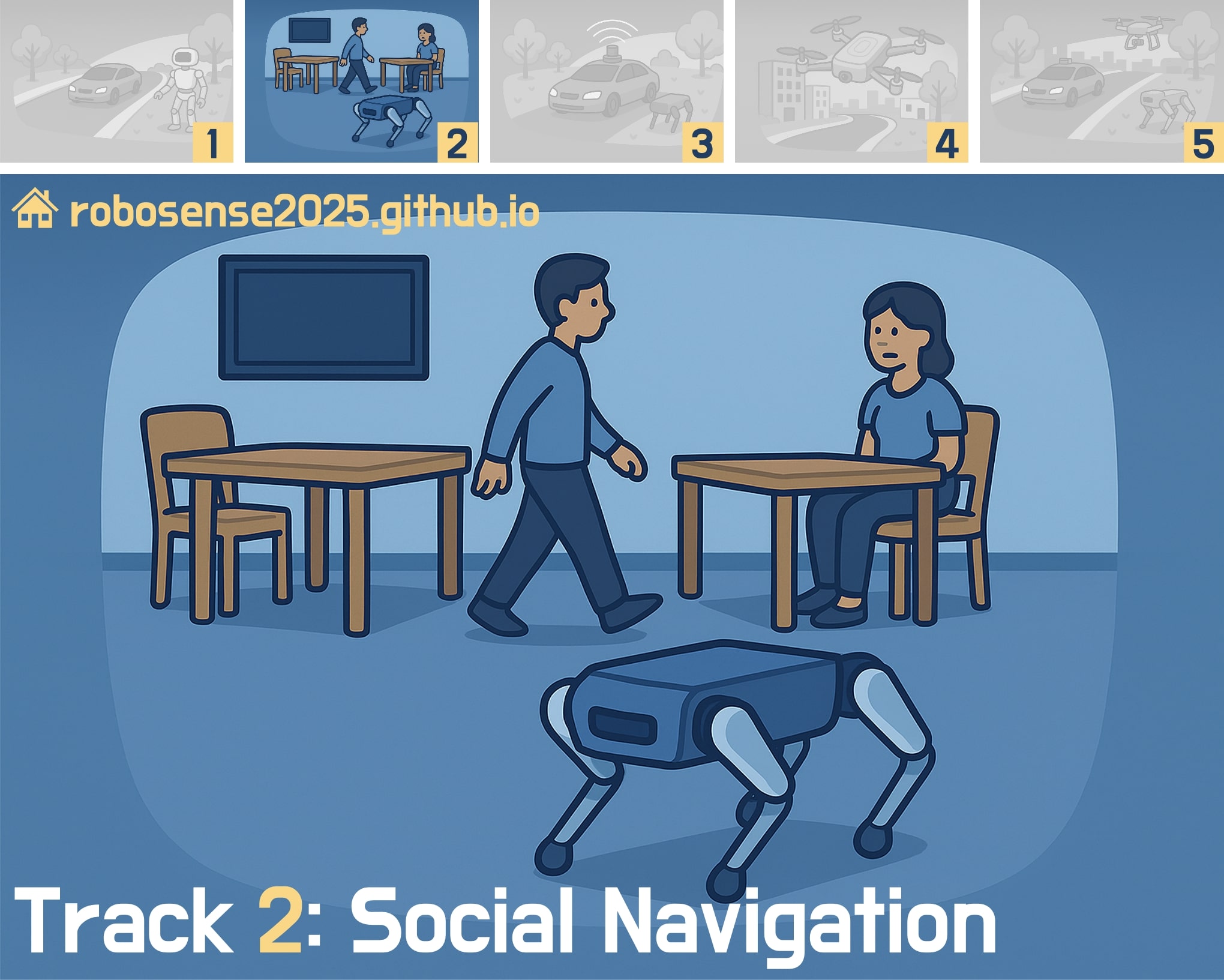
Track 2: Social Navigation challenges participants to develop advanced RGBD-based perception and navigation systems that empower autonomous agents to interact safely, efficiently, and socially in dynamic human environments.
Participants will design algorithms that interpret human behaviors and contextual cues to generate navigation strategies that strike a balance between navigation efficiency and social compliance. Submissions must address key challenges such as real-time adaptability, occlusion handling, and ethical decision-making in socially complex settings.
This track evaluates an agent's ability to perform socially compliant navigation in dynamic indoor environments populated with realistic human agents. Participants must design navigation policies based solely on RGBD observations and odometry, without access to global maps or privileged information.
| Prize | Award |
|---|---|
| 🥇 1st Place | $1000 + Certificate |
| 🥈 2nd Place | $600 + Certificate |
| 🥉 3rd Place | $400 + Certificate |
| 🌟 Innovation Award | Cash Award + Certificate |
| Participation | Certificate |
This track uses the RoboSense Track 2 Social Navigation Dataset, which is based on the Social-HM3D benchmark and provides:
| Dataset | Num. of Scenes | Scene Types | Num. of Humans | Natural Motion |
|---|---|---|---|---|
| Social-HM3D | 844 | Residence, Office, Shop, etc. | 0–6 | ✔️ |
The Falcon baseline achieves the following performance on the Phase I evaluation set using the Social-HM3D datasets (∼1,000 test episodes):
| Dataset | Success ↑ | SPL ↑ | PSC ↑ | H-Coll ↓ |
|---|---|---|---|---|
| Social-HM3D | 55.15 | 55.15 | 89.56 | 42.96 |
Note: These baseline results are based solely on depth input. As the competition supports full RGB-D modalities, participants are encouraged to explore richer representations and surpass the baseline performance.
Assuming you have conda installed, let's prepare a conda env:
conda_env_name=falcon
conda create -n $conda_env_name python=3.9 cmake=3.14.0
conda activate $conda_env_name
Following Habitat-lab's instruction:
conda install habitat-sim=0.3.1 withbullet -c conda-forge -c aihabitat
Then, assuming you have this repository cloned (forked from Habitat 3.0), install the necessary dependencies of Habitat.
git clone --recurse-submodules https://github.com/robosense2025/track2.git # to download the submodule
cd Falcon
pip install -e habitat-lab
pip install -e habitat-baselines
Follow the instructions for HM3D in Habitat-lab's Datasets.md. By default, the download script fetches version 0.2 of the HM3D dataset, which includes only the assets required for use with Habitat-Sim.
python -m habitat_sim.utils.datasets_download --username <api-token-id> --password <api-token-secret> --uids hm3d
You can also add _full to the uid to download the raw glbs in addition to what is needed for use with Habitat-Sim.
python -m habitat_sim.utils.datasets_download --username <api-token-id> --password <api-token-secret> --uids hm3d_full
Download social navigation (SocialNav) episodes for the test scenes, which can be found here: Link.
After downloading, unzip and place the datasets in the default location:
unzip -d data/datasets/pointnav
wget https://github.com/facebookresearch/habitat-lab/files/12502177/spot_walking_trajectory.csv -O data/robots/spot_data/spot_walking_trajectory.csv
python -m habitat_sim.utils.datasets_download --uids habitat_humanoids hab3_bench_assets hab_spot_arm
The file structure should look like this:
Falcon/
└── data/
    ├── datasets
    │   └── pointnav
    │       └── social-hm3d
    │           ├── train
    │           │   ├── content
    │           │   └── train.json.gz
    │           └── val
    │               ├── content
    │               └── val.json.gz
    ├── scene_datasets
    ├── robots
    ├── humanoids
    ├── versoned_data
    └── hab3_bench_assets
Note that here the definition of SocialNav is different from the original task in Habitat 3.0.
The pretrained models can be found in this link. Download it to pretrained_model/ under the root directory.
You can evaluate it on the Social-HM3D datasets using the following template:
python -u -m habitat-baselines.habitat_baselines.eval \
--config-name=social_nav_v2/falcon_hm3d.yaml
We provide a standardized Docker environment for remote evaluation to ensure consistency and reproducibility across all submissions.
All submissions will be evaluated inside the following Docker image:
Phase 1: Evaluations were run inside
docker pull zeyinggong/robosense_socialnav:v0.5
Phase 2: Evaluations will use
docker pull zeyinggong/robosense_socialnav:v0.7
Changes in v0.7:
Fixed driver compatibility issues because of EGL error
Phase 2 now supports up to 8 environments, including single-environment inference.
Update action space: in Phase 1, action 0 (stop) did not terminate the episode. In Phase 2, the action set has been refined to clearly distinguish between stopping (ending an episode) and pausing (remaining stationary without ending). A new move_backward action is also introduced, enabling the robot to retreat when needed for better social compliance and obstacle avoidance. The updated action space is:
0 - stop            # now correctly ends the episode
1 - move_forward
2 - turn_left
3 - turn_right
4 - move_backward   # newly added action for moving backward
5 - pause           # newly added action for pausing without movement
The two new actions (4-move_backward, 5-pause) are optional. Teams can continue using only actions 0-3 from Phase 1. Therefore, the action space is fully backward-compatible with Phase 1, ensuring smooth transition for existing methods.
Participants are strongly encouraged to develop and test their pipelines locally using this image to ensure compatibility with the evaluation server.
Submissions will be evaluated inside the container under /app/Falcon/. The evaluator will unzip your submission.zip or load your actions.json file into /app/Falcon/input/ inside the container.
For Phase 2, only a complete code submission (submission.zip) will be accepted. We may perform additional audits for the top-performing teams in both test phases.
submission.zip): Your archive must be structured as follows:submission.zip
├── run.sh # The main script to be executed (must be executable).
├── config.yaml # An optional YAML configuration file for inference.
├── model.pth # Optional pretrained model weights.
├── custom_policy.py # An optional file containing your custom policy or inference logic.
└── ... # Any other necessary files.
Your run.sh entry point will be called directly.
actions.json): Only supported in Phase 1. The evaluator will run:python -u -m habitat_baselines.eval --config-name=social_nav_v2/falcon_hm3d_replay.yaml
To simplify submissions, all evaluation data directories for Minival, Phase 1, and Phase 2 are mapped to the same location inside the container:
/app/Falcon/data/datasets/pointnav/social-hm3d/minival. This means your code only needs to be compatible with a single directory structure like the one used for minival.
Phase 1
You can test your submission locally before uploading to EvalAI:
docker run --rm -it \
    --gpus all \
    --runtime=nvidia \
    -v /path/to/your/submission:/app/Falcon/input:ro \
    -v /path/to/your/data:/app/Falcon/data:ro \
    zeyinggong/robosense_socialnav:v0.5
Inside the container, navigate to /app/Falcon/ and manually execute your run.sh or replay evaluator command to verify correctness.
Tip: You may refer to the provided Baseline ZIP Submission Example (Updated) and Baseline Action Submission Example for reference.
Phase 2
For this phase, we recommend using Docker image version v0.7, which is optimized with an improved action space and enhanced environment setup. Please note that Phase 2 does not support action submissions due to the dataset not being publicly available.
You can test your submission locally before uploading to EvalAI:
docker run --rm -it \
    --gpus all \
    --runtime=nvidia \
    -v /path/to/your/submission:/app/Falcon/input:ro \
    -v /path/to/your/data:/app/Falcon/data:ro \
    zeyinggong/robosense_socialnav:v0.7
You can manually execute your run.sh inside the container to verify correctness.
Tip: You may refer to the provided Baseline ZIP Submission Example (Updated) for reference.
If your submission remains pending for over 48 hours, please open an issue on our GitHub repository: issues. You may also contact us via email at robosense2025@gmail.com if necessary.
Our benchmark focuses on two key aspects: task completion and social compliance.
| Metric | Description |
|---|---|
| SR (Success Rate) | Fraction of episodes where the robot successfully reaches the goal. |
| SPL (Success weighted by Path Length) | Penalizes inefficient navigation. Rewards shorter, successful paths. |
| PSC (Personal Space Compliance) | Measures how well the robot avoids violating human personal space. A higher PSC indicates better social behavior. The threshold is set to 1.0m, considering a 0.3m human radius and 0.25m robot radius. |
| H-Coll (Human Collision Rate) | The proportion of episodes involving any human collision. Collisions imply task failure. |
| Total Score | Weighted combination of the core metrics: Total = 0.4 × SR + 0.3 × SPL + 0.3 × PSC. This score reflects overall navigation quality while implicitly penalizing human collisions. |
Note: The evaluation metrics and scoring formula remain the same for both Phase 1 and Phase 2. The final rankings and awards will be determined exclusively by the results from Phase 2. Rankings are based on the
Total Score, with ties broken by the higher Success Rate (SR).
Public test set evaluation (~1000 episodes)
Deadline: August 15th, 2025 (AoE)
Leaderboard Visibility: The leaderboard for Phase 1 is public. Your submissions will be visible on the leaderboard as soon as they are successfully evaluated, allowing you to track your progress and compare with other teams.
Private test set evaluation (~500 episodes)
Note: Teams that were unable to submit any evaluations during Phase 1 are still welcome to continue participating in Phase 2. The final ranking will be determined solely by the results from Phase 2.
Deadline: September 15th, 2025 (AoE)
Leaderboard Visibility: The leaderboard for Phase 2 is private and will not be publicly revealed until after the competition concludes. However, participants can see if their own submissions appear on the private leaderboard to confirm that they have been successfully processed and evaluated.
Final Submission: For Phase 2, only a complete code submission (submission.zip) will be accepted. Your final submission must contain all code, configurations, and trained model weights necessary to reproduce your results.
Reproducibility Audit: The organizing team will audit the submissions of top-performing teams to verify their reproducibility. We will execute your code in the official Docker environment and compare the results with the public leaderboard scores.
Disqualification: Any submission found to be in violation of the rules will be disqualified. This includes, but is not limited to, submissions that:
result.json file by bypassing the intended evaluation logic.The most common reason is that your submission did not generate a valid result.json file in the expected format. Please ensure your submission:
output/result.jsonSR, SPL, PSC, H-CollExample of correct format:
{
  "SR": 0.50,
  "SPL": 0.45,
  "PSC": 0.60,
  "H-Coll": 0.02
}
If your submission requires additional dependencies:
run.sh script using conda/pipExample run.sh with dependency installation:
#!/bin/bash
# Install additional dependencies
conda install -c conda-forge your_package
pip install specific_library==1.2.3

# Run your inference
source activate falcon
python your_inference_script.py
To simplify evaluation, we use a fixed dataset mount point inside the evaluation Docker container:
/app/Falcon/data/datasets/pointnav/social-hm3d/minival
Important: Your code should always read data from this path, regardless of which phase is being evaluated. Our backend automatically mounts the appropriate dataset for each phase to this location.
All submissions are evaluated inside Docker images with the following versions:
docker pull zeyinggong/robosense_socialnav:v0.5docker pull zeyinggong/robosense_socialnav:v0.7Key Changes in v0.7:
0 - stop            # now correctly ends the episode
1 - move_forward
2 - turn_left
3 - turn_right
4 - move_backward   # newly added action for moving backward
5 - pause           # newly added action for pausing without movement
The two new actions (4-move_backward, 5-pause) are optional. Teams can continue using only actions 0-3 from Phase 1. Therefore, the action space is fully backward-compatible with Phase 1, ensuring smooth transition for existing methods.
For Phase II, we recommend using Docker image v0.7 for local testing:
docker run --rm -it \
    --gpus all \
    --runtime=nvidia \
    -v /path/to/your/submission:/app/Falcon/input:ro \
    -v /path/to/your/data:/app/Falcon/data:ro \
    zeyinggong/robosense_socialnav:v0.7
You can manually execute your run.sh inside the container to verify correctness.
Tip: Refer to the provided Baseline ZIP Submission Example (Updated) for reference.
Note: Phase II does not support action submissions since the test dataset is not publicly available.
If your submission remains pending for over 48 hours, please:
Yes, we encourage flexible approaches! You have significant freedom to modify the evaluation pipeline and import your own policy code, including:
Falcon/habitat-baselines/habitat_baselines/eval.py (main evaluation script)Falcon/habitat-baselines/habitat_baselines/rl/ppo/falcon_evaluator.py (evaluator implementation)You can import and integrate your custom modules, modify the inference pipeline, or adapt the evaluation logic to suit your approach.
⚠️ However, the following restrictions must be respected:
falcon_evaluator.py, including accessing extra environmental information or sensors beyond the allowed observation keys, or any other validation checksThese restrictions ensure fair competition while maintaining the scientific integrity of the challenge.
🆘 Still need help? If your question isn't answered here, please reach out to us:
If you use the code and dataset in your research, please cite:
@article{gong2024cognition,
  title = {From Cognition to Precognition: A Future-Aware Framework for Social Navigation},
  author = {Gong, Zeying and Hu, Tianshuai and Qiu, Ronghe and Liang, Junwei},
  journal = {arXiv preprint arXiv:2409.13244},
  year = {2024}
}

@article{robosense2025track2,
  title     = {RoboSense Challenge 2025: Track 2 - Social Navigation},
  author    = {RoboSense Challenge Organizers},
  booktitle = {IROS 2025},
  year      = {2025},
  url       = {https://robosense2025.github.io/track2}
}
🤖 Ready to sense the world robustly? Register now and compete for $2,000!
📝 Register Here | 🌐 Challenge Website | 📧 Contact Us
Made with ❤️ by the RoboSense 2025 Team
Track 2: Social Navigation
See the codeOfficial Baseline Implementation for Track 2
Based on Falcon -- "From Cognition to Precognition: A Future-Aware Framework for Social Navigation"
(https://github.com/Zeying-Gong/Falcon)
🏆 Prize Pool: $2,000 USD for Track 2 Winners
Track 2: Social Navigation challenges participants to develop advanced RGBD-based perception and navigation systems that empower autonomous agents to interact safely, efficiently, and socially in dynamic human environments.
Participants will design algorithms that interpret human behaviors and contextual cues to generate navigation strategies that strike a balance between navigation efficiency and social compliance. Submissions must address key challenges such as real-time adaptability, occlusion handling, and ethical decision-making in socially complex settings.
This track evaluates an agent's ability to perform socially compliant navigation in dynamic indoor environments populated with realistic human agents. Participants must design navigation policies based solely on RGBD observations and odometry, without access to global maps or privileged information.
| Prize | Award |
|---|---|
| 🥇 1st Place | $1000 + Certificate |
| 🥈 2nd Place | $600 + Certificate |
| 🥉 3rd Place | $400 + Certificate |
| 🌟 Innovation Award | Cash Award + Certificate |
| Participation | Certificate |
This track uses the RoboSense Track 2 Social Navigation Dataset, which is based on the Social-HM3D benchmark and provides:
| Dataset | Num. of Scenes | Scene Types | Num. of Humans | Natural Motion |
|---|---|---|---|---|
| Social-HM3D | 844 | Residence, Office, Shop, etc. | 0–6 | ✔️ |
The Falcon baseline achieves the following performance on the Phase I evaluation set using the Social-HM3D datasets (∼1,000 test episodes):
| Dataset | Success ↑ | SPL ↑ | PSC ↑ | H-Coll ↓ |
|---|---|---|---|---|
| Social-HM3D | 55.15 | 55.15 | 89.56 | 42.96 |
Note: These baseline results are based solely on depth input. As the competition supports full RGB-D modalities, participants are encouraged to explore richer representations and surpass the baseline performance.
Assuming you have conda installed, let's prepare a conda env:
conda_env_name=falcon
conda create -n $conda_env_name python=3.9 cmake=3.14.0
conda activate $conda_env_name
Following Habitat-lab's instruction:
conda install habitat-sim=0.3.1 withbullet -c conda-forge -c aihabitat
Then, assuming you have this repository cloned (forked from Habitat 3.0), install the necessary dependencies of Habitat.
git clone --recurse-submodules https://github.com/robosense2025/track2.git # to download the submodule
cd Falcon
pip install -e habitat-lab
pip install -e habitat-baselines
Follow the instructions for HM3D in Habitat-lab's Datasets.md. By default, the download script fetches version 0.2 of the HM3D dataset, which includes only the assets required for use with Habitat-Sim.
python -m habitat_sim.utils.datasets_download --username <api-token-id> --password <api-token-secret> --uids hm3d
You can also add _full to the uid to download the raw glbs in addition to what is needed for use with Habitat-Sim.
python -m habitat_sim.utils.datasets_download --username <api-token-id> --password <api-token-secret> --uids hm3d_full
Download social navigation (SocialNav) episodes for the test scenes, which can be found here: Link.
After downloading, unzip and place the datasets in the default location:
unzip -d data/datasets/pointnav
wget https://github.com/facebookresearch/habitat-lab/files/12502177/spot_walking_trajectory.csv -O data/robots/spot_data/spot_walking_trajectory.csv
python -m habitat_sim.utils.datasets_download --uids habitat_humanoids hab3_bench_assets hab_spot_arm
The file structure should look like this:
Falcon/
└── data/
    ├── datasets
    │   └── pointnav
    │       └── social-hm3d
    │           ├── train
    │           │   ├── content
    │           │   └── train.json.gz
    │           └── val
    │               ├── content
    │               └── val.json.gz
    ├── scene_datasets
    ├── robots
    ├── humanoids
    ├── versoned_data
    └── hab3_bench_assets
Note that here the definition of SocialNav is different from the original task in Habitat 3.0.
The pretrained models can be found in this link. Download it to pretrained_model/ under the root directory.
You can evaluate it on the Social-HM3D datasets using the following template:
python -u -m habitat-baselines.habitat_baselines.eval \
--config-name=social_nav_v2/falcon_hm3d.yaml
We provide a standardized Docker environment for remote evaluation to ensure consistency and reproducibility across all submissions.
All submissions will be evaluated inside the following Docker image:
Phase 1: Evaluations were run inside
docker pull zeyinggong/robosense_socialnav:v0.5
Phase 2: Evaluations will use
docker pull zeyinggong/robosense_socialnav:v0.7
Changes in v0.7:
Fixed driver compatibility issues because of EGL error
Phase 2 now supports up to 8 environments, including single-environment inference.
Update action space: in Phase 1, action 0 (stop) did not terminate the episode. In Phase 2, the action set has been refined to clearly distinguish between stopping (ending an episode) and pausing (remaining stationary without ending). A new move_backward action is also introduced, enabling the robot to retreat when needed for better social compliance and obstacle avoidance. The updated action space is:
0 - stop            # now correctly ends the episode
1 - move_forward
2 - turn_left
3 - turn_right
4 - move_backward   # newly added action for moving backward
5 - pause           # newly added action for pausing without movement
The two new actions (4-move_backward, 5-pause) are optional. Teams can continue using only actions 0-3 from Phase 1. Therefore, the action space is fully backward-compatible with Phase 1, ensuring smooth transition for existing methods.
Participants are strongly encouraged to develop and test their pipelines locally using this image to ensure compatibility with the evaluation server.
Submissions will be evaluated inside the container under /app/Falcon/. The evaluator will unzip your submission.zip or load your actions.json file into /app/Falcon/input/ inside the container.
For Phase 2, only a complete code submission (submission.zip) will be accepted. We may perform additional audits for the top-performing teams in both test phases.
submission.zip): Your archive must be structured as follows:submission.zip
├── run.sh # The main script to be executed (must be executable).
├── config.yaml # An optional YAML configuration file for inference.
├── model.pth # Optional pretrained model weights.
├── custom_policy.py # An optional file containing your custom policy or inference logic.
└── ... # Any other necessary files.
Your run.sh entry point will be called directly.
actions.json): Only supported in Phase 1. The evaluator will run:python -u -m habitat_baselines.eval --config-name=social_nav_v2/falcon_hm3d_replay.yaml
To simplify submissions, all evaluation data directories for Minival, Phase 1, and Phase 2 are mapped to the same location inside the container:
/app/Falcon/data/datasets/pointnav/social-hm3d/minival. This means your code only needs to be compatible with a single directory structure like the one used for minival.
Phase 1
You can test your submission locally before uploading to EvalAI:
docker run --rm -it \
    --gpus all \
    --runtime=nvidia \
    -v /path/to/your/submission:/app/Falcon/input:ro \
    -v /path/to/your/data:/app/Falcon/data:ro \
    zeyinggong/robosense_socialnav:v0.5
Inside the container, navigate to /app/Falcon/ and manually execute your run.sh or replay evaluator command to verify correctness.
Tip: You may refer to the provided Baseline ZIP Submission Example (Updated) and Baseline Action Submission Example for reference.
Phase 2
For this phase, we recommend using Docker image version v0.7, which is optimized with an improved action space and enhanced environment setup. Please note that Phase 2 does not support action submissions due to the dataset not being publicly available.
You can test your submission locally before uploading to EvalAI:
docker run --rm -it \
    --gpus all \
    --runtime=nvidia \
    -v /path/to/your/submission:/app/Falcon/input:ro \
    -v /path/to/your/data:/app/Falcon/data:ro \
    zeyinggong/robosense_socialnav:v0.7
You can manually execute your run.sh inside the container to verify correctness.
Tip: You may refer to the provided Baseline ZIP Submission Example (Updated) for reference.
If your submission remains pending for over 48 hours, please open an issue on our GitHub repository: issues. You may also contact us via email at robosense2025@gmail.com if necessary.
Our benchmark focuses on two key aspects: task completion and social compliance.
| Metric | Description |
|---|---|
| SR (Success Rate) | Fraction of episodes where the robot successfully reaches the goal. |
| SPL (Success weighted by Path Length) | Penalizes inefficient navigation. Rewards shorter, successful paths. |
| PSC (Personal Space Compliance) | Measures how well the robot avoids violating human personal space. A higher PSC indicates better social behavior. The threshold is set to 1.0m, considering a 0.3m human radius and 0.25m robot radius. |
| H-Coll (Human Collision Rate) | The proportion of episodes involving any human collision. Collisions imply task failure. |
| Total Score | Weighted combination of the core metrics: Total = 0.4 × SR + 0.3 × SPL + 0.3 × PSC. This score reflects overall navigation quality while implicitly penalizing human collisions. |
Note: The evaluation metrics and scoring formula remain the same for both Phase 1 and Phase 2. The final rankings and awards will be determined exclusively by the results from Phase 2. Rankings are based on the
Total Score, with ties broken by the higher Success Rate (SR).
Public test set evaluation (~1000 episodes)
Deadline: August 15th, 2025 (AoE)
Leaderboard Visibility: The leaderboard for Phase 1 is public. Your submissions will be visible on the leaderboard as soon as they are successfully evaluated, allowing you to track your progress and compare with other teams.
Private test set evaluation (~500 episodes)
Note: Teams that were unable to submit any evaluations during Phase 1 are still welcome to continue participating in Phase 2. The final ranking will be determined solely by the results from Phase 2.
Deadline: September 15th, 2025 (AoE)
Leaderboard Visibility: The leaderboard for Phase 2 is private and will not be publicly revealed until after the competition concludes. However, participants can see if their own submissions appear on the private leaderboard to confirm that they have been successfully processed and evaluated.
Final Submission: For Phase 2, only a complete code submission (submission.zip) will be accepted. Your final submission must contain all code, configurations, and trained model weights necessary to reproduce your results.
Reproducibility Audit: The organizing team will audit the submissions of top-performing teams to verify their reproducibility. We will execute your code in the official Docker environment and compare the results with the public leaderboard scores.
Disqualification: Any submission found to be in violation of the rules will be disqualified. This includes, but is not limited to, submissions that:
result.json file by bypassing the intended evaluation logic.The most common reason is that your submission did not generate a valid result.json file in the expected format. Please ensure your submission:
output/result.jsonSR, SPL, PSC, H-CollExample of correct format:
{
  "SR": 0.50,
  "SPL": 0.45,
  "PSC": 0.60,
  "H-Coll": 0.02
}
If your submission requires additional dependencies:
run.sh script using conda/pipExample run.sh with dependency installation:
#!/bin/bash
# Install additional dependencies
conda install -c conda-forge your_package
pip install specific_library==1.2.3

# Run your inference
source activate falcon
python your_inference_script.py
To simplify evaluation, we use a fixed dataset mount point inside the evaluation Docker container:
/app/Falcon/data/datasets/pointnav/social-hm3d/minival
Important: Your code should always read data from this path, regardless of which phase is being evaluated. Our backend automatically mounts the appropriate dataset for each phase to this location.
All submissions are evaluated inside Docker images with the following versions:
docker pull zeyinggong/robosense_socialnav:v0.5docker pull zeyinggong/robosense_socialnav:v0.7Key Changes in v0.7:
0 - stop            # now correctly ends the episode
1 - move_forward
2 - turn_left
3 - turn_right
4 - move_backward   # newly added action for moving backward
5 - pause           # newly added action for pausing without movement
The two new actions (4-move_backward, 5-pause) are optional. Teams can continue using only actions 0-3 from Phase 1. Therefore, the action space is fully backward-compatible with Phase 1, ensuring smooth transition for existing methods.
For Phase II, we recommend using Docker image v0.7 for local testing:
docker run --rm -it \
    --gpus all \
    --runtime=nvidia \
    -v /path/to/your/submission:/app/Falcon/input:ro \
    -v /path/to/your/data:/app/Falcon/data:ro \
    zeyinggong/robosense_socialnav:v0.7
You can manually execute your run.sh inside the container to verify correctness.
Tip: Refer to the provided Baseline ZIP Submission Example (Updated) for reference.
Note: Phase II does not support action submissions since the test dataset is not publicly available.
If your submission remains pending for over 48 hours, please:
Yes, we encourage flexible approaches! You have significant freedom to modify the evaluation pipeline and import your own policy code, including:
Falcon/habitat-baselines/habitat_baselines/eval.py (main evaluation script)Falcon/habitat-baselines/habitat_baselines/rl/ppo/falcon_evaluator.py (evaluator implementation)You can import and integrate your custom modules, modify the inference pipeline, or adapt the evaluation logic to suit your approach.
⚠️ However, the following restrictions must be respected:
falcon_evaluator.py, including accessing extra environmental information or sensors beyond the allowed observation keys, or any other validation checksThese restrictions ensure fair competition while maintaining the scientific integrity of the challenge.
🆘 Still need help? If your question isn't answered here, please reach out to us:
If you use the code and dataset in your research, please cite:
@article{gong2024cognition,
  title = {From Cognition to Precognition: A Future-Aware Framework for Social Navigation},
  author = {Gong, Zeying and Hu, Tianshuai and Qiu, Ronghe and Liang, Junwei},
  journal = {arXiv preprint arXiv:2409.13244},
  year = {2024}
}

@article{robosense2025track2,
  title     = {RoboSense Challenge 2025: Track 2 - Social Navigation},
  author    = {RoboSense Challenge Organizers},
  booktitle = {IROS 2025},
  year      = {2025},
  url       = {https://robosense2025.github.io/track2}
}
🤖 Ready to sense the world robustly? Register now and compete for $2,000!
📝 Register Here | 🌐 Challenge Website | 📧 Contact Us
Made with ❤️ by the RoboSense 2025 Team





