SimpleNav: A simple, unified, reproducible, and extensible framework for navigation VLA research.
See the code
Make Navigation VLA Simple.
A simple, unified, reproducible, and extensible framework for navigation VLA research.





Project Page · Data Pipeline · Documentation · Results · Data, Environments & Models
SimpleNav is a simple, unified, reproducible, and extensible framework for navigation VLA research, jointly developed and open-sourced by THUNLP at Tsinghua University, AI9Stars, OpenBMB, and HITDIP. It provides a unified research pipeline that connects heterogeneous navigation data, long-horizon VLA models, training, and benchmark evaluation through well-defined interfaces. SimpleNav supports both aerial and ground navigation, preserves dataset-specific coordinate systems and simulator semantics through dedicated adapters, and standardizes model, action, artifact, and evaluation interfaces to enable efficient reuse, comparison, and extension across datasets, tasks, and platforms.
| Area | What is provided |
|---|---|
| Simple Data | Conversion, trajectory augmentation, AirSim image collection, LeRobot v3 writing, validation, statistics, BATS context, and visual-token cache tools. |
| Simple Model | Qwen3.5-VL navigation, long-history selection, temporal-view encoding, visual-token caching, and diffusion action heads. |
| Simple Training | Configuration-driven local, distributed, single-dataset, and mixed-dataset training. |
| Simple Evaluation | Portable OpenFly, TravelUAV, AerialVLN, EVT-Bench, R2R-CE, and RxR-CE configs with shared rollout artifacts. |
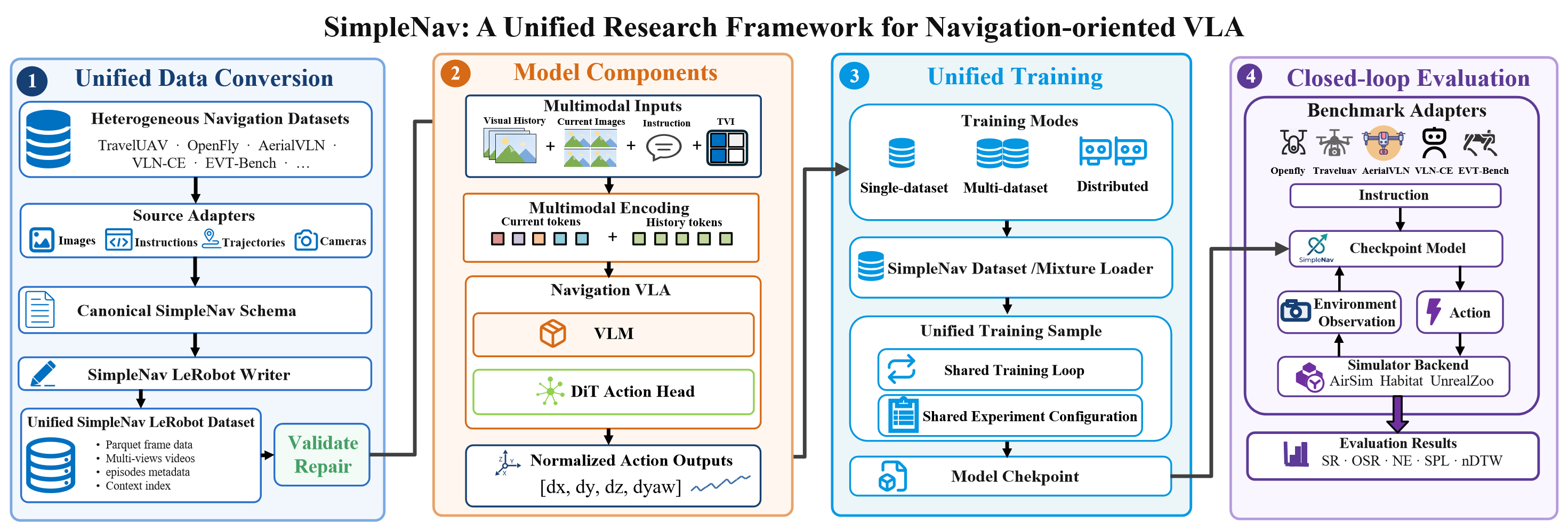
| Path | Description |
|---|---|
data_pipeline/ | Raw-data conversion, trajectory augmentation, simulator image collection, and enhanced-data construction. |
starVLA/ | Dataloaders, models, training runtime, and shared modules. |
examples/NavVLA/ | Portable training entry points and configs. |
benchmark/ | Closed-loop and offline benchmark evaluation. |
tool/navvla/ | Dataset validation, repair, statistics, context, cache, and open-loop tools. |
deployment/ | Deployment-side entry points. |
docs/ | Documentation for installation, data, models, training, evaluation, and results. |
The primary LeRobot dataloader keeps storage, model input, and prediction target separate:
| Field | Protocol |
|---|---|
Stored observation.state | One pose [x, y, z, yaw] in the coordinate convention declared by the dataset adapter. |
| Model state | When include_state: true, consecutive body-frame relative motions over the selected BATS history, ending at the current frame. It is not the stored absolute pose or the future action target. |
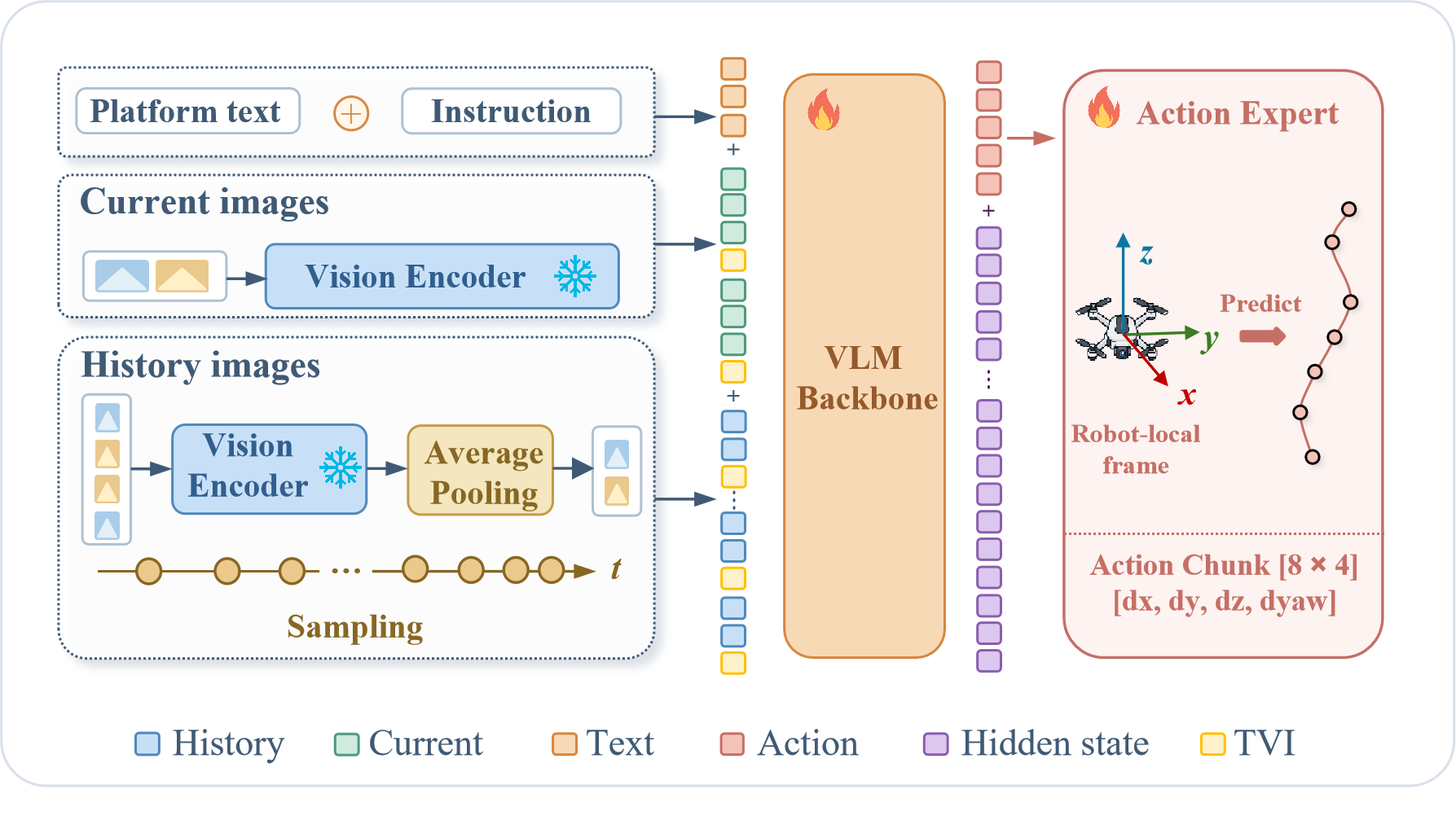
| Primary action target | A future chunk [H, 4] of [dx_forward, dy_right, dz_down, dyaw]. Every waypoint is independently anchored at the current pose, not at the previous predicted waypoint. |
| Normalization | dataset_statistics.json is authoritative. Actions use per-dimension q01/q99; padded action rows are zero after normalization. |
Benchmark adapters may declare a different action Protocol when required by the benchmark. The config and adapter Protocol are authoritative. See Data Structure and State/Action Protocol.
SimpleNav combines a vision-language backbone, selected long history, temporal-view context, and a continuous action head. The model consumes the protocol above and keeps dataset-specific coordinate semantics in the adapter.
We adopt Qwen3.5-VL 4B as the unified vision-language backbone, and complete model training and closed-loop evaluation on 6 benchmarks respectively. Except for the necessary adaptation of data and task interfaces, we do not perform task-specific performance optimization for any individual benchmark. The results are summarized as follows. Full comparison tables and protocol notes are in Release 01 Benchmarks.
| Benchmark | Split | NE↓ | SR↑ | OS/OSR↑ | SPL↑ | nDTW↑ | SDTW↑ |
|---|---|---|---|---|---|---|---|
| OpenFly | Seen | 37.1 m | 52.8 | 74.2 | 51.0 | - | - |
| TravelUAV | Test Seen / Full | 85.6 m | 22.4 | 55.1 | 20.5 | - | - |
| AerialVLN-S | Val Seen | 126.0 m | 8.4 | 18.9 | - | - | 3.4 |
| R2R-CE | Val-Unseen | 4.7 m | 49.2 | 55.9 | 45.8 | - | - |
| RxR-CE | Val-Unseen | 4.6 m | 58.4 | - | 52.2 | 74.6 | - |
| Benchmark | Task | SR↑ | TR↑ | CR↓ |
|---|---|---|---|---|
| EVT-Bench | STT | 82.8 | 93.5 | 1.2 |
Animated rollout previews are shown below. Click an animation to play the full rollout video hosted on the project website. More videos are available in the project-page video gallery.
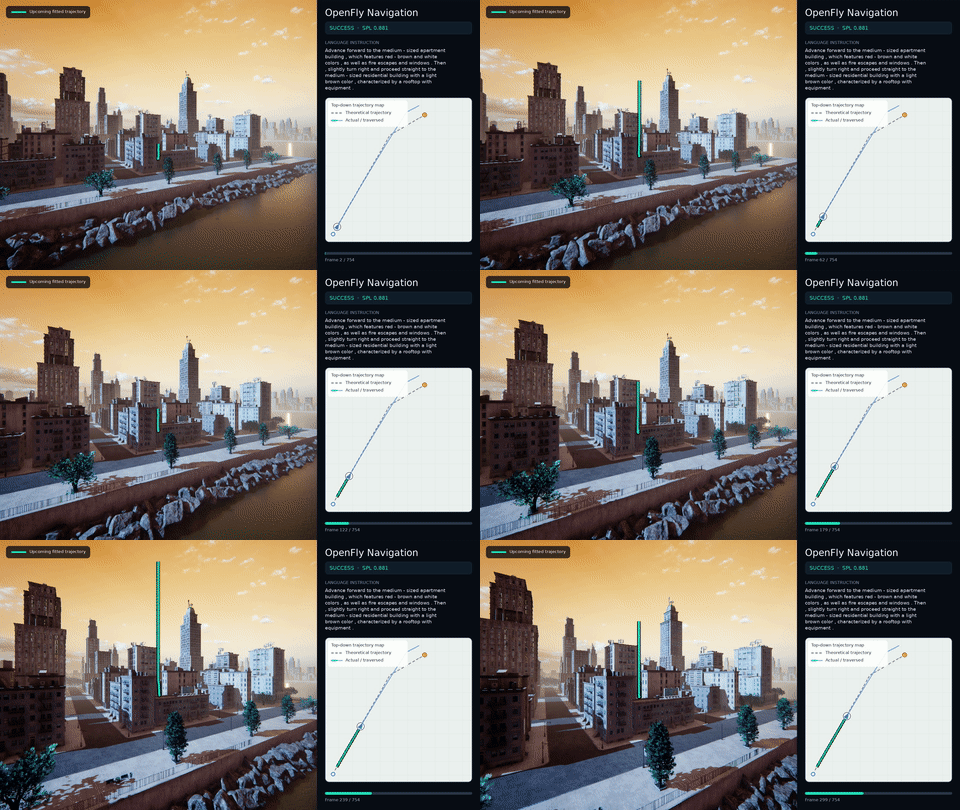 OpenFly · Env 16 | 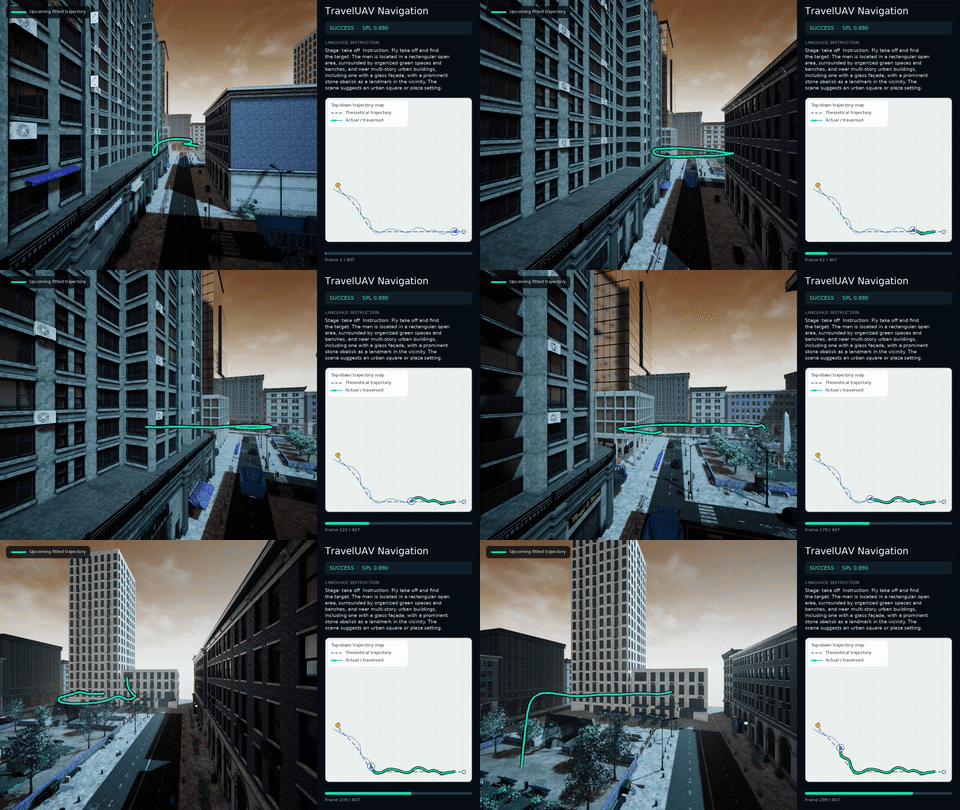 TravelUAV · Modern City |
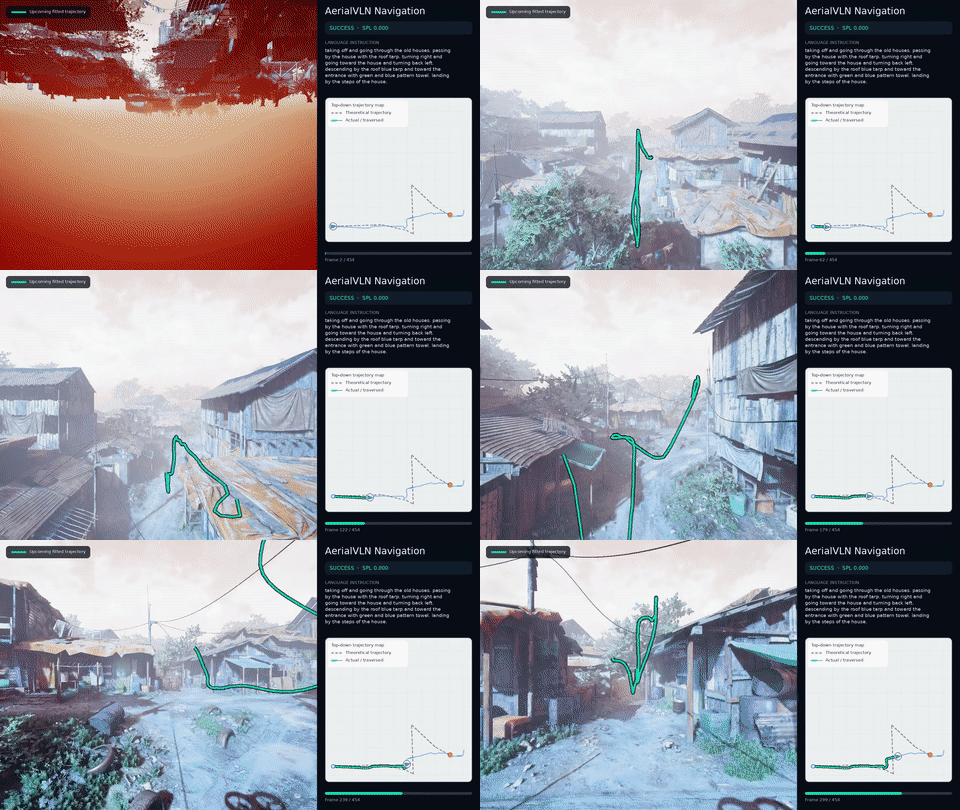 AerialVLN · Env 8 | 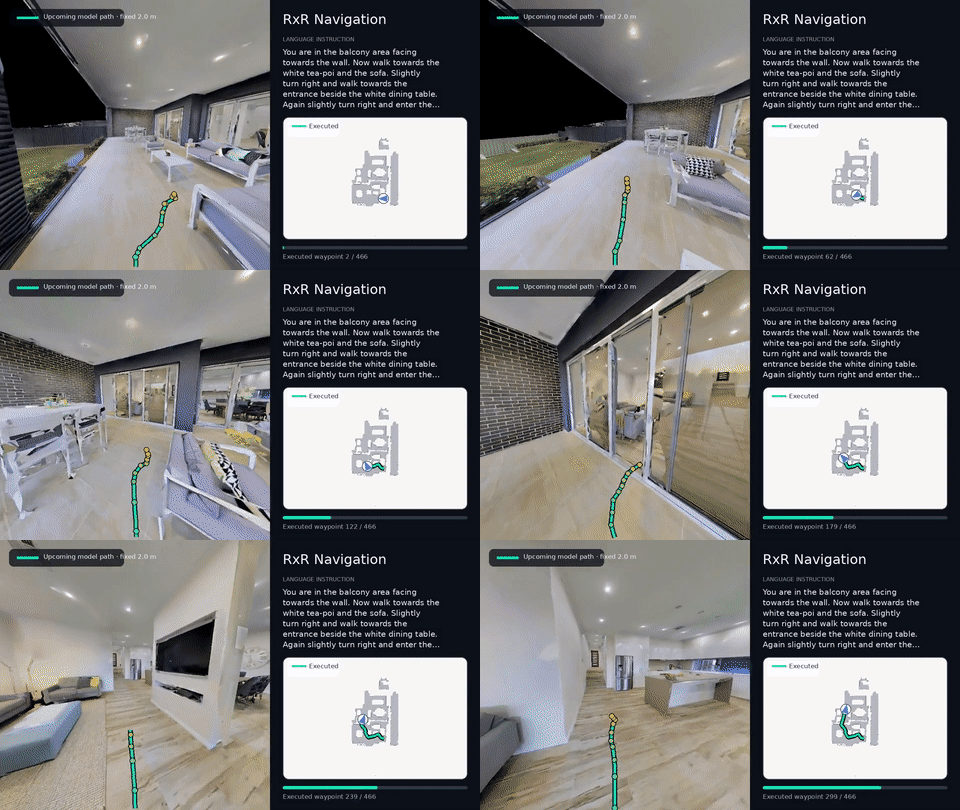 RxR-CE · Episode 10129 |
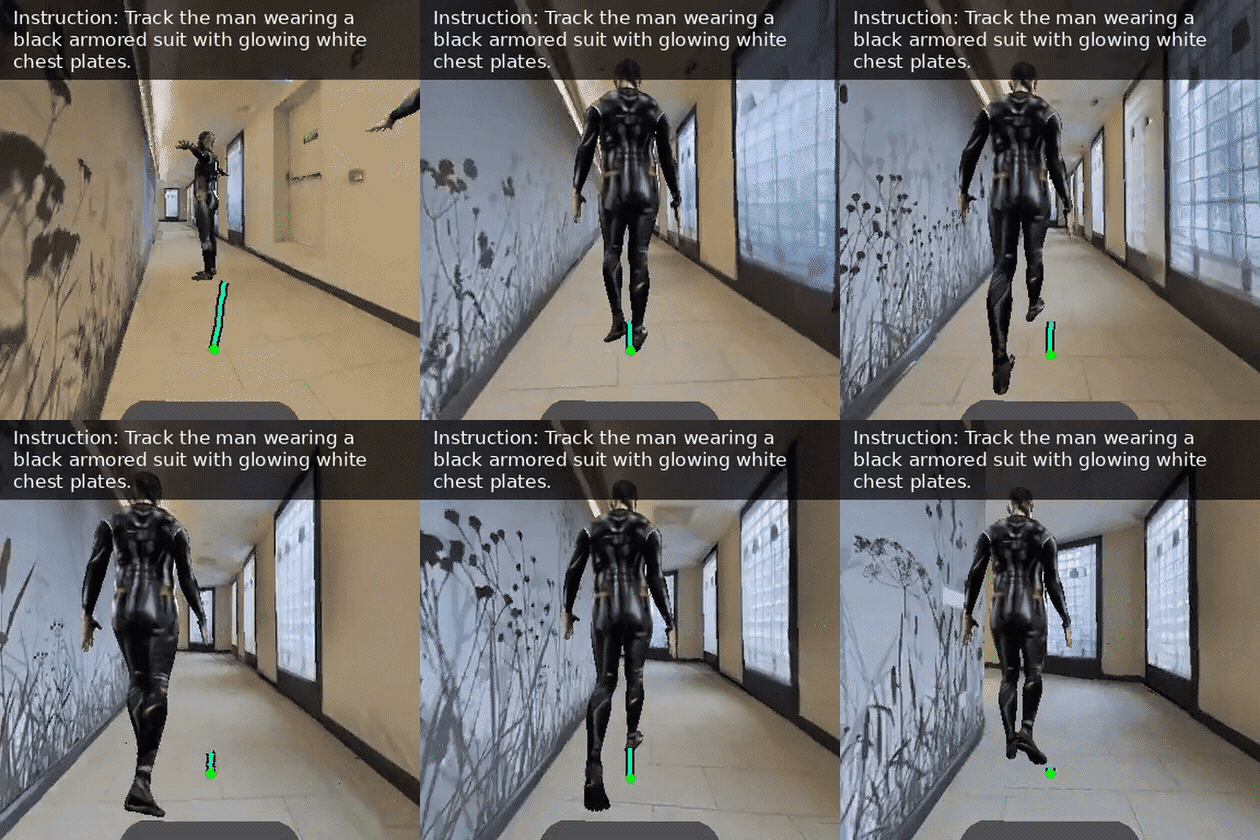 EVT-Bench · Scene 2 | 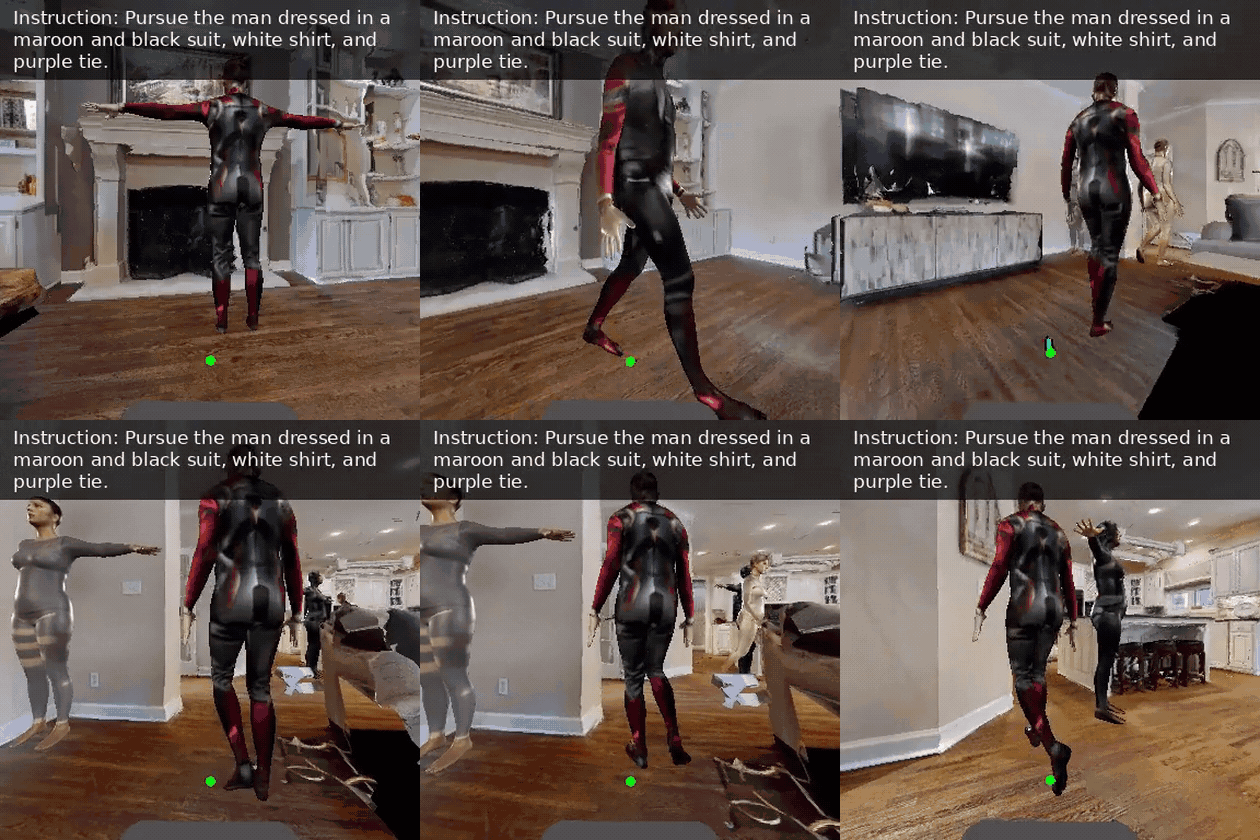 EVT-Bench · Scene 30 |
Public resources:
Place native dependency wheels in the repository-relative third_party/wheels/ directory. Place data, environment, and model packages in the local/ layout below.
One root pyproject.toml installs the SimpleNav project into the root .venv. Base includes models, training, DINO, dataset conversion, trajectory augmentation, and common evaluation tools. The data-pipeline directories are source modules in this project, with six console commands; they are not separate distributions or uv workspace members.
Simulator dependencies are optional and selected by simulator, not by benchmark:
| Installation | Includes | Typical use |
|---|---|---|
| Base (no extra) | Models, training, DINO, conversion, augmentation, offline tools | Train from prepared data; convert or augment any supported dataset |
--extra airsim | Base + AirSim 1.8.1 and RPC client | OpenFly, TravelUAV, AerialVLN; pipeline image collection |
--extra habitat | Base + Habitat-Sim/Lab 0.3.1 and Magnum | R2R-CE, RxR-CE, EVT-Bench; VLN-CE image rendering |
--extra unrealcv | Base + UnrealCV SDK and Gym | UnrealZoo backend; also supply its external gym_unrealcv plugin and scene assets through runtime config |
TravelUAV's DINO dependencies are in base. Benchmark data, scenes, and model weights are downloaded separately. VLN-CE conversion of already rendered data needs only base; online VLN-CE evaluation/rendering requires Habitat.
Python is fixed to 3.10.12; uv.lock pins dependencies, and ordinary packages use the Tsinghua index. Base includes CUDA training libraries: use Linux x86_64, a CUDA 12.4 toolkit and compatible NVIDIA driver, GCC/G++, and FFmpeg/FFprobe with H.264 support. Set CUDA_HOME to your toolkit; DeepSpeed requires an executable bin/nvcc. AirSim rendering additionally needs Vulkan and scene executables. Habitat source builds additionally need CMake, Ninja, and EGL/OpenGL development libraries.
sudo apt-get install build-essential python3.10-dev libjpeg-dev ffmpeg
git clone -b SimpleNav https://github.com/OpenBMB/SimpleNav.git SimpleNav
cd SimpleNav
curl -LsSf https://astral.sh/uv/install.sh | sh
export CUDA_HOME=/usr/local/cuda-12.4
export UV_PROJECT_ENVIRONMENT="$PWD/.venv"
Download the FlashAttention and causal-conv1d wheels to the exact repository-relative paths below. Both are required by base and target Python cp310, Linux x86_64, Torch 2.6, CUDA 12, and C++ ABI FALSE. Habitat-Sim and Magnum are only needed when selecting habitat.
| Package | Version | Source | Required relative path |
|---|---|---|---|
| Habitat-Sim | 0.3.1 | Built from the pinned submodule above | third_party/wheels/habitat_sim-0.3.1-cp310-cp310-linux_x86_64.whl |
| Magnum (with Corrade bindings) | 0.0.0 | Built from Habitat-Sim's dependencies above | third_party/wheels/magnum-0.0.0-cp310-cp310-linux_x86_64.whl |
| FlashAttention | 2.7.4.post1+cu12torch2.6cxx11abiFALSE | Official release download | third_party/wheels/flash_attn-2.7.4.post1+cu12torch2.6cxx11abiFALSE-cp310-cp310-linux_x86_64.whl |
| causal-conv1d | 1.5.0.post8+cu12torch2.6cxx11abiFALSE | Official release download | third_party/wheels/causal_conv1d-1.5.0.post8+cu12torch2.6cxx11abiFALSE-cp310-cp310-linux_x86_64.whl |
Wheels are ignored by Git; the source manifest and patches stay tracked. Download the two base wheels from the official releases:
mkdir -p third_party/wheels
curl -fL 'https://github.com/Dao-AILab/flash-attention/releases/download/v2.7.4.post1/flash_attn-2.7.4.post1%2Bcu12torch2.6cxx11abiFALSE-cp310-cp310-linux_x86_64.whl' \
  -o third_party/wheels/flash_attn-2.7.4.post1+cu12torch2.6cxx11abiFALSE-cp310-cp310-linux_x86_64.whl
curl -fL 'https://github.com/Dao-AILab/causal-conv1d/releases/download/v1.5.0.post8/causal_conv1d-1.5.0.post8%2Bcu12torch2.6cxx11abiFALSE-cp310-cp310-linux_x86_64.whl' \
  -o third_party/wheels/causal_conv1d-1.5.0.post8+cu12torch2.6cxx11abiFALSE-cp310-cp310-linux_x86_64.whl
Install base, then select the simulator(s) you need:
uv sync --frozen                                # base
uv sync --frozen --extra airsim                 # base + AirSim
# Or, after preparing the Habitat wheels below:
uv sync --frozen --extra habitat                # base + Habitat
# Or:
uv sync --frozen --extra unrealcv               # base + UnrealCV
# Multiple simulators in the same environment:
uv sync --frozen --extra airsim --extra habitat
Each sync selects the complete set of extras to keep: repeat all desired extras on subsequent syncs. uv sync --frozen with no extras returns to base. Use --frozen for installations from the committed lock so unselected simulators do not require their local wheels or source checkouts. Run commands with uv run --no-sync after installation. --extra dev adds development tools.
Core versions remain Torch 2.6.0/cu124, torchvision 0.21.0, Transformers 5.12.1, DeepSpeed 0.16.9, NumPy 1.26.4, PyArrow 14.0.1, and Pillow 12.2.0. Export CUDA_HOME in the shell used for training; launchers and evaluation workers select the root .venv directly.
Skip this section for base, AirSim, or UnrealCV installations. Habitat-Sim is a Git submodule pinned to revision 3d6d67d6deae4ab2472cc84df7a3cef1503f606d (0.3.1), also recorded in third_party/sources.json. Its NumPy patch remains tracked at third_party/patches/habitat-sim-numpy126.patch; applying it leaves an expected local modification inside the submodule.
Install base first, then install the build prerequisites and build Habitat-Sim and Magnum/Corrade with the root interpreter. The patch check supports an already patched checkout:
sudo apt-get install cmake ninja-build libglm-dev libegl1-mesa-dev libgl1-mesa-dev
git submodule update --init --recursive --jobs 4
git -C third_party/habitat-sim apply --reverse --check ../patches/habitat-sim-numpy126.patch 2>/dev/null || \
  git -C third_party/habitat-sim apply ../patches/habitat-sim-numpy126.patch

cd third_party/habitat-sim
../../.venv/bin/python setup.py build_ext --parallel 8 bdist_wheel \
  --headless --bullet --skip-install-magnum --no-update-submodules --no-lto
cp dist/habitat_sim-0.3.1-cp310-cp310-linux_x86_64.whl ../wheels/
cd ../..

repo_root=$PWD
(
  cd third_party/habitat-sim/build/temp.linux-x86_64-cpython-310/deps/magnum-bindings/src/python
  "$repo_root/.venv/bin/python" setup.py bdist_wheel -d "$repo_root/third_party/wheels"
)
The build enables headless EGL and Bullet; RGB rendering does not require --with-cuda. Habitat-Lab 0.3.1 is installed from fixed Git revision 142616776544f918c19e7f0392b65cc8cc69fa13. Track tasks use the same installed Habitat-Lab.
If locally rebuilt wheels differ from the committed hashes, refresh their lock entries before installation (lock maintenance requires all four local wheels):
uv lock --refresh-package habitat-sim --refresh-package magnum
uv lock --check
uv sync --frozen --extra habitat
uv pip check --python .venv/bin/python
uv run --no-sync python -c "import habitat_sim; print(habitat_sim.__version__)"
If the Habitat wheels already match the lock, run uv sync --frozen --extra habitat directly. Include any other simulator extras you want to retain.
The converter is already installed in the shared environment:
uv run --no-sync vln-convert --help
The other component entry points are:
data_pipeline/trajectory_augmentation  -> vln-augment
data_pipeline/image_collection         -> vln-collect
Follow Data Preparation, then place local resources under:
local/
├── models/                         # base VLMs and auxiliary models
├── data/                           # converted datasets and benchmark inputs
├── checkpoints/                    # SimpleNav checkpoints + dataset_statistics.json
├── simulators/                     # AirSim/Habitat runtimes and scene assets
├── eval_results/
└── results/
Validate a converted split:
uv run --no-sync python -m tool.navvla.cli.validate_dataset \
  local/data/<dataset>/<split> --visual-token-mode online_images --smoke-load 8
The public reference recipe is OpenFly Qwen3.5-VL training:
bash examples/NavVLA/train_files/qwen35/run_train.sh \
  examples/NavVLA/train_files/qwen35/navvla_qwen35_cpm_openfly_portable.yaml \
  --dry-run

bash examples/NavVLA/train_files/qwen35/run_train.sh \
  examples/NavVLA/train_files/qwen35/navvla_qwen35_cpm_openfly_portable.yaml
Copy the portable config before changing data mixtures, GPU counts, or attention implementations. See Training.
Each public config resolves paths relative to its own directory.
| Benchmark | Config | Launcher |
|---|---|---|
| OpenFly | benchmark/openfly/config_portable.yaml | bash benchmark/openfly/run_eval.sh |
| TravelUAV | benchmark/traveluav/config_portable.yaml | bash benchmark/traveluav/run_eval.sh |
| AerialVLN | benchmark/aerialvln/config_portable.yaml | bash benchmark/aerialvln/run_eval.sh |
| AerialVLN-S Val Seen · action stop | benchmark/aerialvln/config_qwen35_tb1024_ph32_s_seen_stop_finalseg0p292_k2.yaml | bash benchmark/aerialvln/run_eval.sh --config <config> |
| EVT-Bench | benchmark/track/eval_qwen35_track.py | bash benchmark/track/run_qwen35_track_eval.sh |
| R2R-CE | benchmark/vlnce/r2r/config_portable.yaml | bash benchmark/vlnce/r2r/run_eval.sh |
| RxR-CE | benchmark/vlnce/rxr/config_portable.yaml | bash benchmark/vlnce/rxr/run_eval.sh |
Inspect a two-episode plan before starting a simulator:
bash benchmark/openfly/run_eval.sh --dry-run \
  --override benchmark.max_samples=2 \
  --override parallel.gpu_ids='[0]' \
  --override output.run_name=openfly_dry_run
See Evaluation for resource layout, execution, resume, and artifacts.
For the OpenFly, AerialVLN, and TravelUAV data-to-training-to-evaluation workflow, use Aerial Training and Evaluation.
For the released R2R-CE and RxR-CE Qwen3.5 workflow, use VLN-CE Training and Evaluation.
| Task | Document |
|---|---|
| Install the shared environment | README environment setup |
| Convert, augment, and render data | Data Preparation |
| Understand state/action semantics | Data Structure and State/Action Protocol |
| Understand or extend the model | Model Architecture |
| Find model and checkpoint entries | Models and Checkpoints |
| Train a model | Training |
| Reproduce mixed EVT-Bench training/evaluation | EVT_BENCH_RECIPE |
| Run a benchmark | Evaluation |
| Reproduce OpenFly, AerialVLN, and TravelUAV training/evaluation | Aerial Training and Evaluation |
| Reproduce R2R-CE and RxR-CE training/evaluation | VLN-CE Training and Evaluation |
| Inspect complete results | Release 01 Benchmarks |
| Read the project direction | Vision and Roadmap |
SimpleNav is a research framework whose performance may vary across environments and platforms. Validate models in simulation and controlled settings before deployment, with human oversight and independent safety measures; operators remain responsible for safe use.
If SimpleNav is useful in your work, please cite the repository.
@software{simplenav,
  title = {SimpleNav: Make Navigation VLA Simple},
  author = {{SimpleNav Contributors}},
  year = {2026},
  url = {https://github.com/OpenBMB/SimpleNav},
}
Repository source code is released under the MIT License. Datasets, pretrained models, simulators, scene assets, and third-party components retain their own licenses.
We thank pioneering navigation VLA studies, including NavFoM, Qwen-RobotNav, ABot-N0, starVLA and InternVLA-N1, whose valuable explorations have helped shape and advance this field.
SimpleNav builds upon starVLA, Qwen-VL, LeRobot, PyTorch, Transformers, DeepSpeed, AirSim, Habitat, as well as the datasets and benchmarks described above. We gratefully acknowledge these open-source contributions and encourage users to cite the original projects and datasets employed in their experiments.
SimpleNav: A simple, unified, reproducible, and extensible framework for navigation VLA research.
See the code
Make Navigation VLA Simple.
A simple, unified, reproducible, and extensible framework for navigation VLA research.
Project Page · Data Pipeline · Documentation · Results · Data, Environments & Models
SimpleNav is a simple, unified, reproducible, and extensible framework for navigation VLA research, jointly developed and open-sourced by THUNLP at Tsinghua University, AI9Stars, OpenBMB, and HITDIP. It provides a unified research pipeline that connects heterogeneous navigation data, long-horizon VLA models, training, and benchmark evaluation through well-defined interfaces. SimpleNav supports both aerial and ground navigation, preserves dataset-specific coordinate systems and simulator semantics through dedicated adapters, and standardizes model, action, artifact, and evaluation interfaces to enable efficient reuse, comparison, and extension across datasets, tasks, and platforms.
| Area | What is provided |
|---|---|
| Simple Data | Conversion, trajectory augmentation, AirSim image collection, LeRobot v3 writing, validation, statistics, BATS context, and visual-token cache tools. |
| Simple Model | Qwen3.5-VL navigation, long-history selection, temporal-view encoding, visual-token caching, and diffusion action heads. |
| Simple Training | Configuration-driven local, distributed, single-dataset, and mixed-dataset training. |
| Simple Evaluation | Portable OpenFly, TravelUAV, AerialVLN, EVT-Bench, R2R-CE, and RxR-CE configs with shared rollout artifacts. |
| Path | Description |
|---|---|
data_pipeline/ | Raw-data conversion, trajectory augmentation, simulator image collection, and enhanced-data construction. |
starVLA/ | Dataloaders, models, training runtime, and shared modules. |
examples/NavVLA/ | Portable training entry points and configs. |
benchmark/ | Closed-loop and offline benchmark evaluation. |
tool/navvla/ | Dataset validation, repair, statistics, context, cache, and open-loop tools. |
deployment/ | Deployment-side entry points. |
docs/ | Documentation for installation, data, models, training, evaluation, and results. |
The primary LeRobot dataloader keeps storage, model input, and prediction target separate:
| Field | Protocol |
|---|---|
Stored observation.state | One pose [x, y, z, yaw] in the coordinate convention declared by the dataset adapter. |
| Model state | When include_state: true, consecutive body-frame relative motions over the selected BATS history, ending at the current frame. It is not the stored absolute pose or the future action target. |
| Primary action target | A future chunk [H, 4] of [dx_forward, dy_right, dz_down, dyaw]. Every waypoint is independently anchored at the current pose, not at the previous predicted waypoint. |
| Normalization | dataset_statistics.json is authoritative. Actions use per-dimension q01/q99; padded action rows are zero after normalization. |
Benchmark adapters may declare a different action Protocol when required by the benchmark. The config and adapter Protocol are authoritative. See Data Structure and State/Action Protocol.
SimpleNav combines a vision-language backbone, selected long history, temporal-view context, and a continuous action head. The model consumes the protocol above and keeps dataset-specific coordinate semantics in the adapter.
We adopt Qwen3.5-VL 4B as the unified vision-language backbone, and complete model training and closed-loop evaluation on 6 benchmarks respectively. Except for the necessary adaptation of data and task interfaces, we do not perform task-specific performance optimization for any individual benchmark. The results are summarized as follows. Full comparison tables and protocol notes are in Release 01 Benchmarks.
| Benchmark | Split | NE↓ | SR↑ | OS/OSR↑ | SPL↑ | nDTW↑ | SDTW↑ |
|---|---|---|---|---|---|---|---|
| OpenFly | Seen | 37.1 m | 52.8 | 74.2 | 51.0 | - | - |
| TravelUAV | Test Seen / Full | 85.6 m | 22.4 | 55.1 | 20.5 | - | - |
| AerialVLN-S | Val Seen | 126.0 m | 8.4 | 18.9 | - | - | 3.4 |
| R2R-CE | Val-Unseen | 4.7 m | 49.2 | 55.9 | 45.8 | - | - |
| RxR-CE | Val-Unseen | 4.6 m | 58.4 | - | 52.2 | 74.6 | - |
| Benchmark | Task | SR↑ | TR↑ | CR↓ |
|---|---|---|---|---|
| EVT-Bench | STT | 82.8 | 93.5 | 1.2 |
Animated rollout previews are shown below. Click an animation to play the full rollout video hosted on the project website. More videos are available in the project-page video gallery.
OpenFly · Env 16 | TravelUAV · Modern City |
AerialVLN · Env 8 | RxR-CE · Episode 10129 |
EVT-Bench · Scene 2 | EVT-Bench · Scene 30 |
Public resources:
Place native dependency wheels in the repository-relative third_party/wheels/ directory. Place data, environment, and model packages in the local/ layout below.
One root pyproject.toml installs the SimpleNav project into the root .venv. Base includes models, training, DINO, dataset conversion, trajectory augmentation, and common evaluation tools. The data-pipeline directories are source modules in this project, with six console commands; they are not separate distributions or uv workspace members.
Simulator dependencies are optional and selected by simulator, not by benchmark:
| Installation | Includes | Typical use |
|---|---|---|
| Base (no extra) | Models, training, DINO, conversion, augmentation, offline tools | Train from prepared data; convert or augment any supported dataset |
--extra airsim | Base + AirSim 1.8.1 and RPC client | OpenFly, TravelUAV, AerialVLN; pipeline image collection |
--extra habitat | Base + Habitat-Sim/Lab 0.3.1 and Magnum | R2R-CE, RxR-CE, EVT-Bench; VLN-CE image rendering |
--extra unrealcv | Base + UnrealCV SDK and Gym | UnrealZoo backend; also supply its external gym_unrealcv plugin and scene assets through runtime config |
TravelUAV's DINO dependencies are in base. Benchmark data, scenes, and model weights are downloaded separately. VLN-CE conversion of already rendered data needs only base; online VLN-CE evaluation/rendering requires Habitat.
Python is fixed to 3.10.12; uv.lock pins dependencies, and ordinary packages use the Tsinghua index. Base includes CUDA training libraries: use Linux x86_64, a CUDA 12.4 toolkit and compatible NVIDIA driver, GCC/G++, and FFmpeg/FFprobe with H.264 support. Set CUDA_HOME to your toolkit; DeepSpeed requires an executable bin/nvcc. AirSim rendering additionally needs Vulkan and scene executables. Habitat source builds additionally need CMake, Ninja, and EGL/OpenGL development libraries.
sudo apt-get install build-essential python3.10-dev libjpeg-dev ffmpeg
git clone -b SimpleNav https://github.com/OpenBMB/SimpleNav.git SimpleNav
cd SimpleNav
curl -LsSf https://astral.sh/uv/install.sh | sh
export CUDA_HOME=/usr/local/cuda-12.4
export UV_PROJECT_ENVIRONMENT="$PWD/.venv"
Download the FlashAttention and causal-conv1d wheels to the exact repository-relative paths below. Both are required by base and target Python cp310, Linux x86_64, Torch 2.6, CUDA 12, and C++ ABI FALSE. Habitat-Sim and Magnum are only needed when selecting habitat.
| Package | Version | Source | Required relative path |
|---|---|---|---|
| Habitat-Sim | 0.3.1 | Built from the pinned submodule above | third_party/wheels/habitat_sim-0.3.1-cp310-cp310-linux_x86_64.whl |
| Magnum (with Corrade bindings) | 0.0.0 | Built from Habitat-Sim's dependencies above | third_party/wheels/magnum-0.0.0-cp310-cp310-linux_x86_64.whl |
| FlashAttention | 2.7.4.post1+cu12torch2.6cxx11abiFALSE | Official release download | third_party/wheels/flash_attn-2.7.4.post1+cu12torch2.6cxx11abiFALSE-cp310-cp310-linux_x86_64.whl |
| causal-conv1d | 1.5.0.post8+cu12torch2.6cxx11abiFALSE | Official release download | third_party/wheels/causal_conv1d-1.5.0.post8+cu12torch2.6cxx11abiFALSE-cp310-cp310-linux_x86_64.whl |
Wheels are ignored by Git; the source manifest and patches stay tracked. Download the two base wheels from the official releases:
mkdir -p third_party/wheels
curl -fL 'https://github.com/Dao-AILab/flash-attention/releases/download/v2.7.4.post1/flash_attn-2.7.4.post1%2Bcu12torch2.6cxx11abiFALSE-cp310-cp310-linux_x86_64.whl' \
  -o third_party/wheels/flash_attn-2.7.4.post1+cu12torch2.6cxx11abiFALSE-cp310-cp310-linux_x86_64.whl
curl -fL 'https://github.com/Dao-AILab/causal-conv1d/releases/download/v1.5.0.post8/causal_conv1d-1.5.0.post8%2Bcu12torch2.6cxx11abiFALSE-cp310-cp310-linux_x86_64.whl' \
  -o third_party/wheels/causal_conv1d-1.5.0.post8+cu12torch2.6cxx11abiFALSE-cp310-cp310-linux_x86_64.whl
Install base, then select the simulator(s) you need:
uv sync --frozen                                # base
uv sync --frozen --extra airsim                 # base + AirSim
# Or, after preparing the Habitat wheels below:
uv sync --frozen --extra habitat                # base + Habitat
# Or:
uv sync --frozen --extra unrealcv               # base + UnrealCV
# Multiple simulators in the same environment:
uv sync --frozen --extra airsim --extra habitat
Each sync selects the complete set of extras to keep: repeat all desired extras on subsequent syncs. uv sync --frozen with no extras returns to base. Use --frozen for installations from the committed lock so unselected simulators do not require their local wheels or source checkouts. Run commands with uv run --no-sync after installation. --extra dev adds development tools.
Core versions remain Torch 2.6.0/cu124, torchvision 0.21.0, Transformers 5.12.1, DeepSpeed 0.16.9, NumPy 1.26.4, PyArrow 14.0.1, and Pillow 12.2.0. Export CUDA_HOME in the shell used for training; launchers and evaluation workers select the root .venv directly.
Skip this section for base, AirSim, or UnrealCV installations. Habitat-Sim is a Git submodule pinned to revision 3d6d67d6deae4ab2472cc84df7a3cef1503f606d (0.3.1), also recorded in third_party/sources.json. Its NumPy patch remains tracked at third_party/patches/habitat-sim-numpy126.patch; applying it leaves an expected local modification inside the submodule.
Install base first, then install the build prerequisites and build Habitat-Sim and Magnum/Corrade with the root interpreter. The patch check supports an already patched checkout:
sudo apt-get install cmake ninja-build libglm-dev libegl1-mesa-dev libgl1-mesa-dev
git submodule update --init --recursive --jobs 4
git -C third_party/habitat-sim apply --reverse --check ../patches/habitat-sim-numpy126.patch 2>/dev/null || \
  git -C third_party/habitat-sim apply ../patches/habitat-sim-numpy126.patch

cd third_party/habitat-sim
../../.venv/bin/python setup.py build_ext --parallel 8 bdist_wheel \
  --headless --bullet --skip-install-magnum --no-update-submodules --no-lto
cp dist/habitat_sim-0.3.1-cp310-cp310-linux_x86_64.whl ../wheels/
cd ../..

repo_root=$PWD
(
  cd third_party/habitat-sim/build/temp.linux-x86_64-cpython-310/deps/magnum-bindings/src/python
  "$repo_root/.venv/bin/python" setup.py bdist_wheel -d "$repo_root/third_party/wheels"
)
The build enables headless EGL and Bullet; RGB rendering does not require --with-cuda. Habitat-Lab 0.3.1 is installed from fixed Git revision 142616776544f918c19e7f0392b65cc8cc69fa13. Track tasks use the same installed Habitat-Lab.
If locally rebuilt wheels differ from the committed hashes, refresh their lock entries before installation (lock maintenance requires all four local wheels):
uv lock --refresh-package habitat-sim --refresh-package magnum
uv lock --check
uv sync --frozen --extra habitat
uv pip check --python .venv/bin/python
uv run --no-sync python -c "import habitat_sim; print(habitat_sim.__version__)"
If the Habitat wheels already match the lock, run uv sync --frozen --extra habitat directly. Include any other simulator extras you want to retain.
The converter is already installed in the shared environment:
uv run --no-sync vln-convert --help
The other component entry points are:
data_pipeline/trajectory_augmentation  -> vln-augment
data_pipeline/image_collection         -> vln-collect
Follow Data Preparation, then place local resources under:
local/
├── models/                         # base VLMs and auxiliary models
├── data/                           # converted datasets and benchmark inputs
├── checkpoints/                    # SimpleNav checkpoints + dataset_statistics.json
├── simulators/                     # AirSim/Habitat runtimes and scene assets
├── eval_results/
└── results/
Validate a converted split:
uv run --no-sync python -m tool.navvla.cli.validate_dataset \
  local/data/<dataset>/<split> --visual-token-mode online_images --smoke-load 8
The public reference recipe is OpenFly Qwen3.5-VL training:
bash examples/NavVLA/train_files/qwen35/run_train.sh \
  examples/NavVLA/train_files/qwen35/navvla_qwen35_cpm_openfly_portable.yaml \
  --dry-run

bash examples/NavVLA/train_files/qwen35/run_train.sh \
  examples/NavVLA/train_files/qwen35/navvla_qwen35_cpm_openfly_portable.yaml
Copy the portable config before changing data mixtures, GPU counts, or attention implementations. See Training.
Each public config resolves paths relative to its own directory.
| Benchmark | Config | Launcher |
|---|---|---|
| OpenFly | benchmark/openfly/config_portable.yaml | bash benchmark/openfly/run_eval.sh |
| TravelUAV | benchmark/traveluav/config_portable.yaml | bash benchmark/traveluav/run_eval.sh |
| AerialVLN | benchmark/aerialvln/config_portable.yaml | bash benchmark/aerialvln/run_eval.sh |
| AerialVLN-S Val Seen · action stop | benchmark/aerialvln/config_qwen35_tb1024_ph32_s_seen_stop_finalseg0p292_k2.yaml | bash benchmark/aerialvln/run_eval.sh --config <config> |
| EVT-Bench | benchmark/track/eval_qwen35_track.py | bash benchmark/track/run_qwen35_track_eval.sh |
| R2R-CE | benchmark/vlnce/r2r/config_portable.yaml | bash benchmark/vlnce/r2r/run_eval.sh |
| RxR-CE | benchmark/vlnce/rxr/config_portable.yaml | bash benchmark/vlnce/rxr/run_eval.sh |
Inspect a two-episode plan before starting a simulator:
bash benchmark/openfly/run_eval.sh --dry-run \
  --override benchmark.max_samples=2 \
  --override parallel.gpu_ids='[0]' \
  --override output.run_name=openfly_dry_run
See Evaluation for resource layout, execution, resume, and artifacts.
For the OpenFly, AerialVLN, and TravelUAV data-to-training-to-evaluation workflow, use Aerial Training and Evaluation.
For the released R2R-CE and RxR-CE Qwen3.5 workflow, use VLN-CE Training and Evaluation.
| Task | Document |
|---|---|
| Install the shared environment | README environment setup |
| Convert, augment, and render data | Data Preparation |
| Understand state/action semantics | Data Structure and State/Action Protocol |
| Understand or extend the model | Model Architecture |
| Find model and checkpoint entries | Models and Checkpoints |
| Train a model | Training |
| Reproduce mixed EVT-Bench training/evaluation | EVT_BENCH_RECIPE |
| Run a benchmark | Evaluation |
| Reproduce OpenFly, AerialVLN, and TravelUAV training/evaluation | Aerial Training and Evaluation |
| Reproduce R2R-CE and RxR-CE training/evaluation | VLN-CE Training and Evaluation |
| Inspect complete results | Release 01 Benchmarks |
| Read the project direction | Vision and Roadmap |
SimpleNav is a research framework whose performance may vary across environments and platforms. Validate models in simulation and controlled settings before deployment, with human oversight and independent safety measures; operators remain responsible for safe use.
If SimpleNav is useful in your work, please cite the repository.
@software{simplenav,
  title = {SimpleNav: Make Navigation VLA Simple},
  author = {{SimpleNav Contributors}},
  year = {2026},
  url = {https://github.com/OpenBMB/SimpleNav},
}
Repository source code is released under the MIT License. Datasets, pretrained models, simulators, scene assets, and third-party components retain their own licenses.
We thank pioneering navigation VLA studies, including NavFoM, Qwen-RobotNav, ABot-N0, starVLA and InternVLA-N1, whose valuable explorations have helped shape and advance this field.
SimpleNav builds upon starVLA, Qwen-VL, LeRobot, PyTorch, Transformers, DeepSpeed, AirSim, Habitat, as well as the datasets and benchmarks described above. We gratefully acknowledge these open-source contributions and encourage users to cite the original projects and datasets employed in their experiments.



