ReText: Simple but powerful editor for Markdown and reStructuredText
Python
2,062
1,429 commits
updated Sep 24, 2026

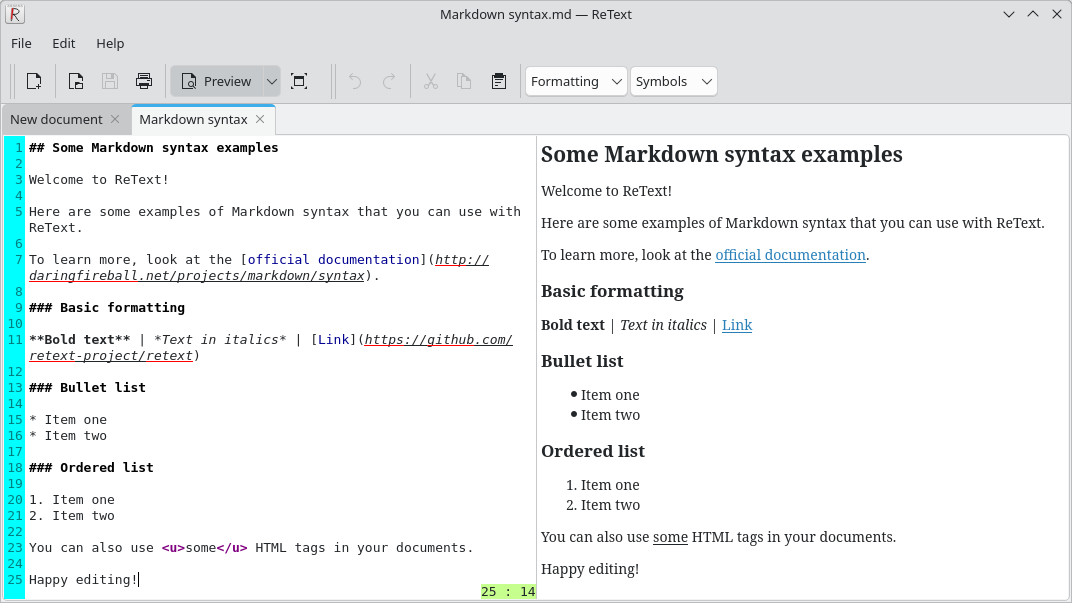
ReText is a simple but powerful editor for markup languages. It is based on Markups module which supports Markdown, reStructuredText, Textile and AsciiDoc. One can also add support for custom markups using Python modules.
To install ReText, make sure that you have Python (3.9 or later) installed,
and run pip3 install ReText. To avoid system-wide installation, you can
create a virtual environment and install from there. You can also manually
download the tarball from PyPI or clone the repository, and then run
./retext.py.
ReText requires PyQt6 and Markups (4.0 or later) to run. When you run
pip3 install ReText, pip will install them automatically, but you can also
install manually and specify markups that you are going to use using extras
syntax, e.g.:
pip3 install Markups[markdown,restructuredtext,textile]
We also recommend having these packages installed:
Translation files are already compiled for release tarballs and will be
automatically loaded. For development snapshots, compile translations using
lrelease ReText/locale/*.ts command (on Debian-based systems, use
/usr/lib/qt6/bin/lrelease from qt6-l10n-tools package). Translation files
can also be loaded from /usr/share/retext/ directory.
You can translate ReText into your language on Transifex.
ReText is Copyright 2011–2025 Dmitry Shachnev,
2011–2023 Maurice van der Pot, and is
licensed under GNU GPL (v2+) license, the current version is available in
LICENSE_GPL file.
ReText icon is based on accessories-text-editor icon from the Faenza theme.
You can read more about ReText in the wiki.
Overall
Maintained
Code review
PyPI
Latest release
Releases this year
808 followers · starred Nov 2024
3,379 followers · starred Oct 2015
802 followers · starred Sep 2020
217 followers · starred Oct 2018
ReText: Simple but powerful editor for Markdown and reStructuredText
Python
2,062
1,429 commits
updated Sep 24, 2026
ReText is a simple but powerful editor for markup languages. It is based on Markups module which supports Markdown, reStructuredText, Textile and AsciiDoc. One can also add support for custom markups using Python modules.
To install ReText, make sure that you have Python (3.9 or later) installed,
and run pip3 install ReText. To avoid system-wide installation, you can
create a virtual environment and install from there. You can also manually
download the tarball from PyPI or clone the repository, and then run
./retext.py.
ReText requires PyQt6 and Markups (4.0 or later) to run. When you run
pip3 install ReText, pip will install them automatically, but you can also
install manually and specify markups that you are going to use using extras
syntax, e.g.:
pip3 install Markups[markdown,restructuredtext,textile]
We also recommend having these packages installed:
Translation files are already compiled for release tarballs and will be
automatically loaded. For development snapshots, compile translations using
lrelease ReText/locale/*.ts command (on Debian-based systems, use
/usr/lib/qt6/bin/lrelease from qt6-l10n-tools package). Translation files
can also be loaded from /usr/share/retext/ directory.
You can translate ReText into your language on Transifex.
ReText is Copyright 2011–2025 Dmitry Shachnev,
2011–2023 Maurice van der Pot, and is
licensed under GNU GPL (v2+) license, the current version is available in
LICENSE_GPL file.
ReText icon is based on accessories-text-editor icon from the Faenza theme.
You can read more about ReText in the wiki.
Overall
Maintained
Code review
PyPI
Latest release
Releases this year
808 followers · starred Nov 2024
3,379 followers · starred Oct 2015
802 followers · starred Sep 2020
217 followers · starred Oct 2018