This is a repository for ISCA'24 AE Pre-gated MoE.
For more details about this project, please refer to our paper published in ISCA-2024, "Pre-gated MoE: An Algorithm-System Co-Design for Fast and Scalable Mixture-of-Expert Inference,"
This open-source project is for proof of concept purposes only and should not be used in production environments. The code has not been officially vetted for security vulnerabilities and provides no guarantees of correctness or security. Users should carefully review the code and conduct their own security assessments before using the software.
# Starting from the official container
docker run -ti --gpus all --shm-size 5g --name pregated -v ${DATA_PATH}:/data nvcr.io/nvidia/pytorch:22.09-py3 bash
git clone --recursive https://github.com/ranggihwang/Pregated_MoE.git FasterTransformer

# build on A100
mkdir -p FasterTransformer/build
cd FasterTransformer/build
cmake -DSM=80 -DCMAKE_BUILD_TYPE=Release -DBUILD_PYT=ON -DBUILD_MULTI_GPU=ON ..
make -j
${DATA_PATH} with path on host.xx of -DSM=xx in the scripts above means the compute capability of your GPU. The following table shows the compute capability of common GPUs.| GPU | compute capacity |
|---|---|
| P40 | 60 |
| P4 | 61 |
| V100 | 70 |
| T4 | 75 |
| A100 | 80 |
| A30 | 80 |
| A10 | 86 |
# Python dependencies
pip install -r ../examples/pytorch/t5/requirement.txt
mkdir /data/ft
cd /workspace/FasterTransformer/
./scripts/convert.sh
cd /workspace/FasterTransformer/
# logs will be output here
mkdir logs/
python scripts/eval_all.py
Check block_lats.csv, throughputs.csv and peak_mems.csv for block latencies, throughputs and peak memory usage respectively.
You can modify the following lines in scripts/eval_all.py:
models = [
    "switch-base-8",
    "switch-base-64",
    "switch-base-128",
    "switch-large-128",
]
batch_sizes = [
    1,
    # 2,
    # 4,
    # 8,
    # 16,
]
methods = [
    "GPU-only",
    "Pre-gated",
    "DeepSpeed",  # This is MoE-OnDemand
    "SE-MoE",     # This is MoE-Prefetch
]
metrics = [
    "block_lat",
    "throughput",
    "peak_mem",
    # "max_active_expert",
    # "cache_hit_rate",
]
forced_num_experts = [
    0,
    # 1,
    # 2,
    # 4,
    # 8,
    # 16,
]
cache_ratios = [
    0,
    # 0.01,
    # 0.03,
    # 0.05,
    # 0.1,
    # 0.2,
    # 0.4,
    # 0.8,
]
disk_offloads = [
    0,
    # 1,
]
Ranggi Hwang, Jianyu Wei, Shijie Cao, Changho Hwang, Xiaohu Tang, Ting Cao, and Mao Yang, "Pre-gated MoE: An Algorithm-System Co-Design for Fast and Scalable Mixture-of-Expert Inference," The 51st IEEE/ACM International Symposium on Computer Architecture (ISCA-51), Buenos Aires, Argentina, June 2024
This is the readme for FasterTransformer
This repository provides a script and recipe to run the highly optimized transformer-based encoder and decoder component, and it is tested and maintained by NVIDIA.
In NLP, encoder and decoder are two important components, with the transformer layer becoming a popular architecture for both components. FasterTransformer implements a highly optimized transformer layer for both the encoder and decoder for inference. On Volta, Turing and Ampere GPUs, the computing power of Tensor Cores are used automatically when the precision of the data and weights are FP16.
FasterTransformer is built on top of CUDA, cuBLAS, cuBLASLt and C++. We provide at least one API of the following frameworks: TensorFlow, PyTorch and Triton backend. Users can integrate FasterTransformer into these frameworks directly. For supporting frameworks, we also provide example codes to demonstrate how to use, and show the performance on these frameworks.
| Models | Framework | FP16 | INT8 (after Turing) | Sparsity (after Ampere) | Tensor parallel | Pipeline parallel | FP8 (after Hopper) |
|---|---|---|---|---|---|---|---|
| BERT | TensorFlow | Yes | Yes | - | - | - | - |
| BERT | PyTorch | Yes | Yes | Yes | Yes | Yes | - |
| BERT | Triton backend | Yes | - | - | Yes | Yes | - |
| BERT | C++ | Yes | Yes | - | - | - | Yes |
| XLNet | C++ | Yes | - | - | - | - | - |
| Encoder | TensorFlow | Yes | Yes | - | - | - | - |
| Encoder | PyTorch | Yes | Yes | Yes | - | - | - |
| Decoder | TensorFlow | Yes | - | - | - | - | - |
| Decoder | PyTorch | Yes | - | - | - | - | - |
| Decoding | TensorFlow | Yes | - | - | - | - | - |
| Decoding | PyTorch | Yes | - | - | - | - | - |
| GPT | TensorFlow | Yes | - | - | - | - | - |
| GPT/OPT | PyTorch | Yes | - | - | Yes | Yes | Yes |
| GPT/OPT | Triton backend | Yes | - | - | Yes | Yes | - |
| GPT-MoE | PyTorch | Yes | - | - | Yes | Yes | - |
| BLOOM | PyTorch | Yes | - | - | Yes | Yes | - |
| BLOOM | Triton backend | Yes | - | - | Yes | Yes | - |
| GPT-J | Triton backend | Yes | - | - | Yes | Yes | - |
| Longformer | PyTorch | Yes | - | - | - | - | - |
| T5/UL2 | PyTorch | Yes | - | - | Yes | Yes | - |
| T5 | TensorFlow 2 | Yes | - | - | - | - | - |
| T5/UL2 | Triton backend | Yes | - | - | Yes | Yes | - |
| T5 | TensorRT | Yes | - | - | Yes | Yes | - |
| T5-MoE | PyTorch | Yes | - | - | Yes | Yes | - |
| Swin Transformer | PyTorch | Yes | Yes | - | - | - | - |
| Swin Transformer | TensorRT | Yes | Yes | - | - | - | - |
| ViT | PyTorch | Yes | Yes | - | - | - | - |
| ViT | TensorRT | Yes | Yes | - | - | - | - |
| GPT-NeoX | PyTorch | Yes | - | - | Yes | Yes | - |
| GPT-NeoX | Triton backend | Yes | - | - | Yes | Yes | - |
| BART/mBART | PyTorch | Yes | - | - | Yes | Yes | - |
| WeNet | C++ | Yes | - | - | - | - | - |
| DeBERTa | TensorFlow 2 | Yes | - | - | On-going | On-going | - |
| DeBERTa | PyTorch | Yes | - | - | On-going | On-going | - |
More details of specific models are put in xxx_guide.md of docs/, where xxx means the model name. Some common questions and the respective answers are put in docs/QAList.md. Note that the model of Encoder and BERT are similar and we put the explanation into bert_guide.md together.
The following code lists the directory structure of FasterTransformer:
/src/fastertransformer: source code of FasterTransformer
    |--/cutlass_extensions: Implementation of cutlass gemm/kernels.
    |--/kernels: CUDA kernels for different models/layers and operations, like addBiasResiual.
    |--/layers: Implementation of layer modules, like attention layer, ffn layer.
    |--/models: Implementation of different models, like BERT, GPT.
    |--/tensorrt_plugin: encapluate FasterTransformer into TensorRT plugin.
    |--/tf_op: custom Tensorflow OP implementation
    |--/th_op: custom PyTorch OP implementation
    |--/triton_backend: custom triton backend implementation
    |--/utils: Contains common cuda utils, like cublasMMWrapper, memory_utils
/examples: C++, tensorflow and pytorch interface examples
    |--/cpp: C++ interface examples
    |--/pytorch: PyTorch OP examples
    |--/tensorflow: TensorFlow OP examples
    |--/tensorrt: TensorRT examples
/docs: Documents to explain the details of implementation of different models, and show the benchmark
/benchmark: Contains the scripts to run the benchmarks of different models
/tests: Unit tests
/templates: Documents to explain how to add a new model/example into FasterTransformer repo
Note that many folders contains many sub-folders to split different models. Quantization tools are move to examples, like examples/tensorflow/bert/bert-quantization/ and examples/pytorch/bert/bert-quantization-sparsity/.
FasterTransformer provides some convenient environment variables for debuging and testing.
FT_LOG_LEVEL: This environment controls the log level of debug messae. More details are in src/fastertransformer/utils/logger.h. Note that the program will print lots of message when the level is lower than DEBUG and the program would become very slow.FT_NVTX: If it is set to be ON like FT_NVTX=ON ./bin/gpt_example, the program will insert tha tag of nvtx to help profiling the program.FT_DEBUG_LEVEL: If it is set to be DEBUG, then the program will run cudaDeviceSynchronize() after every kernels. Otherwise, the kernel is executued asynchronously by default. It is helpful to locate the error point during debuging. But this flag affects the performance of program significantly. So, it should be used only for debuging.Hardware settings:
In order to run the following benchmark, we need to install the unix computing tool "bc" by
apt-get install bc
The FP16 results of TensorFlow were obtained by running the benchmarks/bert/tf_benchmark.sh.
The INT8 results of TensorFlow were obtained by running the benchmarks/bert/tf_int8_benchmark.sh.
The FP16 results of PyTorch were obtained by running the benchmarks/bert/pyt_benchmark.sh.
The INT8 results of PyTorch were obtained by running the benchmarks/bert/pyt_int8_benchmark.sh.
More benchmarks are put in docs/bert_guide.md.
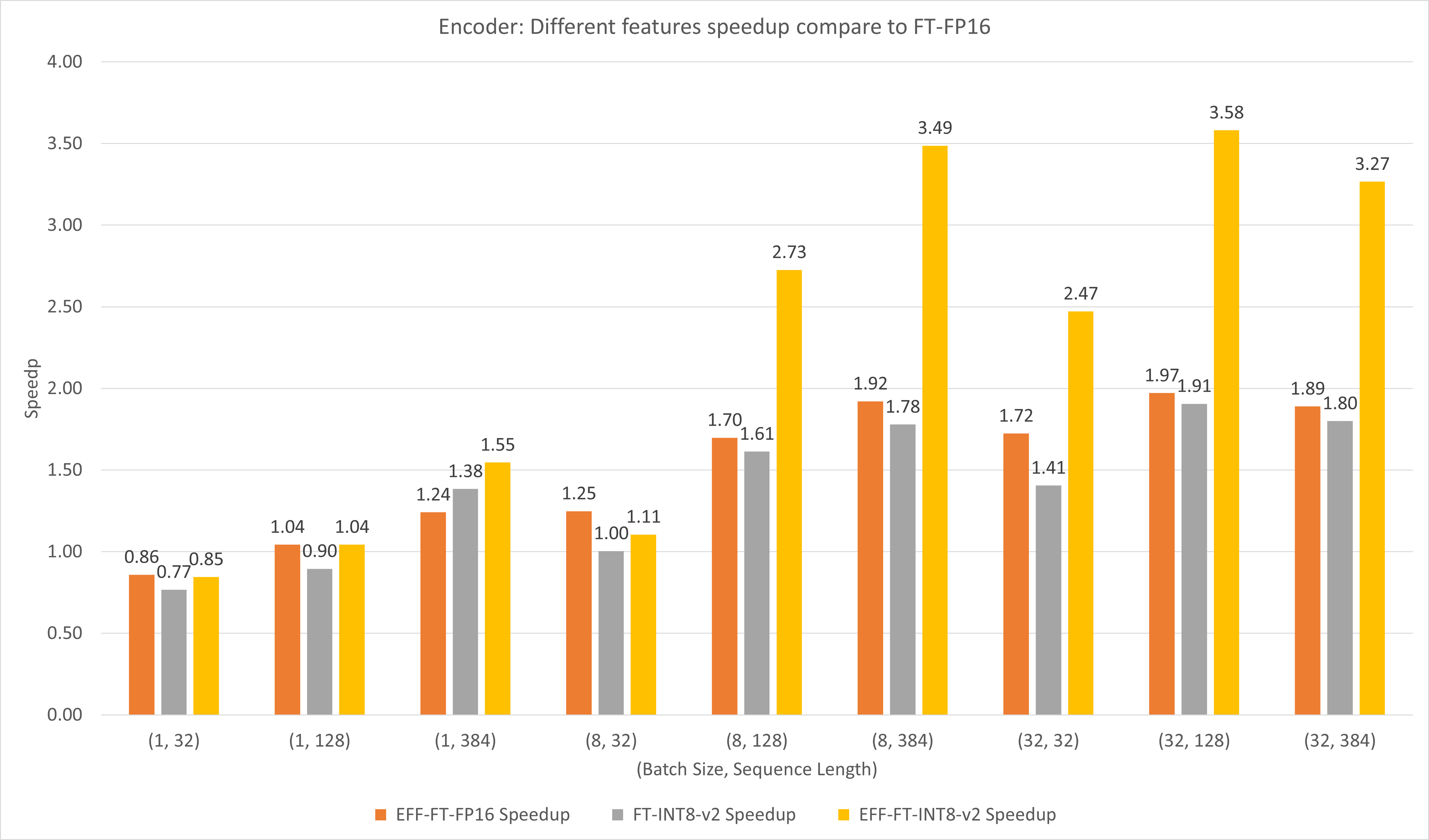
The following figure compares the performances of different features of FasterTransformer and FasterTransformer under FP16 on T4.
For large batch size and sequence length, both EFF-FT and FT-INT8-v2 bring about 2x speedup. Using Effective FasterTransformer and int8v2 at the same time can bring about 3.5x speedup compared to FasterTransformer FP16 for large case.
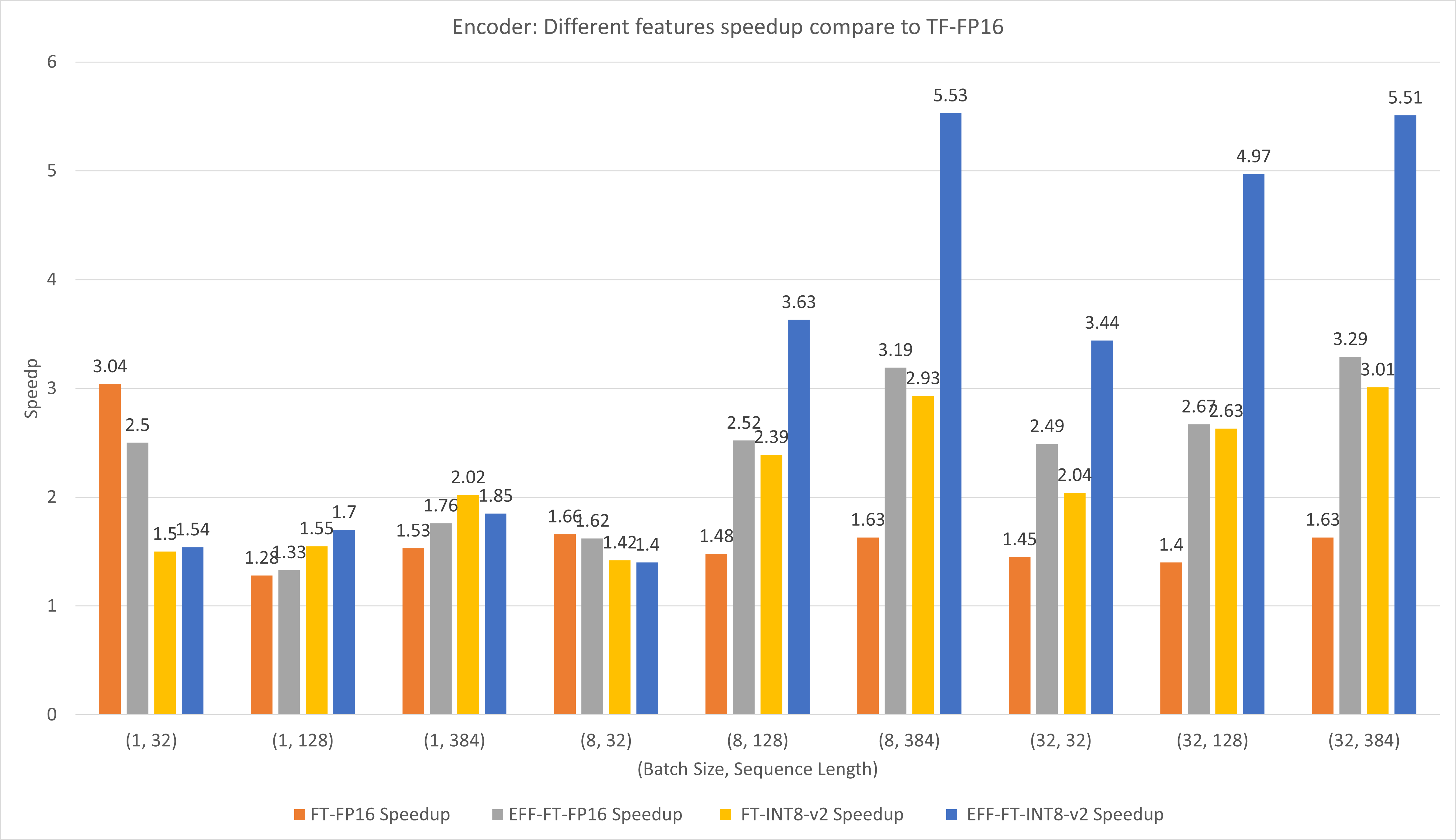
The following figure compares the performances of different features of FasterTransformer and TensorFlow XLA under FP16 on T4.
For small batch size and sequence length, using FasterTransformer can bring about 3x speedup.
For large batch size and sequence length, using Effective FasterTransformer with INT8-v2 quantization can bring about 5x speedup.
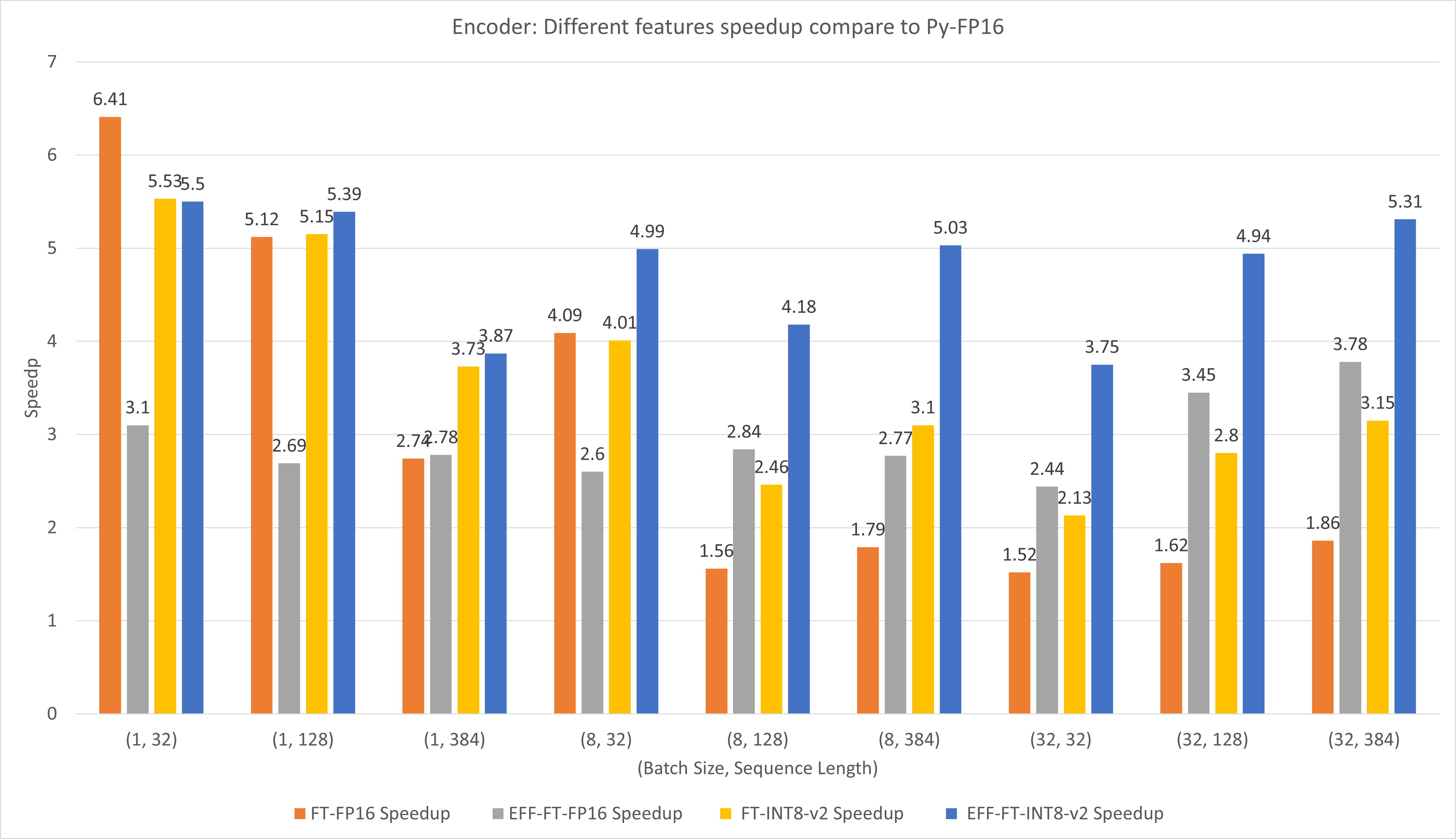
The following figure compares the performances of different features of FasterTransformer and PyTorch TorchScript under FP16 on T4.
For small batch size and sequence length, using FasterTransformer CustomExt can bring about 4x ~ 6x speedup.
For large batch size and sequence length, using Effective FasterTransformer with INT8-v2 quantization can bring about 5x speedup.
The results of TensorFlow were obtained by running the benchmarks/decoding/tf_decoding_beamsearch_benchmark.sh and benchmarks/decoding/tf_decoding_sampling_benchmark.sh
The results of PyTorch were obtained by running the benchmarks/decoding/pyt_decoding_beamsearch_benchmark.sh.
In the experiments of decoding, we updated the following parameters:
More benchmarks are put in docs/decoder_guide.md.
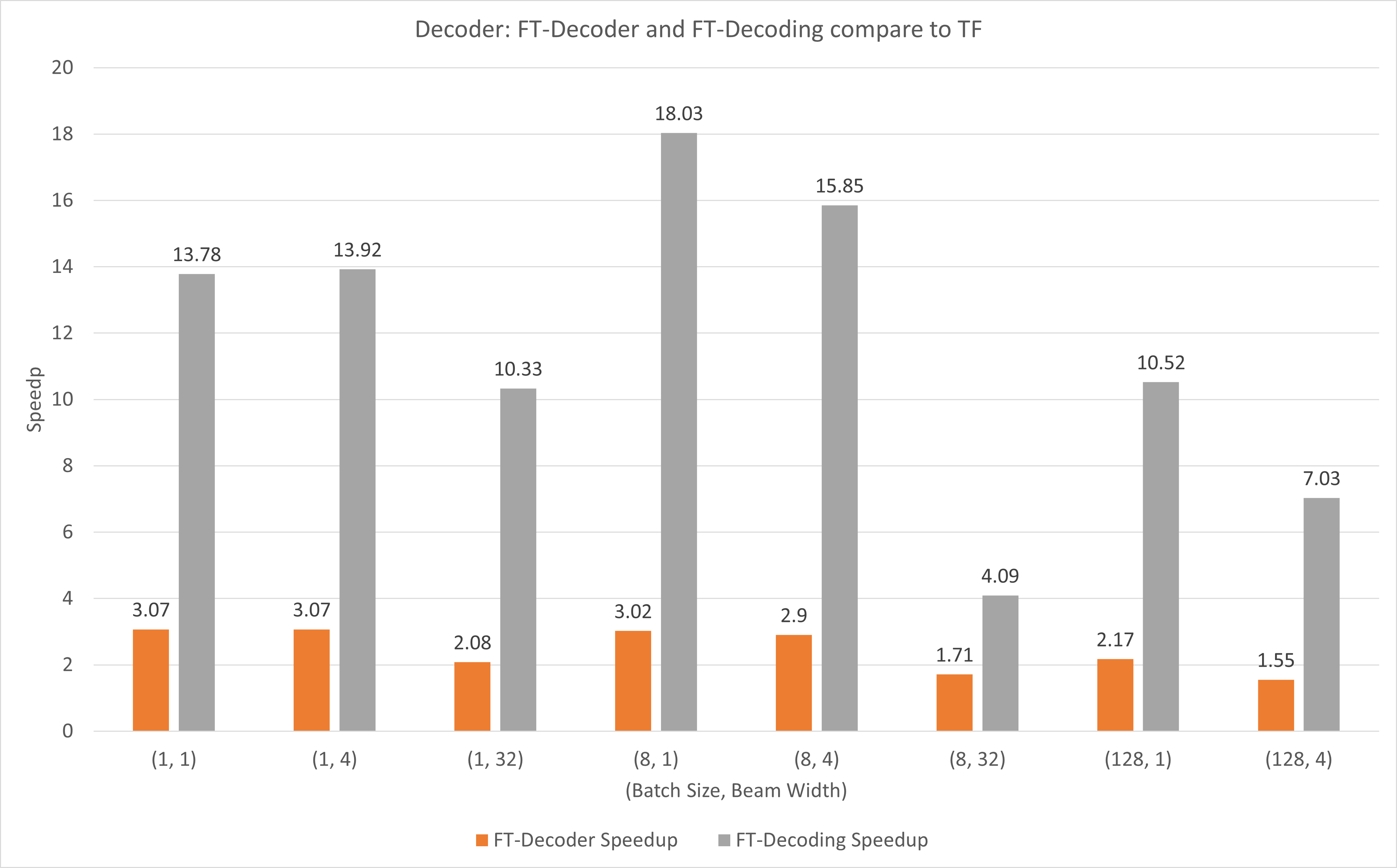
The following figure shows the speedup of of FT-Decoder op and FT-Decoding op compared to TensorFlow under FP16 with T4. Here, we use the throughput of translating a test set to prevent the total tokens of each methods may be different. Compared to TensorFlow, FT-Decoder provides 1.5x ~ 3x speedup; while FT-Decoding provides 4x ~ 18x speedup.
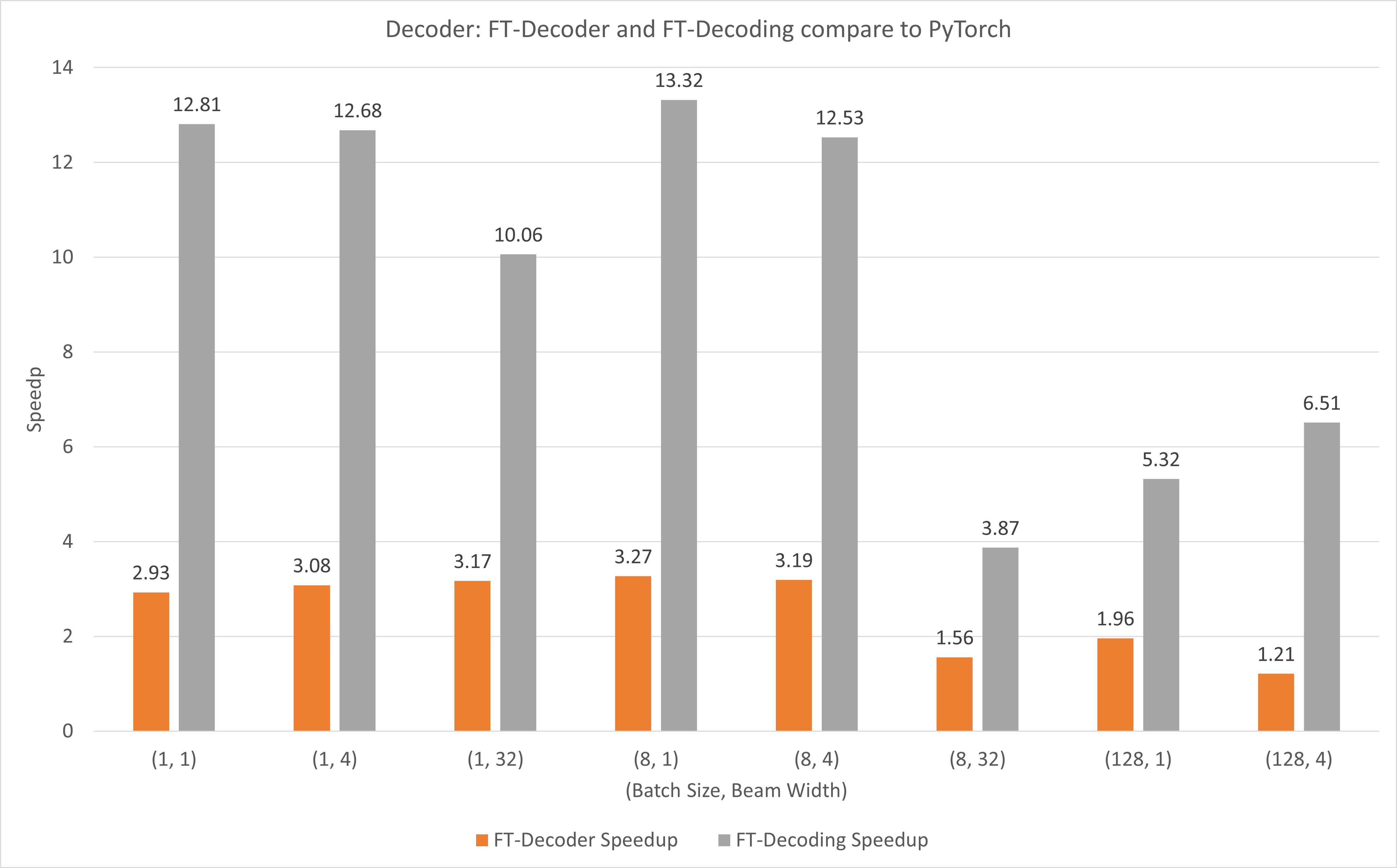
The following figure shows the speedup of of FT-Decoder op and FT-Decoding op compared to PyTorch under FP16 with T4. Here, we use the throughput of translating a test set to prevent the total tokens of each methods may be different. Compared to PyTorch, FT-Decoder provides 1.2x ~ 3x speedup; while FT-Decoding provides 3.8x ~ 13x speedup.
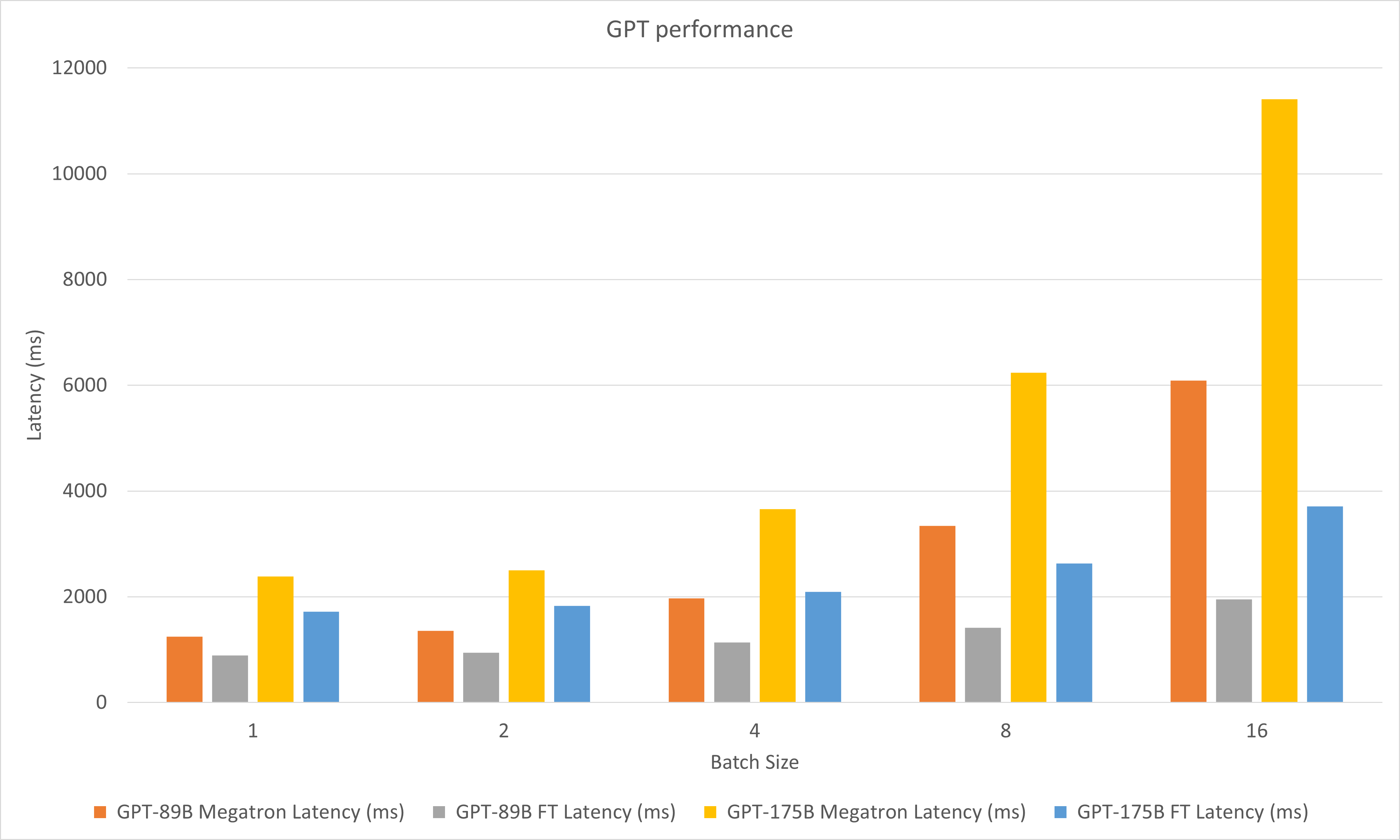
The following figure compares the performances of Megatron and FasterTransformer under FP16 on A100.
In the experiments of decoding, we updated the following parameters:
January 2023
Dec 2022
Nov 2022
Oct 2022
Sep 2022
Aug 2022
July 2022
June 2022
May 2022
April 2022
March 2022
stop_ids and ban_bad_ids in GPT-J.start_id and end_id in GPT-J, GPT, T5 and Decoding.February 2022
December 2021
November 2021
August 2021
layer_para to pipeline_para.size_per_head 96, 160, 192, 224, 256 for GPT model.June 2021
April 2021
Dec 2020
Nov 2020
Sep 2020
Aug 2020
June 2020
May 2020
translate_sample.py.April 2020
decoding_opennmt.h to decoding_beamsearch.hdecoding_sampling.hbert_transformer_op.h, bert_transformer_op.cu.cc into bert_transformer_op.ccdecoder.h, decoder.cu.cc into decoder.ccdecoding_beamsearch.h, decoding_beamsearch.cu.cc into decoding_beamsearch.ccbleu_score.py into utils. Note that the BLEU score requires python3.March 2020
translate_sample.py to demonstrate how to translate a sentence by restoring the pretrained model of OpenNMT-tf.February 2020
July 2019
import torch first. If this has been done, it is due to the incompatible C++ ABI. You may need to check the PyTorch used during compilation and execution are the same, or you need to check how your PyTorch is compiled, or the version of your GCC, etc.This is a repository for ISCA'24 AE Pre-gated MoE.
For more details about this project, please refer to our paper published in ISCA-2024, "Pre-gated MoE: An Algorithm-System Co-Design for Fast and Scalable Mixture-of-Expert Inference,"
This open-source project is for proof of concept purposes only and should not be used in production environments. The code has not been officially vetted for security vulnerabilities and provides no guarantees of correctness or security. Users should carefully review the code and conduct their own security assessments before using the software.
# Starting from the official container
docker run -ti --gpus all --shm-size 5g --name pregated -v ${DATA_PATH}:/data nvcr.io/nvidia/pytorch:22.09-py3 bash
git clone --recursive https://github.com/ranggihwang/Pregated_MoE.git FasterTransformer

# build on A100
mkdir -p FasterTransformer/build
cd FasterTransformer/build
cmake -DSM=80 -DCMAKE_BUILD_TYPE=Release -DBUILD_PYT=ON -DBUILD_MULTI_GPU=ON ..
make -j
${DATA_PATH} with path on host.xx of -DSM=xx in the scripts above means the compute capability of your GPU. The following table shows the compute capability of common GPUs.| GPU | compute capacity |
|---|---|
| P40 | 60 |
| P4 | 61 |
| V100 | 70 |
| T4 | 75 |
| A100 | 80 |
| A30 | 80 |
| A10 | 86 |
# Python dependencies
pip install -r ../examples/pytorch/t5/requirement.txt
mkdir /data/ft
cd /workspace/FasterTransformer/
./scripts/convert.sh
cd /workspace/FasterTransformer/
# logs will be output here
mkdir logs/
python scripts/eval_all.py
Check block_lats.csv, throughputs.csv and peak_mems.csv for block latencies, throughputs and peak memory usage respectively.
You can modify the following lines in scripts/eval_all.py:
models = [
    "switch-base-8",
    "switch-base-64",
    "switch-base-128",
    "switch-large-128",
]
batch_sizes = [
    1,
    # 2,
    # 4,
    # 8,
    # 16,
]
methods = [
    "GPU-only",
    "Pre-gated",
    "DeepSpeed",  # This is MoE-OnDemand
    "SE-MoE",     # This is MoE-Prefetch
]
metrics = [
    "block_lat",
    "throughput",
    "peak_mem",
    # "max_active_expert",
    # "cache_hit_rate",
]
forced_num_experts = [
    0,
    # 1,
    # 2,
    # 4,
    # 8,
    # 16,
]
cache_ratios = [
    0,
    # 0.01,
    # 0.03,
    # 0.05,
    # 0.1,
    # 0.2,
    # 0.4,
    # 0.8,
]
disk_offloads = [
    0,
    # 1,
]
Ranggi Hwang, Jianyu Wei, Shijie Cao, Changho Hwang, Xiaohu Tang, Ting Cao, and Mao Yang, "Pre-gated MoE: An Algorithm-System Co-Design for Fast and Scalable Mixture-of-Expert Inference," The 51st IEEE/ACM International Symposium on Computer Architecture (ISCA-51), Buenos Aires, Argentina, June 2024
This is the readme for FasterTransformer
This repository provides a script and recipe to run the highly optimized transformer-based encoder and decoder component, and it is tested and maintained by NVIDIA.
In NLP, encoder and decoder are two important components, with the transformer layer becoming a popular architecture for both components. FasterTransformer implements a highly optimized transformer layer for both the encoder and decoder for inference. On Volta, Turing and Ampere GPUs, the computing power of Tensor Cores are used automatically when the precision of the data and weights are FP16.
FasterTransformer is built on top of CUDA, cuBLAS, cuBLASLt and C++. We provide at least one API of the following frameworks: TensorFlow, PyTorch and Triton backend. Users can integrate FasterTransformer into these frameworks directly. For supporting frameworks, we also provide example codes to demonstrate how to use, and show the performance on these frameworks.
| Models | Framework | FP16 | INT8 (after Turing) | Sparsity (after Ampere) | Tensor parallel | Pipeline parallel | FP8 (after Hopper) |
|---|---|---|---|---|---|---|---|
| BERT | TensorFlow | Yes | Yes | - | - | - | - |
| BERT | PyTorch | Yes | Yes | Yes | Yes | Yes | - |
| BERT | Triton backend | Yes | - | - | Yes | Yes | - |
| BERT | C++ | Yes | Yes | - | - | - | Yes |
| XLNet | C++ | Yes | - | - | - | - | - |
| Encoder | TensorFlow | Yes | Yes | - | - | - | - |
| Encoder | PyTorch | Yes | Yes | Yes | - | - | - |
| Decoder | TensorFlow | Yes | - | - | - | - | - |
| Decoder | PyTorch | Yes | - | - | - | - | - |
| Decoding | TensorFlow | Yes | - | - | - | - | - |
| Decoding | PyTorch | Yes | - | - | - | - | - |
| GPT | TensorFlow | Yes | - | - | - | - | - |
| GPT/OPT | PyTorch | Yes | - | - | Yes | Yes | Yes |
| GPT/OPT | Triton backend | Yes | - | - | Yes | Yes | - |
| GPT-MoE | PyTorch | Yes | - | - | Yes | Yes | - |
| BLOOM | PyTorch | Yes | - | - | Yes | Yes | - |
| BLOOM | Triton backend | Yes | - | - | Yes | Yes | - |
| GPT-J | Triton backend | Yes | - | - | Yes | Yes | - |
| Longformer | PyTorch | Yes | - | - | - | - | - |
| T5/UL2 | PyTorch | Yes | - | - | Yes | Yes | - |
| T5 | TensorFlow 2 | Yes | - | - | - | - | - |
| T5/UL2 | Triton backend | Yes | - | - | Yes | Yes | - |
| T5 | TensorRT | Yes | - | - | Yes | Yes | - |
| T5-MoE | PyTorch | Yes | - | - | Yes | Yes | - |
| Swin Transformer | PyTorch | Yes | Yes | - | - | - | - |
| Swin Transformer | TensorRT | Yes | Yes | - | - | - | - |
| ViT | PyTorch | Yes | Yes | - | - | - | - |
| ViT | TensorRT | Yes | Yes | - | - | - | - |
| GPT-NeoX | PyTorch | Yes | - | - | Yes | Yes | - |
| GPT-NeoX | Triton backend | Yes | - | - | Yes | Yes | - |
| BART/mBART | PyTorch | Yes | - | - | Yes | Yes | - |
| WeNet | C++ | Yes | - | - | - | - | - |
| DeBERTa | TensorFlow 2 | Yes | - | - | On-going | On-going | - |
| DeBERTa | PyTorch | Yes | - | - | On-going | On-going | - |
More details of specific models are put in xxx_guide.md of docs/, where xxx means the model name. Some common questions and the respective answers are put in docs/QAList.md. Note that the model of Encoder and BERT are similar and we put the explanation into bert_guide.md together.
The following code lists the directory structure of FasterTransformer:
/src/fastertransformer: source code of FasterTransformer
    |--/cutlass_extensions: Implementation of cutlass gemm/kernels.
    |--/kernels: CUDA kernels for different models/layers and operations, like addBiasResiual.
    |--/layers: Implementation of layer modules, like attention layer, ffn layer.
    |--/models: Implementation of different models, like BERT, GPT.
    |--/tensorrt_plugin: encapluate FasterTransformer into TensorRT plugin.
    |--/tf_op: custom Tensorflow OP implementation
    |--/th_op: custom PyTorch OP implementation
    |--/triton_backend: custom triton backend implementation
    |--/utils: Contains common cuda utils, like cublasMMWrapper, memory_utils
/examples: C++, tensorflow and pytorch interface examples
    |--/cpp: C++ interface examples
    |--/pytorch: PyTorch OP examples
    |--/tensorflow: TensorFlow OP examples
    |--/tensorrt: TensorRT examples
/docs: Documents to explain the details of implementation of different models, and show the benchmark
/benchmark: Contains the scripts to run the benchmarks of different models
/tests: Unit tests
/templates: Documents to explain how to add a new model/example into FasterTransformer repo
Note that many folders contains many sub-folders to split different models. Quantization tools are move to examples, like examples/tensorflow/bert/bert-quantization/ and examples/pytorch/bert/bert-quantization-sparsity/.
FasterTransformer provides some convenient environment variables for debuging and testing.
FT_LOG_LEVEL: This environment controls the log level of debug messae. More details are in src/fastertransformer/utils/logger.h. Note that the program will print lots of message when the level is lower than DEBUG and the program would become very slow.FT_NVTX: If it is set to be ON like FT_NVTX=ON ./bin/gpt_example, the program will insert tha tag of nvtx to help profiling the program.FT_DEBUG_LEVEL: If it is set to be DEBUG, then the program will run cudaDeviceSynchronize() after every kernels. Otherwise, the kernel is executued asynchronously by default. It is helpful to locate the error point during debuging. But this flag affects the performance of program significantly. So, it should be used only for debuging.Hardware settings:
In order to run the following benchmark, we need to install the unix computing tool "bc" by
apt-get install bc
The FP16 results of TensorFlow were obtained by running the benchmarks/bert/tf_benchmark.sh.
The INT8 results of TensorFlow were obtained by running the benchmarks/bert/tf_int8_benchmark.sh.
The FP16 results of PyTorch were obtained by running the benchmarks/bert/pyt_benchmark.sh.
The INT8 results of PyTorch were obtained by running the benchmarks/bert/pyt_int8_benchmark.sh.
More benchmarks are put in docs/bert_guide.md.
The following figure compares the performances of different features of FasterTransformer and FasterTransformer under FP16 on T4.
For large batch size and sequence length, both EFF-FT and FT-INT8-v2 bring about 2x speedup. Using Effective FasterTransformer and int8v2 at the same time can bring about 3.5x speedup compared to FasterTransformer FP16 for large case.
The following figure compares the performances of different features of FasterTransformer and TensorFlow XLA under FP16 on T4.
For small batch size and sequence length, using FasterTransformer can bring about 3x speedup.
For large batch size and sequence length, using Effective FasterTransformer with INT8-v2 quantization can bring about 5x speedup.
The following figure compares the performances of different features of FasterTransformer and PyTorch TorchScript under FP16 on T4.
For small batch size and sequence length, using FasterTransformer CustomExt can bring about 4x ~ 6x speedup.
For large batch size and sequence length, using Effective FasterTransformer with INT8-v2 quantization can bring about 5x speedup.
The results of TensorFlow were obtained by running the benchmarks/decoding/tf_decoding_beamsearch_benchmark.sh and benchmarks/decoding/tf_decoding_sampling_benchmark.sh
The results of PyTorch were obtained by running the benchmarks/decoding/pyt_decoding_beamsearch_benchmark.sh.
In the experiments of decoding, we updated the following parameters:
More benchmarks are put in docs/decoder_guide.md.
The following figure shows the speedup of of FT-Decoder op and FT-Decoding op compared to TensorFlow under FP16 with T4. Here, we use the throughput of translating a test set to prevent the total tokens of each methods may be different. Compared to TensorFlow, FT-Decoder provides 1.5x ~ 3x speedup; while FT-Decoding provides 4x ~ 18x speedup.
The following figure shows the speedup of of FT-Decoder op and FT-Decoding op compared to PyTorch under FP16 with T4. Here, we use the throughput of translating a test set to prevent the total tokens of each methods may be different. Compared to PyTorch, FT-Decoder provides 1.2x ~ 3x speedup; while FT-Decoding provides 3.8x ~ 13x speedup.
The following figure compares the performances of Megatron and FasterTransformer under FP16 on A100.
In the experiments of decoding, we updated the following parameters:
January 2023
Dec 2022
Nov 2022
Oct 2022
Sep 2022
Aug 2022
July 2022
June 2022
May 2022
April 2022
March 2022
stop_ids and ban_bad_ids in GPT-J.start_id and end_id in GPT-J, GPT, T5 and Decoding.February 2022
December 2021
November 2021
August 2021
layer_para to pipeline_para.size_per_head 96, 160, 192, 224, 256 for GPT model.June 2021
April 2021
Dec 2020
Nov 2020
Sep 2020
Aug 2020
June 2020
May 2020
translate_sample.py.April 2020
decoding_opennmt.h to decoding_beamsearch.hdecoding_sampling.hbert_transformer_op.h, bert_transformer_op.cu.cc into bert_transformer_op.ccdecoder.h, decoder.cu.cc into decoder.ccdecoding_beamsearch.h, decoding_beamsearch.cu.cc into decoding_beamsearch.ccbleu_score.py into utils. Note that the BLEU score requires python3.March 2020
translate_sample.py to demonstrate how to translate a sentence by restoring the pretrained model of OpenNMT-tf.February 2020
July 2019
import torch first. If this has been done, it is due to the incompatible C++ ABI. You may need to check the PyTorch used during compilation and execution are the same, or you need to check how your PyTorch is compiled, or the version of your GCC, etc.


