Fully local voice agent that answers in a clone of your own voice on open-weight models: ~170 ms spoken reaction, ~1 s to the answer, Intel Core Ultra (NPU + Arc iGPU) or Apple Silicon, English/Hindi, no cloud, no API keys
Python
0
24 commits
updated Sep 8, 2026



A real-time spoken assistant that listens, thinks, looks things up on the internet, and answers in a clone of your voice, running entirely on one laptop with no cloud inference and no proprietary models. It reacts in ~170 milliseconds (a spoken acknowledgement in your cloned voice) and speaks the first words of its answer about a second after you stop talking; the transcript is already finished before you finish pausing. It was built and measured on an Intel Core Ultra 7 155H (CPU + Arc iGPU + NPU, no NVIDIA GPU), splitting the models across the three compute units so that no stage waits for another stage's hardware.
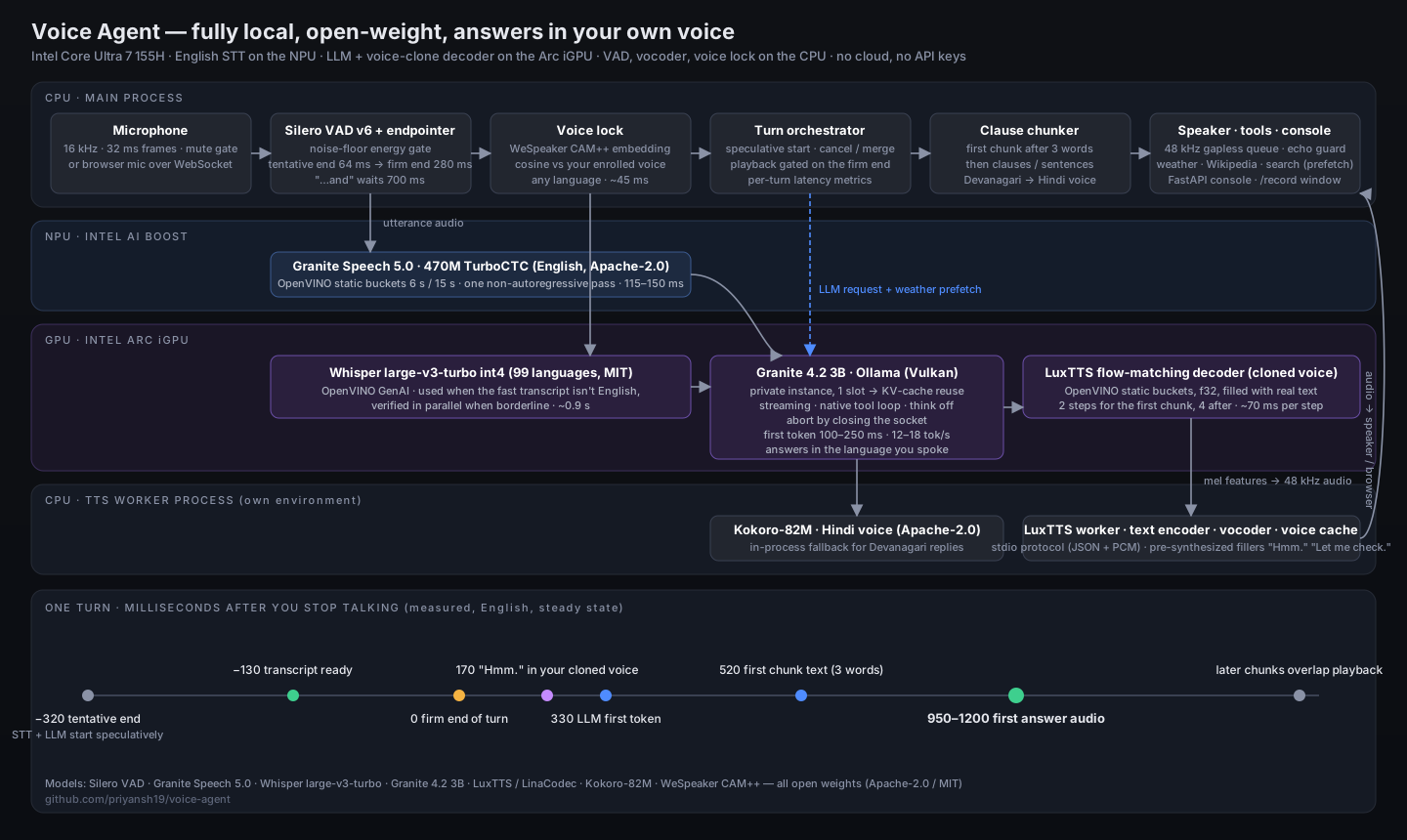
Measured on that laptop (English, steady state, ms after you stop speaking):
| moment | ms |
|---|---|
| transcript ready (started speculatively during your pause) | before the firm end of turn |
| first spoken reaction in your cloned voice ("Hmm.", "Right.") | ~170 |
| LLM first token | 330–550 |
| first words of the answer audible | 950–1200 |
Hindi / Hinglish turns take 4–6 s (multilingual STT plus Devanagari being token-expensive for the LLM). The honest framing: under 200 ms to a spoken reaction, about one second to the answer, everything local.
This is a compute-heavy local stack; the numbers above depend on the hardware split. What you need:
| minimum (it runs) | measured configuration (the numbers above) | |
|---|---|---|
| CPU | x86-64 with AVX2, 8 threads | Intel Core Ultra 7 155H (6P + 8E + 2LP cores) |
| Accelerators | none (CPU fallbacks for every stage) | Intel Arc iGPU (LLM via Vulkan, Whisper + TTS flow via OpenVINO) and Intel AI Boost NPU (English STT) |
| RAM | 16 GB (≈7 GB resident for the models) | 32 GB |
| Disk | 25 GB free (weights ≈16 GB + compiled caches + two Python environments) | 250 GB SSD |
| OS | Windows 11 (tested) or Linux (should work, untested); Python 3.12 via uv | Windows 11 |
| Audio | any microphone and speaker, or a browser in hosted mode | laptop mic array / headset |
| Software | Ollama ≥ 0.33 with granite4.2:3b pulled | Ollama 0.33.3 |
| Network | only for first-run model downloads and the keyless tools (weather, Wikipedia, search) |
What changes without the accelerators: on CPU alone the English STT takes 0.5–0.8 s instead of 0.13 s, Whisper ~5 s, the LLM ~5 tok/s, and a cloned-voice sentence 3–4 s, so expect 3–6 s to the answer instead of ~1 s. An Intel Core Ultra (Meteor Lake or newer) gets the measured behaviour out of the box. NVIDIA GPUs and Apple Silicon run the LLM through Ollama today, but the STT/TTS accelerator backends are OpenVINO-specific, so those stages fall back to CPU until a CUDA/Metal backend is contributed (see CONTRIBUTING → Adding a backend).
Conversation
Understanding
Knowledge and tools (all keyless)
Voice
Operations
web/).agent/ — the core package| module | what it does | why it was needed |
|---|---|---|
pipeline.py | The orchestrator: owns the turn state machine, speculative start/cancel/merge, the ordered TTS slot queue, filler logic, voice-lock check, language tagging, prefetch, browser-audio attachment, voice re-recording, per-turn metrics and UI events. | Every latency trick lives in the sequencing, not in any single model. A turn is an object with cancel/commit events so STT, LLM, TTS and playback can overlap safely and be aborted at any point. |
vad.py | Silero VAD v6 endpointer with hysteresis, pre-roll, tentative and firm end events, adaptive silence, noise-floor energy gate. | The endpoint decision is the first item on the latency budget. Emitting a tentative end at 64 ms of silence is what lets STT and LLM start early; the energy gate fixed "it listens too much". |
stt.py | Granite Speech 5.0 TurboCTC exported to OpenVINO with static-shape buckets (6 s, 15 s) and compiled for the NPU; greedy CTC decode; serialized infer requests. | On CPU this model took 500–800 ms; on the NPU it takes 115–150 ms for any length, and the NPU is otherwise idle. Static shapes are required by the NPU; the GPU garbled long audio in fp16. |
stt_whisper.py | Whisper large-v3-turbo int4 through OpenVINO GenAI on the GPU, plus an English-likeness score (wordfreq) and transcript-equality test. | The CTC model is English-only. Whisper costs ~0.9 s, so it is only in the critical path when the fast transcript looks like romanized Hindi (score < 0.7), and skipped entirely for clear English. |
llm.py | Streaming chat against Ollama with the native tool loop, a fresh HTTP client per turn so a cancelled turn can be aborted by closing the socket, and warmup that primes the KV cache. | Without socket abort a cancelled request could block the next one (Ollama serializes). Warmup avoids a 2 s first-token on the first real turn. |
ollama_launcher.py | Spawns a private ollama serve on port 11436 with OLLAMA_NUM_PARALLEL=1, keep-alive forever, flash attention, q8 KV cache. | The system Ollama used 4 slots; consecutive turns landed on different empty slots and re-evaluated the whole prompt (0.5–0.8 s). One slot reuses the prefix. Done without touching user settings. |
tools.py | Weather (Open-Meteo + geocoding with a Devanagari city table), Wikipedia, DuckDuckGo, time, calculator; connection pre-warming; forecast cache; deliberately short JSON schemas. | The agent must reach the internet without API keys. Short schemas matter: every token of the tool schema is part of the prompt state Ollama saves/restores on each turn. |
prefetch.py | Keyword rules (English, Hinglish, Hindi) that start a weather fetch from the transcript before the LLM runs and inject the result as context. | A tool call costs a full extra LLM round (~4–6 s with tool JSON generation); prefetching collapses it to one round. |
chunker.py | Streaming text → speakable chunks: first chunk after 2–3 words, later chunks at clause/sentence boundaries, Devanagari danda support, markdown stripping. | TTS latency is paid per chunk, so the first chunk must be tiny and the rest must be natural clauses. |
tts_client.py | TTS backends behind one interface: the LuxTTS worker (cloned voice) over a binary stdio protocol, Kokoro in-process, and a router that sends Devanagari text to the Hindi voice. | LuxTTS needs transformers<=4.57 while the STT needs >=5.16, so the clone runs in a separate venv/process, which also isolates it from the main process's GIL. |
speaker_gate.py | WeSpeaker CAM++ speaker embeddings on onnxruntime (kaldi fbank via torchaudio), robust enrollment over voiced windows, cosine similarity gate. | "Answer only my voice." The published sherpa-onnx wrapper crashed against the newer onnxruntime, so the model is driven directly. |
audio_io.py | Microphone capture, gapless pull-based speaker with per-chunk callbacks and instant stop, a remote (browser) playback path, resampling. | Playback timing feeds the metrics ("first audio out" is measured when samples reach the device), and barge-in/echo handling needs an instant flush. |
metrics.py | Per-turn timestamps and the latency table printed to the console and pushed to the UI. | You cannot optimize what you do not measure per stage; every claim in this README comes from this table. |
config.py | YAML config with attribute access. | All knobs in one file (config.yaml), no code edits for tuning. |
tts_worker/ — the cloned-voice process| file | what it does | why |
|---|---|---|
lux_fast.py | LuxTTS with three fixes: the upstream CPU path's duration formula (short sentences produced zero frames), a vocoder minimum-length guard, and static-shape buckets for the flow decoder on the Intel GPU via OpenVINO, filled with real filler text (zero-padding broke the output) and landed exactly on a bucket by solving for the speaking-rate argument; f32 on GPU because fp16 produced NaNs. | On CPU a sentence took 3–4 s; on the GPU with static buckets it takes 300–500 ms. Dynamic shapes recompiled for ~20 s per new length, hence buckets. |
server.py | The worker: loads the model, condenses the reference recording to speech-only, encodes and caches the voice prompt, compiles buckets, pre-synthesizes fillers, then serves synth requests over stdio (JSON header + float32 PCM). fd 1 is reserved for the protocol; all library output goes to stderr. | Process isolation for the dependency conflict, and a cache so restarts cost seconds, not minutes. |
ui/ and web/ — the consoleui/server.py: FastAPI app with a control WebSocket (events, commands, settings), the /audio WebSocket (16 kHz
int16 in, 48 kHz int16 out, browser mic + playback), /record and /voice.wav, UTF-8 forced on the console
(the Windows console crashed on Devanagari).ui/index.html: the console; ui/record.html: the voice-recording window.web/: static copy of the console (built by tools/build_web.py) for Vercel or any static host; it connects to
whatever backend URL you enter.main.py — CLILive mic mode, offline wav replay, text-only turns, voice recording, device listing, --prepare to compile and
cache every model on first install.
benchmarks/, tests/, tools/The scripts that drove every decision above: STT on CPU vs NPU vs GPU, thread sweeps, Whisper variants, Ollama
time-to-first-token experiments (localhost vs 127.0.0.1, slots, prompt length), LuxTTS backends and bucket
padding, vocoder conversion attempts, TTS quality checked by transcribing its own output, and an end-to-end test
of the browser-audio protocol.
127.0.0.1, not localhost: on Windows the client tried IPv6 first and lost ~1.7 s per Ollama request.Remaining floor on this laptop, and how to get to ~500 ms: the Ollama per-request state overhead (~250 ms) goes away by running the LLM through OpenVINO GenAI with a persistent in-process KV cache; the vocoder (100–300 ms on CPU; it does not convert to OpenVINO) needs a GPU-friendly replacement or a 1-step flow; a smaller model would produce the first words ~100 ms sooner. On an Apple M-series or NVIDIA machine the same architecture gets there with native Metal/CUDA paths and far less effort.
Prerequisites: Windows 11 or Linux with an Intel Core Ultra (for the NPU/GPU paths; CPU fallbacks exist but are
slow), uv, Ollama with ollama pull granite4.2:3b.
uv sync                                                  # main environment
uv venv --python 3.12 tts_worker/.venv                   # isolated LuxTTS environment
uv pip install --python tts_worker/.venv -r tts_worker/requirements.txt
uv pip install --python tts_worker/.venv --reinstall-package torch --reinstall-package torchaudio --index-url https://download.pytorch.org/whl/cpu torch torchaudio
uv pip install --python tts_worker/.venv openvino
Model files: Granite STT and LuxTTS download from Hugging Face on first use; Kokoro files go in
models/kokoro/ (kokoro-v1.0.onnx, voices-v1.0.bin from the kokoro-onnx releases); the speaker model
wespeaker_en_voxceleb_CAM++.onnx goes in models/speaker/ (sherpa-onnx releases); Whisper downloads from the
OpenVINO Hugging Face org. First start compiles everything (~5 min), later starts take ~90 s.
Run:
uv run python ui/server.py       # console at http://127.0.0.1:8765
uv run python main.py            # terminal mode
uv run python main.py --wav samples/test_utterance_16k.wav --no-audio-out   # offline check
First conversation: Record my voice… (read the script, aim for "good take", Use this voice), enable Voice lock, unmute (Space), talk.
web/). The models need a real machine: run ui/server.py
there, expose it with cloudflared tunnel --url http://127.0.0.1:8765, enter that URL in the page's backend
field and tick Use THIS browser's microphone. Put Cloudflare Access in front: it speaks in your voice.device='mps' in LuxTTS); expect ~600–800 ms to the
answer after porting the Intel-specific STT/TTS backends.config.yaml)| section | key knobs |
|---|---|
vad | threshold, min_rms_ratio (noise gate), min_silence_ms (280), min_silence_uncertain_ms, speculative, barge_in |
stt | device (NPU/GPU/CPU), buckets_frames; multilingual.enabled/model/device/english_threshold/skip_check_above |
llm | host (private instance on 11436), private_instance, model, num_ctx, num_predict, system_prompt, default_location, prefetch_wait_s |
chunker | first_chunk_min_words, first_chunk_max_words, min_words, max_chars |
tts | voice_ref, prompt_duration_s, steps, first_chunk_steps, buckets, threads, fillers.*, kokoro.hindi_voice, hindi_fallback |
speaker_gate | enabled, threshold, model |
agent/          core package (pipeline, VAD, STT x2, LLM, tools, prefetch, chunker, TTS client, voice lock, audio I/O, metrics)
tts_worker/     LuxTTS worker process + its isolated environment (server.py, lux_fast.py, requirements.txt)
ui/             FastAPI console server, console page, voice-recording page
web/            static hosted copy of the console (generated)
benchmarks/     stt/, llm/, tts/ — the experiments behind every decision
tests/          end-to-end test of the browser-audio WebSocket path
tools/          build_web.py
docs/           architecture.svg
samples/        synthetic test utterances
voices/         your reference recording (git-ignored)
models/         downloaded weights and compiled caches (git-ignored)
main.py, config.yaml, pyproject.toml
uv run pytest tests/unit -q      # ~1 min, no GPU/NPU/mic: models are replaced by fakes with known latencies
uv run pytest -m speed -rA       # the pipeline's own overhead must stay < 250 ms on top of the model latencies
uv run ruff check .
| suite | covers |
|---|---|
tests/unit/test_chunker.py | first-chunk cut, sentence/clause boundaries, decimals, Devanagari, markdown |
tests/unit/test_language_and_prefetch.py | English-likeness score, transcript equality, weather prefetch rules in three languages |
tests/unit/test_tools.py | weather text and caching with mocked HTTP, Devanagari geocoding, calculator sandbox, schema size |
tests/unit/test_vad_audio_metrics.py | Silero endpointer on a real utterance and on noise, adaptive silence, speaker queue, remote playback, metrics |
tests/unit/test_pipeline.py | turn flow, speculative start, cancel + merge, fillers, voice lock, language tags, multilingual override, tool filler, latency budget |
tests/unit/test_ui_server.py | console pages, control WebSocket, /audio PCM streaming end to end |
tests/e2e/ | the same /audio protocol against a running server with real models |
GitHub Actions: ci.yml (lint, Ubuntu + Windows test matrix, latency budget, hosted-page freshness),
tts-worker.yml (the isolated LuxTTS environment resolves and imports; weekly), benchmark.yml (real end-to-end
latency on a self-hosted runner with the hardware, on demand, uploads the per-turn tables and reply audio).
See CONTRIBUTING.md (dev setup, test layers, how to add an STT/LLM/TTS backend, "bring numbers" rule for latency PRs), SECURITY.md (responsible use of voice cloning) and the issue templates, including a latency report template to grow the hardware table. Licensed under Apache-2.0.
| model | role | license |
|---|---|---|
| Silero VAD v6 | voice activity | MIT |
| Granite Speech 5.0 470M TurboCTC | English STT | Apache-2.0 |
| Whisper large-v3-turbo (OpenVINO int4) | multilingual STT | MIT |
| Granite 4.2 3B | LLM | Apache-2.0 |
| LuxTTS / ZipVoice-distill + LinaCodec | cloned-voice TTS | Apache-2.0 |
| Kokoro-82M | Hindi voice / fallback | Apache-2.0 |
| WeSpeaker CAM++ | voice lock | Apache-2.0 |
Fully local voice agent that answers in a clone of your own voice on open-weight models: ~170 ms spoken reaction, ~1 s to the answer, Intel Core Ultra (NPU + Arc iGPU) or Apple Silicon, English/Hindi, no cloud, no API keys
Python
0
24 commits
updated Sep 8, 2026
A real-time spoken assistant that listens, thinks, looks things up on the internet, and answers in a clone of your voice, running entirely on one laptop with no cloud inference and no proprietary models. It reacts in ~170 milliseconds (a spoken acknowledgement in your cloned voice) and speaks the first words of its answer about a second after you stop talking; the transcript is already finished before you finish pausing. It was built and measured on an Intel Core Ultra 7 155H (CPU + Arc iGPU + NPU, no NVIDIA GPU), splitting the models across the three compute units so that no stage waits for another stage's hardware.
Measured on that laptop (English, steady state, ms after you stop speaking):
| moment | ms |
|---|---|
| transcript ready (started speculatively during your pause) | before the firm end of turn |
| first spoken reaction in your cloned voice ("Hmm.", "Right.") | ~170 |
| LLM first token | 330–550 |
| first words of the answer audible | 950–1200 |
Hindi / Hinglish turns take 4–6 s (multilingual STT plus Devanagari being token-expensive for the LLM). The honest framing: under 200 ms to a spoken reaction, about one second to the answer, everything local.
This is a compute-heavy local stack; the numbers above depend on the hardware split. What you need:
| minimum (it runs) | measured configuration (the numbers above) | |
|---|---|---|
| CPU | x86-64 with AVX2, 8 threads | Intel Core Ultra 7 155H (6P + 8E + 2LP cores) |
| Accelerators | none (CPU fallbacks for every stage) | Intel Arc iGPU (LLM via Vulkan, Whisper + TTS flow via OpenVINO) and Intel AI Boost NPU (English STT) |
| RAM | 16 GB (≈7 GB resident for the models) | 32 GB |
| Disk | 25 GB free (weights ≈16 GB + compiled caches + two Python environments) | 250 GB SSD |
| OS | Windows 11 (tested) or Linux (should work, untested); Python 3.12 via uv | Windows 11 |
| Audio | any microphone and speaker, or a browser in hosted mode | laptop mic array / headset |
| Software | Ollama ≥ 0.33 with granite4.2:3b pulled | Ollama 0.33.3 |
| Network | only for first-run model downloads and the keyless tools (weather, Wikipedia, search) |
What changes without the accelerators: on CPU alone the English STT takes 0.5–0.8 s instead of 0.13 s, Whisper ~5 s, the LLM ~5 tok/s, and a cloned-voice sentence 3–4 s, so expect 3–6 s to the answer instead of ~1 s. An Intel Core Ultra (Meteor Lake or newer) gets the measured behaviour out of the box. NVIDIA GPUs and Apple Silicon run the LLM through Ollama today, but the STT/TTS accelerator backends are OpenVINO-specific, so those stages fall back to CPU until a CUDA/Metal backend is contributed (see CONTRIBUTING → Adding a backend).
Conversation
Understanding
Knowledge and tools (all keyless)
Voice
Operations
web/).agent/ — the core package| module | what it does | why it was needed |
|---|---|---|
pipeline.py | The orchestrator: owns the turn state machine, speculative start/cancel/merge, the ordered TTS slot queue, filler logic, voice-lock check, language tagging, prefetch, browser-audio attachment, voice re-recording, per-turn metrics and UI events. | Every latency trick lives in the sequencing, not in any single model. A turn is an object with cancel/commit events so STT, LLM, TTS and playback can overlap safely and be aborted at any point. |
vad.py | Silero VAD v6 endpointer with hysteresis, pre-roll, tentative and firm end events, adaptive silence, noise-floor energy gate. | The endpoint decision is the first item on the latency budget. Emitting a tentative end at 64 ms of silence is what lets STT and LLM start early; the energy gate fixed "it listens too much". |
stt.py | Granite Speech 5.0 TurboCTC exported to OpenVINO with static-shape buckets (6 s, 15 s) and compiled for the NPU; greedy CTC decode; serialized infer requests. | On CPU this model took 500–800 ms; on the NPU it takes 115–150 ms for any length, and the NPU is otherwise idle. Static shapes are required by the NPU; the GPU garbled long audio in fp16. |
stt_whisper.py | Whisper large-v3-turbo int4 through OpenVINO GenAI on the GPU, plus an English-likeness score (wordfreq) and transcript-equality test. | The CTC model is English-only. Whisper costs ~0.9 s, so it is only in the critical path when the fast transcript looks like romanized Hindi (score < 0.7), and skipped entirely for clear English. |
llm.py | Streaming chat against Ollama with the native tool loop, a fresh HTTP client per turn so a cancelled turn can be aborted by closing the socket, and warmup that primes the KV cache. | Without socket abort a cancelled request could block the next one (Ollama serializes). Warmup avoids a 2 s first-token on the first real turn. |
ollama_launcher.py | Spawns a private ollama serve on port 11436 with OLLAMA_NUM_PARALLEL=1, keep-alive forever, flash attention, q8 KV cache. | The system Ollama used 4 slots; consecutive turns landed on different empty slots and re-evaluated the whole prompt (0.5–0.8 s). One slot reuses the prefix. Done without touching user settings. |
tools.py | Weather (Open-Meteo + geocoding with a Devanagari city table), Wikipedia, DuckDuckGo, time, calculator; connection pre-warming; forecast cache; deliberately short JSON schemas. | The agent must reach the internet without API keys. Short schemas matter: every token of the tool schema is part of the prompt state Ollama saves/restores on each turn. |
prefetch.py | Keyword rules (English, Hinglish, Hindi) that start a weather fetch from the transcript before the LLM runs and inject the result as context. | A tool call costs a full extra LLM round (~4–6 s with tool JSON generation); prefetching collapses it to one round. |
chunker.py | Streaming text → speakable chunks: first chunk after 2–3 words, later chunks at clause/sentence boundaries, Devanagari danda support, markdown stripping. | TTS latency is paid per chunk, so the first chunk must be tiny and the rest must be natural clauses. |
tts_client.py | TTS backends behind one interface: the LuxTTS worker (cloned voice) over a binary stdio protocol, Kokoro in-process, and a router that sends Devanagari text to the Hindi voice. | LuxTTS needs transformers<=4.57 while the STT needs >=5.16, so the clone runs in a separate venv/process, which also isolates it from the main process's GIL. |
speaker_gate.py | WeSpeaker CAM++ speaker embeddings on onnxruntime (kaldi fbank via torchaudio), robust enrollment over voiced windows, cosine similarity gate. | "Answer only my voice." The published sherpa-onnx wrapper crashed against the newer onnxruntime, so the model is driven directly. |
audio_io.py | Microphone capture, gapless pull-based speaker with per-chunk callbacks and instant stop, a remote (browser) playback path, resampling. | Playback timing feeds the metrics ("first audio out" is measured when samples reach the device), and barge-in/echo handling needs an instant flush. |
metrics.py | Per-turn timestamps and the latency table printed to the console and pushed to the UI. | You cannot optimize what you do not measure per stage; every claim in this README comes from this table. |
config.py | YAML config with attribute access. | All knobs in one file (config.yaml), no code edits for tuning. |
tts_worker/ — the cloned-voice process| file | what it does | why |
|---|---|---|
lux_fast.py | LuxTTS with three fixes: the upstream CPU path's duration formula (short sentences produced zero frames), a vocoder minimum-length guard, and static-shape buckets for the flow decoder on the Intel GPU via OpenVINO, filled with real filler text (zero-padding broke the output) and landed exactly on a bucket by solving for the speaking-rate argument; f32 on GPU because fp16 produced NaNs. | On CPU a sentence took 3–4 s; on the GPU with static buckets it takes 300–500 ms. Dynamic shapes recompiled for ~20 s per new length, hence buckets. |
server.py | The worker: loads the model, condenses the reference recording to speech-only, encodes and caches the voice prompt, compiles buckets, pre-synthesizes fillers, then serves synth requests over stdio (JSON header + float32 PCM). fd 1 is reserved for the protocol; all library output goes to stderr. | Process isolation for the dependency conflict, and a cache so restarts cost seconds, not minutes. |
ui/ and web/ — the consoleui/server.py: FastAPI app with a control WebSocket (events, commands, settings), the /audio WebSocket (16 kHz
int16 in, 48 kHz int16 out, browser mic + playback), /record and /voice.wav, UTF-8 forced on the console
(the Windows console crashed on Devanagari).ui/index.html: the console; ui/record.html: the voice-recording window.web/: static copy of the console (built by tools/build_web.py) for Vercel or any static host; it connects to
whatever backend URL you enter.main.py — CLILive mic mode, offline wav replay, text-only turns, voice recording, device listing, --prepare to compile and
cache every model on first install.
benchmarks/, tests/, tools/The scripts that drove every decision above: STT on CPU vs NPU vs GPU, thread sweeps, Whisper variants, Ollama
time-to-first-token experiments (localhost vs 127.0.0.1, slots, prompt length), LuxTTS backends and bucket
padding, vocoder conversion attempts, TTS quality checked by transcribing its own output, and an end-to-end test
of the browser-audio protocol.
127.0.0.1, not localhost: on Windows the client tried IPv6 first and lost ~1.7 s per Ollama request.Remaining floor on this laptop, and how to get to ~500 ms: the Ollama per-request state overhead (~250 ms) goes away by running the LLM through OpenVINO GenAI with a persistent in-process KV cache; the vocoder (100–300 ms on CPU; it does not convert to OpenVINO) needs a GPU-friendly replacement or a 1-step flow; a smaller model would produce the first words ~100 ms sooner. On an Apple M-series or NVIDIA machine the same architecture gets there with native Metal/CUDA paths and far less effort.
Prerequisites: Windows 11 or Linux with an Intel Core Ultra (for the NPU/GPU paths; CPU fallbacks exist but are
slow), uv, Ollama with ollama pull granite4.2:3b.
uv sync                                                  # main environment
uv venv --python 3.12 tts_worker/.venv                   # isolated LuxTTS environment
uv pip install --python tts_worker/.venv -r tts_worker/requirements.txt
uv pip install --python tts_worker/.venv --reinstall-package torch --reinstall-package torchaudio --index-url https://download.pytorch.org/whl/cpu torch torchaudio
uv pip install --python tts_worker/.venv openvino
Model files: Granite STT and LuxTTS download from Hugging Face on first use; Kokoro files go in
models/kokoro/ (kokoro-v1.0.onnx, voices-v1.0.bin from the kokoro-onnx releases); the speaker model
wespeaker_en_voxceleb_CAM++.onnx goes in models/speaker/ (sherpa-onnx releases); Whisper downloads from the
OpenVINO Hugging Face org. First start compiles everything (~5 min), later starts take ~90 s.
Run:
uv run python ui/server.py       # console at http://127.0.0.1:8765
uv run python main.py            # terminal mode
uv run python main.py --wav samples/test_utterance_16k.wav --no-audio-out   # offline check
First conversation: Record my voice… (read the script, aim for "good take", Use this voice), enable Voice lock, unmute (Space), talk.
web/). The models need a real machine: run ui/server.py
there, expose it with cloudflared tunnel --url http://127.0.0.1:8765, enter that URL in the page's backend
field and tick Use THIS browser's microphone. Put Cloudflare Access in front: it speaks in your voice.device='mps' in LuxTTS); expect ~600–800 ms to the
answer after porting the Intel-specific STT/TTS backends.config.yaml)| section | key knobs |
|---|---|
vad | threshold, min_rms_ratio (noise gate), min_silence_ms (280), min_silence_uncertain_ms, speculative, barge_in |
stt | device (NPU/GPU/CPU), buckets_frames; multilingual.enabled/model/device/english_threshold/skip_check_above |
llm | host (private instance on 11436), private_instance, model, num_ctx, num_predict, system_prompt, default_location, prefetch_wait_s |
chunker | first_chunk_min_words, first_chunk_max_words, min_words, max_chars |
tts | voice_ref, prompt_duration_s, steps, first_chunk_steps, buckets, threads, fillers.*, kokoro.hindi_voice, hindi_fallback |
speaker_gate | enabled, threshold, model |
agent/          core package (pipeline, VAD, STT x2, LLM, tools, prefetch, chunker, TTS client, voice lock, audio I/O, metrics)
tts_worker/     LuxTTS worker process + its isolated environment (server.py, lux_fast.py, requirements.txt)
ui/             FastAPI console server, console page, voice-recording page
web/            static hosted copy of the console (generated)
benchmarks/     stt/, llm/, tts/ — the experiments behind every decision
tests/          end-to-end test of the browser-audio WebSocket path
tools/          build_web.py
docs/           architecture.svg
samples/        synthetic test utterances
voices/         your reference recording (git-ignored)
models/         downloaded weights and compiled caches (git-ignored)
main.py, config.yaml, pyproject.toml
uv run pytest tests/unit -q      # ~1 min, no GPU/NPU/mic: models are replaced by fakes with known latencies
uv run pytest -m speed -rA       # the pipeline's own overhead must stay < 250 ms on top of the model latencies
uv run ruff check .
| suite | covers |
|---|---|
tests/unit/test_chunker.py | first-chunk cut, sentence/clause boundaries, decimals, Devanagari, markdown |
tests/unit/test_language_and_prefetch.py | English-likeness score, transcript equality, weather prefetch rules in three languages |
tests/unit/test_tools.py | weather text and caching with mocked HTTP, Devanagari geocoding, calculator sandbox, schema size |
tests/unit/test_vad_audio_metrics.py | Silero endpointer on a real utterance and on noise, adaptive silence, speaker queue, remote playback, metrics |
tests/unit/test_pipeline.py | turn flow, speculative start, cancel + merge, fillers, voice lock, language tags, multilingual override, tool filler, latency budget |
tests/unit/test_ui_server.py | console pages, control WebSocket, /audio PCM streaming end to end |
tests/e2e/ | the same /audio protocol against a running server with real models |
GitHub Actions: ci.yml (lint, Ubuntu + Windows test matrix, latency budget, hosted-page freshness),
tts-worker.yml (the isolated LuxTTS environment resolves and imports; weekly), benchmark.yml (real end-to-end
latency on a self-hosted runner with the hardware, on demand, uploads the per-turn tables and reply audio).
See CONTRIBUTING.md (dev setup, test layers, how to add an STT/LLM/TTS backend, "bring numbers" rule for latency PRs), SECURITY.md (responsible use of voice cloning) and the issue templates, including a latency report template to grow the hardware table. Licensed under Apache-2.0.
| model | role | license |
|---|---|---|
| Silero VAD v6 | voice activity | MIT |
| Granite Speech 5.0 470M TurboCTC | English STT | Apache-2.0 |
| Whisper large-v3-turbo (OpenVINO int4) | multilingual STT | MIT |
| Granite 4.2 3B | LLM | Apache-2.0 |
| LuxTTS / ZipVoice-distill + LinaCodec | cloned-voice TTS | Apache-2.0 |
| Kokoro-82M | Hindi voice / fallback | Apache-2.0 |
| WeSpeaker CAM++ | voice lock | Apache-2.0 |



