
Casual poker, redesigned — clean single-player Texas Hold'em. Play money, no account needed, no fake felt.
See the codeSee what people are saying
README

pip
Real single-player Texas Hold'em against AI. No account needed, no real money,
open source down to the shuffle.
▶ Play at playpip.io · no signup, nothing to install


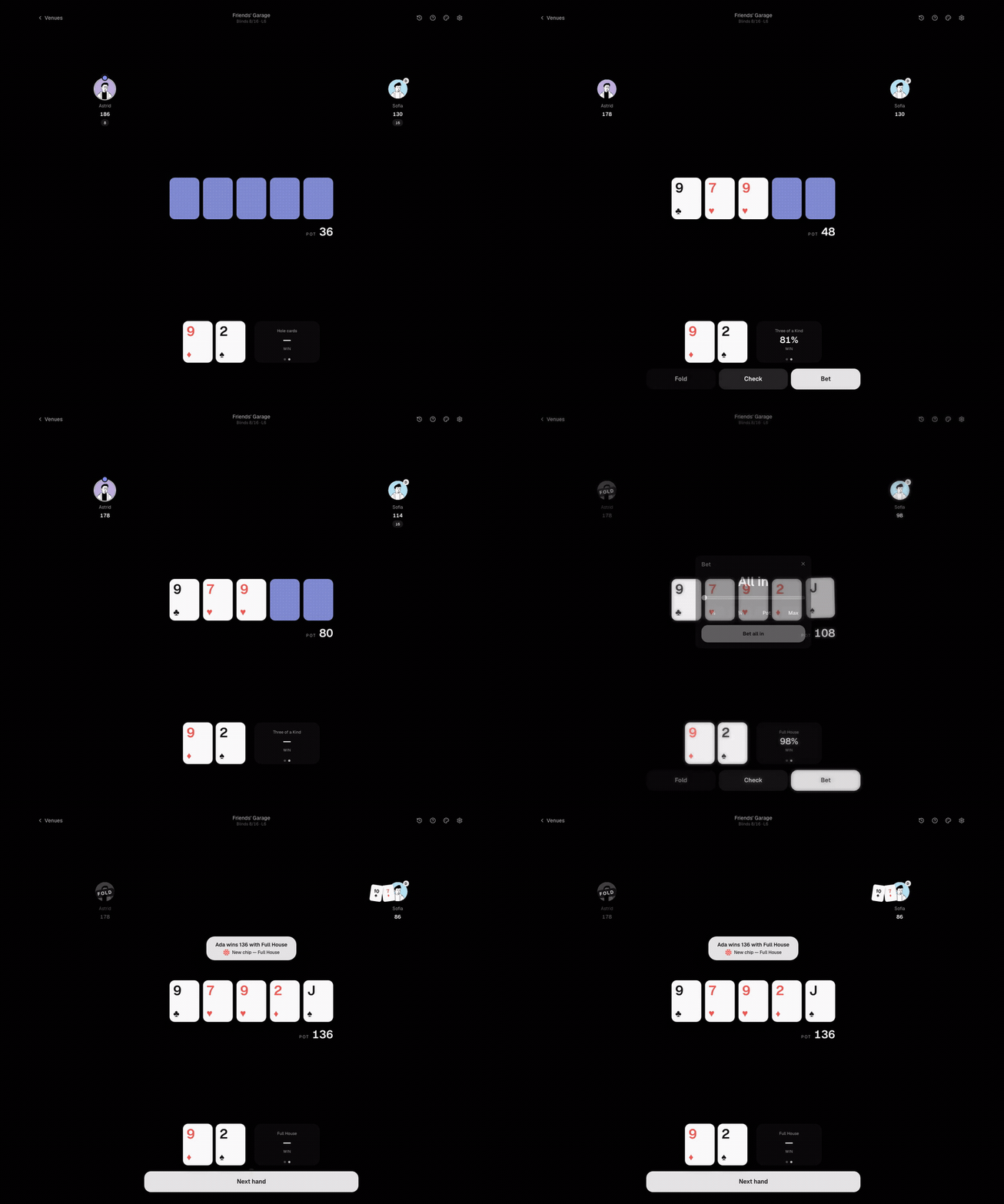
Free poker apps tend to look and feel like a scam: neon, leather textures, coin jingles, and more time spent closing offers than playing cards. Pip is the opposite — a flat, calm, black-first table where the poker is the whole product. Single-player, play money only, no pop-ups, no fake felt.
How it plays
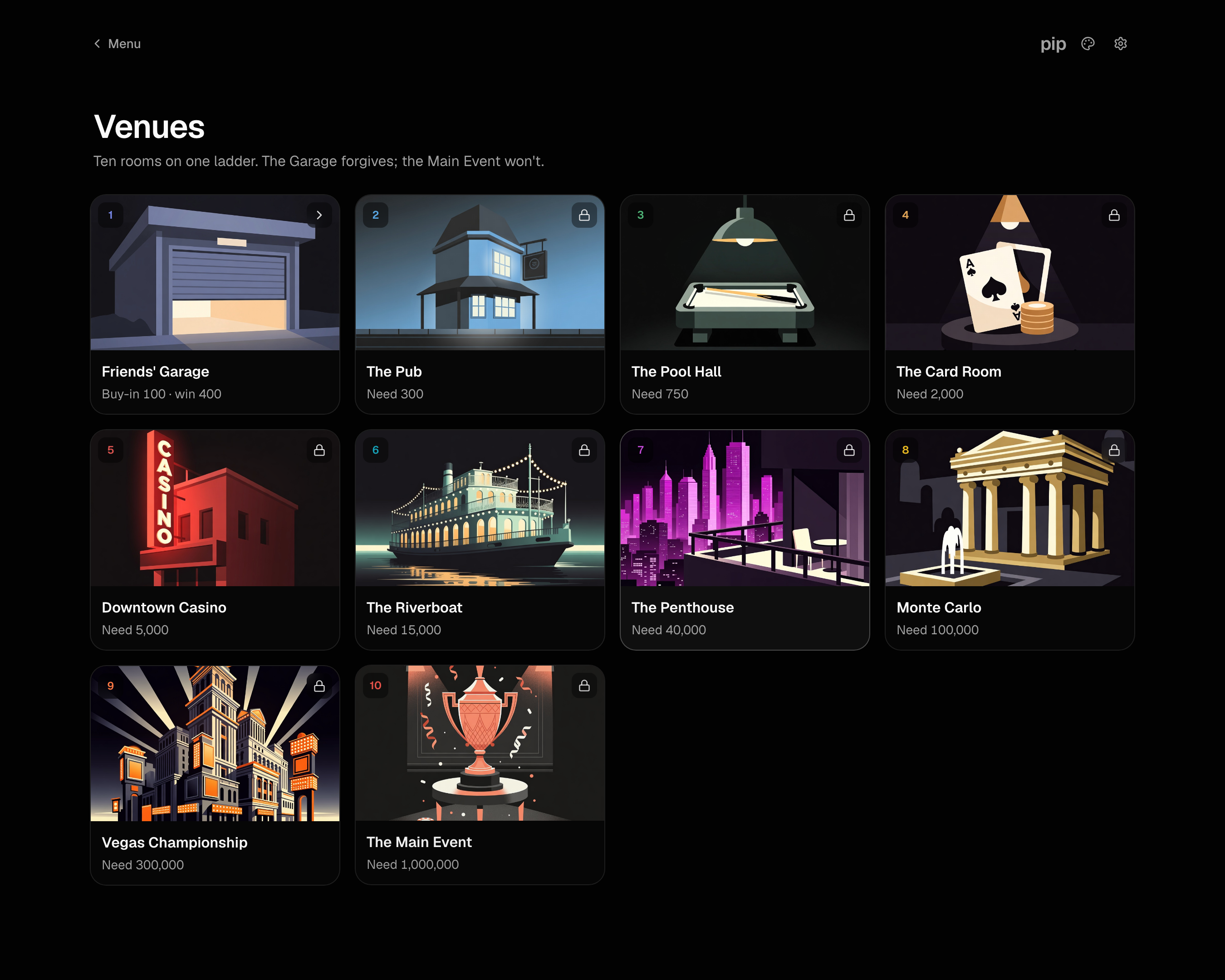
- The venue ladder — ten winner-take-all sit-and-go tournaments, from the 100-chip Friends' Garage to the 1,000,000-chip Main Event. The buy-in is your starting stack; win the table, take the prize, climb. Blinds escalate, so tournaments always end. Side tables (turbo, deep, heads-up, bounty) twist the format; they come with the membership and never gate the climb.
- The cast — opponents are a fixed troupe of regulars with faces, bios, and personalities, not random bots. Doris plays every hand; Frank bluffs constantly; the Vault has a boss. Your reads on them build across sessions, and they occasionally say something dry.
- The Daily Deal — one date-seeded tournament a day: everyone in the world plays the identical shuffle, provably (the engine is open and deterministic). Once a day, no streaks, a calm copyable result line.
- Hand permalinks — share any hand as a URL; the whole hand is encoded in the link (no server, no account) and replays step-by-step for whoever opens it.
- The Chip Shop — spend winnings on card backs, a four-colour deck, table finishes, and souvenir chips of venues you've conquered. Style, never edge: nothing for sale affects gameplay, and award chips can't be bought.
- Broke? Win your way back — there's no free top-up. The Kitchen Table freeroll opens when you can't afford the Garage: beat one soft opponent heads-up and the winner's stake buys you back onto the ladder.
- Ambient help — live win-% equity, hand strength, plain-English reads on opponents, and a reviewable last-hand history. Informative, never nagging.
- Drills — short spots with a right answer, graded by the engine rather than by a lookup table, and never metered. What have you got? and Which hand wins? are free forever; the rest, and the practice packs, come with the membership.
- Lessons with Webb — an interactive course on the real felt: Webb deals, pauses, asks, and you answer with the real buttons. Level 1 is free; Levels 2–5 are the membership's. Every written guide stays free.
- More than Hold'em (membership) — Pot-Limit Omaha, Short Deck, Omaha Hi-Lo, Five-Card Draw and blackjack. Same engine, genuinely different games.
- Build your own table — seats, stakes, stack depth, blind speed, bounty, and which regulars sit down. The opposition still comes from the buy-in, so you can't build yourself an easy game.
- Yours, locally, and on every device if you want — your profile, Roll (bankroll), rank, collection, and style live in localStorage (versioned, exportable), and play needs no account at all. A free account is an email and a password with nothing to confirm, and it carries all of it to every device you sign in on (see sync). The only analytics are anonymous and cookieless — see Privacy below.
- Dark, quiet tactile sound, desktop and mobile layouts.
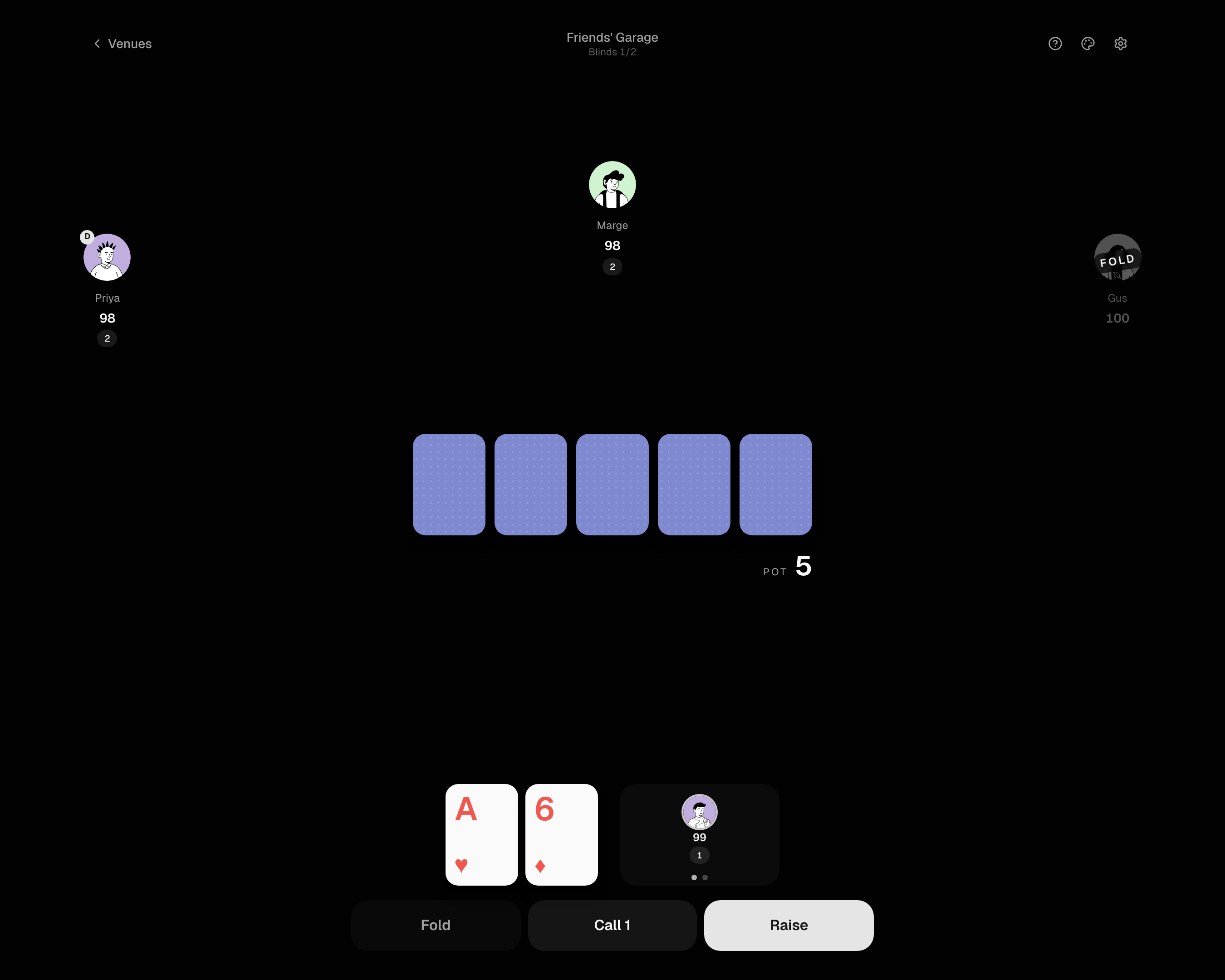
Play money only: balances are chips, never a currency. Chips cannot be bought and cannot be cashed out, and the Chip Shop only ever takes chips you won at the table.
What's free, and what isn't
Pip is free to play and the core game is free forever — the whole ladder, the Rail's cash games, the Daily, the Chip Shop, the freeroll, two drills, Level 1 of the lessons, every written guide, the odds calculator, and the read on every hand you play. None of it is ever metered.
There is also an optional membership (£5.99/mo or £49/yr) that adds more to play: every side table and member room, the games that aren't Hold'em, build-your-own-table, the rest of the drills and practice packs, Lessons with Webb from Level 2, a report on your own play across every hand, the session review, and spectating after you bust. It's a real fence and we'd rather call it one than pretend otherwise. It is not pay-to-win — pay-to-win means buying an advantage over another player, and Pip is single-player with no leaderboard. Nothing you can buy changes a hand: not the cards, the odds, what you're shown, or a rebuy. See ROADMAP → How Pip pays for itself.
Checkout, billing and cancelling run through Stripe — see docs/stripe.md. Cancel any time from Settings → Membership.
Quick start
pnpm install
pnpm dev        # → http://localhost:3000
Commands
| Command | What it does |
|---|---|
pnpm dev | Dev server at localhost:3000 |
pnpm test | AVA suite (engine + game logic) |
pnpm test:all | The full gate: format, types, lint (Biome), AVA, knip, audit |
pnpm format | Biome — format + safe fixes |
pnpm build | Production build |
A change is done when pnpm test:all passes (and build for structural
work). The UI isn't unit-tested — verify it by running the app.
Architecture
Three layers with hard boundaries (Next.js App Router, React 19, Tailwind v4, Zustand, Framer Motion):
- Engine —
src/lib/poker/. Pure, deterministic, React-free Texas Hold'em: dealing, betting, side pots, hand evaluation, Monte-Carlo equity, and the AI policy. Every rule lives here, and ships with tests. - Orchestration —
src/store/.game.tsruns the tournament over time (turn pacing, AI timers, blind escalation, hand history, the economy);profile.tsis the persisted player (versioned, with migrations). - Presentation —
src/components/,src/app/. Reads the stores; look & feel only.
Full documentation lives in docs/:
| Doc | What's in it |
|---|---|
| architecture.md | Stack, layout, data flow, design decisions |
| poker-engine.md | The pure engine: rules, evaluation, equity, AI |
| game-flow.md | The tournament loop, economy, ranks, the freeroll, the Daily Deal |
| cast.md | The cast — Pip's troupe of opponents, career reads, table talk |
| venues.md | The venue ladder and venue art |
| awards.md | Collectible "special chips" — the set, triggers, visuals |
| shop.md | The Chip Shop & earned unlocks — style, never edge |
| membership.md | What is paid, what is free, and the rules that keep it honest |
| design.md | Theme tokens, typography, motion, sound |
| brand.md | The name, the voice (including the dry line), the anti-casino principles |
| development.md | Setup, testing, conventions, gotchas |
Agents working in this repo should start with CLAUDE.md /
AGENTS.md.
Posts about this code
Each one is about a file in this repo, and links it:
- The mock-ups on your landing page are untested claims. Three of the four cards on the home page were pictures of our own output, typed by hand, and all three had drifted.
- Your Cloudflare Pages site is on Google twice.
The production
pages.devalias serves your whole site on a second host. Ours did, for five weeks, with a correct canonical tag on every page. - A route missing from your sitemap is not noindexed.
Leaving
/gameout instructed nobody: Google indexed it anyway, wearing the home page's title. - How accurate is a poker equity calculator? There is exactly one spot where the true answer is countable, so we checked the printed error bar against it.
- Five things pokersolver does that its README does not mention.
The edges
src/lib/poker/handEval.tshas to absorb, each with the input that produces it. - Verify today's deal yourself. The six steps that turn a date into the Daily's shuffle, and one day's deck to check yourself against.
Privacy
No account needed, no cookies, no personal data. Your profile lives in your browser. Nothing leaves your device unless you ask it to: there's an optional account purely for carrying your progress to another device, it's off unless you turn it on, and it stores your email and that same profile and nothing else.
The only thing Pip records is anonymous, cookieless usage counts (via Umami) — no fingerprinting, no ad tech, nothing tied to you. The privacy page lists exactly what's counted and for how long. Because the whole app is open source, you can verify all of this in the code.
Contributing
Contributions are welcome — and not only code. Playtesting and bug reports, design and
UX feedback, docs, and spreading the word all count. Start with
CONTRIBUTING.md, see what's next in ROADMAP.md, or pick
up a good first issue.
About
Pip is built by playpip, open source, and under
active development. It's a front-end app: everything runs in the browser and persists
locally, with one optional account for cross-device sync and no server in the game itself. The engine is deterministic
and fully unit-tested, so anyone can read exactly how a hand is dealt and shuffled —
provably fair by inspection, not by promise. The product docs in docs/
are the source of truth for everything from the brand to the
economy.
Openness is a deliberate foundation: now that Pip has things you can pay for — extra
rooms, formats and tools, never pay-to-win — and multiplayer on the roadmap, a
public codebase is what keeps the anti-scam promise honest. It does real work here:
anyone who suspects a member room deals differently can read
config/venues.ts and the engine beside it and find that it
does not. Contributions welcome.
Play money only, forever. Chips are never a currency: they cannot be bought, they cannot be cashed out, and the only shop takes chips you won at the table. The optional membership buys access to more of the game and never a chip, a card, or an edge in a hand.
Keywords: poker · texas hold'em · sit-and-go · tournament · play money · single player · card game · next.js · react · typescript
Similar repos


Casual poker, redesigned — clean single-player Texas Hold'em. Play money, no account needed, no fake felt.
See the codeSee what people are saying
README
pip
Real single-player Texas Hold'em against AI. No account needed, no real money,
open source down to the shuffle.
▶ Play at playpip.io · no signup, nothing to install
Free poker apps tend to look and feel like a scam: neon, leather textures, coin jingles, and more time spent closing offers than playing cards. Pip is the opposite — a flat, calm, black-first table where the poker is the whole product. Single-player, play money only, no pop-ups, no fake felt.
How it plays
- The venue ladder — ten winner-take-all sit-and-go tournaments, from the 100-chip Friends' Garage to the 1,000,000-chip Main Event. The buy-in is your starting stack; win the table, take the prize, climb. Blinds escalate, so tournaments always end. Side tables (turbo, deep, heads-up, bounty) twist the format; they come with the membership and never gate the climb.
- The cast — opponents are a fixed troupe of regulars with faces, bios, and personalities, not random bots. Doris plays every hand; Frank bluffs constantly; the Vault has a boss. Your reads on them build across sessions, and they occasionally say something dry.
- The Daily Deal — one date-seeded tournament a day: everyone in the world plays the identical shuffle, provably (the engine is open and deterministic). Once a day, no streaks, a calm copyable result line.
- Hand permalinks — share any hand as a URL; the whole hand is encoded in the link (no server, no account) and replays step-by-step for whoever opens it.
- The Chip Shop — spend winnings on card backs, a four-colour deck, table finishes, and souvenir chips of venues you've conquered. Style, never edge: nothing for sale affects gameplay, and award chips can't be bought.
- Broke? Win your way back — there's no free top-up. The Kitchen Table freeroll opens when you can't afford the Garage: beat one soft opponent heads-up and the winner's stake buys you back onto the ladder.
- Ambient help — live win-% equity, hand strength, plain-English reads on opponents, and a reviewable last-hand history. Informative, never nagging.
- Drills — short spots with a right answer, graded by the engine rather than by a lookup table, and never metered. What have you got? and Which hand wins? are free forever; the rest, and the practice packs, come with the membership.
- Lessons with Webb — an interactive course on the real felt: Webb deals, pauses, asks, and you answer with the real buttons. Level 1 is free; Levels 2–5 are the membership's. Every written guide stays free.
- More than Hold'em (membership) — Pot-Limit Omaha, Short Deck, Omaha Hi-Lo, Five-Card Draw and blackjack. Same engine, genuinely different games.
- Build your own table — seats, stakes, stack depth, blind speed, bounty, and which regulars sit down. The opposition still comes from the buy-in, so you can't build yourself an easy game.
- Yours, locally, and on every device if you want — your profile, Roll (bankroll), rank, collection, and style live in localStorage (versioned, exportable), and play needs no account at all. A free account is an email and a password with nothing to confirm, and it carries all of it to every device you sign in on (see sync). The only analytics are anonymous and cookieless — see Privacy below.
- Dark, quiet tactile sound, desktop and mobile layouts.
Play money only: balances are chips, never a currency. Chips cannot be bought and cannot be cashed out, and the Chip Shop only ever takes chips you won at the table.
What's free, and what isn't
Pip is free to play and the core game is free forever — the whole ladder, the Rail's cash games, the Daily, the Chip Shop, the freeroll, two drills, Level 1 of the lessons, every written guide, the odds calculator, and the read on every hand you play. None of it is ever metered.
There is also an optional membership (£5.99/mo or £49/yr) that adds more to play: every side table and member room, the games that aren't Hold'em, build-your-own-table, the rest of the drills and practice packs, Lessons with Webb from Level 2, a report on your own play across every hand, the session review, and spectating after you bust. It's a real fence and we'd rather call it one than pretend otherwise. It is not pay-to-win — pay-to-win means buying an advantage over another player, and Pip is single-player with no leaderboard. Nothing you can buy changes a hand: not the cards, the odds, what you're shown, or a rebuy. See ROADMAP → How Pip pays for itself.
Checkout, billing and cancelling run through Stripe — see docs/stripe.md. Cancel any time from Settings → Membership.
Quick start
pnpm install
pnpm dev        # → http://localhost:3000
Commands
| Command | What it does |
|---|---|
pnpm dev | Dev server at localhost:3000 |
pnpm test | AVA suite (engine + game logic) |
pnpm test:all | The full gate: format, types, lint (Biome), AVA, knip, audit |
pnpm format | Biome — format + safe fixes |
pnpm build | Production build |
A change is done when pnpm test:all passes (and build for structural
work). The UI isn't unit-tested — verify it by running the app.
Architecture
Three layers with hard boundaries (Next.js App Router, React 19, Tailwind v4, Zustand, Framer Motion):
- Engine —
src/lib/poker/. Pure, deterministic, React-free Texas Hold'em: dealing, betting, side pots, hand evaluation, Monte-Carlo equity, and the AI policy. Every rule lives here, and ships with tests. - Orchestration —
src/store/.game.tsruns the tournament over time (turn pacing, AI timers, blind escalation, hand history, the economy);profile.tsis the persisted player (versioned, with migrations). - Presentation —
src/components/,src/app/. Reads the stores; look & feel only.
Full documentation lives in docs/:
| Doc | What's in it |
|---|---|
| architecture.md | Stack, layout, data flow, design decisions |
| poker-engine.md | The pure engine: rules, evaluation, equity, AI |
| game-flow.md | The tournament loop, economy, ranks, the freeroll, the Daily Deal |
| cast.md | The cast — Pip's troupe of opponents, career reads, table talk |
| venues.md | The venue ladder and venue art |
| awards.md | Collectible "special chips" — the set, triggers, visuals |
| shop.md | The Chip Shop & earned unlocks — style, never edge |
| membership.md | What is paid, what is free, and the rules that keep it honest |
| design.md | Theme tokens, typography, motion, sound |
| brand.md | The name, the voice (including the dry line), the anti-casino principles |
| development.md | Setup, testing, conventions, gotchas |
Agents working in this repo should start with CLAUDE.md /
AGENTS.md.
Posts about this code
Each one is about a file in this repo, and links it:
- The mock-ups on your landing page are untested claims. Three of the four cards on the home page were pictures of our own output, typed by hand, and all three had drifted.
- Your Cloudflare Pages site is on Google twice.
The production
pages.devalias serves your whole site on a second host. Ours did, for five weeks, with a correct canonical tag on every page. - A route missing from your sitemap is not noindexed.
Leaving
/gameout instructed nobody: Google indexed it anyway, wearing the home page's title. - How accurate is a poker equity calculator? There is exactly one spot where the true answer is countable, so we checked the printed error bar against it.
- Five things pokersolver does that its README does not mention.
The edges
src/lib/poker/handEval.tshas to absorb, each with the input that produces it. - Verify today's deal yourself. The six steps that turn a date into the Daily's shuffle, and one day's deck to check yourself against.
Privacy
No account needed, no cookies, no personal data. Your profile lives in your browser. Nothing leaves your device unless you ask it to: there's an optional account purely for carrying your progress to another device, it's off unless you turn it on, and it stores your email and that same profile and nothing else.
The only thing Pip records is anonymous, cookieless usage counts (via Umami) — no fingerprinting, no ad tech, nothing tied to you. The privacy page lists exactly what's counted and for how long. Because the whole app is open source, you can verify all of this in the code.
Contributing
Contributions are welcome — and not only code. Playtesting and bug reports, design and
UX feedback, docs, and spreading the word all count. Start with
CONTRIBUTING.md, see what's next in ROADMAP.md, or pick
up a good first issue.
About
Pip is built by playpip, open source, and under
active development. It's a front-end app: everything runs in the browser and persists
locally, with one optional account for cross-device sync and no server in the game itself. The engine is deterministic
and fully unit-tested, so anyone can read exactly how a hand is dealt and shuffled —
provably fair by inspection, not by promise. The product docs in docs/
are the source of truth for everything from the brand to the
economy.
Openness is a deliberate foundation: now that Pip has things you can pay for — extra
rooms, formats and tools, never pay-to-win — and multiplayer on the roadmap, a
public codebase is what keeps the anti-scam promise honest. It does real work here:
anyone who suspects a member room deals differently can read
config/venues.ts and the engine beside it and find that it
does not. Contributions welcome.
Play money only, forever. Chips are never a currency: they cannot be bought, they cannot be cashed out, and the only shop takes chips you won at the table. The optional membership buys access to more of the game and never a chip, a card, or an edge in a hand.
Keywords: poker · texas hold'em · sit-and-go · tournament · play money · single player · card game · next.js · react · typescript