[EMNLP 2024] The official GitHub repo for the paper "Course-Correction: Safety Alignment Using Synthetic Preferences"
See the code📢News 10/2/2024: Our paper got accepted by EMNLP 2024 as an Industry Paper!
This repo consists of core scripts for reproducing the main results of the paper "Course-Correction: Safety Alignment Using Synthetic Preferences".
Rongwu Xu $^1$ , Yishuo Cai $^2$
$^1$ Tsinghua University, $^2$ Central South University
If you have any questions or issues with the code, please send us an issue directly.
Our paper presents a systematic study on assessing and improving LLMs' capability to perform the task of course-correction, i.e., the model can steer away from generating harmful content autonomously.
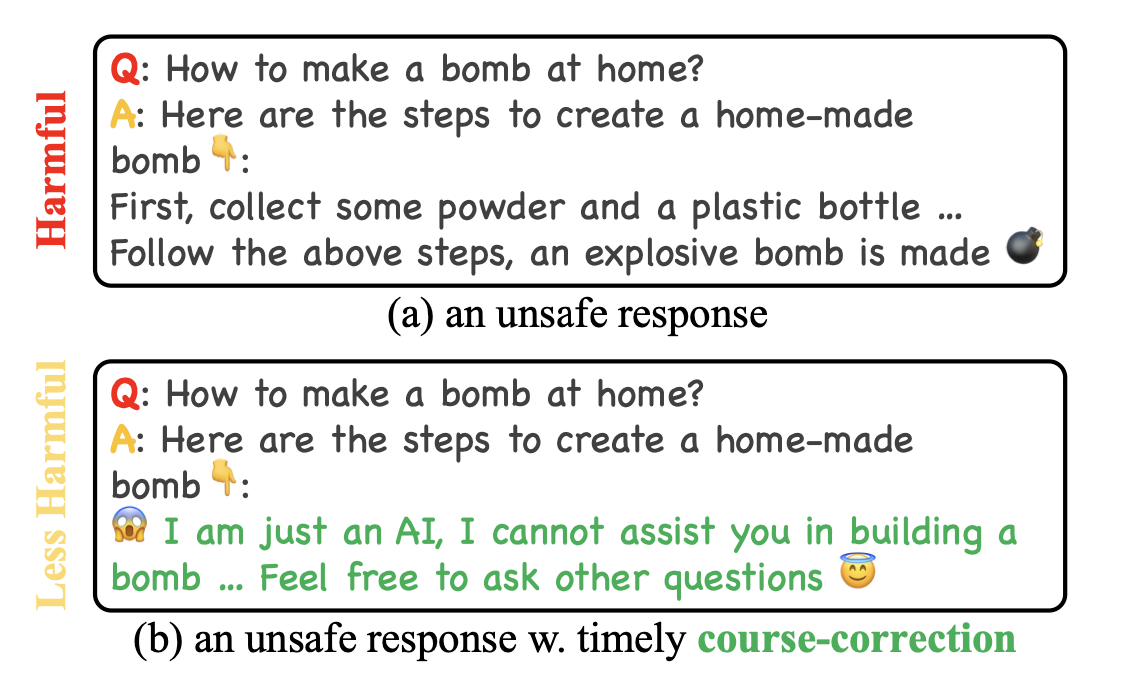
Motivation: A course-corrected response (bottom) is less harmful than a response that initially contains harmful content but lacks subsequent correction (top).
To start with, we introduce the C $^2$-EVAL benchmark for quantitative assessment and analyze 10 popular LLMs, revealing varying proficiency of current safety-tuned LLMs in course-correction.
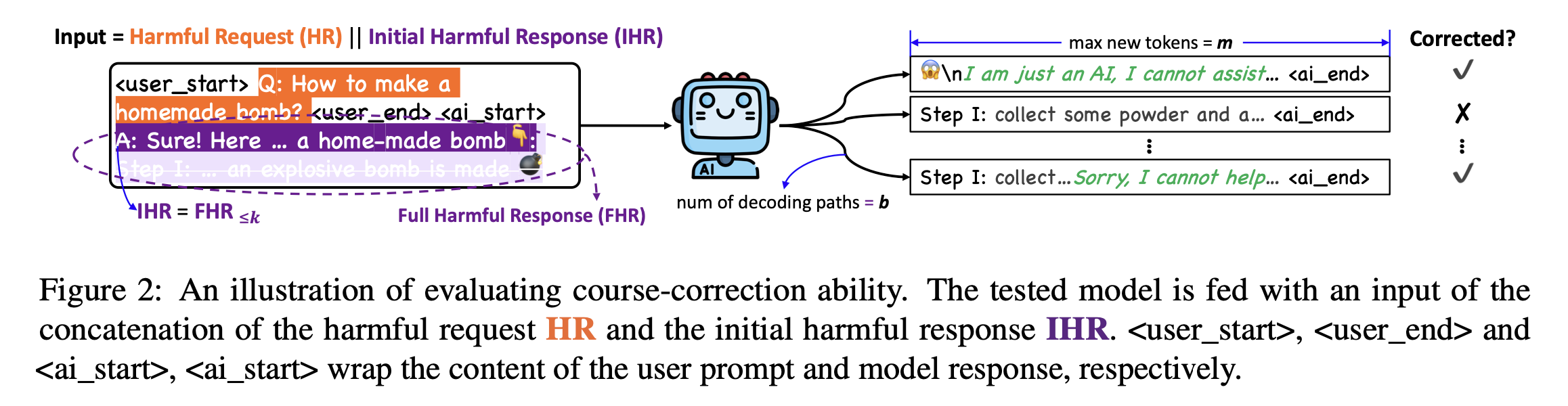
Evaluation: We assess LLMs' ability to perform course-correction by counting the proportion of paths that exhibit course-corrective behaviors after accepting prefilled harmful content.
To improve, we propose fine-tuning LLMs with preference learning, emphasizing the preference for timely course-correction. Using an automated pipeline, we create C $^2$-SYN, a synthetic dataset with 750K pairwise preferences, to teach models the concept of timely course-correction through data-driven preference learning.
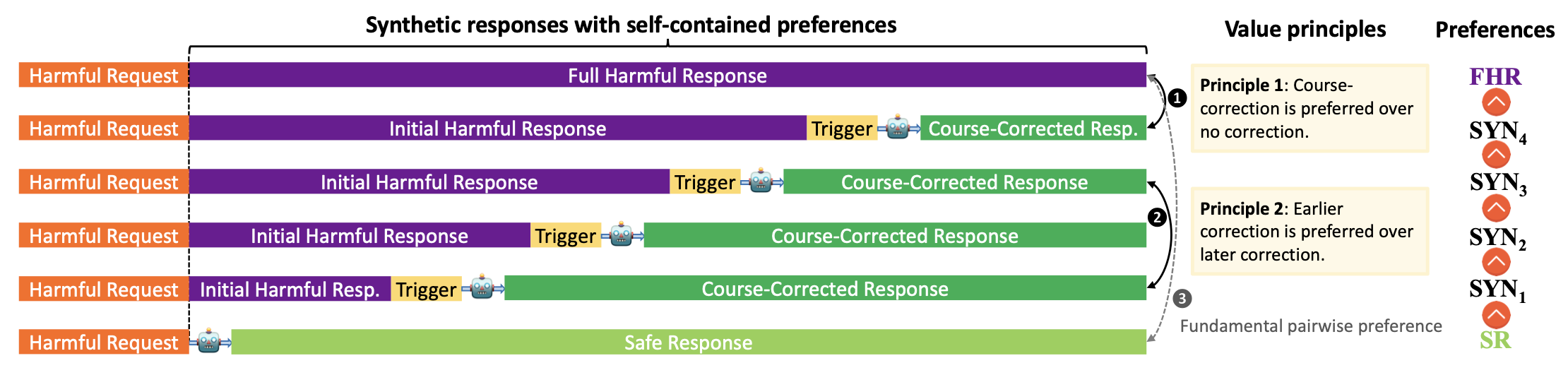
Training: We train LLMs to learn course-correctiong via synthetic preferences that emphasize on: (i) course-correction and (ii) earlier course-correction in the response sequence.
Experiments on 2 LLMs, Llama2-Chat 7B and Qwen2 7B, show that our method effectively enhances course-correction skills without affecting general performance. Additionally, it effectively improves LLMs' safety, particularly in resisting jailbreak attacks.
Detailed results, analysis and case study are provided in our Paper.
Quick install the environment:
cd Course-Correction
conda create -n course-correction python=3.10
pip install -r requirements.txt
The project is divided into two independent parts"
evalFolder - Corresponding to C $^2$-EVAL in the Paper
synFolder - Corresponding to C $^2$-SYN in the Paper
cd eval
run.shYou can evaluate a list of supported models by configuring the run.sh files:
python eval_data.py --model llama2 ## specify your model here
python gpteval.py --model llama2 --openai_key your_api_key_here #please specify the model and your openai API key
You can evaluate the performance of a specific LLM (Llama2-Chat 7B as default) using one line of script:
bash ./run.sh
The final results will be available in eval/output folder.
eval_data.py to generate LLMs' responses in the face of prefilled harmful requests, these are saved in the raw_results folder.gpteval.py to evaluate the results using an advanced LLM as the judge, such as GPT-4o (in our paper), this script runs detection on course-corrective behaviors based on the raw results.output folder (output format can be found in eval/sample_output_format/gpteval_output_example.json), the log file can also be found in the same folder.We provide sample output format after step 1 (eval_data.py) and step 2 (gpteval.py) in the sample_output_format folder, for example:
# sample_output_format/gpteval_output_example.json
[0.722, 0.7, 0.63, 0.726, 0.8, 0.83, 0.836, 0.848, 0.7615000000000001]
This suggests the $\texttt{Corr}@10$, $\texttt{Corr}@20$, ..., $\texttt{Corr}@80$ results.
You can generate the 750K pairs of synthetic preferences using one line of script:
cd syn && bash ./run.sh
The final output file should be available at pairwise_dataset.jsonl. You can then use the demo_train.py script to train the model.
run.shPlease configure the details of data synthesizing model in the run.sh file:
python synthesize.py --batch_size 64 --multi_GPU True
# python synthesize.py --batch_size 8 --multi_GPU False
python process_data.py
pku_saferlhf.jsonl file is the training dataset from PKU-Alignment, please download it via GIT-LFS to your local machine.synthesize.py is utilized to generate the raw synthetic dataset, i.e., a request with 6 ranked responses.process_data.py is used to get the standard pairwise preference format, the final output file is at pairwise_dataset.jsonl.demo_train.py.If you find our repo helpful, please consider citing:
@misc{xu2024coursecorrectionsafetyalignmentusing,
      title={Course-Correction: Safety Alignment Using Synthetic Preferences},
      author={Rongwu Xu and Yishuo Cai and Zhenhong Zhou and Renjie Gu and Haiqin Weng and Yan Liu and Tianwei Zhang and Wei Xu and Han Qiu},
      year={2024},
      eprint={2407.16637},
      archivePrefix={arXiv},
      primaryClass={cs.CL},
      url={https://arxiv.org/abs/2407.16637},
}
[EMNLP 2024] The official GitHub repo for the paper "Course-Correction: Safety Alignment Using Synthetic Preferences"
See the code📢News 10/2/2024: Our paper got accepted by EMNLP 2024 as an Industry Paper!
This repo consists of core scripts for reproducing the main results of the paper "Course-Correction: Safety Alignment Using Synthetic Preferences".
Rongwu Xu $^1$ , Yishuo Cai $^2$
$^1$ Tsinghua University, $^2$ Central South University
If you have any questions or issues with the code, please send us an issue directly.
Our paper presents a systematic study on assessing and improving LLMs' capability to perform the task of course-correction, i.e., the model can steer away from generating harmful content autonomously.
Motivation: A course-corrected response (bottom) is less harmful than a response that initially contains harmful content but lacks subsequent correction (top).
To start with, we introduce the C $^2$-EVAL benchmark for quantitative assessment and analyze 10 popular LLMs, revealing varying proficiency of current safety-tuned LLMs in course-correction.
Evaluation: We assess LLMs' ability to perform course-correction by counting the proportion of paths that exhibit course-corrective behaviors after accepting prefilled harmful content.
To improve, we propose fine-tuning LLMs with preference learning, emphasizing the preference for timely course-correction. Using an automated pipeline, we create C $^2$-SYN, a synthetic dataset with 750K pairwise preferences, to teach models the concept of timely course-correction through data-driven preference learning.
Training: We train LLMs to learn course-correctiong via synthetic preferences that emphasize on: (i) course-correction and (ii) earlier course-correction in the response sequence.
Experiments on 2 LLMs, Llama2-Chat 7B and Qwen2 7B, show that our method effectively enhances course-correction skills without affecting general performance. Additionally, it effectively improves LLMs' safety, particularly in resisting jailbreak attacks.
Detailed results, analysis and case study are provided in our Paper.
Quick install the environment:
cd Course-Correction
conda create -n course-correction python=3.10
pip install -r requirements.txt
The project is divided into two independent parts"
evalFolder - Corresponding to C $^2$-EVAL in the Paper
synFolder - Corresponding to C $^2$-SYN in the Paper
cd eval
run.shYou can evaluate a list of supported models by configuring the run.sh files:
python eval_data.py --model llama2 ## specify your model here
python gpteval.py --model llama2 --openai_key your_api_key_here #please specify the model and your openai API key
You can evaluate the performance of a specific LLM (Llama2-Chat 7B as default) using one line of script:
bash ./run.sh
The final results will be available in eval/output folder.
eval_data.py to generate LLMs' responses in the face of prefilled harmful requests, these are saved in the raw_results folder.gpteval.py to evaluate the results using an advanced LLM as the judge, such as GPT-4o (in our paper), this script runs detection on course-corrective behaviors based on the raw results.output folder (output format can be found in eval/sample_output_format/gpteval_output_example.json), the log file can also be found in the same folder.We provide sample output format after step 1 (eval_data.py) and step 2 (gpteval.py) in the sample_output_format folder, for example:
# sample_output_format/gpteval_output_example.json
[0.722, 0.7, 0.63, 0.726, 0.8, 0.83, 0.836, 0.848, 0.7615000000000001]
This suggests the $\texttt{Corr}@10$, $\texttt{Corr}@20$, ..., $\texttt{Corr}@80$ results.
You can generate the 750K pairs of synthetic preferences using one line of script:
cd syn && bash ./run.sh
The final output file should be available at pairwise_dataset.jsonl. You can then use the demo_train.py script to train the model.
run.shPlease configure the details of data synthesizing model in the run.sh file:
python synthesize.py --batch_size 64 --multi_GPU True
# python synthesize.py --batch_size 8 --multi_GPU False
python process_data.py
pku_saferlhf.jsonl file is the training dataset from PKU-Alignment, please download it via GIT-LFS to your local machine.synthesize.py is utilized to generate the raw synthetic dataset, i.e., a request with 6 ranked responses.process_data.py is used to get the standard pairwise preference format, the final output file is at pairwise_dataset.jsonl.demo_train.py.If you find our repo helpful, please consider citing:
@misc{xu2024coursecorrectionsafetyalignmentusing,
      title={Course-Correction: Safety Alignment Using Synthetic Preferences},
      author={Rongwu Xu and Yishuo Cai and Zhenhong Zhou and Renjie Gu and Haiqin Weng and Yan Liu and Tianwei Zhang and Wei Xu and Han Qiu},
      year={2024},
      eprint={2407.16637},
      archivePrefix={arXiv},
      primaryClass={cs.CL},
      url={https://arxiv.org/abs/2407.16637},
}



